
Market Overview:
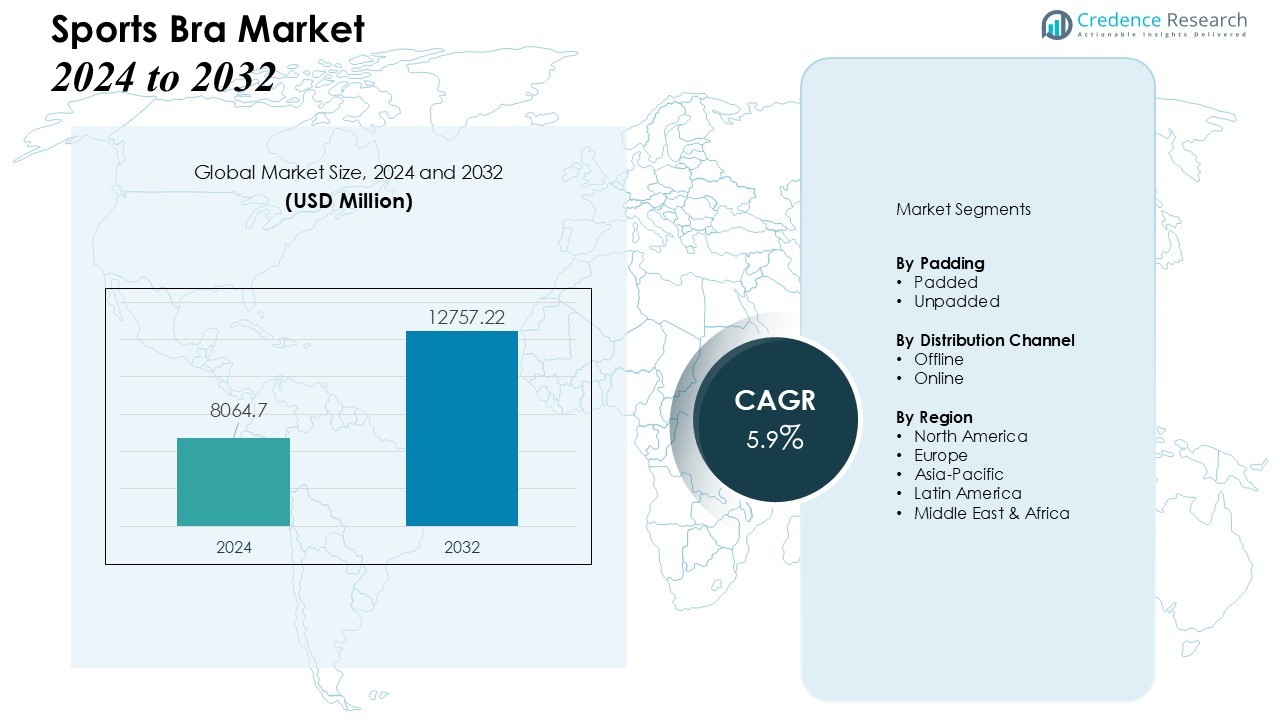
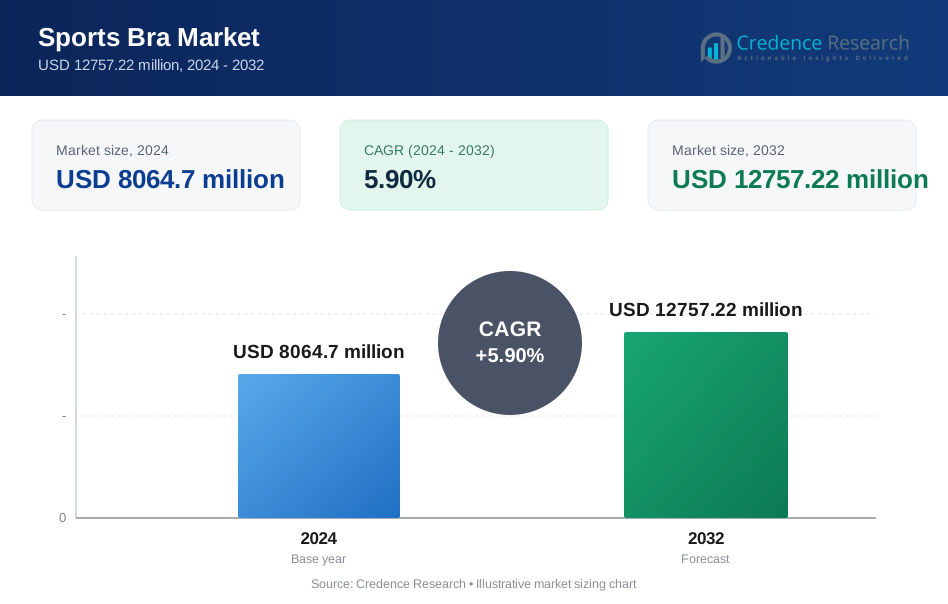
The Sports Bra Market size was valued at USD 8064.7 million in 2024 and is anticipated to reach USD 12757.22 million by 2032, at a CAGR of 5.9% during the forecast period (2024-2032).
| REPORT ATTRIBUTE | DETAILS |
|---|---|
| Historical Period | 2020-2023 |
| Base Year | 2024 |
| Forecast Period | 2025-2032 |
| Sports Bra Market Size 2024 | USD 8064.7 Million |
| Sports Bra Market, CAGR | 5.9% |
| Sports Bra Market Size 2032 | USD 12757.22 Million |
Rising female participation in sports, fitness activities, and wellness regimes remains a core growth driver. The increasing global shift toward healthier lifestyles and fitness culture fuels demand. Simultaneously, the proliferation of the “athleisure” trend—wearing activewear for casual as well as athletic use—is expanding the “sports bra” from a functional garment into a daily‑wear fashion and comfort item. Broadening of size ranges, improved comfort features, and better-fit options have also attracted a more inclusive customer base, driving further adoption.
From a regional perspective, the market shows pronounced geographic variation. The Asia‑Pacific region emerged as a dominant region in 2023, capturing a significant share, largely due to expanding fitness awareness, rising women’s workforce participation, and growing online retail penetration. Meanwhile, North America continues to lead in per‑capita consumption and market maturity, driven by strong athleisure adoption and advanced retail infrastructure. These regional dynamics underscore the market’s dual nature—booming in emerging economies while sustaining steady growth in established ones.
Market Insights:
- The Sports Bra Market was valued at USD 8064.7 million in 2024 and is projected to reach USD 12757.22 million by 2032, growing at a CAGR of 5.9%. Rising female participation in sports, fitness routines, and wellness activities drives steady demand, supported by global focus on healthier lifestyles.
- Adoption of athleisure and dual-purpose wear expands the market beyond workouts. Consumers increasingly wear sports bras for daily comfort and style, transforming them from functional athletic garments into lifestyle apparel and broadening the customer base.
- Innovations in fabrics and design enhance appeal and functionality. Features like moisture-wicking, seamless construction, ergonomic compression, and inclusive sizing improve comfort, fit, and performance, encouraging adoption across diverse body types.
- Inclusive sizing and greater accessibility strengthen market penetration. Extended size ranges and designs for varied body types, coupled with the growth of e-commerce and direct-to-consumer channels, allow brands to reach previously underserved demographics globally.
- Regional dynamics shape growth opportunities. North America leads with 41% share due to a mature fitness culture and strong retail infrastructure, Europe holds 28% with emphasis on style and sustainability, and Asia-Pacific accounts for 23%, driven by urbanization, rising female workforce participation, and expanding fitness awareness.
 Market Drivers:
Rising Women’s Fitness Participation Fuels Demand
Growing adoption of fitness routines and active lifestyles worldwide is a fundamental driver for the Sports Bra Market. More women now engage regularly in gym workouts, yoga, aerobic exercises, and other physical activities — creating a steady demand for supportive activewear. Sports bras deliver essential support and comfort during movement. Women increasingly prioritize health and wellness, driving sales of sports bras upward.
- For instance, Adidas integrated RHEON™ polymer strips in its Techfit Control Bra, which stiffen dynamically to provide support only during movement, reducing bulk by adapting in real time.
Shift Toward Athleisure and Everyday Wear
The line between athletic wear and casual wear continues to blur. Many consumers now choose sports bras not only for workouts but also for everyday comfort and style. This shift transforms sports bras from purely functional garments into lifestyle apparel. The dual-use appeal broadens the consumer base beyond fitness enthusiasts to daily-wear users, boosting overall market demand.
- For instance, Adidas noted that its women’s bras and tights business delivered double‑digit growth in a recent reporting period, driven by capsule collections that pair sports bras with track pants and lifestyle sneakers, explicitly targeting “all‑day comfort” and blurring lines between performance and casual wear.
Innovation in Fabric and Fit Enhances Market Appeal
Advances in textile technology intensify the attractiveness of sports bras. Manufacturers increasingly use moisture‑wicking, breathable fabrics, seamless construction and ergonomic compression to enhance comfort, reduce chafing, and improve performance. Such innovations make sports bras more functional, comfortable, and desirable. Improved sizing options and inclusive fit further encourage adoption across diverse body types, expanding the potential customer base.
Inclusive Sizing and Broader Accessibility Expand Consumer Base
Brands respond to evolving consumer expectations by offering extended size ranges and designs for varied body types. This inclusivity attracts women who might have been underserved earlier, increasing the total addressable market. Growth of online retail and direct-to-consumer channels improves accessibility even in regions where dedicated activewear shops remain sparse. Through broader reach and inclusive fit, the market penetrates new demographics globally.
Market Trends:
Growing Demand Driven by Fitness Culture, Athleisure and Inclusivity
The global drive toward healthier lifestyles has significantly lifted demand for supportive athletic apparel, making the Sports Bra Market a vital segment in women’s activewear. Studies show expansion in female participation across fitness, running, yoga and gym-based training worldwide — this surge raises demand for bras that provide reliable support during motion. Brands respond by offering broader size ranges and comfortable fits, attracting women of varied body types and thereby widening the consumer base. Growth also stems from athleisure: more women now wear sports bras both for workouts and everyday settings, encouraging manufacturers to design pieces that blend performance, comfort and style.
- For instance, Nike's FlyWeb sports bra uses 3D printing with computational design to optimize material density, reducing moisture retention by 40% compared to traditional multi-layer designs.
Innovation in Design, Materials and Distribution Elevates Market Dynamics
Manufacturers develop advanced sports bras with features like moisture‑wicking fabrics, seamless construction and ergonomic support to meet rising expectations for comfort and performance. Hybrid designs — combining compression and encapsulation — gain traction, satisfying needs from yoga to high‑intensity workouts. Meanwhile, online retail channels expand quickly, granting consumers easier access and enabling personalized shopping, which further boosts market growth. Regional growth concentrates in fast‑developing markets within Asia‑Pacific, where rising fitness awareness and urban lifestyles drive demand upward.
- For instance, Adidas launched its globally available Climacool line, offering 360-degree ventilation that supports comfort for all-day wear in hot conditions.
Market Challenges Analysis:
Growing Demand Driven by Fitness Culture, Athleisure, and Inclusivity
The global emphasis on healthier lifestyles has significantly increased demand for supportive athletic apparel, positioning the Sports Bra Market as a key segment in women’s activewear. Rising female participation in fitness, running, yoga, and gym-based activities worldwide drives the need for bras that deliver reliable support during motion. Brands respond by offering wider size ranges and enhanced comfort, appealing to women of diverse body types and expanding the consumer base. Growth also reflects the rise of athleisure, with more women wearing sports bras for both workouts and everyday activities, prompting manufacturers to design products that merge performance, comfort, and style.
Innovation in Design, Materials, and Distribution Strengthens Market Dynamics
Manufacturers continue to introduce advanced sports bras featuring moisture-wicking fabrics, seamless construction, and ergonomic support to meet growing expectations for comfort and performance. Hybrid designs that combine compression and encapsulation gain popularity, catering to activities ranging from yoga to high-intensity workouts. Online retail channels are expanding rapidly, offering consumers easier access and personalized shopping experiences, further driving market growth. Regional expansion is particularly notable in fast-developing Asia-Pacific markets, where increasing fitness awareness and urban lifestyles fuel rising demand.
Market Opportunities:
Expanding Reach Through Untapped Regions and Diverse Consumer Segments
Growing awareness about fitness and wellness across emerging markets creates a significant opportunity for the Sports Bra Market to reach new customer segments. In many parts of Asia‑Pacific, Latin America, Middle East, and Africa, female fitness participation continues to rise while access to well‑fitting, quality sports bras remains limited. Brands that introduce culturally adapted sizing, modest‑wear friendly options, or affordable mid-range lines stand to capture first‑mover advantage in under-served markets. It also offers scope to serve plus-size, maternity, or post-surgery segments — areas where supply remains scarce and consumer need is growing.
Leveraging Online Channels and Product Innovation for Competitive Edge
Rapid expansion of online retail and direct-to-consumer models gives firms an efficient way to reach wider geographies and diverse demographics. It allows brands to offer customization — whether in size, fit, or support level — and reduces distribution costs, boosting profitability. Rising consumer interest in comfort-oriented features such as moisture‑wicking fabrics, ergonomic design, and sustainable materials presents opportunities to differentiate products. It also enables premium positioning, catering to consumers who value performance, comfort, and style equally.
Market Segmentation Analysis:
By Padding — Padded vs. Unpadded
The unpadded segment accounts for a majority of current global revenue, holding roughly 65% share. It meets demand from consumers who prefer lightweight comfort and a natural fit, especially for low‑ to medium‑impact activities or casual wear. The padded segment shows attractive growth potential, driven by demand from customers seeking enhanced support and cushioning during high‑intensity workouts or for improved shaping under clothes. Padded bras appeal to women who value both performance during exercise and aesthetic appearance, strengthening their relevance in fitness and athleisure contexts.
- For instance, Under Armour's UA Infinity High padded sports bra features molded, PU injected one-piece padding that is engineered for high-impact activities like running, providing significant bounce control.
By Distribution Channel — Offline vs. Online
The offline channel remains dominant, accounting for about 75% of global sports bra revenue, reflecting consumer preference to try on bras for correct fit and support before purchase. Physical stores — specialty stores, sportswear retailers, and department stores — continue to anchor the market, especially for first‑time or fit‑sensitive buyers. The online channel shows a faster growth rate, supported by expanding e‑commerce penetration, wider product variety, and convenience in browsing and purchasing across geographies. Online sales increasingly attract repeat buyers and younger demographics who value convenience and variety, helping brands expand reach beyond traditional retail footprints.
- For instance, leading lingerie manufacturers frequently employ 3D spacer fabrics in full-support padded bras.
Segmentations:
By Padding
- Padded
- Unpadded
By Distribution Channel
- Offline
- Online
By Region
- North America
- U.S.
- Canada
- Mexico
- Europe
- Germany
- France
- U.K.
- Italy
- Spain
- Rest of Europe
- Asia Pacific
- China
- Japan
- India
- South Korea
- South-east Asia
- Rest of Asia Pacific
- Latin America
- Brazil
- Argentina
- Rest of Latin America
- Middle East & Africa
- GCC Countries
- South Africa
- Rest of the Middle East and Africa
Regional Analysis:
North America Leads with Significant Market Share and Mature Demand
North America holds 41% share of the global market in 2025. The Sports Bra Market in this region benefits from a well‑established fitness culture, high disposable incomes, and strong brand loyalty. Consumers demand premium, high‑support sports bras suited to high‑intensity workouts, and they regularly upgrade to newer, performance‑oriented models. Robust retail infrastructure, including wide e‑commerce adoption, ensures consistent availability and convenience. These factors combine to sustain steady demand for advanced sports bras in North America.
Europe Holds Substantial Share, Driven by Balanced Demand and Fashion Consciousness
Europe commands 28% of global demand according to recent data. Demand in key markets — notably the UK, Germany, and France — reflects a mix of fitness participation and athleisure lifestyle preferences. Consumers in Europe often select medium‑support and sustainably produced sports bras that balance performance and fashion. Well‑established retail networks and growing interest in eco‑friendly activewear contribute to stable consumption. The region’s combination of health awareness and style orientation shapes a consistent but selective demand pattern for sports bras.
Asia‑Pacific Emerges as Fast‑Growing Region with Rising Adoption and Demographic Momentum
Asia‑Pacific records 23% of the global market share and represents the fastest-growing regional segment. Urbanization, rising female workforce participation, and growing health and fitness awareness drive demand across markets such as China, India, Japan, and South Korea. Consumers in this region show high sensitivity to price and prefer mid-range sports bras offering medium or light support. Rapid expansion of e‑commerce channels and rising exposure to global fitness trends accelerate adoption, especially among younger women. The region’s evolving socio‑economic dynamics and shifting lifestyle preferences position Asia‑Pacific as a strategic growth engine for sports bra offerings.
Key Player Analysis:
- Adidas AG
- Berkshire Hathaway
- Calvin Klein
- Giorgio Armani S.p.A.
- Hanesbrands Inc.
- Hugo Boss AG
- Jockey International, Inc.
- Mack Weldon
- Nike, Inc.
- Puma SE
Competitive Analysis:
The Sports Bra Market features intense competition among established global brands and emerging niche players. Leading brands such as Nike and Adidas maintain strong positions through extensive distribution networks, brand equity, and consistent investment in performance‑oriented designs. Premium players like Lululemon Athletica differentiate through high-quality fabrics, seamless construction, and lifestyle-focused positioning that appeals to consumers seeking comfort and versatility beyond workouts. Smaller or niche brands compete by offering specialized options such as inclusive sizing, sustainable materials, or budget-friendly pricing, targeting underserved demographics. Competitive pressure drives continuous innovation in materials, fit, and product range, while expanding online and direct-to-consumer sales enables broader reach. It forces all players to refine value propositions and strengthen differentiation strategies to maintain or grow market share in a dynamic and crowded landscape.
Recent Developments:
- In April 2025, Hugo Boss launched the Beckham x BOSS collection, boosting brand momentum amid challenges.
- In February 2025, Nike partnered with Skims to launch NikeSKIMS, a new women's activewear brand with an initial collection debuting that spring and global rollout planned for 2026.
Report Coverage:
The research report offers an in-depth analysis based on Padding, Distribution Channel and Region. It details leading market players, providing an overview of their business, product offerings, investments, revenue streams, and key applications. Additionally, the report includes insights into the competitive environment, SWOT analysis, current market trends, as well as the primary drivers and constraints. Furthermore, it discusses various factors that have driven market expansion in recent years. The report also explores market dynamics, regulatory scenarios, and technological advancements that are shaping the industry. It assesses the impact of external factors and ITALY economic changes on market growth. Lastly, it provides strategic recommendations for new entrants and established companies to navigate the complexities of the market.
Future Outlook:
- Growing health consciousness and fitness participation among women will continue to drive demand for performance-oriented sports bras.
- Expansion of the athleisure trend will encourage consumers to use sports bras for both workouts and daily wear.
- Rising awareness about body positivity and inclusive sizing will push brands to develop broader size ranges and adaptive fits.
- Innovations in fabric technology, such as moisture-wicking, breathable, and sustainable materials, will enhance comfort and performance.
- Online retail growth and direct-to-consumer models will provide easier access and personalized shopping experiences, boosting market penetration.
- Regional growth in Asia-Pacific and Latin America will create new opportunities as urbanization and female workforce participation increase.
- Demand for hybrid designs combining compression and encapsulation will rise, catering to various fitness activities from yoga to high-intensity training.
- Consumers will increasingly seek multifunctional sports bras that offer support, style, and versatility for casual and athletic use.
- Sustainable production practices and eco-friendly materials will gain importance, influencing brand selection and purchasing decisions.
- Strategic partnerships, product collaborations, and digital marketing initiatives will help brands strengthen market presence and connect with younger, fitness-oriented consumers.
Request a Free Sample
Fill in your details and we'll send you a free sample report.
- Sample data tables & charts
- Research methodology
Need a Custom Version of This Report?
Tailor the scope, geography, or segments to your exact requirements.
- Custom geography or segment scope
- Direct access to our analyst team
Frequently Asked Questions
What is the current market size of the Sports Bra Market, and what is its projected growth?
Which factors are driving the growth of the Sports Bra Market?
Which segment of the Sports Bra Market held the largest share in 2024?
Which regions are leading the Sports Bra Market?
Who are the key players in the Sports Bra Market?
Table of Content
Chapter 1. Report Introduction
- 1.1 Report Description & Purpose
- 1.1.1 Report Title & Market Definition
- 1.1.2 Unique Selling Propositions (USP) & Key Differentiators
- 1.1.3 Value Proposition for Stakeholders
- 1.2 Research Objectives
- 1.2.1 Market Sizing Objectives (Volume & Revenue)
- 1.2.2 Segmentation Objectives
- 1.2.3 Competitive Intelligence Objectives
- 1.2.4 Forecast & Scenario Objectives
- 1.3 Report Scope
- 1.3.1 Sports Bra Scope – Types & Subtypes Covered
- 1.3.2 Geographic Scope – Regions & Countries Covered
- 1.3.3 Historical Period, Base Year & Forecast Period (2024; forecast to 2032)
- 1.3.4 Inclusions & Exclusions
- 1.4 HS Code & Classification Framework
- 1.5 Currency, Units & Pricing Basis
- 1.6 Target Stakeholders
- 1.7 Limitations & Assumptions
Chapter 2. Executive Summary
- 2.1 Global Sports Bra Market Snapshot
- 2.1.1 Market Size – Historical (2024) & Forecast (2024-2032) (2024: USD 8064.7 million → 2032: USD 12757.22 million)
- 2.1.2 Volume & Revenue – Global Totals
- 2.1.3 Key Market Highlights – Top Five Facts
- 2.2 Sports Bra Market Segmentation Snapshot
- 2.2.1 Market Split by Region – 2024 vs. 2032
- 2.3 Competitive Snapshot
- 2.3.1 Top 10 Players by Revenue Share – 2024
- 2.3.2 Top 10 Players by Volume Share – 2024
- 2.3.3 Recent Strategic Developments (18-Month Summary)
- 2.4 Key Investment Highlights & Strategic Conclusions
Chapter 3. Sports Bra Market Dynamics & Industry Analysis
- 3.1 Market Overview & Context
- 3.1.1 Sports Bra Market Position in the Broader Automotive Value Chain
- 3.1.2 OEM vs. Replacement Market Dynamics
- 3.1.3 Market Maturity & Development Stage by Region
- 3.2 Sports Bra Market Drivers
- 3.3 Sports Bra Market Restraints & Challenges
- 3.4 Sports Bra Market Opportunities
- 3.5 Porter's Five Forces Analysis
- 3.5.1 Threat of New Entrants
- 3.5.2 Bargaining Power of Suppliers
- 3.5.3 Bargaining Power of Buyers
- 3.5.4 Threat of Substitutes
- 3.5.5 Competitive Rivalry – Intensity Assessment
- 3.6 Sports Bra Value Chain Analysis
- 3.6.1 Upstream – Raw Material/Input Suppliers
- 3.6.1.1 Raw Material/Input 1
- 3.6.1.2 Raw Material/Input 2
- 3.6.1.3 Raw Material/Input 3
- 3.6.2 Midstream – Production/Manufacturing/Service Delivery
- 3.6.2.1 Production/Process Overview
- 3.6.2.2 Key Facility Locations & Capacity by Manufacturer
- 3.6.3 Downstream – Distribution & End Consumer
- 3.6.3.1 Primary Channel – B2B/OEM
- 3.6.3.2 Secondary Channels – Dealer, Retail, Online, Direct
- 3.6.4 Value Chain Profitability Analysis
- 3.6.1 Upstream – Raw Material/Input Suppliers
- 3.7 PESTEL Analysis
- 3.7.1 Political Factors
- 3.7.2 Economic Factors
- 3.7.3 Social Factors
- 3.7.4 Technological Factors
- 3.7.5 Environmental Factors
- 3.7.6 Legal Factors
- 3.8 Sports Bra Supply Chain Analysis
- 3.8.1 Raw Material/Input Supply Risk Assessment
- 3.8.2 Manufacturing Concentration Risk (Geographic Exposure)
- 3.8.3 Trade Disruption Impact Analysis
- 3.9 Regulatory & Policy Landscape
Note: The regulatory and policy landscape section covers regulations based on their applicability to the market, Sports Bra category, geography, and scope of the study. Only regulatory frameworks with a material impact on operations, compliance, trade, sustainability, or market access are analyzed in detail.
Chapter 4. Key Investment Pockets & Opportunity Analysis
- 4.1 Sports Bra Market Attractiveness Analysis
- 4.1.1 By Region – Investment Attractiveness Matrix (Volume × CAGR)
- 4.2 Absolute Revenue Growth Opportunity
- 4.2.1 By Region – Absolute USD Growth Through 2032
- 4.3 Incremental Volume Opportunity
- 4.3.1 By Region – Incremental Volume Through 2032
- 4.3.2 Segment – Incremental Volume
- 4.4 Emerging Submarket Opportunity Deep Dive (Subject to Applicability)
- 4.5 Emerging Market Opportunity Scorecards
- 4.5.1 United States
- 4.5.2 Europe
- 4.5.3 Asia
- 4.5.4 Middle East & Africa
Note: Emerging Market Opportunity Scorecards will be included based on relevance and strategic importance. Regions listed are indicative and may vary depending on data availability and market dynamics.
Chapter 5. Sports Bra Import-Export Analysis & Trade Flows
- 5.1 Global Trade Overview
- 5.1.1 Global Export Value by Country (2024)
- 5.1.2 Global Export Volume by Country (2024)
- 5.1.3 Global Import Value by Country (2024)
- 5.1.4 Global Import Volume by Country (2024)
- 5.1.5 Net Trade Balance by Country (2024)
- 5.2 Export Analysis – Segment
- 5.2.1 Type 1 (HS Code)
- 5.2.2 Type 2 (HS Code)
- 5.2.3 Type 3 (HS Code)
- 5.2.4 Type 4 (HS Code)
- 5.2.5 Type 5 (HS Code)
- 5.3 Import Analysis – Segment
- 5.3.1 Type 1 (HS Code)
- 5.3.2 Type 2 (HS Code)
- 5.3.3 Type 3 (HS Code)
- 5.3.4 Type 4 (HS Code)
- 5.3.5 Type 5 (HS Code)
- 5.4 Average Unit Trade Prices
- 5.4.1 Average Export Price – Segment & Country
- 5.4.2 Average Import Price – Segment & Source Country
- 5.4.3 Price Trends (2024)
- 5.5 Key Trade Route Analysis
- 5.5.1 Trade Route 1
- 5.5.2 Trade Route 2
- 5.5.3 Trade Route 3
- 5.5.4 Trade Route 4
- 5.5.5 Trade Route 5
- 5.6 Trade Policy Impact Assessment
- 5.6.1 US Anti-Dumping & Section 301 Tariffs
- 5.6.2 EU Customs Union Impact
- 5.6.3 Major Free Trade Agreements
- 5.6.4 USMCA Rules of Origin
Note: Trade policy analysis will be included only where relevant to the Sports Bra market.
Chapter 6. Competitive Landscape & Company Benchmarking
- 6.1 Sports Bra Market Concentration & Structure
- 6.1.1 Herfindahl-Hirschman Index (HHI) – vs. 2024
- 6.1.2 Tier 1, Tier 2 & Tier 3 Market Structure
- 6.1.3 Global, Regional & Local Player Dynamics
- 6.2 Sports Bra Market Share Analysis – 2024
- 6.2.1 Global Revenue Share by Company
- 6.2.2 Global Volume Share by Company
- 6.2.3 Regional Revenue Share
- 6.2.4 Market Share Evolution ( vs. 2024)
- 6.2.5 OEM Segment Share by Company
- 6.2.6 Replacement Segment Share by Company
- 6.3 Production/Delivery Capacity & Facility Analysis
- 6.3.1 Global Installed Capacity
- 6.3.2 Capacity Utilization Rates
- 6.3.3 Production/Output Volume
- 6.3.4 Facility Locations & Capacity Map
- 6.3.5 Planned Capacity Additions
- 6.4 Sports Bra Competitive Benchmarking Matrix
- 6.4.1 Revenue, Volume, CAGR & Profitability Comparison
- 6.4.2 Channel Revenue Mix
- 6.4.3 Geographic Revenue Exposure
- 6.4.4 R&D Intensity
- 6.4.5 Sustainability Maturity
- 6.5 Strategic Developments in Sports Bra (Last 24 Months)
- 6.5.1 Mergers, Acquisitions & Divestments
- 6.5.2 New Sports Bra Launches
- 6.5.3 Facility Expansions
- 6.5.4 Strategic Alliances, Joint Ventures & Partnerships
- 6.5.5 Distribution Expansion & Market Entry
- 6.5.6 Sustainability & ESG Initiatives
- 6.6 Competitive Strategy Mapping
- 6.6.1 Leader, Challenger, Follower & Niche Classification
- 6.6.2 Pricing Strategy Comparison
- 6.6.3 Channel Strategy Matrix
Note: Strategic developments are included based on their materiality and the availability of reliable information.
Chapter 7. Global Sports Bra Market – By Distribution Channel
- 7.1 Segment Overview
- 7.1.1 Volume & Revenue Split by Channel (2024 & 2032)
- 7.1.2 Channel Mix Evolution (2024-2032)
Chapter 8. Regional Market Analysis – Global Overview
- 8.1 Global Regional Overview
- 8.1.1 Regional Volume Share
- 8.1.2 Regional Revenue Share
- 8.1.3 Regional Volume by Region
- 8.1.4 Regional Revenue by Region
- 8.1.5 Regional Forecast Through 2032
- 8.2 Cross-Regional Segment Analysis
- 8.2.1 By Distribution Channel
- 8.2.2 By Brand/Price Tier
Chapter 9. North America Sports Bra Market
- 9.1 United States
- 9.2 Canada
- 9.3 Mexico
Chapter 10. Europe Sports Bra Market
- 10.1 Germany
- 10.2 France
- 10.3 Italy
- 10.4 United Kingdom
- 10.5 Spain
- 10.6 Poland
- 10.7 Russia
- 10.8 Netherlands
- 10.9 Belgium
- 10.10 Sweden
- 10.11 Denmark
- 10.12 Norway
- 10.13 Rest of Europe
Chapter 11. Asia Pacific Sports Bra Market
- 11.1 China
- 11.2 India
- 11.3 Japan
- 11.4 South Korea
- 11.5 Thailand
- 11.6 Indonesia
- 11.7 Vietnam
- 11.8 Malaysia
- 11.9 Australia
- 11.10 Rest of Asia Pacific
Chapter 12. Latin America Sports Bra Market
- 12.1 Brazil
- 12.2 Argentina
- 12.3 Colombia
- 12.4 Chile
- 12.5 Rest of Latin America
Chapter 13. Middle East Sports Bra Market
- 13.1 Saudi Arabia
- 13.2 United Arab Emirates
- 13.3 Turkey
- 13.4 Israel
- 13.5 Iran
- 13.6 Rest of the Middle East
Chapter 14. Africa Sports Bra Market
- 14.1 South Africa
- 14.2 Egypt
- 14.3 Nigeria
- 14.4 Morocco
- 14.5 Rest of Africa
Chapter 15. Sports Bra Company Profiles
- 15.1 [Company 01]
- 15.1.1 Company Overview
- 15.1.2 Key Management Personnel
- 15.1.3 Products & Services Portfolio
- 15.1.4 Financial Performance
- 15.1.5 Key Market Focus & Geographic Presence
- 15.1.6 Recent Developments & Strategic Initiatives
Note: The company profile list is preliminary and may change based on research findings, market developments, data availability, and client requirements.
Chapter 16. Appendices
- Appendix A – List of Abbreviations & Acronyms
- Appendix B – Industry Classification Code Reference – Full Series
- Appendix C – Production & Capacity Data Tables
- Appendix D – End-Use & Demand Base Tables
- Appendix E – Consumption & Replacement Rate Assumptions
- Appendix F – ASP Reference Tables
- Appendix G – Manufacturing & Facility Database
- Appendix H – Import-Export Data Tables
- Appendix I – Regulatory Summary Tables
- Appendix J – Primary Research Participant List (Anonymized)
- Appendix K – Primary Research Questionnaire Framework
- Appendix L – Data Sources & Bibliography
- Appendix M – Market Size Divergence & Source Comparison
Chapter 17. Research Methodology
- 17.1 Research Framework & Philosophy
- 17.2 Secondary Research – Sources, Hierarchy & Data Extraction
- 17.3 Data Modeling – Bottom-Up & Top-Down Market Sizing
- 17.4 Primary Research – Stakeholder Framework, LOI & Sample Sizes
- 17.5 Forecast Methodology – Regression, Scenario & Sensitivity Analysis
- 17.6 Quality Control – Four-Layer Validation Framework
- 17.7 Limitations & Standard Assumptions
- 17.8 Disclaimer
