
Market Overview
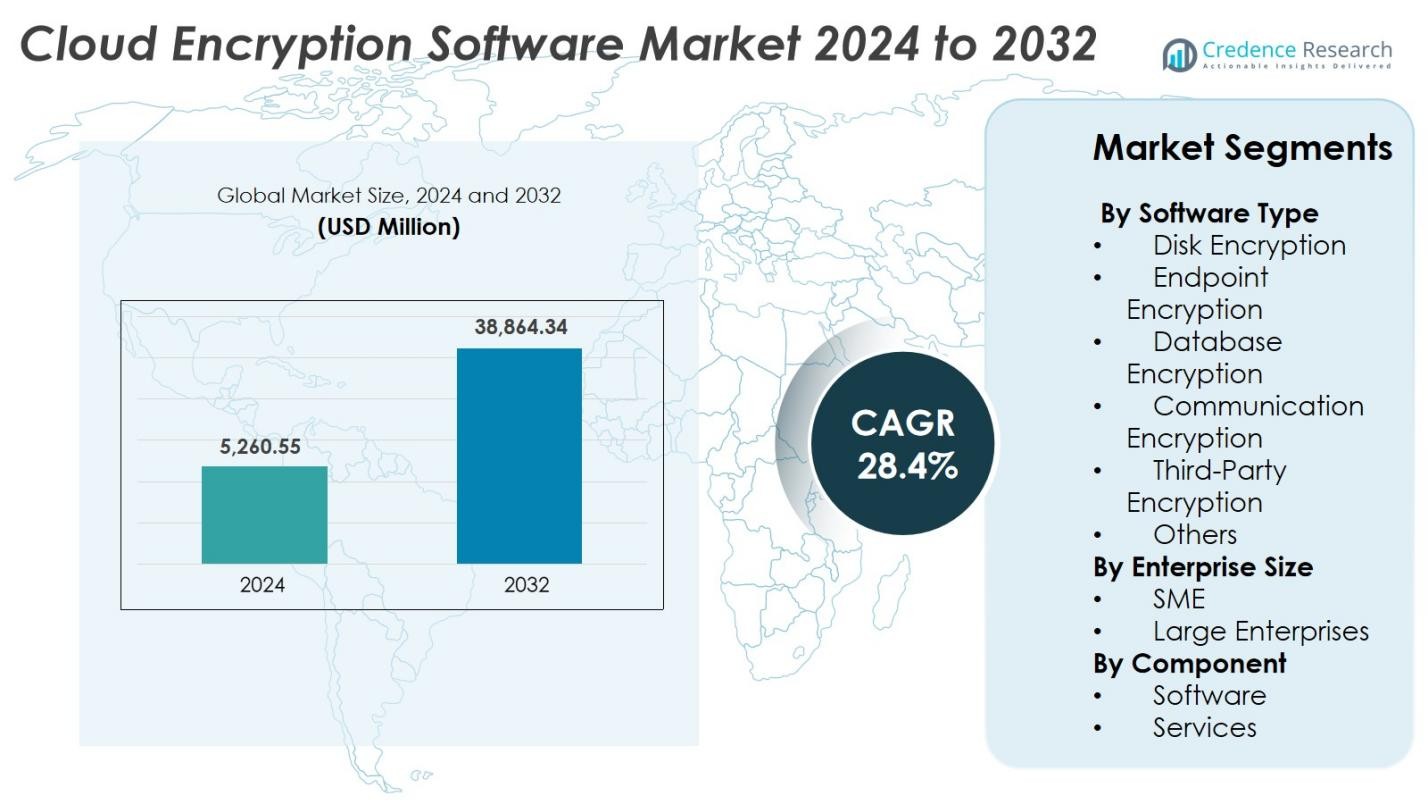
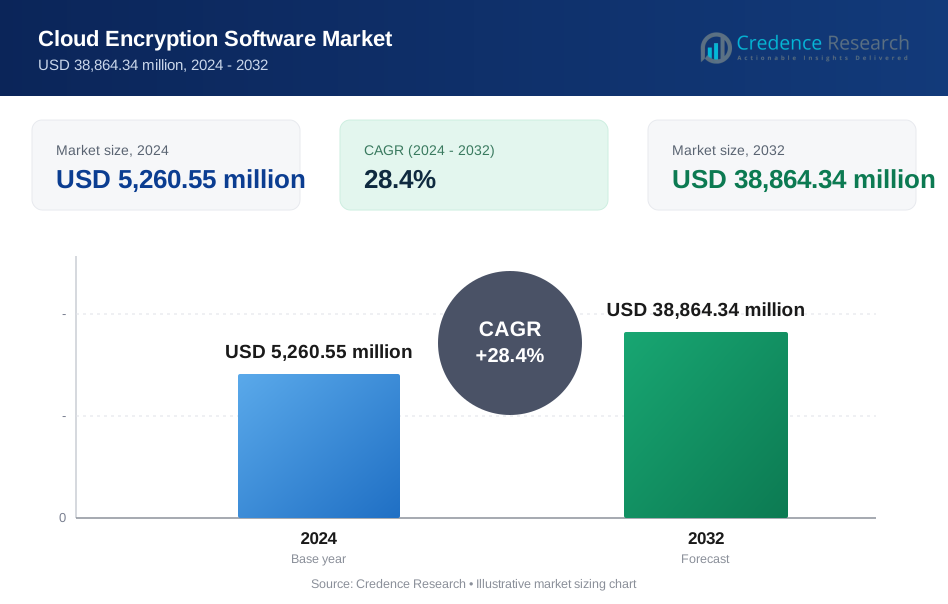
Cloud Encryption Software Market size was valued USD 5,260.55 million in 2024 and is anticipated to reach USD 38,864.34 million by 2032, at a CAGR of 28.4% during the forecast period.
| REPORT ATTRIBUTE | DETAILS |
|---|---|
| Historical Period | 2020-2023 |
| Base Year | 2024 |
| Forecast Period | 2025-2032 |
| Cloud Encryption Software Market Size 2024 | USD 5,260.55 Million |
| Cloud Encryption Software Market, CAGR | 28.4% |
| Cloud Encryption Software Market Size 2032 | USD 38,864.34 Million |
Major players in the Cloud Encryption Software market include Check Point Software Technologies Ltd., Dell Technologies Inc., Hewlett Packard Enterprise, Intel Corp., Proofpoint Inc., Sophos Ltd., Symantec (Broadcom), Thales Group, Trend Micro Inc., and IBM Corporation. These companies offer disk, database, and endpoint encryption integrated with automated key management and zero-trust security. Product innovation, cloud partnerships, and subscription-based deployment models strengthen their competitive position across large enterprises and SMEs. North America leads the global market with a 38% share, driven by early cloud adoption, strong regulatory compliance needs, and high cybersecurity spending across financial, government, and healthcare sectors.
Market Insights
- The Cloud Encryption Software market was valued at USD 5,260.55 million in 2024 and is projected to reach USD 38,864.34 million by 2032, growing at a CAGR of 28.4% during the forecast period.
- Growing cloud adoption across BFSI, healthcare, and government sectors drives demand for encryption solutions, as enterprises secure data at rest, in transit, and in use across hybrid and multi-cloud platforms.
- Key trends include rising use of AI-driven automated key management and increased adoption of subscription-based encryption models, which support SMEs and reduce infrastructure costs.
- The market features strong competition among global players offering disk, database, and endpoint encryption, while partnerships with cloud providers improve integration and compliance.
- North America leads with 38% market share, followed by Europe at 27% and Asia-Pacific at 24%, while disk encryption holds the largest segment share due to high adoption in data-heavy industries.
Market Segmentation Analysis
By Software Type
Disk encryption holds the largest share of the Cloud Encryption Software Market, accounting for around 32% of total revenue. Organizations depend on disk-level security to protect sensitive data stored in virtual machines and cloud databases. Growing ransomware attacks and strict compliance mandates encourage enterprises to secure data at rest. Endpoint and communication encryption represent 25% combined, gaining traction as remote work expands and data moves across multiple devices and networks. Database encryption contributes 20%, rising in demand among finance and healthcare firms. Third-party encryption maintains 15%, remaining essential for cloud-native applications to ensure protection when data is processed or shared outside internal IT environments.
- For instance, Microsoft enhanced its BitLocker management features for Azure in early 2023, strengthening cloud-based disk encryption capabilities.
By Enterprise Size
Large enterprises dominate the Cloud Encryption Software Market with 60% share due to the widespread use of multi-cloud ecosystems, vast data volumes, and regulatory compliance needs. These companies invest in advanced encryption solutions integrated with identity management, key vaults, and zero-trust frameworks. SMEs account for 40%, showing strong growth as affordable subscription-based models reduce deployment costs. Increasing cyber-attacks on small firms and privacy mandates push SMEs to adopt endpoint and disk encryption. The shift toward cloud-based operations continues to drive spending across both enterprise segments.
- For instance, IBM’s Guardium Data Encryption suite is widely adopted by large organizations to automate compliance controls and secure diverse environments, integrating capabilities like key vaults and identity management.
By Component
Software accounts for the major share of 70% in the Cloud Encryption Software Market. Businesses prefer scalable tools that secure data at rest, in transit, and in use across hybrid and public clouds. Automated key management, seamless workload integration, and minimal performance loss drive this dominance. Services hold 30%, growing steadily due to rising demand for deployment support, encryption key lifecycle management, and compliance consulting. Managed security providers play a key role in serving SMEs without dedicated cybersecurity teams, further accelerating service-based market expansion.
Key Growth Drivers
Rising Cloud Adoption Across Enterprises
Rapid migration from on-premise infrastructure to public and hybrid cloud systems drives strong demand for Cloud Encryption Software. Organizations store sensitive data in SaaS, IaaS, and PaaS environments, increasing the need for tools that secure information at rest and in transit. Growth in remote workforces further accelerates cloud usage, pushing businesses to secure distributed data flows. Cloud-native workloads also require encryption controls that integrate with identity access management and zero-trust security frameworks. As enterprises expand digital transformation initiatives and adopt multi-cloud strategies, encryption becomes a core requirement to protect intellectual property and ensure operational continuity across global data centers.
- For instance, Microsoft Azure implements 256-bit AES encryption across all storage systems with customer-managed key options through Azure Key Vault, enabling organizations to maintain encryption control while leveraging cloud infrastructure.
Stringent Data Protection Regulations
Global cybersecurity mandates compel enterprises to deploy encryption to avoid penalties, breach liabilities, and reputational loss. Regulations such as GDPR, HIPAA, PCI-DSS, and CCPA enforce strict guidelines for protecting customer data and financial information in cloud environments. Industries like BFSI, healthcare, and government face heavy compliance scrutiny, driving rapid adoption of disk, database, and communication encryption tools. Many countries now impose data localization rules that require secure data storage within national borders, boosting encrypted cloud storage demand. Enterprises increasingly invest in robust encryption and key management platforms to meet evolving compliance audits and maintain secure cross-border data flow.
- For instance, in healthcare, the U.S. Department of Health and Human Services (HHS) proposed in 2025 to require encryption and multifactor authentication for all systems handling patient data, closing previous regulatory flexibility gaps.
Growing Incidents of Cyberattacks and Data Breaches
Frequent cyberattacks on public, private, and hybrid cloud environments fuel market expansion. Ransomware, phishing, and insider threats target stored datasets, business emails, and payment records across industries. Cloud Encryption Software protects sensitive information even if networks or endpoints are compromised. Enterprises adopt multi-layered security with file-level, disk-level, and application-layer encryption to prevent unauthorized data access. Cloud providers also partner with encryption vendors to offer embedded security features in managed services. As attack sophistication increases, organizations seek advanced encryption integrated with monitoring, authentication, and automated key rotation, further accelerating market adoption.
Key Trends & Opportunities
Growth of Encryption-as-a-Service and Subscription Models
Subscription-based encryption services are gaining traction, especially among SMEs seeking scalable protection without heavy capital investment. Vendors offer pay-as-you-go tools that secure data across cloud applications, virtual machines, and collaboration platforms. Managed encryption services also reduce the burden of key provisioning and compliance, making cloud security more accessible. This trend creates strong opportunities for vendors offering integrated encryption bundles with threat analytics, identity governance, and zero-trust security. As digital transformation expands in emerging markets, cloud-native encryption subscriptions provide a cost-effective pathway for widespread adoption.
- For instance, Utimaco introduced its u.trust LAN Crypt Cloud in November 2023, a cloud-based file encryption-as-a-service solution that offers end-to-end encryption, role-based access controls, and administrative visibility for rapid enterprise deployment.
Increasing Use of AI-Driven Automated Key Management
Automation is becoming a major advancement, reducing manual security gaps and preventing human error in encryption key lifecycle management. AI-based tools generate, rotate, and revoke keys automatically while monitoring usage patterns for anomalies. Predictive analytics help detect threats before they escalate, making encryption solutions more proactive. Enterprises integrating AI-driven encryption gain faster response times and stronger protection for large-scale cloud workloads. As data volumes and multi-cloud deployments grow, automated key orchestration presents a new opportunity for vendors to differentiate their offerings with enhanced intelligence and real-time protection.
- For instance, Microsoft Azure AI Search uses customer-managed keys with Azure Key Vault and Hardware Security Modules (HSMs) to automate key rotation and revocation, providing secure, real-time controls over encryption keys.
Key Challenges
Integration Complexity in Multi-Cloud Environments
Enterprises adopt multiple cloud platforms to enhance flexibility and performance, but managing encryption across different architectures remains difficult. Varying encryption policies, key management standards, and storage formats create interoperability issues. IT teams must ensure seamless encryption during data migration and cross-cloud communication, raising costs and deployment timelines. Without unified management, encryption gaps increase the risk of breach exposure. Vendors must develop centralized platforms that support automated policies, standardized key vaults, and universal APIs to overcome this challenge and improve usability for both SMEs and large enterprises.
High Costs and Performance Overheads
Strong encryption improves security but can reduce system performance and increase operating expenses. Small businesses struggle with licensing fees, hardware requirements for key storage, and ongoing maintenance of encryption frameworks. High computational load also slows processing speeds for database queries and file transfers, forcing enterprises to balance cost, speed, and security. Vendors must innovate lightweight encryption algorithms and optimized processing to minimize latency. Broader adoption of subscription-based models and managed services is helping reduce barriers, but performance concerns remain a major restraint for large-scale deployment.
Regional Analysis
North America
North America holds 38% of the Cloud Encryption Software market, the largest regional share. Strong adoption of public and hybrid cloud services in banking, retail, and healthcare drives steady demand. The United States leads due to mature cybersecurity spending and the presence of major cloud vendors offering advanced disk, endpoint, and communication encryption. Regulatory pressures and zero-trust adoption encourage enterprises to secure data stored across multiple clouds. Large organizations also invest in automated key management and compliance-focused encryption, reinforcing North America’s dominant position.
Europe
Europe accounts for 27% of the global market, backed by strict compliance with GDPR and sector-specific data protection laws. Enterprises in BFSI, government, and healthcare focus on encrypted cloud storage and secure data transfer across borders. Germany, the United Kingdom, and France remain major revenue contributors as companies deploy encryption in multi-cloud environments. Growing interest in zero-trust frameworks, secure communication channels, and encrypted virtual machines also drives adoption. Vendor expansion of regional data centers supports localized encryption and key vault services.
Asia-Pacific
Asia-Pacific holds 24% of the Cloud Encryption Software market and remains the fastest-growing region. Rapid digital transformation, rising cyberattacks, and expansion of cloud data centers in China, India, Japan, and South Korea fuel adoption. SMEs rely on subscription-based encryption for secure remote working and digital payments. Banks, telecom providers, and e-commerce platforms deploy database and endpoint encryption to safeguard customer records. Increasing data localization policies further accelerate market growth as regional businesses secure cloud workloads.
Latin America
Latin America represents 6% of the market and shows a steady growth outlook. Enterprises in Brazil, Mexico, and Chile transition to public and hybrid cloud models to support online banking, mobile payments, and digital commerce. Ransomware and payment fraud concerns drive higher demand for database and communication encryption. SMEs increasingly adopt subscription-based encryption services due to lower costs and limited internal IT resources. Vendor investments in local data centers support wider regional adoption.
Middle East & Africa
The Middle East & Africa region holds 5% of the market, driven by government digitization, telecom upgrades, and banking modernization. The UAE, Saudi Arabia, and South Africa lead deployment of cloud-based encryption to secure citizen data and financial transactions. Large enterprises remain primary users, though SMEs are adopting managed encryption services for compliance. Smart city initiatives, cybersecurity regulations, and cloud expansion from global vendors continue to support gradual market growth.
Market Segmentations
By Software Type
- Disk Encryption
- Endpoint Encryption
- Database Encryption
- Communication Encryption
- Third-Party Encryption
- Others
By Enterprise Size
- SME
- Large Enterprises
By Component
- Software
- Services
By Geography
- North America
- U.S.
- Canada
- Mexico
- Europe
- Germany
- France
- U.K.
- Italy
- Spain
- Rest of Europe
- Asia Pacific
- China
- Japan
- India
- South Korea
- South-east Asia
- Rest of Asia Pacific
- Latin America
- Brazil
- Argentina
- Rest of Latin America
- Middle East & Africa
- GCC Countries
- South Africa
- Rest of the Middle East and Africa
Competitive Landscape
The Cloud Encryption Software market features strong competition among global cybersecurity vendors, cloud service providers, and emerging encryption specialists. Leading companies focus on advanced data-at-rest and data-in-transit protection while integrating automated key management and zero-trust frameworks. Vendors enhance product portfolios with disk, database, and endpoint encryption that support hybrid and public cloud workloads. Strategic partnerships with cloud providers enable embedded encryption in SaaS and IaaS platforms, improving adoption across enterprises and SMEs. Firms also invest in AI-driven threat analytics, hardware-based key vaults, and compliance management to address complex regulations. Mergers, acquisitions, and regional data center expansion strengthen market positioning, while subscription-based offerings increase accessibility for smaller businesses. As cyberattacks grow more sophisticated, vendors continue to differentiate through lightweight encryption, faster processing, and interoperability across multi-cloud environments, creating a highly dynamic and innovation-driven competitive landscape.
Key Player Analysis
- Hitachi Ltd.
- Hewlett Packard Enterprise Co.
- Cisco Systems Inc.
- Dell Technologies Inc.
- Check Point Software Technologies Ltd.
- Alphabet Inc.
- Forcepoint LLC
- Intel Corp.
- International Business Machines Corp.
- F Secure Corp.
Recent Developments
- In March 2025, NIST selected HQC as its fifth post-quantum encryption candidate, broadening cryptographic diversity.
- In February 2025, Google Cloud introduced quantum-safe digital signatures in Cloud KMS, implementing ML-DSA-65 and SLH-DSA-SHA2-128S.
- In January 2025, Amazon Web Services and Booz Allen Hamilton expanded cooperation to offer end-to-end encryption for U.S. federal agencies.
- In January 2025, Broadcom delivered the first quantum-resistant network encryption through Emulex Secure Fibre Channel HBAs, adding real-time ransomware detection.
Report Coverage
The research report offers an in-depth analysis based on Software, Enterprise, Component and Geography. It details leading market players, providing an overview of their business, product offerings, investments, revenue streams, and key applications. Additionally, the report includes insights into the competitive environment, SWOT analysis, current market trends, as well as the primary drivers and constraints. Furthermore, it discusses various factors that have driven market expansion in recent years. The report also explores market dynamics, regulatory scenarios, and technological advancements that are shaping the industry. It assesses the impact of external factors and global economic changes on market growth. Lastly, it provides strategic recommendations for new entrants and established companies to navigate the complexities of the market.
Future Outlook
- Enterprises will increase adoption of cloud-native encryption to secure multi-cloud workloads.
- Demand for automated key lifecycle management will rise as data volumes grow.
- AI-driven encryption tools will strengthen threat detection and reduce manual security gaps.
- Subscription-based encryption services will expand among SMEs seeking low-cost security.
- Integration of encryption with zero-trust frameworks will become standard in regulated industries.
- Cloud providers will embed stronger built-in encryption to support compliance and cross-border data transfer.
- Growth in remote work will boost demand for endpoint and communication encryption.
- Data localization laws will drive regional deployment of encrypted cloud storage and key vault services.
- Lightweight encryption algorithms will gain prominence to reduce performance impact on cloud systems.
- Partnerships between cybersecurity vendors and cloud platforms will accelerate global market penetration.
Request a Free Sample
Fill in your details and we'll send you a free sample report.
- Sample data tables & charts
- Research methodology
Need a Custom Version of This Report?
Tailor the scope, geography, or segments to your exact requirements.
- Custom geography or segment scope
- Direct access to our analyst team
Frequently Asked Questions
What is the current market size for the Cloud Encryption Software market, and what is its projected size in 2032?
At what Compound Annual Growth Rate is the Cloud Encryption Software market projected to grow between 2025 and 2032?
Which Cloud Encryption Software market segment held the largest share in 2024?
What are the primary factors fueling the growth of the Cloud Encryption Software market?
Who are the leading companies in the Cloud Encryption Software market?
Which region commanded the largest share of the Cloud Encryption Software market in 2024?
Table of Content
Chapter 1. Report Introduction
- 1.1 Report Description & Purpose
- 1.1.1 Report Title & Market Definition
- 1.1.2 Unique Selling Propositions (USP) & Key Differentiators
- 1.1.3 Value Proposition for Stakeholders
- 1.2 Research Objectives
- 1.2.1 Market Sizing Objectives (Volume & Revenue)
- 1.2.2 Segmentation Objectives
- 1.2.3 Competitive Intelligence Objectives
- 1.2.4 Forecast & Scenario Objectives
- 1.3 Report Scope
- 1.3.1 Cloud Encryption Software Scope – Types & Subtypes Covered
- 1.3.2 Geographic Scope – Regions & Countries Covered
- 1.3.3 Historical Period, Base Year & Forecast Period (2024; forecast to 2032)
- 1.3.4 Inclusions & Exclusions
- 1.4 HS Code & Classification Framework
- 1.5 Currency, Units & Pricing Basis
- 1.6 Target Stakeholders
- 1.7 Limitations & Assumptions
Chapter 2. Executive Summary
- 2.1 Global Cloud Encryption Software Market Snapshot
- 2.1.1 Market Size – Historical (2024) & Forecast (2024-2032) (2024: USD 5,260.55 million → 2032: USD 38,864.34 million)
- 2.1.2 Volume & Revenue – Global Totals
- 2.1.3 Key Market Highlights – Top Five Facts
- 2.2 Cloud Encryption Software Market Segmentation Snapshot
- 2.2.1 Market Split by Region – 2024 vs. 2032
- 2.3 Competitive Snapshot
- 2.3.1 Top 10 Players by Revenue Share – 2024
- 2.3.2 Top 10 Players by Volume Share – 2024
- 2.3.3 Recent Strategic Developments (18-Month Summary)
- 2.4 Key Investment Highlights & Strategic Conclusions
Chapter 3. Cloud Encryption Software Market Dynamics & Industry Analysis
- 3.1 Market Overview & Context
- 3.1.1 Cloud Encryption Software Market Position in the Broader Automotive Value Chain
- 3.1.2 OEM vs. Replacement Market Dynamics
- 3.1.3 Market Maturity & Development Stage by Region
- 3.2 Cloud Encryption Software Market Drivers
- 3.3 Cloud Encryption Software Market Restraints & Challenges
- 3.4 Cloud Encryption Software Market Opportunities
- 3.5 Porter's Five Forces Analysis
- 3.5.1 Threat of New Entrants
- 3.5.2 Bargaining Power of Suppliers
- 3.5.3 Bargaining Power of Buyers
- 3.5.4 Threat of Substitutes
- 3.5.5 Competitive Rivalry – Intensity Assessment
- 3.6 Cloud Encryption Software Value Chain Analysis
- 3.6.1 Upstream – Raw Material/Input Suppliers
- 3.6.1.1 Raw Material/Input 1
- 3.6.1.2 Raw Material/Input 2
- 3.6.1.3 Raw Material/Input 3
- 3.6.2 Midstream – Production/Manufacturing/Service Delivery
- 3.6.2.1 Production/Process Overview
- 3.6.2.2 Key Facility Locations & Capacity by Manufacturer
- 3.6.3 Downstream – Distribution & End Consumer
- 3.6.3.1 Primary Channel – B2B/OEM
- 3.6.3.2 Secondary Channels – Dealer, Retail, Online, Direct
- 3.6.4 Value Chain Profitability Analysis
- 3.6.1 Upstream – Raw Material/Input Suppliers
- 3.7 PESTEL Analysis
- 3.7.1 Political Factors
- 3.7.2 Economic Factors
- 3.7.3 Social Factors
- 3.7.4 Technological Factors
- 3.7.5 Environmental Factors
- 3.7.6 Legal Factors
- 3.8 Cloud Encryption Software Supply Chain Analysis
- 3.8.1 Raw Material/Input Supply Risk Assessment
- 3.8.2 Manufacturing Concentration Risk (Geographic Exposure)
- 3.8.3 Trade Disruption Impact Analysis
- 3.9 Regulatory & Policy Landscape
Note: The regulatory and policy landscape section covers regulations based on their applicability to the market, Cloud Encryption Software category, geography, and scope of the study. Only regulatory frameworks with a material impact on operations, compliance, trade, sustainability, or market access are analyzed in detail.
Chapter 4. Key Investment Pockets & Opportunity Analysis
- 4.1 Cloud Encryption Software Market Attractiveness Analysis
- 4.1.1 By Region – Investment Attractiveness Matrix (Volume × CAGR)
- 4.2 Absolute Revenue Growth Opportunity
- 4.2.1 By Region – Absolute USD Growth Through 2032
- 4.3 Incremental Volume Opportunity
- 4.3.1 By Region – Incremental Volume Through 2032
- 4.3.2 Segment – Incremental Volume
- 4.4 Emerging Submarket Opportunity Deep Dive (Subject to Applicability)
- 4.5 Emerging Market Opportunity Scorecards
- 4.5.1 United States
- 4.5.2 Europe
- 4.5.3 Asia
- 4.5.4 Middle East & Africa
Note: Emerging Market Opportunity Scorecards will be included based on relevance and strategic importance. Regions listed are indicative and may vary depending on data availability and market dynamics.
Chapter 5. Cloud Encryption Software Import-Export Analysis & Trade Flows
- 5.1 Global Trade Overview
- 5.1.1 Global Export Value by Country (2024)
- 5.1.2 Global Export Volume by Country (2024)
- 5.1.3 Global Import Value by Country (2024)
- 5.1.4 Global Import Volume by Country (2024)
- 5.1.5 Net Trade Balance by Country (2024)
- 5.2 Export Analysis – Segment
- 5.2.1 Type 1 (HS Code)
- 5.2.2 Type 2 (HS Code)
- 5.2.3 Type 3 (HS Code)
- 5.2.4 Type 4 (HS Code)
- 5.2.5 Type 5 (HS Code)
- 5.3 Import Analysis – Segment
- 5.3.1 Type 1 (HS Code)
- 5.3.2 Type 2 (HS Code)
- 5.3.3 Type 3 (HS Code)
- 5.3.4 Type 4 (HS Code)
- 5.3.5 Type 5 (HS Code)
- 5.4 Average Unit Trade Prices
- 5.4.1 Average Export Price – Segment & Country
- 5.4.2 Average Import Price – Segment & Source Country
- 5.4.3 Price Trends (2024)
- 5.5 Key Trade Route Analysis
- 5.5.1 Trade Route 1
- 5.5.2 Trade Route 2
- 5.5.3 Trade Route 3
- 5.5.4 Trade Route 4
- 5.5.5 Trade Route 5
- 5.6 Trade Policy Impact Assessment
- 5.6.1 US Anti-Dumping & Section 301 Tariffs
- 5.6.2 EU Customs Union Impact
- 5.6.3 Major Free Trade Agreements
- 5.6.4 USMCA Rules of Origin
Note: Trade policy analysis will be included only where relevant to the Cloud Encryption Software market.
Chapter 6. Competitive Landscape & Company Benchmarking
- 6.1 Cloud Encryption Software Market Concentration & Structure
- 6.1.1 Herfindahl-Hirschman Index (HHI) – vs. 2024
- 6.1.2 Tier 1, Tier 2 & Tier 3 Market Structure
- 6.1.3 Global, Regional & Local Player Dynamics
- 6.2 Cloud Encryption Software Market Share Analysis – 2024
- 6.2.1 Global Revenue Share by Company
- 6.2.2 Global Volume Share by Company
- 6.2.3 Regional Revenue Share
- 6.2.4 Market Share Evolution ( vs. 2024)
- 6.2.5 OEM Segment Share by Company
- 6.2.6 Replacement Segment Share by Company
- 6.3 Production/Delivery Capacity & Facility Analysis
- 6.3.1 Global Installed Capacity
- 6.3.2 Capacity Utilization Rates
- 6.3.3 Production/Output Volume
- 6.3.4 Facility Locations & Capacity Map
- 6.3.5 Planned Capacity Additions
- 6.4 Cloud Encryption Software Competitive Benchmarking Matrix
- 6.4.1 Revenue, Volume, CAGR & Profitability Comparison
- 6.4.2 Channel Revenue Mix
- 6.4.3 Geographic Revenue Exposure
- 6.4.4 R&D Intensity
- 6.4.5 Sustainability Maturity
- 6.5 Strategic Developments in Cloud Encryption Software (Last 24 Months)
- 6.5.1 Mergers, Acquisitions & Divestments
- 6.5.2 New Cloud Encryption Software Launches
- 6.5.3 Facility Expansions
- 6.5.4 Strategic Alliances, Joint Ventures & Partnerships
- 6.5.5 Distribution Expansion & Market Entry
- 6.5.6 Sustainability & ESG Initiatives
- 6.6 Competitive Strategy Mapping
- 6.6.1 Leader, Challenger, Follower & Niche Classification
- 6.6.2 Pricing Strategy Comparison
- 6.6.3 Channel Strategy Matrix
Note: Strategic developments are included based on their materiality and the availability of reliable information.
Chapter 7. Global Cloud Encryption Software Market – By Distribution Channel
- 7.1 Segment Overview
- 7.1.1 Volume & Revenue Split by Channel (2024 & 2032)
- 7.1.2 Channel Mix Evolution (2024-2032)
Chapter 8. Regional Market Analysis – Global Overview
- 8.1 Global Regional Overview
- 8.1.1 Regional Volume Share
- 8.1.2 Regional Revenue Share
- 8.1.3 Regional Volume by Region
- 8.1.4 Regional Revenue by Region
- 8.1.5 Regional Forecast Through 2032
- 8.2 Cross-Regional Segment Analysis
- 8.2.1 By Distribution Channel
- 8.2.2 By Brand/Price Tier
Chapter 9. North America Cloud Encryption Software Market
- 9.1 United States
- 9.2 Canada
- 9.3 Mexico
Chapter 10. Europe Cloud Encryption Software Market
- 10.1 Germany
- 10.2 France
- 10.3 Italy
- 10.4 United Kingdom
- 10.5 Spain
- 10.6 Poland
- 10.7 Russia
- 10.8 Netherlands
- 10.9 Belgium
- 10.10 Sweden
- 10.11 Denmark
- 10.12 Norway
- 10.13 Rest of Europe
Chapter 11. Asia Pacific Cloud Encryption Software Market
- 11.1 China
- 11.2 India
- 11.3 Japan
- 11.4 South Korea
- 11.5 Thailand
- 11.6 Indonesia
- 11.7 Vietnam
- 11.8 Malaysia
- 11.9 Australia
- 11.10 Rest of Asia Pacific
Chapter 12. Latin America Cloud Encryption Software Market
- 12.1 Brazil
- 12.2 Argentina
- 12.3 Colombia
- 12.4 Chile
- 12.5 Rest of Latin America
Chapter 13. Middle East Cloud Encryption Software Market
- 13.1 Saudi Arabia
- 13.2 United Arab Emirates
- 13.3 Turkey
- 13.4 Israel
- 13.5 Iran
- 13.6 Rest of the Middle East
Chapter 14. Africa Cloud Encryption Software Market
- 14.1 South Africa
- 14.2 Egypt
- 14.3 Nigeria
- 14.4 Morocco
- 14.5 Rest of Africa
Chapter 15. Cloud Encryption Software Company Profiles
- 15.1 [Company 01]
- 15.1.1 Company Overview
- 15.1.2 Key Management Personnel
- 15.1.3 Products & Services Portfolio
- 15.1.4 Financial Performance
- 15.1.5 Key Market Focus & Geographic Presence
- 15.1.6 Recent Developments & Strategic Initiatives
Note: The company profile list is preliminary and may change based on research findings, market developments, data availability, and client requirements.
Chapter 16. Appendices
- Appendix A – List of Abbreviations & Acronyms
- Appendix B – Industry Classification Code Reference – Full Series
- Appendix C – Production & Capacity Data Tables
- Appendix D – End-Use & Demand Base Tables
- Appendix E – Consumption & Replacement Rate Assumptions
- Appendix F – ASP Reference Tables
- Appendix G – Manufacturing & Facility Database
- Appendix H – Import-Export Data Tables
- Appendix I – Regulatory Summary Tables
- Appendix J – Primary Research Participant List (Anonymized)
- Appendix K – Primary Research Questionnaire Framework
- Appendix L – Data Sources & Bibliography
- Appendix M – Market Size Divergence & Source Comparison
Chapter 17. Research Methodology
- 17.1 Research Framework & Philosophy
- 17.2 Secondary Research – Sources, Hierarchy & Data Extraction
- 17.3 Data Modeling – Bottom-Up & Top-Down Market Sizing
- 17.4 Primary Research – Stakeholder Framework, LOI & Sample Sizes
- 17.5 Forecast Methodology – Regression, Scenario & Sensitivity Analysis
- 17.6 Quality Control – Four-Layer Validation Framework
- 17.7 Limitations & Standard Assumptions
- 17.8 Disclaimer
