
What is the Global Market Scenario of Flashlight?
The utilisation of cutting-edge illumination technology by flashlight producers is emphasising product updates. Durability and battery lifespan are anticipated to become the most important factors as the popularity of these technologies increases visibly. Product advancements in the LED flashlight market would have a significant impact on these criteria. One such invention that enables life extension and more effective battery use is the multi-level LED flashlight.
Growing inclination for new features and advanced lighting, developments in illumination technologies, and rising demand for reliable, low-maintenance, and efficient lamps. Innovation in flashlight products for outdoor activities, rising demand for explosion-proof LED flashlights, the development of regulated and multi-level LED lights, increasing LED technology penetration, and increased traction for everyday carry flashlights in the household sector are all factors propelling the growth of the global flashlight market.
What is the Market Size of Flashlight in term of value?
Global Flashlight Market is projected to increase at a significant CAGR of 4.5% in the coming years. In 2021, the global flashlight market was valued at USD 6,827.5 Million and is projected to reach at value of USD 8,891.2 Million by 2028. The demand for flashlight is projected to increase substantially in the coming years and is presumed to generate revenue opportunity for the key industry players that worth USD 2,063.7 Million during the forecast period between 2022 and 2028.
How LED Lights Will Pave Way for Flashlight Sales?
The rise of the LED flashlight industry is mostly due to its energy-efficiency and small size. Additionally, growing R&D expenditures have resulted in improvements to the features and form factors of LED flashlights. The market for LED flashlights is expanding as a result of the rising demand for security and safety at commercial and industrial sites and the rising frequency of power outages in rural areas.
In both the domestic and industrial sectors, LED technology in flashlights is used for excellent performance and endurance. The flashlight market will gain speed thanks to new product advancements and the solid financial standing of major market competitors. Over the past few years, LED lighting has gained widespread adoption and appeal at an unheard-of rate. Due to declining LED pricing and rapid scientific breakthroughs in LED technology, the use of LED-based lighting solutions is rapidly expanding in both residential and commercial End-users.
Interesting Facts about Flashlight Industry
- The top 5 countries for flashlight exports are Germany, United States, U.K, Canada, and China
- In 2021, the LED segment had the most demand, accounting for more than 78 percent of the market.
- Additionally, it is anticipated that government attempts to phase out inefficient halogen lamps and fluorescent lights as well as to establish minimum quality standards for LED lighting will propel the global LED market's expansion.
- The military's use of tactical LED flashlights is also influenced by factors such as rising defence budgets on an annual basis, as well as their durability, shockproof, and waterproof qualities, large batteries, long lumen range, weapon mounting, eye strobing, etc.
- One of the main factors limiting the growth of the LED flashlight market is fluctuating raw material prices
Who are the Top 10 players/companies in flashlight market in term of value and volume?
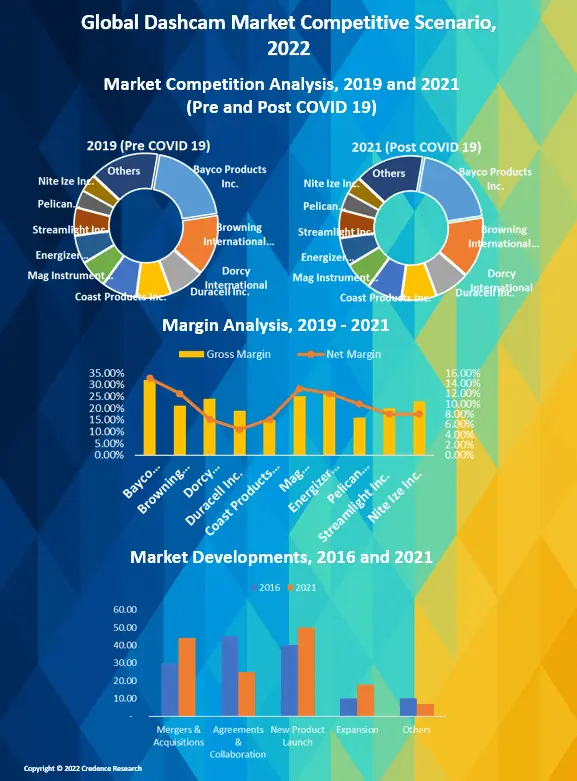
The key players in the global flashlight market in terms of value and volume include Bayco Products Inc., Browning International S.A, Dorcy International, Duracell Inc., Coast Products Inc., Mag Instrument Inc., Energizer Holdings Inc., Pelican Products, Inc. and Streamlight Inc. Manufacturers are developing long term collaboration with end user in order to streamline the supply chain of sales of flashlight. Product modification is done by leading manufacturers by providing USB batteries that can be charged separately from the torch, several flashlight makers even go beyond the USB-rechargeable trend.
Market players are targeting specific End-user sectors such as homeland security and outdoor recreation activities. For instance, Indiegogo, Inc. introduced outdoor recreation flashlights like the Mule Light V2, a multi-function flashlight with stylish and durable features that offers glow stick illumination for more than 500 hours. For adventures, this design's remarkable adaptability and battery life are available.
Who are the Top 10 Countries in the Flashlight Market?
In the global flashlight market, the major countries are China, India, the U.S., Canada, Japan, France, Russia, Germany, Spain, and U.K. In terms of current technology, standard of life, infrastructure development, and many other factors, the US is a developed nation. A competitive market is the outcome of technological breakthroughs in the area. A centre for technical advancement, China is leading from the front for production of flashlight.
When LEDs are incorporated into flashlights, the technology becomes compact and portable, making it ideal for workforce that use a flashlight in an emergency situation where brightness is crucial for performing repairs to equipment or performing rescue operations. Additionally, there is a big demand for LED flashlights among commercial, residential, and other buildings in Indian market. This element would contribute to a greater penetration of all lighting sales.
Which is the Leading End-user in the Flashlight Market?
As more young people go on adventurous vacations to discover nature, the demand for flashlights used in outdoor recreational activities like camping, hunting, diving, and fishing is rising. The segment has dominated the market revenue share with capturing close to 23% share in 2021. During night-time camping or hiking, flashlights are utilised for safety purposes. As a result, producers are concentrating primarily on producing torches and headlamps with comfortable shapes and water-resistant characteristics, which are perfect for outdoor activities like camping and hunting.
What are the Major Driving Factors for Flashlight Market?
One of the main potentials for the flashlight business is rechargeable LED flashlights. Incandescent flashlights are being replaced with LED flashlights. Rechargeable LED flashlights are convenient for customers to use because they don't require dry dell batteries.
Instead of solid-state batteries and battery chargers, a rechargeable flashlight often plugs into an electrical outlet for increased power. Outdoor activities and domestic security frequently make use of rechargeable torches. There has been a significant market opportunity for producers as a result of the sophisticated LED technology used in flashlights.
International Energy Agency (IEA) figures show that the adoption of LED-based lighting has been growing significantly on a global scale; in the residential market, it went from 5 percent in 2013 to 40 percent in 2018. Because of the beneficial actions made by various nations, the decreasing costs of LED are another enabling element that is projected to accelerate the global adoption of LED-based lighting solutions.
What are the Restraints for Flashlight Market?
A significant barrier to the expansion of the flashlight business has been potential customers' lack of knowledge and appreciation of the advantages of contemporary flashlights for a variety of End-users. Consumer bias against the use of innovative flashlight goods is also growing as a result of the introduction of low-quality lighting products with short product lifespans and the false belief that current lighting solutions are more expensive than fuel-based lighting. These elements have significantly curbed the expansion of the flashlight market.
Which Region Dominated the World Flashlight Market?
With more than 52 percent revenue share in 2021, APAC dominated the worldwide LED flashlight market. With a variety of manufacturing sectors, a large military, and an expanding economy, the Asia Pacific area has emerged as a centre for global manufacturing. Due to a rise in the industrial and construction industries, a significant number of developing nations, and the military, the Asian market for LED flashlights has experienced tremendous growth.
As a result, more people are using LED illumination goods, such as flashlight bulbs. Primary nations with a sizable market share in the LED flashlight industry is China and India market in APAC region, which is being driven by an increase in commercial items. Due to the region’s expanding population, China's construction industry is expanding exponentially, which is driving up demand for modern lighting solutions to ensure hassle-free operations.
Segmentation of Global Flashlight Market-
Global Flashlight Market – By Product
- LED Flashlight
- Incandescent Flashlight
Global Flashlight Market – By Application
- Residential
- Industrial
Global Flashlight Market – By End-user
- Homeland Security
- Home Inspection
- Outdoor Recreation Activities
- Construction & Auto Repairing
- Doctor Visit
- Games

Request a Free Sample
Fill in your details and we'll send you a free sample report.
- Sample data tables & charts
- Research methodology
Market Dynamics
Advancements in LED Technology
Rapid improvements in LED efficiency, battery life, and multi-level lighting features are making flashlights more durable, energy-efficient, and attractive to both consumers and industrial users.
Rising Demand for Outdoor and Recreational Activities
Increasing participation in camping, hiking, hunting, and other outdoor activities is driving demand for high-performance, water-resistant, and long-lasting flashlights, especially among younger consumers.
Shift Toward Rechargeable and Low-Maintenance Solutions
Consumers and industries are increasingly preferring rechargeable LED flashlights over traditional battery-powered or incandescent models, reducing maintenance costs and environmental impact.
Government Regulations and Energy Efficiency Standards
Policies phasing out inefficient lighting and setting minimum quality standards for LEDs are accelerating the adoption of advanced flashlight technologies across residential, commercial, and industrial sectors.
Industrial and Security Applications
The need for reliable, explosion-proof, and tactical flashlights in sectors such as homeland security, construction, and industrial maintenance is fueling market growth, especially as safety and operational uptime become critical.
Need a Custom Version of This Report?
Tailor the scope, geography, or segments to your exact requirements.
- Custom geography or segment scope
- Direct access to our analyst team
Frequently Asked Questions
Who are the key players in flashlight market?
Which is the leading market for flashlight?
What are the key drivers for the growth of the flashlight market?
Which is the major segment in Flashlight Market by Product?
Which is the major segment in Flashlight Market by Application?
Table of Content
Chapter 1 Market Segmentation
- 1.1 Segmentation Framework
- 1.1.1 Product and Service Classification
- 1.1.2 Application and End-Use Classification
- 1.1.3 Technology and Solution Classification
- 1.1.4 Customer and Distribution Channel Classification
- 1.1.5 Geographic Segmentation
- 1.1.6 Market Segment Definitions and Boundaries
- 1.2 By Product
- 1.2.1 LED Flashlight
- 1.2.2 Incandescent Flashlight
- 1.3 By End-user
- 1.3.1 Homeland Security
- 1.3.2 Home Inspection
- 1.3.3 Outdoor Recreation Activities
- 1.3.4 Construction & Auto Repairing
- 1.3.5 Doctor Visit
- 1.3.6 Games
- 1.4 By Application
- 1.4.1 Residential
- 1.4.2 Industrial
Chapter 2 Introduction
- 2.1 Report Objectives and Scope
- 2.2 Product Definition and Industry Terminology
- 2.3 Market Inclusions and Exclusions
- 2.4 Research Process
- 2.4.1 Primary Research and Expert Interviews
- 2.4.2 Secondary Research and Source Review
- 2.4.3 Top-Down and Bottom-Up Estimation
- 2.4.4 Data Triangulation and Verification
- 2.5 Market Size Measurement Basis
- 2.5.1 2021: USD 6,827.5 Million → 2028: USD 8,891.2 Million
- 2.6 Historical and Forecast Reference Periods
- 2.6.1 Base Year: 2021
- 2.6.2 Forecast Period: 2021-2028
- 2.7 Research Assumptions and Limitations
Chapter 3 Executive Summary
- 3.1 Market Snapshot and Key Findings
- 3.2 Base-Year Market Size, 2021
- 3.3 Forecast Market Size, 2028
- 3.4 Revenue and Volume Growth Outlook
- 3.5 Key Demand and Supply Indicators
- 3.6 Leading Market Segments
- 3.7 Fastest-Growing Market Opportunities
- 3.8 Regional Performance Highlights
- 3.9 Technology and Industry Transformation
- 3.10 Competitive Landscape Summary
- 3.11 Analyst View and Strategic Implications
Chapter 4 Global Flashlight Market Trends and Developments
- 4.1 Historical Industry Development
- 4.2 Recent Market Trends and Developments
- 4.3 Demand and Customer Behavior Trends
- 4.4 Technology and Product Innovation
- 4.5 Artificial Intelligence, Automation and Digitalization
- 4.6 Local Manufacturing and Supply Chain Realignment
- 4.7 Industry Partnerships, Mergers and Acquisitions
- 4.8 Sustainability and Circular Economy Developments
- 4.9 Government and Private Sector Investment Trends
- 4.10 Emerging Business Models and Commercialization
- 4.11 Industry Developments and Announcements
Chapter 5 Global Flashlight Market Production, Supply and Demand Analysis
- 5.1 Demand Trend and Consumption Analysis
- 5.2 Demand Forecast, 2021-2028
- 5.3 Production and Output Trend
- 5.4 Production and Output Forecast, 2021-2028
- 5.5 Installed Capacity and Capacity Utilization
- 5.6 Company-Wise Production Plants and Statistics
- 5.6.1 Installed Production Capacity
- 5.6.2 Actual Production
- 5.6.3 Planned Capacity and Expansion Targets
- 5.7 Supply Chain Structure and Procurement Trends
- 5.8 Supply-Demand Gap and Bottlenecks
- 5.9 Import Dependence and Sourcing Structure
- 5.10 Contract Manufacturing and Outsourcing
- 5.11 Regional Supply and Demand Concentration
Chapter 6 Global Flashlight Market Pricing Analysis
- 6.1 Pricing Structure and Measurement
- 6.2 Historical Pricing Trends
- 6.3 Pricing Outlook, 2021-2028
- 6.4 Average Selling Price and Unit Economics
- 6.5 Pricing by Product and Market Segment
- 6.6 Geographic Pricing Differences
- 6.7 Key Input, Energy, Labor and Logistics Costs
- 6.8 Contract Pricing and Purchasing Models
- 6.9 Pricing Sensitivity and Competitive Positioning
- 6.10 Price, Margin and Profitability Implications
Chapter 7 Global Flashlight Market Dynamics
- 7.1 Market Growth Drivers
- 7.1.1 Demand-Side Drivers
- 7.1.2 Technology and Innovation Drivers
- 7.1.3 Infrastructure and Investment Drivers
- 7.1.4 Regulatory and Policy Drivers
- 7.2 Market Restraints
- 7.2.1 Cost and Affordability Constraints
- 7.2.2 Technology and Adoption Barriers
- 7.2.3 Supply Chain and Operational Constraints
- 7.3 Market Challenges
- 7.3.1 Competitive Pressure and Margin Erosion
- 7.3.2 Skills, Infrastructure and Implementation Gaps
- 7.4 Emerging Market Opportunities
- 7.5 Market Dynamics Impact and Time-Horizon Assessment
Chapter 8 Global Flashlight Value Chain Analysis
- 8.1 Industry Value Chain Overview
- 8.2 Upstream Suppliers and Critical Inputs
- 8.3 Technology and Component Providers
- 8.4 Manufacturing or Service Delivery
- 8.5 Distribution, Channel Partners and Integrators
- 8.6 Downstream Applications and End Users
- 8.7 Value Addition and Profit Pools
- 8.8 Vertical Integration and Outsourcing
- 8.9 Supplier Concentration and Risk
- 8.10 Supply Chain Localization and Resilience
Chapter 9 Global Flashlight Market Regulations and Policies
- 9.1 Relevant Laws, Standards and Compliance Frameworks
- 9.2 Product, Service, Safety and Quality Requirements
- 9.3 Government Policies, Incentives and Subsidies
- 9.4 Imports, Exports and Trade Barriers
- 9.5 Public Procurement and Local Content Requirements
- 9.6 Environmental and Sustainability Compliance
- 9.7 Data Protection, AI and Cybersecurity Compliance
- 9.8 Upcoming Policy Changes and Market Implications
Chapter 10 Global Flashlight Market Hotspots and Opportunities
- 10.1 Market Opportunity Mapping and Growth Hotspots
- 10.2 High-Growth Applications and Customer Groups
- 10.3 Underserved Markets and White-Space Opportunities
- 10.4 Emerging Technology and Product Opportunities
- 10.5 New Capacity and Investment Hotspots
- 10.6 Market Entry and Expansion Opportunities
- 10.7 Distribution and Partnership Opportunities
- 10.8 Near-Term and Long-Term Commercial Potential
- 10.9 Opportunity Attractiveness and Execution Risks
Chapter 11 Global Flashlight Market Outlook, 2021-2028
- 11.1 Market Size and Analysis
- 11.1.1 Revenue (Market Measurement: 2021: USD 6,827.5 Million → 2028: USD 8,891.2 Million)
- 11.1.2 Market Volume and Quantity Sold
- 11.1.3 Historical Market Size
- 11.1.4 Base-Year Market Size, 2021
- 11.2 Market Forecast, 2021-2028
- 11.2.1 Revenue Forecast to 2028
- 11.2.2 Volume Forecast to 2028
- 11.2.3 CAGR and Year-on-Year Growth
- 11.2.4 Incremental Revenue Opportunity
- 11.3 Forecast Assumptions and Scenario Analysis
- 11.3.1 Base-Case Forecast
- 11.3.2 Optimistic and Conservative Scenarios
- 11.3.3 Technology, Pricing and Policy Sensitivities
- 11.4 Market Attractiveness and Growth Outlook
Chapter 12 Global Flashlight Market Segmentation and Outlook
- 12.1 Segmentation Summary and Market Shares, 2021
- 12.2 Largest and Fastest-Growing Segments
- 12.3 By Product - Market Size and Forecast, 2021-2028
- 12.3.1 Segment Definition and Scope
- 12.3.2 Historical Market Size
- 12.3.3 Revenue Forecast, 2021-2028
- 12.3.4 Volume Forecast, 2021-2028
- 12.3.5 Base-Year Market Share, 2021
- 12.3.6 Segment CAGR and Growth Drivers
- 12.3.7 Subsegment Market Size and Forecast
- 12.3.7.1 LED Flashlight
- 12.3.7.2 Incandescent Flashlight
- 12.3.8 Subsegment Pricing and Adoption Trends
- 12.3.9 Leading Suppliers and Competition
- 12.3.10 Regional Demand and Opportunities
- 12.4 By End-user - Market Size and Forecast, 2021-2028
- 12.4.1 Segment Definition and Scope
- 12.4.2 Historical Market Size
- 12.4.3 Revenue Forecast, 2021-2028
- 12.4.4 Volume Forecast, 2021-2028
- 12.4.5 Base-Year Market Share, 2021
- 12.4.6 Segment CAGR and Growth Drivers
- 12.4.7 Subsegment Market Size and Forecast
- 12.4.7.1 Homeland Security
- 12.4.7.2 Home Inspection
- 12.4.7.3 Outdoor Recreation Activities
- 12.4.7.4 Construction & Auto Repairing
- 12.4.7.5 Doctor Visit
- 12.4.7.6 Games
- 12.4.8 Subsegment Pricing and Adoption Trends
- 12.4.9 Leading Suppliers and Competition
- 12.4.10 Regional Demand and Opportunities
- 12.5 By Application - Market Size and Forecast, 2021-2028
- 12.5.1 Segment Definition and Scope
- 12.5.2 Historical Market Size
- 12.5.3 Revenue Forecast, 2021-2028
- 12.5.4 Volume Forecast, 2021-2028
- 12.5.5 Base-Year Market Share, 2021
- 12.5.6 Segment CAGR and Growth Drivers
- 12.5.7 Subsegment Market Size and Forecast
- 12.5.7.1 Residential
- 12.5.7.2 Industrial
- 12.5.8 Subsegment Pricing and Adoption Trends
- 12.5.9 Leading Suppliers and Competition
- 12.5.10 Regional Demand and Opportunities
- 12.6 Segment Growth Comparison
- 12.7 Segment Attractiveness and Priority Matrix
Chapter 13 Global Flashlight End-Use and Application Market Outlook
- 13.1 End-Use Industry and Customer Demand Structure
- 13.2 Leading Applications and Customer Groups
- 13.3 End-Use Market Size, Share and Forecast
- 13.4 Major End-Use Industry Deep Dives
- 13.4.1 Customer Requirements and Use Cases
- 13.4.2 Demand and Replacement Cycles
- 13.4.3 Technical and Regulatory Considerations
- 13.4.4 Purchasing and Procurement Models
- 13.4.5 Leading Vendors and Distribution Channels
- 13.4.6 Forecast and Commercial Opportunities
- 13.5 Emerging Applications and Cross-Segment Demand
- 13.6 End-Use Industry Investment Priorities
Chapter 14 Global Flashlight Geographic Market Outlook, 2021-2028
- 14.1 Regional Market Size and Share, 2021
- 14.2 Regional Market Forecast, 2021-2028
- 14.3 Regional Pricing, Production and Demand Differences
- 14.4 North America
- 14.4.1 United States
- 14.4.2 Canada
- 14.4.3 Mexico
- 14.5 Europe
- 14.5.1 Germany
- 14.5.2 France
- 14.5.3 Italy
- 14.5.4 United Kingdom
- 14.5.5 Spain
- 14.5.6 Poland
- 14.5.7 Russia
- 14.5.8 Netherlands
- 14.5.9 Belgium
- 14.5.10 Sweden
- 14.5.11 Denmark
- 14.5.12 Norway
- 14.5.13 Rest of Europe
- 14.6 Asia Pacific
- 14.6.1 China
- 14.6.2 India
- 14.6.3 Japan
- 14.6.4 South Korea
- 14.6.5 Thailand
- 14.6.6 Indonesia
- 14.6.7 Vietnam
- 14.6.8 Malaysia
- 14.6.9 Australia
- 14.6.10 Rest of Asia Pacific
- 14.7 Latin America
- 14.7.1 Brazil
- 14.7.2 Argentina
- 14.7.3 Colombia
- 14.7.4 Chile
- 14.7.5 Rest of Latin America
- 14.8 Middle East
- 14.8.1 Saudi Arabia
- 14.8.2 United Arab Emirates
- 14.8.3 Turkey
- 14.8.4 Israel
- 14.8.5 Iran
- 14.8.6 Rest of the Middle East
- 14.9 Africa
- 14.9.1 South Africa
- 14.9.2 Egypt
- 14.9.3 Nigeria
- 14.9.4 Morocco
- 14.9.5 Rest of Africa
- 14.10 Regional Investment, Policy and Supply Chain Differences
- 14.11 Regional Competitive Landscape
- 14.12 Geographic Growth Hotspots
Chapter 15 Global Flashlight Technology, Innovation and Sustainability Outlook
- 15.1 Technology Landscape and Maturity
- 15.2 Product, Process and Service Innovation
- 15.3 AI, Automation and Digital Tools in the Industry
- 15.4 Technology Adoption and Performance Benchmarking
- 15.5 Innovation Pipeline and R&D Investment
- 15.6 Patent and Intellectual Property Trends
- 15.7 Energy Efficiency and Resource Management
- 15.8 Sustainability, Recycling and Circularity
- 15.9 Technology Roadmap, 2021-2028
- 15.10 Risks of Obsolescence and Technology Substitution
Chapter 16 Global Flashlight Market Key Strategic Imperatives
- 16.1 Growth and Market Entry Priorities
- 16.2 High-Return Products and Segments
- 16.3 Pricing, Profitability and Cost Optimization
- 16.4 Technology Investment and Product Differentiation
- 16.5 Supply Chain Localization and Resilience
- 16.6 Distribution and Customer Acquisition
- 16.7 Partnership, Acquisition and Capacity Strategy
- 16.8 Regional Expansion Priorities
- 16.9 Short-, Medium- and Long-Term Actions
Chapter 17 Competition Outlook
- 17.1 Industry Competition Characteristics
- 17.2 Market Structure and Concentration
- 17.3 Market Share and Competitive Positioning, 2021
- 17.4 Company-Wise Revenue and Product Benchmarking
- 17.5 Production and Service Capacity Benchmarking
- 17.6 Technology, Pricing and Differentiation
- 17.7 Regional Footprint and Distribution Strength
- 17.8 Mergers, Acquisitions and Strategic Alliances
- 17.9 New Entrants and Competitive Threats
- 17.10 Porter's Five Forces and Industry Attractiveness
- 17.11 Competitive Outlook, 2021-2028
Chapter 18 Company Profiles
- 18.1 Company Coverage and Selection Criteria
- 18.2 Bayco Products Inc.
- 18.2.1 Business Description
- 18.2.2 Company Ownership and Geographic Presence
- 18.2.3 Product and Service Portfolio
- 18.2.4 Manufacturing and Operating Footprint
- 18.2.5 Production Capacity and Expansion Plans
- 18.2.6 Financial Performance and Investment
- 18.2.7 Market Share and Competitive Position
- 18.2.8 Technology and Innovation Capabilities
- 18.2.9 Strategic Alliances or Partnerships
- 18.2.10 Recent Developments
- 18.2.11 Growth Strategy and Outlook
- 18.3 Browning International S.A.
- 18.4 Dorcy International
- 18.5 Duracell Inc.
- 18.6 Coast Products Inc.
- 18.7 Mag Instrument Inc.
- 18.8 Energizer Holdings Inc.
- 18.9 Pelican Products, Inc.
- 18.10 Streamlight Inc.
- 18.11 Indiegogo, Inc.
- 18.12 Other Relevant Market Participants
Note: Every listed company is profiled on the structure shown under the first company. The company list is preliminary and may change based on research findings, market developments, data availability and client requirements.
Chapter 19 Disclaimer
- 19.1 Research and Forecast Disclaimer
- 19.2 Data Source and Estimation Limitations
Note: The depth of individual sections depends on data availability for this market. Volume, capacity, trade and other unit-based metrics are included where applicable.

