
Market Overview
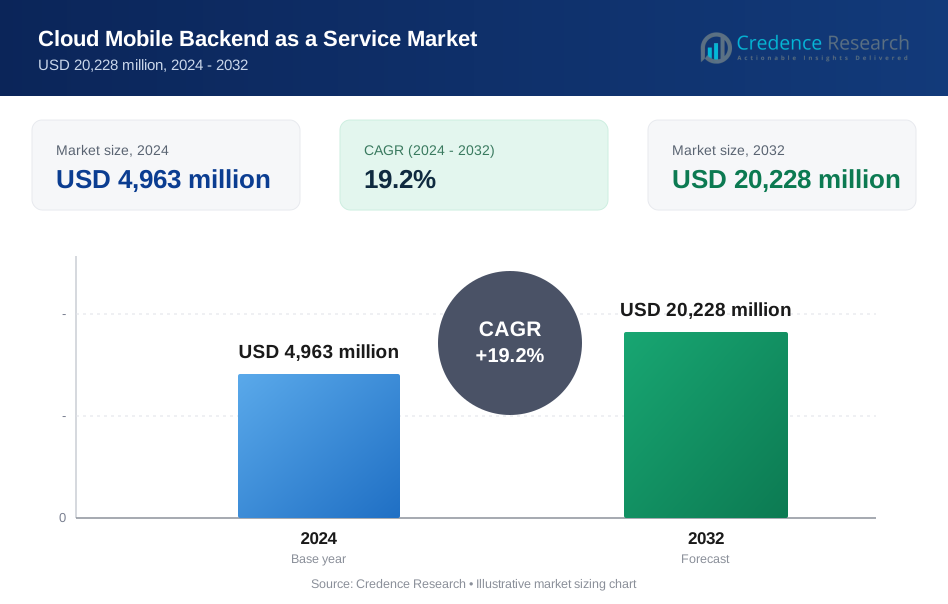
Cloud Mobile Backend as a Service Market was valued at USD 4963 million in 2024 and is anticipated to reach USD 20228 million by 2032, growing at a CAGR of 19.2 % during the forecast period.
| REPORT ATTRIBUTE | DETAILS |
|---|---|
| Historical Period | 2020-2023 |
| Base Year | 2024 |
| Forecast Period | 2025-2032 |
| Cloud Mobile Backend as a Service Market Size 2024 | USD 4963 million |
| Cloud Mobile Backend as a Service Market, CAGR | 19.2% |
| Cloud Mobile Backend as a Service Market Size 2032 | USD 20228 million |
The Cloud Mobile Backend as a Service (MBaaS) market is led by major technology providers such as Amazon Web Services (AWS) Amplify, Google Firebase, Microsoft, IBM, and Oracle, which collectively account for a significant portion of global revenue through their advanced cloud infrastructure, developer tools, and integrated service ecosystems. These companies focus on delivering scalable backend solutions with features such as real-time database management, user authentication, and cross-platform compatibility. North America dominates the global MBaaS market, holding an estimated 38.6% market share in 2024, driven by strong cloud adoption, a mature mobile application ecosystem, and high demand for enterprise mobility solutions across industries such as IT, finance, and healthcare.

Market Insights
- The global Cloud Mobile Backend as a Service (MBaaS) market was valued at USD 4963 million in 2024 and is projected to grow at a CAGR of 19.2 % from 2025 to 2030, driven by the rising demand for scalable mobile app development platforms.
- Growing mobile application adoption, cloud integration, and the need for real-time data synchronization are key drivers accelerating MBaaS adoption across enterprises and developers.
- Emerging trends include increased use of AI-powered backend management, serverless architecture, and multi-cloud deployment models to improve performance and reduce operational costs.
- The market is highly competitive, with leading players such as AWS Amplify, Google Firebase, Microsoft, IBM, and Oracle dominating through innovation, partnerships, and robust developer ecosystems.
- North America held the largest regional share of 38.6% in 2024, while the Database Management service segment accounted for the highest share due to growing data-driven mobile applications.
Market Segmentation Analysis:
By Service
The service segment of the cloud mobile Backend-as-a-Service market is led by the Database Management sub-segment, which held a dominant share in 2024 as mobile applications increasingly demand secure, real-time data access and scalable storage. This sub-segment’s prominence stems from the critical need to handle structured and unstructured data-for example through NoSQL/SQL solutions, real-time streaming and multi-region replication-which underpin features like personalization, analytics and IoT integration. Growth is driven by accelerated digital transformation, rising mobile app usage and the convergence of AI/ML capabilities in backend systems.
- For instance, Amazon DynamoDB Global Tables support fully managed, multi-region, multi-active replication and document that the Replication Latency metric can typically range between 0.5 to 2.5 seconds for regions in the same geographic area.
By Platform Outlook
In the platform outlook of the cloud mobile Backend-as-a-Service market, the Android platform sub-segment is the dominant contributor, with nearly half of the global share in 2023 (around 49.7 %). The leadership of Android results from its extensive global user base-especially in emerging markets where cost-effective devices are widely adopted-and a robust developer ecosystem that leverages open-source flexibility for mobile app development. As organizations target mass-market mobile audiences and multi-device form-factors, Android’s prevalence strengthens demand for backend services tuned to its environment.
- For instance, Google Firebase Analytics shows that one app might record 72 000 users in the past 30 days in the Android channel, providing direct backend service usage and engagement insights.
By Organization Size
Within the organizational-size segmentation of the cloud mobile Backend-as-a-Service market, the Small & Medium Enterprises (SMEs) sub-segment commanded the majority share in 2023 (approx. 54.4 %). SMEs are prime users of MBaaS offerings because they seek rapid deployment of mobile applications, wish to minimise upfront infrastructure investment, and rely on scalable cloud-backends to accelerate go-to-market and cost efficiency. Key drivers include increasing mobile-first strategies among SMEs, the need for agile digital engagement and the push for modernization despite limited in-house IT resources.
Key Growth Drivers
Rising Demand for Scalable Mobile Applications
The rapid expansion of mobile applications across industries such as e-commerce, healthcare, and banking has significantly driven the adoption of Cloud Mobile Backend as a Service (MBaaS). Businesses increasingly seek scalable backend infrastructure to handle growing user bases, real-time data processing, and seamless connectivity across multiple platforms. MBaaS solutions enable developers to focus on front-end features while outsourcing backend complexities like database management, authentication, and cloud integration. This scalability and flexibility allow enterprises to accelerate time-to-market, enhance user experiences, and reduce operational costs, making MBaaS a crucial enabler of mobile-driven digital transformation.
- For instance, Microsoft Azure Cosmos DB supports globally distributed throughput and guarantees single-digit-millisecond latency at the 99th percentile across any region.
Increasing Cloud Adoption Across Enterprises
Enterprises worldwide are migrating workloads to the cloud to achieve agility, cost optimization, and enhanced collaboration. MBaaS platforms leverage cloud infrastructure to offer integrated backend functionalities, reducing the need for manual server management. The increasing reliance on hybrid and multi-cloud environments supports real-time synchronization and scalability, which are essential for modern mobile applications. Additionally, the integration of artificial intelligence (AI) and Internet of Things (IoT) services into cloud platforms further amplifies the demand for MBaaS, as organizations strive to deliver intelligent, connected, and data-driven mobile experiences across sectors such as manufacturing, retail, and education.
- For instance, Amazon EKS now supports up to 100,000 worker nodes in a single cluster, demonstrating the scale that cloud-native platforms can reach.
Growing Developer Preference for Serverless Architecture
The shift toward serverless and API-driven architecture is a major catalyst for MBaaS market growth. Developers increasingly prefer serverless platforms because they eliminate infrastructure management, improve scalability, and lower operational costs. MBaaS offerings built on serverless models automatically manage provisioning, scaling, and maintenance, allowing teams to focus on innovation and app functionality. This approach aligns with agile and DevOps practices, accelerating the software development lifecycle. As organizations adopt microservices-based mobile architectures, the flexibility and responsiveness of MBaaS solutions continue to drive widespread adoption, especially among startups and small to medium enterprises seeking efficient backend management.
Key Trends & Opportunities
Integration of AI and Machine Learning in Backend Services
A major emerging trend in the MBaaS market is the integration of artificial intelligence (AI) and machine learning (ML) to enhance application intelligence and automation. Vendors are embedding AI-based analytics, natural language processing, and predictive algorithms into backend systems, enabling developers to deliver smarter, personalized, and context-aware mobile applications. This capability not only enhances user engagement but also helps businesses gain actionable insights from real-time data. As enterprises increasingly adopt data-driven decision-making models, AI-enabled MBaaS platforms present significant growth opportunities for both developers and service providers in the evolving cloud ecosystem.
- For instance, IBM’s watsonx platform includes the Granite family of foundation models which launched with 13 billion parameter models, enabling enterprises to fine‑tune domain‑specific tasks such as code generation and document summarisation.
Expansion of IoT and Edge Computing Integration
The convergence of MBaaS with Internet of Things (IoT) and edge computing is reshaping the mobile development landscape. Developers now require backend systems capable of managing vast data streams from connected devices in real time. MBaaS platforms integrated with IoT frameworks offer seamless data processing, device management, and analytics capabilities, improving performance and reducing latency. This trend creates new opportunities for industries such as healthcare, logistics, and smart cities, where connected devices rely on cloud-backed mobile apps for functionality and analytics. The growing number of IoT endpoints further expands the addressable market for MBaaS vendors globally.
- For instance, Amazon Web Services’s edge computing services offer access to over 700global Points of Presence (PoPs) and support over 200 integrated device services for IoT and edge scenarios, enabling high‑throughput data processing near the device.
Key Challenges
Data Security and Compliance Concerns
Despite the advantages of MBaaS adoption, data security and regulatory compliance remain critical challenges. Organizations handling sensitive data-especially in finance, healthcare, and government sectors-face concerns related to unauthorized access, data breaches, and compliance with international privacy regulations such as GDPR and HIPAA. The shared-responsibility model of cloud services often complicates accountability for data protection. Vendors are investing heavily in encryption, access control, and multi-factor authentication to address these risks. However, persistent concerns around trust and governance continue to hinder full-scale adoption of MBaaS in highly regulated industries.
Integration Complexity with Legacy Systems
Integrating MBaaS platforms with existing enterprise systems and legacy infrastructure poses another significant challenge. Many organizations operate on outdated architectures that are incompatible with modern cloud-based APIs and services. Migrating such systems requires considerable investment, technical expertise, and time, often resulting in operational disruptions. Furthermore, maintaining interoperability between on-premises databases and cloud-based backend services can be complex, especially in hybrid environments. To overcome these issues, vendors are focusing on offering pre-built connectors, middleware solutions, and integration frameworks, but seamless migration remains a hurdle for widespread MBaaS adoption in traditional enterprises.
Regional Analysis
North America
North America dominates the Cloud Mobile Backend as a Service (MBaaS) market, accounting for approximately 38.6% of the global share in 2024. The region’s leadership is driven by strong cloud infrastructure, high mobile application penetration, and early adoption of digital transformation initiatives. Major technology providers such as AWS, Google, Microsoft, IBM, and Oracle have established extensive cloud ecosystems that support developers and enterprises. Additionally, the region’s focus on enterprise mobility, AI integration, and IoT application development continues to fuel demand for scalable MBaaS platforms across industries like healthcare, BFSI, and retail.
Europe
Europe holds a substantial 26.3% market share in the global MBaaS landscape, supported by growing investments in cloud computing, data protection compliance, and enterprise digitalization. The region’s emphasis on GDPR-compliant cloud services has encouraged the adoption of secure and reliable backend platforms. Countries such as the UK, Germany, and France are key contributors, leveraging MBaaS solutions to support fintech, e-commerce, and industrial IoT applications. European enterprises are increasingly migrating to cloud-native environments to enhance operational efficiency, streamline app deployment, and strengthen data management capabilities.
Asia-Pacific
The Asia-Pacific region is the fastest-growing market, with a projected CAGR of over 25% and a market share of 21.7% in 2024. Growth is fueled by rapid smartphone adoption, expanding internet penetration, and government-led digital initiatives across economies such as China, India, Japan, and South Korea. The increasing number of startups and SMEs focusing on mobile-first strategies drives MBaaS adoption to reduce development time and costs. Additionally, the region’s expanding e-commerce, fintech, and logistics sectors are creating strong demand for scalable, cloud-based backend infrastructures to support high user engagement and data-driven operations.
Latin America
Latin America accounts for roughly 7.8% of the global MBaaS market, driven by rising mobile application usage and increasing cloud adoption among small and medium-sized enterprises. Countries like Brazil and Mexico are leading in digital innovation, supported by growing investments in cloud data centers and developer ecosystems. The region’s focus on improving mobile connectivity and supporting digital startups has accelerated the demand for cost-effective backend services. However, challenges such as limited infrastructure maturity and data security concerns slightly restrain faster market expansion across emerging economies.
Middle East & Africa (MEA)
The Middle East and Africa region represent an emerging segment, holding an estimated 5.6% market share in 2024. The market’s growth is supported by increasing government initiatives in smart cities, e-governance, and digital transformation. Countries such as the UAE, Saudi Arabia, and South Africa are investing in advanced cloud infrastructure to support mobile application ecosystems. MBaaS adoption is gaining traction among telecommunications and fintech sectors seeking agile backend management. Despite infrastructure constraints and slower cloud integration, the region presents long-term growth potential driven by rising internet penetration and cloud modernization strategies.
Market Segmentations:
By Service
- Cloud Storage and Backup
- User authentication
- Database Management
- Push Notifications
By Platform Outlook
- iOS
- Android
- Other Platforms
By Organization Size
- Small & Medium Enterprises (SMEs)
- Large Enterprises
By Geography
- North America
- U.S.
- Canada
- Mexico
- Europe
- Germany
- France
- U.K.
- Italy
- Spain
- Rest of Europe
- Asia Pacific
- China
- Japan
- India
- South Korea
- South-east Asia
- Rest of Asia Pacific
- Latin America
- Brazil
- Argentina
- Rest of Latin America
- Middle East & Africa
- GCC Countries
- South Africa
- Rest of the Middle East and Africa
Competitive Landscape
The Cloud Mobile Backend as a Service (MBaaS) market is characterized by intense competition among global technology leaders and specialized service providers striving to expand their developer ecosystems and cloud portfolios. Key players such as Amazon Web Services (AWS) Amplify, Google Firebase, Microsoft, IBM, and Oracle dominate the market through robust infrastructure, extensive API integration, and advanced analytics capabilities. These vendors leverage their cloud expertise to deliver scalable, secure, and developer-centric backend solutions that reduce app development time and enhance user experience. Emerging participants like Back4App, Kony, Kinvey, CloudMine, Parse, and Reshuffle contribute to market diversity by offering flexible, open-source, and customizable MBaaS platforms targeting small and medium enterprises. Strategic initiatives such as partnerships, mergers, product enhancements, and cloud-native innovations continue to shape competitive dynamics, with emphasis on real-time data management, multi-platform support, and integration with AI and IoT ecosystems.
Key Player Analysis
- Amazon Web Services (AWS) Amplify
- Google Firebase
- Microsoft
- IBM
- Oracle
- Back4App
- Kony
- Kinvey
- CloudMine
- Parse
Recent Developments
- In April 2025, Firebase announced general availability of App Hosting for Angular and Next.js, extending backend automation to full-stack web deployments Firebase Blog.
- In January 2024, Amazon Web Services (AWS) launched an integrated mobile app experience for its AWS Console, enabling users to manage AWS resources directly from their mobile devices. This new functionality allows for convenient monitoring, troubleshooting, and managing cloud services on the go, enhancing operational efficiency and responsiveness for AWS customers. The app supports key features like resource navigation, real-time status updates, and alerts, empowering users to maintain visibility and control over their AWS environments from anywhere.
- In September 2023, Oracle announced new application development capabilities to enable developers to rapidly build and deploy applications on Oracle Cloud Infrastructure (OCI). Designed for cloud-native and Java developers, the new capabilities will help developers build highly responsive and efficient cloud-native applications while reducing costs. In addition, Oracle is building generative AI capabilities for application development to take advantage of cutting-edge large language models with the level of security and privacy that enterprises demand
Report Coverage
The research report offers an in-depth analysis based on Service, Platform Outlook, Organization Size and Geography. It details leading market players, providing an overview of their business, product offerings, investments, revenue streams, and key applications. Additionally, the report includes insights into the competitive environment, SWOT analysis, current market trends, as well as the primary drivers and constraints. Furthermore, it discusses various factors that have driven market expansion in recent years. The report also explores market dynamics, regulatory scenarios, and technological advancements that are shaping the industry. It assesses the impact of external factors and global economic changes on market growth. Lastly, it provides strategic recommendations for new entrants and established companies to navigate the complexities of the market.
Future Outlook
- The Cloud Mobile Backend as a Service market will continue to expand rapidly with growing demand for mobile-first digital transformation.
- Integration of artificial intelligence and machine learning will enhance backend automation and analytics capabilities.
- Serverless and microservices-based architectures will become the preferred models for application scalability and flexibility.
- Rising adoption of edge computing will drive faster, low-latency backend processing for mobile and IoT applications.
- Cross-platform development tools will strengthen as businesses target seamless experiences across Android, iOS, and web ecosystems.
- Security enhancements and compliance-focused backend solutions will gain prominence amid tightening data regulations.
- Small and medium enterprises will increasingly adopt MBaaS platforms to reduce development time and operational costs.
- Partnerships between cloud providers and app developers will accelerate product innovation and ecosystem growth.
- Emerging markets in Asia-Pacific and the Middle East will witness the highest adoption rates due to digital initiatives.
- The focus on real-time data synchronization and API-driven ecosystems will shape the next phase of MBaaS evolution.
Request a Free Sample
Fill in your details and we'll send you a free sample report.
- Sample data tables & charts
- Research methodology
Need a Custom Version of This Report?
Tailor the scope, geography, or segments to your exact requirements.
- Custom geography or segment scope
- Direct access to our analyst team
Frequently Asked Questions
What is the current market size for the Cloud Mobile Backend as a Service Market, and what is its projected size in 2032?
At what Compound Annual Growth Rate is the Cloud Mobile Backend as a Service Market projected to grow between 2025 and 2032?
Which segment held the largest share in 2024?
What are the primary factors fueling the growth of the Cloud Mobile Backend as a Service Market?
Who are the leading companies in the Cloud Mobile Backend as a Service Market?
Which region commanded the largest share of the Cloud Mobile Backend as a Service Market in 2024?
Table of Content
Chapter 1 Market Segmentation
- 1.1 Segmentation Framework
- 1.1.1 Product and Service Classification
- 1.1.2 Application and End-Use Classification
- 1.1.3 Technology and Solution Classification
- 1.1.4 Customer and Distribution Channel Classification
- 1.1.5 Geographic Segmentation
- 1.1.6 Market Segment Definitions and Boundaries
Chapter 2 Introduction
- 2.1 Report Objectives and Scope
- 2.2 Product Definition and Industry Terminology
- 2.3 Market Inclusions and Exclusions
- 2.4 Research Process
- 2.4.1 Primary Research and Expert Interviews
- 2.4.2 Secondary Research and Source Review
- 2.4.3 Top-Down and Bottom-Up Estimation
- 2.4.4 Data Triangulation and Verification
- 2.5 Market Size Measurement Basis
- 2.5.1 2024: USD 4,963 million → 2032: USD 20,228 million
- 2.6 Historical and Forecast Reference Periods
- 2.6.1 Base Year: 2024
- 2.6.2 Forecast Period: 2024-2032
- 2.7 Research Assumptions and Limitations
Chapter 3 Executive Summary
- 3.1 Market Snapshot and Key Findings
- 3.2 Base-Year Market Size, 2024
- 3.3 Forecast Market Size, 2032
- 3.4 Revenue and Volume Growth Outlook
- 3.5 Key Demand and Supply Indicators
- 3.6 Leading Market Segments
- 3.7 Fastest-Growing Market Opportunities
- 3.8 Regional Performance Highlights
- 3.9 Technology and Industry Transformation
- 3.10 Competitive Landscape Summary
- 3.11 Analyst View and Strategic Implications
Chapter 4 Global Cloud Mobile Backend as a Service Market Trends and Developments
- 4.1 Historical Industry Development
- 4.2 Recent Market Trends and Developments
- 4.3 Demand and Customer Behavior Trends
- 4.4 Technology and Product Innovation
- 4.5 Artificial Intelligence, Automation and Digitalization
- 4.6 Local Manufacturing and Supply Chain Realignment
- 4.7 Industry Partnerships, Mergers and Acquisitions
- 4.8 Sustainability and Circular Economy Developments
- 4.9 Government and Private Sector Investment Trends
- 4.10 Emerging Business Models and Commercialization
- 4.11 Industry Developments and Announcements
Chapter 5 Global Cloud Mobile Backend as a Service Market Supply and Demand Analysis
- 5.1 Demand Trend and Consumption Analysis
- 5.2 Demand Forecast, 2024-2032
- 5.3 Supply Chain Structure and Procurement Trends
- 5.4 Supply-Demand Gap and Bottlenecks
- 5.5 Import Dependence and Sourcing Structure
- 5.6 Regional Supply and Demand Concentration
Chapter 6 Global Cloud Mobile Backend as a Service Market Pricing Analysis
- 6.1 Pricing Structure and Measurement
- 6.2 Historical Pricing Trends
- 6.3 Pricing Outlook, 2024-2032
- 6.4 Pricing by Product and Market Segment
- 6.5 Geographic Pricing Differences
- 6.6 Key Input, Energy, Labor and Logistics Costs
- 6.7 Contract Pricing and Purchasing Models
- 6.8 Pricing Sensitivity and Competitive Positioning
- 6.9 Price, Margin and Profitability Implications
Chapter 7 Global Cloud Mobile Backend as a Service Market Dynamics
- 7.1 Market Growth Drivers
- 7.1.1 Demand-Side Drivers
- 7.1.2 Technology and Innovation Drivers
- 7.1.3 Infrastructure and Investment Drivers
- 7.1.4 Regulatory and Policy Drivers
- 7.2 Market Restraints
- 7.2.1 Cost and Affordability Constraints
- 7.2.2 Technology and Adoption Barriers
- 7.2.3 Supply Chain and Operational Constraints
- 7.3 Market Challenges
- 7.3.1 Competitive Pressure and Margin Erosion
- 7.3.2 Skills, Infrastructure and Implementation Gaps
- 7.4 Emerging Market Opportunities
- 7.5 Market Dynamics Impact and Time-Horizon Assessment
Chapter 8 Global Cloud Mobile Backend as a Service Value Chain Analysis
- 8.1 Industry Value Chain Overview
- 8.2 Upstream Suppliers and Critical Inputs
- 8.3 Technology and Component Providers
- 8.4 Manufacturing or Service Delivery
- 8.5 Distribution, Channel Partners and Integrators
- 8.6 Downstream Applications and End Users
- 8.7 Value Addition and Profit Pools
- 8.8 Vertical Integration and Outsourcing
- 8.9 Supplier Concentration and Risk
- 8.10 Supply Chain Localization and Resilience
Chapter 9 Global Cloud Mobile Backend as a Service Market Regulations and Policies
- 9.1 Relevant Laws, Standards and Compliance Frameworks
- 9.2 Product, Service, Safety and Quality Requirements
- 9.3 Government Policies, Incentives and Subsidies
- 9.4 Imports, Exports and Trade Barriers
- 9.5 Public Procurement and Local Content Requirements
- 9.6 Data Protection, AI and Cybersecurity Compliance
- 9.7 Upcoming Policy Changes and Market Implications
Chapter 10 Global Cloud Mobile Backend as a Service Market Hotspots and Opportunities
- 10.1 Market Opportunity Mapping and Growth Hotspots
- 10.2 High-Growth Applications and Customer Groups
- 10.3 Underserved Markets and White-Space Opportunities
- 10.4 Emerging Technology and Product Opportunities
- 10.5 New Capacity and Investment Hotspots
- 10.6 Market Entry and Expansion Opportunities
- 10.7 Distribution and Partnership Opportunities
- 10.8 Near-Term and Long-Term Commercial Potential
- 10.9 Opportunity Attractiveness and Execution Risks
Chapter 11 Global Cloud Mobile Backend as a Service Market Outlook, 2024-2032
- 11.1 Market Size and Analysis
- 11.1.1 Revenue (Market Measurement: 2024: USD 4,963 million → 2032: USD 20,228 million)
- 11.1.2 Historical Market Size
- 11.1.3 Base-Year Market Size, 2024
- 11.2 Market Forecast, 2024-2032
- 11.2.1 Revenue Forecast to 2032
- 11.2.2 CAGR and Year-on-Year Growth
- 11.2.3 Incremental Revenue Opportunity
- 11.3 Forecast Assumptions and Scenario Analysis
- 11.3.1 Base-Case Forecast
- 11.3.2 Optimistic and Conservative Scenarios
- 11.3.3 Technology, Pricing and Policy Sensitivities
- 11.4 Market Attractiveness and Growth Outlook
Chapter 12 Global Cloud Mobile Backend as a Service Market Segmentation and Outlook
- 12.1 Segmentation Summary and Market Shares, 2024
- 12.2 Largest and Fastest-Growing Segments
- 12.3 Segment Growth Comparison
- 12.4 Segment Attractiveness and Priority Matrix
Chapter 13 Global Cloud Mobile Backend as a Service Geographic Market Outlook, 2024-2032
- 13.1 Regional Market Size and Share, 2024
- 13.2 Regional Market Forecast, 2024-2032
- 13.3 Regional Pricing, Production and Demand Differences
- 13.4 North America
- 13.4.1 United States
- 13.4.2 Canada
- 13.4.3 Mexico
- 13.5 Europe
- 13.5.1 Germany
- 13.5.2 France
- 13.5.3 Italy
- 13.5.4 United Kingdom
- 13.5.5 Spain
- 13.5.6 Poland
- 13.5.7 Russia
- 13.5.8 Netherlands
- 13.5.9 Belgium
- 13.5.10 Sweden
- 13.5.11 Denmark
- 13.5.12 Norway
- 13.5.13 Rest of Europe
- 13.6 Asia Pacific
- 13.6.1 China
- 13.6.2 India
- 13.6.3 Japan
- 13.6.4 South Korea
- 13.6.5 Thailand
- 13.6.6 Indonesia
- 13.6.7 Vietnam
- 13.6.8 Malaysia
- 13.6.9 Australia
- 13.6.10 Rest of Asia Pacific
- 13.7 Latin America
- 13.7.1 Brazil
- 13.7.2 Argentina
- 13.7.3 Colombia
- 13.7.4 Chile
- 13.7.5 Rest of Latin America
- 13.8 Middle East
- 13.8.1 Saudi Arabia
- 13.8.2 United Arab Emirates
- 13.8.3 Turkey
- 13.8.4 Israel
- 13.8.5 Iran
- 13.8.6 Rest of the Middle East
- 13.9 Africa
- 13.9.1 South Africa
- 13.9.2 Egypt
- 13.9.3 Nigeria
- 13.9.4 Morocco
- 13.9.5 Rest of Africa
- 13.10 Regional Investment, Policy and Supply Chain Differences
- 13.11 Regional Competitive Landscape
- 13.12 Geographic Growth Hotspots
Chapter 14 Global Cloud Mobile Backend as a Service Technology, Innovation and Sustainability Outlook
- 14.1 Technology Landscape and Maturity
- 14.2 Product, Process and Service Innovation
- 14.3 AI, Automation and Digital Tools in the Industry
- 14.4 Technology Adoption and Performance Benchmarking
- 14.5 Innovation Pipeline and R&D Investment
- 14.6 Energy Efficiency and Resource Management
- 14.7 Sustainability, Recycling and Circularity
- 14.8 Technology Roadmap, 2024-2032
- 14.9 Risks of Obsolescence and Technology Substitution
Chapter 15 Global Cloud Mobile Backend as a Service Market Key Strategic Imperatives
- 15.1 Growth and Market Entry Priorities
- 15.2 High-Return Products and Segments
- 15.3 Pricing, Profitability and Cost Optimization
- 15.4 Technology Investment and Product Differentiation
- 15.5 Supply Chain Localization and Resilience
- 15.6 Distribution and Customer Acquisition
- 15.7 Partnership, Acquisition and Capacity Strategy
- 15.8 Regional Expansion Priorities
- 15.9 Short-, Medium- and Long-Term Actions
Chapter 16 Competition Outlook
- 16.1 Industry Competition Characteristics
- 16.2 Market Structure and Concentration
- 16.3 Market Share and Competitive Positioning, 2024
- 16.4 Company-Wise Revenue and Product Benchmarking
- 16.5 Production and Service Capacity Benchmarking
- 16.6 Technology, Pricing and Differentiation
- 16.7 Regional Footprint and Distribution Strength
- 16.8 Mergers, Acquisitions and Strategic Alliances
- 16.9 New Entrants and Competitive Threats
- 16.10 Porter's Five Forces and Industry Attractiveness
- 16.11 Competitive Outlook, 2024-2032
Chapter 17 Company Profiles
- 17.1 Company Coverage and Selection Criteria
- 17.2 Leading Market Participants – Standard Profile Structure
- 17.2.1 Business Description
- 17.2.2 Company Ownership and Geographic Presence
- 17.2.3 Product and Service Portfolio
- 17.2.4 Manufacturing and Operating Footprint
- 17.2.5 Financial Performance and Investment
- 17.2.6 Market Share and Competitive Position
- 17.2.7 Technology and Innovation Capabilities
- 17.2.8 Strategic Alliances or Partnerships
- 17.2.9 Recent Developments
- 17.2.10 Growth Strategy and Outlook
- 17.3 Other Relevant Market Participants
Note: Every listed company is profiled on the structure shown under the first company. The company list is preliminary and may change based on research findings, market developments, data availability and client requirements.
Chapter 18 Disclaimer
- 18.1 Research and Forecast Disclaimer
- 18.2 Data Source and Estimation Limitations
Note: The depth of individual sections depends on data availability for this market. Volume, capacity, trade and other unit-based metrics are included where applicable.

