
Market Overview:
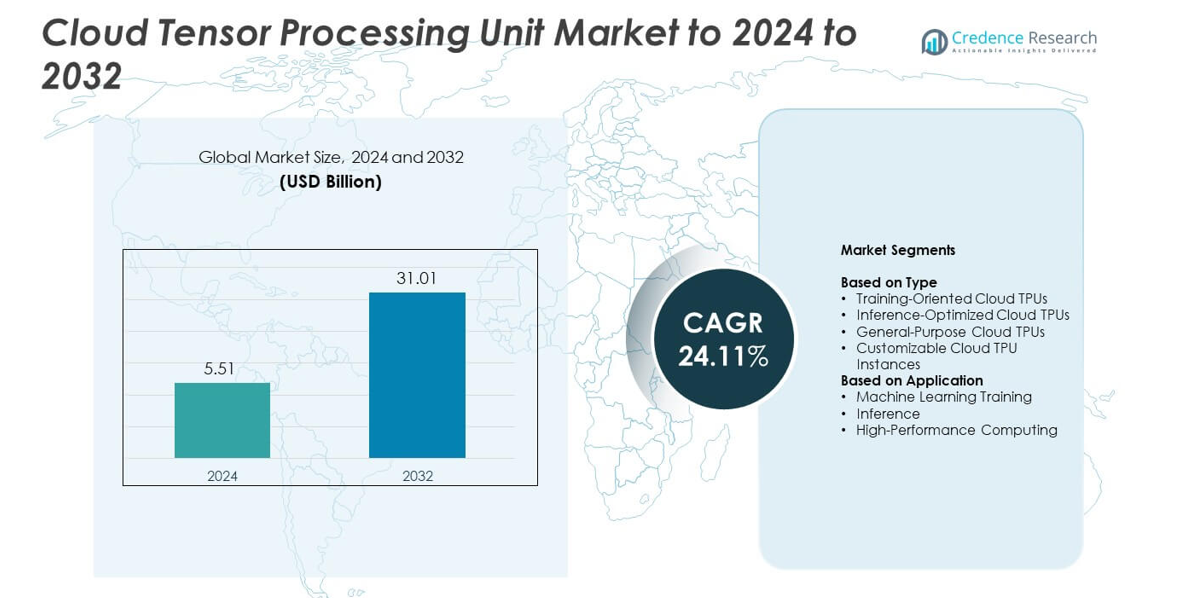
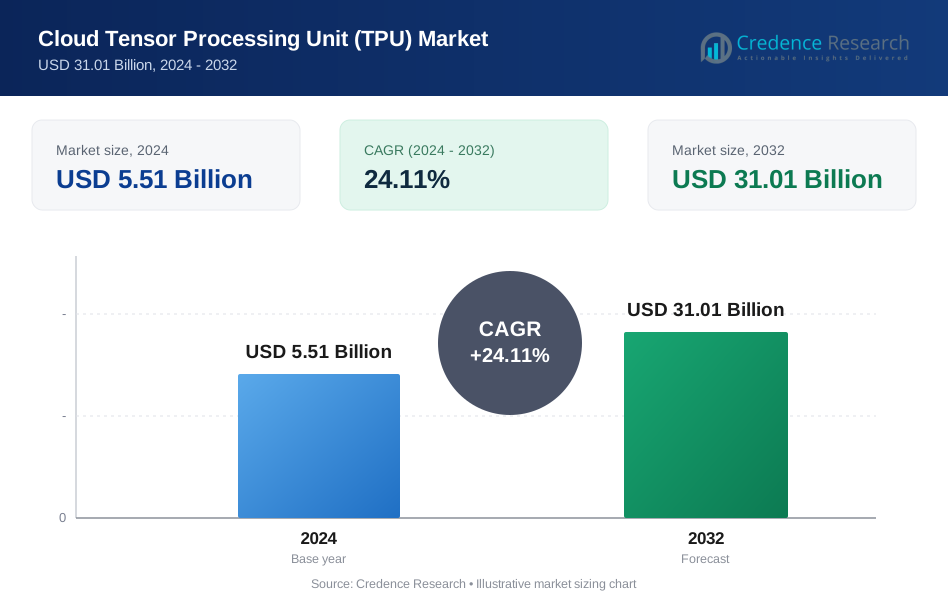
Cloud Tensor Processing Unit Market size was valued at USD 5.51 Billion in 2024 and is anticipated to reach USD 31.01 Billion by 2032, at a CAGR of 24.11% during the forecast period.
| REPORT ATTRIBUTE | DETAILS |
|---|---|
| Historical Period | 2020-2023 |
| Base Year | 2024 |
| Forecast Period | 2025-2032 |
| Cloud Tensor Processing Unit Market Size 2024 | USD 5.51 Billion |
| Cloud Tensor Processing Unit Market, CAGR | 24.11% |
| Cloud Tensor Processing Unit Market Size 2032 | USD 31.01 Billion |
The Cloud Tensor Processing Unit Market includes leading providers such as Amazon Web Services (AWS), Oracle Cloud Infrastructure, Microsoft Azure, Alibaba Cloud, Google Cloud Platform, and IBM Cloud, each expanding advanced AI compute capabilities to support enterprise-scale model training and inference. These companies compete by enhancing TPU performance, reducing latency, and improving cost efficiency across cloud environments. North America dominated the market in 2024 with about 41% share due to strong AI adoption, extensive cloud infrastructure, and high investment in large-model development. Europe and Asia Pacific followed with growing demand from automation, analytics, and generative AI workloads.
Market Insights
- Cloud Tensor Processing Unit Market reached USD 5.51 Billion in 2024 and is projected to hit USD 31.01 Billion by 2032, growing at a CAGR of 24.11%.
- Strong demand for large-model training and scalable AI compute drives rapid adoption, with training-oriented cloud TPUs holding about 46% share due to heavy enterprise usage in deep learning workloads.
- Generative AI expansion and rising interest in energy-efficient accelerated computing shape key market trends, supported by growing preference for customizable TPU instances across industries.
- Competition intensifies as major cloud providers enhance TPU performance, optimize pricing models, and expand global data center networks to improve access and efficiency for AI developers.
- North America led the market in 2024 with around 41% share, followed by Europe at about 27% and Asia Pacific at roughly 24%, while Latin America and Middle East & Africa together accounted for nearly 8% as adoption continued to grow.
Market Segmentation Analysis:
By Type
Training-oriented cloud TPUs held the dominant position in 2024 with about 46% share due to strong use in large-scale model training across generative AI, speech models, and vision networks. These TPUs delivered high matrix throughput and supported parallelism for complex workloads. Inference-optimized TPUs expanded as companies scaled real-time AI services. General-purpose TPUs gained steady demand from cloud users seeking balanced performance. Customizable TPU instances grew as enterprises adopted flexible configurations for cost-efficient deployments.
- For instance, Google’s Cloud TPU v4 pod links 4,096 chips and delivers about 1.1 exaFLOPS of peak compute for large-scale model training.
By Application
Machine learning training led the segment in 2024 with nearly 57% share because enterprises used TPUs to accelerate deep learning workloads and reduce training time for large foundation models. Training tasks benefited from improved compute density and high-speed interconnects. Inference workloads increased as AI adoption in cloud services and automation grew. High-performance computing applications advanced as research groups and technical teams used TPUs for simulation, optimization, and advanced analytics.
- For instance, Amazon EC2 Inf2 instances use up to 12 Inferentia2 chips to provide around 2.3 petaFLOPS of BF16 or FP16 compute for low-latency inference.
Key Growth Drivers
Rising Adoption of Large AI Models
Demand for cloud TPUs grew as organizations trained larger and more complex AI models across language, vision, and multimodal tasks. These workloads required high compute density, low latency, and strong parallel processing, which TPUs delivered at scale. Enterprises shifted toward accelerated computing to improve model accuracy and reduce training cycles. This shift strengthened cloud TPU usage across tech, healthcare, finance, and retail, making advanced model training a major growth driver for the market.
- For instance, xAI operates the world's largest operational AI supercomputer, the Colossus cluster, which uses an estimated 200,000 GPUs (a mix of H100 and H200 units) as of late 2024/early 2025.
Expansion of AI Integration Across Industries
Wider adoption of AI workloads across sectors increased TPU deployment in cloud environments. Companies relied on accelerated infrastructure to support applications such as predictive analytics, image recognition, autonomous decision-making, and personalized digital services. This growth pushed demand for scalable and cost-efficient TPU clusters that handled diverse enterprise workloads. Rising digital transformation strategies across global industries reinforced this expansion, making broad AI integration a key growth driver for cloud TPU demand.
- For instance, the Salesforce Einstein platform now delivers over 200 billion AI-powered predictions every day across all Salesforce products, including sales, service, marketing, and commerce clouds.
Growth in Cloud-Based AI Infrastructure Investments
Cloud providers expanded TPU availability to support rising enterprise migration toward scalable AI compute. Investments focused on high-efficiency TPU pods, energy-optimized architectures, and global data center expansion. These advancements provided stronger performance and lower operating costs for AI development teams. Increased cloud adoption created long-term demand for TPU-based compute resources, positioning infrastructure expansion as a strategic growth driver for the market.
Key Trends and Opportunities
Shift Toward Generative AI Workloads
Generative AI adoption accelerated TPU demand as enterprises built and deployed large-scale models for content creation, automation, and data augmentation. Cloud TPUs supported fast training cycles and efficient inference for generative systems. This trend opened opportunities for cloud providers to introduce specialized TPU versions optimized for large memory needs and distributed training. Strong enterprise interest in generative applications positioned this shift as a major trend and opportunity.
- For instance, SAP’s roadmap for SAP Business AI targets roughly 400 embedded AI use cases by 2025, building on more than 200 existing AI features across its enterprise portfolio.
Rising Demand for Energy-Efficient AI Compute
Energy efficiency became a priority as organizations sought lower operating costs and greener AI infrastructure. Cloud TPUs offered strong performance per watt, making them attractive for sustainable compute strategies. Providers introduced improved thermal design, optimized interconnects, and next-generation tensor cores to maximize efficiency. The push for sustainable AI systems created opportunities for TPU-based data centers to gain adoption among enterprises focused on ESG goals and reduced power consumption.
- For instance, Huawei’s Atlas 950 SuperCluster combines 64 SuperPoDs and 524,288 Ascend 950DT accelerators to deliver about 1 FP4 zettaFLOPS for inference and 524 FP8 exaFLOPS for training within one system.
Growth of Customizable TPU Instances
Flexible TPU configurations gained attention as enterprises sought tailored performance levels for specific workloads. This trend supported wider adoption among mid-sized businesses and research groups that required scalable yet cost-efficient compute. Cloud vendors offered adjustable memory sizes, core counts, and network capacity, enabling finer workload matching. This customization opportunity expanded the market by reducing barriers to adopting high-performance TPU compute environments.
Key Challenges
High Cost of Advanced AI Compute Infrastructure
Cloud TPU adoption faced challenges due to high compute costs, especially for large-scale training workloads. Complex AI models demanded extended training cycles, which increased spending for enterprises with limited budgets. Cost-sensitive sectors struggled to adopt TPU-powered systems at scale. Although cloud vendors introduced optimized pricing and shared clusters, overall cost barriers remained a major challenge for broader adoption in emerging markets and smaller organizations.
Technical Complexity and Integration Barriers
Enterprises often faced difficulty integrating cloud TPUs into existing AI pipelines due to specialized tooling, compatibility requirements, and limited in-house expertise. Migrating workloads from GPUs to TPUs required new development practices and updated model architectures. This complexity slowed adoption for teams lacking advanced machine learning engineering skills. Limited availability of TPU-optimized frameworks also created integration friction, making technical complexity a significant challenge for the market.
Regional Analysis
North America
North America held the largest share in 2024 with about 41% due to strong cloud adoption, advanced AI infrastructure, and heavy investment from major providers. The region benefited from rapid growth in generative AI, autonomous systems, and enterprise automation, which increased demand for high-performance TPU clusters. Technology companies, financial institutions, and healthcare networks expanded large-scale AI projects, strengthening regional leadership. Supportive innovation policies and a mature digital ecosystem further pushed TPU integration across industries.
Europe
Europe accounted for nearly 27% share in 2024 as enterprises adopted cloud-based AI solutions to support automation, smart manufacturing, and advanced data analytics. Increased regulatory focus on trustworthy AI encouraged investment in secure and efficient compute systems. Cloud vendors expanded TPU availability across major EU countries, enabling enterprise users to train complex models with improved compliance. Strong digitalization efforts in automotive, industrial equipment, and public services also supported wider TPU deployments across the region.
Asia Pacific
Asia Pacific captured about 24% share in 2024, supported by rapid growth in cloud spending, AI-driven consumer platforms, and large-scale digital transformation across enterprises. Strong demand from telecommunications, e-commerce, and financial services boosted TPU usage for training and inference workloads. Governments increased investment in AI research and hyperscale data centers, strengthening regional uptake. Expanding adoption of machine learning in manufacturing, robotics, and smart city projects positioned Asia Pacific as the fastest-growing regional market.
Latin America
Latin America held close to 5% share in 2024 as enterprises gradually adopted cloud-based AI solutions to improve analytics, automation, and digital services. TPU deployment increased in sectors such as banking, retail, and telecommunications, driven by rising demand for faster model processing. Cloud providers expanded regional data center presence, improving access to high-performance compute. Although adoption remained lower than major regions, increasing digital modernization and AI investment supported steady market growth.
Middle East & Africa
Middle East & Africa accounted for around 3% share in 2024, supported by emerging AI deployment in government, energy, banking, and urban development projects. Countries in the Gulf region invested in cloud infrastructure to accelerate national digital strategies and smart city initiatives. Growing demand for machine learning and predictive analytics encouraged early TPU adoption. Limited technical expertise and slower enterprise modernization moderated growth, but improving cloud availability continued to expand adoption across key industries.
Market Segmentations:
By Type
- Training-Oriented Cloud TPUs
- Inference-Optimized Cloud TPUs
- General-Purpose Cloud TPUs
- Customizable Cloud TPU Instances
By Application
- Machine Learning Training
- Inference
- High-Performance Computing
By Geography
- North America
- U.S.
- Canada
- Mexico
- Europe
- Germany
- France
- U.K.
- Italy
- Spain
- Rest of Europe
- Asia Pacific
- China
- Japan
- India
- South Korea
- South-east Asia
- Rest of Asia Pacific
- Latin America
- Brazil
- Argentina
- Rest of Latin America
- Middle East & Africa
- GCC Countries
- South Africa
- Rest of the Middle East and Africa
Competitive Landscape
The competitive landscape in the Cloud Tensor Processing Unit Market features Amazon Web Services (AWS), Oracle Cloud Infrastructure, Microsoft Azure, Alibaba Cloud, Google Cloud Platform, and IBM Cloud in the first line, with rivalry centered on advanced AI compute capabilities and scalable cloud architectures. Providers focus on improving training throughput, lowering inference latency, and offering energy-efficient TPU alternatives to meet rising enterprise demand. Competition intensifies as vendors expand data center footprints, enhance interconnect speeds, and introduce flexible instance configurations. Strategic partnerships with AI software developers and enterprise clients help strengthen platform adoption. Continuous innovation in tensor processing architecture, optimized ML frameworks, and integrated development environments further shapes competition. Vendors also prioritize cost efficiency through usage-based pricing models and optimization tools, aiming to attract AI teams managing large and complex workloads. This combination of performance innovation, global expansion, and ecosystem integration defines the evolving market landscape.
Key Player Analysis
- Amazon Web Services (AWS)
- Oracle Cloud Infrastructure
- Microsoft Azure
- Alibaba Cloud
- Google Cloud Platform
- IBM Cloud
Recent Developments
- In 2025, Google Cloud Platform unveiled Ironwood, its seventh-generation Tensor Processing Unit (TPU), at the Google Cloud Next conference
- In 2024, Amazon Web Services (AWS) announced details about the next-generation Trainium 3 AI training chip, expected to be four times more performant than its predecessor.
- In 2023, Microsoft Azure Launched new Azure Virtual Machines with NVIDIA H100 GPUs and developed custom silicon, including the Azure Maia AI accelerator chip.
Report Coverage
The research report offers an in-depth analysis based on Type, Application and Geography. It details leading market players, providing an overview of their business, product offerings, investments, revenue streams, and key applications. Additionally, the report includes insights into the competitive environment, SWOT analysis, current market trends, as well as the primary drivers and constraints. Furthermore, it discusses various factors that have driven market expansion in recent years. The report also explores market dynamics, regulatory scenarios, and technological advancements that are shaping the industry. It assesses the impact of external factors and global economic changes on market growth. Lastly, it provides strategic recommendations for new entrants and established companies to navigate the complexities of the market.
Future Outlook
- The market will grow as enterprises scale generative AI and large-model training.
- Cloud providers will expand TPU clusters to support faster and more efficient workloads.
- Demand for energy-efficient AI compute will push adoption of next-generation TPU designs.
- Customizable TPU instances will attract mid-sized businesses seeking flexible performance.
- Integration of TPUs into multimodal AI systems will accelerate across industries.
- Wider use of AI in automation will increase real-time inference workloads on TPUs.
- Hybrid cloud strategies will strengthen TPU adoption in regulated sectors.
- Advancements in tensor core architecture will reduce training time for complex models.
- Global data center expansion will improve regional access to TPU compute.
- Partnerships between cloud vendors and AI developers will drive optimized TPU ecosystems.
Request a Free Sample
Fill in your details and we'll send you a free sample report.
- Sample data tables & charts
- Research methodology
Market Dynamics
Rising Adoption of Large AI Models
Organizations are increasingly training larger and more complex AI models for language, vision, and multimodal tasks, which require the high compute density and parallel processing capabilities of cloud TPUs. This trend is driving significant demand for scalable TPU infrastructure to accelerate model development and deployment.
Expansion of AI Integration Across Industries
The integration of AI into sectors such as healthcare, finance, retail, and manufacturing is boosting the need for cloud-based TPU resources to support applications like predictive analytics, automation, and personalized services. As digital transformation accelerates, enterprises are turning to TPUs for efficient and scalable AI compute.
Growth in Cloud-Based AI Infrastructure Investments
Major cloud providers are investing heavily in expanding TPU availability, building high-efficiency TPU pods, and deploying global data centers. These investments enable enterprises to access advanced AI compute resources with lower operational costs and improved performance, fueling market growth.
Shift Toward Generative AI Workloads
The rapid adoption of generative AI for content creation, automation, and data augmentation is increasing the need for high-performance TPUs capable of supporting fast training cycles and efficient inference. Cloud providers are responding by introducing specialized TPU versions optimized for these demanding workloads.
Rising Demand for Energy-Efficient AI Compute
As organizations prioritize sustainability and cost reduction, energy-efficient TPUs are becoming more attractive for large-scale AI operations. Innovations in thermal design and tensor core architecture are enabling enterprises to achieve high performance per watt, supporting both ESG goals and operational efficiency.
Need a Custom Version of This Report?
Tailor the scope, geography, or segments to your exact requirements.
- Custom geography or segment scope
- Direct access to our analyst team
Frequently Asked Questions
What is the current market size for Cloud Tensor Processing Unit Market, and what is its projected size in 2032?
At what Compound Annual Growth Rate is the Cloud Tensor Processing Unit Market projected to grow between 2025 and 2032?
Which is the leading market for Cloud Tensor Processing Unit (TPU)?
What are the key drivers for the growth of the Cloud Tensor Processing Unit (TPU) market?
Which is the major segment in Cloud Tensor Processing Unit (TPU) Market by End Users/Applications?
Who are the leading companies in the Cloud Tensor Processing Unit Market?
Table of Content
Chapter 1 Market Segmentation
- 1.1 Segmentation Framework
- 1.1.1 Product and Service Classification
- 1.1.2 Application and End-Use Classification
- 1.1.3 Technology and Solution Classification
- 1.1.4 Customer and Distribution Channel Classification
- 1.1.5 Geographic Segmentation
- 1.1.6 Market Segment Definitions and Boundaries
- 1.2 By Type
- 1.2.1 Training-Oriented Cloud TPUs
- 1.2.2 Inference-Optimized Cloud TPUs
- 1.2.3 General-Purpose Cloud TPUs
- 1.2.4 Customizable Cloud TPU Instances
- 1.3 By Application
- 1.3.1 Machine Learning Training
- 1.3.2 Inference
- 1.3.3 High-Performance Computing
Chapter 2 Introduction
- 2.1 Report Objectives and Scope
- 2.2 Product Definition and Industry Terminology
- 2.3 Market Inclusions and Exclusions
- 2.4 Research Process
- 2.4.1 Primary Research and Expert Interviews
- 2.4.2 Secondary Research and Source Review
- 2.4.3 Top-Down and Bottom-Up Estimation
- 2.4.4 Data Triangulation and Verification
- 2.5 Market Size Measurement Basis
- 2.5.1 2024: USD 5.51 Billion → 2032: USD 31.01 Billion
- 2.6 Historical and Forecast Reference Periods
- 2.6.1 Base Year: 2024
- 2.6.2 Forecast Period: 2024-2032
- 2.7 Research Assumptions and Limitations
Chapter 3 Executive Summary
- 3.1 Market Snapshot and Key Findings
- 3.2 Base-Year Market Size, 2024
- 3.3 Forecast Market Size, 2032
- 3.4 Revenue and Volume Growth Outlook
- 3.5 Key Demand and Supply Indicators
- 3.6 Leading Market Segments
- 3.7 Fastest-Growing Market Opportunities
- 3.8 Regional Performance Highlights
- 3.9 Technology and Industry Transformation
- 3.10 Competitive Landscape Summary
- 3.11 Analyst View and Strategic Implications
Chapter 4 Global Cloud Tensor Processing Unit (TPU) Market Trends and Developments
- 4.1 Historical Industry Development
- 4.2 Recent Market Trends and Developments
- 4.3 Demand and Customer Behavior Trends
- 4.4 Technology and Product Innovation
- 4.5 Artificial Intelligence, Automation and Digitalization
- 4.6 Local Manufacturing and Supply Chain Realignment
- 4.7 Industry Partnerships, Mergers and Acquisitions
- 4.8 Sustainability and Circular Economy Developments
- 4.9 Government and Private Sector Investment Trends
- 4.10 Emerging Business Models and Commercialization
- 4.11 Industry Developments and Announcements
Chapter 5 Global Cloud Tensor Processing Unit (TPU) Market Production, Supply and Demand Analysis
- 5.1 Demand Trend and Consumption Analysis
- 5.2 Demand Forecast, 2024-2032
- 5.3 Production and Output Trend
- 5.4 Production and Output Forecast, 2024-2032
- 5.5 Installed Capacity and Capacity Utilization
- 5.6 Company-Wise Production Plants and Statistics
- 5.6.1 Installed Production Capacity
- 5.6.2 Actual Production
- 5.6.3 Planned Capacity and Expansion Targets
- 5.7 Supply Chain Structure and Procurement Trends
- 5.8 Supply-Demand Gap and Bottlenecks
- 5.9 Import Dependence and Sourcing Structure
- 5.10 Contract Manufacturing and Outsourcing
- 5.11 Regional Supply and Demand Concentration
Chapter 6 Global Cloud Tensor Processing Unit (TPU) Market Pricing Analysis
- 6.1 Pricing Structure and Measurement
- 6.2 Historical Pricing Trends
- 6.3 Pricing Outlook, 2024-2032
- 6.4 Average Selling Price and Unit Economics
- 6.5 Pricing by Product and Market Segment
- 6.6 Geographic Pricing Differences
- 6.7 Key Input, Energy, Labor and Logistics Costs
- 6.8 Contract Pricing and Purchasing Models
- 6.9 Pricing Sensitivity and Competitive Positioning
- 6.10 Price, Margin and Profitability Implications
Chapter 7 Global Cloud Tensor Processing Unit (TPU) Market Dynamics
- 7.1 Market Growth Drivers
- 7.1.1 Demand-Side Drivers
- 7.1.2 Technology and Innovation Drivers
- 7.1.3 Infrastructure and Investment Drivers
- 7.1.4 Regulatory and Policy Drivers
- 7.2 Market Restraints
- 7.2.1 Cost and Affordability Constraints
- 7.2.2 Technology and Adoption Barriers
- 7.2.3 Supply Chain and Operational Constraints
- 7.3 Market Challenges
- 7.3.1 Competitive Pressure and Margin Erosion
- 7.3.2 Skills, Infrastructure and Implementation Gaps
- 7.4 Emerging Market Opportunities
- 7.5 Market Dynamics Impact and Time-Horizon Assessment
Chapter 8 Global Cloud Tensor Processing Unit (TPU) Value Chain Analysis
- 8.1 Industry Value Chain Overview
- 8.2 Upstream Suppliers and Critical Inputs
- 8.3 Technology and Component Providers
- 8.4 Manufacturing or Service Delivery
- 8.5 Distribution, Channel Partners and Integrators
- 8.6 Downstream Applications and End Users
- 8.7 Value Addition and Profit Pools
- 8.8 Vertical Integration and Outsourcing
- 8.9 Supplier Concentration and Risk
- 8.10 Supply Chain Localization and Resilience
Chapter 9 Global Cloud Tensor Processing Unit (TPU) Market Regulations and Policies
- 9.1 Relevant Laws, Standards and Compliance Frameworks
- 9.2 Product, Service, Safety and Quality Requirements
- 9.3 Government Policies, Incentives and Subsidies
- 9.4 Imports, Exports and Trade Barriers
- 9.5 Public Procurement and Local Content Requirements
- 9.6 Environmental and Sustainability Compliance
- 9.7 Data Protection, AI and Cybersecurity Compliance
- 9.8 Upcoming Policy Changes and Market Implications
Chapter 10 Global Cloud Tensor Processing Unit (TPU) Market Hotspots and Opportunities
- 10.1 Market Opportunity Mapping and Growth Hotspots
- 10.2 High-Growth Applications and Customer Groups
- 10.3 Underserved Markets and White-Space Opportunities
- 10.4 Emerging Technology and Product Opportunities
- 10.5 New Capacity and Investment Hotspots
- 10.6 Market Entry and Expansion Opportunities
- 10.7 Distribution and Partnership Opportunities
- 10.8 Near-Term and Long-Term Commercial Potential
- 10.9 Opportunity Attractiveness and Execution Risks
Chapter 11 Global Cloud Tensor Processing Unit (TPU) Market Outlook, 2024-2032
- 11.1 Market Size and Analysis
- 11.1.1 Revenue (Market Measurement: 2024: USD 5.51 Billion → 2032: USD 31.01 Billion)
- 11.1.2 Market Volume and Quantity Sold
- 11.1.3 Historical Market Size
- 11.1.4 Base-Year Market Size, 2024
- 11.2 Market Forecast, 2024-2032
- 11.2.1 Revenue Forecast to 2032
- 11.2.2 Volume Forecast to 2032
- 11.2.3 CAGR and Year-on-Year Growth
- 11.2.4 Incremental Revenue Opportunity
- 11.3 Forecast Assumptions and Scenario Analysis
- 11.3.1 Base-Case Forecast
- 11.3.2 Optimistic and Conservative Scenarios
- 11.3.3 Technology, Pricing and Policy Sensitivities
- 11.4 Market Attractiveness and Growth Outlook
Chapter 12 Global Cloud Tensor Processing Unit (TPU) Market Segmentation and Outlook
- 12.1 Segmentation Summary and Market Shares, 2024
- 12.2 Largest and Fastest-Growing Segments
- 12.3 By Type - Market Size and Forecast, 2024-2032
- 12.3.1 Segment Definition and Scope
- 12.3.2 Historical Market Size
- 12.3.3 Revenue Forecast, 2024-2032
- 12.3.4 Volume Forecast, 2024-2032
- 12.3.5 Base-Year Market Share, 2024
- 12.3.6 Segment CAGR and Growth Drivers
- 12.3.7 Subsegment Market Size and Forecast
- 12.3.7.1 Training-Oriented Cloud TPUs
- 12.3.7.2 Inference-Optimized Cloud TPUs
- 12.3.7.3 General-Purpose Cloud TPUs
- 12.3.7.4 Customizable Cloud TPU Instances
- 12.3.8 Subsegment Pricing and Adoption Trends
- 12.3.9 Leading Suppliers and Competition
- 12.3.10 Regional Demand and Opportunities
- 12.4 By Application - Market Size and Forecast, 2024-2032
- 12.4.1 Segment Definition and Scope
- 12.4.2 Historical Market Size
- 12.4.3 Revenue Forecast, 2024-2032
- 12.4.4 Volume Forecast, 2024-2032
- 12.4.5 Base-Year Market Share, 2024
- 12.4.6 Segment CAGR and Growth Drivers
- 12.4.7 Subsegment Market Size and Forecast
- 12.4.7.1 Machine Learning Training
- 12.4.7.2 Inference
- 12.4.7.3 High-Performance Computing
- 12.4.8 Subsegment Pricing and Adoption Trends
- 12.4.9 Leading Suppliers and Competition
- 12.4.10 Regional Demand and Opportunities
- 12.5 Segment Growth Comparison
- 12.6 Segment Attractiveness and Priority Matrix
Chapter 13 Global Cloud Tensor Processing Unit (TPU) End-Use and Application Market Outlook
- 13.1 End-Use Industry and Customer Demand Structure
- 13.2 Leading Applications and Customer Groups
- 13.3 End-Use Market Size, Share and Forecast
- 13.4 Major End-Use Industry Deep Dives
- 13.4.1 Customer Requirements and Use Cases
- 13.4.2 Demand and Replacement Cycles
- 13.4.3 Technical and Regulatory Considerations
- 13.4.4 Purchasing and Procurement Models
- 13.4.5 Leading Vendors and Distribution Channels
- 13.4.6 Forecast and Commercial Opportunities
- 13.5 Emerging Applications and Cross-Segment Demand
- 13.6 End-Use Industry Investment Priorities
Chapter 14 Global Cloud Tensor Processing Unit (TPU) Geographic Market Outlook, 2024-2032
- 14.1 Regional Market Size and Share, 2024
- 14.2 Regional Market Forecast, 2024-2032
- 14.3 Regional Pricing, Production and Demand Differences
- 14.4 North America
- 14.4.1 United States
- 14.4.2 Canada
- 14.4.3 Mexico
- 14.5 Europe
- 14.5.1 Germany
- 14.5.2 France
- 14.5.3 Italy
- 14.5.4 United Kingdom
- 14.5.5 Spain
- 14.5.6 Poland
- 14.5.7 Russia
- 14.5.8 Netherlands
- 14.5.9 Belgium
- 14.5.10 Sweden
- 14.5.11 Denmark
- 14.5.12 Norway
- 14.5.13 Rest of Europe
- 14.6 Asia Pacific
- 14.6.1 China
- 14.6.2 India
- 14.6.3 Japan
- 14.6.4 South Korea
- 14.6.5 Thailand
- 14.6.6 Indonesia
- 14.6.7 Vietnam
- 14.6.8 Malaysia
- 14.6.9 Australia
- 14.6.10 Rest of Asia Pacific
- 14.7 Latin America
- 14.7.1 Brazil
- 14.7.2 Argentina
- 14.7.3 Colombia
- 14.7.4 Chile
- 14.7.5 Rest of Latin America
- 14.8 Middle East
- 14.8.1 Saudi Arabia
- 14.8.2 United Arab Emirates
- 14.8.3 Turkey
- 14.8.4 Israel
- 14.8.5 Iran
- 14.8.6 Rest of the Middle East
- 14.9 Africa
- 14.9.1 South Africa
- 14.9.2 Egypt
- 14.9.3 Nigeria
- 14.9.4 Morocco
- 14.9.5 Rest of Africa
- 14.10 Regional Investment, Policy and Supply Chain Differences
- 14.11 Regional Competitive Landscape
- 14.12 Geographic Growth Hotspots
Chapter 15 Global Cloud Tensor Processing Unit (TPU) Technology, Innovation and Sustainability Outlook
- 15.1 Technology Landscape and Maturity
- 15.2 Product, Process and Service Innovation
- 15.3 AI, Automation and Digital Tools in the Industry
- 15.4 Technology Adoption and Performance Benchmarking
- 15.5 Innovation Pipeline and R&D Investment
- 15.6 Patent and Intellectual Property Trends
- 15.7 Energy Efficiency and Resource Management
- 15.8 Sustainability, Recycling and Circularity
- 15.9 Technology Roadmap, 2024-2032
- 15.10 Risks of Obsolescence and Technology Substitution
Chapter 16 Global Cloud Tensor Processing Unit (TPU) Market Key Strategic Imperatives
- 16.1 Growth and Market Entry Priorities
- 16.2 High-Return Products and Segments
- 16.3 Pricing, Profitability and Cost Optimization
- 16.4 Technology Investment and Product Differentiation
- 16.5 Supply Chain Localization and Resilience
- 16.6 Distribution and Customer Acquisition
- 16.7 Partnership, Acquisition and Capacity Strategy
- 16.8 Regional Expansion Priorities
- 16.9 Short-, Medium- and Long-Term Actions
Chapter 17 Competition Outlook
- 17.1 Industry Competition Characteristics
- 17.2 Market Structure and Concentration
- 17.3 Market Share and Competitive Positioning, 2024
- 17.4 Company-Wise Revenue and Product Benchmarking
- 17.5 Production and Service Capacity Benchmarking
- 17.6 Technology, Pricing and Differentiation
- 17.7 Regional Footprint and Distribution Strength
- 17.8 Mergers, Acquisitions and Strategic Alliances
- 17.9 New Entrants and Competitive Threats
- 17.10 Porter's Five Forces and Industry Attractiveness
- 17.11 Competitive Outlook, 2024-2032
Chapter 18 Company Profiles
- 18.1 Company Coverage and Selection Criteria
- 18.2 Amazon Web Services (AWS)
- 18.2.1 Business Description
- 18.2.2 Company Ownership and Geographic Presence
- 18.2.3 Product and Service Portfolio
- 18.2.4 Manufacturing and Operating Footprint
- 18.2.5 Production Capacity and Expansion Plans
- 18.2.6 Financial Performance and Investment
- 18.2.7 Market Share and Competitive Position
- 18.2.8 Technology and Innovation Capabilities
- 18.2.9 Strategic Alliances or Partnerships
- 18.2.10 Recent Developments
- 18.2.11 Growth Strategy and Outlook
- 18.3 Google Cloud Platform
- 18.4 Microsoft Azure
- 18.5 Alibaba Cloud
- 18.6 IBM Cloud
- 18.7 Oracle Cloud Infrastructure
- 18.8 Huawei Cloud
- 18.9 Tencent Cloud
- 18.10 Other Relevant Market Participants
Note: Every listed company is profiled on the structure shown under the first company. The company list is preliminary and may change based on research findings, market developments, data availability and client requirements.
Chapter 19 Disclaimer
- 19.1 Research and Forecast Disclaimer
- 19.2 Data Source and Estimation Limitations
Note: The depth of individual sections depends on data availability for this market. Volume, capacity, trade and other unit-based metrics are included where applicable.

