
| REPORT ATTRIBUTE | DETAILS |
|---|---|
| Historical Period | 2019-2022 |
| Base Year | 2023 |
| Forecast Period | 2024-2032 |
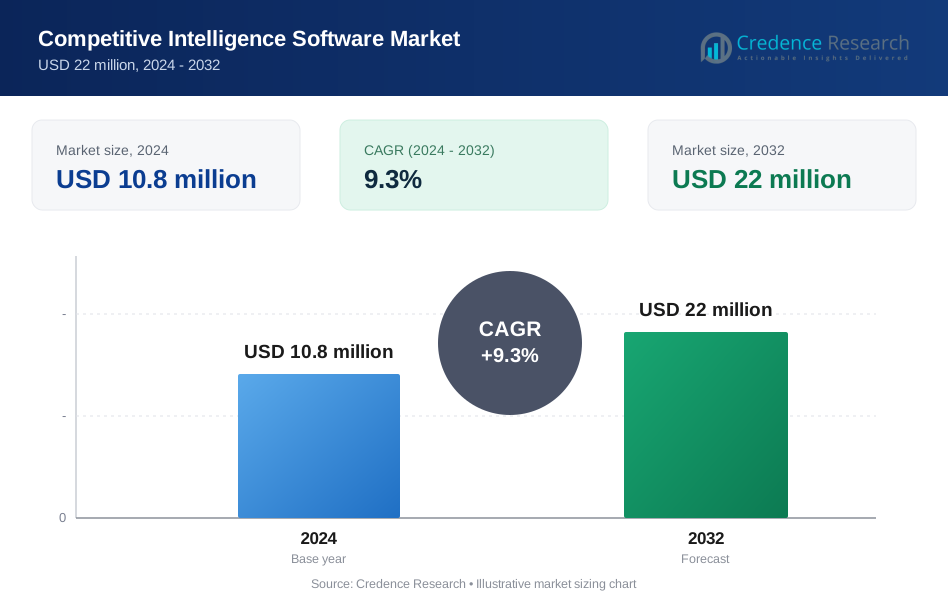
| Competitive Intelligence Software Market Size 2024 | USD 10.8 million |
| Competitive Intelligence Software Market, CAGR | 9.3% |
| Competitive Intelligence Software Market Size 2032 | USD 22 million |
Market Overview:
The Competitive Intelligence Software Market is projected to grow from USD 10.8 million in 2024 to USD 22 million by 2032, at a compound annual growth rate (CAGR) of 9.3%. This growth is driven by the increasing need for businesses to gather and analyze large amounts of data to stay competitive. The integration of advanced technologies such as artificial intelligence (AI) and machine learning (ML) into competitive intelligence software is enhancing its capabilities, making it easier for businesses to gather, analyze, and interpret data. This, in turn, is helping businesses make informed decisions and gain a competitive edge in the market.
Several factors are driving the growth of the Competitive Intelligence Software Market. The exponential increase in data generated from various sources, such as mobile devices, the Internet, and social media, is one of the key drivers. Businesses are increasingly adopting competitive intelligence software to analyze competitors’ product portfolios, promotions, pricing strategies, and customer preferences. This real-time data-driven insight helps companies identify new growth opportunities and potential threats from competitors. Additionally, the growing need for actionable strategies backed by continuous competitor monitoring is boosting the adoption of competitive intelligence software globally.
Regionally, North America holds the largest market share, accounting for approximately 34.3% of the global market in 2024. The region’s dominance is attributed to the early adoption of competitive intelligence software by major tech giants and established software companies. The presence of a highly skilled workforce with strong technical expertise in data analytics, data science, and AI further supports market growth in North America. Asia-Pacific is emerging as the fastest-growing region, driven by rapid digitization and increased adoption of competitive intelligence solutions across industries. Countries like China, India, Japan, and South Korea are key markets in this region, with significant investments in digital transformation and smart city initiatives. Europe, South America, and the Middle East & Africa also contribute to the market’s growth, with increasing adoption of competitive intelligence software in various industries.
Market Drivers:
Increasing Demand for Real-Time Data Analytics:
The demand for real-time data analytics is a significant driver in the Competitive Intelligence Software Market. Companies are increasingly relying on competitive intelligence tools to process and analyze vast amounts of data in real-time. For instance, according to a survey by IBM, 94% of companies stated that real-time data processing capabilities were critical to their operations. This growing emphasis on real-time data is pushing organizations to adopt competitive intelligence software that can provide timely and actionable insights, helping them to make informed decisions quickly and maintain a competitive edge in their respective industries.
Integration of AI and Machine Learning:
The integration of Artificial Intelligence (AI) and Machine Learning (ML) into competitive intelligence software is transforming how businesses gather and analyze competitive data. AI-driven tools enable companies to automate the collection of data from various sources, such as social media, news, and public records, and to generate insights with greater accuracy and speed. According to a report by PwC, 86% of business leaders believe that AI will become a mainstream technology in their organizations by 2025. This trend is driving the adoption of AI-powered competitive intelligence software, as companies seek to leverage these technologies to gain deeper insights into market trends and competitor strategies.
Rise of Digital Transformation Initiatives:
Digital transformation is another key driver of the Competitive Intelligence Software Market. As businesses across various sectors undergo digital transformation, the need for advanced software solutions that can support these initiatives has grown. For instance, according to a survey by Deloitte, 68% of executives ranked digital transformation as a top priority in their organizations. Competitive intelligence software plays a crucial role in these transformation efforts by providing businesses with the tools needed to analyze digital footprints, monitor competitor activities, and identify market opportunities, thus enabling them to navigate the complexities of the digital age effectively.
Growing Importance of Competitive Positioning:
In today’s highly competitive business environment, understanding and improving competitive positioning has become a top priority for many organizations. Companies are investing in competitive intelligence software to gain a comprehensive understanding of their market position relative to their competitors. A study by Gartner found that 72% of companies are focused on improving their competitive positioning as a strategic priority. By leveraging competitive intelligence tools, businesses can identify gaps in the market, monitor competitor strategies, and refine their own offerings to better meet the needs of their target audiences, thereby enhancing their overall market competitiveness.
Market Trends:
Growing Adoption of AI and Automation:
The integration of Artificial Intelligence (AI) and automation into competitive intelligence software is a significant trend shaping the market. Companies are increasingly turning to AI-driven tools to automate the collection and analysis of competitive data. For instance, a survey by McKinsey found that 70% of companies are either using or planning to use AI to enhance their business processes, including competitive intelligence. Automation not only accelerates data processing but also reduces human error, enabling organizations to generate more accurate and actionable insights. This trend is leading to a shift towards more sophisticated, AI-powered competitive intelligence platforms.
Emphasis on Data Privacy and Security:
As competitive intelligence software collects and analyzes vast amounts of sensitive data, there is a growing emphasis on data privacy and security. Governments and regulatory bodies are imposing stricter data protection regulations, such as the General Data Protection Regulation (GDPR) in Europe. According to a report by Deloitte, 60% of companies have made significant investments in data security to comply with these regulations. This focus on data privacy is prompting companies to adopt competitive intelligence tools that offer robust security features, ensuring that their data management practices align with legal requirements.
Integration with Business Intelligence Tools:
Another trend in the Competitive Intelligence Software Market is the integration of competitive intelligence with broader business intelligence (BI) tools. Organizations are increasingly seeking unified platforms that combine competitive intelligence with other BI functions, such as financial analysis and market forecasting. For instance, a survey by Gartner revealed that 58% of companies prefer integrated BI platforms that offer a holistic view of their business environment. This trend is driving the development of competitive intelligence software that seamlessly integrates with existing BI systems, enabling organizations to make more informed and strategic decisions.
Increasing Use of Cloud-Based Solutions:
The shift towards cloud-based competitive intelligence solutions is another key trend. Companies are opting for cloud-based platforms due to their scalability, flexibility, and cost-effectiveness. According to a study by IDC, 70% of organizations have either migrated to or are planning to adopt cloud-based solutions for their data management needs. This trend is particularly prevalent among small and medium-sized enterprises (SMEs) that require competitive intelligence capabilities without the need for significant upfront investments in infrastructure. The increasing adoption of cloud-based competitive intelligence software is enabling organizations to access real-time insights from anywhere, further enhancing their competitive advantage.
Market Challenges Analysis:
High Implementation Costs:
One of the primary restraints in the Competitive Intelligence Software Market is the high cost associated with the implementation and integration of these advanced tools. Many organizations, particularly small and medium-sized enterprises (SMEs), face significant financial barriers when it comes to adopting competitive intelligence software. The initial investment in software licenses, along with the costs of integrating the software into existing IT infrastructure, can be prohibitively expensive. Additionally, the need for continuous updates and maintenance further adds to the overall cost, making it challenging for smaller firms to justify the expenditure.
Complexity and Training Requirements:
The complexity of competitive intelligence software presents another challenge. These tools often require specialized knowledge to operate effectively, necessitating extensive training for employees. Organizations must invest in training programs to ensure their staff can leverage the full capabilities of the software, which can be both time-consuming and costly. This learning curve can deter companies from adopting competitive intelligence solutions, particularly if they lack the resources to provide adequate training.
Data Privacy and Security Concerns:
Data privacy and security concerns are also significant challenges in the Competitive Intelligence Software Market. As these tools handle sensitive and often proprietary information, organizations must ensure robust security measures are in place to protect against data breaches and unauthorized access. However, the increasing complexity of cyber threats and the evolving nature of data privacy regulations, such as GDPR, make it difficult for companies to stay compliant. Failure to adequately address these concerns can lead to legal repercussions and damage to the organization's reputation.
Integration with Existing Systems:
Lastly, integrating competitive intelligence software with existing business systems can be a major challenge. Many organizations struggle to seamlessly incorporate these tools into their current workflows, leading to inefficiencies and potential data silos. The lack of standardization across different software platforms further complicates integration efforts, making it difficult for companies to fully capitalize on their competitive intelligence investments.
Market Segmentation Analysis:
By Type
The Competitive Intelligence Software Market is segmented by type into cloud-based and on-premises solutions. Cloud-based solutions are witnessing significant growth due to their scalability, cost-effectiveness, and ease of deployment. They allow organizations to access real-time insights from any location, making them increasingly popular among small and medium-sized enterprises (SMEs). On-premises solutions, while offering more control over data, are often preferred by larger organizations with substantial IT infrastructure and stringent data security requirements.
By Technology
By technology, the market is divided into artificial intelligence (AI), machine learning (ML), big data analytics, and natural language processing (NLP). AI and ML technologies are driving innovation in the market, enabling more advanced data analysis, predictive insights, and automation of competitive intelligence processes. Big data analytics plays a crucial role in processing large volumes of data from various sources, while NLP enhances the ability to analyze unstructured data, such as social media content and news articles.
By End User
The end-user segment includes large enterprises, small and medium-sized enterprises (SMEs), and government agencies. Large enterprises are the dominant users of competitive intelligence software, leveraging these tools to gain strategic insights and maintain a competitive edge in the market. SMEs are increasingly adopting these solutions to stay competitive, despite budget constraints, due to the availability of affordable cloud-based options. Government agencies also use competitive intelligence software for strategic decision-making and monitoring market dynamics to inform policy decisions.
Segmentation:
By Deployment
- On Premise
- Cloud-Based
By End User
- BFSI
- IT & Telecom
- Automotive
- Retail
- HealthCare
- Energy
- Industrial
- Others
- North America
- The U.S
- Canada
- Mexico
- Europe
- Germany
- France
- The U.K.
- Italy
- Spain
- Rest of Europe
- Asia Pacific
- China
- Japan
- India
- South Korea
- South-east Asia
- Rest of Asia Pacific
- Latin America
- Brazil
- Argentina
- Rest of Latin America
- Middle East & Africa
- GCC Countries
- South Africa
- Rest of Middle East and Africa
Regional Analysis:
North America
North America holds the largest market share, accounting for approximately 40% of the global Competitive Intelligence Software Market. The region's dominance can be attributed to the early adoption of advanced technologies and the presence of major market players such as IBM, Microsoft, and Oracle. The United States, in particular, is a significant contributor, with companies across various sectors investing heavily in competitive intelligence solutions to gain strategic advantages. The region’s robust IT infrastructure and the increasing need for data-driven decision-making further fuel the market's growth.
Europe
Europe follows closely, with a market share of around 30%. The region is characterized by a strong focus on data privacy and security, driven by regulations such as the General Data Protection Regulation (GDPR). Countries like Germany, the United Kingdom, and France are leading adopters of competitive intelligence software, particularly in industries such as finance, automotive, and healthcare. The demand for AI-driven competitive intelligence tools is growing, as businesses in the region seek to enhance their market positioning and navigate complex regulatory environments.
Asia Pacific
Asia Pacific is the fastest-growing region, with a market share of approximately 20%. The rapid digitalization of businesses, particularly in emerging economies like China and India, is a key driver of growth in this region. The increasing adoption of cloud-based solutions and the rise of small and medium-sized enterprises (SMEs) are also contributing to the expansion of the market. Moreover, governments in the region are actively promoting digital transformation initiatives, which are expected to boost the adoption of competitive intelligence software in the coming years.
Latin America and the Middle East & Africa
Latin America and the Middle East & Africa regions together account for the remaining 10% of the market share. In Latin America, Brazil and Mexico are leading markets, driven by the increasing awareness of the benefits of competitive intelligence and the growing number of SMEs. The Middle East & Africa region, although currently smaller in market size, is showing promising growth potential. The adoption of competitive intelligence software in this region is primarily driven by the expansion of the IT sector and the increasing focus on data-driven strategies in industries such as oil and gas, banking, and retail.
Key Player Analysis:
- Crimson Hexagon
- Crimson
- Meltwater
- SimilarWeb
- Klue
- Cognism
- Contify
- Owler
- Rival IQ
- Kompyte
Competitive Analysis:
The Competitive Intelligence Software Market is characterized by intense competition, with several key players striving to enhance their market position through innovation and strategic partnerships. Major companies such as Crayon, Klue, and Kompyte are leading the market by offering advanced solutions that integrate artificial intelligence and machine learning to provide real-time insights and predictive analytics. These companies are focusing on expanding their product portfolios and enhancing their software capabilities to meet the evolving needs of businesses. Additionally, strategic acquisitions and collaborations are common strategies employed by market leaders to strengthen their competitive edge. The market is also witnessing the entry of new players, further intensifying the competition. Overall, the competitive landscape of the Competitive Intelligence Software Market is dynamic, with continuous advancements and strategic initiatives driving growth and innovation.
Recent Developments:
- In 2023 Kompyte introduced new AI-powered features to its competitive intelligence platform, enhancing its capabilities in data analysis and predictive insights. These enhancements aim to provide users with more accurate and actionable intelligence to stay ahead of competitors.
- In 2022 Klue announced a strategic partnership with Salesforce to integrate its competitive intelligence software with Salesforce’s CRM platform. This integration allows users to access real-time competitive insights directly within their CRM, improving decision-making and sales strategies.
- In 2024 Gartner released its Market Guide for Competitive Intelligence Tools, highlighting the increasing adoption of AI and machine learning in competitive intelligence software. The guide also emphasized the importance of real-time data and predictive analytics in gaining a competitive edge.
Market Concentration & Characteristics:
The Competitive Intelligence Software Market is characterized by a moderate level of market concentration, with several key players dominating the landscape. Major companies such as Crayon, Klue, and Kompyte lead the market by offering advanced solutions that integrate artificial intelligence and machine learning to provide real-time insights and predictive analytics. These companies focus on enhancing their product capabilities and expanding their market presence through strategic partnerships and acquisitions. The market is also witnessing the entry of new players, further intensifying the competition. The competitive intelligence software market is dynamic and ever-evolving, driven by the increasing need for businesses to gather and analyze large amounts of data to stay competitive. The integration of advanced technologies, such as AI and ML, is enhancing the capabilities of competitive intelligence software, making it easier for businesses to gather, analyze, and interpret data. This, in turn, is helping businesses make informed decisions and gain a competitive edge.
Report Coverage:
The research report offers an in-depth analysis based on Deployment, End User, and Region. It details leading market players, providing an overview of their business, product offerings, investments, revenue streams, and key applications. Additionally, the report includes insights into the competitive environment, SWOT analysis, current market trends, as well as the primary drivers and constraints. Furthermore, it discusses various factors that have driven market expansion in recent years. The report also explores market dynamics, regulatory scenarios, and technological advancements that are shaping the industry. It assesses the impact of external factors and global economic changes on market growth. Lastly, it provides strategic recommendations for new entrants and established companies to navigate the complexities of the market.
Future Outlook:
- The integration of AI and machine learning will enhance the capabilities of competitive intelligence software, providing more accurate and actionable insights.
- Cloud-based solutions will continue to gain traction due to their scalability, cost-effectiveness, and ease of access.
- The increasing volume of data generated from various sources will drive the demand for advanced analytics and real-time data processing.
- Businesses will increasingly adopt competitive intelligence software to stay ahead of competitors and identify new growth opportunities.
- The rise of digital transformation initiatives across industries will boost the adoption of competitive intelligence tools.
- Enhanced data privacy and security measures will become a priority for competitive intelligence software providers.
- The growing importance of predictive analytics will enable businesses to anticipate market trends and competitor movements.
- Strategic partnerships and acquisitions will be common as companies seek to expand their product offerings and market presence.
- The integration of competitive intelligence software with other business applications will improve decision-making and operational efficiency.
- The market will witness the entry of new players, further intensifying competition and driving innovation.
Request a Free Sample
Fill in your details and we'll send you a free sample report.
- Sample data tables & charts
- Research methodology
Need a Custom Version of This Report?
Tailor the scope, geography, or segments to your exact requirements.
- Custom geography or segment scope
- Direct access to our analyst team
Frequently Asked Questions
What is the current size of the Competitive Intelligence Software Market?
What factors are driving the growth of the Competitive Intelligence Software Market?
What are some challenges faced by the Competitive Intelligence Software Market?
Who are the major players in the Competitive Intelligence Software Market?
Table of Content
Chapter 1. Report Introduction
- 1.1 Report Description & Purpose
- 1.1.1 Report Title & Market Definition
- 1.1.2 Unique Selling Propositions (USP) & Key Differentiators
- 1.1.3 Value Proposition for Stakeholders
- 1.2 Research Objectives
- 1.2.1 Market Sizing Objectives (Volume & Revenue) (Volume Where Applicable)
- 1.2.2 Segmentation Objectives
- 1.2.3 Competitive Intelligence Objectives
- 1.2.4 Forecast & Scenario Objectives
- 1.3 Report Scope
- 1.3.1 Competitive Intelligence Software Scope – Segments & Subsegments Covered
- 1.3.2 Geographic Scope – Regions & Countries Covered
- 1.3.3 Historical Period, Base Year & Forecast Period (2024; forecast to 2032)
- 1.3.4 Inclusions & Exclusions
- 1.4 Industry Classification & Applicable Codes
- 1.5 Currency, Measurement Units & Valuation Basis
- 1.6 Target Stakeholders
- 1.7 Limitations & Assumptions
Chapter 2. Executive Summary
- 2.1 Global Competitive Intelligence Software Market Snapshot
- 2.1.1 Market Size – Historical (2024) & Forecast (2024-2032) (2024: USD 10.8 million → 2032: USD 22 million)
- 2.1.2 Volume & Revenue – Global Totals (Volume Where Applicable)
- 2.1.3 Key Market Highlights – Top Five Facts
- 2.2 Competitive Intelligence Software Market Segmentation Snapshot
- 2.2.1 Market Split by Region – 2024 vs. 2032
- 2.3 Competitive Snapshot
- 2.3.1 Top 10 Players by Revenue Share – 2024
- 2.3.2 Top 10 Players by Volume Share – 2024 (Volume Where Applicable)
- 2.3.3 Recent Strategic Developments (18-Month Summary)
- 2.4 Key Investment Highlights & Strategic Conclusions
Chapter 3. Competitive Intelligence Software Market Dynamics & Industry Analysis
- 3.1 Market Overview & Context
- 3.1.1 Competitive Intelligence Software Market Position in the Broader Industry Value Chain
- 3.1.2 Demand Structure & Purchasing Dynamics
- 3.1.3 Market Maturity & Development Stage by Region
- 3.2 Competitive Intelligence Software Market Drivers
- 3.3 Competitive Intelligence Software Market Restraints & Challenges
- 3.4 Competitive Intelligence Software Market Opportunities
- 3.5 Porter's Five Forces Analysis
- 3.5.1 Threat of New Entrants
- 3.5.2 Bargaining Power of Suppliers
- 3.5.3 Bargaining Power of Buyers
- 3.5.4 Threat of Substitutes
- 3.5.5 Competitive Rivalry – Intensity Assessment
- 3.6 Competitive Intelligence Software Value Chain Analysis
- 3.6.1 Upstream – Key Inputs, Resources & Suppliers
- 3.6.1.1 Key Input/Resource 1
- 3.6.1.2 Key Input/Resource 2
- 3.6.1.3 Key Input/Resource 3
- 3.6.2 Midstream – Core Operations & Value Creation
- 3.6.2.1 Operating Model & Process Overview
- 3.6.2.2 Key Operating Locations & Capabilities by Company
- 3.6.3 Downstream – Market Channels & End Users
- 3.6.3.1 Direct Sales & Customer Engagement Channels
- 3.6.3.2 Indirect Sales, Intermediaries & Partner Channels
- 3.6.4 Value Chain Profitability Analysis
- 3.6.1 Upstream – Key Inputs, Resources & Suppliers
- 3.7 PESTEL Analysis
- 3.7.1 Political Factors
- 3.7.2 Economic Factors
- 3.7.3 Social Factors
- 3.7.4 Technological Factors
- 3.7.5 Environmental Factors
- 3.7.6 Legal Factors
- 3.8 Competitive Intelligence Software Supply Chain Analysis
- 3.8.1 Critical Input & Resource Availability Risk Assessment
- 3.8.2 Supplier & Operational Concentration Risk (Geographic Exposure)
- 3.8.3 Supply & Service Disruption Impact Analysis
- 3.9 Regulatory & Policy Landscape
Note: The regulatory and policy landscape section covers regulations based on their applicability to the market, Competitive Intelligence Software category, geography, and scope of the study. Only regulatory frameworks with a material impact on operations, compliance, trade, sustainability, or market access are analyzed in detail.
Chapter 4. Key Investment Pockets & Opportunity Analysis
- 4.1 Competitive Intelligence Software Market Attractiveness Analysis
- 4.1.1 By Region – Investment Attractiveness Matrix (Market Size × CAGR)
- 4.2 Absolute Revenue Growth Opportunity
- 4.2.1 By Region – Absolute Revenue Growth Through 2032
- 4.3 Incremental Demand Opportunity
- 4.3.1 By Region – Incremental Demand Through 2032
- 4.3.2 Segment – Incremental Demand
- 4.4 Emerging Submarket Opportunity Deep Dive (Subject to Applicability)
- 4.5 Priority Market Opportunity Scorecards
- 4.5.1 United States
- 4.5.2 Europe
- 4.5.3 Asia
- 4.5.4 Middle East & Africa
Note: Priority market opportunity scorecards reflect the geographic scope and strategic relevance of the study. Listed markets are indicative and may be adapted to the industry.
Chapter 5. Competitive Intelligence Software Cross-Border Trade & Market Access Analysis
- 5.1 International Trade & Cross-Border Activity Overview
- 5.1.1 Global Export Value by Country (2024)
- 5.1.2 Global Export Volume by Country (2024) (Volume Where Applicable)
- 5.1.3 Global Import Value by Country (2024)
- 5.1.4 Global Import Volume by Country (2024) (Volume Where Applicable)
- 5.1.5 Net Trade Balance by Country (2024)
- 5.2 Export Analysis – Segment
- 5.2.1 Category 1 (Applicable Classification Code)
- 5.2.2 Category 2 (Applicable Classification Code)
- 5.2.3 Category 3 (Applicable Classification Code)
- 5.2.4 Category 4 (Applicable Classification Code)
- 5.2.5 Category 5 (Applicable Classification Code)
- 5.3 Import Analysis – Segment
- 5.3.1 Category 1 (Applicable Classification Code)
- 5.3.2 Category 2 (Applicable Classification Code)
- 5.3.3 Category 3 (Applicable Classification Code)
- 5.3.4 Category 4 (Applicable Classification Code)
- 5.3.5 Category 5 (Applicable Classification Code)
- 5.4 Cross-Border Pricing & Transaction Benchmarks
- 5.4.1 Export Pricing – Segment & Country
- 5.4.2 Import Pricing – Segment & Source Country
- 5.4.3 Price Trends (2024)
- 5.5 Key Cross-Border Trade & Delivery Routes
- 5.5.1 Cross-Border Trade/Delivery Route 1
- 5.5.2 Cross-Border Trade/Delivery Route 2
- 5.5.3 Cross-Border Trade/Delivery Route 3
- 5.5.4 Cross-Border Trade/Delivery Route 4
- 5.5.5 Cross-Border Trade/Delivery Route 5
- 5.6 Trade Policy & Market Access Impact Assessment
- 5.6.1 Tariff & Non-Tariff Barriers
- 5.6.2 Regional Trade & Economic Integration Frameworks
- 5.6.3 Bilateral & Multilateral Trade Agreements
- 5.6.4 Cross-Border Operating, Licensing & Localization Requirements
Note: This chapter applies where cross-border trade or delivery is relevant to Competitive Intelligence Software. Goods, services, and digital offerings are assessed using applicable classifications and transaction measures. Import-export volumes, trade balances, and route analyses are included only where meaningful to the market.
Chapter 6. Competitive Landscape & Company Benchmarking
- 6.1 Competitive Intelligence Software Market Concentration & Structure
- 6.1.1 Herfindahl-Hirschman Index (HHI) – vs. 2024
- 6.1.2 Leading, Mid-Sized & Emerging Player Structure
- 6.1.3 Global, Regional & Local Player Dynamics
- 6.2 Competitive Intelligence Software Market Share Analysis – 2024
- 6.2.1 Global Revenue Share by Company
- 6.2.2 Global Volume Share by Company (Volume Where Applicable)
- 6.2.3 Regional Revenue Share
- 6.2.4 Market Share Evolution ( vs. 2024)
- 6.2.5 Company Market Share by Key Segment
- 6.2.6 Company Market Share by Customer Group
- 6.3 Operating Scale, Capacity & Infrastructure Analysis
- 6.3.1 Global Operating Scale & Supply Capacity
- 6.3.2 Resource Utilization & Operating Efficiency
- 6.3.3 Output, Service Delivery & Activity Metrics
- 6.3.4 Operating Footprint & Infrastructure Map
- 6.3.5 Planned Operational & Capacity Expansion
- 6.4 Competitive Intelligence Software Competitive Benchmarking Matrix
- 6.4.1 Revenue, Growth, Profitability & Operating Metric Comparison
- 6.4.2 Channel Revenue Mix
- 6.4.3 Geographic Revenue Exposure
- 6.4.4 R&D Intensity
- 6.4.5 Sustainability Maturity
- 6.5 Strategic Developments in Competitive Intelligence Software (Last 24 Months)
- 6.5.1 Mergers, Acquisitions & Divestments
- 6.5.2 New Products, Services & Solutions in Competitive Intelligence Software
- 6.5.3 Operational & Infrastructure Expansions
- 6.5.4 Strategic Alliances, Joint Ventures & Partnerships
- 6.5.5 Distribution Expansion & Market Entry
- 6.5.6 Sustainability & ESG Initiatives
- 6.6 Competitive Strategy Mapping
- 6.6.1 Leader, Challenger, Follower & Niche Classification
- 6.6.2 Pricing Strategy Comparison
- 6.6.3 Channel Strategy Matrix
Note: Strategic developments are included based on their materiality and the availability of reliable information.
Chapter 7. Global Competitive Intelligence Software Market – By Sales & Delivery Channel
- 7.1 Segment Overview
- 7.1.1 Volume & Revenue Split by Channel (2024 & 2032) (Volume Where Applicable)
- 7.1.2 Channel Mix Evolution (2024-2032)
Chapter 8. Regional Market Analysis – Global Overview
- 8.1 Global Regional Overview
- 8.1.1 Regional Volume Share (Volume Where Applicable)
- 8.1.2 Regional Revenue Share
- 8.1.3 Regional Volume by Region (Volume Where Applicable)
- 8.1.4 Regional Revenue by Region
- 8.1.5 Regional Forecast Through 2032
- 8.2 Cross-Regional Segment Analysis
- 8.2.1 By Sales & Delivery Channel
- 8.2.2 By Competitive Positioning & Price Tier
Chapter 9. North America Competitive Intelligence Software Market
- 9.1 United States
- 9.2 Canada
- 9.3 Mexico
Chapter 10. Europe Competitive Intelligence Software Market
- 10.1 Germany
- 10.2 France
- 10.3 Italy
- 10.4 United Kingdom
- 10.5 Spain
- 10.6 Poland
- 10.7 Russia
- 10.8 Netherlands
- 10.9 Belgium
- 10.10 Sweden
- 10.11 Denmark
- 10.12 Norway
- 10.13 Rest of Europe
Chapter 11. Asia Pacific Competitive Intelligence Software Market
- 11.1 China
- 11.2 India
- 11.3 Japan
- 11.4 South Korea
- 11.5 Thailand
- 11.6 Indonesia
- 11.7 Vietnam
- 11.8 Malaysia
- 11.9 Australia
- 11.10 Rest of Asia Pacific
Chapter 12. Latin America Competitive Intelligence Software Market
- 12.1 Brazil
- 12.2 Argentina
- 12.3 Colombia
- 12.4 Chile
- 12.5 Rest of Latin America
Chapter 13. Middle East Competitive Intelligence Software Market
- 13.1 Saudi Arabia
- 13.2 United Arab Emirates
- 13.3 Turkey
- 13.4 Israel
- 13.5 Iran
- 13.6 Rest of the Middle East
Chapter 14. Africa Competitive Intelligence Software Market
- 14.1 South Africa
- 14.2 Egypt
- 14.3 Nigeria
- 14.4 Morocco
- 14.5 Rest of Africa
Chapter 15. Competitive Intelligence Software Company Profiles
- 15.1 [Company 01]
- 15.1.1 Company Overview
- 15.1.2 Key Management Personnel
- 15.1.3 Products & Services Portfolio
- 15.1.4 Financial Performance
- 15.1.5 Key Market Focus & Geographic Presence
- 15.1.6 Recent Developments & Strategic Initiatives
Note: The company profile list is preliminary and may change based on research findings, market developments, data availability, and client requirements.
Chapter 16. Appendices
- Appendix A – List of Abbreviations & Acronyms
- Appendix B – Industry Classification Code Reference – Full Series
- Appendix C – Supply, Output & Operating Capacity Data Tables
- Appendix D – End-Use & Demand Base Tables
- Appendix E – Demand, Adoption & Usage Assumptions
- Appendix F – Pricing & Revenue Metric Reference Tables
- Appendix G – Company Operations & Infrastructure Database
- Appendix H – Cross-Border Trade & Activity Data Tables (Where Applicable)
- Appendix I – Regulatory Summary Tables
- Appendix J – Primary Research Participant List (Anonymized)
- Appendix K – Primary Research Questionnaire Framework
- Appendix L – Data Sources & Bibliography
- Appendix M – Market Size Divergence & Source Comparison
Chapter 17. Research Methodology
- 17.1 Research Framework & Philosophy
- 17.2 Secondary Research – Sources, Hierarchy & Data Extraction
- 17.3 Data Modeling – Bottom-Up & Top-Down Market Sizing
- 17.4 Primary Research – Stakeholder Framework, LOI & Sample Sizes
- 17.5 Forecast Methodology – Regression, Scenario & Sensitivity Analysis
- 17.6 Quality Control – Four-Layer Validation Framework
- 17.7 Limitations & Standard Assumptions
- 17.8 Disclaimer
