
Executive Summary
Market Definition
A multi-channel order management solution (MOM) is business-to-business software designed for various dealers to market their products and highlight internet enterprises. Multichannel requests for the executive's arrangements are often meant to assist in consolidating orders from many channels into a similar list and posting the most recent charges across all business diverts during cost adjustments. For some multichannel requests, executive arrangements are used for basic needs and to function as a business the board arrangement.
Market Overview
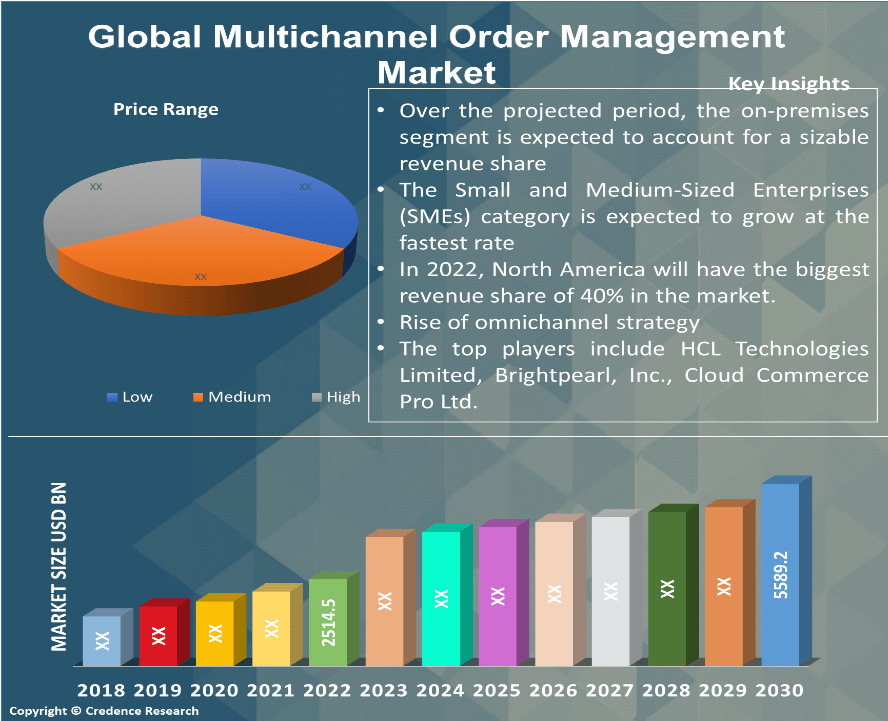
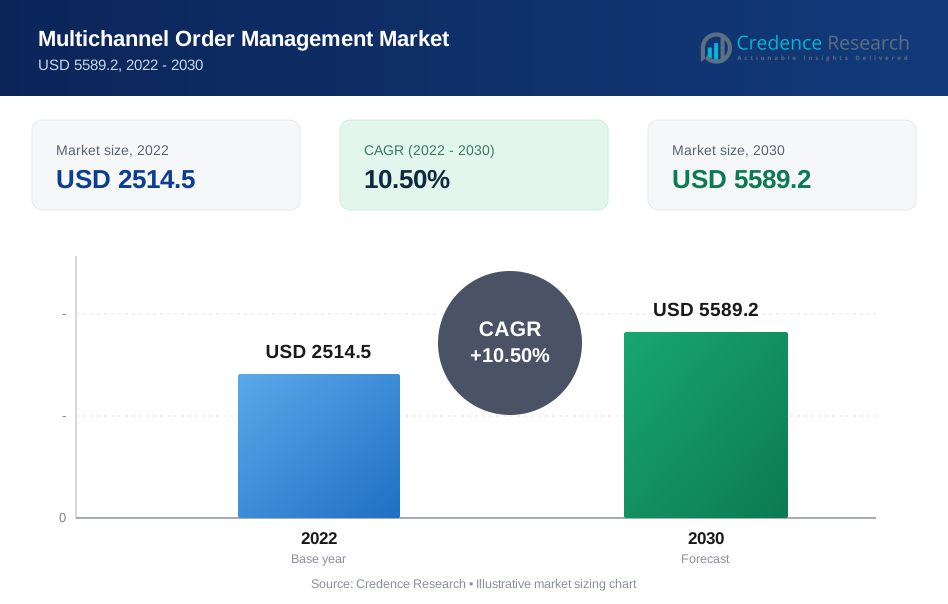
It is anticipated that between 2023 and 2030, the worldwide Multichannel order management market will expand at a compound annual growth rate (CAGR) of 10.50%. From USD 2514.5 million in 2022, the market is projected to be worth USD 5589.2 million by 2030.
The primary drivers driving the Global Multichannel Order Management Market are increases in retail sales and the internet shopping industry, particularly in developing nations. Furthermore, firms are becoming more adaptive and nimble, and scalability expectations are rising. This surge in multichannel selling has raised the necessity for organizations to implement multichannel order management (MOM). Because these systems are less expensive than traditional ones, global demand for multichannel order management is increasing. Furthermore, in countries such as China and India, where internet use is still rapidly rising, the demand for multichannel order management (MOM) is being driven by the observed rapid increase in the number of online users.
Cloud-based solutions are growing in popularity due to their scalability and lower maintenance costs. These factors are expected to favourably boost the global expansion of the Multichannel Order Management Market. A number of constraints and hurdles will impede market expansion. Concerns about security and privacy are keeping the market from expanding. Furthermore, the market's progress is being hampered by a lack of technological know-how. However, the advancement of augmented reality, machine learning, and artificial intelligence technology, as well as the potential for online sales and untapped markets in emerging nations, present promising growth prospects.
Market Insights
- The global demand for multichannel order management was valued at USD 2514.5million in 2022 and is expected to reach USD 5589.2 Million in 2030, growing at a CAGR of 10.50% between 2023 and 2030.
- The on-premises category is predicted to account for a substantial revenue share, while the cloud segment is expected to develop rapidly.
- The B2C sector is frequently more popular, and the B2C section is also significant.
- Small and medium-sized enterprises (SMEs) are predicted to develop at the highest rate, while large enterprises are expected to have a significant revenue share.
- E-commerce has become a dominant force in the retail industry, and the industrial sector is another major component in the Multichannel order management industry.
- The Order Processing and Fulfillment category has the biggest market demand, followed by Payment Processing.
- The Mid-Range Solutions section has the highest market share, although the Enterprise Solutions category is also important.
- The Integrated solutions segment has the highest market share, and stand-alone solutions are another important area in the Multichannel order management business.
- Third-Party Logistics Providers is the fastest expanding segment, while direct consumers are another important component in the Multichannel Order Management market.
- The Online Sales Channels segment is the market's dominating sector, and internet sales channels continue to dominate the industry.
- North America controls the market for Multichannel order management. It controls about 40% of the market, giving it the biggest percentage share and market value. Asia Pacific would be the fastest-growing region.
- Multichannel sales are increasing, which is driving market growth.
- Businesses need more secrecy, and data security is impeding market expansion.
Segmentation by Deployment Type
- Over the projected period, the on-premises segment is expected to account for a sizable revenue share. Organizations may better manage their inventories and orders using on-premises solutions, resulting in smoother procedures.
- During the projection period, the cloud segment is expected to experience strong revenue growth.
Segmentation by Order Type
- The B2C segment is often more popular due to the widespread use of e-commerce and the rising online retail business.
- The B2C segment has a broader customer base and higher transaction volumes.
Segmentation by Enterprise Size
- During the projected period, the Small and Medium-Sized Enterprises (SMEs) category is expected to grow at the fastest rate. Factors that can be ascribed to the increased adoption of this management in SMEs rather than large organizations.
- During the projected period, the large enterprise segment is expected to have a major revenue share.
Segmentation by Industry Vertical
- E-commerce has become a dominant force in the retail business as a result of the advent of online shopping. To handle the high volume of orders from online platforms, efficient multichannel order management is required.
- Another prominent segment in the Multichannel order management industry is the industrial sector.
Segmentation by Functionality
- The Order Processing and Fulfillment category has the highest market demand. It is critical to the proper management and fulfillment of customer orders across numerous channels. This section is dedicated to managing the full order lifecycle, from order placement to order fulfillment. Order entry, inventory allocation, picking, packing, and shipping are all part of the job.
- Payment processing are another major group that contributes heavily to the Multichannel order management market.
Segmentation by Price Range
- The Mid-Range Solutions segment has the most shares. It is designed for companies who demand more advanced features and capabilities than budget solutions but are not yet at the enterprise level.
- In the Multichannel order management market, the enterprise solutions category is also a key player.
Segmentation by Integration
- The Integrated Systems segment holds the most shares. Order management solutions that are smoothly integrated with other company systems, such as inventory management, CRM, and e-commerce platforms, are referred to as integrated systems.
- Another key area in the Multichannel order management industry is stand-alone systems. These systems run independently of other corporate systems and do not require integration.
Segmentation by Customer Type
- Third-Party Logistics Providers is the fastest growing segment in the Multichannel Order Management market. Third-party logistics providers, or 3PLs, are businesses that provide outsourced logistics and supply chain management. They handle warehouse, inventory management, shipping, and order processing, among other areas of order fulfillment.
- Another prominent component in the Multichannel order management industry is direct customers.
Segmentation by Channel Type
- The market's dominant sector is the Online Sales Channels segment. The many digital platforms and websites via which businesses sell their products or services online are referred to as online sales channels.
- While internet sales channels continue to dominate the market, offline sales channels remain important in the Multichannel order management market.
Segmentation by Region
- North America dominates the market for Multichannel order management. It has the largest percentage portion of the market, accounting for about 40% of the total market share.
- Asia Pacific would be the fastest-growing segment throughout the predicted period of 20222-2027.
- The rest of the world, including Latin America, the Middle East, and Africa, supplies the remaining demand for Multichannel order management.
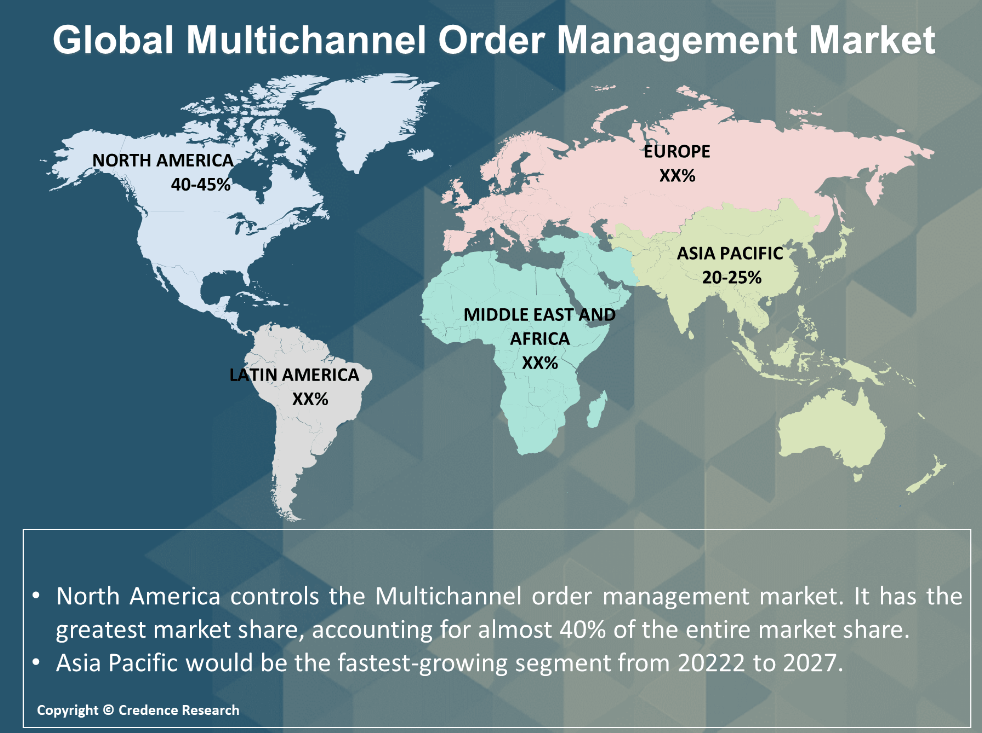
The North America market is estimated to account for the biggest revenue share throughout the forecast period, owing to increased activity by key industry players in this region. For instance, Square has acquired Stitch Labs, a tool for managing operations for expanding commerce enterprises. Stitch Labs has a long record of creating critical business tools like fulfillment solutions, inventory and order management, and channel management. The group will join their seller organization, and they are excited to use their knowledge and talents to improve the way they help sellers.
The Asia Pacific market is predicted to grow at the quickest rate during the forecast period, owing to increased activity by leading industry participants in the region's countries. Fluent Commerce, an Australian company and the leading supplier of a cloud-native distributed Order Management System (OMS), recently announced that it has become an Adobe Exchange Partner Program Premier Partner. Fluent Order Management enables Omni channel order and inventory management at scale, providing the efficiency and scalability that both enterprises and customers expect.
Key Highlights of the Report
The global Multichannel order management Marketis segmented by Deployment Type, Order Type, Enterprise Size, Industry Vertical, Functionality, Price Range, Integration, Customer Type, Channel Type and region. In 2022, The category of Order Processing and Fulfillment has the largest market demand. Third-Party Logistics Providers is also the fastest expanding segment, whereas the B2C market is frequently more popular. Also, the cloud segment is predicted to increase rapidly, and the Mid-Range Solutions segment has the greatest market share, with North Amerca leading the market growth.
As the demand for consistent client experiences across several sales channels grows, Growing e-commerce prevalence, as well as the need for efficient order processing and fulfillment, as well as technological advancements. Furthermore, integration challenges can develop while managing many sales channels and technology. The difficulty in maintaining stocks across several channels and locations When dealing with customer and order information, there are concerns about data security and privacy.
Nonetheless, Throughout the projected period, the North American market is expected to account for the largest revenue share as a result of increasing action by key industry participants in this region. Furthermore, the Asia Pacific market is expected to develop at the fastest rate during the forecast period.
What Elements Are Driving the Global Market for Multichannel order management?
The primary market drivers are the increasing need for seamless customer experiences across different sales channels, Growing adoption of e-commerce and the requirement for efficient order processing and fulfillment and Advancements in technology.
What Are The Main Obstacles That The Global Multichannel order management marketFaces?
Integration challenges might develop while managing many sales channels and technologies. The difficulty in maintaining stocks across several channels and locations When dealing with customer and order information, there are concerns about data security and privacy.
What Market Development Prospects Are There For Multichannel order management Globally?
Opportunities in the market include expansion of the omnichannel approach, provision of a single customer experience, and use of cloud-based technologies for scalability and flexibility
Market Drivers
The global Multichannel order management marketis driven by several factors. The following are the key drivers of the global Multichannel order management Market:
Multichannel Sales Are On The Rise
Businesses are changing as a result of customer preferences, technology advancements, and competition. Due to the unpredictable nature of customers and the market, retailers, wholesalers, fashion brands, food and beverage firms, and health and wellness providers have been obliged to become more responsive and integrate powerful customer experience management solutions into their business processes. Customers are more likely to use online channels globally as a result of the advancement of digital technologies, the internet ecosystem, the widespread use of smartphones and social media, and next-generation networks. Businesses are rapidly increasing their sales channels, including websites, social media, commerce, marketplaces, and offline shops, in order to attract more customers and raise revenue. As a result, firms demand a dependable and customizable order management solution in order to manage, centralize, and simplify orders.
Market Restraints
The global Multichannel order management Marketfaces some challenges that may hinder its growth. These include the following:
Businesses Require More Secrecy And Data Security
When implementing new technology, it is critical to address the security and confidentiality of corporate data. Businesses will seek increased confidentiality and safety to protect against cyberattacks and security risks as loT and cloud technology grow. The issue of information security and privacy is getting increasingly serious as cloud-based and Internet of Things-enabled applications become more popular. Security and confidentiality concerns are expected to grow as more loT-enabled devices reach the market and become more vulnerable to risks and assaults. Furthermore, mobile gadgets can make it easier to retrieve firm data. As a result, effective information security safeguards are required for the proper adoption of digital advanced technology.
Opportunities
The global Multichannel order management Marketoffers significant growth opportunities. These include the following:
Willingness Of The Organization To Use Advanced Technology
Businesses and governmental institutions are entering a new phase of consumer interaction, with emergent revolutions playing a significant role, as a result of significant technological developments and a continuously evolving regulatory environment.
To replicate organizational progress, businesses use cutting-edge technology such as big data, cloud computing, and others. Modern company tactics have evolved from the previous business model approach as a result of advanced technologies. Using cutting-edge technology opens up a world of possibilities and allows businesses to adopt customer-focused marketing strategies.
As a result, demand for multichannel order management solutions has increased across a wide range of company industries.
Competitive Landscape
Key Players
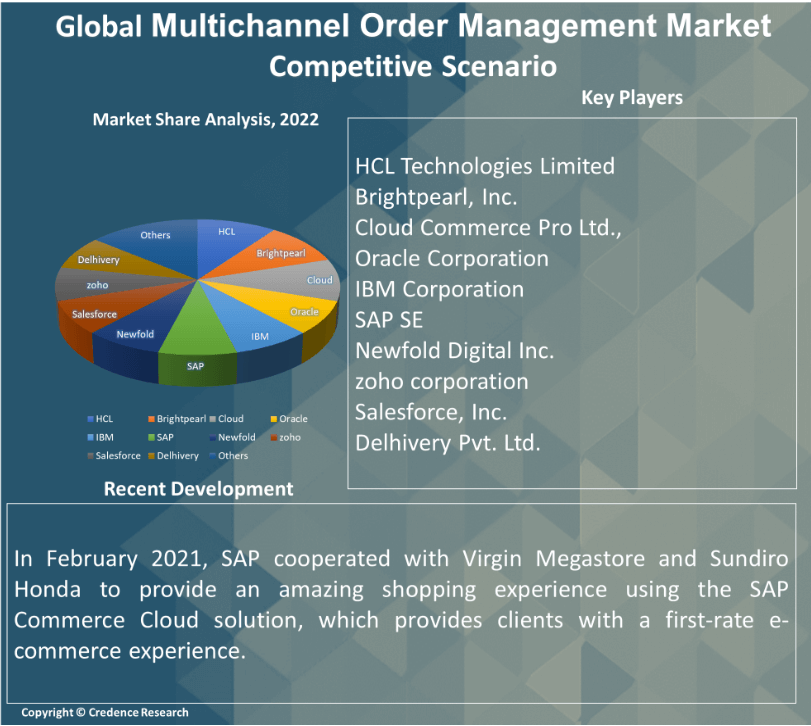
The global Multichannel order management marketis highly competitive, with several key players. Some of the major players in the market and their market share are as follows:
- HCL Technologies Limited
- Brightpearl, Inc.
- Cloud Commerce Pro Ltd.,
- Oracle Corporation
- IBM Corporation
- SAP SE
- Newfold Digital Inc.
- zoho corporation
- Salesforce, Inc.
- Delhivery Pvt. Ltd.
These organizations prioritize Deployment Type innovation, Disease Area expansion, and mergers and acquisitions to stay competitive.
The global Multichannel order management Market's key players continually seek to stay ahead by offering new Deployment Types and developments.
In April 2023, ChannelGrabber has released a whole new version of their multichannel order management software. The redesign shows the company's continuous dedication to providing its customers with a next-generation e-commerce inventory and multichannel order management system.
In February 2023, Ecom Magnum, Ecom Express' Warehouse Management Solutions (WMS) and Order Management Solutions (OMS), was released as a service offering for merchants. The new SaaS service is designed for online retailers looking for order and warehouse management systems that can be integrated with e-marketplaces.
In July 2022, Oracle cooperated with Big Ray's to handle inventory and order management, financial operations, e-commerce operations, and point-of-sale operations on a single Oracle NetSuite platform.
Summary of Key Findings
- The market potential is the organization's willingness to employ sophisticated technology.
- Market segmented by Deployment Type, Order Type, Enterprise Size, Industry Vertical, Functionality, Price Range, Integration, Customer Type, Channel Type and region.
- The Integrated solutions segment has the highest market share
- Third-Party Logistics Providers is the fastest expanding segment,
- North America is leading market growth; the market is highly competitive with key players including HCL Technologies Limited, Brightpearl, Inc., Cloud Commerce Pro Ltd., Oracle Corporation, IBM Corporation, SAP SE, Newfold Digital Inc., zoho corporation, Salesforce, Inc., Delhivery Pvt. Ltd..
Future Outlook
- Continued increase is being fueled by the expansion of e-commerce.
- Rising desire for consistent client experiences
- Technological and automation advancements
- Integration of artificial intelligence and machine learning
- Increasing importance of real-time inventory visibility
- Rise of omnichannel strategy
- Emphasis on data-driven decision making
Segmentation
- By Deployment Type:
- On-Premises
- Cloud-Based
- By Order Type:
- B2B (Business-to-Business)
- B2C (Business-to-Consumer)
- By Enterprise Size:
- Small and Medium-sized Enterprises (SMEs)
- Large Enterprises
- By Industry Vertical:
- Retail
- E-commerce
- Manufacturing
- Healthcare
- Food and Beverage
- Automotive
- By Functionality:
- Order Processing and Fulfillment
- Inventory Management
- Payment Processing
- Customer Relationship Management (CRM)
- Shipping and Logistics Management
- Returns and Refunds Management
- Analytics and Reporting
- By Price Range:
- Budget Solutions
- Mid-Range Solutions
- Enterprise Solutions
- By Integration:
- Integrated Systems
- Standalone Systems
- By Customer Type:
- Direct Customers
- Third-Party Logistics Providers
- By Channel Type:
- Online Sales Channels
- Offline Sales Channels
- By Region
- North America
- US
- Canada
- Mexico
- Europe
- Germany
- France
- UK
- Italy
- Spain
- Rest of Europe
- Asia Pacific
- China
- Japan
- India
- South Korea
- South-east Asia
- Rest of Asia Pacific
- Latin America
- Brazil
- Argentina
- Rest of Latin America
- Middle East & Africa
- GCC Countries
- South Africa
- Rest of Middle East and Africa
- North America
Request a Free Sample
Fill in your details and we'll send you a free sample report.
- Sample data tables & charts
- Research methodology
Need a Custom Version of This Report?
Tailor the scope, geography, or segments to your exact requirements.
- Custom geography or segment scope
- Direct access to our analyst team
Frequently Asked Questions
What is the current Enterprise Size of the worldwide Multichannel order management Market?
What is the predicted growth rate of the Multichannel order management Marketbetween 2023 and 2030?
Which segment has the most market share in terms of industrial vertical?
Which region is driving the Multichannel order management industry forward?
Who are the major players in the global Multichannel order management Market?
Table of Content
Chapter 1. Report Introduction
- 1.1 Report Description & Purpose
- 1.1.1 Report Title & Market Definition
- 1.1.2 Unique Selling Propositions (USP) & Key Differentiators
- 1.1.3 Value Proposition for Stakeholders
- 1.2 Research Objectives
- 1.2.1 Market Sizing Objectives (Volume & Revenue) (Volume Where Applicable)
- 1.2.2 Segmentation Objectives
- 1.2.3 Competitive Intelligence Objectives
- 1.2.4 Forecast & Scenario Objectives
- 1.3 Report Scope
- 1.3.1 Multichannel Order Management Scope – Segments & Subsegments Covered
- 1.3.2 Geographic Scope – Regions & Countries Covered
- 1.3.3 Historical Period, Base Year & Forecast Period (2022; forecast to 2030)
- 1.3.4 Inclusions & Exclusions
- 1.4 Industry Classification & Applicable Codes
- 1.5 Currency, Measurement Units & Valuation Basis
- 1.6 Target Stakeholders
- 1.7 Limitations & Assumptions
Chapter 2. Executive Summary
- 2.1 Global Multichannel Order Management Market Snapshot
- 2.1.1 Market Size – Historical (2022) & Forecast (2022-2030) (2022: USD 2514.5 → 2030: USD 5589.2)
- 2.1.2 Volume & Revenue – Global Totals (Volume Where Applicable)
- 2.1.3 Key Market Highlights – Top Five Facts
- 2.2 Multichannel Order Management Market Segmentation Snapshot
- 2.2.1 Market Split by Region – 2022 vs. 2030
- 2.3 Competitive Snapshot
- 2.3.1 Top 10 Players by Revenue Share – 2022
- 2.3.2 Top 10 Players by Volume Share – 2022 (Volume Where Applicable)
- 2.3.3 Recent Strategic Developments (18-Month Summary)
- 2.4 Key Investment Highlights & Strategic Conclusions
Chapter 3. Multichannel Order Management Market Dynamics & Industry Analysis
- 3.1 Market Overview & Context
- 3.1.1 Multichannel Order Management Market Position in the Broader Industry Value Chain
- 3.1.2 Demand Structure & Purchasing Dynamics
- 3.1.3 Market Maturity & Development Stage by Region
- 3.2 Multichannel Order Management Market Drivers
- 3.3 Multichannel Order Management Market Restraints & Challenges
- 3.4 Multichannel Order Management Market Opportunities
- 3.5 Porter's Five Forces Analysis
- 3.5.1 Threat of New Entrants
- 3.5.2 Bargaining Power of Suppliers
- 3.5.3 Bargaining Power of Buyers
- 3.5.4 Threat of Substitutes
- 3.5.5 Competitive Rivalry – Intensity Assessment
- 3.6 Multichannel Order Management Value Chain Analysis
- 3.6.1 Upstream – Key Inputs, Resources & Suppliers
- 3.6.1.1 Key Input/Resource 1
- 3.6.1.2 Key Input/Resource 2
- 3.6.1.3 Key Input/Resource 3
- 3.6.2 Midstream – Core Operations & Value Creation
- 3.6.2.1 Operating Model & Process Overview
- 3.6.2.2 Key Operating Locations & Capabilities by Company
- 3.6.3 Downstream – Market Channels & End Users
- 3.6.3.1 Direct Sales & Customer Engagement Channels
- 3.6.3.2 Indirect Sales, Intermediaries & Partner Channels
- 3.6.4 Value Chain Profitability Analysis
- 3.6.1 Upstream – Key Inputs, Resources & Suppliers
- 3.7 PESTEL Analysis
- 3.7.1 Political Factors
- 3.7.2 Economic Factors
- 3.7.3 Social Factors
- 3.7.4 Technological Factors
- 3.7.5 Environmental Factors
- 3.7.6 Legal Factors
- 3.8 Multichannel Order Management Supply Chain Analysis
- 3.8.1 Critical Input & Resource Availability Risk Assessment
- 3.8.2 Supplier & Operational Concentration Risk (Geographic Exposure)
- 3.8.3 Supply & Service Disruption Impact Analysis
- 3.9 Regulatory & Policy Landscape
Note: The regulatory and policy landscape section covers regulations based on their applicability to the market, Multichannel Order Management category, geography, and scope of the study. Only regulatory frameworks with a material impact on operations, compliance, trade, sustainability, or market access are analyzed in detail.
Chapter 4. Key Investment Pockets & Opportunity Analysis
- 4.1 Multichannel Order Management Market Attractiveness Analysis
- 4.1.1 By Region – Investment Attractiveness Matrix (Market Size × CAGR)
- 4.2 Absolute Revenue Growth Opportunity
- 4.2.1 By Region – Absolute Revenue Growth Through 2030
- 4.3 Incremental Demand Opportunity
- 4.3.1 By Region – Incremental Demand Through 2030
- 4.3.2 Segment – Incremental Demand
- 4.4 Emerging Submarket Opportunity Deep Dive (Subject to Applicability)
- 4.5 Priority Market Opportunity Scorecards
- 4.5.1 United States
- 4.5.2 Europe
- 4.5.3 Asia
- 4.5.4 Middle East & Africa
Note: Priority market opportunity scorecards reflect the geographic scope and strategic relevance of the study. Listed markets are indicative and may be adapted to the industry.
Chapter 5. Multichannel Order Management Cross-Border Trade & Market Access Analysis
- 5.1 International Trade & Cross-Border Activity Overview
- 5.1.1 Global Export Value by Country (2022)
- 5.1.2 Global Export Volume by Country (2022) (Volume Where Applicable)
- 5.1.3 Global Import Value by Country (2022)
- 5.1.4 Global Import Volume by Country (2022) (Volume Where Applicable)
- 5.1.5 Net Trade Balance by Country (2022)
- 5.2 Export Analysis – Segment
- 5.2.1 Category 1 (Applicable Classification Code)
- 5.2.2 Category 2 (Applicable Classification Code)
- 5.2.3 Category 3 (Applicable Classification Code)
- 5.2.4 Category 4 (Applicable Classification Code)
- 5.2.5 Category 5 (Applicable Classification Code)
- 5.3 Import Analysis – Segment
- 5.3.1 Category 1 (Applicable Classification Code)
- 5.3.2 Category 2 (Applicable Classification Code)
- 5.3.3 Category 3 (Applicable Classification Code)
- 5.3.4 Category 4 (Applicable Classification Code)
- 5.3.5 Category 5 (Applicable Classification Code)
- 5.4 Cross-Border Pricing & Transaction Benchmarks
- 5.4.1 Export Pricing – Segment & Country
- 5.4.2 Import Pricing – Segment & Source Country
- 5.4.3 Price Trends (2022)
- 5.5 Key Cross-Border Trade & Delivery Routes
- 5.5.1 Cross-Border Trade/Delivery Route 1
- 5.5.2 Cross-Border Trade/Delivery Route 2
- 5.5.3 Cross-Border Trade/Delivery Route 3
- 5.5.4 Cross-Border Trade/Delivery Route 4
- 5.5.5 Cross-Border Trade/Delivery Route 5
- 5.6 Trade Policy & Market Access Impact Assessment
- 5.6.1 Tariff & Non-Tariff Barriers
- 5.6.2 Regional Trade & Economic Integration Frameworks
- 5.6.3 Bilateral & Multilateral Trade Agreements
- 5.6.4 Cross-Border Operating, Licensing & Localization Requirements
Note: This chapter applies where cross-border trade or delivery is relevant to Multichannel Order Management. Goods, services, and digital offerings are assessed using applicable classifications and transaction measures. Import-export volumes, trade balances, and route analyses are included only where meaningful to the market.
Chapter 6. Competitive Landscape & Company Benchmarking
- 6.1 Multichannel Order Management Market Concentration & Structure
- 6.1.1 Herfindahl-Hirschman Index (HHI) – vs. 2022
- 6.1.2 Leading, Mid-Sized & Emerging Player Structure
- 6.1.3 Global, Regional & Local Player Dynamics
- 6.2 Multichannel Order Management Market Share Analysis – 2022
- 6.2.1 Global Revenue Share by Company
- 6.2.2 Global Volume Share by Company (Volume Where Applicable)
- 6.2.3 Regional Revenue Share
- 6.2.4 Market Share Evolution ( vs. 2022)
- 6.2.5 Company Market Share by Key Segment
- 6.2.6 Company Market Share by Customer Group
- 6.3 Operating Scale, Capacity & Infrastructure Analysis
- 6.3.1 Global Operating Scale & Supply Capacity
- 6.3.2 Resource Utilization & Operating Efficiency
- 6.3.3 Output, Service Delivery & Activity Metrics
- 6.3.4 Operating Footprint & Infrastructure Map
- 6.3.5 Planned Operational & Capacity Expansion
- 6.4 Multichannel Order Management Competitive Benchmarking Matrix
- 6.4.1 Revenue, Growth, Profitability & Operating Metric Comparison
- 6.4.2 Channel Revenue Mix
- 6.4.3 Geographic Revenue Exposure
- 6.4.4 R&D Intensity
- 6.4.5 Sustainability Maturity
- 6.5 Strategic Developments in Multichannel Order Management (Last 24 Months)
- 6.5.1 Mergers, Acquisitions & Divestments
- 6.5.2 New Products, Services & Solutions in Multichannel Order Management
- 6.5.3 Operational & Infrastructure Expansions
- 6.5.4 Strategic Alliances, Joint Ventures & Partnerships
- 6.5.5 Distribution Expansion & Market Entry
- 6.5.6 Sustainability & ESG Initiatives
- 6.6 Competitive Strategy Mapping
- 6.6.1 Leader, Challenger, Follower & Niche Classification
- 6.6.2 Pricing Strategy Comparison
- 6.6.3 Channel Strategy Matrix
Note: Strategic developments are included based on their materiality and the availability of reliable information.
Chapter 7. Global Multichannel Order Management Market – By Sales & Delivery Channel
- 7.1 Segment Overview
- 7.1.1 Volume & Revenue Split by Channel (2022 & 2030) (Volume Where Applicable)
- 7.1.2 Channel Mix Evolution (2022-2030)
Chapter 8. Regional Market Analysis – Global Overview
- 8.1 Global Regional Overview
- 8.1.1 Regional Volume Share (Volume Where Applicable)
- 8.1.2 Regional Revenue Share
- 8.1.3 Regional Volume by Region (Volume Where Applicable)
- 8.1.4 Regional Revenue by Region
- 8.1.5 Regional Forecast Through 2030
- 8.2 Cross-Regional Segment Analysis
- 8.2.1 By Sales & Delivery Channel
- 8.2.2 By Competitive Positioning & Price Tier
Chapter 9. North America Multichannel Order Management Market
- 9.1 United States
- 9.2 Canada
- 9.3 Mexico
Chapter 10. Europe Multichannel Order Management Market
- 10.1 Germany
- 10.2 France
- 10.3 Italy
- 10.4 United Kingdom
- 10.5 Spain
- 10.6 Poland
- 10.7 Russia
- 10.8 Netherlands
- 10.9 Belgium
- 10.10 Sweden
- 10.11 Denmark
- 10.12 Norway
- 10.13 Rest of Europe
Chapter 11. Asia Pacific Multichannel Order Management Market
- 11.1 China
- 11.2 India
- 11.3 Japan
- 11.4 South Korea
- 11.5 Thailand
- 11.6 Indonesia
- 11.7 Vietnam
- 11.8 Malaysia
- 11.9 Australia
- 11.10 Rest of Asia Pacific
Chapter 12. Latin America Multichannel Order Management Market
- 12.1 Brazil
- 12.2 Argentina
- 12.3 Colombia
- 12.4 Chile
- 12.5 Rest of Latin America
Chapter 13. Middle East Multichannel Order Management Market
- 13.1 Saudi Arabia
- 13.2 United Arab Emirates
- 13.3 Turkey
- 13.4 Israel
- 13.5 Iran
- 13.6 Rest of the Middle East
Chapter 14. Africa Multichannel Order Management Market
- 14.1 South Africa
- 14.2 Egypt
- 14.3 Nigeria
- 14.4 Morocco
- 14.5 Rest of Africa
Chapter 15. Multichannel Order Management Company Profiles
- 15.1 [Company 01]
- 15.1.1 Company Overview
- 15.1.2 Key Management Personnel
- 15.1.3 Products & Services Portfolio
- 15.1.4 Financial Performance
- 15.1.5 Key Market Focus & Geographic Presence
- 15.1.6 Recent Developments & Strategic Initiatives
Note: The company profile list is preliminary and may change based on research findings, market developments, data availability, and client requirements.
Chapter 16. Appendices
- Appendix A – List of Abbreviations & Acronyms
- Appendix B – Industry Classification Code Reference – Full Series
- Appendix C – Supply, Output & Operating Capacity Data Tables
- Appendix D – End-Use & Demand Base Tables
- Appendix E – Demand, Adoption & Usage Assumptions
- Appendix F – Pricing & Revenue Metric Reference Tables
- Appendix G – Company Operations & Infrastructure Database
- Appendix H – Cross-Border Trade & Activity Data Tables (Where Applicable)
- Appendix I – Regulatory Summary Tables
- Appendix J – Primary Research Participant List (Anonymized)
- Appendix K – Primary Research Questionnaire Framework
- Appendix L – Data Sources & Bibliography
- Appendix M – Market Size Divergence & Source Comparison
Chapter 17. Research Methodology
- 17.1 Research Framework & Philosophy
- 17.2 Secondary Research – Sources, Hierarchy & Data Extraction
- 17.3 Data Modeling – Bottom-Up & Top-Down Market Sizing
- 17.4 Primary Research – Stakeholder Framework, LOI & Sample Sizes
- 17.5 Forecast Methodology – Regression, Scenario & Sensitivity Analysis
- 17.6 Quality Control – Four-Layer Validation Framework
- 17.7 Limitations & Standard Assumptions
- 17.8 Disclaimer
