
Market Overview
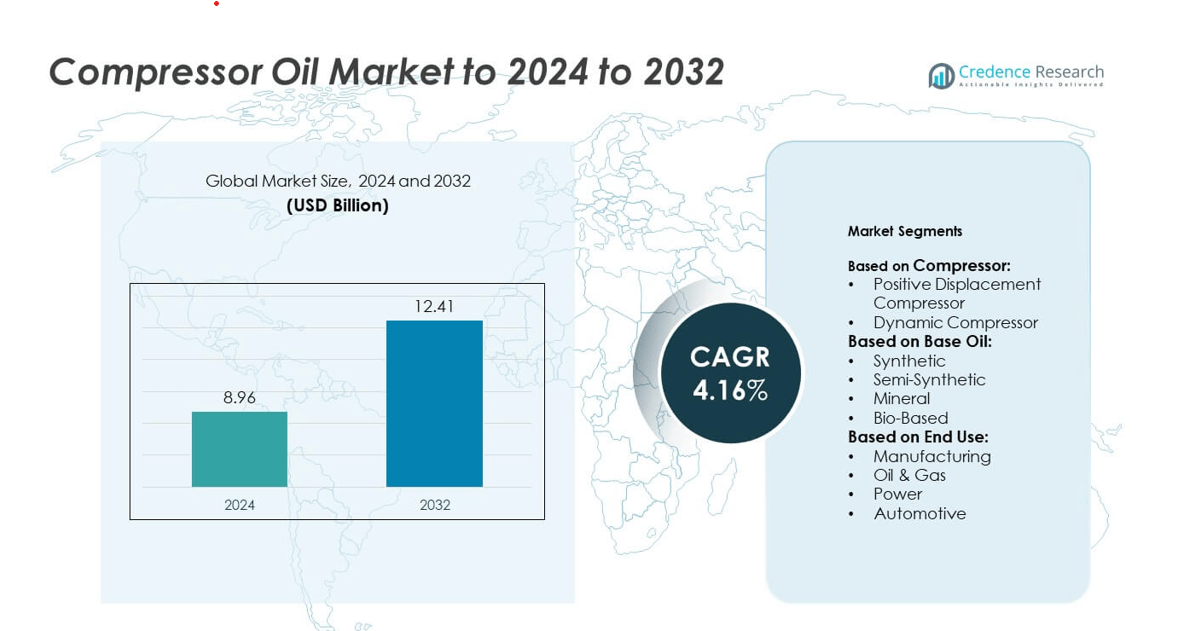
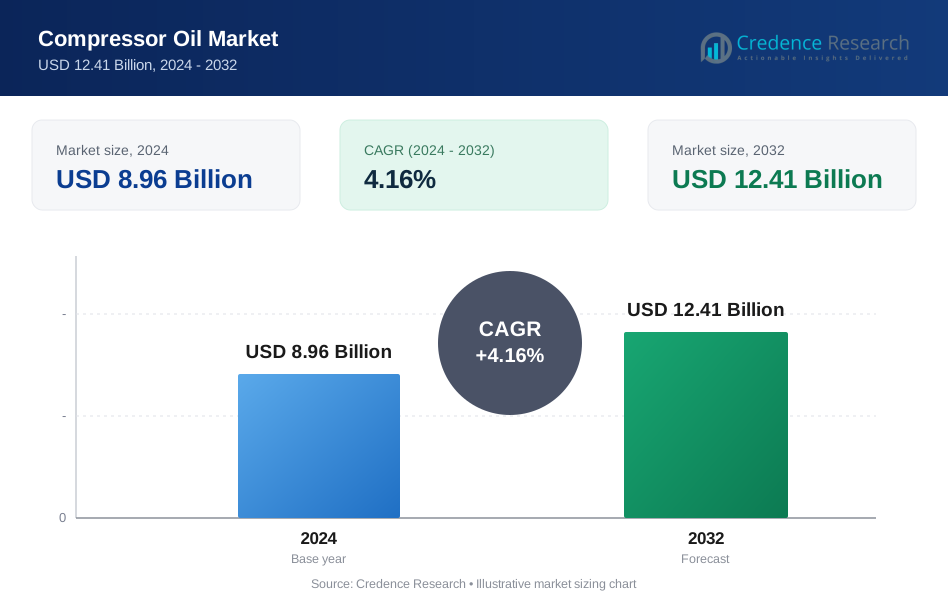
Compressor Oil Market size was valued at USD 8.96 Billion in 2024 and is anticipated to reach USD 12.41 Billion by 2032, at a CAGR of 4.16% during the forecast period.
| REPORT ATTRIBUTE | DETAILS |
|---|---|
| Historical Period | 2020-2023 |
| Base Year | 2024 |
| Forecast Period | 2025-2032 |
| Compressor Oil Market Size 2024 | USD 8.96 Billion |
| Compressor Oil Market, CAGR | 4.16% |
| Compressor Oil Market Size 2032 | USD 12.41 Billion |
The compressor oil market is driven by major players such as Atlas Copco Group, MITSUBISHI HEAVY INDUSTRIES, LTD., FUCHS, Repsol, Shell plc, Siemens AG, Chevron Corporation, and Exxon Mobil Corporation. These companies focus on developing advanced synthetic and bio-based compressor oils that enhance equipment efficiency and meet global sustainability standards. Their strong R&D investments and partnerships with compressor manufacturers help improve oil performance and compatibility. Asia-Pacific led the global market in 2024 with a 34% share, supported by rapid industrialization, infrastructure growth, and expanding manufacturing activities across China, India, and Japan.
Market Insights
- The compressor oil market was valued at USD 8.96 Billion in 2024 and is projected to reach USD 12.41 Billion by 2032, growing at a CAGR of 4.16%.
- Market growth is driven by rising industrial automation, increased power generation, and expanding manufacturing activities worldwide.
- Synthetic and bio-based compressor oils are gaining traction due to superior performance, longer service life, and compliance with sustainability regulations.
- Competition remains strong, with major players focusing on innovation, product diversification, and regional expansion to strengthen their global presence.
- Asia-Pacific led the market with a 34% share in 2024, followed by North America at 28% and Europe at 25%, while the positive displacement compressor segment dominated with 62% market share.
Market Segmentation Analysis:
By Compressor
The positive displacement compressor segment dominated the compressor oil market in 2024, accounting for nearly 62% share. These compressors, including rotary screw and reciprocating types, require continuous lubrication to reduce friction and heat during compression cycles. High operational reliability and suitability for varied industrial applications make them the preferred choice. Their widespread use in manufacturing and energy sectors drives consistent oil demand. Growth in industrial automation and increased maintenance schedules in heavy-duty operations further strengthen the dominance of positive displacement compressors in the market.
- For instance, Ingersoll Rand’s Ultra Coolant is rated for up to 8,000 hours in rotary screw compressors.
By Base Oil
The synthetic oil segment led the compressor oil market with around 48% share in 2024. Synthetic oils offer superior thermal stability, oxidation resistance, and extended drain intervals compared to mineral oils, which lower maintenance costs and downtime. Their performance in extreme temperature conditions makes them suitable for high-load industrial compressors. Industries focusing on energy efficiency and reduced environmental impact are increasingly adopting synthetic lubricants. Expanding manufacturing and power generation sectors, particularly in Asia-Pacific, continue to boost demand for synthetic-based compressor oils.
- For instance, Shell Corena S4 R supports up to 12,000 operating hours in rotary vane and screw compressors.
By End Use
The manufacturing segment held the largest share of approximately 41% in the compressor oil market in 2024. Continuous compressor operation in machinery, assembly lines, and production units creates strong lubrication requirements. The rise of smart factories, automation, and process optimization enhances oil consumption for equipment protection and efficiency. Demand is further supported by growth in sectors like food processing, chemicals, and electronics manufacturing. With expanding industrial infrastructure in developing economies, the manufacturing sector remains the key growth driver for compressor oil applications.
Key Growth Drivers
Expanding Industrial and Manufacturing Activities
Rising industrialization and expansion of manufacturing facilities worldwide are major drivers of compressor oil demand. Continuous operation of compressors in assembly lines, production plants, and processing units requires reliable lubrication to maintain efficiency and reduce wear. Emerging economies such as India and China are investing heavily in manufacturing infrastructure, increasing the need for high-performance compressor oils. The shift toward energy-efficient production systems further boosts the adoption of premium synthetic lubricants that extend equipment life and minimize maintenance downtime.
- For instance, a Kaeser project cut 361,099 kWh per year after optimizing a plant’s compressor setup.
Increasing Use in Power and Energy Infrastructure
The growing demand for electricity and the development of renewable energy facilities are fueling the need for compressor oils in turbines, air systems, and gas handling equipment. Power plants rely on compressors for operations such as air separation and cooling systems. With global power generation capacity expanding, the requirement for long-lasting and thermally stable oils continues to rise. Energy companies are also focusing on low-viscosity oils that improve compressor performance and reduce energy losses, driving consistent product consumption.
- For instance, ExxonMobil’s Mobil Rarus 800 Series extends typical reciprocating drains to 2,000 hours versus 500 hours for mineral oils.
Shift Toward Environmentally Sustainable Lubricants
Environmental regulations and sustainability goals are accelerating the adoption of eco-friendly compressor oils. Manufacturers are introducing bio-based and low-toxicity lubricants that comply with REACH and EPA standards. These oils reduce emissions and improve biodegradability without compromising lubrication performance. Industries are investing in sustainable maintenance practices to meet corporate ESG targets. The shift aligns with broader decarbonization goals across sectors, positioning green lubricants as a strategic growth driver within the compressor oil market.
Key Trends & Opportunities
Rising Adoption of Synthetic Compressor Oils
Synthetic compressor oils are gaining traction due to their superior performance and longer service life compared to mineral-based alternatives. Their ability to operate under extreme temperatures and resist oxidation makes them ideal for demanding industrial conditions. Companies are adopting synthetic oils to minimize downtime and maintenance costs while improving operational efficiency. This trend presents an opportunity for lubricant manufacturers to expand product lines targeting high-performance industrial and energy applications worldwide.
- For instance, Chevron Cetus PAO 68 carries ABB turbocharger approval with a 5,000-hour drain requirement.
Advancements in Smart Maintenance and Monitoring Systems
Integration of IoT-based monitoring in industrial equipment is reshaping compressor oil maintenance strategies. Smart systems track lubricant quality, temperature, and viscosity in real time, allowing predictive maintenance and timely oil replacement. These advancements help reduce equipment failure and extend service intervals. The growing preference for automated maintenance solutions across industries creates new opportunities for manufacturers offering sensor-compatible and performance-tracking compressor oils.
- For instance, Castrol’s SmartOil and SmartMonitor won a 2025 IoT Emerging Technology Award for industrial applications.
Key Challenges
Fluctuating Crude Oil Prices and Supply Instability
Volatile crude oil prices directly impact the cost of raw materials used in compressor oil production. Sudden price shifts affect profit margins and create uncertainty in supply chains. Manufacturers face challenges in maintaining stable pricing while ensuring consistent product quality. Supply disruptions, particularly during geopolitical tensions, can delay production schedules and increase operational costs for both producers and end users.
Rising Competition from Alternative Lubrication Technologies
The development of oil-free and dry-type compressors poses a growing challenge to traditional compressor oil demand. These technologies eliminate the need for lubricants, reducing operational maintenance and environmental risks. As industries adopt oil-free compressors in sectors like food processing and healthcare, market growth for conventional oils faces constraints. Manufacturers must innovate through advanced formulations or hybrid solutions to retain competitiveness in applications increasingly shifting toward low-maintenance technologies.
Regional Analysis
North America
North America held a 28% share of the compressor oil market in 2024, driven by strong industrial and energy sector demand. The United States remains a key contributor due to widespread use of compressors in manufacturing, automotive, and power generation. Technological advancements in synthetic lubricants and increased adoption of energy-efficient systems support market expansion. The presence of major oil producers and lubricant manufacturers further strengthens regional supply capabilities. Regulatory emphasis on reducing emissions and improving operational efficiency continues to encourage the shift toward premium synthetic and bio-based compressor oils.
Europe
Europe accounted for a 25% market share in 2024, supported by its well-established industrial base and environmental regulations promoting sustainable lubricants. Countries such as Germany, France, and the United Kingdom are leading consumers, driven by advanced manufacturing and power generation industries. The European Union’s policies on emissions reduction and waste management are encouraging adoption of biodegradable and low-toxicity compressor oils. Increased investment in renewable energy facilities and compressed air systems across industrial sectors contributes to steady market growth, with synthetic and bio-based oils gaining rapid traction among end users.
Asia-Pacific
Asia-Pacific dominated the compressor oil market with a 34% share in 2024, led by rapid industrialization in China, India, Japan, and South Korea. Strong growth in manufacturing, construction, and energy sectors fuels demand for high-performance lubricants. Expanding infrastructure development and government investments in industrial automation create new opportunities for compressor oil manufacturers. Rising adoption of synthetic oils to reduce maintenance costs and improve efficiency supports market expansion. Local producers are also focusing on cost-effective formulations to meet the growing needs of small and medium-scale industries in the region.
Latin America
Latin America captured an 8% market share in 2024, primarily driven by industrial activities in Brazil, Mexico, and Argentina. The region’s oil and gas sector remains a major end-user of compressor oils, with expanding refinery and energy infrastructure projects sustaining demand. Growth in food processing, packaging, and automotive industries also contributes to consumption. Increasing preference for synthetic and semi-synthetic oils, supported by efforts to enhance operational reliability, is shaping regional trends. However, economic fluctuations and dependency on imports for raw materials pose moderate challenges to consistent market growth.
Middle East & Africa
The Middle East & Africa accounted for a 5% share of the compressor oil market in 2024, supported by the strong presence of the oil and gas industry. Demand is high in nations such as Saudi Arabia, the UAE, and South Africa, where compressors are widely used in extraction and power operations. Ongoing infrastructure projects and industrial diversification initiatives are boosting lubricant consumption. Increasing awareness of maintenance efficiency and energy savings encourages the shift toward high-performance synthetic oils. However, limited local production capacity restricts broader regional penetration.
Market Segmentations:
By Compressor:
- Positive Displacement Compressor
- Dynamic Compressor
By Base Oil:
- Synthetic
- Semi-Synthetic
- Mineral
- Bio-Based
By End Use:
- Manufacturing
- Oil & Gas
- Power
- Automotive
By Geography:
- North America
- U.S.
- Canada
- Europe
- Germany
- France
- U.K.
- Italy
- Spain
- Rest of Europe
- Asia Pacific
- China
- Japan
- India
- South Korea
- South-east Asia
- Rest of Asia Pacific
- Latin America
- Brazil
- Mexico
- Rest of Latin America
- Middle East & Africa
- GCC Countries
- South Africa
- Rest of the Middle East and Africa
Competitive Landscape
The compressor oil market features prominent players such as Atlas Copco Group, MITSUBISHI HEAVY INDUSTRIES, LTD., FUCHS, Repsol, Hitachi, Ltd., KAESER KOMPRESSOREN, Shell plc, Siemens AG, Chevron Corporation, and Exxon Mobil Corporation. These companies focus on expanding their product portfolios with high-performance synthetic and bio-based lubricants designed for enhanced efficiency and sustainability. Strategic investments in R&D enable innovations in oxidation-resistant, low-viscosity oils tailored to meet industrial energy-saving goals. Many producers are forming partnerships with compressor manufacturers to ensure compatibility with advanced systems and optimize performance. Expansion across Asia-Pacific and the Middle East remains a key priority to capture growing industrial demand. Companies are also adopting digital platforms for predictive maintenance and performance monitoring, reinforcing customer retention and operational reliability. Competitive differentiation increasingly relies on offering eco-friendly formulations and meeting regulatory standards, positioning technologically advanced lubricant solutions as the core of future market competition.
Key Player Analysis
- Atlas Copco Group
- MITSUBISHI HEAVY INDUSTRIES, LTD.
- FUCHS
- Repsol
- Hitachi, Ltd.
- KAESER KOMPRESSOREN
- Shell plc
- Siemens AG
- Chevron Corporation
- Exxon Mobil Corporation
Recent Developments
- In 2025, Chevron confirmed plans to reduce its workforce by 15% to 20%, affecting approximately 6,830 to 9,100 jobs, as part of an organizational restructuring.
- In 2024, Shell was once again named the leading global lubricants supplier for the 18th consecutive year by Kline & Company.
- In 2023, MITSUBISHI HEAVY INDUSTRIES, LTD. Provided advanced compressor technology for industries like oil and gas, LNG, and refineries.
Report Coverage
The research report offers an in-depth analysis based on Compressor, Base Oil, End-Use and Geography. It details leading market players, providing an overview of their business, product offerings, investments, revenue streams, and key applications. Additionally, the report includes insights into the competitive environment, SWOT analysis, current market trends, as well as the primary drivers and constraints. Furthermore, it discusses various factors that have driven market expansion in recent years. The report also explores market dynamics, regulatory scenarios, and technological advancements that are shaping the industry. It assesses the impact of external factors and global economic changes on market growth. Lastly, it provides strategic recommendations for new entrants and established companies to navigate the complexities of the market.
Future Outlook
- The compressor oil market will continue expanding with rising global industrial automation.
- Demand for synthetic and bio-based compressor oils will strengthen due to sustainability goals.
- Power generation and renewable energy sectors will boost lubricant consumption.
- Manufacturers will invest in advanced formulations offering higher oxidation and thermal stability.
- Digital monitoring of compressor performance will increase the need for smart-compatible oils.
- The Asia-Pacific region will remain the leading market with strong industrial growth.
- Oil-free compressor technology will pressure traditional lubricant producers to innovate.
- Partnerships between OEMs and lubricant suppliers will enhance product performance standards.
- Environmental regulations will drive the adoption of low-emission and recyclable oil solutions.
- Continuous R&D investment will shape next-generation lubricants focused on efficiency and durability.
Request a Free Sample
Fill in your details and we'll send you a free sample report.
- Sample data tables & charts
- Research methodology
Need a Custom Version of This Report?
Tailor the scope, geography, or segments to your exact requirements.
- Custom geography or segment scope
- Direct access to our analyst team
Frequently Asked Questions
What is the current market size for Compressor Oil Market, and what is its projected size in 2032?
At what Compound Annual Growth Rate is the Compressor Oil Market projected to grow between 2025 and 2032?
Which Compressor Oil Market segment held the largest share in 2024?
What are the primary factors fueling the growth of the Compressor Oil Market?
Who are the leading companies in the Compressor Oil Market?
Table of Content
Chapter 1. Report Introduction
- 1.1 Report Description & Purpose
- 1.1.1 Report Title & Market Definition
- 1.1.2 Unique Selling Propositions (USP) & Key Differentiators
- 1.1.3 Value Proposition for Stakeholders
- 1.2 Research Objectives
- 1.2.1 Market Sizing Objectives (Volume & Revenue) (Volume Where Applicable)
- 1.2.2 Segmentation Objectives
- 1.2.3 Competitive Intelligence Objectives
- 1.2.4 Forecast & Scenario Objectives
- 1.3 Report Scope
- 1.3.1 Compressor Oil Scope – Segments & Subsegments Covered
- 1.3.2 Geographic Scope – Regions & Countries Covered
- 1.3.3 Historical Period, Base Year & Forecast Period (2024; forecast to 2032)
- 1.3.4 Inclusions & Exclusions
- 1.4 Industry Classification & Applicable Codes
- 1.5 Currency, Measurement Units & Valuation Basis
- 1.6 Target Stakeholders
- 1.7 Limitations & Assumptions
Chapter 2. Executive Summary
- 2.1 Global Compressor Oil Market Snapshot
- 2.1.1 Market Size – Historical (2024) & Forecast (2024-2032) (2024: USD 8.96 Billion → 2032: USD 12.41 Billion)
- 2.1.2 Volume & Revenue – Global Totals (Volume Where Applicable)
- 2.1.3 Key Market Highlights – Top Five Facts
- 2.2 Compressor Oil Market Segmentation Snapshot
- 2.2.1 Market Split by Region – 2024 vs. 2032
- 2.3 Competitive Snapshot
- 2.3.1 Top 10 Players by Revenue Share – 2024
- 2.3.2 Top 10 Players by Volume Share – 2024 (Volume Where Applicable)
- 2.3.3 Recent Strategic Developments (18-Month Summary)
- 2.4 Key Investment Highlights & Strategic Conclusions
Chapter 3. Compressor Oil Market Dynamics & Industry Analysis
- 3.1 Market Overview & Context
- 3.1.1 Compressor Oil Market Position in the Broader Industry Value Chain
- 3.1.2 Demand Structure & Purchasing Dynamics
- 3.1.3 Market Maturity & Development Stage by Region
- 3.2 Compressor Oil Market Drivers
- 3.3 Compressor Oil Market Restraints & Challenges
- 3.4 Compressor Oil Market Opportunities
- 3.5 Porter's Five Forces Analysis
- 3.5.1 Threat of New Entrants
- 3.5.2 Bargaining Power of Suppliers
- 3.5.3 Bargaining Power of Buyers
- 3.5.4 Threat of Substitutes
- 3.5.5 Competitive Rivalry – Intensity Assessment
- 3.6 Compressor Oil Value Chain Analysis
- 3.6.1 Upstream – Key Inputs, Resources & Suppliers
- 3.6.1.1 Key Input/Resource 1
- 3.6.1.2 Key Input/Resource 2
- 3.6.1.3 Key Input/Resource 3
- 3.6.2 Midstream – Core Operations & Value Creation
- 3.6.2.1 Operating Model & Process Overview
- 3.6.2.2 Key Operating Locations & Capabilities by Company
- 3.6.3 Downstream – Market Channels & End Users
- 3.6.3.1 Direct Sales & Customer Engagement Channels
- 3.6.3.2 Indirect Sales, Intermediaries & Partner Channels
- 3.6.4 Value Chain Profitability Analysis
- 3.6.1 Upstream – Key Inputs, Resources & Suppliers
- 3.7 PESTEL Analysis
- 3.7.1 Political Factors
- 3.7.2 Economic Factors
- 3.7.3 Social Factors
- 3.7.4 Technological Factors
- 3.7.5 Environmental Factors
- 3.7.6 Legal Factors
- 3.8 Compressor Oil Supply Chain Analysis
- 3.8.1 Critical Input & Resource Availability Risk Assessment
- 3.8.2 Supplier & Operational Concentration Risk (Geographic Exposure)
- 3.8.3 Supply & Service Disruption Impact Analysis
- 3.9 Regulatory & Policy Landscape
Note: The regulatory and policy landscape section covers regulations based on their applicability to the market, Compressor Oil category, geography, and scope of the study. Only regulatory frameworks with a material impact on operations, compliance, trade, sustainability, or market access are analyzed in detail.
Chapter 4. Key Investment Pockets & Opportunity Analysis
- 4.1 Compressor Oil Market Attractiveness Analysis
- 4.1.1 By Region – Investment Attractiveness Matrix (Market Size × CAGR)
- 4.2 Absolute Revenue Growth Opportunity
- 4.2.1 By Region – Absolute Revenue Growth Through 2032
- 4.3 Incremental Demand Opportunity
- 4.3.1 By Region – Incremental Demand Through 2032
- 4.3.2 Segment – Incremental Demand
- 4.4 Emerging Submarket Opportunity Deep Dive (Subject to Applicability)
- 4.5 Priority Market Opportunity Scorecards
- 4.5.1 United States
- 4.5.2 Europe
- 4.5.3 Asia
- 4.5.4 Middle East & Africa
Note: Priority market opportunity scorecards reflect the geographic scope and strategic relevance of the study. Listed markets are indicative and may be adapted to the industry.
Chapter 5. Compressor Oil Cross-Border Trade & Market Access Analysis
- 5.1 International Trade & Cross-Border Activity Overview
- 5.1.1 Global Export Value by Country (2024)
- 5.1.2 Global Export Volume by Country (2024) (Volume Where Applicable)
- 5.1.3 Global Import Value by Country (2024)
- 5.1.4 Global Import Volume by Country (2024) (Volume Where Applicable)
- 5.1.5 Net Trade Balance by Country (2024)
- 5.2 Export Analysis – Segment
- 5.2.1 Category 1 (Applicable Classification Code)
- 5.2.2 Category 2 (Applicable Classification Code)
- 5.2.3 Category 3 (Applicable Classification Code)
- 5.2.4 Category 4 (Applicable Classification Code)
- 5.2.5 Category 5 (Applicable Classification Code)
- 5.3 Import Analysis – Segment
- 5.3.1 Category 1 (Applicable Classification Code)
- 5.3.2 Category 2 (Applicable Classification Code)
- 5.3.3 Category 3 (Applicable Classification Code)
- 5.3.4 Category 4 (Applicable Classification Code)
- 5.3.5 Category 5 (Applicable Classification Code)
- 5.4 Cross-Border Pricing & Transaction Benchmarks
- 5.4.1 Export Pricing – Segment & Country
- 5.4.2 Import Pricing – Segment & Source Country
- 5.4.3 Price Trends (2024)
- 5.5 Key Cross-Border Trade & Delivery Routes
- 5.5.1 Cross-Border Trade/Delivery Route 1
- 5.5.2 Cross-Border Trade/Delivery Route 2
- 5.5.3 Cross-Border Trade/Delivery Route 3
- 5.5.4 Cross-Border Trade/Delivery Route 4
- 5.5.5 Cross-Border Trade/Delivery Route 5
- 5.6 Trade Policy & Market Access Impact Assessment
- 5.6.1 Tariff & Non-Tariff Barriers
- 5.6.2 Regional Trade & Economic Integration Frameworks
- 5.6.3 Bilateral & Multilateral Trade Agreements
- 5.6.4 Cross-Border Operating, Licensing & Localization Requirements
Note: This chapter applies where cross-border trade or delivery is relevant to Compressor Oil. Goods, services, and digital offerings are assessed using applicable classifications and transaction measures. Import-export volumes, trade balances, and route analyses are included only where meaningful to the market.
Chapter 6. Competitive Landscape & Company Benchmarking
- 6.1 Compressor Oil Market Concentration & Structure
- 6.1.1 Herfindahl-Hirschman Index (HHI) – vs. 2024
- 6.1.2 Leading, Mid-Sized & Emerging Player Structure
- 6.1.3 Global, Regional & Local Player Dynamics
- 6.2 Compressor Oil Market Share Analysis – 2024
- 6.2.1 Global Revenue Share by Company
- 6.2.2 Global Volume Share by Company (Volume Where Applicable)
- 6.2.3 Regional Revenue Share
- 6.2.4 Market Share Evolution ( vs. 2024)
- 6.2.5 Company Market Share by Key Segment
- 6.2.6 Company Market Share by Customer Group
- 6.3 Operating Scale, Capacity & Infrastructure Analysis
- 6.3.1 Global Operating Scale & Supply Capacity
- 6.3.2 Resource Utilization & Operating Efficiency
- 6.3.3 Output, Service Delivery & Activity Metrics
- 6.3.4 Operating Footprint & Infrastructure Map
- 6.3.5 Planned Operational & Capacity Expansion
- 6.4 Compressor Oil Competitive Benchmarking Matrix
- 6.4.1 Revenue, Growth, Profitability & Operating Metric Comparison
- 6.4.2 Channel Revenue Mix
- 6.4.3 Geographic Revenue Exposure
- 6.4.4 R&D Intensity
- 6.4.5 Sustainability Maturity
- 6.5 Strategic Developments in Compressor Oil (Last 24 Months)
- 6.5.1 Mergers, Acquisitions & Divestments
- 6.5.2 New Products, Services & Solutions in Compressor Oil
- 6.5.3 Operational & Infrastructure Expansions
- 6.5.4 Strategic Alliances, Joint Ventures & Partnerships
- 6.5.5 Distribution Expansion & Market Entry
- 6.5.6 Sustainability & ESG Initiatives
- 6.6 Competitive Strategy Mapping
- 6.6.1 Leader, Challenger, Follower & Niche Classification
- 6.6.2 Pricing Strategy Comparison
- 6.6.3 Channel Strategy Matrix
Note: Strategic developments are included based on their materiality and the availability of reliable information.
Chapter 7. Global Compressor Oil Market – By Sales & Delivery Channel
- 7.1 Segment Overview
- 7.1.1 Volume & Revenue Split by Channel (2024 & 2032) (Volume Where Applicable)
- 7.1.2 Channel Mix Evolution (2024-2032)
Chapter 8. Regional Market Analysis – Global Overview
- 8.1 Global Regional Overview
- 8.1.1 Regional Volume Share (Volume Where Applicable)
- 8.1.2 Regional Revenue Share
- 8.1.3 Regional Volume by Region (Volume Where Applicable)
- 8.1.4 Regional Revenue by Region
- 8.1.5 Regional Forecast Through 2032
- 8.2 Cross-Regional Segment Analysis
- 8.2.1 By Sales & Delivery Channel
- 8.2.2 By Competitive Positioning & Price Tier
Chapter 9. North America Compressor Oil Market
- 9.1 United States
- 9.2 Canada
- 9.3 Mexico
Chapter 10. Europe Compressor Oil Market
- 10.1 Germany
- 10.2 France
- 10.3 Italy
- 10.4 United Kingdom
- 10.5 Spain
- 10.6 Poland
- 10.7 Russia
- 10.8 Netherlands
- 10.9 Belgium
- 10.10 Sweden
- 10.11 Denmark
- 10.12 Norway
- 10.13 Rest of Europe
Chapter 11. Asia Pacific Compressor Oil Market
- 11.1 China
- 11.2 India
- 11.3 Japan
- 11.4 South Korea
- 11.5 Thailand
- 11.6 Indonesia
- 11.7 Vietnam
- 11.8 Malaysia
- 11.9 Australia
- 11.10 Rest of Asia Pacific
Chapter 12. Latin America Compressor Oil Market
- 12.1 Brazil
- 12.2 Argentina
- 12.3 Colombia
- 12.4 Chile
- 12.5 Rest of Latin America
Chapter 13. Middle East Compressor Oil Market
- 13.1 Saudi Arabia
- 13.2 United Arab Emirates
- 13.3 Turkey
- 13.4 Israel
- 13.5 Iran
- 13.6 Rest of the Middle East
Chapter 14. Africa Compressor Oil Market
- 14.1 South Africa
- 14.2 Egypt
- 14.3 Nigeria
- 14.4 Morocco
- 14.5 Rest of Africa
Chapter 15. Compressor Oil Company Profiles
- 15.1 [Company 01]
- 15.1.1 Company Overview
- 15.1.2 Key Management Personnel
- 15.1.3 Products & Services Portfolio
- 15.1.4 Financial Performance
- 15.1.5 Key Market Focus & Geographic Presence
- 15.1.6 Recent Developments & Strategic Initiatives
Note: The company profile list is preliminary and may change based on research findings, market developments, data availability, and client requirements.
Chapter 16. Appendices
- Appendix A – List of Abbreviations & Acronyms
- Appendix B – Industry Classification Code Reference – Full Series
- Appendix C – Supply, Output & Operating Capacity Data Tables
- Appendix D – End-Use & Demand Base Tables
- Appendix E – Demand, Adoption & Usage Assumptions
- Appendix F – Pricing & Revenue Metric Reference Tables
- Appendix G – Company Operations & Infrastructure Database
- Appendix H – Cross-Border Trade & Activity Data Tables (Where Applicable)
- Appendix I – Regulatory Summary Tables
- Appendix J – Primary Research Participant List (Anonymized)
- Appendix K – Primary Research Questionnaire Framework
- Appendix L – Data Sources & Bibliography
- Appendix M – Market Size Divergence & Source Comparison
Chapter 17. Research Methodology
- 17.1 Research Framework & Philosophy
- 17.2 Secondary Research – Sources, Hierarchy & Data Extraction
- 17.3 Data Modeling – Bottom-Up & Top-Down Market Sizing
- 17.4 Primary Research – Stakeholder Framework, LOI & Sample Sizes
- 17.5 Forecast Methodology – Regression, Scenario & Sensitivity Analysis
- 17.6 Quality Control – Four-Layer Validation Framework
- 17.7 Limitations & Standard Assumptions
- 17.8 Disclaimer
