
| REPORT ATTRIBUTE | DETAILS |
|---|---|
| Historical Period | 2020-2023 |
| Base Year | 2024 |
| Forecast Period | 2025-2032 |
| Italy Digital Oilfield Solutions Market Size 2024 | USD 857.98 million |
| Italy Digital Oilfield Solutions Market, CAGR | 5.91% |
| Italy Digital Oilfield Solutions Market Size 2032 | USD 1,358.71 million |
Market Overview
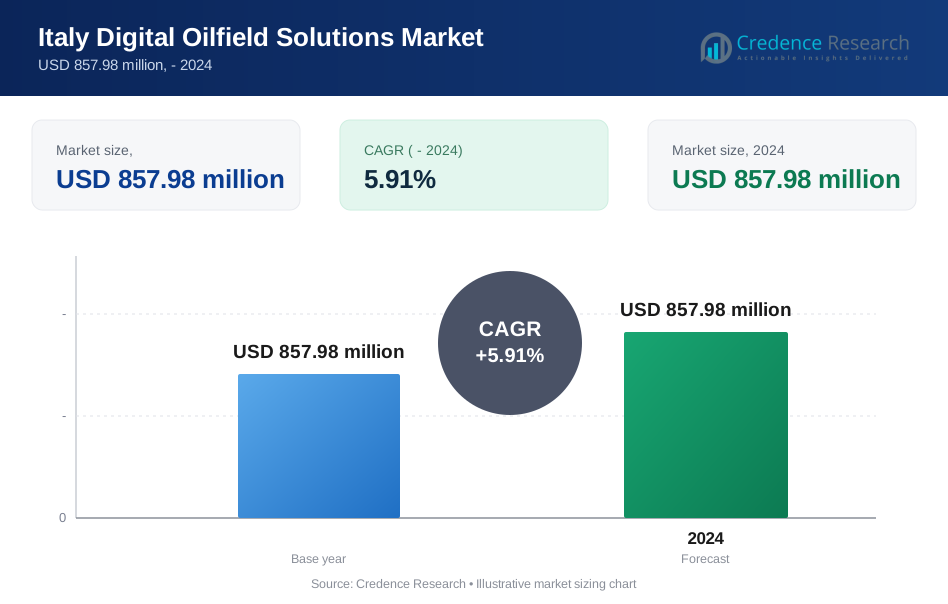
The Italy Digital Oilfield Solutions Market is projected to grow from USD 857.98 million in 2024 to an estimated USD 1,358.71 million by 2032, reflecting a compound annual growth rate (CAGR) of 5.91% from 2025 to 2032. This growth is driven by the increasing adoption of digital technologies in the oil and gas sector to enhance operational efficiency and reduce costs.
Key drivers of this market include the need to boost production from mature oilfields and the integration of advanced technologies such as IoT, AI, and big data analytics. These innovations facilitate real-time monitoring and predictive maintenance, leading to improved safety and productivity. However, challenges like cybersecurity threats and resistance to technological change may impact market growth.
Geographically, Italy is witnessing a steady uptake of digital oilfield solutions, with both onshore and offshore operations embracing these technologies. Key players in the market include Schlumberger, Halliburton, Siemens Energy, Baker Hughes, and Weatherford International, all of which offer a range of digital solutions tailored to the unique needs of the Italian oil and gas industry.
Market Insights
- The Italy Digital Oilfield Solutions Market is projected to grow from USD 857.98 million in 2024 to USD 1,358.71 million by 2032, with a CAGR of 5.91% from 2025 to 2032.
- The Global Digital Oilfield Solutions Market is projected to grow from USD31,374.00 million in 2024 to USD 54,897.18 million by 2032, with a CAGR of 7.24% from 2025 to 2032.
- Increasing integration of IoT, AI, and big data analytics drives digital transformation, enhancing operational efficiency and reducing costs.
- The need to optimize production from mature oilfields is a major driver, with digital solutions enabling better reservoir management and operational control.
- Cybersecurity threats and the industry's resistance to rapid technological changes are major restraints affecting market growth.
- Both onshore and offshore oilfields in Italy are embracing digital oilfield solutions, improving operational efficiency and safety.
- Northern and Southern Italy are the key regions for digital oilfield technologies, with significant advancements in both onshore and offshore sectors.
- Leading players such as Schlumberger, Halliburton, Siemens Energy, and Baker Hughes are contributing to the market with tailored digital solutions for the Italian oil and gas industry
Market Drivers
Pressure to Optimize Production from Mature Oilfields
A key driver in the Italy Digital Oilfield Solutions Market is the increasing pressure to optimize production from mature oilfields. Many of Italy's oil reserves are located in aging fields where production rates have started to decline. To sustain or even increase production levels, oil operators are turning to digital oilfield technologies for enhanced reservoir management and optimization. Digital solutions such as advanced reservoir modeling, enhanced oil recovery (EOR) techniques, and smart field technologies are allowing operators to extract more resources from existing fields. Reservoir management tools, powered by big data and machine learning, can identify untapped potential by modeling fluid flow patterns, predicting reservoir behavior, and recommending optimized drilling techniques. Moreover, automation and sensor technologies can help optimize the injection and extraction processes, improving efficiency and production. As the pressure to maximize production from existing fields continues, the role of digital oilfield solutions in facilitating these efforts will become more pronounced, driving market demand in Italy.
Improved Safety and Environmental Compliance
Safety and environmental concerns are significant priorities in the oil and gas industry. Italy’s regulatory environment demands strict adherence to safety protocols and environmental standards, which can be challenging in the complex and hazardous environments found on oilfields. Digital oilfield solutions play a crucial role in addressing these concerns by enhancing monitoring, ensuring compliance, and improving safety measures. Real-time data monitoring through IoT sensors allows for the detection of equipment malfunctions, gas leaks, or other hazardous situations, triggering instant alerts to operators. This proactive approach ensures that safety risks are minimized and that quick responses are made in case of emergencies. Furthermore, digital technologies also assist in meeting environmental compliance requirements by monitoring emissions, water usage, and waste management, ensuring that operations align with Italy’s strict environmental laws. The ability to track and manage these factors not only improves safety but also reduces the risk of costly fines or production delays due to non-compliance. As environmental and safety concerns continue to be a top priority for both regulatory bodies and operators, the demand for digital oilfield solutions that address these issues will continue to grow.
Increased Adoption of Advanced Technologies
The growth of the Italy Digital Oilfield Solutions Market is driven by the adoption of cutting-edge technologies such as IoT, AI, machine learning, and big data analytics. These innovations are transforming oilfield operations by enabling real-time monitoring, predictive maintenance, and enhanced decision-making processes. IoT sensors, for instance, allow operators to track the performance of critical assets like pumps and drilling equipment remotely, reducing downtime and improving operational reliability. AI-powered analytics further enhance efficiency by predicting potential failures and optimizing resource allocation. The integration of big data analytics enables companies to process vast datasets from multiple sources, facilitating better drilling strategies and resource management. As these technologies advance, their application in Italy’s oil and gas sector will expand, offering operators the tools to navigate complex environments while improving productivity and sustainability.
Enhanced Operational Efficiency and Cost Reduction
The oil and gas industry faces constant pressure to improve efficiency and reduce costs amidst fluctuating market conditions. Digital oilfield solutions provide a comprehensive approach to addressing these challenges by automating workflows, enabling remote monitoring, and minimizing manual interventions. Remote control systems, for instance, allow operators to oversee drilling activities from centralized locations, reducing field visits and improving safety. Predictive maintenance tools help anticipate equipment failures before they occur, cutting repair costs and avoiding production interruptions. These solutions streamline operations by eliminating bottlenecks and ensuring consistent output. As Italian operators seek ways to optimize mature fields under cost constraints, the adoption of digital technologies continues to grow, promising more efficient and sustainable oilfield management practices.
Market Trends
Focus on Sustainability and Environmental Compliance
Sustainability and environmental concerns are becoming increasingly central to the operations of oil and gas companies, and Italy is no exception. The country’s regulatory environment emphasizes the reduction of environmental impacts and the improvement of energy efficiency in oilfield operations. As a result, digital oilfield solutions are being leveraged to meet these sustainability goals and ensure compliance with stringent environmental regulations. Technologies such as real-time environmental monitoring, emissions tracking, and energy management systems are helping operators better manage their environmental footprints. Digital solutions enable oilfield operators to track emissions of harmful gases such as methane and carbon dioxide, ensuring that emissions remain within permissible limits. Additionally, advanced technologies allow for the monitoring of water usage, waste management, and energy consumption, promoting more efficient and sustainable practices. Oil companies in Italy are investing heavily in digital oilfield solutions that enable them to not only comply with government regulations but also demonstrate their commitment to sustainability and corporate social responsibility. As environmental pressures intensify and regulations become stricter, the demand for digital solutions that enable sustainable operations is expected to grow in Italy’s oil and gas sector.
Integration of Cloud-Based Technologies for Data Management
The integration of cloud-based technologies for data management is another key trend that is transforming the Italy Digital Oilfield Solutions Market. Cloud computing offers oil and gas companies the ability to store, process, and analyze vast amounts of data in a cost-effective and scalable manner. By leveraging cloud-based platforms, operators can access critical data from anywhere, improving collaboration and decision-making across different levels of the organization. These platforms enable real-time data sharing, which is crucial for coordinating operations and ensuring that all stakeholders have access to the same information. Moreover, cloud technologies support the implementation of advanced analytics, artificial intelligence, and machine learning algorithms, which require high computational power and data storage capabilities. In Italy, many oilfield operators are adopting cloud-based solutions to enhance their data management capabilities and improve the efficiency of their operations. The shift to the cloud also helps companies reduce IT infrastructure costs, improve data security, and provide more flexible and scalable solutions as business needs evolve. As cloud technology continues to mature, its role in the oilfield solutions market is expected to expand, helping companies better manage their operations and stay competitive in an increasingly digitalized environment.
Integration of Artificial Intelligence (AI) and Machine Learning for Predictive Analytics
One of the most significant trends in the Italy Digital Oilfield Solutions Market is the integration of Artificial Intelligence (AI) and machine learning technologies for predictive analytics. These technologies empower oil and gas companies to process vast datasets collected from sensors, equipment, and operations in real-time. For instance, AI models can predict equipment failures and optimize maintenance schedules by analyzing operational patterns and anomalies. Predictive maintenance, driven by these technologies, has become a cornerstone for reducing unplanned downtime, extending asset lifespans, and improving production efficiency. In Italy, oilfield operators increasingly utilize AI tools to monitor drilling performance, optimize reservoir management, and forecast well output. This proactive approach not only enhances operational efficiency but also bolsters safety and environmental performance by mitigating risks of costly incidents. As regulatory pressures mount to ensure safer and greener operations, AI-driven predictive analytics is emerging as a transformative capability in the oil and gas sector.
Rise of Remote Monitoring and Automation
Another notable trend in the Italy Digital Oilfield Solutions Market is the rise of remote monitoring and automation technologies. These solutions provide operators with real-time access to drilling, production, and maintenance data from centralized control systems. For instance, remote monitoring systems leverage IoT sensors to detect anomalies in equipment performance or environmental conditions. This reduces the need for field personnel in hazardous environments while enabling faster responses to operational issues. Automation technologies like robotic process automation (RPA) are increasingly deployed for repetitive tasks, enhancing efficiency and reducing labor costs. In Italy, oilfield operators are adopting these solutions to address workforce shortages and improve asset management across dispersed sites. The ability to operate remotely aligns with broader industry goals of cost reduction, safety enhancement, and operational optimization. As oilfield operations expand into challenging environments, remote monitoring systems are proving indispensable for maintaining productivity while minimizing risks.
Market Challenge
Cybersecurity Threats and Data Privacy Concerns
As the Italy Digital Oilfield Solutions Market continues to grow, the increasing reliance on digital technologies such as IoT, AI, and cloud-based platforms introduces significant cybersecurity risks. For instance, recent cyberattacks targeting major Italian energy firms like Eni and GSE have highlighted vulnerabilities within critical infrastructure, underscoring the need for robust security measures. The integration of real-time monitoring, automated systems, and data analytics means that large volumes of sensitive data are being transmitted and stored across various platforms, making them vulnerable to cyberattacks. A breach could lead to operational disruptions, financial losses, or environmental incidents, damaging both company reputation and regulatory compliance. Oil and gas operators in Italy must invest heavily in robust cybersecurity measures to safeguard their digital infrastructure. However, the complex and evolving nature of cyber threats presents a major challenge in ensuring comprehensive protection against potential risks. As the industry digitalizes, the need for improved security protocols, encryption, and threat detection systems will become even more critical in maintaining the integrity and safety of operations.
Resistance to Technological Change and High Implementation Costs
The oil and gas industry, traditionally conservative and risk-averse, often faces resistance when adopting new technologies. Despite the clear benefits of digital oilfield solutions, such as improved efficiency and cost reduction, many stakeholders remain hesitant to transition from conventional methods to digital platforms. This resistance is often due to a lack of familiarity with new technologies, concerns about the reliability of digital systems, and a perceived disruption to established workflows. Additionally, the initial investment required for the deployment of digital technologies, including hardware, software, and the necessary training, can be substantial. Smaller oilfield operators, in particular, may find these upfront costs prohibitive, delaying the widespread adoption of digital solutions. Overcoming this resistance and demonstrating a strong return on investment (ROI) will be crucial for unlocking the full potential of digital technologies in Italy's oil and gas sector.
Market Opportunities
Adoption of Advanced Technologies for Enhanced Efficiency
The Italy Digital Oilfield Solutions Market presents a significant opportunity driven by the increasing demand for advanced technologies to optimize oil and gas operations. As oil operators in Italy look for ways to maximize production, reduce costs, and improve efficiency, digital solutions like AI, machine learning, and IoT-based sensors are becoming integral to their operations. These technologies enable predictive maintenance, real-time monitoring, and data-driven decision-making, ultimately enhancing the performance of oilfields. The continued integration of advanced automation and digital solutions presents a growing opportunity for companies to streamline operations, reduce downtime, and increase productivity, particularly as Italian oilfields mature and face declining production rates. This trend provides a prime opportunity for digital solution providers to offer their services to a growing market focused on improving operational efficiency and cost-effectiveness.
Focus on Environmental Sustainability and Regulatory Compliance
Environmental sustainability and strict regulatory compliance are key concerns for the Italian oil and gas industry, creating an opportunity for digital oilfield solutions to assist in meeting these objectives. As regulatory frameworks become more stringent, the demand for solutions that facilitate environmental monitoring, emissions tracking, and sustainable practices is increasing. Digital technologies that monitor air quality, water usage, and energy consumption are becoming essential for ensuring compliance with environmental laws and minimizing operational impacts on the environment. This focus on sustainability opens up a substantial market opportunity for providers of digital solutions that enable oil operators in Italy to meet their environmental and compliance goals while improving operational efficiency.
Market Segmentation Analysis
By Solution
The market is primarily divided into three key solution types: hardware, software, and services. Hardware solutions account for a significant portion of the market, driven by the increasing demand for IoT sensors, advanced drilling equipment, and other physical components necessary for real-time monitoring and automation in oilfields. Software solutions follow closely, with software for data analytics, predictive maintenance, and reservoir management playing a crucial role in optimizing operations. Services encompass a broad range of offerings, including consulting, installation, and maintenance services, which are essential for ensuring the successful implementation and continued operation of digital solutions. Th growing integration of AI and machine learning software tools, combined with robust hardware infrastructure, is expected to drive demand in this segment.
By Application
The market is further segmented by application into onshore and offshore operations. Onshore oilfields are currently leading in market share, owing to the more widespread presence of onshore oilfields in Italy. These fields benefit from the application of digital solutions that enhance efficiency and reduce operational costs. Offshore operations are also gaining traction, particularly with the increased focus on optimizing production from mature offshore fields. Digital solutions such as automated drilling systems, real-time monitoring, and reservoir management tools are crucial for maximizing output and ensuring operational safety in the challenging offshore environments.
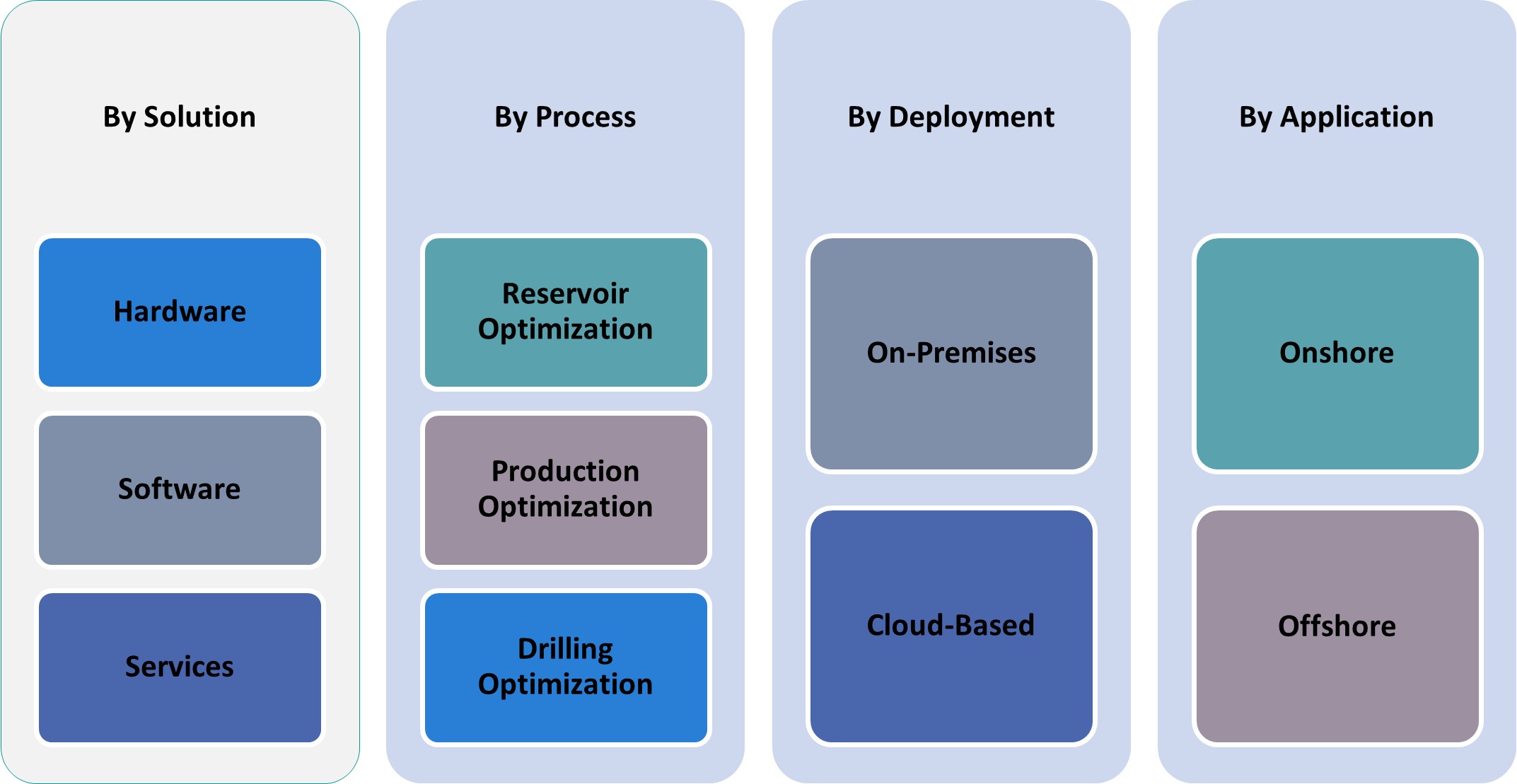
Segments
Based on Solution
- Hardware
- Software
- Services
Based on Application
- Onshore
- Offshore
Based on Process
- Reservoir Optimization
- Production Optimization
- Drilling Optimization
Based on Deployment
- On-Premises
- Cloud-Based
Based on Region
- Northern Italy
- Southern Italy
- Central Italy
- Offshore Operations in the Mediterranean Se
Regional Analysis
Northern Italy (40%)
Northern Italy, particularly regions such as Lombardy, Piedmont, and Emilia-Romagna, plays a crucial role in the country’s oil and gas operations. This area is home to many onshore oilfields, which benefit greatly from the implementation of digital oilfield solutions. The region has seen significant investments in infrastructure, with digital solutions like automated drilling systems, real-time data monitoring, and predictive maintenance technologies becoming integral to operations. Additionally, this region houses a number of leading oil and gas companies, which are early adopters of innovative digital technologies aimed at optimizing production and improving safety. The continued push toward industrial automation and efficiency has made Northern Italy a major contributor to the digital oilfield solutions market.
Southern Italy (35%)
Southern Italy, including regions such as Sicily and Calabria, is another key area in the digital oilfield solutions market. While Southern Italy is less densely populated with oilfields compared to the north, it still represents a significant share due to its offshore oil and gas operations, particularly in the Mediterranean Sea. Offshore production has seen an uptick in digital technology adoption, with real-time monitoring and predictive analytics becoming vital for managing complex offshore drilling processes. The emphasis on reducing environmental impact and improving safety compliance has accelerated the adoption of digital solutions in this region. Southern Italy’s share of the market reflects its growing role in digital oilfield advancements, particularly in optimizing offshore production.
Key players
- ABB Ltd.
- Schneider Electric SE
- Kongsberg Gruppen ASA
- TechnipFMC plc
- Wipro Limited
- Rockwell Automation, Inc.
- IBM Corporation
- SAP SE
- Yokogawa Electric Corporation
Competitive Analysis
The Italy Digital Oilfield Solutions Market is highly competitive, with several key players offering diverse solutions to optimize oilfield operations. ABB Ltd. and Schneider Electric SE lead in providing integrated automation, control systems, and energy-efficient solutions. Kongsberg Gruppen ASA and TechnipFMC plc specialize in offshore oilfield solutions, particularly with their expertise in drilling automation and subsea systems. Wipro Limited and Rockwell Automation, Inc. focus on providing software solutions and industrial automation technologies, driving digital transformation for oilfield operators. IBM Corporation and SAP SE leverage their strengths in AI, machine learning, and big data analytics to provide intelligent, data-driven solutions for oilfield optimization. Yokogawa Electric Corporation is known for its real-time data monitoring and process control technologies. These companies are competing by enhancing their digital capabilities, developing innovative solutions, and expanding their market presence to capitalize on Italy’s growing demand for digital oilfield technologies.
Recent Developments
- In March 2025, Schneider Electric unveiled the One Digital Grid Platform, an AI-powered platform designed to enhance grid resiliency and efficiency. This platform is set to be available later in 2025. The company announced a $700 million investment plan in the U.S. to enhance energy infrastructure and AI capabilities.
- In April 2025, ABB India delivered integrated automation and digital solutions for IndianOil's cross-country pipeline network, enhancing efficiency and safety through real-time monitoring and robust cybersecurity.
- In March 2025, Kongsberg Digital participated in the IPTC 2025, focusing on digital transformation in the oil and gas sector.
- In January 2025, SAP S/4HANA Cloud was highlighted as a key enabler for a smarter, more efficient energy ecosystem in the oil and gas industry.
- In April 2025, Schlumberger (SLB) announced a partnership with Shell to deploy Petrel™ subsurface software across Shell's global assets. This collaboration aims to enhance digital capabilities and operational efficiencies through advanced AI-driven seismic interpretation workflows. This development underscores SLB's ongoing commitment to advancing subsurface digital technology and fostering strategic partnerships in the energy sector.
Market Concentration and Characteristics
The Italy Digital Oilfield Solutions Market is moderately concentrated, with a mix of established global players and regional firms offering a wide range of digital technologies for oilfield optimization. Key players like ABB Ltd., Schneider Electric SE, TechnipFMC plc, and Wipro Limited dominate the market with their comprehensive solutions spanning automation, control systems, real-time monitoring, and predictive analytics. While these large corporations hold significant market share, there is room for smaller players specializing in niche technologies or services, which contribute to the market's diversity. The market is characterized by high competition, continuous innovation, and a strong emphasis on technological advancements like AI, machine learning, and IoT for improving operational efficiency, safety, and environmental compliance. This dynamic environment encourages both large and small companies to focus on developing scalable, flexible, and cost-effective solutions to meet the growing demand for digital transformation in Italy's oil and gas sector.
Report Coverage
The research report offers an in-depth analysis based on Solution, Application, Process, Deployment and Region. It details leading market players, providing an overview of their business, product offerings, investments, revenue streams, and key applications. Additionally, the report includes insights into the competitive environment, SWOT analysis, current market trends, as well as the primary drivers and constraints. Furthermore, it discusses various factors that have driven market expansion in recent years. The report also explores market dynamics, regulatory scenarios, and technological advancements that are shaping the industry. It assesses the impact of external factors and global economic changes on market growth. Lastly, it provides strategic recommendations for new entrants and established companies to navigate the complexities of the market.
Future Outlook
- The integration of AI and machine learning technologies will continue to drive the growth of the market, enhancing predictive analytics and real-time decision-making capabilities. This will improve operational efficiency and reduce downtime across oilfields.
- Cloud-based platforms will see accelerated adoption, enabling oilfield operators to store, access, and analyze data from remote locations, offering cost-effective scalability and real-time data sharing.
- As environmental regulations become stricter, digital solutions focused on emissions tracking, waste management, and energy optimization will become increasingly critical for compliance and sustainability in Italy’s oilfields.
- Digital solutions will gain traction in offshore oil and gas operations, particularly in the Mediterranean, with a focus on automation, remote monitoring, and enhanced production optimization to address the unique challenges of offshore environments.
- The trend of remote monitoring and automation will expand, enabling oilfield operators to manage operations efficiently while minimizing the need for on-site personnel, reducing costs, and improving safety.
- Digital twin technology will play a key role in Italy's digital oilfield sector, allowing operators to create virtual replicas of physical assets for real-time monitoring, predictive maintenance, and operational optimization.
- With the increasing digitalization of oilfield operations, there will be a growing need for robust cybersecurity measures to protect sensitive data, systems, and infrastructure from potential cyber threats and attacks.
- IoT devices and sensors will become more pervasive in Italy’s oilfields, providing operators with continuous data on equipment health, environmental conditions, and production processes to ensure optimal performance.
- Collaborations between technology providers, oil companies, and research institutions will foster innovation in the digital oilfield solutions market, resulting in the development of more advanced and customized solutions.
- As the availability of big data increases, Italy's oil and gas operators will increasingly rely on data-driven decision-making to optimize drilling, production, and resource management, enhancing overall performance and profitability.
Request a Free Sample
Fill in your details and we'll send you a free sample report.
- Sample data tables & charts
- Research methodology
Need a Custom Version of This Report?
Tailor the scope, geography, or segments to your exact requirements.
- Custom geography or segment scope
- Direct access to our analyst team
Frequently Asked Questions
What is the projected market size of the Italy Digital Oilfield Solutions Market in 2023 and 2032?
What are the main drivers of the Italy Digital Oilfield Solutions Market?
What challenges are faced by the Italy Digital Oilfield Solutions Market?
What is the role of digital technologies in improving oilfield operations?
Table of Content
Chapter 1. Report Introduction
- 1.1 Report Description & Purpose
- 1.1.1 Report Title & Market Definition
- 1.1.2 Unique Selling Propositions (USP) & Key Differentiators
- 1.1.3 Value Proposition for Stakeholders
- 1.2 Research Objectives
- 1.2.1 Market Sizing Objectives (Volume & Revenue)
- 1.2.2 Segmentation Objectives
- 1.2.3 Competitive Intelligence Objectives
- 1.2.4 Forecast & Scenario Objectives
- 1.3 Report Scope
- 1.3.1 Italy Digital Oilfield Solutions Scope – Types & Subtypes Covered
- 1.3.2 Geographic Scope – Regions & Countries Covered
- 1.3.3 Historical Period, Base Year & Forecast Period (the historical period; forecast to 2024)
- 1.3.4 Inclusions & Exclusions
- 1.4 HS Code & Classification Framework
- 1.5 Currency, Units & Pricing Basis
- 1.6 Target Stakeholders
- 1.7 Limitations & Assumptions
Chapter 2. Executive Summary
- 2.1 Global Italy Digital Oilfield Solutions Market Snapshot
- 2.1.1 Market Size – Historical (the historical period) & Forecast (2024) (base year: USD 857.98 million → 2024: USD 857.98 million)
- 2.1.2 Volume & Revenue – Global Totals
- 2.1.3 Key Market Highlights – Top Five Facts
- 2.2 Italy Digital Oilfield Solutions Market Segmentation Snapshot
- 2.2.1 Market Split by Region – vs. 2024
- 2.3 Competitive Snapshot
- 2.3.1 Top 10 Players by Revenue Share –
- 2.3.2 Top 10 Players by Volume Share –
- 2.3.3 Recent Strategic Developments (18-Month Summary)
- 2.4 Key Investment Highlights & Strategic Conclusions
Chapter 3. Italy Digital Oilfield Solutions Market Dynamics & Industry Analysis
- 3.1 Market Overview & Context
- 3.1.1 Italy Digital Oilfield Solutions Market Position in the Broader Automotive Value Chain
- 3.1.2 OEM vs. Replacement Market Dynamics
- 3.1.3 Market Maturity & Development Stage by Region
- 3.2 Italy Digital Oilfield Solutions Market Drivers
- 3.3 Italy Digital Oilfield Solutions Market Restraints & Challenges
- 3.4 Italy Digital Oilfield Solutions Market Opportunities
- 3.5 Porter's Five Forces Analysis
- 3.5.1 Threat of New Entrants
- 3.5.2 Bargaining Power of Suppliers
- 3.5.3 Bargaining Power of Buyers
- 3.5.4 Threat of Substitutes
- 3.5.5 Competitive Rivalry – Intensity Assessment
- 3.6 Italy Digital Oilfield Solutions Value Chain Analysis
- 3.6.1 Upstream – Raw Material/Input Suppliers
- 3.6.1.1 Raw Material/Input 1
- 3.6.1.2 Raw Material/Input 2
- 3.6.1.3 Raw Material/Input 3
- 3.6.2 Midstream – Production/Manufacturing/Service Delivery
- 3.6.2.1 Production/Process Overview
- 3.6.2.2 Key Facility Locations & Capacity by Manufacturer
- 3.6.3 Downstream – Distribution & End Consumer
- 3.6.3.1 Primary Channel – B2B/OEM
- 3.6.3.2 Secondary Channels – Dealer, Retail, Online, Direct
- 3.6.4 Value Chain Profitability Analysis
- 3.6.1 Upstream – Raw Material/Input Suppliers
- 3.7 PESTEL Analysis
- 3.7.1 Political Factors
- 3.7.2 Economic Factors
- 3.7.3 Social Factors
- 3.7.4 Technological Factors
- 3.7.5 Environmental Factors
- 3.7.6 Legal Factors
- 3.8 Italy Digital Oilfield Solutions Supply Chain Analysis
- 3.8.1 Raw Material/Input Supply Risk Assessment
- 3.8.2 Manufacturing Concentration Risk (Geographic Exposure)
- 3.8.3 Trade Disruption Impact Analysis
- 3.9 Regulatory & Policy Landscape
Note: The regulatory and policy landscape section covers regulations based on their applicability to the market, Italy Digital Oilfield Solutions category, geography, and scope of the study. Only regulatory frameworks with a material impact on operations, compliance, trade, sustainability, or market access are analyzed in detail.
Chapter 4. Key Investment Pockets & Opportunity Analysis
- 4.1 Italy Digital Oilfield Solutions Market Attractiveness Analysis
- 4.1.1 By Region – Investment Attractiveness Matrix (Volume × CAGR)
- 4.2 Absolute Revenue Growth Opportunity
- 4.2.1 By Region – Absolute USD Growth Through 2024
- 4.3 Incremental Volume Opportunity
- 4.3.1 By Region – Incremental Volume Through 2024
- 4.3.2 Segment – Incremental Volume
- 4.4 Emerging Submarket Opportunity Deep Dive (Subject to Applicability)
- 4.5 Emerging Market Opportunity Scorecards
- 4.5.1 United States
- 4.5.2 Europe
- 4.5.3 Asia
- 4.5.4 Middle East & Africa
Note: Emerging Market Opportunity Scorecards will be included based on relevance and strategic importance. Regions listed are indicative and may vary depending on data availability and market dynamics.
Chapter 5. Italy Digital Oilfield Solutions Import-Export Analysis & Trade Flows
- 5.1 Global Trade Overview
- 5.1.1 Global Export Value by Country (the historical period)
- 5.1.2 Global Export Volume by Country (the historical period)
- 5.1.3 Global Import Value by Country (the historical period)
- 5.1.4 Global Import Volume by Country (the historical period)
- 5.1.5 Net Trade Balance by Country (the historical period)
- 5.2 Export Analysis – Segment
- 5.2.1 Type 1 (HS Code)
- 5.2.2 Type 2 (HS Code)
- 5.2.3 Type 3 (HS Code)
- 5.2.4 Type 4 (HS Code)
- 5.2.5 Type 5 (HS Code)
- 5.3 Import Analysis – Segment
- 5.3.1 Type 1 (HS Code)
- 5.3.2 Type 2 (HS Code)
- 5.3.3 Type 3 (HS Code)
- 5.3.4 Type 4 (HS Code)
- 5.3.5 Type 5 (HS Code)
- 5.4 Average Unit Trade Prices
- 5.4.1 Average Export Price – Segment & Country
- 5.4.2 Average Import Price – Segment & Source Country
- 5.4.3 Price Trends (the historical period)
- 5.5 Key Trade Route Analysis
- 5.5.1 Trade Route 1
- 5.5.2 Trade Route 2
- 5.5.3 Trade Route 3
- 5.5.4 Trade Route 4
- 5.5.5 Trade Route 5
- 5.6 Trade Policy Impact Assessment
- 5.6.1 US Anti-Dumping & Section 301 Tariffs
- 5.6.2 EU Customs Union Impact
- 5.6.3 Major Free Trade Agreements
- 5.6.4 USMCA Rules of Origin
Note: Trade policy analysis will be included only where relevant to the Italy Digital Oilfield Solutions market.
Chapter 6. Competitive Landscape & Company Benchmarking
- 6.1 Italy Digital Oilfield Solutions Market Concentration & Structure
- 6.1.1 Herfindahl-Hirschman Index (HHI) – vs.
- 6.1.2 Tier 1, Tier 2 & Tier 3 Market Structure
- 6.1.3 Global, Regional & Local Player Dynamics
- 6.2 Italy Digital Oilfield Solutions Market Share Analysis –
- 6.2.1 Global Revenue Share by Company
- 6.2.2 Global Volume Share by Company
- 6.2.3 Regional Revenue Share
- 6.2.4 Market Share Evolution ( vs. )
- 6.2.5 OEM Segment Share by Company
- 6.2.6 Replacement Segment Share by Company
- 6.3 Production/Delivery Capacity & Facility Analysis
- 6.3.1 Global Installed Capacity
- 6.3.2 Capacity Utilization Rates
- 6.3.3 Production/Output Volume
- 6.3.4 Facility Locations & Capacity Map
- 6.3.5 Planned Capacity Additions
- 6.4 Italy Digital Oilfield Solutions Competitive Benchmarking Matrix
- 6.4.1 Revenue, Volume, CAGR & Profitability Comparison
- 6.4.2 Channel Revenue Mix
- 6.4.3 Geographic Revenue Exposure
- 6.4.4 R&D Intensity
- 6.4.5 Sustainability Maturity
- 6.5 Strategic Developments in Italy Digital Oilfield Solutions (Last 24 Months)
- 6.5.1 Mergers, Acquisitions & Divestments
- 6.5.2 New Italy Digital Oilfield Solutions Launches
- 6.5.3 Facility Expansions
- 6.5.4 Strategic Alliances, Joint Ventures & Partnerships
- 6.5.5 Distribution Expansion & Market Entry
- 6.5.6 Sustainability & ESG Initiatives
- 6.6 Competitive Strategy Mapping
- 6.6.1 Leader, Challenger, Follower & Niche Classification
- 6.6.2 Pricing Strategy Comparison
- 6.6.3 Channel Strategy Matrix
Note: Strategic developments are included based on their materiality and the availability of reliable information.
Chapter 7. Global Italy Digital Oilfield Solutions Market – By Distribution Channel
- 7.1 Segment Overview
- 7.1.1 Volume & Revenue Split by Channel ( & 2024)
- 7.1.2 Channel Mix Evolution (2024)
Chapter 8. Regional Market Analysis – Global Overview
- 8.1 Global Regional Overview
- 8.1.1 Regional Volume Share
- 8.1.2 Regional Revenue Share
- 8.1.3 Regional Volume by Region
- 8.1.4 Regional Revenue by Region
- 8.1.5 Regional Forecast Through 2024
- 8.2 Cross-Regional Segment Analysis
- 8.2.1 By Distribution Channel
- 8.2.2 By Brand/Price Tier
Chapter 9. North America Italy Digital Oilfield Solutions Market
- 9.1 United States
- 9.2 Canada
- 9.3 Mexico
Chapter 10. Europe Italy Digital Oilfield Solutions Market
- 10.1 Germany
- 10.2 France
- 10.3 Italy
- 10.4 United Kingdom
- 10.5 Spain
- 10.6 Poland
- 10.7 Russia
- 10.8 Netherlands
- 10.9 Belgium
- 10.10 Sweden
- 10.11 Denmark
- 10.12 Norway
- 10.13 Rest of Europe
Chapter 11. Asia Pacific Italy Digital Oilfield Solutions Market
- 11.1 China
- 11.2 India
- 11.3 Japan
- 11.4 South Korea
- 11.5 Thailand
- 11.6 Indonesia
- 11.7 Vietnam
- 11.8 Malaysia
- 11.9 Australia
- 11.10 Rest of Asia Pacific
Chapter 12. Latin America Italy Digital Oilfield Solutions Market
- 12.1 Brazil
- 12.2 Argentina
- 12.3 Colombia
- 12.4 Chile
- 12.5 Rest of Latin America
Chapter 13. Middle East Italy Digital Oilfield Solutions Market
- 13.1 Saudi Arabia
- 13.2 United Arab Emirates
- 13.3 Turkey
- 13.4 Israel
- 13.5 Iran
- 13.6 Rest of the Middle East
Chapter 14. Africa Italy Digital Oilfield Solutions Market
- 14.1 South Africa
- 14.2 Egypt
- 14.3 Nigeria
- 14.4 Morocco
- 14.5 Rest of Africa
Chapter 15. Italy Digital Oilfield Solutions Company Profiles
- 15.1 [Company 01]
- 15.1.1 Company Overview
- 15.1.2 Key Management Personnel
- 15.1.3 Products & Services Portfolio
- 15.1.4 Financial Performance
- 15.1.5 Key Market Focus & Geographic Presence
- 15.1.6 Recent Developments & Strategic Initiatives
Note: The company profile list is preliminary and may change based on research findings, market developments, data availability, and client requirements.
Chapter 16. Appendices
- Appendix A – List of Abbreviations & Acronyms
- Appendix B – Industry Classification Code Reference – Full Series
- Appendix C – Production & Capacity Data Tables
- Appendix D – End-Use & Demand Base Tables
- Appendix E – Consumption & Replacement Rate Assumptions
- Appendix F – ASP Reference Tables
- Appendix G – Manufacturing & Facility Database
- Appendix H – Import-Export Data Tables
- Appendix I – Regulatory Summary Tables
- Appendix J – Primary Research Participant List (Anonymized)
- Appendix K – Primary Research Questionnaire Framework
- Appendix L – Data Sources & Bibliography
- Appendix M – Market Size Divergence & Source Comparison
Chapter 17. Research Methodology
- 17.1 Research Framework & Philosophy
- 17.2 Secondary Research – Sources, Hierarchy & Data Extraction
- 17.3 Data Modeling – Bottom-Up & Top-Down Market Sizing
- 17.4 Primary Research – Stakeholder Framework, LOI & Sample Sizes
- 17.5 Forecast Methodology – Regression, Scenario & Sensitivity Analysis
- 17.6 Quality Control – Four-Layer Validation Framework
- 17.7 Limitations & Standard Assumptions
- 17.8 Disclaimer
