
Market Overview
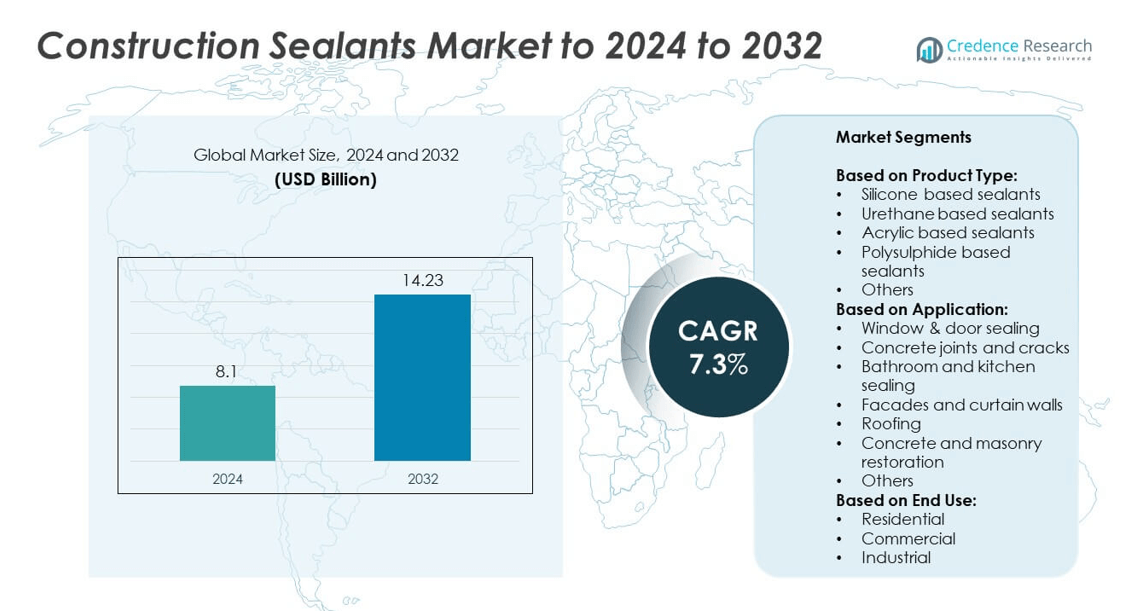
The Construction Sealants Market size was valued at USD 8.1 billion in 2024 and is anticipated to reach USD 14.23 billion by 2032, at a CAGR of 7.3% during the forecast period.
| REPORT ATTRIBUTE | DETAILS |
|---|---|
| Historical Period | 2020-2023 |
| Base Year | 2024 |
| Forecast Period | 2025-2032 |
| Construction Sealants Market Size 2024 | USD 8.1 billion |
| Construction Sealants Market, CAGR | 7.3% |
| Construction Sealants Market Size 2032 | USD 14.23 billion |
The construction sealants market is highly competitive, with major players such as Sika AG, Dow Inc., BASF SE, Henkel AG & Co. KGaA, H.B. Fuller Company, Tremco, Arkema S.A., and Wacker Chemie AG leading global operations. These companies dominate through extensive product portfolios, strong R&D capabilities, and strategic expansion across infrastructure and residential sectors. They focus on developing sustainable, low-VOC, and high-performance sealants to meet tightening environmental standards. Regionally, North America leads the market with a 33% share in 2024, driven by robust construction activity, renovation projects, and growing demand for energy-efficient and durable sealing solutions.
Market Insights
- The construction sealants market was valued at USD 8.1 billion in 2024 and is projected to reach USD 14.23 billion by 2032, growing at a CAGR of 7.3%.
- Market growth is driven by rising global infrastructure development, urbanization, and increasing demand for energy-efficient and durable sealing solutions in residential and commercial construction.
- Key trends include the shift toward low-VOC, sustainable, and hybrid polymer sealants that meet environmental regulations and improve long-term performance in high-stress applications.
- The market is competitive, with major companies focusing on innovation, mergers, and product diversification to strengthen their global presence and meet advanced building material standards.
- Regionally, North America leads with a 33% share, followed by Europe at 27% and Asia Pacific at 29%, while silicone-based sealants dominate the product segment with around 36% of total market share.
Market Segmentation Analysis:
By Product Type
Silicone-based sealants dominated the construction sealants market in 2024, accounting for around 36% of the total share. Their strong adhesion, flexibility, and resistance to UV radiation and weathering make them ideal for exterior applications. Silicone sealants are extensively used in glass glazing, curtain walls, and expansion joints due to their long lifespan and thermal stability. Increasing adoption in modern architectural designs and energy-efficient buildings further boosts demand. Urethane and acrylic-based sealants follow closely, supported by cost efficiency and compatibility with concrete and masonry substrates.
- For instance, Dow reports DOWSIL™ 995 meets ASTM C1184 and ASTM C920, plus Federal TT-S-00230C.
By Application
Window and door sealing held the largest market share in 2024, capturing about 31% of total application-based revenue. This segment benefits from growing residential and commercial construction, where sealants ensure air and water tightness, improving energy efficiency. Expanding renovation activities and stricter building envelope standards drive segment growth. Facades and curtain walls also witness rising demand due to increasing use of glass exteriors in urban projects. Silicone and polyurethane sealants dominate these uses because of their high elasticity, durability, and compatibility with various surface materials.
- For instance, Sika specifies that the optimum application temperature for the substrate and sealant of its Sikasil® IG-25 HM Plus product is between 15 °C and 25 °C.
By End Use
The residential sector led the construction sealants market in 2024, representing nearly 42% of the total share. Growth is fueled by rising urban housing development, home renovation projects, and demand for waterproofing and energy-efficient sealing solutions. Government initiatives promoting affordable housing in developing economies further enhance consumption. The commercial segment also expands steadily, driven by construction of high-rise offices and retail complexes. Industrial applications remain essential for infrastructure, factories, and warehouses, emphasizing high-performance sealants with superior chemical and temperature resistance for long-term durability.
Key Growth Drivers
Rising Infrastructure and Construction Activities
The expansion of residential, commercial, and industrial infrastructure globally remains the primary growth driver for the construction sealants market. Rapid urbanization and smart city projects in countries such as India, China, and the U.S. are increasing sealant consumption for glazing, insulation, and joint sealing. Demand for flexible, durable sealants in large-scale public infrastructure projects, such as airports and bridges, continues to grow. This steady rise in construction activity sustains market demand for advanced and weather-resistant sealant formulations.
- For instance, MAPEI operates 106 manufacturing plants across 42 nations.
Increasing Focus on Energy Efficiency and Green Buildings
Growing adoption of energy-efficient building designs is a key driver of sealant demand. Sealants play a crucial role in enhancing thermal insulation and preventing air leakage, reducing building energy use. Governments and developers are promoting green certification programs like LEED, driving the use of low-VOC, silicone, and polyurethane sealants. The preference for sustainable construction materials is further boosted by stricter emission standards and eco-friendly formulations from major sealant manufacturers.
- For instance, 3M's research and development efforts produce more than 3,500 new patents each year across its wide-ranging portfolio of products, including those applicable to building materials.
Technological Advancements and Product Innovation
Ongoing R&D in hybrid and high-performance sealants enhances durability, adhesion, and resistance to extreme weather. Manufacturers are investing in silane-modified polymers (SMPs) and hybrid systems combining polyurethane and silicone advantages. These innovations enable improved bonding on varied substrates, reducing maintenance costs. Additionally, the growing use of automated application equipment in large-scale construction projects increases efficiency and precision, supporting broader adoption of premium-grade sealants in global markets.
Key Trends and Opportunities
Shift Toward Low-VOC and Sustainable Sealants
The market is witnessing a strong shift toward environmentally friendly sealants with low volatile organic compounds (VOC). Regulatory policies across Europe and North America are pushing manufacturers to develop solvent-free and water-based sealants. This transition aligns with growing awareness of indoor air quality and green construction materials. Companies introducing recyclable packaging and bio-based ingredients are gaining a competitive edge as sustainability becomes a major purchasing factor among architects and contractors.
- For instance, Soudal Fix ALL High Tack declares VOC content < 10 g/L in its statement.
Rising Demand from Renovation and Retrofit Projects
Renovation and refurbishment projects across aging infrastructure are creating steady opportunities for sealant manufacturers. Aging residential and commercial buildings require extensive sealing for windows, facades, and concrete restoration. The demand for crack-repair and waterproofing sealants is increasing in developed regions such as North America and Western Europe. This trend is supported by energy efficiency upgrades and sustainability-driven building modernization initiatives, ensuring continuous market growth beyond new construction.
- For instance, In its 2024 Sustainability Report, H.B. Fuller detailed a closed-loop recycling program in Germany that recovered 435 metric tons of material and reused over 16,500 drums.
Key Challenges
Fluctuating Raw Material Prices
Volatility in the prices of raw materials such as silicone, acrylic, and polyurethane directly impacts production costs. Supply chain disruptions and crude oil price variations influence the availability of chemical feedstocks used in sealant manufacturing. Smaller manufacturers face margin pressures, while large players struggle to balance pricing strategies with profitability. These fluctuations often lead to product price hikes, reducing affordability for cost-sensitive construction projects in developing economies.
Stringent Environmental and Safety Regulations
Tightening global regulations regarding VOC emissions and hazardous chemical content pose significant challenges. Manufacturers must comply with evolving environmental standards, increasing R&D and formulation costs. Non-compliance risks penalties or product bans, especially in regions like the EU and North America. Additionally, frequent updates to safety and labeling requirements extend product approval timelines. Balancing performance with environmental safety remains a major constraint for sealant producers aiming to expand globally.
Regional Analysis
North America
North America held the largest share of around 33% in the global construction sealants market in 2024. The region’s dominance is supported by strong residential and commercial construction, particularly in the United States. High adoption of energy-efficient and sustainable building materials drives demand for low-VOC silicone and polyurethane sealants. Ongoing infrastructure modernization and renovation of aging buildings further boost consumption. Major players such as 3M and Dow focus on product innovation and environmentally compliant formulations to meet green building standards under programs like LEED and Energy Star certifications.
Europe
Europe accounted for approximately 27% of the global construction sealants market in 2024. The region benefits from a mature construction industry with a strong emphasis on sustainability and environmental compliance. Strict regulations under REACH and directives promoting low-emission materials are shaping product development. Demand is particularly high for glazing and facade sealing in modern commercial buildings. Countries such as Germany, France, and the U.K. lead market consumption due to their focus on renovation, insulation, and retrofitting projects aligned with the European Green Deal objectives.
Asia Pacific
Asia Pacific captured about 29% of the total construction sealants market share in 2024. Rapid urbanization, industrial expansion, and infrastructure investments in China, India, and Southeast Asia drive strong growth. Rising demand for affordable housing and government-backed construction initiatives are fueling large-scale adoption of silicone and polyurethane sealants. Growing awareness of building energy efficiency and durability also contributes to regional demand. Local manufacturers expand capacity to meet the growing need for cost-effective, weather-resistant sealants across residential and commercial construction projects.
Latin America
Latin America held nearly 6% of the global construction sealants market in 2024. The region’s growth is driven by recovery in the construction sector, particularly in Brazil and Mexico. Public infrastructure programs, along with expanding residential projects, are spurring demand for sealants used in roofing, concrete joints, and window sealing. Despite economic fluctuations, investment in urban housing and commercial development continues to rise. Manufacturers are increasingly targeting this region with competitively priced products and distribution partnerships to meet the growing construction material requirements.
Middle East & Africa
The Middle East and Africa region accounted for around 5% of the construction sealants market in 2024. Growth is supported by large-scale infrastructure and urban development projects in the Gulf Cooperation Council (GCC) countries. Demand is strong in high-temperature applications, where durable and UV-resistant sealants are essential. The construction of commercial buildings, airports, and housing complexes in Saudi Arabia and the UAE contributes significantly. Africa shows gradual adoption, driven by expanding residential construction and government infrastructure investments across South Africa, Kenya, and Nigeria.
Market Segmentations:
By Product Type:
- Silicone based sealants
- Urethane based sealants
- Acrylic based sealants
- Polysulphide based sealants
- Others
By Application:
- Window & door sealing
- Concrete joints and cracks
- Bathroom and kitchen sealing
- Facades and curtain walls
- Roofing
- Concrete and masonry restoration
- Others
By End Use:
- Residential
- Commercial
- Industrial
By Geography:
- North America
- U.S.
- Canada
- Europe
- Germany
- France
- U.K.
- Italy
- Spain
- Rest of Europe
- Asia Pacific
- China
- Japan
- India
- South Korea
- South-east Asia
- Rest of Asia Pacific
- Latin America
- Brazil
- Mexico
- Rest of Latin America
- Middle East & Africa
- GCC Countries
- South Africa
- Rest of the Middle East and Africa
Competitive Landscape
The construction sealants market is characterized by strong competition among major players such as Sika AG, Dow Inc., Tremco, BASF SE, Henkel AG & Co. KGaA, H.B. Fuller Company, Arkema S.A., Bostik, Wacker Chemie AG, 3M Company, Huntsman Corporation, Momentive Performance Materials Inc., MAPEI S.p.A., RPM International Inc., ITW Polymers Sealants, and Avery Dennison Corporation. The market is driven by continuous innovation in hybrid and low-VOC formulations designed to meet stricter environmental standards. Companies focus on expanding their product portfolios to cater to infrastructure, residential, and industrial construction needs. Increasing emphasis on durability, weather resistance, and sustainability fuels R&D investment and technological advancements. Strategic partnerships, acquisitions, and regional expansions remain common approaches to strengthen distribution networks and penetrate emerging markets. The competition is also intensifying with rising demand for smart, automated application technologies and growing adoption of eco-friendly sealing solutions in both developed and developing regions.
Key Player Analysis
- Sika AG
- Dow Inc.
- Tremco
- BASF SE
- Henkel AG & Co. KGaA
- B. Fuller Company
- Arkema S.A.
- Bostik (an Arkema subsidiary)
- Wacker Chemie AG
- 3M Company
- Huntsman Corporation
- Momentive Performance Materials Inc.
- MAPEI S.p.A.
- RPM International Inc.
- ITW Polymers Sealants
- Avery Dennison Corporation
Recent Developments
- In May 2023, Sika completed its acquisition of MBCC Group, a significant strategic move that expanded its product portfolio and market presence, especially in concrete admixtures and construction sealants.
- In 2023, Dow launched a new product line of silicone-based sealants and adhesives called DOWSIL PV.
- In 2023, Henkel opened a new 70,000-square-foot Technology Center in Bridgewater, New Jersey. The center was designed to showcase Henkel's portfolio, including adhesives, sealants, and functional coatings, and to foster collaboration with customers from over 800 industry segments.
Report Coverage
The research report offers an in-depth analysis based on Product Type, Application, End-Use and Geography. It details leading market players, providing an overview of their business, product offerings, investments, revenue streams, and key applications. Additionally, the report includes insights into the competitive environment, SWOT analysis, current market trends, as well as the primary drivers and constraints. Furthermore, it discusses various factors that have driven market expansion in recent years. The report also explores market dynamics, regulatory scenarios, and technological advancements that are shaping the industry. It assesses the impact of external factors and global economic changes on market growth. Lastly, it provides strategic recommendations for new entrants and established companies to navigate the complexities of the market.
Future Outlook
- The construction sealants market will expand steadily due to global infrastructure growth.
- Demand for energy-efficient and eco-friendly sealants will continue to rise across all regions.
- Silicone and polyurethane sealants will maintain dominance due to superior performance.
- Hybrid sealants combining multiple polymer technologies will gain wider adoption.
- Increasing renovation and retrofit activities will drive consistent product consumption.
- Digital application tools and automated dispensing systems will improve installation efficiency.
- Manufacturers will invest more in low-VOC and bio-based sealant formulations.
- Emerging economies in Asia Pacific will remain key growth hubs for construction activity.
- Stricter environmental and safety standards will shape new product development.
- Strategic partnerships and mergers among global manufacturers will strengthen market competitiveness.

Request a Free Sample
Fill in your details and we'll send you a free sample report.
- Sample data tables & charts
- Research methodology
Market Dynamics
Rising Infrastructure and Construction Activities
Global expansion of residential, commercial, and industrial infrastructure is increasing the demand for construction sealants, especially in rapidly urbanizing regions and large-scale public projects such as airports and bridges.
Increasing Focus on Energy Efficiency and Green Buildings
Stricter building codes and the push for energy-efficient, sustainable construction are driving the adoption of low-VOC and high-performance sealants that improve insulation and reduce air leakage, supporting green certification initiatives.
Technological Advancements and Product Innovation
Ongoing R&D in hybrid and high-performance sealants, such as silane-modified polymers and hybrid polyurethane-silicone systems, is enhancing durability, adhesion, and weather resistance, making sealants more attractive for demanding applications.
Shift Toward Low-VOC and Sustainable Sealants
Regulatory pressures and growing awareness of indoor air quality are prompting manufacturers to develop solvent-free, water-based, and bio-based sealants, aligning with sustainability goals and increasing market appeal among environmentally conscious buyers.
Rising Demand from Renovation and Retrofit Projects
Aging infrastructure and increased renovation activities, particularly in developed regions, are boosting the need for sealants in window, facade, and concrete restoration, ensuring steady market growth beyond new construction.
Need a Custom Version of This Report?
Tailor the scope, geography, or segments to your exact requirements.
- Custom geography or segment scope
- Direct access to our analyst team
Frequently Asked Questions
What is the current market size for Construction Sealants Market, and what is its projected size in 2032?
At what Compound Annual Growth Rate is the Construction Sealants Market projected to grow between 2025 and 2032?
Which Construction Sealants Market segment held the largest share in 2024?
What are the primary factors fueling the growth of the Construction Sealants Market?
Who are the leading companies in the Construction Sealants Market?
Table of Content
Chapter 1 Market Segmentation
- 1.1 Segmentation Framework
- 1.1.1 Product and Service Classification
- 1.1.2 Application and End-Use Classification
- 1.1.3 Technology and Solution Classification
- 1.1.4 Customer and Distribution Channel Classification
- 1.1.5 Geographic Segmentation
- 1.1.6 Market Segment Definitions and Boundaries
- 1.2 By End Use
- 1.2.1 Residential
- 1.2.2 Commercial
- 1.2.3 Industrial
- 1.3 By Application
- 1.3.1 Window & door sealing
- 1.3.2 Concrete joints and cracks
- 1.3.3 Bathroom and kitchen sealing
- 1.3.4 Facades and curtain walls
- 1.3.5 Roofing
- 1.3.6 Concrete and masonry restoration
- 1.3.7 Others
- 1.4 By Product Type
- 1.4.1 Silicone based sealants
- 1.4.2 Urethane based sealants
- 1.4.3 Acrylic based sealants
- 1.4.4 Polysulphide based sealants
- 1.4.5 Others
Chapter 2 Introduction
- 2.1 Report Objectives and Scope
- 2.2 Product Definition and Industry Terminology
- 2.3 Market Inclusions and Exclusions
- 2.4 Research Process
- 2.4.1 Primary Research and Expert Interviews
- 2.4.2 Secondary Research and Source Review
- 2.4.3 Top-Down and Bottom-Up Estimation
- 2.4.4 Data Triangulation and Verification
- 2.5 Market Size Measurement Basis
- 2.5.1 2024: USD 8.1 billion → 2032: USD 14.23 billion
- 2.6 Historical and Forecast Reference Periods
- 2.6.1 Base Year: 2024
- 2.6.2 Forecast Period: 2024-2032
- 2.7 Research Assumptions and Limitations
Chapter 3 Executive Summary
- 3.1 Market Snapshot and Key Findings
- 3.2 Base-Year Market Size, 2024
- 3.3 Forecast Market Size, 2032
- 3.4 Revenue and Volume Growth Outlook
- 3.5 Key Demand and Supply Indicators
- 3.6 Leading Market Segments
- 3.7 Fastest-Growing Market Opportunities
- 3.8 Regional Performance Highlights
- 3.9 Technology and Industry Transformation
- 3.10 Competitive Landscape Summary
- 3.11 Analyst View and Strategic Implications
Chapter 4 Global Construction Sealants Market Trends and Developments
- 4.1 Historical Industry Development
- 4.2 Recent Market Trends and Developments
- 4.3 Demand and Customer Behavior Trends
- 4.4 Technology and Product Innovation
- 4.5 Artificial Intelligence, Automation and Digitalization
- 4.6 Local Manufacturing and Supply Chain Realignment
- 4.7 Industry Partnerships, Mergers and Acquisitions
- 4.8 Sustainability and Circular Economy Developments
- 4.9 Government and Private Sector Investment Trends
- 4.10 Emerging Business Models and Commercialization
- 4.11 Industry Developments and Announcements
Chapter 5 Global Construction Sealants Market Production, Supply and Demand Analysis
- 5.1 Demand Trend and Consumption Analysis
- 5.2 Demand Forecast, 2024-2032
- 5.3 Production and Output Trend
- 5.4 Production and Output Forecast, 2024-2032
- 5.5 Installed Capacity and Capacity Utilization
- 5.6 Company-Wise Production Plants and Statistics
- 5.6.1 Installed Production Capacity
- 5.6.2 Actual Production
- 5.6.3 Planned Capacity and Expansion Targets
- 5.7 Supply Chain Structure and Procurement Trends
- 5.8 Supply-Demand Gap and Bottlenecks
- 5.9 Import Dependence and Sourcing Structure
- 5.10 Contract Manufacturing and Outsourcing
- 5.11 Regional Supply and Demand Concentration
Chapter 6 Global Construction Sealants Market Pricing Analysis
- 6.1 Pricing Structure and Measurement
- 6.2 Historical Pricing Trends
- 6.3 Pricing Outlook, 2024-2032
- 6.4 Average Selling Price and Unit Economics
- 6.5 Pricing by Product and Market Segment
- 6.6 Geographic Pricing Differences
- 6.7 Key Input, Energy, Labor and Logistics Costs
- 6.8 Contract Pricing and Purchasing Models
- 6.9 Pricing Sensitivity and Competitive Positioning
- 6.10 Price, Margin and Profitability Implications
Chapter 7 Global Construction Sealants Market Dynamics
- 7.1 Market Growth Drivers
- 7.1.1 Demand-Side Drivers
- 7.1.2 Technology and Innovation Drivers
- 7.1.3 Infrastructure and Investment Drivers
- 7.1.4 Regulatory and Policy Drivers
- 7.2 Market Restraints
- 7.2.1 Cost and Affordability Constraints
- 7.2.2 Technology and Adoption Barriers
- 7.2.3 Supply Chain and Operational Constraints
- 7.3 Market Challenges
- 7.3.1 Competitive Pressure and Margin Erosion
- 7.3.2 Skills, Infrastructure and Implementation Gaps
- 7.4 Emerging Market Opportunities
- 7.5 Market Dynamics Impact and Time-Horizon Assessment
Chapter 8 Global Construction Sealants Value Chain Analysis
- 8.1 Industry Value Chain Overview
- 8.2 Upstream Suppliers and Critical Inputs
- 8.3 Technology and Component Providers
- 8.4 Manufacturing or Service Delivery
- 8.5 Distribution, Channel Partners and Integrators
- 8.6 Downstream Applications and End Users
- 8.7 Value Addition and Profit Pools
- 8.8 Vertical Integration and Outsourcing
- 8.9 Supplier Concentration and Risk
- 8.10 Supply Chain Localization and Resilience
Chapter 9 Global Construction Sealants Market Regulations and Policies
- 9.1 Relevant Laws, Standards and Compliance Frameworks
- 9.2 Product, Service, Safety and Quality Requirements
- 9.3 Government Policies, Incentives and Subsidies
- 9.4 Imports, Exports and Trade Barriers
- 9.5 Public Procurement and Local Content Requirements
- 9.6 Environmental and Sustainability Compliance
- 9.7 Upcoming Policy Changes and Market Implications
Chapter 10 Global Construction Sealants Market Hotspots and Opportunities
- 10.1 Market Opportunity Mapping and Growth Hotspots
- 10.2 High-Growth Applications and Customer Groups
- 10.3 Underserved Markets and White-Space Opportunities
- 10.4 Emerging Technology and Product Opportunities
- 10.5 New Capacity and Investment Hotspots
- 10.6 Market Entry and Expansion Opportunities
- 10.7 Distribution and Partnership Opportunities
- 10.8 Near-Term and Long-Term Commercial Potential
- 10.9 Opportunity Attractiveness and Execution Risks
Chapter 11 Global Construction Sealants Market Outlook, 2024-2032
- 11.1 Market Size and Analysis
- 11.1.1 Revenue (Market Measurement: 2024: USD 8.1 billion → 2032: USD 14.23 billion)
- 11.1.2 Market Volume and Quantity Sold
- 11.1.3 Historical Market Size
- 11.1.4 Base-Year Market Size, 2024
- 11.2 Market Forecast, 2024-2032
- 11.2.1 Revenue Forecast to 2032
- 11.2.2 Volume Forecast to 2032
- 11.2.3 CAGR and Year-on-Year Growth
- 11.2.4 Incremental Revenue Opportunity
- 11.3 Forecast Assumptions and Scenario Analysis
- 11.3.1 Base-Case Forecast
- 11.3.2 Optimistic and Conservative Scenarios
- 11.3.3 Technology, Pricing and Policy Sensitivities
- 11.4 Market Attractiveness and Growth Outlook
Chapter 12 Global Construction Sealants Market Segmentation and Outlook
- 12.1 Segmentation Summary and Market Shares, 2024
- 12.2 Largest and Fastest-Growing Segments
- 12.3 By End Use - Market Size and Forecast, 2024-2032
- 12.3.1 Segment Definition and Scope
- 12.3.2 Historical Market Size
- 12.3.3 Revenue Forecast, 2024-2032
- 12.3.4 Volume Forecast, 2024-2032
- 12.3.5 Base-Year Market Share, 2024
- 12.3.6 Segment CAGR and Growth Drivers
- 12.3.7 Subsegment Market Size and Forecast
- 12.3.7.1 Residential
- 12.3.7.2 Commercial
- 12.3.7.3 Industrial
- 12.3.8 Subsegment Pricing and Adoption Trends
- 12.3.9 Leading Suppliers and Competition
- 12.3.10 Regional Demand and Opportunities
- 12.4 By Application - Market Size and Forecast, 2024-2032
- 12.4.1 Segment Definition and Scope
- 12.4.2 Historical Market Size
- 12.4.3 Revenue Forecast, 2024-2032
- 12.4.4 Volume Forecast, 2024-2032
- 12.4.5 Base-Year Market Share, 2024
- 12.4.6 Segment CAGR and Growth Drivers
- 12.4.7 Subsegment Market Size and Forecast
- 12.4.7.1 Window & door sealing
- 12.4.7.2 Concrete joints and cracks
- 12.4.7.3 Bathroom and kitchen sealing
- 12.4.7.4 Facades and curtain walls
- 12.4.7.5 Roofing
- 12.4.7.6 Concrete and masonry restoration
- 12.4.7.7 Others
- 12.4.8 Subsegment Pricing and Adoption Trends
- 12.4.9 Leading Suppliers and Competition
- 12.4.10 Regional Demand and Opportunities
- 12.5 By Product Type - Market Size and Forecast, 2024-2032
- 12.5.1 Segment Definition and Scope
- 12.5.2 Historical Market Size
- 12.5.3 Revenue Forecast, 2024-2032
- 12.5.4 Volume Forecast, 2024-2032
- 12.5.5 Base-Year Market Share, 2024
- 12.5.6 Segment CAGR and Growth Drivers
- 12.5.7 Subsegment Market Size and Forecast
- 12.5.7.1 Silicone based sealants
- 12.5.7.2 Urethane based sealants
- 12.5.7.3 Acrylic based sealants
- 12.5.7.4 Polysulphide based sealants
- 12.5.7.5 Others
- 12.5.8 Subsegment Pricing and Adoption Trends
- 12.5.9 Leading Suppliers and Competition
- 12.5.10 Regional Demand and Opportunities
- 12.6 Segment Growth Comparison
- 12.7 Segment Attractiveness and Priority Matrix
Chapter 13 Global Construction Sealants End-Use and Application Market Outlook
- 13.1 End-Use Industry and Customer Demand Structure
- 13.2 Leading Applications and Customer Groups
- 13.3 End-Use Market Size, Share and Forecast
- 13.4 Major End-Use Industry Deep Dives
- 13.4.1 Customer Requirements and Use Cases
- 13.4.2 Demand and Replacement Cycles
- 13.4.3 Technical and Regulatory Considerations
- 13.4.4 Purchasing and Procurement Models
- 13.4.5 Leading Vendors and Distribution Channels
- 13.4.6 Forecast and Commercial Opportunities
- 13.5 Emerging Applications and Cross-Segment Demand
- 13.6 End-Use Industry Investment Priorities
Chapter 14 Global Construction Sealants Geographic Market Outlook, 2024-2032
- 14.1 Regional Market Size and Share, 2024
- 14.2 Regional Market Forecast, 2024-2032
- 14.3 Regional Pricing, Production and Demand Differences
- 14.4 North America
- 14.4.1 United States
- 14.4.2 Canada
- 14.4.3 Mexico
- 14.5 Europe
- 14.5.1 Germany
- 14.5.2 France
- 14.5.3 Italy
- 14.5.4 United Kingdom
- 14.5.5 Spain
- 14.5.6 Poland
- 14.5.7 Russia
- 14.5.8 Netherlands
- 14.5.9 Belgium
- 14.5.10 Sweden
- 14.5.11 Denmark
- 14.5.12 Norway
- 14.5.13 Rest of Europe
- 14.6 Asia Pacific
- 14.6.1 China
- 14.6.2 India
- 14.6.3 Japan
- 14.6.4 South Korea
- 14.6.5 Thailand
- 14.6.6 Indonesia
- 14.6.7 Vietnam
- 14.6.8 Malaysia
- 14.6.9 Australia
- 14.6.10 Rest of Asia Pacific
- 14.7 Latin America
- 14.7.1 Brazil
- 14.7.2 Argentina
- 14.7.3 Colombia
- 14.7.4 Chile
- 14.7.5 Rest of Latin America
- 14.8 Middle East
- 14.8.1 Saudi Arabia
- 14.8.2 United Arab Emirates
- 14.8.3 Turkey
- 14.8.4 Israel
- 14.8.5 Iran
- 14.8.6 Rest of the Middle East
- 14.9 Africa
- 14.9.1 South Africa
- 14.9.2 Egypt
- 14.9.3 Nigeria
- 14.9.4 Morocco
- 14.9.5 Rest of Africa
- 14.10 Regional Investment, Policy and Supply Chain Differences
- 14.11 Regional Competitive Landscape
- 14.12 Geographic Growth Hotspots
Chapter 15 Global Construction Sealants Technology, Innovation and Sustainability Outlook
- 15.1 Technology Landscape and Maturity
- 15.2 Product, Process and Service Innovation
- 15.3 AI, Automation and Digital Tools in the Industry
- 15.4 Technology Adoption and Performance Benchmarking
- 15.5 Innovation Pipeline and R&D Investment
- 15.6 Patent and Intellectual Property Trends
- 15.7 Energy Efficiency and Resource Management
- 15.8 Sustainability, Recycling and Circularity
- 15.9 Technology Roadmap, 2024-2032
- 15.10 Risks of Obsolescence and Technology Substitution
Chapter 16 Global Construction Sealants Market Key Strategic Imperatives
- 16.1 Growth and Market Entry Priorities
- 16.2 High-Return Products and Segments
- 16.3 Pricing, Profitability and Cost Optimization
- 16.4 Technology Investment and Product Differentiation
- 16.5 Supply Chain Localization and Resilience
- 16.6 Distribution and Customer Acquisition
- 16.7 Partnership, Acquisition and Capacity Strategy
- 16.8 Regional Expansion Priorities
- 16.9 Short-, Medium- and Long-Term Actions
Chapter 17 Competition Outlook
- 17.1 Industry Competition Characteristics
- 17.2 Market Structure and Concentration
- 17.3 Market Share and Competitive Positioning, 2024
- 17.4 Company-Wise Revenue and Product Benchmarking
- 17.5 Production and Service Capacity Benchmarking
- 17.6 Technology, Pricing and Differentiation
- 17.7 Regional Footprint and Distribution Strength
- 17.8 Mergers, Acquisitions and Strategic Alliances
- 17.9 New Entrants and Competitive Threats
- 17.10 Porter's Five Forces and Industry Attractiveness
- 17.11 Competitive Outlook, 2024-2032
Chapter 18 Company Profiles
- 18.1 Company Coverage and Selection Criteria
- 18.2 Sika AG
- 18.2.1 Business Description
- 18.2.2 Company Ownership and Geographic Presence
- 18.2.3 Product and Service Portfolio
- 18.2.4 Manufacturing and Operating Footprint
- 18.2.5 Production Capacity and Expansion Plans
- 18.2.6 Financial Performance and Investment
- 18.2.7 Market Share and Competitive Position
- 18.2.8 Technology and Innovation Capabilities
- 18.2.9 Strategic Alliances or Partnerships
- 18.2.10 Recent Developments
- 18.2.11 Growth Strategy and Outlook
- 18.3 Dow Inc.
- 18.4 BASF SE
- 18.5 Henkel AG & Co. KGaA
- 18.6 H.B. Fuller Company
- 18.7 Tremco
- 18.8 Arkema S.A.
- 18.9 Wacker Chemie AG
- 18.10 3M Company
- 18.11 MAPEI S.p.A.
- 18.12 Other Relevant Market Participants
Note: Every listed company is profiled on the structure shown under the first company. The company list is preliminary and may change based on research findings, market developments, data availability and client requirements.
Chapter 19 Disclaimer
- 19.1 Research and Forecast Disclaimer
- 19.2 Data Source and Estimation Limitations
Note: The depth of individual sections depends on data availability for this market. Volume, capacity, trade and other unit-based metrics are included where applicable.

