
Tool demand follows new vehicle, packaging and drug programs
The global industrial mold market was valued at USD 40.54 billion in 2025 and is projected to increase from USD 42.74 billion in 2026 to USD 68.73 billion by 2035, registering a CAGR of 5.42% during 2026–2035. Demand comes from automakers and their parts suppliers, packaging converters, electronics assemblers and medical device makers that commission a new tool for every new part, model change or added production line. Asia Pacific held the largest regional share, 52.0% in 2025, because China and Japan run the deepest toolmaking bases and ship finished molds to plants on every continent. Middle East & Africa is the fastest-growing region at 6.5% a year, led by new vehicle assembly in North Africa. Injection molds for plastic parts carry most of the value, while compression tooling gains ground as beverage closures are redesigned for European rules. Metal 3D-printed inserts with conformal cooling channels are also moving from trials into production tools, which shortens cycle times for molders.
Why are press dies and molding machines outside this estimate?
The market counts the value of new production molds sold to manufacturers that shape plastics, rubber, glass and light-metal parts, including injection, blow, compression and transfer molds and smaller families such as thermoforming and rotational tools. Value covers the mold base, cavities and cores, slides and ejection systems, and the hot runner when it ships with the tool. Buyers usually order molds as projects, with a quoted price per tool, design approval, trial shots and acceptance before final payment.
Stamping and press dies for sheet metal sit outside the estimate, as do the molding machines that hold the tools and the molded parts themselves. Repair, refurbishment and engineering changes on existing molds are counted only when they are billed as new tooling. Value is measured at the toolmaker level, so it reflects the price paid by the molder or brand owner rather than the value of the parts that the tool goes on to produce.

Industrial Mold Market Insights
- The market is valued at USD 40.54 billion in 2025 and is projected to reach USD 68.73 billion by 2035, growing at a 5.42% CAGR as vehicle, packaging and medical programs retool.
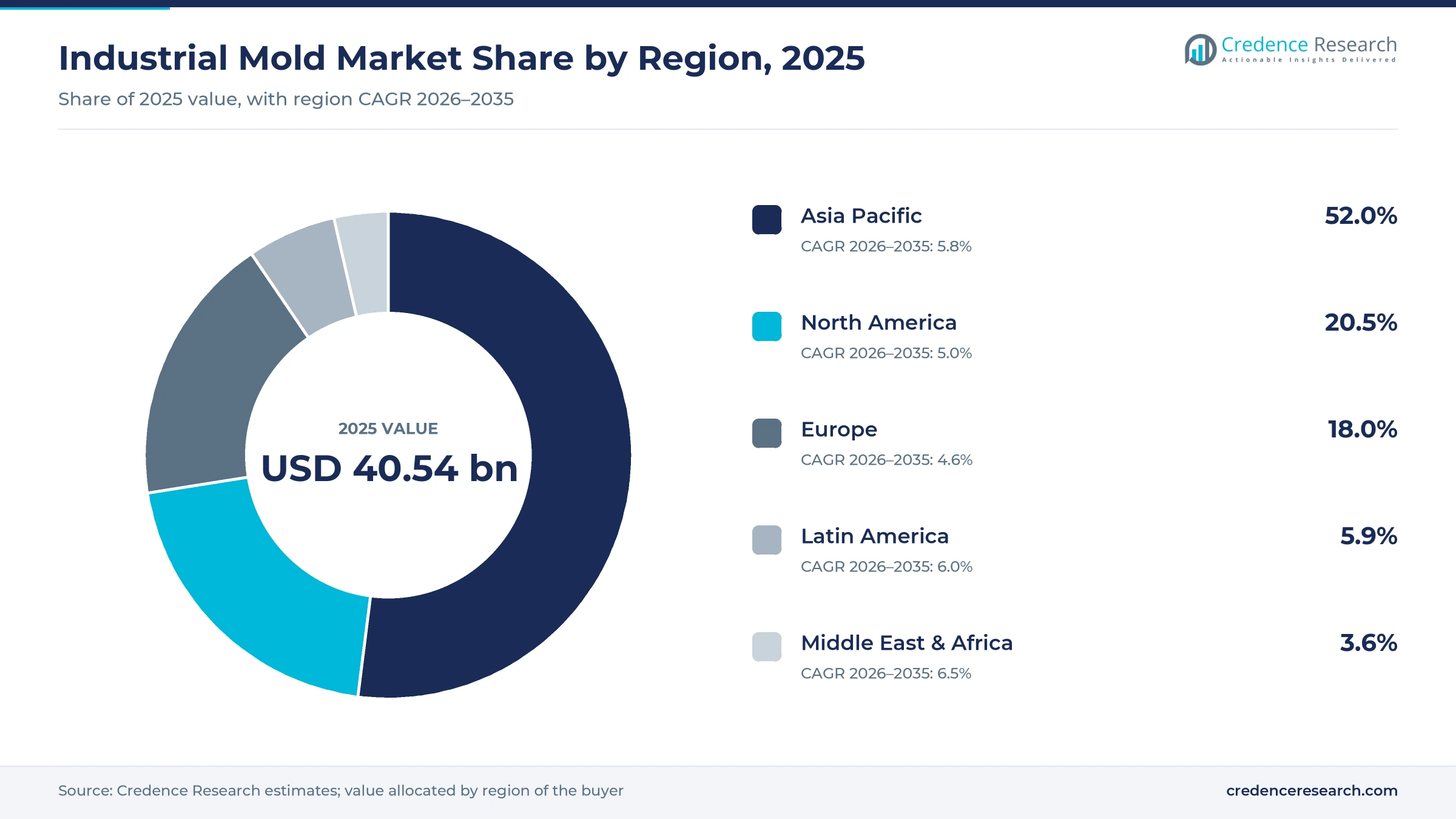
- Asia Pacific led with 52.0% of 2025 value, because China and Japan host the largest toolmaking bases and export molds to plants worldwide.
- Injection Molds held 58.0% of 2025 value, because most plastic parts in cars, packaging, electronics and medical devices are shot in injection tools.
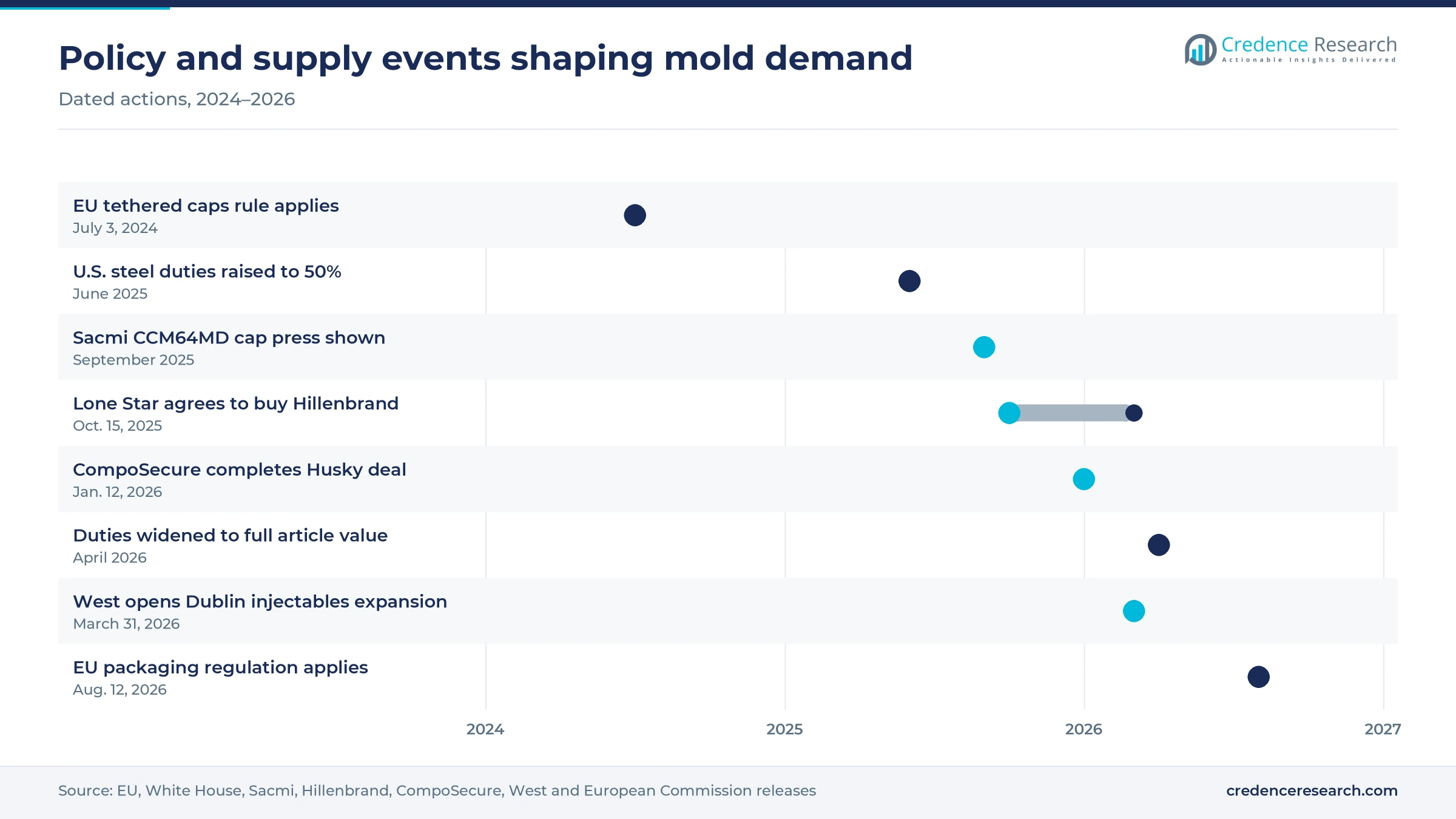
- The EU required beverage caps to stay attached to bottles from July 3, 2024, which forced closure makers to replace cap tooling across Europe.
- Husky Technologies joined CompoSecure on Jan. 12, 2026, to form GPGI, one of several ownership changes among hot runner and mold system suppliers.
Injection tools lead while compression and medical gain
Why do injection molds lead while compression molds grow fastest?
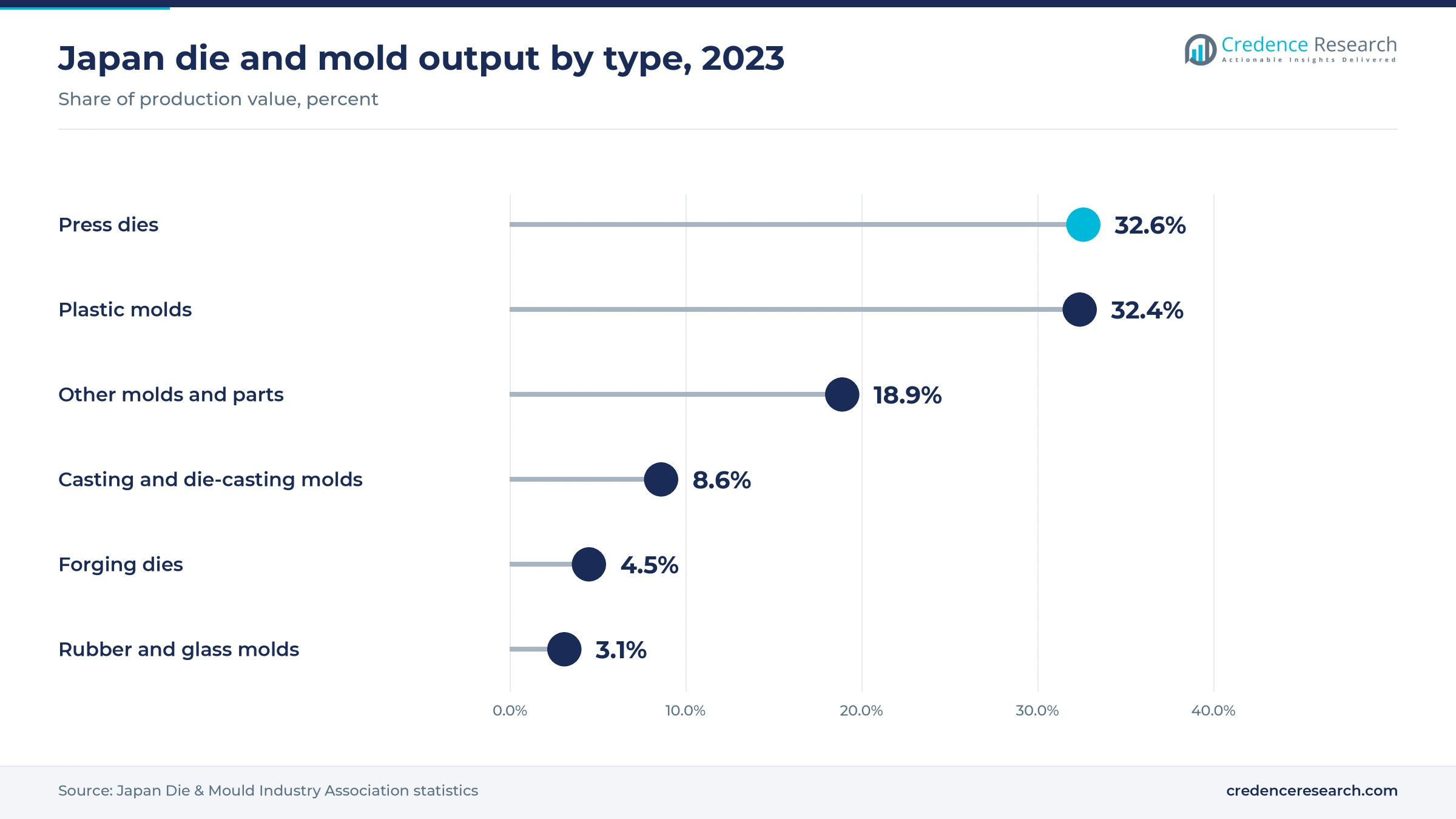
Based on type, the market is categorized into injection molds, blow molds, compression molds, transfer molds and others. Injection Molds led with 58.0% of 2025 value because injection is the standard process for plastic parts, and the Japan Die & Mould Industry Association counts plastic molds at 32.4% of Japan's 2023 die and mold output, far ahead of rubber and glass molds at 3.1%. Compression Molds grow fastest at 6.3% a year as closure makers retool for attached caps. Sacmi said in July 2025 that its CCM64MD press makes 2,850 caps a minute from 64 molds, which shows how much output each compression tool now carries.
Why does steel lead while aluminum tooling grows faster?
Based on material, the market is categorized into steel, aluminum and copper alloys and others. Steel led with 72.0% of 2025 value because high-volume tools must survive millions of cycles, and Formlabs lists complex multi-cavity steel molds at USD 100,000 or more. Aluminum grows fastest at 6.4% a year as short product runs spread. The same Formlabs guide puts machined aluminum molds at USD 2,000 to USD 5,000 for runs of about 1,000 to 5,000 parts, so aluminum suits bridge tooling and product launches. Copper alloys sit in hot spots of steel tools, where faster heat removal shortens cycles.
Why does automotive lead while medical tooling grows fastest?
Based on application, the market is categorized into automotive, packaging, electronics, medical and others. Automotive led with 34.0% of 2025 value because each new vehicle program needs fresh tools for bumpers, lamps, trim and under-hood parts. The automotive industry took 47% of Canada's industrial robot installations in 2024, according to the International Federation of Robotics, a sign of how car programs set the pace of factory tooling. Medical grows fastest at 6.7% a year as injectable drugs scale. West Pharmaceutical Services opened a 165,000-square-foot expansion at its Dublin site on March 31, 2026, adding drug handling for GLP-1 and other injectables next to its existing component molding.
| Segment Group | Leading Sub-segment | Share, 2025 | Fastest-growing Sub-segment | CAGR, 2026–2035 |
|---|---|---|---|---|
| By Type | Injection Molds | 58.0% | Compression Molds | 6.3% |
| By Material | Steel | 72.0% | Aluminum | 6.4% |
| By Application | Automotive | 34.0% | Medical | 6.7% |
Mold prices scale with run length, steel and cooling
Molds are priced per tool as engineering projects, and the quote depends on how many parts the tool must make, the steel grade, the cavity count and the cooling layout. The table shows how far apart the tiers sit, from resin inserts for a few hundred shots to hardened multi-cavity steel for millions. Imported steel tools now also carry the full-value U.S. steel duty described in the challenges, which widens the price gap between domestic and offshore quotes for American buyers. Shops with strong balance sheets can carry long payment terms and take share from smaller rivals.
| Tool or offer | Typical price or fee | Basis |
|---|---|---|
| SLA 3D-printed resin mold, low volume | From about USD 100 per tool | Formlabs cost guide lists |
| Machined aluminum mold, 1,000 to 5,000 parts | USD 2,000 to USD 5,000 per tool | Formlabs cost guide lists |
| Complex mold, 10,000 parts and more | USD 5,000 to USD 100,000 per tool | Formlabs cost guide lists |
| Multi-cavity hardened steel production mold | USD 100,000 and more per tool | Formlabs cost guide lists |
| Conformal-cooled insert, effect on molding cost | 16% to 18% lower in two benchmarks | Cimatron customer story on Bastech |
Request a Free Sample
Fill in your details and we'll send you a free sample report.
- Sample data tables & charts
- Research methodology
Plastics growth, EVs and packaging rules lift tool orders
Rising plastics output keeps new tools in steady demand
Plastics volumes set the floor for mold demand, because every new part, added cavity or extra production line needs its own tool. Plastics Europe says world plastics production grew 4.1% in 2024 and stood 16.3% above 2018. Growth is concentrated outside Europe, which makes mold demand follow new converting capacity in Asia and the Americas. Injection tools, the largest type by value, take most of this work, since most consumer, packaging and vehicle parts are shot rather than extruded. Toolmakers that sit close to new converting plants also win the follow-on orders for spare cavities, engineering changes and repairs over the life of each program.
Electrification and new assembly hubs widen automotive tooling
Automotive programs are the largest source of mold orders, and electrification adds parts that older platforms never needed. Battery housings, charging connectors and thermal parts now sit in tool budgets next to bumpers and trim. Vehicle assembly is also spreading to new countries in Africa and Latin America. Morocco's trade and industry minister, Ryad Mezzour, told parliament on June 3, 2025, that national vehicle capacity of 700,000 units should reach 1 million by the end of 2025, with hybrids already at 120,000 units a year, Hespress reported. Each new plant needs tools for trim, lighting and plastics used in electric vehicles, so mold demand follows assembly into new regions.
Packaging rules force closure and container makers to retool
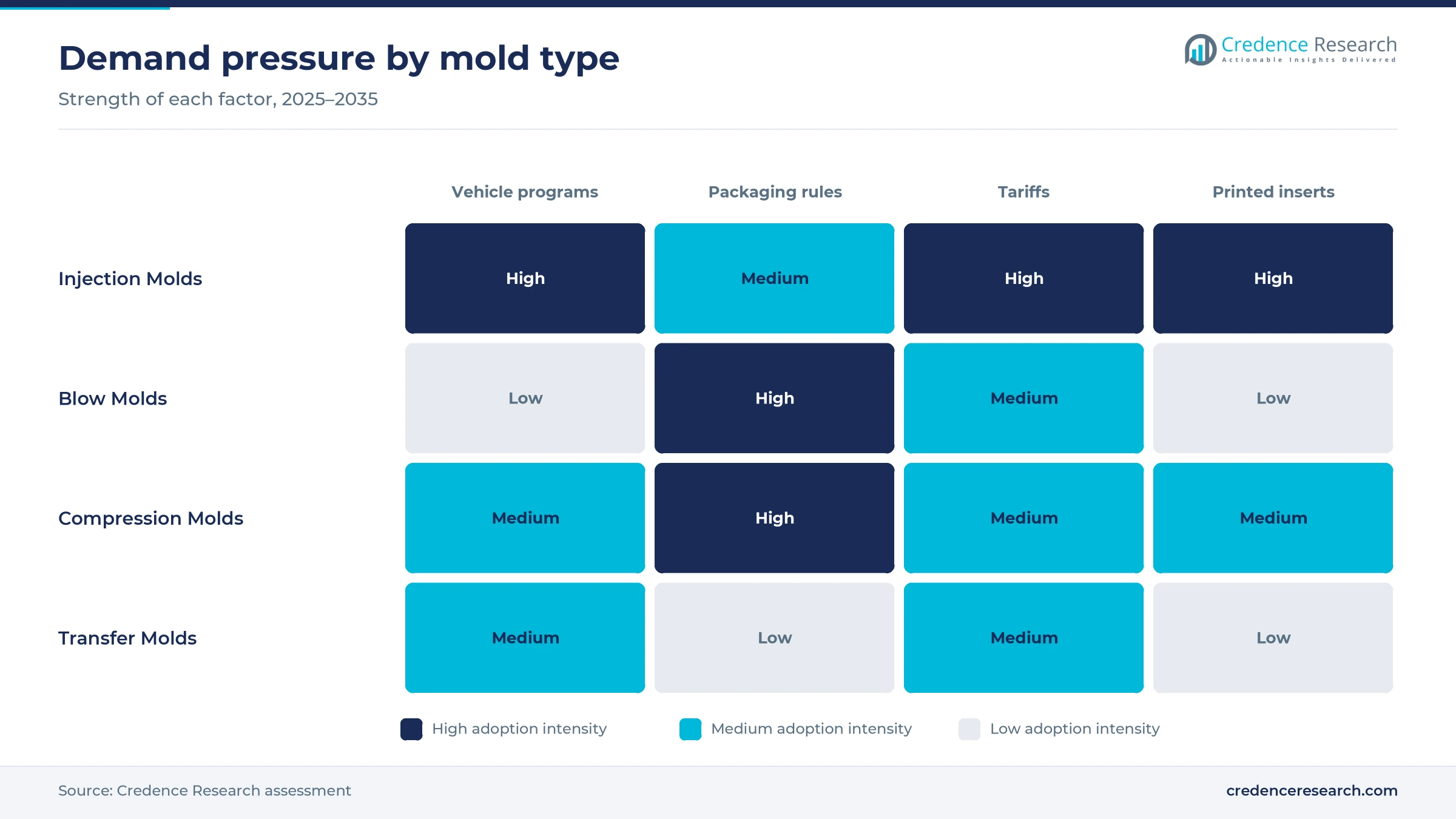
Packaging regulation creates replacement demand that does not depend on volume growth. The EU Single-Use Plastics Directive requires caps and lids on plastic beverage containers of up to three liters to stay attached from July 3, 2024, so closure makers had to cut new cavities for tethered designs. The European Commission says its Packaging and Packaging Waste Regulation became generally applicable on Aug. 12, 2026, with recyclability and recycled-content rules phasing in from 2030. Each design change of this kind retires working tools before they wear out. Compression Molds gain the most from it, growing at 6.3% a year, because high-speed closures are mostly compression molded on multi-mold presses.
Injectable drug devices pull tooling into cleanroom plants
Medical tooling grows faster than the market because drug delivery devices need tight-tolerance, multi-cavity molds that run in cleanrooms. Weekly GLP-1 injections for diabetes and obesity have lifted demand for pens, autoinjectors and their molded parts. The 165,000-square-foot Dublin expansion noted in the segment section shows injectable volumes pulling capacity next to component molding lines. Husky's January 2026 filing names medical devices among the products its molds, hot runners and controllers make, alongside beverage containers and electronics parts. Medical grows at 6.7% a year, the fastest of any application. Toolmakers that can validate molds for regulated production win long-running orders against few qualified competitors.
Printed cooling, new owners and data reshape toolmaking
Conformal cooling shifts from trials into production tools
Metal additive manufacturing is moving from prototype work into production molds, mainly to cut cooling time, often the longest part of a cycle. K-Rain cut a sprinkler-head cycle from 49 seconds to 41 seconds with a 3D-printed conformal-cooled insert built by Zero Tolerance and Xact Metal, after a faster unscrewing motor had already taken it down from 52 seconds, Plastics Engineering reported in December 2025. Hasco showed additively manufactured hot runners and filters at K 2025 in October, bringing the method into standard components. Wider use of metal powders for additive manufacturing should lower insert costs over time. Molders gain output per tool, while toolmakers that master hybrid machining and printing can charge for the design work.
Ownership changes reshape hot runner and mold system suppliers
Financial buyers and new parents are taking control of the largest hot runner and mold system brands, which shifts how they invest. CompoSecure completed its combination with Husky Technologies on Jan. 12, 2026, and renamed itself GPGI, according to its Securities and Exchange Commission filing. Hillenbrand, owner of Mold-Masters, agreed on Oct. 15, 2025, to be acquired by Lone Star Funds for about USD 3.8 billion, after selling a 51% stake in Milacron to a Bain Capital affiliate earlier that year, Plastics Machinery & Manufacturing reported. New owners tend to push aftermarket parts, controllers and service contracts, so buyers should expect more bundled offers and firmer prices on replacement components.
Automated cells and mold data open a service opportunity
Automation opens an opportunity for toolmakers that sell monitored molds and data rather than steel alone. The International Federation of Robotics counted 542,000 industrial robot installations in 2024, with China taking 54%, and expects 575,000 in 2025, which shows how quickly molding cells are being automated. Hasco presented early wiring-fault diagnostics at K 2025, together with paperless tool documentation that lets users order spare parts directly from the mold. Smart molds that report temperature, cycle counts and wear can be sold with service contracts, giving suppliers recurring income after a tool ships. Buyers benefit too, because monitored tools reduce unplanned stops in lights-out molding cells.
Import substitution in India opens room for local toolmakers
India offers the clearest import substitution opportunity, because domestic shops still cannot meet a large part of local tooling demand. Makino India's president said in April 2026 that nearly one-third of India's tooling demand is met through imports, The Machine Maker reported ahead of the TAGMA Die & Mould India show held April 21 to 24, 2026, in Mumbai. Vehicle makers lead automation there, with the automotive industry taking 45% of India's robot installations in 2024, according to the International Federation of Robotics. Local toolmakers that invest in five-axis machine tools and simulation can replace imported molds for vehicle and appliance programs, and global suppliers can enter through joint ventures.
Tariffs, skills gaps and slow payments squeeze shops
Steel tariffs raise the landed cost of imported molds
Tariffs have raised the cost of moving finished molds into the United States. A June 2025 presidential proclamation raised Section 232 duties on steel and aluminum imports to 50%. In early April 2026 the rule was widened to charge the full value of articles made almost entirely of these metals, BNN Bloomberg reported, which brings complete steel molds into the duty. Toolmakers in Canada, Europe and Asia must now absorb the duty, share it with customers or move final machining into U.S. plants.
A shortage of skilled toolmakers limits shop capacity
Toolmaking depends on experienced designers, machinists and polishers, and too few new workers are entering the trade. The Manufacturing Institute and Deloitte estimated in April 2024 that U.S. manufacturers may need 3.8 million new employees by 2033 and that 1.9 million of those jobs could remain unfilled. Mold shops compete with better-paid sectors for the same CNC and design skills. Lead times stretch when shops lose staff, so buyers place orders earlier and shops lean on automation.
Delayed payments strain mold shop cash flow
Mold shops fund steel, machining and labor months before they are paid, so delays in a customer program hit them first. Canadian toolmakers told BNN Bloomberg in May 2026 that many customers had delayed shipments after the U.S. duty change, leaving shops unpaid until tools reach production. The Canadian Association of Mold Makers estimated that larger shops could last three to six months under these conditions and smaller ones about three months. Milestone payments and supplier financing ease the strain for shops that can negotiate them.
Small shop size limits investment in new technology
Most mold makers are small firms with limited capital for five-axis machining, printing or sensors. Japan's 2023 die and mold output of about 1.43 trillion yen came from 4,321 establishments employing about 75,000 people, according to the Japan Die & Mould Industry Association, an average of about 17 workers each. Shops of that size struggle to fund new equipment and to train staff on digital tools. Mergers, shared machining centers and supplier financing help, but progress is slow.
Asia Pacific builds most tools while Morocco adds demand
| Region | Value, 2025 (USD billion) | Share, 2025 | CAGR, 2026–2035 |
|---|---|---|---|
| Asia Pacific | 21.08 | 52.0% | 5.8% |
| North America | 8.31 | 20.5% | 5.0% |
| Europe | 7.30 | 18.0% | 4.5% |
| Latin America | 2.39 | 5.9% | 6.0% |
| Middle East & Africa | 1.46 | 3.6% | 6.5% |
Asia Pacific leads on Chinese and Japanese toolmaking depth
Asia Pacific held 52.0% of 2025 value and grows at 5.8% a year, because China, Japan, South Korea and Taiwan build molds for their own plants and for export. Chinese shops set the price reference for simple tools worldwide. Japanese and Korean toolmakers specialize in high-precision tools for electronics, optics and vehicle lamps, while Southeast Asian plants in Vietnam and Thailand add demand as electronics assembly spreads beyond China. India adds new demand as vehicle and appliance makers localize tooling, which keeps the region ahead to 2035.
North America retools around tariffs and reshored parts
North America held 20.5% of 2025 value and grows at 5.0% a year. Tool demand comes from vehicle, packaging and medical programs in the United States, Canada and Mexico, and many tools cross a border before the first part is shot. Trade friction between the three countries now shapes where tools are sourced. PlasticsToday reported that the United States announced 50% tariffs on July 20, 2026, on Canadian goods such as plastic films and tableware, on top of the earlier steel duties. Buyers are qualifying more U.S.-built tools, which favors domestic shops with spare capacity.
Europe keeps precision tooling as plastics output shrinks
Europe held 18.0% of 2025 value and grows at 4.5% a year, slower than other regions because plastics output there is losing ground to Asia. Plastics Europe puts Europe at about 12% of world plastics production in 2024, down from 22% in 2006. The region still leads in high-cavity closure tools, standard mold components and hot runners from Germany, Austria, Switzerland and Italy. The tethered-cap and packaging rules described in the drivers keep retooling demand alive even as volumes stagnate.
Latin America follows Mexican vehicle assembly
Latin America held 5.9% of 2025 value and grows at 6.0% a year, led by Mexico's vehicle and appliance plants. The automotive industry took 63% of Mexico's industrial robot installations in 2024, according to the International Federation of Robotics, which shows how closely local molding follows car assembly. Brazil adds packaging and appliance tooling for its large domestic consumer market. Many complex tools are still imported from the United States, Canada, Europe and China, so local toolmakers focus on maintenance, engineering changes and simpler production molds.
Middle East & Africa grows fastest from North African car plants
Middle East & Africa held 3.6% of 2025 value and grows at 6.5% a year, the fastest of any region, from a small base. Morocco leads demand as carmakers and parts suppliers expand there. Its trade minister said in June 2025 that the country produced 70,000 electric vehicles a year and expected electric capacity of 107,000 units by late 2025, Hespress reported. Gulf packaging and petrochemical converters add blow and injection tools for bottles and caps. Most molds are imported, which gives European and Chinese toolmakers the first claim on this growth.
Ownership deals and tariffs defined 2025 and 2026
| Development | Status and market relevance |
|---|---|
| In June 2025, the United States raised Section 232 duties on steel and aluminum imports to 50%, lifting costs for imported steel molds. | In force; widened to full article value in April 2026 |
| In October 2025, Hillenbrand agreed to be acquired by Lone Star Funds for about USD 3.8 billion, including the Mold-Masters hot runner business. | Agreed; closing expected by the end of the first quarter of 2026 |
| In October 2025, Hasco presented additively manufactured hot runners and wiring-fault diagnostics at K 2025 in Düsseldorf. | Launched; brings printed parts into standard catalogs |
| In January 2026, CompoSecure completed its combination with Husky Technologies and renamed the company GPGI. | Completed; Husky molds and hot runners under new ownership |
Conformal cooling, hot runners and sensors raise tool value
- Conformal cooling channels follow the shape of the part inside 3D-printed inserts, which cuts cooling time and evens out part warpage.
- Hot runner systems keep plastic molten up to each gate, which removes runner scrap and allows more cavities in one tool.
- In-mold sensors track cavity pressure, temperature and cycle counts, so molders can catch defects and plan maintenance before a tool fails.
- Hardened mold steels such as prehardened and through-hardened tool steel grades extend tool life to millions of shots for packaging and vehicle parts.
Need a Custom Version of This Report?
Tailor the scope, geography, or segments to your exact requirements.
- Custom geography or segment scope
- Direct access to our analyst team
Component suppliers earn margins that custom shops lack
Competition works differently in each layer of the supply chain. In hot runners and mold systems, Husky, Mold-Masters and Hasco compete on gate precision, controller software and global service, and their new owners are pressing for more aftermarket sales. In standard components, Meusburger, Hasco and MISUMI compete on catalog breadth, CAD integration and delivery speed, since a toolmaker under deadline orders from whoever ships fastest. Packaging specialists such as StackTeck and SACMI win on cavitation, cycle time and closure design know-how. Roehr Tool competes in a narrower niche with collapsible cores for threaded and undercut parts. Custom toolmakers compete regionally on engineering support and lead time, while Chinese shops win simple tools on price. Buyers increasingly ask suppliers to share risk through cycle-count warranties and through the design work needed for tethered closures and printed inserts.
How is the supply side of mold making organized?
The supply side has two layers with very different economics. A small group of component and system suppliers, including Husky, Mold-Masters, Hasco, Meusburger and MISUMI, sells hot runners, mold bases, standard parts and controllers to thousands of customers and earns the higher margins. Below them sit many small toolmakers, as the Japanese establishment count in the challenges section shows, that build custom tools on project terms. Barriers for custom shops are skilled labor, five-axis machining and trust earned on earlier programs, while component suppliers are protected by catalogs, CAD libraries and global stock.
Companies profiled and their roles in this market
| Company | Type | Role in the market |
|---|---|---|
| Husky Technologies (GPGI) | Mold and hot runner system supplier | Molds, hot runners and controllers for beverage containers, medical devices and electronics parts |
| Mold-Masters | Hot runner supplier | Hot runners, controllers and small-part molding systems shown at K 2025 |
| HASCO Hasenclever | Mold component supplier | Mold bases, standard parts and hot runners, including additively made hot runner parts |
| Meusburger Georg | Mold component supplier | Plates, mold bases, components and hot runners with a CAD standard parts library |
| MISUMI Group | Component distributor | Plastic mold and injection molding components sold through online catalogs |
| StackTeck Systems | Mold maker | High-performance injection molds, preform molds and automation systems |
| SACMI | Mold and machine maker | Compression molding presses and molds for caps, plus preform systems |
| Roehr Tool | Mold component maker | Collapsible core and expandable cavity technology for threaded and undercut parts |
Output per tool, not steel weight, will decide winners
Credence Research's view is that this market will reward suppliers that sell output per tool rather than steel by weight. Molders now judge tools on cycle time, uptime and data, and conformal cooling, hot runners and sensors decide those numbers. Buyers should write cycle-time and cycle-count guarantees into contracts and qualify a second toolmaker in another tariff zone for critical programs. Custom shops need either a specialty, such as closures, medical or large vehicle parts, or a partnership with a component supplier. Investors should watch vehicle program launches and packaging rule changes, which set the timing of most orders.
Toolmaking statistics anchor the 2025 estimate
The report uses 2025 as the base year and 2035 as the forecast horizon, with values in current U.S. dollars. The 2025 value carries forward the earlier Credence Research estimate of about USD 38.46 billion for 2024 at its stated growth rate and was checked against published die and mold production and trade statistics for the main toolmaking countries. Regional, segment and scenario splits are Credence Research estimates built from industry association data, company filings and press releases, trade statistics and regulatory texts. No interviews or proprietary surveys were used to build these estimates.
Program launches, not plastics volume, pace growth to 2035
Growth to 2035 follows the pace of new product programs more than the volume of plastics. Vehicle platforms, packaging redesigns and drug delivery devices will each bring waves of new tools, while mature parts keep running on existing molds for years. Asia Pacific keeps most production, but tariffs push more North American and European buyers toward local or nearshore toolmakers. Printed inserts and sensors will spread from premium tools into standard catalogs, raising value per mold. On the base case, the market reaches USD 68.73 billion by 2035.
Vehicle programs and trade rules set the range of outcomes
The range depends mainly on how many new vehicle and packaging programs reach tooling and on how trade rules settle. A slowdown in electric vehicle launches and wider tariffs on metal articles would delay orders and push more work to domestic shops at higher cost. Faster platform renewals, steady packaging redesigns and wider use of printed inserts would lift spending per program and support the upside case.
| Scenario | CAGR, 2026–2035 | Value, 2035 | What has to hold |
|---|---|---|---|
| Downside | 3.9% | USD 60.41 billion | Vehicle launches slip after 2027 and tariffs on metal articles widen across major markets |
| Base | 5.42% | USD 68.73 billion | Vehicle, packaging and medical programs retool at the pace seen in 2024 and 2025 |
| Upside | 6.6% | USD 76.10 billion | Faster platform renewals and wider use of printed conformal inserts raise spending per program |
Frequently Asked Questions
How big is the industrial mold market?
What is the industrial mold market CAGR to 2035?
What drives growth in the industrial mold market?
What is a smart mold?
What are the main trends in mold manufacturing?
What challenges does the mold industry face?
How much does an injection mold cost?
Which region leads the industrial mold market?
Table of Content
Chapter 1 Market Segmentation
- 1.1 Segmentation Framework
- 1.1.1 Product and Service Classification
- 1.1.2 Application and End-Use Classification
- 1.1.3 Technology and Solution Classification
- 1.1.4 Customer and Distribution Channel Classification
- 1.1.5 Geographic Segmentation
- 1.1.6 Market Segment Definitions and Boundaries
- 1.2 By Type
- 1.2.1 Injection Molds
- 1.2.2 Blow Molds
- 1.2.3 Compression Molds
- 1.2.4 Transfer Molds
- 1.2.5 Others
- 1.3 By Material
- 1.3.1 Steel
- 1.3.2 Aluminum
- 1.3.3 Copper Alloys & Others
- 1.4 By Application
- 1.4.1 Automotive
- 1.4.2 Packaging
- 1.4.3 Electronics
- 1.4.4 Medical
- 1.4.5 Others
Chapter 2 Introduction
- 2.1 Report Objectives and Scope
- 2.2 Product Definition and Industry Terminology
- 2.3 Market Inclusions and Exclusions
- 2.4 Research Process
- 2.4.1 Primary Research and Expert Interviews
- 2.4.2 Secondary Research and Source Review
- 2.4.3 Top-Down and Bottom-Up Estimation
- 2.4.4 Data Triangulation and Verification
- 2.5 Market Size Measurement Basis
- 2.5.1 2025: USD 40.54 billion → 2035: USD 68.73 billion
- 2.6 Historical and Forecast Reference Periods
- 2.6.1 Historical Period: 2018-2025
- 2.6.2 Base Year: 2025
- 2.6.3 Forecast Period: 2025-2035
- 2.7 Research Assumptions and Limitations
Chapter 3 Executive Summary
- 3.1 Market Snapshot and Key Findings
- 3.2 Base-Year Market Size, 2025
- 3.3 Forecast Market Size, 2035
- 3.4 Revenue and Volume Growth Outlook
- 3.5 Key Demand and Supply Indicators
- 3.6 Leading Market Segments
- 3.7 Fastest-Growing Market Opportunities
- 3.8 Regional Performance Highlights
- 3.9 Technology and Industry Transformation
- 3.10 Competitive Landscape Summary
- 3.11 Analyst View and Strategic Implications
Chapter 4 Global Industrial Mold Market Trends and Developments
- 4.1 Historical Industry Development, 2018-2025
- 4.2 Recent Market Trends and Developments
- 4.3 Demand and Customer Behavior Trends
- 4.4 Technology and Product Innovation
- 4.5 Artificial Intelligence, Automation and Digitalization
- 4.6 Local Manufacturing and Supply Chain Realignment
- 4.7 Industry Partnerships, Mergers and Acquisitions
- 4.8 Sustainability and Circular Economy Developments
- 4.9 Government and Private Sector Investment Trends
- 4.10 Emerging Business Models and Commercialization
- 4.11 Industry Developments and Announcements
Chapter 5 Global Industrial Mold Market Production, Supply and Demand Analysis
- 5.1 Demand Trend and Consumption Analysis, 2018-2025
- 5.2 Demand Forecast, 2025-2035
- 5.3 Production and Output Trend, 2018-2025
- 5.4 Production and Output Forecast, 2025-2035
- 5.5 Installed Capacity and Capacity Utilization
- 5.6 Company-Wise Production Plants and Statistics
- 5.6.1 Installed Production Capacity
- 5.6.2 Actual Production
- 5.6.3 Planned Capacity and Expansion Targets
- 5.7 Supply Chain Structure and Procurement Trends
- 5.8 Supply-Demand Gap and Bottlenecks
- 5.9 Import Dependence and Sourcing Structure
- 5.10 Contract Manufacturing and Outsourcing
- 5.11 Regional Supply and Demand Concentration
Chapter 6 Global Industrial Mold Market Pricing Analysis
- 6.1 Pricing Structure and Measurement
- 6.2 Historical Pricing Trends, 2018-2025
- 6.3 Pricing Outlook, 2025-2035
- 6.4 Average Selling Price and Unit Economics
- 6.5 Pricing by Product and Market Segment
- 6.6 Geographic Pricing Differences
- 6.7 Key Input, Energy, Labor and Logistics Costs
- 6.8 Contract Pricing and Purchasing Models
- 6.9 Pricing Sensitivity and Competitive Positioning
- 6.10 Price, Margin and Profitability Implications
Chapter 7 Global Industrial Mold Market Dynamics
- 7.1 Market Growth Drivers
- 7.1.1 Demand-Side Drivers
- 7.1.2 Technology and Innovation Drivers
- 7.1.3 Infrastructure and Investment Drivers
- 7.1.4 Regulatory and Policy Drivers
- 7.2 Market Restraints
- 7.2.1 Cost and Affordability Constraints
- 7.2.2 Technology and Adoption Barriers
- 7.2.3 Supply Chain and Operational Constraints
- 7.3 Market Challenges
- 7.3.1 Competitive Pressure and Margin Erosion
- 7.3.2 Skills, Infrastructure and Implementation Gaps
- 7.4 Emerging Market Opportunities
- 7.5 Market Dynamics Impact and Time-Horizon Assessment
Chapter 8 Global Industrial Mold Value Chain Analysis
- 8.1 Industry Value Chain Overview
- 8.2 Upstream Suppliers and Critical Inputs
- 8.3 Technology and Component Providers
- 8.4 Manufacturing or Service Delivery
- 8.5 Distribution, Channel Partners and Integrators
- 8.6 Downstream Applications and End Users
- 8.7 Value Addition and Profit Pools
- 8.8 Vertical Integration and Outsourcing
- 8.9 Supplier Concentration and Risk
- 8.10 Supply Chain Localization and Resilience
Chapter 9 Global Industrial Mold Market Regulations and Policies
- 9.1 Relevant Laws, Standards and Compliance Frameworks
- 9.2 Product, Service, Safety and Quality Requirements
- 9.3 Government Policies, Incentives and Subsidies
- 9.4 Imports, Exports and Trade Barriers
- 9.5 Public Procurement and Local Content Requirements
- 9.6 Environmental and Sustainability Compliance
- 9.7 Upcoming Policy Changes and Market Implications
Chapter 10 Global Industrial Mold Market Hotspots and Opportunities
- 10.1 Market Opportunity Mapping and Growth Hotspots
- 10.2 High-Growth Applications and Customer Groups
- 10.3 Underserved Markets and White-Space Opportunities
- 10.4 Emerging Technology and Product Opportunities
- 10.5 New Capacity and Investment Hotspots
- 10.6 Market Entry and Expansion Opportunities
- 10.7 Distribution and Partnership Opportunities
- 10.8 Near-Term and Long-Term Commercial Potential
- 10.9 Opportunity Attractiveness and Execution Risks
Chapter 11 Global Industrial Mold Market Outlook, 2025-2035
- 11.1 Market Size and Analysis
- 11.1.1 Revenue (Market Measurement: 2025: USD 40.54 billion → 2035: USD 68.73 billion)
- 11.1.2 Market Volume and Quantity Sold
- 11.1.3 Historical Market Size, 2018-2025
- 11.1.4 Base-Year Market Size, 2025
- 11.2 Market Forecast, 2025-2035
- 11.2.1 Revenue Forecast to 2035
- 11.2.2 Volume Forecast to 2035
- 11.2.3 CAGR and Year-on-Year Growth
- 11.2.4 Incremental Revenue Opportunity
- 11.3 Forecast Assumptions and Scenario Analysis
- 11.3.1 Base-Case Forecast
- 11.3.2 Optimistic and Conservative Scenarios
- 11.3.3 Technology, Pricing and Policy Sensitivities
- 11.4 Market Attractiveness and Growth Outlook
Chapter 12 Global Industrial Mold Market Segmentation and Outlook
- 12.1 Segmentation Summary and Market Shares, 2025
- 12.2 Largest and Fastest-Growing Segments
- 12.3 By Type - Market Size and Forecast, 2025-2035
- 12.3.1 Segment Definition and Scope
- 12.3.2 Historical Market Size, 2018-2025
- 12.3.3 Revenue Forecast, 2025-2035
- 12.3.4 Volume Forecast, 2025-2035
- 12.3.5 Base-Year Market Share, 2025
- 12.3.6 Segment CAGR and Growth Drivers
- 12.3.7 Subsegment Market Size and Forecast
- 12.3.7.1 Injection Molds
- 12.3.7.2 Blow Molds
- 12.3.7.3 Compression Molds
- 12.3.7.4 Transfer Molds
- 12.3.7.5 Others
- 12.3.8 Subsegment Pricing and Adoption Trends
- 12.3.9 Leading Suppliers and Competition
- 12.3.10 Regional Demand and Opportunities
- 12.4 By Material - Market Size and Forecast, 2025-2035
- 12.4.1 Segment Definition and Scope
- 12.4.2 Historical Market Size, 2018-2025
- 12.4.3 Revenue Forecast, 2025-2035
- 12.4.4 Volume Forecast, 2025-2035
- 12.4.5 Base-Year Market Share, 2025
- 12.4.6 Segment CAGR and Growth Drivers
- 12.4.7 Subsegment Market Size and Forecast
- 12.4.7.1 Steel
- 12.4.7.2 Aluminum
- 12.4.7.3 Copper Alloys & Others
- 12.4.8 Subsegment Pricing and Adoption Trends
- 12.4.9 Leading Suppliers and Competition
- 12.4.10 Regional Demand and Opportunities
- 12.5 By Application - Market Size and Forecast, 2025-2035
- 12.5.1 Segment Definition and Scope
- 12.5.2 Historical Market Size, 2018-2025
- 12.5.3 Revenue Forecast, 2025-2035
- 12.5.4 Volume Forecast, 2025-2035
- 12.5.5 Base-Year Market Share, 2025
- 12.5.6 Segment CAGR and Growth Drivers
- 12.5.7 Subsegment Market Size and Forecast
- 12.5.7.1 Automotive
- 12.5.7.2 Packaging
- 12.5.7.3 Electronics
- 12.5.7.4 Medical
- 12.5.7.5 Others
- 12.5.8 Subsegment Pricing and Adoption Trends
- 12.5.9 Leading Suppliers and Competition
- 12.5.10 Regional Demand and Opportunities
- 12.6 Segment Growth Comparison
- 12.7 Segment Attractiveness and Priority Matrix
Chapter 13 Global Industrial Mold End-Use and Application Market Outlook
- 13.1 End-Use Industry and Customer Demand Structure
- 13.2 Leading Applications and Customer Groups
- 13.3 End-Use Market Size, Share and Forecast
- 13.4 Major End-Use Industry Deep Dives
- 13.4.1 Customer Requirements and Use Cases
- 13.4.2 Demand and Replacement Cycles
- 13.4.3 Technical and Regulatory Considerations
- 13.4.4 Purchasing and Procurement Models
- 13.4.5 Leading Vendors and Distribution Channels
- 13.4.6 Forecast and Commercial Opportunities
- 13.5 Emerging Applications and Cross-Segment Demand
- 13.6 End-Use Industry Investment Priorities
Chapter 14 Global Industrial Mold Geographic Market Outlook, 2025-2035
- 14.1 Regional Market Size and Share, 2025
- 14.2 Regional Market Forecast, 2025-2035
- 14.3 Regional Pricing, Production and Demand Differences
- 14.4 North America
- 14.4.1 United States
- 14.4.2 Canada
- 14.4.3 Mexico
- 14.5 Europe
- 14.5.1 Germany
- 14.5.2 France
- 14.5.3 Italy
- 14.5.4 United Kingdom
- 14.5.5 Spain
- 14.5.6 Poland
- 14.5.7 Russia
- 14.5.8 Netherlands
- 14.5.9 Belgium
- 14.5.10 Sweden
- 14.5.11 Denmark
- 14.5.12 Norway
- 14.5.13 Rest of Europe
- 14.6 Asia Pacific
- 14.6.1 China
- 14.6.2 India
- 14.6.3 Japan
- 14.6.4 South Korea
- 14.6.5 Thailand
- 14.6.6 Indonesia
- 14.6.7 Vietnam
- 14.6.8 Malaysia
- 14.6.9 Australia
- 14.6.10 Rest of Asia Pacific
- 14.7 Latin America
- 14.7.1 Brazil
- 14.7.2 Argentina
- 14.7.3 Colombia
- 14.7.4 Chile
- 14.7.5 Rest of Latin America
- 14.8 Middle East
- 14.8.1 Saudi Arabia
- 14.8.2 United Arab Emirates
- 14.8.3 Turkey
- 14.8.4 Israel
- 14.8.5 Iran
- 14.8.6 Rest of the Middle East
- 14.9 Africa
- 14.9.1 South Africa
- 14.9.2 Egypt
- 14.9.3 Nigeria
- 14.9.4 Morocco
- 14.9.5 Rest of Africa
- 14.10 Regional Investment, Policy and Supply Chain Differences
- 14.11 Regional Competitive Landscape
- 14.12 Geographic Growth Hotspots
Chapter 15 Global Industrial Mold Technology, Innovation and Sustainability Outlook
- 15.1 Technology Landscape and Maturity
- 15.2 Product, Process and Service Innovation
- 15.3 AI, Automation and Digital Tools in the Industry
- 15.4 Technology Adoption and Performance Benchmarking
- 15.5 Innovation Pipeline and R&D Investment
- 15.6 Patent and Intellectual Property Trends
- 15.7 Energy Efficiency and Resource Management
- 15.8 Sustainability, Recycling and Circularity
- 15.9 Technology Roadmap, 2025-2035
- 15.10 Risks of Obsolescence and Technology Substitution
Chapter 16 Global Industrial Mold Market Key Strategic Imperatives
- 16.1 Growth and Market Entry Priorities
- 16.2 High-Return Products and Segments
- 16.3 Pricing, Profitability and Cost Optimization
- 16.4 Technology Investment and Product Differentiation
- 16.5 Supply Chain Localization and Resilience
- 16.6 Distribution and Customer Acquisition
- 16.7 Partnership, Acquisition and Capacity Strategy
- 16.8 Regional Expansion Priorities
- 16.9 Short-, Medium- and Long-Term Actions
Chapter 17 Competition Outlook
- 17.1 Industry Competition Characteristics
- 17.2 Market Structure and Concentration
- 17.3 Market Share and Competitive Positioning, 2025
- 17.4 Company-Wise Revenue and Product Benchmarking
- 17.5 Production and Service Capacity Benchmarking
- 17.6 Technology, Pricing and Differentiation
- 17.7 Regional Footprint and Distribution Strength
- 17.8 Mergers, Acquisitions and Strategic Alliances
- 17.9 New Entrants and Competitive Threats
- 17.10 Porter's Five Forces and Industry Attractiveness
- 17.11 Competitive Outlook, 2025-2035
Chapter 18 Company Profiles
- 18.1 Company Coverage and Selection Criteria
- 18.2 Husky Technologies (GPGI)
- 18.2.1 Business Description
- 18.2.2 Company Ownership and Geographic Presence
- 18.2.3 Product and Service Portfolio
- 18.2.4 Manufacturing and Operating Footprint
- 18.2.5 Production Capacity and Expansion Plans
- 18.2.6 Financial Performance and Investment
- 18.2.7 Market Share and Competitive Position
- 18.2.8 Technology and Innovation Capabilities
- 18.2.9 Strategic Alliances or Partnerships
- 18.2.10 Recent Developments
- 18.2.11 Growth Strategy and Outlook
- 18.3 Mold-Masters
- 18.4 HASCO Hasenclever
- 18.5 Meusburger Georg
- 18.6 MISUMI Group
- 18.7 StackTeck Systems
- 18.8 SACMI
- 18.9 Roehr Tool
- 18.10 Other Relevant Market Participants
Note: Every listed company is profiled on the structure shown under the first company. The company list is preliminary and may change based on research findings, market developments, data availability and client requirements.
Chapter 19 Disclaimer
- 19.1 Research and Forecast Disclaimer
- 19.2 Data Source and Estimation Limitations
Note: The depth of individual sections depends on data availability for this market. Volume, capacity, trade and other unit-based metrics are included where applicable.

