
| REPORT ATTRIBUTE | DETAILS |
|---|---|
| Historical Period | 2020-2023 |
| Base Year | 2024 |
| Forecast Period | 2025-2032 |
| Cryptocurrency Mining ASIC Market Size 2024 | USD 8,904.56 million |
| Cryptocurrency Mining ASIC Market, CAGR | 9.67% |
| Cryptocurrency Mining ASIC Market Size 2032 | USD 19,621.87 million |
Market Overview:
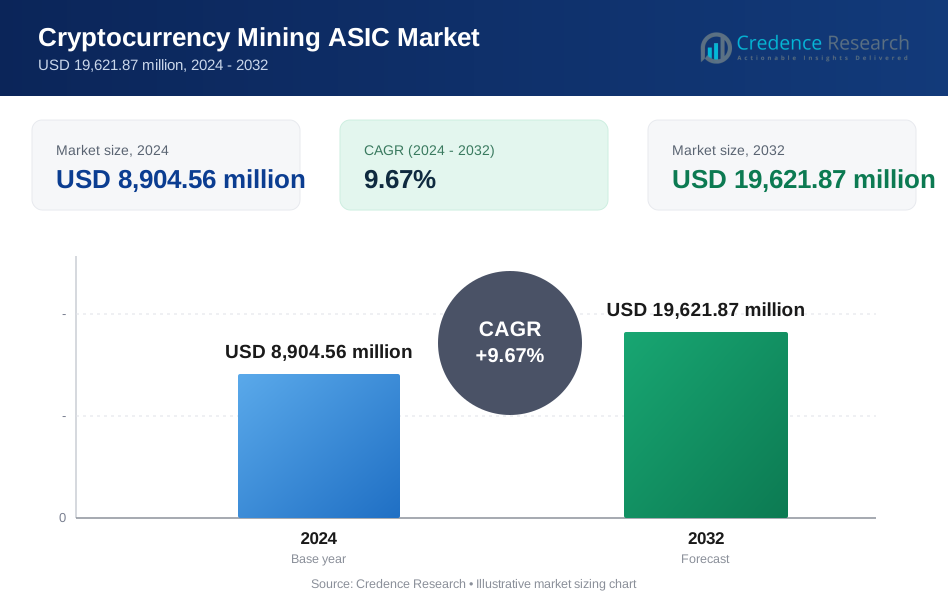
The Global Cryptocurrency Mining ASIC Market size was valued at USD 5,096.25 million in 2018 to USD 8,904.56 million in 2024 and is anticipated to reach USD 19,621.87 million by 2032, at a CAGR of 9.67% during the forecast period.
Several key drivers are fueling the growth of the ASIC mining market. First, the rising institutional and retail investment in cryptocurrencies-particularly Bitcoin-has amplified the need for scalable, profitable mining solutions. ASICs deliver higher hash rates and improved energy efficiency, enabling miners to remain competitive amid increasing network difficulty. Second, ongoing technological advancements in chip design, thermal management, and manufacturing processes are enhancing performance while reducing operating costs. Companies such as Bitmain and MicroBT are consistently releasing more powerful models to meet demand. Third, global interest in low-cost, renewable power sources-such as hydroelectricity and flared natural gas-is pushing miners toward sustainable operations, and ASICs play a crucial role in maximizing output per kilowatt. Additionally, growing regulatory clarity in key jurisdictions is encouraging strategic investments, partnerships, and new data center buildouts tailored for ASIC deployment.
Regionally, North America dominates the ASIC mining landscape, supported by access to cheap renewable energy, favorable policy environments, and significant infrastructure investments. The United States and Canada have become hotspots for industrial-scale mining operations, often benefitting from tax incentives and partnerships with utility providers. The Asia-Pacific region, historically led by China, continues to influence the market despite regulatory crackdowns, with countries like Kazakhstan, Malaysia, and Indonesia emerging as alternative hubs. Southeast Asian nations are beginning to gain traction due to improving digital infrastructure and access to competitively priced electricity. Latin America and parts of the Middle East and Africa are also seeing increased activity, thanks to abundant natural resources and government interest in digital innovation. Meanwhile, Europe maintains a smaller market share, limited by higher electricity costs and stringent environmental policies, though Scandinavian countries with strong green energy capabilities continue to attract ethically conscious mining projects.

Market Insights:
- The Global Cryptocurrency Mining ASIC Market was valued at USD 8,904.56 million in 2024 and is projected to reach USD 19,621.87 million by 2032, expanding at a CAGR of 9.67%.
- Rising demand for high-efficiency, high-throughput mining hardware is pushing the market toward ASICs, which offer superior hash rates and lower energy consumption compared to GPUs or CPUs.
- Technological innovations in chip design, power efficiency, and thermal management by key players like Bitmain and MicroBT are accelerating hardware performance and reducing mining costs.
- Industrial-scale mining operations are expanding in low-cost energy regions such as North America, Central Asia, and Latin America, driving bulk ASIC hardware procurement.
- Institutional investment in mining is increasing demand for enterprise-grade ASIC systems with scalable architecture, high durability, and optimized power usage.
- Regulatory inconsistencies and geopolitical decisions continue to challenge long-term planning, especially in regions facing bans or power restrictions.
- North America leads the market due to renewable energy access, policy support, and infrastructure, while Asia-Pacific remains vital for manufacturing and new mining hubs like Kazakhstan and Malaysia.
Market Drivers:
Rising demand for high-efficiency mining hardware to meet increasing network difficulty
The Global Cryptocurrency Mining ASIC Market is primarily driven by the growing need for high-performance mining solutions as blockchain networks become more complex. Bitcoin’s increasing mining difficulty and the competitive nature of Proof-of-Work systems compel miners to use specialized ASIC hardware that offers superior processing power and energy efficiency. These devices perform targeted computations, enabling users to generate higher hash rates while maintaining lower operational costs. With general-purpose GPUs and CPUs becoming less viable for large-scale mining, the market continues to shift toward purpose-built ASIC units. It addresses the need for optimized computation by offering custom chipsets that are far more effective than standard alternatives. This transition reinforces ASICs as the backbone of efficient cryptocurrency mining infrastructure.
- Bitmain’s latest Antminer S21 XP Hydro, for example, delivers a hashrate of 473 terahashes per second (TH/s) with an energy efficiency of 12 joules per terahash (J/TH), representing a major leap over previous generation.
Technological advancements in ASIC chip design are driving hardware innovation and profitability
Breakthroughs in semiconductor manufacturing and chip architecture have significantly advanced the performance capabilities of mining ASICs. Companies are developing chips with smaller node sizes, enhanced power efficiency, and improved thermal design, allowing miners to achieve better output with reduced energy input. The Global Cryptocurrency Mining ASIC Market benefits directly from this trend, as new product launches from key players like Bitmain, Canaan, and MicroBT feature machines that deliver higher terahashes per second (TH/s) with lower watts per terahash (W/TH) ratios. It helps miners increase returns while minimizing electricity costs, which is often the most significant operational expense. Rapid innovation cycles also create a continuous replacement market, encouraging ongoing hardware upgrades. These developments push miners toward newer models that deliver competitive advantages in both performance and profitability.
Global expansion of mining farms supported by energy cost arbitrage and favorable policy conditions
Energy availability and cost remain central to mining operations, making access to low-cost electricity a critical factor influencing deployment. In several countries, miners take advantage of excess hydroelectric capacity, flared natural gas, or government-subsidized power to maximize margins. The Global Cryptocurrency Mining ASIC Market reflects this strategy through the concentration of ASIC installations in energy-abundant regions such as North America, Central Asia, and parts of Latin America. It enables industrial-scale mining farms to operate more efficiently and sustainably. Government policies that provide tax incentives or infrastructure support for digital assets further encourage capital investment in mining facilities. Regional stability and predictable regulation enhance investor confidence and accelerate ASIC hardware procurement and deployment.
- For instance, Bitmain’s hydro-cooled Antminer series is specifically designed for deployment in large mining farms, with the Antspace HK3 container supporting up to 210 miners and a total capacity of 1 megawatt, optimized for year-round operation in energy-rich areas.
Institutionalization of cryptocurrency mining is increasing demand for scalable, purpose-built systems
The entrance of institutional investors and publicly traded mining companies has reshaped the competitive landscape of crypto mining. These entities demand industrial-grade hardware that offers reliability, consistency, and long-term profitability. The Global Cryptocurrency Mining ASIC Market is responding with high-capacity machines capable of supporting enterprise-scale operations. It supports the growth of mining-as-a-service models and large data centers dedicated to digital asset generation. Institutional stakeholders prioritize metrics like power usage effectiveness and ROI per device, pushing vendors to innovate at a rapid pace. This professionalization of mining operations amplifies the demand for cutting-edge ASIC systems tailored for scalable, high-throughput environments.
Market Trends:
Shift toward sustainable mining practices influencing ASIC design and deployment
Environmental concerns and regulatory scrutiny are pushing the cryptocurrency industry toward more energy-efficient mining solutions. The Global Cryptocurrency Mining ASIC Market reflects this shift through rising demand for hardware optimized for low power consumption without sacrificing computational power. Manufacturers are now focusing on thermal efficiency, compact hardware architecture, and advanced cooling systems to reduce overall energy usage. It supports the transition to greener operations, especially in regions enforcing sustainability mandates. ASIC designs that operate effectively with renewable power sources or within carbon-neutral frameworks are gaining favor among investors. This trend is redefining hardware procurement criteria and shaping long-term strategic planning for mining firms.
- For example, MicroBT’s WhatsMiner M63S+ pushes the boundaries further, offering 412 TH/s at 17 W/TH, and is optimized for immersion cooling-enabling efficient operation in high-temperature environments and supporting mining farms’ transition to greener energy sources. MicroBT’s technical documentation states that the M63S+ can be integrated directly with solar or wind installations, aligning with sustainability mandates in markets such as North America and the EU.
Increasing integration of AI and automation for real-time monitoring and performance optimization
Modern mining operations are integrating artificial intelligence and machine learning tools to enhance equipment performance and optimize resource utilization. The Global Cryptocurrency Mining ASIC Market is adopting AI-based analytics to monitor temperature, predict maintenance needs, and control energy distribution dynamically. It allows operators to extend ASIC hardware lifespan, reduce downtime, and prevent costly breakdowns. Intelligent automation also improves mining farm scalability by minimizing manual intervention in operations. Vendors are offering ASICs with embedded telemetry and remote management capabilities that align with the data-driven approach of modern facilities. This trend supports continuous improvement of operational efficiency in a highly competitive environment.
- For instance, Crusoe Energyhas pioneered the co-location of AI workloads with Bitcoin mining, sharing immersion cooling infrastructure to optimize both computing and energy use. Crusoe’s technical releases report that this integration has reduced cooling-related energy consumption by 18% and enabled dynamic load balancing between AI and mining tasks, maximizing profitability and resource utilization.
Emergence of decentralized mining pools reshaping ASIC demand and ownership models
The rise of decentralized and community-driven mining pools is altering how individuals and small entities participate in mining. The Global Cryptocurrency Mining ASIC Market is witnessing growing interest from independent users investing in entry-level or mid-tier ASICs to contribute to decentralized pools. It fosters a more distributed network structure, balancing the dominance of large mining corporations. These decentralized platforms provide transparent reward mechanisms and reduced pool fees, incentivizing smaller players to invest in dedicated hardware. This evolving trend strengthens hardware accessibility and encourages broader participation in the mining ecosystem. The market is adapting by offering varied ASIC configurations to meet different ownership and budget profiles.
Customization and localization of ASIC supply chains gaining strategic importance
Geopolitical tensions, trade restrictions, and pandemic-induced disruptions have underscored the need for resilient and localized supply chains. The Global Cryptocurrency Mining ASIC Market is seeing increased investment in regional assembly, testing, and distribution hubs to reduce dependence on a few manufacturing centers. It enables faster delivery cycles, cost savings on logistics, and greater control over inventory management. Manufacturers are also developing hardware tailored to regional power standards, cooling environments, and compliance regulations. This localization strategy supports agility in meeting diverse market needs and strengthens vendor-customer relationships. The trend marks a strategic evolution in how ASIC products are designed, produced, and delivered globally.
Market Challenges Analysis:
Regulatory uncertainty and policy constraints hinder strategic expansion and long-term planning
The Global Cryptocurrency Mining ASIC Market faces significant challenges due to evolving regulatory frameworks and policy inconsistencies across major regions. Governments continue to debate the environmental impact of mining, power grid strain, and financial oversight, leading to sudden changes in operational legality and tax obligations. It creates an unstable investment environment, making it difficult for companies to plan hardware procurement and deployment cycles. Bans or restrictions in countries like China and Kazakhstan have disrupted global supply chains and forced large-scale relocations, reducing operational continuity. Regulatory fragmentation between states or provinces within a country further complicates cross-border equipment distribution. These obstacles slow infrastructure development and discourage long-term capital investments in ASIC-based mining ventures.
Hardware obsolescence and high capital costs reduce profitability for small and mid-scale miners
Rapid innovation cycles in ASIC chip development pose serious challenges for smaller mining operations that struggle to keep pace with technological upgrades. The Global Cryptocurrency Mining ASIC Market sees frequent hardware releases that outperform previous models by large margins, shortening the effective lifespan of mining rigs. It forces continuous reinvestment in newer devices, placing financial strain on independent miners and small-scale enterprises. The high upfront costs of ASIC units, coupled with volatile cryptocurrency prices, add risk to return-on-investment calculations. Miners unable to access low-cost energy or scale their operations quickly face declining margins and exit the market. This trend is contributing to increased centralization, as only large entities can absorb the financial and operational demands of frequent hardware refreshes.
Market Opportunities:
Expansion into emerging markets with abundant energy resources creates new growth avenues
The Global Cryptocurrency Mining ASIC Market holds strong potential in regions with untapped energy reserves and supportive economic policies. Countries in Latin America, Africa, and Southeast Asia offer low-cost electricity, favorable climates for cooling, and growing interest in digital infrastructure. It enables mining operators to reduce operational expenses while accessing new user bases. Governments seeking to attract foreign investment in technology sectors may offer incentives for ASIC-based facilities. These markets present opportunities for vendors to introduce localized hardware solutions tailored to regional conditions. Strategic partnerships with energy providers and data center operators can further strengthen footholds in these expanding territories.
Rising institutional interest in digital asset infrastructure drives demand for enterprise-scale ASIC systems
Institutional investors and public companies are increasing their exposure to cryptocurrency mining, creating opportunities for high-capacity, durable ASIC systems. The Global Cryptocurrency Mining ASIC Market can capitalize on this shift by developing enterprise-grade hardware with advanced management features and optimized energy profiles. It supports mining-as-a-service platforms, co-location services, and green-certified facilities that align with institutional ESG goals. Custom ASIC design and integration services may also gain traction as professional firms seek competitive advantages. This trend strengthens demand for scalable, high-performance ASIC hardware capable of meeting stringent operational and compliance standards.
Market Segmentation Analysis:
The Global Cryptocurrency Mining ASIC Market is segmented by product type, application, and sales channel, each playing a distinct role in shaping market dynamics.
By product type, Bitcoin ASIC miners dominate the market due to the widespread adoption of SHA-256 algorithm for Bitcoin mining and higher demand for profitability in large-scale operations. Litecoin and Scrypt ASIC miners hold a smaller share, catering to altcoin miners focused on reduced competition and faster block processing. Ethereum Classic and other altcoin ASIC miners are emerging as viable alternatives following Ethereum’s shift to Proof-of-Stake.
- Goldshell’s LT6 is a leading example in the Scrypt ASIC segment, designed for Litecoin and Dogecoin mining. It achieves 3.35 GH/s at 3200 W, catering to altcoin miners who prioritize reduced network competition and faster block confirmation times. These devices appeal to operators seeking alternatives to Bitcoin’s intense competition.
By application, mining farms lead the market, driven by institutional-scale investments and the need for high-throughput, energy-efficient operations. Enterprise mining operations follow closely, with companies deploying dedicated facilities supported by custom ASIC systems. Individual miners maintain relevance but face pressure from hardware costs and hash rate competitiveness.
- For example, Hive Blockchain’s deployment of custom ASIC systems in dedicated Canadian facilities demonstrates enterprise-scale mining. Their operations utilize thousands of Bitmain and Canaan miners, achieving consistent uptime and optimized power usage effectiveness, supported by robust infrastructure and monitoring systems.
By sales channel, online distribution accounts for the majority of ASIC hardware sales due to broader reach, transparent pricing, and direct access to manufacturers. Offline channels serve niche markets and local resellers, supporting buyers who require bundled services or localized support. It continues to adapt to changing buyer behavior, regional preferences, and evolving digital infrastructure.

Segmentation:
By Product Type
- Bitcoin ASIC Miners (SHA-256 algorithm)
- Litecoin and Scrypt ASIC Miners
- Ethereum Classic and Altcoin ASIC Miners
By Application
- Mining Farms
- Individual Miners
- Enterprise Mining Operations
By Sales Channel
- Online
- Offline
By Region
- North America
- U.S.
- Canada
- Mexico
- Europe
- Germany
- France
- U.K.
- Italy
- Spain
- Rest of Europe
- Asia Pacific
- China
- Japan
- India
- South Korea
- South-east Asia
- Rest of Asia Pacific
- Latin America
- Brazil
- Argentina
- Rest of Latin America
- Middle East & Africa
- GCC Countries
- South Africa
- Rest of the Middle East and Africa
Regional Analysis:
The North America Cryptocurrency Mining ASIC Market size was valued at USD 1,412.83 million in 2018 to USD 2,428.23 million in 2024 and is anticipated to reach USD 5,374.33 million by 2032, at a CAGR of 9.7% during the forecast period. North America holds a significant share in the Global Cryptocurrency Mining ASIC Market, accounting for around 23.5% of the global revenue in 2024. It benefits from stable regulations, low-cost renewable energy in regions like Texas and Quebec, and strong infrastructure for industrial-scale mining. The U.S. leads the region, supported by mining-friendly policies and institutional investment in digital assets. Major players have established large ASIC-based mining farms, leveraging excess capacity from hydroelectric and wind power grids. It offers a favorable environment for expansion due to predictable taxation and compliance standards. The presence of advanced data center ecosystems and skilled labor further strengthens the region's dominance.
The Europe Cryptocurrency Mining ASIC Market size was valued at USD 1,076.48 million in 2018 to USD 1,789.84 million in 2024 and is anticipated to reach USD 3,630.10 million by 2032, at a CAGR of 8.5% during the forecast period. Europe represents nearly 17.4% of the Global Cryptocurrency Mining ASIC Market, with growth driven by selective regional opportunities rather than broad adoption. Northern European countries like Sweden and Norway lead in ASIC adoption due to access to clean, low-cost hydroelectric energy. It faces challenges from stringent environmental regulations and high electricity prices in central and western Europe. However, the region benefits from a focus on sustainable mining and ESG-compliant infrastructure. Companies operating in Europe increasingly seek energy-efficient ASICs to align with emission targets. Market expansion remains steady in countries where government support and grid capacity permit industrial-scale deployment.
The Asia Pacific Cryptocurrency Mining ASIC Market size was valued at USD 2,167.10 million in 2018 to USD 3,930.20 million in 2024 and is anticipated to reach USD 9,202.83 million by 2032, at a CAGR of 10.5% during the forecast period. Asia Pacific leads the Global Cryptocurrency Mining ASIC Market with the largest share, contributing over 38% of global revenue in 2024. China, despite regulatory crackdowns, remains a key hardware manufacturing hub, while nations like Kazakhstan, Malaysia, and Thailand are emerging as mining hotspots. It benefits from cost-effective labor, abundant energy resources, and proximity to leading ASIC suppliers. The region sees increasing activity in India, Indonesia, and Vietnam due to growing digital infrastructure and investment in blockchain technologies. Government policy varies, but countries offering low-cost power and tax incentives see consistent market growth. Asia Pacific remains vital for both ASIC production and deployment.
The Latin America Cryptocurrency Mining ASIC Market size was valued at USD 235.04 million in 2018 to USD 405.45 million in 2024 and is anticipated to reach USD 788.27 million by 2032, at a CAGR of 8.0% during the forecast period. Latin America holds a modest 3.9% share in the Global Cryptocurrency Mining ASIC Market, yet displays strong potential driven by favorable energy conditions. Countries like Paraguay, Argentina, and Brazil offer abundant hydroelectric power and supportive tax regimes. It attracts both local and foreign miners looking for affordable operational bases. Political and economic volatility, however, can hinder long-term investment. The region shows growing interest in blockchain and digital currency integration, encouraging demand for ASIC hardware. Strategic partnerships with energy providers may further unlock value in underutilized areas.
The Middle East Cryptocurrency Mining ASIC Market size was valued at USD 138.23 million in 2018 to USD 220.09 million in 2024 and is anticipated to reach USD 406.50 million by 2032, at a CAGR of 7.3% during the forecast period. The Middle East contributes roughly 2.1% to the Global Cryptocurrency Mining ASIC Market, supported by access to low-cost fossil fuel energy and improving digital policies. The UAE and Bahrain are leading efforts to attract tech investment, including cryptocurrency operations. It offers a favorable climate for data center infrastructure, though extreme temperatures challenge cooling systems. Power subsidies and national innovation agendas help accelerate hardware demand. Market growth depends on regulatory clarity and the ability to balance energy-intensive operations with environmental commitments. High capital liquidity in the region supports large-scale hardware acquisition and facility development.
The Africa Cryptocurrency Mining ASIC Market size was valued at USD 66.57 million in 2018 to USD 130.75 million in 2024 and is anticipated to reach USD 219.84 million by 2032, at a CAGR of 6.0% during the forecast period. Africa accounts for only 1.3% of the Global Cryptocurrency Mining ASIC Market in 2024, yet it presents emerging opportunities in countries with surplus renewable energy. Ethiopia and Kenya have seen interest due to hydropower availability and favorable climates. It still faces barriers related to unstable power grids, limited infrastructure, and policy ambiguity. Despite these challenges, grassroots mining activity and mobile-first digital finance ecosystems are encouraging broader adoption. The growth potential lies in localized mining models and collaboration with foreign investors. The region remains underexplored but strategically important for long-term diversification.
Key Player Analysis:
- Bitmain Technologies
- MicroBT
- Canaan Inc.
- Ebang International
- Innosilicon
- AGMH
- Bee Computing
- Auradine
Competitive Analysis:
The Global Cryptocurrency Mining ASIC Market features a concentrated competitive landscape dominated by a few key players, including Bitmain Technologies, MicroBT, Canaan Inc., and Ebang International. These companies maintain market leadership through continuous innovation in chip performance, power efficiency, and thermal management. It experiences high entry barriers due to significant R&D investment and technological expertise required for ASIC design and fabrication. Leading firms often release upgraded models in rapid cycles, reinforcing brand loyalty and ensuring dominance in high-volume orders. Regional players and niche manufacturers compete by offering cost-effective alternatives and localized solutions. Strategic partnerships, vertical integration, and control over supply chains further strengthen competitive positioning. The market favors companies that can deliver consistent performance, manage large-scale production, and adapt quickly to evolving energy and regulatory demands. Innovation in AI-integrated ASICs and sustainable mining solutions is becoming a key differentiator in securing long-term market relevance.
Recent Developments:
- In CoreWeave, on July 7, 2025, the company announced an agreement to acquire crypto miner Core Scientific. The all-stock deal, valued at approximately USD 9 billion, will conclude in Q4 2025. It enables CoreWeave to convert Core Scientific’s power and cooling infrastructure-originally built for Bitcoin mining-into high-performance AI computing facilities.
- In Jan 2025, HIVE Digital Technologiesexpanded its operations by acquiring a new fleet of Bitcoin miners and increasing its mining capacity. This strategic acquisition is part of HIVE’s ongoing effort to scale up its Bitcoin mining operations and capitalize on the latest advancements in ASIC hardware, ensuring competitive hashrate and operational efficiency.
- In November 2024, Prosperannounced a partnership with Bitmain to provide miner hosting services. This collaboration is designed to offer scalable and reliable infrastructure solutions for cryptocurrency miners, leveraging Bitmain’s hardware expertise and Prosper’s operational capabilities to support large-scale mining operations.
- In July 2024, Blockentered into a significant agreement with Core Scientific to develop and supply new 3nm mining ASICs, marking a major advancement in ASIC chip technology for the cryptocurrency mining sector. This partnership aims to enhance mining efficiency and performance, positioning both companies at the forefront of next-generation mining hardware innovation.
Market Concentration & Characteristics:
The Global Cryptocurrency Mining ASIC Market exhibits a high level of market concentration, with a small number of players accounting for the majority of global revenue. It is characterized by rapid technological advancements, short product lifecycles, and high capital requirements. Dominant companies like Bitmain, MicroBT, and Canaan set performance benchmarks through aggressive innovation and early access to advanced semiconductor foundries. It requires strong supply chain control, consistent R&D investment, and the ability to scale production quickly to meet fluctuating demand. The market favors firms with deep expertise in chip architecture, energy efficiency, and cooling integration. It remains sensitive to cryptocurrency price volatility, regulatory developments, and energy pricing, which influence both hardware procurement and operational strategy. Competitive differentiation often hinges on hash rate performance, energy consumption, and overall ROI.
Report Coverage:
The research report offers an in-depth analysis based on product type, application, and sales channel. It details leading market players, providing an overview of their business, product offerings, investments, revenue streams, and key applications. Additionally, the report includes insights into the competitive environment, SWOT analysis, current market trends, as well as the primary drivers and constraints. Furthermore, it discusses various factors that have driven market expansion in recent years. The report also explores market dynamics, regulatory scenarios, and technological advancements that are shaping the industry. It assesses the impact of external factors and global economic changes on market growth. Lastly, it provides strategic recommendations for new entrants and established companies to navigate the complexities of the market.
Future Outlook:
- Increased focus on energy-efficient ASIC designs to align with global sustainability goals.
- Growing adoption of immersion and liquid cooling systems to optimize hardware performance.
- Expansion of institutional mining operations will drive demand for enterprise-grade ASIC solutions.
- Emerging markets in Latin America and Africa will attract new ASIC deployments due to low-cost energy.
- Integration of AI and automation in ASIC firmware will enhance operational control and predictive maintenance.
- Localized manufacturing and regional supply chain hubs will reduce dependency on specific geographies.
- Market consolidation is expected as smaller players struggle to compete with rapid hardware cycles.
- Regulatory developments will shape hardware design standards and deployment strategies.
- Rise of decentralized mining networks will support demand for compact, consumer-friendly ASIC units.
- Increased R&D investment will lead to breakthroughs in processing speed and thermal efficiency.
Request a Free Sample
Fill in your details and we'll send you a free sample report.
- Sample data tables & charts
- Research methodology
Market Dynamics
Need for High-Efficiency Mining Hardware
As blockchain networks like Bitcoin become more complex and mining difficulty increases, miners require specialized ASIC hardware that delivers higher hash rates and improved energy efficiency. This shift from general-purpose GPUs and CPUs to ASICs is essential for maintaining profitability and competitiveness.
Technological Advancements in ASIC Design
Continuous innovation in semiconductor manufacturing, chip architecture, and thermal management is enabling the production of ASICs with greater performance and lower power consumption. These advancements reduce operational costs and drive frequent hardware upgrades, fueling market growth.
Expansion of Industrial-Scale Mining Operations
The proliferation of large mining farms in regions with low-cost energy, such as North America and Central Asia, is driving bulk procurement of ASIC hardware. Favorable policies, tax incentives, and infrastructure investments further support the deployment of enterprise-grade mining solutions.
Institutionalization and Professionalization of Mining
The entry of institutional investors and publicly traded companies into cryptocurrency mining is increasing demand for scalable, reliable, and high-throughput ASIC systems. This trend is accelerating the adoption of advanced hardware and supporting the growth of mining-as-a-service and large data center operations.
Shift Toward Sustainable and Energy-Efficient Mining
Growing environmental concerns and regulatory scrutiny are pushing the market toward ASICs optimized for low power consumption and compatibility with renewable energy sources. This focus on sustainability is influencing hardware design and procurement strategies, especially in regions with strict ESG mandates.
Need a Custom Version of This Report?
Tailor the scope, geography, or segments to your exact requirements.
- Custom geography or segment scope
- Direct access to our analyst team
Frequently Asked Questions
What is the current size of the Global Cryptocurrency Mining ASIC Market?
What are the key segments within the Global Cryptocurrency Mining ASIC Market?
What are some challenges faced by the Global Cryptocurrency Mining ASIC Market?
Who are the major players in the Global Cryptocurrency Mining ASIC Market?
Table of Content
Chapter 1 Market Segmentation
- 1.1 Segmentation Framework
- 1.1.1 Product and Service Classification
- 1.1.2 Application and End-Use Classification
- 1.1.3 Technology and Solution Classification
- 1.1.4 Customer and Distribution Channel Classification
- 1.1.5 Geographic Segmentation
- 1.1.6 Market Segment Definitions and Boundaries
- 1.2 By Application
- 1.2.1 Mining Farms
- 1.2.2 Individual Miners
- 1.2.3 Enterprise Mining Operations
- 1.3 By Product Type
- 1.3.1 Bitcoin ASIC Miners (SHA-256 algorithm)
- 1.3.2 Litecoin and Scrypt ASIC Miners
- 1.3.3 Ethereum Classic and Altcoin ASIC Miners
- 1.4 By Sales Channel
- 1.4.1 Online
- 1.4.2 Offline
Chapter 2 Introduction
- 2.1 Report Objectives and Scope
- 2.2 Product Definition and Industry Terminology
- 2.3 Market Inclusions and Exclusions
- 2.4 Research Process
- 2.4.1 Primary Research and Expert Interviews
- 2.4.2 Secondary Research and Source Review
- 2.4.3 Top-Down and Bottom-Up Estimation
- 2.4.4 Data Triangulation and Verification
- 2.5 Market Size Measurement Basis
- 2.5.1 2024: USD 8,904.56 million → 2032: USD 19,621.87 million
- 2.6 Historical and Forecast Reference Periods
- 2.6.1 Base Year: 2024
- 2.6.2 Forecast Period: 2024-2032
- 2.7 Research Assumptions and Limitations
Chapter 3 Executive Summary
- 3.1 Market Snapshot and Key Findings
- 3.2 Base-Year Market Size, 2024
- 3.3 Forecast Market Size, 2032
- 3.4 Revenue and Volume Growth Outlook
- 3.5 Key Demand and Supply Indicators
- 3.6 Leading Market Segments
- 3.7 Fastest-Growing Market Opportunities
- 3.8 Regional Performance Highlights
- 3.9 Technology and Industry Transformation
- 3.10 Competitive Landscape Summary
- 3.11 Analyst View and Strategic Implications
Chapter 4 Global Cryptocurrency Mining ASIC Market Trends and Developments
- 4.1 Historical Industry Development
- 4.2 Recent Market Trends and Developments
- 4.3 Demand and Customer Behavior Trends
- 4.4 Technology and Product Innovation
- 4.5 Artificial Intelligence, Automation and Digitalization
- 4.6 Local Manufacturing and Supply Chain Realignment
- 4.7 Industry Partnerships, Mergers and Acquisitions
- 4.8 Sustainability and Circular Economy Developments
- 4.9 Government and Private Sector Investment Trends
- 4.10 Emerging Business Models and Commercialization
- 4.11 Industry Developments and Announcements
Chapter 5 Global Cryptocurrency Mining ASIC Market Production, Supply and Demand Analysis
- 5.1 Demand Trend and Consumption Analysis
- 5.2 Demand Forecast, 2024-2032
- 5.3 Production and Output Trend
- 5.4 Production and Output Forecast, 2024-2032
- 5.5 Installed Capacity and Capacity Utilization
- 5.6 Company-Wise Production Plants and Statistics
- 5.6.1 Installed Production Capacity
- 5.6.2 Actual Production
- 5.6.3 Planned Capacity and Expansion Targets
- 5.7 Supply Chain Structure and Procurement Trends
- 5.8 Supply-Demand Gap and Bottlenecks
- 5.9 Import Dependence and Sourcing Structure
- 5.10 Contract Manufacturing and Outsourcing
- 5.11 Regional Supply and Demand Concentration
Chapter 6 Global Cryptocurrency Mining ASIC Market Pricing Analysis
- 6.1 Pricing Structure and Measurement
- 6.2 Historical Pricing Trends
- 6.3 Pricing Outlook, 2024-2032
- 6.4 Average Selling Price and Unit Economics
- 6.5 Pricing by Product and Market Segment
- 6.6 Geographic Pricing Differences
- 6.7 Key Input, Energy, Labor and Logistics Costs
- 6.8 Contract Pricing and Purchasing Models
- 6.9 Pricing Sensitivity and Competitive Positioning
- 6.10 Price, Margin and Profitability Implications
Chapter 7 Global Cryptocurrency Mining ASIC Market Dynamics
- 7.1 Market Growth Drivers
- 7.1.1 Demand-Side Drivers
- 7.1.2 Technology and Innovation Drivers
- 7.1.3 Infrastructure and Investment Drivers
- 7.1.4 Regulatory and Policy Drivers
- 7.2 Market Restraints
- 7.2.1 Cost and Affordability Constraints
- 7.2.2 Technology and Adoption Barriers
- 7.2.3 Supply Chain and Operational Constraints
- 7.3 Market Challenges
- 7.3.1 Competitive Pressure and Margin Erosion
- 7.3.2 Skills, Infrastructure and Implementation Gaps
- 7.4 Emerging Market Opportunities
- 7.5 Market Dynamics Impact and Time-Horizon Assessment
Chapter 8 Global Cryptocurrency Mining ASIC Value Chain Analysis
- 8.1 Industry Value Chain Overview
- 8.2 Upstream Suppliers and Critical Inputs
- 8.3 Technology and Component Providers
- 8.4 Manufacturing or Service Delivery
- 8.5 Distribution, Channel Partners and Integrators
- 8.6 Downstream Applications and End Users
- 8.7 Value Addition and Profit Pools
- 8.8 Vertical Integration and Outsourcing
- 8.9 Supplier Concentration and Risk
- 8.10 Supply Chain Localization and Resilience
Chapter 9 Global Cryptocurrency Mining ASIC Market Regulations and Policies
- 9.1 Relevant Laws, Standards and Compliance Frameworks
- 9.2 Product, Service, Safety and Quality Requirements
- 9.3 Government Policies, Incentives and Subsidies
- 9.4 Imports, Exports and Trade Barriers
- 9.5 Public Procurement and Local Content Requirements
- 9.6 Environmental and Sustainability Compliance
- 9.7 Data Protection, AI and Cybersecurity Compliance
- 9.8 Upcoming Policy Changes and Market Implications
Chapter 10 Global Cryptocurrency Mining ASIC Market Hotspots and Opportunities
- 10.1 Market Opportunity Mapping and Growth Hotspots
- 10.2 High-Growth Applications and Customer Groups
- 10.3 Underserved Markets and White-Space Opportunities
- 10.4 Emerging Technology and Product Opportunities
- 10.5 New Capacity and Investment Hotspots
- 10.6 Market Entry and Expansion Opportunities
- 10.7 Distribution and Partnership Opportunities
- 10.8 Near-Term and Long-Term Commercial Potential
- 10.9 Opportunity Attractiveness and Execution Risks
Chapter 11 Global Cryptocurrency Mining ASIC Market Outlook, 2024-2032
- 11.1 Market Size and Analysis
- 11.1.1 Revenue (Market Measurement: 2024: USD 8,904.56 million → 2032: USD 19,621.87 million)
- 11.1.2 Market Volume and Quantity Sold
- 11.1.3 Historical Market Size
- 11.1.4 Base-Year Market Size, 2024
- 11.2 Market Forecast, 2024-2032
- 11.2.1 Revenue Forecast to 2032
- 11.2.2 Volume Forecast to 2032
- 11.2.3 CAGR and Year-on-Year Growth
- 11.2.4 Incremental Revenue Opportunity
- 11.3 Forecast Assumptions and Scenario Analysis
- 11.3.1 Base-Case Forecast
- 11.3.2 Optimistic and Conservative Scenarios
- 11.3.3 Technology, Pricing and Policy Sensitivities
- 11.4 Market Attractiveness and Growth Outlook
Chapter 12 Global Cryptocurrency Mining ASIC Market Segmentation and Outlook
- 12.1 Segmentation Summary and Market Shares, 2024
- 12.2 Largest and Fastest-Growing Segments
- 12.3 By Application - Market Size and Forecast, 2024-2032
- 12.3.1 Segment Definition and Scope
- 12.3.2 Historical Market Size
- 12.3.3 Revenue Forecast, 2024-2032
- 12.3.4 Volume Forecast, 2024-2032
- 12.3.5 Base-Year Market Share, 2024
- 12.3.6 Segment CAGR and Growth Drivers
- 12.3.7 Subsegment Market Size and Forecast
- 12.3.7.1 Mining Farms
- 12.3.7.2 Individual Miners
- 12.3.7.3 Enterprise Mining Operations
- 12.3.8 Subsegment Pricing and Adoption Trends
- 12.3.9 Leading Suppliers and Competition
- 12.3.10 Regional Demand and Opportunities
- 12.4 By Product Type - Market Size and Forecast, 2024-2032
- 12.4.1 Segment Definition and Scope
- 12.4.2 Historical Market Size
- 12.4.3 Revenue Forecast, 2024-2032
- 12.4.4 Volume Forecast, 2024-2032
- 12.4.5 Base-Year Market Share, 2024
- 12.4.6 Segment CAGR and Growth Drivers
- 12.4.7 Subsegment Market Size and Forecast
- 12.4.7.1 Bitcoin ASIC Miners (SHA-256 algorithm)
- 12.4.7.2 Litecoin and Scrypt ASIC Miners
- 12.4.7.3 Ethereum Classic and Altcoin ASIC Miners
- 12.4.8 Subsegment Pricing and Adoption Trends
- 12.4.9 Leading Suppliers and Competition
- 12.4.10 Regional Demand and Opportunities
- 12.5 By Sales Channel - Market Size and Forecast, 2024-2032
- 12.5.1 Segment Definition and Scope
- 12.5.2 Historical Market Size
- 12.5.3 Revenue Forecast, 2024-2032
- 12.5.4 Volume Forecast, 2024-2032
- 12.5.5 Base-Year Market Share, 2024
- 12.5.6 Segment CAGR and Growth Drivers
- 12.5.7 Subsegment Market Size and Forecast
- 12.5.7.1 Online
- 12.5.7.2 Offline
- 12.5.8 Subsegment Pricing and Adoption Trends
- 12.5.9 Leading Suppliers and Competition
- 12.5.10 Regional Demand and Opportunities
- 12.6 Segment Growth Comparison
- 12.7 Segment Attractiveness and Priority Matrix
Chapter 13 Global Cryptocurrency Mining ASIC End-Use and Application Market Outlook
- 13.1 End-Use Industry and Customer Demand Structure
- 13.2 Leading Applications and Customer Groups
- 13.3 End-Use Market Size, Share and Forecast
- 13.4 Major End-Use Industry Deep Dives
- 13.4.1 Customer Requirements and Use Cases
- 13.4.2 Demand and Replacement Cycles
- 13.4.3 Technical and Regulatory Considerations
- 13.4.4 Purchasing and Procurement Models
- 13.4.5 Leading Vendors and Distribution Channels
- 13.4.6 Forecast and Commercial Opportunities
- 13.5 Emerging Applications and Cross-Segment Demand
- 13.6 End-Use Industry Investment Priorities
Chapter 14 Global Cryptocurrency Mining ASIC Geographic Market Outlook, 2024-2032
- 14.1 Regional Market Size and Share, 2024
- 14.2 Regional Market Forecast, 2024-2032
- 14.3 Regional Pricing, Production and Demand Differences
- 14.4 North America
- 14.4.1 United States
- 14.4.2 Canada
- 14.4.3 Mexico
- 14.5 Europe
- 14.5.1 Germany
- 14.5.2 France
- 14.5.3 Italy
- 14.5.4 United Kingdom
- 14.5.5 Spain
- 14.5.6 Poland
- 14.5.7 Russia
- 14.5.8 Netherlands
- 14.5.9 Belgium
- 14.5.10 Sweden
- 14.5.11 Denmark
- 14.5.12 Norway
- 14.5.13 Rest of Europe
- 14.6 Asia Pacific
- 14.6.1 China
- 14.6.2 India
- 14.6.3 Japan
- 14.6.4 South Korea
- 14.6.5 Thailand
- 14.6.6 Indonesia
- 14.6.7 Vietnam
- 14.6.8 Malaysia
- 14.6.9 Australia
- 14.6.10 Rest of Asia Pacific
- 14.7 Latin America
- 14.7.1 Brazil
- 14.7.2 Argentina
- 14.7.3 Colombia
- 14.7.4 Chile
- 14.7.5 Rest of Latin America
- 14.8 Middle East
- 14.8.1 Saudi Arabia
- 14.8.2 United Arab Emirates
- 14.8.3 Turkey
- 14.8.4 Israel
- 14.8.5 Iran
- 14.8.6 Rest of the Middle East
- 14.9 Africa
- 14.9.1 South Africa
- 14.9.2 Egypt
- 14.9.3 Nigeria
- 14.9.4 Morocco
- 14.9.5 Rest of Africa
- 14.10 Regional Investment, Policy and Supply Chain Differences
- 14.11 Regional Competitive Landscape
- 14.12 Geographic Growth Hotspots
Chapter 15 Global Cryptocurrency Mining ASIC Technology, Innovation and Sustainability Outlook
- 15.1 Technology Landscape and Maturity
- 15.2 Product, Process and Service Innovation
- 15.3 AI, Automation and Digital Tools in the Industry
- 15.4 Technology Adoption and Performance Benchmarking
- 15.5 Innovation Pipeline and R&D Investment
- 15.6 Patent and Intellectual Property Trends
- 15.7 Energy Efficiency and Resource Management
- 15.8 Sustainability, Recycling and Circularity
- 15.9 Technology Roadmap, 2024-2032
- 15.10 Risks of Obsolescence and Technology Substitution
Chapter 16 Global Cryptocurrency Mining ASIC Market Key Strategic Imperatives
- 16.1 Growth and Market Entry Priorities
- 16.2 High-Return Products and Segments
- 16.3 Pricing, Profitability and Cost Optimization
- 16.4 Technology Investment and Product Differentiation
- 16.5 Supply Chain Localization and Resilience
- 16.6 Distribution and Customer Acquisition
- 16.7 Partnership, Acquisition and Capacity Strategy
- 16.8 Regional Expansion Priorities
- 16.9 Short-, Medium- and Long-Term Actions
Chapter 17 Competition Outlook
- 17.1 Industry Competition Characteristics
- 17.2 Market Structure and Concentration
- 17.3 Market Share and Competitive Positioning, 2024
- 17.4 Company-Wise Revenue and Product Benchmarking
- 17.5 Production and Service Capacity Benchmarking
- 17.6 Technology, Pricing and Differentiation
- 17.7 Regional Footprint and Distribution Strength
- 17.8 Mergers, Acquisitions and Strategic Alliances
- 17.9 New Entrants and Competitive Threats
- 17.10 Porter's Five Forces and Industry Attractiveness
- 17.11 Competitive Outlook, 2024-2032
Chapter 18 Company Profiles
- 18.1 Company Coverage and Selection Criteria
- 18.2 Bitmain Technologies
- 18.2.1 Business Description
- 18.2.2 Company Ownership and Geographic Presence
- 18.2.3 Product and Service Portfolio
- 18.2.4 Manufacturing and Operating Footprint
- 18.2.5 Production Capacity and Expansion Plans
- 18.2.6 Financial Performance and Investment
- 18.2.7 Market Share and Competitive Position
- 18.2.8 Technology and Innovation Capabilities
- 18.2.9 Strategic Alliances or Partnerships
- 18.2.10 Recent Developments
- 18.2.11 Growth Strategy and Outlook
- 18.3 MicroBT
- 18.4 Canaan Inc.
- 18.5 Ebang International
- 18.6 Innosilicon
- 18.7 AGMH
- 18.8 Bee Computing
- 18.9 Auradine
- 18.10 Other Relevant Market Participants
Note: Every listed company is profiled on the structure shown under the first company. The company list is preliminary and may change based on research findings, market developments, data availability and client requirements.
Chapter 19 Disclaimer
- 19.1 Research and Forecast Disclaimer
- 19.2 Data Source and Estimation Limitations
Note: The depth of individual sections depends on data availability for this market. Volume, capacity, trade and other unit-based metrics are included where applicable.

