
City, rail and certification rules reset CCTV buying
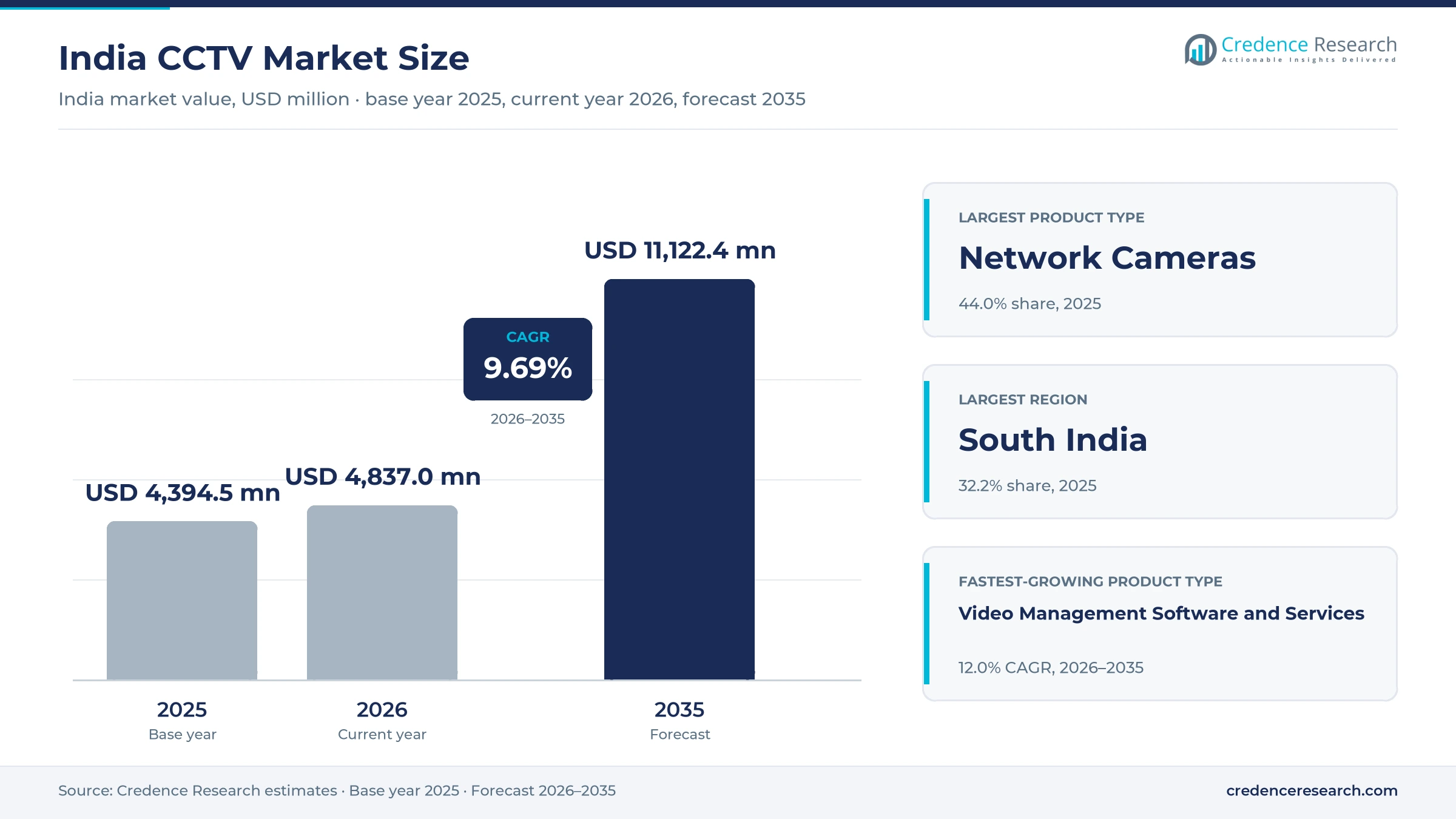
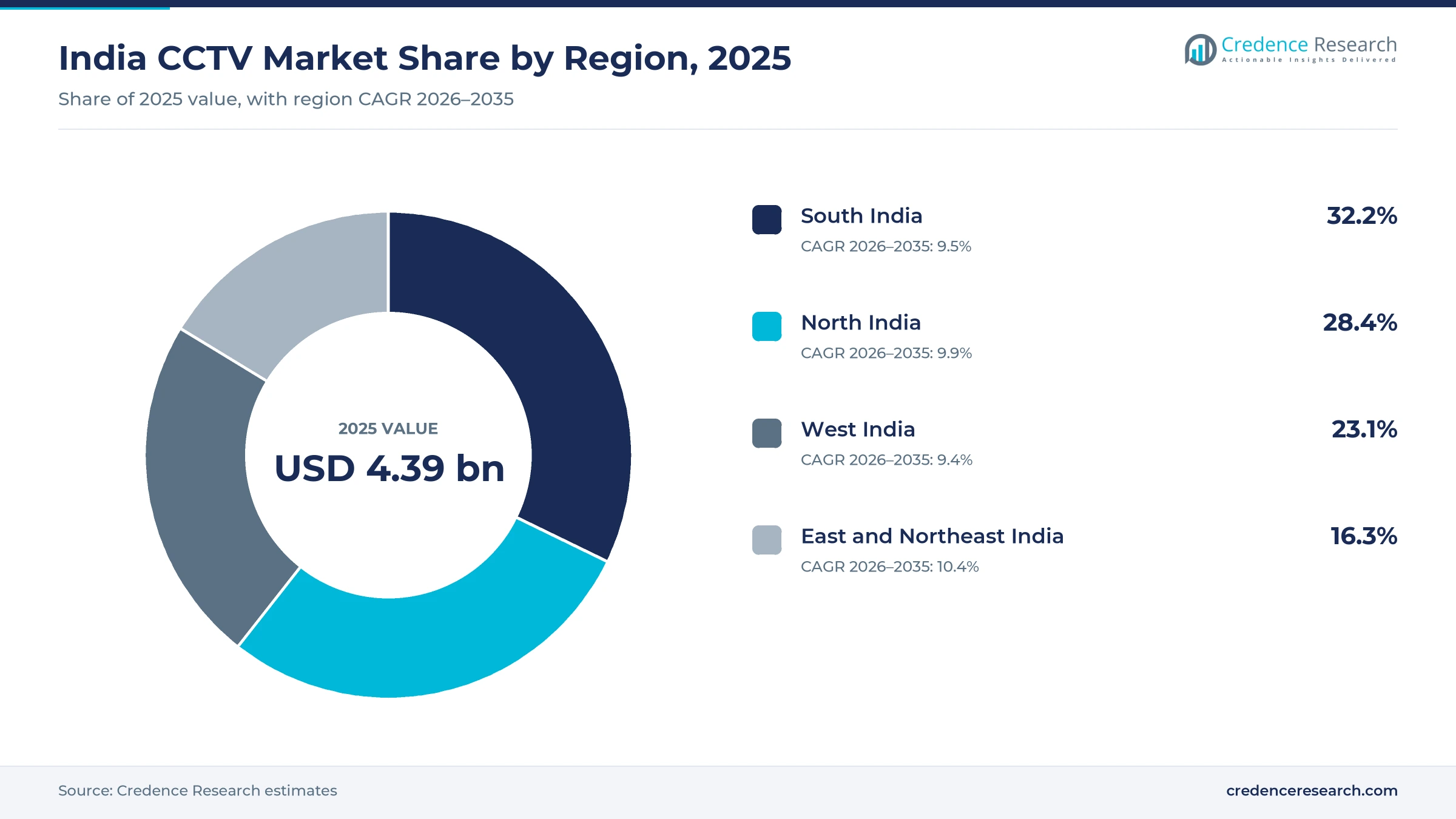
The India CCTV market was valued at USD 4.39 billion in 2025 and is projected to increase from USD 4.84 billion in 2026 to USD 11.12 billion by 2035, registering a CAGR of 9.69% during 2026–2035. Spending comes from state police and city programs, railways and bus operators, offices, factories and housing societies, and the mix is moving from stand-alone cameras toward networked systems with storage and analytics. South India held the largest regional share, 32.2% in 2025, because Bengaluru, Hyderabad and Chennai run some of the densest police camera networks in the country. East and Northeast India is the fastest-growing region at 10.3% a year, as Kolkata and Bhubaneswar-Cuttack build out safe city systems from a smaller base. The main regulatory change is the cybersecurity rule that took full effect on April 1, 2026, which barred the sale of uncertified internet-connected cameras and pushed buyers toward tested domestic and foreign brands.
Networked cameras, recorders and software make up the spend
The market counts what buyers in India pay for network and analog HD cameras, digital and network video recorders, storage, video management and analytics software, and the installation, integration and maintenance services sold with them. Values are measured at the price the end buyer pays, whether the system comes through a government tender, a dealer or an online store.
Access control panels, alarm systems, body-worn cameras and drones are excluded unless they are sold as part of a video system. The value chain runs from chip and sensor suppliers through camera brands and contract manufacturers to distributors, dealers and system integrators, who design, install and often operate city and enterprise networks.
India CCTV Market Insights
- The India CCTV market rises from USD 4.39 billion in 2025 to USD 11.12 billion by 2035, a 9.69% CAGR during 2026–2035, as public networks expand and certified cameras replace older fleets.
- South India held 32.2% of 2025 value, supported by Bengaluru, where police had geotagged more than 5.36 lakh cameras by April 30, 2025.
- Network cameras held 44.0% of 2025 value, because the security rules and most public tenders now specify IP cameras with tested firmware.
- From April 1, 2026, uncertified internet-connected cameras can no longer be sold in India, after MeitY withdrew its stock relaxation in January 2026.
- Aditya Infotech says its CP PLUS brand held about 38.9% of the Indian video surveillance industry in the December 2025 quarter.
Network cameras lead as software and services grow fastest
IP cameras lead and software grows the fastest
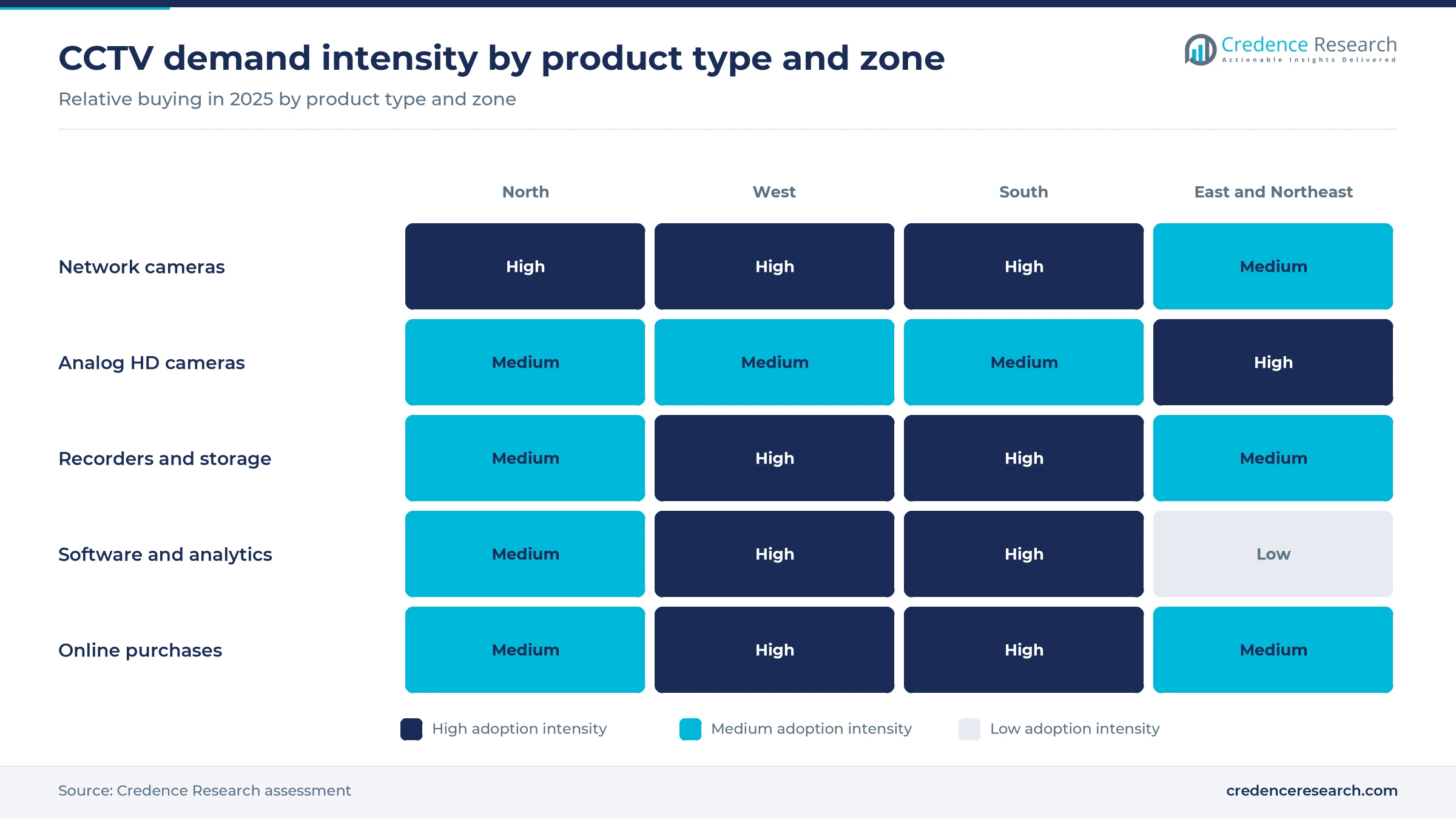
Based on product type, the market is categorized into network cameras, analog HD cameras, video recorders and storage, and video management software and services. Network Cameras led with 44.0% of 2025 value because the essential security requirements apply only to connected devices, and a MeitY notification of March 12, 2025, exempted analog cameras from them. That exemption keeps analog HD units alive in shops and homes, but most tenders now ask for IP. Video Management Software and Services grow fastest at 12.0% a year, as city projects pay for facial recognition and behavior analytics on top of cameras.
Property security leads while transport grows fastest
Based on application, the market is categorized into public safety and city surveillance, traffic and transport monitoring, property and perimeter security, and process and workplace monitoring. Property and Perimeter Security led with 38.0% of 2025 value because offices, shops, warehouses and housing societies buy cameras every year in small orders across thousands of towns. Traffic and Transport Monitoring grows fastest at 11.1% a year, as Indian Railways plans cameras in all 74,000 coaches and 15,000 locomotives. Process and workplace monitoring stays smaller in India CCTV demand, since it is tied to factory and warehouse automation budgets.
Government buys the most and homes grow fastest
Based on end user, the market is categorized into government and public infrastructure, commercial enterprises, industrial and critical infrastructure, and residential and housing communities. Government and Public Infrastructure led with 37.0% of 2025 value because police, city and transport agencies buy in large tenders, and the Safe City program alone sanctioned Rs 2,919 crore for eight cities. Residential and Housing Communities grow fastest at 10.9% a year, as Aditya Infotech launched its Nexivue range for rural and mass-market buyers and telecom operators sell cloud cameras by subscription. Commercial enterprises hold about 31% of India CCTV value, led by banks, retail chains and IT campuses that also buy data center security.
Integrators win projects as online sales rise
Based on distribution channel, the market is categorized into system integrators and EPC contractors, authorized distributors and dealers, direct enterprise sales and e-commerce and retail. System Integrators and EPC Contractors led with 41.0% of 2025 value because public networks are awarded as turnkey contracts, such as the Mumbai award noted in the drivers. Distributors remain the backbone for dealers, and Axis Communications appointed Redington as an India distributor in October 2024. E-Commerce and Retail grows fastest at 11.5% a year, as industrial marketplaces such as Moglix list branded 2.4MP cameras below Rs 1,400.
| Segment Group | Leading Sub-segment | Share, 2025 | Fastest-growing Sub-segment | CAGR, 2026–2035 |
|---|---|---|---|---|
| By Product Type | Network Cameras | 44.0% | Video Management Software and Services | 12.0% |
| By Application | Property and Perimeter Security | 38.0% | Traffic and Transport Monitoring | 11.1% |
| By End User | Government and Public Infrastructure | 37.0% | Residential and Housing Communities | 10.9% |
| By Distribution Channel | System Integrators and EPC Contractors | 41.0% | E-Commerce and Retail | 11.5% |
Cameras cost Rs 1,349 to Rs 4,929 before installation
CCTV prices in India form two very different ladders, one for retail hardware and one for projects. In retail, a branded analog HD dome sells for about a third of the price of a 2MP IP camera, and marketplaces discount list prices by 25% to more than 50%, so brand margins on entry hardware are thin. In public projects, the camera is a small part of the bill, since fiber, poles, control rooms, analytics licences and five-year maintenance are priced into each site. The Mumbai phase 3 award works out at about Rs 14 lakh per camera all-in, so integrators, not camera brands, capture most project value. Subscription cloud plans add a third model, aimed at homes and small shops.
| Product or project | Typical price or fee | Basis |
|---|---|---|
| 2.4MP HD analog dome camera, CP PLUS | Rs 1,349 including GST (MRP Rs 2,800) | Moglix listing, November 2026 |
| 2MP IP dome camera, CP PLUS | Rs 4,039 including GST | Moglix listing, November 2026 |
| 2MP IP bullet camera, CP PLUS | Rs 4,929 including GST | Moglix listing, November 2026 |
| 8-channel 1080p DVR, CP PLUS | Rs 5,041 including GST | Moglix listing, November 2026 |
| Home cloud camera with subscription, Airtel Xsafe | From Rs 2,499 plus Rs 999 a year | Airtel, September 2022 |
| City project, Mumbai phase 3 | About Rs 14 lakh per camera all-in | Credence Research estimate from Rs 2,140 crore for 15,000 cameras |
Request a Free Sample
Fill in your details and we'll send you a free sample report.
- Sample data tables & charts
- Research methodology
Public projects and the 2026 certification rule lift demand
Police, city and transit programs buy at scale
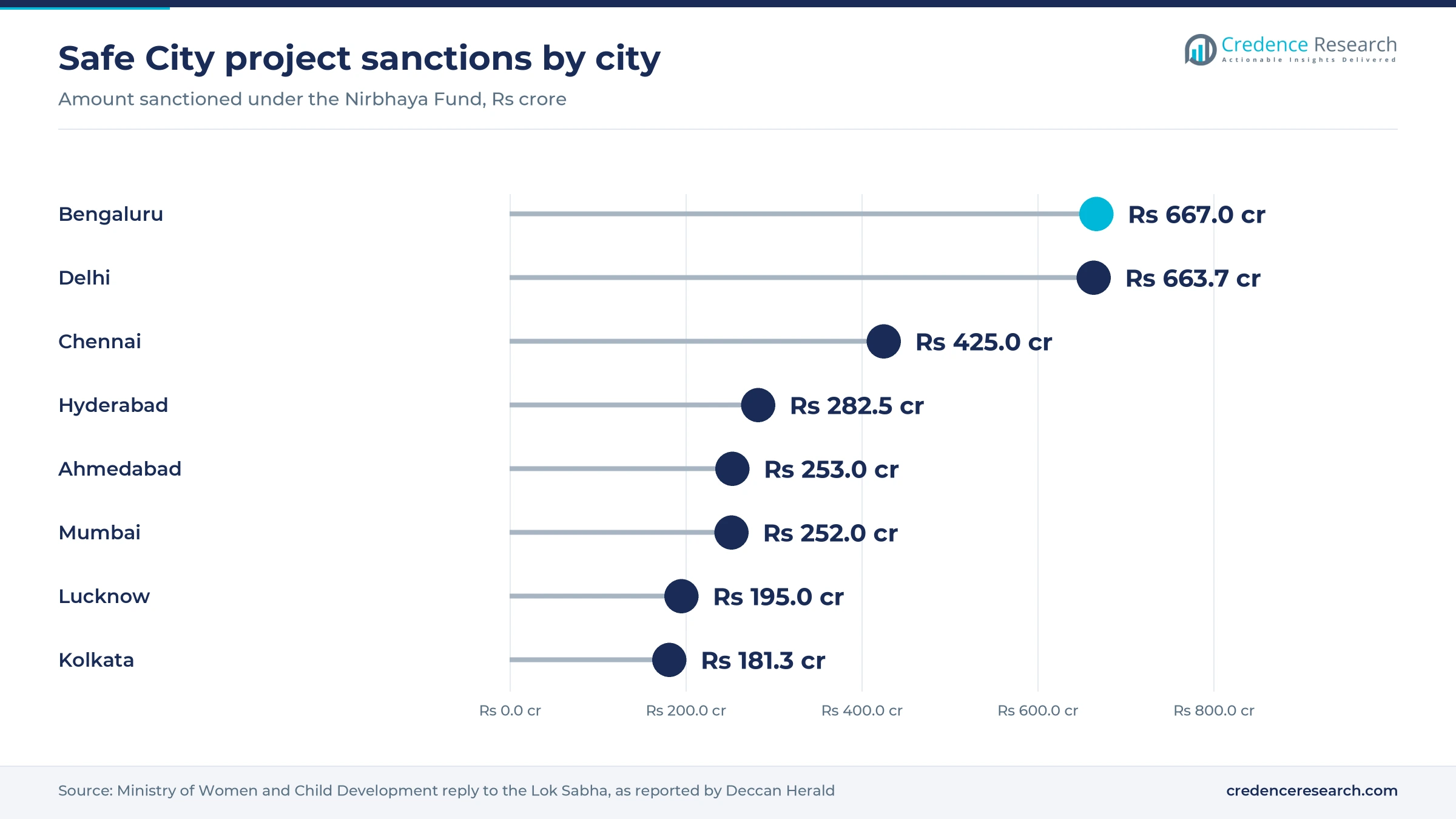
Public agencies are the largest single source of demand, because each program buys cameras, control rooms and maintenance together. The Safe City program sanctioned Rs 2,919 crore for Delhi, Mumbai, Bengaluru, Chennai, Ahmedabad, Kolkata, Hyderabad and Lucknow, according to a written reply to the Lok Sabha. Maharashtra has since approved a Rs 2,140 crore third phase for 15,000 AI cameras in Mumbai, which extends the existing police network into new junctions and suburbs. The state bus operator MSRTC is also installing 7,035 cameras at bus stands and depots, according to the Free Press Journal in February 2026. These awards keep Government and Public Infrastructure buyers at 37.0% of value and give integrators multi-year order books.
The 2026 security rule forces a replacement cycle
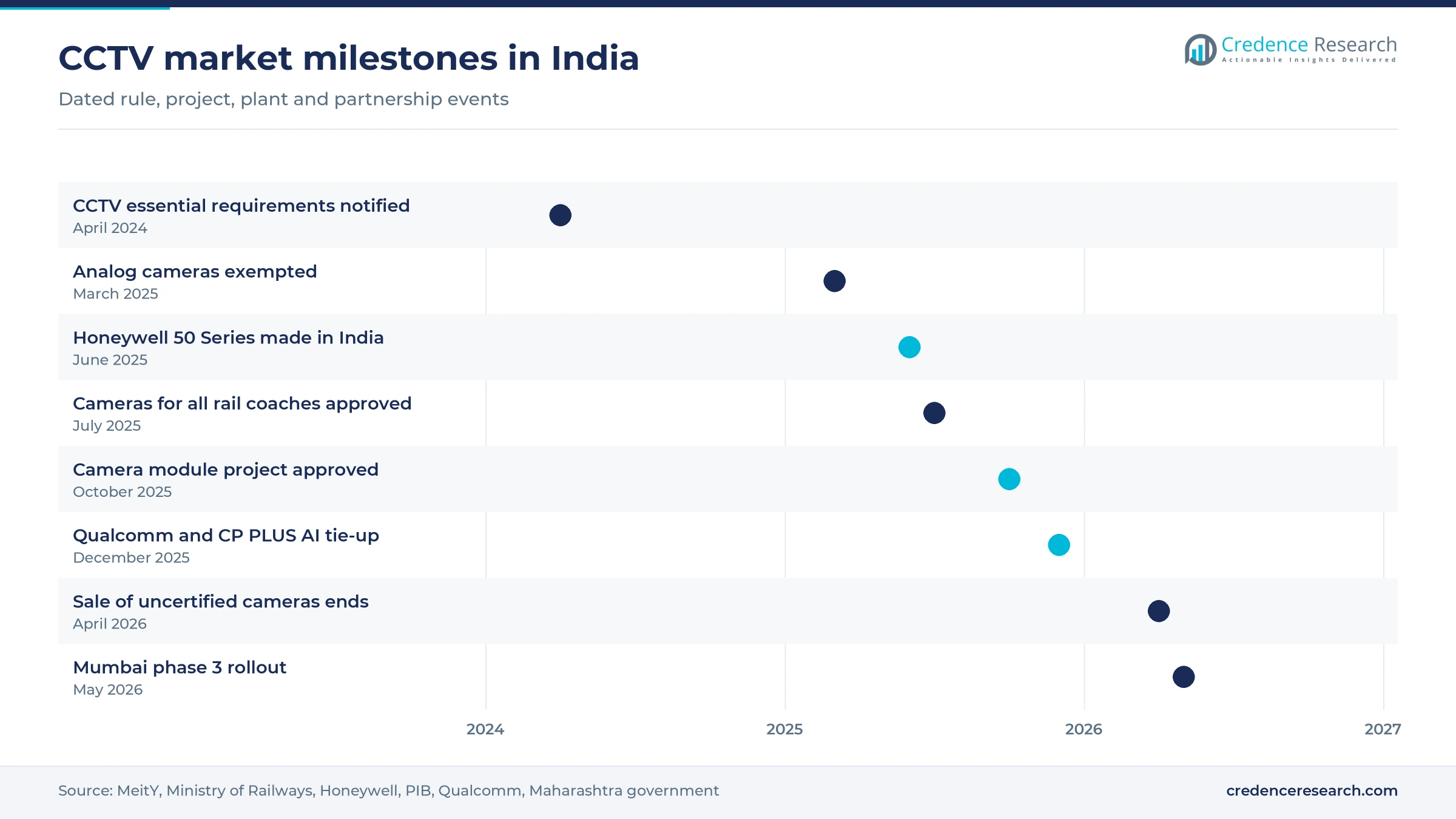
Cybersecurity certification has turned compliance into a reason to buy new equipment. MeitY added CCTV cameras to the compulsory registration order through notification S.O. 1652(E) of April 9, 2024, with essential requirements covering firmware, network security and penetration testing. A MeitY office memorandum of Jan. 16, 2026, then withdrew the relaxation for existing stock, so non-conforming cameras could not be sold from April 1, 2026, Matrix Comsec notes. More than 500 models had been certified under the regime, The News Minute reported, while Chinese brands had held about a third of sales. Buyers replacing uncertified fleets now favor tested IP models, which supports the 44.0% share of network cameras.
AI analytics push buyers from analog to IP networks
Analytics are changing what agencies buy, because detection and search work only on networked, high-resolution feeds. The railway ministry approved cameras for 74,000 coaches and 15,000 locomotives in July 2025, required STQC certification and asked officials to test AI analysis with the IndiaAI mission. At the Maha Kumbh in Prayagraj, which spread over about 4,000 acres, about 250 of roughly 2,750 cameras were AI-enabled and fed crowd-density alerts to a command center, the Tribune reported in February 2025. Video management software and services grow fastest at 12.0% a year as these analytics licences, servers and operator services are bought with each new network.
Domestic factories shorten lead times and lower risk
New local capacity lets buyers meet origin and security rules without waiting for imports. Aditya Infotech reported monthly capacity of 1.8 million units in February 2026 and targeted 2.1 million by the March 2026 quarter, according to AlphaStreet. Sparsh CCTV announced Rs 300 crore of investment in June 2024 for a Kashipur unit aimed at one million cameras a month. Honeywell launched its 50 Series cameras, its first portfolio designed and produced in India with VVDN Technologies, in June 2025. Faster domestic supply matters most for System Integrators and EPC Contractors, who must deliver tested models on fixed tender schedules.
Edge AI chips and central video storage change system design
Edge AI chips move analytics into the camera
The rise of edge AI is moving analytics from control-room servers into the camera, which cuts bandwidth and storage needs. Qualcomm and CP PLUS announced a collaboration for AI-enabled video intelligence in India in December 2025, and Honeywell's locally made range noted above carries on-board analytics. L&T Semiconductor Technologies is developing indigenous AI camera chips with CP PLUS, according to Inc42. BigEndian Semiconductors puts the Indian surveillance chip opportunity at nearly USD 1 billion, and Mindgrove Technologies has a vision chip in prototyping with three customers evaluating it ahead of market entry in early-to-mid 2027. On-board analytics let small sites run alerts without a server, which takes AI beyond large city projects. Bengaluru already runs 7,500 AI-enabled Safe City cameras, which shows the scale at which Indian police buy analytics.
Central storage and cloud management gain ground
Video is shifting from recorders at each site to central and cloud-managed storage, because large networks need one view of thousands of feeds. The railway ministry's coach program asks for STQC-certified cameras in every coach, which ties recording and monitoring to tested network equipment. MSRTC's central control room in Mumbai, which monitors cameras statewide, completed user acceptance testing in February 2026. The planned Chennai Marina Beach network will archive video for 30 days and feed the city command center. Axis Communications also brought its Camera Station Pro, Edge and Cloud Connect software to India through Redington in October 2024 and plans to reach smaller cities over the following five years. This shift moves spending from recorders toward servers, video management software and managed services in each new project.
Camera modules and chips open a component market
Local component supply is an opening for electronics makers, because nearly all camera chipsets still came from China in recent import data cited by a&s Magazine in June 2025. Under the Electronics Component Manufacturing Scheme, notified on April 8, 2025, with an outlay of Rs 22,919 crore, MeitY approved a Rs 325 crore camera module sub-assembly project by Kaynes Circuits India in Tamil Nadu on Oct. 27, 2025. BigEndian also raised USD 6 million in May 2026 to launch its surveillance chip and aims to meet about a quarter of Indian demand within five years, Inc42 reported. Suppliers that qualify early can lock into CP PLUS, Sparsh and Matrix sourcing.
Urban homes and small shops offer a volume opening
Households and small businesses offer suppliers the largest untapped volume, because most still have no camera at all. India's 522.4 million urban residents (World Bank, 2025) live mostly in homes without cameras, which is where subscription models aim. Airtel sells its Xsafe home cameras from Rs 2,499 with a Rs 999 annual cloud plan, which shows the subscription model telecom operators can bundle with home broadband and mobile plans. A 2MP IP dome lists at Rs 4,039 online, within reach of a small shop owner. Residential and housing communities grow fastest at 10.9% a year, so brands with simple app setup and doorstep installation can win first-time buyers.
Testing load, chip imports and thin margins test suppliers
Certification testing slows new model launches
Testing has become a barrier to entry, because every connected model needs approval before it can be sold. STQC checks 30 essential requirement points, now adds a factory visit, and each application can cover only up to 10 similar models, according to a&s Magazine in June 2025. Testing was projected to take about two months per application. Smaller brands with wide catalogs face months of delay and repeated fees, so many will narrow their ranges or rebrand certified products from larger makers.
Imported chips keep costs tied to Asian suppliers
Local assembly has not yet removed the risk of dependence on imported silicon, which exposes makers to currency and supply shocks. Indian brands have moved to non-Chinese chipsets, often from Taiwan, The News Minute reported ahead of the April 2026 deadline. Domestic chip startups aim only for near-Chinese pricing, according to Inc42, so local silicon is unlikely to undercut imports soon. Until local chips reach scale, a weaker rupee feeds straight into camera prices for buyers.
Entry hardware prices leave thin brand margins
Price pressure is a challenge in the crowded entry tier, so brands earn little on the cameras sold in the largest numbers. The analog dome in the price table sells at more than half off its MRP, which leaves dealers and brands little room on each unit. Marketplace discounts of 25% to 42% also apply to IP models. Makers recover margin only through recorders, storage and project services, which favors brands that also sell software and maintenance.
Data protection rules add storage and breach duties
The Digital Personal Data Protection Rules, notified in November 2025, give camera operators new duties as their main obligations take effect over 18 months. Operators must report a personal data breach to the Data Protection Board with a detailed report within 72 hours, and keep processing logs for at least one year, according to Storyboard18. Housing societies, retailers and employers that record faces will need notices, access controls and retention policies, which raises the cost of running a system.
South India leads while the east adds city projects
| Region | Value, 2025 (USD billion) | Share, 2025 | CAGR, 2026–2035 |
|---|---|---|---|
| South India | 1.42 | 32.2% | 9.4% |
| North India | 1.25 | 28.4% | 9.8% |
| West India | 1.02 | 23.1% | 9.3% |
| East and Northeast India | 0.72 | 16.3% | 10.3% |
South India leads on dense police camera networks
South India held 32.2% of 2025 value and grows at 9.4% a year. Bengaluru police had geotagged 5,35,815 cameras by April 30, 2025, including 7,500 AI-enabled units installed under the Rs 667 crore Safe City project, according to Deccan Herald. Chennai police planned 300 cameras, including 280 4K bullet units, at 71 spots along Marina Beach, linked to the city command center, DT Next reported in September 2025. The zone also hosts the CP PLUS factory at Kadapa in Andhra Pradesh, so dealers there receive certified stock quickly.
North India pairs Delhi spending with factory capacity
North India held 28.4% of 2025 value and grows at 9.8% a year. Delhi received the second-largest Safe City sanction at Rs 663.67 crore, and Lucknow received Rs 195 crore under the same program. Uttar Pradesh also showed how event security drives purchases, with an AI-assisted command center at the Maha Kumbh in 2025. Uttarakhand hosts the Sparsh plants in Haridwar and Kashipur, which supply northern integrators with domestic cameras.
West India grows through Mumbai and transport projects
West India held 23.1% of 2025 value and grows at 9.3% a year. Mumbai's third phase adds to its police network, and Ahmedabad received a Rs 253 crore Safe City sanction. The statewide MSRTC project adds cameras at bus stands, depots and workshops across 31 divisions. Dense office, retail and warehouse clusters around Mumbai, Pune and Ahmedabad keep enterprise demand steady as well.
East and Northeast India builds from a smaller base
East and Northeast India held 16.3% of 2025 value and is the fastest-growing zone at 10.3% a year. Kolkata received the smallest Safe City sanction among the eight cities at Rs 181.32 crore, which leaves room for later phases. The Bhubaneswar-Cuttack commissionerate in Odisha has also submitted a Safe City proposal, a Lok Sabha answer of March 25, 2022, shows. Rail station coverage and new urban projects should lift demand across Bihar, Odisha and Assam.
Certifications, local plants and AI tie-ups in 2024–2026
| Development | Status and market relevance |
|---|---|
| In April 2024, MeitY notified S.O. 1652(E), adding CCTV cameras to the compulsory registration order with essential security requirements. | In force; full sales restriction on non-conforming cameras from April 1, 2026 |
| In June 2025, Honeywell launched its 50 Series CCTV cameras, designed in Bengaluru and produced in India with VVDN Technologies. | Launched; Class 1 local supplier status for public tenders |
| In December 2025, Qualcomm and CP PLUS announced a collaboration on AI-enabled video intelligence products for India. | Announced; brings edge AI processing into domestic cameras |
| In February 2026, Motorola Solutions received BIS ER certification from STQC for its Avigilon H6SL and Pelco Sarix Professional 4 cameras. | Certified; keeps the portfolio open to Indian enterprise and public buyers |
| In April 2026, Hanwha Vision secured STQC cybersecurity certification and announced more technical staff and experience centers in India. | Certified; expansion starting in Bengaluru |
Secure boot, edge AI and hybrid recorders shape products
- Secure-boot IP cameras carry digitally signed firmware and encrypted streams, the features STQC tests before a model can be sold.
- Edge AI processors run detection and counting inside the camera, the focus of the Qualcomm and CP PLUS collaboration.
- Video management platforms such as Axis Camera Station link thousands of feeds to one control room with search, alerts and remote access.
- Hybrid analog-IP recorders let shops and homes keep exempt analog HD cameras while adding network models over time.
Need a Custom Version of This Report?
Tailor the scope, geography, or segments to your exact requirements.
- Custom geography or segment scope
- Direct access to our analyst team
Domestic brands took share as Chinese makers lost access
Competition now turns on certified catalogs, delivery capacity and project support rather than on price alone. CP PLUS competes with the widest certified range, its own factory and more than 800 distributors. Prama and Sparsh sell domestic cameras built with non-Chinese components, while Matrix Comsec lists its STQC-certified network cameras on the Government e-Marketplace. Honeywell and Axis compete for offices, data centers and transport with analytics, software and local production or distribution. Hanwha Vision and Motorola Solutions certified their ranges in 2026 to stay in enterprise bids. Hikvision and Dahua, once leaders by volume, lost access to the connected-camera market when the rule took effect, which moved a large block of demand to certified brands. Integrators often decide the brand, so partner programs and training matter as much as products. Buyers that also need electronic access control systems increasingly ask one integrator for both.
How the India CCTV supply side is organized
The supply side is concentrated at the top and fragmented below it. CP PLUS put its own share at about 38.9% of the industry in the December 2025 quarter, after Chinese brands lost access to the connected-camera market, and Prama, Sparsh and Matrix form a second domestic tier. Global brands such as Honeywell, Axis, Hanwha Vision and Motorola Solutions focus on enterprise and premium projects. Below them, thousands of dealers and integrators install and service systems. Certification, factory audits and dealer reach are now the main entry barriers, and margins sit with integrators and with brands that sell software and services.
Companies profiled and their roles in this market
| Company | Type | Role in the market |
|---|---|---|
| Aditya Infotech Limited (CP PLUS) | Domestic brand and maker | About 38.9% share in the December 2025 quarter, 1.8 million units a month, Kadapa plant |
| Prama India Private Limited | Domestic brand and maker | Former Hikvision technology partner, shifted to non-Chinese components |
| Matrix Comsec Private Limited | Domestic brand and maker | STQC-certified network cameras listed on the Government e-Marketplace |
| Honeywell International India Private Limited | Global brand, local production | 50 Series cameras made in India with VVDN since June 2025 |
| Axis Communications India | Global brand | Network cameras and Camera Station software through Redington since October 2024 |
| Hanwha Vision India | Global brand | STQC certification in April 2026, new experience centers starting in Bengaluru |
| Motorola Solutions India (Avigilon) | Global brand | Avigilon H6SL and Pelco cameras certified by STQC in February 2026 |
| Hikvision India | Global brand | Named among brands restricted by the April 2026 certification rule |
| Dahua Technology India Private Limited | Global brand | Named among brands restricted by the April 2026 certification rule |
Compliance turned a price market into a trust market
Credence Research's view is that the 2026 security rule turned the India CCTV market from a price market into a trust market. Buyers now choose among tested brands, and the brands with certified catalogs and their own factories gained share almost overnight. Hardware prices will keep falling, so the value that grows is in software, analytics, storage and services sold with each network. The main risks are slow state tenders and continued reliance on imported chips. Suppliers that combine certified cameras with project delivery and video analytics should gain the most by 2035.
Unit volumes, prices and project awards anchor estimates
The report uses 2025 as the base year and forecasts value to 2035 in USD million from the Credence Research market model. The 2025 value is checked against camera unit volumes, retail list prices and the value of public project awards. Segment and regional splits are Credence Research estimates built from government notifications, parliamentary answers, company releases and filings, published retail prices and press reports on city and transport projects. No interviews or surveys were used for this edition of the India CCTV report.
System value more than doubles as fleets turn digital
The India CCTV market grows from USD 4.84 billion in 2026 to USD 11.12 billion by 2035, at 9.69% a year, as public networks and enterprises digitize their camera fleets. Network cameras keep the largest product share, while software and services gain as analytics become standard in public projects. South India remains the largest zone, and East and Northeast India gains share as later safe city phases and rail coverage reach its cities. Local chip and camera module plants should reach volume in the second half of the decade, which would lower costs and make Indian brands more competitive in export markets as well as at home.
Tender timing and chip supply set the range to 2035
Two factors decide which case the India CCTV market follows to 2035. The first is the pace of public tenders, since city, rail and bus programs make up the largest orders and can slip with state budgets. The second is component supply, because certified cameras still rely on imported chipsets. Delayed projects and a weak rupee would produce the downside. Fast rollout of railway and safe city phases, plus local chips at scale, would produce the upside.
| Scenario | CAGR, 2026–2035 | Value, 2035 | What has to hold |
|---|---|---|---|
| Downside | 7.7% | USD 9.42 billion | State tenders slip and imported chip costs rise with a weaker rupee |
| Base | 9.69% | USD 11.12 billion | Rail, city and enterprise projects proceed and certified domestic supply keeps pace |
| Upside | 11.2% | USD 12.57 billion | Rail coach rollout finishes early and local chips cut camera costs after 2028 |
Frequently Asked Questions
How big is the India CCTV market?
Why were Chinese CCTV brands restricted in India in 2026?
Do analog CCTV cameras need STQC certification?
How much does a CCTV camera cost in India?
Which region leads CCTV demand in India?
Will Indian Railways install CCTV in all coaches?
Which product segment grows fastest in Indian CCTV?
Who are the main CCTV companies in India?
Table of Content
Chapter 1 Market Segmentation
- 1.1 Segmentation Framework
- 1.1.1 Product and Service Classification
- 1.1.2 Application and End-Use Classification
- 1.1.3 Technology and Solution Classification
- 1.1.4 Customer and Distribution Channel Classification
- 1.1.5 Geographic Segmentation
- 1.1.6 Market Segment Definitions and Boundaries
- 1.2 By Product Type
- 1.2.1 Network Cameras
- 1.2.2 Analog HD Cameras
- 1.2.3 Video Recorders and Storage
- 1.2.4 Video Management Software and Services
- 1.3 By Application
- 1.3.1 Public Safety and City Surveillance
- 1.3.2 Traffic and Transport Monitoring
- 1.3.3 Property and Perimeter Security
- 1.3.4 Process and Workplace Monitoring
- 1.4 By End User
- 1.4.1 Government and Public Infrastructure
- 1.4.2 Commercial Enterprises
- 1.4.3 Industrial and Critical Infrastructure
- 1.4.4 Residential and Housing Communities
Chapter 2 Introduction
- 2.1 Report Objectives and Scope
- 2.2 Product Definition and Industry Terminology
- 2.3 Market Inclusions and Exclusions
- 2.4 Research Process
- 2.4.1 Primary Research and Expert Interviews
- 2.4.2 Secondary Research and Source Review
- 2.4.3 Top-Down and Bottom-Up Estimation
- 2.4.4 Data Triangulation and Verification
- 2.5 Market Size Measurement Basis
- 2.5.1 2025: USD 4.39 billion → 2035: USD 11.12 billion
- 2.6 Historical and Forecast Reference Periods
- 2.6.1 Historical Period: 2018-2025
- 2.6.2 Base Year: 2025
- 2.6.3 Forecast Period: 2025-2035
- 2.7 Research Assumptions and Limitations
Chapter 3 Executive Summary
- 3.1 Market Snapshot and Key Findings
- 3.2 Base-Year Market Size, 2025
- 3.3 Forecast Market Size, 2035
- 3.4 Revenue and Volume Growth Outlook
- 3.5 Key Demand and Supply Indicators
- 3.6 Leading Market Segments
- 3.7 Fastest-Growing Market Opportunities
- 3.8 Regional Performance Highlights
- 3.9 Technology and Industry Transformation
- 3.10 Competitive Landscape Summary
- 3.11 Analyst View and Strategic Implications
Chapter 4 India CCTV Market Trends and Developments
- 4.1 Historical Industry Development, 2018-2025
- 4.2 Recent Market Trends and Developments
- 4.3 Demand and Customer Behavior Trends
- 4.4 Technology and Product Innovation
- 4.5 Artificial Intelligence, Automation and Digitalization
- 4.6 Local Manufacturing and Supply Chain Realignment
- 4.7 Industry Partnerships, Mergers and Acquisitions
- 4.8 Sustainability and Circular Economy Developments
- 4.9 Government and Private Sector Investment Trends
- 4.10 Emerging Business Models and Commercialization
- 4.11 Industry Developments and Announcements
Chapter 5 India CCTV Market Production, Supply and Demand Analysis
- 5.1 Demand Trend and Consumption Analysis, 2018-2025
- 5.2 Demand Forecast, 2025-2035
- 5.3 Production and Output Trend, 2018-2025
- 5.4 Production and Output Forecast, 2025-2035
- 5.5 Installed Capacity and Capacity Utilization
- 5.6 Company-Wise Production Plants and Statistics
- 5.6.1 Installed Production Capacity
- 5.6.2 Actual Production
- 5.6.3 Planned Capacity and Expansion Targets
- 5.7 Supply Chain Structure and Procurement Trends
- 5.8 Supply-Demand Gap and Bottlenecks
- 5.9 Import Dependence and Sourcing Structure
- 5.10 Contract Manufacturing and Outsourcing
- 5.11 Regional Supply and Demand Concentration
Chapter 6 India CCTV Market Pricing Analysis
- 6.1 Pricing Structure and Measurement
- 6.2 Historical Pricing Trends, 2018-2025
- 6.3 Pricing Outlook, 2025-2035
- 6.4 Average Selling Price and Unit Economics
- 6.5 Pricing by Product and Market Segment
- 6.6 Geographic Pricing Differences
- 6.7 Key Input, Energy, Labor and Logistics Costs
- 6.8 Contract Pricing and Purchasing Models
- 6.9 Pricing Sensitivity and Competitive Positioning
- 6.10 Price, Margin and Profitability Implications
Chapter 7 India CCTV Market Dynamics
- 7.1 Market Growth Drivers
- 7.1.1 Demand-Side Drivers
- 7.1.2 Technology and Innovation Drivers
- 7.1.3 Infrastructure and Investment Drivers
- 7.1.4 Regulatory and Policy Drivers
- 7.2 Market Restraints
- 7.2.1 Cost and Affordability Constraints
- 7.2.2 Technology and Adoption Barriers
- 7.2.3 Supply Chain and Operational Constraints
- 7.3 Market Challenges
- 7.3.1 Competitive Pressure and Margin Erosion
- 7.3.2 Skills, Infrastructure and Implementation Gaps
- 7.4 Emerging Market Opportunities
- 7.5 Market Dynamics Impact and Time-Horizon Assessment
Chapter 8 India CCTV Value Chain Analysis
- 8.1 Industry Value Chain Overview
- 8.2 Upstream Suppliers and Critical Inputs
- 8.3 Technology and Component Providers
- 8.4 Manufacturing or Service Delivery
- 8.5 Distribution, Channel Partners and Integrators
- 8.6 Downstream Applications and End Users
- 8.7 Value Addition and Profit Pools
- 8.8 Vertical Integration and Outsourcing
- 8.9 Supplier Concentration and Risk
- 8.10 Supply Chain Localization and Resilience
Chapter 9 India CCTV Market Regulations and Policies
- 9.1 Relevant Laws, Standards and Compliance Frameworks
- 9.2 Product, Service, Safety and Quality Requirements
- 9.3 Government Policies, Incentives and Subsidies
- 9.4 Imports, Exports and Trade Barriers
- 9.5 Public Procurement and Local Content Requirements
- 9.6 Environmental and Sustainability Compliance
- 9.7 Data Protection, AI and Cybersecurity Compliance
- 9.8 Upcoming Policy Changes and Market Implications
Chapter 10 India CCTV Market Hotspots and Opportunities
- 10.1 Market Opportunity Mapping and Growth Hotspots
- 10.2 High-Growth Applications and Customer Groups
- 10.3 Underserved Markets and White-Space Opportunities
- 10.4 Emerging Technology and Product Opportunities
- 10.5 New Capacity and Investment Hotspots
- 10.6 Market Entry and Expansion Opportunities
- 10.7 Distribution and Partnership Opportunities
- 10.8 Near-Term and Long-Term Commercial Potential
- 10.9 Opportunity Attractiveness and Execution Risks
Chapter 11 India CCTV Market Outlook, 2025-2035
- 11.1 Market Size and Analysis
- 11.1.1 Revenue (Market Measurement: 2025: USD 4.39 billion → 2035: USD 11.12 billion)
- 11.1.2 Market Volume and Quantity Sold
- 11.1.3 Historical Market Size, 2018-2025
- 11.1.4 Base-Year Market Size, 2025
- 11.2 Market Forecast, 2025-2035
- 11.2.1 Revenue Forecast to 2035
- 11.2.2 Volume Forecast to 2035
- 11.2.3 CAGR and Year-on-Year Growth
- 11.2.4 Incremental Revenue Opportunity
- 11.3 Forecast Assumptions and Scenario Analysis
- 11.3.1 Base-Case Forecast
- 11.3.2 Optimistic and Conservative Scenarios
- 11.3.3 Technology, Pricing and Policy Sensitivities
- 11.4 Market Attractiveness and Growth Outlook
Chapter 12 India CCTV Market Segmentation and Outlook
- 12.1 Segmentation Summary and Market Shares, 2025
- 12.2 Largest and Fastest-Growing Segments
- 12.3 By Product Type - Market Size and Forecast, 2025-2035
- 12.3.1 Segment Definition and Scope
- 12.3.2 Historical Market Size, 2018-2025
- 12.3.3 Revenue Forecast, 2025-2035
- 12.3.4 Volume Forecast, 2025-2035
- 12.3.5 Base-Year Market Share, 2025
- 12.3.6 Segment CAGR and Growth Drivers
- 12.3.7 Subsegment Market Size and Forecast
- 12.3.7.1 Network Cameras
- 12.3.7.2 Analog HD Cameras
- 12.3.7.3 Video Recorders and Storage
- 12.3.7.4 Video Management Software and Services
- 12.3.8 Subsegment Pricing and Adoption Trends
- 12.3.9 Leading Suppliers and Competition
- 12.3.10 Regional Demand and Opportunities
- 12.4 By Application - Market Size and Forecast, 2025-2035
- 12.4.1 Segment Definition and Scope
- 12.4.2 Historical Market Size, 2018-2025
- 12.4.3 Revenue Forecast, 2025-2035
- 12.4.4 Volume Forecast, 2025-2035
- 12.4.5 Base-Year Market Share, 2025
- 12.4.6 Segment CAGR and Growth Drivers
- 12.4.7 Subsegment Market Size and Forecast
- 12.4.7.1 Public Safety and City Surveillance
- 12.4.7.2 Traffic and Transport Monitoring
- 12.4.7.3 Property and Perimeter Security
- 12.4.7.4 Process and Workplace Monitoring
- 12.4.8 Subsegment Pricing and Adoption Trends
- 12.4.9 Leading Suppliers and Competition
- 12.4.10 Regional Demand and Opportunities
- 12.5 By End User - Market Size and Forecast, 2025-2035
- 12.5.1 Segment Definition and Scope
- 12.5.2 Historical Market Size, 2018-2025
- 12.5.3 Revenue Forecast, 2025-2035
- 12.5.4 Volume Forecast, 2025-2035
- 12.5.5 Base-Year Market Share, 2025
- 12.5.6 Segment CAGR and Growth Drivers
- 12.5.7 Subsegment Market Size and Forecast
- 12.5.7.1 Government and Public Infrastructure
- 12.5.7.2 Commercial Enterprises
- 12.5.7.3 Industrial and Critical Infrastructure
- 12.5.7.4 Residential and Housing Communities
- 12.5.8 Subsegment Pricing and Adoption Trends
- 12.5.9 Leading Suppliers and Competition
- 12.5.10 Regional Demand and Opportunities
- 12.6 Segment Growth Comparison
- 12.7 Segment Attractiveness and Priority Matrix
Chapter 13 India CCTV End-Use and Application Market Outlook
- 13.1 End-Use Industry and Customer Demand Structure
- 13.2 Leading Applications and Customer Groups
- 13.3 End-Use Market Size, Share and Forecast
- 13.4 Major End-Use Industry Deep Dives
- 13.4.1 Customer Requirements and Use Cases
- 13.4.2 Demand and Replacement Cycles
- 13.4.3 Technical and Regulatory Considerations
- 13.4.4 Purchasing and Procurement Models
- 13.4.5 Leading Vendors and Distribution Channels
- 13.4.6 Forecast and Commercial Opportunities
- 13.5 Emerging Applications and Cross-Segment Demand
- 13.6 End-Use Industry Investment Priorities
Chapter 14 India CCTV Geographic Market Outlook, 2025-2035
- 14.1 Domestic Market Distribution and Demand Clusters
- 14.2 State- or Province-Wise Market Size and Forecast, 2025-2035
- 14.3 City and Metropolitan Market Outlook
- 14.4 Industrial, Manufacturing and Commercial Clusters
- 14.5 Geographic Concentration of Key End Users
- 14.6 Local Pricing and Purchasing Differences
- 14.7 Domestic Production Facilities and Capacity Map
- 14.8 Local Infrastructure and Project Pipeline
- 14.9 State-Level Policy and Incentive Differences
- 14.10 Subnational Investment Hotspots and Opportunities
- 14.11 Distribution and Logistics Networks
- 14.12 Domestic Competitive Footprint
Chapter 15 India CCTV Technology, Innovation and Sustainability Outlook
- 15.1 Technology Landscape and Maturity
- 15.2 Product, Process and Service Innovation
- 15.3 AI, Automation and Digital Tools in the Industry
- 15.4 Technology Adoption and Performance Benchmarking
- 15.5 Innovation Pipeline and R&D Investment
- 15.6 Patent and Intellectual Property Trends
- 15.7 Energy Efficiency and Resource Management
- 15.8 Sustainability, Recycling and Circularity
- 15.9 Technology Roadmap, 2025-2035
- 15.10 Risks of Obsolescence and Technology Substitution
Chapter 16 India CCTV Market Key Strategic Imperatives
- 16.1 Growth and Market Entry Priorities
- 16.2 High-Return Products and Segments
- 16.3 Pricing, Profitability and Cost Optimization
- 16.4 Technology Investment and Product Differentiation
- 16.5 Supply Chain Localization and Resilience
- 16.6 Distribution and Customer Acquisition
- 16.7 Partnership, Acquisition and Capacity Strategy
- 16.8 Regional Expansion Priorities
- 16.9 Short-, Medium- and Long-Term Actions
Chapter 17 Competition Outlook
- 17.1 Industry Competition Characteristics
- 17.2 Market Structure and Concentration
- 17.3 Market Share and Competitive Positioning, 2025
- 17.4 Company-Wise Revenue and Product Benchmarking
- 17.5 Production and Service Capacity Benchmarking
- 17.6 Technology, Pricing and Differentiation
- 17.7 Regional Footprint and Distribution Strength
- 17.8 Mergers, Acquisitions and Strategic Alliances
- 17.9 New Entrants and Competitive Threats
- 17.10 Porter's Five Forces and Industry Attractiveness
- 17.11 Competitive Outlook, 2025-2035
Chapter 18 Company Profiles
- 18.1 Company Coverage and Selection Criteria
- 18.2 Aditya Infotech Limited (CP PLUS)
- 18.2.1 Business Description
- 18.2.2 Company Ownership and Geographic Presence
- 18.2.3 Product and Service Portfolio
- 18.2.4 Manufacturing and Operating Footprint
- 18.2.5 Production Capacity and Expansion Plans
- 18.2.6 Financial Performance and Investment
- 18.2.7 Market Share and Competitive Position
- 18.2.8 Technology and Innovation Capabilities
- 18.2.9 Strategic Alliances or Partnerships
- 18.2.10 Recent Developments
- 18.2.11 Growth Strategy and Outlook
- 18.3 Prama India Private Limited
- 18.4 Hikvision India
- 18.5 Dahua Technology India Private Limited
- 18.6 Honeywell International India Private Limited
- 18.7 Matrix Comsec Private Limited
- 18.8 Axis Communications India
- 18.9 Hanwha Vision India
- 18.10 Vivotek India
- 18.11 Motorola Solutions India (Avigilon)
- 18.12 Other Relevant Market Participants
Note: Every listed company is profiled on the structure shown under the first company. The company list is preliminary and may change based on research findings, market developments, data availability and client requirements.
Chapter 19 Disclaimer
- 19.1 Research and Forecast Disclaimer
- 19.2 Data Source and Estimation Limitations
Note: The depth of individual sections depends on data availability for this market. Volume, capacity, trade and other unit-based metrics are included where applicable.

