
Certified health alerts turn the watch into a health device
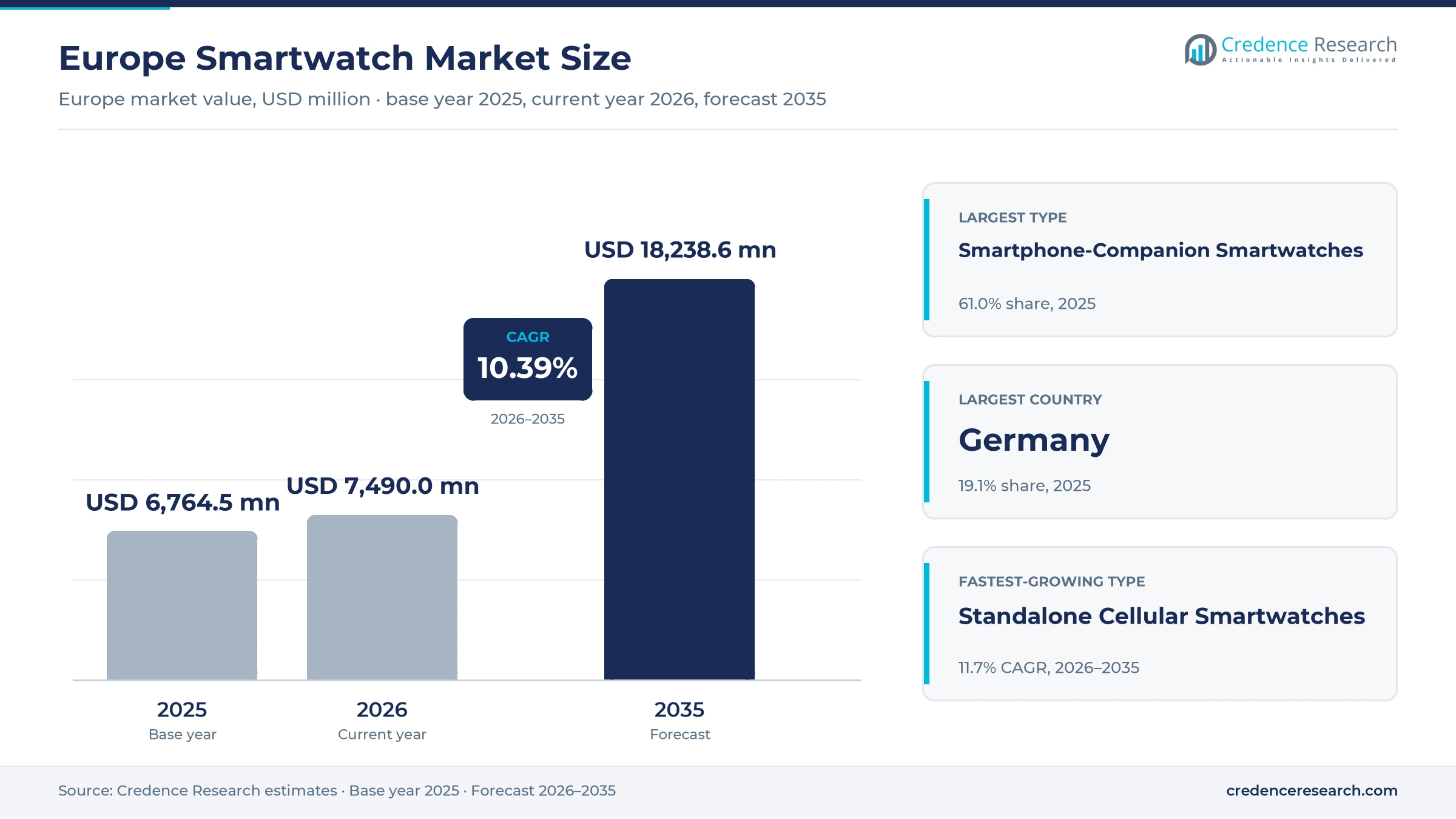
The Europe smartwatch market was valued at USD 6.76 billion in 2025 and is projected to increase from USD 7.49 billion in 2026 to USD 18.24 billion by 2035, registering a CAGR of 10.39% during 2026–2035. Demand rests on buyers who now expect a watch to flag heart and sleep risks, on carriers that sell watch numbers alongside phone plans, and on owners who replace older models to gain newly certified health alerts. Germany is the largest single country market with 19.1% of 2025 value, because high wearable use and a large base of premium buyers meet a dense network of electronics chains. The United Kingdom is the fastest-growing country at 10.9% a year as cellular watches and carrier bundles gain ground. Regulation is also changing the market, since the European Commission now requires Apple to open iPhone features such as notification forwarding to rival watches.
Which watches and buyers does the market include?
The market counts the retail value of wrist-worn smartwatches sold in Europe, from phone-paired models and LTE watches with their own number to hybrid analog watches with health sensors and kids watches with calling and location features. Buyers are mainly consumers who shop through brand stores, online marketplaces, electronics chains and mobile carriers, with a smaller share of employers and insurers that fund devices for staff or members.
The estimate excludes screenless fitness bands, smart rings, connected earbuds and watch straps sold on their own, as well as subscription fees for health coaching and mobile plans. Value is counted at the final sale, so chip and sensor suppliers, platform owners, device brands, distributors, retailers and carriers all sit inside the chain that the buyer pays for.
Europe Smartwatch Market Insights
- The market grows from USD 6.76 billion in 2025 to USD 18.24 billion by 2035, a 10.39% pace driven by certified health alerts, cellular models and premium replacement buying.
- Germany held 19.1% of 2025 value as the largest single country, while the United Kingdom grows fastest at 10.9% a year on cellular watch adoption.
- Smartphone-Companion Smartwatches held 61.0% of 2025 value, because most buyers still pair a watch with the phone they already own.
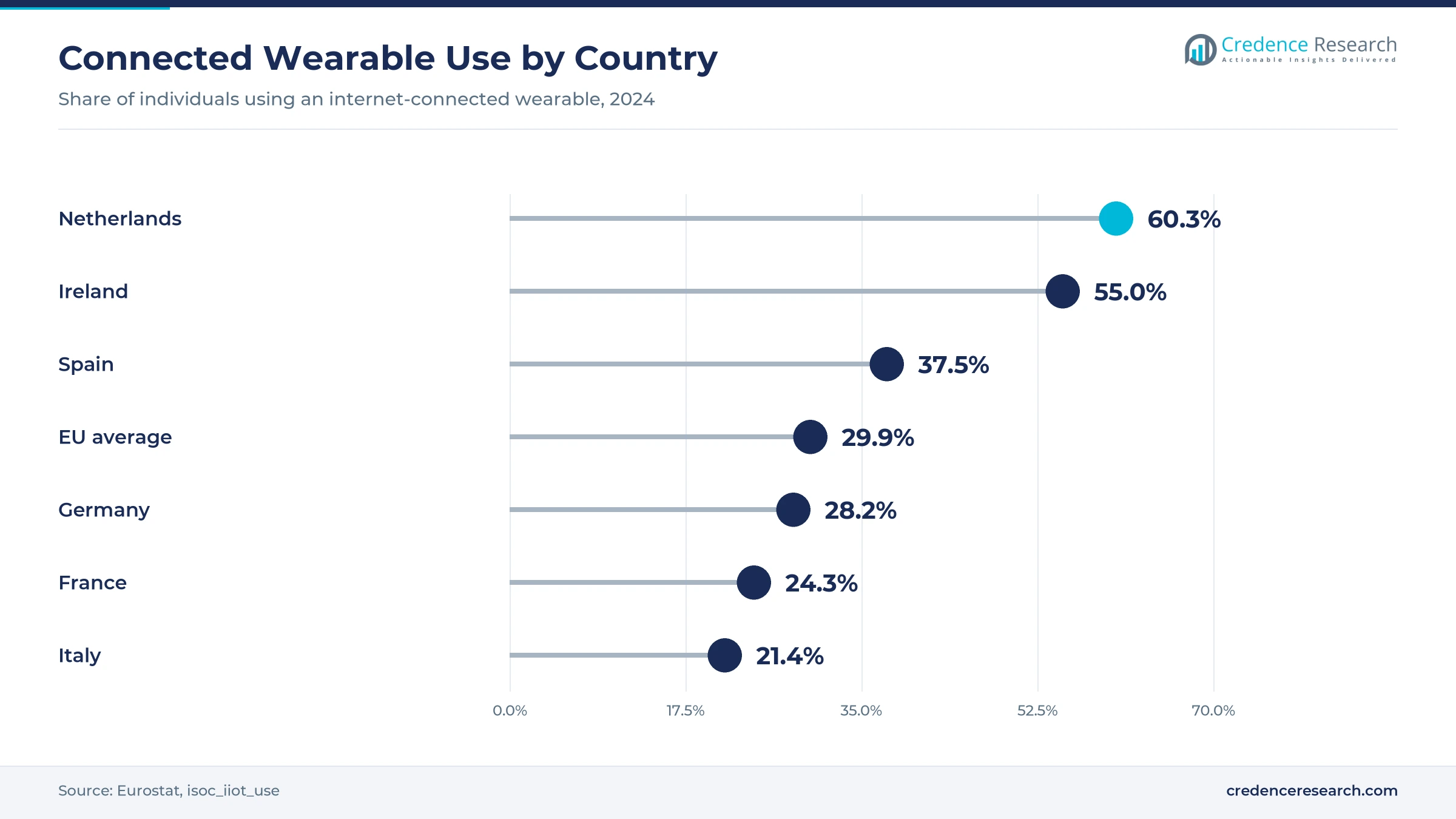
- Use is uneven, with 60.3% of people in the Netherlands using a connected wearable in 2024 against 24.3% in France, according to Eurostat.
- Apple, Samsung and Huawei now ship health features certified as medical functions in Europe, which raises the cost of entry for smaller brands.
Companion watches lead while LTE models gain the most
Why do companion watches lead while cellular models grow fastest?
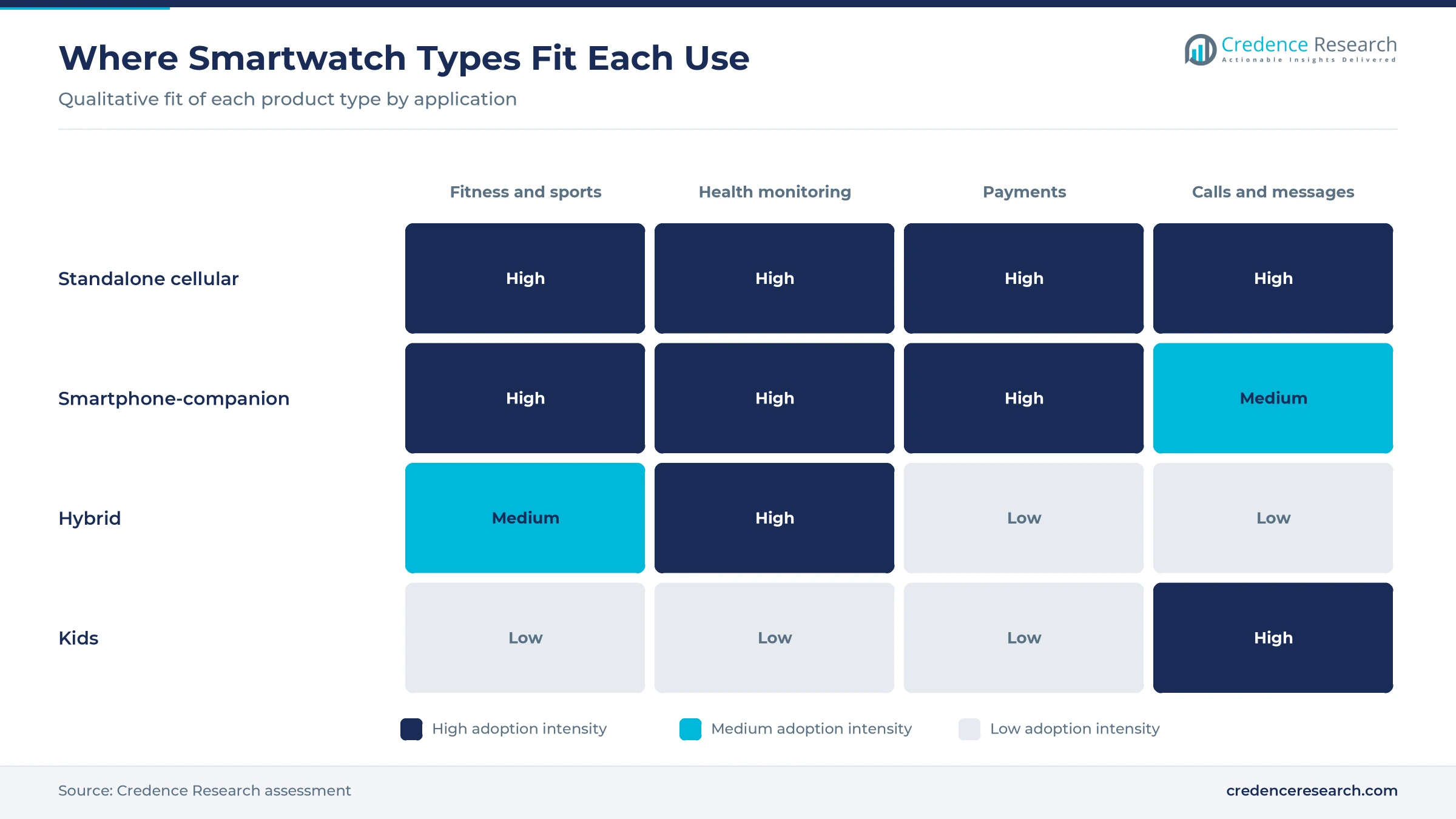
Based on product type, the market is categorized into standalone cellular smartwatches, smartphone-companion smartwatches, hybrid smartwatches and kids smartwatches. Smartphone-Companion Smartwatches led with 61.0% of 2025 value because the Bluetooth version is the cheaper entry point, and Samsung charges a fixed extra for the LTE version of the Galaxy Watch9 it launched in July 2026. Standalone Cellular Smartwatches grow fastest at 11.7% a year as carriers make the extra number simple, and Deutsche Telekom states that the eSIM is built into the watch at no charge. Brands that bundle a first month of service can turn that LTE step into an easy upgrade.
Why does fitness lead while health monitoring adds the most value?
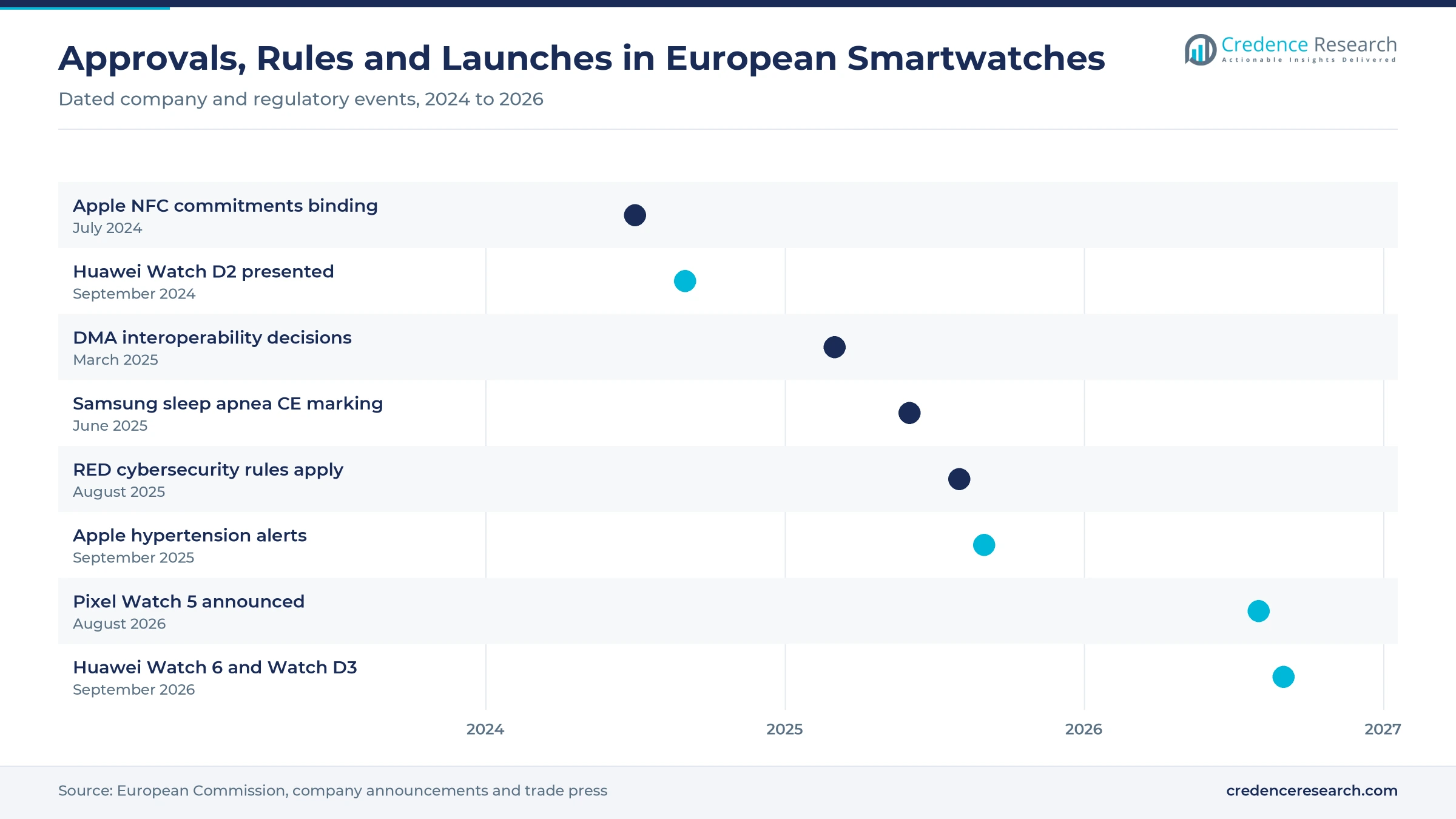
Based on application, the market is categorized into fitness and sports, health and medical monitoring, payments and commerce, and personal assistance and communications. Fitness & Sports led with 44.0% of 2025 value because training remains the main purchase reason, and Garmin launched the Venu 4 on Sept. 17, 2025, with a coach that builds workouts for more than 25 activities. Health & Medical Monitoring grows fastest at 11.4% a year as features gain medical approval, after Huawei presented the Watch D2 in Barcelona in September 2024 as a wrist blood pressure monitor certified under the EU Medical Device Regulation. Certified features move the watch closer to a health purchase.
Why does the USD 300-499 tier lead while the top tier grows fastest?
Based on price tier, the market is categorized into four bands that run from the budget tier to the premium tier. USD 300-499 led with 33.0% of 2025 value because flagship models from the largest brands sit there, and Polar priced its Grit X2 outdoor watch at €479.90 in 2025. The USD 500 and Above tier grows fastest at 11.4% a year as rugged and titanium models gain buyers, with Apple refreshing its Ultra line every September. The budget tier keeps volume through models such as the Amazfit Active 2, launched in Europe in February 2025, but it adds less value per unit sold.
Why do electronics chains lead while marketplaces grow fastest?
Based on distribution channel, the market is categorized into brand e-commerce, online marketplaces, consumer electronics retailers and telecom carriers. Consumer Electronics Retailers led with 33.0% of 2025 value because buyers still like to try the fit and screen before spending €400 or more, and chains stock every major brand side by side. Online Marketplaces grow fastest at 11.2% a year as online buying becomes routine, with Eurostat data reported in March 2026 showing that 77.8% of EU internet users bought online in 2025. Brands that control prices across marketplace sellers will protect margins best.
| Segment Group | Leading Sub-segment | Share, 2025 | Fastest-growing Sub-segment | CAGR, 2026–2035 |
|---|---|---|---|---|
| By Product Type | Smartphone-Companion Smartwatches | 61.0% | Standalone Cellular Smartwatches | 11.7% |
| By Application | Fitness & Sports | 44.0% | Health & Medical Monitoring | 11.4% |
| By Price Tier | USD 300-499 | 33.0% | USD 500 and Above | 11.4% |
| By Distribution Channel | Consumer Electronics Retailers | 33.0% | Online Marketplaces | 11.2% |
Flagships cluster near €400 as LTE adds a premium
Smartwatch pricing works per device, with a clear ladder from budget fitness watches to rugged titanium flagships. Most value sits in the middle of that ladder, where the core models of Apple, Samsung, Google and Huawei compete. Cellular versions carry a fixed premium, such as the €50 Samsung charges for LTE on the Galaxy Watch9, and the buyer then pays a monthly fee for a shared watch number. Prices are drifting up, since the 40 mm Galaxy Watch9 lists at €409 against €380 for the Galaxy Watch8 a year earlier. Brands defend margins by moving buyers to larger, cellular or titanium versions rather than by cutting base prices.
| Model or offer | Typical price or fee | Basis |
|---|---|---|
| Amazfit Active 2, standard version | €99 at European launch | Notebookcheck, February 2025 |
| Xiaomi Redmi Watch 5 | €109.99 recommended price in Germany, £89.99 in the U.K. | Notebookcheck, January 2025 |
| Apple Watch SE 3 | From £219 | Apple U.K. online store, November 2026 |
| Samsung Galaxy Watch9, 40 mm | €409 Bluetooth, €50 more for LTE | Notebookcheck, July 2026 |
| Apple Watch Series 12 | From £369 | Apple U.K. online store, November 2026 |
| Garmin Venu 4 | From €549.99 | TechRadar Benelux, September 2025 |
| Apple Watch Ultra 4 | From £749 | Apple U.K. online store, November 2026 |
| Vodafone OneNumber watch plan, U.K. | From £7.50 a month | Vodafone U.K., November 2026 |
Request a Free Sample
Fill in your details and we'll send you a free sample report.
- Sample data tables & charts
- Research methodology
Health alerts, LTE plans and premium upgrades lift spend
Health and fitness monitoring becomes the core purchase reason
Health tracking has moved from a side feature to the main reason Europeans buy a smartwatch. Eurostat data show that 29.9% of people in the EU used an internet-connected wearable in 2024, with use ranging from 60.3% in the Netherlands to 21.4% in Italy, which leaves a large base still to convert. Regulators are now approving clinical functions, and Samsung secured CE marking for its sleep apnea feature in 34 European markets on June 5, 2025, bringing its total to 70 markets. Huawei, Apple and Withings also sell watches with ECG or rhythm checks, so buyers can compare certified features across brands. This is why health monitoring is the fastest-growing use, and it rewards brands that invest in clinical validation rather than in more sports profiles.
Standalone connectivity expands daily utility away from the phone
Cellular watches are widening the use of a smartwatch from a phone accessory to a device that works on its own during runs, commutes and school days. In the U.K., Vodafone sells its OneNumber watch plan from £7.50 a month, sharing the phone allowance with a cellular Apple, Samsung or Google watch. Kids watch demand shows the same pull, since Norwegian maker Xplora reported 476,000 subscriptions at the end of 2025, up from 358,000 a year earlier, with more than 70,000 of them in Germany. Apple added 5G to the Series 11 in September 2025, which improves data speeds for streaming and maps. As carriers make watch numbers routine, Standalone Cellular Smartwatches gain share in every major country.
Premium health features strengthen replacement economics
New health functions give owners a concrete reason to replace a working watch, which shortens the upgrade cycle. Apple launched hypertension notifications in September 2025 in more than 150 countries and regions, including the EU, but the alerts need a Series 9 or later, so owners of older models must upgrade to use them. Apple then introduced a redesigned heart-rate sensing system and a daily Readiness score with the Series 12 on Sept. 9, 2026. Google followed in August 2026 with breathing emergency detection on the Pixel Watch 5, launching first in Europe. Each new feature tied to new hardware moves buyers up the price ladder, which explains why the premium band keeps gaining share through the forecast.
Contactless payment habits make the watch a daily wallet
Paying with a watch has become normal at European checkouts, which adds daily use and makes the watch harder to leave at home. Bitkom reported in June 2025 that 64% of Germans aged 16 and over had paid with a smartphone or smartwatch in the previous year, up from 46% in 2022. The European Commission also made Apple's commitments binding on July 11, 2024, opening iPhone tap-and-go access to rival wallets in the European Economic Area for ten years, which widens the payment options linked to watches. Garmin, Huawei, Xiaomi and Zepp watches already carry payment chips, so banks reach buyers on every major platform. Wider wallet choice supports demand for wearable payment devices across all price tiers.
Open phone pairing and senior safety reshape demand
Shift to open phone pairing for rival watches in the EU
Interoperability rules are loosening the hold that phone platforms have on watch choice in the EU. On March 19, 2025, the European Commission adopted decisions under the Digital Markets Act that require Apple to open nine iOS connectivity features used by connected devices, including notifications on smartwatches. Apple then brought notification forwarding to third-party watches in the 27 EU member states with iOS 26.3, Engadget reported in December 2025, although alerts can reach only one watch at a time. The Commission says the functions will be fully available in the bloc in 2026. Garmin, Huawei and Xiaomi stand to gain iPhone buyers, while Apple Watch keeps its advantage outside the EU.
Rise of hybrid and long-battery designs for everyday wear
A growing group of buyers wants health tracking without daily charging or a full touchscreen, which favors hybrid and long-battery designs. Withings lists its ScanWatch 2 hybrid at €349.95 with up to 35 days of battery life and passive atrial fibrillation detection. Xiaomi claims up to 24 days of typical use for the Redmi Watch 5, and Garmin rates the Venu 4 at up to 12 days in smartwatch mode. These figures compare with the up to 24 hours Apple quotes for the Series 11. Battery life is therefore becoming a main point of difference, and it gives brands outside the two largest platforms a clear way to compete.
Opening in safety watches for Europe's aging population
Older adults are a large and underserved buyer group, and safety features give them a clear reason to wear a watch. Eurostat figures show that people aged 65 and over made up 22.0% of the EU population in 2025, about three points more than a decade earlier. Bitkom found that 29% of Germans aged 65 and over paid with a smartphone or smartwatch in 2025, up from 11% in 2022, which shows that older buyers adopt wrist technology quickly once they see a use. Fall detection, emergency calling and breathing alerts can also be sold through insurers and care providers as part of remote patient monitoring programs. Brands that simplify setup for this group can add buyers rather than only replace devices.
Opening for clinically validated watches in care pathways
Doctors and insurers are starting to treat certified watch data as useful evidence, which opens a route into paid health programs. Huawei followed the Watch D2 with the Watch D3 blood pressure watch at its Munich launch on Sept. 2, 2026. Withings lets cardiologists review ECG recordings from its watches through its Cardio Check-Up service, while Apple says hypertension notifications were checked in a clinical study of more than 2,000 participants. Each step brings smartwatches closer to the wearable medical devices used in clinics. Brands that build evidence and reimbursement files can sell to payers as well as consumers, which lifts value per device.
Battery rules, security law and price rises test makers
Will EU battery rules force costly redesigns?
EU Battery Regulation 2023/1542 requires portable batteries in products to be removable and replaceable by end users from Feb. 18, 2027. A delegated act adopted on July 14, 2026, adds a wearables derogation, but only for devices that meet set miniaturization or sealed-enclosure conditions. Brands without a clear exemption must redesign cases, which adds engineering cost. Google has already designed the Pixel Watch 4 so its battery and display can be replaced, which shows one route to comply.
How much does cybersecurity law add to launch costs?
Security rules now apply to every connected watch sold in the EU. Delegated Regulation 2022/30 under the Radio Equipment Directive has applied since Aug. 1, 2025, requiring internet-connected radio equipment to protect networks, personal data and payments. Harmonised standards for these duties were published only in early January 2025, leaving makers little time to test. Kids watches face the most scrutiny because they collect location data on children, so smaller brands carry the heaviest compliance cost.
Will rising list prices slow replacement buying?
Flagship prices are moving up, which can stretch the time owners keep a watch. The Galaxy Watch9 price step described in the pricing section, about 8% in one generation, shows how quickly flagship list prices are climbing. Price-sensitive buyers can trade down to budget models from Xiaomi or Amazfit. Brands that raise prices without a clear new health function risk longer replacement cycles and slower value growth.
Can health features keep pace with national approvals?
Certified health features do not reach every European country at the same time, which splits product launches. Samsung notes that application dates for its sleep apnea feature may vary by national registration in some European markets, even after CE marking in June 2025. Feature gaps between countries confuse buyers who compare models online across borders. Brands that plan approvals country by country can launch features together and avoid lost sales.
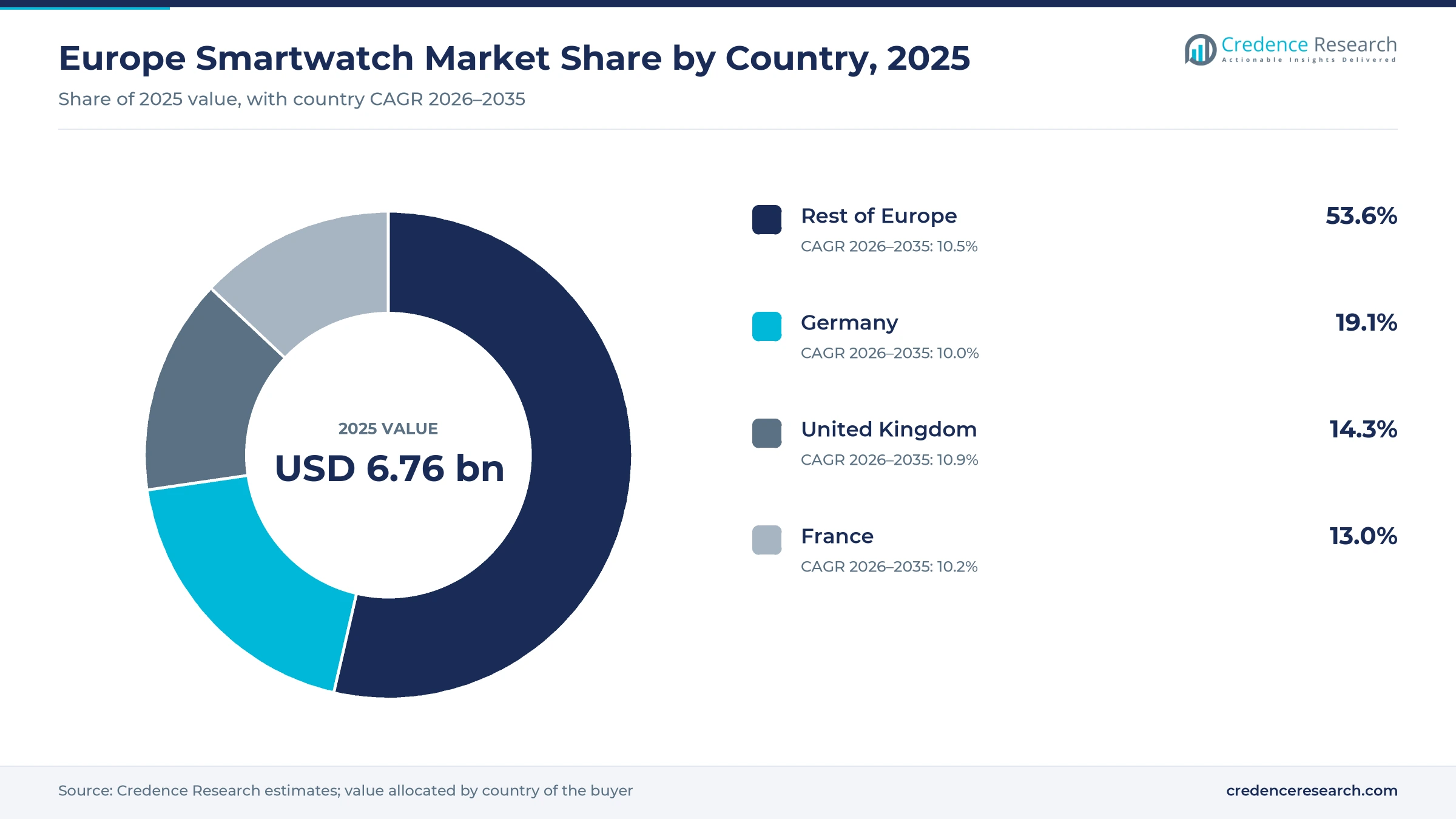
Germany leads named countries while the U.K. grows fastest
| Country | Value, 2025 (USD billion) | Share, 2025 | CAGR, 2026–2035 |
|---|---|---|---|
| Rest of Europe | 3.63 | 53.6% | 10.5% |
| Germany | 1.29 | 19.1% | 10.0% |
| United Kingdom | 0.97 | 14.3% | 10.9% |
| France | 0.88 | 13.0% | 10.2% |
Germany leads named countries through broad smartwatch use
Germany held 19.1% of 2025 value and grows at 10.0% a year. Bitkom found in September 2024 that 36% of Germans aged 16 and over use a smartwatch, and it expected 13.1 million wearables to be sold in Germany that year at an average price of €196. Smartwatch demand in Germany rests on a wide user base, and Eurostat data show that 28.2% of Germans used a connected wearable in 2024, close to the EU average. Electronics chains and carrier MultiSIM offers give buyers wide choice, so German demand favors mid-priced brands with strong health tracking.
The United Kingdom grows fastest on premium and cellular watches
The United Kingdom held 14.3% of 2025 value and grows fastest at 10.9% a year. Apple lists the Series 12 from £369 and the Ultra 4 from £749 on its U.K. store, while Huawei began U.K. retail sales of the Watch 6 at £399.99 on Sept. 23, 2026. The carrier watch plans described above make cellular models easy to buy on contract. British demand therefore leans toward premium and LTE models, which lifts value per unit faster than in most other countries.
France holds a steady share with strong local health brands
France held 13.0% of 2025 value and grows at 10.2% a year. Wearable demand in France has room to grow, since Eurostat data show that 24.3% of French people used a connected wearable in 2024, below the EU average. Arcep reported that 46% of the French population owned connected objects in June 2025, up three points on 2024. France is also among the markets where Samsung supports its CE-marked sleep apnea feature, so Android buyers there can use certified health checks.
Rest of Europe combines the highest use rates with large gaps
The rest of Europe held 53.6% of 2025 value and grows at 10.5% a year. Eurostat data show that wearable use in 2024 reached 55.0% in Ireland, 54.8% in Norway and 37.5% in Spain, but only 19.9% in Hungary. Huawei priced the Watch 5 at €449 across the EU in May 2025, and Xiaomi and Amazfit sell budget models across Central and Eastern Europe. Demand across the rest of Europe is therefore uneven, and most future unit growth sits in southern and eastern countries with use rates near 20%.
Health certifications and new flagships mark 2024 to 2026
| Development | Status and market relevance |
|---|---|
| In September 2024, Huawei presented the Watch D2 in Barcelona as a wrist blood pressure monitor certified under the EU Medical Device Regulation. | On sale; first certified wrist blood pressure watch in Europe |
| In June 2025, Samsung secured CE marking for the Galaxy Watch sleep apnea feature, adding 34 European markets. | Rolling out by country; lifts health use |
| In September 2025, Apple launched hypertension notifications on Apple Watch in more than 150 countries and regions, including the EU. | Available; requires Series 9 or later |
| In August 2026, Google announced the Pixel Watch 5 with breathing emergency detection launching first in Europe. | On sale; adds safety use for older buyers |
| In September 2026, Huawei launched the Watch 6 and Watch D3 at an event in Munich. | On sale; U.K. retail from Sept. 23, 2026 |
Sensors, eSIM modules and open pairing shape products
- Optical and electrical heart sensors now support certified rhythm checks and hypertension alerts, and Apple redesigned its sensing system for the Series 12.
- Embedded eSIM modules let a watch share the phone number and work without the phone, which underpins the cellular segment.
- Open pairing under the Digital Markets Act lets rival watches receive iPhone notifications in the EU, widening choice for iPhone owners.
- Low-power displays and chips stretch battery life to weeks on hybrid and sports models, which matters to buyers who wear the watch day and night for sleep and heart tracking.
Need a Custom Version of This Report?
Tailor the scope, geography, or segments to your exact requirements.
- Custom geography or segment scope
- Direct access to our analyst team
Platform owners set prices as sports brands defend niches
Competition in the Europe smartwatch market centers on health features, platform ties and battery life rather than on screen size or design alone. Apple relies on iPhone loyalty and certified heart features, and it refreshes the line each September with models such as the Series 12. Samsung and Google sell Wear OS watches with sleep apnea checks and breathing alerts. Huawei competes with HarmonyOS watches and certified blood pressure models launched at events in Barcelona, Berlin and Munich. Garmin, Polar and Suunto defend the sports and outdoor segment with training software and battery life of up to 12 days on models such as the Garmin Venu 4. Xiaomi and Zepp Health, through Amazfit, compete on low prices and long battery life. Withings sells hybrid watches with medical features such as passive atrial fibrillation detection. Retail buyers reward brands that offer cellular versions, wide size ranges and clear health benefits.
How is supply organized, and where do margins sit?
Supply is organized around a few platform owners and a wider group of specialist brands. Apple, Samsung, Google and Huawei control both the operating system and the hardware, which lets them tie watches to their phones and capture service revenue. Garmin, Polar and Suunto compete on sports software and battery life, while Xiaomi and Zepp Health win volume with low-priced models. Margins sit mostly with platform owners and premium sports brands that sell through their own stores. Entry barriers are rising, because medical certification, chip access and EU compliance now cost more than industrial design.
Which companies shape smartwatch supply in Europe?
| Company | Type | Role in the market |
|---|---|---|
| Apple Inc. | Platform owner | Apple Watch Series 12, SE 3 and Ultra 4 sold through its U.K. and EU stores |
| Samsung Electronics Co., Ltd. | Platform partner | Galaxy Watch9 on Wear OS with CE-marked sleep apnea feature in Europe |
| Huawei Technologies Co., Ltd. | Platform owner | Watch 6 and Watch D3 launched in Munich in September 2026 |
| Garmin Ltd. | Sports specialist | Venu 4 and sports watches sold from €549.99 in Europe |
| Xiaomi Corporation | Value brand | Redmi Watch 5 sold in Europe from €109.99 |
| Google LLC | Platform owner | Pixel Watch 5 with breathing emergency detection launching first in Europe |
| Zepp Health Corporation | Value brand | Amazfit Active 2 launched in Europe at €99 |
| Polar Electro Oy | Sports specialist | Grit X2 outdoor watch priced at €479.90 and £399 |
| Withings S.A. | Health specialist | ScanWatch 2 hybrid watch with ECG at €349.95 |
| Suunto Oy | Sports specialist | Vertical 2 GPS outdoor watch with offline maps, launched in October 2025 |
Medical-grade features will decide upgrade cycles
Credence Research's view is that the next phase of Europe smartwatch growth will be won on certified health value rather than on new screens or bands. Owners now replace watches mainly to gain alerts that older hardware cannot run, so brands with a steady flow of approved features will keep the strongest upgrade cycles. The opening of iPhone pairing in the EU gives rival platforms their best chance in years to win iPhone owners. The United Kingdom should keep the fastest growth as cellular watches become standard, while older buyers offer the largest source of new users.
Wearable use rates and shelf prices anchor the estimate
The report uses 2025 as the base year and forecasts values to 2035. Market values come from the Credence Research model, and segment and country splits are Credence Research estimates. The size was cross-checked against the number of wearable users implied by Eurostat usage rates, a typical replacement cycle and observed list prices in the U.K., Germany and the EU, and against German wearable unit sales reported by Bitkom. Evidence comes from Eurostat, EU regulation and Commission decisions, trade associations, company announcements, carrier price lists, retailer listings and trade press. No interviews or surveys were conducted for the preparation of this report.
Cellular and premium health watches carry growth to 2035
Europe smartwatch value should reach USD 18.24 billion by 2035, up from USD 7.49 billion in 2026, as certified health alerts and cellular models widen the role of the watch. Standalone Cellular Smartwatches should expand at 11.7% a year as carriers bundle watch numbers with phone plans. Premium and rugged models should gain share as owners upgrade for new sensors. Open iPhone pairing should give rival platforms more room in the EU. Demand from the 22.0% of EU residents aged 65 and over should also widen the buyer base as safety features improve. The main risk is slower replacement buying if prices keep rising without clear new health functions.
What separates the downside, base and upside paths to 2035?
The range of outcomes depends on whether new health functions keep giving owners a reason to upgrade. A downside path follows if list prices keep rising while new models add few certified features, and if battery rules delay launches. The base case assumes steady health approvals and gradual cellular adoption. An upside path needs insurers and care providers to fund watches for older adults and blood pressure or breathing alerts to reach most European countries.
| Scenario | CAGR, 2026–2035 | Value, 2035 | What has to hold |
|---|---|---|---|
| Downside | 8.4% | USD 15.47 billion | Prices keep rising, few new certified features arrive and battery rules delay several launches |
| Base | 10.39% | USD 18.24 billion | Health approvals continue at their current pace and cellular watches gain share gradually |
| Upside | 11.9% | USD 20.59 billion | Insurers fund watches for older adults and certified blood pressure alerts reach most countries |
Frequently Asked Questions
How big is the Europe smartwatch market?
Which country is the largest smartwatch market in Europe?
Which country grows fastest?
Which product type holds the largest share?
Which health features are certified in Europe?
How do EU rules affect iPhone owners who want another watch?
What is the biggest risk for smartwatch brands?
Which companies are active in the market?
Table of Content
Chapter 1 Market Segmentation
- 1.1 Segmentation Framework
- 1.1.1 Product and Service Classification
- 1.1.2 Application and End-Use Classification
- 1.1.3 Technology and Solution Classification
- 1.1.4 Customer and Distribution Channel Classification
- 1.1.5 Geographic Segmentation
- 1.1.6 Market Segment Definitions and Boundaries
- 1.2 By Product Type
- 1.2.1 Smartphone-Companion Smartwatches
- 1.2.2 Standalone Cellular Smartwatches
- 1.2.3 Hybrid Smartwatches
- 1.2.4 Kids Smartwatches
- 1.3 By Application
- 1.3.1 Fitness & Sports
- 1.3.2 Health & Medical Monitoring
- 1.3.3 Payments & Commerce
- 1.3.4 Personal Assistance & Communications
- 1.4 By Price Tier
- 1.4.1 Below USD 150
- 1.4.2 USD 150-299
- 1.4.3 USD 300-499
- 1.4.4 USD 500 and Above
- 1.5 By Country
- 1.5.1 United Kingdom
- 1.5.2 Germany
- 1.5.3 France
- 1.5.4 Rest of Europe
Chapter 2 Introduction
- 2.1 Report Objectives and Scope
- 2.2 Product Definition and Industry Terminology
- 2.3 Market Inclusions and Exclusions
- 2.4 Research Process
- 2.4.1 Primary Research and Expert Interviews
- 2.4.2 Secondary Research and Source Review
- 2.4.3 Top-Down and Bottom-Up Estimation
- 2.4.4 Data Triangulation and Verification
- 2.5 Market Size Measurement Basis
- 2.5.1 2025: USD 6.76 billion → 2035: USD 18.24 billion
- 2.6 Historical and Forecast Reference Periods
- 2.6.1 Historical Period: 2018-2025
- 2.6.2 Base Year: 2025
- 2.6.3 Forecast Period: 2025-2035
- 2.7 Research Assumptions and Limitations
Chapter 3 Executive Summary
- 3.1 Market Snapshot and Key Findings
- 3.2 Base-Year Market Size, 2025
- 3.3 Forecast Market Size, 2035
- 3.4 Revenue and Volume Growth Outlook
- 3.5 Key Demand and Supply Indicators
- 3.6 Leading Market Segments
- 3.7 Fastest-Growing Market Opportunities
- 3.8 Regional Performance Highlights
- 3.9 Technology and Industry Transformation
- 3.10 Competitive Landscape Summary
- 3.11 Analyst View and Strategic Implications
Chapter 4 Europe Smartwatch Market Trends and Developments
- 4.1 Historical Industry Development, 2018-2025
- 4.2 Recent Market Trends and Developments
- 4.3 Demand and Customer Behavior Trends
- 4.4 Technology and Product Innovation
- 4.5 Artificial Intelligence, Automation and Digitalization
- 4.6 Local Manufacturing and Supply Chain Realignment
- 4.7 Industry Partnerships, Mergers and Acquisitions
- 4.8 Sustainability and Circular Economy Developments
- 4.9 Government and Private Sector Investment Trends
- 4.10 Emerging Business Models and Commercialization
- 4.11 Industry Developments and Announcements
Chapter 5 Europe Smartwatch Market Production, Supply and Demand Analysis
- 5.1 Demand Trend and Consumption Analysis, 2018-2025
- 5.2 Demand Forecast, 2025-2035
- 5.3 Production and Output Trend, 2018-2025
- 5.4 Production and Output Forecast, 2025-2035
- 5.5 Installed Capacity and Capacity Utilization
- 5.6 Company-Wise Production Plants and Statistics
- 5.6.1 Installed Production Capacity
- 5.6.2 Actual Production
- 5.6.3 Planned Capacity and Expansion Targets
- 5.7 Supply Chain Structure and Procurement Trends
- 5.8 Supply-Demand Gap and Bottlenecks
- 5.9 Import Dependence and Sourcing Structure
- 5.10 Contract Manufacturing and Outsourcing
- 5.11 Regional Supply and Demand Concentration
Chapter 6 Europe Smartwatch Market Pricing Analysis
- 6.1 Pricing Structure and Measurement
- 6.2 Historical Pricing Trends, 2018-2025
- 6.3 Pricing Outlook, 2025-2035
- 6.4 Average Selling Price and Unit Economics
- 6.5 Pricing by Product and Market Segment
- 6.6 Geographic Pricing Differences
- 6.7 Key Input, Energy, Labor and Logistics Costs
- 6.8 Contract Pricing and Purchasing Models
- 6.9 Pricing Sensitivity and Competitive Positioning
- 6.10 Price, Margin and Profitability Implications
Chapter 7 Europe Smartwatch Market Dynamics
- 7.1 Market Growth Drivers
- 7.1.1 Demand-Side Drivers
- 7.1.2 Technology and Innovation Drivers
- 7.1.3 Infrastructure and Investment Drivers
- 7.1.4 Regulatory and Policy Drivers
- 7.2 Market Restraints
- 7.2.1 Cost and Affordability Constraints
- 7.2.2 Technology and Adoption Barriers
- 7.2.3 Supply Chain and Operational Constraints
- 7.3 Market Challenges
- 7.3.1 Competitive Pressure and Margin Erosion
- 7.3.2 Skills, Infrastructure and Implementation Gaps
- 7.4 Emerging Market Opportunities
- 7.5 Market Dynamics Impact and Time-Horizon Assessment
Chapter 8 Europe Smartwatch Value Chain Analysis
- 8.1 Industry Value Chain Overview
- 8.2 Upstream Suppliers and Critical Inputs
- 8.3 Technology and Component Providers
- 8.4 Manufacturing or Service Delivery
- 8.5 Distribution, Channel Partners and Integrators
- 8.6 Downstream Applications and End Users
- 8.7 Value Addition and Profit Pools
- 8.8 Vertical Integration and Outsourcing
- 8.9 Supplier Concentration and Risk
- 8.10 Supply Chain Localization and Resilience
Chapter 9 Europe Smartwatch Market Regulations and Policies
- 9.1 Relevant Laws, Standards and Compliance Frameworks
- 9.2 Product, Service, Safety and Quality Requirements
- 9.3 Government Policies, Incentives and Subsidies
- 9.4 Imports, Exports and Trade Barriers
- 9.5 Public Procurement and Local Content Requirements
- 9.6 Environmental and Sustainability Compliance
- 9.7 Data Protection, AI and Cybersecurity Compliance
- 9.8 Upcoming Policy Changes and Market Implications
Chapter 10 Europe Smartwatch Market Hotspots and Opportunities
- 10.1 Market Opportunity Mapping and Growth Hotspots
- 10.2 High-Growth Applications and Customer Groups
- 10.3 Underserved Markets and White-Space Opportunities
- 10.4 Emerging Technology and Product Opportunities
- 10.5 New Capacity and Investment Hotspots
- 10.6 Market Entry and Expansion Opportunities
- 10.7 Distribution and Partnership Opportunities
- 10.8 Near-Term and Long-Term Commercial Potential
- 10.9 Opportunity Attractiveness and Execution Risks
Chapter 11 Europe Smartwatch Market Outlook, 2025-2035
- 11.1 Market Size and Analysis
- 11.1.1 Revenue (Market Measurement: 2025: USD 6.76 billion → 2035: USD 18.24 billion)
- 11.1.2 Market Volume and Quantity Sold
- 11.1.3 Historical Market Size, 2018-2025
- 11.1.4 Base-Year Market Size, 2025
- 11.2 Market Forecast, 2025-2035
- 11.2.1 Revenue Forecast to 2035
- 11.2.2 Volume Forecast to 2035
- 11.2.3 CAGR and Year-on-Year Growth
- 11.2.4 Incremental Revenue Opportunity
- 11.3 Forecast Assumptions and Scenario Analysis
- 11.3.1 Base-Case Forecast
- 11.3.2 Optimistic and Conservative Scenarios
- 11.3.3 Technology, Pricing and Policy Sensitivities
- 11.4 Market Attractiveness and Growth Outlook
Chapter 12 Europe Smartwatch Market Segmentation and Outlook
- 12.1 Segmentation Summary and Market Shares, 2025
- 12.2 Largest and Fastest-Growing Segments
- 12.3 By Product Type - Market Size and Forecast, 2025-2035
- 12.3.1 Segment Definition and Scope
- 12.3.2 Historical Market Size, 2018-2025
- 12.3.3 Revenue Forecast, 2025-2035
- 12.3.4 Volume Forecast, 2025-2035
- 12.3.5 Base-Year Market Share, 2025
- 12.3.6 Segment CAGR and Growth Drivers
- 12.3.7 Subsegment Market Size and Forecast
- 12.3.7.1 Smartphone-Companion Smartwatches
- 12.3.7.2 Standalone Cellular Smartwatches
- 12.3.7.3 Hybrid Smartwatches
- 12.3.7.4 Kids Smartwatches
- 12.3.8 Subsegment Pricing and Adoption Trends
- 12.3.9 Leading Suppliers and Competition
- 12.3.10 Regional Demand and Opportunities
- 12.4 By Application - Market Size and Forecast, 2025-2035
- 12.4.1 Segment Definition and Scope
- 12.4.2 Historical Market Size, 2018-2025
- 12.4.3 Revenue Forecast, 2025-2035
- 12.4.4 Volume Forecast, 2025-2035
- 12.4.5 Base-Year Market Share, 2025
- 12.4.6 Segment CAGR and Growth Drivers
- 12.4.7 Subsegment Market Size and Forecast
- 12.4.7.1 Fitness & Sports
- 12.4.7.2 Health & Medical Monitoring
- 12.4.7.3 Payments & Commerce
- 12.4.7.4 Personal Assistance & Communications
- 12.4.8 Subsegment Pricing and Adoption Trends
- 12.4.9 Leading Suppliers and Competition
- 12.4.10 Regional Demand and Opportunities
- 12.5 By Price Tier - Market Size and Forecast, 2025-2035
- 12.5.1 Segment Definition and Scope
- 12.5.2 Historical Market Size, 2018-2025
- 12.5.3 Revenue Forecast, 2025-2035
- 12.5.4 Volume Forecast, 2025-2035
- 12.5.5 Base-Year Market Share, 2025
- 12.5.6 Segment CAGR and Growth Drivers
- 12.5.7 Subsegment Market Size and Forecast
- 12.5.7.1 Below USD 150
- 12.5.7.2 USD 150-299
- 12.5.7.3 USD 300-499
- 12.5.7.4 USD 500 and Above
- 12.5.8 Subsegment Pricing and Adoption Trends
- 12.5.9 Leading Suppliers and Competition
- 12.5.10 Regional Demand and Opportunities
- 12.6 By Country - Market Size and Forecast, 2025-2035
- 12.6.1 Segment Definition and Scope
- 12.6.2 Historical Market Size, 2018-2025
- 12.6.3 Revenue Forecast, 2025-2035
- 12.6.4 Volume Forecast, 2025-2035
- 12.6.5 Base-Year Market Share, 2025
- 12.6.6 Segment CAGR and Growth Drivers
- 12.6.7 Subsegment Market Size and Forecast
- 12.6.7.1 United Kingdom
- 12.6.7.2 Germany
- 12.6.7.3 France
- 12.6.7.4 Rest of Europe
- 12.6.8 Subsegment Pricing and Adoption Trends
- 12.6.9 Leading Suppliers and Competition
- 12.6.10 Regional Demand and Opportunities
- 12.7 Segment Growth Comparison
- 12.8 Segment Attractiveness and Priority Matrix
Chapter 13 Europe Smartwatch End-Use and Application Market Outlook
- 13.1 End-Use Industry and Customer Demand Structure
- 13.2 Leading Applications and Customer Groups
- 13.3 End-Use Market Size, Share and Forecast
- 13.4 Major End-Use Industry Deep Dives
- 13.4.1 Customer Requirements and Use Cases
- 13.4.2 Demand and Replacement Cycles
- 13.4.3 Technical and Regulatory Considerations
- 13.4.4 Purchasing and Procurement Models
- 13.4.5 Leading Vendors and Distribution Channels
- 13.4.6 Forecast and Commercial Opportunities
- 13.5 Emerging Applications and Cross-Segment Demand
- 13.6 End-Use Industry Investment Priorities
Chapter 14 Europe Smartwatch Geographic Market Outlook, 2025-2035
- 14.1 Regional Market Size and Country-Level Shares, 2025
- 14.2 Country Market Size Comparison, 2025
- 14.3 Country Market Forecasts, 2025-2035
- 14.4 Subregional Industrial and Demand Clusters
- 14.5 Intra-Regional Pricing and Cost Differences
- 14.6 Cross-Border Trade and Supply Networks
- 14.7 Regional Supply and Demand Balances
- 14.8 Country Opportunity Comparison and Prioritization
Note: Every listed country is covered on the structure shown under the first country.
Chapter 15 Europe Smartwatch Technology, Innovation and Sustainability Outlook
- 15.1 Technology Landscape and Maturity
- 15.2 Product, Process and Service Innovation
- 15.3 AI, Automation and Digital Tools in the Industry
- 15.4 Technology Adoption and Performance Benchmarking
- 15.5 Innovation Pipeline and R&D Investment
- 15.6 Patent and Intellectual Property Trends
- 15.7 Energy Efficiency and Resource Management
- 15.8 Sustainability, Recycling and Circularity
- 15.9 Technology Roadmap, 2025-2035
- 15.10 Risks of Obsolescence and Technology Substitution
Chapter 16 Europe Smartwatch Market Key Strategic Imperatives
- 16.1 Growth and Market Entry Priorities
- 16.2 High-Return Products and Segments
- 16.3 Pricing, Profitability and Cost Optimization
- 16.4 Technology Investment and Product Differentiation
- 16.5 Supply Chain Localization and Resilience
- 16.6 Distribution and Customer Acquisition
- 16.7 Partnership, Acquisition and Capacity Strategy
- 16.8 Regional Expansion Priorities
- 16.9 Short-, Medium- and Long-Term Actions
Chapter 17 Competition Outlook
- 17.1 Industry Competition Characteristics
- 17.2 Market Structure and Concentration
- 17.3 Market Share and Competitive Positioning, 2025
- 17.4 Company-Wise Revenue and Product Benchmarking
- 17.5 Production and Service Capacity Benchmarking
- 17.6 Technology, Pricing and Differentiation
- 17.7 Regional Footprint and Distribution Strength
- 17.8 Mergers, Acquisitions and Strategic Alliances
- 17.9 New Entrants and Competitive Threats
- 17.10 Porter's Five Forces and Industry Attractiveness
- 17.11 Competitive Outlook, 2025-2035
Chapter 18 Company Profiles
- 18.1 Company Coverage and Selection Criteria
- 18.2 Apple Inc.
- 18.2.1 Business Description
- 18.2.2 Company Ownership and Geographic Presence
- 18.2.3 Product and Service Portfolio
- 18.2.4 Manufacturing and Operating Footprint
- 18.2.5 Production Capacity and Expansion Plans
- 18.2.6 Financial Performance and Investment
- 18.2.7 Market Share and Competitive Position
- 18.2.8 Technology and Innovation Capabilities
- 18.2.9 Strategic Alliances or Partnerships
- 18.2.10 Recent Developments
- 18.2.11 Growth Strategy and Outlook
- 18.3 Samsung Electronics Co., Ltd.
- 18.4 Huawei Technologies Co., Ltd.
- 18.5 Garmin Ltd.
- 18.6 Xiaomi Corporation
- 18.7 Google LLC
- 18.8 Zepp Health Corporation
- 18.9 Polar Electro Oy
- 18.10 Withings S.A.
- 18.11 Suunto Oy
- 18.12 Other Relevant Market Participants
Note: Every listed company is profiled on the structure shown under the first company. The company list is preliminary and may change based on research findings, market developments, data availability and client requirements.
Chapter 19 Disclaimer
- 19.1 Research and Forecast Disclaimer
- 19.2 Data Source and Estimation Limitations
Note: The depth of individual sections depends on data availability for this market. Volume, capacity, trade and other unit-based metrics are included where applicable.

