Direct Air Capture Market Overview:
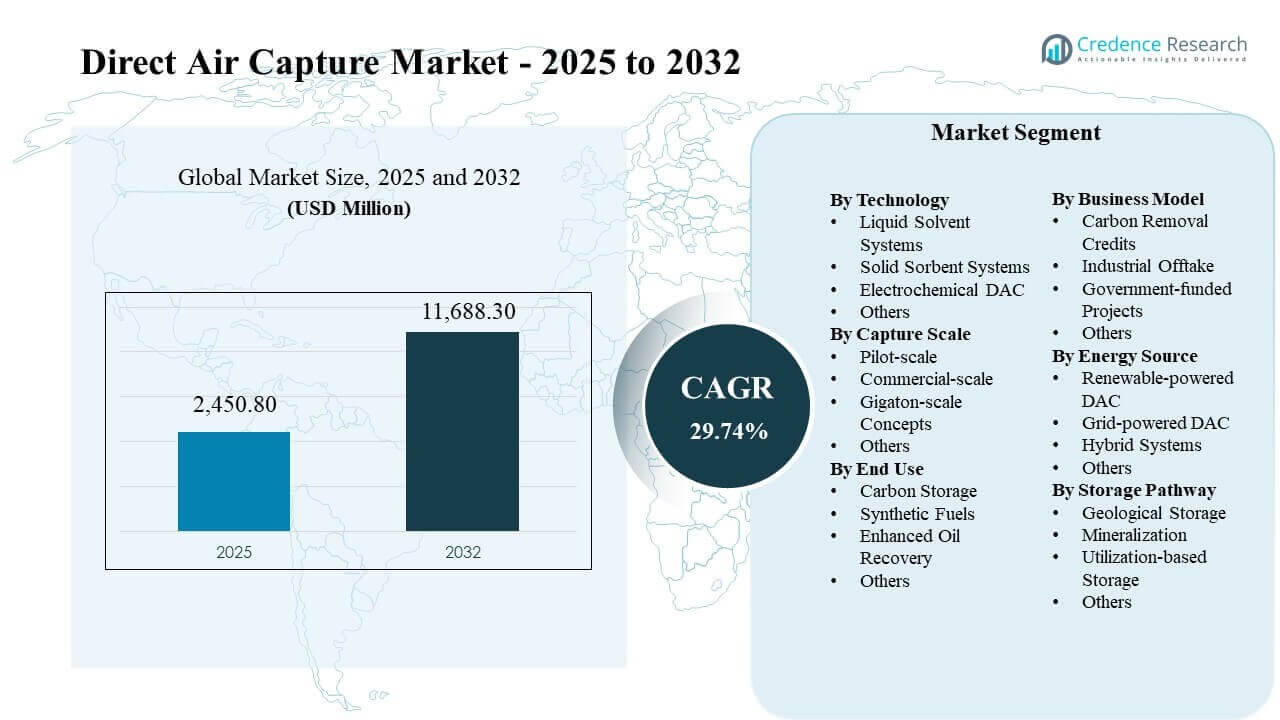
The Direct Air Capture Market size was estimated at USD 2,450.80 million in 2025 and is expected to reach USD 11,688.30 million by 2032, growing at a CAGR of 29.74% from 2025 to 2032. Growth is primarily driven by rising demand for durable carbon removal that supports net-zero commitments and compliance-grade climate claims across hard-to-abate sectors. North America and Europe remain central to early deployment because policy support, infrastructure readiness, and buyer ecosystems are more mature, and Asia Pacific is accelerating through pilots and scale-up planning tied to industrial decarbonization.
| REPORT ATTRIBUTE | DETAILS |
|---|---|
| Historical Period | 2021-2024 |
| Base Year | 2025 |
| Forecast Period | 2026-2032 |
| Direct Air Capture Market Size 2025 | USD 2,450.80 million |
| Direct Air Capture Market, CAGR | 29.74% |
| Direct Air Capture Market Size 2032 | USD 11,688.30 million |
Key Market Trends & Insights
- The Direct Air Capture Market is projected to expand from USD 2,450.80 million (2025) to USD 11,688.30 million (2032), reflecting a 29.74% CAGR (2025–2032).
- Solid Sorbent Systems accounted for the largest share of 59.4% in 2025, reflecting the advantage of modular plant designs and scalable manufacturing pathways.
- Carbon Storage accounted for the largest share of 55.2% in 2025, reflecting buyer preference for permanence and audit-ready removal outcomes.
- North America held a 44.2% share in 2025, supported by project pipelines, storage development, and early long-term offtake contracting activity.
- Asia Pacific reached a 19.4% share in 2025, supported by pilot deployments and industrial decarbonization agendas that encourage scale-up readiness.
Segment Analysis
The Direct Air Capture Market continues to shift from pilot demonstration toward repeatable commercial deployment, with customer preference moving toward higher-integrity removals supported by measurable verification. Corporate buyers and public-sector programs are shaping contracting standards, which raises the value of projects paired with durable storage pathways and low-carbon energy. Procurement favors solutions that can demonstrate stable capture performance, high availability, and transparent monitoring aligned with registry requirements and audit expectations.
Segment momentum also reflects increasing coordination across capture, energy supply, CO2 transport, and storage development, which influences project timelines and financing outcomes. Business models are maturing from opportunistic credit sales toward longer-duration offtakes and government-backed procurement that support bankability. Scale-up remains constrained by energy intensity, supply-chain availability for key components, and the complexity of permitting and storage integration, which favors regions with established regulatory pathways.
By Technology Insights
Solid Sorbent Systems accounted for the largest share of 59.4% in 2025. Solid sorbent designs support modular expansion through repeatable unit blocks that reduce engineering rework across successive plants. Packaged systems simplify integration with balance-of-plant equipment and improve predictability in construction schedules. Solid sorbent pathways also enable clearer operational monitoring and verification designs when paired with durable storage, which supports buyer acceptance and contracting confidence.
By Capture Scale Insights
Pilot-scale activity remains a core contributor to deployment volume because developers continue optimizing uptime, thermal integration, and material durability under real operating conditions. Commercial-scale planning is expanding as developers convert pilot learnings into standardized plant layouts and equipment procurement playbooks. Gigaton-scale concepts remain longer-term, requiring major gains in energy efficiency, equipment mass-manufacturing, and permitting throughput. Capture scale decisions increasingly track contracted demand and infrastructure availability rather than technology readiness alone.
By End Use Insights
Carbon Storage accounted for the largest share of 55.2% in 2025. Carbon storage aligns with permanence requirements that underpin durable removal claims and supports stronger credit quality positioning. Storage-linked projects also reduce reversal risk compared with utilization routes that can re-emit CO2 on short time horizons. Policy incentives and enabling infrastructure encourage storage pairing, and durable storage pathways typically improve buyer confidence for long-term contracting.
By Business Model Insights
Carbon removal credits continue to anchor early monetization because many end-use pathways remain at early adoption stages and require longer commercialization cycles. Industrial offtake is expanding where synthetic fuels and chemicals pathways can secure credible demand signals and contracted pricing structures. Government-funded projects are increasing in importance as hubs and grants reduce first-of-a-kind risk and unlock shared infrastructure. Business model selection is increasingly shaped by verification standards, buyer acceptance criteria, and contract tenor requirements.
By Energy Source Insights
Renewable-powered DAC configurations are gaining emphasis because low-carbon electricity and heat strengthen net-removal credibility and reduce lifecycle emissions risk. Grid-powered DAC competitiveness depends on local grid intensity and contracting approaches that support credible decarbonized energy supply. Hybrid systems are used to stabilize operations when variable renewable output would otherwise limit annual capture hours. Energy sourcing choices have become a major differentiator in buyer acceptance, contract pricing, and reputational risk management.
By Storage Pathway Insights
Geological storage remains the most widely pursued pathway for permanence and scalability, supporting long-duration removal positioning. Mineralization pathways offer durable binding and strong permanence narratives, but deployment depends on project pipeline maturity and standardization progress. Utilization-based storage supports market pull in fuels and materials, yet permanence and end-of-life considerations influence claim quality and buyer willingness to pay. Storage pathway selection is shaped by geology, permitting readiness, and the maturity of local transport and injection ecosystems.
Direct Air Capture Market Drivers
Policy support and public procurement expansion
Policy support and public procurement are accelerating project pipelines by reducing early-stage risk and improving financing viability. Regulatory clarity on storage, permitting, and monitoring requirements strengthens confidence among developers and buyers. Government programs that fund hubs, shared transport infrastructure, and storage development lower unit costs across multiple projects. Public purchasing commitments also improve demand visibility for durable removals, which supports longer contract tenors and better project bankability for commercial facilities.
Corporate net-zero commitments and durability requirements
Corporate decarbonization commitments are pushing demand toward durable removals that can address residual emissions in hard-to-abate value chains. Buyer procurement is increasingly guided by permanence, auditability, and transparent monitoring that supports credible climate claims. Long-term offtake agreements help stabilize revenue profiles and support project financing. Procurement sophistication is rising as buyers evaluate lifecycle emissions, energy sourcing, and storage risk, which strengthens demand for higher-integrity project designs.
- For instance, Microsoft signed an agreement with 1PointFive for 500,000 metric tons of carbon removal to be delivered over 66 years from the STRATOS facility, showing how large buyers are prioritizing durable, storage-linked removals with measurable delivery commitments.
Technology modularization and repeatable plant deployment
Technology progress is improving performance consistency through better contactor designs, improved materials, and more standardized balance-of-plant integration. Modular engineering approaches support repeatable deployment, which can shorten build cycles and reduce commissioning variability. Standardization also supports clearer verification frameworks because operating parameters become more predictable across plant generations. As manufacturing readiness improves for key components, project execution risk declines, which supports the transition from pilot-scale learning to commercial-scale deployment.
Storage integration and infrastructure build-out
CO2 storage readiness is a critical driver because durable storage pairing improves claim quality and strengthens buyer confidence. Regions building transport and injection infrastructure can support more projects by reducing site-specific barriers. Integration of capture systems with storage planning improves permitting progress and reduces timeline uncertainty. Storage partnerships also unlock operational monitoring capabilities that support verification, liability management, and long-term stewardship requirements, reinforcing the attractiveness of storage-linked DAC solutions.
- For instance, Climeworks stores captured CO2 with Carbfix in Iceland, where Carbfix has reported that more than 95% of injected CO2 mineralized in less than 2 years, providing a measurable permanence pathway that strengthens verification and long-term stewardship.
Direct Air Capture Market Challenges
Energy intensity and operating cost pressure remain persistent constraints for the Direct Air Capture Market because capture requires large volumes of low-carbon electricity and heat to deliver net-negative outcomes. High energy requirements increase exposure to power price volatility and limit viable site locations. Hardware supply chains and specialized engineering capacity can create bottlenecks during scale-up. These factors raise the importance of reliable energy contracting, design standardization, and careful lifecycle emissions management.
- For instance, Climeworks’ Mammoth plant in Iceland is designed for a nameplate capture capacity of up to 36,000 tons of CO2 per year, uses renewable geothermal energy supplied by ON Power, and began operations with 12 of its 72 collector containers installed.
Project bankability remains challenging because long lead times, permitting complexity, and limited historical operating data increase financing risk. Carbon removal credit standards and buyer acceptance criteria vary, which can slow contracting and complicate revenue predictability. Storage permitting and long-term liability frameworks can extend timelines even when capture technology is ready. Risk allocation across capture, transport, and storage partners also adds negotiation complexity that can delay final investment decisions.
Direct Air Capture Market Trends and Opportunities
Large-scale hubs and shared infrastructure are emerging as a major opportunity because co-located capture, transport, and storage systems reduce duplication and lower unit costs. Standardized monitoring frameworks are improving buyer confidence and supporting longer-duration contracts. The shift toward long-term offtakes expands opportunity for structured financing and project aggregation. As verification and reporting expectations mature, developers that design for audit-ready performance can strengthen pricing power and win repeat procurement.
- For instance, Northern Lights completed Phase 1 of its shared CO2 transport-and-storage system with capacity of 1.5 million tonnes per year, including a 100 km subsea pipeline and injection into a reservoir about 2,600 meters below the seabed, and then approved Phase 2 to raise capacity to a minimum of 5 million tonnes per year after signing an agreement with Stockholm Exergi for up to 900,000 tonnes annually.
Opportunities are expanding in utilization pathways where synthetic fuels and industrial carbon use cases create additional demand channels beyond credit markets. Partnerships with energy suppliers can enable lower-carbon heat and electricity solutions that strengthen net-removal performance. Engineering optimization and material improvements can increase capture efficiency and extend component lifetimes, reducing operating expenses. Regions building supportive policy frameworks and storage capacity can attract new projects and develop supplier ecosystems that accelerate commercialization.
Regional Insights
North America
North America accounted for 44.2% share in 2025, supported by strong project pipelines, expanding storage development, and early contracting activity for durable removals. Policy-driven funding and hub approaches reduce first-of-a-kind risk and encourage shared infrastructure build-out. Buyer ecosystems include corporate offtakers and public-sector procurement that support longer contracting tenors. Market activity benefits from strong engineering capability and a growing set of storage partnerships that strengthen permanence narratives.
Europe
Europe held a 33.1% share in 2025, supported by climate policy ambition and accelerating adoption of durable removal strategies within broader decarbonization plans. Project development benefits from cross-border industrial ecosystems and experience with carbon management initiatives. Market momentum is shaped by permitting timelines, energy sourcing strategy, and verification expectations aligned with high-integrity climate claims. Storage-linked pathways remain strategically important because durability expectations guide procurement and contracting decisions.
Asia Pacific
Asia Pacific reached a 19.4% share in 2025, supported by a growing pipeline of pilots and scale-up initiatives tied to industrial decarbonization. Market progress depends on local energy mix, availability of low-carbon power, and the pace of policy support for removals and storage. Partnerships across industrial players and engineering providers are increasing as stakeholders evaluate commercial pathways. Deployment strategies often prioritize demonstration projects that validate performance in diverse climates and operating profiles.
Latin America
Latin America accounted for 1.7% share in 2025, reflecting earlier-stage deployment and limited large-scale infrastructure availability relative to leading regions. Market development is supported by expanding interest in climate finance, renewable energy resources, and industrial decarbonization planning. Project viability depends on site selection, energy contracting structure, and access to durable storage pathways or reliable utilization markets. Partnerships and policy clarity remain key accelerators for moving from concepts to bankable projects.
Middle East & Africa
Middle East & Africa held a 1.6% share in 2025, supported by pilot initiatives and growing interest in carbon management aligned with energy transition strategies. High-heat operating environments drive emphasis on materials performance validation and system durability. Market development depends on expanding storage readiness, energy sourcing, and the development of verification frameworks that support durable claims. Strategic collaborations with engineering and industrial players can accelerate learning curves and commercialization pathways.
Competitive Landscape
Competition in the Direct Air Capture Market is defined by technology differentiation, project execution capability, and access to low-carbon energy and durable storage integration. Developers focus on modular designs, improved thermal integration, and standardized verification frameworks to strengthen bankability and contracting confidence. Partnerships with storage operators, utilities, and industrial customers help de-risk deployment and secure long-term revenue structures. Contracting credibility, operational performance, and transparent monitoring increasingly determine buyer preference and pricing outcomes.
Climeworks remains a prominent specialist focused on scaling modular direct air capture plants and pairing captured CO2 with durable storage pathways. Climeworks emphasizes commercial deployment learning through larger facilities and operational monitoring approaches aligned with rigorous buyer expectations. Climeworks also relies on partnerships that connect capture operations with storage solutions, supporting permanence narratives and credit integrity. Climeworks progress reinforces competitive pressure on other developers to demonstrate repeatable construction, high plant availability, and verifiable net-removal outcomes.
The industry research and growth report includes detailed analyses of the competitive landscape of the market and information about key companies, including:
- Climeworks
- Carbon Engineering
- Heirloom Carbon
- Global Thermostat
- Occidental Low Carbon Ventures
- Aker Carbon Capture
- Svante
- Mitsubishi Heavy Industries
- Siemens Energy
- Shell
Qualitative and quantitative analysis of companies has been conducted to help clients understand the wider business environment as well as the strengths and weaknesses of key industry players. Data is qualitatively analyzed to categorize companies as pure play, category-focused, industry-focused, and diversified; it is quantitatively analyzed to categorize companies as dominant, leading, strong, tentative, and weak.
Recent Developments
- In May 2025, Occidental and ADNOC’s XRG announced that they would evaluate a joint venture to develop a Direct Air Capture facility in South Texas, making it one of the most notable recent partnership moves in the DAC market. The agreement was announced through Occidental and its subsidiary 1PointFive together with XRG, ADNOC’s investment company.
- In December 2024, Skytree announced the acquisition of Dutch DAC startup ReCarbn to strengthen its technology portfolio in filtration and sorbent circulation for direct air capture systems. Skytree said the deal would integrate ReCarbn’s intellectual property into its DAC product portfolio and bring ReCarbn’s founders into leadership roles within the company.
- In June 2024, CarbonCapture Inc. launched its Leo Series, described as the first U.S. direct air capture system designed for mass production. The company said each modular unit is built for easier transport and can capture more than 500 tons of CO2 per year, with first deployments planned for 2025.
Report Scope
| Report Attribute | Details |
| Market size value in 2025 | USD 2,450.80 million |
| Revenue forecast in 2032 | USD 11,688.30 million |
| Growth rate (CAGR) | 29.74% (2025–2032) |
| Base year | 2025 |
| Forecast period | 2026-2032 |
| Quantitative units | USD million |
| Segments covered | By Technology Outlook: Liquid Solvent Systems, Solid Sorbent Systems, Electrochemical DAC, Others; By Capture Scale Outlook: Pilot-scale, Commercial-scale, Gigaton-scale Concepts, Others; By End Use Outlook: Carbon Storage, Synthetic Fuels, Enhanced Oil Recovery, Others; By Business Model Outlook: Carbon Removal Credits, Industrial Offtake, Government-funded Projects, Others; By Energy Source Outlook: Renewable-powered DAC, Grid-powered DAC, Hybrid Systems, Others; By Storage Pathway Outlook: Geological Storage, Mineralization, Utilization-based Storage, Others |
| Regional scope | North America, Europe, Asia Pacific, Latin America, Middle East & Africa |
| Key companies profiled | Climeworks, Carbon Engineering, Heirloom Carbon, Global Thermostat, Occidental Low Carbon Ventures, Aker Carbon Capture, Svante, Mitsubishi Heavy Industries, Siemens Energy, Shell |
| No. of Pages | 346 |
Segmentation
By Technology
- Liquid Solvent Systems
- Solid Sorbent Systems
- Electrochemical DAC
- Others
By Capture Scale
- Pilot-scale
- Commercial-scale
- Gigaton-scale Concepts
- Others
By End Use
- Carbon Storage
- Synthetic Fuels
- Enhanced Oil Recovery
- Others
By Business Model
- Carbon Removal Credits
- Industrial Offtake
- Government-funded Projects
- Others
By Energy Source
- Renewable-powered DAC
- Grid-powered DAC
- Hybrid Systems
- Others
By Storage Pathway
- Geological Storage
- Mineralization
- Utilization-based Storage
- Others
By Region
- North America
- U.S.
- Canada
- Mexico
- Europe
- Germany
- France
- U.K.
- Italy
- Spain
- Rest of Europe
- Asia Pacific
- China
- Japan
- India
- South Korea
- South-east Asia
- Rest of Asia Pacific
- Latin America
- Brazil
- Argentina
- Rest of Latin America
- Middle East & Africa
- GCC Countries
- South Africa
- Rest of the Middle East and Africa

Request a Free Sample
Fill in your details and we'll send you a free sample report.
- Sample data tables & charts
- Research methodology
Need a Custom Version of This Report?
Tailor the scope, geography, or segments to your exact requirements.
- Custom geography or segment scope
- Direct access to our analyst team
Frequently Asked Questions
What is the market size of the Direct Air Capture Market in 2025 and 2032?
What is the CAGR for the Direct Air Capture Market during 2025–2032?
What is the largest segment in the Direct Air Capture Market?
What are the key factors driving growth in the Direct Air Capture Market?
Which companies are leading in the Direct Air Capture Market?
Which region leads the Direct Air Capture Market?
Table of Content
Chapter 1 Market Segmentation
- 1.1 Segmentation Framework
- 1.1.1 Product and Service Classification
- 1.1.2 Application and End-Use Classification
- 1.1.3 Technology and Solution Classification
- 1.1.4 Customer and Distribution Channel Classification
- 1.1.5 Geographic Segmentation
- 1.1.6 Market Segment Definitions and Boundaries
Chapter 2 Introduction
- 2.1 Report Objectives and Scope
- 2.2 Product Definition and Industry Terminology
- 2.3 Market Inclusions and Exclusions
- 2.4 Research Process
- 2.4.1 Primary Research and Expert Interviews
- 2.4.2 Secondary Research and Source Review
- 2.4.3 Top-Down and Bottom-Up Estimation
- 2.4.4 Data Triangulation and Verification
- 2.5 Market Size Measurement Basis
- 2.5.1 2025: USD 2,450.80 million → 2032: USD 11,688.30 million
- 2.6 Historical and Forecast Reference Periods
- 2.6.1 Base Year: 2025
- 2.6.2 Forecast Period: 2025-2032
- 2.7 Research Assumptions and Limitations
Chapter 3 Executive Summary
- 3.1 Market Snapshot and Key Findings
- 3.2 Base-Year Market Size, 2025
- 3.3 Forecast Market Size, 2032
- 3.4 Revenue and Volume Growth Outlook
- 3.5 Key Demand and Supply Indicators
- 3.6 Leading Market Segments
- 3.7 Fastest-Growing Market Opportunities
- 3.8 Regional Performance Highlights
- 3.9 Technology and Industry Transformation
- 3.10 Competitive Landscape Summary
- 3.11 Analyst View and Strategic Implications
Chapter 4 Global Direct Air Capture Market Trends and Developments
- 4.1 Historical Industry Development
- 4.2 Recent Market Trends and Developments
- 4.3 Demand and Customer Behavior Trends
- 4.4 Technology and Product Innovation
- 4.5 Artificial Intelligence, Automation and Digitalization
- 4.6 Local Manufacturing and Supply Chain Realignment
- 4.7 Industry Partnerships, Mergers and Acquisitions
- 4.8 Sustainability and Circular Economy Developments
- 4.9 Government and Private Sector Investment Trends
- 4.10 Emerging Business Models and Commercialization
- 4.11 Industry Developments and Announcements
Chapter 5 Global Direct Air Capture Market Production, Supply and Demand Analysis
- 5.1 Demand Trend and Consumption Analysis
- 5.2 Demand Forecast, 2025-2032
- 5.3 Production and Output Trend
- 5.4 Production and Output Forecast, 2025-2032
- 5.5 Installed Capacity and Capacity Utilization
- 5.6 Company-Wise Production Plants and Statistics
- 5.6.1 Installed Production Capacity
- 5.6.2 Actual Production
- 5.6.3 Planned Capacity and Expansion Targets
- 5.7 Supply Chain Structure and Procurement Trends
- 5.8 Supply-Demand Gap and Bottlenecks
- 5.9 Import Dependence and Sourcing Structure
- 5.10 Contract Manufacturing and Outsourcing
- 5.11 Regional Supply and Demand Concentration
Chapter 6 Global Direct Air Capture Market Pricing Analysis
- 6.1 Pricing Structure and Measurement
- 6.2 Historical Pricing Trends
- 6.3 Pricing Outlook, 2025-2032
- 6.4 Average Selling Price and Unit Economics
- 6.5 Pricing by Product and Market Segment
- 6.6 Geographic Pricing Differences
- 6.7 Key Input, Energy, Labor and Logistics Costs
- 6.8 Contract Pricing and Purchasing Models
- 6.9 Pricing Sensitivity and Competitive Positioning
- 6.10 Price, Margin and Profitability Implications
Chapter 7 Global Direct Air Capture Market Dynamics
- 7.1 Market Growth Drivers
- 7.1.1 Demand-Side Drivers
- 7.1.2 Technology and Innovation Drivers
- 7.1.3 Infrastructure and Investment Drivers
- 7.1.4 Regulatory and Policy Drivers
- 7.2 Market Restraints
- 7.2.1 Cost and Affordability Constraints
- 7.2.2 Technology and Adoption Barriers
- 7.2.3 Supply Chain and Operational Constraints
- 7.3 Market Challenges
- 7.3.1 Competitive Pressure and Margin Erosion
- 7.3.2 Skills, Infrastructure and Implementation Gaps
- 7.4 Emerging Market Opportunities
- 7.5 Market Dynamics Impact and Time-Horizon Assessment
Chapter 8 Global Direct Air Capture Value Chain Analysis
- 8.1 Industry Value Chain Overview
- 8.2 Upstream Suppliers and Critical Inputs
- 8.3 Technology and Component Providers
- 8.4 Manufacturing or Service Delivery
- 8.5 Distribution, Channel Partners and Integrators
- 8.6 Downstream Applications and End Users
- 8.7 Value Addition and Profit Pools
- 8.8 Vertical Integration and Outsourcing
- 8.9 Supplier Concentration and Risk
- 8.10 Supply Chain Localization and Resilience
Chapter 9 Global Direct Air Capture Market Regulations and Policies
- 9.1 Relevant Laws, Standards and Compliance Frameworks
- 9.2 Product, Service, Safety and Quality Requirements
- 9.3 Government Policies, Incentives and Subsidies
- 9.4 Imports, Exports and Trade Barriers
- 9.5 Public Procurement and Local Content Requirements
- 9.6 Environmental and Sustainability Compliance
- 9.7 Upcoming Policy Changes and Market Implications
Chapter 10 Global Direct Air Capture Market Hotspots and Opportunities
- 10.1 Market Opportunity Mapping and Growth Hotspots
- 10.2 High-Growth Applications and Customer Groups
- 10.3 Underserved Markets and White-Space Opportunities
- 10.4 Emerging Technology and Product Opportunities
- 10.5 New Capacity and Investment Hotspots
- 10.6 Market Entry and Expansion Opportunities
- 10.7 Distribution and Partnership Opportunities
- 10.8 Near-Term and Long-Term Commercial Potential
- 10.9 Opportunity Attractiveness and Execution Risks
Chapter 11 Global Direct Air Capture Market Outlook, 2025-2032
- 11.1 Market Size and Analysis
- 11.1.1 Revenue (Market Measurement: 2025: USD 2,450.80 million → 2032: USD 11,688.30 million)
- 11.1.2 Market Volume and Quantity Sold
- 11.1.3 Historical Market Size
- 11.1.4 Base-Year Market Size, 2025
- 11.2 Market Forecast, 2025-2032
- 11.2.1 Revenue Forecast to 2032
- 11.2.2 Volume Forecast to 2032
- 11.2.3 CAGR and Year-on-Year Growth
- 11.2.4 Incremental Revenue Opportunity
- 11.3 Forecast Assumptions and Scenario Analysis
- 11.3.1 Base-Case Forecast
- 11.3.2 Optimistic and Conservative Scenarios
- 11.3.3 Technology, Pricing and Policy Sensitivities
- 11.4 Market Attractiveness and Growth Outlook
Chapter 12 Global Direct Air Capture Market Segmentation and Outlook
- 12.1 Segmentation Summary and Market Shares, 2025
- 12.2 Largest and Fastest-Growing Segments
- 12.3 Segment Growth Comparison
- 12.4 Segment Attractiveness and Priority Matrix
Chapter 13 Global Direct Air Capture Geographic Market Outlook, 2025-2032
- 13.1 Regional Market Size and Share, 2025
- 13.2 Regional Market Forecast, 2025-2032
- 13.3 Regional Pricing, Production and Demand Differences
- 13.4 North America
- 13.4.1 United States
- 13.4.2 Canada
- 13.4.3 Mexico
- 13.5 Europe
- 13.5.1 Germany
- 13.5.2 France
- 13.5.3 Italy
- 13.5.4 United Kingdom
- 13.5.5 Spain
- 13.5.6 Poland
- 13.5.7 Russia
- 13.5.8 Netherlands
- 13.5.9 Belgium
- 13.5.10 Sweden
- 13.5.11 Denmark
- 13.5.12 Norway
- 13.5.13 Rest of Europe
- 13.6 Asia Pacific
- 13.6.1 China
- 13.6.2 India
- 13.6.3 Japan
- 13.6.4 South Korea
- 13.6.5 Thailand
- 13.6.6 Indonesia
- 13.6.7 Vietnam
- 13.6.8 Malaysia
- 13.6.9 Australia
- 13.6.10 Rest of Asia Pacific
- 13.7 Latin America
- 13.7.1 Brazil
- 13.7.2 Argentina
- 13.7.3 Colombia
- 13.7.4 Chile
- 13.7.5 Rest of Latin America
- 13.8 Middle East
- 13.8.1 Saudi Arabia
- 13.8.2 United Arab Emirates
- 13.8.3 Turkey
- 13.8.4 Israel
- 13.8.5 Iran
- 13.8.6 Rest of the Middle East
- 13.9 Africa
- 13.9.1 South Africa
- 13.9.2 Egypt
- 13.9.3 Nigeria
- 13.9.4 Morocco
- 13.9.5 Rest of Africa
- 13.10 Regional Investment, Policy and Supply Chain Differences
- 13.11 Regional Competitive Landscape
- 13.12 Geographic Growth Hotspots
Chapter 14 Global Direct Air Capture Technology, Innovation and Sustainability Outlook
- 14.1 Technology Landscape and Maturity
- 14.2 Product, Process and Service Innovation
- 14.3 AI, Automation and Digital Tools in the Industry
- 14.4 Technology Adoption and Performance Benchmarking
- 14.5 Innovation Pipeline and R&D Investment
- 14.6 Patent and Intellectual Property Trends
- 14.7 Energy Efficiency and Resource Management
- 14.8 Sustainability, Recycling and Circularity
- 14.9 Technology Roadmap, 2025-2032
- 14.10 Risks of Obsolescence and Technology Substitution
Chapter 15 Global Direct Air Capture Market Key Strategic Imperatives
- 15.1 Growth and Market Entry Priorities
- 15.2 High-Return Products and Segments
- 15.3 Pricing, Profitability and Cost Optimization
- 15.4 Technology Investment and Product Differentiation
- 15.5 Supply Chain Localization and Resilience
- 15.6 Distribution and Customer Acquisition
- 15.7 Partnership, Acquisition and Capacity Strategy
- 15.8 Regional Expansion Priorities
- 15.9 Short-, Medium- and Long-Term Actions
Chapter 16 Competition Outlook
- 16.1 Industry Competition Characteristics
- 16.2 Market Structure and Concentration
- 16.3 Market Share and Competitive Positioning, 2025
- 16.4 Company-Wise Revenue and Product Benchmarking
- 16.5 Production and Service Capacity Benchmarking
- 16.6 Technology, Pricing and Differentiation
- 16.7 Regional Footprint and Distribution Strength
- 16.8 Mergers, Acquisitions and Strategic Alliances
- 16.9 New Entrants and Competitive Threats
- 16.10 Porter's Five Forces and Industry Attractiveness
- 16.11 Competitive Outlook, 2025-2032
Chapter 17 Company Profiles
- 17.1 Company Coverage and Selection Criteria
- 17.2 Leading Market Participants – Standard Profile Structure
- 17.2.1 Business Description
- 17.2.2 Company Ownership and Geographic Presence
- 17.2.3 Product and Service Portfolio
- 17.2.4 Manufacturing and Operating Footprint
- 17.2.5 Production Capacity and Expansion Plans
- 17.2.6 Financial Performance and Investment
- 17.2.7 Market Share and Competitive Position
- 17.2.8 Technology and Innovation Capabilities
- 17.2.9 Strategic Alliances or Partnerships
- 17.2.10 Recent Developments
- 17.2.11 Growth Strategy and Outlook
- 17.3 Other Relevant Market Participants
Note: Every listed company is profiled on the structure shown under the first company. The company list is preliminary and may change based on research findings, market developments, data availability and client requirements.
Chapter 18 Disclaimer
- 18.1 Research and Forecast Disclaimer
- 18.2 Data Source and Estimation Limitations
Note: The depth of individual sections depends on data availability for this market. Volume, capacity, trade and other unit-based metrics are included where applicable.