
Market Overview
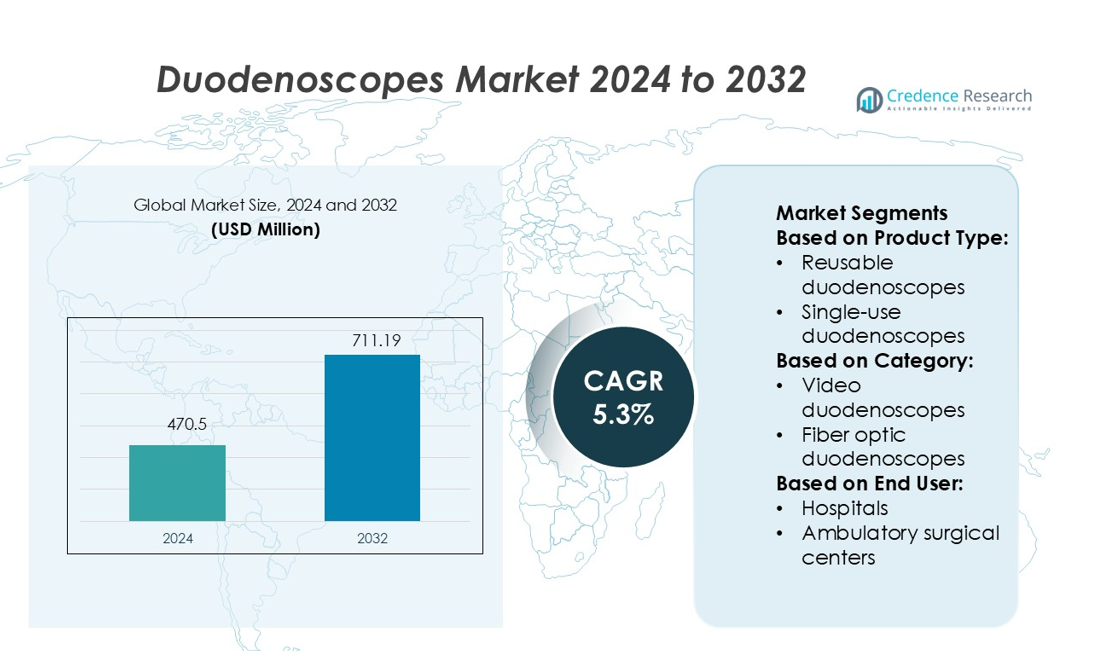
Duodenoscopes Market size was valued USD 470.5 million in 2024 and is anticipated to reach USD 711.19 million by 2032, at a CAGR of 5.3% during the forecast period.
| REPORT ATTRIBUTE | DETAILS |
|---|---|
| Historical Period | 2020-2023 |
| Base Year | 2024 |
| Forecast Period | 2025-2032 |
| Duodenoscopes Market Size 2024 | USD 470.5 million |
| Duodenoscopes Market, CAGR | 5.3% |
| Duodenoscopes Market Size 2032 | USD 711.19 million |
The duodenoscopes market is shaped by strong competition among major players such as Olympus Corporation, Arthrex, Inc., FUJIFILM Holdings Corporation, SonoScape Medical Corp., Ambu A/S, Boston Scientific Corporation, Aesculap, Inc., PENTAX Medical (Hoya Corporation), Ottomed Endoscopy, and Covidien Plc. These companies focus on advancing imaging technologies, improving device safety, and expanding their global reach through partnerships and product innovation. North America leads the global duodenoscopes market with a 36% share, driven by high procedure volumes, advanced healthcare infrastructure, and rapid adoption of single-use models. Strong investment in R&D and regulatory compliance further strengthens the region’s leadership position.
Market Insights
- The duodenoscopes market was valued at USD 470.5 million in 2024 and is projected to reach USD 711.19 million by 2032, growing at a CAGR of 5.3%.
- Rising prevalence of gastrointestinal diseases and growing demand for minimally invasive procedures are driving market expansion.
- Increasing adoption of single-use duodenoscopes and integration of advanced imaging technologies are key trends shaping the market.
- The market is highly competitive with major players focusing on innovation, strategic collaborations, and expanding product portfolios.
- North America holds a 36% market share, leading globally, while reusable duodenoscopes dominate the product segment, supported by established clinical use and cost efficiency.
Market Segmentation Analysis:
By Product Type
Reusable duodenoscopes hold the dominant market share due to their widespread use in ERCP procedures and established integration in clinical workflows. Hospitals prefer reusable models for cost efficiency and consistent imaging performance across high patient volumes. Their advanced reprocessing systems help maintain infection control while extending product life. Manufacturers are enhancing durability and ease of reprocessing to meet stricter regulatory standards. In contrast, single-use duodenoscopes are growing rapidly, driven by infection prevention initiatives and regulatory push for safer endoscopy practices.
- For instance, Olympus’s TJF-Q190V duodenoscope features a 20% expanded vertical field of view compared with the prior model, enabling improved cannulation efficiency.
By Category
Video duodenoscopes lead the category segment with a significant share, supported by their superior imaging quality and advanced diagnostic capabilities. These devices offer high-resolution visualization, which improves procedure accuracy and patient outcomes. Growing adoption of digital platforms for real-time image sharing in hospitals and clinics strengthens their market leadership. Fiber optic duodenoscopes continue to serve lower-cost and resource-limited settings but are declining in share due to the increasing preference for digital alternatives in modern endoscopy centers.
- For instance, Arthrex’s Synergy Vision imaging system delivers ultra-high-definition 4K resolution (3840 × 2160 pixels) with a 10-bit color depth and HDR support. The system also supports secure live video streaming to authorized remote viewers and image export to USB or network locations.
By End User
Hospitals dominate the end-user segment, supported by their high patient inflow, advanced endoscopy units, and strong reimbursement infrastructure. Hospitals prioritize reusable and video duodenoscopes to perform complex procedures with precision and efficiency. Strategic procurement programs and investments in sterilization facilities further reinforce their market leadership. Ambulatory surgical centers are expanding rapidly due to faster procedure turnaround and lower costs, while other end users, including specialty clinics, cater to niche patient groups with rising adoption of single-use devices.
Key Growth Drivers
Rising Prevalence of Gastrointestinal Disorders
The increasing incidence of gastrointestinal diseases, including pancreatic and biliary conditions, is a major driver of the duodenoscopes market. Hospitals and clinics are performing more endoscopic retrograde cholangiopancreatography (ERCP) procedures, which depend heavily on duodenoscopes for accurate diagnosis and treatment. The growing elderly population is further increasing demand for minimally invasive procedures. Early disease detection and improved treatment outcomes are encouraging healthcare facilities to expand endoscopy services, fueling market growth worldwide.
- For instance, Fujifilm’s new video duodenoscope model ED-840T features a 4.5 mm instrument channel and a tip outer diameter of 13.1 mm, designed to improve insertion and treat biliary and pancreatic diseases.
Shift Toward Minimally Invasive Procedures
Healthcare systems are increasingly adopting minimally invasive approaches to reduce recovery time, hospital stays, and post-surgical complications. Duodenoscopes play a critical role in enabling ERCP procedures with high precision and minimal patient discomfort. This shift is supported by advancements in imaging technology and endoscopic accessories, which improve procedural accuracy. Growing patient preference for less invasive treatments and healthcare cost reduction strategies are driving higher procedure volumes and supporting broader market adoption.
- For instance, SonoScape’s X-2600 series image processor supports 1080p full high-definition output, integrates a 2-LED multi-spectrum light source with an average lifespan of 50,000 hours.
Advancements in Endoscopic Technologies
Continuous technological innovation in duodenoscopes is enhancing clinical performance and patient safety. Advanced video duodenoscopes now offer high-resolution imaging, real-time data sharing, and improved maneuverability during procedures. Integration of infection control features and better sterilization compatibility further increase their reliability. Manufacturers are also focusing on single-use models to eliminate contamination risks. These developments strengthen physician confidence, expand clinical applications, and contribute to market growth across both developed and emerging economies.
Key Trends & Opportunities
Growing Adoption of Single-Use Duodenoscopes
The increasing emphasis on infection prevention is driving demand for single-use duodenoscopes. Hospitals are shifting toward disposable models to reduce cross-contamination risks and comply with stricter regulatory guidelines. Leading manufacturers are introducing cost-effective designs and integrating advanced imaging features to match reusable models. This trend is opening opportunities in both high-income and emerging markets, especially where infection control infrastructure is limited, creating a new growth path for device suppliers and healthcare providers.
- For instance, Ambu’s aScope™ Duodeno 2 has a working channel diameter of 4.2 mm, a distal end outer diameter of 13.7 mm and an insertion tube outer diameter of 11.5 mm.
Integration of Digital Imaging and AI Technologies
The integration of advanced imaging and artificial intelligence tools in duodenoscopes is improving clinical accuracy and decision-making. AI-powered image analysis assists in early detection of lesions and enhances procedural efficiency. Digital platforms also enable real-time data transmission, improving collaboration among healthcare teams. These technologies not only increase diagnostic precision but also reduce procedure times and complications. This creates strong growth opportunities for vendors investing in smart, connected endoscopy solutions.
- For instance, BSX benchmarks of force reductions include a 35% reduction in left/right bending force, 25% in up/down, and 25% in elevator force, compared with Generation 2 models.
Expanding Access to Endoscopy in Emerging Markets
Rising healthcare investments and infrastructure development in emerging economies are creating strong market opportunities. Governments and private providers are expanding endoscopy units to improve access to advanced diagnostics. Affordable duodenoscope models and local training programs are encouraging adoption in secondary care facilities. Growing medical tourism in regions such as Asia-Pacific and Latin America is further boosting demand, supporting market expansion beyond traditional high-income markets.
Key Challenges
High Cost of Advanced Duodenoscopes
The high purchase and maintenance costs of advanced duodenoscopes remain a major challenge, particularly for small hospitals and clinics. Video duodenoscopes and single-use models involve significant upfront investments or recurring expenses. These costs limit adoption in resource-constrained settings and create barriers for rapid market penetration. Reimbursement limitations and budget constraints further restrict access to new technologies, slowing down growth in cost-sensitive markets.
Risk of Infection and Complex Reprocessing Procedures
Despite advancements, reusable duodenoscopes carry a persistent risk of infection transmission if not properly reprocessed. Reprocessing involves multiple steps and requires specialized equipment and trained personnel. Any breach in the sterilization process can lead to contamination and patient safety concerns. These risks increase operational complexity for healthcare providers and drive stricter regulatory scrutiny. As a result, hospitals face operational burdens that may slow adoption or require costly procedural changes.
Regional Analysis
North America
North America holds the largest market share of 36% in the global duodenoscopes market, driven by advanced healthcare infrastructure and a high volume of ERCP procedures. The United States leads the region, supported by favorable reimbursement policies and rapid adoption of innovative endoscopic technologies. Growing awareness of infection control has accelerated the shift toward single-use duodenoscopes, particularly in hospitals and outpatient centers. Major players are investing in product innovation and training programs to strengthen clinical adoption. High disease prevalence and increasing healthcare spending further solidify North America’s strong position in the global market.
Europe
Europe accounts for 29% of the global duodenoscopes market, supported by well-established healthcare systems and strict infection control regulations. Countries such as Germany, France, and the UK are leading adopters of advanced video duodenoscopes and single-use models. Regulatory bodies strongly emphasize patient safety, encouraging healthcare providers to adopt disposable solutions to minimize contamination risks. Strategic collaborations between hospitals and manufacturers are enhancing procedural efficiency and access to modern endoscopy. High awareness levels among physicians and steady technological adoption contribute to the region’s strong and stable market position.
Asia-Pacific
Asia-Pacific represents 22% of the global duodenoscopes market and is the fastest-growing region. The market growth is driven by rising healthcare investments, growing patient awareness, and an increasing burden of gastrointestinal disorders. China, Japan, and India are major contributors, supported by expanding hospital networks and improved endoscopy infrastructure. Affordable device offerings and government-led healthcare programs are improving access to advanced diagnostics. Additionally, growing medical tourism in countries like India and Thailand is boosting demand. The region’s expanding healthcare capacity and rapid technology adoption position Asia-Pacific as a key future growth hub.
Latin America
Latin America holds a 7% share in the global duodenoscopes market, supported by growing investments in healthcare infrastructure and rising adoption of endoscopic procedures. Brazil and Mexico are the primary contributors, driven by increasing prevalence of gastrointestinal diseases and improving access to specialized care. Public and private healthcare providers are investing in modern endoscopy units to expand service capabilities. While reusable duodenoscopes dominate due to cost advantages, interest in single-use models is rising in larger hospitals. Economic development and healthcare modernization efforts continue to support gradual market expansion in the region.
Middle East & Africa
The Middle East & Africa region accounts for 6% of the global duodenoscopes market, driven by improving healthcare infrastructure and increasing demand for advanced diagnostic procedures. The UAE, Saudi Arabia, and South Africa are key markets, supported by growing investments in specialized care centers. High-end hospitals are adopting video and single-use duodenoscopes to enhance infection control and procedural safety. However, limited access to advanced equipment in rural areas remains a restraint. Government healthcare initiatives and private sector participation are expected to gradually expand the adoption of duodenoscopes across the region.
Market Segmentations:
By Product Type:
- Reusable duodenoscopes
- Single-use duodenoscopes
By Category:
- Video duodenoscopes
- Fiber optic duodenoscopes
By End User:
- Hospitals
- Ambulatory surgical centers
By Geography
- North America
- U.S.
- Canada
- Mexico
- Europe
- Germany
- France
- U.K.
- Italy
- Spain
- Rest of Europe
- Asia Pacific
- China
- Japan
- India
- South Korea
- South-east Asia
- Rest of Asia Pacific
- Latin America
- Brazil
- Argentina
- Rest of Latin America
- Middle East & Africa
- GCC Countries
- South Africa
- Rest of the Middle East and Africa
Competitive Landscape
The duodenoscopes market is characterized by strong competition among key players including Olympus Corporation, Arthrex, Inc., FUJIFILM Holdings Corporation, SonoScape Medical Corp., Ambu A/S, Boston Scientific Corporation, Aesculap, Inc., PENTAX Medical (Hoya Corporation), Ottomed Endoscopy, and Covidien Plc. The duodenoscopes market is highly competitive, driven by rapid technological advancements and rising clinical demand. Manufacturers are focusing on improving visualization, maneuverability, and infection control features to enhance procedural safety and efficiency. Single-use duodenoscopes are gaining strong momentum as healthcare providers aim to reduce contamination risks and comply with stricter regulatory guidelines. Companies are actively investing in product development, strategic collaborations, and global distribution expansion to strengthen their market presence. Growing emphasis on training programs, after-sales support, and cost-effective product offerings is further intensifying competition.
Key Player Analysis
- Olympus Corporation
- Arthrex, Inc.
- FUJIFILM Holdings Corporation
- SonoScape Medical Corp.
- Ambu A/S
- Boston Scientific Corporation
- Aesculap, Inc.
- PENTAX Medical (Hoya Corporation)
- Ottomed Endoscopy
- Covidien Plc
Recent Developments
- In August 2024, KARL STORZ United States partnered with FUJIFILM Healthcare Americas Corporation (Fujifilm) to provide comprehensive solutions for endoscopists and surgeons.
- In August 2024, PENTAX Medical, a division of HOYA group, announced that it has received FDA clearance for their DEC Duodenoscope compatible with the STERRAD 100NX Sterilizer, a product of Advanced Sterilization Products (ASP). This partnership between Pentax and ASP may enable to improve the ongoing challenges of duodenoscope reprocessing.
- In July 2024, FUJIFILM India opened a new endoscopy center in Mumbai. This center is FUJIFILM’s second-largest unit, equipped with repair tools and technology that aim to reduce service turnaround times.
- In April 2024, Ambu announced that it has received FDA clearance for its new generation duodenoscopy solution, Ambu aScope Duodeno 2 and Ambu aBox 2, to be used in ERCP procedures. This development may allow company to expand its product basket and enhance its industry presence
Report Coverage
The research report offers an in-depth analysis based on Product Type, Category, End-User and Geography. It details leading market players, providing an overview of their business, product offerings, investments, revenue streams, and key applications. Additionally, the report includes insights into the competitive environment, SWOT analysis, current market trends, as well as the primary drivers and constraints. Furthermore, it discusses various factors that have driven market expansion in recent years. The report also explores market dynamics, regulatory scenarios, and technological advancements that are shaping the industry. It assesses the impact of external factors and global economic changes on market growth. Lastly, it provides strategic recommendations for new entrants and established companies to navigate the complexities of the market.
Future Outlook
- Demand for minimally invasive procedures will continue to increase worldwide.
- Single-use duodenoscopes will gain wider adoption due to infection control measures.
- Technological advancements will enhance imaging quality and procedural precision.
- Integration of AI and digital tools will support real-time diagnostics.
- Hospitals will expand endoscopy units to meet rising patient volumes.
- Emerging markets will experience faster growth due to infrastructure development.
- Regulatory bodies will enforce stricter safety and sterilization standards.
- Strategic partnerships will strengthen global product distribution.
- Training programs will increase physician adoption of advanced scopes.
- Competition will drive innovation and faster product launches.

Request a Free Sample
Fill in your details and we'll send you a free sample report.
- Sample data tables & charts
- Research methodology
Need a Custom Version of This Report?
Tailor the scope, geography, or segments to your exact requirements.
- Custom geography or segment scope
- Direct access to our analyst team
Frequently Asked Questions
What is the current market size for Duodenoscopes Market, and what is its projected size in 2032?
At what Compound Annual Growth Rate is the Duodenoscopes Market projected to grow between 2025 and 2032?
Which Duodenoscopes Market segment held the largest share in 2024?
What are the primary factors fueling the growth of the Duodenoscopes Market?
Who are the leading companies in the Duodenoscopes Market?
Which region commanded the largest share of the Duodenoscopes Market in 2024?
Table of Content
Chapter 1 Market Segmentation
- 1.1 Segmentation Framework
- 1.1.1 Product and Service Classification
- 1.1.2 Application and End-Use Classification
- 1.1.3 Technology and Solution Classification
- 1.1.4 Customer and Distribution Channel Classification
- 1.1.5 Geographic Segmentation
- 1.1.6 Market Segment Definitions and Boundaries
Chapter 2 Introduction
- 2.1 Report Objectives and Scope
- 2.2 Product Definition and Industry Terminology
- 2.3 Market Inclusions and Exclusions
- 2.4 Research Process
- 2.4.1 Primary Research and Expert Interviews
- 2.4.2 Secondary Research and Source Review
- 2.4.3 Top-Down and Bottom-Up Estimation
- 2.4.4 Data Triangulation and Verification
- 2.5 Market Size Measurement Basis
- 2.5.1 2024: USD 470.5 million → 2032: USD 711.19 million
- 2.6 Historical and Forecast Reference Periods
- 2.6.1 Base Year: 2024
- 2.6.2 Forecast Period: 2024-2032
- 2.7 Research Assumptions and Limitations
Chapter 3 Executive Summary
- 3.1 Market Snapshot and Key Findings
- 3.2 Base-Year Market Size, 2024
- 3.3 Forecast Market Size, 2032
- 3.4 Revenue and Volume Growth Outlook
- 3.5 Key Demand and Supply Indicators
- 3.6 Leading Market Segments
- 3.7 Fastest-Growing Market Opportunities
- 3.8 Regional Performance Highlights
- 3.9 Technology and Industry Transformation
- 3.10 Competitive Landscape Summary
- 3.11 Analyst View and Strategic Implications
Chapter 4 Global Duodenoscopes Market Trends and Developments
- 4.1 Historical Industry Development
- 4.2 Recent Market Trends and Developments
- 4.3 Demand and Customer Behavior Trends
- 4.4 Technology and Product Innovation
- 4.5 Artificial Intelligence, Automation and Digitalization
- 4.6 Local Manufacturing and Supply Chain Realignment
- 4.7 Industry Partnerships, Mergers and Acquisitions
- 4.8 Sustainability and Circular Economy Developments
- 4.9 Government and Private Sector Investment Trends
- 4.10 Emerging Business Models and Commercialization
- 4.11 Industry Developments and Announcements
Chapter 5 Global Duodenoscopes Market Production, Supply and Demand Analysis
- 5.1 Demand Trend and Consumption Analysis
- 5.2 Demand Forecast, 2024-2032
- 5.3 Production and Output Trend
- 5.4 Production and Output Forecast, 2024-2032
- 5.5 Installed Capacity and Capacity Utilization
- 5.6 Company-Wise Production Plants and Statistics
- 5.6.1 Installed Production Capacity
- 5.6.2 Actual Production
- 5.6.3 Planned Capacity and Expansion Targets
- 5.7 Supply Chain Structure and Procurement Trends
- 5.8 Supply-Demand Gap and Bottlenecks
- 5.9 Import Dependence and Sourcing Structure
- 5.10 Contract Manufacturing and Outsourcing
- 5.11 Regional Supply and Demand Concentration
Chapter 6 Global Duodenoscopes Market Pricing Analysis
- 6.1 Pricing Structure and Measurement
- 6.2 Historical Pricing Trends
- 6.3 Pricing Outlook, 2024-2032
- 6.4 Average Selling Price and Unit Economics
- 6.5 Pricing by Product and Market Segment
- 6.6 Geographic Pricing Differences
- 6.7 Key Input, Energy, Labor and Logistics Costs
- 6.8 Contract Pricing and Purchasing Models
- 6.9 Pricing Sensitivity and Competitive Positioning
- 6.10 Price, Margin and Profitability Implications
Chapter 7 Global Duodenoscopes Market Dynamics
- 7.1 Market Growth Drivers
- 7.1.1 Demand-Side Drivers
- 7.1.2 Technology and Innovation Drivers
- 7.1.3 Infrastructure and Investment Drivers
- 7.1.4 Regulatory and Policy Drivers
- 7.2 Market Restraints
- 7.2.1 Cost and Affordability Constraints
- 7.2.2 Technology and Adoption Barriers
- 7.2.3 Supply Chain and Operational Constraints
- 7.3 Market Challenges
- 7.3.1 Competitive Pressure and Margin Erosion
- 7.3.2 Skills, Infrastructure and Implementation Gaps
- 7.4 Emerging Market Opportunities
- 7.5 Market Dynamics Impact and Time-Horizon Assessment
Chapter 8 Global Duodenoscopes Value Chain Analysis
- 8.1 Industry Value Chain Overview
- 8.2 Upstream Suppliers and Critical Inputs
- 8.3 Technology and Component Providers
- 8.4 Manufacturing or Service Delivery
- 8.5 Distribution, Channel Partners and Integrators
- 8.6 Downstream Applications and End Users
- 8.7 Value Addition and Profit Pools
- 8.8 Vertical Integration and Outsourcing
- 8.9 Supplier Concentration and Risk
- 8.10 Supply Chain Localization and Resilience
Chapter 9 Global Duodenoscopes Market Regulations and Policies
- 9.1 Relevant Laws, Standards and Compliance Frameworks
- 9.2 Product, Service, Safety and Quality Requirements
- 9.3 Government Policies, Incentives and Subsidies
- 9.4 Imports, Exports and Trade Barriers
- 9.5 Public Procurement and Local Content Requirements
- 9.6 Environmental and Sustainability Compliance
- 9.7 Upcoming Policy Changes and Market Implications
Chapter 10 Global Duodenoscopes Market Hotspots and Opportunities
- 10.1 Market Opportunity Mapping and Growth Hotspots
- 10.2 High-Growth Applications and Customer Groups
- 10.3 Underserved Markets and White-Space Opportunities
- 10.4 Emerging Technology and Product Opportunities
- 10.5 New Capacity and Investment Hotspots
- 10.6 Market Entry and Expansion Opportunities
- 10.7 Distribution and Partnership Opportunities
- 10.8 Near-Term and Long-Term Commercial Potential
- 10.9 Opportunity Attractiveness and Execution Risks
Chapter 11 Global Duodenoscopes Market Outlook, 2024-2032
- 11.1 Market Size and Analysis
- 11.1.1 Revenue (Market Measurement: 2024: USD 470.5 million → 2032: USD 711.19 million)
- 11.1.2 Market Volume and Quantity Sold
- 11.1.3 Historical Market Size
- 11.1.4 Base-Year Market Size, 2024
- 11.2 Market Forecast, 2024-2032
- 11.2.1 Revenue Forecast to 2032
- 11.2.2 Volume Forecast to 2032
- 11.2.3 CAGR and Year-on-Year Growth
- 11.2.4 Incremental Revenue Opportunity
- 11.3 Forecast Assumptions and Scenario Analysis
- 11.3.1 Base-Case Forecast
- 11.3.2 Optimistic and Conservative Scenarios
- 11.3.3 Technology, Pricing and Policy Sensitivities
- 11.4 Market Attractiveness and Growth Outlook
Chapter 12 Global Duodenoscopes Market Segmentation and Outlook
- 12.1 Segmentation Summary and Market Shares, 2024
- 12.2 Largest and Fastest-Growing Segments
- 12.3 Segment Growth Comparison
- 12.4 Segment Attractiveness and Priority Matrix
Chapter 13 Global Duodenoscopes Geographic Market Outlook, 2024-2032
- 13.1 Regional Market Size and Share, 2024
- 13.2 Regional Market Forecast, 2024-2032
- 13.3 Regional Pricing, Production and Demand Differences
- 13.4 North America
- 13.4.1 United States
- 13.4.2 Canada
- 13.4.3 Mexico
- 13.5 Europe
- 13.5.1 Germany
- 13.5.2 France
- 13.5.3 Italy
- 13.5.4 United Kingdom
- 13.5.5 Spain
- 13.5.6 Poland
- 13.5.7 Russia
- 13.5.8 Netherlands
- 13.5.9 Belgium
- 13.5.10 Sweden
- 13.5.11 Denmark
- 13.5.12 Norway
- 13.5.13 Rest of Europe
- 13.6 Asia Pacific
- 13.6.1 China
- 13.6.2 India
- 13.6.3 Japan
- 13.6.4 South Korea
- 13.6.5 Thailand
- 13.6.6 Indonesia
- 13.6.7 Vietnam
- 13.6.8 Malaysia
- 13.6.9 Australia
- 13.6.10 Rest of Asia Pacific
- 13.7 Latin America
- 13.7.1 Brazil
- 13.7.2 Argentina
- 13.7.3 Colombia
- 13.7.4 Chile
- 13.7.5 Rest of Latin America
- 13.8 Middle East
- 13.8.1 Saudi Arabia
- 13.8.2 United Arab Emirates
- 13.8.3 Turkey
- 13.8.4 Israel
- 13.8.5 Iran
- 13.8.6 Rest of the Middle East
- 13.9 Africa
- 13.9.1 South Africa
- 13.9.2 Egypt
- 13.9.3 Nigeria
- 13.9.4 Morocco
- 13.9.5 Rest of Africa
- 13.10 Regional Investment, Policy and Supply Chain Differences
- 13.11 Regional Competitive Landscape
- 13.12 Geographic Growth Hotspots
Chapter 14 Global Duodenoscopes Technology, Innovation and Sustainability Outlook
- 14.1 Technology Landscape and Maturity
- 14.2 Product, Process and Service Innovation
- 14.3 AI, Automation and Digital Tools in the Industry
- 14.4 Technology Adoption and Performance Benchmarking
- 14.5 Innovation Pipeline and R&D Investment
- 14.6 Patent and Intellectual Property Trends
- 14.7 Energy Efficiency and Resource Management
- 14.8 Sustainability, Recycling and Circularity
- 14.9 Technology Roadmap, 2024-2032
- 14.10 Risks of Obsolescence and Technology Substitution
Chapter 15 Global Duodenoscopes Market Key Strategic Imperatives
- 15.1 Growth and Market Entry Priorities
- 15.2 High-Return Products and Segments
- 15.3 Pricing, Profitability and Cost Optimization
- 15.4 Technology Investment and Product Differentiation
- 15.5 Supply Chain Localization and Resilience
- 15.6 Distribution and Customer Acquisition
- 15.7 Partnership, Acquisition and Capacity Strategy
- 15.8 Regional Expansion Priorities
- 15.9 Short-, Medium- and Long-Term Actions
Chapter 16 Competition Outlook
- 16.1 Industry Competition Characteristics
- 16.2 Market Structure and Concentration
- 16.3 Market Share and Competitive Positioning, 2024
- 16.4 Company-Wise Revenue and Product Benchmarking
- 16.5 Production and Service Capacity Benchmarking
- 16.6 Technology, Pricing and Differentiation
- 16.7 Regional Footprint and Distribution Strength
- 16.8 Mergers, Acquisitions and Strategic Alliances
- 16.9 New Entrants and Competitive Threats
- 16.10 Porter's Five Forces and Industry Attractiveness
- 16.11 Competitive Outlook, 2024-2032
Chapter 17 Company Profiles
- 17.1 Company Coverage and Selection Criteria
- 17.2 Leading Market Participants – Standard Profile Structure
- 17.2.1 Business Description
- 17.2.2 Company Ownership and Geographic Presence
- 17.2.3 Product and Service Portfolio
- 17.2.4 Manufacturing and Operating Footprint
- 17.2.5 Production Capacity and Expansion Plans
- 17.2.6 Financial Performance and Investment
- 17.2.7 Market Share and Competitive Position
- 17.2.8 Technology and Innovation Capabilities
- 17.2.9 Strategic Alliances or Partnerships
- 17.2.10 Recent Developments
- 17.2.11 Growth Strategy and Outlook
- 17.3 Other Relevant Market Participants
Note: Every listed company is profiled on the structure shown under the first company. The company list is preliminary and may change based on research findings, market developments, data availability and client requirements.
Chapter 18 Disclaimer
- 18.1 Research and Forecast Disclaimer
- 18.2 Data Source and Estimation Limitations
Note: The depth of individual sections depends on data availability for this market. Volume, capacity, trade and other unit-based metrics are included where applicable.

