
Mobile video audiences pull brand budgets online in Egypt
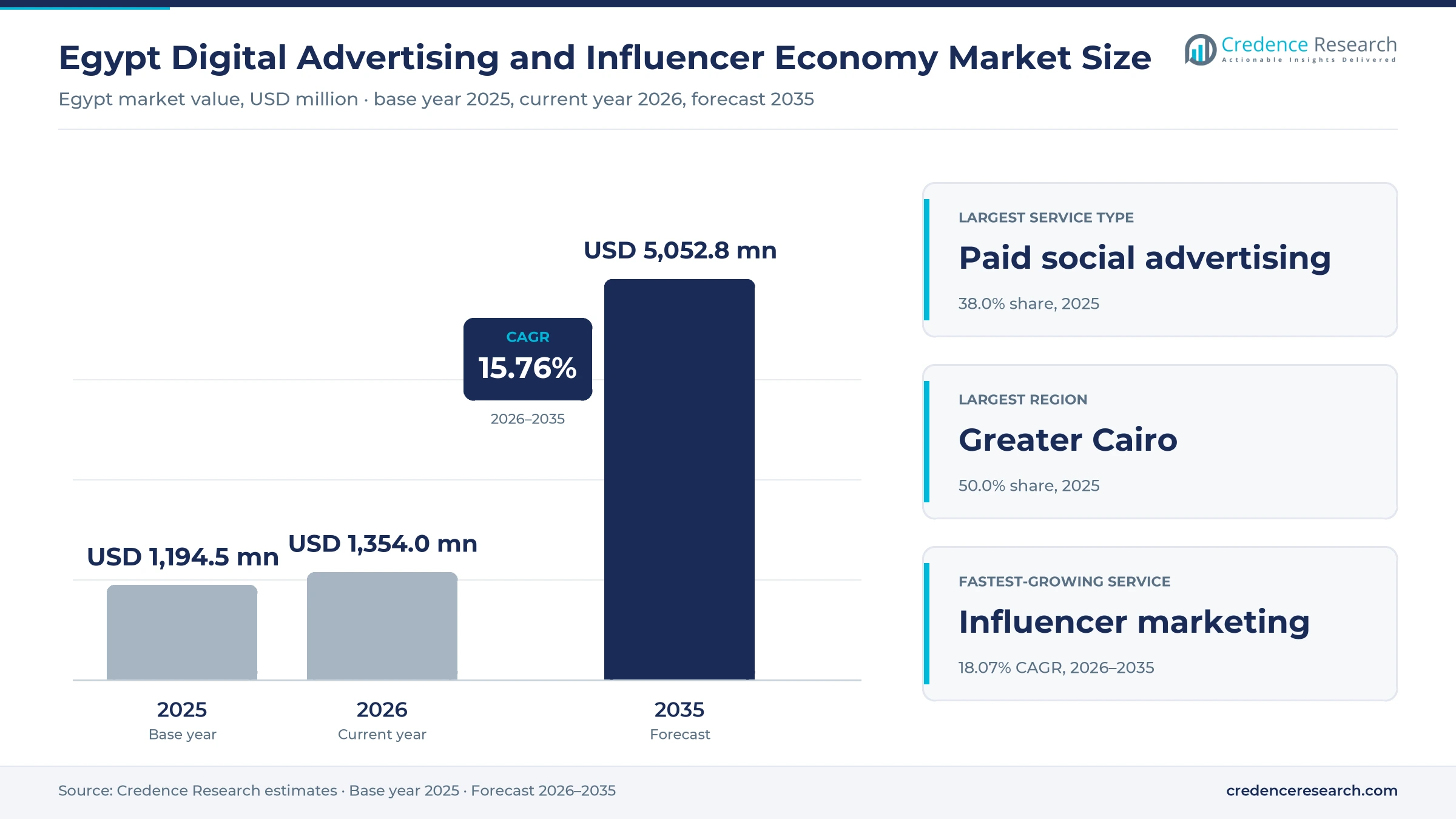
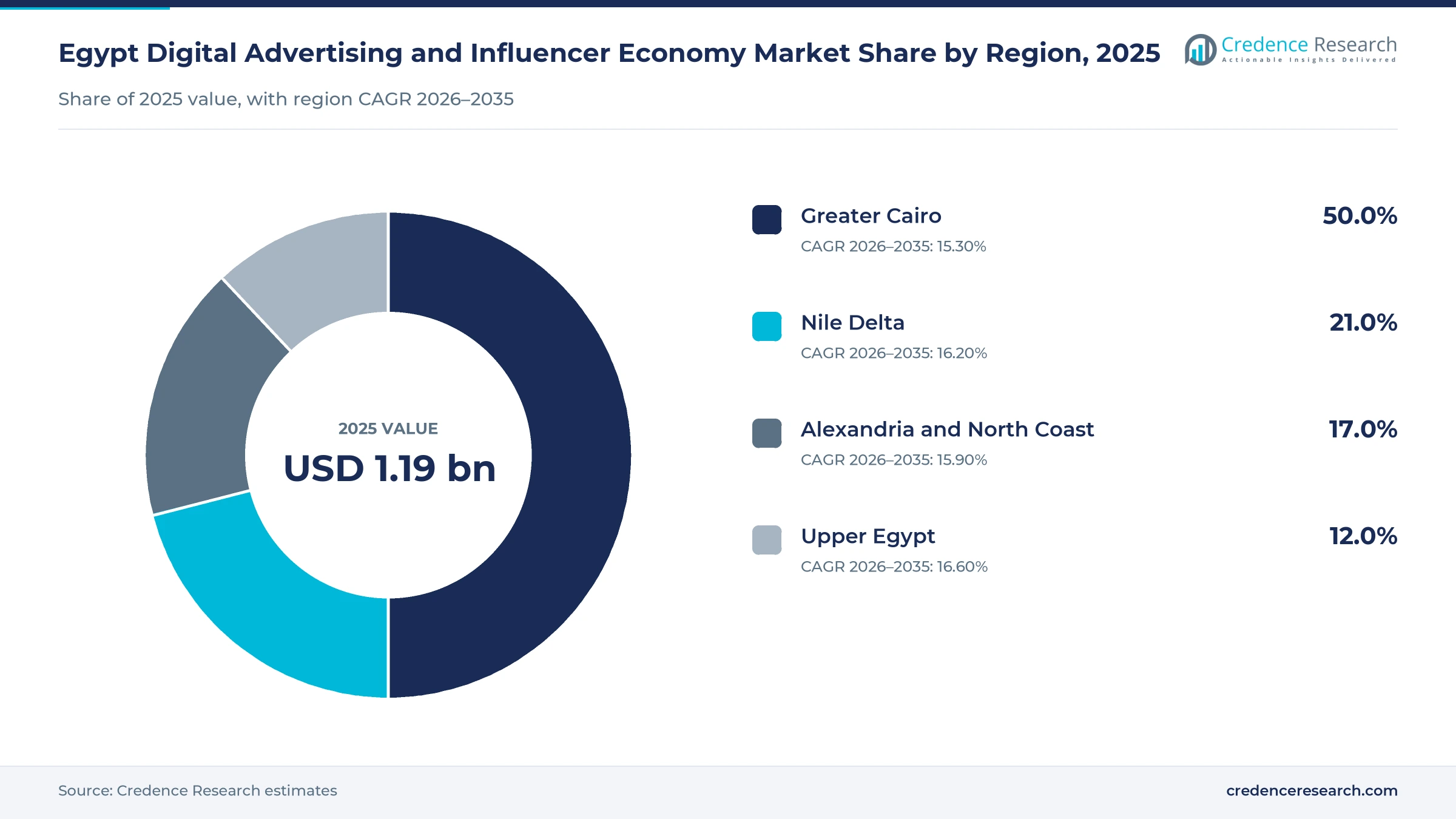
The Egypt digital advertising and influencer economy market was valued at USD 1.19 billion in 2025 and is projected to increase from USD 1.35 billion in 2026 to USD 5.05 billion by 2035, registering a CAGR of 15.76% during 2026–2035. Demand comes from consumer brands, online sellers, banks and telecom operators that move budgets from television and print to social feeds, search results, online video and creator partnerships. Greater Cairo held the largest regional share, 50.0% in 2025, because most brand headquarters, media agencies and production studios sit in the capital region. Upper Egypt is the fastest-growing region at 16.60% a year, as mobile internet use spreads to younger audiences in southern governorates. In turn, Egypt issued the executive regulations of its personal data protection law in November 2025, which require prior consent for electronic marketing and push advertisers toward first-party data and licensed campaigns.
Which paid media and creator services does the estimate cover?
The estimate measures spending by advertisers in Egypt on paid social placements, search ads, programmatic display and video, and influencer marketing, including the fees paid to agencies, platforms and creators. It covers campaigns bought by multinational and national brands, online sellers and public-sector advertisers through agencies, self-service tools and direct creator deals.
The estimate excludes television, radio, print and outdoor media, unpaid organic posts and spending by Egyptian brands on audiences outside the country. The value chain runs from advertisers and agencies through ad platforms, publishers and creator networks to the audiences who view and act on each campaign.
Egypt Digital Advertising and Influencer Economy Market Insights
- The Egypt digital advertising and influencer economy market was valued at USD 1.19 billion in 2025 and is projected to reach USD 5.05 billion by 2035, registering a CAGR of 15.76% during 2026–2035.
- Greater Cairo held a 50.0% share of 2025 value, because most brand headquarters, agencies and production studios operate in the capital region.
- Paid social advertising led with a 38.0% share of 2025 value, because Facebook, TikTok and Instagram reach most connected adults in Egypt.
- Egypt had 98.2 million internet users at the end of 2025, equal to 82.7% of the population, according to DataReportal figures published in November 2025.
- Influencer marketing grows fastest at 18.07% a year during 2026–2035, as brands shift budget toward creators on short-form video platforms.
Paid social leads while creator marketing grows fastest
Why does paid social take the largest share of spend?
Based on service type, the market is categorized into paid social advertising, search advertising, programmatic display and video, and influencer marketing. Paid Social Advertising led with a 38.0% share of 2025 value, because social feeds reach most connected adults at low entry prices. Influencer Marketing grows fastest at 18.07% a year, as brands pay creators to explain products in short videos.
How do national and multinational brands split budgets?
Based on customer type, the market is categorized into multinational consumer brands, national consumer brands, digital-native and e-commerce brands, and government and public-sector advertisers. National Consumer Brands led with a 36.0% share of 2025 value, because large local food, property and telecom groups advertise heavily online. Digital-Native and E-commerce Brands grow fastest at 17.65% a year, as online sellers buy performance campaigns.
Which industries spend the most on online campaigns?
Based on end-use industry, the market is categorized into retail and e-commerce, food and beverage, financial services and travel and hospitality. Retail and E-commerce led with a 34.0% share of 2025 value, because retailers run constant sales campaigns that drive clicks to stores and apps. Financial Services grow fastest at 16.82% a year, as banks and payment apps compete for new wallet users.
How are campaigns bought and managed?
Based on delivery model, the market is categorized into agency-managed campaigns, platform self-service buying, creator-direct partnerships and hybrid managed-service programs. Agency-Managed Campaigns led with a 48.0% share of 2025 value, because large brands rely on agencies for planning, buying and reporting. Creator-Direct Partnerships grow fastest at 18.18% a year, as brands sign creators directly for long-term content deals.
| Segment Group | Leading Sub-segment | Share, 2025 | Fastest-growing Sub-segment | CAGR, 2026–2035 |
|---|---|---|---|---|
| By Service Type | Paid Social Advertising | 38.0% | Influencer Marketing | 18.07% |
| By Customer Type | National Consumer Brands | 36.0% | Digital-Native and E-commerce Brands | 17.65% |
| By End-Use Industry | Retail and E-commerce | 34.0% | Financial Services | 16.82% |
| By Delivery Model | Agency-Managed Campaigns | 48.0% | Creator-Direct Partnerships | 18.18% |
Request a Free Sample
Fill in your details and we'll send you a free sample report.
- Sample data tables & charts
- Research methodology
Wider online reach and short video drive ad demand
How does a wider online audience expand ad spending?
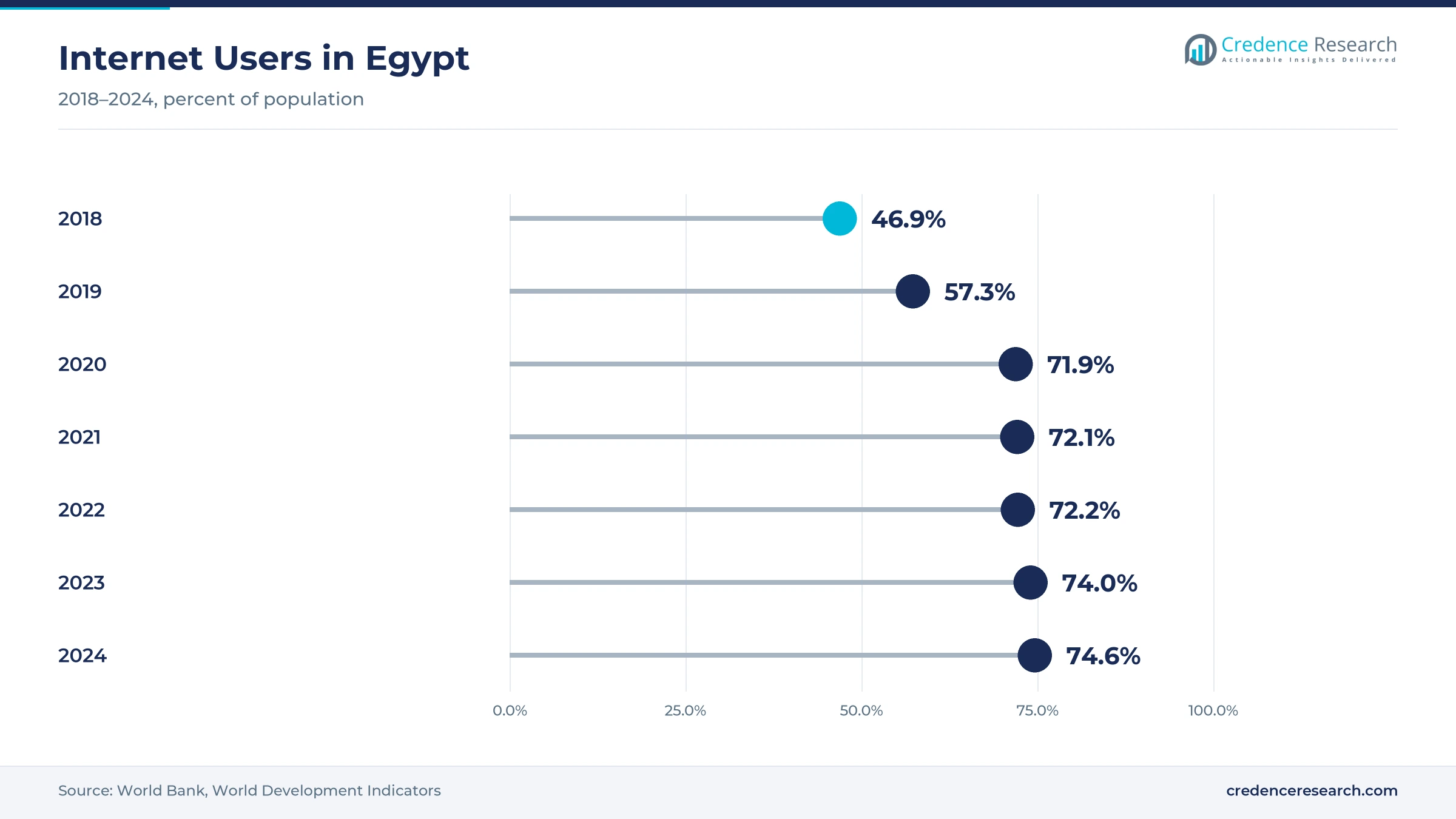
Expansion of addressable online audiences lifts spending, because every new connected adult can be reached by targeted social, search and video campaigns. Egypt had 98.2 million internet users at the end of 2025, or 82.7% of the population, according to DataReportal. The same source counts 121 million cellular connections, equal to 102% of the population, which shows that most adults now browse on phones. Individuals using the internet rose from 46.9% of the population in 2018 to 74.6% in 2024, according to the World Bank. As a result, paid social advertising holds 38.0% of 2025 value, because brands follow audiences into the feeds where they spend most time.
Why does short-form video and creator viewing shift budgets?
Short-form video and creator consumption shift budgets, because young Egyptians now discover products through clips posted by creators they follow. TikTok reached 48.8 million adults in Egypt in late 2025, or 65.5% of people aged 18 and above, while YouTube reached 49.3 million users. Online streaming in Egypt drew 41 million viewers a day during the peak Ramadan season, with 14 million hours watched daily, according to figures from the telecom regulator cited by Ahram Online. That viewing level was 41% higher than a year earlier. In turn, influencer marketing grows at 18.07% a year during 2026–2035.
How does a growing online services base create new advertisers?
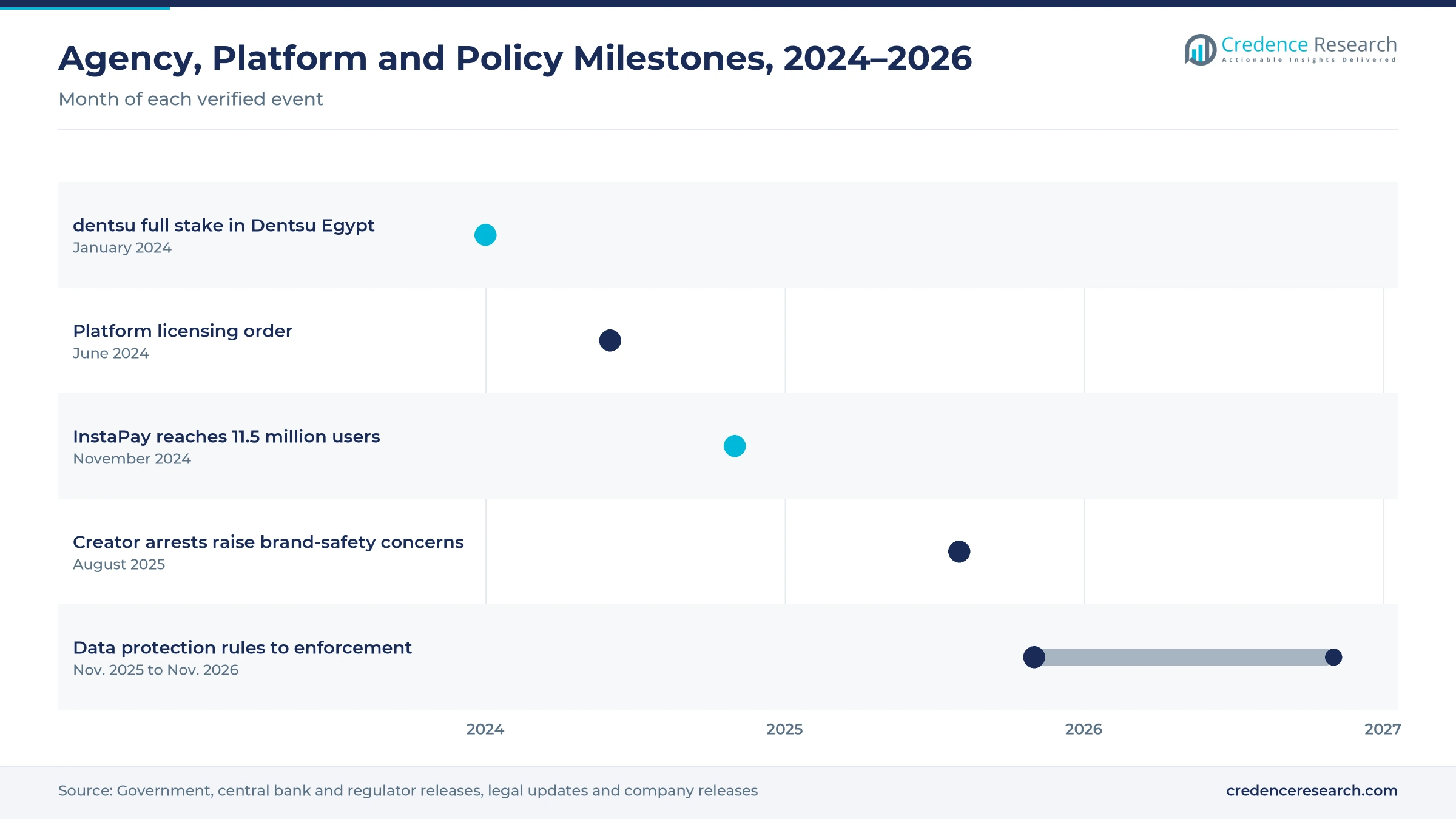
Expansion of Egypt's online services ecosystem creates new advertisers, because banks, wallets, delivery apps and public services all need users to download and transact. The ICT sector grew 13.76% in real terms in fiscal 2024/25, and digital exports reached $7.4 billion in 2025, according to Zawya. The Digital Egypt platform served 10.4 million users in 2025, up from 8.1 million in 2024, and handled 23.8 million transactions. The InstaPay instant payment app reached 11.5 million users within two years, according to the central bank in November 2024. As a result, financial services grow at 16.82% a year, as fintech apps compete for wallet users.
Why do network agencies and ad-tech firms deepen services?
Network agencies and ad-tech firms deepen campaign services, because global owners now invest in Cairo teams that plan, create and buy media for the wider region. dentsu acquired a 100% stake in its Egyptian subsidiary, Dentsu Egypt, in a deal reported in January 2024, after first buying 51% in 2016. Digital Republic, headquartered in Cairo with a team of 80 at the time, joined the dentsu network in May 2016. ArabyAds, founded in Egypt in 2013, raised $30 million in August 2022 and keeps a technology hub in the country. In turn, agency-managed campaigns hold 48.0% of 2025 value, as large brands buy integrated services.
Creator commerce, consent rules and speed reshape spend
How is the rise of creator commerce changing campaigns?
The rise of creator commerce is changing campaigns, because brands now pay for sales and app installs that creators generate, not only for views. ArabyAds offers platforms for influencer marketing, coupon-based advertising, retail media and live commerce across the Middle East and North Africa. Facebook reached 51.6 million users in Egypt in late 2025, while Instagram reached 21.7 million, which gives sellers large audiences for shoppable posts. Social media user identities reached 51.6 million in October 2025, or 43.4% of the population. As a result, digital-native and e-commerce brands grow at 17.65% a year, as e-commerce sellers reward creators by results.
Why is the shift to consent-based data significant?
The shift to consent-based data is significant, because advertisers must now prove that people agreed to receive marketing messages. Egypt issued the executive regulations of its personal data protection law on Nov. 1, 2025, under Ministerial Decision No. 816/2025, according to CMS. The rules require prior consent for electronic direct marketing, clear sender identity, a free opt-out and a specific license. Enforcement is expected to begin on Nov. 1, 2026, under a strict reading of the one-year grace period. In turn, brands shift spending toward platform-native targeting and programmatic media buying that relies on consented data.
Can faster mobile networks open richer video formats?
Faster mobile networks can open richer video formats, because higher speeds let viewers stream longer clips and live sessions without buffering. Median mobile download speed in Egypt reached 56.45 Mbps at the end of 2025, while median fixed broadband speed reached 89.84 Mbps. YouTube ad reach of 49.3 million users gives brands a large audience for longer product demonstrations and serialized content. Online streaming peaks during Ramadan already bring millions of daily viewers to video platforms. As a result, programmatic display and video formats gain share of brand budgets, as advertisers test shoppable live streams and connected television placements.
Is vetted creator management an opening for agencies?
Vetted creator management offers an opening for agencies, because brands want creators who are tax-registered, compliant and safe to work with. The Egyptian Tax Authority asked content creators to register for income tax in September 2021 and required value-added tax registration above EGP 500,000 in annual revenue. Egyptian authorities arrested several TikTok creators in August 2025 over content they said violated family values, which raised brand-safety concerns. The media regulator also told online platforms in June 2024 to obtain licenses. In turn, creator-direct partnerships grow at 18.18% a year, supported by social media analytics that screen creator audiences.
Content rules, measurement gaps and costs pressure buyers
How do content rules raise campaign risk?
Content rules raise campaign risk, because creators and platforms can face legal action over posts that authorities consider offensive. As a result, brands worry that a sponsored creator could be arrested or banned in the middle of a campaign. Advertisers respond with stricter contracts, content reviews before posting and wider creator rosters that spread risk. In turn, agencies that vet creators carefully win more long-term brand mandates.
Why do measurement gaps weaken buyer confidence?
Measurement gaps weaken buyer confidence, because many campaigns rely on platform-reported numbers that brands cannot check independently. In turn, fake followers and inflated views make influencer prices hard to judge. Advertisers respond with audience audits, promo codes, tracked links and sales-based payment terms that tie fees to results. As a result, performance buying and verified creator networks gain ground over simple reach deals.
How do currency swings affect media pricing?
Currency swings affect media pricing, because many global platforms price ads in dollars while Egyptian brands earn in pounds. As a result, campaign costs can rise sharply when the pound weakens, which squeezes local budgets. Advertisers respond by shifting to local creators, cheaper formats and shorter campaigns that deliver quick sales. In turn, agencies with strong local production teams can protect client budgets better than rivals.
Why does talent competition squeeze agency margins?
Talent competition squeezes agency margins, because skilled media buyers, data analysts and video editors are often hired by Gulf agencies and global platforms. In turn, Cairo agencies must raise salaries to keep staff, which cuts profit on fixed-fee retainers. Agencies respond with training programs, automation tools and regional hub roles that keep talent in Cairo while serving clients across the Middle East and North Africa.
Greater Cairo leads while Upper Egypt grows fastest
| Region | Value, 2025 (USD billion) | Share, 2025 | CAGR, 2026–2035 |
|---|---|---|---|
| Greater Cairo | 0.60 | 50.0% | 15.30% |
| Nile Delta | 0.25 | 21.0% | 16.20% |
| Alexandria and North Coast | 0.20 | 17.0% | 15.90% |
| Upper Egypt | 0.14 | 12.0% | 16.60% |
Why does Greater Cairo hold the top share?
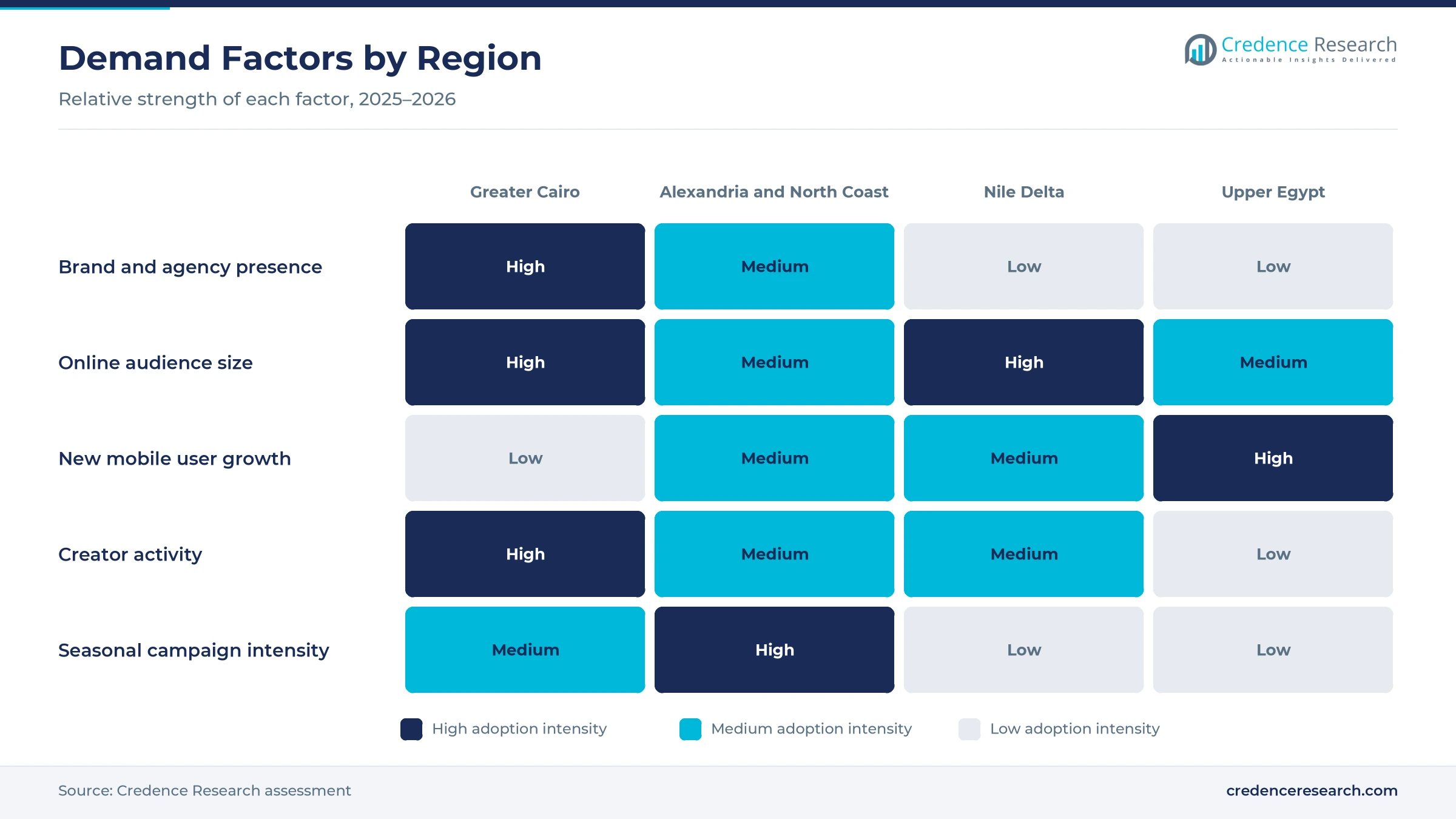
Greater Cairo held a 50.0% share of 2025 value and grows at 15.30% a year, because most multinational and national brands, media agencies and production studios work from the capital region. Dentsu Egypt and Digital Republic both run their teams from Cairo, which keeps planning and buying close to clients. The capital also hosts the largest base of affluent online shoppers. As a result, Greater Cairo remains the main hub for campaign spending and creator production.
How is the Nile Delta adding online audiences?
The Nile Delta held a 21.0% share of 2025 value and grows at 16.20% a year, because its dense population and growing towns add many new mobile internet users each year. National food, retail and telecom brands target Delta audiences with Arabic-language social and video campaigns. Creators from Delta cities also build large local followings on short video apps. In turn, the region gains spending from both national brands and local sellers.
Why does Alexandria and the North Coast attract seasonal campaigns?
Alexandria and North Coast held a 17.0% share of 2025 value and grows at 15.90% a year, because Alexandria is a major commercial city and the coast draws heavy summer tourism. Travel, property and food brands run seasonal campaigns aimed at summer visitors. Local creators also promote resorts, events and restaurants during peak months. As a result, spending in the region rises sharply during summer.
How fast is Upper Egypt growing?
Upper Egypt held a 12.0% share of 2025 value and grows fastest at 16.60% a year, because mobile internet use is spreading quickly among younger audiences in southern governorates. Brands that once relied on television now reach these viewers through short video and social feeds at lower cost. Government and banking campaigns also target new wallet and e-service users in the south. In turn, the region adds share from a smaller base.
Agency deals, platform rules and payment milestones
| Development | Status and market relevance |
|---|---|
| In August 2025, Egyptian authorities arrested several TikTok creators over content they said violated family values, raising brand-safety concerns for sponsors. | Pushes brands toward vetted creator rosters |
| In November 2025, Egypt introduced the executive regulations of its personal data protection law under Ministerial Decision No. 816/2025. | Requires consent and licensing for electronic marketing |
| In November 2025, DataReportal reported 98.2 million internet users in Egypt and TikTok ad reach of 48.8 million adults. | Confirms a large mobile video audience |
| In December 2025, the Egyptian Cabinet announced that the Digital Egypt platform expanded to 10.4 million users in 2025, up from 8.1 million. | Widens the base of online service users |
| In September 2026, the Information and Decision Support Center announced 13.76% real ICT sector growth for fiscal 2024/25. | Signals a growing online services base |
Short video, ad tech and payments tools drive campaigns
- Short-form video tools let creators and brands publish vertical clips quickly, which suits mobile viewers who scroll through feeds many times a day.
- Programmatic platforms buy display and video impressions automatically across publishers, which lets brands target audiences by interest and location.
- Coupon and affiliate tracking links each sale to the creator or publisher that drove it, which supports pay-for-results deals with online sellers.
- Consent management tools record user permissions for marketing messages, which helps advertisers comply with the new data protection rules.
Need a Custom Version of This Report?
Tailor the scope, geography, or segments to your exact requirements.
- Custom geography or segment scope
- Direct access to our analyst team
Network agencies and ad-tech firms compete on reach and data
Competition is led by global network agencies with Cairo teams, alongside regional ad-tech firms, independent creative shops and creator networks. dentsu competes through Dentsu Egypt, which it fully acquired in 2024 and which offers creative, media, social and content services to automotive, banking, consumer goods and telecom clients. Digital Republic, headquartered in Cairo, adds creative and technology work for consumer brands within the dentsu network. ArabyAds competes with influencer marketing, coupon-based advertising and retail media platforms built by a team that began in Egypt. Rivals compete on audience reach, creator rosters, data tools, production speed and pricing. Because brands now judge campaigns by sales and installs, agencies that combine media buying, creator management and measurement usually win larger mandates.
Which agencies and platforms run Egyptian campaigns?
| Company | Type | Role in the market |
|---|---|---|
| dentsu | Global agency network | Fully owns Dentsu Egypt, serving automotive, banking, consumer goods and telecom clients |
| Digital Republic | Creative and technology agency | Headquartered in Cairo within the dentsu network |
| ArabyAds | Ad-tech company | Runs influencer, coupon and retail media platforms with a technology hub in Egypt |
Credence Research view on Egyptian brand spending online
Credence Research's view is that Egyptian online media spending will keep growing quickly because brands follow a young, mobile audience into social feeds and short video. Paid social advertising remains the largest value pool, while influencer marketing, creator-direct deals and financial services campaigns add the fastest growth. New data protection rules will reward advertisers with consented data and licensed messaging. Agencies that combine creator vetting, performance tracking and local production should gain the most, while content rules and currency swings keep pressure on budgets.
How the national online media estimate was built
The report uses 2025 as the base year on a calendar basis, and market values come from the Credence Research model. That model combines internet and mobile statistics, platform audience estimates, ICT sector data, payment data and company releases. Regional shares, segment splits and growth rates are Credence Research estimates, because the client sheet gave regions without shares. Sources used are official statistics, government and central bank releases, legal updates and company releases reported in trade media, and no interviews or surveys were used.
Creator deals and mobile video carry growth to 2035
The Egypt digital advertising and influencer economy market is expected to reach USD 5.05 billion by 2035, a 15.76% CAGR during 2026–2035, as brands shift more budget to social feeds, video and creators. Growth should be strongest in influencer marketing, creator-direct partnerships, financial services and Upper Egypt, because these areas gain most from new mobile users and payment apps. Data protection rules will favor consented targeting, while content rules, measurement gaps and currency swings could slow some campaigns.
Frequently Asked Questions
How big is the Egypt digital advertising and influencer economy market?
Which service type leads Egyptian online ad spending?
Which region leads the Egyptian market?
How many people in Egypt use the internet?
How do the new data protection rules affect advertisers?
Which delivery model is growing fastest?
Who are the leading companies in the Egyptian market?
What are the main challenges for advertisers in Egypt?
Table of Content
Chapter 1 Market Segmentation
- 1.1 Segmentation Framework
- 1.1.1 Product and Service Classification
- 1.1.2 Application and End-Use Classification
- 1.1.3 Technology and Solution Classification
- 1.1.4 Customer and Distribution Channel Classification
- 1.1.5 Geographic Segmentation
- 1.1.6 Market Segment Definitions and Boundaries
- 1.2 By Service Type
- 1.2.1 Paid Social Advertising
- 1.2.2 Search Advertising
- 1.2.3 Programmatic Display and Video
- 1.2.4 Influencer Marketing
- 1.3 By Customer Type
- 1.3.1 Multinational Consumer Brands
- 1.3.2 National Consumer Brands
- 1.3.3 Digital-Native and E-commerce Brands
- 1.3.4 Government and Public-Sector Advertisers
- 1.4 By End-Use Industry
- 1.4.1 Retail and E-commerce
- 1.4.2 Food and Beverage
- 1.4.3 Financial Services
- 1.4.4 Travel and Hospitality
- 1.5 By Delivery Model
- 1.5.1 Agency-Managed Campaigns
- 1.5.2 Platform Self-Service Buying
- 1.5.3 Creator-Direct Partnerships
- 1.5.4 Hybrid Managed-Service Programs
Chapter 2 Introduction
- 2.1 Report Objectives and Scope
- 2.2 Product Definition and Industry Terminology
- 2.3 Market Inclusions and Exclusions
- 2.4 Research Process
- 2.4.1 Primary Research and Expert Interviews
- 2.4.2 Secondary Research and Source Review
- 2.4.3 Top-Down and Bottom-Up Estimation
- 2.4.4 Data Triangulation and Verification
- 2.5 Market Size Measurement Basis
- 2.5.1 2025: USD 1.19 billion → 2035: USD 5.05 billion
- 2.6 Historical and Forecast Reference Periods
- 2.6.1 Historical Period: 2018-2025
- 2.6.2 Base Year: 2025
- 2.6.3 Forecast Period: 2025-2035
- 2.7 Research Assumptions and Limitations
Chapter 3 Executive Summary
- 3.1 Market Snapshot and Key Findings
- 3.2 Base-Year Market Size, 2025
- 3.3 Forecast Market Size, 2035
- 3.4 Revenue and Volume Growth Outlook
- 3.5 Key Demand and Supply Indicators
- 3.6 Leading Market Segments
- 3.7 Fastest-Growing Market Opportunities
- 3.8 Regional Performance Highlights
- 3.9 Technology and Industry Transformation
- 3.10 Competitive Landscape Summary
- 3.11 Analyst View and Strategic Implications
Chapter 4 Egypt Digital Advertising and Influencer Economy Market Trends and Developments
- 4.1 Historical Industry Development, 2018-2025
- 4.2 Recent Market Trends and Developments
- 4.3 Demand and Customer Behavior Trends
- 4.4 Technology and Product Innovation
- 4.5 Artificial Intelligence, Automation and Digitalization
- 4.6 Local Manufacturing and Supply Chain Realignment
- 4.7 Industry Partnerships, Mergers and Acquisitions
- 4.8 Sustainability and Circular Economy Developments
- 4.9 Government and Private Sector Investment Trends
- 4.10 Emerging Business Models and Commercialization
- 4.11 Industry Developments and Announcements
Chapter 5 Egypt Digital Advertising and Influencer Economy Market Production, Supply and Demand Analysis
- 5.1 Demand Trend and Consumption Analysis, 2018-2025
- 5.2 Demand Forecast, 2025-2035
- 5.3 Production and Output Trend, 2018-2025
- 5.4 Production and Output Forecast, 2025-2035
- 5.5 Installed Capacity and Capacity Utilization
- 5.6 Company-Wise Production Plants and Statistics
- 5.6.1 Installed Production Capacity
- 5.6.2 Actual Production
- 5.6.3 Planned Capacity and Expansion Targets
- 5.7 Supply Chain Structure and Procurement Trends
- 5.8 Supply-Demand Gap and Bottlenecks
- 5.9 Import Dependence and Sourcing Structure
- 5.10 Contract Manufacturing and Outsourcing
- 5.11 Regional Supply and Demand Concentration
Chapter 6 Egypt Digital Advertising and Influencer Economy Market Pricing Analysis
- 6.1 Pricing Structure and Measurement
- 6.2 Historical Pricing Trends, 2018-2025
- 6.3 Pricing Outlook, 2025-2035
- 6.4 Average Selling Price and Unit Economics
- 6.5 Pricing by Product and Market Segment
- 6.6 Geographic Pricing Differences
- 6.7 Key Input, Energy, Labor and Logistics Costs
- 6.8 Contract Pricing and Purchasing Models
- 6.9 Pricing Sensitivity and Competitive Positioning
- 6.10 Price, Margin and Profitability Implications
Chapter 7 Egypt Digital Advertising and Influencer Economy Market Dynamics
- 7.1 Market Growth Drivers
- 7.1.1 Demand-Side Drivers
- 7.1.2 Technology and Innovation Drivers
- 7.1.3 Infrastructure and Investment Drivers
- 7.1.4 Regulatory and Policy Drivers
- 7.2 Market Restraints
- 7.2.1 Cost and Affordability Constraints
- 7.2.2 Technology and Adoption Barriers
- 7.2.3 Supply Chain and Operational Constraints
- 7.3 Market Challenges
- 7.3.1 Competitive Pressure and Margin Erosion
- 7.3.2 Skills, Infrastructure and Implementation Gaps
- 7.4 Emerging Market Opportunities
- 7.5 Market Dynamics Impact and Time-Horizon Assessment
Chapter 8 Egypt Digital Advertising and Influencer Economy Value Chain Analysis
- 8.1 Industry Value Chain Overview
- 8.2 Upstream Suppliers and Critical Inputs
- 8.3 Technology and Component Providers
- 8.4 Manufacturing or Service Delivery
- 8.5 Distribution, Channel Partners and Integrators
- 8.6 Downstream Applications and End Users
- 8.7 Value Addition and Profit Pools
- 8.8 Vertical Integration and Outsourcing
- 8.9 Supplier Concentration and Risk
- 8.10 Supply Chain Localization and Resilience
Chapter 9 Egypt Digital Advertising and Influencer Economy Market Regulations and Policies
- 9.1 Relevant Laws, Standards and Compliance Frameworks
- 9.2 Product, Service, Safety and Quality Requirements
- 9.3 Government Policies, Incentives and Subsidies
- 9.4 Imports, Exports and Trade Barriers
- 9.5 Public Procurement and Local Content Requirements
- 9.6 Environmental and Sustainability Compliance
- 9.7 Data Protection, AI and Cybersecurity Compliance
- 9.8 Upcoming Policy Changes and Market Implications
Chapter 10 Egypt Digital Advertising and Influencer Economy Market Hotspots and Opportunities
- 10.1 Market Opportunity Mapping and Growth Hotspots
- 10.2 High-Growth Applications and Customer Groups
- 10.3 Underserved Markets and White-Space Opportunities
- 10.4 Emerging Technology and Product Opportunities
- 10.5 New Capacity and Investment Hotspots
- 10.6 Market Entry and Expansion Opportunities
- 10.7 Distribution and Partnership Opportunities
- 10.8 Near-Term and Long-Term Commercial Potential
- 10.9 Opportunity Attractiveness and Execution Risks
Chapter 11 Egypt Digital Advertising and Influencer Economy Market Outlook, 2025-2035
- 11.1 Market Size and Analysis
- 11.1.1 Revenue (Market Measurement: 2025: USD 1.19 billion → 2035: USD 5.05 billion)
- 11.1.2 Market Volume and Quantity Sold
- 11.1.3 Historical Market Size, 2018-2025
- 11.1.4 Base-Year Market Size, 2025
- 11.2 Market Forecast, 2025-2035
- 11.2.1 Revenue Forecast to 2035
- 11.2.2 Volume Forecast to 2035
- 11.2.3 CAGR and Year-on-Year Growth
- 11.2.4 Incremental Revenue Opportunity
- 11.3 Forecast Assumptions and Scenario Analysis
- 11.3.1 Base-Case Forecast
- 11.3.2 Optimistic and Conservative Scenarios
- 11.3.3 Technology, Pricing and Policy Sensitivities
- 11.4 Market Attractiveness and Growth Outlook
Chapter 12 Egypt Digital Advertising and Influencer Economy Market Segmentation and Outlook
- 12.1 Segmentation Summary and Market Shares, 2025
- 12.2 Largest and Fastest-Growing Segments
- 12.3 By Service Type - Market Size and Forecast, 2025-2035
- 12.3.1 Segment Definition and Scope
- 12.3.2 Historical Market Size, 2018-2025
- 12.3.3 Revenue Forecast, 2025-2035
- 12.3.4 Volume Forecast, 2025-2035
- 12.3.5 Base-Year Market Share, 2025
- 12.3.6 Segment CAGR and Growth Drivers
- 12.3.7 Subsegment Market Size and Forecast
- 12.3.7.1 Paid Social Advertising
- 12.3.7.2 Search Advertising
- 12.3.7.3 Programmatic Display and Video
- 12.3.7.4 Influencer Marketing
- 12.3.8 Subsegment Pricing and Adoption Trends
- 12.3.9 Leading Suppliers and Competition
- 12.3.10 Regional Demand and Opportunities
- 12.4 By Customer Type - Market Size and Forecast, 2025-2035
- 12.4.1 Segment Definition and Scope
- 12.4.2 Historical Market Size, 2018-2025
- 12.4.3 Revenue Forecast, 2025-2035
- 12.4.4 Volume Forecast, 2025-2035
- 12.4.5 Base-Year Market Share, 2025
- 12.4.6 Segment CAGR and Growth Drivers
- 12.4.7 Subsegment Market Size and Forecast
- 12.4.7.1 Multinational Consumer Brands
- 12.4.7.2 National Consumer Brands
- 12.4.7.3 Digital-Native and E-commerce Brands
- 12.4.7.4 Government and Public-Sector Advertisers
- 12.4.8 Subsegment Pricing and Adoption Trends
- 12.4.9 Leading Suppliers and Competition
- 12.4.10 Regional Demand and Opportunities
- 12.5 By End-Use Industry - Market Size and Forecast, 2025-2035
- 12.5.1 Segment Definition and Scope
- 12.5.2 Historical Market Size, 2018-2025
- 12.5.3 Revenue Forecast, 2025-2035
- 12.5.4 Volume Forecast, 2025-2035
- 12.5.5 Base-Year Market Share, 2025
- 12.5.6 Segment CAGR and Growth Drivers
- 12.5.7 Subsegment Market Size and Forecast
- 12.5.7.1 Retail and E-commerce
- 12.5.7.2 Food and Beverage
- 12.5.7.3 Financial Services
- 12.5.7.4 Travel and Hospitality
- 12.5.8 Subsegment Pricing and Adoption Trends
- 12.5.9 Leading Suppliers and Competition
- 12.5.10 Regional Demand and Opportunities
- 12.6 By Delivery Model - Market Size and Forecast, 2025-2035
- 12.6.1 Segment Definition and Scope
- 12.6.2 Historical Market Size, 2018-2025
- 12.6.3 Revenue Forecast, 2025-2035
- 12.6.4 Volume Forecast, 2025-2035
- 12.6.5 Base-Year Market Share, 2025
- 12.6.6 Segment CAGR and Growth Drivers
- 12.6.7 Subsegment Market Size and Forecast
- 12.6.7.1 Agency-Managed Campaigns
- 12.6.7.2 Platform Self-Service Buying
- 12.6.7.3 Creator-Direct Partnerships
- 12.6.7.4 Hybrid Managed-Service Programs
- 12.6.8 Subsegment Pricing and Adoption Trends
- 12.6.9 Leading Suppliers and Competition
- 12.6.10 Regional Demand and Opportunities
- 12.7 Segment Growth Comparison
- 12.8 Segment Attractiveness and Priority Matrix
Chapter 13 Egypt Digital Advertising and Influencer Economy End-Use and Application Market Outlook
- 13.1 End-Use Industry and Customer Demand Structure
- 13.2 Leading Applications and Customer Groups
- 13.3 End-Use Market Size, Share and Forecast
- 13.4 Major End-Use Industry Deep Dives
- 13.4.1 Customer Requirements and Use Cases
- 13.4.2 Demand and Replacement Cycles
- 13.4.3 Technical and Regulatory Considerations
- 13.4.4 Purchasing and Procurement Models
- 13.4.5 Leading Vendors and Distribution Channels
- 13.4.6 Forecast and Commercial Opportunities
- 13.5 Emerging Applications and Cross-Segment Demand
- 13.6 End-Use Industry Investment Priorities
Chapter 14 Egypt Digital Advertising and Influencer Economy Geographic Market Outlook, 2025-2035
- 14.1 Domestic Market Distribution and Demand Clusters
- 14.2 State- or Province-Wise Market Size and Forecast, 2025-2035
- 14.3 City and Metropolitan Market Outlook
- 14.4 Industrial, Manufacturing and Commercial Clusters
- 14.5 Geographic Concentration of Key End Users
- 14.6 Local Pricing and Purchasing Differences
- 14.7 Domestic Production Facilities and Capacity Map
- 14.8 Local Infrastructure and Project Pipeline
- 14.9 State-Level Policy and Incentive Differences
- 14.10 Subnational Investment Hotspots and Opportunities
- 14.11 Distribution and Logistics Networks
- 14.12 Domestic Competitive Footprint
Chapter 15 Egypt Digital Advertising and Influencer Economy Technology, Innovation and Sustainability Outlook
- 15.1 Technology Landscape and Maturity
- 15.2 Product, Process and Service Innovation
- 15.3 AI, Automation and Digital Tools in the Industry
- 15.4 Technology Adoption and Performance Benchmarking
- 15.5 Innovation Pipeline and R&D Investment
- 15.6 Patent and Intellectual Property Trends
- 15.7 Energy Efficiency and Resource Management
- 15.8 Sustainability, Recycling and Circularity
- 15.9 Technology Roadmap, 2025-2035
- 15.10 Risks of Obsolescence and Technology Substitution
Chapter 16 Egypt Digital Advertising and Influencer Economy Market Key Strategic Imperatives
- 16.1 Growth and Market Entry Priorities
- 16.2 High-Return Products and Segments
- 16.3 Pricing, Profitability and Cost Optimization
- 16.4 Technology Investment and Product Differentiation
- 16.5 Supply Chain Localization and Resilience
- 16.6 Distribution and Customer Acquisition
- 16.7 Partnership, Acquisition and Capacity Strategy
- 16.8 Regional Expansion Priorities
- 16.9 Short-, Medium- and Long-Term Actions
Chapter 17 Competition Outlook
- 17.1 Industry Competition Characteristics
- 17.2 Market Structure and Concentration
- 17.3 Market Share and Competitive Positioning, 2025
- 17.4 Company-Wise Revenue and Product Benchmarking
- 17.5 Production and Service Capacity Benchmarking
- 17.6 Technology, Pricing and Differentiation
- 17.7 Regional Footprint and Distribution Strength
- 17.8 Mergers, Acquisitions and Strategic Alliances
- 17.9 New Entrants and Competitive Threats
- 17.10 Porter's Five Forces and Industry Attractiveness
- 17.11 Competitive Outlook, 2025-2035
Chapter 18 Company Profiles
- 18.1 Company Coverage and Selection Criteria
- 18.2 ArabyAds
- 18.2.1 Business Description
- 18.2.2 Company Ownership and Geographic Presence
- 18.2.3 Product and Service Portfolio
- 18.2.4 Manufacturing and Operating Footprint
- 18.2.5 Production Capacity and Expansion Plans
- 18.2.6 Financial Performance and Investment
- 18.2.7 Market Share and Competitive Position
- 18.2.8 Technology and Innovation Capabilities
- 18.2.9 Strategic Alliances or Partnerships
- 18.2.10 Recent Developments
- 18.2.11 Growth Strategy and Outlook
- 18.3 Kijamii
- 18.4 MO4 Network
- 18.5 Tarek Nour Partners
- 18.6 Mindshare Egypt
- 18.7 OMD Egypt
- 18.8 Media Republic
- 18.9 Icon Creations
- 18.10 Digital Republic
- 18.11 dentsu
- 18.12 Other Relevant Market Participants
Note: Every listed company is profiled on the structure shown under the first company. The company list is preliminary and may change based on research findings, market developments, data availability and client requirements.
Chapter 19 Disclaimer
- 19.1 Research and Forecast Disclaimer
- 19.2 Data Source and Estimation Limitations
Note: The depth of individual sections depends on data availability for this market. Volume, capacity, trade and other unit-based metrics are included where applicable.

