Market Overview:
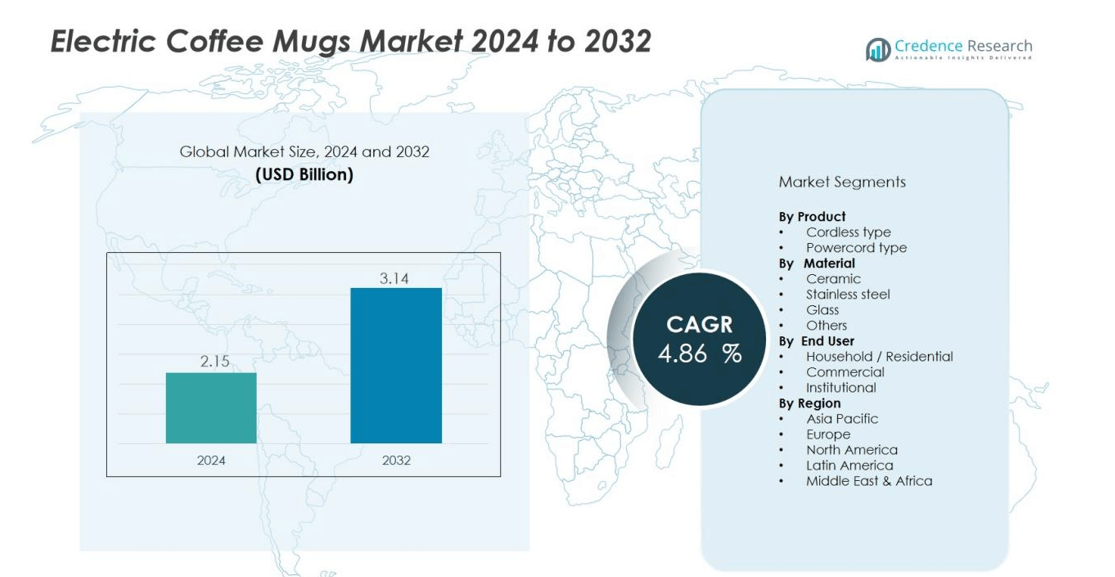
The Electric Coffee Mugs Market size was valued at USD 2.15 billion in 2024 and is anticipated to reach USD 3.14 billion by 2032, at a CAGR of 4.86 % during the forecast period.
| REPORT ATTRIBUTE | DETAILS |
|---|---|
| Historical Period | 2020-2023 |
| Base Year | 2024 |
| Forecast Period | 2025-2032 |
| Electric Coffee Mugs Market Size 2024 | USD 2.15 billion |
| Electric Coffee Mugs Market, CAGR | 4.86% |
| Electric Coffee Mugs Market Size 2032 | USD 3.14 billion |
The key drivers behind market expansion include the growing coffee culture worldwide, technological advancements in smart drinkware, and the increasing interest in premium, personalized products. Smart features such as app-controlled heating, cordless designs, and energy-efficient capabilities are enhancing product appeal. Furthermore, the growing trend of gifting innovative, practical products is contributing to the market's momentum, particularly in regions with high disposable incomes.
Regionally, North America holds a dominant market share due to high coffee consumption and strong demand for premium and smart home devices. The U.S. market is particularly influential, driven by the high adoption rate of innovative products. Europe shows steady demand, with increasing popularity in smart and sustainable consumer products. Asia-Pacific, however, is the fastest-growing region, propelled by urbanization, rising middle-class incomes, and increasing interest in coffee culture.
Market Insights:
- The Electric Coffee Mugs Market was valued at USD 2.15 billion in 2024 and is expected to reach USD 3.14 billion by 2032, growing at a CAGR of 4.86% during the forecast period.
- North America holds the largest market share, approximately 45%, due to high disposable income, strong coffee consumption, and the demand for premium smart drinkware. Europe follows with a 20% share, driven by demand for stylish, sustainable, and tech-enabled mugs.
- Asia-Pacific, with a market share of about 25%, is the fastest-growing region, fueled by rising middle-class incomes, expanding coffee culture, and increasing urbanization.
- The residential end-user segment dominates with the largest share, driven by personal consumption. The commercial sector also holds significant market share, particularly in offices and cafes, due to consistent beverage temperature demand.
- The market is segmented by product type, with cordless mugs and power-cord mugs holding key shares, and material preferences shifting towards stainless steel, ceramic, and eco-friendly options.
Market Drivers:
Growing Demand for Portable Hot Beverage Solutions
The increasing need for convenient, portable hot beverage solutions is one of the primary drivers for the growth of the Electric Coffee Mugs Market. Consumers are looking for innovative ways to enjoy their favorite drinks while on the go. Electric coffee mugs offer a practical solution by maintaining the desired beverage temperature for longer periods, making them highly attractive for busy professionals and travelers. This trend is particularly noticeable among urban populations, where time efficiency and convenience are top priorities.
- For instance, Ember Technologies launched its Smart Mug 2 featuring advanced precision temperature control-maintaining drinks at user-set temperatures between 120°F and 145°F
Rise in Coffee Consumption and Coffee Culture
Coffee consumption is experiencing steady growth globally, fueling demand for accessories like electric coffee mugs. Coffee has become more than just a beverage; it is now an integral part of social and work culture in many regions. With a shift towards premium coffee experiences, consumers are increasingly investing in products that enhance their coffee-drinking habits. Electric coffee mugs allow for a personalized and elevated drinking experience, making them desirable among coffee enthusiasts.
- For instance, Ember, a leading temperature-controlled mug manufacturer, has achieved significant market validation, selling over 3 million units to date and nearing 1 million units sold annually.
Technological Advancements in Smart Drinkware
Technological innovations have played a pivotal role in the expansion of the Electric Coffee Mugs Market. Many of these mugs now feature smart capabilities, such as app-controlled heating, temperature monitoring, and cordless operation. These advanced features appeal to tech-savvy consumers who are increasingly incorporating smart devices into their daily lives. The ability to control temperature with precision and convenience has significantly increased the product’s appeal.
Consumer Preference for Premium and Personalized Products
Consumers’ growing inclination towards premium and customized products also contributes to the market's expansion. Electric coffee mugs are viewed as not just functional items but as personalized accessories that complement individual preferences. Many manufacturers now offer a variety of designs, colors, and sizes, catering to diverse tastes. This customization trend boosts product adoption, especially as these mugs are also popular as unique gifts.
Market Trends:
Increasing Integration of Smart Features and Connectivity
The Electric Coffee Mugs Market has witnessed a surge in adoption of smart‑enabled mugs that connect to mobile apps or integrate with voice assistants. Consumers value the ability to set precise beverage temperatures, receive alerts, and manage devices remotely through their smartphones. Manufacturers respond by embedding Wi‑Fi or Bluetooth modules, offering seamless user experiences and enhanced convenience. These technological upgrades elevate the product beyond a simple mug into part of a connected lifestyle ecosystem. Many brands now target tech‑savvy urban professionals who expect intelligent functionality in everyday objects.
- For instance, Ember Technologies launched the Ember Mug², which allows users to set and maintain temperatures within a range of 120°F to 145°F via a dedicated app, and boasts Bluetooth connectivity supporting up to 1.5 hours of battery life per charge.
Focus on Sustainability, Customization and Diverse Beverage Use
The market shows a distinct shift toward eco‑friendly materials and alternative beverage applications. Buyers are increasingly drawn to mugs made of recycled plastics, stainless steel or ceramic with minimal electronic waste. Companies respond by offering modular components, replaceable batteries and customizable aesthetics to reflect personal style. There is also a growing trend of using electric mugs for tea, hot chocolate and other warm‑drink categories rather than only coffee. This broadened usage expands the addressable consumer base and supports more versatile purchase motivations beyond traditional coffee‑drinkers.
- For instance, the YETI Rambler travel mug uses double-wall vacuum insulation to maintain the initial temperature of a hot beverage and can keep drinks hot for hours. The 'HotShot' cap is designed for 360-degree, leakproof sipping and helps seal in heat between drinks, making it suitable for a wide range of warm beverages including coffee, tea, and hot chocolate
Market Challenges Analysis:
High Manufacturing and Retail Cost Structures
The Electric Coffee Mugs Market faces upward pressure from elevated production costs. Manufacturers allocate significant spending to heating elements, insulated materials, smart sensors and battery systems. End‑products therefore carry higher retail prices compared to conventional drinkware. Price‑sensitive consumers may hesitate to switch from insulated mugs and travel tumblers. Large scale adoption may stall unless companies optimise supply‑chains and material use.
Technical Reliability, Battery Life and Consumer Awareness Constraints
It remains a challenge for manufacturers to ensure consistent durability, safe operation and long battery life in smart mugs. Some consumers report limited hours of use before recharge and question long‑term electronic component reliability. Compatibility issues with mobile apps or smart home ecosystems may narrow the potential user base. The market may also suffer from lower awareness in emerging regions, where consumers might prefer simpler beverage containers. Brands need strong education programmes and robust warranties to build trust.
Market Opportunities:
Expansion into Emerging and Underserved Regions
The Electric Coffee Mugs Market presents a strong opportunity in emerging economies where consumer incomes and coffee culture accelerate. Manufacturers can introduce affordable models tailored for price‑sensitive markets while maintaining key features like temperature control and portability. Retailers and online platforms in Asia‑Pacific, Latin America and the Middle East may capture new customer segments. Local partnerships and regionalised marketing strategies offer entry points for brands seeking growth. Firms that adapt products to local tastes and languages may gain competitive advantage.
Innovation in Product Design and Sustainability for Differentiation
There is substantial potential for brands to lead through innovation and eco‑friendly design. It pays to develop energy‑efficient heating elements, lighter materials and modular batteries that extend product life. Customisation options - such as colour options, smart app integration or personalised branding - can differentiate offerings. The shift toward sustainable materials - recycled plastics, bamboo composites or refillable systems - can attract environmentally aware consumers. Brands that emphasise both functionality and sustainability may unlock higher margin segments and build stronger brand loyalty.
Market Segmentation Analysis:
By Product
The Electric Coffee Mugs Market can be segmented based on product type, with the most popular categories being standard electric coffee mugs, smart mugs with app integration, and travel mugs with built‑in heating. Smart mugs, featuring temperature control features and Bluetooth connectivity, are seeing increased adoption due to growing consumer interest in connected devices. Travel mugs are particularly popular among professionals and commuters, offering portability and convenience. As consumers continue to seek practical, tech‑enhanced products, these categories are expected to dominate the market.
- For instance, the Ember Smart Mug 2 integrates with an app to allow precise temperature control between 120°F and 145°F (50°C and 62.5°C)
By Material
Electric coffee mugs are available in a variety of materials, including stainless steel, plastic, ceramic, and glass. Stainless steel is the most popular material due to its durability, insulation properties, and sleek appearance. Ceramic mugs also enjoy consumer preference for their aesthetic appeal and the feel of traditional drinkware. The market is seeing an increasing shift towards eco‑friendly materials, such as bamboo composites and recycled plastics, driven by sustainability trends. The material choice plays a significant role in influencing both product quality and consumer preferences.
- For instance, Contigo’s AUTOSEAL mugs, typically constructed from BPA-free stainless steel with BPA-free plastic lids, consistently score above 4.4/5 in verified consumer satisfaction surveys for leak-proof performance and durability.
By End-User
The Electric Coffee Mugs Market is divided into several end‑user categories, including residential, commercial, and institutional sectors. Residential users represent the largest share, as individuals seek convenience and personalization in their daily coffee routines. The commercial sector, particularly offices and cafes, also presents significant opportunities due to increased demand for high‑quality, consistent beverage temperatures. The institutional segment, including hospitals and educational institutions, is a growing market as these establishments look for efficient solutions for mass beverage service.
Segmentations:
By Product
- Cordless type
- Power‑cord type
By Material
- Ceramic
- Stainless steel
- Glass
- Others
By End User
- Household / Residential
- Commercial
- Institutional
By Region
- North America
- U.S.
- Canada
- Mexico
- Europe
- Germany
- France
- U.K.
- Italy
- Spain
- Rest of Europe
- Asia Pacific
- China
- Japan
- India
- South Korea
- South-east Asia
- Rest of Asia Pacific
- Latin America
- Brazil
- Argentina
- Rest of Latin America
- Middle East & Africa
- GCC Countries
- South Africa
- Rest of the Middle East and Africa
Regional Analysis:
North America Regional Insight
The region held a market share of approximately 45% in 2023 for the Electric Coffee Mugs Market. High disposable income and strong coffee‑consumption habits support demand. Consumers in the U.S. and Canada prefer premium and smart drinkware. Retail and online channels both contribute significantly. Manufacturers invest heavily in marketing and retail presence to capture this favourable landscape. The region’s advanced e‑commerce infrastructure aids rapid product availability and adoption.
Europe Regional Insight
Europe secured a market share near 20% in 2023. Consumers in Western Europe emphasise design, functionality and brand prestige. Eastern European markets show faster growth due to rising incomes and urbanisation. Scandinavian countries lead in sustainable and smart‑enabled mugs. Distribution networks blend online retail with strong presence in specialty stores. Manufacturers tailor materials and features to local preferences for successful market entry.
Asia‑Pacific and Other Regions Insight
Asia‑Pacific accounted for about 25% of the market in 2023 and emerged as the fastest‑growing region. Rising middle‑class incomes and expanding coffee culture increase uptake. Markets in China, India and Southeast Asia show strong growth potential for smart and portable mugs. Latin America and Middle East & Africa together hold around 10% of market share. These regions face challenges in awareness and premium‑product penetration, but offer opportunities through cost‑effective models and targeted regional strategies.
Key Player Analysis:
- Cauldryn
- Glowstone
- Burnout
- Muggo
- Geezo
- OHOM
- Ember
- ionMug
- SMRTMUGG
- CMG Technologies
- Tanfel
- CN Innovations
- GIAN
- Dou Yee Technologies
Competitive Analysis:
The competitive landscape of the Electric Coffee Mugs Market highlights both established brands and emerging players. Cauldryn, Glowstone, Burnout, Muggo, Geezo, OHOM, and Ember dominate the market with a combined share in the 20-30% range. Ember excels through patented temperature-control technology and premium materials, positioning its products at the high end of the market. OHOM targets value-conscious consumers with self-heating ceramic mugs and pads, leveraging simplicity and design to compete. Muggo differentiates via add-on functionality such as integrated power banks and smartphone charging features, which broadens its appeal beyond basic drinkware. Cauldryn emphasizes variable temperature control and rugged styling, appealing to on-the-go professionals. Overall, market fragmentation remains high, with numerous smaller firms offering niche products or regional variants. The leading firms maintain an advantage through brand recognition, innovation, and distribution strength.
Recent Developments:
- In August 2025, Starling Group agreed to acquire Ember, the UK-based fintech company specializing in digital tax and accounting tools for small businesses, integrating its technology into Starling Bank’s business banking suite.
- In September 2025, Ember, the D2C cookware brand, raised $3.2 million in funding to enhance research and development and accelerate product innovation, though no specific product launch was announced alongside this funding round.
Report Coverage:
The research report offers an in-depth analysis based on Product, Material, End User and Region. It details leading Market players, providing an overview of their business, product offerings, investments, revenue streams, and key applications. Additionally, the report includes insights into the competitive environment, SWOT analysis, current Market trends, as well as the primary drivers and constraints. Furthermore, it discusses various factors that have driven Market expansion in recent years. The report also explores Market dynamics, regulatory scenarios, and technological advancements that are shaping the industry. It assesses the impact of external factors and global economic changes on Market growth. Lastly, it provides strategic recommendations for new entrants and established companies to navigate the complexities of the Market.
Future Outlook:
- The market will benefit from growth in smart‑home ecosystems and connected drinkware.
- Consumers will demand energy‑efficient heating elements and longer battery life from electric mugs.
- Demand will rise for multi‑beverage compatibility, covering tea, hot chocolate and soups in addition to coffee.
- Customization of both material finish and smart features will provide differentiation for brands in the market.
- Sustainable and recyclable materials will become standard, driven by consumer eco‑awareness and regulatory pressure.
- Expansion into mid‑priced segments will open access in emerging economies that currently have low penetration.
- Online direct‑to‑consumer channels will grow in importance, offering brands more control over design, pricing and loyalty programmes.
- Collaborations between beverage brands and drinkware manufacturers will enhance product visibility and co‑branded appeal.
- The rise of workplace and mobile consumption environments will raise demand for portable electric mugs suited for travel and commuting.
- Competitive pressure will push firms to innovate on safety features, user interface and integration with wider digital ecosystems.

Request a Free Sample
Fill in your details and we'll send you a free sample report.
- Sample data tables & charts
- Research methodology
Need a Custom Version of This Report?
Tailor the scope, geography, or segments to your exact requirements.
- Custom geography or segment scope
- Direct access to our analyst team
Frequently Asked Questions
What is the current market size for the Electric Coffee Mugs Market, and what is its projected size in 2032?
At what Compound Annual Growth Rate is the Electric Coffee Mugs Market projected to grow between 2024 and 2032?
Which Electric Coffee Mugs Market segment held the largest share in 2024?
What are the primary factors fueling the growth of the Electric Coffee Mugs Market?
Who are the leading companies in the Electric Coffee Mugs Market?
Which region commanded the largest share of the Electric Coffee Mugs Market in 2024?
Table of Content
Chapter 1 Market Segmentation
- 1.1 Segmentation Framework
- 1.1.1 Product and Service Classification
- 1.1.2 Application and End-Use Classification
- 1.1.3 Technology and Solution Classification
- 1.1.4 Customer and Distribution Channel Classification
- 1.1.5 Geographic Segmentation
- 1.1.6 Market Segment Definitions and Boundaries
Chapter 2 Introduction
- 2.1 Report Objectives and Scope
- 2.2 Product Definition and Industry Terminology
- 2.3 Market Inclusions and Exclusions
- 2.4 Research Process
- 2.4.1 Primary Research and Expert Interviews
- 2.4.2 Secondary Research and Source Review
- 2.4.3 Top-Down and Bottom-Up Estimation
- 2.4.4 Data Triangulation and Verification
- 2.5 Market Size Measurement Basis
- 2.5.1 2024: USD 2.15 billion → 2032: USD 3.14 billion
- 2.6 Historical and Forecast Reference Periods
- 2.6.1 Base Year: 2024
- 2.6.2 Forecast Period: 2024-2032
- 2.7 Research Assumptions and Limitations
Chapter 3 Executive Summary
- 3.1 Market Snapshot and Key Findings
- 3.2 Base-Year Market Size, 2024
- 3.3 Forecast Market Size, 2032
- 3.4 Revenue and Volume Growth Outlook
- 3.5 Key Demand and Supply Indicators
- 3.6 Leading Market Segments
- 3.7 Fastest-Growing Market Opportunities
- 3.8 Regional Performance Highlights
- 3.9 Technology and Industry Transformation
- 3.10 Competitive Landscape Summary
- 3.11 Analyst View and Strategic Implications
Chapter 4 Global Electric Coffee Mugs Market Trends and Developments
- 4.1 Historical Industry Development
- 4.2 Recent Market Trends and Developments
- 4.3 Demand and Customer Behavior Trends
- 4.4 Technology and Product Innovation
- 4.5 Artificial Intelligence, Automation and Digitalization
- 4.6 Local Manufacturing and Supply Chain Realignment
- 4.7 Industry Partnerships, Mergers and Acquisitions
- 4.8 Sustainability and Circular Economy Developments
- 4.9 Government and Private Sector Investment Trends
- 4.10 Emerging Business Models and Commercialization
- 4.11 Industry Developments and Announcements
Chapter 5 Global Electric Coffee Mugs Market Production, Supply and Demand Analysis
- 5.1 Demand Trend and Consumption Analysis
- 5.2 Demand Forecast, 2024-2032
- 5.3 Production and Output Trend
- 5.4 Production and Output Forecast, 2024-2032
- 5.5 Installed Capacity and Capacity Utilization
- 5.6 Company-Wise Production Plants and Statistics
- 5.6.1 Installed Production Capacity
- 5.6.2 Actual Production
- 5.6.3 Planned Capacity and Expansion Targets
- 5.7 Supply Chain Structure and Procurement Trends
- 5.8 Supply-Demand Gap and Bottlenecks
- 5.9 Import Dependence and Sourcing Structure
- 5.10 Contract Manufacturing and Outsourcing
- 5.11 Regional Supply and Demand Concentration
Chapter 6 Global Electric Coffee Mugs Market Pricing Analysis
- 6.1 Pricing Structure and Measurement
- 6.2 Historical Pricing Trends
- 6.3 Pricing Outlook, 2024-2032
- 6.4 Average Selling Price and Unit Economics
- 6.5 Pricing by Product and Market Segment
- 6.6 Geographic Pricing Differences
- 6.7 Key Input, Energy, Labor and Logistics Costs
- 6.8 Contract Pricing and Purchasing Models
- 6.9 Pricing Sensitivity and Competitive Positioning
- 6.10 Price, Margin and Profitability Implications
Chapter 7 Global Electric Coffee Mugs Market Dynamics
- 7.1 Market Growth Drivers
- 7.1.1 Demand-Side Drivers
- 7.1.2 Technology and Innovation Drivers
- 7.1.3 Infrastructure and Investment Drivers
- 7.1.4 Regulatory and Policy Drivers
- 7.2 Market Restraints
- 7.2.1 Cost and Affordability Constraints
- 7.2.2 Technology and Adoption Barriers
- 7.2.3 Supply Chain and Operational Constraints
- 7.3 Market Challenges
- 7.3.1 Competitive Pressure and Margin Erosion
- 7.3.2 Skills, Infrastructure and Implementation Gaps
- 7.4 Emerging Market Opportunities
- 7.5 Market Dynamics Impact and Time-Horizon Assessment
Chapter 8 Global Electric Coffee Mugs Value Chain Analysis
- 8.1 Industry Value Chain Overview
- 8.2 Upstream Suppliers and Critical Inputs
- 8.3 Technology and Component Providers
- 8.4 Manufacturing or Service Delivery
- 8.5 Distribution, Channel Partners and Integrators
- 8.6 Downstream Applications and End Users
- 8.7 Value Addition and Profit Pools
- 8.8 Vertical Integration and Outsourcing
- 8.9 Supplier Concentration and Risk
- 8.10 Supply Chain Localization and Resilience
Chapter 9 Global Electric Coffee Mugs Market Regulations and Policies
- 9.1 Relevant Laws, Standards and Compliance Frameworks
- 9.2 Product, Service, Safety and Quality Requirements
- 9.3 Government Policies, Incentives and Subsidies
- 9.4 Imports, Exports and Trade Barriers
- 9.5 Public Procurement and Local Content Requirements
- 9.6 Environmental and Sustainability Compliance
- 9.7 Upcoming Policy Changes and Market Implications
Chapter 10 Global Electric Coffee Mugs Market Hotspots and Opportunities
- 10.1 Market Opportunity Mapping and Growth Hotspots
- 10.2 High-Growth Applications and Customer Groups
- 10.3 Underserved Markets and White-Space Opportunities
- 10.4 Emerging Technology and Product Opportunities
- 10.5 New Capacity and Investment Hotspots
- 10.6 Market Entry and Expansion Opportunities
- 10.7 Distribution and Partnership Opportunities
- 10.8 Near-Term and Long-Term Commercial Potential
- 10.9 Opportunity Attractiveness and Execution Risks
Chapter 11 Global Electric Coffee Mugs Market Outlook, 2024-2032
- 11.1 Market Size and Analysis
- 11.1.1 Revenue (Market Measurement: 2024: USD 2.15 billion → 2032: USD 3.14 billion)
- 11.1.2 Market Volume and Quantity Sold
- 11.1.3 Historical Market Size
- 11.1.4 Base-Year Market Size, 2024
- 11.2 Market Forecast, 2024-2032
- 11.2.1 Revenue Forecast to 2032
- 11.2.2 Volume Forecast to 2032
- 11.2.3 CAGR and Year-on-Year Growth
- 11.2.4 Incremental Revenue Opportunity
- 11.3 Forecast Assumptions and Scenario Analysis
- 11.3.1 Base-Case Forecast
- 11.3.2 Optimistic and Conservative Scenarios
- 11.3.3 Technology, Pricing and Policy Sensitivities
- 11.4 Market Attractiveness and Growth Outlook
Chapter 12 Global Electric Coffee Mugs Market Segmentation and Outlook
- 12.1 Segmentation Summary and Market Shares, 2024
- 12.2 Largest and Fastest-Growing Segments
- 12.3 Segment Growth Comparison
- 12.4 Segment Attractiveness and Priority Matrix
Chapter 13 Global Electric Coffee Mugs Geographic Market Outlook, 2024-2032
- 13.1 Regional Market Size and Share, 2024
- 13.2 Regional Market Forecast, 2024-2032
- 13.3 Regional Pricing, Production and Demand Differences
- 13.4 North America
- 13.4.1 United States
- 13.4.2 Canada
- 13.4.3 Mexico
- 13.5 Europe
- 13.5.1 Germany
- 13.5.2 France
- 13.5.3 Italy
- 13.5.4 United Kingdom
- 13.5.5 Spain
- 13.5.6 Poland
- 13.5.7 Russia
- 13.5.8 Netherlands
- 13.5.9 Belgium
- 13.5.10 Sweden
- 13.5.11 Denmark
- 13.5.12 Norway
- 13.5.13 Rest of Europe
- 13.6 Asia Pacific
- 13.6.1 China
- 13.6.2 India
- 13.6.3 Japan
- 13.6.4 South Korea
- 13.6.5 Thailand
- 13.6.6 Indonesia
- 13.6.7 Vietnam
- 13.6.8 Malaysia
- 13.6.9 Australia
- 13.6.10 Rest of Asia Pacific
- 13.7 Latin America
- 13.7.1 Brazil
- 13.7.2 Argentina
- 13.7.3 Colombia
- 13.7.4 Chile
- 13.7.5 Rest of Latin America
- 13.8 Middle East
- 13.8.1 Saudi Arabia
- 13.8.2 United Arab Emirates
- 13.8.3 Turkey
- 13.8.4 Israel
- 13.8.5 Iran
- 13.8.6 Rest of the Middle East
- 13.9 Africa
- 13.9.1 South Africa
- 13.9.2 Egypt
- 13.9.3 Nigeria
- 13.9.4 Morocco
- 13.9.5 Rest of Africa
- 13.10 Regional Investment, Policy and Supply Chain Differences
- 13.11 Regional Competitive Landscape
- 13.12 Geographic Growth Hotspots
Chapter 14 Global Electric Coffee Mugs Technology, Innovation and Sustainability Outlook
- 14.1 Technology Landscape and Maturity
- 14.2 Product, Process and Service Innovation
- 14.3 AI, Automation and Digital Tools in the Industry
- 14.4 Technology Adoption and Performance Benchmarking
- 14.5 Innovation Pipeline and R&D Investment
- 14.6 Patent and Intellectual Property Trends
- 14.7 Energy Efficiency and Resource Management
- 14.8 Sustainability, Recycling and Circularity
- 14.9 Technology Roadmap, 2024-2032
- 14.10 Risks of Obsolescence and Technology Substitution
Chapter 15 Global Electric Coffee Mugs Market Key Strategic Imperatives
- 15.1 Growth and Market Entry Priorities
- 15.2 High-Return Products and Segments
- 15.3 Pricing, Profitability and Cost Optimization
- 15.4 Technology Investment and Product Differentiation
- 15.5 Supply Chain Localization and Resilience
- 15.6 Distribution and Customer Acquisition
- 15.7 Partnership, Acquisition and Capacity Strategy
- 15.8 Regional Expansion Priorities
- 15.9 Short-, Medium- and Long-Term Actions
Chapter 16 Competition Outlook
- 16.1 Industry Competition Characteristics
- 16.2 Market Structure and Concentration
- 16.3 Market Share and Competitive Positioning, 2024
- 16.4 Company-Wise Revenue and Product Benchmarking
- 16.5 Production and Service Capacity Benchmarking
- 16.6 Technology, Pricing and Differentiation
- 16.7 Regional Footprint and Distribution Strength
- 16.8 Mergers, Acquisitions and Strategic Alliances
- 16.9 New Entrants and Competitive Threats
- 16.10 Porter's Five Forces and Industry Attractiveness
- 16.11 Competitive Outlook, 2024-2032
Chapter 17 Company Profiles
- 17.1 Company Coverage and Selection Criteria
- 17.2 Leading Market Participants – Standard Profile Structure
- 17.2.1 Business Description
- 17.2.2 Company Ownership and Geographic Presence
- 17.2.3 Product and Service Portfolio
- 17.2.4 Manufacturing and Operating Footprint
- 17.2.5 Production Capacity and Expansion Plans
- 17.2.6 Financial Performance and Investment
- 17.2.7 Market Share and Competitive Position
- 17.2.8 Technology and Innovation Capabilities
- 17.2.9 Strategic Alliances or Partnerships
- 17.2.10 Recent Developments
- 17.2.11 Growth Strategy and Outlook
- 17.3 Other Relevant Market Participants
Note: Every listed company is profiled on the structure shown under the first company. The company list is preliminary and may change based on research findings, market developments, data availability and client requirements.
Chapter 18 Disclaimer
- 18.1 Research and Forecast Disclaimer
- 18.2 Data Source and Estimation Limitations
Note: The depth of individual sections depends on data availability for this market. Volume, capacity, trade and other unit-based metrics are included where applicable.