Recycled Plastics Market Overview:
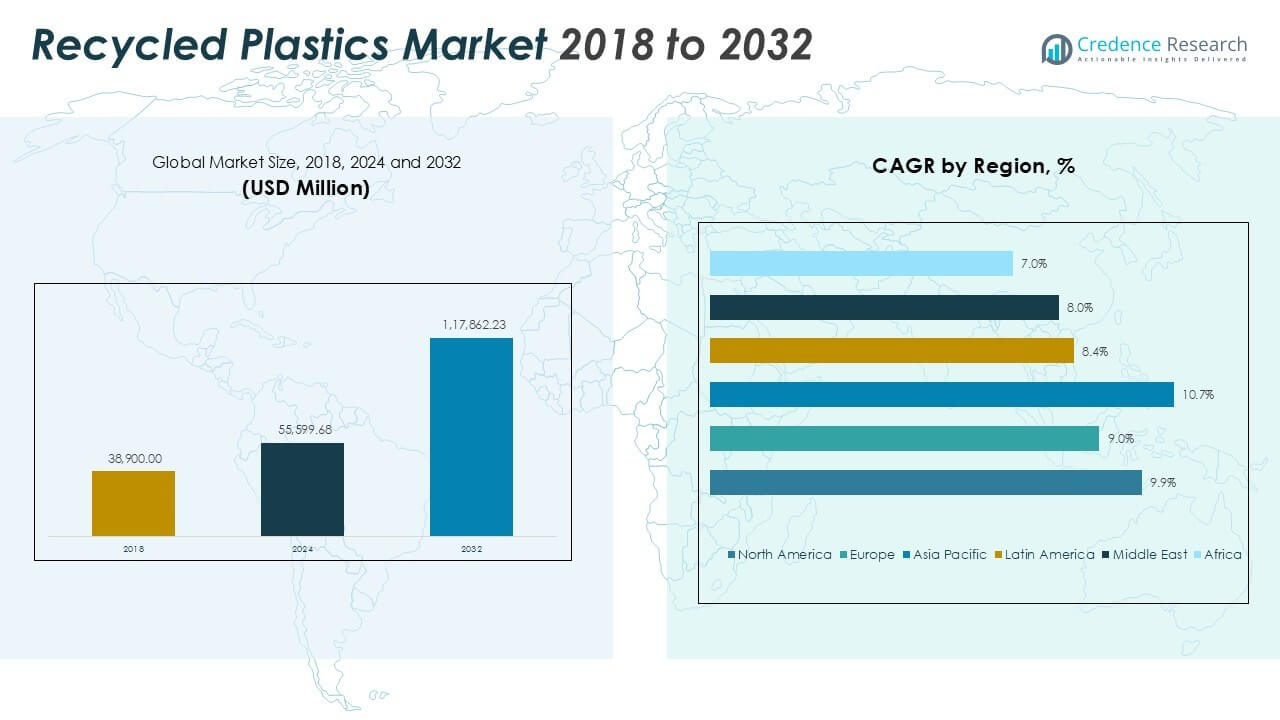
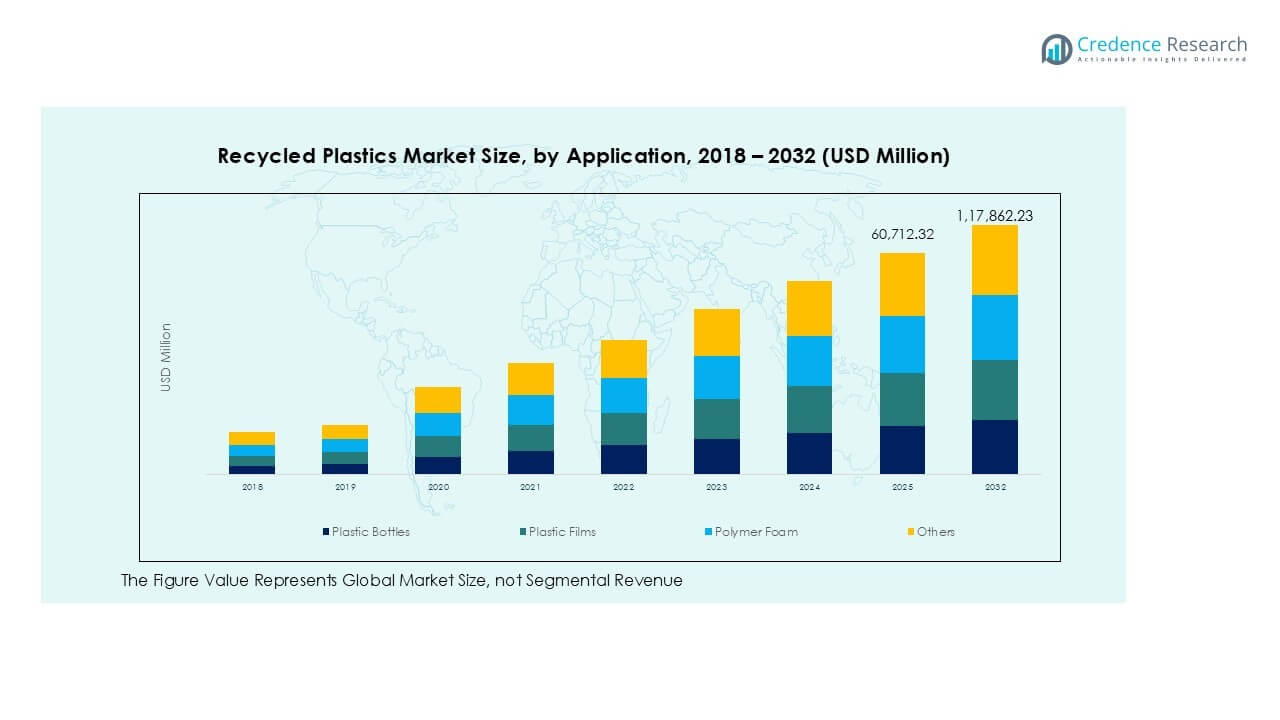
The Recycled Plastics market size was valued at USD 38,900.00 million in 2018, reached USD 55,599.68 million in 2024, and is anticipated to reach USD 117,862.23 million by 2032, growing at a CAGR of 9.94% during the forecast period.
| REPORT ATTRIBUTE | DETAILS |
|---|---|
| Historical Period | 2020-2023 |
| Base Year | 2024 |
| Forecast Period | 2025-2032 |
| Recycled Plastics Market Size 2024 | USD 55,599.68 million |
| Recycled Plastics Market, CAGR | 9.94% |
| Recycled Plastics Market Size 2032 | USD 117,862.23 million |
The recycled plastics market is led by key players such as Veolia, REMONDIS SE & Co. KG, WM Intellectual Property Holdings, L.L.C., Republic Services, Inc., Covestro AG, Shell International B.V., Waste Connections, CLEAN HARBORS, INC., Stericycle, and Biffa. These companies drive innovation through investments in advanced sorting, mechanical, and chemical recycling technologies. Strategic partnerships with FMCG brands and infrastructure upgrades further enhance their competitive edge. Asia Pacific dominates the global recycled plastics market with a 47.3% share in 2024, fueled by high plastic consumption, rising urbanization, and strong government support for recycling initiatives. North America and Europe follow, supported by strict regulations and corporate sustainability mandates.
Recycled Plastics Market Insights
- The global recycled plastics market was valued at USD 38,900.00 million in 2018, reached USD 55,599.68 million in 2024, and is projected to hit USD 117,862.23 million by 2032, growing at a CAGR of 9.94%.
- Growth is driven by rising demand for sustainable packaging, government bans on single-use plastics, and increased brand commitments to recycled content in production.
- Key trends include the adoption of chemical recycling technologies and circular economy partnerships between recyclers and global FMCG players.
- Leading companies such as Veolia, REMONDIS, WM Intellectual Property, and Republic Services focus on capacity expansion and strategic alliances, but quality variability and feedstock shortages remain key challenges.
- Asia Pacific leads the market with 47.3% share in 2024, followed by North America at 23.1%, and Europe at 20.4%; polyethylene dominates by product with over 35%, while plastic bottles lead applications with over 40% share.
Recycled Plastics Market Segmentation Analysis:
By Product
Polyethylene (PE) leads the product segment in the Recycled Plastics Market, accounting for over 35% of the total market share in 2024. High consumption in packaging, bags, and containers supports PE’s dominance. Polyethylene Terephthalate (PET) follows, driven by recycled bottle applications in beverage and food industries. Polypropylene (PP) finds strong demand in automotive parts and rigid packaging. Polyvinyl Chloride (PVC) recycling is gaining traction in construction materials. Polystyrene recycling remains limited due to low recyclability but sees niche use in packaging. Other products, including ABS and nylon, contribute marginally with specialized industrial applications.
- For instance, Veolia operates a global network of 37 plastic recycling facilities with an annual processing capacity exceeding 700,000 metric tons. This includes a significant presence in Europe, where it manages over 360,000 tonnes of capacity, and Asia, where its PlastiLoop network of 12 facilities provides an annual output of 250,000 tonnes of recycled polymers.
By Application
Plastic bottles represent the dominant application segment, holding over 40% market share in 2024. Beverage and water bottling sectors drive high PET recycling rates. Plastic films rank second, supported by growing use in flexible packaging and agricultural films. Polymer foam shows steady demand across automotive and construction insulation applications. Other applications include textiles, electronics, and home goods. Regulatory mandates for recycled content in consumer packaging and rising sustainability targets encourage adoption across all application segments, particularly in food-grade and household use cases.
- For instance, Coca-Cola uses recycled PET sourced from systems capable of supplying hundreds of thousands of tonnes annually for packaging.
By Source
Plastic bottles remain the leading source for recycled plastics, contributing over 45% of the total feedstock in 2024. High availability, easy collection, and established sorting infrastructure support this dominance. Plastic films follow, although contamination and multilayer film complexity hinder recycling efficiency. Polymer foam contributes a smaller share due to technical challenges in collection and reprocessing. Other sources, including rigid containers, industrial scrap, and ocean plastics, are gaining attention through advanced recycling initiatives. Public-private partnerships and waste collection innovations drive source diversification across global recycling ecosystems.
Recycled Plastics Market Key Growth Drivers
Surge in Demand for Sustainable Packaging Solutions
The rising focus on sustainability across industries is a major driver for the recycled plastics market. FMCG, food, and beverage brands are shifting toward eco-friendly materials to meet consumer and regulatory expectations. Global packaging leaders like Unilever and Coca-Cola have committed to using at least 50% recycled content in packaging by 2030. These mandates directly boost demand for rPET, rHDPE, and recycled LDPE. Retailers also push suppliers to meet sustainability benchmarks, increasing procurement of recycled content packaging. The growing ban on single-use plastics across several countries further accelerates substitution with recycled alternatives, reinforcing volume growth across product segments.
- For instance, Unilever reported using approximately 146,120 tonnes of recycled plastic across its global packaging operations in its 2023 data (reported in 2024), accounting for 22% of its total plastic footprint. By the end of 2024, this figure was updated to 21% of its total portfolio.
Expansion of Collection & Recycling Infrastructure
Investment in waste management systems significantly enhances the supply of sorted and processable plastic waste. Governments and private players are investing in material recovery facilities (MRFs) and advanced sorting systems. In 2023, Veolia reported a 12% increase in recycling throughput due to upgraded sorting technologies in Europe. Several municipal initiatives now mandate source-segregated plastic waste collection. Automation in sorting using AI and robotics improves purity levels, increasing recycled resin quality. These infrastructure enhancements ensure a reliable feedstock supply for recyclers, enabling consistent production and meeting rising industry demands for high-grade recycled plastics.
- For instance, Veolia upgraded European sorting plants, lifting annual plastic recycling throughput by hundreds of thousands of tonnes after automation deployment.
Cost Competitiveness and Energy Savings in Manufacturing
Recycling plastic uses significantly less energy than producing virgin plastic, making it an economically attractive alternative. According to the U.S. EPA, manufacturing recycled PET saves up to 79% of energy compared to virgin production. This cost advantage becomes crucial amid fluctuating oil prices, which directly impact virgin polymer prices. Manufacturers benefit from reduced input costs, especially in energy-intensive sectors like automotive and construction. Moreover, recycled plastics qualify for carbon credits in several jurisdictions, offering additional financial benefits. These economic incentives strengthen the market position of recycled materials across multiple downstream industries.
Recycled Plastics Market Key Trends & Opportunities
Rising Adoption of Advanced Recycling Technologies
Mechanical recycling dominates the market, but limitations in handling multilayer films and mixed plastic waste are shifting attention toward chemical recycling. Technologies like pyrolysis, solvolysis, and gasification are gaining traction to process low-quality or contaminated plastic waste. Companies such as Eastman and Plastic Energy are scaling chemical recycling facilities with capacities exceeding 100,000 tons per year. These processes produce virgin-quality output suitable for food-grade and pharmaceutical use. The rise of closed-loop recycling partnerships between consumer brands and recyclers creates new investment opportunities and helps meet high-purity resin requirements in premium applications.
- For instance, Eastman operates molecular recycling facilities designed to process over 110,000 metric tons per year of hard-to-recycle plastic waste into virgin-quality materials.
Circular Economy Initiatives Driving Industry Partnerships
The move toward circular economy models is reshaping market dynamics, encouraging vertical integration and collaboration across the value chain. Major corporations are forming alliances with recyclers to secure long-term supply of recycled resins. For instance, Nestlé and Borealis partnered to boost food-grade rPP supply through advanced recycling. Similarly, global brands now co-invest in collection programs to stabilize material availability. Governments offer incentives and enforce Extended Producer Responsibility (EPR) schemes, further pushing brand accountability. These multi-stakeholder efforts support market expansion and create new business models centered on traceable, high-quality recycled plastics.
Recycled Plastics Market Key Challenges
Quality Variability and Limited Food-Grade Certification
Achieving consistent quality in recycled plastics remains a major challenge, especially for applications requiring strict purity standards. Contamination during collection and processing lowers the suitability of recycled resins for sensitive applications. Food-grade rPET or rHDPE demand stringent compliance with FDA and EFSA regulations. In many regions, only a small fraction of recycled output qualifies for such certifications. This restricts broader adoption in the food, healthcare, and cosmetics packaging sectors. High rejection rates during quality testing and lack of standardized global protocols limit recyclers’ ability to scale across regulated industries.
Supply Shortages Due to Inefficient Collection Systems
Despite growing demand, a significant gap exists between plastic waste generation and recyclables actually collected. In several emerging markets, informal waste collection dominates, leading to inconsistent supply and contamination issues. According to OECD estimates, only 9% of all plastic waste is recycled globally. Seasonal variations, lack of consumer awareness, and inadequate segregation also hamper feedstock availability. Supply shortages impact operational efficiency of recycling facilities and hinder expansion plans. Without robust collection networks, meeting volume targets and ensuring cost stability across the value chain becomes difficult for manufacturers and brand owners.
Recycled Plastics Market Regional Analysis
Asia Pacific
Asia Pacific held the largest share in the global recycled plastics market, accounting for 47.3% in 2024, with a market value rising from USD 18,010.70 million in 2018 to USD 26,345.67 million in 2024. By 2032, the region is projected to reach USD 58,966.57 million, growing at a CAGR of 10.7%. Rapid industrialization, high plastic consumption, and strong recycling mandates in China, India, and Southeast Asia support market growth. Government policies promoting circular economy models and increasing recycling investments further reinforce the region's leadership in volume and revenue share.
North America
North America captured a 23.1% market share in 2024, with revenue rising from USD 9,172.62 million in 2018 to USD 12,865.43 million. The market is projected to reach USD 27,214.60 million by 2032, expanding at a CAGR of 9.9%. The U.S. leads the region with extensive recycling infrastructure and strong consumer brand participation in recycled content usage. Regulatory pressure to reduce landfill waste and corporate ESG commitments continue to drive demand for high-quality recycled resins in packaging and automotive sectors.
Europe
Europe accounted for 20.4% of the global market in 2024, with revenue rising from USD 8,285.70 million in 2018 to USD 11,274.09 million. By 2032, it is expected to reach USD 22,246.81 million, growing at a CAGR of 9.0%. Strict EU recycling targets, bans on single-use plastics, and strong Extended Producer Responsibility (EPR) frameworks fuel the region’s growth. Leading economies like Germany and France actively support closed-loop recycling systems, and brand owners in Europe are increasingly shifting toward food-grade recycled plastics to meet sustainability goals.
Latin America
Latin America held a 4.1% share of the global recycled plastics market in 2024, with revenue increasing from USD 1,633.80 million in 2018 to USD 2,301.27 million. The region is expected to grow at a CAGR of 8.4%, reaching USD 4,345.58 million by 2032. Brazil and Mexico are the primary contributors, supported by rising awareness of plastic pollution and development of organized collection systems. However, inconsistent infrastructure limits full market potential. Ongoing reforms in waste management laws and partnerships with international recycling firms are helping to improve regional capabilities.
Middle East
The Middle East represented a 3.0% share in 2024, growing from USD 1,124.21 million in 2018 to USD 1,473.03 million. The market is forecast to reach USD 2,711.48 million by 2032, registering a CAGR of 8.0%. Recycling efforts are driven by rising environmental concerns and national visions for sustainability, especially in the UAE and Saudi Arabia. Industrial plastic recycling sees rising investments, though consumer-level participation remains low. Public-private initiatives are beginning to address gaps in collection, sorting, and reprocessing infrastructure.
Africa
Africa accounted for a 2.4% market share in 2024, increasing from USD 672.97 million in 2018 to USD 1,340.18 million. It is expected to reach USD 2,377.19 million by 2032, with a CAGR of 7.0%. Growth remains moderate due to underdeveloped waste collection systems and limited recycling technologies. However, urbanization and support from international NGOs and development agencies are pushing investments in plastic waste management. South Africa leads the region with formal recycling programs and emerging circular economy initiatives, gradually expanding regional capacity.
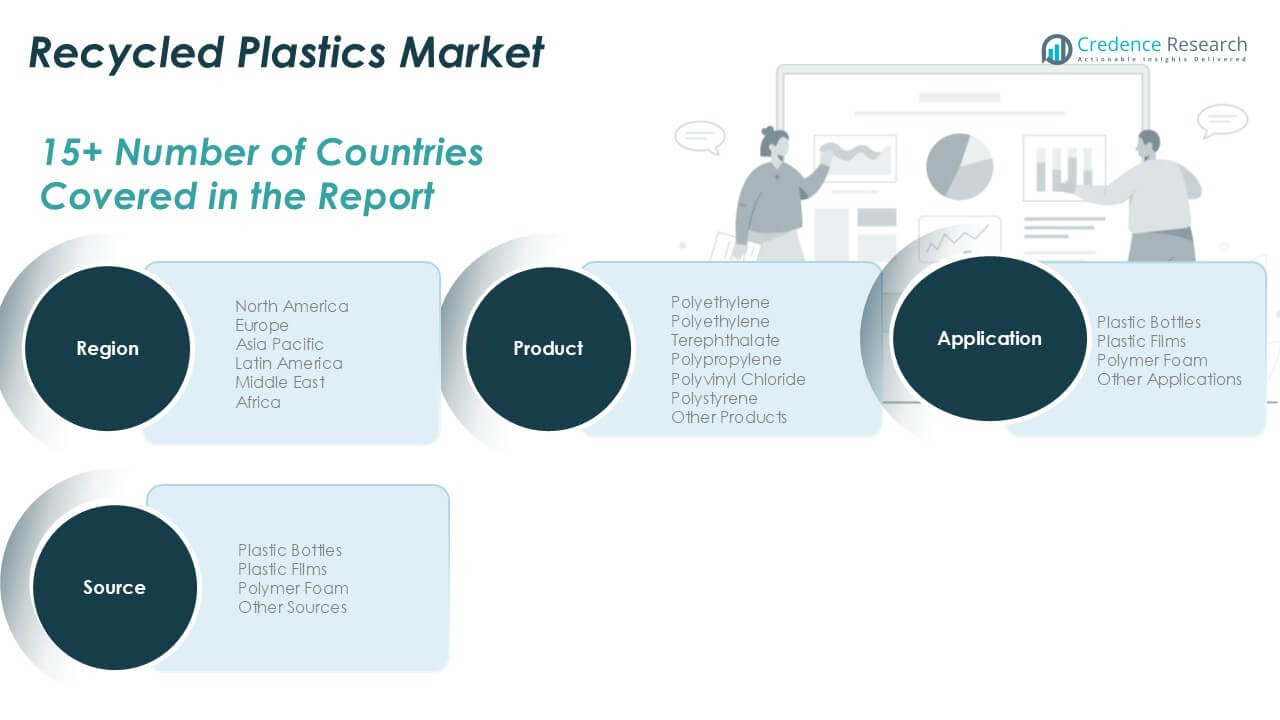
Recycled Plastics Market Segmentations:
By Product
- Polyethylene
- Polyethylene Terephthalate
- Polypropylene
- Polyvinyl Chloride
- Polystyrene
- Other Products
By Application
- Plastic Bottles
- Plastic Films
- Polymer Foam
- Other Applications
By Source
- Plastic Bottles
- Plastic Films
- Polymer Foam
- Other Sources
By Geography
- North America
- U.S.
- Canada
- Mexico
- Europe
- Germany
- France
- U.K.
- Italy
- Spain
- Rest of Europe
- Asia Pacific
- China
- Japan
- India
- South Korea
- South-east Asia
- Rest of Asia Pacific
- Latin America
- Brazil
- Argentina
- Rest of Latin America
- Middle East & Africa
- GCC Countries
- South Africa
- Rest of the Middle East and Africa
Competitive Landscape
The global recycled plastics market is moderately consolidated, with leading players focusing on expanding processing capacities, vertical integration, and strategic partnerships. Companies such as Veolia, REMONDIS SE & Co. KG, and WM Intellectual Property Holdings, L.L.C. maintain strong regional footprints and invest heavily in advanced recycling technologies to meet rising quality demands. Republic Services, Waste Connections, and CLEAN HARBORS, INC. leverage robust collection networks across North America, while Stericycle and Biffa emphasize specialized recycling services. Material producers like Covestro AG and Shell International B.V. enter the space through chemical recycling ventures and closed-loop collaborations. Competitive strategies include acquisitions, automation in sorting facilities, and securing long-term contracts with brand owners seeking recycled content. Market players increasingly align with global sustainability mandates, creating a dynamic environment driven by regulatory shifts, circular economy goals, and innovation in food-grade and multi-polymer recycling solutions. This evolving landscape accelerates consolidation and cross-sector integration across the value chain.
Key Player Analysis
- Veolia
- REMONDIS SE & Co. KG
- WM Intellectual Property Holdings, L.L.C.
- Republic Services, Inc.
- Covestro AG
- Biffa
- Waste Connections
- CLEAN HARBORS, INC.
- Stericycle
- Shell International B.V.
Recent Developments
- In 2025, NMMC, on World Environment Day 2025, launched the Plastic and E-waste Recyclothon at NMMC headquarters in collaboration with the project Mumbai, which aims to create a plastic-free city by eliminating plastic pollution, aligning with the rising environmental concerns and pollution in the city.
- In May 2025, PPG announced the launch of PPG EnviroLuxe Plus powder coatings, which are made of industrial plastic waste up to 18%. This launch focuses on rising environmental concerns and helps in eliminating industrial plastic waste. The coating material produced is used to enhance the durability and aesthetic appeal of the product, aligning with sustainability while minimizing the carbon footprint by providing long-lasting protection and enhancing performance.
- In May 2025, Toyoda Gosei Co., Ltd. launched and developed a new technology to recycle high-quality plastic from plastic automotive parts. This recycling of waste plastic aligns with the rising environmental concerns. To achieve this, they have collaborated with Isono Co., Ltd to procure quality raw material for recycling. This technology accelerates horizontal recycling for reuse in the same parts and contributes to CO2 reduction.
Report Coverage
The research report offers an in-depth analysis based on Product, Application, Source and Geography. It details leading market players, providing an overview of their business, product offerings, investments, revenue streams, and key applications. Additionally, the report includes insights into the competitive environment, SWOT analysis, current market trends, as well as the primary drivers and constraints. Furthermore, it discusses various factors that have driven market expansion in recent years. The report also explores market dynamics, regulatory scenarios, and technological advancements that are shaping the industry. It assesses the impact of external factors and global economic changes on market growth. Lastly, it provides strategic recommendations for new entrants and established companies to navigate the complexities of the market.
Future Outlook
- Demand for recycled plastics will rise across packaging, automotive, and construction sectors due to sustainability goals.
- Chemical recycling technologies will expand, allowing processing of mixed and contaminated plastic waste.
- Brand commitments to increase recycled content in products will create stable demand for food-grade resins.
- Governments will tighten regulations on single-use plastics, accelerating recycling infrastructure investments.
- Partnerships between recyclers and consumer goods companies will grow to support closed-loop systems.
- Asia Pacific will maintain its dominance with continued industrial growth and supportive recycling policies.
- North America and Europe will focus on high-purity recycled materials and advanced sorting technologies.
- Supply chain digitalization will improve traceability and quality control in recycled plastic production.
- Recyclers will explore new feedstock sources like ocean plastics and post-industrial waste to meet demand.
- Technological upgrades will improve cost-efficiency and throughput in mechanical and chemical recycling facilities.

Request a Free Sample
Fill in your details and we'll send you a free sample report.
- Sample data tables & charts
- Research methodology
Need a Custom Version of This Report?
Tailor the scope, geography, or segments to your exact requirements.
- Custom geography or segment scope
- Direct access to our analyst team
Frequently Asked Questions
What is the current market size for the Recycled Plastics market, and what is its projected size in 2032?
At what Compound Annual Growth Rate is the Recycled Plastics market projected to grow between 2024 and 2032?
Which Recycled Plastics market segment held the largest share in 2024?
What are the primary factors fueling the growth of the Recycled Plastics market?
Who are the leading companies in the Recycled Plastics market?
Which region commanded the largest share of the Recycled Plastics market in 2024?
Table of Content
Chapter 1 Market Segmentation
- 1.1 Segmentation Framework
- 1.1.1 Product and Service Classification
- 1.1.2 Application and End-Use Classification
- 1.1.3 Technology and Solution Classification
- 1.1.4 Customer and Distribution Channel Classification
- 1.1.5 Geographic Segmentation
- 1.1.6 Market Segment Definitions and Boundaries
Chapter 2 Introduction
- 2.1 Report Objectives and Scope
- 2.2 Product Definition and Industry Terminology
- 2.3 Market Inclusions and Exclusions
- 2.4 Research Process
- 2.4.1 Primary Research and Expert Interviews
- 2.4.2 Secondary Research and Source Review
- 2.4.3 Top-Down and Bottom-Up Estimation
- 2.4.4 Data Triangulation and Verification
- 2.5 Market Size Measurement Basis
- 2.5.1 2024: USD 55,599.68 million → 2032: USD 117,862.23 million
- 2.6 Historical and Forecast Reference Periods
- 2.6.1 Base Year: 2024
- 2.6.2 Forecast Period: 2024-2032
- 2.7 Research Assumptions and Limitations
Chapter 3 Executive Summary
- 3.1 Market Snapshot and Key Findings
- 3.2 Base-Year Market Size, 2024
- 3.3 Forecast Market Size, 2032
- 3.4 Revenue and Volume Growth Outlook
- 3.5 Key Demand and Supply Indicators
- 3.6 Leading Market Segments
- 3.7 Fastest-Growing Market Opportunities
- 3.8 Regional Performance Highlights
- 3.9 Technology and Industry Transformation
- 3.10 Competitive Landscape Summary
- 3.11 Analyst View and Strategic Implications
Chapter 4 Global Recycled Plastics Market Trends and Developments
- 4.1 Historical Industry Development
- 4.2 Recent Market Trends and Developments
- 4.3 Demand and Customer Behavior Trends
- 4.4 Technology and Product Innovation
- 4.5 Artificial Intelligence, Automation and Digitalization
- 4.6 Local Manufacturing and Supply Chain Realignment
- 4.7 Industry Partnerships, Mergers and Acquisitions
- 4.8 Sustainability and Circular Economy Developments
- 4.9 Government and Private Sector Investment Trends
- 4.10 Emerging Business Models and Commercialization
- 4.11 Industry Developments and Announcements
Chapter 5 Global Recycled Plastics Market Production, Supply and Demand Analysis
- 5.1 Demand Trend and Consumption Analysis
- 5.2 Demand Forecast, 2024-2032
- 5.3 Production and Output Trend
- 5.4 Production and Output Forecast, 2024-2032
- 5.5 Installed Capacity and Capacity Utilization
- 5.6 Company-Wise Production Plants and Statistics
- 5.6.1 Installed Production Capacity
- 5.6.2 Actual Production
- 5.6.3 Planned Capacity and Expansion Targets
- 5.7 Supply Chain Structure and Procurement Trends
- 5.8 Supply-Demand Gap and Bottlenecks
- 5.9 Import Dependence and Sourcing Structure
- 5.10 Contract Manufacturing and Outsourcing
- 5.11 Regional Supply and Demand Concentration
Chapter 6 Global Recycled Plastics Market Pricing Analysis
- 6.1 Pricing Structure and Measurement
- 6.2 Historical Pricing Trends
- 6.3 Pricing Outlook, 2024-2032
- 6.4 Average Selling Price and Unit Economics
- 6.5 Pricing by Product and Market Segment
- 6.6 Geographic Pricing Differences
- 6.7 Key Input, Energy, Labor and Logistics Costs
- 6.8 Contract Pricing and Purchasing Models
- 6.9 Pricing Sensitivity and Competitive Positioning
- 6.10 Price, Margin and Profitability Implications
Chapter 7 Global Recycled Plastics Market Dynamics
- 7.1 Market Growth Drivers
- 7.1.1 Demand-Side Drivers
- 7.1.2 Technology and Innovation Drivers
- 7.1.3 Infrastructure and Investment Drivers
- 7.1.4 Regulatory and Policy Drivers
- 7.2 Market Restraints
- 7.2.1 Cost and Affordability Constraints
- 7.2.2 Technology and Adoption Barriers
- 7.2.3 Supply Chain and Operational Constraints
- 7.3 Market Challenges
- 7.3.1 Competitive Pressure and Margin Erosion
- 7.3.2 Skills, Infrastructure and Implementation Gaps
- 7.4 Emerging Market Opportunities
- 7.5 Market Dynamics Impact and Time-Horizon Assessment
Chapter 8 Global Recycled Plastics Value Chain Analysis
- 8.1 Industry Value Chain Overview
- 8.2 Upstream Suppliers and Critical Inputs
- 8.3 Technology and Component Providers
- 8.4 Manufacturing or Service Delivery
- 8.5 Distribution, Channel Partners and Integrators
- 8.6 Downstream Applications and End Users
- 8.7 Value Addition and Profit Pools
- 8.8 Vertical Integration and Outsourcing
- 8.9 Supplier Concentration and Risk
- 8.10 Supply Chain Localization and Resilience
Chapter 9 Global Recycled Plastics Market Regulations and Policies
- 9.1 Relevant Laws, Standards and Compliance Frameworks
- 9.2 Product, Service, Safety and Quality Requirements
- 9.3 Government Policies, Incentives and Subsidies
- 9.4 Imports, Exports and Trade Barriers
- 9.5 Public Procurement and Local Content Requirements
- 9.6 Environmental and Sustainability Compliance
- 9.7 Upcoming Policy Changes and Market Implications
Chapter 10 Global Recycled Plastics Market Hotspots and Opportunities
- 10.1 Market Opportunity Mapping and Growth Hotspots
- 10.2 High-Growth Applications and Customer Groups
- 10.3 Underserved Markets and White-Space Opportunities
- 10.4 Emerging Technology and Product Opportunities
- 10.5 New Capacity and Investment Hotspots
- 10.6 Market Entry and Expansion Opportunities
- 10.7 Distribution and Partnership Opportunities
- 10.8 Near-Term and Long-Term Commercial Potential
- 10.9 Opportunity Attractiveness and Execution Risks
Chapter 11 Global Recycled Plastics Market Outlook, 2024-2032
- 11.1 Market Size and Analysis
- 11.1.1 Revenue (Market Measurement: 2024: USD 55,599.68 million → 2032: USD 117,862.23 million)
- 11.1.2 Market Volume and Quantity Sold
- 11.1.3 Historical Market Size
- 11.1.4 Base-Year Market Size, 2024
- 11.2 Market Forecast, 2024-2032
- 11.2.1 Revenue Forecast to 2032
- 11.2.2 Volume Forecast to 2032
- 11.2.3 CAGR and Year-on-Year Growth
- 11.2.4 Incremental Revenue Opportunity
- 11.3 Forecast Assumptions and Scenario Analysis
- 11.3.1 Base-Case Forecast
- 11.3.2 Optimistic and Conservative Scenarios
- 11.3.3 Technology, Pricing and Policy Sensitivities
- 11.4 Market Attractiveness and Growth Outlook
Chapter 12 Global Recycled Plastics Market Segmentation and Outlook
- 12.1 Segmentation Summary and Market Shares, 2024
- 12.2 Largest and Fastest-Growing Segments
- 12.3 Segment Growth Comparison
- 12.4 Segment Attractiveness and Priority Matrix
Chapter 13 Global Recycled Plastics Geographic Market Outlook, 2024-2032
- 13.1 Regional Market Size and Share, 2024
- 13.2 Regional Market Forecast, 2024-2032
- 13.3 Regional Pricing, Production and Demand Differences
- 13.4 North America
- 13.4.1 United States
- 13.4.2 Canada
- 13.4.3 Mexico
- 13.5 Europe
- 13.5.1 Germany
- 13.5.2 France
- 13.5.3 Italy
- 13.5.4 United Kingdom
- 13.5.5 Spain
- 13.5.6 Poland
- 13.5.7 Russia
- 13.5.8 Netherlands
- 13.5.9 Belgium
- 13.5.10 Sweden
- 13.5.11 Denmark
- 13.5.12 Norway
- 13.5.13 Rest of Europe
- 13.6 Asia Pacific
- 13.6.1 China
- 13.6.2 India
- 13.6.3 Japan
- 13.6.4 South Korea
- 13.6.5 Thailand
- 13.6.6 Indonesia
- 13.6.7 Vietnam
- 13.6.8 Malaysia
- 13.6.9 Australia
- 13.6.10 Rest of Asia Pacific
- 13.7 Latin America
- 13.7.1 Brazil
- 13.7.2 Argentina
- 13.7.3 Colombia
- 13.7.4 Chile
- 13.7.5 Rest of Latin America
- 13.8 Middle East
- 13.8.1 Saudi Arabia
- 13.8.2 United Arab Emirates
- 13.8.3 Turkey
- 13.8.4 Israel
- 13.8.5 Iran
- 13.8.6 Rest of the Middle East
- 13.9 Africa
- 13.9.1 South Africa
- 13.9.2 Egypt
- 13.9.3 Nigeria
- 13.9.4 Morocco
- 13.9.5 Rest of Africa
- 13.10 Regional Investment, Policy and Supply Chain Differences
- 13.11 Regional Competitive Landscape
- 13.12 Geographic Growth Hotspots
Chapter 14 Global Recycled Plastics Technology, Innovation and Sustainability Outlook
- 14.1 Technology Landscape and Maturity
- 14.2 Product, Process and Service Innovation
- 14.3 AI, Automation and Digital Tools in the Industry
- 14.4 Technology Adoption and Performance Benchmarking
- 14.5 Innovation Pipeline and R&D Investment
- 14.6 Patent and Intellectual Property Trends
- 14.7 Energy Efficiency and Resource Management
- 14.8 Sustainability, Recycling and Circularity
- 14.9 Technology Roadmap, 2024-2032
- 14.10 Risks of Obsolescence and Technology Substitution
Chapter 15 Global Recycled Plastics Market Key Strategic Imperatives
- 15.1 Growth and Market Entry Priorities
- 15.2 High-Return Products and Segments
- 15.3 Pricing, Profitability and Cost Optimization
- 15.4 Technology Investment and Product Differentiation
- 15.5 Supply Chain Localization and Resilience
- 15.6 Distribution and Customer Acquisition
- 15.7 Partnership, Acquisition and Capacity Strategy
- 15.8 Regional Expansion Priorities
- 15.9 Short-, Medium- and Long-Term Actions
Chapter 16 Competition Outlook
- 16.1 Industry Competition Characteristics
- 16.2 Market Structure and Concentration
- 16.3 Market Share and Competitive Positioning, 2024
- 16.4 Company-Wise Revenue and Product Benchmarking
- 16.5 Production and Service Capacity Benchmarking
- 16.6 Technology, Pricing and Differentiation
- 16.7 Regional Footprint and Distribution Strength
- 16.8 Mergers, Acquisitions and Strategic Alliances
- 16.9 New Entrants and Competitive Threats
- 16.10 Porter's Five Forces and Industry Attractiveness
- 16.11 Competitive Outlook, 2024-2032
Chapter 17 Company Profiles
- 17.1 Company Coverage and Selection Criteria
- 17.2 Leading Market Participants – Standard Profile Structure
- 17.2.1 Business Description
- 17.2.2 Company Ownership and Geographic Presence
- 17.2.3 Product and Service Portfolio
- 17.2.4 Manufacturing and Operating Footprint
- 17.2.5 Production Capacity and Expansion Plans
- 17.2.6 Financial Performance and Investment
- 17.2.7 Market Share and Competitive Position
- 17.2.8 Technology and Innovation Capabilities
- 17.2.9 Strategic Alliances or Partnerships
- 17.2.10 Recent Developments
- 17.2.11 Growth Strategy and Outlook
- 17.3 Other Relevant Market Participants
Note: Every listed company is profiled on the structure shown under the first company. The company list is preliminary and may change based on research findings, market developments, data availability and client requirements.
Chapter 18 Disclaimer
- 18.1 Research and Forecast Disclaimer
- 18.2 Data Source and Estimation Limitations
Note: The depth of individual sections depends on data availability for this market. Volume, capacity, trade and other unit-based metrics are included where applicable.