Market Overview
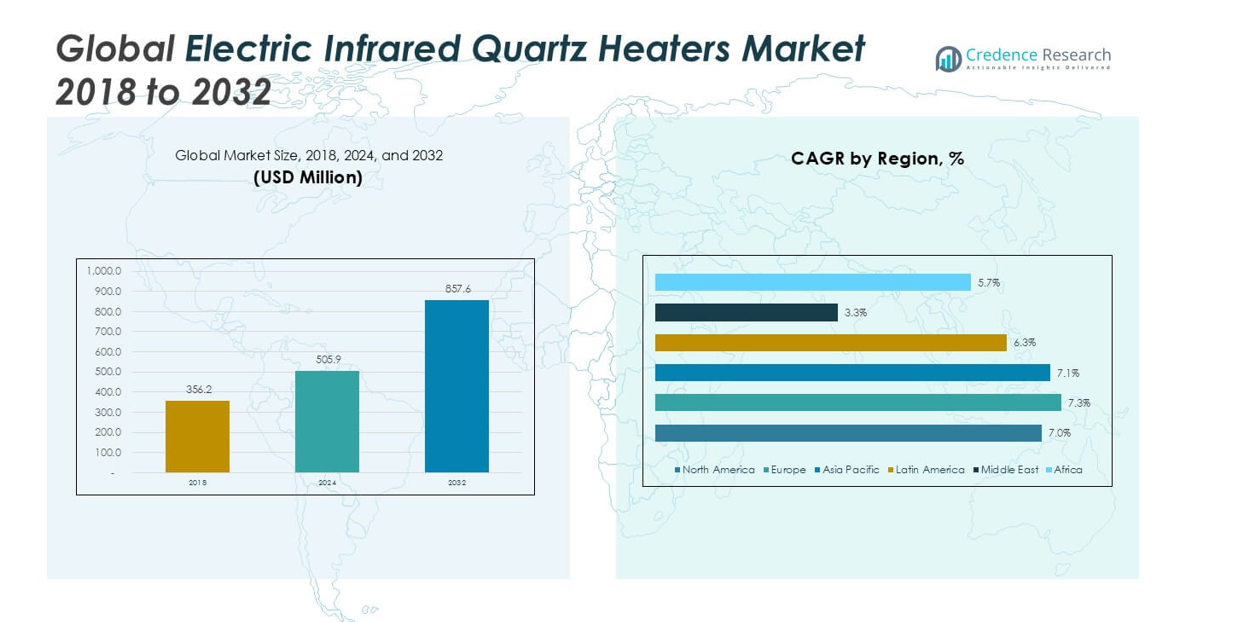
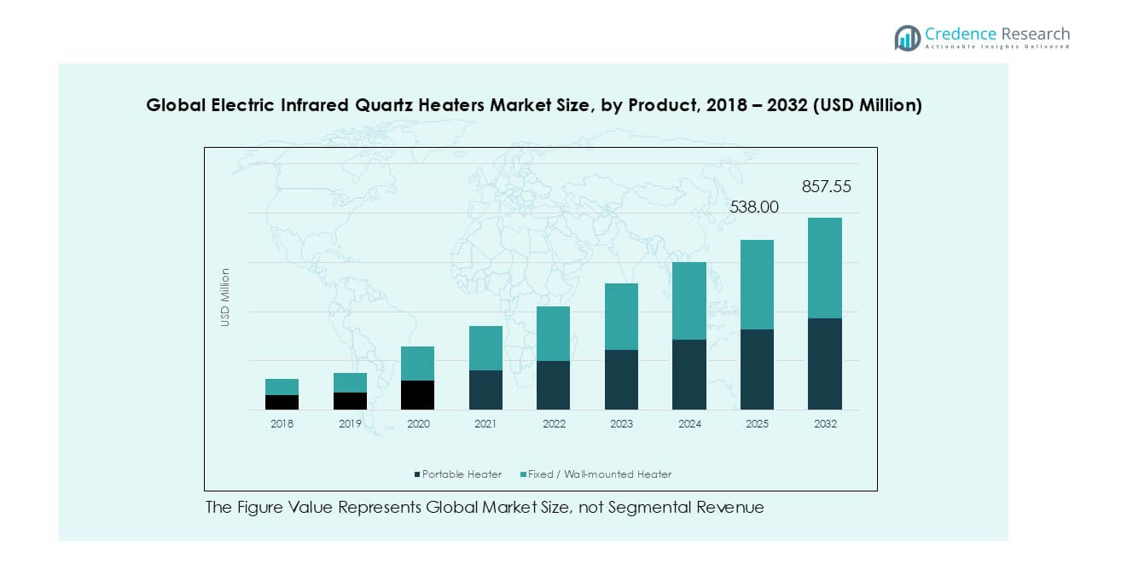
The Electric Infrared Quartz Heaters market size was valued at USD 356.2 million in 2018, reaching USD 505.9 million in 2024, and is anticipated to reach USD 857.6 million by 2032, growing at a CAGR of 6.89% during the forecast period.
| REPORT ATTRIBUTE | DETAILS |
|---|---|
| Historical Period | 2020-2023 |
| Base Year | 2024 |
| Forecast Period | 2025-2032 |
| Electric Infrared Quartz Heaters Market Size 2024 | USD 505.9 million |
| Electric Infrared Quartz Heaters Market, CAGR | 6.89% |
| Electric Infrared Quartz Heaters Market Size 2032 | USD 857.6 million |
The Electric Infrared Quartz Heaters market is led by key companies such as Dr. Infrared Heater, De’Longhi Appliance S.r.l., OMEGA Engineering, Tansun, Lasko Products, TPI Corporation, Pelonis Technologies, Duraflame, Twin-Star International, and Solamagic. These players dominate through continuous innovation, broad product portfolios, and strong retail distribution. They focus on smart features, energy efficiency, and safety enhancements to strengthen consumer appeal. Asia Pacific remains the largest regional market, holding around 32% of the global share in 2024, driven by rapid industrialization and expanding residential adoption. Europe and North America follow, supported by technological upgrades and energy efficiency regulations.
Market Insights
- The Electric Infrared Quartz Heaters market was valued at USD 505.9 million in 2024 and is projected to reach USD 857.6 million by 2032, growing at a CAGR of 6.89% during the forecast period.
- Rising demand for energy-efficient, portable, and smart heating solutions is a key driver, supported by growing awareness of lower carbon emissions and safety standards in residential and commercial applications.
- Market trends highlight increased adoption of smart and IoT-enabled heaters, expansion of e-commerce distribution, and development of compact, high-efficiency quartz elements for both home and industrial use.
- The market is moderately fragmented, with key players such as Dr. Infrared Heater, De’Longhi Appliance S.r.l., OMEGA Engineering, and Lasko Products focusing on product innovation and brand differentiation to enhance global reach.
- Asia Pacific leads with 32% share, followed by Europe (27%) and North America (24%), while portable heaters remain the dominant product segment globally.
Market Segmentation Analysis:
By Product
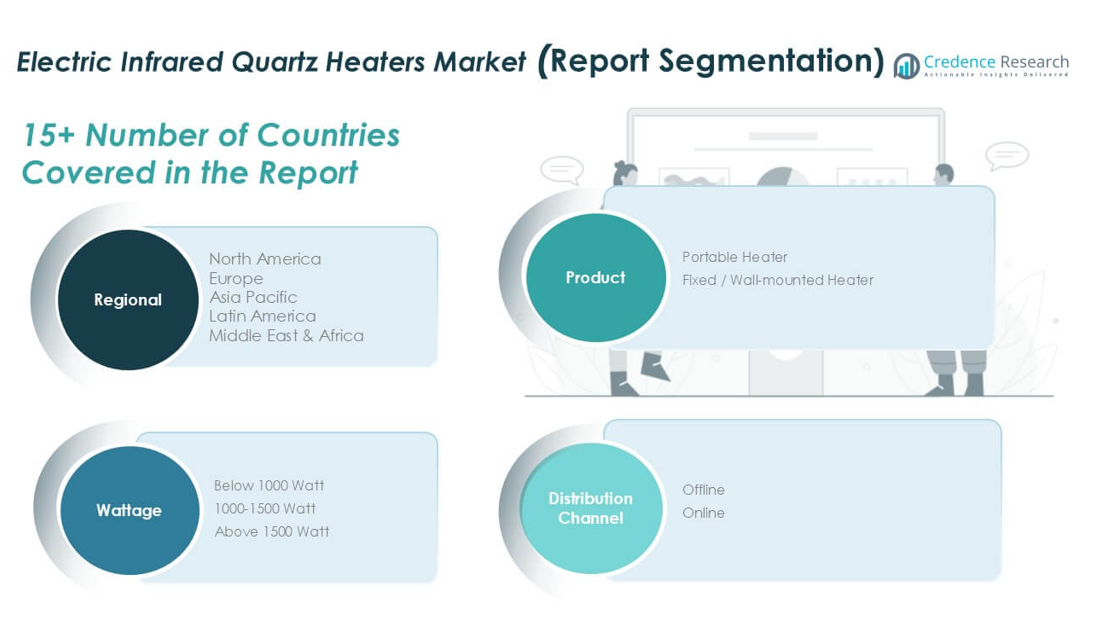
Within the product segmentation, portable heaters dominate, capturing around 55–60 % of revenue share. Consumers value their mobility, plug-and-play setup, and flexibility to target heating by room. Manufacturers drive this through compact designs, safety features, and smart controls. Fixed / wall-mounted heaters follow, favored in commercial or permanent installations for space saving and consistent heat delivery.
- For instane, Dyson offers the Pure Hot+Cool portable heater, which is equipped with a ceramic heating element and intelligent thermostat control. Meanwhile, the De'Longhi Dragon 4 series is a well-regarded oil-filled radiator known for its mobility and integrated safety features like tip-over protection.
By Wattage
In the wattage breakdown, the 1000–1500 W band is the leading sub-segment, commanding about 50 % of the total. This range balances energy efficiency and heat output for typical residential and small commercial applications. Below 1000 W units appeal in energy-constrained settings but lack reach. Above 1500 W units serve large or open spaces but face lower adoption due to higher power costs and infrastructure limits.
- For instance, the Philips 2000 Series Fan Heater provides a 1500 W ceramic heating output, with a power-saving eco-mode that can offer up to a 25% energy saving. In contrast, the Bajaj Electricals Majesty RHX 2 is a halogen room heater with a maximum output of 800 W (two heat settings: 400 W and 800 W), featuring a noiseless operation and safety features but lacks the specific performance metric of maintaining a certain air temperature within a defined time and chamber size.
By Distribution Channel
The online channel holds the largest share, approximately 60 %, driven by e-commerce growth, wide product selection, and consumer convenience. Buyers prefer comparing features, prices, and ratings digitally. Offline (traditional retail) still retains relevance, especially in developing markets, offering tactile experience, immediate availability, and in-store guidance. However, its share is gradually shrinking in mature markets.
Key Growth Drivers
Rising Energy Costs & Efficiency Imperatives
Escalating electricity and fossil-fuel prices push end users toward efficient heating systems. Infrared quartz heaters deliver direct radiant warmth, reducing energy waste linked to heating entire air volumes. This efficiency appeal is stronger in regions with high utility rates or energy subsidies phasing out. Manufacturers respond by improving emitter design, optimizing insulation, and offering better control systems to highlight lower life-cycle cost. As a result, energy savings become a compelling purchase driver for both residential and commercial buyers.
- For instance, the Heat Storm HS 1500 PHX is a 1500-watt infrared wall heater that, like all electric resistance heaters, is nearly 100% energy efficient at the point of use, converting all consumed electricity into heat.
Environmental Awareness & Regulatory Pressure
Growing concern about carbon emissions and stricter efficiency regulations tilt preference toward low-waste heating solutions. Governments in Europe, North America, and parts of Asia increasingly mandate minimum efficiency standards, performance labeling, or incentives for green appliances. Buyers see infrared heaters as a cleaner alternative to convection or gas systems. This regulatory backdrop encourages manufacturers to innovate toward higher efficacy, lower standby loss, and compliance, hence increasing adoption.
- For instance, Glen Dimplex’s Q-Rad electric infrared heater complies with the EU Ecodesign Lot 20 directive, cutting standby power consumption below 0.5 W.
Technological Innovation & Smart Integration
Advances in electronics, sensor technology, and IoT connectivity enhance product functionality and user appeal. Heaters now integrate with smart thermostats, occupancy sensors, and home automation systems. This makes control more precise, reducing energy use and increasing comfort. Such features command premium pricing and drive differentiation among suppliers. The trend toward “connected heating” helps accelerate growth, especially in urban markets and smart-home forward geographies.
Trends & Opportunities
Custom & Application-Specific Designs
Manufacturers increasingly offer heaters tailored to niche applications-outdoor patios, industrial drying, animal husbandry, and wellness spaces. These custom units include narrow beam output, corrosion resistance, or specialized mounting options. This specialization helps penetrate sectors beyond generic residential use, expanding addressable markets. Moreover, bundling solutions for verticals (e.g. outdoor hospitality, greenhouse heating) offers upsell and recurring business.
- For instance, Solamagic GmbH developed its ECO+ Pro 2000 infrared heater with an IP65 weatherproof rating for outdoor hospitality, achieving a heating range of 14 m² with a 2,000 W output.
Shift to Digital Sales & Hybrid Models
E-commerce is becoming the default route for many heater purchases. Buyers compare online, read reviews, and get faster delivery. Yet, hybrid models (online + showrooms, technician support) grow in importance. Brands offering omnichannel experiences can capture more market share. Also, subscription or leasing models for large commercial heaters may emerge-spreading capital cost and reducing friction for adoption in institutional projects.
Key Challenges
Competition from Alternative Heating Technologies
Infrared quartz heaters compete with heat pumps, radiant floor systems, and gas heating. Heat pumps, for example, deliver higher COPs in milder climates and have stronger brand backing. Buyers may prefer a unified HVAC solution rather than add a specialized heater. To counter this, infrared heater makers must emphasize niche strengths (spot heating, fast warm-up) and show total cost advantages over competing systems.
Raw Material Costs & Supply Chain Volatility
Quartz, specialty ceramics, and electronic components are subject to price swings and supply disruption. Rising prices or shortages erode margins or force price hikes. Additionally, import duties or logistics delays can disrupt production schedules. Firms must invest in supply chain resilience, vertical integration, or alternate materials. Without such strategies, cost pressures can hamper competitiveness and slow product rollouts.
Regional Analysis
North America
North America accounted for nearly 24% of the global market in 2024, valued at USD 120.23 million, up from USD 84.31 million in 2018. The region is expected to reach USD 204.87 million by 2032, growing at a CAGR of 7.0%. Growth is driven by high residential adoption, stringent energy-efficiency norms, and increasing demand for smart heating systems. The U.S. dominates the market due to strong consumer preference for portable and wall-mounted infrared heaters in homes and offices, supported by favorable government incentives for energy-saving technologies.
Europe
Europe captured around 27% of the market share in 2024, rising from USD 94.21 million in 2018 to USD 137.18 million in 2024. The market is projected to reach USD 240.11 million by 2032, registering a CAGR of 7.3%. The region’s growth is driven by strict energy regulations, a cold climate, and strong adoption of eco-friendly electric heating solutions. Demand is particularly strong in Germany, the U.K., and France, where residential and hospitality sectors increasingly prefer radiant heating for energy savings and improved comfort.
Asia Pacific
Asia Pacific dominated the market with 32% share in 2024, increasing from USD 114.41 million in 2018 to USD 164.61 million in 2024. The market is forecast to reach USD 283.76 million by 2032, expanding at a CAGR of 7.1%. Rapid urbanization, infrastructure development, and growth in residential construction drive regional demand. China, Japan, and India lead in production and consumption, supported by rising disposable incomes and growing awareness of energy-efficient heating systems. Expanding online retail networks further strengthen product accessibility across key Asian markets.
Latin America
Latin America represented about 9% of the global market in 2024, valued at USD 52.91 million, up from USD 38.40 million in 2018. The market is expected to reach USD 86.01 million by 2032, with a CAGR of 6.3%. Expansion of residential housing projects and commercial facilities in Brazil and Mexico is driving heater installations. The growing middle-class population and rising energy efficiency awareness support adoption. However, limited product availability and higher import costs restrain faster penetration compared to developed regions.
Middle East
The Middle East accounted for roughly 5% of global share in 2024, growing from USD 17.03 million in 2018 to USD 20.54 million in 2024. It is anticipated to reach USD 26.58 million by 2032, reflecting a CAGR of 3.3%. Market growth remains modest due to warmer climates limiting heating demand. However, the segment benefits from applications in commercial hospitality, outdoor recreation, and oilfield facilities requiring controlled heating. The UAE and Saudi Arabia lead demand, driven by high-end residential and hotel developments that integrate advanced comfort systems.
Africa
Africa contributed nearly 3% of the global market in 2024, increasing from USD 7.84 million in 2018 to USD 10.46 million in 2024. The market is projected to reach USD 16.21 million by 2032, advancing at a CAGR of 5.7%. Growth is supported by expanding electrification, urban housing, and tourism infrastructure in countries such as South Africa and Egypt. Limited access to affordable energy-efficient heating products and high upfront costs remain challenges, though gradual industrialization and retail expansion are opening new opportunities for affordable electric heater distribution.
Market Segmentations:
By Product
- Portable Heater
- Fixed / Wall-mounted Heater
By Wattage
- Below 1000 Watt
- 1000–1500 Watt
- Above 1500 Watt
By Distribution Channel
- Offline
- Online
By Geography
- North America
- U.S.
- Canada
- Europe
- Germany
- France
- U.K.
- Italy
- Spain
- Rest of Europe
- Asia Pacific
- China
- Japan
- India
- South Korea
- South-east Asia
- Rest of Asia Pacific
- Latin America
- Brazil
- Mexico
- Rest of Latin America
- Middle East & Africa
- GCC Countries
- South Africa
- Rest of Middle East and Africa
Competitive Landscape
The Electric Infrared Quartz Heaters market is moderately fragmented, featuring a mix of established manufacturers and emerging brands focusing on energy-efficient and smart heating technologies. Key players such as Dr. Infrared Heater, De'Longhi Appliance S.r.l., OMEGA Engineering, Tansun, Lasko Products, TPI Corporation, and Pelonis Technologies lead through product diversification, brand reputation, and technological innovation. Companies emphasize compact designs, safety certification, and remote-control integration to meet residential and commercial needs. Strategic alliances, product launches, and geographic expansion define competition, while continuous R&D investment strengthens brand positioning. Additionally, online distribution and customized B2B solutions help companies enhance global market reach, especially across Asia Pacific and Europe.
Key Player Analysis
- Infrared Heater
- OMEGA Engineering
- De'Longhi Appliance S.r.l.
- Tansun
- Lasko Products, LLC
- TPI Corporation
- Pelonis Technologies, Inc.
- Duraflame, Inc.
- Twin-Star International
- Solamagic
- Other Key Players
Recent Developments
- In August 2025, Pelonis is referenced as a key player in energy-efficient, budget-friendly heaters, with recent product updates focusing on improved safety features, digital controls, and portable formats to address shifting consumer demand in North America and Asia-Pacific.
- In 2025, Twin-Star International continued leading the U.S. electric fireplace and heater market, with innovations including the 3D Flame Effect, PanoGlow®, CoolGlow®, Safer Plug®, and Safer Sensor™.
Report Coverage
The research report offers an in-depth analysis based on Product, Wattage, Distribution Channel and Geography. It details leading market players, providing an overview of their business, product offerings, investments, revenue streams, and key applications. Additionally, the report includes insights into the competitive environment, SWOT analysis, current market trends, as well as the primary drivers and constraints. Furthermore, it discusses various factors that have driven market expansion in recent years. The report also explores market dynamics, regulatory scenarios, and technological advancements that are shaping the industry. It assesses the impact of external factors and global economic changes on market growth. Lastly, it provides strategic recommendations for new entrants and established companies to navigate the complexities of the market.
Future Outlook
- Demand for energy-efficient and low-emission heating systems will continue to rise globally.
- Integration of smart controls and IoT connectivity will enhance product functionality and user comfort.
- Manufacturers will focus on compact, portable, and design-friendly models for residential spaces.
- Industrial and commercial applications will expand with greater emphasis on targeted zone heating.
- Online sales channels will gain further traction due to wide product availability and price transparency.
- Technological innovation in quartz elements will improve heat output and durability.
- Stringent energy-efficiency regulations will encourage faster replacement of conventional heaters.
- Asia Pacific will remain the leading growth region supported by urbanization and industrialization.
- Collaborations and mergers among key players will strengthen global distribution networks.
- Sustainability-driven consumers will drive demand for electric heaters using recyclable materials and energy-saving components.

Request a Free Sample
Fill in your details and we'll send you a free sample report.
- Sample data tables & charts
- Research methodology
Need a Custom Version of This Report?
Tailor the scope, geography, or segments to your exact requirements.
- Custom geography or segment scope
- Direct access to our analyst team
Frequently Asked Questions
What is the current market size for the Electric Infrared Quartz Heaters market, and what is its projected size in 2032?
At what Compound Annual Growth Rate is the Electric Infrared Quartz Heaters market projected to grow between 2025 and 2032?
Which Electric Infrared Quartz Heaters market segment held the largest share in 2024?
What are the primary factors fueling the growth of the Electric Infrared Quartz Heaters market?
Who are the leading companies in the Electric Infrared Quartz Heaters market?
Table of Content
Chapter 1 Market Segmentation
- 1.1 Segmentation Framework
- 1.1.1 Product and Service Classification
- 1.1.2 Application and End-Use Classification
- 1.1.3 Technology and Solution Classification
- 1.1.4 Customer and Distribution Channel Classification
- 1.1.5 Geographic Segmentation
- 1.1.6 Market Segment Definitions and Boundaries
Chapter 2 Introduction
- 2.1 Report Objectives and Scope
- 2.2 Product Definition and Industry Terminology
- 2.3 Market Inclusions and Exclusions
- 2.4 Research Process
- 2.4.1 Primary Research and Expert Interviews
- 2.4.2 Secondary Research and Source Review
- 2.4.3 Top-Down and Bottom-Up Estimation
- 2.4.4 Data Triangulation and Verification
- 2.5 Market Size Measurement Basis
- 2.5.1 2024: USD 505.9 million → 2032: USD 857.6 million
- 2.6 Historical and Forecast Reference Periods
- 2.6.1 Base Year: 2024
- 2.6.2 Forecast Period: 2024-2032
- 2.7 Research Assumptions and Limitations
Chapter 3 Executive Summary
- 3.1 Market Snapshot and Key Findings
- 3.2 Base-Year Market Size, 2024
- 3.3 Forecast Market Size, 2032
- 3.4 Revenue and Volume Growth Outlook
- 3.5 Key Demand and Supply Indicators
- 3.6 Leading Market Segments
- 3.7 Fastest-Growing Market Opportunities
- 3.8 Regional Performance Highlights
- 3.9 Technology and Industry Transformation
- 3.10 Competitive Landscape Summary
- 3.11 Analyst View and Strategic Implications
Chapter 4 Global Electric Infrared Quartz Heaters Market Trends and Developments
- 4.1 Historical Industry Development
- 4.2 Recent Market Trends and Developments
- 4.3 Demand and Customer Behavior Trends
- 4.4 Technology and Product Innovation
- 4.5 Artificial Intelligence, Automation and Digitalization
- 4.6 Local Manufacturing and Supply Chain Realignment
- 4.7 Industry Partnerships, Mergers and Acquisitions
- 4.8 Sustainability and Circular Economy Developments
- 4.9 Government and Private Sector Investment Trends
- 4.10 Emerging Business Models and Commercialization
- 4.11 Industry Developments and Announcements
Chapter 5 Global Electric Infrared Quartz Heaters Market Production, Supply and Demand Analysis
- 5.1 Demand Trend and Consumption Analysis
- 5.2 Demand Forecast, 2024-2032
- 5.3 Production and Output Trend
- 5.4 Production and Output Forecast, 2024-2032
- 5.5 Installed Capacity and Capacity Utilization
- 5.6 Company-Wise Production Plants and Statistics
- 5.6.1 Installed Production Capacity
- 5.6.2 Actual Production
- 5.6.3 Planned Capacity and Expansion Targets
- 5.7 Supply Chain Structure and Procurement Trends
- 5.8 Supply-Demand Gap and Bottlenecks
- 5.9 Import Dependence and Sourcing Structure
- 5.10 Contract Manufacturing and Outsourcing
- 5.11 Regional Supply and Demand Concentration
Chapter 6 Global Electric Infrared Quartz Heaters Market Pricing Analysis
- 6.1 Pricing Structure and Measurement
- 6.2 Historical Pricing Trends
- 6.3 Pricing Outlook, 2024-2032
- 6.4 Average Selling Price and Unit Economics
- 6.5 Pricing by Product and Market Segment
- 6.6 Geographic Pricing Differences
- 6.7 Key Input, Energy, Labor and Logistics Costs
- 6.8 Contract Pricing and Purchasing Models
- 6.9 Pricing Sensitivity and Competitive Positioning
- 6.10 Price, Margin and Profitability Implications
Chapter 7 Global Electric Infrared Quartz Heaters Market Dynamics
- 7.1 Market Growth Drivers
- 7.1.1 Demand-Side Drivers
- 7.1.2 Technology and Innovation Drivers
- 7.1.3 Infrastructure and Investment Drivers
- 7.1.4 Regulatory and Policy Drivers
- 7.2 Market Restraints
- 7.2.1 Cost and Affordability Constraints
- 7.2.2 Technology and Adoption Barriers
- 7.2.3 Supply Chain and Operational Constraints
- 7.3 Market Challenges
- 7.3.1 Competitive Pressure and Margin Erosion
- 7.3.2 Skills, Infrastructure and Implementation Gaps
- 7.4 Emerging Market Opportunities
- 7.5 Market Dynamics Impact and Time-Horizon Assessment
Chapter 8 Global Electric Infrared Quartz Heaters Value Chain Analysis
- 8.1 Industry Value Chain Overview
- 8.2 Upstream Suppliers and Critical Inputs
- 8.3 Technology and Component Providers
- 8.4 Manufacturing or Service Delivery
- 8.5 Distribution, Channel Partners and Integrators
- 8.6 Downstream Applications and End Users
- 8.7 Value Addition and Profit Pools
- 8.8 Vertical Integration and Outsourcing
- 8.9 Supplier Concentration and Risk
- 8.10 Supply Chain Localization and Resilience
Chapter 9 Global Electric Infrared Quartz Heaters Market Regulations and Policies
- 9.1 Relevant Laws, Standards and Compliance Frameworks
- 9.2 Product, Service, Safety and Quality Requirements
- 9.3 Government Policies, Incentives and Subsidies
- 9.4 Imports, Exports and Trade Barriers
- 9.5 Public Procurement and Local Content Requirements
- 9.6 Environmental and Sustainability Compliance
- 9.7 Upcoming Policy Changes and Market Implications
Chapter 10 Global Electric Infrared Quartz Heaters Market Hotspots and Opportunities
- 10.1 Market Opportunity Mapping and Growth Hotspots
- 10.2 High-Growth Applications and Customer Groups
- 10.3 Underserved Markets and White-Space Opportunities
- 10.4 Emerging Technology and Product Opportunities
- 10.5 New Capacity and Investment Hotspots
- 10.6 Market Entry and Expansion Opportunities
- 10.7 Distribution and Partnership Opportunities
- 10.8 Near-Term and Long-Term Commercial Potential
- 10.9 Opportunity Attractiveness and Execution Risks
Chapter 11 Global Electric Infrared Quartz Heaters Market Outlook, 2024-2032
- 11.1 Market Size and Analysis
- 11.1.1 Revenue (Market Measurement: 2024: USD 505.9 million → 2032: USD 857.6 million)
- 11.1.2 Market Volume and Quantity Sold
- 11.1.3 Historical Market Size
- 11.1.4 Base-Year Market Size, 2024
- 11.2 Market Forecast, 2024-2032
- 11.2.1 Revenue Forecast to 2032
- 11.2.2 Volume Forecast to 2032
- 11.2.3 CAGR and Year-on-Year Growth
- 11.2.4 Incremental Revenue Opportunity
- 11.3 Forecast Assumptions and Scenario Analysis
- 11.3.1 Base-Case Forecast
- 11.3.2 Optimistic and Conservative Scenarios
- 11.3.3 Technology, Pricing and Policy Sensitivities
- 11.4 Market Attractiveness and Growth Outlook
Chapter 12 Global Electric Infrared Quartz Heaters Market Segmentation and Outlook
- 12.1 Segmentation Summary and Market Shares, 2024
- 12.2 Largest and Fastest-Growing Segments
- 12.3 Segment Growth Comparison
- 12.4 Segment Attractiveness and Priority Matrix
Chapter 13 Global Electric Infrared Quartz Heaters Geographic Market Outlook, 2024-2032
- 13.1 Regional Market Size and Share, 2024
- 13.2 Regional Market Forecast, 2024-2032
- 13.3 Regional Pricing, Production and Demand Differences
- 13.4 North America
- 13.4.1 United States
- 13.4.2 Canada
- 13.4.3 Mexico
- 13.5 Europe
- 13.5.1 Germany
- 13.5.2 France
- 13.5.3 Italy
- 13.5.4 United Kingdom
- 13.5.5 Spain
- 13.5.6 Poland
- 13.5.7 Russia
- 13.5.8 Netherlands
- 13.5.9 Belgium
- 13.5.10 Sweden
- 13.5.11 Denmark
- 13.5.12 Norway
- 13.5.13 Rest of Europe
- 13.6 Asia Pacific
- 13.6.1 China
- 13.6.2 India
- 13.6.3 Japan
- 13.6.4 South Korea
- 13.6.5 Thailand
- 13.6.6 Indonesia
- 13.6.7 Vietnam
- 13.6.8 Malaysia
- 13.6.9 Australia
- 13.6.10 Rest of Asia Pacific
- 13.7 Latin America
- 13.7.1 Brazil
- 13.7.2 Argentina
- 13.7.3 Colombia
- 13.7.4 Chile
- 13.7.5 Rest of Latin America
- 13.8 Middle East
- 13.8.1 Saudi Arabia
- 13.8.2 United Arab Emirates
- 13.8.3 Turkey
- 13.8.4 Israel
- 13.8.5 Iran
- 13.8.6 Rest of the Middle East
- 13.9 Africa
- 13.9.1 South Africa
- 13.9.2 Egypt
- 13.9.3 Nigeria
- 13.9.4 Morocco
- 13.9.5 Rest of Africa
- 13.10 Regional Investment, Policy and Supply Chain Differences
- 13.11 Regional Competitive Landscape
- 13.12 Geographic Growth Hotspots
Chapter 14 Global Electric Infrared Quartz Heaters Technology, Innovation and Sustainability Outlook
- 14.1 Technology Landscape and Maturity
- 14.2 Product, Process and Service Innovation
- 14.3 AI, Automation and Digital Tools in the Industry
- 14.4 Technology Adoption and Performance Benchmarking
- 14.5 Innovation Pipeline and R&D Investment
- 14.6 Patent and Intellectual Property Trends
- 14.7 Energy Efficiency and Resource Management
- 14.8 Sustainability, Recycling and Circularity
- 14.9 Technology Roadmap, 2024-2032
- 14.10 Risks of Obsolescence and Technology Substitution
Chapter 15 Global Electric Infrared Quartz Heaters Market Key Strategic Imperatives
- 15.1 Growth and Market Entry Priorities
- 15.2 High-Return Products and Segments
- 15.3 Pricing, Profitability and Cost Optimization
- 15.4 Technology Investment and Product Differentiation
- 15.5 Supply Chain Localization and Resilience
- 15.6 Distribution and Customer Acquisition
- 15.7 Partnership, Acquisition and Capacity Strategy
- 15.8 Regional Expansion Priorities
- 15.9 Short-, Medium- and Long-Term Actions
Chapter 16 Competition Outlook
- 16.1 Industry Competition Characteristics
- 16.2 Market Structure and Concentration
- 16.3 Market Share and Competitive Positioning, 2024
- 16.4 Company-Wise Revenue and Product Benchmarking
- 16.5 Production and Service Capacity Benchmarking
- 16.6 Technology, Pricing and Differentiation
- 16.7 Regional Footprint and Distribution Strength
- 16.8 Mergers, Acquisitions and Strategic Alliances
- 16.9 New Entrants and Competitive Threats
- 16.10 Porter's Five Forces and Industry Attractiveness
- 16.11 Competitive Outlook, 2024-2032
Chapter 17 Company Profiles
- 17.1 Company Coverage and Selection Criteria
- 17.2 Leading Market Participants – Standard Profile Structure
- 17.2.1 Business Description
- 17.2.2 Company Ownership and Geographic Presence
- 17.2.3 Product and Service Portfolio
- 17.2.4 Manufacturing and Operating Footprint
- 17.2.5 Production Capacity and Expansion Plans
- 17.2.6 Financial Performance and Investment
- 17.2.7 Market Share and Competitive Position
- 17.2.8 Technology and Innovation Capabilities
- 17.2.9 Strategic Alliances or Partnerships
- 17.2.10 Recent Developments
- 17.2.11 Growth Strategy and Outlook
- 17.3 Other Relevant Market Participants
Note: Every listed company is profiled on the structure shown under the first company. The company list is preliminary and may change based on research findings, market developments, data availability and client requirements.
Chapter 18 Disclaimer
- 18.1 Research and Forecast Disclaimer
- 18.2 Data Source and Estimation Limitations
Note: The depth of individual sections depends on data availability for this market. Volume, capacity, trade and other unit-based metrics are included where applicable.