
Market Overview
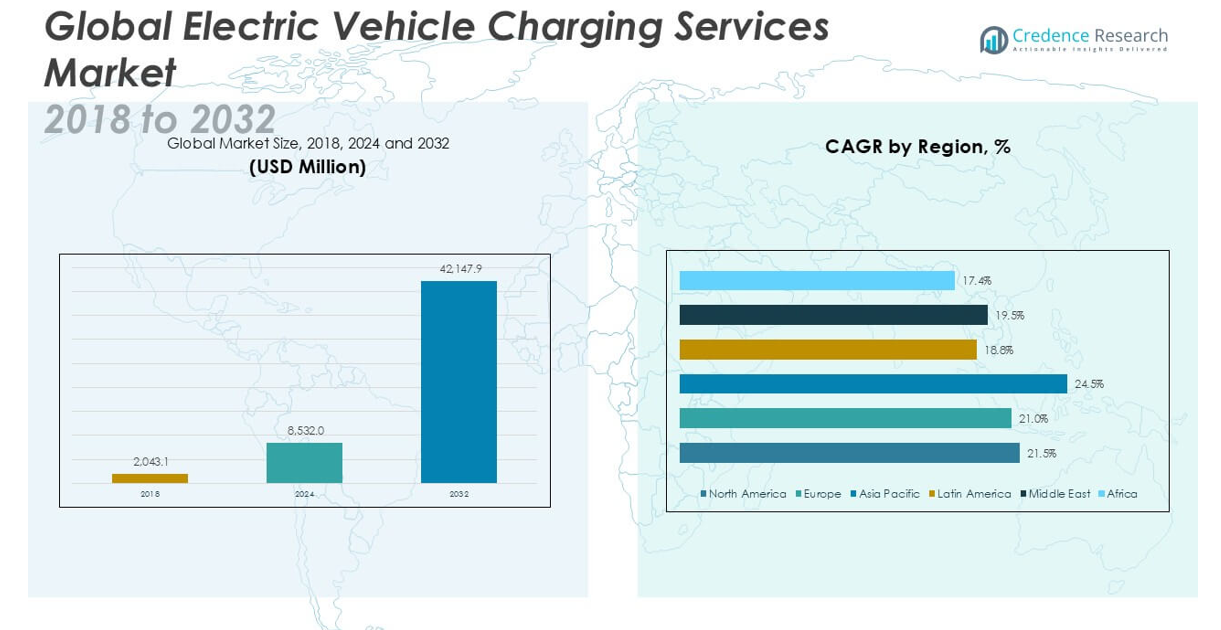
The Electric Vehicle Charging Services market size was valued at USD 2,043.1 million in 2018, increased to USD 8,532.0 million in 2024, and is anticipated to reach USD 42,147.9 million by 2032, at a CAGR of 22.10% during the forecast period.
| REPORT ATTRIBUTE | DETAILS |
|---|---|
| Historical Period | 2020-2023 |
| Base Year | 2024 |
| Forecast Period | 2025-2032 |
| Electric Vehicle Charging Services Market Size 2024 | USD 8,532.0 million |
| Electric Vehicle Charging Services Market, CAGR | 22.10% |
| Electric Vehicle Charging Services Market Size 2032 | USD 42,147.9 million |
The Electric Vehicle Charging Services market is dominated by leading players such as ChargePoint, Inc., Tesla, Inc., BP Pulse, EVgo Services LLC, Shell Recharge Solutions, Blink Charging Co., Electrify America LLC, and Ionity GmbH. These companies actively expand their charging networks, focusing on fast-charging capabilities and smart energy management to strengthen their market positions. Asia Pacific leads the global market with a commanding 33.0% share in 2024, driven by rapid electric vehicle adoption and extensive infrastructure development, particularly in China. Europe follows closely, supported by strong regulatory backing and widespread charging station deployment. North America holds a significant share, fueled by increasing EV sales and government-led sustainability initiatives. The competitive landscape remains dynamic, with strategic collaborations and technological innovations shaping the growth trajectory of the market.
Market Insights
- The Electric Vehicle Charging Services market was valued at USD 2,043.1 million in 2018, reached USD 8,532.0 million in 2024, and is projected to grow to USD 42,147.9 million by 2032, registering a CAGR of 22.10% during the forecast period.
- Rising electric vehicle adoption globally, supported by government incentives and increasing consumer environmental awareness, is driving the demand for reliable and accessible charging services.
- Key trends include the expansion of fast-charging networks, growing integration of renewable energy in charging stations, and the rise of subscription-based charging models that enhance user convenience.
- Major players such as Tesla, ChargePoint, and Shell Recharge are expanding charging infrastructure, but high installation costs and inconsistent charging standards remain key market restraints.
- Asia Pacific holds the largest regional share at 33.0%, while the DC charging segment leads with approximately 55% market share due to its fast-charging capabilities.
Market Segmentation Analysis:
By Vehicle Type:
In the Electric Vehicle Charging Services market, the Battery Electric Vehicle (BEV) segment holds the largest market share, accounting for over 70% in 2024. BEVs are widely adopted due to their zero-emission capabilities, growing environmental awareness, and supportive government incentives. The rising investment in fast-charging infrastructure and increasing range capabilities of BEVs further drive this segment’s dominance. Additionally, the growing affordability of BEVs and the rapid expansion of charging networks are expected to sustain their leading position throughout the forecast period, as consumers increasingly prefer fully electric options over hybrid alternatives.
- For instance, Tesla's Model S Long Range has achieved a driving range of 405 miles per full charge, which is one of the longest ranges available in the BEV market as of 2024.
By Charging Station Type
The DC Charging Station segment leads the market, holding a significant share of approximately 55% in 2024. DC fast chargers are preferred for their ability to quickly charge electric vehicles, catering to the demand for reduced charging times among both private users and commercial fleets. Their growing deployment along highways and in urban centers supports the expansion of long-distance electric vehicle travel. Furthermore, government-led initiatives promoting fast-charging infrastructure and technological advancements in ultra-fast DC chargers are key drivers propelling the segment’s growth, making it the most sought-after charging station type in the market.
- For instance, ABB’s Terra 360 charger, launched in 2021, can deliver a maximum output of 360 kW and is capable of charging an EV in less than 15 minutes, supporting four vehicles simultaneously.
By Application
The Commercial segment dominates the Electric Vehicle Charging Services market with a market share exceeding 60% in 2024. This segment’s growth is driven by the increasing installation of public charging stations in urban areas, workplaces, shopping malls, and along highways to meet the surging demand for accessible charging solutions. Businesses and governments are heavily investing in commercial charging infrastructure to support the accelerating adoption of electric vehicles. The need to address range anxiety and promote sustainable transportation further encourages commercial setups, making this segment the primary contributor to market expansion.
Market Overview
Expanding Electric Vehicle Adoption
The rapid growth in electric vehicle (EV) sales globally serves as a primary driver for the Electric Vehicle Charging Services market. Governments and manufacturers are actively promoting EV adoption through subsidies, tax incentives, and stricter emission regulations. This surge in EV deployment increases the demand for a robust charging infrastructure, both in urban and highway settings. As consumer confidence in EV technology strengthens, the need for accessible, fast, and reliable charging services becomes essential, creating significant market expansion opportunities.
- For instance, BYD sold over 1.57 million battery electric vehicles globally in 2023, significantly boosting EV penetration and contributing to the growing need for expansive charging infrastructure.
Government Initiatives and Investments
Government initiatives to support sustainable transportation heavily contribute to the growth of the Electric Vehicle Charging Services market. Authorities worldwide are investing in the development of charging networks, offering grants, and implementing favorable policies to encourage infrastructure expansion. Public-private partnerships and municipal mandates for new construction projects to include charging stations further bolster market growth. These regulatory measures are crucial in building a scalable and accessible charging ecosystem, thereby driving the market forward.
- For instance, the U.S. government announced in 2023 the National Electric Vehicle Infrastructure (NEVI) program, allocating $5 billion to build a network of 500,000 public EV chargers by 2030.
Technological Advancements in Charging Infrastructure
Innovations in charging technology, particularly in ultra-fast and wireless charging systems, significantly enhance the attractiveness of electric vehicles. The introduction of high-power DC fast chargers and smart grid-enabled charging stations ensures reduced charging times and improved energy efficiency. Additionally, advancements in charging management software enable seamless payment integration and real-time monitoring, improving the overall user experience. These technological improvements are accelerating the deployment of charging stations, fueling market growth.
Key Trends & Opportunities
Integration of Renewable Energy
The integration of renewable energy sources into EV charging stations is an emerging trend creating sustainable opportunities in the Electric Vehicle Charging Services market. Solar-powered charging units and grid-connected stations utilizing clean energy help reduce the carbon footprint associated with vehicle charging. This approach not only aligns with global sustainability goals but also attracts environmentally conscious consumers, offering long-term market advantages and opening new investment avenues for green infrastructure.
- For instance, Shell Recharge operates solar-powered EV charging hubs in the UK, with its Fulham site equipped with 10 charging points powered entirely by on-site solar panels.
Rise of Subscription-Based Charging Models
Subscription-based and membership-driven charging services are gaining traction, offering convenience and cost predictability to EV owners. These models provide users with access to extensive charging networks for a fixed fee, promoting customer loyalty and consistent revenue streams for service providers. The rise of subscription platforms is reshaping consumer behavior by encouraging frequent use of public charging stations, thus presenting a significant opportunity for market players to expand their user base and service offerings.
- For instance, Electrify America’s Pass+ subscription plan offers members a discounted rate of $0.31 per kWh for DC fast charging compared to standard rates, incentivizing regular usage through lower energy costs.
Key Challenges
High Initial Infrastructure Costs
One of the major challenges in the Electric Vehicle Charging Services market is the substantial initial investment required for setting up charging stations. The costs associated with advanced charging equipment, installation, grid upgrades, and land acquisition can deter potential investors. This financial burden often limits the expansion of charging networks, particularly in developing regions, posing a significant barrier to market growth despite increasing demand for EVs.
Inconsistent Charging Standards
The lack of universal charging standards across different countries and vehicle manufacturers presents a critical hurdle for the market. Variations in connector types, charging speeds, and payment systems complicate the user experience and hinder seamless interoperability. This inconsistency creates confusion among consumers and limits the scalability of charging networks, necessitating the development of standardized protocols to ensure widespread and efficient market penetration.
Grid Capacity and Load Management
The growing number of EVs and charging stations puts additional pressure on existing power grids, raising concerns about load management and energy distribution. Inadequate grid capacity and the absence of smart energy management systems can lead to grid instability and increased operational challenges. Addressing these issues requires substantial investments in smart grid technologies and energy storage solutions to support the future growth of the Electric Vehicle Charging Services market effectively.
Regional Analysis
North America
North America accounted for a significant share of approximately 28.5% of the Electric Vehicle Charging Services market in 2024, with a market size increasing from USD 753.9 million in 2018 to USD 2,431.6 million in 2024. The market is projected to reach USD 10,115.5 million by 2032, growing at a CAGR of 21.5% during the forecast period. Growth is driven by strong EV adoption, robust government support, and the rapid expansion of fast-charging networks across the United States and Canada. Continued infrastructure development and regulatory backing will likely sustain North America’s competitive position in the market.
Europe
Europe held a 31.0% market share in the Electric Vehicle Charging Services market in 2024, with the market size growing from USD 592.5 million in 2018 to USD 2,644.9 million in 2024. It is expected to reach USD 12,855.1 million by 2032, registering a CAGR of 21.0%. The region’s growth is supported by aggressive carbon-neutral policies, substantial government investments in charging infrastructure, and strong consumer preference for electric mobility. Europe remains a leading hub for public charging stations, with countries like Germany, the UK, and France spearheading the expansion of accessible EV charging services.
Asia Pacific
Asia Pacific captured the largest market share of approximately 33.0% in 2024, expanding from USD 549.6 million in 2018 to USD 2,815.6 million in 2024. The market is forecasted to grow at the fastest CAGR of 24.5%, reaching USD 16,100.5 million by 2032. The region’s rapid growth is primarily driven by China’s dominant EV market, aggressive infrastructure development, and government subsidies promoting electric vehicle adoption. Additionally, countries like Japan, South Korea, and India are significantly investing in charging stations, reinforcing Asia Pacific’s leading position in the global Electric Vehicle Charging Services market.
Latin America
Latin America held a modest 2.0% market share in 2024, with the market size increasing from USD 40.9 million in 2018 to USD 170.6 million in 2024. The market is anticipated to reach USD 969.4 million by 2032, growing at a CAGR of 18.8%. The region is gradually embracing electric mobility, supported by urban sustainability initiatives and increasing awareness of clean transportation solutions. Countries like Brazil, Mexico, and Chile are focusing on expanding EV infrastructure, although the overall adoption pace remains slower compared to developed regions, offering long-term growth potential.
Middle East
The Middle East accounted for a 4.3% market share in 2024, with the market size growing from USD 83.8 million in 2018 to USD 366.9 million in 2024. The market is projected to reach USD 1,475.2 million by 2032, advancing at a CAGR of 19.5%. Market growth is supported by national diversification strategies, particularly in the UAE and Saudi Arabia, where investments in sustainable transportation and smart cities are underway. While the region is still emerging in EV adoption, the increasing deployment of charging stations signals promising future development.
Africa
Africa represented the smallest market share of 1.2% in 2024, with the market growing from USD 22.5 million in 2018 to USD 102.4 million in 2024. The market is expected to reach USD 632.2 million by 2032, registering a CAGR of 17.4%. The region’s growth is hindered by underdeveloped infrastructure and limited electric vehicle penetration. However, growing environmental concerns, gradual policy support, and pilot projects in countries like South Africa are encouraging investments in EV charging services. Africa presents a long-term growth opportunity, although the market remains in the early adoption phase.
Market Segmentations:
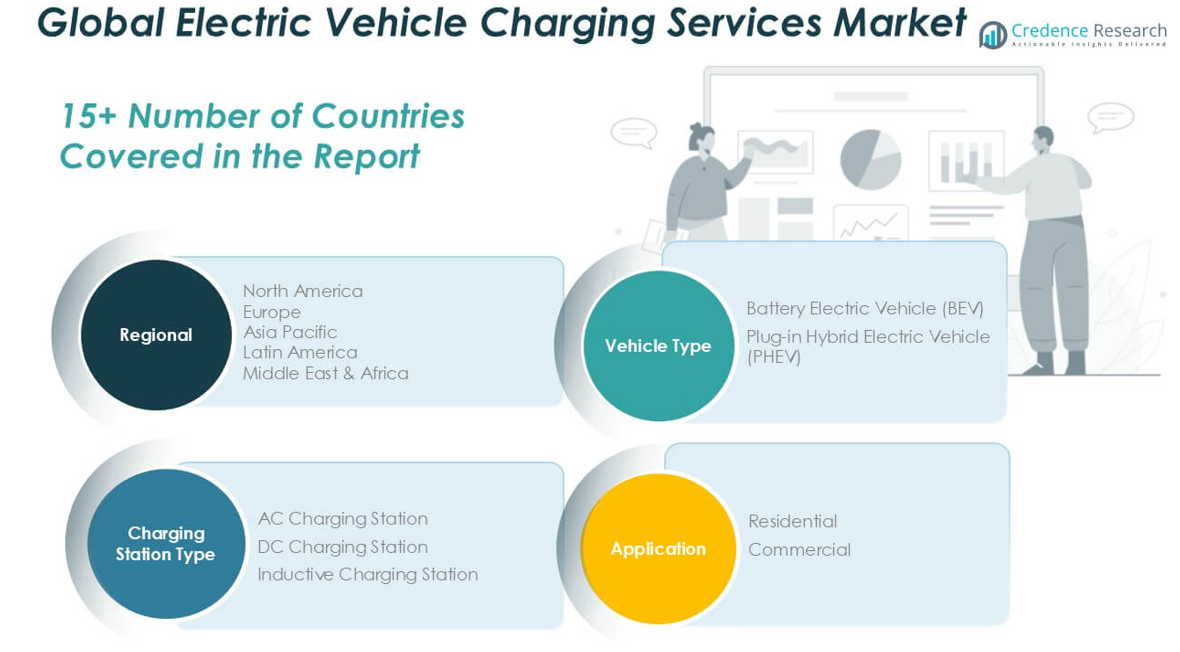
By Vehicle Type
- Battery Electric Vehicle (BEV)
- Plug-in Hybrid Electric Vehicle (PHEV)
By Charging Station Type
- AC Charging Station
- DC Charging Station
- Inductive Charging Station
By Application
- Residential
- Commercial
By Geography:
- North America
- U.S.
- Canada
- Mexico
- Europe
- Germany
- France
- U.K.
- Italy
- Spain
- Rest of Europe
- Asia Pacific
- China
- Japan
- India
- South Korea
- South-east Asia
- Rest of Asia Pacific
- Latin America
- Brazil
- Argentina
- Rest of Latin America
- Middle East & Africa
- GCC Countries
- South Africa
- Rest of the Middle East and Africa
Competitive Landscape
The Electric Vehicle Charging Services market is characterized by intense competition, with key players focusing on expanding their charging networks, enhancing technological capabilities, and forming strategic partnerships to strengthen market presence. Companies such as ChargePoint, Tesla, BP Pulse, EVgo, and Shell Recharge Solutions are leading the market by aggressively deploying fast-charging stations and offering innovative subscription models to attract a broad consumer base. Strategic collaborations between automakers and charging service providers are becoming increasingly common to ensure seamless accessibility and improved customer experience. Additionally, global players are investing heavily in renewable energy integration and smart charging solutions to align with sustainability goals. New entrants and regional companies are also capitalizing on government incentives to establish localized charging infrastructure, intensifying market competition. Continuous advancements in ultra-fast charging technologies, user-friendly mobile applications, and energy management systems are crucial areas where companies seek to gain a competitive edge in this rapidly evolving market.
Key Player Analysis
- ChargePoint, Inc.
- Tesla, Inc.
- BP Pulse
- EVgo Services LLC
- Shell Recharge Solutions
- Blink Charging Co.
- Electrify America LLC
- Volta Inc.
- Tata Power EZ Charge
- Ionity GmbH
- ABB Ltd.
- Siemens AG
- Star Charge
- Engie SA (EVBox Group)
Recent Developments
- In April 2025, ChargePoint announced a new AC Level 2 charging technology. This architecture features bidirectional charging, V2X capability, and ultra-fast charging speeds – 19.2 kW in North America and 22 kW in Europe, among others. This architecture will target various models in North America and Europe within commercial, residential, and fleet applications.
- In March 2025, BYD launched its Super e-Platform featuring megawatt flash charging technology, capable of 1,000 kW charging power and 2 km/second peak charging speed. This launch includes an all-liquid-cooled Megawatt Flash Charging terminal system, with plans to establish over 4,000 'Megawatt Flash Charging stations' in China.
- In March 2025, Micronesia Mall highlighted its ongoing commitment to sustainability and forward-thinking solutions by collaborating with Triple J Technologies, Atkins Kroll BMW, Pacific Solar & Photovoltaics Inc., and EVAR to develop this EV charging station project.
- InMarch 2025, Trinity Cleantech acquired the German startup ME Energy, which specializes in off-grid fast-charging stations. ME Energy filed for insolvency last year and has now been fully acquired by Trinity Cleantech.
- In December 2024, ChargePoint and General Motors announced a collaboration to install up to 500 ultra-fast EV charging ports across strategic US locations by the end of 2025. These GM Energy-branded stations will feature ChargePoint's Express Plus platform (up to 500kW) and Omni Port technology, supporting both CCS and NACS connectors to enhance nationwide EV charging accessibility.
- In February 2024, Raizen Power and BYD formed a strategic partnership to accelerate sustainable electric mobility in Brazil. The initiative aims to significantly expand the public network of electric chargers, providing 100% clean and renewable energy and enhancing the recharging experience for users. Raizen Power, aiming for a 25% market share in Brazil's electromobility sector, will install approximately 600 new DC charge points, contributing an additional 18 MW of installed power for nationwide EV recharging.
Market Concentration & Characteristics
The Electric Vehicle Charging Services Market is moderately concentrated, with a few large players holding significant market shares and several regional providers contributing to a fragmented landscape. It is characterized by rapid technological advancements, strong government involvement, and the growing deployment of fast-charging networks. The market exhibits high capital requirements due to the substantial infrastructure investment needed for setting up charging stations. It continues to evolve through strategic partnerships, mergers, and acquisitions, with companies focusing on network expansion and integration of renewable energy sources. Intense competition is driving service innovation and the introduction of user-friendly digital platforms to improve accessibility and payment convenience. The market shows a strong inclination toward urban installations, yet rural coverage remains limited. Price sensitivity varies by region, depending on government subsidies and electricity costs. It demands continuous technological upgrades to support faster charging speeds and vehicle compatibility, creating pressure on operators to remain competitive.
Report Coverage
The research report offers an in-depth analysis based on Vehicle Type, Charging Station Type, Application and Geography. It details leading market players, providing an overview of their business, product offerings, investments, revenue streams, and key applications. Additionally, the report includes insights into the competitive environment, SWOT analysis, current market trends, as well as the primary drivers and constraints. Furthermore, it discusses various factors that have driven market expansion in recent years. The report also explores market dynamics, regulatory scenarios, and technological advancements that are shaping the industry. It assesses the impact of external factors and global economic changes on market growth. Lastly, it provides strategic recommendations for new entrants and established companies to navigate the complexities of the market.
Future Outlook
- The market is expected to grow steadily with increasing electric vehicle adoption worldwide.
- Governments will continue to invest heavily in public charging infrastructure to support sustainable transportation.
- Fast-charging stations will become more common, reducing charging times and improving convenience for users.
- Renewable energy integration at charging stations will gain momentum, promoting cleaner energy solutions.
- Subscription-based and membership charging models will see higher adoption due to customer demand for predictable costs.
- Smart charging technologies and real-time energy management systems will improve operational efficiency.
- Automakers will expand partnerships with charging service providers to offer seamless charging experiences.
- Investment in rural and highway charging networks will increase to support long-distance electric vehicle travel.
- Companies will focus on developing interoperable systems to address challenges related to charging standardization.
- Mobile app-based payment systems and location tracking will become essential features in enhancing customer experience.

Request a Free Sample
Fill in your details and we'll send you a free sample report.
- Sample data tables & charts
- Research methodology
Market Dynamics
Expanding Electric Vehicle Adoption
The rapid increase in global electric vehicle sales, supported by government incentives and stricter emission regulations, is driving the need for accessible and reliable charging services. As more consumers and fleets transition to EVs, the demand for charging infrastructure grows in both urban and highway settings.
Government Initiatives and Investments
Governments worldwide are investing heavily in public charging infrastructure, offering grants, and implementing favorable policies to accelerate the deployment of charging stations. Public-private partnerships and regulatory mandates for new developments to include charging points are further fueling market growth.
Technological Advancements in Charging Infrastructure
Innovations such as ultra-fast DC chargers, wireless charging, and smart grid integration are reducing charging times and improving energy efficiency. These advancements enhance user experience and operational efficiency, encouraging broader adoption of electric vehicles.
Integration of Renewable Energy
The incorporation of renewable energy sources like solar and wind into charging stations is reducing the carbon footprint of EV charging. This aligns with global sustainability goals and attracts environmentally conscious consumers, opening new opportunities for green infrastructure investment.
Rise of Subscription-Based Charging Models
Subscription and membership-based charging services are providing EV owners with cost predictability and convenience, fostering customer loyalty and recurring revenue for providers. These models encourage frequent use of public charging networks and support the expansion of service offerings.
Need a Custom Version of This Report?
Tailor the scope, geography, or segments to your exact requirements.
- Custom geography or segment scope
- Direct access to our analyst team
Frequently Asked Questions
What is the current size of the Electric Vehicle Charging Services Market?
What are the key segments within the Electric Vehicle Charging Services Market?
What are some challenges faced by the Electric Vehicle Charging Services Market?
Who are the major players in the Electric Vehicle Charging Services Market?
Table of Content
Chapter 1 Market Segmentation
- 1.1 Segmentation Framework
- 1.1.1 Product and Service Classification
- 1.1.2 Application and End-Use Classification
- 1.1.3 Technology and Solution Classification
- 1.1.4 Customer and Distribution Channel Classification
- 1.1.5 Geographic Segmentation
- 1.1.6 Market Segment Definitions and Boundaries
- 1.2 By Application
- 1.2.1 Residential
- 1.2.2 Commercial
- 1.3 By Vehicle Type
- 1.3.1 Battery Electric Vehicle (BEV)
- 1.3.2 Plug-in Hybrid Electric Vehicle (PHEV)
- 1.4 By Charging Station Type
- 1.4.1 AC Charging Station
- 1.4.2 DC Charging Station
- 1.4.3 Inductive Charging Station
Chapter 2 Introduction
- 2.1 Report Objectives and Scope
- 2.2 Product Definition and Industry Terminology
- 2.3 Market Inclusions and Exclusions
- 2.4 Research Process
- 2.4.1 Primary Research and Expert Interviews
- 2.4.2 Secondary Research and Source Review
- 2.4.3 Top-Down and Bottom-Up Estimation
- 2.4.4 Data Triangulation and Verification
- 2.5 Market Size Measurement Basis
- 2.5.1 2024: USD 8,532.0 million → 2032: USD 42,147.9 million
- 2.6 Historical and Forecast Reference Periods
- 2.6.1 Base Year: 2024
- 2.6.2 Forecast Period: 2024-2032
- 2.7 Research Assumptions and Limitations
Chapter 3 Executive Summary
- 3.1 Market Snapshot and Key Findings
- 3.2 Base-Year Market Size, 2024
- 3.3 Forecast Market Size, 2032
- 3.4 Revenue and Volume Growth Outlook
- 3.5 Key Demand and Supply Indicators
- 3.6 Leading Market Segments
- 3.7 Fastest-Growing Market Opportunities
- 3.8 Regional Performance Highlights
- 3.9 Technology and Industry Transformation
- 3.10 Competitive Landscape Summary
- 3.11 Analyst View and Strategic Implications
Chapter 4 Global Electric Vehicle Charging Services Market Trends and Developments
- 4.1 Historical Industry Development
- 4.2 Recent Market Trends and Developments
- 4.3 Demand and Customer Behavior Trends
- 4.4 Technology and Product Innovation
- 4.5 Artificial Intelligence, Automation and Digitalization
- 4.6 Local Manufacturing and Supply Chain Realignment
- 4.7 Industry Partnerships, Mergers and Acquisitions
- 4.8 Sustainability and Circular Economy Developments
- 4.9 Government and Private Sector Investment Trends
- 4.10 Emerging Business Models and Commercialization
- 4.11 Industry Developments and Announcements
Chapter 5 Global Electric Vehicle Charging Services Market Supply and Demand Analysis
- 5.1 Demand Trend and Consumption Analysis
- 5.2 Demand Forecast, 2024-2032
- 5.3 Supply Chain Structure and Procurement Trends
- 5.4 Supply-Demand Gap and Bottlenecks
- 5.5 Import Dependence and Sourcing Structure
- 5.6 Regional Supply and Demand Concentration
Chapter 6 Global Electric Vehicle Charging Services Market Pricing Analysis
- 6.1 Pricing Structure and Measurement
- 6.2 Historical Pricing Trends
- 6.3 Pricing Outlook, 2024-2032
- 6.4 Pricing by Product and Market Segment
- 6.5 Geographic Pricing Differences
- 6.6 Key Input, Energy, Labor and Logistics Costs
- 6.7 Contract Pricing and Purchasing Models
- 6.8 Pricing Sensitivity and Competitive Positioning
- 6.9 Price, Margin and Profitability Implications
Chapter 7 Global Electric Vehicle Charging Services Market Dynamics
- 7.1 Market Growth Drivers
- 7.1.1 Demand-Side Drivers
- 7.1.2 Technology and Innovation Drivers
- 7.1.3 Infrastructure and Investment Drivers
- 7.1.4 Regulatory and Policy Drivers
- 7.2 Market Restraints
- 7.2.1 Cost and Affordability Constraints
- 7.2.2 Technology and Adoption Barriers
- 7.2.3 Supply Chain and Operational Constraints
- 7.3 Market Challenges
- 7.3.1 Competitive Pressure and Margin Erosion
- 7.3.2 Skills, Infrastructure and Implementation Gaps
- 7.4 Emerging Market Opportunities
- 7.5 Market Dynamics Impact and Time-Horizon Assessment
Chapter 8 Global Electric Vehicle Charging Services Value Chain Analysis
- 8.1 Industry Value Chain Overview
- 8.2 Upstream Suppliers and Critical Inputs
- 8.3 Technology and Component Providers
- 8.4 Manufacturing or Service Delivery
- 8.5 Distribution, Channel Partners and Integrators
- 8.6 Downstream Applications and End Users
- 8.7 Value Addition and Profit Pools
- 8.8 Vertical Integration and Outsourcing
- 8.9 Supplier Concentration and Risk
- 8.10 Supply Chain Localization and Resilience
Chapter 9 Global Electric Vehicle Charging Services Market Regulations and Policies
- 9.1 Relevant Laws, Standards and Compliance Frameworks
- 9.2 Product, Service, Safety and Quality Requirements
- 9.3 Government Policies, Incentives and Subsidies
- 9.4 Imports, Exports and Trade Barriers
- 9.5 Public Procurement and Local Content Requirements
- 9.6 Data Protection, AI and Cybersecurity Compliance
- 9.7 Upcoming Policy Changes and Market Implications
Chapter 10 Global Electric Vehicle Charging Services Market Hotspots and Opportunities
- 10.1 Market Opportunity Mapping and Growth Hotspots
- 10.2 High-Growth Applications and Customer Groups
- 10.3 Underserved Markets and White-Space Opportunities
- 10.4 Emerging Technology and Product Opportunities
- 10.5 New Capacity and Investment Hotspots
- 10.6 Market Entry and Expansion Opportunities
- 10.7 Distribution and Partnership Opportunities
- 10.8 Near-Term and Long-Term Commercial Potential
- 10.9 Opportunity Attractiveness and Execution Risks
Chapter 11 Global Electric Vehicle Charging Services Market Outlook, 2024-2032
- 11.1 Market Size and Analysis
- 11.1.1 Revenue (Market Measurement: 2024: USD 8,532.0 million → 2032: USD 42,147.9 million)
- 11.1.2 Historical Market Size
- 11.1.3 Base-Year Market Size, 2024
- 11.2 Market Forecast, 2024-2032
- 11.2.1 Revenue Forecast to 2032
- 11.2.2 CAGR and Year-on-Year Growth
- 11.2.3 Incremental Revenue Opportunity
- 11.3 Forecast Assumptions and Scenario Analysis
- 11.3.1 Base-Case Forecast
- 11.3.2 Optimistic and Conservative Scenarios
- 11.3.3 Technology, Pricing and Policy Sensitivities
- 11.4 Market Attractiveness and Growth Outlook
Chapter 12 Global Electric Vehicle Charging Services Market Segmentation and Outlook
- 12.1 Segmentation Summary and Market Shares, 2024
- 12.2 Largest and Fastest-Growing Segments
- 12.3 By Application - Market Size and Forecast, 2024-2032
- 12.3.1 Segment Definition and Scope
- 12.3.2 Historical Market Size
- 12.3.3 Revenue Forecast, 2024-2032
- 12.3.4 Base-Year Market Share, 2024
- 12.3.5 Segment CAGR and Growth Drivers
- 12.3.6 Subsegment Market Size and Forecast
- 12.3.6.1 Residential
- 12.3.6.2 Commercial
- 12.3.7 Subsegment Pricing and Adoption Trends
- 12.3.8 Leading Suppliers and Competition
- 12.3.9 Regional Demand and Opportunities
- 12.4 By Vehicle Type - Market Size and Forecast, 2024-2032
- 12.4.1 Segment Definition and Scope
- 12.4.2 Historical Market Size
- 12.4.3 Revenue Forecast, 2024-2032
- 12.4.4 Base-Year Market Share, 2024
- 12.4.5 Segment CAGR and Growth Drivers
- 12.4.6 Subsegment Market Size and Forecast
- 12.4.6.1 Battery Electric Vehicle (BEV)
- 12.4.6.2 Plug-in Hybrid Electric Vehicle (PHEV)
- 12.4.7 Subsegment Pricing and Adoption Trends
- 12.4.8 Leading Suppliers and Competition
- 12.4.9 Regional Demand and Opportunities
- 12.5 By Charging Station Type - Market Size and Forecast, 2024-2032
- 12.5.1 Segment Definition and Scope
- 12.5.2 Historical Market Size
- 12.5.3 Revenue Forecast, 2024-2032
- 12.5.4 Base-Year Market Share, 2024
- 12.5.5 Segment CAGR and Growth Drivers
- 12.5.6 Subsegment Market Size and Forecast
- 12.5.6.1 AC Charging Station
- 12.5.6.2 DC Charging Station
- 12.5.6.3 Inductive Charging Station
- 12.5.7 Subsegment Pricing and Adoption Trends
- 12.5.8 Leading Suppliers and Competition
- 12.5.9 Regional Demand and Opportunities
- 12.6 Segment Growth Comparison
- 12.7 Segment Attractiveness and Priority Matrix
Chapter 13 Global Electric Vehicle Charging Services End-Use and Application Market Outlook
- 13.1 End-Use Industry and Customer Demand Structure
- 13.2 Leading Applications and Customer Groups
- 13.3 End-Use Market Size, Share and Forecast
- 13.4 Major End-Use Industry Deep Dives
- 13.4.1 Customer Requirements and Use Cases
- 13.4.2 Demand and Replacement Cycles
- 13.4.3 Technical and Regulatory Considerations
- 13.4.4 Purchasing and Procurement Models
- 13.4.5 Leading Vendors and Distribution Channels
- 13.4.6 Forecast and Commercial Opportunities
- 13.5 Emerging Applications and Cross-Segment Demand
- 13.6 End-Use Industry Investment Priorities
Chapter 14 Global Electric Vehicle Charging Services Geographic Market Outlook, 2024-2032
- 14.1 Regional Market Size and Share, 2024
- 14.2 Regional Market Forecast, 2024-2032
- 14.3 Regional Pricing, Production and Demand Differences
- 14.4 North America
- 14.4.1 United States
- 14.4.2 Canada
- 14.4.3 Mexico
- 14.5 Europe
- 14.5.1 Germany
- 14.5.2 France
- 14.5.3 Italy
- 14.5.4 United Kingdom
- 14.5.5 Spain
- 14.5.6 Poland
- 14.5.7 Russia
- 14.5.8 Netherlands
- 14.5.9 Belgium
- 14.5.10 Sweden
- 14.5.11 Denmark
- 14.5.12 Norway
- 14.5.13 Rest of Europe
- 14.6 Asia Pacific
- 14.6.1 China
- 14.6.2 India
- 14.6.3 Japan
- 14.6.4 South Korea
- 14.6.5 Thailand
- 14.6.6 Indonesia
- 14.6.7 Vietnam
- 14.6.8 Malaysia
- 14.6.9 Australia
- 14.6.10 Rest of Asia Pacific
- 14.7 Latin America
- 14.7.1 Brazil
- 14.7.2 Argentina
- 14.7.3 Colombia
- 14.7.4 Chile
- 14.7.5 Rest of Latin America
- 14.8 Middle East
- 14.8.1 Saudi Arabia
- 14.8.2 United Arab Emirates
- 14.8.3 Turkey
- 14.8.4 Israel
- 14.8.5 Iran
- 14.8.6 Rest of the Middle East
- 14.9 Africa
- 14.9.1 South Africa
- 14.9.2 Egypt
- 14.9.3 Nigeria
- 14.9.4 Morocco
- 14.9.5 Rest of Africa
- 14.10 Regional Investment, Policy and Supply Chain Differences
- 14.11 Regional Competitive Landscape
- 14.12 Geographic Growth Hotspots
Chapter 15 Global Electric Vehicle Charging Services Technology, Innovation and Sustainability Outlook
- 15.1 Technology Landscape and Maturity
- 15.2 Product, Process and Service Innovation
- 15.3 AI, Automation and Digital Tools in the Industry
- 15.4 Technology Adoption and Performance Benchmarking
- 15.5 Innovation Pipeline and R&D Investment
- 15.6 Energy Efficiency and Resource Management
- 15.7 Sustainability, Recycling and Circularity
- 15.8 Technology Roadmap, 2024-2032
- 15.9 Risks of Obsolescence and Technology Substitution
Chapter 16 Global Electric Vehicle Charging Services Market Key Strategic Imperatives
- 16.1 Growth and Market Entry Priorities
- 16.2 High-Return Products and Segments
- 16.3 Pricing, Profitability and Cost Optimization
- 16.4 Technology Investment and Product Differentiation
- 16.5 Supply Chain Localization and Resilience
- 16.6 Distribution and Customer Acquisition
- 16.7 Partnership, Acquisition and Capacity Strategy
- 16.8 Regional Expansion Priorities
- 16.9 Short-, Medium- and Long-Term Actions
Chapter 17 Competition Outlook
- 17.1 Industry Competition Characteristics
- 17.2 Market Structure and Concentration
- 17.3 Market Share and Competitive Positioning, 2024
- 17.4 Company-Wise Revenue and Product Benchmarking
- 17.5 Production and Service Capacity Benchmarking
- 17.6 Technology, Pricing and Differentiation
- 17.7 Regional Footprint and Distribution Strength
- 17.8 Mergers, Acquisitions and Strategic Alliances
- 17.9 New Entrants and Competitive Threats
- 17.10 Porter's Five Forces and Industry Attractiveness
- 17.11 Competitive Outlook, 2024-2032
Chapter 18 Company Profiles
- 18.1 Company Coverage and Selection Criteria
- 18.2 ChargePoint, Inc.
- 18.2.1 Business Description
- 18.2.2 Company Ownership and Geographic Presence
- 18.2.3 Product and Service Portfolio
- 18.2.4 Manufacturing and Operating Footprint
- 18.2.5 Financial Performance and Investment
- 18.2.6 Market Share and Competitive Position
- 18.2.7 Technology and Innovation Capabilities
- 18.2.8 Strategic Alliances or Partnerships
- 18.2.9 Recent Developments
- 18.2.10 Growth Strategy and Outlook
- 18.3 Tesla, Inc.
- 18.4 BP Pulse
- 18.5 EVgo Services LLC
- 18.6 Shell Recharge Solutions
- 18.7 Blink Charging Co.
- 18.8 Electrify America LLC
- 18.9 Ionity GmbH
- 18.10 ABB Ltd.
- 18.11 Siemens AG
- 18.12 Other Relevant Market Participants
Note: Every listed company is profiled on the structure shown under the first company. The company list is preliminary and may change based on research findings, market developments, data availability and client requirements.
Chapter 19 Disclaimer
- 19.1 Research and Forecast Disclaimer
- 19.2 Data Source and Estimation Limitations
Note: The depth of individual sections depends on data availability for this market. Volume, capacity, trade and other unit-based metrics are included where applicable.

