
Market Overview:
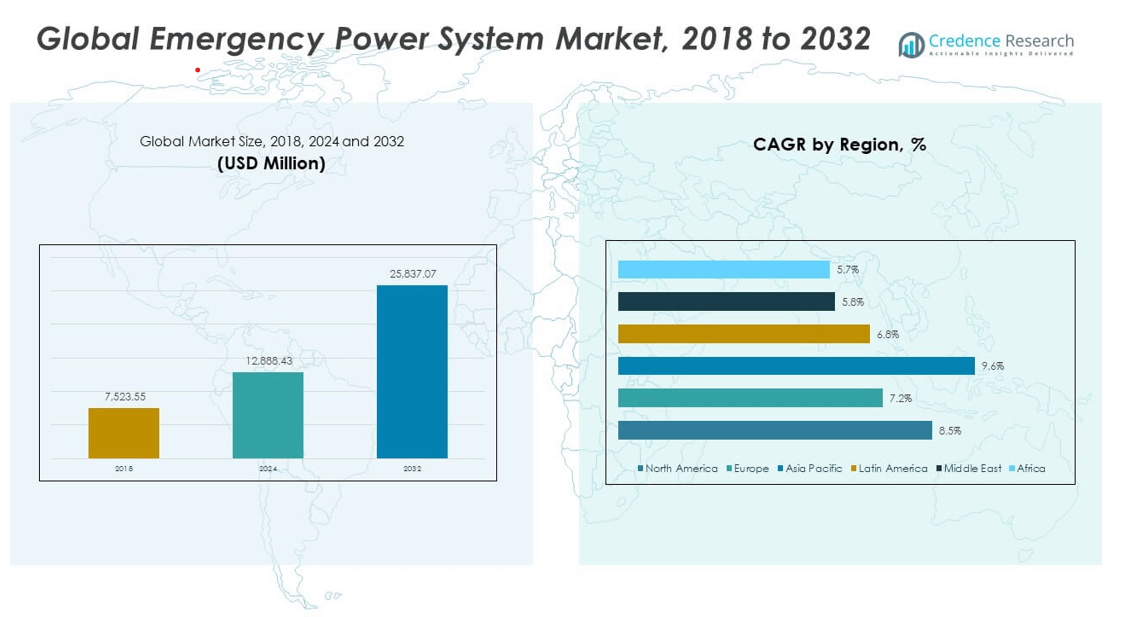
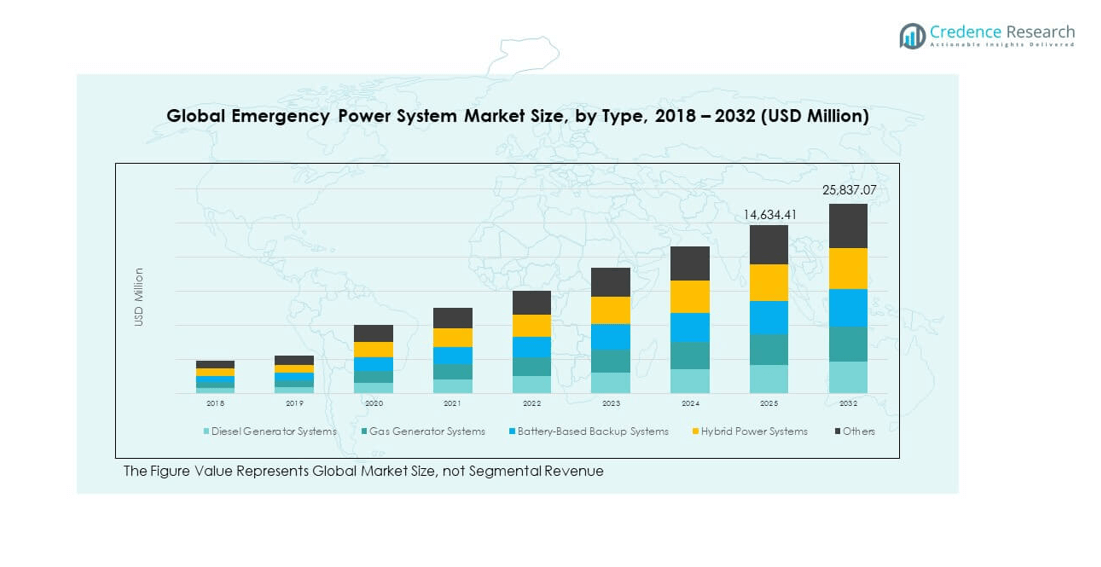
The Global Emergency Power System Market size was valued at USD 7,523.55 million in 2018 to USD 12,888.43 million in 2024 and is anticipated to reach USD 25,837.07 million by 2032, at a CAGR of 8.46% during the forecast period.
| REPORT ATTRIBUTE | DETAILS |
|---|---|
| Historical Period | 2020-2023 |
| Base Year | 2024 |
| Forecast Period | 2025-2032 |
| Emergency Power System Market Size 2024 | USD 12,888.43 million |
| Emergency Power System Market, CAGR | 8.46% |
| Emergency Power System Market Size 2032 | USD 25,837.07 million |
The market is driven by growing demand for reliable power backup solutions across critical industries. Rising grid instability, climate-related disruptions, and growing energy consumption are accelerating adoption. Industrial facilities, data centers, and healthcare institutions rely on emergency power systems to maintain uninterrupted operations. Governments and enterprises invest in backup infrastructure to strengthen energy resilience. Technological advancements in generator efficiency, hybrid systems, and battery storage enhance performance and lower operational risks.
North America leads the market with strong infrastructure readiness, wide industrial adoption, and robust regulatory frameworks. Europe follows with growing modernization of power grids and emission compliance measures. Asia Pacific is emerging rapidly due to increasing urbanization, industrial expansion, and infrastructure growth. Latin America, the Middle East, and Africa are showing steady growth as energy security becomes a key policy focus across developing economies.
Market Insights:
- The Global Emergency Power System Market was valued at USD 7,523.55 million in 2018, reached USD 12,888.43 million in 2024, and is projected to hit USD 25,837.07 million by 2032, at a CAGR of 8.46%.
- North America holds 43.4% share, Asia Pacific 29.4%, and Europe 17.4%, driven by advanced infrastructure, industrial growth, and strong regulatory frameworks.
- Asia Pacific is the fastest-growing region with 29.4% share, supported by rapid urbanization, power grid expansion, and increased investment in industrial backup systems.
- Diesel generator systems lead the market, supported by strong use in industrial and commercial facilities.
- Industrial applications hold the largest share, driven by rising demand for reliable power backup in manufacturing and processing sectors.
Market Drivers
Rising Focus on Power Continuity Across Critical Infrastructure
Power reliability is becoming a priority for industries and governments. Frequent outages disrupt essential operations in hospitals, data centers, and manufacturing plants. The Global Emergency Power System Market gains momentum from this growing focus on uninterrupted power supply. Investments in backup power ensure business continuity and protect sensitive equipment. Emergency generators and UPS systems help reduce operational downtime. Increased emphasis on infrastructure resilience pushes organizations to adopt advanced solutions. Critical sectors view emergency power as essential rather than optional. These trends create a strong base for sustained demand.
- For instance, Caterpillar showcased its hybrid power expansion powertrain at Bauma Munich 2025, featuring the C13D and C3.6 engines. The C3.6 delivers 106 kW output, while the C13D platform supports flexible fuel use, including hydrogen. These systems are engineered to support demanding industrial and critical power applications.
Growing Impact of Climate Extremes on Power Stability
Climate-related disruptions are creating severe challenges for grid stability. Extreme storms, floods, and wildfires cause extended outages across regions. It is driving higher adoption of advanced backup systems to manage unpredictable power interruptions. Utility resilience strategies prioritize emergency power solutions for disaster-prone areas. Backup systems ensure safety, emergency response, and operational control during crises. Energy suppliers are partnering with technology providers to deploy modular backup power. Climate-linked risks are increasing the urgency for power reliability. This driver reinforces market expansion across multiple sectors.
Rapid Urbanization and Industrial Growth Boosting Power Demand
Expanding cities and industrial zones require stable power to maintain productivity. Demand surges strain existing power grids and increase outage risks. The Global Emergency Power System Market grows as governments and businesses invest in backup capacity. Backup power solutions enable uninterrupted operations in smart cities and factories. Construction of modern buildings includes backup infrastructure by design. Energy-intensive sectors such as telecom and healthcare rely on immediate restoration during failures. Emergency power systems help meet peak demands efficiently. Rising power dependency strengthens market adoption.
Technological Advancements Enhancing System Efficiency and Reliability
Innovation in energy storage and generator technologies is improving performance. New systems offer faster start-up times, better fuel efficiency, and longer operating life. It supports industries seeking reliable and cost-effective backup power solutions. Integration with renewable sources enhances sustainability and operational flexibility. Digital control platforms improve real-time monitoring and automated switching. Hybrid systems lower emissions and align with regulatory goals. Smart grids and advanced battery storage increase resilience. These advancements create competitive advantages for end users and providers.
- For instance, Siemens Energy’s Qstor Battery Energy Storage System offers turnkey HV/MV integration and fast grid response capability. The system is designed to support utilities and independent power producers with reliable and resilient energy delivery. Its hybrid grid-forming design enables near-instant response to grid fluctuations.
Market Trends
Integration of Renewable Energy with Backup Power Solutions
Renewable integration is transforming how backup systems operate globally. Organizations combine solar or wind energy with advanced storage units. The Global Emergency Power System Market adopts hybrid systems to meet regulatory and sustainability goals. This shift reduces fuel reliance and carbon emissions while ensuring reliability. Governments support this trend through green incentives and infrastructure programs. Renewable-powered emergency systems are gaining acceptance in commercial and industrial facilities. Long-term operational cost savings make hybrid models attractive. These solutions improve energy security while supporting climate targets.
- For example, Hitachi Energy delivered the Darwin–Katherine Battery Energy Storage System (DK BESS) at the Channel Island Power Station. The project supplies grid-forming battery capacity and provides inertia, voltage and frequency control for the Darwin–Katherine network, which runs loads between 60 MW and 300 MW.
Digitalization and Remote Monitoring of Power Systems
Automation and digital platforms are enhancing power system intelligence. Remote monitoring allows instant fault detection and faster recovery. It enables operators to manage multiple locations through centralized platforms. Advanced analytics provide predictive maintenance and reduce unexpected downtime. The Global Emergency Power System Market embraces digital tools to improve operational control. Integration with IoT and SCADA strengthens system responsiveness. Data-driven insights optimize performance and lifecycle management. These features are raising expectations for reliability and cost efficiency.
Rising Demand from Healthcare and Data Center Industries
Healthcare and data centers depend on uninterrupted power for critical functions. Hospitals use emergency systems to support life-saving equipment during outages. Data centers need constant power to protect servers and digital infrastructure. It drives significant demand for high-capacity, efficient backup systems. The Global Emergency Power System Market benefits from this sustained investment trend. Regulations in healthcare and IT industries reinforce this shift. Stakeholders prioritize fast recovery time and energy security. Sector-specific standards accelerate advanced system adoption.
Shift Toward Modular and Scalable Backup Power Designs
End users prefer flexible systems that match evolving operational needs. Modular solutions allow capacity expansion without full infrastructure overhaul. It helps businesses lower upfront costs and optimize energy strategies. The Global Emergency Power System Market adopts scalable architectures to improve efficiency. These designs support diverse sectors with different power requirements. Rapid deployment of modular units benefits remote and temporary sites. Scalability ensures operational continuity during demand surges. This trend aligns with cost control and energy resilience goals.
- For instance, Hicor Energy’s I-BOX 48100R and Si LV1 systems are modular battery storage solutions designed for solar compatibility and scalable capacity expansion. These systems support flexible installation for industrial and commercial facilities. Their design enables reliable backup power and easy integration with existing energy infrastructure.
Market Challenges Analysis
High Initial Capital Costs and Operational Expenses
Backup power systems involve heavy upfront investment for equipment and installation. Generators, UPS systems, and hybrid solutions require complex infrastructure. Many small and medium enterprises hesitate to invest in these high-cost systems. The Global Emergency Power System Market faces slower adoption in price-sensitive regions. Fuel, maintenance, and compliance costs add to operational burdens. Organizations must allocate dedicated budgets to sustain system performance. Long payback periods reduce immediate ROI for buyers. These financial barriers limit broader market penetration across emerging economies.
Regulatory Compliance and Environmental Restrictions
Tighter emission regulations create challenges for generator-based systems. Governments impose stricter limits on noise and air pollution from diesel units. It forces companies to upgrade or replace older systems with cleaner alternatives. The Global Emergency Power System Market navigates compliance risks that increase capital costs. Complex permitting processes delay installation timelines in regulated regions. Firms must balance reliability needs with sustainability goals. Non-compliance risks attract heavy penalties and operational restrictions. These factors slow down market expansion in certain industries.
Market Opportunities
Expanding Role of Smart Grids and Energy Storage Integration
Smart grids and advanced storage technologies are transforming energy backup models. Integration with these systems enhances flexibility and response speed. The Global Emergency Power System Market can capitalize on investments in energy modernization. Countries modernize their grids to handle higher load demands. Emergency power systems align with smart infrastructure goals. Improved energy flow control creates opportunities for new product categories. Partnerships between utilities and technology firms accelerate adoption. This opportunity strengthens long-term market resilience and scalability.
Rising Investments in Infrastructure Resilience and Disaster Preparedness
Governments and industries are prioritizing energy security and emergency readiness. Infrastructure expansion projects include backup power as a key component. The Global Emergency Power System Market benefits from this strong policy alignment. Nations facing frequent disasters invest heavily in reliable backup solutions. Emergency power systems support rapid recovery during grid failures. This creates favorable conditions for product innovation and service expansion. Resilience programs open opportunities for global suppliers and local integrators. These developments reinforce steady long-term growth potential.
Maket Segmentation Analysis
By Type
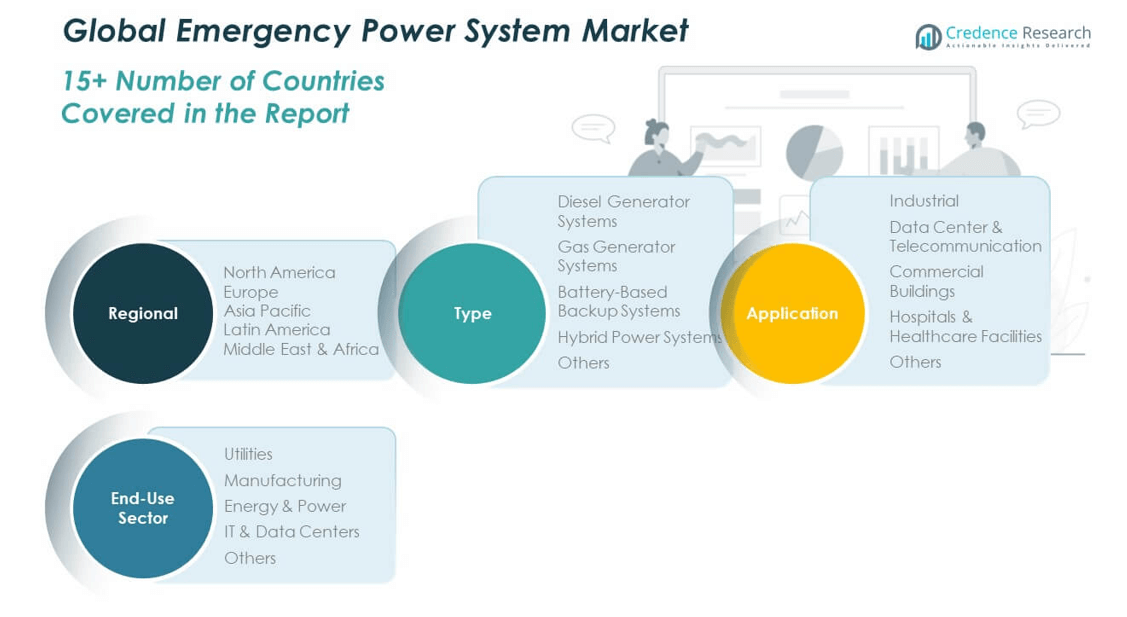
Diesel generator systems hold a significant share due to their reliability and established infrastructure across industries. Gas generator systems gain traction with lower emissions and cleaner fuel options. Battery-based backup systems expand rapidly with technological progress in energy storage. Hybrid power systems offer flexibility and better efficiency, supporting grid stability in sensitive environments. Other systems, including renewable-integrated solutions, strengthen resilience strategies. The Global Emergency Power System Market benefits from rising investments in diversified backup technologies across multiple industries.
- For instance, GE Vernova’s LM2500+G4 aeroderivative turbine delivers 33–34 MW output at ISO conditions with efficiency around 37% (LHV). The turbine is engineered for fast start-up and flexible operation, reaching full load in under 10 minutes. It supports grid stability and industrial backup power applications.
By Application
Industrial facilities represent a major demand hub due to high power dependency in production and process operations. Data center and telecommunication applications grow rapidly as businesses safeguard digital infrastructure from outages. Commercial buildings increasingly integrate emergency power to ensure safety and regulatory compliance. Hospitals and healthcare facilities prioritize reliable power to protect critical equipment and patient care. Other applications, such as public infrastructure, add to broad market coverage and drive steady installation growth.
- For instance, Plug Power delivered a 3 MW hydrogen fuel cell system to support Microsoft’s data center infrastructure. The system is designed to provide clean backup power and grid support for critical operations. Plug Power is working with major cloud service providers to expand hydrogen-powered backup solutions.
By End-Use Sector
Utilities maintain strong adoption levels to ensure grid continuity and emergency response. Manufacturing sectors rely on uninterrupted power to sustain operations and minimize financial loss. Energy and power companies integrate emergency systems into critical generation and distribution nodes. IT and data centers accelerate deployments to prevent costly downtime and service interruptions. Other end-use sectors expand market penetration with flexible backup solutions for varied operational needs. This multi-sector adoption reinforces market stability and supports long-term growth momentum.
Segmentation:
By Type
- Diesel Generator Systems
- Gas Generator Systems
- Battery-Based Backup Systems
- Hybrid Power Systems
- Others
By Application
- Industrial
- Data Center & Telecommunication
- Commercial Buildings
- Hospitals & Healthcare Facilities
- Others
By End-Use Sector
- Utilities
- Manufacturing
- Energy & Power
- IT & Data Centers
- Others
By Region
- North America
- U.S.
- Canada
- Europe
- Germany
- France
- Italy
- U.K.
- Russia
- Rest of Europe
- Asia-Pacific
- India
- China
- Japan
- Rest of Asia-Pacific
- Latin America
- Brazil
- Mexico
- Rest of Latin America
- Middle East and Africa
- GCC Countries
- South Africa
- Rest of Middle East and Africa
Regional Analysis:
North America
The North America Global Emergency Power System Market size was valued at USD 3,297.91 million in 2018 to USD 5,591.13 million in 2024 and is anticipated to reach USD 11,239.38 million by 2032, at a CAGR of 8.5% during the forecast period. North America holds a 43.4% market share. The region leads due to advanced infrastructure, high energy demand, and strong regulatory frameworks supporting emergency power deployment. Industries prioritize power continuity to protect critical operations in healthcare, data centers, and manufacturing. Frequent grid disruptions from extreme weather events drive investments in reliable backup solutions. Adoption of hybrid systems and clean energy technologies further strengthens the market. Government initiatives encourage modernization of power infrastructure and energy resilience planning. Enterprises deploy large-scale backup systems to meet business continuity standards. The region’s mature energy ecosystem ensures steady and consistent market growth.
Europe
The Europe Global Emergency Power System Market size was valued at USD 1,388.60 million in 2018 to USD 2,246.96 million in 2024 and is anticipated to reach USD 4,091.03 million by 2032, at a CAGR of 7.2% during the forecast period. Europe holds a 17.4% market share. The market benefits from aging power infrastructure and increasing renewable energy penetration, which require stable backup systems. Industrial and commercial sectors rely on emergency power to comply with strict safety and operational standards. Countries focus on reducing emission levels by adopting gas and hybrid systems. Data center expansion across Germany, France, and the UK drives new installations. Technological upgrades in healthcare and utility sectors support long-term market growth. Investments in digital grid integration enhance operational efficiency. Rising regulatory pressure on power security ensures sustained market adoption.
Asia Pacific
The Asia Pacific Global Emergency Power System Market size was valued at USD 2,161.86 million in 2018 to USD 3,911.39 million in 2024 and is anticipated to reach USD 8,555.19 million by 2032, at a CAGR of 9.6% during the forecast period. Asia Pacific holds a 29.4% market share. The region grows rapidly due to expanding industrialization, urbanization, and rising energy consumption. Power outages remain frequent in developing economies, prompting strong demand for backup solutions. China, India, and Japan lead with major infrastructure and data center investments. Healthcare facilities and telecom networks adopt modern backup systems to ensure uninterrupted operations. Hybrid and battery-based technologies gain preference for their operational efficiency. Government programs support energy security and capacity building. Growing private investments create favorable conditions for sustained expansion.
Latin America
The Latin America Global Emergency Power System Market size was valued at USD 354.53 million in 2018 to USD 599.77 million in 2024 and is anticipated to reach USD 1,063.86 million by 2032, at a CAGR of 6.8% during the forecast period. Latin America holds a 3.7% market share. The region shows growing adoption across healthcare, commercial, and energy sectors. Power grid instability in several countries drives strong backup power deployment. Brazil leads the market with high demand from manufacturing and utilities. Telecom operators invest in hybrid systems to support network reliability. Governments encourage energy resilience strategies in urban areas. Companies focus on modular and cost-efficient solutions to manage infrastructure challenges. Demand growth is supported by both private and public sector initiatives.
Middle East
The Middle East Global Emergency Power System Market size was valued at USD 189.85 million in 2018 to USD 294.21 million in 2024 and is anticipated to reach USD 486.45 million by 2032, at a CAGR of 5.8% during the forecast period. The Middle East holds a 2.1% market share. Rising energy demand from large commercial and utility projects creates steady opportunities. Data center and critical infrastructure investments in GCC countries drive system deployment. Oil and gas facilities integrate backup power to maintain uninterrupted operations. Regional governments invest in diversification of energy infrastructure. Hybrid and gas generator systems gain traction due to efficiency and lower emissions. Infrastructure modernization programs support technology adoption. Increased awareness of power security strengthens market positioning across key sectors.
Africa
The Africa Global Emergency Power System Market size was valued at USD 130.80 million in 2018 to USD 244.96 million in 2024 and is anticipated to reach USD 401.16 million by 2032, at a CAGR of 5.7% during the forecast period. Africa holds a 1.6% market share. The region witnesses rising adoption of backup systems due to frequent power interruptions. Governments prioritize energy access and infrastructure reliability to support economic development. Telecom and healthcare sectors are key demand drivers. International partnerships accelerate technology transfer and investment inflow. Modular and portable solutions find wide acceptance in remote and off-grid areas. Rising renewable energy projects complement hybrid backup deployment. Policy frameworks supporting power resilience improve market growth potential.
Key Player Analysis:
- Caterpillar Inc.
- Cummins Inc.
- Kohler Co.
- Generac Holdings Inc.
- Atlas Copco AB
- Eaton Corporation plc
- ABB Ltd.
- Schneider Electric SE
- Honda Power Equipment
- Briggs & Stratton Corporation
Competitive Analysis:
The Global Emergency Power System Market is characterized by strong competition among established players and emerging innovators. Leading companies focus on advanced generator technologies, hybrid system integration, and improved fuel efficiency to strengthen their position. It is shaped by strategic initiatives such as mergers, acquisitions, and regional expansions. Caterpillar, Cummins, Kohler, Generac, Eaton, ABB, Schneider Electric, Atlas Copco, Honda Power Equipment, and Briggs & Stratton lead the competitive landscape. These companies emphasize R&D investments to enhance reliability, reduce emissions, and support digital monitoring. Global expansion strategies target fast-growing markets in Asia Pacific and Latin America. Product differentiation and service excellence create competitive advantages. Rising demand for sustainable and efficient power solutions drives continuous innovation and market consolidation.
Recent Developments:
- In October 2025, BAK Battery launched its new ENDURO S+ Commercial and Industrial Liquid-Cooled Integrated Cabinet. Introduced on October 23, 2025, this innovative emergency power solution features advanced liquid-cooling technology, designed to maximize temperature control, system stability, and performance efficiency for large-scale energy applications.
- In July 2025, Eaton Corporation signed an agreement to acquire Resilient Power Systems Inc., a developer of solid-state transformer-based energy technologies. This acquisition enhances Eaton’s intelligent power management portfolio, enabling integration of advanced transformer technology into data centers, battery storage systems, and backup energy networks.
Report Coverage:
The research report offers an in-depth analysis based on Type, Application and End-Use Sector. It details leading market players, providing an overview of their business, product offerings, investments, revenue streams, and key applications. Additionally, the report includes insights into the competitive environment, SWOT analysis, current market trends, as well as the primary drivers and constraints. Furthermore, it discusses various factors that have driven market expansion in recent years. The report also explores market dynamics, regulatory scenarios, and technological advancements that are shaping the industry. It assesses the impact of external factors and global economic changes on market growth. Lastly, it provides strategic recommendations for new entrants and established companies to navigate the complexities of the market.
Future Outlook:
- Rising grid instability and climate disruptions will drive increased demand for advanced emergency power systems across critical infrastructure.
- Hybrid and renewable-integrated backup solutions will gain strong adoption in data centers, healthcare facilities, and commercial spaces.
- Battery-based systems will expand rapidly with falling storage costs and improved energy density.
- Digital monitoring and IoT integration will enhance system efficiency, predictive maintenance, and operational reliability.
- North America will maintain leadership through technology advancements, while Asia Pacific will emerge as the fastest-growing regional market.
- Regulatory frameworks will tighten around emission control, accelerating the shift toward cleaner backup technologies.
- Strategic mergers and acquisitions will shape market consolidation among global power solution providers.
- Modular and scalable systems will dominate new installations to support flexible infrastructure needs.
- Investment in energy resilience programs will create opportunities for product innovation and service expansion.
- Growing focus on sustainability will encourage green certifications and advanced hybrid deployment strategies.

Request a Free Sample
Fill in your details and we'll send you a free sample report.
- Sample data tables & charts
- Research methodology
Need a Custom Version of This Report?
Tailor the scope, geography, or segments to your exact requirements.
- Custom geography or segment scope
- Direct access to our analyst team
Frequently Asked Questions
What is the current market size for Global Emergency Power System Market, and what is its projected size in 2032?
At what Compound Annual Growth Rate is the Global Emergency Power System Market projected to grow between 2024 and 2032?
Which Global Emergency Power System Market segment held the largest share in 2024?
What are the primary factors fueling the growth of the Global Emergency Power System Market?
Who are the leading companies in the Global Emergency Power System Market?
Which region commanded the largest share of the Global Emergency Power System Market in 2024?
Table of Content
Chapter 1 Market Segmentation
- 1.1 Segmentation Framework
- 1.1.1 Product and Service Classification
- 1.1.2 Application and End-Use Classification
- 1.1.3 Technology and Solution Classification
- 1.1.4 Customer and Distribution Channel Classification
- 1.1.5 Geographic Segmentation
- 1.1.6 Market Segment Definitions and Boundaries
Chapter 2 Introduction
- 2.1 Report Objectives and Scope
- 2.2 Product Definition and Industry Terminology
- 2.3 Market Inclusions and Exclusions
- 2.4 Research Process
- 2.4.1 Primary Research and Expert Interviews
- 2.4.2 Secondary Research and Source Review
- 2.4.3 Top-Down and Bottom-Up Estimation
- 2.4.4 Data Triangulation and Verification
- 2.5 Market Size Measurement Basis
- 2.5.1 2024: USD 12,888.43 million → 2032: USD 25,837.07 million
- 2.6 Historical and Forecast Reference Periods
- 2.6.1 Base Year: 2024
- 2.6.2 Forecast Period: 2024-2032
- 2.7 Research Assumptions and Limitations
Chapter 3 Executive Summary
- 3.1 Market Snapshot and Key Findings
- 3.2 Base-Year Market Size, 2024
- 3.3 Forecast Market Size, 2032
- 3.4 Revenue and Volume Growth Outlook
- 3.5 Key Demand and Supply Indicators
- 3.6 Leading Market Segments
- 3.7 Fastest-Growing Market Opportunities
- 3.8 Regional Performance Highlights
- 3.9 Technology and Industry Transformation
- 3.10 Competitive Landscape Summary
- 3.11 Analyst View and Strategic Implications
Chapter 4 Global Emergency Power System Market Trends and Developments
- 4.1 Historical Industry Development
- 4.2 Recent Market Trends and Developments
- 4.3 Demand and Customer Behavior Trends
- 4.4 Technology and Product Innovation
- 4.5 Artificial Intelligence, Automation and Digitalization
- 4.6 Local Manufacturing and Supply Chain Realignment
- 4.7 Industry Partnerships, Mergers and Acquisitions
- 4.8 Sustainability and Circular Economy Developments
- 4.9 Government and Private Sector Investment Trends
- 4.10 Emerging Business Models and Commercialization
- 4.11 Industry Developments and Announcements
Chapter 5 Global Emergency Power System Market Production, Supply and Demand Analysis
- 5.1 Demand Trend and Consumption Analysis
- 5.2 Demand Forecast, 2024-2032
- 5.3 Production and Output Trend
- 5.4 Production and Output Forecast, 2024-2032
- 5.5 Installed Capacity and Capacity Utilization
- 5.6 Company-Wise Production Plants and Statistics
- 5.6.1 Installed Production Capacity
- 5.6.2 Actual Production
- 5.6.3 Planned Capacity and Expansion Targets
- 5.7 Supply Chain Structure and Procurement Trends
- 5.8 Supply-Demand Gap and Bottlenecks
- 5.9 Import Dependence and Sourcing Structure
- 5.10 Contract Manufacturing and Outsourcing
- 5.11 Regional Supply and Demand Concentration
Chapter 6 Global Emergency Power System Market Pricing Analysis
- 6.1 Pricing Structure and Measurement
- 6.2 Historical Pricing Trends
- 6.3 Pricing Outlook, 2024-2032
- 6.4 Average Selling Price and Unit Economics
- 6.5 Pricing by Product and Market Segment
- 6.6 Geographic Pricing Differences
- 6.7 Key Input, Energy, Labor and Logistics Costs
- 6.8 Contract Pricing and Purchasing Models
- 6.9 Pricing Sensitivity and Competitive Positioning
- 6.10 Price, Margin and Profitability Implications
Chapter 7 Global Emergency Power System Market Dynamics
- 7.1 Market Growth Drivers
- 7.1.1 Demand-Side Drivers
- 7.1.2 Technology and Innovation Drivers
- 7.1.3 Infrastructure and Investment Drivers
- 7.1.4 Regulatory and Policy Drivers
- 7.2 Market Restraints
- 7.2.1 Cost and Affordability Constraints
- 7.2.2 Technology and Adoption Barriers
- 7.2.3 Supply Chain and Operational Constraints
- 7.3 Market Challenges
- 7.3.1 Competitive Pressure and Margin Erosion
- 7.3.2 Skills, Infrastructure and Implementation Gaps
- 7.4 Emerging Market Opportunities
- 7.5 Market Dynamics Impact and Time-Horizon Assessment
Chapter 8 Global Emergency Power System Value Chain Analysis
- 8.1 Industry Value Chain Overview
- 8.2 Upstream Suppliers and Critical Inputs
- 8.3 Technology and Component Providers
- 8.4 Manufacturing or Service Delivery
- 8.5 Distribution, Channel Partners and Integrators
- 8.6 Downstream Applications and End Users
- 8.7 Value Addition and Profit Pools
- 8.8 Vertical Integration and Outsourcing
- 8.9 Supplier Concentration and Risk
- 8.10 Supply Chain Localization and Resilience
Chapter 9 Global Emergency Power System Market Regulations and Policies
- 9.1 Relevant Laws, Standards and Compliance Frameworks
- 9.2 Product, Service, Safety and Quality Requirements
- 9.3 Government Policies, Incentives and Subsidies
- 9.4 Imports, Exports and Trade Barriers
- 9.5 Public Procurement and Local Content Requirements
- 9.6 Environmental and Sustainability Compliance
- 9.7 Data Protection, AI and Cybersecurity Compliance
- 9.8 Upcoming Policy Changes and Market Implications
Chapter 10 Global Emergency Power System Market Hotspots and Opportunities
- 10.1 Market Opportunity Mapping and Growth Hotspots
- 10.2 High-Growth Applications and Customer Groups
- 10.3 Underserved Markets and White-Space Opportunities
- 10.4 Emerging Technology and Product Opportunities
- 10.5 New Capacity and Investment Hotspots
- 10.6 Market Entry and Expansion Opportunities
- 10.7 Distribution and Partnership Opportunities
- 10.8 Near-Term and Long-Term Commercial Potential
- 10.9 Opportunity Attractiveness and Execution Risks
Chapter 11 Global Emergency Power System Market Outlook, 2024-2032
- 11.1 Market Size and Analysis
- 11.1.1 Revenue (Market Measurement: 2024: USD 12,888.43 million → 2032: USD 25,837.07 million)
- 11.1.2 Market Volume and Quantity Sold
- 11.1.3 Historical Market Size
- 11.1.4 Base-Year Market Size, 2024
- 11.2 Market Forecast, 2024-2032
- 11.2.1 Revenue Forecast to 2032
- 11.2.2 Volume Forecast to 2032
- 11.2.3 CAGR and Year-on-Year Growth
- 11.2.4 Incremental Revenue Opportunity
- 11.3 Forecast Assumptions and Scenario Analysis
- 11.3.1 Base-Case Forecast
- 11.3.2 Optimistic and Conservative Scenarios
- 11.3.3 Technology, Pricing and Policy Sensitivities
- 11.4 Market Attractiveness and Growth Outlook
Chapter 12 Global Emergency Power System Market Segmentation and Outlook
- 12.1 Segmentation Summary and Market Shares, 2024
- 12.2 Largest and Fastest-Growing Segments
- 12.3 Segment Growth Comparison
- 12.4 Segment Attractiveness and Priority Matrix
Chapter 13 Global Emergency Power System Geographic Market Outlook, 2024-2032
- 13.1 Regional Market Size and Share, 2024
- 13.2 Regional Market Forecast, 2024-2032
- 13.3 Regional Pricing, Production and Demand Differences
- 13.4 North America
- 13.4.1 United States
- 13.4.2 Canada
- 13.4.3 Mexico
- 13.5 Europe
- 13.5.1 Germany
- 13.5.2 France
- 13.5.3 Italy
- 13.5.4 United Kingdom
- 13.5.5 Spain
- 13.5.6 Poland
- 13.5.7 Russia
- 13.5.8 Netherlands
- 13.5.9 Belgium
- 13.5.10 Sweden
- 13.5.11 Denmark
- 13.5.12 Norway
- 13.5.13 Rest of Europe
- 13.6 Asia Pacific
- 13.6.1 China
- 13.6.2 India
- 13.6.3 Japan
- 13.6.4 South Korea
- 13.6.5 Thailand
- 13.6.6 Indonesia
- 13.6.7 Vietnam
- 13.6.8 Malaysia
- 13.6.9 Australia
- 13.6.10 Rest of Asia Pacific
- 13.7 Latin America
- 13.7.1 Brazil
- 13.7.2 Argentina
- 13.7.3 Colombia
- 13.7.4 Chile
- 13.7.5 Rest of Latin America
- 13.8 Middle East
- 13.8.1 Saudi Arabia
- 13.8.2 United Arab Emirates
- 13.8.3 Turkey
- 13.8.4 Israel
- 13.8.5 Iran
- 13.8.6 Rest of the Middle East
- 13.9 Africa
- 13.9.1 South Africa
- 13.9.2 Egypt
- 13.9.3 Nigeria
- 13.9.4 Morocco
- 13.9.5 Rest of Africa
- 13.10 Regional Investment, Policy and Supply Chain Differences
- 13.11 Regional Competitive Landscape
- 13.12 Geographic Growth Hotspots
Chapter 14 Global Emergency Power System Technology, Innovation and Sustainability Outlook
- 14.1 Technology Landscape and Maturity
- 14.2 Product, Process and Service Innovation
- 14.3 AI, Automation and Digital Tools in the Industry
- 14.4 Technology Adoption and Performance Benchmarking
- 14.5 Innovation Pipeline and R&D Investment
- 14.6 Patent and Intellectual Property Trends
- 14.7 Energy Efficiency and Resource Management
- 14.8 Sustainability, Recycling and Circularity
- 14.9 Technology Roadmap, 2024-2032
- 14.10 Risks of Obsolescence and Technology Substitution
Chapter 15 Global Emergency Power System Market Key Strategic Imperatives
- 15.1 Growth and Market Entry Priorities
- 15.2 High-Return Products and Segments
- 15.3 Pricing, Profitability and Cost Optimization
- 15.4 Technology Investment and Product Differentiation
- 15.5 Supply Chain Localization and Resilience
- 15.6 Distribution and Customer Acquisition
- 15.7 Partnership, Acquisition and Capacity Strategy
- 15.8 Regional Expansion Priorities
- 15.9 Short-, Medium- and Long-Term Actions
Chapter 16 Competition Outlook
- 16.1 Industry Competition Characteristics
- 16.2 Market Structure and Concentration
- 16.3 Market Share and Competitive Positioning, 2024
- 16.4 Company-Wise Revenue and Product Benchmarking
- 16.5 Production and Service Capacity Benchmarking
- 16.6 Technology, Pricing and Differentiation
- 16.7 Regional Footprint and Distribution Strength
- 16.8 Mergers, Acquisitions and Strategic Alliances
- 16.9 New Entrants and Competitive Threats
- 16.10 Porter's Five Forces and Industry Attractiveness
- 16.11 Competitive Outlook, 2024-2032
Chapter 17 Company Profiles
- 17.1 Company Coverage and Selection Criteria
- 17.2 Leading Market Participants – Standard Profile Structure
- 17.2.1 Business Description
- 17.2.2 Company Ownership and Geographic Presence
- 17.2.3 Product and Service Portfolio
- 17.2.4 Manufacturing and Operating Footprint
- 17.2.5 Production Capacity and Expansion Plans
- 17.2.6 Financial Performance and Investment
- 17.2.7 Market Share and Competitive Position
- 17.2.8 Technology and Innovation Capabilities
- 17.2.9 Strategic Alliances or Partnerships
- 17.2.10 Recent Developments
- 17.2.11 Growth Strategy and Outlook
- 17.3 Other Relevant Market Participants
Note: Every listed company is profiled on the structure shown under the first company. The company list is preliminary and may change based on research findings, market developments, data availability and client requirements.
Chapter 18 Disclaimer
- 18.1 Research and Forecast Disclaimer
- 18.2 Data Source and Estimation Limitations
Note: The depth of individual sections depends on data availability for this market. Volume, capacity, trade and other unit-based metrics are included where applicable.

