Market Overview:
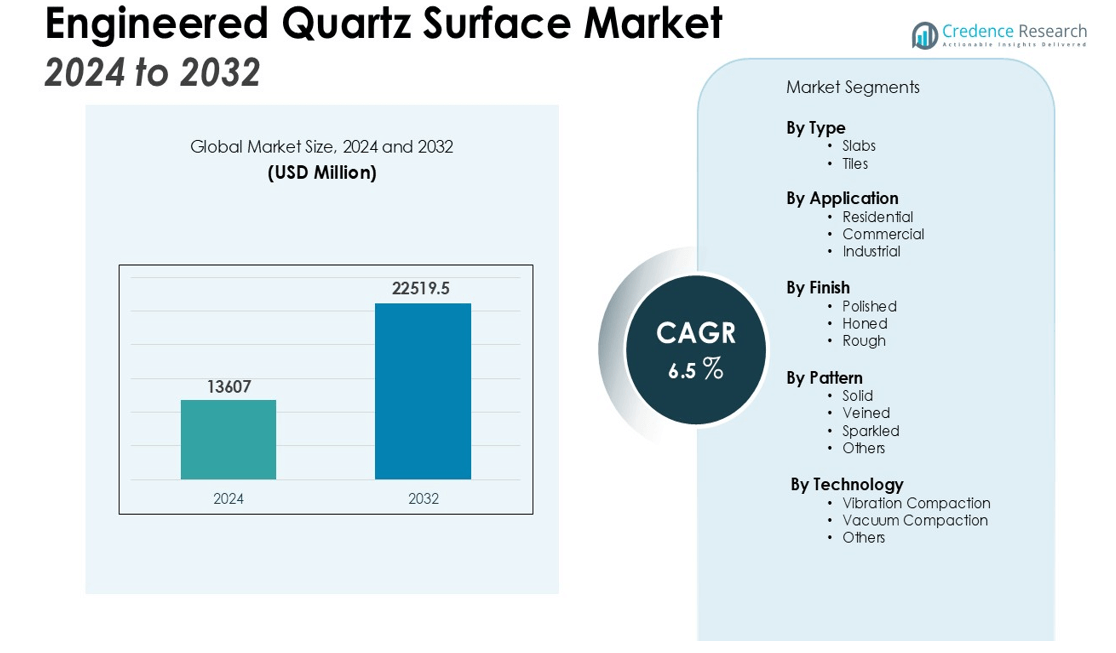
The Engineered Quartz Surface Market size was valued at USD 13607 million in 2024 and is anticipated to reach USD 22519.5 million by 2032, at a CAGR of 6.5% during the forecast period (2024-2032).
| REPORT ATTRIBUTE | DETAILS |
|---|---|
| Historical Period | 2020-2023 |
| Base Year | 2024 |
| Forecast Period | 2025-2032 |
| Engineered Quartz Surface Market Size 2024 | USD 13607 million |
| Engineered Quartz Surface Market, CAGR | 6.5% |
| Engineered Quartz Surface Market Size 2032 | USD 22519.5 million |
Key drivers of market growth include the growing popularity of engineered quartz surfaces in residential and commercial applications due to their superior durability, low maintenance, and versatility in design. The rise in construction activities, particularly in emerging economies, coupled with a shift towards sustainable building materials, has further bolstered demand. Technological advancements in production processes and the ability to offer a wide variety of colors and textures have also contributed to the market's expansion. Additionally, consumer preference for eco-friendly and non-toxic materials has supported the adoption of engineered quartz surfaces. The increasing trend of home renovation and remodeling projects also plays a significant role in driving the market's growth.
Regionally, North America holds the largest market share, driven by significant demand from the U.S. construction and real estate sectors. Europe follows with robust demand from countries like Germany and the U.K. The Asia-Pacific region is expected to witness the highest growth rate, supported by rapid urbanization and increasing construction activities, particularly in China and India. This region is also experiencing rising disposable incomes, leading to greater consumer spending on premium interior products.
Market Insights:
- The engineered quartz surface market was valued at USD 13,607 million in 2024 and is projected to reach USD 22,519.5 million by 2032, with a CAGR of 6.5% during the forecast period.
- Increasing consumer preference for sustainable, eco-friendly materials drives demand for engineered quartz surfaces, which are seen as environmentally friendly alternatives to natural stones.
- Technological advancements in manufacturing allow for greater customization, offering a variety of colors, textures, and patterns to meet diverse consumer preferences.
- The global surge in construction activities, particularly in emerging economies, and the trend in home renovations boosts the demand for engineered quartz surfaces.
- North America holds a 40% market share, with strong demand from the U.S. construction and real estate sectors, while Europe follows with a 30% share driven by sustainability trends.
- Asia Pacific holds a 20% market share and is the fastest-growing region, with rising urbanization and disposable incomes in countries like China and India driving demand.
- Emerging economies, particularly in India, China, and Brazil, offer growth opportunities as urbanization increases the demand for durable, aesthetically versatile building materials.
Market Drivers:
Growing Demand for Durable and Low-Maintenance Materials
Engineered quartz surfaces have gained significant traction due to their exceptional durability and low maintenance requirements. The increasing demand for long-lasting, easy-to-care-for materials in residential and commercial settings has driven their widespread adoption. Homeowners and businesses prefer engineered quartz for its resistance to scratches, stains, and heat, making it an ideal choice for kitchens, bathrooms, and countertops. The material’s ability to maintain its appearance without the need for frequent upkeep boosts its appeal in the market.
- For instance, Cosentino provides a 25-year warranty for its Silestone products, underscoring the long-term durability of the material.
Rise in Construction and Renovation Activities
The surge in global construction activities, particularly in emerging economies, has accelerated the demand for engineered quartz surfaces. As urbanization increases, more residential and commercial properties are being developed, creating a growing need for durable and aesthetically versatile materials. Furthermore, the trend of home renovations and remodeling projects, particularly in developed regions, has also contributed to the market's expansion. The rise in construction activities worldwide plays a pivotal role in propelling the demand for engineered quartz surfaces.
- For instance, to create its durable, non-porous slabs, manufacturer Caesarstone's process involves applying 100 tons of pressure to a mixture of quartz and resins.
Technological Advancements and Customization Options
Technological advancements in manufacturing processes have significantly improved the quality and variety of engineered quartz surfaces. Manufacturers now offer an extensive range of colors, textures, and patterns, catering to diverse consumer preferences. This customization ability allows homeowners, designers, and architects to create unique, personalized spaces. Engineered quartz surfaces can be produced in various styles, enabling it to meet the specific needs of residential and commercial applications.
Environmental and Health Considerations
The increasing emphasis on sustainability and eco-friendly building materials has positively impacted the engineered quartz surface market. Consumers are becoming more conscious of the environmental and health impacts of the materials they use, driving the demand for non-toxic and sustainable options. Engineered quartz is seen as an eco-friendly alternative to natural stones like granite, as it requires less energy to produce and often contains recycled materials. This growing awareness among consumers is shaping the future growth of the market.
Market Trends:
Rising Preference for Sustainable and Eco-Friendly Materials
A significant trend in the engineered quartz surface market is the growing demand for sustainable and eco-friendly materials. Consumers and businesses are increasingly prioritizing products that contribute to a greener environment. Engineered quartz surfaces are seen as an environmentally friendly option, as they are often made using recycled materials and have a lower carbon footprint compared to natural stones like granite. This shift towards sustainability aligns with broader global trends in construction and design, where eco-consciousness plays a crucial role in material selection. As the construction industry embraces green building practices, engineered quartz surfaces offer an attractive alternative that meets aesthetic and environmental goals simultaneously.
- For instance, Caesarstone demonstrates its commitment to the industry's well-being through its Master of Stone program, a free training platform that has certified over 6,300 fabricators globally in healthier and safer work practices.
Customization and Technological Innovations Drive Product Development
Another key trend in the engineered quartz surface market is the growing focus on customization and technological advancements in manufacturing. With advancements in production techniques, manufacturers are offering an expanding variety of colors, textures, and patterns that cater to diverse consumer preferences. This allows homeowners, designers, and architects to create unique spaces, fueling the demand for customized surfaces. Technology has also played a role in improving the durability and functionality of engineered quartz, making it an even more attractive option for a wide range of applications. As consumer preferences for personalization and innovation continue to grow, engineered quartz surfaces will remain a popular choice in both residential and commercial settings.
- For instance, manufacturer Caesarstone produces surfaces with a mineral hardness rating of 7 on the Mohs scale, which makes the material exceptionally resistant to scratches.
Market Challenges Analysis:
High Manufacturing Costs and Price Sensitivity
One of the major challenges faced by the engineered quartz surface market is the high manufacturing costs associated with production. The raw materials, such as quartz, resins, and polymers, are expensive, and the manufacturing process requires advanced technology, which further increases production costs. This results in a higher price point for engineered quartz surfaces compared to alternative materials like granite and laminate. As a consequence, price-sensitive consumers, especially in emerging economies, may opt for more affordable options, limiting the growth potential of engineered quartz in cost-conscious markets.
Competition from Alternative Materials
The engineered quartz surface market faces stiff competition from other materials such as natural stone, marble, and granite, which are widely preferred for their aesthetic appeal and durability. Despite the advantages of engineered quartz, including its versatility and low maintenance, some consumers still favor natural materials due to their unique and luxurious appearance. This competition from well-established alternatives presents a significant challenge to the growth of the engineered quartz surface market. Overcoming this barrier requires continuous innovation and marketing efforts to emphasize the value and benefits of engineered quartz surfaces in comparison to traditional materials.
Market Opportunities:
Expanding Demand in Emerging Economies
The engineered quartz surface market presents significant opportunities in emerging economies, where rapid urbanization and infrastructure development are driving the demand for high-quality building materials. As countries like India, China, and Brazil experience significant growth in residential, commercial, and industrial construction, the need for durable, aesthetically versatile materials like engineered quartz surfaces is increasing. These regions also benefit from a growing middle class that prioritizes modern living spaces and sustainable building materials. Manufacturers can capitalize on this expanding market by offering affordable and customized engineered quartz options tailored to regional preferences and budgets.
Growth in Renovation and Remodeling Sectors
The renovation and remodeling sectors offer another promising opportunity for the engineered quartz surface market. As consumers in developed economies increasingly invest in home improvement projects, the demand for high-quality countertops, backsplashes, and flooring materials continues to rise. Engineered quartz surfaces, with their wide range of styles and low maintenance, are becoming a preferred choice for home renovation. This trend is particularly evident in the kitchen and bathroom renovation segments, where engineered quartz provides both aesthetic appeal and long-lasting durability. The rising trend of home remodeling offers a consistent growth opportunity for engineered quartz manufacturers.
Market Segmentation Analysis:
By Type
The engineered quartz surface market is divided into two primary types-slabs and tiles. Slabs dominate the market due to their larger surface area, which makes them ideal for countertops, backsplashes, and flooring in both residential and commercial settings. Tiles hold a smaller share but continue to grow, particularly in regions with high demand for smaller, more affordable options in bathrooms and kitchens.
- For instance, LG Hausys expanded its Georgia plant with a third manufacturing line, which increased its total annual production capacity of engineered stone to 1.05 million square meters.
By Application
The engineered quartz surface market is widely used in residential, commercial, and industrial applications. In residential applications, countertops, backsplashes, and flooring are the most common uses, driven by increasing demand for durable, low-maintenance surfaces. The commercial segment includes office buildings, hotels, and retail spaces, where engineered quartz is favored for its aesthetic appeal and ease of maintenance. Industrial applications focus on the use of quartz surfaces in high-durability environments such as manufacturing and warehouses.
- For instance, to meet the need for highly durable residential countertops, a company like Caesarstone offers engineered stone slabs with a thickness of 30mm, providing enhanced strength for high-use areas like kitchen islands.
By Finish
Engineered quartz surfaces are available in polished, honed, and rough finishes. The polished finish leads the market, offering a glossy, shiny appearance that is ideal for countertops and kitchen applications. The honed finish, providing a matte look, is gaining popularity in commercial spaces due to its subtle aesthetic and resistance to fingerprints. The rough finish, although less common, is used for specialized applications requiring a more textured surface.
Segmentations:
- By Type:
- Slabs
- Tiles
- By Application:
- Residential
- Commercial
- Industrial
- By Finish:
- Polished
- Honed
- Rough
- By Pattern:
- Solid
- Veined
- Sparkled
- Others
- By Technology:
- Vibration Compaction
- Vacuum Compaction
- Others
- By Region:
- North America
- U.S.
- Canada
- Mexico
- Europe
- UK
- France
- Germany
- Italy
- Spain
- Russia
- Belgium
- Netherlands
- Austria
- Sweden
- Poland
- Denmark
- Switzerland
- Rest of Europe
- Asia Pacific
- China
- Japan
- South Korea
- India
- Australia
- Thailand
- Indonesia
- Vietnam
- Malaysia
- Philippines
- Taiwan
- Rest of Asia Pacific
- Latin America
- Brazil
- Argentina
- Peru
- Chile
- Colombia
- Rest of Latin America
- Middle East
- UAE
- KSA
- Israel
- Turkey
- Iran
- Rest of Middle East
- Africa
- Egypt
- Nigeria
- Algeria
- Morocco
- Rest of Africa
- North America
Regional Analysis:
North America: Leading Demand Driven by Construction and Real Estate
North America accounts for 40% of the global engineered quartz surface market share, with the United States leading demand. The growth is driven by a robust construction sector, particularly in residential and commercial real estate. The demand for engineered quartz surfaces is fueled by their durability, low maintenance, and aesthetic appeal, making them a popular choice for countertops, flooring, and wall cladding. This region benefits from a mature infrastructure and high renovation activities, further boosting the market for engineered quartz surfaces.
Europe: Strong Demand Supported by Sustainability Trends
Europe holds a 30% market share in the engineered quartz surface market, with key players in Germany, the United Kingdom, and France contributing to its growth. The market benefits from an increasing demand for engineered quartz surfaces in construction, particularly in commercial and residential projects. Sustainability trends are driving adoption in the region, as engineered quartz often incorporates recycled content and offers long-lasting durability. European consumers and businesses continue to prioritize eco-friendly materials, which further supports the growth of engineered quartz surfaces.
Asia Pacific: Rapid Growth Fueled by Urbanization and Infrastructure Development
Asia Pacific holds a 20% market share in the engineered quartz surface market and is the fastest-growing region. This growth is driven by rapid urbanization and growing construction activities in countries like China and India. The demand for engineered quartz surfaces is supported by a rising middle class, increasing disposable incomes, and a shift towards modern building materials. In India, the countertops market is projected to experience significant growth, with engineered quartz surfaces dominating the segment. As urbanization continues to rise, the demand for durable and low-maintenance materials like engineered quartz is expected to remain strong in the region.
Key Player Analysis:
- Wilsonart LLC. (Texas, United States)
- POKARNA LIMITED (Secunderabad, India)
- Caesarstone (Haifa District, Israel)
- SodoStone (Xiamen, China)
- Macostone (Guangdong, China)
- VICOSTONE (Hanoi, Vietnam)
- DuPont de Nemours, Inc. (Delaware, United States)
- Cosentino S.A. (Almería, Spain)
- Cambria (Le Sueur, Minnesota)
- STRASSER Steine GmbH (St. Martin im Mühlkreis, Austria)
Competitive Analysis:
The engineered quartz surface market is highly competitive, with several key players dominating the global landscape. Leading companies include Caesarstone Ltd., LG Hausys, Cosentino Group, and Hanstone Quartz, which offer a wide range of quartz surfaces catering to both residential and commercial applications. These companies leverage advanced manufacturing technologies, extensive distribution networks, and strong brand recognition to maintain market dominance. Product innovation, especially in design and finish options, plays a significant role in differentiating these players in the market. With growing consumer demand for sustainable and eco-friendly materials, companies are increasingly focusing on producing quartz surfaces with recycled content and low environmental impact. Additionally, regional players are expanding their presence through strategic partnerships and acquisitions to strengthen their competitive positions. As demand for engineered quartz surfaces increases globally, competition remains intense, with players focusing on quality, customization, and sustainability to capture larger market shares.
Recent Developments:
- In July 2025, Caesarstone officially announced the launch of the Caesarstone ICON™ category of surfaces, which are made with approximately 80% recycled materials.
- In June 2024, DuPont announced it had signed an agreement to acquire Donatelle Plastics Incorporated, a medical device contract manufacturer.
Market Concentration & Characteristics:
The engineered quartz surface market exhibits moderate concentration, with several key players holding substantial market shares. Major companies such as Caesarstone Ltd., LG Hausys, and Cosentino Group dominate the industry, providing a wide variety of high-quality, customizable quartz surfaces. These companies focus on innovation, particularly in product design, color patterns, and finishes, to meet diverse consumer preferences. Despite the presence of regional players, large multinational corporations lead the market due to their advanced manufacturing technologies and extensive distribution networks. The market is characterized by increasing consumer demand for sustainable, low-maintenance materials and a growing preference for quartz over natural stones due to its durability and versatility. The competitive landscape is evolving, with companies expanding their product offerings and focusing on sustainability to gain a competitive edge. This dynamic environment drives continuous innovation and market growth.
Report Coverage:
The research report offers an in-depth analysis based on Type, Application, Finish, Pattern, Technology and Region. It details leading market players, providing an overview of their business, product offerings, investments, revenue streams, and key applications. Additionally, the report includes insights into the competitive environment, SWOT analysis, current market trends, as well as the primary drivers and constraints. Furthermore, it discusses various factors that have driven market expansion in recent years. The report also explores market dynamics, regulatory scenarios, and technological advancements that are shaping the industry. It assesses the impact of external factors and global economic changes on market growth. Lastly, it provides strategic recommendations for new entrants and established companies to navigate the complexities of the market.
Future Outlook:
- The demand for engineered quartz surfaces is expected to continue growing due to rising urbanization and infrastructure development, particularly in emerging economies.
- Increasing consumer preference for low-maintenance, durable, and aesthetically versatile materials will further drive the market.
- The growing trend towards sustainable building materials and eco-friendly products will enhance the adoption of engineered quartz surfaces, as they are considered environmentally friendly alternatives to natural stones.
- Innovation in manufacturing technologies will lead to more customization options, offering a wider variety of colors, textures, and finishes.
- The market will see an increased shift towards high-quality engineered quartz surfaces, particularly in the premium segment for residential and commercial applications.
- Regional demand will grow significantly in Asia-Pacific, driven by rapid urbanization, rising disposable incomes, and infrastructure development.
- The renovation and remodeling sectors will continue to be a strong growth driver, particularly in developed regions where home improvement projects are on the rise.
- Strong demand from the hospitality, retail, and office sectors will continue to propel the commercial segment, where engineered quartz surfaces are favored for their durability and design flexibility.
- Manufacturers are expected to focus on sustainability, offering products with recycled content and lower environmental impact to meet regulatory standards and consumer expectations.
- Partnerships and acquisitions will increase as companies strive to expand their market presence and product offerings to stay competitive in the evolving market.

Request a Free Sample
Fill in your details and we'll send you a free sample report.
- Sample data tables & charts
- Research methodology
Market Dynamics
Growing Demand for Durable and Low-Maintenance Materials
Engineered quartz surfaces are highly valued for their resistance to scratches, stains, and heat, making them ideal for high-traffic areas like kitchens and bathrooms. Their long-lasting nature and minimal upkeep requirements are driving adoption in both residential and commercial construction.
Rise in Construction and Renovation Activities
Global increases in construction, especially in emerging economies, and a surge in home renovation projects in developed regions are fueling demand for engineered quartz surfaces as a preferred material for countertops, flooring, and wall cladding.
Technological Advancements and Customization Options
Innovations in manufacturing have enabled a broader range of colors, textures, and patterns, allowing for greater customization to meet diverse consumer preferences. This flexibility attracts homeowners, designers, and architects seeking unique, personalized spaces.
Preference for Sustainable and Eco-Friendly Materials
Engineered quartz surfaces are increasingly chosen for their eco-friendly attributes, including the use of recycled materials and lower energy requirements compared to natural stone. Growing consumer and regulatory focus on sustainability is accelerating market growth.
Rising Disposable Incomes and Urbanization in Emerging Markets
Rapid urbanization and increasing disposable incomes in countries like China and India are expanding the customer base for premium interior products, including engineered quartz surfaces, particularly in new residential and commercial developments.
Need a Custom Version of This Report?
Tailor the scope, geography, or segments to your exact requirements.
- Custom geography or segment scope
- Direct access to our analyst team
Frequently Asked Questions
What is the current market size for Engineered Quartz Surface, and what is its projected size in 2032?
At what Compound Annual Growth Rate is the Engineered Quartz Surface market projected to grow between 2024 and 2032?
What are the primary factors fueling the growth of the Engineered Quartz Surface market?
Who are the leading companies in the Engineered Quartz Surface market?
Table of Content
Chapter 1 Market Segmentation
- 1.1 Segmentation Framework
- 1.1.1 Product and Service Classification
- 1.1.2 Application and End-Use Classification
- 1.1.3 Technology and Solution Classification
- 1.1.4 Customer and Distribution Channel Classification
- 1.1.5 Geographic Segmentation
- 1.1.6 Market Segment Definitions and Boundaries
- 1.2 By Type
- 1.2.1 Slabs
- 1.2.2 Tiles
- 1.3 By Finish
- 1.3.1 Polished
- 1.3.2 Honed
- 1.3.3 Rough
- 1.4 By Pattern
- 1.4.1 Solid
- 1.4.2 Veined
- 1.4.3 Sparkled
- 1.4.4 Others
- 1.5 By Application
- 1.5.1 Residential
- 1.5.2 Commercial
- 1.5.3 Industrial
Chapter 2 Introduction
- 2.1 Report Objectives and Scope
- 2.2 Product Definition and Industry Terminology
- 2.3 Market Inclusions and Exclusions
- 2.4 Research Process
- 2.4.1 Primary Research and Expert Interviews
- 2.4.2 Secondary Research and Source Review
- 2.4.3 Top-Down and Bottom-Up Estimation
- 2.4.4 Data Triangulation and Verification
- 2.5 Market Size Measurement Basis
- 2.5.1 2024: USD 13,607 million → 2032: USD 22,519.5 million
- 2.6 Historical and Forecast Reference Periods
- 2.6.1 Base Year: 2024
- 2.6.2 Forecast Period: 2024-2032
- 2.7 Research Assumptions and Limitations
Chapter 3 Executive Summary
- 3.1 Market Snapshot and Key Findings
- 3.2 Base-Year Market Size, 2024
- 3.3 Forecast Market Size, 2032
- 3.4 Revenue and Volume Growth Outlook
- 3.5 Key Demand and Supply Indicators
- 3.6 Leading Market Segments
- 3.7 Fastest-Growing Market Opportunities
- 3.8 Regional Performance Highlights
- 3.9 Technology and Industry Transformation
- 3.10 Competitive Landscape Summary
- 3.11 Analyst View and Strategic Implications
Chapter 4 Global Engineered Quartz Surface Market Trends and Developments
- 4.1 Historical Industry Development
- 4.2 Recent Market Trends and Developments
- 4.3 Demand and Customer Behavior Trends
- 4.4 Technology and Product Innovation
- 4.5 Artificial Intelligence, Automation and Digitalization
- 4.6 Local Manufacturing and Supply Chain Realignment
- 4.7 Industry Partnerships, Mergers and Acquisitions
- 4.8 Sustainability and Circular Economy Developments
- 4.9 Government and Private Sector Investment Trends
- 4.10 Emerging Business Models and Commercialization
- 4.11 Industry Developments and Announcements
Chapter 5 Global Engineered Quartz Surface Market Production, Supply and Demand Analysis
- 5.1 Demand Trend and Consumption Analysis
- 5.2 Demand Forecast, 2024-2032
- 5.3 Production and Output Trend
- 5.4 Production and Output Forecast, 2024-2032
- 5.5 Installed Capacity and Capacity Utilization
- 5.6 Company-Wise Production Plants and Statistics
- 5.6.1 Installed Production Capacity
- 5.6.2 Actual Production
- 5.6.3 Planned Capacity and Expansion Targets
- 5.7 Supply Chain Structure and Procurement Trends
- 5.8 Supply-Demand Gap and Bottlenecks
- 5.9 Import Dependence and Sourcing Structure
- 5.10 Contract Manufacturing and Outsourcing
- 5.11 Regional Supply and Demand Concentration
Chapter 6 Global Engineered Quartz Surface Market Pricing Analysis
- 6.1 Pricing Structure and Measurement
- 6.2 Historical Pricing Trends
- 6.3 Pricing Outlook, 2024-2032
- 6.4 Average Selling Price and Unit Economics
- 6.5 Pricing by Product and Market Segment
- 6.6 Geographic Pricing Differences
- 6.7 Key Input, Energy, Labor and Logistics Costs
- 6.8 Contract Pricing and Purchasing Models
- 6.9 Pricing Sensitivity and Competitive Positioning
- 6.10 Price, Margin and Profitability Implications
Chapter 7 Global Engineered Quartz Surface Market Dynamics
- 7.1 Market Growth Drivers
- 7.1.1 Demand-Side Drivers
- 7.1.2 Technology and Innovation Drivers
- 7.1.3 Infrastructure and Investment Drivers
- 7.1.4 Regulatory and Policy Drivers
- 7.2 Market Restraints
- 7.2.1 Cost and Affordability Constraints
- 7.2.2 Technology and Adoption Barriers
- 7.2.3 Supply Chain and Operational Constraints
- 7.3 Market Challenges
- 7.3.1 Competitive Pressure and Margin Erosion
- 7.3.2 Skills, Infrastructure and Implementation Gaps
- 7.4 Emerging Market Opportunities
- 7.5 Market Dynamics Impact and Time-Horizon Assessment
Chapter 8 Global Engineered Quartz Surface Value Chain Analysis
- 8.1 Industry Value Chain Overview
- 8.2 Upstream Suppliers and Critical Inputs
- 8.3 Technology and Component Providers
- 8.4 Manufacturing or Service Delivery
- 8.5 Distribution, Channel Partners and Integrators
- 8.6 Downstream Applications and End Users
- 8.7 Value Addition and Profit Pools
- 8.8 Vertical Integration and Outsourcing
- 8.9 Supplier Concentration and Risk
- 8.10 Supply Chain Localization and Resilience
Chapter 9 Global Engineered Quartz Surface Market Regulations and Policies
- 9.1 Relevant Laws, Standards and Compliance Frameworks
- 9.2 Product, Service, Safety and Quality Requirements
- 9.3 Government Policies, Incentives and Subsidies
- 9.4 Imports, Exports and Trade Barriers
- 9.5 Public Procurement and Local Content Requirements
- 9.6 Environmental and Sustainability Compliance
- 9.7 Upcoming Policy Changes and Market Implications
Chapter 10 Global Engineered Quartz Surface Market Hotspots and Opportunities
- 10.1 Market Opportunity Mapping and Growth Hotspots
- 10.2 High-Growth Applications and Customer Groups
- 10.3 Underserved Markets and White-Space Opportunities
- 10.4 Emerging Technology and Product Opportunities
- 10.5 New Capacity and Investment Hotspots
- 10.6 Market Entry and Expansion Opportunities
- 10.7 Distribution and Partnership Opportunities
- 10.8 Near-Term and Long-Term Commercial Potential
- 10.9 Opportunity Attractiveness and Execution Risks
Chapter 11 Global Engineered Quartz Surface Market Outlook, 2024-2032
- 11.1 Market Size and Analysis
- 11.1.1 Revenue (Market Measurement: 2024: USD 13,607 million → 2032: USD 22,519.5 million)
- 11.1.2 Market Volume and Quantity Sold
- 11.1.3 Historical Market Size
- 11.1.4 Base-Year Market Size, 2024
- 11.2 Market Forecast, 2024-2032
- 11.2.1 Revenue Forecast to 2032
- 11.2.2 Volume Forecast to 2032
- 11.2.3 CAGR and Year-on-Year Growth
- 11.2.4 Incremental Revenue Opportunity
- 11.3 Forecast Assumptions and Scenario Analysis
- 11.3.1 Base-Case Forecast
- 11.3.2 Optimistic and Conservative Scenarios
- 11.3.3 Technology, Pricing and Policy Sensitivities
- 11.4 Market Attractiveness and Growth Outlook
Chapter 12 Global Engineered Quartz Surface Market Segmentation and Outlook
- 12.1 Segmentation Summary and Market Shares, 2024
- 12.2 Largest and Fastest-Growing Segments
- 12.3 By Type - Market Size and Forecast, 2024-2032
- 12.3.1 Segment Definition and Scope
- 12.3.2 Historical Market Size
- 12.3.3 Revenue Forecast, 2024-2032
- 12.3.4 Volume Forecast, 2024-2032
- 12.3.5 Base-Year Market Share, 2024
- 12.3.6 Segment CAGR and Growth Drivers
- 12.3.7 Subsegment Market Size and Forecast
- 12.3.7.1 Slabs
- 12.3.7.2 Tiles
- 12.3.8 Subsegment Pricing and Adoption Trends
- 12.3.9 Leading Suppliers and Competition
- 12.3.10 Regional Demand and Opportunities
- 12.4 By Finish - Market Size and Forecast, 2024-2032
- 12.4.1 Segment Definition and Scope
- 12.4.2 Historical Market Size
- 12.4.3 Revenue Forecast, 2024-2032
- 12.4.4 Volume Forecast, 2024-2032
- 12.4.5 Base-Year Market Share, 2024
- 12.4.6 Segment CAGR and Growth Drivers
- 12.4.7 Subsegment Market Size and Forecast
- 12.4.7.1 Polished
- 12.4.7.2 Honed
- 12.4.7.3 Rough
- 12.4.8 Subsegment Pricing and Adoption Trends
- 12.4.9 Leading Suppliers and Competition
- 12.4.10 Regional Demand and Opportunities
- 12.5 By Pattern - Market Size and Forecast, 2024-2032
- 12.5.1 Segment Definition and Scope
- 12.5.2 Historical Market Size
- 12.5.3 Revenue Forecast, 2024-2032
- 12.5.4 Volume Forecast, 2024-2032
- 12.5.5 Base-Year Market Share, 2024
- 12.5.6 Segment CAGR and Growth Drivers
- 12.5.7 Subsegment Market Size and Forecast
- 12.5.7.1 Solid
- 12.5.7.2 Veined
- 12.5.7.3 Sparkled
- 12.5.7.4 Others
- 12.5.8 Subsegment Pricing and Adoption Trends
- 12.5.9 Leading Suppliers and Competition
- 12.5.10 Regional Demand and Opportunities
- 12.6 By Application - Market Size and Forecast, 2024-2032
- 12.6.1 Segment Definition and Scope
- 12.6.2 Historical Market Size
- 12.6.3 Revenue Forecast, 2024-2032
- 12.6.4 Volume Forecast, 2024-2032
- 12.6.5 Base-Year Market Share, 2024
- 12.6.6 Segment CAGR and Growth Drivers
- 12.6.7 Subsegment Market Size and Forecast
- 12.6.7.1 Residential
- 12.6.7.2 Commercial
- 12.6.7.3 Industrial
- 12.6.8 Subsegment Pricing and Adoption Trends
- 12.6.9 Leading Suppliers and Competition
- 12.6.10 Regional Demand and Opportunities
- 12.7 Segment Growth Comparison
- 12.8 Segment Attractiveness and Priority Matrix
Chapter 13 Global Engineered Quartz Surface End-Use and Application Market Outlook
- 13.1 End-Use Industry and Customer Demand Structure
- 13.2 Leading Applications and Customer Groups
- 13.3 End-Use Market Size, Share and Forecast
- 13.4 Major End-Use Industry Deep Dives
- 13.4.1 Customer Requirements and Use Cases
- 13.4.2 Demand and Replacement Cycles
- 13.4.3 Technical and Regulatory Considerations
- 13.4.4 Purchasing and Procurement Models
- 13.4.5 Leading Vendors and Distribution Channels
- 13.4.6 Forecast and Commercial Opportunities
- 13.5 Emerging Applications and Cross-Segment Demand
- 13.6 End-Use Industry Investment Priorities
Chapter 14 Global Engineered Quartz Surface Geographic Market Outlook, 2024-2032
- 14.1 Regional Market Size and Share, 2024
- 14.2 Regional Market Forecast, 2024-2032
- 14.3 Regional Pricing, Production and Demand Differences
- 14.4 North America
- 14.4.1 United States
- 14.4.2 Canada
- 14.4.3 Mexico
- 14.5 Europe
- 14.5.1 Germany
- 14.5.2 France
- 14.5.3 Italy
- 14.5.4 United Kingdom
- 14.5.5 Spain
- 14.5.6 Poland
- 14.5.7 Russia
- 14.5.8 Netherlands
- 14.5.9 Belgium
- 14.5.10 Sweden
- 14.5.11 Denmark
- 14.5.12 Norway
- 14.5.13 Rest of Europe
- 14.6 Asia Pacific
- 14.6.1 China
- 14.6.2 India
- 14.6.3 Japan
- 14.6.4 South Korea
- 14.6.5 Thailand
- 14.6.6 Indonesia
- 14.6.7 Vietnam
- 14.6.8 Malaysia
- 14.6.9 Australia
- 14.6.10 Rest of Asia Pacific
- 14.7 Latin America
- 14.7.1 Brazil
- 14.7.2 Argentina
- 14.7.3 Colombia
- 14.7.4 Chile
- 14.7.5 Rest of Latin America
- 14.8 Middle East
- 14.8.1 Saudi Arabia
- 14.8.2 United Arab Emirates
- 14.8.3 Turkey
- 14.8.4 Israel
- 14.8.5 Iran
- 14.8.6 Rest of the Middle East
- 14.9 Africa
- 14.9.1 South Africa
- 14.9.2 Egypt
- 14.9.3 Nigeria
- 14.9.4 Morocco
- 14.9.5 Rest of Africa
- 14.10 Regional Investment, Policy and Supply Chain Differences
- 14.11 Regional Competitive Landscape
- 14.12 Geographic Growth Hotspots
Chapter 15 Global Engineered Quartz Surface Technology, Innovation and Sustainability Outlook
- 15.1 Technology Landscape and Maturity
- 15.2 Product, Process and Service Innovation
- 15.3 AI, Automation and Digital Tools in the Industry
- 15.4 Technology Adoption and Performance Benchmarking
- 15.5 Innovation Pipeline and R&D Investment
- 15.6 Patent and Intellectual Property Trends
- 15.7 Energy Efficiency and Resource Management
- 15.8 Sustainability, Recycling and Circularity
- 15.9 Technology Roadmap, 2024-2032
- 15.10 Risks of Obsolescence and Technology Substitution
Chapter 16 Global Engineered Quartz Surface Market Key Strategic Imperatives
- 16.1 Growth and Market Entry Priorities
- 16.2 High-Return Products and Segments
- 16.3 Pricing, Profitability and Cost Optimization
- 16.4 Technology Investment and Product Differentiation
- 16.5 Supply Chain Localization and Resilience
- 16.6 Distribution and Customer Acquisition
- 16.7 Partnership, Acquisition and Capacity Strategy
- 16.8 Regional Expansion Priorities
- 16.9 Short-, Medium- and Long-Term Actions
Chapter 17 Competition Outlook
- 17.1 Industry Competition Characteristics
- 17.2 Market Structure and Concentration
- 17.3 Market Share and Competitive Positioning, 2024
- 17.4 Company-Wise Revenue and Product Benchmarking
- 17.5 Production and Service Capacity Benchmarking
- 17.6 Technology, Pricing and Differentiation
- 17.7 Regional Footprint and Distribution Strength
- 17.8 Mergers, Acquisitions and Strategic Alliances
- 17.9 New Entrants and Competitive Threats
- 17.10 Porter's Five Forces and Industry Attractiveness
- 17.11 Competitive Outlook, 2024-2032
Chapter 18 Company Profiles
- 18.1 Company Coverage and Selection Criteria
- 18.2 Caesarstone
- 18.2.1 Business Description
- 18.2.2 Company Ownership and Geographic Presence
- 18.2.3 Product and Service Portfolio
- 18.2.4 Manufacturing and Operating Footprint
- 18.2.5 Production Capacity and Expansion Plans
- 18.2.6 Financial Performance and Investment
- 18.2.7 Market Share and Competitive Position
- 18.2.8 Technology and Innovation Capabilities
- 18.2.9 Strategic Alliances or Partnerships
- 18.2.10 Recent Developments
- 18.2.11 Growth Strategy and Outlook
- 18.3 Cosentino S.A.
- 18.4 DuPont de Nemours, Inc.
- 18.5 Wilsonart LLC
- 18.6 POKARNA LIMITED
- 18.7 VICOSTONE
- 18.8 Cambria
- 18.9 SodoStone
- 18.10 Macostone
- 18.11 STRASSER Steine GmbH
- 18.12 Other Relevant Market Participants
Note: Every listed company is profiled on the structure shown under the first company. The company list is preliminary and may change based on research findings, market developments, data availability and client requirements.
Chapter 19 Disclaimer
- 19.1 Research and Forecast Disclaimer
- 19.2 Data Source and Estimation Limitations
Note: The depth of individual sections depends on data availability for this market. Volume, capacity, trade and other unit-based metrics are included where applicable.