
Market Overview:
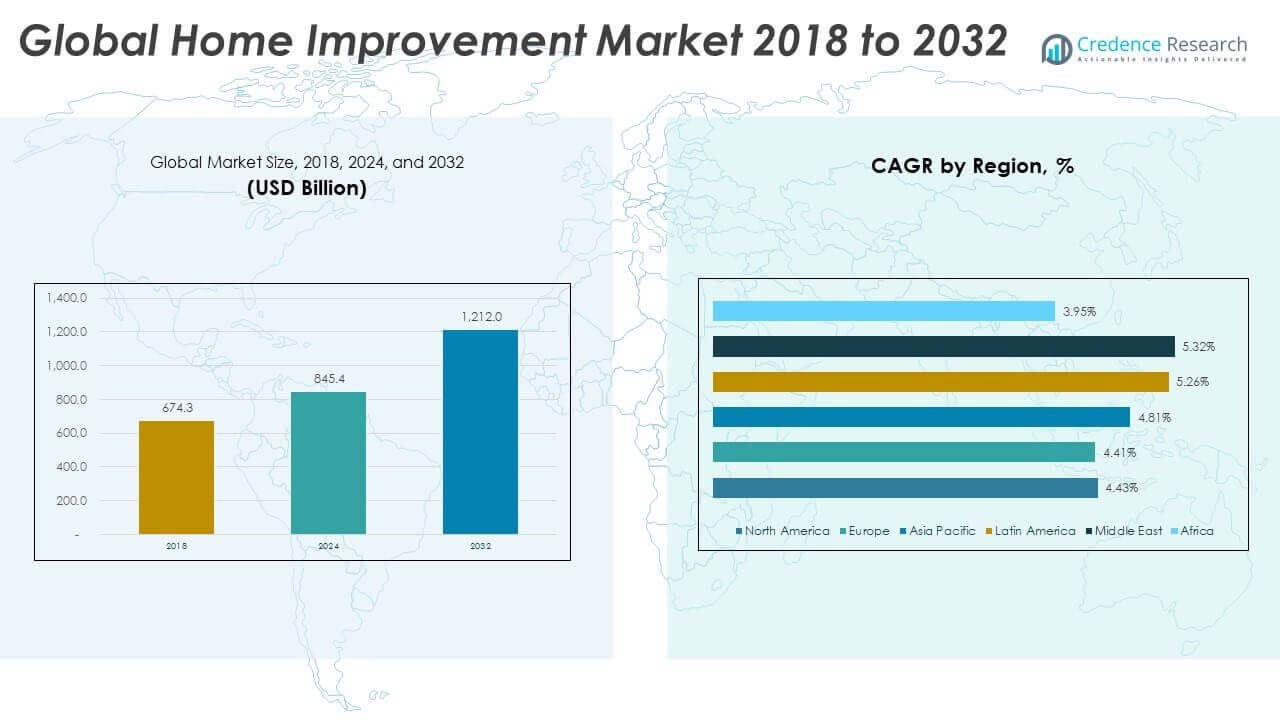
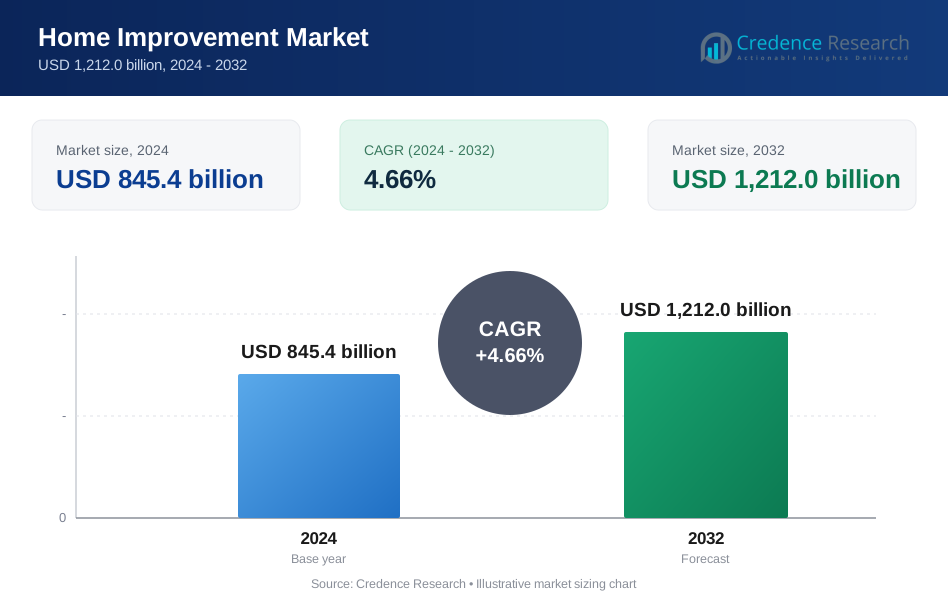
The Global Home Improvement Market size was valued at USD 674.3 billion in 2018 to USD 845.4 billion in 2024 and is anticipated to reach USD 1,212.0 billion by 2032, at a CAGR of 4.66% during the forecast period.
| REPORT ATTRIBUTE | DETAILS |
|---|---|
| Historical Period | 2020-2023 |
| Base Year | 2024 |
| Forecast Period | 2025-2032 |
| Home Improvement Market Size 2024 | USD 845.4 Billion |
| Home Improvement Market, CAGR | 4.66% |
| Home Improvement Market Size 2032 | USD 1,212.0 Billion |
The market is driven by growing demand for renovation of aging homes, rising disposable incomes, and an increasing shift toward energy-efficient upgrades. Consumers invest in kitchen and bathroom remodeling, exterior improvements, and smart home systems. DIY adoption continues to rise, supported by e-commerce access and online tutorials. Green materials and eco-friendly designs gain attention due to rising environmental awareness. Financing options and home equity loans also enable higher-value upgrades across middle-income segments. Builders and service providers respond with flexible solutions tailored for each household type.
Asia Pacific leads the market, driven by urbanization, rising homeownership, and expanding residential development. North America follows with steady renovation activity across aging housing stock. Europe shows strong momentum due to sustainability initiatives and government-backed energy-efficiency programs. Latin America, the Middle East, and Africa are emerging markets supported by improving infrastructure, suburban housing growth, and increasing investment in residential improvements. Demand varies across regions based on income levels, lifestyle shifts, and climate conditions.
Market Insights:
- The Global Home Improvement Market was valued at USD 674.3 billion in 2018, reached USD 845.4 billion in 2024, and is projected to hit USD 1,212.0 billion by 2032, growing at a CAGR of 4.66% over the forecast period.
- Asia Pacific leads with about 96% share in 2024 due to rapid urbanization and housing growth, followed by Europe at 26.61% driven by renovation mandates, and North America at 23.80% supported by mature housing stock and remodeling culture.
- The Middle East is the fastest-growing region, holding around 97% share in 2024, supported by real estate investment, tourism-led housing demand, and national housing programs.
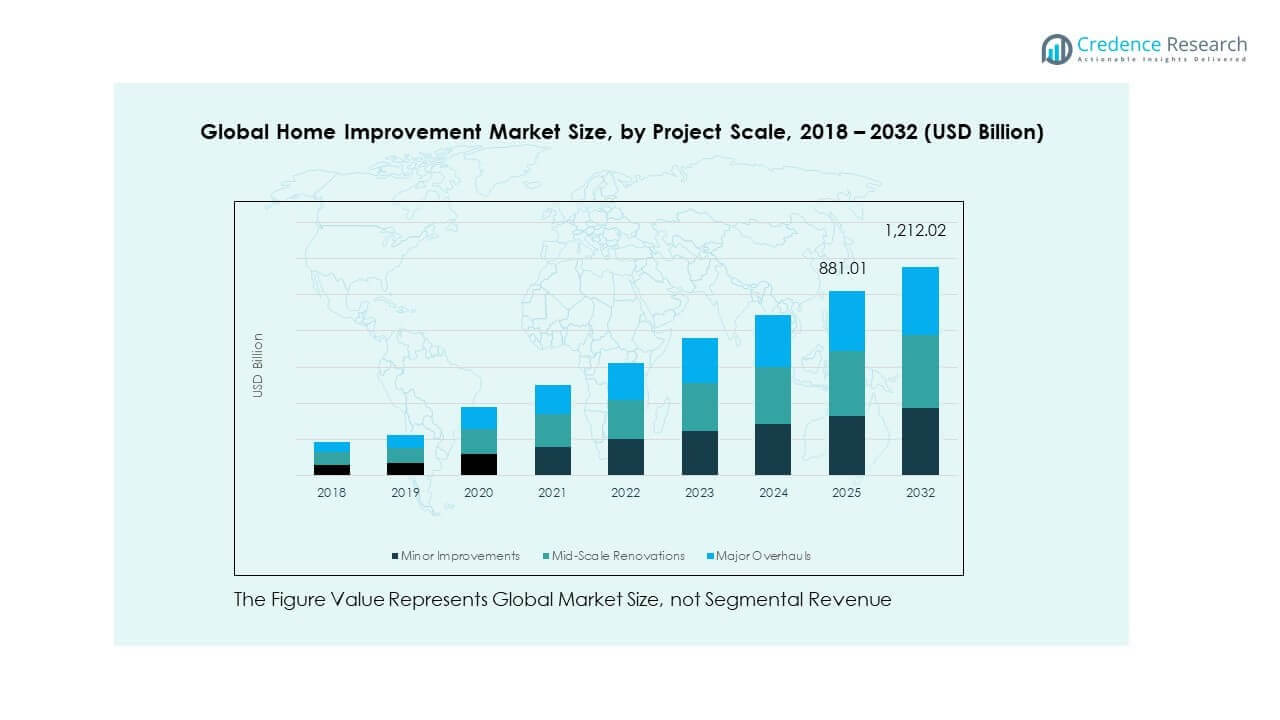
- By project scale, minor improvements account for the largest share at roughly 38%, reflecting frequent, low-cost upgrades, while mid-scale renovations follow with about 34% due to partial home modernizations.
- Major overhauls contribute close to 28% share, driven by full property refurbishments in aging and high-value residential assets.
Market Drivers
Increasing Renovation of Aging Residential Structures Across Developed and Urbanizing Economies
A significant share of homes in North America and Europe were built before 1980. These aging properties need constant upgrades for plumbing, insulation, roofing, and energy systems. The Global Home Improvement Market gains momentum from the rising need to modernize outdated spaces. Consumers prioritize kitchen and bathroom remodels for both comfort and resale value. Aging infrastructure pushes homeowners to adopt smart home technologies and energy-efficient materials. Urbanizing regions in Asia and Latin America see similar trends due to expanding middle-class housing. Builders and property managers invest in retrofit projects to meet new energy codes. Public programs promoting building efficiency further accelerate residential upgrade cycles.
- For instance, Owens Corning's FOAMULAR NGX 250 XPS insulation (launched 2021, updated through 2024) achieves R-4 per inch LTTR value with 90% lower Global Warming Potential via HFO blowing agent, supporting retrofits in foundation walls and slabs of pre-1980 structures.
Surging Consumer Interest in Eco-Friendly and Energy-Efficient Home Enhancements
Rising environmental concerns are influencing consumer choices in home renovation. The Global Home Improvement Market sees growing demand for green insulation, LED lighting, solar installations, and water-saving fixtures. Homeowners seek to reduce utility bills while meeting sustainability goals. Manufacturers offer energy-certified materials that comply with evolving regulatory standards. Demand for electric heat pumps, window glazing, and energy audits continues to rise. Homeowners increasingly invest in decarbonizing their buildings to increase long-term property value. Government incentives encourage the adoption of renewable upgrades. Real estate developers integrate sustainable features to attract conscious buyers and renters.
- For instance, Tesla Powerwall 3 (launched 2024) provides 13.5 kWh usable energy capacity at 97.5% round-trip efficiency, enabling 10+ hours of backup power from solar in existing homes.
Expansion of DIY Culture Supported by Online Retail and Influencer Content
A strong DIY movement has taken root across multiple countries. The Global Home Improvement Market benefits from consumers empowered by digital tutorials and tool access. Online influencers and home improvement channels promote self-led remodeling trends. Retail platforms have expanded their DIY sections with bundled kits and virtual guides. Product personalization, real-time shopping, and visual planning tools make execution easier. Demand for peel-and-stick materials, modular fittings, and compact tools continues to grow. Consumers use DIY methods for cost control and creative flexibility. E-commerce and next-day deliveries allow faster decision-to-installation cycles.
Rising Disposable Income and Homeownership Rates Across Tier-2 and Suburban Regions
Household income improvements in developing countries directly impact spending on home renovation. The Global Home Improvement Market witnesses rising contributions from suburban homeowners upgrading for comfort and modernity. Mortgage access and property tax reforms expand homeownership rates in Asia and Latin America. Suburban and tier-2 homeowners prefer gradual improvements over relocation. Investment in flooring, cabinetry, wall treatments, and landscaping continues to expand. Lifestyle upgrades, enabled by EMI-based financing, support higher-ticket remodeling projects. Urban sprawl in growing economies leads to increased housing development and interior customization. Builders offer semi-finished homes, allowing buyers to complete upgrades over time.
Market Trends
Integration of Smart Home Technologies into Core Renovation and Modernization Activities
Smart homes are shifting from luxury status to mainstream expectation. The Global Home Improvement Market integrates automation systems into lighting, HVAC, and security upgrades. Consumers value voice-controlled systems, motion sensors, and app-connected appliances. Builders now offer smart-ready infrastructure for new homes and retrofit projects. Demand grows for interoperable solutions that work across brands and platforms. Smart thermostats, leak detectors, and camera systems are top choices for homeowners. Homeowners seek convenience, energy management, and enhanced safety through technology. Retailers bundle smart upgrades with broader renovation packages to drive adoption.
- For instance, Google Nest Learning Thermostat (4th gen, 2024) uses Soli radar for Motion Sense occupancy detection and supports 20-30VAC HVAC systems with 1-3 heating/cooling stages plus fan (G), humidifier (HUM), and ventilation (VENT) control via Matter protocol.
Shift Toward Multifunctional and Adaptive Living Spaces in Urban Residences
Urban home designs now emphasize space flexibility and multipurpose use. The Global Home Improvement Market aligns with evolving lifestyle needs such as hybrid work and wellness. Foldable furniture, movable walls, and built-in storage systems are rising in demand. Consumers prioritize modular interiors that can shift from office to guest room to gym. Renovation designs focus on clean aesthetics and space efficiency. Developers include convertible spaces in high-rise projects targeting young professionals. Homeowners use remodeling to adapt older layouts for modern life. Retailers offer product lines tailored for small-space improvements.
- For instance, IKEA's PLATSA modular frame (2023 update) holds up to 50 kg per 80x40 cm section across 18 configurations, with tool-free assembly for reconfiguration in under 30 minutes per official assembly guides.
Strong Uptake of Sustainable and Locally Sourced Building Materials in Key Markets
Local materials reduce transportation costs and environmental impact. The Global Home Improvement Market observes rising adoption of bamboo, recycled wood, cork, and clay products. Builders and consumers value materials with lower embodied carbon. Certifications such as FSC, LEED, and GreenGuard influence product selection. Homeowners want durable and natural-looking finishes. Artisan-crafted surfaces and regionally made furniture see increased demand. Governments promote local sourcing to support economic resilience. Supply chains adjust by offering region-specific SKUs and customization options.
Growth in Home Wellness Features Including Air, Light, and Acoustic Enhancements
Wellness is becoming a core design principle in home upgrades. The Global Home Improvement Market embraces solutions that enhance air purity, lighting quality, and noise reduction. HEPA filters, biophilic elements, and circadian lighting systems see greater use. Homeowners seek materials with low VOC emissions and natural textures. Builders use acoustic panels, double-glazed windows, and soundproof drywall to minimize noise. Design firms market spaces as therapeutic and health-supporting environments. Consumers link wellness investments to productivity, sleep, and family wellbeing. Wellness upgrades complement energy and aesthetic renovations for a holistic experience.
Market Challenges Analysis
Fluctuating Raw Material Prices and Supply Chain Disruptions Impact Timelines and Budgets
Volatile costs for timber, steel, plastics, and adhesives raise concerns across the Global Home Improvement Market. Fluctuating pricing strains project budgets and forces retailers to revise pricing strategies. Contractors delay material procurement due to uncertainty. Global logistics interruptions create delivery backlogs for imported fixtures and tools. Builders struggle to meet project timelines due to unsteady inventory flows. Trade policies and geopolitical instability further disrupt supply consistency. Small players with limited purchasing power feel disproportionate impact. Price-sensitive consumers postpone upgrades or scale down project scopes.
Lack of Skilled Labor in Construction and Renovation Sector Slows Market Execution
Workforce shortages persist across major economies. The Global Home Improvement Market experiences project delays due to limited skilled carpenters, electricians, and masons. Vocational training pipelines are slow to fill demand. High turnover in the trades increases recruitment costs. Some homeowners resort to unlicensed labor, raising quality and safety risks. Extended project durations affect consumer satisfaction and vendor credibility. Companies struggle to scale up operations in fast-growing markets. Regulatory compliance requires experienced professionals, which remain scarce in rural or tier-2 areas.
Market Opportunities
Adoption of Tech-Driven Tools for Project Planning, Visualization, and Real-Time Cost Estimation
Software platforms are transforming how homeowners and contractors approach upgrades. The Global Home Improvement Market benefits from AR-powered design apps, cost simulators, and smart project tracking tools. Digital twins and 3D planners improve accuracy and customer satisfaction. Small firms use cloud-based solutions to manage inventory, schedule tasks, and track margins. Real-time platforms allow collaboration between designers, homeowners, and suppliers. Retailers offer integrated tools for selecting compatible products and materials.
Expansion of Franchised Home Improvement Service Models in Tier-2 and Tier-3 Markets Standardized service delivery appeals to emerging homeowners in smaller cities. The Global Home Improvement Market sees opportunity in branded networks offering repairs, installation, and renovations. Franchise players ensure quality, timelines, and transparent pricing. Growth in residential stock across suburban zones creates large addressable demand. Companies launch mobile units and localized warehouses to serve these areas efficiently. Entrepreneurs join franchise systems to tap into structured business models with supplier linkages.
Market Segmentation Analysis:
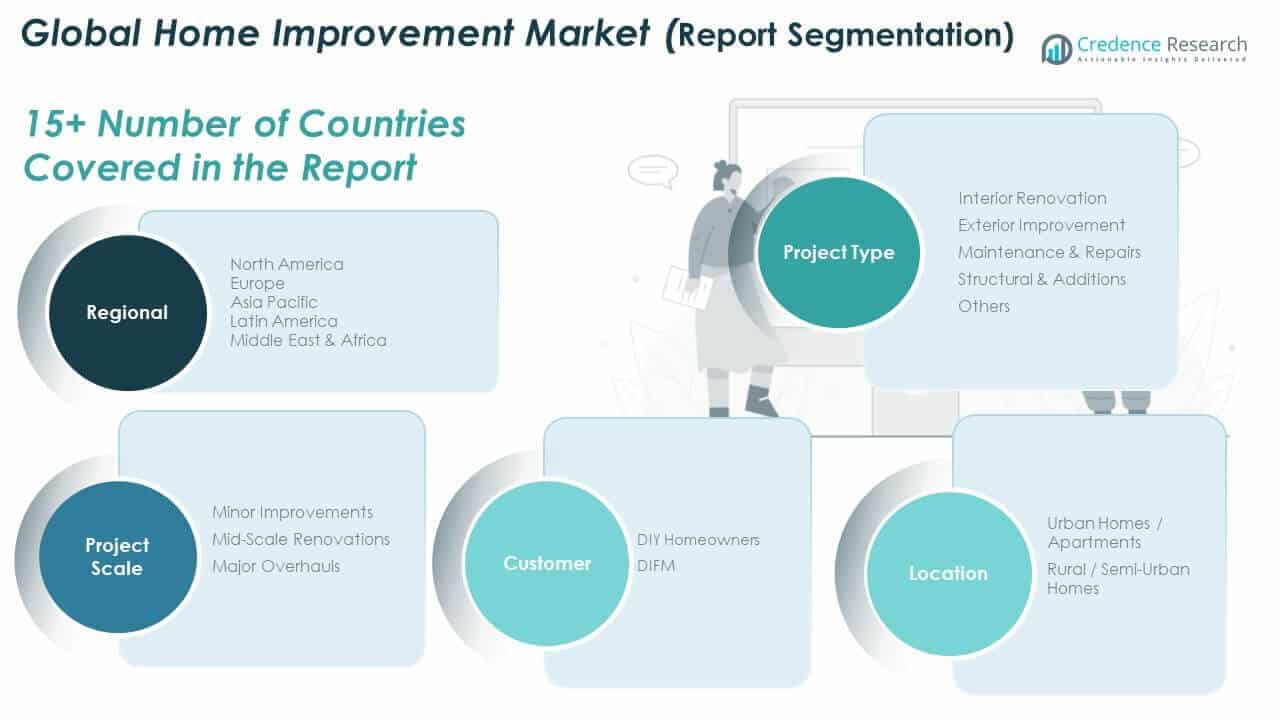
By Project Type Segment
The Global Home Improvement Market is led by interior renovation, which includes kitchen remodeling, bathroom upgrades, and living space improvements. Exterior improvement ranks second, supported by upgrades in roofing, windows, fencing, and landscaping. Maintenance and repairs remain essential for aging structures, particularly in North America and Europe. Structural and additions projects, such as home extensions or load-bearing upgrades, gain momentum in growing families. The others category includes improvements for safety, accessibility, and utility spaces. Demand across project types varies by region, income level, and housing age. Urban homeowners prioritize aesthetic and efficiency upgrades. Product innovation supports deeper penetration across all categories.
- For instance, Kohler’s Artifacts kitchen faucet delivers 1.5 GPM at 60 PSI and features capacitive touchless activation via Response® technology, widely adopted in premium residential remodels.
By Project Scale Segment
Minor improvements dominate the Global Home Improvement Market due to their lower costs and shorter timelines. These include painting, lighting, and minor fixture replacements. Mid-scale renovations are gaining traction in aging urban homes where partial overhauls are needed. These projects often target single rooms or specific systems like HVAC or plumbing. Major overhauls are limited to luxury, high-value, or old properties requiring complete modernization. Such projects often involve redesign, permit approvals, and structural updates. Demand is influenced by financing access, household income, and real estate trends. Builders and contractors tailor offerings across all three scales to match varying consumer needs.
- For instance, Philips Hue White Ambiance bulbs (2024 update) offer up to 1,100 lumens and a long‑life LED design with a 25,000‑hour lifespan, enabling quick DIY lighting swaps with Bluetooth or Zigbee app control and adjustable white light temperature.
By Customer Type Segment
DIY homeowners form the dominant segment due to wide availability of tools, online guides, and retail support. Many prefer small to mid-level projects they can execute with limited help. DIFM (Do-It-For-Me) is growing quickly, especially in urban markets, where time constraints and skill gaps drive outsourcing. The DIFM segment benefits from bundled service models and professional-grade outcomes. E-commerce platforms support both types by offering curated solutions. Consumers often shift between DIY and DIFM based on project complexity. Professional installation services are expanding in response to this hybrid behavior. Contractors target DIFM customers with convenience-focused packages.
By Location Segment
Urban homes and apartments lead the Global Home Improvement Market due to dense populations and modern lifestyle expectations. Space optimization, smart features, and aesthetic updates drive this segment. Builders focus on compact, modular solutions for city dwellings. Rural and semi-urban homes are increasingly active, supported by growing infrastructure and homeownership rates. These regions show strong interest in basic utility upgrades and long-term maintenance. Affordability plays a bigger role in shaping rural demand. Governments and developers expand supply chains to serve these areas efficiently. Location-specific needs shape both the product design and distribution strategy.
Segmentation:
By Project Type Segment
- Interior Renovation
- Exterior Improvement
- Maintenance & Repairs
- Structural & Additions
- Others
By Project Scale Segment
- Minor Improvements
- Mid-Scale Renovations
- Major Overhauls
By Customer Type Segment
- DIY Homeowners
- DIFM (Do-It-For-Me)
By Location Segment
- Urban Homes / Apartments
- Rural / Semi-Urban Homes
By Regional Segment
- North America
- U.S.
- Canada
- Mexico
- Europe
- Germany
- France
- U.K.
- Italy
- Spain
- Rest of Europe
- Asia Pacific
- China
- Japan
- India
- South Korea
- South-east Asia
- Rest of Asia Pacific
- Latin America
- Brazil
- Argentina
- Rest of Latin America
- Middle East & Africa
- GCC Countries
- South Africa
- Rest of the Middle East and Africa
Regional Analysis:
North America
The North America Global Home Improvement Market size was valued at USD 162.58 billion in 2018 to USD 201.22 billion in 2024 and is anticipated to reach USD 283.49 billion by 2032, at a CAGR of 4.43% during the forecast period. North America accounted for 23.80% of the global market in 2024. The region is driven by mature housing stock, frequent remodeling cycles, and high consumer spending. Homeowners invest in kitchen and bathroom upgrades, energy-efficient installations, and smart home technologies. DIY culture remains strong across the U.S. and Canada, supported by large retail networks. Demand for sustainable materials and modular solutions continues to grow. Government rebates and energy standards push green renovation programs. Companies expand their offerings with pre-assembled kits and financing options. E-commerce platforms support rising demand in both urban and rural areas.
Europe
The Europe Global Home Improvement Market size was valued at USD 182.07 billion in 2018 to USD 225.00 billion in 2024 and is anticipated to reach USD 316.34 billion by 2032, at a CAGR of 4.41% during the forecast period. Europe contributed 26.61% to the global market in 2024. Strong regulations on energy efficiency and sustainable housing drive consumer choices. It benefits from national renovation schemes, including subsidies for low-emission housing improvements. Aging infrastructure in countries like Germany, France, and Italy fuels steady demand. Urban consumers invest in functional upgrades, smart devices, and aesthetic enhancements. Rising energy prices shift attention to insulation, glazing, and heat pump installations. The shift toward rental housing has prompted property owners to maintain competitive features. Online retail channels and logistics innovation support regional growth.
Asia Pacific
The Asia Pacific Global Home Improvement Market size was valued at USD 220.30 billion in 2018 to USD 278.62 billion in 2024 and is anticipated to reach USD 404.09 billion by 2032, at a CAGR of 4.81% during the forecast period. Asia Pacific held the largest share of 32.96% in 2024. Rapid urbanization, growing homeownership, and rising income levels support market growth. Consumers prioritize interior upgrades, modular kitchens, and smart integrations. It benefits from expanding middle-class demand in China, India, and Southeast Asia. Governments promote housing reforms and construction quality, leading to sustained improvement activity. Developers offer semi-finished homes to cater to customization trends. E-commerce expansion, mobile-based DIY content, and online consultations support product uptake. Strong growth in suburban areas adds to demand for budget and mid-range solutions.
Latin America
The Latin America Global Home Improvement Market size was valued at USD 59.07 billion in 2018 to USD 76.74 billion in 2024 and is anticipated to reach USD 115.14 billion by 2032, at a CAGR of 5.26% during the forecast period. It represented 9.08% of the global market in 2024. Market growth is fueled by rising housing activity, expanding access to home loans, and lifestyle upgrades. Brazil and Mexico lead in renovation activity due to urban population growth. Consumers increasingly invest in waterproofing, lighting upgrades, and exterior improvement. Informal housing transitions to formal structures, driving demand for maintenance and basic repairs. Mid-income households drive adoption of prefabricated modules and ready-to-install fittings. Retailers expand physical and digital presence in tier-2 cities. Product availability, affordability, and localized services support uptake.
Middle East
The Middle East Global Home Improvement Market size was valued at USD 32.23 billion in 2018 to USD 42.04 billion in 2024 and is anticipated to reach USD 63.39 billion by 2032, at a CAGR of 5.32% during the forecast period. The region accounted for 4.97% of the global market in 2024. Renovation demand rises in response to tourism infrastructure growth, real estate investment, and national housing programs. The UAE and Saudi Arabia lead with smart and luxury renovations in urban centers. Residents prefer modern interiors, energy-saving features, and automation. Property owners refurbish rental spaces to align with lifestyle expectations. Governments offer incentives for thermal insulation and energy-saving materials. Developers invest in value-added home features for new residential zones. Seasonal trends and climate control requirements influence product demand.
Africa
The Africa Global Home Improvement Market size was valued at USD 18.07 billion in 2018 to USD 21.79 billion in 2024 and is anticipated to reach USD 29.57 billion by 2032, at a CAGR of 3.95% during the forecast period. Africa made up 2.58% of the global market in 2024. Market expansion is driven by population growth, housing development, and infrastructure upgrades. Urbanization in Nigeria, Kenya, and Egypt stimulates demand for home improvements. Consumers invest in structural reinforcements, roof upgrades, and basic utilities. Limited access to finance and skilled labor slows high-end renovation adoption. Informal housing remains prominent, but efforts to formalize housing boost market activity. NGOs and government programs focus on affordable improvement solutions. Growth remains steady in core urban areas with rising middle-class aspirations.
Key Player Analysis:
- American Exteriors
- Belfor
- Coit Services, Inc.
- Crane Renovation Group
- DKI Ventures, LLC
- FirstService Corporation
- Masco Corporation
- APCO Industries
- Watsco, Inc.
- Other Key Players
Competitive Analysis:
The Global Home Improvement Market features a mix of large multinational brands, regional contractors, and emerging digital platforms. It remains highly fragmented, with companies competing on product variety, service quality, pricing, and delivery speed. Key players focus on offering end-to-end solutions through retail stores, online platforms, and service tie-ups. Home Depot, Lowe’s, and Kingfisher lead with extensive product catalogs and professional installation services. Smaller firms compete by specializing in niche segments like green materials, modular systems, or premium renovations. The market sees rising investments in AR-based design tools, virtual consultations, and logistics optimization. Brand partnerships with designers, tool manufacturers, and real estate developers strengthen positioning. Competitive intensity varies by region, with local players dominating DIFM services in developing markets. It continues to evolve with rising consumer expectations, new technologies, and shifts in housing trends.
Recent Developments:
- In January 2026, The Home Depot expanded its strategic partnership with Google Cloud to launch agentic AI tools, providing real-time assistance for homeowners and pros via integrations like Magic Apron for store inventory.
- In September 2025, The Home Depot, through its subsidiary SRS Distribution, finalized the acquisition of GMS Inc., a leading building materials distributor, to boost multi-category offerings for residential and commercial professionals.
- In May 2025, Watsco, Inc. acquired Southern Ice Equipment Distributors, along with Lashley & Associates and Hawkins HVAC Distributors earlier that year, adding 10 locations and $47 million in annualized sales across the Sunbelt region. These deals strengthen Watsco's distribution network for HVAC and refrigeration equipment.
- In July 2024, DKI Ventures LLC, through DKI ProSupply, announced a strategic partnership with KnowHow to provide AI-driven training, best practices, and operational support to its restoration network members. The collaboration aims to improve catastrophe response and member onboarding efficiency.
Report Coverage:
The research report offers an in-depth analysis based on Project Type Segment, Project Scale Segment, Customer Type Segment, and Location Segment. It details leading market players, providing an overview of their business, product offerings, investments, revenue streams, and key applications. Additionally, the report includes insights into the competitive environment, SWOT analysis, current market trends, as well as the primary drivers and constraints. Furthermore, it discusses various factors that have driven market expansion in recent years. The report also explores market dynamics, regulatory scenarios, and technological advancements that are shaping the industry. It assesses the impact of external factors and global economic changes on market growth. Lastly, it provides strategic recommendations for new entrants and established companies to navigate the complexities of the market.
Future Outlook:
- Digital transformation will drive market value through AR-based planning tools and smart project management platforms.
- Growing urbanization and migration to smaller living spaces will push demand for modular and space-efficient renovations.
- The DIFM (Do-It-For-Me) customer base will grow faster than DIY segments, especially in urban economies.
- Government incentives and regulatory mandates will expand the uptake of energy-efficient and eco-labeled materials.
- Demand for exterior upgrades like roofing, solar installations, and landscape improvements will rise steadily.
- Product personalization and design flexibility will become central to brand differentiation across segments.
- Smart home integrations will increase, especially in lighting, HVAC, and security remodeling categories.
- The rural and semi-urban market will see stronger activity due to improved infrastructure and rising disposable income.
- Leading players will expand through mergers, service franchises, and omnichannel retail strategies.
- Asia Pacific will maintain the highest growth momentum, supported by a large housing base and lifestyle shifts.
Request a Free Sample
Fill in your details and we'll send you a free sample report.
- Sample data tables & charts
- Research methodology
Need a Custom Version of This Report?
Tailor the scope, geography, or segments to your exact requirements.
- Custom geography or segment scope
- Direct access to our analyst team
Frequently Asked Questions
What is the current market size for Global Home Improvement Market, and what is its projected size in 2032?
At what Compound Annual Growth Rate is the Global Home Improvement Market projected to grow between 2024 and 2032?
Which Global Home Improvement Market segment held the largest share in 2024?
What are the primary factors fueling the growth of the Global Home Improvement Market?
Who are the leading companies in the Global Home Improvement Market?
Which region commanded the largest share of the Global Home Improvement Market in 2024?
Table of Content
Chapter 1. Report Introduction
- 1.1 Report Description & Purpose
- 1.1.1 Report Title & Market Definition
- 1.1.2 Unique Selling Propositions (USP) & Key Differentiators
- 1.1.3 Value Proposition for Stakeholders
- 1.2 Research Objectives
- 1.2.1 Market Sizing Objectives (Volume & Revenue)
- 1.2.2 Segmentation Objectives
- 1.2.3 Competitive Intelligence Objectives
- 1.2.4 Forecast & Scenario Objectives
- 1.3 Report Scope
- 1.3.1 Home Improvement Scope – Types & Subtypes Covered
- 1.3.2 Geographic Scope – Regions & Countries Covered
- 1.3.3 Historical Period, Base Year & Forecast Period (2024; forecast to 2032)
- 1.3.4 Inclusions & Exclusions
- 1.4 HS Code & Classification Framework
- 1.5 Currency, Units & Pricing Basis
- 1.6 Target Stakeholders
- 1.7 Limitations & Assumptions
Chapter 2. Executive Summary
- 2.1 Global Home Improvement Market Snapshot
- 2.1.1 Market Size – Historical (2024) & Forecast (2024-2032) (2024: USD 845.4 billion → 2032: USD 1,212.0 billion)
- 2.1.2 Volume & Revenue – Global Totals
- 2.1.3 Key Market Highlights – Top Five Facts
- 2.2 Home Improvement Market Segmentation Snapshot
- 2.2.1 Market Split by Region – 2024 vs. 2032
- 2.3 Competitive Snapshot
- 2.3.1 Top 10 Players by Revenue Share – 2024
- 2.3.2 Top 10 Players by Volume Share – 2024
- 2.3.3 Recent Strategic Developments (18-Month Summary)
- 2.4 Key Investment Highlights & Strategic Conclusions
Chapter 3. Home Improvement Market Dynamics & Industry Analysis
- 3.1 Market Overview & Context
- 3.1.1 Home Improvement Market Position in the Broader Automotive Value Chain
- 3.1.2 OEM vs. Replacement Market Dynamics
- 3.1.3 Market Maturity & Development Stage by Region
- 3.2 Home Improvement Market Drivers
- 3.3 Home Improvement Market Restraints & Challenges
- 3.4 Home Improvement Market Opportunities
- 3.5 Porter's Five Forces Analysis
- 3.5.1 Threat of New Entrants
- 3.5.2 Bargaining Power of Suppliers
- 3.5.3 Bargaining Power of Buyers
- 3.5.4 Threat of Substitutes
- 3.5.5 Competitive Rivalry – Intensity Assessment
- 3.6 Home Improvement Value Chain Analysis
- 3.6.1 Upstream – Raw Material/Input Suppliers
- 3.6.1.1 Raw Material/Input 1
- 3.6.1.2 Raw Material/Input 2
- 3.6.1.3 Raw Material/Input 3
- 3.6.2 Midstream – Production/Manufacturing/Service Delivery
- 3.6.2.1 Production/Process Overview
- 3.6.2.2 Key Facility Locations & Capacity by Manufacturer
- 3.6.3 Downstream – Distribution & End Consumer
- 3.6.3.1 Primary Channel – B2B/OEM
- 3.6.3.2 Secondary Channels – Dealer, Retail, Online, Direct
- 3.6.4 Value Chain Profitability Analysis
- 3.6.1 Upstream – Raw Material/Input Suppliers
- 3.7 PESTEL Analysis
- 3.7.1 Political Factors
- 3.7.2 Economic Factors
- 3.7.3 Social Factors
- 3.7.4 Technological Factors
- 3.7.5 Environmental Factors
- 3.7.6 Legal Factors
- 3.8 Home Improvement Supply Chain Analysis
- 3.8.1 Raw Material/Input Supply Risk Assessment
- 3.8.2 Manufacturing Concentration Risk (Geographic Exposure)
- 3.8.3 Trade Disruption Impact Analysis
- 3.9 Regulatory & Policy Landscape
Note: The regulatory and policy landscape section covers regulations based on their applicability to the market, Home Improvement category, geography, and scope of the study. Only regulatory frameworks with a material impact on operations, compliance, trade, sustainability, or market access are analyzed in detail.
Chapter 4. Key Investment Pockets & Opportunity Analysis
- 4.1 Home Improvement Market Attractiveness Analysis
- 4.1.1 By Region – Investment Attractiveness Matrix (Volume × CAGR)
- 4.2 Absolute Revenue Growth Opportunity
- 4.2.1 By Region – Absolute USD Growth Through 2032
- 4.3 Incremental Volume Opportunity
- 4.3.1 By Region – Incremental Volume Through 2032
- 4.3.2 Segment – Incremental Volume
- 4.4 Emerging Submarket Opportunity Deep Dive (Subject to Applicability)
- 4.5 Emerging Market Opportunity Scorecards
- 4.5.1 United States
- 4.5.2 Europe
- 4.5.3 Asia
- 4.5.4 Middle East & Africa
Note: Emerging Market Opportunity Scorecards will be included based on relevance and strategic importance. Regions listed are indicative and may vary depending on data availability and market dynamics.
Chapter 5. Home Improvement Import-Export Analysis & Trade Flows
- 5.1 Global Trade Overview
- 5.1.1 Global Export Value by Country (2024)
- 5.1.2 Global Export Volume by Country (2024)
- 5.1.3 Global Import Value by Country (2024)
- 5.1.4 Global Import Volume by Country (2024)
- 5.1.5 Net Trade Balance by Country (2024)
- 5.2 Export Analysis – Segment
- 5.2.1 Type 1 (HS Code)
- 5.2.2 Type 2 (HS Code)
- 5.2.3 Type 3 (HS Code)
- 5.2.4 Type 4 (HS Code)
- 5.2.5 Type 5 (HS Code)
- 5.3 Import Analysis – Segment
- 5.3.1 Type 1 (HS Code)
- 5.3.2 Type 2 (HS Code)
- 5.3.3 Type 3 (HS Code)
- 5.3.4 Type 4 (HS Code)
- 5.3.5 Type 5 (HS Code)
- 5.4 Average Unit Trade Prices
- 5.4.1 Average Export Price – Segment & Country
- 5.4.2 Average Import Price – Segment & Source Country
- 5.4.3 Price Trends (2024)
- 5.5 Key Trade Route Analysis
- 5.5.1 Trade Route 1
- 5.5.2 Trade Route 2
- 5.5.3 Trade Route 3
- 5.5.4 Trade Route 4
- 5.5.5 Trade Route 5
- 5.6 Trade Policy Impact Assessment
- 5.6.1 US Anti-Dumping & Section 301 Tariffs
- 5.6.2 EU Customs Union Impact
- 5.6.3 Major Free Trade Agreements
- 5.6.4 USMCA Rules of Origin
Note: Trade policy analysis will be included only where relevant to the Home Improvement market.
Chapter 6. Competitive Landscape & Company Benchmarking
- 6.1 Home Improvement Market Concentration & Structure
- 6.1.1 Herfindahl-Hirschman Index (HHI) – vs. 2024
- 6.1.2 Tier 1, Tier 2 & Tier 3 Market Structure
- 6.1.3 Global, Regional & Local Player Dynamics
- 6.2 Home Improvement Market Share Analysis – 2024
- 6.2.1 Global Revenue Share by Company
- 6.2.2 Global Volume Share by Company
- 6.2.3 Regional Revenue Share
- 6.2.4 Market Share Evolution ( vs. 2024)
- 6.2.5 OEM Segment Share by Company
- 6.2.6 Replacement Segment Share by Company
- 6.3 Production/Delivery Capacity & Facility Analysis
- 6.3.1 Global Installed Capacity
- 6.3.2 Capacity Utilization Rates
- 6.3.3 Production/Output Volume
- 6.3.4 Facility Locations & Capacity Map
- 6.3.5 Planned Capacity Additions
- 6.4 Home Improvement Competitive Benchmarking Matrix
- 6.4.1 Revenue, Volume, CAGR & Profitability Comparison
- 6.4.2 Channel Revenue Mix
- 6.4.3 Geographic Revenue Exposure
- 6.4.4 R&D Intensity
- 6.4.5 Sustainability Maturity
- 6.5 Strategic Developments in Home Improvement (Last 24 Months)
- 6.5.1 Mergers, Acquisitions & Divestments
- 6.5.2 New Home Improvement Launches
- 6.5.3 Facility Expansions
- 6.5.4 Strategic Alliances, Joint Ventures & Partnerships
- 6.5.5 Distribution Expansion & Market Entry
- 6.5.6 Sustainability & ESG Initiatives
- 6.6 Competitive Strategy Mapping
- 6.6.1 Leader, Challenger, Follower & Niche Classification
- 6.6.2 Pricing Strategy Comparison
- 6.6.3 Channel Strategy Matrix
Note: Strategic developments are included based on their materiality and the availability of reliable information.
Chapter 7. Global Home Improvement Market – By Distribution Channel
- 7.1 Segment Overview
- 7.1.1 Volume & Revenue Split by Channel (2024 & 2032)
- 7.1.2 Channel Mix Evolution (2024-2032)
Chapter 8. Regional Market Analysis – Global Overview
- 8.1 Global Regional Overview
- 8.1.1 Regional Volume Share
- 8.1.2 Regional Revenue Share
- 8.1.3 Regional Volume by Region
- 8.1.4 Regional Revenue by Region
- 8.1.5 Regional Forecast Through 2032
- 8.2 Cross-Regional Segment Analysis
- 8.2.1 By Distribution Channel
- 8.2.2 By Brand/Price Tier
Chapter 9. North America Home Improvement Market
- 9.1 United States
- 9.2 Canada
- 9.3 Mexico
Chapter 10. Europe Home Improvement Market
- 10.1 Germany
- 10.2 France
- 10.3 Italy
- 10.4 United Kingdom
- 10.5 Spain
- 10.6 Poland
- 10.7 Russia
- 10.8 Netherlands
- 10.9 Belgium
- 10.10 Sweden
- 10.11 Denmark
- 10.12 Norway
- 10.13 Rest of Europe
Chapter 11. Asia Pacific Home Improvement Market
- 11.1 China
- 11.2 India
- 11.3 Japan
- 11.4 South Korea
- 11.5 Thailand
- 11.6 Indonesia
- 11.7 Vietnam
- 11.8 Malaysia
- 11.9 Australia
- 11.10 Rest of Asia Pacific
Chapter 12. Latin America Home Improvement Market
- 12.1 Brazil
- 12.2 Argentina
- 12.3 Colombia
- 12.4 Chile
- 12.5 Rest of Latin America
Chapter 13. Middle East Home Improvement Market
- 13.1 Saudi Arabia
- 13.2 United Arab Emirates
- 13.3 Turkey
- 13.4 Israel
- 13.5 Iran
- 13.6 Rest of the Middle East
Chapter 14. Africa Home Improvement Market
- 14.1 South Africa
- 14.2 Egypt
- 14.3 Nigeria
- 14.4 Morocco
- 14.5 Rest of Africa
Chapter 15. Home Improvement Company Profiles
- 15.1 [Company 01]
- 15.1.1 Company Overview
- 15.1.2 Key Management Personnel
- 15.1.3 Products & Services Portfolio
- 15.1.4 Financial Performance
- 15.1.5 Key Market Focus & Geographic Presence
- 15.1.6 Recent Developments & Strategic Initiatives
Note: The company profile list is preliminary and may change based on research findings, market developments, data availability, and client requirements.
Chapter 16. Appendices
- Appendix A – List of Abbreviations & Acronyms
- Appendix B – Industry Classification Code Reference – Full Series
- Appendix C – Production & Capacity Data Tables
- Appendix D – End-Use & Demand Base Tables
- Appendix E – Consumption & Replacement Rate Assumptions
- Appendix F – ASP Reference Tables
- Appendix G – Manufacturing & Facility Database
- Appendix H – Import-Export Data Tables
- Appendix I – Regulatory Summary Tables
- Appendix J – Primary Research Participant List (Anonymized)
- Appendix K – Primary Research Questionnaire Framework
- Appendix L – Data Sources & Bibliography
- Appendix M – Market Size Divergence & Source Comparison
Chapter 17. Research Methodology
- 17.1 Research Framework & Philosophy
- 17.2 Secondary Research – Sources, Hierarchy & Data Extraction
- 17.3 Data Modeling – Bottom-Up & Top-Down Market Sizing
- 17.4 Primary Research – Stakeholder Framework, LOI & Sample Sizes
- 17.5 Forecast Methodology – Regression, Scenario & Sensitivity Analysis
- 17.6 Quality Control – Four-Layer Validation Framework
- 17.7 Limitations & Standard Assumptions
- 17.8 Disclaimer
