
Market Overview:
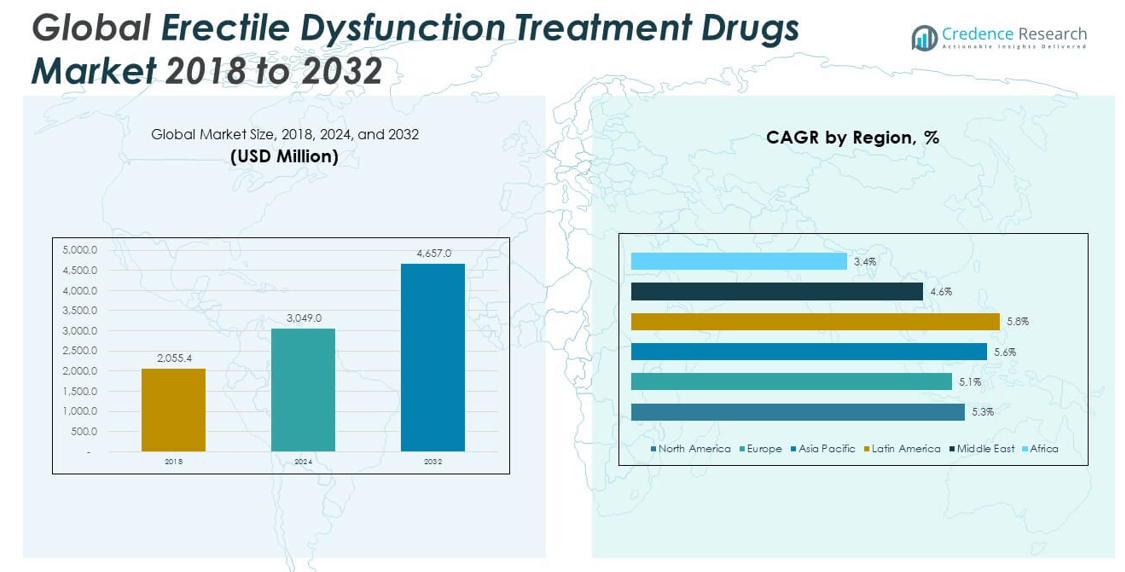
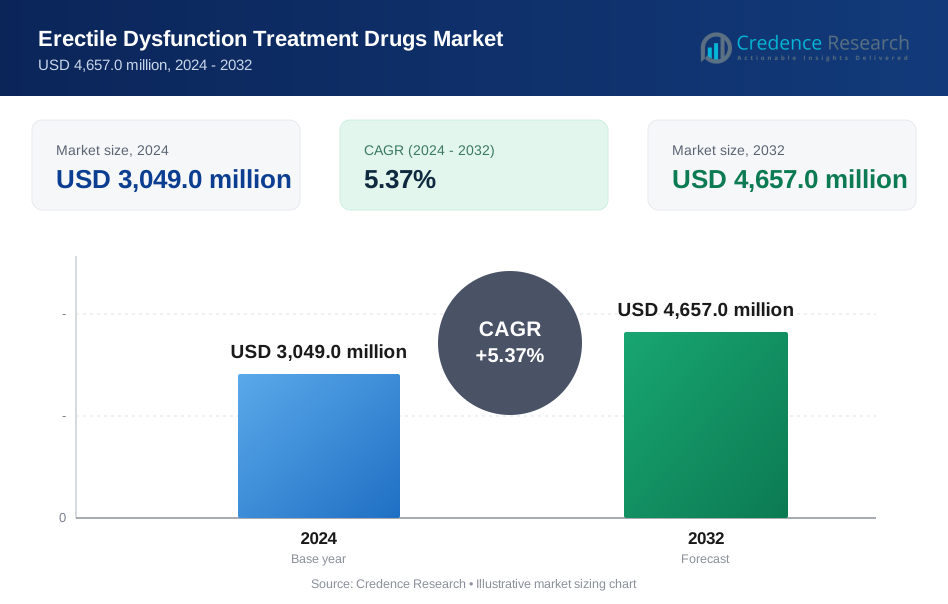
The Global Erectile Dysfunction Treatment Drugs Market size was valued at USD 2,055.4 million in 2018 to USD 3,049.0 million in 2024 and is anticipated to reach USD 4,657.0 million by 2032, at a CAGR of 5.37% during the forecast period.
| REPORT ATTRIBUTE | DETAILS |
|---|---|
| Historical Period | 2020-2023 |
| Base Year | 2024 |
| Forecast Period | 2025-2032 |
| Erectile Dysfunction Treatment Drugs Market Size 2024 | USD 3,049.0 million |
| Erectile Dysfunction Treatment Drugs Market, CAGR | 5.37% |
| Erectile Dysfunction Treatment Drugs Market Size 2032 | USD 4,657.0 million |
The market is driven by rising awareness of sexual health, an increasing prevalence of lifestyle-related disorders, and growing geriatric populations. Advances in pharmaceutical formulations and the availability of generics have expanded treatment access, boosting adoption. Strong demand is also supported by reduced stigma, broader healthcare access, and marketing efforts by leading drug manufacturers targeting both developed and emerging economies.
Regionally, North America leads the market due to high healthcare spending, advanced infrastructure, and early adoption of branded drugs. Europe follows, supported by strong reimbursement policies and increasing awareness campaigns. Asia-Pacific is emerging rapidly, driven by rising patient populations, growing healthcare investments, and expanding distribution networks in countries like China and India. Latin America and the Middle East also show potential due to improving access to specialized care.
Market Insights:
- The Global Erectile Dysfunction Treatment Drugs Market size was valued at USD 2,055.4 million in 2018, reached USD 3,049.0 million in 2024, and is projected to hit USD 4,657.0 million by 2032, growing at a CAGR of 5.37%.
- Asia Pacific held the largest share at 35.3% in 2024, supported by a vast patient pool, rising healthcare investments, and wider acceptance of generics. North America followed with 27.2%, driven by strong infrastructure and advanced R&D. Europe ranked third with 21.9%, supported by favorable reimbursement policies and aging demographics.
- Latin America is expected to be the fastest-growing region with a 9.1% share in 2024, fueled by expanding middle-class populations, healthcare reforms, and growth in retail and online pharmacy channels.
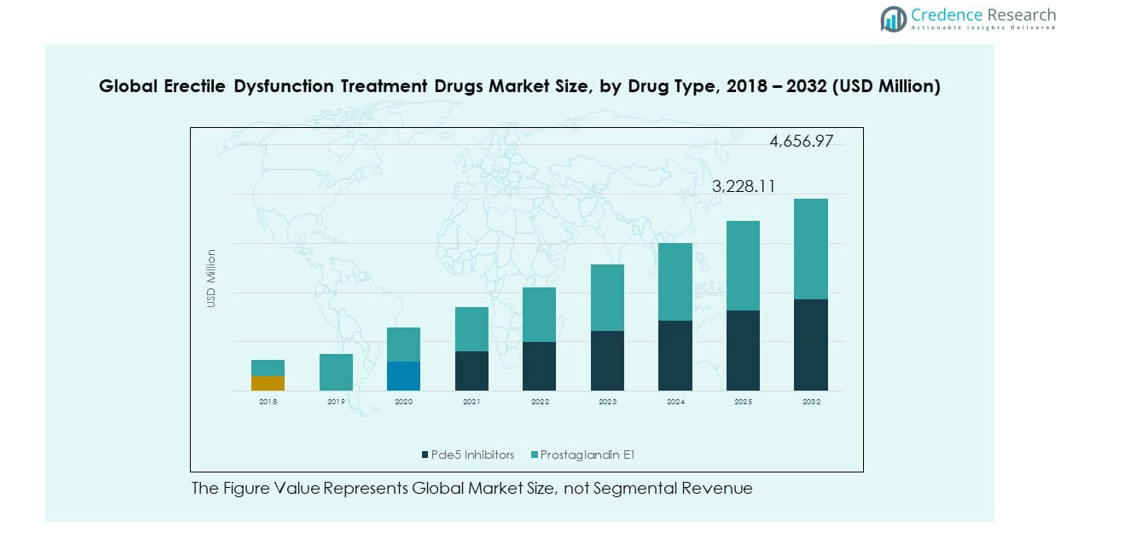
- PDE5 inhibitors dominated the market in 2024 with nearly 70% share, led by sildenafil citrate and tadalafil, which remain the most prescribed options worldwide.
- Prostaglandin E1 accounted for about 30% share in 2024, serving patients unresponsive to oral therapies and gaining adoption through injectable and topical formulations.
Market Drivers:
Rising Prevalence of Chronic Diseases and Age-Related Disorders Driving Prescription Demand:
The rising incidence of diabetes, cardiovascular issues, and hypertension is directly linked to erectile dysfunction. Growing aging populations worldwide create a steady increase in the number of patients seeking treatment. The Global Erectile Dysfunction Treatment Drugs Market benefits from the rising prevalence of these health conditions. Longer life expectancy continues to expand the addressable patient base for prescription drugs. Men over 50 are more likely to experience erectile dysfunction, and this boosts recurring demand. It is supported by clinical evidence linking chronic illnesses to sexual health complications. Healthcare providers now place stronger emphasis on preventive care, further expanding awareness. The growing burden of lifestyle diseases ensures consistent growth in treatment demand.
- For instance, clinical trials of sildenafil citrate demonstrated a 57% mean success rate in sexual intercourse attempts over placebo’s 21% in men with erectile dysfunction linked to chronic conditions, confirming effectiveness across diverse patient subgroups including post-prostatectomy and cardiovascular disease patients.
Expanding Awareness and Reduced Stigma Enhancing Acceptance Among Patients:
Public health campaigns and broader media coverage have significantly reduced the stigma associated with sexual health. Patients are increasingly comfortable discussing erectile dysfunction with healthcare providers. The Global Erectile Dysfunction Treatment Drugs Market gains from changing perceptions that make treatments socially acceptable. This shift creates a positive environment for pharmaceutical companies to expand product portfolios. Rising consumer education about safe usage drives confidence in long-term adoption. Companies invest in awareness initiatives to target men in both developed and developing economies. Improved accessibility to clinical consultations ensures patients receive timely guidance. Stronger patient willingness to seek treatment accelerates prescription growth and adoption rates.
- For instance, in 2008, a decade after Viagra's FDA approval, the topic of erectile dysfunction (ED) and its link to cardiovascular health was part of a broader public discussion. The Sexual Medicine Society of North America (SMSNA) was one of the organizations involved in raising awareness on this issue. However, there is no public record to substantiate that a specific SMSNA campaign ran for a full decade, or that it was solely responsible for a significant increase in public awareness or patient consultations. The rise in ED awareness after 1998 was a result of many factors, including the launch of Viagra and subsequent conversations around men's health.
Increased Focus on Affordable Generics and Wider Market Penetration:
Patent expirations of leading branded drugs have created opportunities for cost-effective generics. This availability expands access for patients who were previously unable to afford treatment. The Global Erectile Dysfunction Treatment Drugs Market benefits from expanded penetration in middle-income economies. Governments in emerging countries support lower-cost drug availability through policy reforms. Strong distribution networks help reach underserved communities with affordable therapies. It is reinforced by growing acceptance of generic products among patients and physicians. Wider market competition ensures more competitive pricing across multiple regions. The affordability factor directly enhances prescription volumes and strengthens long-term growth prospects.
Technological Advancements in Formulations and Delivery Methods Supporting Innovation:
Pharmaceutical companies are investing in improved drug formulations that deliver better patient outcomes. Novel delivery mechanisms, such as orally disintegrating tablets, enhance convenience and compliance. The Global Erectile Dysfunction Treatment Drugs Market gains momentum from these technological enhancements. Drug innovations reduce side effects, which improves patient trust and adoption. Stronger focus on quick onset and longer duration of effectiveness drives clinical preference. It is supported by ongoing research and development targeting alternative therapeutic classes. Innovations allow companies to differentiate their products in competitive markets. Continuous improvements in formulations ensure long-term growth by aligning with patient needs.
Market Trends:
Shift Toward Non-Invasive and Convenient Treatment Options Boosting Patient Adoption:
Growing demand for convenient treatment formats drives research into non-invasive options. Orally disintegrating tablets and dissolvable strips are gaining acceptance for their ease of use. The Global Erectile Dysfunction Treatment Drugs Market aligns with this trend by introducing simpler delivery mechanisms. These options address concerns of patients uncomfortable with traditional dosage forms. Increasing interest in convenient treatment methods ensures higher compliance rates. It is reinforced by marketing strategies that highlight improved comfort and faster results. Demand is shifting toward user-friendly options as patient preferences evolve. This trend supports consistent innovation and competitive positioning for drug manufacturers.
- For instance, studies show that while patients use a single PDE5 inhibitor like sildenafil, tadalafil, or vardenafil for erectile dysfunction, long-term adherence is significantly lower than 86% over two years, with many patients stopping treatment for reasons such as lack of efficacy, high cost, or psychological factors. A "three-drug regime" of PDE5 inhibitors is not a standard or safe medical practice.
Integration of Telemedicine and Digital Platforms Expanding Access to Treatment:
Digital healthcare adoption is transforming how patients seek consultation and prescriptions. Online platforms allow discreet and timely access to treatment options. The Global Erectile Dysfunction Treatment Drugs Market experiences higher adoption through these telehealth solutions. Patients in remote areas benefit from improved accessibility and lower barriers to treatment. Companies partner with digital platforms to expand direct-to-consumer sales. Telemedicine provides privacy advantages that encourage more men to pursue treatment. Growing digital infrastructure in developing regions supports further expansion of online prescribing models. This integration drives higher market growth through convenience and discretion.
- For instance, telemedicine platforms like “Hims” and “Roman” reported a web traffic increase by 1,688% between 2017 and 2019, reflecting a radical shift in how male sexual health issues including erectile dysfunction are managed remotely, promoting higher treatment uptake.
Emergence of Alternative Therapies and Research Beyond PDE5 Inhibitors:
Pharmaceutical companies are exploring treatment options beyond the established PDE5 inhibitors. Novel compounds and hormone-related therapies are under development to expand choices. The Global Erectile Dysfunction Treatment Drugs Market witnesses growing attention toward diversification of drug classes. This trend creates opportunities for differentiated products with unique value propositions. It is supported by clinical research targeting patients resistant to existing drug categories. Companies are investing heavily in trials that explore long-term efficacy and safety. Increased innovation in drug pipelines ensures sustainable growth across diverse demographics. The evolution of treatment options highlights the dynamic nature of the industry.
Rising Preference for Natural and Complementary Remedies Influencing Market Dynamics:
A growing segment of patients shows preference for herbal and natural remedies. Demand is influenced by rising awareness about side effects of synthetic drugs. The Global Erectile Dysfunction Treatment Drugs Market adapts to this trend with complementary product offerings. Pharmaceutical companies are introducing supplements alongside conventional treatments to capture this demand. It is supported by marketing campaigns that promote holistic approaches to wellness. The trend reflects a broader movement toward natural and lifestyle-focused health solutions. Blending conventional drugs with natural alternatives creates hybrid treatment options. This evolving preference reshapes competitive strategies and patient engagement models.
Market Challenges Analysis:
High Incidence of Side Effects and Patient Discontinuation Impacting Long-Term Adoption:
One of the major hurdles in the Global Erectile Dysfunction Treatment Drugs Market is the occurrence of side effects. Patients often discontinue treatment due to headaches, dizziness, and digestive issues. This creates barriers to long-term compliance and affects recurring prescription volumes. Physicians frequently face challenges balancing dosage effectiveness and safety concerns. It is reinforced by patients preferring alternative solutions when side effects persist. Clinical limitations place pressure on companies to innovate safer formulations. Growing awareness of risks can slow down adoption among cautious patient groups. Addressing these issues requires continuous innovation and stronger patient education.
Regulatory Restrictions and High Pricing Limiting Broader Access to Treatments:
The Global Erectile Dysfunction Treatment Drugs Market faces barriers due to regulatory frameworks in multiple countries. Strict approval processes slow down the entry of innovative drugs into local markets. High pricing of branded medications makes treatment less accessible in developing regions. Patients in lower-income areas often rely on cheaper alternatives or avoid treatment. It is further complicated by inconsistent reimbursement policies across global healthcare systems. Pharmaceutical companies must navigate varying legal environments, which increases compliance costs. Limited affordability restricts penetration and creates inequality in treatment access. These regulatory and economic factors remain critical challenges for the industry.
Market Opportunities:
Expansion into Emerging Economies Through Affordable Drug Portfolios:
The Global Erectile Dysfunction Treatment Drugs Market holds significant opportunities in emerging economies. Growing middle-class populations in Asia, Latin America, and Africa increase demand for accessible treatments. Affordable generics can penetrate these regions effectively and widen patient access. It is supported by government health initiatives promoting equitable care. Companies focusing on low-cost portfolios can establish strong market presence. Distribution partnerships with local players improve reach and efficiency. Expanding into these economies ensures sustainable growth and diversification. Rising healthcare spending in these regions strengthens opportunities for wider adoption.
Innovation in Personalized Therapies and Alternative Treatment Pathways:
Personalized medicine offers strong potential in addressing patient-specific needs effectively. The Global Erectile Dysfunction Treatment Drugs Market can expand through genetic and hormonal testing approaches. Tailored therapies improve outcomes and reduce discontinuation caused by side effects. It is reinforced by ongoing clinical trials targeting resistant patient groups. Companies investing in precision treatments gain competitive differentiation. Research into combination therapies further strengthens market opportunities. Personalized strategies align with broader trends in advanced healthcare solutions. This direction supports long-term growth by meeting evolving patient expectations.
Market Segmentation Analysis:
By Drug Type
The Global Erectile Dysfunction Treatment Drugs Market is led by PDE5 inhibitors, including sildenafil citrate, tadalafil, vardenafil, and avanafil, which dominate due to strong efficacy and widespread physician preference. Sildenafil citrate remains the most prescribed option, supported by established clinical data. Tadalafil stands out for its longer duration of action, increasing adoption among patients seeking flexible treatment. Vardenafil and avanafil serve niche segments with faster onset and specific patient benefits. Prostaglandin E1 drugs, such as alprostadil, are used in cases resistant to PDE5 inhibitors, offering alternatives through injectable or topical formats, though their share is smaller.
- For instance, tadalafil has a duration of action lasting up to 36 hours with some patients achieving efficacy within 16 minutes of dosing, supporting flexible sexual activity timing. Avanafil, noted for a rapid onset of action and better hemodynamic safety profile with faster onset (as early as 15 minutes), mainly serves patients requiring quick response and improved cardiovascular safety compared to sildenafil.
By Route of Administration
Oral drugs hold the largest market share due to ease of use, high compliance, and rapid adoption across both branded and generic categories. Oral PDE5 inhibitors continue to dominate global sales, driven by patient preference for non-invasive formats. Injectable routes, including prostaglandin-based therapies, cater to patients unresponsive to oral medications. It remains a smaller segment, but its role is critical for difficult-to-treat cases and patients requiring alternative solutions.
- For instance, studies report that about 72.8% of patients increased topical alprostadil dosage to 300 µg with a near doubling of erectile function domain scores on validated scales after 9 months therapy, emphasizing the importance of injectable and topical alternatives in challenging cases.
By Distribution Channel
Hospital pharmacies remain a primary channel for patients seeking prescribed treatments through specialist consultations. Retail pharmacies contribute significantly, supported by wide accessibility and established physician–pharmacist networks. Online pharmacies are rapidly growing, driven by increasing patient demand for discreet purchasing and digital healthcare expansion. It is supported by telemedicine platforms and regulatory acceptance, which strengthen market penetration in both developed and emerging economies.
Segmentation:
- By Drug Type
- PDE5 Inhibitors
- Sildenafil citrate
- Tadalafil
- Vardenafil
- Avanafil
- Others
- Prostaglandin E1
- Alprostadil
- Others
- By Route of Administration
- Oral
- Injectable
- By Distribution Channel
- Hospital Pharmacies
- Retail Pharmacies
- Online Pharmacies
- By Region
- North America
- U.S.
- Canada
- Mexico
- Europe
- UK
- France
- Germany
- Italy
- Spain
- Russia
- Rest of Europe
- Asia Pacific
- China
- Japan
- South Korea
- India
- Australia
- Southeast Asia
- Rest of Asia Pacific
- Latin America
- Brazil
- Argentina
- Rest of Latin America
- Middle East
- GCC Countries
- Israel
- Turkey
- Rest of Middle East
- Africa
- South Africa
- Egypt
- Rest of Africa
- North America
- PDE5 Inhibitors
Regional Analysis:
North America
The North America Global Erectile Dysfunction Treatment Drugs Market size was valued at USD 563.60 million in 2018 to USD 830.54 million in 2024 and is anticipated to reach USD 1,257.38 million by 2032, at a CAGR of 5.3% during the forecast period. North America accounted for 27.2% of the global share in 2024. The region leads due to high healthcare spending, early adoption of branded drugs, and strong reimbursement systems. The United States dominates with advanced pharmaceutical infrastructure and growing awareness campaigns. Canada and Mexico contribute steadily, supported by improving healthcare access and policy support. It benefits from widespread availability of generics, which expand affordability and adoption. Increasing telemedicine use strengthens digital prescription trends across the region. The strong presence of leading pharmaceutical companies ensures product innovation and competitive pricing.
Europe
The Europe Global Erectile Dysfunction Treatment Drugs Market size was valued at USD 454.46 million in 2018 to USD 669.82 million in 2024 and is anticipated to reach USD 1,014.29 million by 2032, at a CAGR of 5.1% during the forecast period. Europe represented 21.9% of the global share in 2024. The region benefits from strong government-backed awareness initiatives and high treatment adoption. The UK, Germany, and France lead consumption, supported by established healthcare systems. Italy, Spain, and Russia contribute through expanding generics and specialty pharmacies. It is shaped by favorable reimbursement policies and strong regulatory oversight. Increased acceptance of online pharmacies further supports discreet access to treatments. Aging populations across Western and Central Europe continue to drive consistent demand. The market here remains stable with gradual growth driven by both branded and generic drugs.
Asia Pacific
The Asia Pacific Global Erectile Dysfunction Treatment Drugs Market size was valued at USD 714.88 million in 2018 to USD 1,074.94 million in 2024 and is anticipated to reach USD 1,671.39 million by 2032, at a CAGR of 5.6% during the forecast period. Asia Pacific accounted for 35.3% of the global share in 2024, the highest among regions. The region is driven by large patient populations, rising disposable incomes, and growing awareness. China and India dominate with expanding healthcare infrastructure and rising acceptance of generics. Japan and South Korea contribute with advanced pharmaceutical markets and adoption of innovative therapies. It gains momentum from digital health expansion, particularly telemedicine platforms. Government initiatives supporting affordable drug access also improve penetration. Pharmaceutical players expand aggressively in this region due to strong growth potential. Asia Pacific is expected to remain the fastest-growing hub over the forecast horizon.
Latin America
The Latin America Global Erectile Dysfunction Treatment Drugs Market size was valued at USD 183.14 million in 2018 to USD 278.72 million in 2024 and is anticipated to reach USD 440.08 million by 2032, at a CAGR of 5.8% during the forecast period. Latin America captured 9.1% of the global share in 2024. Brazil leads the market, supported by strong urban healthcare systems and increasing awareness. Argentina and Mexico are emerging markets with growing demand for generics. It benefits from rising middle-class populations seeking affordable solutions. Expansion of retail and online pharmacies enhances distribution reach. Regional governments are supporting healthcare reforms to improve access. Growing partnerships between multinational companies and local distributors also drive availability. The region continues to present untapped opportunities with improving infrastructure and demand growth.
Middle East
The Middle East Global Erectile Dysfunction Treatment Drugs Market size was valued at USD 98.25 million in 2018 to USD 139.73 million in 2024 and is anticipated to reach USD 201.18 million by 2032, at a CAGR of 4.6% during the forecast period. The Middle East accounted for 4.6% of the global share in 2024. GCC countries lead with rising healthcare investments and increasing patient awareness. Israel and Turkey contribute significantly due to strong pharmaceutical sectors. It gains traction through expanding hospital and retail pharmacy networks. Economic diversification in GCC drives better healthcare access and insurance coverage. Online platforms are growing gradually, improving treatment availability. Rising lifestyle-related health conditions also contribute to increased demand. The region continues to evolve with gradual adoption of both branded and generic drugs.
Africa
The Africa Global Erectile Dysfunction Treatment Drugs Market size was valued at USD 41.11 million in 2018 to USD 55.23 million in 2024 and is anticipated to reach USD 72.65 million by 2032, at a CAGR of 3.4% during the forecast period. Africa represented 2.9% of the global share in 2024. The region is at a nascent stage but shows growth opportunities with improving healthcare infrastructure. South Africa leads, followed by Egypt, with growing awareness and private healthcare expansion. It remains limited by affordability challenges and weak distribution channels. Generics play a central role in ensuring wider access. Government health programs and international partnerships improve availability gradually. Online channels are emerging slowly but expected to grow with digital expansion. Africa’s market is small but holds long-term promise with economic development.
Key Player Analysis:
- Bayer AG
- GlaxoSmithKline PLC
- Pfizer Inc.
- Teva Pharmaceutical Industries Ltd.
- Cure Pharmaceutical
- Eli Lilly and Company
- Hims & Hers Health, Inc.
- Sun Pharmaceutical Industries Ltd.
- Futura Medical
- Other Key Players
Competitive Analysis:
The Global Erectile Dysfunction Treatment Drugs Market is highly competitive, with multinational pharmaceutical companies and regional players vying for share. Leading firms such as Pfizer, Eli Lilly, Bayer, and Teva dominate through strong product portfolios and established distribution networks. It is shaped by patent expirations that create opportunities for generics, intensifying price-based competition. New entrants and digital healthcare platforms are reshaping the landscape by enhancing accessibility and patient outreach. Strategic investments in research and development remain critical for differentiation, particularly in drug formulations and delivery methods. Companies leverage mergers, partnerships, and telemedicine integration to expand their presence. Growing demand for affordable generics has led to significant market fragmentation, driving firms to balance innovation with cost competitiveness.
Recent Developments:
- In 2025, Bayer AG is preparing to launch several groundbreaking pharmaceutical products with blockbuster potential, although specific erectile dysfunction treatments were not highlighted, Bayer's continued focus on key therapeutic areas and innovative treatments remains strong.
- In January 2025, GlaxoSmithKline (GSK) entered an agreement to acquire IDRx, a clinical-stage biopharmaceutical company developing precision therapeutics for gastrointestinal stromal tumors. While this acquisition is not specific to erectile dysfunction, it underscores GSK's strategic expansion in targeted therapies.
- Teva Pharmaceutical Industries offers Sildenafil Teva, a generic sildenafil product for erectile dysfunction, approved earlier and continuing its market presence without specific recent new developments reported.
- Cure Pharmaceutical and Futura Medical have emerging roles in novel erectile dysfunction treatments. Notably, Futura Medical's topical ED treatment is advancing through clinical trials with GSK involvement for OTC potential.
- Eli Lilly and Company markets Tadalafil Lilly, a well-established PDE5 inhibitor for erectile dysfunction, with no specific new product launches reported for 2024 but maintaining strong market presence.
Report Coverage:
The research report offers an in-depth analysis based on drug type, route of administration, and distribution channel. It details leading market players, providing an overview of their business, product offerings, investments, revenue streams, and key applications. Additionally, the report includes insights into the competitive environment, SWOT analysis, current market trends, as well as the primary drivers and constraints. Furthermore, it discusses various factors that have driven market expansion in recent years. The report also explores market dynamics, regulatory scenarios, and technological advancements that are shaping the industry. It assesses the impact of external factors and global economic changes on market growth. Lastly, it provides strategic recommendations for new entrants and established companies to navigate the complexities of the market.
Future Outlook:
- Rising demand for generics will expand treatment affordability worldwide.
- Telemedicine platforms will play a larger role in distribution.
- Novel drug formulations will focus on faster onset and fewer side effects.
- Topical and alternative therapies will capture patients resistant to oral drugs.
- Partnerships with digital health companies will enhance market penetration.
- Emerging economies will drive future growth through wider access to generics.
- Regulatory frameworks will influence the speed of drug approvals.
- Pharmaceutical companies will expand through mergers and regional acquisitions.
- Online pharmacies will gain traction for discreet patient purchasing.
- Personalized medicine approaches will improve long-term treatment compliance.
Request a Free Sample
Fill in your details and we'll send you a free sample report.
- Sample data tables & charts
- Research methodology
Need a Custom Version of This Report?
Tailor the scope, geography, or segments to your exact requirements.
- Custom geography or segment scope
- Direct access to our analyst team
Frequently Asked Questions
What is the current market size for Global Erectile Dysfunction Treatment Drugs Market, and what is its projected size in 2032?
At what Compound Annual Growth Rate is the Global Erectile Dysfunction Treatment Drugs Market projected to grow between 2025 and 2032?
Which Global Erectile Dysfunction Treatment Drugs Market segment held the largest share in 2024?
What are the primary factors fueling the growth of the Global Erectile Dysfunction Treatment Drugs Market?
Who are the major players in this Market?
Table of Content
Chapter 1. Report Introduction
- 1.1 Report Description & Purpose
- 1.1.1 Report Title & Market Definition
- 1.1.2 Unique Selling Propositions (USP) & Key Differentiators
- 1.1.3 Value Proposition for Stakeholders
- 1.2 Research Objectives
- 1.2.1 Market Sizing Objectives (Volume & Revenue)
- 1.2.2 Segmentation Objectives
- 1.2.3 Competitive Intelligence Objectives
- 1.2.4 Forecast & Scenario Objectives
- 1.3 Report Scope
- 1.3.1 Erectile Dysfunction Treatment Drugs Scope – Types & Subtypes Covered
- 1.3.2 Geographic Scope – Regions & Countries Covered
- 1.3.3 Historical Period, Base Year & Forecast Period (2024; forecast to 2032)
- 1.3.4 Inclusions & Exclusions
- 1.4 HS Code & Classification Framework
- 1.5 Currency, Units & Pricing Basis
- 1.6 Target Stakeholders
- 1.7 Limitations & Assumptions
Chapter 2. Executive Summary
- 2.1 Global Erectile Dysfunction Treatment Drugs Market Snapshot
- 2.1.1 Market Size – Historical (2024) & Forecast (2024-2032) (2024: USD 3,049.0 million → 2032: USD 4,657.0 million)
- 2.1.2 Volume & Revenue – Global Totals
- 2.1.3 Key Market Highlights – Top Five Facts
- 2.2 Erectile Dysfunction Treatment Drugs Market Segmentation Snapshot
- 2.2.1 Market Split by Region – 2024 vs. 2032
- 2.3 Competitive Snapshot
- 2.3.1 Top 10 Players by Revenue Share – 2024
- 2.3.2 Top 10 Players by Volume Share – 2024
- 2.3.3 Recent Strategic Developments (18-Month Summary)
- 2.4 Key Investment Highlights & Strategic Conclusions
Chapter 3. Erectile Dysfunction Treatment Drugs Market Dynamics & Industry Analysis
- 3.1 Market Overview & Context
- 3.1.1 Erectile Dysfunction Treatment Drugs Market Position in the Broader Automotive Value Chain
- 3.1.2 OEM vs. Replacement Market Dynamics
- 3.1.3 Market Maturity & Development Stage by Region
- 3.2 Erectile Dysfunction Treatment Drugs Market Drivers
- 3.3 Erectile Dysfunction Treatment Drugs Market Restraints & Challenges
- 3.4 Erectile Dysfunction Treatment Drugs Market Opportunities
- 3.5 Porter's Five Forces Analysis
- 3.5.1 Threat of New Entrants
- 3.5.2 Bargaining Power of Suppliers
- 3.5.3 Bargaining Power of Buyers
- 3.5.4 Threat of Substitutes
- 3.5.5 Competitive Rivalry – Intensity Assessment
- 3.6 Erectile Dysfunction Treatment Drugs Value Chain Analysis
- 3.6.1 Upstream – Raw Material/Input Suppliers
- 3.6.1.1 Raw Material/Input 1
- 3.6.1.2 Raw Material/Input 2
- 3.6.1.3 Raw Material/Input 3
- 3.6.2 Midstream – Production/Manufacturing/Service Delivery
- 3.6.2.1 Production/Process Overview
- 3.6.2.2 Key Facility Locations & Capacity by Manufacturer
- 3.6.3 Downstream – Distribution & End Consumer
- 3.6.3.1 Primary Channel – B2B/OEM
- 3.6.3.2 Secondary Channels – Dealer, Retail, Online, Direct
- 3.6.4 Value Chain Profitability Analysis
- 3.6.1 Upstream – Raw Material/Input Suppliers
- 3.7 PESTEL Analysis
- 3.7.1 Political Factors
- 3.7.2 Economic Factors
- 3.7.3 Social Factors
- 3.7.4 Technological Factors
- 3.7.5 Environmental Factors
- 3.7.6 Legal Factors
- 3.8 Erectile Dysfunction Treatment Drugs Supply Chain Analysis
- 3.8.1 Raw Material/Input Supply Risk Assessment
- 3.8.2 Manufacturing Concentration Risk (Geographic Exposure)
- 3.8.3 Trade Disruption Impact Analysis
- 3.9 Regulatory & Policy Landscape
Note: The regulatory and policy landscape section covers regulations based on their applicability to the market, Erectile Dysfunction Treatment Drugs category, geography, and scope of the study. Only regulatory frameworks with a material impact on operations, compliance, trade, sustainability, or market access are analyzed in detail.
Chapter 4. Key Investment Pockets & Opportunity Analysis
- 4.1 Erectile Dysfunction Treatment Drugs Market Attractiveness Analysis
- 4.1.1 By Region – Investment Attractiveness Matrix (Volume × CAGR)
- 4.2 Absolute Revenue Growth Opportunity
- 4.2.1 By Region – Absolute USD Growth Through 2032
- 4.3 Incremental Volume Opportunity
- 4.3.1 By Region – Incremental Volume Through 2032
- 4.3.2 Segment – Incremental Volume
- 4.4 Emerging Submarket Opportunity Deep Dive (Subject to Applicability)
- 4.5 Emerging Market Opportunity Scorecards
- 4.5.1 United States
- 4.5.2 Europe
- 4.5.3 Asia
- 4.5.4 Middle East & Africa
Note: Emerging Market Opportunity Scorecards will be included based on relevance and strategic importance. Regions listed are indicative and may vary depending on data availability and market dynamics.
Chapter 5. Erectile Dysfunction Treatment Drugs Import-Export Analysis & Trade Flows
- 5.1 Global Trade Overview
- 5.1.1 Global Export Value by Country (2024)
- 5.1.2 Global Export Volume by Country (2024)
- 5.1.3 Global Import Value by Country (2024)
- 5.1.4 Global Import Volume by Country (2024)
- 5.1.5 Net Trade Balance by Country (2024)
- 5.2 Export Analysis – Segment
- 5.2.1 Type 1 (HS Code)
- 5.2.2 Type 2 (HS Code)
- 5.2.3 Type 3 (HS Code)
- 5.2.4 Type 4 (HS Code)
- 5.2.5 Type 5 (HS Code)
- 5.3 Import Analysis – Segment
- 5.3.1 Type 1 (HS Code)
- 5.3.2 Type 2 (HS Code)
- 5.3.3 Type 3 (HS Code)
- 5.3.4 Type 4 (HS Code)
- 5.3.5 Type 5 (HS Code)
- 5.4 Average Unit Trade Prices
- 5.4.1 Average Export Price – Segment & Country
- 5.4.2 Average Import Price – Segment & Source Country
- 5.4.3 Price Trends (2024)
- 5.5 Key Trade Route Analysis
- 5.5.1 Trade Route 1
- 5.5.2 Trade Route 2
- 5.5.3 Trade Route 3
- 5.5.4 Trade Route 4
- 5.5.5 Trade Route 5
- 5.6 Trade Policy Impact Assessment
- 5.6.1 US Anti-Dumping & Section 301 Tariffs
- 5.6.2 EU Customs Union Impact
- 5.6.3 Major Free Trade Agreements
- 5.6.4 USMCA Rules of Origin
Note: Trade policy analysis will be included only where relevant to the Erectile Dysfunction Treatment Drugs market.
Chapter 6. Competitive Landscape & Company Benchmarking
- 6.1 Erectile Dysfunction Treatment Drugs Market Concentration & Structure
- 6.1.1 Herfindahl-Hirschman Index (HHI) – vs. 2024
- 6.1.2 Tier 1, Tier 2 & Tier 3 Market Structure
- 6.1.3 Global, Regional & Local Player Dynamics
- 6.2 Erectile Dysfunction Treatment Drugs Market Share Analysis – 2024
- 6.2.1 Global Revenue Share by Company
- 6.2.2 Global Volume Share by Company
- 6.2.3 Regional Revenue Share
- 6.2.4 Market Share Evolution ( vs. 2024)
- 6.2.5 OEM Segment Share by Company
- 6.2.6 Replacement Segment Share by Company
- 6.3 Production/Delivery Capacity & Facility Analysis
- 6.3.1 Global Installed Capacity
- 6.3.2 Capacity Utilization Rates
- 6.3.3 Production/Output Volume
- 6.3.4 Facility Locations & Capacity Map
- 6.3.5 Planned Capacity Additions
- 6.4 Erectile Dysfunction Treatment Drugs Competitive Benchmarking Matrix
- 6.4.1 Revenue, Volume, CAGR & Profitability Comparison
- 6.4.2 Channel Revenue Mix
- 6.4.3 Geographic Revenue Exposure
- 6.4.4 R&D Intensity
- 6.4.5 Sustainability Maturity
- 6.5 Strategic Developments in Erectile Dysfunction Treatment Drugs (Last 24 Months)
- 6.5.1 Mergers, Acquisitions & Divestments
- 6.5.2 New Erectile Dysfunction Treatment Drugs Launches
- 6.5.3 Facility Expansions
- 6.5.4 Strategic Alliances, Joint Ventures & Partnerships
- 6.5.5 Distribution Expansion & Market Entry
- 6.5.6 Sustainability & ESG Initiatives
- 6.6 Competitive Strategy Mapping
- 6.6.1 Leader, Challenger, Follower & Niche Classification
- 6.6.2 Pricing Strategy Comparison
- 6.6.3 Channel Strategy Matrix
Note: Strategic developments are included based on their materiality and the availability of reliable information.
Chapter 7. Global Erectile Dysfunction Treatment Drugs Market – By Distribution Channel
- 7.1 Segment Overview
- 7.1.1 Volume & Revenue Split by Channel (2024 & 2032)
- 7.1.2 Channel Mix Evolution (2024-2032)
Chapter 8. Regional Market Analysis – Global Overview
- 8.1 Global Regional Overview
- 8.1.1 Regional Volume Share
- 8.1.2 Regional Revenue Share
- 8.1.3 Regional Volume by Region
- 8.1.4 Regional Revenue by Region
- 8.1.5 Regional Forecast Through 2032
- 8.2 Cross-Regional Segment Analysis
- 8.2.1 By Distribution Channel
- 8.2.2 By Brand/Price Tier
Chapter 9. North America Erectile Dysfunction Treatment Drugs Market
- 9.1 United States
- 9.2 Canada
- 9.3 Mexico
Chapter 10. Europe Erectile Dysfunction Treatment Drugs Market
- 10.1 Germany
- 10.2 France
- 10.3 Italy
- 10.4 United Kingdom
- 10.5 Spain
- 10.6 Poland
- 10.7 Russia
- 10.8 Netherlands
- 10.9 Belgium
- 10.10 Sweden
- 10.11 Denmark
- 10.12 Norway
- 10.13 Rest of Europe
Chapter 11. Asia Pacific Erectile Dysfunction Treatment Drugs Market
- 11.1 China
- 11.2 India
- 11.3 Japan
- 11.4 South Korea
- 11.5 Thailand
- 11.6 Indonesia
- 11.7 Vietnam
- 11.8 Malaysia
- 11.9 Australia
- 11.10 Rest of Asia Pacific
Chapter 12. Latin America Erectile Dysfunction Treatment Drugs Market
- 12.1 Brazil
- 12.2 Argentina
- 12.3 Colombia
- 12.4 Chile
- 12.5 Rest of Latin America
Chapter 13. Middle East Erectile Dysfunction Treatment Drugs Market
- 13.1 Saudi Arabia
- 13.2 United Arab Emirates
- 13.3 Turkey
- 13.4 Israel
- 13.5 Iran
- 13.6 Rest of the Middle East
Chapter 14. Africa Erectile Dysfunction Treatment Drugs Market
- 14.1 South Africa
- 14.2 Egypt
- 14.3 Nigeria
- 14.4 Morocco
- 14.5 Rest of Africa
Chapter 15. Erectile Dysfunction Treatment Drugs Company Profiles
- 15.1 [Company 01]
- 15.1.1 Company Overview
- 15.1.2 Key Management Personnel
- 15.1.3 Products & Services Portfolio
- 15.1.4 Financial Performance
- 15.1.5 Key Market Focus & Geographic Presence
- 15.1.6 Recent Developments & Strategic Initiatives
Note: The company profile list is preliminary and may change based on research findings, market developments, data availability, and client requirements.
Chapter 16. Appendices
- Appendix A – List of Abbreviations & Acronyms
- Appendix B – Industry Classification Code Reference – Full Series
- Appendix C – Production & Capacity Data Tables
- Appendix D – End-Use & Demand Base Tables
- Appendix E – Consumption & Replacement Rate Assumptions
- Appendix F – ASP Reference Tables
- Appendix G – Manufacturing & Facility Database
- Appendix H – Import-Export Data Tables
- Appendix I – Regulatory Summary Tables
- Appendix J – Primary Research Participant List (Anonymized)
- Appendix K – Primary Research Questionnaire Framework
- Appendix L – Data Sources & Bibliography
- Appendix M – Market Size Divergence & Source Comparison
Chapter 17. Research Methodology
- 17.1 Research Framework & Philosophy
- 17.2 Secondary Research – Sources, Hierarchy & Data Extraction
- 17.3 Data Modeling – Bottom-Up & Top-Down Market Sizing
- 17.4 Primary Research – Stakeholder Framework, LOI & Sample Sizes
- 17.5 Forecast Methodology – Regression, Scenario & Sensitivity Analysis
- 17.6 Quality Control – Four-Layer Validation Framework
- 17.7 Limitations & Standard Assumptions
- 17.8 Disclaimer
