
Market Overview
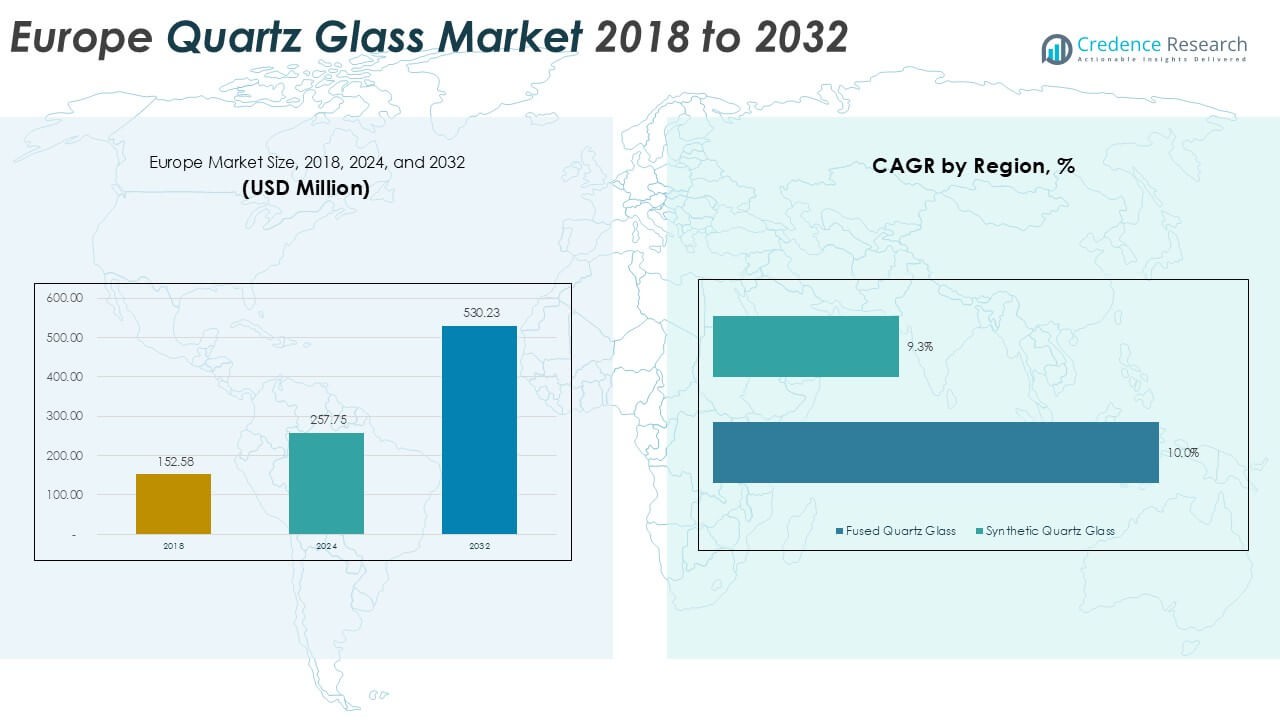
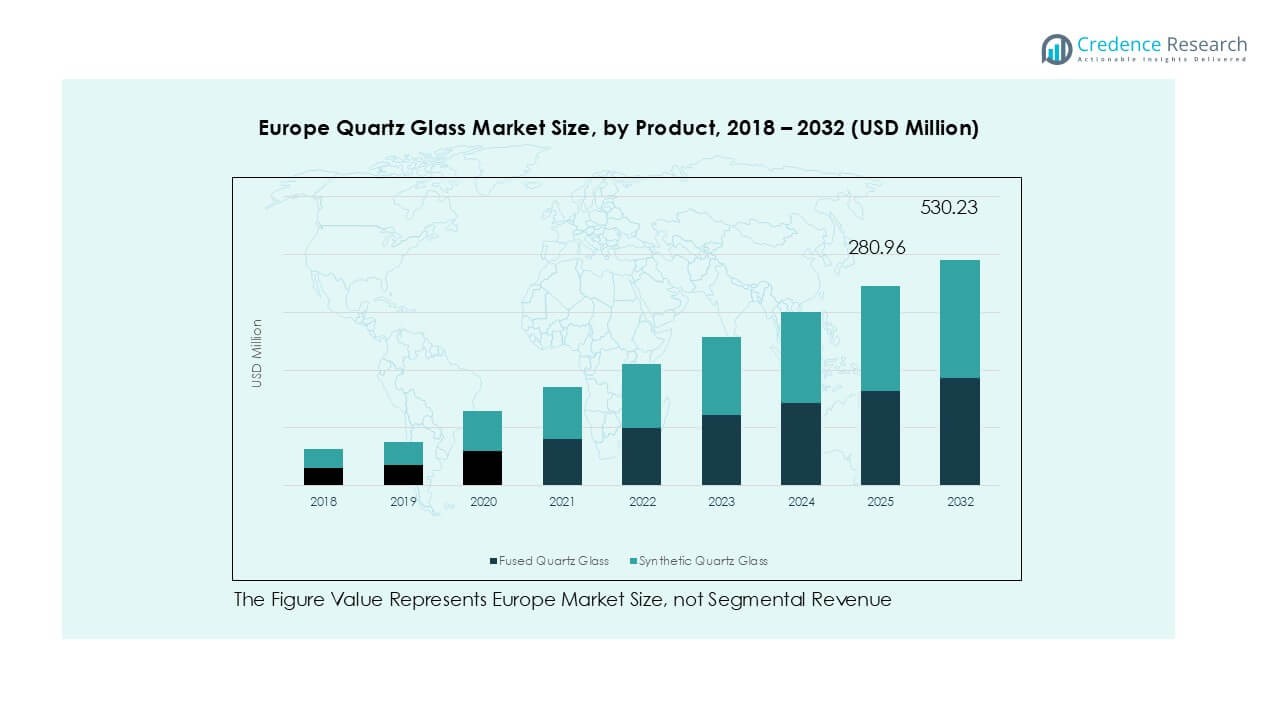
Europe Quartz Glass market size was valued at USD 152.58 million in 2018, expanded to USD 257.75 million in 2024, and is anticipated to reach USD 530.23 million by 2032, at a CAGR of 9.5% during the forecast period.
| REPORT ATTRIBUTE | DETAILS |
|---|---|
| Historical Period | 2020-2023 |
| Base Year | 2024 |
| Forecast Period | 2025-2032 |
| Europe Quartz Glass Market Size 2024 | USD 257.75 Million |
| Europe Quartz Glass Market, CAGR | 9.5% |
| Europe Quartz Glass Market Size 2032 | USD 530.23 Million |
The Europe quartz glass market is led by prominent players such as Saint-Gobain S.A., Heraeus Holding, proQuarz GmbH, WONIK Group, and Raesch Quarz, which hold strong positions through advanced product portfolios and strategic collaborations in semiconductors, solar, and photonics sectors. These companies emphasize high-purity fused and synthetic quartz glass to meet stringent industrial standards, particularly in electronics and renewable energy. On the regional front, Germany accounted for 28% of the market share in 2024, driven by its robust semiconductor and optics industries, followed by the UK with 14% and France with 12%, reflecting their investments in photonics, medical devices, and renewable energy applications.
Market Insights
- The Europe Quartz Glass market was valued at USD 257.75 million in 2024 and is projected to reach USD 530.23 million by 2032, growing at a CAGR of 9.5%.
- Strong demand from the semiconductors and electronics segment (48% share) drives growth, supported by EU’s Chips Act and rising investment in advanced fabrication plants across Germany and France.
- Key trends include the rising adoption of synthetic quartz glass for EUV lithography and growing opportunities in photonics and medical devices, supported by EU-funded research initiatives.
- The competitive landscape is led by Saint-Gobain, Heraeus Holding, proQuarz GmbH, and WONIK Group, while regional specialists such as Raesch Quarz and Quartz Solutions strengthen niche supply with customized offerings.
- Germany held 28% share of the market in 2024, followed by the UK at 14% and France at 12%, while quartz tubes dominated forms (45% share), highlighting the regional and product-level growth concentration.
Market Segmentation Analysis:
By Product
Fused quartz glass dominated the Europe quartz glass market in 2024, accounting for over 62% share. Its wide adoption stems from high thermal stability, superior optical transmission, and cost efficiency compared to synthetic quartz. The material is extensively used in semiconductors, photomasks, and laboratory equipment, driving large-scale consumption. Growth in precision electronics and expansion of photonics research across Germany, France, and the UK further reinforce demand. Synthetic quartz glass continues to expand steadily, supported by its superior purity and reliability for applications in advanced optics, EUV lithography, and specialized medical devices.
- For instance, Heraeus produces fused quartz tubes in Germany for use in semiconductor diffusion processes involving 300 mm wafers. These tubes are manufactured to very tight dimensional tolerances to meet the stringent demands of high-precision semiconductor fabrication.
By Application
The semiconductors and electronics segment held the leading position with over 48% share in 2024. Rising investments in chip fabrication and microelectronics across Europe fuel strong demand for quartz components used in photomasks, diffusion tubes, and etching chambers. Growing government support for semiconductor independence, including EU’s Chips Act, strengthens regional capacity. Solar energy applications are expanding rapidly as quartz glass enables high-efficiency photovoltaic cells. Optics, photonics, and medical segments also show steady growth, driven by laser optics, diagnostic devices, and laboratory equipment requiring high-purity quartz substrates.
- For instance, ASML’s EUV lithography systems manufactured in the Netherlands require ultra-pure synthetic quartz photomask blanks with flatness ≤15 nm over 150 mm, driving supplier demand in the region.
By Form
Quartz tubes emerged as the dominant form, representing more than 45% share in 2024. Their prevalence comes from widespread use in semiconductor furnaces, UV lamps, and photovoltaic cell production. Quartz tubes offer high heat resistance, transparency, and purity, making them indispensable in advanced manufacturing. Quartz rods and plates follow, gaining traction in optical components, lab instrumentation, and photonic devices. Increasing R&D in photonics and laboratory automation across European research institutes also drives demand for plates and sheets. Rising innovation in medical laser applications further supports the growth of specialty quartz forms.
Key Growth Drivers
Expanding Semiconductor and Electronics Industry
The semiconductor and electronics sector is the largest consumer of quartz glass in Europe, driving substantial demand. Quartz glass is vital for semiconductor manufacturing equipment, including diffusion tubes, photomasks, and etching chambers, where high purity and heat resistance are essential. The EU’s strategic initiatives, such as the Chips Act, aim to enhance Europe’s semiconductor production capacity and reduce dependence on imports. These programs are fostering new fabrication plants and expanding existing facilities across Germany, France, and the Netherlands. As production scales, the need for fused and synthetic quartz glass rises significantly. Furthermore, the rapid development of advanced nodes and EUV lithography processes relies heavily on synthetic quartz due to its exceptional optical and structural properties. The semiconductor industry’s acceleration, fueled by increasing demand for microelectronics, sensors, and communication devices, ensures quartz glass will remain a critical material supporting Europe’s industrial and technological competitiveness.
- For instance, GlobalFoundries and STMicroelectronics announced in 2023 a €7.4 billion joint fab in Crolla's, France, which will rely on high-purity fused quartz components for 300 mm wafer processing.
Growth in Renewable Energy and Solar Installations
Europe’s strong focus on renewable energy adoption, particularly solar power, is creating a robust demand for quartz glass. Quartz glass plays a crucial role in photovoltaic manufacturing, where its high optical transmission and resistance to thermal stress support the production of solar cells and modules. Countries such as Germany, Spain, and Italy are expanding solar installations to meet the EU’s 2030 climate targets. With the region targeting at least 45% renewable energy share by 2030, solar PV projects are accelerating rapidly. Quartz glass is extensively used in tubes and sheets for silicon wafer production and protective covers for solar applications. Additionally, the development of concentrated solar power (CSP) systems further increases quartz glass consumption, particularly for high-temperature-resistant components. As Europe invests in energy transition, quartz glass becomes indispensable in enabling efficiency and durability for solar technologies. This sectoral push firmly positions renewable energy growth as a long-term driver of the market.
- For instance, Germany added 14.6 GW of solar capacity in 2023, all requiring quartz crucibles and tubes for silicon wafer production.
Expanding Applications in Optics, Photonics, and Medical Devices
Quartz glass is witnessing increasing demand across optics, photonics, and medical device applications, contributing significantly to market expansion. In optics and photonics, quartz glass is used in laser optics, lenses, and fiber optics due to its superior transparency and low thermal expansion. Research institutes and industries in Germany, Switzerland, and the UK are accelerating investments in photonics for communication, defense, and biomedical applications. Simultaneously, the medical sector increasingly utilizes quartz glass for laboratory equipment, diagnostic systems, and laser-based surgical instruments. The material’s chemical inertness and biocompatibility make it well-suited for medical laboratories and healthcare devices. With Europe’s healthcare sector adopting advanced imaging and diagnostic technologies, quartz glass demand in medical applications continues to rise. Additionally, the growing focus on photonic research and EU funding for advanced optics and laser projects further enhances opportunities. This broad application base beyond semiconductors ensures quartz glass remains integral to Europe’s innovation-driven industries.
Key Trends and Opportunities
Advancement in High-Purity Synthetic Quartz Glass
A major trend in the European quartz glass market is the rising demand for high-purity synthetic quartz. As semiconductor manufacturing transitions to EUV lithography and smaller nanometer nodes, synthetic quartz glass becomes indispensable for optics, masks, and precision equipment. Companies are investing in refining production technologies to deliver defect-free, ultra-pure quartz glass that meets stringent requirements. This trend is not limited to semiconductors; optics and photonics applications are also benefiting from improved material purity. Growing R&D collaborations between European universities, research institutes, and industrial players are accelerating material innovation. This technological shift creates opportunities for regional manufacturers to enhance competitiveness against Asian suppliers.
- For instance, Shin-Etsu Chemical provides photomask blank alternatives, but EUV lithography tools, like those manufactured by ASML, require reflective photomasks. These EUV masks are built on low thermal expansion material (LTEM) substrates, coated with a multilayer of molybdenum and silicon to reflect the 13.5 nm light.
Opportunities in Photonics and Laser Applications
The European Union identifies photonics as a key enabling technology, which opens significant opportunities for quartz glass. Quartz glass is essential in high-power laser systems, optical fibers, and precision optics, which support industries ranging from defense to telecommunications. With strong research investments under Horizon Europe and Photonics21 initiatives, Europe is building leadership in photonics innovation. Demand for quartz-based laser optics and optical substrates is growing rapidly, particularly for biomedical imaging, laser machining, and quantum communication. As industries adopt advanced optical technologies, the opportunity for quartz glass suppliers to serve diverse sectors such as healthcare, aerospace, and automotive expands, ensuring long-term growth prospects.
Key Challenges
High Production Costs and Energy-Intensive Processing
One of the major challenges in the Europe quartz glass market is the high cost associated with production. Manufacturing quartz glass requires extreme purity raw materials and energy-intensive melting processes at very high temperatures. This significantly increases operational costs, particularly with Europe’s rising electricity and natural gas prices. The reliance on specialized facilities and complex refining technologies also limits scalability, raising entry barriers for new players. Furthermore, the cost competitiveness of Asian suppliers adds pricing pressure on European producers. Balancing energy efficiency, cost control, and product quality remains a key challenge to sustaining profitability.
Raw Material Supply Constraints
The quartz glass industry depends on high-quality silica sand and other critical inputs, which are subject to supply constraints. Limited availability of ultra-pure raw materials in Europe leads to dependence on imports from countries with abundant reserves, increasing vulnerability to price volatility and supply disruptions. Geopolitical tensions and trade restrictions can further impact raw material sourcing. Additionally, stricter EU mining and environmental regulations limit domestic extraction, compounding supply risks. These constraints create challenges in maintaining consistent production while meeting rising demand from semiconductors, solar energy, and photonics. Developing sustainable sourcing strategies and recycling technologies is becoming essential for the industry.
Regional Analysis
Germany
Germany led the Europe quartz glass market in 2024, accounting for 28% share. The country’s dominance is supported by its strong semiconductor and electronics industry, particularly with leading fabrication facilities and R&D centers. Germany’s renewable energy push, especially solar, also drives quartz glass demand for photovoltaic applications. The presence of advanced photonics and optics research hubs further boosts adoption. Strategic initiatives under the EU Chips Act and Horizon Europe programs strengthen domestic manufacturing and innovation capacity. Germany’s industrial base, coupled with government funding for clean energy and advanced materials, ensures sustained leadership in quartz glass consumption.
UK
The UK held nearly 14% share of the Europe quartz glass market in 2024. Demand is largely fueled by the country’s growing investments in photonics, laser technology, and medical devices. Universities and research institutes, particularly in Cambridge and Oxford clusters, contribute significantly to optics and laboratory applications. The healthcare sector’s focus on advanced diagnostics also supports quartz glass adoption. Although semiconductor manufacturing is relatively limited compared to Germany, the UK’s research-driven photonics ecosystem offers strong opportunities. Increasing renewable energy deployment, particularly offshore solar and smart energy systems, further enhances demand for quartz tubes and plates across key industries.
France
France accounted for 12% share in the Europe quartz glass market in 2024. The country benefits from expanding semiconductor activity, supported by national strategies to attract fabrication investments under the EU framework. France’s well-established aerospace and optics industries also drive demand for high-purity quartz components in precision instruments and laser technologies. Strong solar energy deployment, particularly in southern regions, reinforces quartz glass usage in photovoltaic applications. In addition, France’s advanced healthcare infrastructure encourages adoption in laboratory equipment and diagnostic tools. With government-backed investments in photonics and optics research, France is poised to expand its role in high-tech applications.
Italy
Italy represented about 9% share of the Europe quartz glass market in 2024. The country’s solar energy expansion and steady semiconductor equipment demand underpin market growth. Italy’s manufacturing sector integrates quartz glass in electronics, optics, and laboratory applications, supported by regional industrial clusters. The adoption of photovoltaic installations in central and southern Italy contributes to rising demand for quartz tubes and sheets. Furthermore, Italy’s medical technology industry increasingly incorporates quartz-based diagnostic and imaging devices. Investments in renewable energy and government incentives for energy efficiency continue to create opportunities, ensuring Italy’s stable role in the regional quartz glass landscape.
Spain
Spain contributed nearly 8% share to the Europe quartz glass market in 2024. The country’s strong focus on solar energy is the primary growth driver, with quartz glass widely used in photovoltaic modules. Spain’s rapid expansion of solar farms under EU renewable targets makes quartz an essential material. Beyond energy, Spain also sees demand in medical and laboratory sectors, supported by its growing biotech and research ecosystem. Semiconductor applications remain modest but show steady growth due to rising electronics demand. With favorable climate policies and renewable adoption, Spain is positioned as a fast-growing market within the region.
Russia
Russia held about 11% share in the Europe quartz glass market in 2024. The country’s demand is largely supported by semiconductor, electronics, and defense-related optics industries. Russia’s growing investments in photonics and laser technologies drive the need for quartz glass in high-precision applications. Solar energy expansion, although gradual, is adding to demand for quartz tubes and sheets. Despite geopolitical tensions and trade restrictions, Russia continues to develop domestic quartz processing to reduce reliance on imports. The country’s focus on technological independence ensures steady consumption, but supply chain constraints and limited access to advanced raw materials pose ongoing challenges.
Rest of Europe
The Rest of Europe, including Nordic nations, Eastern Europe, and Benelux, represented around 18% share in 2024. Demand is distributed across renewable energy, semiconductors, and photonics industries. Countries such as the Netherlands and Belgium are strengthening their role in semiconductor R&D, boosting demand for synthetic quartz. The Nordic region is seeing strong adoption of renewable energy, particularly solar and emerging photonics applications. Eastern Europe is gradually expanding manufacturing capacities, supported by EU investment programs. Collectively, these regions offer steady growth potential, ensuring the rest of Europe remains an important contributor to quartz glass demand across diverse industries.
Market Segmentations:
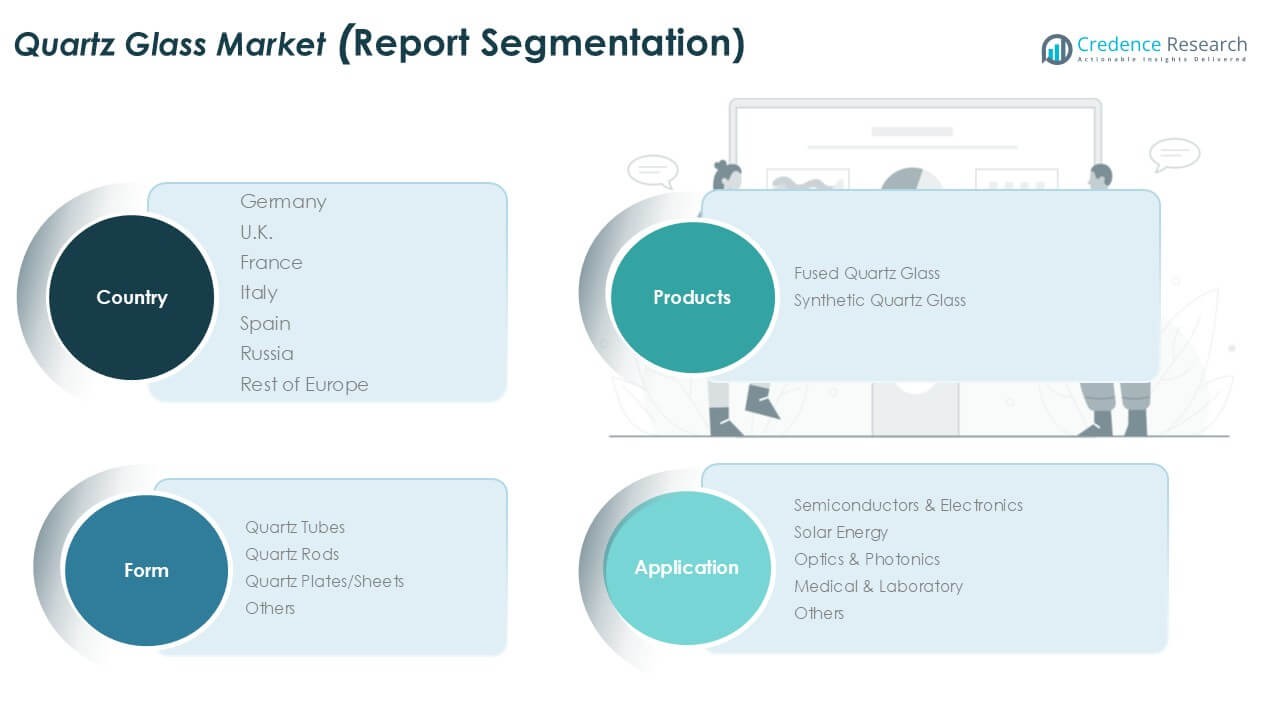
By Product
- Fused Quartz Glass
- Synthetic Quartz Glass
By Application
- Semiconductors & Electronics
- Solar Energy
- Optics & Photonics
- Medical & Laboratory
- Others
By Form
- Quartz Tubes
- Quartz Rods
- Quartz Plates/Sheets
- Others
By Geography
- Germany
- UK
- France
- Italy
- Spain
- Russia
- Rest of Europe
Competitive Landscape
The Europe quartz glass market is moderately consolidated, with a mix of established global players and specialized regional manufacturers. Leading companies such as Saint-Gobain S.A., Heraeus Holding, proQuarz GmbH, WONIK Group, and Raesch Quarz dominate the market through their strong product portfolios and extensive distribution networks. These firms emphasize high-purity quartz for semiconductors, solar energy, and photonics applications, aligning with Europe’s industrial and renewable energy strategies. Regional players including Quartz Solutions, SUNG RIM Europe GmbH, and Precision Electronic Glass enhance competitiveness by offering niche solutions and customized components. Companies actively pursue strategies such as R&D investment, capacity expansion, and collaborations with semiconductor and optics firms to strengthen their presence. Recent developments highlight innovation in synthetic quartz for EUV lithography and advanced optical applications, reflecting market focus on technology-driven growth. The competitive environment remains dynamic, shaped by technological advancements, supply chain optimization, and increasing demand from semiconductor and renewable sectors.
Key Player Analysis
- proQuarz GmbH
- Saint-Gobain S.A.
- Heraeus Holding
- Quartz Solutions
- Precision Electronic Glass
- WONIK Group
- Raesch Quarz
- S & S Optical Company, Inc.
- SUNG RIM Europe GmbH
- Swift Glass
- Sandfire Scientific
- Other Key Players
Recent Developments
- In July 2025, QSIL inaugurated (opened) an expansion building at its ceramics site in Auma-Weidatal for the metallization process. While this is not directly quartz glass, it is part of its high-performance materials / production footprint.
- In March 2025, Heraeus (Heraeus Covantics) launches a new quartz manufacturing plant in Shenyang, China.The facility cost is ~600 million yuan (≈ USD 83.6 million). It focuses on high-purity and ultra-high-purity synthetic quartz products.
- In January 2025, Heraeus Covantics is formed (reorganization). Heraeus combined its high-performance materials units, Heraeus Conamic and Heraeus Comvance, into a new operating company under the name.
- In December 2024 / January 2025, QSIL GmbH Quarzschmelze Ilmenau is acquired by SCHOTT AG. Effective early 2025, SCHOTT acquired the quartz glass production facility in Ilmenau, Germany, including about 275 employees. The acquisition is seen as strategic for SCHOTT to bolster its semiconductor materials portfolio and ensure supply chain resilience.
Report Coverage
The research report offers an in-depth analysis based on Product, Application, Form and Geography. It details leading market players, providing an overview of their business, product offerings, investments, revenue streams, and key applications. Additionally, the report includes insights into the competitive environment, SWOT analysis, current market trends, as well as the primary drivers and constraints. Furthermore, it discusses various factors that have driven market expansion in recent years. The report also explores market dynamics, regulatory scenarios, and technological advancements that are shaping the industry. It assesses the impact of external factors and global economic changes on market growth. Lastly, it provides strategic recommendations for new entrants and established companies to navigate the complexities of the market.
Future Outlook
- The Europe quartz glass market is set to expand steadily with strong growth prospects across industries.
- Rising semiconductor demand will remain the primary driver, supported by EU initiatives to boost local chip production.
- Solar energy expansion will accelerate quartz glass use in photovoltaic and CSP applications.
- Synthetic quartz glass will gain momentum due to its purity and suitability for EUV lithography.
- Leading companies will focus on R&D and partnerships to meet advanced optical and photonics requirements.
- High production costs and energy intensity will push firms toward efficiency and recycling innovations.
- Germany will maintain its dominance with 28% share, followed by the UK and France.
- Quartz tubes will continue leading with more than 45% share, driven by semiconductor and solar uses.
- Healthcare and laboratory applications will create new demand channels for quartz-based precision instruments.
- Regional diversification and investment in advanced materials will shape future competitiveness in the market.

Request a Free Sample
Fill in your details and we'll send you a free sample report.
- Sample data tables & charts
- Research methodology
Market Dynamics
Expanding Semiconductor and Electronics Industry
Europe's push for semiconductor independence, supported by the EU Chips Act and major investments in fabrication plants, is driving robust demand for high-purity quartz glass used in diffusion tubes, photomasks, and etching chambers. The transition to advanced nodes and EUV lithography further increases the need for both fused and synthetic quartz glass.
Growth in Renewable Energy and Solar Installations
The rapid expansion of solar PV and CSP installations across Europe, especially in Germany, Spain, and Italy, is fueling demand for quartz glass in photovoltaic cell production and protective covers. EU climate targets and renewable energy incentives ensure sustained growth in this segment.
Advancements in Photonics, Optics, and Medical Devices
Rising investments in photonics research, laser technology, and advanced medical diagnostics are expanding the use of quartz glass in high-precision optics, laboratory equipment, and biomedical devices. EU-funded initiatives and regional R&D clusters are accelerating innovation and adoption.
Technological Shift Toward High-Purity Synthetic Quartz
The increasing adoption of EUV lithography and miniaturized electronics requires ultra-high-purity synthetic quartz glass, prompting manufacturers to invest in advanced refining and defect-free production technologies. This trend is critical for maintaining competitiveness in semiconductor and photonics applications.
Regional Industrial and R&D Leadership
Germany, the UK, and France are leading the market due to their strong industrial bases, government-backed R&D, and strategic investments in semiconductors, optics, and renewable energy. Their leadership drives regional demand and shapes the competitive landscape.
Need a Custom Version of This Report?
Tailor the scope, geography, or segments to your exact requirements.
- Custom geography or segment scope
- Direct access to our analyst team
Frequently Asked Questions
What is the current market size for Europe Quartz Glass market, and what is its projected size in 2032?
At what Compound Annual Growth Rate is the Europe Quartz Glass market projected to grow between 2025 and 2032?
Which Europe Quartz Glass market segment held the largest share in 2024?
What are the primary factors fueling the growth of the Europe Quartz Glass market?
Who are the leading companies in the Europe Quartz Glass market?
Which region commanded the largest share of the Europe Quartz Glass market in 2024?
Table of Content
Chapter 1 Market Segmentation
- 1.1 Segmentation Framework
- 1.1.1 Product and Service Classification
- 1.1.2 Application and End-Use Classification
- 1.1.3 Technology and Solution Classification
- 1.1.4 Customer and Distribution Channel Classification
- 1.1.5 Geographic Segmentation
- 1.1.6 Market Segment Definitions and Boundaries
- 1.2 By Form
- 1.2.1 Quartz Tubes
- 1.2.2 Quartz Rods
- 1.2.3 Quartz Plates/Sheets
- 1.2.4 Others
- 1.3 By Product
- 1.3.1 Fused Quartz Glass
- 1.3.2 Synthetic Quartz Glass
- 1.4 By Application
- 1.4.1 Semiconductors & Electronics
- 1.4.2 Solar Energy
- 1.4.3 Optics & Photonics
- 1.4.4 Medical & Laboratory
- 1.4.5 Others
Chapter 2 Introduction
- 2.1 Report Objectives and Scope
- 2.2 Product Definition and Industry Terminology
- 2.3 Market Inclusions and Exclusions
- 2.4 Research Process
- 2.4.1 Primary Research and Expert Interviews
- 2.4.2 Secondary Research and Source Review
- 2.4.3 Top-Down and Bottom-Up Estimation
- 2.4.4 Data Triangulation and Verification
- 2.5 Market Size Measurement Basis
- 2.5.1 2024: USD 257.75 million → 2032: USD 530.23 million
- 2.6 Historical and Forecast Reference Periods
- 2.6.1 Base Year: 2024
- 2.6.2 Forecast Period: 2024-2032
- 2.7 Research Assumptions and Limitations
Chapter 3 Executive Summary
- 3.1 Market Snapshot and Key Findings
- 3.2 Base-Year Market Size, 2024
- 3.3 Forecast Market Size, 2032
- 3.4 Revenue and Volume Growth Outlook
- 3.5 Key Demand and Supply Indicators
- 3.6 Leading Market Segments
- 3.7 Fastest-Growing Market Opportunities
- 3.8 Regional Performance Highlights
- 3.9 Technology and Industry Transformation
- 3.10 Competitive Landscape Summary
- 3.11 Analyst View and Strategic Implications
Chapter 4 Europe Quartz Glass Market Trends and Developments
- 4.1 Historical Industry Development
- 4.2 Recent Market Trends and Developments
- 4.3 Demand and Customer Behavior Trends
- 4.4 Technology and Product Innovation
- 4.5 Artificial Intelligence, Automation and Digitalization
- 4.6 Local Manufacturing and Supply Chain Realignment
- 4.7 Industry Partnerships, Mergers and Acquisitions
- 4.8 Sustainability and Circular Economy Developments
- 4.9 Government and Private Sector Investment Trends
- 4.10 Emerging Business Models and Commercialization
- 4.11 Industry Developments and Announcements
Chapter 5 Europe Quartz Glass Market Production, Supply and Demand Analysis
- 5.1 Demand Trend and Consumption Analysis
- 5.2 Demand Forecast, 2024-2032
- 5.3 Production and Output Trend
- 5.4 Production and Output Forecast, 2024-2032
- 5.5 Installed Capacity and Capacity Utilization
- 5.6 Company-Wise Production Plants and Statistics
- 5.6.1 Installed Production Capacity
- 5.6.2 Actual Production
- 5.6.3 Planned Capacity and Expansion Targets
- 5.7 Supply Chain Structure and Procurement Trends
- 5.8 Supply-Demand Gap and Bottlenecks
- 5.9 Import Dependence and Sourcing Structure
- 5.10 Contract Manufacturing and Outsourcing
- 5.11 Regional Supply and Demand Concentration
Chapter 6 Europe Quartz Glass Market Pricing Analysis
- 6.1 Pricing Structure and Measurement
- 6.2 Historical Pricing Trends
- 6.3 Pricing Outlook, 2024-2032
- 6.4 Average Selling Price and Unit Economics
- 6.5 Pricing by Product and Market Segment
- 6.6 Geographic Pricing Differences
- 6.7 Key Input, Energy, Labor and Logistics Costs
- 6.8 Contract Pricing and Purchasing Models
- 6.9 Pricing Sensitivity and Competitive Positioning
- 6.10 Price, Margin and Profitability Implications
Chapter 7 Europe Quartz Glass Market Dynamics
- 7.1 Market Growth Drivers
- 7.1.1 Demand-Side Drivers
- 7.1.2 Technology and Innovation Drivers
- 7.1.3 Infrastructure and Investment Drivers
- 7.1.4 Regulatory and Policy Drivers
- 7.2 Market Restraints
- 7.2.1 Cost and Affordability Constraints
- 7.2.2 Technology and Adoption Barriers
- 7.2.3 Supply Chain and Operational Constraints
- 7.3 Market Challenges
- 7.3.1 Competitive Pressure and Margin Erosion
- 7.3.2 Skills, Infrastructure and Implementation Gaps
- 7.4 Emerging Market Opportunities
- 7.5 Market Dynamics Impact and Time-Horizon Assessment
Chapter 8 Europe Quartz Glass Value Chain Analysis
- 8.1 Industry Value Chain Overview
- 8.2 Upstream Suppliers and Critical Inputs
- 8.3 Technology and Component Providers
- 8.4 Manufacturing or Service Delivery
- 8.5 Distribution, Channel Partners and Integrators
- 8.6 Downstream Applications and End Users
- 8.7 Value Addition and Profit Pools
- 8.8 Vertical Integration and Outsourcing
- 8.9 Supplier Concentration and Risk
- 8.10 Supply Chain Localization and Resilience
Chapter 9 Europe Quartz Glass Market Regulations and Policies
- 9.1 Relevant Laws, Standards and Compliance Frameworks
- 9.2 Product, Service, Safety and Quality Requirements
- 9.3 Government Policies, Incentives and Subsidies
- 9.4 Imports, Exports and Trade Barriers
- 9.5 Public Procurement and Local Content Requirements
- 9.6 Environmental and Sustainability Compliance
- 9.7 Upcoming Policy Changes and Market Implications
Chapter 10 Europe Quartz Glass Market Hotspots and Opportunities
- 10.1 Market Opportunity Mapping and Growth Hotspots
- 10.2 High-Growth Applications and Customer Groups
- 10.3 Underserved Markets and White-Space Opportunities
- 10.4 Emerging Technology and Product Opportunities
- 10.5 New Capacity and Investment Hotspots
- 10.6 Market Entry and Expansion Opportunities
- 10.7 Distribution and Partnership Opportunities
- 10.8 Near-Term and Long-Term Commercial Potential
- 10.9 Opportunity Attractiveness and Execution Risks
Chapter 11 Europe Quartz Glass Market Outlook, 2024-2032
- 11.1 Market Size and Analysis
- 11.1.1 Revenue (Market Measurement: 2024: USD 257.75 million → 2032: USD 530.23 million)
- 11.1.2 Market Volume and Quantity Sold
- 11.1.3 Historical Market Size
- 11.1.4 Base-Year Market Size, 2024
- 11.2 Market Forecast, 2024-2032
- 11.2.1 Revenue Forecast to 2032
- 11.2.2 Volume Forecast to 2032
- 11.2.3 CAGR and Year-on-Year Growth
- 11.2.4 Incremental Revenue Opportunity
- 11.3 Forecast Assumptions and Scenario Analysis
- 11.3.1 Base-Case Forecast
- 11.3.2 Optimistic and Conservative Scenarios
- 11.3.3 Technology, Pricing and Policy Sensitivities
- 11.4 Market Attractiveness and Growth Outlook
Chapter 12 Europe Quartz Glass Market Segmentation and Outlook
- 12.1 Segmentation Summary and Market Shares, 2024
- 12.2 Largest and Fastest-Growing Segments
- 12.3 By Form - Market Size and Forecast, 2024-2032
- 12.3.1 Segment Definition and Scope
- 12.3.2 Historical Market Size
- 12.3.3 Revenue Forecast, 2024-2032
- 12.3.4 Volume Forecast, 2024-2032
- 12.3.5 Base-Year Market Share, 2024
- 12.3.6 Segment CAGR and Growth Drivers
- 12.3.7 Subsegment Market Size and Forecast
- 12.3.7.1 Quartz Tubes
- 12.3.7.2 Quartz Rods
- 12.3.7.3 Quartz Plates/Sheets
- 12.3.7.4 Others
- 12.3.8 Subsegment Pricing and Adoption Trends
- 12.3.9 Leading Suppliers and Competition
- 12.3.10 Regional Demand and Opportunities
- 12.4 By Product - Market Size and Forecast, 2024-2032
- 12.4.1 Segment Definition and Scope
- 12.4.2 Historical Market Size
- 12.4.3 Revenue Forecast, 2024-2032
- 12.4.4 Volume Forecast, 2024-2032
- 12.4.5 Base-Year Market Share, 2024
- 12.4.6 Segment CAGR and Growth Drivers
- 12.4.7 Subsegment Market Size and Forecast
- 12.4.7.1 Fused Quartz Glass
- 12.4.7.2 Synthetic Quartz Glass
- 12.4.8 Subsegment Pricing and Adoption Trends
- 12.4.9 Leading Suppliers and Competition
- 12.4.10 Regional Demand and Opportunities
- 12.5 By Application - Market Size and Forecast, 2024-2032
- 12.5.1 Segment Definition and Scope
- 12.5.2 Historical Market Size
- 12.5.3 Revenue Forecast, 2024-2032
- 12.5.4 Volume Forecast, 2024-2032
- 12.5.5 Base-Year Market Share, 2024
- 12.5.6 Segment CAGR and Growth Drivers
- 12.5.7 Subsegment Market Size and Forecast
- 12.5.7.1 Semiconductors & Electronics
- 12.5.7.2 Solar Energy
- 12.5.7.3 Optics & Photonics
- 12.5.7.4 Medical & Laboratory
- 12.5.7.5 Others
- 12.5.8 Subsegment Pricing and Adoption Trends
- 12.5.9 Leading Suppliers and Competition
- 12.5.10 Regional Demand and Opportunities
- 12.6 Segment Growth Comparison
- 12.7 Segment Attractiveness and Priority Matrix
Chapter 13 Europe Quartz Glass End-Use and Application Market Outlook
- 13.1 End-Use Industry and Customer Demand Structure
- 13.2 Leading Applications and Customer Groups
- 13.3 End-Use Market Size, Share and Forecast
- 13.4 Major End-Use Industry Deep Dives
- 13.4.1 Customer Requirements and Use Cases
- 13.4.2 Demand and Replacement Cycles
- 13.4.3 Technical and Regulatory Considerations
- 13.4.4 Purchasing and Procurement Models
- 13.4.5 Leading Vendors and Distribution Channels
- 13.4.6 Forecast and Commercial Opportunities
- 13.5 Emerging Applications and Cross-Segment Demand
- 13.6 End-Use Industry Investment Priorities
Chapter 14 Europe Quartz Glass Geographic Market Outlook, 2024-2032
- 14.1 Regional Market Size and Country-Level Shares, 2024
- 14.2 Country Market Size Comparison, 2024
- 14.3 Country Market Forecasts, 2024-2032
- 14.4 Subregional Industrial and Demand Clusters
- 14.5 Intra-Regional Pricing and Cost Differences
- 14.6 Cross-Border Trade and Supply Networks
- 14.7 Regional Supply and Demand Balances
- 14.8 Country Opportunity Comparison and Prioritization
Note: Every listed country is covered on the structure shown under the first country.
Chapter 15 Europe Quartz Glass Technology, Innovation and Sustainability Outlook
- 15.1 Technology Landscape and Maturity
- 15.2 Product, Process and Service Innovation
- 15.3 AI, Automation and Digital Tools in the Industry
- 15.4 Technology Adoption and Performance Benchmarking
- 15.5 Innovation Pipeline and R&D Investment
- 15.6 Patent and Intellectual Property Trends
- 15.7 Energy Efficiency and Resource Management
- 15.8 Sustainability, Recycling and Circularity
- 15.9 Technology Roadmap, 2024-2032
- 15.10 Risks of Obsolescence and Technology Substitution
Chapter 16 Europe Quartz Glass Market Key Strategic Imperatives
- 16.1 Growth and Market Entry Priorities
- 16.2 High-Return Products and Segments
- 16.3 Pricing, Profitability and Cost Optimization
- 16.4 Technology Investment and Product Differentiation
- 16.5 Supply Chain Localization and Resilience
- 16.6 Distribution and Customer Acquisition
- 16.7 Partnership, Acquisition and Capacity Strategy
- 16.8 Regional Expansion Priorities
- 16.9 Short-, Medium- and Long-Term Actions
Chapter 17 Competition Outlook
- 17.1 Industry Competition Characteristics
- 17.2 Market Structure and Concentration
- 17.3 Market Share and Competitive Positioning, 2024
- 17.4 Company-Wise Revenue and Product Benchmarking
- 17.5 Production and Service Capacity Benchmarking
- 17.6 Technology, Pricing and Differentiation
- 17.7 Regional Footprint and Distribution Strength
- 17.8 Mergers, Acquisitions and Strategic Alliances
- 17.9 New Entrants and Competitive Threats
- 17.10 Porter's Five Forces and Industry Attractiveness
- 17.11 Competitive Outlook, 2024-2032
Chapter 18 Company Profiles
- 18.1 Company Coverage and Selection Criteria
- 18.2 Saint-Gobain S.A.
- 18.2.1 Business Description
- 18.2.2 Company Ownership and Geographic Presence
- 18.2.3 Product and Service Portfolio
- 18.2.4 Manufacturing and Operating Footprint
- 18.2.5 Production Capacity and Expansion Plans
- 18.2.6 Financial Performance and Investment
- 18.2.7 Market Share and Competitive Position
- 18.2.8 Technology and Innovation Capabilities
- 18.2.9 Strategic Alliances or Partnerships
- 18.2.10 Recent Developments
- 18.2.11 Growth Strategy and Outlook
- 18.3 Heraeus Holding
- 18.4 proQuarz GmbH
- 18.5 WONIK Group
- 18.6 Raesch Quarz
- 18.7 Quartz Solutions
- 18.8 SUNG RIM Europe GmbH
- 18.9 Precision Electronic Glass
- 18.10 SCHOTT AG
- 18.11 Swift Glass
- 18.12 Other Relevant Market Participants
Note: Every listed company is profiled on the structure shown under the first company. The company list is preliminary and may change based on research findings, market developments, data availability and client requirements.
Chapter 19 Disclaimer
- 19.1 Research and Forecast Disclaimer
- 19.2 Data Source and Estimation Limitations
Note: The depth of individual sections depends on data availability for this market. Volume, capacity, trade and other unit-based metrics are included where applicable.

