
Market Overview
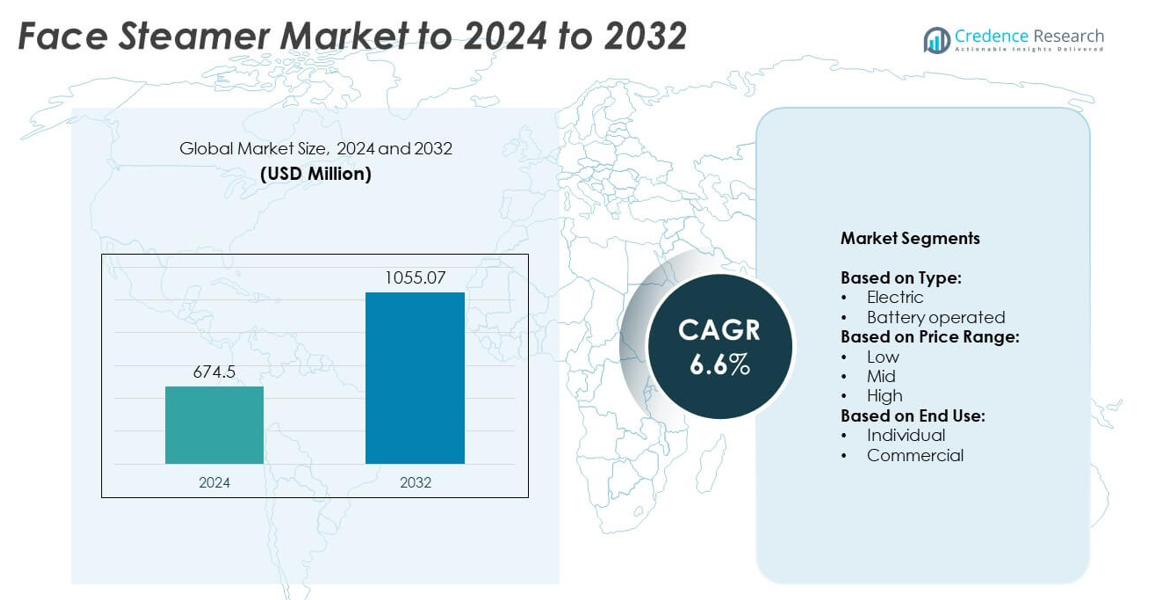
Face Steamer market size was valued at USD 674.5 million in 2024 and is anticipated to reach USD 1055.07 million by 2032, at a CAGR of 6.6% during the forecast period.
| REPORT ATTRIBUTE | DETAILS |
|---|---|
| Historical Period | 2020-2023 |
| Base Year | 2024 |
| Forecast Period | 2025-2032 |
| Face Steamer market Size 2024 | USD 674.5 million |
| Face Steamer market, CAGR | 6.6% |
| Face Steamer market Size 2032 | USD 1055.07 million |
The face steamer market is shaped by key players including Revlon Inc., Panasonic Corporation, Vanity Planet, Zora Cosmetics, LONOVE, PureSkin Devices, Kingdom Beauty, SENNEN, Pure Daily Care, Conair Corporation, and Secura. These companies compete through product innovation, digital marketing, and diverse pricing strategies to appeal to both individual and commercial users. North America led the global market in 2024, holding a 35% share, supported by high consumer awareness, strong salon integration, and robust e-commerce networks. Europe followed with 28% market share, while Asia Pacific accounted for 25%, driven by strong beauty culture and rising disposable incomes.
Market Insights
- The face steamer market size was USD 674.5 million in 2024 and is projected to reach USD 1055.07 million by 2032, growing at a CAGR of 6.6%.
- Rising adoption of at-home skincare devices and increasing awareness of facial treatments are fueling market demand globally.
- Trends such as multifunctional devices with nano-ionic technology and expanding online sales through e-commerce platforms are reshaping consumer preferences.
- The market is highly competitive, with global and regional players focusing on innovation, affordability, and digital marketing strategies to expand customer reach.
- North America led with 35% share in 2024, followed by Europe at 28% and Asia Pacific at 25%, while the electric type segment dominated with over 70% share, and mid-priced devices captured the largest portion of consumer demand.
Market Segmentation Analysis:
By Type
The face steamer market by type is led by the electric segment, which accounted for over 70% share in 2024. Electric steamers dominate due to their convenience, steady steam output, and wider product availability across both retail and online channels. Their popularity is further supported by compact designs and integration of features like adjustable steam levels and quick heat-up times. Battery-operated steamers, while gaining traction for portability, remain niche compared to electric models. Growing consumer demand for effective skincare solutions continues to reinforce the dominance of electric face steamers in global markets.
- For instance, The Panasonic EH-SA31 facial steamer generates nano-sized ionic steam in approximately 2 minutes. It provides a full 6-minute steaming cycle with a full water tank and should be used with the face positioned at least 20 cm (8 inches) away from the nozzle, as recommended in the user manual.
By Price Range
The mid-price range segment held the largest share of the face steamer market in 2024, contributing nearly 50% of revenue. These products strike a balance between affordability and advanced functionality, appealing to both individual users and professionals. Features such as multiple steam settings, compact design, and durability attract a broad customer base. Low-priced steamers capture cost-sensitive buyers, while high-end models target premium skincare users, but the mid-range remains dominant. Rising disposable incomes and preference for reliable, moderately priced devices strengthen this segment’s leadership across key markets.
- For instance, the Vanity Planet Aira facial steamer has an 85 ml water tank and automatically shuts off after 15 minutes or when the tank is empty.
By End Use
The individual segment accounted for more than 65% of the market share in 2024, making it the largest end-use category. Home-use devices dominate as consumers increasingly adopt self-care routines and at-home spa treatments. Easy availability through e-commerce platforms and product affordability drive widespread adoption among individuals. Commercial usage, including beauty salons and wellness centers, represents a steady share, driven by demand for professional skincare services. However, the growing emphasis on personal skincare and convenience ensures that individual users remain the primary growth driver of the face steamer market.
Key Growth Drivers
Rising Adoption of At-Home Skincare Devices
The growing preference for home-based skincare routines is the primary growth driver in the face steamer market. Consumers increasingly seek professional-level treatments without frequent salon visits, boosting demand for easy-to-use steamers. Enhanced awareness of skincare benefits, such as deep cleansing and hydration, further supports adoption. E-commerce platforms offering wide product ranges at competitive prices also expand accessibility. This shift toward do-it-yourself beauty care has made at-home steamers the most influential factor shaping the market’s consistent growth worldwide.
- For instance, Prospera’s DL008 lists a 100 ml tank and 15-minute working time, matching home-use sessions.
Expansion of Beauty and Wellness Industry
The rapid growth of the global beauty and wellness sector significantly drives the face steamer market. Professional salons, spas, and dermatology clinics increasingly incorporate steamers to enhance service quality and customer satisfaction. Rising demand for holistic wellness solutions and skin-rejuvenating treatments creates new opportunities for manufacturers. Marketing campaigns from beauty brands highlight the benefits of facial steaming, further fueling consumer interest. This alignment of wellness trends and skincare device innovation firmly positions beauty industry expansion as a major driver of market growth.
- For instance, some professional Kingsteam facial steamer units have a 650 ml tank and are advertised with a 60-minute timer, which is suitable for salon operations. These units automatically shut off when the water level is low. Other versions of Kingsteam steamers exist with different tank sizes and timer settings
Product Innovation and Technological Advancements
Technological innovation is a key factor accelerating the adoption of face steamers across markets. Manufacturers integrate features such as nano-ionic steam, temperature control, and multifunctional settings, making devices more effective and appealing. Compact, portable designs also cater to modern lifestyles. These advancements differentiate products and enhance consumer satisfaction, directly boosting sales. The continuous push for improved product performance, combined with aesthetic appeal, strengthens brand positioning. Innovation in product design and function remains a critical driver ensuring competitive advantage for leading market players.
Key Trends & Opportunities
Growth of E-Commerce and Digital Marketing
The expansion of online retail platforms has created major opportunities in the face steamer market. E-commerce channels provide wider product visibility, competitive pricing, and doorstep delivery, boosting consumer adoption. Brands leverage digital marketing and influencer partnerships to engage younger demographics and promote skincare routines. Growing smartphone penetration and secure online payment systems further support this trend. With shifting consumer buying behavior toward digital platforms, online sales emerge as a vital trend and opportunity for manufacturers to strengthen global reach and market presence.
- For instance, Project E Beauty sells the Sensa steamer online with a specified 85 ml tank. Different models with different voltages are sold in different regions, such as a 110V version in North America and a 220V version in some other markets.
Rising Demand for Premium and Multifunctional Devices
Consumers are increasingly shifting toward premium skincare solutions, creating new opportunities for advanced steamers. Multifunctional devices that combine steaming with features such as aromatherapy, LED therapy, or humidifying functions attract high-value customers. This demand is driven by greater disposable incomes, growing beauty awareness, and willingness to invest in high-performance skincare tools. Premium products also find strong uptake in professional segments, including spas and wellness centers. The trend toward multifunctionality offers significant opportunities for brands to capture both personal and commercial markets.
- For instance, Beurer’s FS50 offers 2 output levels and a 120 W heater, plus inhalation and aroma attachments.
Key Challenges
High Competition and Price Sensitivity
The face steamer market faces intense competition from both established and emerging brands. Price-sensitive consumers often choose low-cost alternatives, challenging premium and mid-range players to justify value. Local manufacturers, especially in developing regions, further drive down prices, pressuring global companies. Maintaining differentiation through design, performance, and brand image becomes difficult in such an environment. This competitive pressure, combined with consumer cost-consciousness, poses a significant challenge to sustaining profitability and market share for established face steamer companies.
Limited Awareness in Developing Regions
Despite growing popularity in developed markets, the face steamer market struggles with limited awareness in developing economies. Many consumers remain unfamiliar with the benefits of facial steaming or view steamers as non-essential luxury items. Low awareness restricts adoption, particularly in rural areas with limited access to skincare products. Additionally, cultural variations in beauty routines further slow penetration. Overcoming this challenge requires targeted marketing strategies, education campaigns, and affordable product launches to expand reach and establish presence in these underpenetrated regions.
Regional Analysis
North America
North America accounted for the largest share of the face steamer market in 2024, representing around 35%. The region benefits from high consumer awareness about advanced skincare routines and strong spending power on personal care devices. The United States leads adoption, supported by widespread availability of premium products and well-developed e-commerce networks. Professional salons and wellness centers also contribute to regional demand by incorporating steamers into facial treatments. The rising trend of at-home beauty care and active marketing campaigns by leading brands continue to drive the growth of the North American face steamer market.
Europe
Europe held approximately 28% of the global market share in 2024, positioning it as the second-largest region. The strong influence of beauty culture, particularly in countries such as France, Germany, and the United Kingdom, supports adoption. Consumers in this region are highly receptive to premium and multifunctional skincare devices, which boosts demand for advanced steamers. Stringent product safety standards also encourage the sale of high-quality devices. Professional spa and salon services integrate steamers as part of facial care, reinforcing their importance. Growing emphasis on wellness and self-care further drives the European face steamer market.
Asia Pacific
Asia Pacific represented nearly 25% of the face steamer market share in 2024, with China, Japan, and South Korea emerging as key contributors. High interest in skincare routines, fueled by strong cultural emphasis on beauty and wellness, supports widespread adoption. Local manufacturers in countries like China play a major role by offering affordable devices, making steamers accessible to a broad consumer base. Rapid e-commerce growth further strengthens product penetration in the region. Rising disposable incomes and expanding middle-class populations also drive demand, positioning Asia Pacific as one of the fastest-growing markets for face steamers.
Latin America
Latin America captured about 7% of the global market share in 2024, with Brazil and Mexico serving as leading contributors. The region is witnessing rising demand for affordable and mid-range skincare devices as consumers adopt at-home facial care routines. Growing beauty consciousness, particularly among younger populations, fuels market expansion. However, price sensitivity remains high, encouraging the dominance of low-cost devices. Local retailers and online platforms play a crucial role in increasing accessibility. While smaller compared to developed markets, Latin America shows steady growth potential driven by rising awareness of skincare device benefits.
Middle East and Africa
The Middle East and Africa region accounted for nearly 5% of the global face steamer market share in 2024. Growth is supported by rising beauty awareness in urban areas, especially in Gulf countries with strong demand for premium skincare products. Professional salons and spas in regions such as the UAE and Saudi Arabia increasingly integrate facial steamers, driving commercial usage. However, limited awareness in rural areas and lower affordability restrain overall adoption. Expanding retail networks and increasing online availability are gradually improving penetration, providing opportunities for future growth in the Middle East and Africa.
Market Segmentations:
By Type:
- Electric
- Battery operated
By Price Range:
- Low
- Mid
- High
By End Use:
- Individual
- Commercial
By Geography
- North America
- U.S.
- Canada
- Mexico
- Europe
- Germany
- France
- U.K.
- Italy
- Spain
- Rest of Europe
- Asia Pacific
- China
- Japan
- India
- South Korea
- South-east Asia
- Rest of Asia Pacific
- Latin America
- Brazil
- Argentina
- Rest of Latin America
- Middle East & Africa
- GCC Countries
- South Africa
- Rest of the Middle East and Africa
Competitive Landscape
The competitive landscape of the face steamer market is shaped by leading players such as Revlon Inc., Panasonic Corporation, Vanity Planet, Zora Cosmetics, LONOVE, PureSkin Devices, Kingdom Beauty, SENNEN, Pure Daily Care, Conair Corporation, and Secura. These companies compete by offering a wide range of products that cater to both individual and commercial users. The market is driven by innovations in design, including compact and portable models, as well as advanced features like nano-ionic steam and multifunctional capabilities. Strong brand positioning and global distribution networks enhance visibility, while digital marketing and influencer-led promotions expand consumer reach. E-commerce platforms have become a critical growth channel, allowing manufacturers to target diverse customer bases across developed and emerging economies. Pricing strategies also play a major role, as premium models compete with affordable alternatives in a highly fragmented market. Continuous investment in product innovation and consumer engagement remains essential for sustaining competitiveness.
Key Player Analysis
- Revlon Inc.
- Panasonic Corporation
- Vanity Planet
- Zora Cosmetics
- LONOVE
- PureSkin Devices
- Kingdom Beauty
- SENNEN
- Pure Daily Care
- Conair Corporation
- Secura
Recent Developments
- In 2023, Panasonic introduced a new smart facial steamer featuring app connectivity.
- In 2023, PureSkin Devices launched the Eco-Stream Pro, a new steamer made with sustainable materials
- In 2023, Zora cosmetics introduced budget-friendly, easy-to-use facial steamers with features like rapid steam generation and auto shut-off.
Report Coverage
The research report offers an in-depth analysis based on Type, Price Range, End-Use and Geography. It details leading market players, providing an overview of their business, product offerings, investments, revenue streams, and key applications. Additionally, the report includes insights into the competitive environment, SWOT analysis, current market trends, as well as the primary drivers and constraints. Furthermore, it discusses various factors that have driven market expansion in recent years. The report also explores market dynamics, regulatory scenarios, and technological advancements that are shaping the industry. It assesses the impact of external factors and global economic changes on market growth. Lastly, it provides strategic recommendations for new entrants and established companies to navigate the complexities of the market.
Future Outlook
- The face steamer market will continue to grow steadily with rising skincare awareness.
- At-home beauty devices will dominate demand as consumers seek convenient skincare solutions.
- Electric steamers will maintain leadership, while portable models gain gradual traction.
- Premium and multifunctional devices will see faster adoption in developed markets.
- E-commerce will remain a primary sales channel, supported by influencer-driven promotions.
- Individual end users will continue to account for the largest share of market demand.
- Asia Pacific will emerge as the fastest-growing region due to strong beauty culture.
- Technological innovation will focus on nano-ionic steam and multi-use features.
- Commercial usage in spas and salons will expand as wellness trends increase.
- Competitive pricing pressure will push brands to balance affordability with product quality.

Request a Free Sample
Fill in your details and we'll send you a free sample report.
- Sample data tables & charts
- Research methodology
Need a Custom Version of This Report?
Tailor the scope, geography, or segments to your exact requirements.
- Custom geography or segment scope
- Direct access to our analyst team
Frequently Asked Questions
What is the current market size for Face Steamer Market, and what is its projected size in 2032?
At what Compound Annual Growth Rate is the Face Steamer Market projected to grow between 2025 and 2032?
Which Face Steamer Market segment held the largest share in 2024?
What are the primary factors fueling the growth of the Face Steamer Market?
Table of Content
Chapter 1 Market Segmentation
- 1.1 Segmentation Framework
- 1.1.1 Product and Service Classification
- 1.1.2 Application and End-Use Classification
- 1.1.3 Technology and Solution Classification
- 1.1.4 Customer and Distribution Channel Classification
- 1.1.5 Geographic Segmentation
- 1.1.6 Market Segment Definitions and Boundaries
Chapter 2 Introduction
- 2.1 Report Objectives and Scope
- 2.2 Product Definition and Industry Terminology
- 2.3 Market Inclusions and Exclusions
- 2.4 Research Process
- 2.4.1 Primary Research and Expert Interviews
- 2.4.2 Secondary Research and Source Review
- 2.4.3 Top-Down and Bottom-Up Estimation
- 2.4.4 Data Triangulation and Verification
- 2.5 Market Size Measurement Basis
- 2.5.1 2024: USD 674.5 million → 2032: USD 1055.07 million
- 2.6 Historical and Forecast Reference Periods
- 2.6.1 Base Year: 2024
- 2.6.2 Forecast Period: 2024-2032
- 2.7 Research Assumptions and Limitations
Chapter 3 Executive Summary
- 3.1 Market Snapshot and Key Findings
- 3.2 Base-Year Market Size, 2024
- 3.3 Forecast Market Size, 2032
- 3.4 Revenue and Volume Growth Outlook
- 3.5 Key Demand and Supply Indicators
- 3.6 Leading Market Segments
- 3.7 Fastest-Growing Market Opportunities
- 3.8 Regional Performance Highlights
- 3.9 Technology and Industry Transformation
- 3.10 Competitive Landscape Summary
- 3.11 Analyst View and Strategic Implications
Chapter 4 Global Face Steamer Market Trends and Developments
- 4.1 Historical Industry Development
- 4.2 Recent Market Trends and Developments
- 4.3 Demand and Customer Behavior Trends
- 4.4 Technology and Product Innovation
- 4.5 Artificial Intelligence, Automation and Digitalization
- 4.6 Local Manufacturing and Supply Chain Realignment
- 4.7 Industry Partnerships, Mergers and Acquisitions
- 4.8 Sustainability and Circular Economy Developments
- 4.9 Government and Private Sector Investment Trends
- 4.10 Emerging Business Models and Commercialization
- 4.11 Industry Developments and Announcements
Chapter 5 Global Face Steamer Market Production, Supply and Demand Analysis
- 5.1 Demand Trend and Consumption Analysis
- 5.2 Demand Forecast, 2024-2032
- 5.3 Production and Output Trend
- 5.4 Production and Output Forecast, 2024-2032
- 5.5 Installed Capacity and Capacity Utilization
- 5.6 Company-Wise Production Plants and Statistics
- 5.6.1 Installed Production Capacity
- 5.6.2 Actual Production
- 5.6.3 Planned Capacity and Expansion Targets
- 5.7 Supply Chain Structure and Procurement Trends
- 5.8 Supply-Demand Gap and Bottlenecks
- 5.9 Import Dependence and Sourcing Structure
- 5.10 Contract Manufacturing and Outsourcing
- 5.11 Regional Supply and Demand Concentration
Chapter 6 Global Face Steamer Market Pricing Analysis
- 6.1 Pricing Structure and Measurement
- 6.2 Historical Pricing Trends
- 6.3 Pricing Outlook, 2024-2032
- 6.4 Average Selling Price and Unit Economics
- 6.5 Pricing by Product and Market Segment
- 6.6 Geographic Pricing Differences
- 6.7 Key Input, Energy, Labor and Logistics Costs
- 6.8 Contract Pricing and Purchasing Models
- 6.9 Pricing Sensitivity and Competitive Positioning
- 6.10 Price, Margin and Profitability Implications
Chapter 7 Global Face Steamer Market Dynamics
- 7.1 Market Growth Drivers
- 7.1.1 Demand-Side Drivers
- 7.1.2 Technology and Innovation Drivers
- 7.1.3 Infrastructure and Investment Drivers
- 7.1.4 Regulatory and Policy Drivers
- 7.2 Market Restraints
- 7.2.1 Cost and Affordability Constraints
- 7.2.2 Technology and Adoption Barriers
- 7.2.3 Supply Chain and Operational Constraints
- 7.3 Market Challenges
- 7.3.1 Competitive Pressure and Margin Erosion
- 7.3.2 Skills, Infrastructure and Implementation Gaps
- 7.4 Emerging Market Opportunities
- 7.5 Market Dynamics Impact and Time-Horizon Assessment
Chapter 8 Global Face Steamer Value Chain Analysis
- 8.1 Industry Value Chain Overview
- 8.2 Upstream Suppliers and Critical Inputs
- 8.3 Technology and Component Providers
- 8.4 Manufacturing or Service Delivery
- 8.5 Distribution, Channel Partners and Integrators
- 8.6 Downstream Applications and End Users
- 8.7 Value Addition and Profit Pools
- 8.8 Vertical Integration and Outsourcing
- 8.9 Supplier Concentration and Risk
- 8.10 Supply Chain Localization and Resilience
Chapter 9 Global Face Steamer Market Regulations and Policies
- 9.1 Relevant Laws, Standards and Compliance Frameworks
- 9.2 Product, Service, Safety and Quality Requirements
- 9.3 Government Policies, Incentives and Subsidies
- 9.4 Imports, Exports and Trade Barriers
- 9.5 Public Procurement and Local Content Requirements
- 9.6 Environmental and Sustainability Compliance
- 9.7 Upcoming Policy Changes and Market Implications
Chapter 10 Global Face Steamer Market Hotspots and Opportunities
- 10.1 Market Opportunity Mapping and Growth Hotspots
- 10.2 High-Growth Applications and Customer Groups
- 10.3 Underserved Markets and White-Space Opportunities
- 10.4 Emerging Technology and Product Opportunities
- 10.5 New Capacity and Investment Hotspots
- 10.6 Market Entry and Expansion Opportunities
- 10.7 Distribution and Partnership Opportunities
- 10.8 Near-Term and Long-Term Commercial Potential
- 10.9 Opportunity Attractiveness and Execution Risks
Chapter 11 Global Face Steamer Market Outlook, 2024-2032
- 11.1 Market Size and Analysis
- 11.1.1 Revenue (Market Measurement: 2024: USD 674.5 million → 2032: USD 1055.07 million)
- 11.1.2 Market Volume and Quantity Sold
- 11.1.3 Historical Market Size
- 11.1.4 Base-Year Market Size, 2024
- 11.2 Market Forecast, 2024-2032
- 11.2.1 Revenue Forecast to 2032
- 11.2.2 Volume Forecast to 2032
- 11.2.3 CAGR and Year-on-Year Growth
- 11.2.4 Incremental Revenue Opportunity
- 11.3 Forecast Assumptions and Scenario Analysis
- 11.3.1 Base-Case Forecast
- 11.3.2 Optimistic and Conservative Scenarios
- 11.3.3 Technology, Pricing and Policy Sensitivities
- 11.4 Market Attractiveness and Growth Outlook
Chapter 12 Global Face Steamer Market Segmentation and Outlook
- 12.1 Segmentation Summary and Market Shares, 2024
- 12.2 Largest and Fastest-Growing Segments
- 12.3 Segment Growth Comparison
- 12.4 Segment Attractiveness and Priority Matrix
Chapter 13 Global Face Steamer Geographic Market Outlook, 2024-2032
- 13.1 Regional Market Size and Share, 2024
- 13.2 Regional Market Forecast, 2024-2032
- 13.3 Regional Pricing, Production and Demand Differences
- 13.4 North America
- 13.4.1 United States
- 13.4.2 Canada
- 13.4.3 Mexico
- 13.5 Europe
- 13.5.1 Germany
- 13.5.2 France
- 13.5.3 Italy
- 13.5.4 United Kingdom
- 13.5.5 Spain
- 13.5.6 Poland
- 13.5.7 Russia
- 13.5.8 Netherlands
- 13.5.9 Belgium
- 13.5.10 Sweden
- 13.5.11 Denmark
- 13.5.12 Norway
- 13.5.13 Rest of Europe
- 13.6 Asia Pacific
- 13.6.1 China
- 13.6.2 India
- 13.6.3 Japan
- 13.6.4 South Korea
- 13.6.5 Thailand
- 13.6.6 Indonesia
- 13.6.7 Vietnam
- 13.6.8 Malaysia
- 13.6.9 Australia
- 13.6.10 Rest of Asia Pacific
- 13.7 Latin America
- 13.7.1 Brazil
- 13.7.2 Argentina
- 13.7.3 Colombia
- 13.7.4 Chile
- 13.7.5 Rest of Latin America
- 13.8 Middle East
- 13.8.1 Saudi Arabia
- 13.8.2 United Arab Emirates
- 13.8.3 Turkey
- 13.8.4 Israel
- 13.8.5 Iran
- 13.8.6 Rest of the Middle East
- 13.9 Africa
- 13.9.1 South Africa
- 13.9.2 Egypt
- 13.9.3 Nigeria
- 13.9.4 Morocco
- 13.9.5 Rest of Africa
- 13.10 Regional Investment, Policy and Supply Chain Differences
- 13.11 Regional Competitive Landscape
- 13.12 Geographic Growth Hotspots
Chapter 14 Global Face Steamer Technology, Innovation and Sustainability Outlook
- 14.1 Technology Landscape and Maturity
- 14.2 Product, Process and Service Innovation
- 14.3 AI, Automation and Digital Tools in the Industry
- 14.4 Technology Adoption and Performance Benchmarking
- 14.5 Innovation Pipeline and R&D Investment
- 14.6 Patent and Intellectual Property Trends
- 14.7 Energy Efficiency and Resource Management
- 14.8 Sustainability, Recycling and Circularity
- 14.9 Technology Roadmap, 2024-2032
- 14.10 Risks of Obsolescence and Technology Substitution
Chapter 15 Global Face Steamer Market Key Strategic Imperatives
- 15.1 Growth and Market Entry Priorities
- 15.2 High-Return Products and Segments
- 15.3 Pricing, Profitability and Cost Optimization
- 15.4 Technology Investment and Product Differentiation
- 15.5 Supply Chain Localization and Resilience
- 15.6 Distribution and Customer Acquisition
- 15.7 Partnership, Acquisition and Capacity Strategy
- 15.8 Regional Expansion Priorities
- 15.9 Short-, Medium- and Long-Term Actions
Chapter 16 Competition Outlook
- 16.1 Industry Competition Characteristics
- 16.2 Market Structure and Concentration
- 16.3 Market Share and Competitive Positioning, 2024
- 16.4 Company-Wise Revenue and Product Benchmarking
- 16.5 Production and Service Capacity Benchmarking
- 16.6 Technology, Pricing and Differentiation
- 16.7 Regional Footprint and Distribution Strength
- 16.8 Mergers, Acquisitions and Strategic Alliances
- 16.9 New Entrants and Competitive Threats
- 16.10 Porter's Five Forces and Industry Attractiveness
- 16.11 Competitive Outlook, 2024-2032
Chapter 17 Company Profiles
- 17.1 Company Coverage and Selection Criteria
- 17.2 Leading Market Participants – Standard Profile Structure
- 17.2.1 Business Description
- 17.2.2 Company Ownership and Geographic Presence
- 17.2.3 Product and Service Portfolio
- 17.2.4 Manufacturing and Operating Footprint
- 17.2.5 Production Capacity and Expansion Plans
- 17.2.6 Financial Performance and Investment
- 17.2.7 Market Share and Competitive Position
- 17.2.8 Technology and Innovation Capabilities
- 17.2.9 Strategic Alliances or Partnerships
- 17.2.10 Recent Developments
- 17.2.11 Growth Strategy and Outlook
- 17.3 Other Relevant Market Participants
Note: Every listed company is profiled on the structure shown under the first company. The company list is preliminary and may change based on research findings, market developments, data availability and client requirements.
Chapter 18 Disclaimer
- 18.1 Research and Forecast Disclaimer
- 18.2 Data Source and Estimation Limitations
Note: The depth of individual sections depends on data availability for this market. Volume, capacity, trade and other unit-based metrics are included where applicable.

