
Forklift Market Overview:
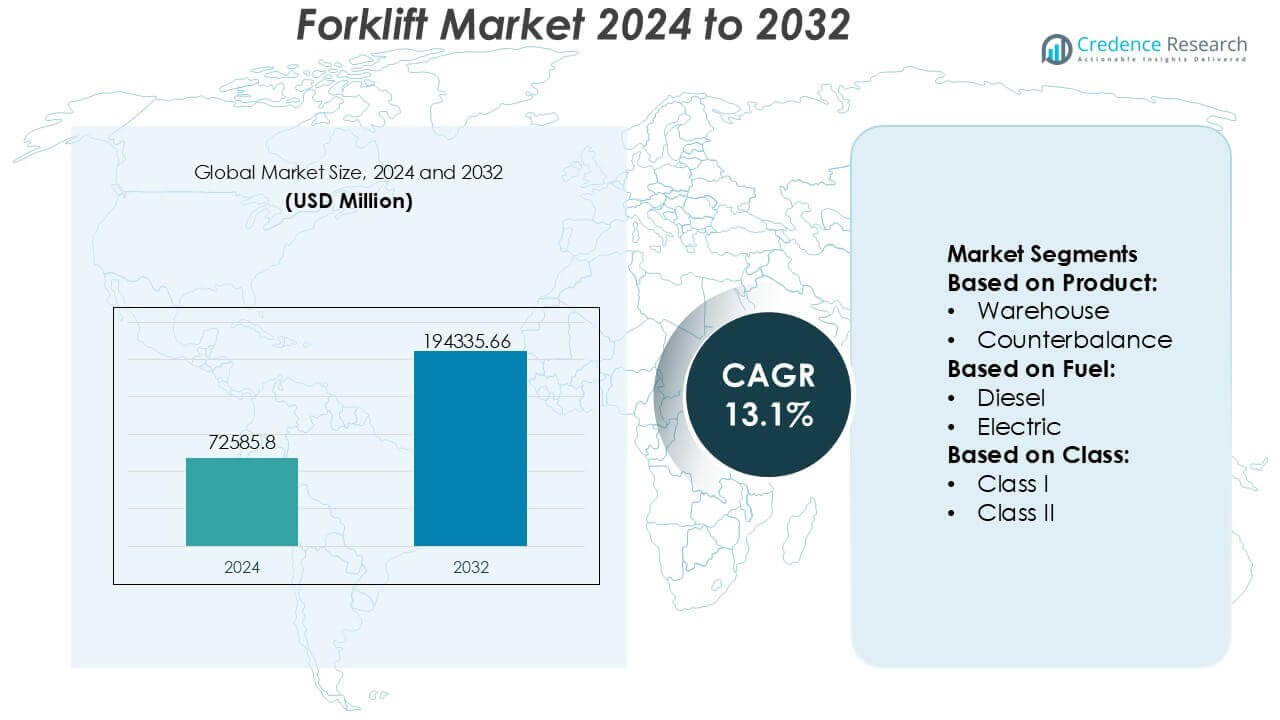
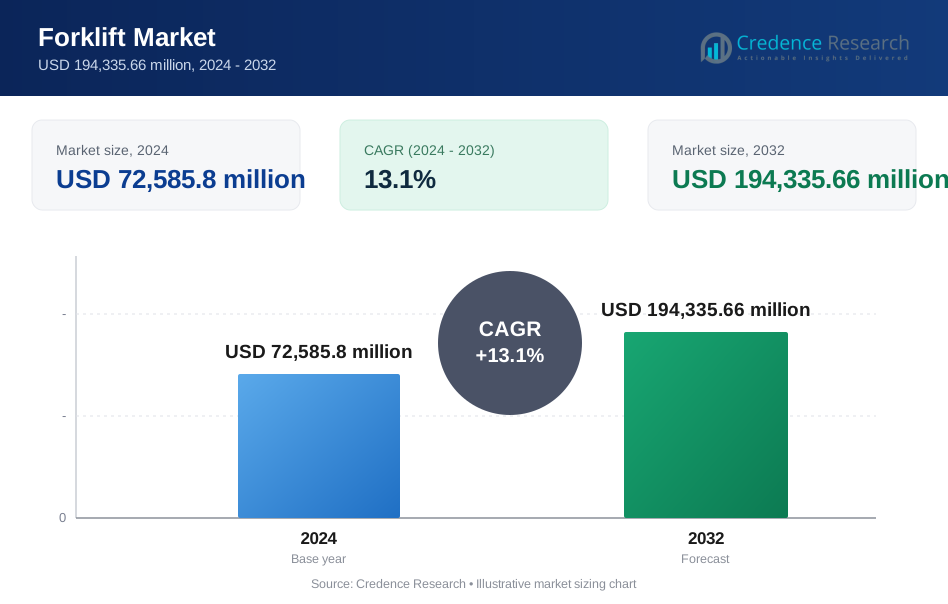
Forklift Market size was valued USD 72585.8 million in 2024 and is anticipated to reach USD 194335.66 million by 2032, at a CAGR of 13.1% during the forecast period.
| REPORT ATTRIBUTE | DETAILS |
|---|---|
| Historical Period | 2020-2023 |
| Base Year | 2024 |
| Forecast Period | 2025-2032 |
| Forklift Market Size 2024 | USD 72585.8 million |
| Forklift Market, CAGR | 13.1% |
| Forklift Market Size 2032 | USD 194335.66 million |
Forklift Market Insights
- Market growth is primarily driven by rapid expansion of e-commerce, increasing warehouse construction, and rising adoption of material-handling automation to improve productivity and reduce labor dependency.
- Electrification represents a key market trend, with electric forklifts holding the leading segment share due to lower emissions, reduced operating costs, and growing use of lithium-ion battery systems.
- The competitive landscape remains moderately consolidated, with leading players differentiating through advanced telematics, automation-ready designs, strong service networks, and long-term fleet management solutions.
- Asia-Pacific leads the global forklift market with an exact 38% market share, supported by large-scale manufacturing, high replacement demand, and cost-efficient production across China, Japan, and Southeast Asia.
Forklift Market Segmentation Analysis:
By Product
The forklift market by product is primarily segmented into warehouse forklifts and counterbalance forklifts. Counterbalance forklifts represent the dominant sub-segment, accounting for around 60% market share, driven by their versatility across indoor and outdoor operations and ability to handle diverse load types without additional stabilizing equipment. These forklifts are widely adopted in manufacturing, ports, construction sites, and large warehouses. Meanwhile, warehouse forklifts are gaining traction due to rapid expansion of e-commerce and organized retail, where narrow-aisle operations, high stacking efficiency, and maneuverability in confined spaces are critical operational requirements.
- For instance, Crown Equipment Corporation manufactures electric counterbalance forklifts in its SC and FC Series with rated load capacities up to 4,000 kg and travel speeds reaching 18 km/h, supported by Crown’s proprietary AC traction and hydraulic motor technology designed for thermal stability and consistent torque output.
By Fuel
By fuel type, the market is divided into diesel, electric, and gasoline & LPG/CNG forklifts. Electric forklifts dominate this segment with an estimated 55% market share, supported by strict emission regulations, lower operating costs, and increasing adoption in indoor and food-grade environments. Advances in lithium-ion battery technology have improved charging times and equipment uptime, accelerating replacement of internal combustion models. Diesel forklifts maintain relevance in heavy-duty outdoor applications due to high torque and durability, while gasoline and LPG/CNG forklifts serve mixed-use operations requiring flexibility across indoor and outdoor settings.
- For instance, Hangcha Forklift has commercialized lithium-ion electric forklifts equipped with 80 V battery systems offering capacities up to 412 Ah, enabling continuous operation cycles with full-charge times of approximately 1.5 hours using high-power integrated chargers documented in Hangcha’s product specifications.
By Class
The forklift market by class includes Class I through Class V and others, with Class III forklifts holding the leading position at approximately 35% market share. This dominance is driven by extensive use of electric motor hand trucks and pallet jacks in warehouses, distribution centers, and retail backrooms for short-distance material movement. Class I forklifts are increasingly used in indoor electric counterbalance applications, while Class IV and V forklifts support internal combustion needs in heavy manufacturing and logistics yards. Growing warehouse automation continues to reinforce demand for lower-capacity, high-frequency handling classes.
Key Growth Drivers
- Expansion of Warehousing and Logistics Infrastructure
Rapid growth in e-commerce, organized retail, and third-party logistics is driving sustained investment in modern warehousing infrastructure. Distribution centers increasingly prioritize high-throughput material handling to manage rising SKU complexity and faster order fulfillment cycles. Forklifts play a central role in pallet movement, racking operations, and cross-docking activities. The shift toward large, automated warehouses further accelerates forklift demand, as operators seek reliable equipment compatible with warehouse management systems and optimized aisle layouts to improve space utilization and operational efficiency.
- For instance, Jungheinrich 2500 ETV325 exemplifies Jungheinrich’s recent advancements in reach truck technology, featuring a lithium-ion battery option available in capacities of 230 Ah and 460 Ah, enabling operators to complete extended shifts with rapid intermediate charging capabilities and reduced downtime, as detailed in Jungheinrich’s product release.
- Industrialization and Manufacturing Output Growth
Rising manufacturing activity across automotive, food & beverage, chemicals, and construction materials continues to support forklift adoption. Production facilities require efficient internal logistics to handle raw materials, work-in-process inventory, and finished goods with minimal downtime. Forklifts enhance plant productivity by reducing manual handling, improving load safety, and enabling just-in-time material flow. Emerging economies, in particular, benefit from new factory setups and industrial parks, where forklifts are integral to streamlining shop-floor operations and supporting scalable production volumes.
- For instance, Clark Material Handling Company has advanced its forklift technology across multiple product lines with verifiable performance specifications directly from official sources. Clark’s Crossover Electric Raider models (L25XE / L30XE / L35XE) integrate modern lithium-ion battery systems with capacities of up to 460 Ah and deliver rated load capabilities up to 3,500 kg with maximum lift heights reaching 7,315 mm.
- Increasing Emphasis on Workplace Safety and Productivity
Stricter occupational safety regulations and growing awareness of worker well-being are encouraging companies to replace manual material handling with mechanized solutions. Forklifts help reduce injury risks associated with heavy lifting while improving handling precision and consistency. Modern forklifts equipped with stability controls, operator assistance features, and ergonomic designs further enhance productivity per shift. As labor costs rise globally, businesses increasingly view forklifts as productivity-enhancing assets that deliver measurable efficiency gains and lower long-term operational risks.
Key Trends & Opportunities
- Rising Adoption of Electric and Low-Emission Forklifts
Sustainability goals and indoor air-quality requirements are accelerating the shift toward electric forklifts. Battery-powered models offer lower operating noise, zero tailpipe emissions, and reduced maintenance compared to internal combustion alternatives. Advances in lithium-ion batteries enable faster charging, opportunity charging, and longer operating hours, improving fleet utilization. This transition creates opportunities for manufacturers to offer energy-efficient models, battery-management systems, and charging infrastructure tailored to warehouse and cold-storage environments.
- For instance, Mitsubishi Logisnext also recently expanded its electric cushion truck lineup with the FBC20Q–FBC40Q Series, supporting lift capacities of 4,000 lb to 8,000 lb and lift heights up to 312 inches (7,925 mm), while offering a 100° turning radius engineered for tight-aisle maneuverability and high-density storage scenarios.
- Integration of Automation and Smart Technologies
Forklift design is increasingly aligned with digital transformation initiatives in material handling. Telematics, fleet management software, and sensor-based monitoring enable real-time tracking of equipment usage, maintenance needs, and operator behavior. Semi-autonomous and autonomous forklifts are gaining traction in high-volume warehouses, reducing dependency on manual labor. This trend opens opportunities for technology-driven differentiation, value-added services, and long-term service contracts focused on predictive maintenance and data-driven optimization.
- For instance, Anhui Heli Co., Ltd. has documented several recent technical advancements in its forklift portfolio with specific performance metrics drawn from official product sources. Heli’s G3 series 4–5 t electric counterbalanced forklifts are engineered with lithium-ion battery systems supporting fast operation cycles and feature standard mast lifting heights of 3,000 mm with load centers at 500 mm, showcasing optimized power delivery and compact design suited for heavy lift tasks.
- Growth in Rental and Leasing Models
Many end users are shifting from outright forklift purchases to rental and leasing arrangements to improve capital efficiency. Short-term projects, seasonal demand fluctuations, and uncertain economic conditions favor flexible access to equipment. Rental fleets allow users to adopt newer technologies without large upfront investments. This trend creates opportunities for manufacturers and dealers to expand rental portfolios, refurbishment services, and lifecycle management offerings that generate recurring revenue streams.
Key Challenges
- High Initial Investment and Total Cost of Ownership
Forklifts represent a significant capital investment, particularly for small and medium-sized enterprises. Beyond purchase costs, expenses related to batteries, charging infrastructure, spare parts, and skilled maintenance add to the total cost of ownership. Advanced electric and automated forklifts further increase upfront expenditure. Cost sensitivity in emerging markets can delay replacement cycles and limit adoption of advanced models, posing a challenge for suppliers seeking to balance innovation with affordability.
- Operator Skill Gaps and Safety Compliance
Effective forklift operation requires trained and certified operators, yet skill shortages remain a concern in many regions. Improper use increases accident risks, equipment damage, and downtime. Continuous training, certification, and compliance with evolving safety standards add operational complexity for end users. For manufacturers and fleet owners, ensuring consistent operator competence and adherence to safety protocols remains a critical challenge that directly impacts productivity and liability exposure.
Regional Analysis
North America
North America accounts for approximately 26% of the global forklift market, driven by strong demand from warehousing, logistics, and manufacturing industries. High penetration of organized retail and advanced e-commerce fulfillment centers sustains consistent equipment replacement and fleet upgrades. The region shows strong adoption of electric forklifts due to stringent emission norms and indoor-use requirements. Investments in automation, telematics, and operator safety technologies further support demand. Additionally, a mature rental and leasing ecosystem enables flexible fleet management, reinforcing steady forklift utilization across distribution centers and industrial facilities.
Europe
Europe holds nearly 24% of the global forklift market, supported by advanced manufacturing bases in automotive, food processing, and industrial goods. Strict environmental regulations accelerate the shift toward electric and energy-efficient forklifts, particularly in Western Europe. Warehouse automation, narrow-aisle storage systems, and high-density logistics hubs drive demand for specialized forklifts. Eastern Europe contributes incremental growth through expanding industrial production and logistics infrastructure. The region also benefits from strong aftermarket services, refurbishment programs, and long equipment lifecycles, ensuring stable replacement demand across both developed and emerging European economies.
Asia-Pacific
Asia-Pacific dominates the forklift market with an estimated 38% share, led by rapid industrialization, infrastructure development, and expanding e-commerce activity. China, Japan, South Korea, and India represent major demand centers, supported by manufacturing expansion and large-scale warehouse construction. The region experiences rising adoption of electric forklifts alongside cost-effective internal combustion models in heavy industries. Government-led industrial initiatives and foreign direct investment continue to stimulate factory and logistics development. High-volume production facilities and growing third-party logistics networks make Asia-Pacific the fastest-growing and most dynamic regional market.
Latin America
Latin America represents around 7% of the global forklift market, supported by gradual improvements in manufacturing output, port infrastructure, and retail logistics. Brazil and Mexico lead regional demand due to automotive production, food & beverage processing, and export-oriented warehouses. Forklift adoption is driven by modernization of material handling practices and increasing safety awareness. However, cost sensitivity and economic volatility influence purchasing decisions, favoring refurbished and rental equipment. As logistics networks expand and regional trade improves, forklift penetration is expected to rise steadily across key industrial corridors.
Middle East & Africa
The Middle East & Africa accounts for approximately 5% of the forklift market, driven by infrastructure development, construction activity, and logistics expansion. Gulf countries lead demand through investments in ports, free trade zones, and large distribution hubs. Forklifts support material handling in construction, oil & gas support facilities, and retail warehousing. In Africa, growth is supported by gradual industrialization and improving supply-chain infrastructure. While adoption remains moderate, increasing foreign investment and warehouse modernization initiatives are expected to enhance forklift utilization across the region.
Forklift Market Segmentations:
By Product:
- Warehouse
- Counterbalance
By Fuel:
- Diesel
- Electric
By Class:
- Class I
- Class II
By Geography
- North America
- U.S.
- Canada
- Mexico
- Europe
- Germany
- France
- U.K.
- Italy
- Spain
- Rest of Europe
- Asia Pacific
- China
- Japan
- India
- South Korea
- South-east Asia
- Rest of Asia Pacific
- Latin America
- Brazil
- Argentina
- Rest of Latin America
- Middle East & Africa
- GCC Countries
- South Africa
- Rest of the Middle East and Africa
Competitive Landscape
The forklift market players such as Komatsu Ltd., Crown Equipment Corporation, Hangcha Forklift, Jungheinrich AG, Clark Material Handling Company, Mitsubishi Logisnext Co., Ltd., Anhui Heli Co., Ltd., Hyster-Yale Materials Handling, Inc., KION Group AG, Doosan Corporation. The forklift market features a competitive and moderately consolidated landscape shaped by continuous product innovation, global manufacturing scale, and strong aftermarket capabilities. Market participants compete across electric, internal combustion, and warehouse equipment categories, with growing emphasis on energy efficiency, operator safety, and lifecycle cost optimization. Electrification remains a core competitive lever, supported by advances in lithium-ion batteries, fast-charging systems, and energy-management software that reduce downtime and emissions. Digital differentiation is strengthening through telematics, fleet analytics, and predictive maintenance platforms that improve asset utilization for logistics, manufacturing, and distribution customers. Regional strategies vary, with cost-efficient production and volume leadership driving competitiveness in Asia-Pacific, while technology depth, automation readiness, and service quality underpin positioning in Europe and North America. Ongoing investments in automation compatibility, modular product platforms, and service network expansion continue to redefine competitive strength, as suppliers align portfolios with evolving warehouse automation and sustainability requirements.
Key Player Analysis
- Komatsu Ltd.
- Crown Equipment Corporation
- Hangcha Forklift
- Jungheinrich AG
- Clark Material Handling Company
- Mitsubishi Logisnext Co., Ltd.
- Anhui Heli Co., Ltd.
- Hyster-Yale Materials Handling, Inc.
- KION Group AG
- Doosan Corporation
Recent Developments
- In November 2025, Bobcat launched the B16-20-NT series, their first 3-wheel electric forklifts using advanced lithium-ion (Li-ion) technology, with models B16NT, B18NT, and B20NT, targeting light to medium-duty warehouse and logistics tasks with enhanced maneuverability, efficiency, and operator comfort, alongside introducing their own Li-ion battery packs for their electric range.
- In January 2025, Clark expanded its S-Series Electric line with new 3- and 4-wheel models (STE and SE series), which are replacing the older GTX and GEX series in the 48-volt segment.
- In November 2024, Linde launched the new generation of electric forklifts, the Linde 1251 series, replacing the popular 386 series with 26 models (3 & 4-wheel, 1.0-2.0t lift) featuring enhanced material design, improved ergonomics, advanced safety, better maneuverability, and optional lithium-ion batteries, aiming to set new standards in internal logistics.
Report Coverage
The research report offers an in-depth analysis based on Product, Fuel, Class and Geography. It details leading market players, providing an overview of their business, product offerings, investments, revenue streams, and key applications. Additionally, the report includes insights into the competitive environment, SWOT analysis, current market trends, as well as the primary drivers and constraints. Furthermore, it discusses various factors that have driven market expansion in recent years. The report also explores market dynamics, regulatory scenarios, and technological advancements that are shaping the industry. It assesses the impact of external factors and global economic changes on market growth. Lastly, it provides strategic recommendations for new entrants and established companies to navigate the complexities of the market.
Future Outlook
- Electric forklifts will gain stronger adoption as companies prioritize lower emissions, reduced operating noise, and improved energy efficiency across warehouses and factories.
- Lithium-ion battery technology will increasingly replace lead-acid systems due to faster charging, longer cycle life, and minimal maintenance requirements.
- Integration of telematics and connected fleet management platforms will expand, enabling real-time monitoring, predictive maintenance, and improved asset utilization.
- Demand for automated and semi-autonomous forklifts will rise as logistics operators address labor shortages and pursue higher throughput.
- Warehouse optimization and e-commerce growth will continue to drive demand for compact, high-maneuverability forklifts in dense storage environments.
- Manufacturers will focus on modular product platforms to accelerate customization and reduce development and production lead times.
- Safety innovations such as advanced sensors, collision-avoidance systems, and operator assistance features will become standard across mid-range models.
- Aftermarket services, including maintenance contracts, digital diagnostics, and parts management, will play a larger role in long-term revenue generation.
- Emerging markets will see increased forklift penetration supported by industrialization, infrastructure investment, and expansion of organized logistics.
- Sustainability regulations and corporate ESG commitments will push continuous improvements in energy efficiency, recyclability, and lifecycle management.
Request a Free Sample
Fill in your details and we'll send you a free sample report.
- Sample data tables & charts
- Research methodology
Need a Custom Version of This Report?
Tailor the scope, geography, or segments to your exact requirements.
- Custom geography or segment scope
- Direct access to our analyst team
Frequently Asked Questions
What is the current market size for the Forklift Market, and what is its projected size in 2032?
At what Compound Annual Growth Rate is the Forklift Market projected to grow between 2024 and 2032?
Which Forklift Market segment held the largest share in 2024?
What are the primary factors fueling the growth of the Forklift Market?
Who are the leading companies in the Forklift Market?
Which region commanded the largest share of the Forklift Market in 2024?
Table of Content
Chapter 1. Report Introduction
- 1.1 Report Description & Purpose
- 1.1.1 Report Title & Market Definition
- 1.1.2 Unique Selling Propositions (USP) & Key Differentiators
- 1.1.3 Value Proposition for Stakeholders
- 1.2 Research Objectives
- 1.2.1 Market Sizing Objectives (Volume & Revenue)
- 1.2.2 Segmentation Objectives
- 1.2.3 Competitive Intelligence Objectives
- 1.2.4 Forecast & Scenario Objectives
- 1.3 Report Scope
- 1.3.1 Forklift Scope – Types & Subtypes Covered
- 1.3.2 Geographic Scope – Regions & Countries Covered
- 1.3.3 Historical Period, Base Year & Forecast Period (2024; forecast to 2032)
- 1.3.4 Inclusions & Exclusions
- 1.4 HS Code & Classification Framework
- 1.5 Currency, Units & Pricing Basis
- 1.6 Target Stakeholders
- 1.7 Limitations & Assumptions
Chapter 2. Executive Summary
- 2.1 Global Forklift Market Snapshot
- 2.1.1 Market Size – Historical (2024) & Forecast (2024-2032) (2024: USD 72,585.8 million → 2032: USD 194,335.66 million)
- 2.1.2 Volume & Revenue – Global Totals
- 2.1.3 Key Market Highlights – Top Five Facts
- 2.2 Forklift Market Segmentation Snapshot
- 2.2.1 Market Split by Region – 2024 vs. 2032
- 2.3 Competitive Snapshot
- 2.3.1 Top 10 Players by Revenue Share – 2024
- 2.3.2 Top 10 Players by Volume Share – 2024
- 2.3.3 Recent Strategic Developments (18-Month Summary)
- 2.4 Key Investment Highlights & Strategic Conclusions
Chapter 3. Forklift Market Dynamics & Industry Analysis
- 3.1 Market Overview & Context
- 3.1.1 Forklift Market Position in the Broader Automotive Value Chain
- 3.1.2 OEM vs. Replacement Market Dynamics
- 3.1.3 Market Maturity & Development Stage by Region
- 3.2 Forklift Market Drivers
- 3.3 Forklift Market Restraints & Challenges
- 3.4 Forklift Market Opportunities
- 3.5 Porter's Five Forces Analysis
- 3.5.1 Threat of New Entrants
- 3.5.2 Bargaining Power of Suppliers
- 3.5.3 Bargaining Power of Buyers
- 3.5.4 Threat of Substitutes
- 3.5.5 Competitive Rivalry – Intensity Assessment
- 3.6 Forklift Value Chain Analysis
- 3.6.1 Upstream – Raw Material/Input Suppliers
- 3.6.1.1 Raw Material/Input 1
- 3.6.1.2 Raw Material/Input 2
- 3.6.1.3 Raw Material/Input 3
- 3.6.2 Midstream – Production/Manufacturing/Service Delivery
- 3.6.2.1 Production/Process Overview
- 3.6.2.2 Key Facility Locations & Capacity by Manufacturer
- 3.6.3 Downstream – Distribution & End Consumer
- 3.6.3.1 Primary Channel – B2B/OEM
- 3.6.3.2 Secondary Channels – Dealer, Retail, Online, Direct
- 3.6.4 Value Chain Profitability Analysis
- 3.6.1 Upstream – Raw Material/Input Suppliers
- 3.7 PESTEL Analysis
- 3.7.1 Political Factors
- 3.7.2 Economic Factors
- 3.7.3 Social Factors
- 3.7.4 Technological Factors
- 3.7.5 Environmental Factors
- 3.7.6 Legal Factors
- 3.8 Forklift Supply Chain Analysis
- 3.8.1 Raw Material/Input Supply Risk Assessment
- 3.8.2 Manufacturing Concentration Risk (Geographic Exposure)
- 3.8.3 Trade Disruption Impact Analysis
- 3.9 Regulatory & Policy Landscape
Note: The regulatory and policy landscape section covers regulations based on their applicability to the market, Forklift category, geography, and scope of the study. Only regulatory frameworks with a material impact on operations, compliance, trade, sustainability, or market access are analyzed in detail.
Chapter 4. Key Investment Pockets & Opportunity Analysis
- 4.1 Forklift Market Attractiveness Analysis
- 4.1.1 By Region – Investment Attractiveness Matrix (Volume × CAGR)
- 4.2 Absolute Revenue Growth Opportunity
- 4.2.1 By Region – Absolute USD Growth Through 2032
- 4.3 Incremental Volume Opportunity
- 4.3.1 By Region – Incremental Volume Through 2032
- 4.3.2 Segment – Incremental Volume
- 4.4 Emerging Submarket Opportunity Deep Dive (Subject to Applicability)
- 4.5 Emerging Market Opportunity Scorecards
- 4.5.1 United States
- 4.5.2 Europe
- 4.5.3 Asia
- 4.5.4 Middle East & Africa
Note: Emerging Market Opportunity Scorecards will be included based on relevance and strategic importance. Regions listed are indicative and may vary depending on data availability and market dynamics.
Chapter 5. Forklift Import-Export Analysis & Trade Flows
- 5.1 Global Trade Overview
- 5.1.1 Global Export Value by Country (2024)
- 5.1.2 Global Export Volume by Country (2024)
- 5.1.3 Global Import Value by Country (2024)
- 5.1.4 Global Import Volume by Country (2024)
- 5.1.5 Net Trade Balance by Country (2024)
- 5.2 Export Analysis – Segment
- 5.2.1 Type 1 (HS Code)
- 5.2.2 Type 2 (HS Code)
- 5.2.3 Type 3 (HS Code)
- 5.2.4 Type 4 (HS Code)
- 5.2.5 Type 5 (HS Code)
- 5.3 Import Analysis – Segment
- 5.3.1 Type 1 (HS Code)
- 5.3.2 Type 2 (HS Code)
- 5.3.3 Type 3 (HS Code)
- 5.3.4 Type 4 (HS Code)
- 5.3.5 Type 5 (HS Code)
- 5.4 Average Unit Trade Prices
- 5.4.1 Average Export Price – Segment & Country
- 5.4.2 Average Import Price – Segment & Source Country
- 5.4.3 Price Trends (2024)
- 5.5 Key Trade Route Analysis
- 5.5.1 Trade Route 1
- 5.5.2 Trade Route 2
- 5.5.3 Trade Route 3
- 5.5.4 Trade Route 4
- 5.5.5 Trade Route 5
- 5.6 Trade Policy Impact Assessment
- 5.6.1 US Anti-Dumping & Section 301 Tariffs
- 5.6.2 EU Customs Union Impact
- 5.6.3 Major Free Trade Agreements
- 5.6.4 USMCA Rules of Origin
Note: Trade policy analysis will be included only where relevant to the Forklift market.
Chapter 6. Competitive Landscape & Company Benchmarking
- 6.1 Forklift Market Concentration & Structure
- 6.1.1 Herfindahl-Hirschman Index (HHI) – vs. 2024
- 6.1.2 Tier 1, Tier 2 & Tier 3 Market Structure
- 6.1.3 Global, Regional & Local Player Dynamics
- 6.2 Forklift Market Share Analysis – 2024
- 6.2.1 Global Revenue Share by Company
- 6.2.2 Global Volume Share by Company
- 6.2.3 Regional Revenue Share
- 6.2.4 Market Share Evolution ( vs. 2024)
- 6.2.5 OEM Segment Share by Company
- 6.2.6 Replacement Segment Share by Company
- 6.3 Production/Delivery Capacity & Facility Analysis
- 6.3.1 Global Installed Capacity
- 6.3.2 Capacity Utilization Rates
- 6.3.3 Production/Output Volume
- 6.3.4 Facility Locations & Capacity Map
- 6.3.5 Planned Capacity Additions
- 6.4 Forklift Competitive Benchmarking Matrix
- 6.4.1 Revenue, Volume, CAGR & Profitability Comparison
- 6.4.2 Channel Revenue Mix
- 6.4.3 Geographic Revenue Exposure
- 6.4.4 R&D Intensity
- 6.4.5 Sustainability Maturity
- 6.5 Strategic Developments in Forklift (Last 24 Months)
- 6.5.1 Mergers, Acquisitions & Divestments
- 6.5.2 New Forklift Launches
- 6.5.3 Facility Expansions
- 6.5.4 Strategic Alliances, Joint Ventures & Partnerships
- 6.5.5 Distribution Expansion & Market Entry
- 6.5.6 Sustainability & ESG Initiatives
- 6.6 Competitive Strategy Mapping
- 6.6.1 Leader, Challenger, Follower & Niche Classification
- 6.6.2 Pricing Strategy Comparison
- 6.6.3 Channel Strategy Matrix
Note: Strategic developments are included based on their materiality and the availability of reliable information.
Chapter 7. Global Forklift Market – By Distribution Channel
- 7.1 Segment Overview
- 7.1.1 Volume & Revenue Split by Channel (2024 & 2032)
- 7.1.2 Channel Mix Evolution (2024-2032)
Chapter 8. Regional Market Analysis – Global Overview
- 8.1 Global Regional Overview
- 8.1.1 Regional Volume Share
- 8.1.2 Regional Revenue Share
- 8.1.3 Regional Volume by Region
- 8.1.4 Regional Revenue by Region
- 8.1.5 Regional Forecast Through 2032
- 8.2 Cross-Regional Segment Analysis
- 8.2.1 By Distribution Channel
- 8.2.2 By Brand/Price Tier
Chapter 9. North America Forklift Market
- 9.1 United States
- 9.2 Canada
- 9.3 Mexico
Chapter 10. Europe Forklift Market
- 10.1 Germany
- 10.2 France
- 10.3 Italy
- 10.4 United Kingdom
- 10.5 Spain
- 10.6 Poland
- 10.7 Russia
- 10.8 Netherlands
- 10.9 Belgium
- 10.10 Sweden
- 10.11 Denmark
- 10.12 Norway
- 10.13 Rest of Europe
Chapter 11. Asia Pacific Forklift Market
- 11.1 China
- 11.2 India
- 11.3 Japan
- 11.4 South Korea
- 11.5 Thailand
- 11.6 Indonesia
- 11.7 Vietnam
- 11.8 Malaysia
- 11.9 Australia
- 11.10 Rest of Asia Pacific
Chapter 12. Latin America Forklift Market
- 12.1 Brazil
- 12.2 Argentina
- 12.3 Colombia
- 12.4 Chile
- 12.5 Rest of Latin America
Chapter 13. Middle East Forklift Market
- 13.1 Saudi Arabia
- 13.2 United Arab Emirates
- 13.3 Turkey
- 13.4 Israel
- 13.5 Iran
- 13.6 Rest of the Middle East
Chapter 14. Africa Forklift Market
- 14.1 South Africa
- 14.2 Egypt
- 14.3 Nigeria
- 14.4 Morocco
- 14.5 Rest of Africa
Chapter 15. Forklift Company Profiles
- 15.1 [Company 01]
- 15.1.1 Company Overview
- 15.1.2 Key Management Personnel
- 15.1.3 Products & Services Portfolio
- 15.1.4 Financial Performance
- 15.1.5 Key Market Focus & Geographic Presence
- 15.1.6 Recent Developments & Strategic Initiatives
Note: The company profile list is preliminary and may change based on research findings, market developments, data availability, and client requirements.
Chapter 16. Appendices
- Appendix A – List of Abbreviations & Acronyms
- Appendix B – Industry Classification Code Reference – Full Series
- Appendix C – Production & Capacity Data Tables
- Appendix D – End-Use & Demand Base Tables
- Appendix E – Consumption & Replacement Rate Assumptions
- Appendix F – ASP Reference Tables
- Appendix G – Manufacturing & Facility Database
- Appendix H – Import-Export Data Tables
- Appendix I – Regulatory Summary Tables
- Appendix J – Primary Research Participant List (Anonymized)
- Appendix K – Primary Research Questionnaire Framework
- Appendix L – Data Sources & Bibliography
- Appendix M – Market Size Divergence & Source Comparison
Chapter 17. Research Methodology
- 17.1 Research Framework & Philosophy
- 17.2 Secondary Research – Sources, Hierarchy & Data Extraction
- 17.3 Data Modeling – Bottom-Up & Top-Down Market Sizing
- 17.4 Primary Research – Stakeholder Framework, LOI & Sample Sizes
- 17.5 Forecast Methodology – Regression, Scenario & Sensitivity Analysis
- 17.6 Quality Control – Four-Layer Validation Framework
- 17.7 Limitations & Standard Assumptions
- 17.8 Disclaimer
