
Resale, repair and rental keep French clothing in use
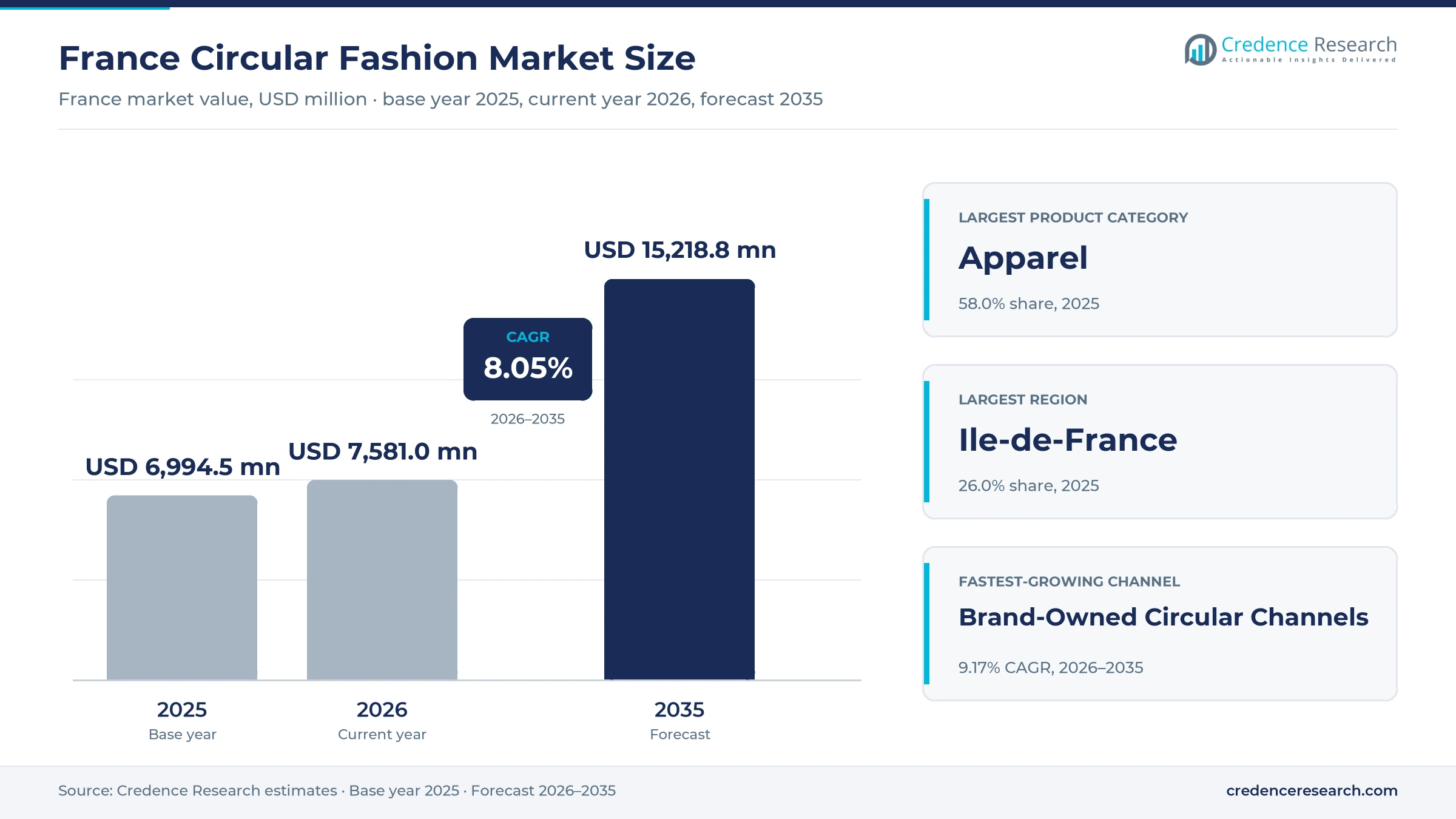
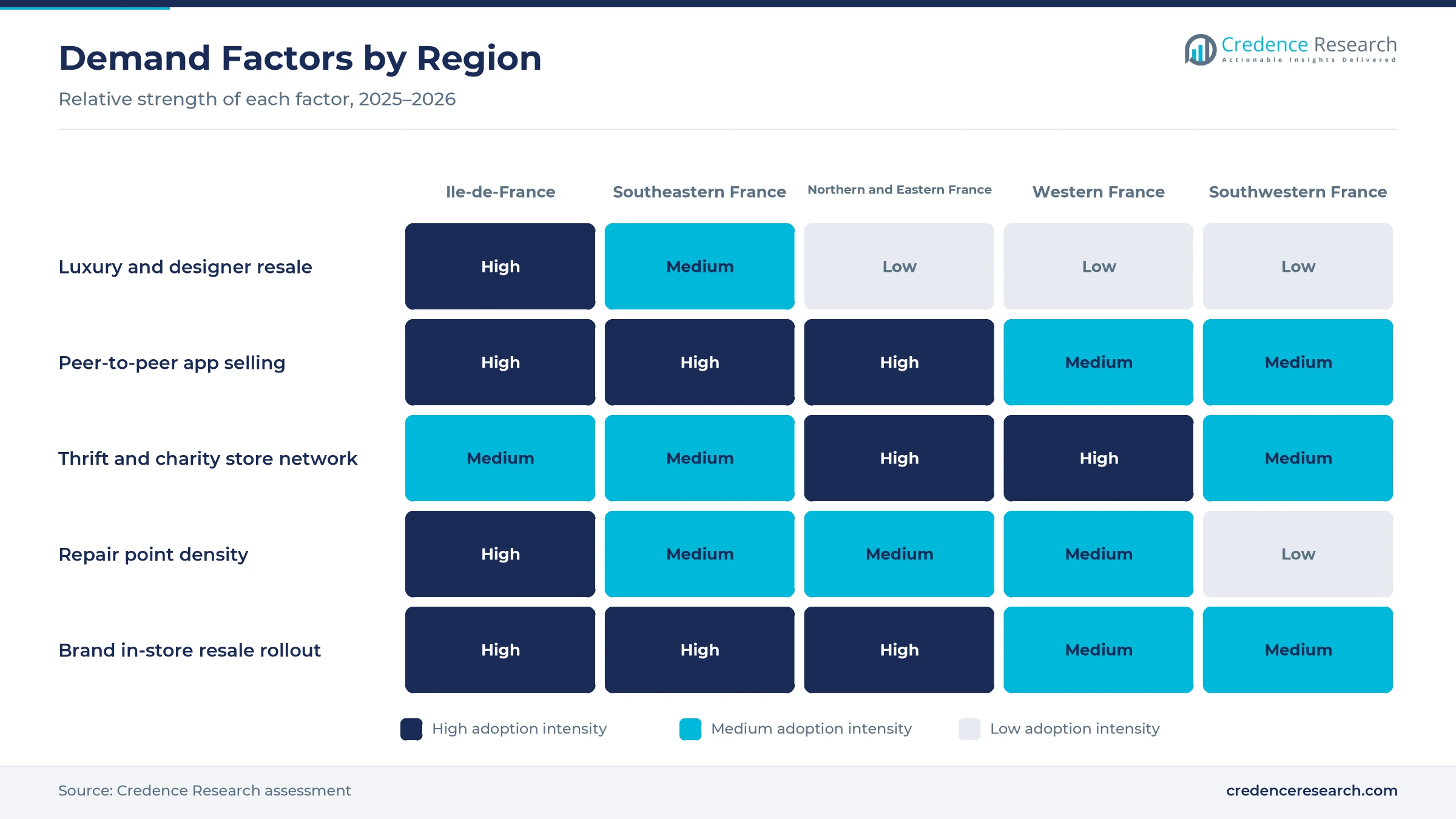
The France circular fashion market was valued at USD 6.99 billion in 2025 and is projected to increase from USD 7.58 billion in 2026 to USD 15.22 billion by 2035, registering a CAGR of 8.05% during 2026–2035. Demand comes from shoppers who buy used clothing to save money, parents who replace outgrown children's wear, and buyers who want authenticated luxury bags and shoes at lower prices. Ile-de-France held the largest regional share, 26.0% in 2025, because Paris combines high incomes, dense consignment stores and the main luxury resale buyers. Southeastern France is the fastest-growing zone at 8.40% a year, as Lyon, Marseille and Nice add resale corners and repair points. Peer-to-peer resale led the business model mix in 2025, while brand-owned channels gain as retailers take used items back in store. A national law adopted in June 2026 also targets ultra fast fashion with per-item penalties, which favors longer garment use.
Which resale, repair and rental activities does the estimate cover?
The estimate measures the value of used apparel, footwear, bags and accessories sold in France, together with paid repair, refurbishment, rental, subscription and upcycling services. It covers sales between consumers on digital marketplaces, consignment and managed resale, brand take-back programs, thrift stores and department store corners. Values are stated at consumer prices and include platform commissions and service fees paid by French buyers.
The estimate excludes new clothing sold at full or discounted prices, raw fiber recycling sold to industry and used textiles exported in bulk. The value chain runs from households and brand returns through collection points, sorting centers, repair workshops and authentication teams to marketplaces, resale stores and rental services that reach buyers.
France Circular Fashion Market Insights
- The France circular fashion market was valued at USD 6.99 billion in 2025 and is projected to reach USD 15.22 billion by 2035, registering a CAGR of 8.05% during 2026–2035.
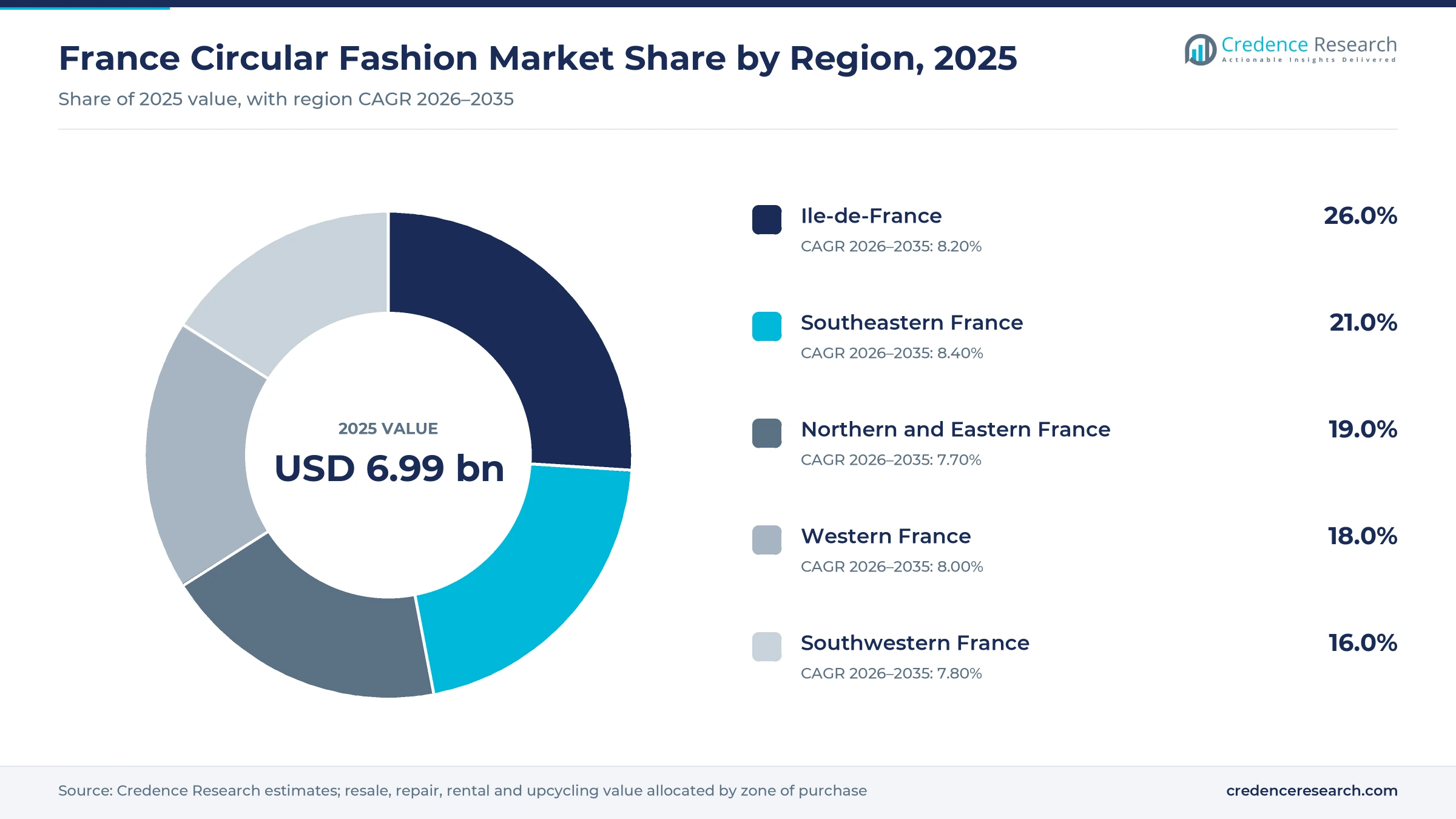
- Ile-de-France held a 26.0% share of 2025 value, because Paris combines high incomes, luxury resale buyers and the densest network of consignment stores.
- Apparel led with a 58.0% share of 2025 value, because everyday clothing and children's wear account for most items listed and resold.
- French producers placed 3.6 billion clothing, linen and footwear items on the market in 2025, and 272,479 metric tons of used textiles were collected.
- France's Parliament adopted a law against ultra fast fashion on June 29, 2026, with per-item penalties capped at 50% of the pre-tax price.
Apparel leads while brand resale channels grow fastest
Why does apparel lead product demand?
Based on product category, the market is categorized into apparel, footwear, bags and leather goods, and fashion accessories. Apparel led with a 58.0% share of 2025 value, because everyday clothing and children's wear make up most items that households list and resell. Bags & Leather Goods grow fastest at 8.63% a year, as authenticated designer bags hold value and attract buyers who want luxury pieces at lower prices.
How does repair gain on peer-to-peer resale?
Based on circular business model, the market is categorized into peer-to-peer resale, managed resale and consignment, repair and refurbishment, rental and subscription, and upcycling and remanufacture. Peer-to-Peer Resale led with 44.0% of 2025 value, because app listings let households sell items directly. Repair & Refurbishment grows fastest at 8.79% a year, as the national repair bonus lowers the cost of fixing shoes and garments.
Why are brand-owned resale channels growing fastest?
Based on distribution channel, the market is categorized into C2C digital marketplaces, brand-owned circular channels, specialist resale e-commerce, physical thrift and consignment stores, and department store circular corners. C2C Digital Marketplaces led with a 42.0% share of 2025 value, because large apps reach millions of French users. Brand-Owned Circular Channels grow fastest at 9.17% a year, as retailers collect and resell used items in their own stores.
How do value and luxury tiers shape spending?
Based on price tier, the market is categorized into value circular, mid-market circular, premium circular and luxury and collectible resale. Value Circular led with a 38.0% share of 2025 value, because most used garments sell at prices close to entry-level new clothing. Luxury & Collectible Resale grows fastest at 8.48% a year, as authentication services and platform partnerships widen access to designer pieces.
| Segment Group | Leading Sub-segment | Share, 2025 | Fastest-growing Sub-segment | CAGR, 2026–2035 |
|---|---|---|---|---|
| By Product Category | Apparel | 58.0% | Bags & Leather Goods | 8.63% |
| By Circular Business Model | Peer-to-Peer Resale | 44.0% | Repair & Refurbishment | 8.79% |
| By Distribution Channel | C2C Digital Marketplaces | 42.0% | Brand-Owned Circular Channels | 9.17% |
| By Price Tier | Value Circular | 38.0% | Luxury & Collectible Resale | 8.48% |
Request a Free Sample
Fill in your details and we'll send you a free sample report.
- Sample data tables & charts
- Research methodology
Mainstream resale and textile rules lift French demand
How does mainstream second-hand buying lift demand?
Second-hand buying has become mainstream in France, because used clothing now costs about the same as entry-level new items while lasting longer. Second-hand clothing and footwear sales reached 65,400 metric tons in 2025, and the average used item sold for 8.30 euros against 8.50 euros for an entry-level new item, according to FashionNetwork. The same data show that 74% of second-hand purchases replaced a new product, which shifts spending away from new garments. Vinted was the largest clothing seller in France by volume in the first quarter of 2025, with 23 million users. As a result, peer-to-peer resale holds a 44.0% share of 2025 value, as secondhand apparel becomes an everyday purchase.
Why do textile lifecycle rules raise reuse volumes?
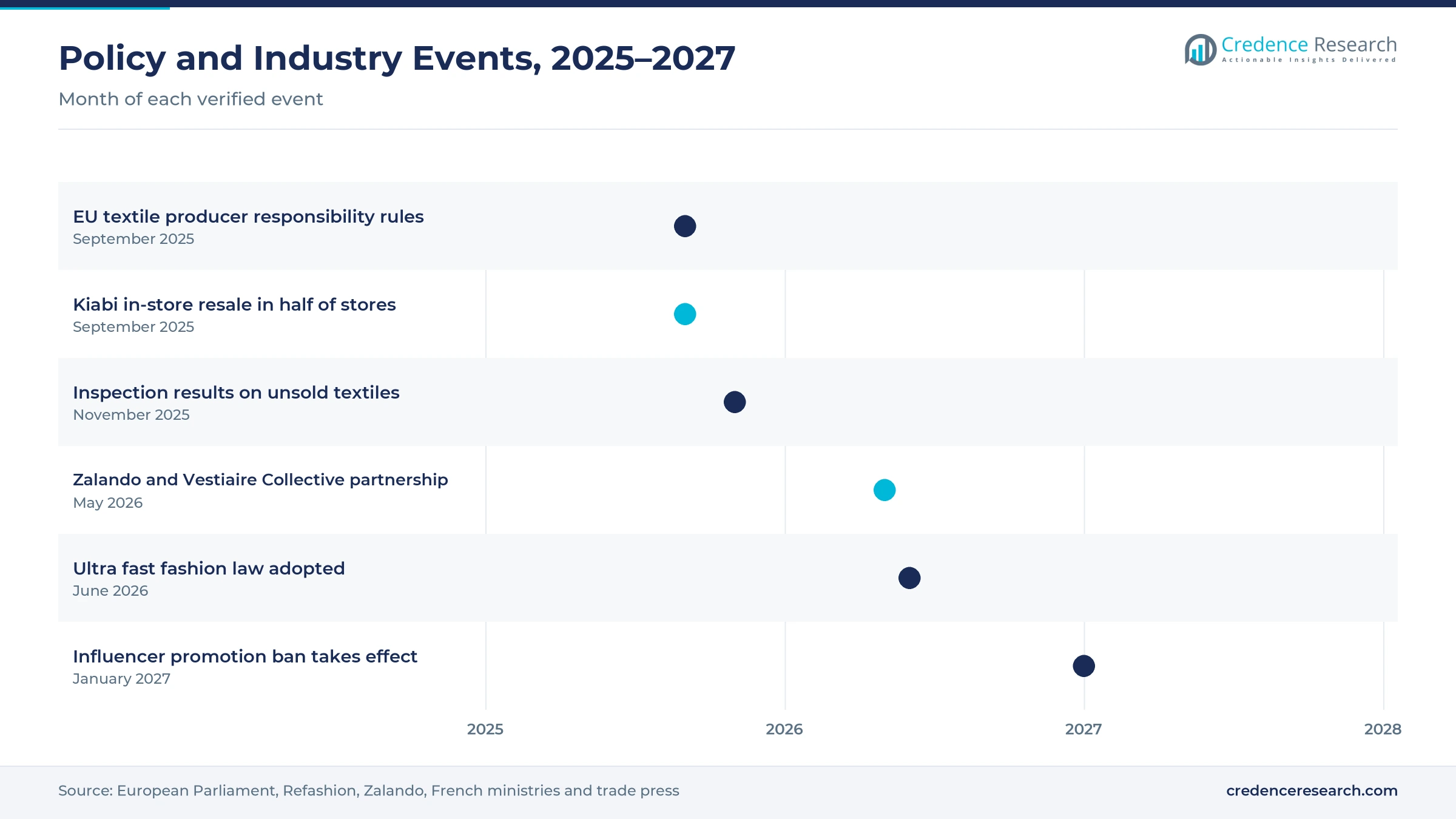
Regulation now places textile lifecycle costs on producers and sellers, because French and European rules limit destruction and fund collection. Since Jan. 1, 2022, the anti-waste law has banned the destruction of unsold non-food goods, so brands must donate, reuse or recycle surplus clothing. In 2024, inspectors checked 113 textile businesses for compliance with these rules and found many unaware of their reuse duties. The European Parliament adopted textile producer responsibility rules on Sept. 9, 2025, citing 12.6 million metric tons of EU textile waste a year, according to the European Parliament. In turn, managed resale and consignment grows at a steady pace, as brands send surplus and returns into resale channels.
How do collection and reuse networks enable scale?
Collection and reuse infrastructure enables scale, because resale and repair depend on a steady supply of sorted garments. Producers placed 3.6 billion clothing, linen and footwear items, or 917,604 metric tons, on the French market in 2025, according to Refashion. In the same year, 272,479 metric tons of used textiles were collected, or 3.96 kilograms per person, through 47,227 drop-off points in 17,015 municipalities. The reuse share of sorted volumes reached 54.47%, which keeps a large flow of wearable items available for thrift stores and resale apps. As a result, physical thrift and consignment stores retain a large base, while sorting centers supply both domestic stores and export buyers.
Why does the repair bonus support longer garment use?
The national repair bonus supports longer garment use, because it cuts the price consumers pay to fix shoes and clothing. The bonus launched on Nov. 7, 2023, with seven euros for a hole or tear in a garment and 25 euros for resoling leather shoes, funded by a 154 million euro budget through 2028. In 2025, the scheme covered 628,268 repaired products, including 500,907 pairs of shoes and 127,361 garments. France also counted 1,586 labeled repair points in 2025, with 70% of them serving clothing and 30% serving footwear. In turn, repair and refurbishment grows at 8.79% a year, the fastest business model rate in the forecast.
In-store resale and authenticated luxury reshape supply
How is the shift to in-store resale changing retail?
The shift to in-store resale is changing French clothing retail, because large chains now collect used items and resell them beside new stock. Zara launched its pre-owned platform in France on Sept. 7, 2023, letting customers sell, repair or donate garments in stores, online and in its app. By the end of September 2025, half of Kiabi's French stores offered clothing collection and in-store resale, with 15 more stores added each month toward all 352 locations. Decathlon also runs Second Life corners in 24 stores that sell refurbished sports products. As a result, brand-owned circular channels grow at 9.17% a year, the fastest channel rate in the forecast.
Why is the rise of authenticated luxury resale widening reach?
The rise of authenticated luxury resale is widening reach, because platform partnerships place checked designer items in front of mainstream shoppers. On May 28, 2026, Zalando and Paris-based Vestiaire Collective announced a partnership to sell authenticated pre-owned luxury fashion in 14 European markets, including France, according to Zalando. Vestiaire Collective employs more than 100 authenticators and 50 quality controllers for the program, and buyers receive a 30-day return window. In 2025, 62% of Zalando's pre-owned assortment sold within seven days of listing. In turn, luxury and collectible resale grows at 8.48% a year, as luxury handbags and shoes keep strong resale value.
Can sorting and upcycling absorb more collected garments?
Sorting and upcycling can absorb more collected garments, because France exports a large share of used textiles at falling prices. Used textile exports reached 172,000 metric tons in 2025, up 3.6%, while the average export price fell 8.2% to 471 euros per metric ton. Africa took 62,000 metric tons, or 36% of exports, which leaves French sorters exposed to a narrow buyer base. Clothing and footwear waste in the EU equals about 12 kilograms per person each year, which keeps the volume needing reuse high. As a result, upcycling and remanufacture can win more feedstock, as textile recycling and remake workshops turn low-grade items into new products.
Is there room for repair and resale after the fast fashion law?
Repair and resale networks have room to grow after the fast fashion law, because penalties on disposable clothing will fund longer-life alternatives. The Senate adopted the final law against ultra fast fashion on June 29, 2026, according to Euronews, with per-item penalties capped at 50% of the pre-tax selling price. Penalty revenue will fund recycling, repair and more responsible brands, while platforms must display reuse and recycling messages at checkout. A ban on influencer promotion of ultra fast fashion starts on Jan. 1, 2027, with fines up to 100,000 euros. In turn, repair points and resale stores can gain buyers who move away from very low-priced new clothing.
Low prices, sorting costs and quality checks limit margins
How do low resale prices squeeze operator margins?
Low resale prices squeeze operator margins, because an average used item sells for about eight euros in France. Collection, sorting, cleaning, photography and shipping costs remain high for each piece, which hurts thrift stores and managed resale operators most. As a result, many operators focus on higher-value brands and bundle low-value items. Larger platforms respond with buyer fees, shipping partnerships and automated listing tools that reduce handling time.
Why do sorting and export costs create pressure?
Sorting and export costs create pressure, because collected volumes grow faster than domestic demand for low-grade garments. Export prices fell in 2025, which reduces income for sorting centers that sell surplus abroad. In turn, collectors face higher storage costs and slower stock turnover. Operators respond by investing in fiber sorting, upcycling workshops and partnerships with brands that can use reclaimed materials in new collections.
How do counterfeits and quality gaps affect trust?
Counterfeits and quality gaps affect trust, because luxury resale depends on buyers believing that items are genuine and accurately described. A single fake bag or misdescribed defect can lead to refunds and lost repeat buyers. As a result, platforms spend more on authenticators, quality controllers and return windows. Smaller resellers respond with certificates of authenticity, brand partnerships and clear grading systems that help buyers compare items.
Why does rental struggle to reach scale?
Rental struggles to reach scale, because cleaning, repairs and two-way delivery raise the cost of each wear. Demand is also uneven, with peaks around weddings, parties and seasonal events, which leaves stock idle in quieter months. In turn, operators of online clothing rental services limit their ranges to occasionwear and children's clothing. Some services respond with subscriptions and resale of retired rental pieces.
Ile-de-France leads while the southeast grows fastest
| Region | Value, 2025 (USD billion) | Share, 2025 | CAGR, 2026–2035 |
|---|---|---|---|
| Ile-de-France | 1.82 | 26.0% | 8.20% |
| Southeastern France | 1.47 | 21.0% | 8.40% |
| Northern and Eastern France | 1.33 | 19.0% | 7.70% |
| Western France | 1.26 | 18.0% | 8.00% |
| Southwestern France | 1.12 | 16.0% | 7.80% |
Why does Ile-de-France hold the largest share?
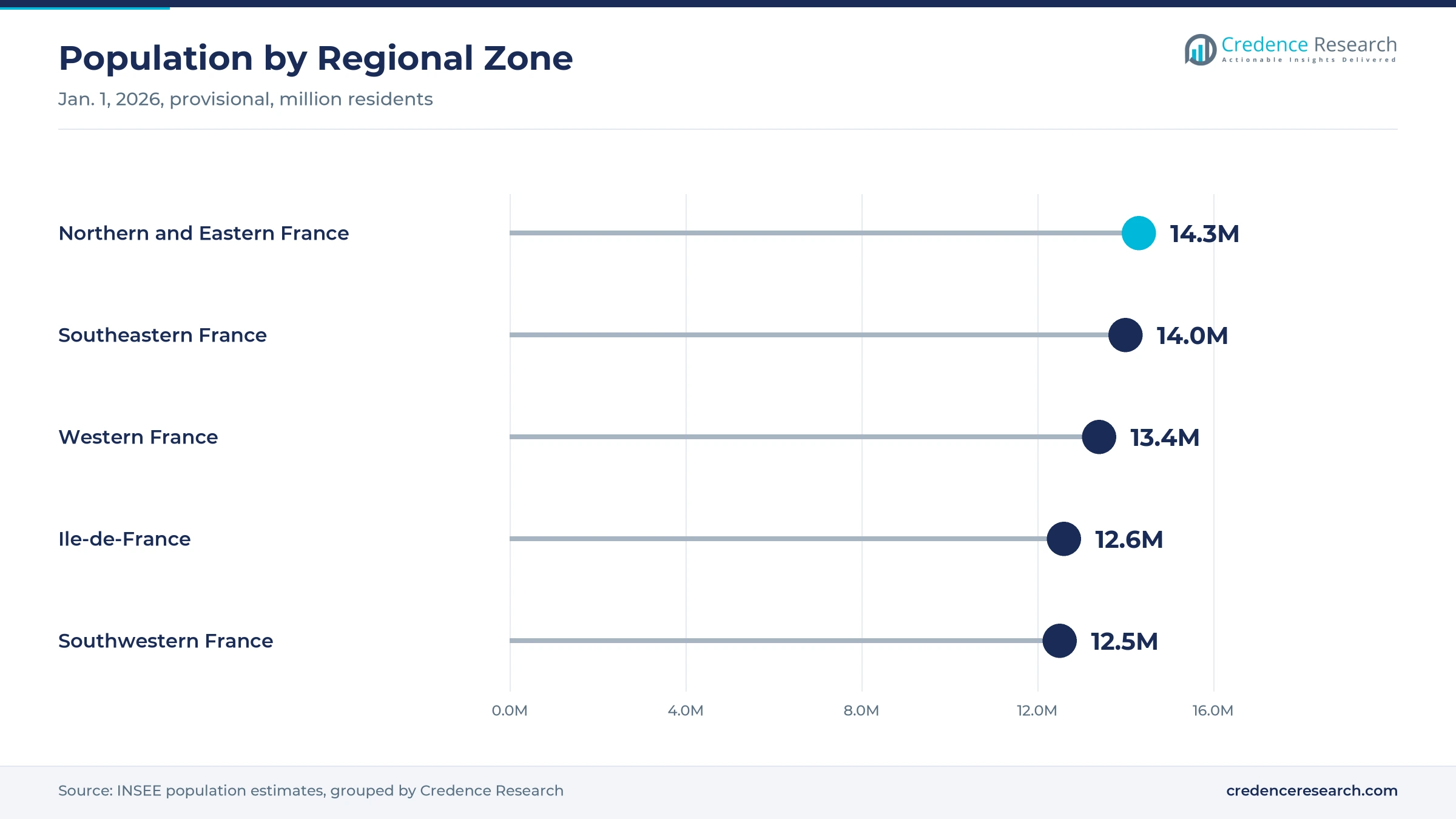
Ile-de-France held a 26.0% share of 2025 value and grows at 8.20% a year, because Paris and its suburbs combine 12.6 million residents with the highest incomes in France. The capital hosts the main luxury consignment stores, vintage boutiques and department store resale corners. France's urban population share reached 78.8% in 2025, according to World Bank data, which concentrates resale demand in large cities. As a result, the zone accounts for a larger share of luxury and premium resale than its population alone suggests, while dense parcel networks speed peer-to-peer shipping.
How does Southeastern France grow fastest?
Southeastern France held a 21.0% share of 2025 value and grows fastest at 8.40% a year, because Auvergne-Rhône-Alpes, Provence-Alpes-Côte d'Azur and Corsica together have about 14.0 million residents. Lyon, Marseille and Nice add resale corners in chain stores and attract tourists who buy vintage pieces. In turn, the zone gains repair points and brand take-back programs faster than other regions outside Paris.
What supports reuse in Northern and Eastern France?
Northern and Eastern France held a 19.0% share of 2025 value and grows at 7.70% a year, because Hauts-de-France, Grand Est and Bourgogne-Franche-Comté combine about 14.3 million residents with many value-focused families. The zone hosts large sorting centers and the head offices of several mass retailers. However, lower average incomes keep spending focused on value and children's clothing rather than luxury resale.
How does Western France use thrift and repair?
Western France held an 18.0% share of 2025 value and grows at 8.00% a year, because Brittany, Normandy, Pays de la Loire and Centre-Val de Loire have about 13.4 million residents and active charity networks. Thrift stores run by social enterprises take a large share of local sales. As a result, demand centers on everyday clothing and repairs, while cities such as Nantes and Rennes add specialist resale shops.
What shapes demand in Southwestern France?
Southwestern France held a 16.0% share of 2025 value and grows at 7.80% a year, because Nouvelle-Aquitaine and Occitanie have about 12.5 million residents spread across large rural areas. Bordeaux and Toulouse anchor urban resale demand, while smaller towns rely on charity shops and app-based selling. However, longer delivery distances and fewer repair points slow growth compared with the southeast.
Laws, partnerships and store rollouts marked 2025 to 2026
| Development | Status and market relevance |
|---|---|
| In September 2025, the European Parliament adopted rules requiring producer responsibility schemes for textiles within 30 months. | Extends French-style producer funding of collection across the EU |
| In September 2025, Kiabi reported that half of its French stores offered clothing collection and in-store resale. | Rollout to all 352 French stores planned by early 2026 |
| In November 2025, French inspectors reported results of 2024 checks on unsold goods, including 113 textile businesses. | Mostly educational follow-up with warnings and compliance orders |
| In May 2026, Zalando and Vestiaire Collective announced an authenticated luxury resale partnership covering France. | Brings checked designer items to 14 European markets |
| In June 2026, the French Parliament adopted the law against ultra fast fashion with per-item penalties. | Influencer promotion ban starts on Jan. 1, 2027 |
Authentication, sorting and repair tools support reuse
- Authentication teams and imaging tools check designer bags, shoes and accessories before sale, which reduces counterfeit risk and refunds.
- Automated sorting lines separate wearable garments from recycling grades by fiber and condition, which speeds supply to thrift stores.
- Repair booking platforms link consumers with labeled repair points and apply the national bonus at checkout, which lowers repair prices.
- Listing and pricing software helps sellers photograph, describe and price used items, which shortens the time items stay unsold.
Need a Custom Version of This Report?
Tailor the scope, geography, or segments to your exact requirements.
- Custom geography or segment scope
- Direct access to our analyst team
Peer platforms compete with brands and luxury resellers
Competition is split between peer-to-peer apps, specialist luxury resellers, brand-owned programs and thrift stores run by social enterprises. Vinted was the largest clothing seller in France by volume in early 2025, with 23 million users, and handled about 20,500 metric tons of French second-hand sales in 2025. Vestiaire Collective, based in Paris, sells authenticated luxury items and partnered with Zalando in May 2026 to reach 14 European markets. Zara runs a pre-owned service in France for resale, repair and donation, while Kiabi is adding collection and resale to its French stores through its Beebs offer. Decathlon sells refurbished products in Second Life corners inside 24 of its stores. Rivals compete on user numbers, authentication, shipping costs, store access and price, while new penalties on ultra fast fashion may push more shoppers toward used clothing.
Companies profiled and their roles in this market
| Company | Type | Role in the market |
|---|---|---|
| Vinted | Peer-to-peer platform | Largest clothing seller in France by volume in early 2025 |
| Vestiaire Collective | Luxury resale platform | Partnered with Zalando in May 2026 for authenticated luxury |
| Zara Pre-Owned | Brand-owned program | Offers resale, repair and donation in France since September 2023 |
| Kiabi Beebs | Brand-owned program | Adds in-store collection and resale across French stores |
| Decathlon Second Life | Refurbishment program | Sells refurbished products in 24 store corners |
Credence Research view on French clothing reuse
Credence Research's view is that French circular fashion will keep growing faster than new clothing sales, because price, regulation and convenience now favor reuse. Peer-to-peer apps remain the base of the market, while brand-owned channels, repair and authenticated luxury resale gain share. The repair bonus covered 628,268 products in 2025, which shows that subsidies change behavior when the discount is clear. However, low prices, sorting costs and export weakness will keep margins thin. Operators that combine collection, grading, repair and resale in one network should gain share fastest through 2035.
How the French reuse and resale estimate was built
The report uses 2025 as the base year on a calendar basis, and market values come from the Credence Research model. That model combines collection, reuse and repair data published by the French textile producer responsibility organization, trade press reports on second-hand sales, European and French legislative releases, national population statistics and company announcements. Segment and regional splits are Credence Research estimates, and the five regional zones were built from national population data and retail density. Sources used are public reports, official releases and company announcements, and no interviews or surveys were used.
Resale and repair carry French reuse spending to 2035
Circular fashion spending in France is expected to reach USD 15.22 billion by 2035, an 8.05% CAGR during 2026–2035, as resale, repair and brand take-back programs keep garments in use longer. Growth should stay strong through 2028 while chain stores roll out resale corners and the ultra fast fashion penalties take effect. After that, EU producer responsibility schemes and better sorting will carry more growth as peer-to-peer resale matures. Weaker consumer budgets would favor value resale, while faster luxury authentication would lift premium tiers. Operators with strong collection networks and repair capacity are expected to gain the most.
Frequently Asked Questions
How big is the France circular fashion market?
Which product category leads circular fashion in France?
Which region leads circular fashion spending in France?
Which business model grows fastest?
What drives circular fashion demand in France?
How does the ultra fast fashion law affect the market?
Who are the leading circular fashion companies in France?
What are the main challenges for circular fashion operators?
Table of Content
Chapter 1 Market Segmentation
- 1.1 Segmentation Framework
- 1.1.1 Product and Service Classification
- 1.1.2 Application and End-Use Classification
- 1.1.3 Technology and Solution Classification
- 1.1.4 Customer and Distribution Channel Classification
- 1.1.5 Geographic Segmentation
- 1.1.6 Market Segment Definitions and Boundaries
- 1.2 By Product Category
- 1.2.1 Apparel
- 1.2.2 Footwear
- 1.2.3 Bags & Leather Goods
- 1.2.4 Fashion Accessories
- 1.3 By Circular Business Model
- 1.3.1 Peer-to-Peer Resale
- 1.3.2 Managed Resale & Consignment
- 1.3.3 Repair & Refurbishment
- 1.3.4 Rental & Subscription
- 1.3.5 Upcycling & Remanufacture
- 1.4 By Price Tier
- 1.4.1 Value Circular
- 1.4.2 Mid-Market Circular
- 1.4.3 Premium Circular
- 1.4.4 Luxury & Collectible Resale
Chapter 2 Introduction
- 2.1 Report Objectives and Scope
- 2.2 Product Definition and Industry Terminology
- 2.3 Market Inclusions and Exclusions
- 2.4 Research Process
- 2.4.1 Primary Research and Expert Interviews
- 2.4.2 Secondary Research and Source Review
- 2.4.3 Top-Down and Bottom-Up Estimation
- 2.4.4 Data Triangulation and Verification
- 2.5 Market Size Measurement Basis
- 2.5.1 2025: USD 6.99 billion → 2035: USD 15.22 billion
- 2.6 Historical and Forecast Reference Periods
- 2.6.1 Historical Period: 2018-2025
- 2.6.2 Base Year: 2025
- 2.6.3 Forecast Period: 2025-2035
- 2.7 Research Assumptions and Limitations
Chapter 3 Executive Summary
- 3.1 Market Snapshot and Key Findings
- 3.2 Base-Year Market Size, 2025
- 3.3 Forecast Market Size, 2035
- 3.4 Revenue and Volume Growth Outlook
- 3.5 Key Demand and Supply Indicators
- 3.6 Leading Market Segments
- 3.7 Fastest-Growing Market Opportunities
- 3.8 Regional Performance Highlights
- 3.9 Technology and Industry Transformation
- 3.10 Competitive Landscape Summary
- 3.11 Analyst View and Strategic Implications
Chapter 4 France Circular Fashion Market Trends and Developments
- 4.1 Historical Industry Development, 2018-2025
- 4.2 Recent Market Trends and Developments
- 4.3 Demand and Customer Behavior Trends
- 4.4 Technology and Product Innovation
- 4.5 Artificial Intelligence, Automation and Digitalization
- 4.6 Local Manufacturing and Supply Chain Realignment
- 4.7 Industry Partnerships, Mergers and Acquisitions
- 4.8 Sustainability and Circular Economy Developments
- 4.9 Government and Private Sector Investment Trends
- 4.10 Emerging Business Models and Commercialization
- 4.11 Industry Developments and Announcements
Chapter 5 France Circular Fashion Market Production, Supply and Demand Analysis
- 5.1 Demand Trend and Consumption Analysis, 2018-2025
- 5.2 Demand Forecast, 2025-2035
- 5.3 Production and Output Trend, 2018-2025
- 5.4 Production and Output Forecast, 2025-2035
- 5.5 Installed Capacity and Capacity Utilization
- 5.6 Company-Wise Production Plants and Statistics
- 5.6.1 Installed Production Capacity
- 5.6.2 Actual Production
- 5.6.3 Planned Capacity and Expansion Targets
- 5.7 Supply Chain Structure and Procurement Trends
- 5.8 Supply-Demand Gap and Bottlenecks
- 5.9 Import Dependence and Sourcing Structure
- 5.10 Contract Manufacturing and Outsourcing
- 5.11 Regional Supply and Demand Concentration
Chapter 6 France Circular Fashion Market Pricing Analysis
- 6.1 Pricing Structure and Measurement
- 6.2 Historical Pricing Trends, 2018-2025
- 6.3 Pricing Outlook, 2025-2035
- 6.4 Average Selling Price and Unit Economics
- 6.5 Pricing by Product and Market Segment
- 6.6 Geographic Pricing Differences
- 6.7 Key Input, Energy, Labor and Logistics Costs
- 6.8 Contract Pricing and Purchasing Models
- 6.9 Pricing Sensitivity and Competitive Positioning
- 6.10 Price, Margin and Profitability Implications
Chapter 7 France Circular Fashion Market Dynamics
- 7.1 Market Growth Drivers
- 7.1.1 Demand-Side Drivers
- 7.1.2 Technology and Innovation Drivers
- 7.1.3 Infrastructure and Investment Drivers
- 7.1.4 Regulatory and Policy Drivers
- 7.2 Market Restraints
- 7.2.1 Cost and Affordability Constraints
- 7.2.2 Technology and Adoption Barriers
- 7.2.3 Supply Chain and Operational Constraints
- 7.3 Market Challenges
- 7.3.1 Competitive Pressure and Margin Erosion
- 7.3.2 Skills, Infrastructure and Implementation Gaps
- 7.4 Emerging Market Opportunities
- 7.5 Market Dynamics Impact and Time-Horizon Assessment
Chapter 8 France Circular Fashion Value Chain Analysis
- 8.1 Industry Value Chain Overview
- 8.2 Upstream Suppliers and Critical Inputs
- 8.3 Technology and Component Providers
- 8.4 Manufacturing or Service Delivery
- 8.5 Distribution, Channel Partners and Integrators
- 8.6 Downstream Applications and End Users
- 8.7 Value Addition and Profit Pools
- 8.8 Vertical Integration and Outsourcing
- 8.9 Supplier Concentration and Risk
- 8.10 Supply Chain Localization and Resilience
Chapter 9 France Circular Fashion Market Regulations and Policies
- 9.1 Relevant Laws, Standards and Compliance Frameworks
- 9.2 Product, Service, Safety and Quality Requirements
- 9.3 Government Policies, Incentives and Subsidies
- 9.4 Imports, Exports and Trade Barriers
- 9.5 Public Procurement and Local Content Requirements
- 9.6 Environmental and Sustainability Compliance
- 9.7 Upcoming Policy Changes and Market Implications
Chapter 10 France Circular Fashion Market Hotspots and Opportunities
- 10.1 Market Opportunity Mapping and Growth Hotspots
- 10.2 High-Growth Applications and Customer Groups
- 10.3 Underserved Markets and White-Space Opportunities
- 10.4 Emerging Technology and Product Opportunities
- 10.5 New Capacity and Investment Hotspots
- 10.6 Market Entry and Expansion Opportunities
- 10.7 Distribution and Partnership Opportunities
- 10.8 Near-Term and Long-Term Commercial Potential
- 10.9 Opportunity Attractiveness and Execution Risks
Chapter 11 France Circular Fashion Market Outlook, 2025-2035
- 11.1 Market Size and Analysis
- 11.1.1 Revenue (Market Measurement: 2025: USD 6.99 billion → 2035: USD 15.22 billion)
- 11.1.2 Market Volume and Quantity Sold
- 11.1.3 Historical Market Size, 2018-2025
- 11.1.4 Base-Year Market Size, 2025
- 11.2 Market Forecast, 2025-2035
- 11.2.1 Revenue Forecast to 2035
- 11.2.2 Volume Forecast to 2035
- 11.2.3 CAGR and Year-on-Year Growth
- 11.2.4 Incremental Revenue Opportunity
- 11.3 Forecast Assumptions and Scenario Analysis
- 11.3.1 Base-Case Forecast
- 11.3.2 Optimistic and Conservative Scenarios
- 11.3.3 Technology, Pricing and Policy Sensitivities
- 11.4 Market Attractiveness and Growth Outlook
Chapter 12 France Circular Fashion Market Segmentation and Outlook
- 12.1 Segmentation Summary and Market Shares, 2025
- 12.2 Largest and Fastest-Growing Segments
- 12.3 By Product Category - Market Size and Forecast, 2025-2035
- 12.3.1 Segment Definition and Scope
- 12.3.2 Historical Market Size, 2018-2025
- 12.3.3 Revenue Forecast, 2025-2035
- 12.3.4 Volume Forecast, 2025-2035
- 12.3.5 Base-Year Market Share, 2025
- 12.3.6 Segment CAGR and Growth Drivers
- 12.3.7 Subsegment Market Size and Forecast
- 12.3.7.1 Apparel
- 12.3.7.2 Footwear
- 12.3.7.3 Bags & Leather Goods
- 12.3.7.4 Fashion Accessories
- 12.3.8 Subsegment Pricing and Adoption Trends
- 12.3.9 Leading Suppliers and Competition
- 12.3.10 Regional Demand and Opportunities
- 12.4 By Circular Business Model - Market Size and Forecast, 2025-2035
- 12.4.1 Segment Definition and Scope
- 12.4.2 Historical Market Size, 2018-2025
- 12.4.3 Revenue Forecast, 2025-2035
- 12.4.4 Volume Forecast, 2025-2035
- 12.4.5 Base-Year Market Share, 2025
- 12.4.6 Segment CAGR and Growth Drivers
- 12.4.7 Subsegment Market Size and Forecast
- 12.4.7.1 Peer-to-Peer Resale
- 12.4.7.2 Managed Resale & Consignment
- 12.4.7.3 Repair & Refurbishment
- 12.4.7.4 Rental & Subscription
- 12.4.7.5 Upcycling & Remanufacture
- 12.4.8 Subsegment Pricing and Adoption Trends
- 12.4.9 Leading Suppliers and Competition
- 12.4.10 Regional Demand and Opportunities
- 12.5 By Price Tier - Market Size and Forecast, 2025-2035
- 12.5.1 Segment Definition and Scope
- 12.5.2 Historical Market Size, 2018-2025
- 12.5.3 Revenue Forecast, 2025-2035
- 12.5.4 Volume Forecast, 2025-2035
- 12.5.5 Base-Year Market Share, 2025
- 12.5.6 Segment CAGR and Growth Drivers
- 12.5.7 Subsegment Market Size and Forecast
- 12.5.7.1 Value Circular
- 12.5.7.2 Mid-Market Circular
- 12.5.7.3 Premium Circular
- 12.5.7.4 Luxury & Collectible Resale
- 12.5.8 Subsegment Pricing and Adoption Trends
- 12.5.9 Leading Suppliers and Competition
- 12.5.10 Regional Demand and Opportunities
- 12.6 Segment Growth Comparison
- 12.7 Segment Attractiveness and Priority Matrix
Chapter 13 France Circular Fashion Geographic Market Outlook, 2025-2035
- 13.1 Regional Market Size and Country-Level Shares, 2025
- 13.2 Country Market Size Comparison, 2025
- 13.3 Country Market Forecasts, 2025-2035
- 13.4 Subregional Industrial and Demand Clusters
- 13.5 Intra-Regional Pricing and Cost Differences
- 13.6 Cross-Border Trade and Supply Networks
- 13.7 Regional Supply and Demand Balances
- 13.8 Country Opportunity Comparison and Prioritization
Note: Every listed country is covered on the structure shown under the first country.
Chapter 14 France Circular Fashion Technology, Innovation and Sustainability Outlook
- 14.1 Technology Landscape and Maturity
- 14.2 Product, Process and Service Innovation
- 14.3 AI, Automation and Digital Tools in the Industry
- 14.4 Technology Adoption and Performance Benchmarking
- 14.5 Innovation Pipeline and R&D Investment
- 14.6 Patent and Intellectual Property Trends
- 14.7 Energy Efficiency and Resource Management
- 14.8 Sustainability, Recycling and Circularity
- 14.9 Technology Roadmap, 2025-2035
- 14.10 Risks of Obsolescence and Technology Substitution
Chapter 15 France Circular Fashion Market Key Strategic Imperatives
- 15.1 Growth and Market Entry Priorities
- 15.2 High-Return Products and Segments
- 15.3 Pricing, Profitability and Cost Optimization
- 15.4 Technology Investment and Product Differentiation
- 15.5 Supply Chain Localization and Resilience
- 15.6 Distribution and Customer Acquisition
- 15.7 Partnership, Acquisition and Capacity Strategy
- 15.8 Regional Expansion Priorities
- 15.9 Short-, Medium- and Long-Term Actions
Chapter 16 Competition Outlook
- 16.1 Industry Competition Characteristics
- 16.2 Market Structure and Concentration
- 16.3 Market Share and Competitive Positioning, 2025
- 16.4 Company-Wise Revenue and Product Benchmarking
- 16.5 Production and Service Capacity Benchmarking
- 16.6 Technology, Pricing and Differentiation
- 16.7 Regional Footprint and Distribution Strength
- 16.8 Mergers, Acquisitions and Strategic Alliances
- 16.9 New Entrants and Competitive Threats
- 16.10 Porter's Five Forces and Industry Attractiveness
- 16.11 Competitive Outlook, 2025-2035
Chapter 17 Company Profiles
- 17.1 Company Coverage and Selection Criteria
- 17.2 Vinted
- 17.2.1 Business Description
- 17.2.2 Company Ownership and Geographic Presence
- 17.2.3 Product and Service Portfolio
- 17.2.4 Manufacturing and Operating Footprint
- 17.2.5 Production Capacity and Expansion Plans
- 17.2.6 Financial Performance and Investment
- 17.2.7 Market Share and Competitive Position
- 17.2.8 Technology and Innovation Capabilities
- 17.2.9 Strategic Alliances or Partnerships
- 17.2.10 Recent Developments
- 17.2.11 Growth Strategy and Outlook
- 17.3 Vestiaire Collective
- 17.4 Leboncoin
- 17.5 Decathlon Second Life
- 17.6 Kiabi Beebs
- 17.7 Zara Pre-Owned
- 17.8 H&M Pre-Loved
- 17.9 CrushON
- 17.10 Monogram Paris
- 17.11 Once Again
- 17.12 Other Relevant Market Participants
Note: Every listed company is profiled on the structure shown under the first company. The company list is preliminary and may change based on research findings, market developments, data availability and client requirements.
Chapter 18 Disclaimer
- 18.1 Research and Forecast Disclaimer
- 18.2 Data Source and Estimation Limitations
Note: The depth of individual sections depends on data availability for this market. Volume, capacity, trade and other unit-based metrics are included where applicable.

