
Online Clothing Rental Market Overview:
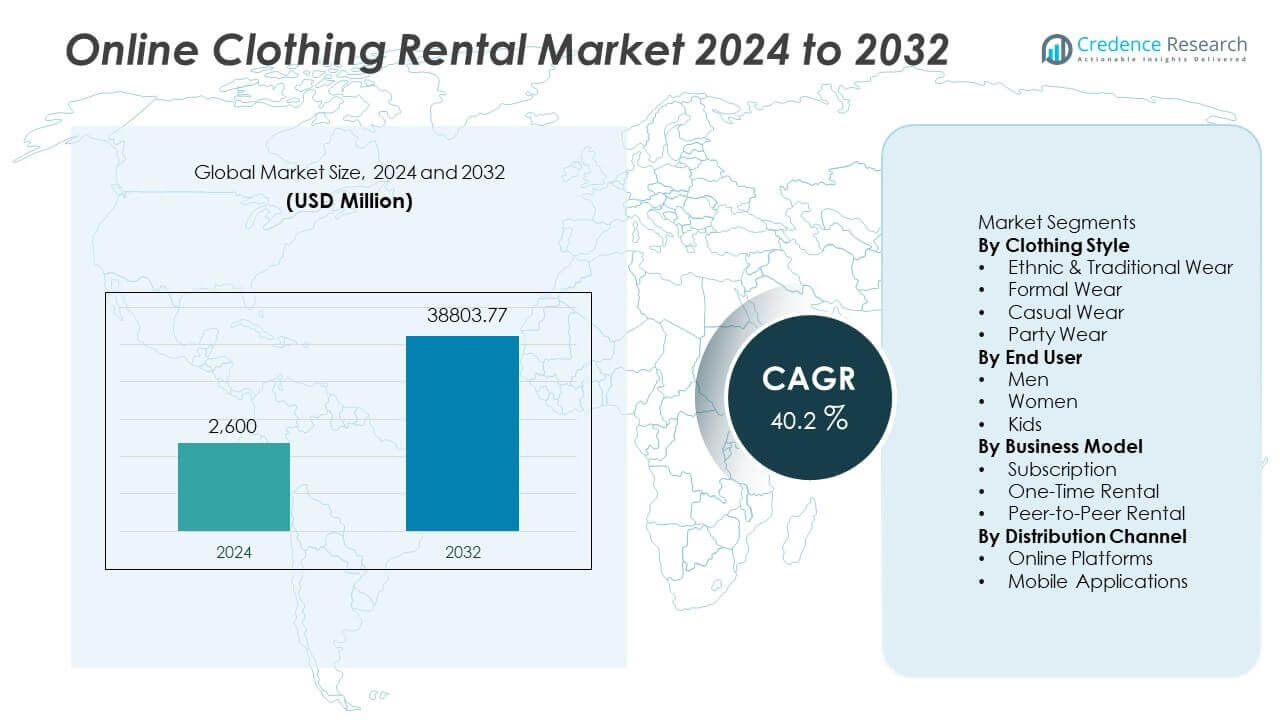
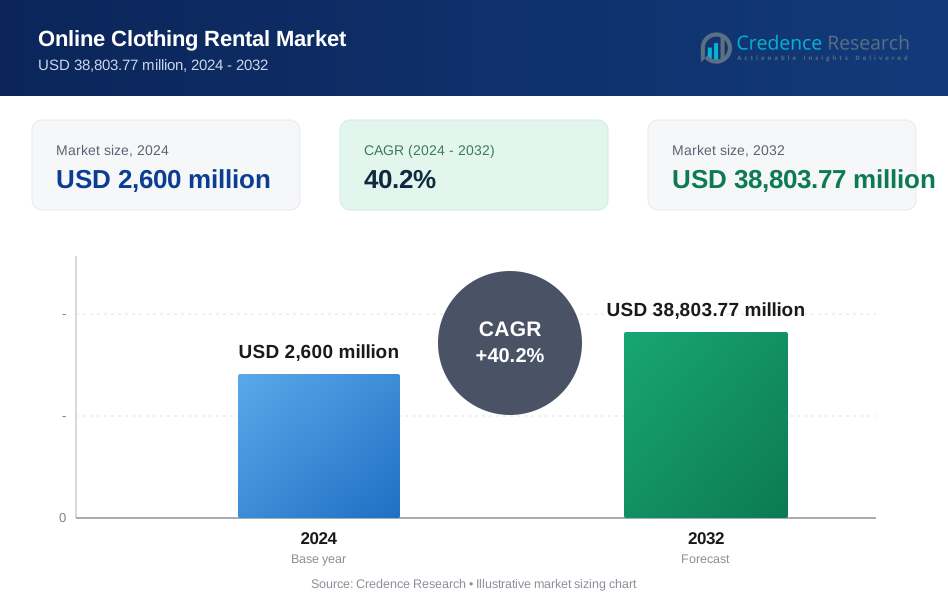
The Online Clothing Rental market size was valued at USD 2,600 million in 2024 and is projected to reach USD 38,803.77 million by 2032, reflecting a CAGR of 40.2% during the forecast period.
| REPORT ATTRIBUTE | DETAILS |
|---|---|
| Historical Period | 2020-2023 |
| Base Year | 2024 |
| Forecast Period | 2025-2032 |
| Online Clothing Rental Market Size 2024 | USD 2,600 million |
| Online Clothing Rental Market, CAGR | 40.2% |
| Online Clothing Rental Market Size 2032 | USD 38,803.77 million |
Online Clothing Rental Market Insights
- Rising demand for designer fashion, event-based dressing, and cost-efficient wardrobe access drives steady adoption, supported by strong uptake of ethnic and traditional wear rentals, which lead the clothing style segment with a 38% share.
- Digital styling tools, virtual try-ons, and curated subscription models shape market trends, improving customer satisfaction and increasing rental frequency across diverse age groups.
- Competitive activity continues to rise as platforms expand premium apparel collections, strengthen logistics performance, and enhance customer experience, while rental hygiene management and operational costs remain key restraints.
- Asia Pacific holds a 36% regional share followed by North America at 33% and Europe at 27%, supported by strong digital adoption and expanding demand for subscription and event-based rental models.
Online Clothing Rental Market Segmentation Analysis:
By Clothing Style
Ethnic and traditional wear leads the clothing style segment with a 38% share, driven by strong demand for wedding attire, festive outfits, and event-specific garments. Customers prefer premium pieces that offer high visual appeal at lower cost, creating steady rental circulation. Party wear shows strong growth due to expanding social events and influencer-driven fashion choices. Formal wear remains relevant for corporate and occasion-based needs, while casual wear supports recurring rentals for everyday use. The ethnic and traditional segment maintains dominance as users prioritize variety, designer availability, and convenience.
- For instance, Rent the Runway reports increased customer engagement with its expanding inventory of designer wear, reflecting growing demand for premium styles suited for special occasions and diverse events.
By End User
Women account for a 62% share of the end user segment, supported by rising awareness of rental fashion and greater adoption of designer choices. Female customers value wardrobe flexibility and cost savings while accessing premium styles for events, parties, and weddings. Men represent growing demand for tuxedos, suits, and corporate wear rentals, supported by increased professional and social engagements. Kids’ rentals remain niche but gain traction in birthdays and cultural events. The women’s segment continues to lead due to broader fashion preferences and rapid digital engagement.
- For instance, Flyrobe fulfilled a significant number of women’s ethnic rental orders for wedding and festive occasions, reflecting its position as a leader in India's fashion rental market.
By Business Model
Subscription models hold a 49% share of the business model segment, driven by recurring usage and customer preference for flexible wardrobe options. Subscribers benefit from regular rotation of styles at predictable cost and home delivery convenience. One-time rental demand remains strong for weddings, vacations, and theme-based events. Peer-to-peer rental platforms expand through social shopping trends and sustainable fashion awareness. Subscription-based rental continues to dominate due to predictable revenue, higher retention, and seamless product access.
Key Growth Drivers
Rising Fashion Consciousness and Event-Based Demand
Growing interest in designer fashion and premium styling drives strong demand for online clothing rental services. Users seek variety without long-term purchase costs, especially for weddings, parties, corporate events, and seasonal festivals. Social media influence and rapid fashion exposure increase browsing and rental frequency. This trend supports higher rotation rates, stronger subscription activity, and wider product categories. Online platforms expand offerings to match evolving style preferences and size inclusivity. The shift toward smart wardrobe spending reinforces long-term rental adoption across urban markets.
- For instance, The Mr. & Ms. Collection provides a variety of menswear styles to accommodate frequent professional and formal event rentals.
Increased Awareness of Sustainable Fashion Practices
Sustainability awareness supports market expansion as consumers shift from fast fashion to more eco-conscious options. Renting apparel reduces wardrobe waste, promotes shared usage, and extends product life cycles. Growing environmental concerns influence young consumers to prefer rental models that lower carbon and production footprints. Platforms highlight recycling, garment care, and circular fashion benefits to attract long-term users. Increased focus on environmental responsibility also strengthens brand loyalty and market visibility.
- For instance, Bag Borrow or Steal maintains a specialized restoration team that refurbishes luxury items to maintain their quality and extend their rental life.
Growth in Digital Connectivity and E-Commerce Expansion
Rising internet penetration and smartphone usage accelerate rental adoption across global markets. Easy access to online platforms improves browsing convenience, booking efficiency, and delivery reliability. Digital tools enhance size prediction, styling recommendations, and subscription management. Automated logistics, secure payment systems, and customer support services improve renting confidence. E-commerce growth continues to attract first-time renters, especially in urban and semi-urban regions, strengthening revenue potential across diverse customer groups.
Key Trends & Opportunities
Expansion of Designer and Luxury Rental Collections
Growing demand for luxury and designer apparel rental creates strong opportunities for platform differentiation. High-end brands gain wider visibility through rental partnerships, while users access premium pieces at lower cost. Exclusive collections and capsule drops boost conversion rates and repeat usage. Styling add-ons and personalized selections support value-added services. The trend strengthens platform positioning in competitive markets and attracts premium subscribers.
- For instance, GlamCorner partnered with the iconic Australian label Carla Zampatti to offer a collection of luxury designer pieces, enhancing their selection of high-value fashion rentals.
Technology Advancements in Fit, Personalization, and Delivery
Digital tools shape customer engagement through AI-driven size guidance, virtual try-ons, and data-based recommendations. Improved logistics and faster delivery enhance convenience and reduce rental downtime. Automated garment tracking, fabric care systems, and wearable tech integration support operational efficiency. Platforms leverage data insights to improve pricing models, inventory planning, and customer retention. These advancements strengthen service reliability across peer-to-peer and subscription models.
- For instance, Le Tote analyzes user data patterns and historical rental behavior to optimize its stock planning and mitigate return-related fit issues.
Key Challenges
Logistics, Inventory Management, and Garment Maintenance Costs
Efficient rental operations require strong logistics networks, product tracking, and secure packaging. Garment repair, dry cleaning, and quality control add significant recurring costs. Rapid size rotation and multi-user handling increase wear and tear, impacting asset value and replacement cycles. Scaling inventory across styles, sizes, and occasions remains challenging for service consistency.
Consumer Hesitancy and Fit-Related Concerns
Some users remain uncertain about product cleanliness, size accuracy, and garment condition. Limited awareness of rental value and long-term savings reduces adoption in traditional retail markets. Concerns about delayed delivery, return policies, and damage fees influence rental decisions. Overcoming fit challenges and trust barriers requires consistent quality assurance, digital guidance tools, and transparent service communication.
Regional Analysis
North America
North America holds a 33% share of the online clothing rental market, driven by strong demand for designer apparel, formalwear, and subscription-based rental services. The United States leads platform adoption, supported by high digital spending, strong fashion engagement, and expanding influencer-driven buying behavior. Users prioritise access to premium labels and sustainable wardrobe choices. Growth in peer-to-peer rental and curated collections further enhances customer appeal. Rising event culture, social media exposure, and fast delivery infrastructure strengthen long-term market potential. Subscription and party wear rentals gain momentum across major metro regions, supporting continuous revenue growth.
Europe
Europe accounts for a 27% share of the online clothing rental market, supported by strong focus on sustainable fashion and high interest in designer and luxury rentals. Markets in the United Kingdom, Germany, France, and Italy drive demand, influenced by high fashion awareness and event-driven spending. Growth in circular fashion initiatives supports wider adoption among eco-conscious customers. Peer-to-peer platforms gain visibility as consumers prioritise value and waste reduction. Expanding subscription models and premium wardrobe rentals support long-term customer retention. Strong digital infrastructure enables wider expansion across urban regions.
Asia Pacific
Asia Pacific leads the online clothing rental market with a 36% share, driven by rising urbanisation, growing disposable income, and rapid fashion consumption. India, China, Japan, and South Korea experience high rental adoption supported by digital accessibility and strong demand for ethnic, bridal, and party wear categories. Younger demographics drive rental frequency and platform engagement. Growing preference for cost-efficient styling, seasonal outfits, and influencer-inspired looks strengthens long-term industry expansion. Mobile app penetration and same-day delivery options further accelerate platform growth across major cities.
Latin America
Latin America holds a 3% share of the online clothing rental market, supported by rising event culture and growing interest in cost-effective fashion. Brazil, Mexico, and Argentina show expanding rental adoption across party wear, formalwear, and cultural outfits. Influencer-led styling, social media exposure, and online marketplace integration improve platform awareness. Economic considerations drive interest in affordable designer wear access. Market development aligns with rising e-commerce expansion and improving delivery logistics.
Middle East & Africa
Middle East and Africa hold a 1% share, reflecting emerging rental adoption across urban centres in the United Arab Emirates, Saudi Arabia, and South Africa. Demand rises for premium cultural, bridal, and party wear rentals driven by event-focused consumption. Increased tourism and wedding travel contribute to rental growth. Platforms benefit from expanding digital infrastructure and rising fashion engagement among young users. Market momentum aligns with growing sustainability awareness and cost-efficient wardrobe preferences.
Online Clothing Rental Market Segmentations:
By Clothing Style
- Ethnic & Traditional Wear
- Formal Wear
- Casual Wear
- Party Wear
By End User
- Men
- Women
- Kids
By Business Model
- Subscription
- One-Time Rental
- Peer-to-Peer Rental
By Distribution Channel
- Online Platforms
- Mobile Applications
By Geography
- North America
- U.S.
- Canada
- Mexico
- Europe
- Germany
- France
- U.K.
- Italy
- Spain
- Rest of Europe
- Asia Pacific
- China
- Japan
- India
- South Korea
- South-east Asia
- Rest of Asia Pacific
- Latin America
- Brazil
- Argentina
- Rest of Latin America
- Middle East & Africa
- GCC Countries
- South Africa
- Rest of the Middle East and Africa
Competitive Landscape
Competitive landscape analysis highlights key players including Rent the Runway, Le Tote, GlamCorner, Flyrobe, Rent It Bae, Bag Borrow or Steal, Style Lend, The Mr. & Ms. Collection, Rent Frock Repeat, and Fashion Rental Co. The market remains highly dynamic, shaped by subscription models, digital personalization, and strong demand for designer wear access. Companies compete based on apparel range, delivery speed, price flexibility, and platform experience. Many providers expand partnerships with fashion labels and boutiques to increase premium inventory depth. AI-driven size recommendations, virtual styling tools, and curated collections enhance user satisfaction and retention. Sustainability messaging, garment care quality, and hygiene assurance remain vital factors for consumer trust. Peer-to-peer rental growth adds new competitive pressure, encouraging players to scale logistics networks, improve return processing efficiency, and strengthen customer support. Market differentiation continues to rely on product diversity, service quality, and digital innovation.
Key Player Analysis
- Rent the Runway
- Le Tote
- GlamCorner
- Flyrobe
- Rent It Bae
- Bag Borrow or Steal
- Style Lend
- The Mr. & Ms. Collection
- Rent Frock Repeat
- Fashion Rental Co.
Recent Developments
- In January 2025, Rent the Runway gifted 10,000 free two-month memberships to Los Angeles wildfire victims.
- In 2025, GlamCorner continued operating as a major Australian designer rental service, expanding its fashion-rental offerings.
Report Coverage
The research report offers an in-depth analysis based on Clothing Style, End User, Business Model, Distribution Channel and Geography. It details leading market players, providing an overview of their business, product offerings, investments, revenue streams, and key applications. Additionally, the report includes insights into the competitive environment, SWOT analysis, current market trends, as well as the primary drivers and constraints. Furthermore, it discusses various factors that have driven market expansion in recent years. The report also explores market dynamics, regulatory scenarios, and technological advancements that are shaping the industry. It assesses the impact of external factors and global economic changes on market growth. Lastly, it provides strategic recommendations for new entrants and established companies to navigate the complexities of the market.
Future Outlook
- Rental demand for premium and designer wear will continue to rise.
- Subscription models will expand as platforms enhance wardrobe flexibility.
- Peer-to-peer rentals will grow through social commerce and influencer engagement.
- Digital tools will improve size accuracy, styling, and personalized recommendations.
- Sustainable fashion awareness will strengthen long-term rental adoption.
- Logistics and delivery networks will expand to support faster turnaround.
- Platforms will increase exclusive partnerships with designers and fashion brands.
- Rental penetration will rise in emerging markets with higher event-driven usage.
- Improved garment care technology will extend product life cycles.
- Mobile-first platforms will drive higher customer retention and repeat rentals.
Request a Free Sample
Fill in your details and we'll send you a free sample report.
- Sample data tables & charts
- Research methodology
Need a Custom Version of This Report?
Tailor the scope, geography, or segments to your exact requirements.
- Custom geography or segment scope
- Direct access to our analyst team
Frequently Asked Questions
What is the current market size for Online Clothing Rental market, and what is its projected size in 2032?
At what Compound Annual Growth Rate is the Online Clothing Rental market projected to grow between 2024 and 2032?
Which Online Clothing Rental market segment held the largest share in 2024?
What are the primary factors fueling the growth of the Online Clothing Rental market?
Who are the leading companies in the Online Clothing Rental market?
Which region commanded the largest share of the Online Clothing Rental market in 2024?
Table of Content
Chapter 1. Report Introduction
- 1.1 Report Description & Purpose
- 1.1.1 Report Title & Market Definition
- 1.1.2 Unique Selling Propositions (USP) & Key Differentiators
- 1.1.3 Value Proposition for Stakeholders
- 1.2 Research Objectives
- 1.2.1 Market Sizing Objectives (Volume & Revenue) (Volume Where Applicable)
- 1.2.2 Segmentation Objectives
- 1.2.3 Competitive Intelligence Objectives
- 1.2.4 Forecast & Scenario Objectives
- 1.3 Report Scope
- 1.3.1 Online Clothing Rental Scope – Segments & Subsegments Covered
- 1.3.2 Geographic Scope – Regions & Countries Covered
- 1.3.3 Historical Period, Base Year & Forecast Period (2024; forecast to 2032)
- 1.3.4 Inclusions & Exclusions
- 1.4 Industry Classification & Applicable Codes
- 1.5 Currency, Measurement Units & Valuation Basis
- 1.6 Target Stakeholders
- 1.7 Limitations & Assumptions
Chapter 2. Executive Summary
- 2.1 Global Online Clothing Rental Market Snapshot
- 2.1.1 Market Size – Historical (2024) & Forecast (2024-2032) (2024: USD 2,600 million → 2032: USD 38,803.77 million)
- 2.1.2 Volume & Revenue – Global Totals (Volume Where Applicable)
- 2.1.3 Key Market Highlights – Top Five Facts
- 2.2 Online Clothing Rental Market Segmentation Snapshot
- 2.2.1 Market Split by Region – 2024 vs. 2032
- 2.3 Competitive Snapshot
- 2.3.1 Top 10 Players by Revenue Share – 2024
- 2.3.2 Top 10 Players by Volume Share – 2024 (Volume Where Applicable)
- 2.3.3 Recent Strategic Developments (18-Month Summary)
- 2.4 Key Investment Highlights & Strategic Conclusions
Chapter 3. Online Clothing Rental Market Dynamics & Industry Analysis
- 3.1 Market Overview & Context
- 3.1.1 Online Clothing Rental Market Position in the Broader Industry Value Chain
- 3.1.2 Demand Structure & Purchasing Dynamics
- 3.1.3 Market Maturity & Development Stage by Region
- 3.2 Online Clothing Rental Market Drivers
- 3.3 Online Clothing Rental Market Restraints & Challenges
- 3.4 Online Clothing Rental Market Opportunities
- 3.5 Porter's Five Forces Analysis
- 3.5.1 Threat of New Entrants
- 3.5.2 Bargaining Power of Suppliers
- 3.5.3 Bargaining Power of Buyers
- 3.5.4 Threat of Substitutes
- 3.5.5 Competitive Rivalry – Intensity Assessment
- 3.6 Online Clothing Rental Value Chain Analysis
- 3.6.1 Upstream – Key Inputs, Resources & Suppliers
- 3.6.1.1 Key Input/Resource 1
- 3.6.1.2 Key Input/Resource 2
- 3.6.1.3 Key Input/Resource 3
- 3.6.2 Midstream – Core Operations & Value Creation
- 3.6.2.1 Operating Model & Process Overview
- 3.6.2.2 Key Operating Locations & Capabilities by Company
- 3.6.3 Downstream – Market Channels & End Users
- 3.6.3.1 Direct Sales & Customer Engagement Channels
- 3.6.3.2 Indirect Sales, Intermediaries & Partner Channels
- 3.6.4 Value Chain Profitability Analysis
- 3.6.1 Upstream – Key Inputs, Resources & Suppliers
- 3.7 PESTEL Analysis
- 3.7.1 Political Factors
- 3.7.2 Economic Factors
- 3.7.3 Social Factors
- 3.7.4 Technological Factors
- 3.7.5 Environmental Factors
- 3.7.6 Legal Factors
- 3.8 Online Clothing Rental Supply Chain Analysis
- 3.8.1 Critical Input & Resource Availability Risk Assessment
- 3.8.2 Supplier & Operational Concentration Risk (Geographic Exposure)
- 3.8.3 Supply & Service Disruption Impact Analysis
- 3.9 Regulatory & Policy Landscape
Note: The regulatory and policy landscape section covers regulations based on their applicability to the market, Online Clothing Rental category, geography, and scope of the study. Only regulatory frameworks with a material impact on operations, compliance, trade, sustainability, or market access are analyzed in detail.
Chapter 4. Key Investment Pockets & Opportunity Analysis
- 4.1 Online Clothing Rental Market Attractiveness Analysis
- 4.1.1 By Region – Investment Attractiveness Matrix (Market Size × CAGR)
- 4.2 Absolute Revenue Growth Opportunity
- 4.2.1 By Region – Absolute Revenue Growth Through 2032
- 4.3 Incremental Demand Opportunity
- 4.3.1 By Region – Incremental Demand Through 2032
- 4.3.2 Segment – Incremental Demand
- 4.4 Emerging Submarket Opportunity Deep Dive (Subject to Applicability)
- 4.5 Priority Market Opportunity Scorecards
- 4.5.1 United States
- 4.5.2 Europe
- 4.5.3 Asia
- 4.5.4 Middle East & Africa
Note: Priority market opportunity scorecards reflect the geographic scope and strategic relevance of the study. Listed markets are indicative and may be adapted to the industry.
Chapter 5. Online Clothing Rental Cross-Border Trade & Market Access Analysis
- 5.1 International Trade & Cross-Border Activity Overview
- 5.1.1 Global Export Value by Country (2024)
- 5.1.2 Global Export Volume by Country (2024) (Volume Where Applicable)
- 5.1.3 Global Import Value by Country (2024)
- 5.1.4 Global Import Volume by Country (2024) (Volume Where Applicable)
- 5.1.5 Net Trade Balance by Country (2024)
- 5.2 Export Analysis – Segment
- 5.2.1 Category 1 (Applicable Classification Code)
- 5.2.2 Category 2 (Applicable Classification Code)
- 5.2.3 Category 3 (Applicable Classification Code)
- 5.2.4 Category 4 (Applicable Classification Code)
- 5.2.5 Category 5 (Applicable Classification Code)
- 5.3 Import Analysis – Segment
- 5.3.1 Category 1 (Applicable Classification Code)
- 5.3.2 Category 2 (Applicable Classification Code)
- 5.3.3 Category 3 (Applicable Classification Code)
- 5.3.4 Category 4 (Applicable Classification Code)
- 5.3.5 Category 5 (Applicable Classification Code)
- 5.4 Cross-Border Pricing & Transaction Benchmarks
- 5.4.1 Export Pricing – Segment & Country
- 5.4.2 Import Pricing – Segment & Source Country
- 5.4.3 Price Trends (2024)
- 5.5 Key Cross-Border Trade & Delivery Routes
- 5.5.1 Cross-Border Trade/Delivery Route 1
- 5.5.2 Cross-Border Trade/Delivery Route 2
- 5.5.3 Cross-Border Trade/Delivery Route 3
- 5.5.4 Cross-Border Trade/Delivery Route 4
- 5.5.5 Cross-Border Trade/Delivery Route 5
- 5.6 Trade Policy & Market Access Impact Assessment
- 5.6.1 Tariff & Non-Tariff Barriers
- 5.6.2 Regional Trade & Economic Integration Frameworks
- 5.6.3 Bilateral & Multilateral Trade Agreements
- 5.6.4 Cross-Border Operating, Licensing & Localization Requirements
Note: This chapter applies where cross-border trade or delivery is relevant to Online Clothing Rental. Goods, services, and digital offerings are assessed using applicable classifications and transaction measures. Import-export volumes, trade balances, and route analyses are included only where meaningful to the market.
Chapter 6. Competitive Landscape & Company Benchmarking
- 6.1 Online Clothing Rental Market Concentration & Structure
- 6.1.1 Herfindahl-Hirschman Index (HHI) – vs. 2024
- 6.1.2 Leading, Mid-Sized & Emerging Player Structure
- 6.1.3 Global, Regional & Local Player Dynamics
- 6.2 Online Clothing Rental Market Share Analysis – 2024
- 6.2.1 Global Revenue Share by Company
- 6.2.2 Global Volume Share by Company (Volume Where Applicable)
- 6.2.3 Regional Revenue Share
- 6.2.4 Market Share Evolution ( vs. 2024)
- 6.2.5 Company Market Share by Key Segment
- 6.2.6 Company Market Share by Customer Group
- 6.3 Operating Scale, Capacity & Infrastructure Analysis
- 6.3.1 Global Operating Scale & Supply Capacity
- 6.3.2 Resource Utilization & Operating Efficiency
- 6.3.3 Output, Service Delivery & Activity Metrics
- 6.3.4 Operating Footprint & Infrastructure Map
- 6.3.5 Planned Operational & Capacity Expansion
- 6.4 Online Clothing Rental Competitive Benchmarking Matrix
- 6.4.1 Revenue, Growth, Profitability & Operating Metric Comparison
- 6.4.2 Channel Revenue Mix
- 6.4.3 Geographic Revenue Exposure
- 6.4.4 R&D Intensity
- 6.4.5 Sustainability Maturity
- 6.5 Strategic Developments in Online Clothing Rental (Last 24 Months)
- 6.5.1 Mergers, Acquisitions & Divestments
- 6.5.2 New Products, Services & Solutions in Online Clothing Rental
- 6.5.3 Operational & Infrastructure Expansions
- 6.5.4 Strategic Alliances, Joint Ventures & Partnerships
- 6.5.5 Distribution Expansion & Market Entry
- 6.5.6 Sustainability & ESG Initiatives
- 6.6 Competitive Strategy Mapping
- 6.6.1 Leader, Challenger, Follower & Niche Classification
- 6.6.2 Pricing Strategy Comparison
- 6.6.3 Channel Strategy Matrix
Note: Strategic developments are included based on their materiality and the availability of reliable information.
Chapter 7. Global Online Clothing Rental Market – By Sales & Delivery Channel
- 7.1 Segment Overview
- 7.1.1 Volume & Revenue Split by Channel (2024 & 2032) (Volume Where Applicable)
- 7.1.2 Channel Mix Evolution (2024-2032)
Chapter 8. Regional Market Analysis – Global Overview
- 8.1 Global Regional Overview
- 8.1.1 Regional Volume Share (Volume Where Applicable)
- 8.1.2 Regional Revenue Share
- 8.1.3 Regional Volume by Region (Volume Where Applicable)
- 8.1.4 Regional Revenue by Region
- 8.1.5 Regional Forecast Through 2032
- 8.2 Cross-Regional Segment Analysis
- 8.2.1 By Sales & Delivery Channel
- 8.2.2 By Competitive Positioning & Price Tier
Chapter 9. North America Online Clothing Rental Market
- 9.1 United States
- 9.2 Canada
- 9.3 Mexico
Chapter 10. Europe Online Clothing Rental Market
- 10.1 Germany
- 10.2 France
- 10.3 Italy
- 10.4 United Kingdom
- 10.5 Spain
- 10.6 Poland
- 10.7 Russia
- 10.8 Netherlands
- 10.9 Belgium
- 10.10 Sweden
- 10.11 Denmark
- 10.12 Norway
- 10.13 Rest of Europe
Chapter 11. Asia Pacific Online Clothing Rental Market
- 11.1 China
- 11.2 India
- 11.3 Japan
- 11.4 South Korea
- 11.5 Thailand
- 11.6 Indonesia
- 11.7 Vietnam
- 11.8 Malaysia
- 11.9 Australia
- 11.10 Rest of Asia Pacific
Chapter 12. Latin America Online Clothing Rental Market
- 12.1 Brazil
- 12.2 Argentina
- 12.3 Colombia
- 12.4 Chile
- 12.5 Rest of Latin America
Chapter 13. Middle East Online Clothing Rental Market
- 13.1 Saudi Arabia
- 13.2 United Arab Emirates
- 13.3 Turkey
- 13.4 Israel
- 13.5 Iran
- 13.6 Rest of the Middle East
Chapter 14. Africa Online Clothing Rental Market
- 14.1 South Africa
- 14.2 Egypt
- 14.3 Nigeria
- 14.4 Morocco
- 14.5 Rest of Africa
Chapter 15. Online Clothing Rental Company Profiles
- 15.1 [Company 01]
- 15.1.1 Company Overview
- 15.1.2 Key Management Personnel
- 15.1.3 Products & Services Portfolio
- 15.1.4 Financial Performance
- 15.1.5 Key Market Focus & Geographic Presence
- 15.1.6 Recent Developments & Strategic Initiatives
Note: The company profile list is preliminary and may change based on research findings, market developments, data availability, and client requirements.
Chapter 16. Appendices
- Appendix A – List of Abbreviations & Acronyms
- Appendix B – Industry Classification Code Reference – Full Series
- Appendix C – Supply, Output & Operating Capacity Data Tables
- Appendix D – End-Use & Demand Base Tables
- Appendix E – Demand, Adoption & Usage Assumptions
- Appendix F – Pricing & Revenue Metric Reference Tables
- Appendix G – Company Operations & Infrastructure Database
- Appendix H – Cross-Border Trade & Activity Data Tables (Where Applicable)
- Appendix I – Regulatory Summary Tables
- Appendix J – Primary Research Participant List (Anonymized)
- Appendix K – Primary Research Questionnaire Framework
- Appendix L – Data Sources & Bibliography
- Appendix M – Market Size Divergence & Source Comparison
Chapter 17. Research Methodology
- 17.1 Research Framework & Philosophy
- 17.2 Secondary Research – Sources, Hierarchy & Data Extraction
- 17.3 Data Modeling – Bottom-Up & Top-Down Market Sizing
- 17.4 Primary Research – Stakeholder Framework, LOI & Sample Sizes
- 17.5 Forecast Methodology – Regression, Scenario & Sensitivity Analysis
- 17.6 Quality Control – Four-Layer Validation Framework
- 17.7 Limitations & Standard Assumptions
- 17.8 Disclaimer
