
Affluent locals and returning tourists anchor demand
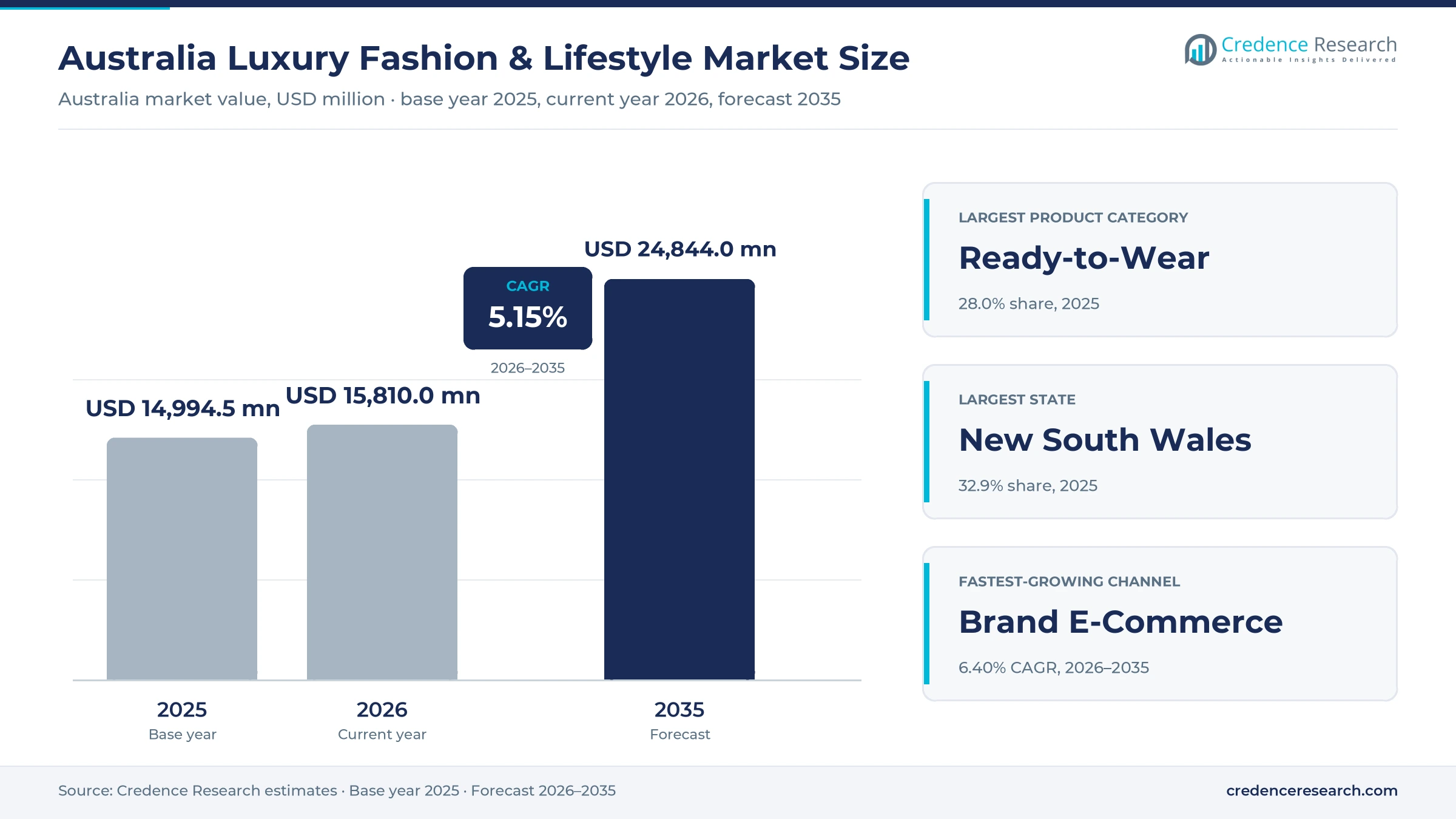
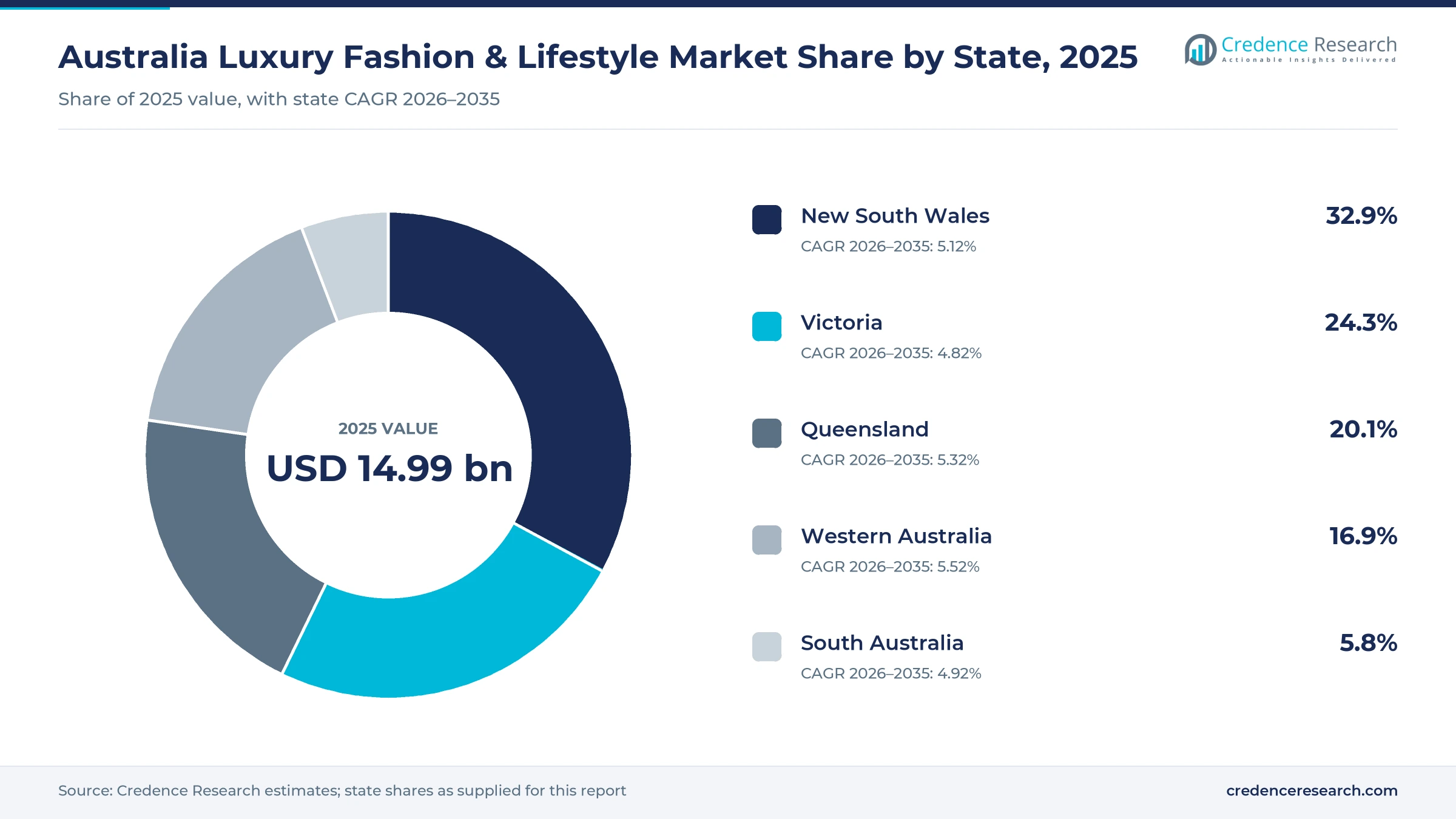
The Australia luxury fashion & lifestyle market was valued at USD 14.99 billion in 2025 and is projected to increase from USD 15.81 billion in 2026 to USD 24.84 billion by 2035, registering a CAGR of 5.15% during 2026–2035. Demand comes from affluent residents who buy handbags, ready-to-wear, footwear, watches and fine jewelry, and from international visitors who shop in Sydney and Melbourne before flying home. New South Wales held the largest state share, 32.9% in 2025, because Sydney hosts the densest cluster of flagship boutiques around Castlereagh, King and Market Streets. Western Australia is the fastest-growing state at 5.52% a year, supported by rapid population growth and rising visitor spending. Meanwhile, international visitor spending reached a record pace in the December quarter of 2025, and European houses kept enlarging city stores. As a result, demand is shifting toward larger boutiques that combine fashion, leather goods, watches and private client rooms under one roof.
Which designer goods and store formats are counted?
The estimate counts retail spending in Australia on luxury ready-to-wear, handbags and leather goods, footwear, fine jewelry, watches, accessories and fragrances sold under luxury and designer labels. It covers sales through brand boutiques, luxury department stores, multi-brand designer retailers, brand websites and airport stores, and it includes purchases made by international tourists inside the country.
The estimate excludes luxury cars, hotels, dining, wine and spirits, and second-hand resale between consumers. It also excludes goods that Australians buy overseas or from offshore websites without local fulfillment. The value chain runs from European and Asian design houses through local subsidiaries, licensees and wholesale partners to boutiques and the final customer.
Australia Luxury Fashion & Lifestyle Market Insights
- The market was valued at USD 14.99 billion in 2025 and is projected to reach USD 24.84 billion by 2035, registering a CAGR of 5.15% during 2026–2035.
- New South Wales held 32.9% of Australian spending in 2025, because Sydney hosts the largest cluster of flagship boutiques and airport stores.
- Mono-brand boutiques led with 46.0% of 2025 value, as global houses keep control of pricing, service and stock in their own stores.
- International visitors spent $9.8 billion in Australia in the December quarter of 2025, up 27% on a year earlier, which lifted city-center luxury sales.
- Chanel opened its largest Australian store on Market Street in Sydney in 2025, adding the country's first dedicated Chanel watches and fine jewelry space.
Leather goods and apparel lead while jewelry grows fastest
Why do leather goods and apparel hold the largest shares?
Based on product category, the market is categorized into ready-to-wear apparel, handbags and leather goods, footwear, fine jewelry and watches, and accessories and fragrances. Ready-to-Wear Apparel led with 28.0% of 2025 value, because seasonal collections bring repeat visits from loyal clients. Fine Jewellery & Watches grows fastest at 5.61% a year, as houses open dedicated watch and jewelry rooms in Sydney and Melbourne.
How does spending split across price tiers?
Based on price tier, the market is categorized into accessible luxury, premium luxury, high luxury and ultra-luxury or couture. Accessible Luxury led with 38.0% of 2025 value, because small leather goods, fragrances and entry handbags reach a wide group of buyers. Ultra-Luxury / Couture grows fastest at 5.73% a year, as private appointments and made-to-order pieces attract the wealthiest clients in every major city.
Which buyers generate the most luxury spending?
Based on customer type, the market is categorized into domestic affluent consumers, resident high-net-worth individuals, international tourists, aspirational premium buyers and corporate gift buyers. Domestic Affluent Consumers led with 42.0% of 2025 value, because they shop year-round across every category. International Tourists grow fastest at 6.04% a year, as visitor arrivals and visitor spending keep recovering.
Where do Australians buy luxury goods?
Based on distribution channel, the market is categorized into mono-brand boutiques, luxury department stores, multi-brand designer retailers, brand e-commerce platforms and travel retail. Mono-Brand Boutiques led with 46.0% of 2025 value, because global houses control service, pricing and stock in their own stores. Brand E-Commerce Platforms grow fastest at 6.40% a year, as buyers research and reserve online first.
| Segment Group | Leading Sub-segment | Share, 2025 | Fastest-growing Sub-segment | CAGR, 2026–2035 |
|---|---|---|---|---|
| By Product Category | Ready-to-Wear Apparel | 28.0% | Fine Jewellery & Watches | 5.61% |
| By Price Tier | Accessible Luxury | 38.0% | Ultra-Luxury / Couture | 5.73% |
| By Customer Type | Domestic Affluent Consumers | 42.0% | International Tourists | 6.04% |
| By Distribution Channel | Mono-Brand Boutiques | 46.0% | Brand E-Commerce Platforms | 6.40% |
Request a Free Sample
Fill in your details and we'll send you a free sample report.
- Sample data tables & charts
- Research methodology
Wealth, tourism and omnichannel selling lift spending
How does affluent consumer density support spending?
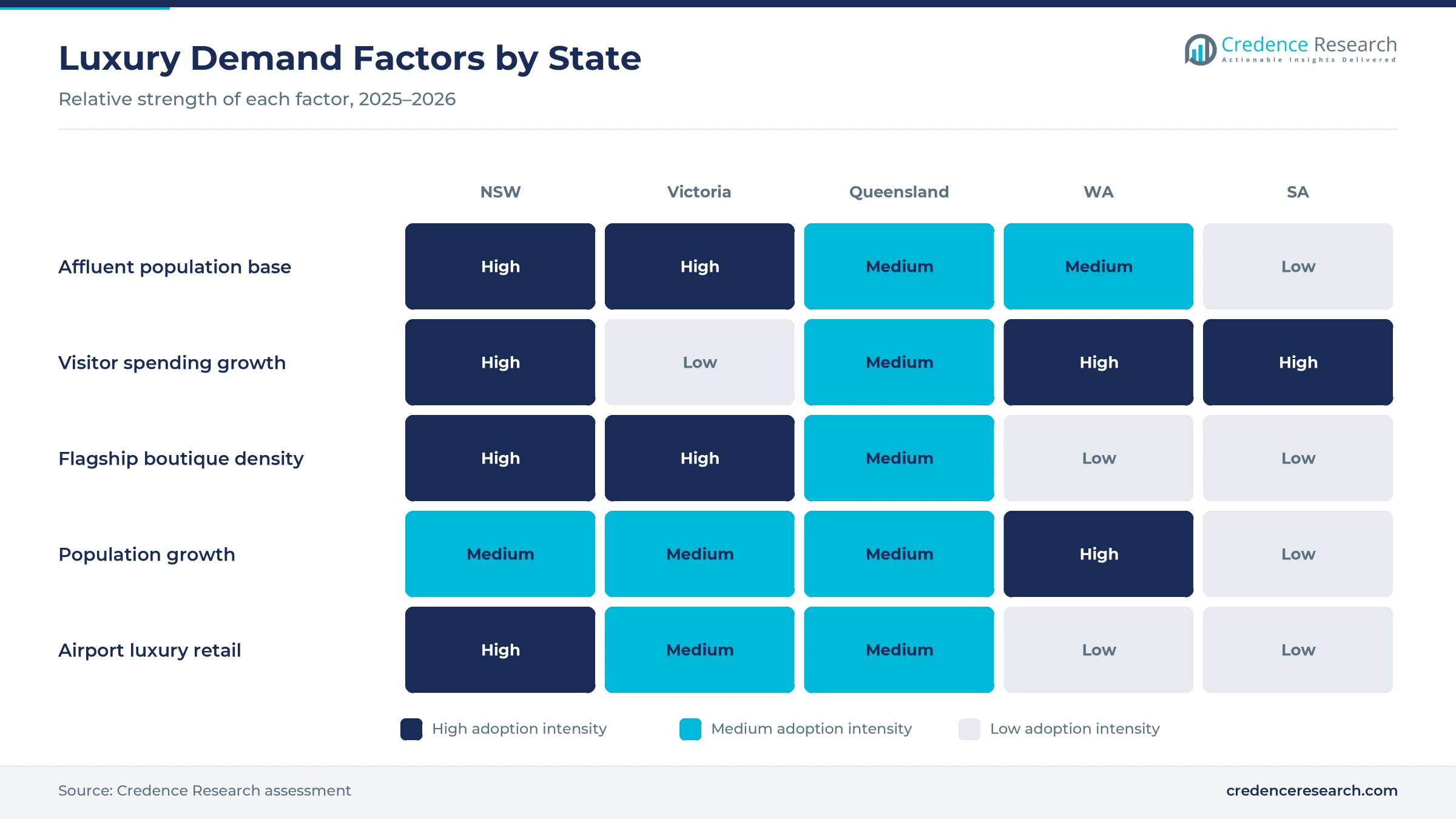
Affluent consumer density is the core driver of fashion lifestyle demand, because a large share of Australian households can afford regular luxury purchases. Australia's GDP per capita reached about $65,130 in 2025, according to World Bank data, one of the highest levels in the world. Total household wealth also rose 1.0%, or A$201.1 billion, in the June quarter of 2026, according to the ABS, led by superannuation balances. In turn, wealthy suburbs around Sydney, Melbourne, Brisbane and Perth sustain boutique traffic in every season of the year. As a result, domestic affluent consumers held a 42.0% share of 2025 value, the largest buyer group in the market, and they shop across handbags, apparel, watches and jewelry.
Why does international tourism recovery lift boutique sales?
International tourism recovery lifts boutique sales, because visitors buy luxury goods in city stores and claim tax refunds when they leave. Visitors spent $9.8 billion in the December quarter of 2025, up 27% on a year earlier, according to Tourism Research Australia. China accounted for 29% of visitor spending in the year to December 2025, and Chinese spending rose 39%. Travelers lodged 957,000 claims under the Tourist Refund Scheme in 2024-25, receiving $318.7 million, and Chinese tourists made 33% of the claims. Therefore, international tourists grow at 6.04% a year, the fastest customer group in Australian luxury retail and a key source of new boutique demand.
How does omnichannel selling widen the buyer base?
Omnichannel selling widens the buyer base for luxury fashion lifestyle brands, because shoppers now browse, reserve and pay online before collecting in boutiques. Australians spent a record $82.6 billion online in 2025, up 13.9%, according to Australia Post data. About 9.8 million households shopped online during the year, and fashion and apparel was the second-largest category at $11.6 billion. Luxury houses use their own websites, live chat and click-and-collect to reach clients outside the major cities. As a result, brand e-commerce platforms grow at 6.40% a year, the fastest channel, while boutiques remain the place where most clients complete higher-value purchases of designer handbags and jewelry.
Do larger city flagships pull spending into boutiques?
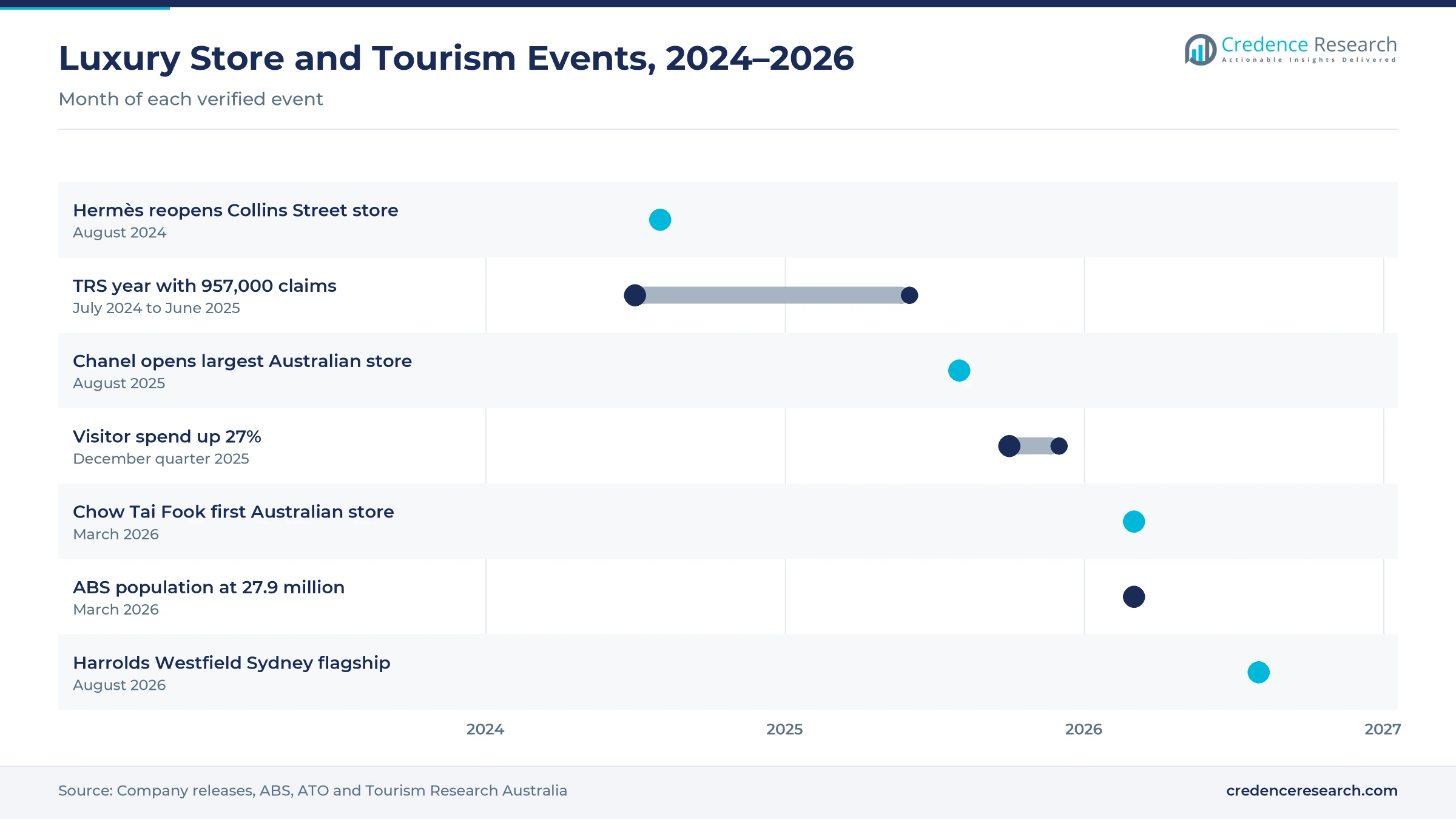
Larger city flagships pull fashion lifestyle spending into boutiques, because global houses are investing in bigger stores with private client rooms. In August 2024, Hermès reopened its two-floor store at 71 Collins Street in Melbourne after a year-long renovation. Chanel opened its largest Australian store in the former David Jones menswear building on Market Street in Sydney in 2025. Chow Tai Fook opened its first Australian store at Westfield Sydney in March 2026, and Harrolds opened a new Westfield Sydney flagship in August 2026. Consequently, mono-brand boutiques held a 46.0% share of 2025 value, the largest channel and department stores lean on concessions for women's apparel and beauty.
Flagships, watch salons and travel retail reshape buying
Why are watch and fine jewelry salons expanding?
Watch and fine jewelry salons are expanding, because houses see high-value hard luxury as a steady source of repeat clients. Chanel opened Australia's first dedicated Chanel watches and fine jewelry space beside its Market Street store in 2025, with its own entrance from the mall. Piaget had already opened a Sydney flagship at 84 King Street in 2023, selling pieces priced from four to six figures. Chow Tai Fook then added a Westfield Sydney store with a VIP lounge in March 2026. In turn, fine jewellery and watches grow at 5.61% a year, the fastest product category, as clients shift spending toward prestige watches and diamonds that hold value over time.
How is airport retail shifting luxury buying?
Airport retail is shifting luxury buying toward departure halls, because visitors and outbound Australians shop before boarding. Sydney Airport built a luxury precinct in its T1 International terminal, where Louis Vuitton opened its largest stand-alone travel retail store worldwide. Dior, Gucci and Valentino opened in the same phase, after Burberry, Hermès and Prada opened in an earlier one, and Gucci expanded its airport store to more than 225 square meters. China was the second-largest source of short-term visitor arrivals in July 2026, with 117,440 trips, according to the ABS. Therefore, airport stores give houses a second point of sale for travelers, and duty-free shopping keeps gaining share of departing visitor spend.
Can Western and South Australia open new store opportunities?
Western Australia and South Australia offer an opening for new stores, because visitor spending and population are growing faster there than in the eastern states. Visitor spending rose 30% in Western Australia and 31% in South Australia in the year to December 2025, against 7% in Victoria. Western Australia's population grew 2.1% to about 3.10 million in the year to March 2026, according to the ABS, the fastest rate in the country. As a result, Western Australia is the fastest-growing state in this report, and Perth can support more boutiques for designer footwear, handbags and watches over the forecast period.
Will private salons and hospitality lift high-end spending?
Private salons and in-store hospitality offer a second opening, because the wealthiest clients want discreet service and time with advisers. Harrolds designed its 2026 Westfield Sydney flagship around brand spaces for Brioni, Thom Browne, Stefano Ricci and Lardini, with a lounge serving coffee, Champagne and wine. Hermès built salon-style reception areas for privacy at Collins Street at 71 Collins Street, where the upper floor also shows some of its 16 craft disciplines, and Chow Tai Fook added a VIP lounge for private consultations. Therefore, ultra-luxury and couture grows at 5.73% a year, the fastest price tier, as retailers turn store visits into appointments that are hard to copy online.
Softer arrivals, rents and GST rules test retailers
How do softer visitor arrivals affect city stores?
Softer visitor arrivals can slow city-center fashion lifestyle sales, because tourists buy a large share of handbags and watches in Sydney and Melbourne. Short-term visitor arrivals fell 4.3% to 710,980 in July 2026, according to the ABS, and stayed below July 2019 levels. As a result, boutiques that depend on tour groups can see uneven months. Retailers respond by building local client books, hosting private events and adding Mandarin-speaking advisers for higher-spending visitors who still arrive.
Why do rents and fit-out costs weigh on retailers?
Rents and fit-out costs weigh on fashion lifestyle retailers, because prime CBD sites on Castlereagh, King and Collins Streets carry high occupancy costs. Heritage buildings also demand long renovations, as the year-long Hermès Melbourne project showed. Smaller multi-brand retailers and licensees feel this pressure most in prime city locations. Therefore, some brands share precincts with landlords, choose shopping-center locations or open smaller satellite stores, while larger houses absorb costs through higher-margin categories.
How do GST rules and refund checks affect tourist sales?
GST rules and refund checks affect tourist sales, because the Tourist Refund Scheme returns tax only on goods taken out of the country. Authorities processed 957,000 claims in 2024-25, and Australian residents made 27% of them, which keeps compliance under review. Stricter checks could slow some purchases of watches and jewelry. In turn, retailers train staff on refund rules and keep clear invoices so that genuine visitors can claim without delays at the airport.
Do counterfeits and price gaps divert demand?
Counterfeits and price gaps divert demand, because Australian fashion lifestyle prices often sit above prices in Europe after freight, duties and exchange rates. Some shoppers buy overseas during holidays or turn to resale platforms instead. As a result, local boutiques can lose entry-level sales of small leather goods and accessories. Brands answer with local exclusives, after-sales repair, authentication services and loyalty events that give clients reasons to buy at home.
New South Wales leads while Western Australia grows fastest
| State | Value, 2025 (USD billion) | Share, 2025 | CAGR, 2026–2035 |
|---|---|---|---|
| New South Wales | 4.93 | 32.9% | 5.12% |
| Victoria | 3.64 | 24.3% | 4.82% |
| Queensland | 3.01 | 20.1% | 5.32% |
| Western Australia | 2.53 | 16.9% | 5.52% |
| South Australia | 0.87 | 5.8% | 4.92% |
Why do Sydney boutiques give new South Wales the lead?
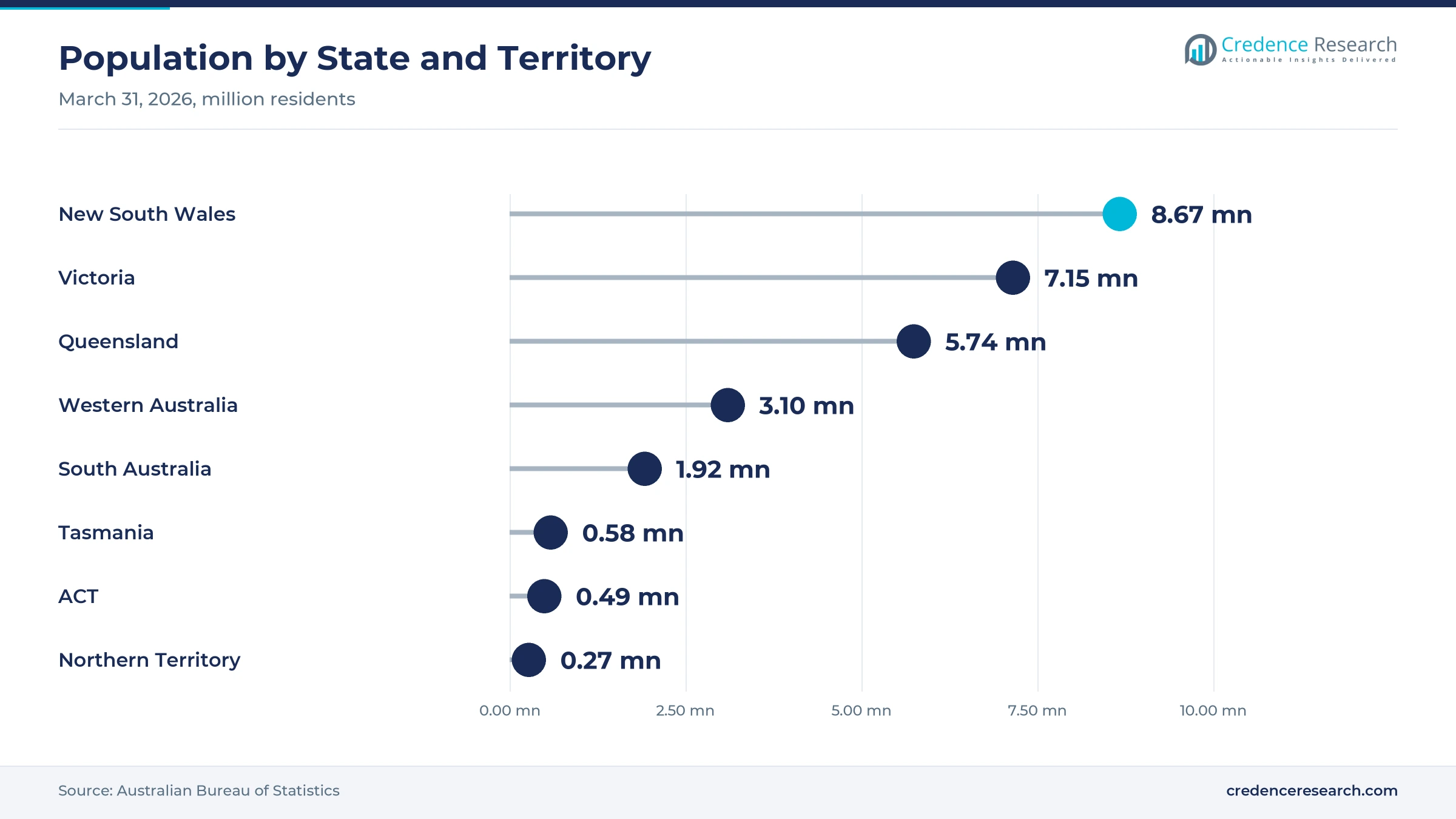
New South Wales held a 32.9% share of 2025 state value and grows at 5.12% a year. This lead reflects Sydney's large, wealthy population, about 8.67 million state residents at March 2026, and the Sydney Airport T1 luxury precinct serves departing visitors. Chanel, Tiffany & Co., Piaget and Valentino operate CBD stores, while Westfield Sydney hosts several flagships. Visitor spending in the state rose 25% in the year to December 2025, which supports handbags, watches and jewelry.
How does Collins Street anchor victorian luxury demand?
Victoria held a 24.3% share of 2025 state value and grows at 4.82% a year. Melbourne's Collins Street remains the main luxury address, where Hermès reopened its renovated two-floor store in August 2024. The state population grew 1.6% to about 7.15 million in the year to March 2026. However, visitor spending in Victoria rose only 7% in 2025, which keeps growth below the national rate as domestic clients carry most sales.
How do Brisbane and Gold Coast shoppers support Queensland?
Queensland held a 20.1% share of 2025 state value and grows at 5.32% a year. Brisbane and the Gold Coast combine a growing population of about 5.74 million with strong holiday travel. Visitor spending in the state rose 20% in the year to December 2025. Therefore, Queensland supports resort-style boutiques and department store concessions that serve both local professionals and visitors buying fragrances, footwear and accessories.
Why do Perth luxury sales outpace other states?
Western Australia held a 16.9% share of 2025 state value and grows at 5.52% a year, the fastest state. Its population rose 2.1% to about 3.10 million in the year to March 2026, the quickest rate in the country. Visitor spending also rose 30% in 2025, so Perth retailers see more demand for watches, jewelry and leather goods from both resource-sector earners and visitors.
What role do adelaide department stores play?
South Australia held a 5.8% share of 2025 state value and grows at 4.92% a year. Adelaide has about 1.92 million state residents and fewer mono-brand boutiques, so department stores and multi-brand retailers carry more of the sales. Visitor spending in the state rose 31% in 2025, giving retailers a growing base of tourist shoppers.
Flagship openings and tourism data from 2024 to 2026
| Development | Status and market relevance |
|---|---|
| In August 2024, Hermès reopened its Melbourne store at 71 Collins Street after a year-long renovation of the heritage Harley House building. | Two floors of leather goods, silk, watches, jewelry and ready-to-wear |
| In August 2025, Chanel opened its largest Australian store on Market Street in Sydney, with a separate watches and fine jewelry space. | Strengthens hard luxury and ready-to-wear supply in the Sydney CBD |
| In March 2026, Chow Tai Fook opened its first Australian store at Westfield Sydney, with a VIP lounge for private consultations. | Adds a large Asian jewelry house to the Sydney luxury cluster |
| In August 2026, Harrolds opened a new Westfield Sydney flagship with brand spaces for Brioni, Thom Browne, Stefano Ricci and Lardini. | Expands multi-brand menswear and hospitality-led selling |
Clienteling, online stores and private salons ahead
- Clienteling apps let advisers track preferences, sizes and past purchases, which helps boutiques invite clients to private previews and events.
- Brand e-commerce sites offer delivery, click-and-collect and online appointments, which bring clients in regional areas into the brand network.
- Digital tax refund checks speed up refund claims for departing visitors, which supports watch and jewelry sales in city stores.
- Authentication and repair services protect resale value and build trust, which helps houses compete with grey-market and counterfeit goods.
Need a Custom Version of This Report?
Tailor the scope, geography, or segments to your exact requirements.
- Custom geography or segment scope
- Direct access to our analyst team
European houses compete with local multi-brand retailers
Competition centers on European fashion houses that run their own boutiques, alongside local multi-brand retailers and department stores. Chanel opened its largest Australian store on Market Street in Sydney in 2025, and Hermès reopened its Collins Street store in Melbourne in 2024. Louis Vuitton operates its largest stand-alone travel retail store worldwide at Sydney Airport, where Dior, Gucci, Valentino, Burberry, Hermès and Prada also trade. Valentino has a CBD store on Castlereagh Street in Sydney. Fendi and Versace were not verified in this run beyond brand lists, so they are not profiled here. Local retailer Harrolds competes through multi-brand menswear, while Chow Tai Fook entered the country in 2026. Houses compete on product exclusivity, store experience, private service and control of pricing.
Companies profiled and their roles in this market
| Company | Type | Role in the market |
|---|---|---|
| Chanel | Global fashion house | Largest Australian store on Market Street, Sydney, with a watches and fine jewelry space |
| Hermès | Global fashion house | Renovated two-floor Collins Street store in Melbourne and a Sydney Airport boutique |
| Louis Vuitton | Global fashion house | Largest stand-alone travel retail store worldwide at Sydney Airport T1 |
| Gucci | Global fashion house | Westfield Sydney flagship and an enlarged Sydney Airport store |
| Valentino | Global fashion house | Castlereagh Street precinct store and a Sydney Airport boutique |
| Dior | Global fashion house | Sydney Airport boutique in the T1 luxury precinct |
| Burberry | Global fashion house | Sydney Airport boutique in the T1 luxury precinct |
| Prada | Global fashion house | Sydney Airport boutique in the T1 luxury precinct |
Credence Research view on growth and risk
Credence Research's view is that Australian luxury fashion & lifestyle spending will grow steadily, because wealthy households and returning visitors support demand in every major city. Hard luxury and private client service will gain the most, as houses enlarge boutiques and add watch and jewelry rooms. Online channels will grow quickly but will mostly support store visits rather than replace them. However, softer arrivals, high rents and price gaps with Europe remain risks, so growth will favor brands that combine local client books with strong tourist service.
Model inputs behind the luxury spending estimate
The report uses 2025 as the base year on a calendar basis, with values in USD million at current prices. Market values come from the Credence Research model, which links household wealth, visitor spending and store networks by category. State shares were supplied for this report, and luxury fashion & lifestyle segment splits and growth rates are Credence Research estimates. Sources used are ABS statistics, Tourism Research Australia data, ATO reports, World Bank data, postal e-commerce data and company announcements, and no interviews or surveys were used.
Tourists, jewelry and online sales shape 2035 demand
Luxury fashion & lifestyle spending is expected to reach USD 24.84 billion by 2035, a 5.15% CAGR during 2026–2035, as wealth and tourism keep supporting boutique sales. Growth should be steady through the late 2020s as new flagships in Sydney and Melbourne mature and visitor numbers recover. After that, fine jewelry, watches and online sales should lift demand, while Western Australia gains share. Weaker arrivals or sharp price increases could slow some years, although affluent residents should keep the base of the market stable.
Frequently Asked Questions
How big is the Australia luxury fashion & lifestyle market?
Which state leads luxury spending in Australia?
Which product category holds the largest share?
How important are international tourists?
Which state grows fastest through 2035?
Which channel grows fastest?
Which companies compete in this market?
What are the main risks for luxury retailers?
Table of Content
Chapter 1 Market Segmentation
- 1.1 Segmentation Framework
- 1.1.1 Product and Service Classification
- 1.1.2 Application and End-Use Classification
- 1.1.3 Technology and Solution Classification
- 1.1.4 Customer and Distribution Channel Classification
- 1.1.5 Geographic Segmentation
- 1.1.6 Market Segment Definitions and Boundaries
- 1.2 By Product Category
- 1.2.1 Ready-to-Wear Apparel
- 1.2.2 Handbags & Leather Goods
- 1.2.3 Fine Jewellery & Watches
- 1.2.4 Footwear
- 1.2.5 Accessories & Fragrances
- 1.3 By Price Tier
- 1.3.1 Accessible Luxury
- 1.3.2 Premium Luxury
- 1.3.3 High Luxury
- 1.3.4 Ultra-Luxury / Couture
- 1.4 By Customer Type
- 1.4.1 Domestic Affluent Consumers
- 1.4.2 International Tourists
- 1.4.3 Resident HNWIs
- 1.4.4 Aspirational Premium Buyers
- 1.4.5 Corporate Gift Buyers
- 1.5 By State
- 1.5.1 New South Wales
- 1.5.2 Victoria
- 1.5.3 Queensland
- 1.5.4 Western Australia
- 1.5.5 South Australia
Chapter 2 Introduction
- 2.1 Report Objectives and Scope
- 2.2 Product Definition and Industry Terminology
- 2.3 Market Inclusions and Exclusions
- 2.4 Research Process
- 2.4.1 Primary Research and Expert Interviews
- 2.4.2 Secondary Research and Source Review
- 2.4.3 Top-Down and Bottom-Up Estimation
- 2.4.4 Data Triangulation and Verification
- 2.5 Market Size Measurement Basis
- 2.5.1 2025: USD 14.99 billion → 2035: USD 24.84 billion
- 2.6 Historical and Forecast Reference Periods
- 2.6.1 Historical Period: 2018-2025
- 2.6.2 Base Year: 2025
- 2.6.3 Forecast Period: 2025-2035
- 2.7 Research Assumptions and Limitations
Chapter 3 Executive Summary
- 3.1 Market Snapshot and Key Findings
- 3.2 Base-Year Market Size, 2025
- 3.3 Forecast Market Size, 2035
- 3.4 Revenue and Volume Growth Outlook
- 3.5 Key Demand and Supply Indicators
- 3.6 Leading Market Segments
- 3.7 Fastest-Growing Market Opportunities
- 3.8 Regional Performance Highlights
- 3.9 Technology and Industry Transformation
- 3.10 Competitive Landscape Summary
- 3.11 Analyst View and Strategic Implications
Chapter 4 Australia Luxury Fashion & Lifestyle Market Trends and Developments
- 4.1 Historical Industry Development, 2018-2025
- 4.2 Recent Market Trends and Developments
- 4.3 Demand and Customer Behavior Trends
- 4.4 Technology and Product Innovation
- 4.5 Artificial Intelligence, Automation and Digitalization
- 4.6 Local Manufacturing and Supply Chain Realignment
- 4.7 Industry Partnerships, Mergers and Acquisitions
- 4.8 Sustainability and Circular Economy Developments
- 4.9 Government and Private Sector Investment Trends
- 4.10 Emerging Business Models and Commercialization
- 4.11 Industry Developments and Announcements
Chapter 5 Australia Luxury Fashion & Lifestyle Market Production, Supply and Demand Analysis
- 5.1 Demand Trend and Consumption Analysis, 2018-2025
- 5.2 Demand Forecast, 2025-2035
- 5.3 Production and Output Trend, 2018-2025
- 5.4 Production and Output Forecast, 2025-2035
- 5.5 Installed Capacity and Capacity Utilization
- 5.6 Company-Wise Production Plants and Statistics
- 5.6.1 Installed Production Capacity
- 5.6.2 Actual Production
- 5.6.3 Planned Capacity and Expansion Targets
- 5.7 Supply Chain Structure and Procurement Trends
- 5.8 Supply-Demand Gap and Bottlenecks
- 5.9 Import Dependence and Sourcing Structure
- 5.10 Contract Manufacturing and Outsourcing
- 5.11 Regional Supply and Demand Concentration
Chapter 6 Australia Luxury Fashion & Lifestyle Market Pricing Analysis
- 6.1 Pricing Structure and Measurement
- 6.2 Historical Pricing Trends, 2018-2025
- 6.3 Pricing Outlook, 2025-2035
- 6.4 Average Selling Price and Unit Economics
- 6.5 Pricing by Product and Market Segment
- 6.6 Geographic Pricing Differences
- 6.7 Key Input, Energy, Labor and Logistics Costs
- 6.8 Contract Pricing and Purchasing Models
- 6.9 Pricing Sensitivity and Competitive Positioning
- 6.10 Price, Margin and Profitability Implications
Chapter 7 Australia Luxury Fashion & Lifestyle Market Dynamics
- 7.1 Market Growth Drivers
- 7.1.1 Demand-Side Drivers
- 7.1.2 Technology and Innovation Drivers
- 7.1.3 Infrastructure and Investment Drivers
- 7.1.4 Regulatory and Policy Drivers
- 7.2 Market Restraints
- 7.2.1 Cost and Affordability Constraints
- 7.2.2 Technology and Adoption Barriers
- 7.2.3 Supply Chain and Operational Constraints
- 7.3 Market Challenges
- 7.3.1 Competitive Pressure and Margin Erosion
- 7.3.2 Skills, Infrastructure and Implementation Gaps
- 7.4 Emerging Market Opportunities
- 7.5 Market Dynamics Impact and Time-Horizon Assessment
Chapter 8 Australia Luxury Fashion & Lifestyle Value Chain Analysis
- 8.1 Industry Value Chain Overview
- 8.2 Upstream Suppliers and Critical Inputs
- 8.3 Technology and Component Providers
- 8.4 Manufacturing or Service Delivery
- 8.5 Distribution, Channel Partners and Integrators
- 8.6 Downstream Applications and End Users
- 8.7 Value Addition and Profit Pools
- 8.8 Vertical Integration and Outsourcing
- 8.9 Supplier Concentration and Risk
- 8.10 Supply Chain Localization and Resilience
Chapter 9 Australia Luxury Fashion & Lifestyle Market Regulations and Policies
- 9.1 Relevant Laws, Standards and Compliance Frameworks
- 9.2 Product, Service, Safety and Quality Requirements
- 9.3 Government Policies, Incentives and Subsidies
- 9.4 Imports, Exports and Trade Barriers
- 9.5 Public Procurement and Local Content Requirements
- 9.6 Environmental and Sustainability Compliance
- 9.7 Upcoming Policy Changes and Market Implications
Chapter 10 Australia Luxury Fashion & Lifestyle Market Hotspots and Opportunities
- 10.1 Market Opportunity Mapping and Growth Hotspots
- 10.2 High-Growth Applications and Customer Groups
- 10.3 Underserved Markets and White-Space Opportunities
- 10.4 Emerging Technology and Product Opportunities
- 10.5 New Capacity and Investment Hotspots
- 10.6 Market Entry and Expansion Opportunities
- 10.7 Distribution and Partnership Opportunities
- 10.8 Near-Term and Long-Term Commercial Potential
- 10.9 Opportunity Attractiveness and Execution Risks
Chapter 11 Australia Luxury Fashion & Lifestyle Market Outlook, 2025-2035
- 11.1 Market Size and Analysis
- 11.1.1 Revenue (Market Measurement: 2025: USD 14.99 billion → 2035: USD 24.84 billion)
- 11.1.2 Market Volume and Quantity Sold
- 11.1.3 Historical Market Size, 2018-2025
- 11.1.4 Base-Year Market Size, 2025
- 11.2 Market Forecast, 2025-2035
- 11.2.1 Revenue Forecast to 2035
- 11.2.2 Volume Forecast to 2035
- 11.2.3 CAGR and Year-on-Year Growth
- 11.2.4 Incremental Revenue Opportunity
- 11.3 Forecast Assumptions and Scenario Analysis
- 11.3.1 Base-Case Forecast
- 11.3.2 Optimistic and Conservative Scenarios
- 11.3.3 Technology, Pricing and Policy Sensitivities
- 11.4 Market Attractiveness and Growth Outlook
Chapter 12 Australia Luxury Fashion & Lifestyle Market Segmentation and Outlook
- 12.1 Segmentation Summary and Market Shares, 2025
- 12.2 Largest and Fastest-Growing Segments
- 12.3 By Product Category - Market Size and Forecast, 2025-2035
- 12.3.1 Segment Definition and Scope
- 12.3.2 Historical Market Size, 2018-2025
- 12.3.3 Revenue Forecast, 2025-2035
- 12.3.4 Volume Forecast, 2025-2035
- 12.3.5 Base-Year Market Share, 2025
- 12.3.6 Segment CAGR and Growth Drivers
- 12.3.7 Subsegment Market Size and Forecast
- 12.3.7.1 Ready-to-Wear Apparel
- 12.3.7.2 Handbags & Leather Goods
- 12.3.7.3 Fine Jewellery & Watches
- 12.3.7.4 Footwear
- 12.3.7.5 Accessories & Fragrances
- 12.3.8 Subsegment Pricing and Adoption Trends
- 12.3.9 Leading Suppliers and Competition
- 12.3.10 Regional Demand and Opportunities
- 12.4 By Price Tier - Market Size and Forecast, 2025-2035
- 12.4.1 Segment Definition and Scope
- 12.4.2 Historical Market Size, 2018-2025
- 12.4.3 Revenue Forecast, 2025-2035
- 12.4.4 Volume Forecast, 2025-2035
- 12.4.5 Base-Year Market Share, 2025
- 12.4.6 Segment CAGR and Growth Drivers
- 12.4.7 Subsegment Market Size and Forecast
- 12.4.7.1 Accessible Luxury
- 12.4.7.2 Premium Luxury
- 12.4.7.3 High Luxury
- 12.4.7.4 Ultra-Luxury / Couture
- 12.4.8 Subsegment Pricing and Adoption Trends
- 12.4.9 Leading Suppliers and Competition
- 12.4.10 Regional Demand and Opportunities
- 12.5 By Customer Type - Market Size and Forecast, 2025-2035
- 12.5.1 Segment Definition and Scope
- 12.5.2 Historical Market Size, 2018-2025
- 12.5.3 Revenue Forecast, 2025-2035
- 12.5.4 Volume Forecast, 2025-2035
- 12.5.5 Base-Year Market Share, 2025
- 12.5.6 Segment CAGR and Growth Drivers
- 12.5.7 Subsegment Market Size and Forecast
- 12.5.7.1 Domestic Affluent Consumers
- 12.5.7.2 International Tourists
- 12.5.7.3 Resident HNWIs
- 12.5.7.4 Aspirational Premium Buyers
- 12.5.7.5 Corporate Gift Buyers
- 12.5.8 Subsegment Pricing and Adoption Trends
- 12.5.9 Leading Suppliers and Competition
- 12.5.10 Regional Demand and Opportunities
- 12.6 By State - Market Size and Forecast, 2025-2035
- 12.6.1 Segment Definition and Scope
- 12.6.2 Historical Market Size, 2018-2025
- 12.6.3 Revenue Forecast, 2025-2035
- 12.6.4 Volume Forecast, 2025-2035
- 12.6.5 Base-Year Market Share, 2025
- 12.6.6 Segment CAGR and Growth Drivers
- 12.6.7 Subsegment Market Size and Forecast
- 12.6.7.1 New South Wales
- 12.6.7.2 Victoria
- 12.6.7.3 Queensland
- 12.6.7.4 Western Australia
- 12.6.7.5 South Australia
- 12.6.8 Subsegment Pricing and Adoption Trends
- 12.6.9 Leading Suppliers and Competition
- 12.6.10 Regional Demand and Opportunities
- 12.7 Segment Growth Comparison
- 12.8 Segment Attractiveness and Priority Matrix
Chapter 13 Australia Luxury Fashion & Lifestyle End-Use and Application Market Outlook
- 13.1 End-Use Industry and Customer Demand Structure
- 13.2 Leading Applications and Customer Groups
- 13.3 End-Use Market Size, Share and Forecast
- 13.4 Major End-Use Industry Deep Dives
- 13.4.1 Customer Requirements and Use Cases
- 13.4.2 Demand and Replacement Cycles
- 13.4.3 Technical and Regulatory Considerations
- 13.4.4 Purchasing and Procurement Models
- 13.4.5 Leading Vendors and Distribution Channels
- 13.4.6 Forecast and Commercial Opportunities
- 13.5 Emerging Applications and Cross-Segment Demand
- 13.6 End-Use Industry Investment Priorities
Chapter 14 Australia Luxury Fashion & Lifestyle Geographic Market Outlook, 2025-2035
- 14.1 Regional Market Size and Country-Level Shares, 2025
- 14.2 Country Market Size Comparison, 2025
- 14.3 Country Market Forecasts, 2025-2035
- 14.4 Subregional Industrial and Demand Clusters
- 14.5 Intra-Regional Pricing and Cost Differences
- 14.6 Cross-Border Trade and Supply Networks
- 14.7 Regional Supply and Demand Balances
- 14.8 Country Opportunity Comparison and Prioritization
Note: Every listed country is covered on the structure shown under the first country.
Chapter 15 Australia Luxury Fashion & Lifestyle Technology, Innovation and Sustainability Outlook
- 15.1 Technology Landscape and Maturity
- 15.2 Product, Process and Service Innovation
- 15.3 AI, Automation and Digital Tools in the Industry
- 15.4 Technology Adoption and Performance Benchmarking
- 15.5 Innovation Pipeline and R&D Investment
- 15.6 Patent and Intellectual Property Trends
- 15.7 Energy Efficiency and Resource Management
- 15.8 Sustainability, Recycling and Circularity
- 15.9 Technology Roadmap, 2025-2035
- 15.10 Risks of Obsolescence and Technology Substitution
Chapter 16 Australia Luxury Fashion & Lifestyle Market Key Strategic Imperatives
- 16.1 Growth and Market Entry Priorities
- 16.2 High-Return Products and Segments
- 16.3 Pricing, Profitability and Cost Optimization
- 16.4 Technology Investment and Product Differentiation
- 16.5 Supply Chain Localization and Resilience
- 16.6 Distribution and Customer Acquisition
- 16.7 Partnership, Acquisition and Capacity Strategy
- 16.8 Regional Expansion Priorities
- 16.9 Short-, Medium- and Long-Term Actions
Chapter 17 Competition Outlook
- 17.1 Industry Competition Characteristics
- 17.2 Market Structure and Concentration
- 17.3 Market Share and Competitive Positioning, 2025
- 17.4 Company-Wise Revenue and Product Benchmarking
- 17.5 Production and Service Capacity Benchmarking
- 17.6 Technology, Pricing and Differentiation
- 17.7 Regional Footprint and Distribution Strength
- 17.8 Mergers, Acquisitions and Strategic Alliances
- 17.9 New Entrants and Competitive Threats
- 17.10 Porter's Five Forces and Industry Attractiveness
- 17.11 Competitive Outlook, 2025-2035
Chapter 18 Company Profiles
- 18.1 Company Coverage and Selection Criteria
- 18.2 Louis Vuitton
- 18.2.1 Business Description
- 18.2.2 Company Ownership and Geographic Presence
- 18.2.3 Product and Service Portfolio
- 18.2.4 Manufacturing and Operating Footprint
- 18.2.5 Production Capacity and Expansion Plans
- 18.2.6 Financial Performance and Investment
- 18.2.7 Market Share and Competitive Position
- 18.2.8 Technology and Innovation Capabilities
- 18.2.9 Strategic Alliances or Partnerships
- 18.2.10 Recent Developments
- 18.2.11 Growth Strategy and Outlook
- 18.3 Gucci
- 18.4 Chanel
- 18.5 Prada
- 18.6 Burberry
- 18.7 Hermès
- 18.8 Dior
- 18.9 Fendi
- 18.10 Versace
- 18.11 Valentino
- 18.12 Other Relevant Market Participants
Note: Every listed company is profiled on the structure shown under the first company. The company list is preliminary and may change based on research findings, market developments, data availability and client requirements.
Chapter 19 Disclaimer
- 19.1 Research and Forecast Disclaimer
- 19.2 Data Source and Estimation Limitations
Note: The depth of individual sections depends on data availability for this market. Volume, capacity, trade and other unit-based metrics are included where applicable.

