
Vietnam households trade up to larger inverter fridges
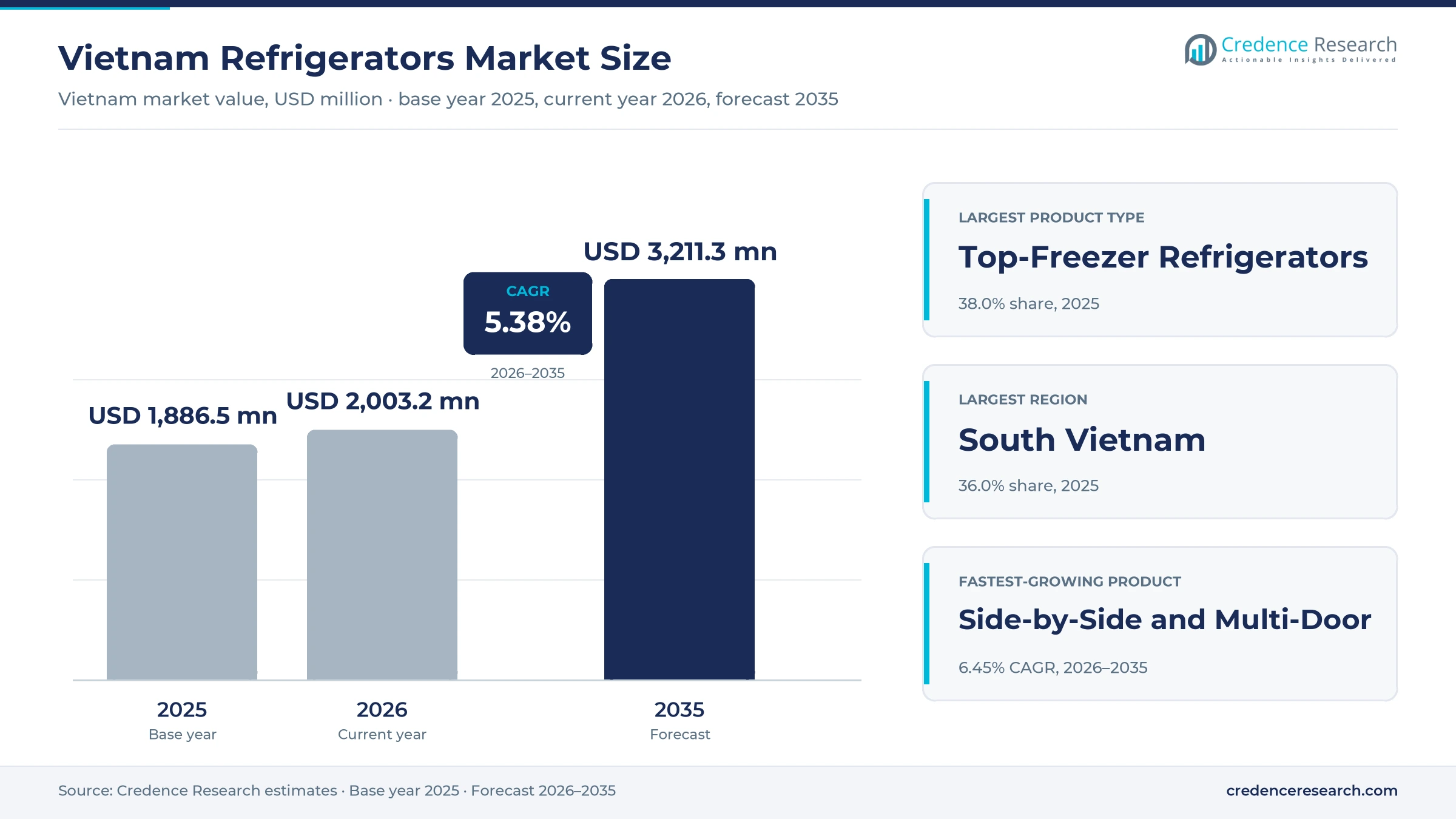
The Vietnam refrigerators market was valued at USD 1.89 billion in 2025 and is projected to increase from USD 2.00 billion in 2026 to USD 3.21 billion by 2035, registering a CAGR of 5.38% during 2026–2035. Demand comes from households that replace small top-freezer units with larger inverter models, from new urban apartments and from shops that need cold storage for food and drinks. South Vietnam held the largest regional share, 36.0% in 2025, because Ho Chi Minh City and its industrial provinces combine high incomes with dense electronics retail. The Mekong Delta is the fastest-growing region at 6.02% a year, as rural families in the delta buy larger models through installment plans. Inverter models led the technology mix in 2025, while side-by-side and multi-door units are moving into more homes. Under Decision 14/2023/QD-TTg, refrigerators sold in Vietnam had to meet the latest efficiency standards from April 2025, which pushes low-efficiency models out of stores.
Which fridges and buyers does the estimate cover?
The estimate measures the retail sales value of household refrigerators and refrigerator-freezers sold in Vietnam to homes and small businesses. It covers top-freezer, bottom-freezer, side-by-side and multi-door, and single-door and mini models with inverter or fixed-speed compressors. Values are stated at current prices and include sales through electronics chains, independent dealers, brand stores and online platforms.
The estimate excludes commercial display cabinets, chest freezers sold as separate units, walk-in cold rooms and spare parts. The value chain runs from compressor, steel and electronics suppliers through local assembly plants and importers to the brands, retail chains and service teams that deliver, install and repair units across the country.
Vietnam Refrigerators Market Insights
- The Vietnam refrigerators market was valued at USD 1.89 billion in 2025 and is projected to reach USD 3.21 billion by 2035, registering a CAGR of 5.38% during 2026–2035.
- South Vietnam held 36.0% of 2025 sales, because Ho Chi Minh City and nearby provinces pair high incomes with dense electronics retail.
- Top-freezer refrigerators led with 38.0% of 2025 value, because two-door units remain the standard first purchase for Vietnamese homes.
- Refrigerators sold in Vietnam had to meet the latest efficiency standards from April 1, 2025, under Decision 14/2023/QD-TTg on low-efficiency equipment.
- Aqua Vietnam extended its Dong Nai plants to 2045 in early 2026 and plans about 800,000 refrigerators a year, which strengthens local supply.
Top-freezer units lead while multi-door models rise
Why do two-door top-freezer fridges still lead?
Based on product type, the market is categorized into top-freezer refrigerators, side-by-side and multi-door refrigerators, bottom-freezer refrigerators and single-door and mini refrigerators. Top-Freezer Refrigerators led with 38.0% of 2025 value, because two-door units fit most kitchens and family budgets. Side-by-Side and Multi-Door Refrigerators grow fastest at 6.45% a year, as apartment buyers want more space for fresh food and flexible storage.
Why do inverter compressors dominate new fridge sales?
Based on technology, the market is categorized into inverter models and non-inverter models. Inverter Models led with 78.0% of 2025 value, because variable-speed compressors cut power use and noise in a hot, humid climate. The same group also grows faster, at 5.83% a year, as stricter efficiency rules and higher power tariffs move buyers away from fixed-speed units. In turn, non-inverter models are shrinking toward low-cost single-door units sold in rural stores.
Why do 200 to 400 liter fridges hold most spending?
Based on capacity, the market is categorized into below 200 liters, 200 to 400 liters and above 400 liters. 200 to 400 Liters led with 48.0% of 2025 value, because mid-size units suit families of three to five people. Above 400 Liters grows fastest at 6.24% a year, as larger homes, weekly shopping and bulk storage push buyers toward bigger models.
Why are online fridge sales gaining on store chains?
Based on distribution channel, the market is categorized into consumer electronics chains, independent dealers, online platforms and brand stores and others. Consumer Electronics Chains led with 55.0% of 2025 value, because national chains bundle delivery, installation and installment payment. Online Platforms grow fastest at 7.16% a year, as brands run official stores and livestream sales on major marketplaces.
| Segment Group | Leading Sub-segment | Share, 2025 | Fastest-growing Sub-segment | CAGR, 2026–2035 |
|---|---|---|---|---|
| By Product Type | Top-Freezer Refrigerators | 38.0% | Side-by-Side and Multi-Door Refrigerators | 6.45% |
| By Technology | Inverter Models | 78.0% | Inverter Models | 5.83% |
| By Capacity | 200 to 400 Liters | 48.0% | Above 400 Liters | 6.24% |
| By Distribution Channel | Consumer Electronics Chains | 55.0% | Online Platforms | 7.16% |
Request a Free Sample
Fill in your details and we'll send you a free sample report.
- Sample data tables & charts
- Research methodology
Retail spending, energy rules and local plants lift demand
How do retail growth and appliance spending lift demand?
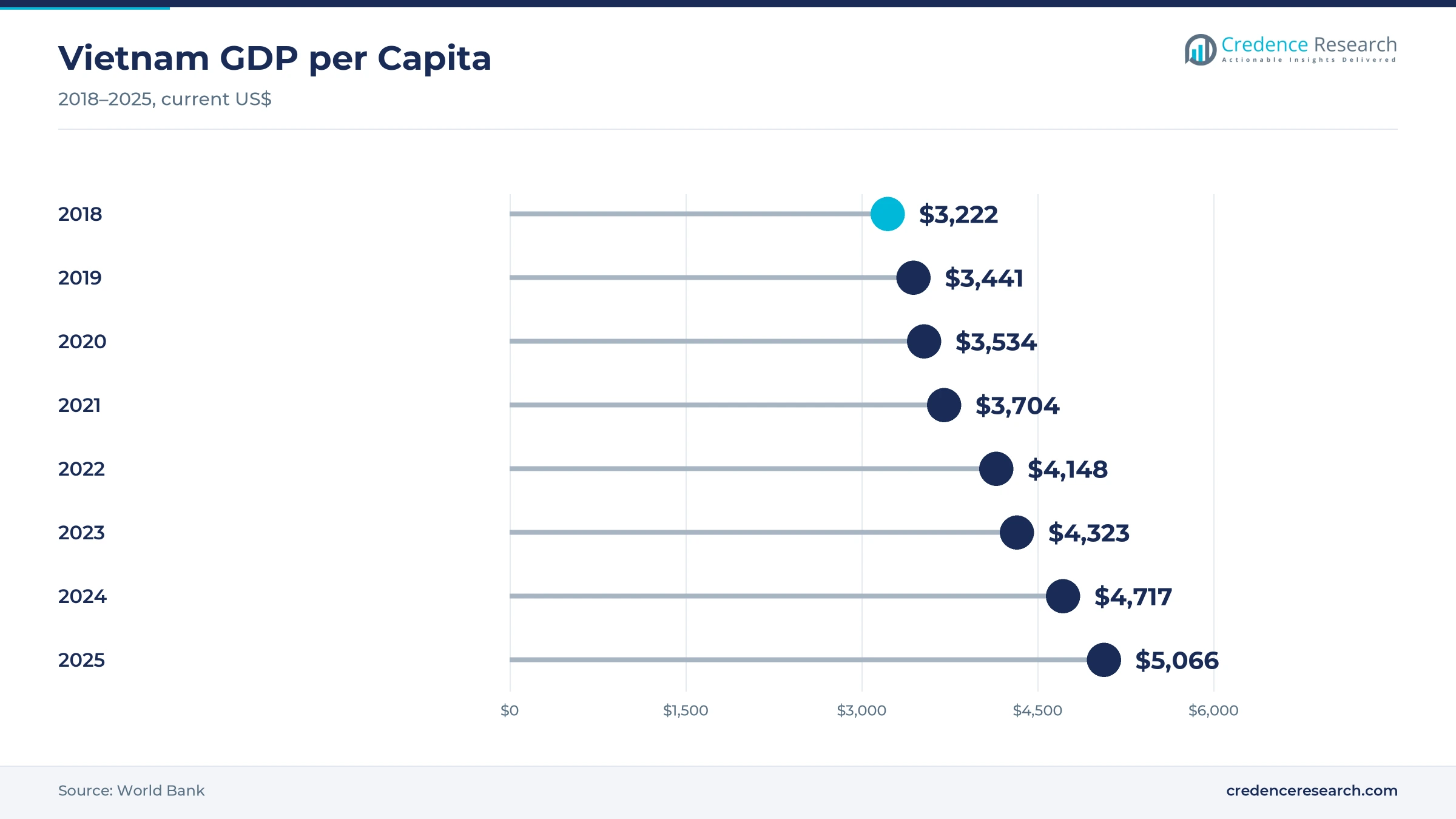
Retail expansion and steady household spending are the main source of demand, because families with rising incomes replace old units and buy larger ones. Total retail sales of goods and services topped VND7 quadrillion, about US$270 billion, in 2025, up 9.2% from 2024, based on National Statistics Office data. Retail goods sales alone rose 9% and made up 76.1% of the total. GDP per capita also reached about US$5,066 in 2025, up from US$3,222 in 2018, according to World Bank data. As a result, homes that also buy air conditioners trade up from basic two-door units, and Side-by-Side and Multi-Door Refrigerators grow at 6.45% a year.
Why do energy rules push buyers toward premium models?
Energy regulation supports a premium mix, because rules remove the least efficient fridges from stores and reward inverter designs. Decision 14/2023/QD-TTg took effect on July 15, 2023, and lists refrigerators, refrigerator-freezers and freezers among products subject to efficiency limits, as summarized by a CLASP policy record. Products had to comply with the latest standards from April 1, 2025, so demand shifted toward units that clear the new efficiency bar. The national power utility also raised the average retail tariff by 4.8% to VND2,204.07 per kWh from May 10, 2025, according to EVN. In turn, inverter models hold 78.0% of 2025 value, as households weigh running costs alongside price.
How does omni-channel retail widen fridge access?
Omni-channel retail development widens access, because buyers now compare models online and then buy through stores that offer delivery, installation and installments. Dien May Xanh, the appliance chain of Mobile World, operates more than 2,000 stores across Vietnam, based on company disclosures. Online appliance demand also rose as e-commerce growth hit 28% in August and September 2025. The trade ministry raised its 2025 growth forecast for business-to-consumer e-commerce to 25.5% in September 2025, with fourth-quarter growth projected at 33.67%. Aqua Vietnam also sells through about 6,000 retail outlets backed by 120 service stations nationwide. As a result, online platforms grow at 7.16% a year, as brands use live commerce sessions to launch new models.
Why does local manufacturing support supply and pricing?
Local manufacturing supports supply and pricing, because brands that build fridges in Vietnam can cut import costs and adapt designs to local kitchens. Aqua Vietnam received approval to extend its Bien Hoa 2 factories in Dong Nai to 2045 and plans about 800,000 refrigerators a year, as reported by The Investor in February 2026. Its localization rate is just over 50%, and the company targets 75% in the medium term. Panasonic Appliances Vietnam, set up in 2003 at Thang Long Industrial Park in Hanoi, also makes refrigerators locally. In turn, local supply of inverter compressors and parts supports stable pricing in North and South Vietnam.
AI screens, flush-fit designs and rural upgrades shape sales
How is the rise of AI and connected fridges changing the mix?
The rise of AI and connected fridges is changing the premium tier, because brands now compete on food tracking and energy apps rather than on storage alone. Samsung showed its Bespoke AI Family Hub in Ho Chi Minh City from April 16 to April 27, 2025, with a 32-inch touchscreen, as noted in its Vietnam newsroom. Its AI Vision Inside camera recognizes up to 150 food types and tracks expiry dates. The SmartThings AI Energy mode also adjusts power use, and LG adds AI Inverter and AI Saving Mode through its ThinQ app. As a result, fridges join other smart home appliances in large homes.
Why is the shift to flush-fit French-door models gaining pace?
The shift to flush-fit French-door models is gaining pace, because new apartments have fitted kitchens with tight cabinet space. LG Electronics Vietnam launched its French Door Fit and Max InstaView model in July 2026 at a suggested price of VND59.99 million. The model uses a 55 mm door and zero-clearance hinges, so it can stand close to walls and cabinets. LG also said global InstaView sales passed 5.3 million units by July 2026. Toshiba promotes slim multi-door units that fit standard kitchen cabinets and freeze down to -30 C. In turn, units above 400 liters grow at 6.24% a year, the fastest capacity rate.
Can rural households open a large upgrade channel?
Rural households offer a large upgrade opening, because most of the population still lives outside cities and many homes own small or aging units. Urban residents made up only 38.8% of the population in 2025, based on World Bank data, which leaves about 61% in rural areas. Aqua Vietnam reaches buyers through about 6,000 retail outlets, and Panasonic used microfinance installments from 2016 to sell appliances to rural homes. Electronics chains also offer 0% installment plans on larger appliances. As a result, the Mekong Delta is the fastest-growing zone in the forecast, as first upgrades spread through provincial towns.
Is there room for local sourcing and export-led scale?
Local sourcing and export-led scale are an opening, because larger plants lower unit costs and support new models for the domestic market. Aqua Vietnam plans to serve domestic demand and export refrigerators to Asia and Europe, adding the Americas and Africa within five years. The company targets about 2 million appliance units a year over the next five years, with refrigerators and washing machines as its two core lines. Its Dong Nai complex covers 77,466 square meters and employs about 1,600 factory workers. The brand entered Vietnam in 1996 and launched the Aqua name in 2014, after Haier bought the business in 2011. In turn, local plants can make efficient units at lower cost.
Price wars, power costs and rural service gaps slow growth
How do price wars squeeze margins?
Price wars are a key challenge, because global brands, local assemblers and retailer promotions all target the same mid-size two-door buyer. Frequent discount campaigns train shoppers to wait for holiday sales, which slows full-price demand and puts pressure on margins. As a result, smaller brands struggle to fund new designs and service networks. Brands respond with tiered model ranges, trade-in offers and installment plans that protect average prices while keeping entry models within reach of first-time buyers.
Why do power costs and heat test buyer budgets?
Power costs and hot weather limit household budgets, because a fridge runs all day and works harder in summer. EVN raised the average retail tariff four times between 2023 and May 2025, which made running costs more visible to families. In turn, some buyers keep old fixed-speed units longer instead of paying for a new inverter model. Brands respond by showing star ratings, estimated yearly power use and app-based energy tracking at the point of sale in electronics chains.
How do rural service gaps slow adoption?
Rural service gaps are a barrier to adoption, because large fridges need delivery, installation and repair that small towns may lack. Dealers in remote districts often carry few spare parts, which leaves broken units idle for days during the hot season. As a result, families hesitate to buy bigger models with complex electronics and app features. Brands respond by adding authorized service stations, training local technicians and using national retail chains to schedule visits across provinces.
Why does refrigerant and recycling policy add costs?
Refrigerant and end-of-life rules are a cost risk, because makers must shift to lower-impact gases and handle used appliances responsibly. Plants that switch refrigerants need new equipment, safety checks and staff training before production starts. In turn, smaller assemblers face higher costs than large brands with regional supply chains and shared platforms. Brands respond by standardizing designs across models and working with retailers on trade-in and collection programs for old units.
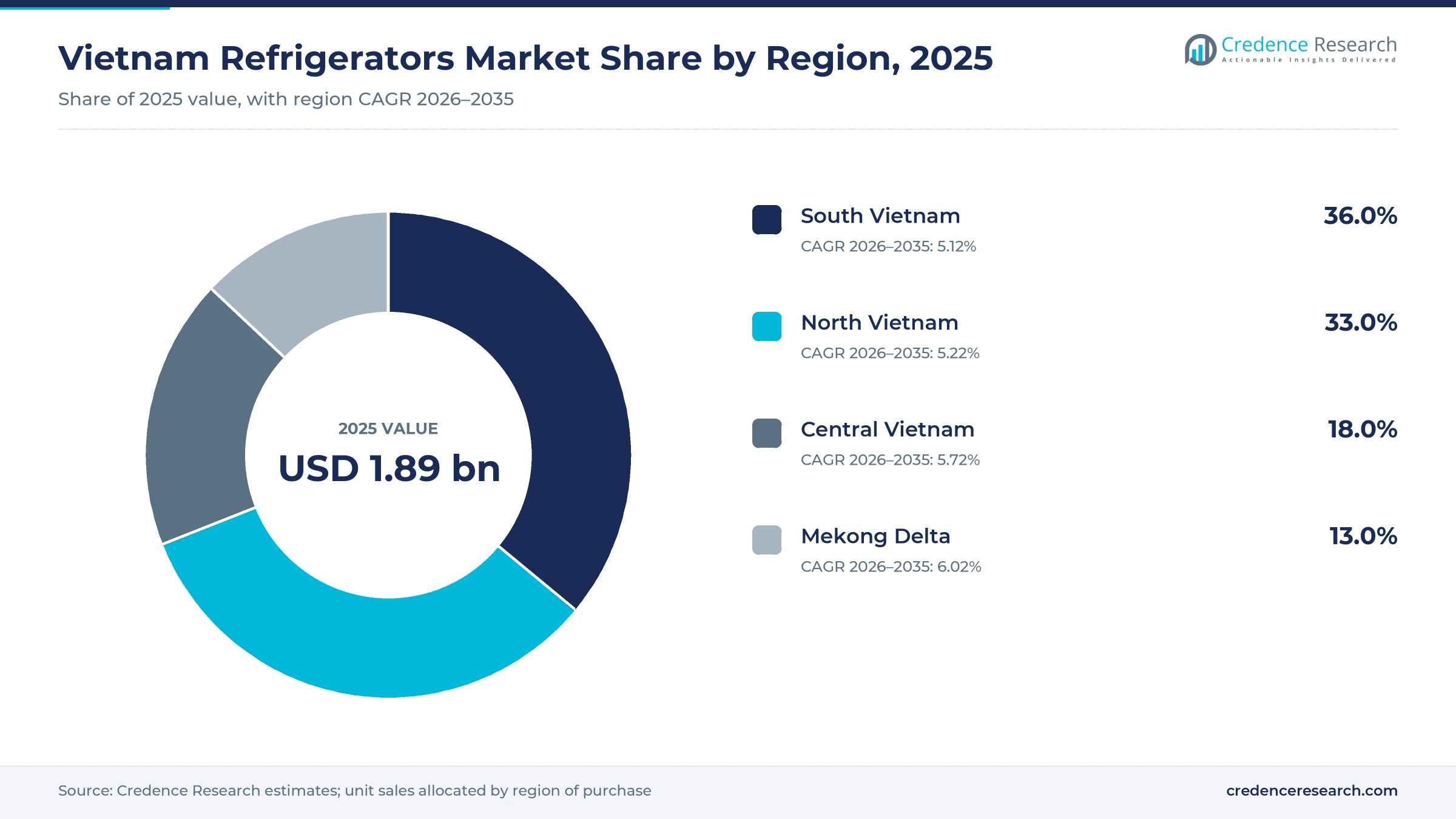
South Vietnam leads while the Mekong Delta grows fastest
| Region | Value, 2025 (USD billion) | Share, 2025 | CAGR, 2026–2035 |
|---|---|---|---|
| South Vietnam | 0.68 | 36.0% | 5.12% |
| North Vietnam | 0.62 | 33.0% | 5.22% |
| Central Vietnam | 0.34 | 18.0% | 5.72% |
| Mekong Delta | 0.25 | 13.0% | 6.02% |
Why does Ho Chi Minh City anchor South Vietnam's lead?
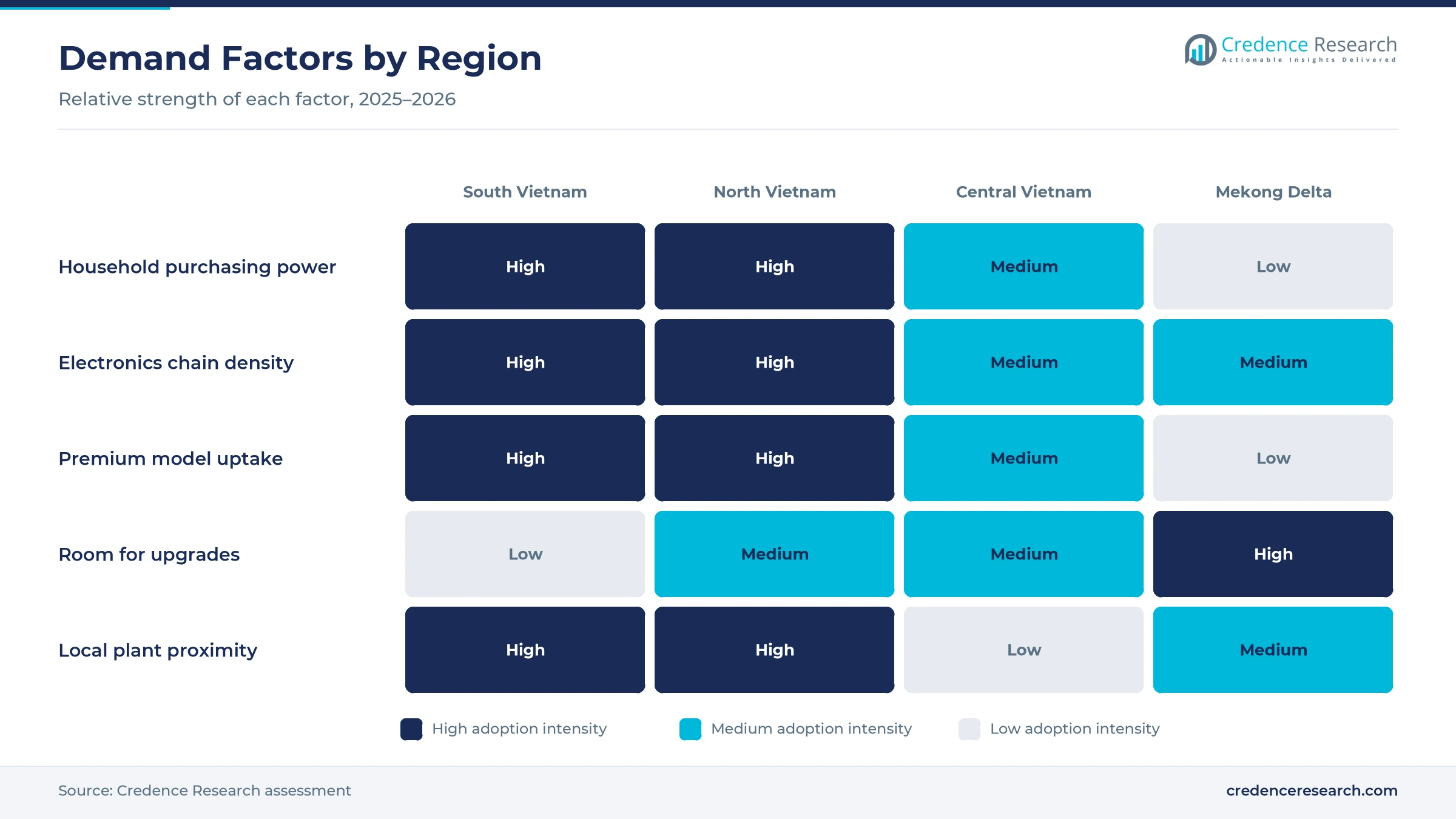
South Vietnam held 36.0% of 2025 value and grows at 5.12% a year, because Ho Chi Minh City and nearby industrial provinces have the largest pool of middle-income households. Premium launches such as Samsung's Bespoke AI event and LG's experience space start in Ho Chi Minh City. Aqua Vietnam's Bien Hoa 2 plants in Dong Nai also sit close to the main market. However, growth slows as most city homes already own a fridge and buy mainly upgrades.
How do Hanoi apartments shape North Vietnam demand?
North Vietnam held 33.0% of 2025 value and grows at 5.22% a year, because Hanoi and the Red River Delta combine dense apartment housing with strong electronics retail. Panasonic Appliances Vietnam makes refrigerators at Thang Long Industrial Park in Hanoi, which supports local supply. The urban share of the population reached 38.8% in 2025, which keeps apartment demand rising around the capital. In turn, new apartment projects around the capital add demand for flush-fit and multi-door units. Cold winters also lower summer peaks, which keeps demand steadier through the year.
How do coastal cities lift Central Vietnam fridge sales?
Central Vietnam held 18.0% of 2025 value and grows at 5.72% a year, because coastal cities such as Da Nang and Nha Trang add tourism, food service and new housing. Hot summers raise the need for reliable cooling in homes and small shops. Hotel and food service demand also rose as international arrivals reached about 21.2 million in 2025. However, rural districts have fewer dealers and service points, which makes national electronics chains and online platforms important for reaching new buyers.
Why do Mekong Delta upgrades outpace other zones?
The Mekong Delta held 13.0% of 2025 value and grows fastest at 6.02% a year, because many rural households still own small single-door or aging two-door units. Rising farm and remittance incomes allow families to buy larger models through 0% installment plans. As a result, electronics chains and dealers promote mid-size inverter units in provincial towns, and first upgrades lift volume through 2035.
Energy rules, AI launches and plant deals shaped 2025–2026
| Development | Status and market relevance |
|---|---|
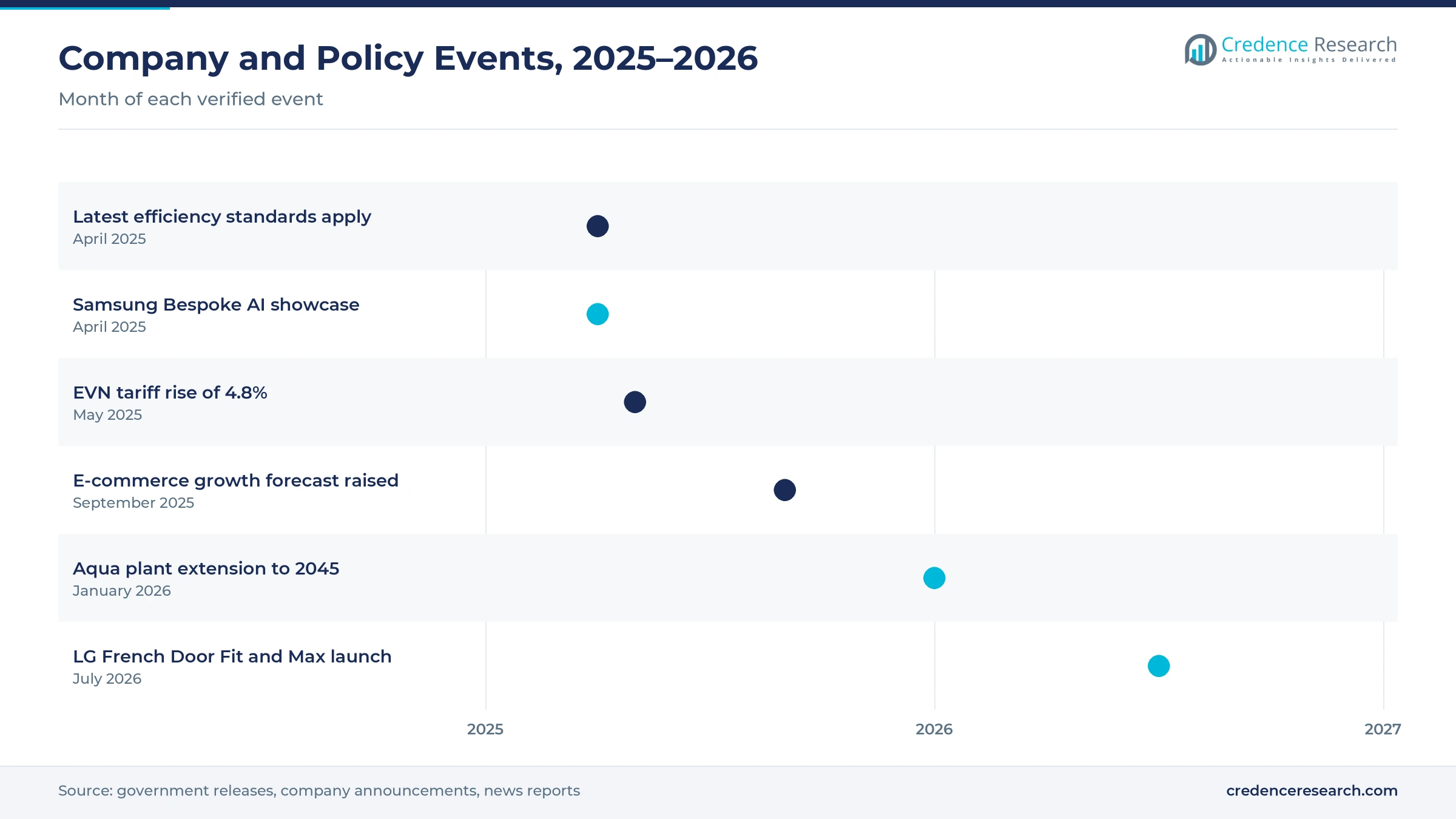
| In April 2025, the latest refrigerator efficiency standards under Decision 14/2023/QD-TTg became mandatory for products sold in Vietnam. | Removes low-efficiency models and favors inverter units |
| In April 2025, Samsung showcased its Bespoke AI Family Hub refrigerator with a 32-inch screen in Ho Chi Minh City. | Adds AI food tracking to the premium tier |
| In May 2025, EVN raised the average retail electricity tariff by 4.8%. | Makes running costs more visible to fridge buyers |
| In January 2026, Aqua Vietnam won approval to extend its Dong Nai plants to 2045 with about 800,000 refrigerators a year of capacity. | Strengthens local supply and export plans |
| In July 2026, LG Electronics Vietnam launched its French Door Fit and Max InstaView refrigerator. | Targets fitted kitchens with flush-fit premium units |
Inverter drives, AI cameras and app control reshape fridges
- Inverter compressors vary motor speed with cooling demand, which cuts power use and noise and helps units meet the latest efficiency standards.
- AI food cameras recognize stored items and track expiry dates, as Samsung's AI Vision Inside does for up to 150 food types.
- Convertible compartments switch between fridge and freezer settings, as LG's Full Convert Drawer does across six presets from 7 C to -23 C.
- App-based energy control tracks power use and adjusts cooling through SmartThings and ThinQ, which helps households manage rising tariffs.
Need a Custom Version of This Report?
Tailor the scope, geography, or segments to your exact requirements.
- Custom geography or segment scope
- Direct access to our analyst team
Korean, Japanese and Haier-owned brands compete on features
Competition is led by Korean, Japanese and Haier-owned brands that sell through national electronics chains and dealer networks. Aqua Vietnam, a Haier subsidiary that entered Vietnam in 1996 as Sanyo, makes refrigerators at three plants in Dong Nai and says it held the largest share of refrigerator sales at the end of 2025. Samsung and LG compete in the premium tier with AI screens, InstaView doors and app control, and both run experience events in Ho Chi Minh City. Panasonic makes refrigerators in Hanoi and competes on Japanese quality and energy efficiency. Toshiba promotes slim multi-door models that fit standard kitchen cabinets in new apartments. Rivals compete on price, capacity, power use, installment offers and service speed, while retail chain campaigns decide much of the volume.
Companies profiled and their roles in this market
| Company | Type | Role in the market |
|---|---|---|
| Aqua | Local manufacturer | Makes refrigerators at three Dong Nai plants extended to 2045 |
| Samsung Electronics | Premium brand | Showcased Bespoke AI Family Hub in Ho Chi Minh City in 2025 |
| LG Electronics | Premium brand | Launched French Door Fit and Max InstaView model in 2026 |
| Panasonic | Local manufacturer | Makes refrigerators at Thang Long Industrial Park in Hanoi |
| Toshiba | Brand | Sells slim multi-door models for fitted kitchens |
Credence Research view on premium mix and rural reach
Credence Research's view is that Vietnamese fridge spending will grow steadily because households keep trading up to larger inverter models even though most homes already own a fridge. Stricter efficiency rules and higher power tariffs reward premium units, while local plants keep prices within reach. However, price wars and thin rural service will keep some buyers cautious. Brands that pair efficient mid-size models with installment plans, trade-in offers and dense service networks should gain share fastest through 2035, especially in the Mekong Delta and Central Vietnam.
How the Vietnam fridge spending estimate was built
The report uses 2025 as the base year on a calendar basis, and market values come from the Credence Research model. That model combines national retail sales and income statistics, World Bank data, efficiency rules, company disclosures and typical retail prices by product type. Segment and regional splits are Credence Research estimates based on population, income and retail reach by zone. Sources used are government releases, company announcements, news reports and statistical databases, and no interviews or surveys were used.
Upgrades and energy rules carry fridge sales to 2035
Fridge sales are expected to reach USD 3.21 billion by 2035, a 5.38% CAGR during 2026–2035, as upgrades, efficiency rules and wider retail reach keep demand steady. Growth should be strongest while rural households replace small units and city homes move to multi-door and flush-fit models. After that, replacement cycles, smart features and service plans will add steady value as ownership matures. A sharp rise in power tariffs or a weaker housing market would lower this outlook, while faster rural income growth would raise it. Brands that build efficient units locally are best placed to hold prices as demand shifts toward larger models.
Frequently Asked Questions
How big is the Vietnam refrigerators market?
Which product type leads fridge sales in Vietnam?
Which region leads the Vietnam refrigerators market?
How important are inverter models?
What drives fridge demand in Vietnam?
Which capacity band grows fastest?
Who are the leading refrigerator brands in Vietnam?
What are the main challenges for fridge brands?
Table of Content
Chapter 1 Market Segmentation
- 1.1 Segmentation Framework
- 1.1.1 Product and Service Classification
- 1.1.2 Application and End-Use Classification
- 1.1.3 Technology and Solution Classification
- 1.1.4 Customer and Distribution Channel Classification
- 1.1.5 Geographic Segmentation
- 1.1.6 Market Segment Definitions and Boundaries
- 1.2 By Product Type
- 1.2.1 Top-Freezer Refrigerators
- 1.2.2 Side-by-Side and Multi-Door Refrigerators
- 1.2.3 Bottom-Freezer Refrigerators
- 1.2.4 Single-Door and Mini Refrigerators
- 1.3 By Technology
- 1.3.1 Inverter Models
- 1.3.2 Non-Inverter Models
- 1.4 By Capacity
- 1.4.1 Below 200 Liters
- 1.4.2 200 to 400 Liters
- 1.4.3 Above 400 Liters
Chapter 2 Introduction
- 2.1 Report Objectives and Scope
- 2.2 Product Definition and Industry Terminology
- 2.3 Market Inclusions and Exclusions
- 2.4 Research Process
- 2.4.1 Primary Research and Expert Interviews
- 2.4.2 Secondary Research and Source Review
- 2.4.3 Top-Down and Bottom-Up Estimation
- 2.4.4 Data Triangulation and Verification
- 2.5 Market Size Measurement Basis
- 2.5.1 2025: USD 1.89 billion → 2035: USD 3.21 billion
- 2.6 Historical and Forecast Reference Periods
- 2.6.1 Historical Period: 2018-2025
- 2.6.2 Base Year: 2025
- 2.6.3 Forecast Period: 2025-2035
- 2.7 Research Assumptions and Limitations
Chapter 3 Executive Summary
- 3.1 Market Snapshot and Key Findings
- 3.2 Base-Year Market Size, 2025
- 3.3 Forecast Market Size, 2035
- 3.4 Revenue and Volume Growth Outlook
- 3.5 Key Demand and Supply Indicators
- 3.6 Leading Market Segments
- 3.7 Fastest-Growing Market Opportunities
- 3.8 Regional Performance Highlights
- 3.9 Technology and Industry Transformation
- 3.10 Competitive Landscape Summary
- 3.11 Analyst View and Strategic Implications
Chapter 4 Vietnam Refrigerators Market Trends and Developments
- 4.1 Historical Industry Development, 2018-2025
- 4.2 Recent Market Trends and Developments
- 4.3 Demand and Customer Behavior Trends
- 4.4 Technology and Product Innovation
- 4.5 Artificial Intelligence, Automation and Digitalization
- 4.6 Local Manufacturing and Supply Chain Realignment
- 4.7 Industry Partnerships, Mergers and Acquisitions
- 4.8 Sustainability and Circular Economy Developments
- 4.9 Government and Private Sector Investment Trends
- 4.10 Emerging Business Models and Commercialization
- 4.11 Industry Developments and Announcements
Chapter 5 Vietnam Refrigerators Market Production, Supply and Demand Analysis
- 5.1 Demand Trend and Consumption Analysis, 2018-2025
- 5.2 Demand Forecast, 2025-2035
- 5.3 Production and Output Trend, 2018-2025
- 5.4 Production and Output Forecast, 2025-2035
- 5.5 Installed Capacity and Capacity Utilization
- 5.6 Company-Wise Production Plants and Statistics
- 5.6.1 Installed Production Capacity
- 5.6.2 Actual Production
- 5.6.3 Planned Capacity and Expansion Targets
- 5.7 Supply Chain Structure and Procurement Trends
- 5.8 Supply-Demand Gap and Bottlenecks
- 5.9 Import Dependence and Sourcing Structure
- 5.10 Contract Manufacturing and Outsourcing
- 5.11 Regional Supply and Demand Concentration
Chapter 6 Vietnam Refrigerators Market Pricing Analysis
- 6.1 Pricing Structure and Measurement
- 6.2 Historical Pricing Trends, 2018-2025
- 6.3 Pricing Outlook, 2025-2035
- 6.4 Average Selling Price and Unit Economics
- 6.5 Pricing by Product and Market Segment
- 6.6 Geographic Pricing Differences
- 6.7 Key Input, Energy, Labor and Logistics Costs
- 6.8 Contract Pricing and Purchasing Models
- 6.9 Pricing Sensitivity and Competitive Positioning
- 6.10 Price, Margin and Profitability Implications
Chapter 7 Vietnam Refrigerators Market Dynamics
- 7.1 Market Growth Drivers
- 7.1.1 Demand-Side Drivers
- 7.1.2 Technology and Innovation Drivers
- 7.1.3 Infrastructure and Investment Drivers
- 7.1.4 Regulatory and Policy Drivers
- 7.2 Market Restraints
- 7.2.1 Cost and Affordability Constraints
- 7.2.2 Technology and Adoption Barriers
- 7.2.3 Supply Chain and Operational Constraints
- 7.3 Market Challenges
- 7.3.1 Competitive Pressure and Margin Erosion
- 7.3.2 Skills, Infrastructure and Implementation Gaps
- 7.4 Emerging Market Opportunities
- 7.5 Market Dynamics Impact and Time-Horizon Assessment
Chapter 8 Vietnam Refrigerators Value Chain Analysis
- 8.1 Industry Value Chain Overview
- 8.2 Upstream Suppliers and Critical Inputs
- 8.3 Technology and Component Providers
- 8.4 Manufacturing or Service Delivery
- 8.5 Distribution, Channel Partners and Integrators
- 8.6 Downstream Applications and End Users
- 8.7 Value Addition and Profit Pools
- 8.8 Vertical Integration and Outsourcing
- 8.9 Supplier Concentration and Risk
- 8.10 Supply Chain Localization and Resilience
Chapter 9 Vietnam Refrigerators Market Regulations and Policies
- 9.1 Relevant Laws, Standards and Compliance Frameworks
- 9.2 Product, Service, Safety and Quality Requirements
- 9.3 Government Policies, Incentives and Subsidies
- 9.4 Imports, Exports and Trade Barriers
- 9.5 Public Procurement and Local Content Requirements
- 9.6 Environmental and Sustainability Compliance
- 9.7 Upcoming Policy Changes and Market Implications
Chapter 10 Vietnam Refrigerators Market Hotspots and Opportunities
- 10.1 Market Opportunity Mapping and Growth Hotspots
- 10.2 High-Growth Applications and Customer Groups
- 10.3 Underserved Markets and White-Space Opportunities
- 10.4 Emerging Technology and Product Opportunities
- 10.5 New Capacity and Investment Hotspots
- 10.6 Market Entry and Expansion Opportunities
- 10.7 Distribution and Partnership Opportunities
- 10.8 Near-Term and Long-Term Commercial Potential
- 10.9 Opportunity Attractiveness and Execution Risks
Chapter 11 Vietnam Refrigerators Market Outlook, 2025-2035
- 11.1 Market Size and Analysis
- 11.1.1 Revenue (Market Measurement: 2025: USD 1.89 billion → 2035: USD 3.21 billion)
- 11.1.2 Market Volume and Quantity Sold
- 11.1.3 Historical Market Size, 2018-2025
- 11.1.4 Base-Year Market Size, 2025
- 11.2 Market Forecast, 2025-2035
- 11.2.1 Revenue Forecast to 2035
- 11.2.2 Volume Forecast to 2035
- 11.2.3 CAGR and Year-on-Year Growth
- 11.2.4 Incremental Revenue Opportunity
- 11.3 Forecast Assumptions and Scenario Analysis
- 11.3.1 Base-Case Forecast
- 11.3.2 Optimistic and Conservative Scenarios
- 11.3.3 Technology, Pricing and Policy Sensitivities
- 11.4 Market Attractiveness and Growth Outlook
Chapter 12 Vietnam Refrigerators Market Segmentation and Outlook
- 12.1 Segmentation Summary and Market Shares, 2025
- 12.2 Largest and Fastest-Growing Segments
- 12.3 By Product Type - Market Size and Forecast, 2025-2035
- 12.3.1 Segment Definition and Scope
- 12.3.2 Historical Market Size, 2018-2025
- 12.3.3 Revenue Forecast, 2025-2035
- 12.3.4 Volume Forecast, 2025-2035
- 12.3.5 Base-Year Market Share, 2025
- 12.3.6 Segment CAGR and Growth Drivers
- 12.3.7 Subsegment Market Size and Forecast
- 12.3.7.1 Top-Freezer Refrigerators
- 12.3.7.2 Side-by-Side and Multi-Door Refrigerators
- 12.3.7.3 Bottom-Freezer Refrigerators
- 12.3.7.4 Single-Door and Mini Refrigerators
- 12.3.8 Subsegment Pricing and Adoption Trends
- 12.3.9 Leading Suppliers and Competition
- 12.3.10 Regional Demand and Opportunities
- 12.4 By Technology - Market Size and Forecast, 2025-2035
- 12.4.1 Segment Definition and Scope
- 12.4.2 Historical Market Size, 2018-2025
- 12.4.3 Revenue Forecast, 2025-2035
- 12.4.4 Volume Forecast, 2025-2035
- 12.4.5 Base-Year Market Share, 2025
- 12.4.6 Segment CAGR and Growth Drivers
- 12.4.7 Subsegment Market Size and Forecast
- 12.4.7.1 Inverter Models
- 12.4.7.2 Non-Inverter Models
- 12.4.8 Subsegment Pricing and Adoption Trends
- 12.4.9 Leading Suppliers and Competition
- 12.4.10 Regional Demand and Opportunities
- 12.5 By Capacity - Market Size and Forecast, 2025-2035
- 12.5.1 Segment Definition and Scope
- 12.5.2 Historical Market Size, 2018-2025
- 12.5.3 Revenue Forecast, 2025-2035
- 12.5.4 Volume Forecast, 2025-2035
- 12.5.5 Base-Year Market Share, 2025
- 12.5.6 Segment CAGR and Growth Drivers
- 12.5.7 Subsegment Market Size and Forecast
- 12.5.7.1 Below 200 Liters
- 12.5.7.2 200 to 400 Liters
- 12.5.7.3 Above 400 Liters
- 12.5.8 Subsegment Pricing and Adoption Trends
- 12.5.9 Leading Suppliers and Competition
- 12.5.10 Regional Demand and Opportunities
- 12.6 Segment Growth Comparison
- 12.7 Segment Attractiveness and Priority Matrix
Chapter 13 Vietnam Refrigerators Geographic Market Outlook, 2025-2035
- 13.1 Regional Market Size and Country-Level Shares, 2025
- 13.2 Country Market Size Comparison, 2025
- 13.3 Country Market Forecasts, 2025-2035
- 13.4 Subregional Industrial and Demand Clusters
- 13.5 Intra-Regional Pricing and Cost Differences
- 13.6 Cross-Border Trade and Supply Networks
- 13.7 Regional Supply and Demand Balances
- 13.8 Country Opportunity Comparison and Prioritization
Note: Every listed country is covered on the structure shown under the first country.
Chapter 14 Vietnam Refrigerators Technology, Innovation and Sustainability Outlook
- 14.1 Technology Landscape and Maturity
- 14.2 Product, Process and Service Innovation
- 14.3 AI, Automation and Digital Tools in the Industry
- 14.4 Technology Adoption and Performance Benchmarking
- 14.5 Innovation Pipeline and R&D Investment
- 14.6 Patent and Intellectual Property Trends
- 14.7 Energy Efficiency and Resource Management
- 14.8 Sustainability, Recycling and Circularity
- 14.9 Technology Roadmap, 2025-2035
- 14.10 Risks of Obsolescence and Technology Substitution
Chapter 15 Vietnam Refrigerators Market Key Strategic Imperatives
- 15.1 Growth and Market Entry Priorities
- 15.2 High-Return Products and Segments
- 15.3 Pricing, Profitability and Cost Optimization
- 15.4 Technology Investment and Product Differentiation
- 15.5 Supply Chain Localization and Resilience
- 15.6 Distribution and Customer Acquisition
- 15.7 Partnership, Acquisition and Capacity Strategy
- 15.8 Regional Expansion Priorities
- 15.9 Short-, Medium- and Long-Term Actions
Chapter 16 Competition Outlook
- 16.1 Industry Competition Characteristics
- 16.2 Market Structure and Concentration
- 16.3 Market Share and Competitive Positioning, 2025
- 16.4 Company-Wise Revenue and Product Benchmarking
- 16.5 Production and Service Capacity Benchmarking
- 16.6 Technology, Pricing and Differentiation
- 16.7 Regional Footprint and Distribution Strength
- 16.8 Mergers, Acquisitions and Strategic Alliances
- 16.9 New Entrants and Competitive Threats
- 16.10 Porter's Five Forces and Industry Attractiveness
- 16.11 Competitive Outlook, 2025-2035
Chapter 17 Company Profiles
- 17.1 Company Coverage and Selection Criteria
- 17.2 Samsung Electronics
- 17.2.1 Business Description
- 17.2.2 Company Ownership and Geographic Presence
- 17.2.3 Product and Service Portfolio
- 17.2.4 Manufacturing and Operating Footprint
- 17.2.5 Production Capacity and Expansion Plans
- 17.2.6 Financial Performance and Investment
- 17.2.7 Market Share and Competitive Position
- 17.2.8 Technology and Innovation Capabilities
- 17.2.9 Strategic Alliances or Partnerships
- 17.2.10 Recent Developments
- 17.2.11 Growth Strategy and Outlook
- 17.3 LG Electronics
- 17.4 Panasonic
- 17.5 Aqua
- 17.6 Toshiba
- 17.7 Other Relevant Market Participants
Note: Every listed company is profiled on the structure shown under the first company. The company list is preliminary and may change based on research findings, market developments, data availability and client requirements.
Chapter 18 Disclaimer
- 18.1 Research and Forecast Disclaimer
- 18.2 Data Source and Estimation Limitations
Note: The depth of individual sections depends on data availability for this market. Volume, capacity, trade and other unit-based metrics are included where applicable.

