A dense food network that pharma flows now lift
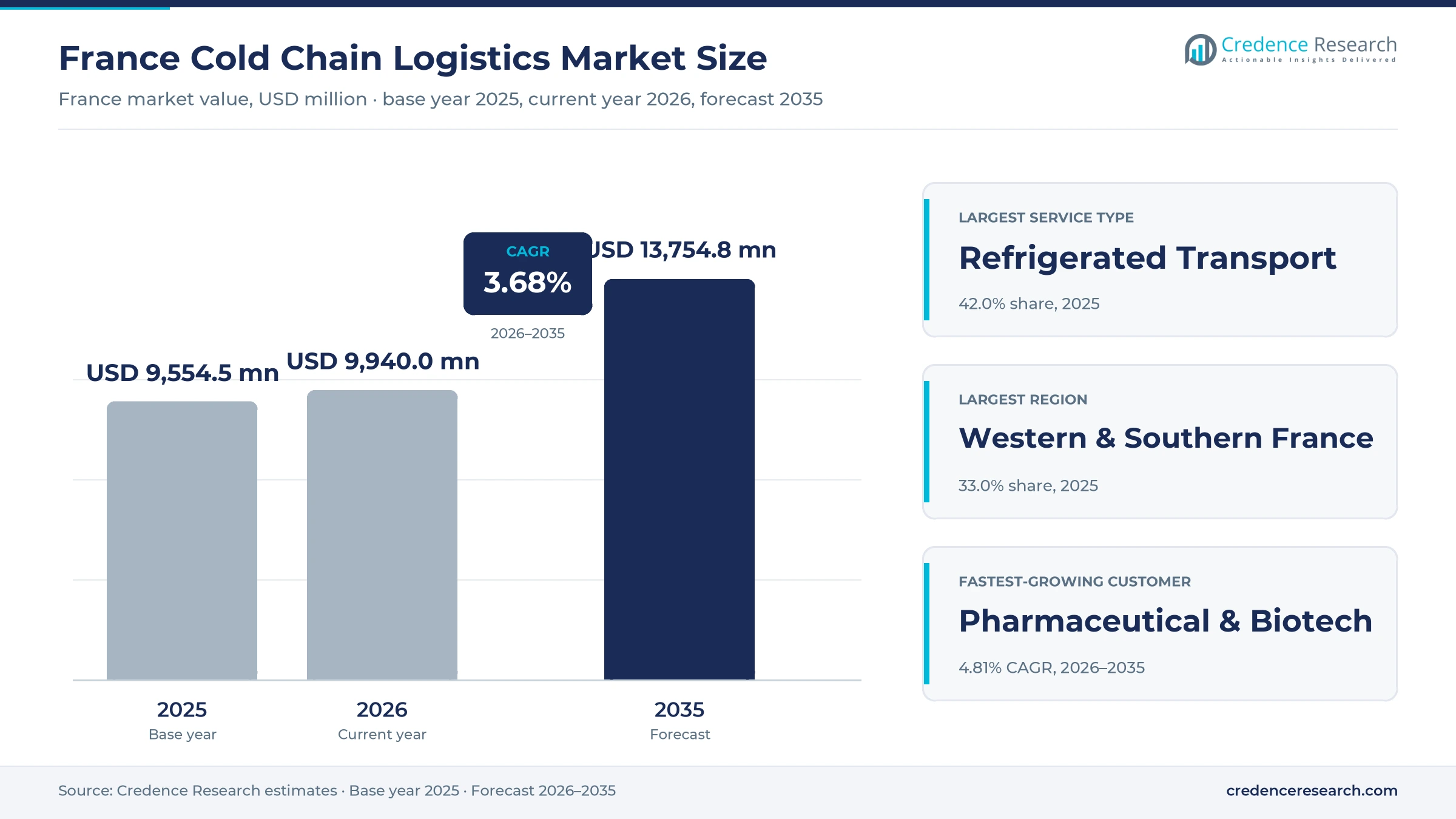
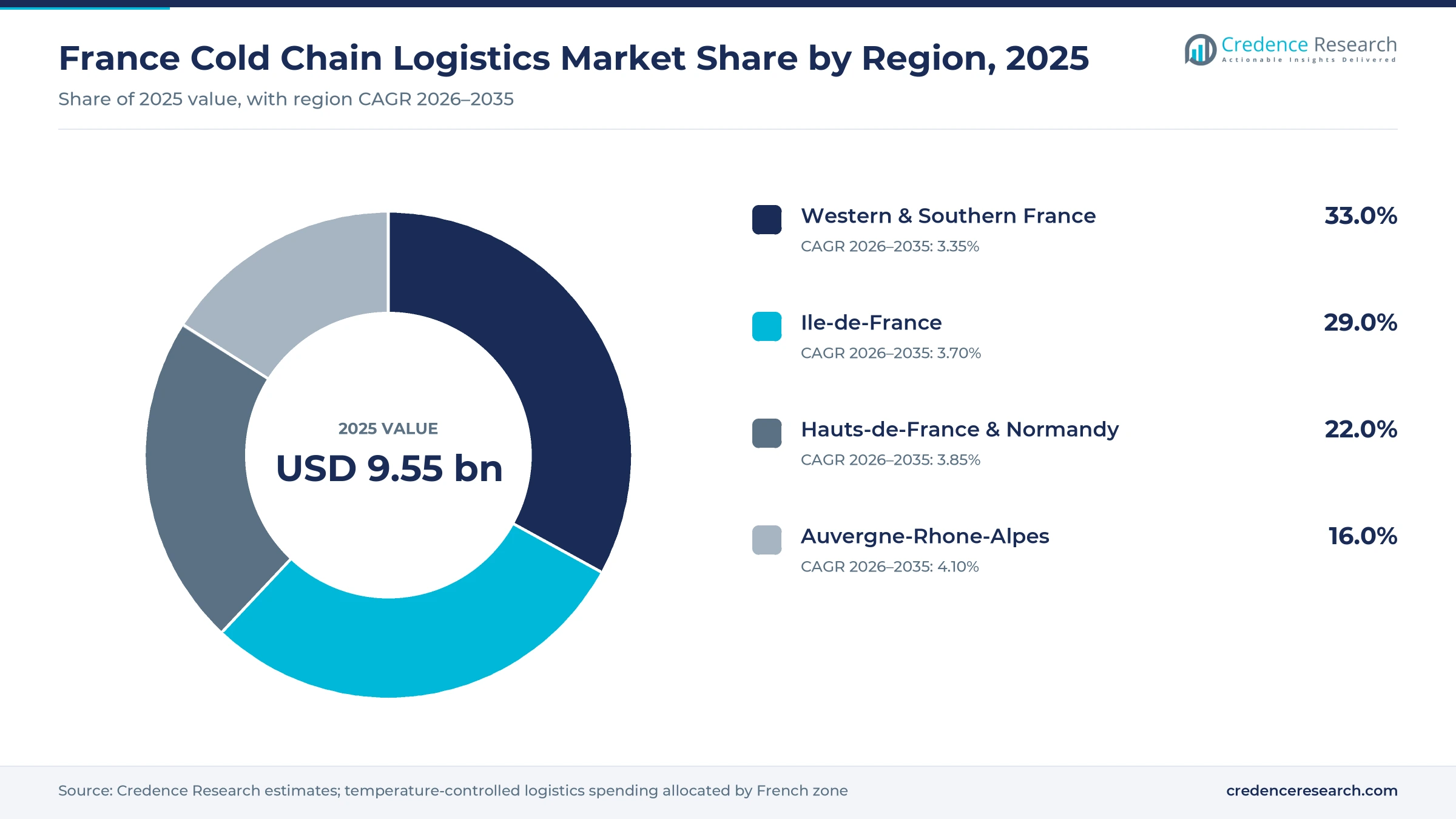
The France cold chain logistics market was valued at USD 9.55 billion in 2025 and is projected to increase from USD 9.94 billion in 2026 to USD 13.75 billion by 2035, registering a CAGR of 3.68% during 2026–2035. Demand comes from one of the largest food manufacturing bases in Europe, a national grocery network that needs daily chilled and frozen replenishment, and a growing flow of biologic medicines that must stay within tight temperature ranges. Western and Southern France held the largest regional share, 33.0% in 2025, because Brittany, Pays de la Loire and the southwest concentrate meat, dairy and seafood processing. Auvergne-Rhone-Alpes is the fastest-growing region at 4.10% a year, supported by new biologics and vaccine capacity around Lyon. On the regulatory side, the European Union fluorinated gas rules that entered into force in March 2024 are pushing operators to replace older refrigeration systems with natural refrigerants and electric units.
What services does the temperature-controlled estimate include?
The estimate measures spending on refrigerated storage, refrigerated transport, value-added handling and last-mile temperature-controlled delivery carried out for shippers in France. It covers chilled, frozen and controlled ambient flows by road, sea, air and rail, whether bought under dedicated contracts, shared networks or spot orders. Values are stated in USD million at current prices for each calendar year.
The estimate excludes the sale of refrigerated trucks, trailers, cooling units and packaging, which are counted as equipment rather than services. It also excludes shippers that run fully in-house fleets and warehouses without buying outside services. The value chain runs from producers and importers through cold stores and cross-docks to retail platforms, restaurants, pharmacies and hospitals.
France Cold Chain Logistics Market Insights
- The market was valued at USD 9.55 billion in 2025 and is projected to reach USD 13.75 billion by 2035, registering a CAGR of 3.68% during 2026–2035.
- Western and Southern France held 33.0% of 2025 value, because the zone concentrates meat, dairy and seafood processing plants.
- Refrigerated transport led service types with 42.0% of 2025 value, as daily chilled replenishment of stores needs dense road networks.
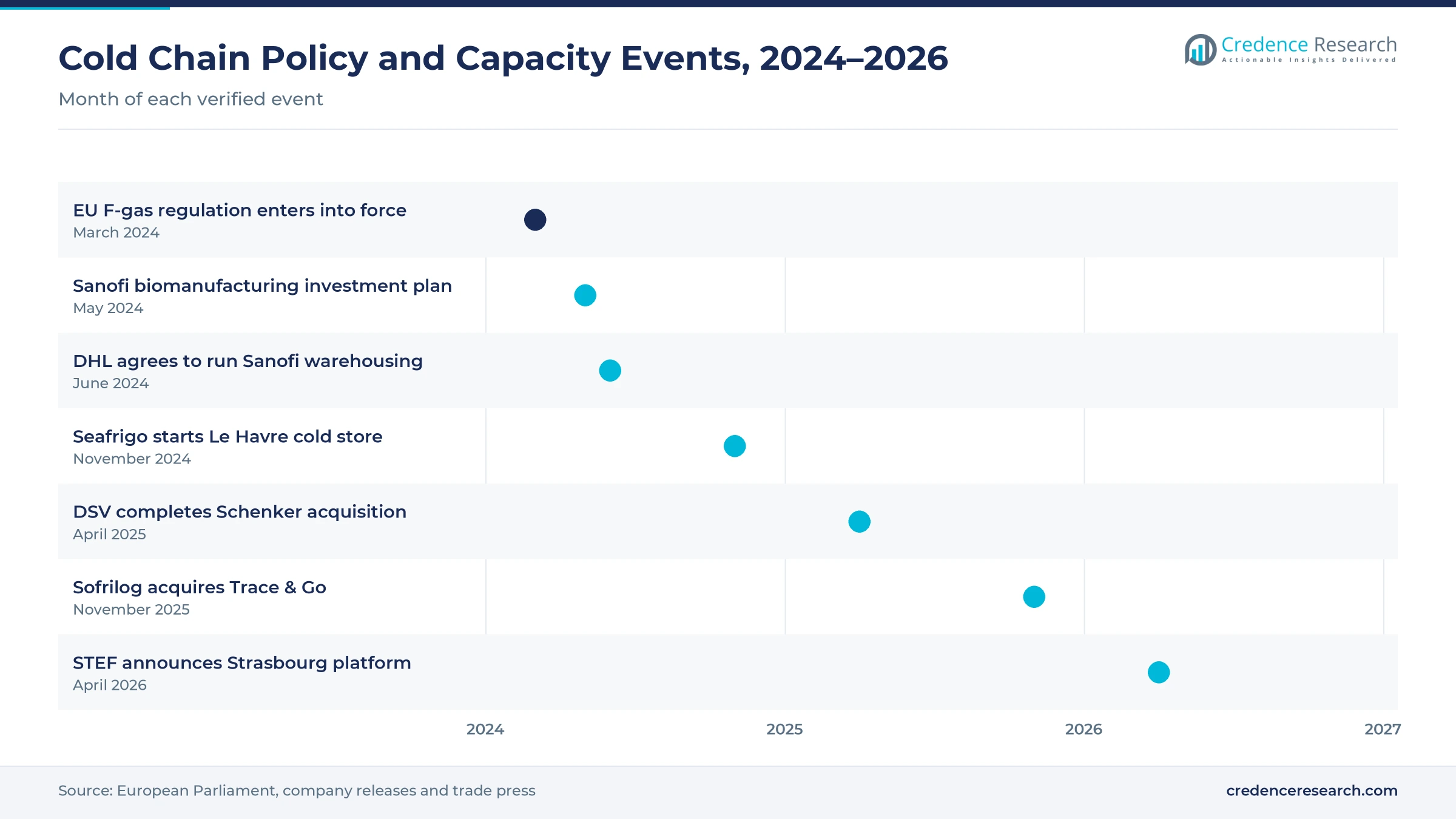
- The European Union fluorinated gas regulation entered into force on March 11, 2024, which speeds the replacement of older refrigeration systems in cold stores.
- STEF announced a new refrigerated platform at the port of Strasbourg in April 2026, showing specialists still investing in regional capacity.
Road transport and food processors anchor spending
Why does refrigerated transport lead spending?
Based on service type, the market is categorized into refrigerated storage, refrigerated transport, value-added handling and last-mile temperature-controlled delivery. Refrigerated Transport led with 42.0% of 2025 value, because stores, restaurants and pharmacies need frequent chilled deliveries across the country. Last-Mile Temperature-Controlled Delivery grows fastest at 4.50% a year, as online grocery orders and home delivery of fresh meals spread from large cities.
How does the transport mode mix change?
Based on mode of transport, the market is categorized into road, sea, air and rail. Road led with 82.0% of 2025 value, because almost every chilled pallet moves by truck for at least part of its journey. Rail grows fastest at 4.58% a year from a small base, as shippers test refrigerated combined transport on long north to south corridors to cut emissions.
Which customers buy the most cold chain services?
Based on customer type, the market is categorized into food manufacturers and processors, grocery retailers and foodservice, pharmaceutical and biotech companies, and agriculture and seafood producers. Food Manufacturers & Processors led with 40.0% of 2025 value, because processors outsource storage and national distribution. Pharmaceutical & Biotech Companies grow fastest at 4.81% a year, as biologic medicines and vaccines need validated temperature control.
How do food and medicine flows compare?
Based on end-use industry, the market is categorized into dairy and frozen desserts, meat, poultry and seafood, fruits, vegetables and prepared foods, and pharmaceuticals and biologics. Meat, Poultry & Seafood led with 30.0% of 2025 value, because these products need strict chilled or frozen handling from slaughter or landing to shelf. Pharmaceuticals & Biologics grow fastest at 4.83% a year, supported by new domestic biomanufacturing capacity.
| Segment Group | Leading Sub-segment | Share, 2025 | Fastest-growing Sub-segment | CAGR, 2026–2035 |
|---|---|---|---|---|
| By Service Type | Refrigerated Transport | 42.0% | Last-Mile Temperature-Controlled Delivery | 4.50% |
| By Mode of Transport | Road | 82.0% | Rail | 4.58% |
| By Customer Type | Food Manufacturers & Processors | 40.0% | Pharmaceutical & Biotech Companies | 4.81% |
| By End-Use Industry | Meat, Poultry & Seafood | 30.0% | Pharmaceuticals & Biologics | 4.83% |
Request a Free Sample
Fill in your details and we'll send you a free sample report.
- Sample data tables & charts
- Research methodology
Food output, biologics and dense hubs sustain demand
How does a large food and retail base sustain demand?
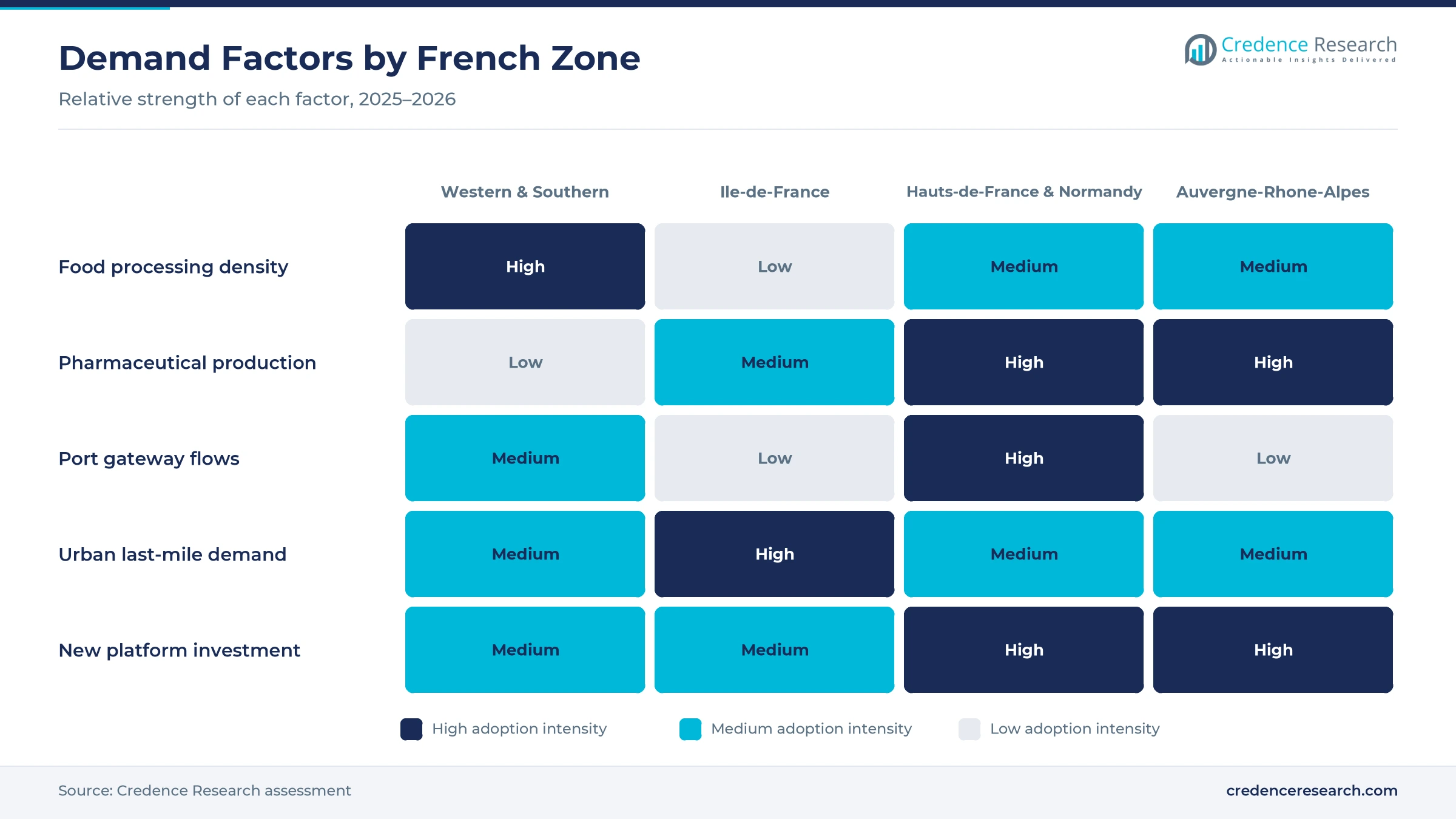
A large food manufacturing and retail base is the main demand driver, because processors and grocers outsource most chilled and frozen flows. The agri-food industry is the first industrial employer in the country, with 520,000 employees and more than 20,940 companies, according to an October 2025 release for the national agri-food jobs week. France is also forecast to account for 22% of European Union bovine meat production in the second half of 2025, according to Eurostat. In turn, the Rungis wholesale market near Paris hosts 1,198 companies on 234 hectares, and fruits and vegetables make up 70% of its arrivals. Food manufacturers and processors held 40.0% of 2025 value, the largest customer group in this report.
Why do biologics add complex temperature-controlled flows?
Pharmaceutical and biologics complexity adds high-value demand, because these products need validated storage and transport at 2 to 8 degrees Celsius or colder. Sanofi announced more than EUR 1 billion of new investment in May 2024, including a plant that will double monoclonal antibody capacity at Vitry-sur-Seine, according to its press release. The same release lists nearly EUR 500 million for a biologics and vaccines facility at Neuville-sur-Saône near Lyon. In June 2024, DHL Supply Chain agreed to run Sanofi warehousing at Amilly, Croissy-Beaubourg and Saint-Loubès, according to Contract Pharma. As a result, pharmaceutical and biotech customers grow at 4.81% a year, the fastest customer group.
How does dense specialist infrastructure keep costs low?
Dense specialist infrastructure keeps unit costs low, because shared networks let many shippers fill the same trucks and cold rooms every day. STEF employs about 25,000 people in eight European countries and runs a national network of temperature-controlled depots and warehouses, which its 2025 results describe as robust after ongoing modernization. Sofrilog reported 40 warehouses and 1.4 million cubic meters of frozen storage capacity in 2022, before adding further sites in the west. Mutual Logistics built its model on shared food logistics and operates a 31,000-square-meter site at Orléans. Therefore, multi-client networks allow smaller producers to reach national retailers without running their own fleets or cold stores.
Why do port gateways lift import and export flows?
Port gateways on the Channel and North Sea coasts lift import and export flows of frozen seafood, fruit and meat, because reefer containers must be unloaded, inspected and stored close to the quay. Seafrigo began building a 9,200-square-meter cold store with up to 30,000 pallet positions in Le Havre, with opening planned for early 2025. Norfrigo, a joint venture involving STEF, built a 48,000-cubic-meter frozen seafood store in the logistics zone of the port of Dunkirk. In turn, Hauts-de-France and Normandy grow at 3.85% a year in this report, as import gateway distribution and export cold chain volumes concentrate near these ports and their inland cross-docks.
Electric reefers and port gateways reshape the network
How is the shift to electric refrigeration changing fleets?
Operators are shifting toward electric and low-emission refrigeration units, because cities and retailers want quieter, cleaner night deliveries. STEF ordered 10 Carrier Transicold Vector eCool units in December 2023, an all-electric trailer cooling system that recovers braking energy through a generator axle and stores it in a battery. The units entered a two-year service trial in France across traction, collection and distribution use. STEF also targets a 30% cut in greenhouse gas emissions from its vehicles by 2030 under its Moving Green plan. As a result, buyers of refrigerated trucks and trailer units now weigh energy recovery and noise levels alongside purchase price.
Why is refrigerant regulation shifting cold store design?
Refrigerant regulation is shifting cold store design toward natural refrigerants such as ammonia, carbon dioxide and hydrocarbons. Regulation (EU) 2024/573 on fluorinated greenhouse gases entered into force on March 11, 2024, according to the European Parliament legislative summary. The rules ban servicing refrigeration equipment with high global warming potential gases from 2025, with a derogation for reclaimed gases until 2030. They also phase out consumption of hydrofluorocarbons completely by 2050. In turn, older refrigerated warehousing sites face costly retrofit decisions over the next decade, while new platforms are designed with natural refrigerant systems and better insulation from the start.
Can pharma cold chain services open a premium segment?
Pharma cold chain services offer a clear premium opening, because new domestic biologics capacity needs certified storage, transport and airport handling. Kuehne+Nagel opened a hub at Paris Charles de Gaulle Airport in October 2023 with more than 48,000 square feet of cold rooms and temperature-controlled zones, compliant with good distribution practice and CEIV standards. Sanofi also earmarked EUR 100 million for biologics filling and packaging capacity at Le Trait in Normandy in May 2024. Pharmaceuticals and biologics grow at 4.83% a year, the fastest end-use industry. Therefore, providers that can supply biologics makers with validated lanes can win long contracts.
Is there room to grow last-mile chilled delivery?
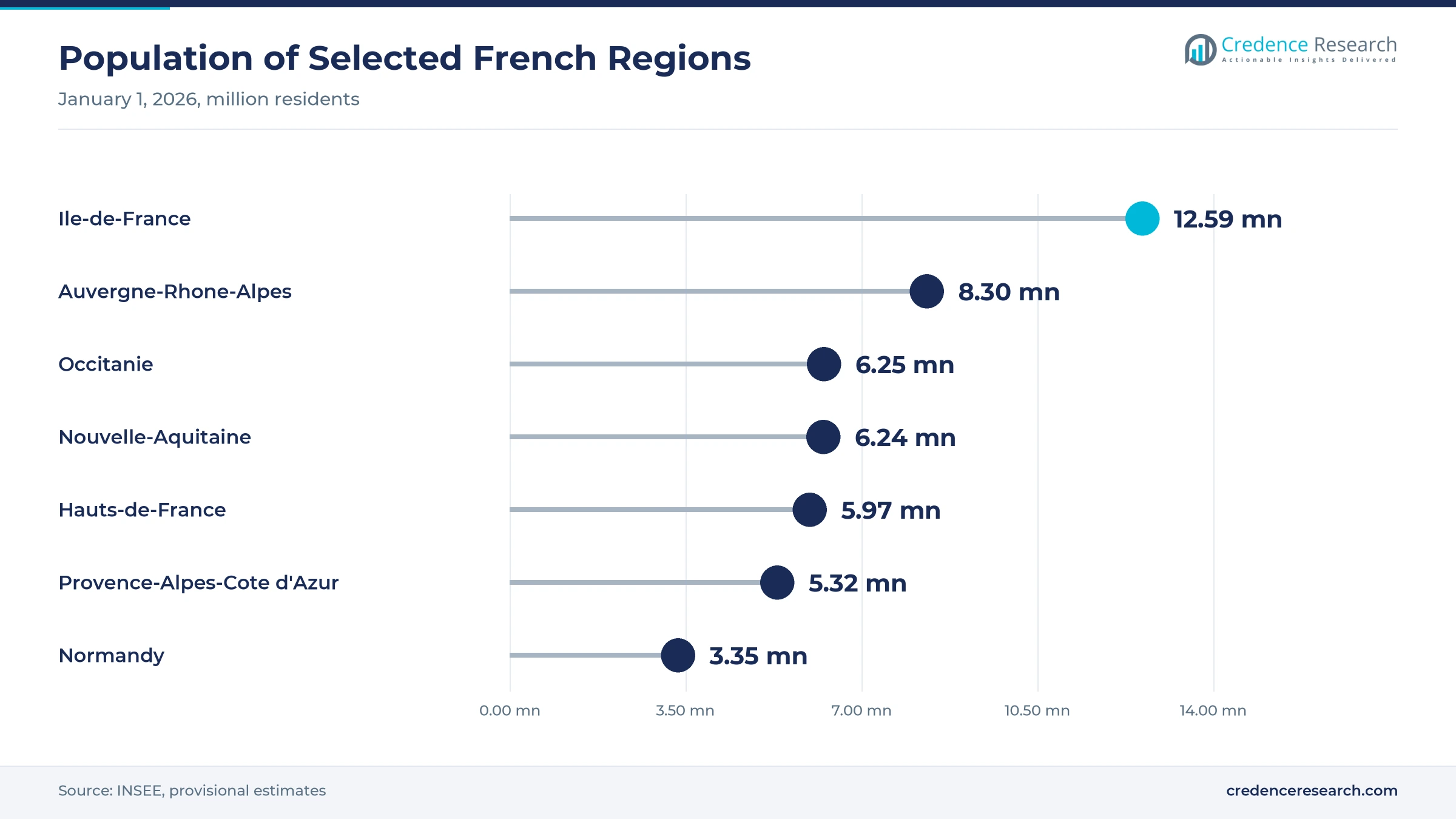
Last-mile chilled delivery offers an opening, because the largest urban areas combine high incomes with dense flats and limited storage space. Ile-de-France counted 12,594,502 residents on Jan. 1, 2026, according to INSEE provisional estimates, the largest population of any French region. Auvergne-Rhone-Alpes followed with 8,303,191 residents and Occitanie with 6,246,988, which adds two more large urban markets around Lyon, Toulouse and Montpellier, where home delivery of chilled groceries is spreading. Last-mile temperature-controlled delivery grows at 4.50% a year, the fastest service type in this report. As a result, operators that combine urban cross-docks with small electric vans can serve grocers, meal-kit brands and retail pharmacy chains.
Weak food volumes and refrigerant rules squeeze margins
How do weak food volumes limit growth?
Weak food production volumes limit growth, because cold chain revenue depends on the tonnage that processors ship every week. STEF reported that food production in France declined for a third consecutive year in 2025, according to its annual results. As a result, providers compete harder for the same pallets, which holds down rates for storage and distribution. Operators respond with productivity gains and new pharma or import flows, but recovery depends on consumer demand and farm output.
Why does retail concentration pressure provider margins?
Retail concentration pressures provider margins, because a small number of grocery groups negotiate national logistics contracts and purchasing alliances. STEF noted that some of its activities in France were severely affected by the concentration of major retailers in 2025. In turn, providers face tender rounds that favor the lowest price per pallet or per stop. Larger networks can spread fixed costs over more clients, while smaller regional carriers may lose volume or exit the market altogether.
How do refrigerant rules raise capital needs?
Refrigerant rules raise capital needs, because operators must replace or convert older systems that rely on high global warming potential gases. The servicing ban from 2025 limits how long such equipment can run on new gas supplies. Therefore, owners of older cold stores must budget for ammonia or carbon dioxide systems, new controls and safety work. Smaller warehouse owners struggle to fund this, which may push them to sell sites or partner with larger groups.
Why do driver shortages and energy costs strain operations?
Driver shortages and energy costs strain operations, because refrigerated transport needs skilled drivers and continuous power for cooling. Chilled deliveries often run at night and on weekends, which makes recruitment harder than in ambient freight. At the same time, cold stores consume large amounts of electricity around the clock. Operators mitigate these pressures with better route planning, solar roofs and energy recovery units, but costs still feed into contract prices.
Western France leads while the Lyon area grows fastest
| Region | Value, 2025 (USD billion) | Share, 2025 | CAGR, 2026–2035 |
|---|---|---|---|
| Western & Southern France | 3.15 | 33.0% | 3.35% |
| Ile-de-France | 2.77 | 29.0% | 3.70% |
| Hauts-de-France & Normandy | 2.10 | 22.0% | 3.85% |
| Auvergne-Rhone-Alpes | 1.53 | 16.0% | 4.10% |
Why do western and Southern France lead spending?
Western and Southern France held 33.0% of 2025 value and grows at 3.35% a year, the slowest pace among the four zones. Brittany and Pays de la Loire concentrate meat, poultry and dairy processing, while the southwest and Provence supply fruit and vegetables. Sofrilog strengthened its western network in November 2025 by buying Trace & Go in Puceul, Loire-Atlantique. However, flat food output keeps growth below the national rate through 2035.
How does Ile-de-France combine consumption and air cargo?
Ile-de-France held 29.0% of 2025 value and grows at 3.70% a year, supported by the largest regional population in the country. The Rungis wholesale market hosts 1,198 companies on 234 hectares, making it the main fresh food hub for Paris restaurants and stores. Paris Charles de Gaulle Airport also handles temperature-controlled pharmaceutical air cargo through certified hubs. As a result, the region leads in last-mile chilled delivery and air pharma handling.
What role do Hauts-de-France and Normandy ports play?
Hauts-de-France and Normandy held 22.0% of 2025 value and grow at 3.85% a year, the second-fastest pace among the four zones. Le Havre and Dunkirk handle reefer containers of seafood, fruit and meat, and Seafrigo and Norfrigo run large cold stores close to the quays. Normandy also hosts Sanofi sites at Le Trait and Val-de-Reuil, which ship vaccines and biologics. Therefore, the zone combines import gateway flows with pharmaceutical export lanes.
Why does Auvergne-Rhone-Alpes grow fastest?
Auvergne-Rhone-Alpes held 16.0% of 2025 value and grows at 4.10% a year, the fastest pace among the four zones. The Lyon area hosts a large cluster of vaccine and biologics plants, including the Sanofi facility at Neuville-sur-Saône. The region also sits on the main north to south road and rail corridor toward Italy and Spain. As a result, pharmaceutical storage and transit cross-docks add demand faster than in the food-heavy western zones.
Acquisitions and new platforms mark 2024 to 2026
| Development | Status and market relevance |
|---|---|
| In May 2024, Sanofi announced more than EUR 1 billion of new biomanufacturing investment in France, including Vitry-sur-Seine and Le Trait. | Adds domestic biologics output that needs certified temperature-controlled storage and transport |
| In June 2024, DHL Supply Chain agreed to manage Sanofi warehousing at Amilly, Croissy-Beaubourg and Saint-Loubès. | Expands outsourced pharmaceutical logistics across three French sites |
| In November 2024, Seafrigo began building a 9,200-square-meter cold store with up to 30,000 pallet positions in Le Havre. | Adds frozen and chilled capacity at the main Channel container gateway |
| In November 2025, Sofrilog acquired Trace & Go, a company based in Puceul, Loire-Atlantique. | Strengthens a frozen logistics specialist in western France |
| In April 2026, STEF announced a new refrigerated platform at the port of Strasbourg, planned to open within a year. | Modernizes eastern capacity for chilled food distribution and cross-border flows |
Electric cooling and data loggers change daily operations
- All-electric trailer cooling recovers braking energy through a generator axle and powers the refrigeration unit from a battery, which cuts diesel use and noise.
- Natural refrigerant systems based on ammonia or carbon dioxide replace high global warming potential gases in new and retrofitted cold stores.
- Real-time temperature data loggers record conditions for each pallet or parcel, which supports good distribution practice audits for medicines.
- Automated high-bay frozen storage uses cranes and shuttles at minus 25 degrees Celsius, which raises density and reduces staff exposure to cold.
Need a Custom Version of This Report?
Tailor the scope, geography, or segments to your exact requirements.
- Custom geography or segment scope
- Direct access to our analyst team
National specialists and global 3PLs compete on density
Competition in the France cold chain logistics market combines national food specialists with global contract logistics groups. STEF runs the densest national network for chilled and frozen food and keeps investing in regional platforms. Sofrilog, Olano Group and Mutual Logistics compete in frozen storage, meat transport and shared food logistics, often with strong regional roots. Seafrigo focuses on import and export flows through Le Havre and other ports. DHL Supply Chain, Kuehne + Nagel, GEODIS and DSV compete for pharmaceutical contracts, airport handling and integrated third-party logistics, and DSV grew its scale by completing the purchase of Schenker in April 2025. XPO serves food and industrial shippers with road transport capacity across the country. Rivals compete on network density, certification, energy efficiency, price per pallet and the ability to combine storage, transport and value-added handling in one contract.
Companies profiled and their roles in this market
| Company | Type | Role in the market |
|---|---|---|
| STEF | National temperature-controlled specialist | Runs a national network and announced a new Strasbourg platform in April 2026 |
| Sofrilog | Frozen logistics specialist | Operates large frozen storage capacity and bought Trace & Go in November 2025 |
| Seafrigo | Port-based food logistics provider | Began a 30,000-pallet cold store in Le Havre in November 2024 |
| DHL Supply Chain | Global contract logistics provider | Manages Sanofi warehousing at three French sites since a June 2024 agreement |
| Kuehne + Nagel | Global logistics provider | Runs a GDP and CEIV compliant cold hub at Paris Charles de Gaulle Airport |
| Mutual Logistics | Shared food logistics provider | Operates multi-client food logistics, including a 31,000-square-meter Orléans site |
| DSV | Global logistics provider | Completed the acquisition of Schenker on April 30, 2025 |
Credence Research view on pharma and port capacity
Credence Research's view is that France cold chain logistics will grow at a moderate pace, with value shifting toward pharmaceutical lanes, port gateways and urban last-mile delivery while core food volumes stay flat. Providers that pair dense food networks with certified pharma capacity should hold the strongest position. Refrigerant rules and electric cooling raise capital needs, which favors groups with the balance sheet to rebuild older cold stores. However, retail concentration will keep pressure on rates, so winners will need energy-efficient sites, high truck fill rates and long contracts with pharma and import customers.
How the temperature-controlled logistics estimate was built
The report uses 2025 as the base year on a calendar basis, with values in USD million at current prices. Market values come from the Credence Research model, which starts from chilled and frozen food and medicine volumes and applies service intensity and price assumptions for storage, transport and handling. Regional, segment and customer splits are Credence Research estimates built from population, processing and port indicators. Sources used are INSEE population statistics, Eurostat agricultural forecasts, European Union legislative records, industry releases and company announcements, and no interviews or surveys were used.
Moderate growth through 2035 with pharma gaining share
France cold chain logistics spending is expected to reach USD 13.75 billion by 2035, a 3.68% CAGR during 2026–2035, as pharmaceutical flows, port gateway volumes and urban chilled delivery add demand. Growth should stay modest in 2026 and 2027 while food output remains weak and operators absorb refrigerant and energy costs. After that, new biologics plants and modernized platforms should lift volumes and service mix. A recovery in food production would lift this outlook, while further retail consolidation or higher power prices would lower it.
Frequently Asked Questions
How big is the France cold chain logistics market?
Which zone leads temperature-controlled logistics spending?
Which zone grows fastest?
Which service type holds the largest share?
How do European refrigerant rules affect cold stores?
Why are pharmaceutical flows growing?
Who are the leading cold chain logistics companies in France?
Which transport mode dominates?
Table of Content
Chapter 1 Market Segmentation
- 1.1 Segmentation Framework
- 1.1.1 Product and Service Classification
- 1.1.2 Application and End-Use Classification
- 1.1.3 Technology and Solution Classification
- 1.1.4 Customer and Distribution Channel Classification
- 1.1.5 Geographic Segmentation
- 1.1.6 Market Segment Definitions and Boundaries
- 1.2 By Service Type
- 1.2.1 Refrigerated Transport
- 1.2.2 Refrigerated Storage
- 1.2.3 Last-Mile Temperature-Controlled Delivery
- 1.2.4 Value-Added Handling
- 1.3 By Mode of Transport
- 1.3.1 Road
- 1.3.2 Sea
- 1.3.3 Air
- 1.3.4 Rail
- 1.4 By Customer Type
- 1.4.1 Food Manufacturers & Processors
- 1.4.2 Grocery Retailers & Foodservice
- 1.4.3 Pharmaceutical & Biotech Companies
- 1.4.4 Agriculture & Seafood Producers
- 1.5 By End-Use Industry
- 1.5.1 Meat, Poultry & Seafood
- 1.5.2 Fruits, Vegetables & Prepared Foods
- 1.5.3 Dairy & Frozen Desserts
- 1.5.4 Pharmaceuticals & Biologics
Chapter 2 Introduction
- 2.1 Report Objectives and Scope
- 2.2 Product Definition and Industry Terminology
- 2.3 Market Inclusions and Exclusions
- 2.4 Research Process
- 2.4.1 Primary Research and Expert Interviews
- 2.4.2 Secondary Research and Source Review
- 2.4.3 Top-Down and Bottom-Up Estimation
- 2.4.4 Data Triangulation and Verification
- 2.5 Market Size Measurement Basis
- 2.5.1 2025: USD 9.55 billion → 2035: USD 13.75 billion
- 2.6 Historical and Forecast Reference Periods
- 2.6.1 Historical Period: 2018-2025
- 2.6.2 Base Year: 2025
- 2.6.3 Forecast Period: 2025-2035
- 2.7 Research Assumptions and Limitations
Chapter 3 Executive Summary
- 3.1 Market Snapshot and Key Findings
- 3.2 Base-Year Market Size, 2025
- 3.3 Forecast Market Size, 2035
- 3.4 Revenue and Volume Growth Outlook
- 3.5 Key Demand and Supply Indicators
- 3.6 Leading Market Segments
- 3.7 Fastest-Growing Market Opportunities
- 3.8 Regional Performance Highlights
- 3.9 Technology and Industry Transformation
- 3.10 Competitive Landscape Summary
- 3.11 Analyst View and Strategic Implications
Chapter 4 France Cold Chain Logistics Market Trends and Developments
- 4.1 Historical Industry Development, 2018-2025
- 4.2 Recent Market Trends and Developments
- 4.3 Demand and Customer Behavior Trends
- 4.4 Technology and Product Innovation
- 4.5 Artificial Intelligence, Automation and Digitalization
- 4.6 Local Manufacturing and Supply Chain Realignment
- 4.7 Industry Partnerships, Mergers and Acquisitions
- 4.8 Sustainability and Circular Economy Developments
- 4.9 Government and Private Sector Investment Trends
- 4.10 Emerging Business Models and Commercialization
- 4.11 Industry Developments and Announcements
Chapter 5 France Cold Chain Logistics Market Production, Supply and Demand Analysis
- 5.1 Demand Trend and Consumption Analysis, 2018-2025
- 5.2 Demand Forecast, 2025-2035
- 5.3 Production and Output Trend, 2018-2025
- 5.4 Production and Output Forecast, 2025-2035
- 5.5 Installed Capacity and Capacity Utilization
- 5.6 Company-Wise Production Plants and Statistics
- 5.6.1 Installed Production Capacity
- 5.6.2 Actual Production
- 5.6.3 Planned Capacity and Expansion Targets
- 5.7 Supply Chain Structure and Procurement Trends
- 5.8 Supply-Demand Gap and Bottlenecks
- 5.9 Import Dependence and Sourcing Structure
- 5.10 Contract Manufacturing and Outsourcing
- 5.11 Regional Supply and Demand Concentration
Chapter 6 France Cold Chain Logistics Market Pricing Analysis
- 6.1 Pricing Structure and Measurement
- 6.2 Historical Pricing Trends, 2018-2025
- 6.3 Pricing Outlook, 2025-2035
- 6.4 Average Selling Price and Unit Economics
- 6.5 Pricing by Product and Market Segment
- 6.6 Geographic Pricing Differences
- 6.7 Key Input, Energy, Labor and Logistics Costs
- 6.8 Contract Pricing and Purchasing Models
- 6.9 Pricing Sensitivity and Competitive Positioning
- 6.10 Price, Margin and Profitability Implications
Chapter 7 France Cold Chain Logistics Market Dynamics
- 7.1 Market Growth Drivers
- 7.1.1 Demand-Side Drivers
- 7.1.2 Technology and Innovation Drivers
- 7.1.3 Infrastructure and Investment Drivers
- 7.1.4 Regulatory and Policy Drivers
- 7.2 Market Restraints
- 7.2.1 Cost and Affordability Constraints
- 7.2.2 Technology and Adoption Barriers
- 7.2.3 Supply Chain and Operational Constraints
- 7.3 Market Challenges
- 7.3.1 Competitive Pressure and Margin Erosion
- 7.3.2 Skills, Infrastructure and Implementation Gaps
- 7.4 Emerging Market Opportunities
- 7.5 Market Dynamics Impact and Time-Horizon Assessment
Chapter 8 France Cold Chain Logistics Value Chain Analysis
- 8.1 Industry Value Chain Overview
- 8.2 Upstream Suppliers and Critical Inputs
- 8.3 Technology and Component Providers
- 8.4 Manufacturing or Service Delivery
- 8.5 Distribution, Channel Partners and Integrators
- 8.6 Downstream Applications and End Users
- 8.7 Value Addition and Profit Pools
- 8.8 Vertical Integration and Outsourcing
- 8.9 Supplier Concentration and Risk
- 8.10 Supply Chain Localization and Resilience
Chapter 9 France Cold Chain Logistics Market Regulations and Policies
- 9.1 Relevant Laws, Standards and Compliance Frameworks
- 9.2 Product, Service, Safety and Quality Requirements
- 9.3 Government Policies, Incentives and Subsidies
- 9.4 Imports, Exports and Trade Barriers
- 9.5 Public Procurement and Local Content Requirements
- 9.6 Environmental and Sustainability Compliance
- 9.7 Upcoming Policy Changes and Market Implications
Chapter 10 France Cold Chain Logistics Market Hotspots and Opportunities
- 10.1 Market Opportunity Mapping and Growth Hotspots
- 10.2 High-Growth Applications and Customer Groups
- 10.3 Underserved Markets and White-Space Opportunities
- 10.4 Emerging Technology and Product Opportunities
- 10.5 New Capacity and Investment Hotspots
- 10.6 Market Entry and Expansion Opportunities
- 10.7 Distribution and Partnership Opportunities
- 10.8 Near-Term and Long-Term Commercial Potential
- 10.9 Opportunity Attractiveness and Execution Risks
Chapter 11 France Cold Chain Logistics Market Outlook, 2025-2035
- 11.1 Market Size and Analysis
- 11.1.1 Revenue (Market Measurement: 2025: USD 9.55 billion → 2035: USD 13.75 billion)
- 11.1.2 Market Volume and Quantity Sold
- 11.1.3 Historical Market Size, 2018-2025
- 11.1.4 Base-Year Market Size, 2025
- 11.2 Market Forecast, 2025-2035
- 11.2.1 Revenue Forecast to 2035
- 11.2.2 Volume Forecast to 2035
- 11.2.3 CAGR and Year-on-Year Growth
- 11.2.4 Incremental Revenue Opportunity
- 11.3 Forecast Assumptions and Scenario Analysis
- 11.3.1 Base-Case Forecast
- 11.3.2 Optimistic and Conservative Scenarios
- 11.3.3 Technology, Pricing and Policy Sensitivities
- 11.4 Market Attractiveness and Growth Outlook
Chapter 12 France Cold Chain Logistics Market Segmentation and Outlook
- 12.1 Segmentation Summary and Market Shares, 2025
- 12.2 Largest and Fastest-Growing Segments
- 12.3 By Service Type - Market Size and Forecast, 2025-2035
- 12.3.1 Segment Definition and Scope
- 12.3.2 Historical Market Size, 2018-2025
- 12.3.3 Revenue Forecast, 2025-2035
- 12.3.4 Volume Forecast, 2025-2035
- 12.3.5 Base-Year Market Share, 2025
- 12.3.6 Segment CAGR and Growth Drivers
- 12.3.7 Subsegment Market Size and Forecast
- 12.3.7.1 Refrigerated Transport
- 12.3.7.2 Refrigerated Storage
- 12.3.7.3 Last-Mile Temperature-Controlled Delivery
- 12.3.7.4 Value-Added Handling
- 12.3.8 Subsegment Pricing and Adoption Trends
- 12.3.9 Leading Suppliers and Competition
- 12.3.10 Regional Demand and Opportunities
- 12.4 By Mode of Transport - Market Size and Forecast, 2025-2035
- 12.4.1 Segment Definition and Scope
- 12.4.2 Historical Market Size, 2018-2025
- 12.4.3 Revenue Forecast, 2025-2035
- 12.4.4 Volume Forecast, 2025-2035
- 12.4.5 Base-Year Market Share, 2025
- 12.4.6 Segment CAGR and Growth Drivers
- 12.4.7 Subsegment Market Size and Forecast
- 12.4.7.1 Road
- 12.4.7.2 Sea
- 12.4.7.3 Air
- 12.4.7.4 Rail
- 12.4.8 Subsegment Pricing and Adoption Trends
- 12.4.9 Leading Suppliers and Competition
- 12.4.10 Regional Demand and Opportunities
- 12.5 By Customer Type - Market Size and Forecast, 2025-2035
- 12.5.1 Segment Definition and Scope
- 12.5.2 Historical Market Size, 2018-2025
- 12.5.3 Revenue Forecast, 2025-2035
- 12.5.4 Volume Forecast, 2025-2035
- 12.5.5 Base-Year Market Share, 2025
- 12.5.6 Segment CAGR and Growth Drivers
- 12.5.7 Subsegment Market Size and Forecast
- 12.5.7.1 Food Manufacturers & Processors
- 12.5.7.2 Grocery Retailers & Foodservice
- 12.5.7.3 Pharmaceutical & Biotech Companies
- 12.5.7.4 Agriculture & Seafood Producers
- 12.5.8 Subsegment Pricing and Adoption Trends
- 12.5.9 Leading Suppliers and Competition
- 12.5.10 Regional Demand and Opportunities
- 12.6 By End-Use Industry - Market Size and Forecast, 2025-2035
- 12.6.1 Segment Definition and Scope
- 12.6.2 Historical Market Size, 2018-2025
- 12.6.3 Revenue Forecast, 2025-2035
- 12.6.4 Volume Forecast, 2025-2035
- 12.6.5 Base-Year Market Share, 2025
- 12.6.6 Segment CAGR and Growth Drivers
- 12.6.7 Subsegment Market Size and Forecast
- 12.6.7.1 Meat, Poultry & Seafood
- 12.6.7.2 Fruits, Vegetables & Prepared Foods
- 12.6.7.3 Dairy & Frozen Desserts
- 12.6.7.4 Pharmaceuticals & Biologics
- 12.6.8 Subsegment Pricing and Adoption Trends
- 12.6.9 Leading Suppliers and Competition
- 12.6.10 Regional Demand and Opportunities
- 12.7 Segment Growth Comparison
- 12.8 Segment Attractiveness and Priority Matrix
Chapter 13 France Cold Chain Logistics End-Use and Application Market Outlook
- 13.1 End-Use Industry and Customer Demand Structure
- 13.2 Leading Applications and Customer Groups
- 13.3 End-Use Market Size, Share and Forecast
- 13.4 Major End-Use Industry Deep Dives
- 13.4.1 Customer Requirements and Use Cases
- 13.4.2 Demand and Replacement Cycles
- 13.4.3 Technical and Regulatory Considerations
- 13.4.4 Purchasing and Procurement Models
- 13.4.5 Leading Vendors and Distribution Channels
- 13.4.6 Forecast and Commercial Opportunities
- 13.5 Emerging Applications and Cross-Segment Demand
- 13.6 End-Use Industry Investment Priorities
Chapter 14 France Cold Chain Logistics Geographic Market Outlook, 2025-2035
- 14.1 Regional Market Size and Country-Level Shares, 2025
- 14.2 Country Market Size Comparison, 2025
- 14.3 Country Market Forecasts, 2025-2035
- 14.4 Subregional Industrial and Demand Clusters
- 14.5 Intra-Regional Pricing and Cost Differences
- 14.6 Cross-Border Trade and Supply Networks
- 14.7 Regional Supply and Demand Balances
- 14.8 Country Opportunity Comparison and Prioritization
Note: Every listed country is covered on the structure shown under the first country.
Chapter 15 France Cold Chain Logistics Technology, Innovation and Sustainability Outlook
- 15.1 Technology Landscape and Maturity
- 15.2 Product, Process and Service Innovation
- 15.3 AI, Automation and Digital Tools in the Industry
- 15.4 Technology Adoption and Performance Benchmarking
- 15.5 Innovation Pipeline and R&D Investment
- 15.6 Patent and Intellectual Property Trends
- 15.7 Energy Efficiency and Resource Management
- 15.8 Sustainability, Recycling and Circularity
- 15.9 Technology Roadmap, 2025-2035
- 15.10 Risks of Obsolescence and Technology Substitution
Chapter 16 France Cold Chain Logistics Market Key Strategic Imperatives
- 16.1 Growth and Market Entry Priorities
- 16.2 High-Return Products and Segments
- 16.3 Pricing, Profitability and Cost Optimization
- 16.4 Technology Investment and Product Differentiation
- 16.5 Supply Chain Localization and Resilience
- 16.6 Distribution and Customer Acquisition
- 16.7 Partnership, Acquisition and Capacity Strategy
- 16.8 Regional Expansion Priorities
- 16.9 Short-, Medium- and Long-Term Actions
Chapter 17 Competition Outlook
- 17.1 Industry Competition Characteristics
- 17.2 Market Structure and Concentration
- 17.3 Market Share and Competitive Positioning, 2025
- 17.4 Company-Wise Revenue and Product Benchmarking
- 17.5 Production and Service Capacity Benchmarking
- 17.6 Technology, Pricing and Differentiation
- 17.7 Regional Footprint and Distribution Strength
- 17.8 Mergers, Acquisitions and Strategic Alliances
- 17.9 New Entrants and Competitive Threats
- 17.10 Porter's Five Forces and Industry Attractiveness
- 17.11 Competitive Outlook, 2025-2035
Chapter 18 Company Profiles
- 18.1 Company Coverage and Selection Criteria
- 18.2 STEF
- 18.2.1 Business Description
- 18.2.2 Company Ownership and Geographic Presence
- 18.2.3 Product and Service Portfolio
- 18.2.4 Manufacturing and Operating Footprint
- 18.2.5 Production Capacity and Expansion Plans
- 18.2.6 Financial Performance and Investment
- 18.2.7 Market Share and Competitive Position
- 18.2.8 Technology and Innovation Capabilities
- 18.2.9 Strategic Alliances or Partnerships
- 18.2.10 Recent Developments
- 18.2.11 Growth Strategy and Outlook
- 18.3 Kuehne + Nagel
- 18.4 Sofrilog
- 18.5 Olano Group
- 18.6 XPO
- 18.7 DSV
- 18.8 DHL Supply Chain
- 18.9 GEODIS
- 18.10 Seafrigo
- 18.11 Mutual Logistics
- 18.12 Other Relevant Market Participants
Note: Every listed company is profiled on the structure shown under the first company. The company list is preliminary and may change based on research findings, market developments, data availability and client requirements.
Chapter 19 Disclaimer
- 19.1 Research and Forecast Disclaimer
- 19.2 Data Source and Estimation Limitations
Note: The depth of individual sections depends on data availability for this market. Volume, capacity, trade and other unit-based metrics are included where applicable.