
Hair Restoration Market Overview:
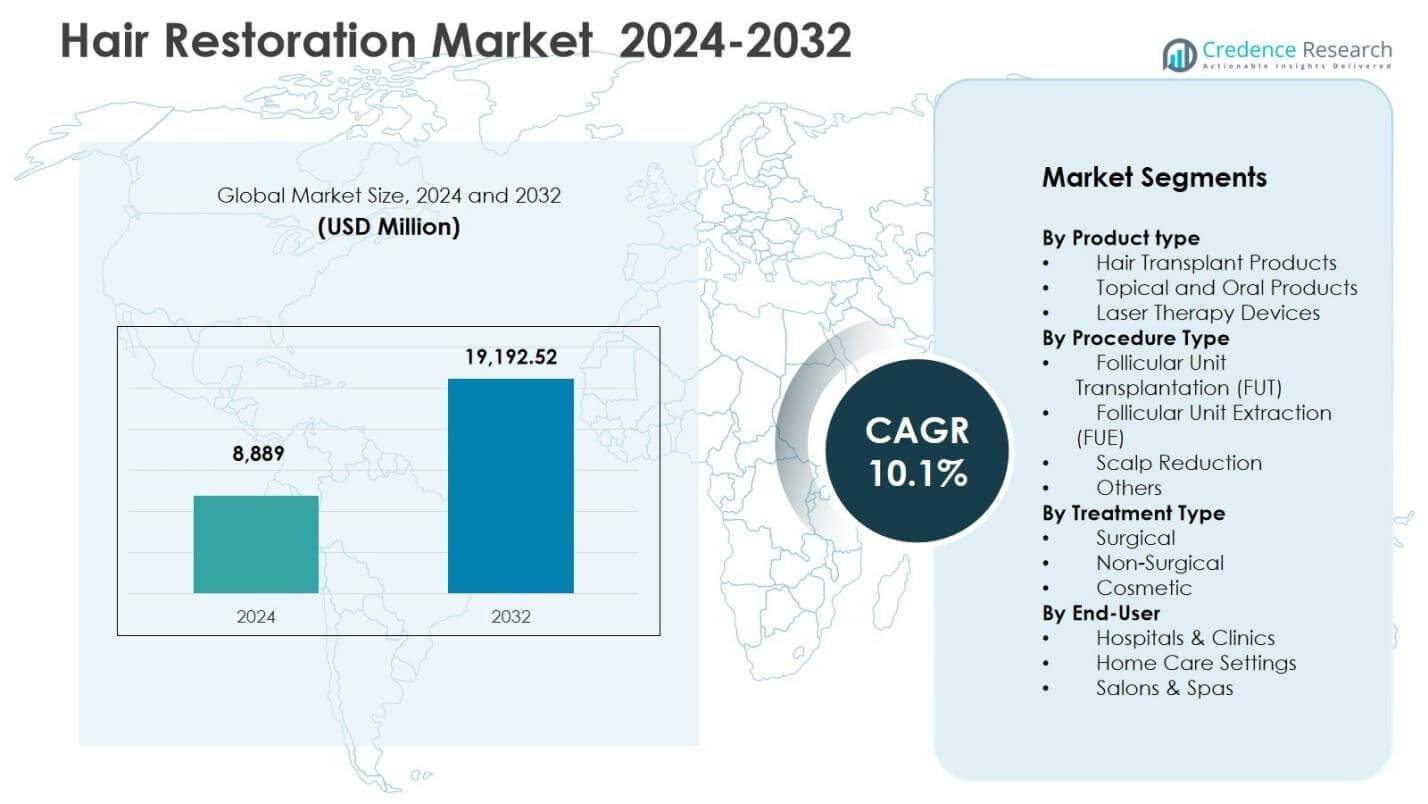
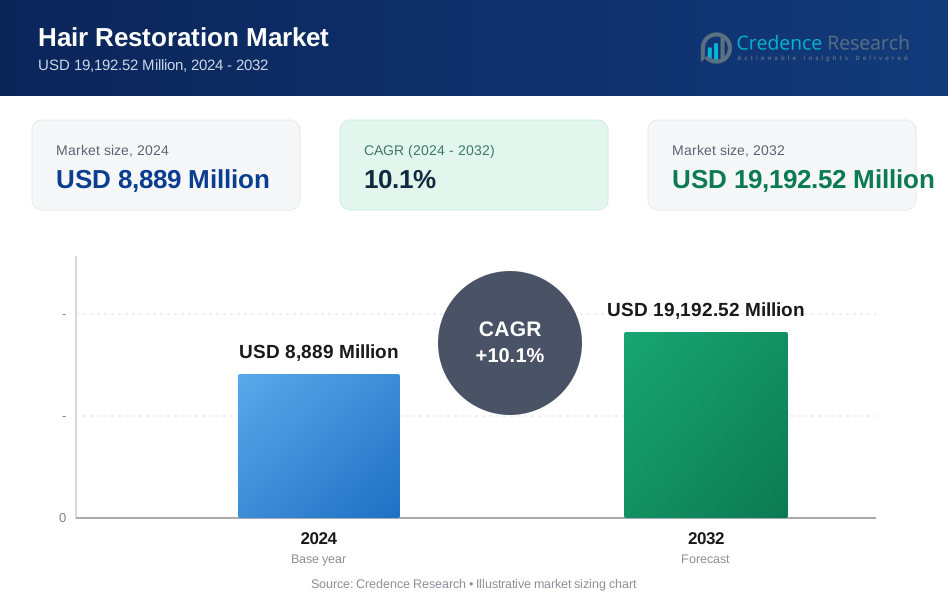
Hair Restoration Market size was valued USD 8,889 Million in 2024 and is anticipated to reach USD 19,192.52 Million by 2032, at a CAGR of 10.1% during the forecast period.
| REPORT ATTRIBUTE | DETAILS |
|---|---|
| Historical Period | 2020-2023 |
| Base Year | 2024 |
| Forecast Period | 2025-2032 |
| Hair Restoration Market Size 2024 | USD 8,889 million |
| Hair Restoration Market, CAGR | 10.1% |
| Hair Restoration Market Size 2032 | USD 19,192.52 million |
Market Insights
- Market overview highlights rising demand for restoration therapies as Non-Surgical Treatments held 61.7% share in 2024, supported by PRP adoption, laser therapy usage, and strong patient preference for minimally invasive solutions.
- Market driver reflects increasing incidence of androgenetic alopecia, lifestyle-induced hair loss, and technology-enabled FUE procedures that enhance treatment outcomes and expand acceptance across male and female patient groups.
- Market trends indicate growing focus on clinic network expansion, robotic transplant systems, and service differentiation by major players, supported by widening access to regenerative and maintenance-based treatment portfolios.
- Regional analysis shows North America with 36.4% share in 2024, followed by Europe with 28.7% share and Asia-Pacific with 22.9% share, while Latin America and the Middle East & Africa continue strengthening procedure adoption across emerging treatment hubs.
Hair Restoration Market Segmentation Analysis:
By Product Type
The Hair Restoration Market by product type is led by Topical and Oral Products, which accounted for 44.6% market share in 2024, driven by rising consumer preference for non-invasive hair regrowth solutions, wider OTC availability, and increasing dermatological recommendations. This segment benefits from strong adoption of nutraceuticals, minoxidil-based formulations, finasteride tablets, and supportive hair-care supplements. Hair Transplant Products hold significant traction due to expanding transplant procedures, while Laser Therapy Devices continue gaining momentum as home-use devices improve clinically validated outcomes and affordability. Growth across product categories is supported by rising hair loss prevalence and early-stage treatment awareness.
- For instance, Cipla's Finpecia 1mg finasteride tablets treat male pattern hair loss by reducing DHT levels. Studies indicate 65% of men achieve positive results, with hair growth improvements in 66% after two years.
By Procedure Type
The market by procedure type is dominated by Follicular Unit Extraction (FUE), which captured 58.3% market share in 2024, supported by its minimally invasive nature, faster recovery time, reduced scarring, and increasing dependency on robotic and automated graft extraction systems. FUE adoption continues to rise across male and female patients, especially in premium aesthetic centers. Follicular Unit Transplantation (FUT) remains relevant for high-density graft requirements, while Scalp Reduction and Others serve niche reconstructive cases. The expanding network of specialized clinics and improved procedural precision further strengthens the preference for FUE-based hair restoration.
- For instance, Aderans (Hair Club) and Bernstein Medical maintain relevance in FUT for high-density cases, often combining with FUE hybrids. Acibadem Healthcare Group and Hair Transplant Center Turkey serve medical tourism with FUT/FUE mixes, while niche players like Limmer Hair Transplant Center target reconstructive scalp reduction.
By Treatment Type
By treatment type, the market is led by Non-Surgical Treatments, which represented 61.7% market share in 2024, driven by strong acceptance of topical therapies, PRP treatments, laser therapy systems, and lifestyle-based preventive hair loss solutions. This segment benefits from lower treatment costs, broader patient suitability, and growing consumer shift toward maintenance-focused aesthetic care. Surgical Treatments continue to gain demand among patients seeking permanent restoration outcomes, particularly in advanced baldness stages. Cosmetic Treatments complement both categories through camouflage and density-enhancement solutions, supporting overall treatment adoption across diverse demographic groups.
Key Growth Drivers
Rising Prevalence of Alopecia and Lifestyle-Induced Hair Loss
The Hair Restoration Market experiences strong growth due to the increasing prevalence of androgenetic alopecia, stress-related hair thinning, hormonal disorders, and nutritional deficiencies among both men and women. Urban lifestyles, pollution exposure, and rising tobacco and alcohol consumption further accelerate hair loss incidence across younger demographics. Growing awareness of early diagnosis and availability of clinically approved therapies encourages individuals to seek professional treatment rather than cosmetic concealment. The expanding patient pool, combined with improved access to dermatology services in emerging economies, strengthens demand for both surgical and non-surgical restoration solutions and drives sustained market expansion.
- For instance, current smokers face 1.88 times higher risk of alopecia areata incidence than non-smokers, with risks rising to 2.25 for over 10 years of smoking and 2.03 for more than five cigarettes daily.
Advancements in Hair Transplant and Regenerative Treatment Technologies
Technological innovation acts as a major catalyst for market growth, particularly through developments in robotic FUE systems, automated graft implantation tools, and precision microsurgical instruments. These advancements improve procedural accuracy, reduce downtime, and enhance aesthetic outcomes, thereby boosting patient confidence and procedural acceptance. Parallel progress in regenerative medicine, including PRP therapy, stem-cell-based research, and growth-factor-enhanced treatment protocols, expands the scope of non-surgical interventions. Clinics increasingly adopt hybrid treatment models that combine surgical restoration with maintenance therapies, enabling long-term follicular survival and density improvement while positioning technology-enabled solutions as key drivers of clinical differentiation and revenue growth.
- For instance, Venus Concept's ARTAS iX system employs a multi-camera stereoscopic vision with 44-micron resolution and a seven-axis robotic arm to harvest and implant grafts precisely, protecting existing hair and enabling up to 1,000 grafts per hour.
Growing Consumer Shift Toward Aesthetic Wellness and Personal Grooming
Rising disposable income, increasing beauty consciousness, and strong social-media influence significantly contribute to market expansion as consumers prioritize appearance enhancement and self-image confidence. Hair restoration is evolving from a corrective medical procedure to a lifestyle and aesthetic wellness choice, particularly among millennials and working professionals. Greater cultural acceptance of cosmetic treatments, celebrity endorsements, and growing patient education through digital platforms foster positive treatment perception. The expansion of premium aesthetic clinics, medical tourism hubs, and subscription-based maintenance therapy models further strengthens procedural adoption, supporting sustained demand across global urban, semi-urban, and emerging market populations.
Key Trends & Opportunities
Expansion of Non-Surgical and Combination Therapy Ecosystems
A major trend shaping the Hair Restoration Market is the rapid expansion of non-surgical treatment solutions, including PRP therapy, low-level laser therapy devices, nutraceuticals, topical actives, and minimally invasive regenerative procedures. These options attract cost-sensitive and early-stage hair loss patients, creating recurring revenue opportunities for clinics. Combination therapy protocols that integrate non-surgical maintenance with surgical transplant outcomes are gaining clinical relevance as they improve graft survival and density retention. Home-use care technologies, tele-consultation platforms, and subscription-based treatment programs further enhance patient engagement, enabling continuous care management and opening new growth opportunities for service providers and device manufacturers.
- For instance, Bosley Medical offers PRP therapy as a non-surgical solution that injects platelet-rich plasma to promote healing and hair growth, often paired with hair transplants for faster recovery and better density.
Rising Adoption of Digital Healthcare Platforms and Medical Tourism Growth
Digitalization presents a significant market opportunity as clinics increasingly leverage AI-enabled hair assessment tools, virtual consultation models, and outcome-simulation applications to improve diagnosis accuracy and patient decision confidence. Digital marketing ecosystems and global online clinic networks broaden international patient outreach and support cross-border bookings. Medical tourism hubs across Asia, the Middle East, and Eastern Europe continue to expand due to competitive treatment pricing, surgeon expertise, and comprehensive cosmetic procedure packages. This trend strengthens international procedure volumes, enhances clinic profitability, and positions destination markets as strategic growth centers for both surgical and advanced non-surgical hair restoration services.
- For instance, Greco Hair Restoration schedules video consultations where doctors assess scalp conditions and hair loss extent remotely, providing detailed procedure explanations for both surgical and non-surgical options to build patient confidence.
Key Challenges
High Treatment Costs and Limited Accessibility in Price-Sensitive Markets
Despite strong demand drivers, the Hair Restoration Market faces challenges associated with high procedural costs, limited insurance coverage, and affordability barriers in developing economies. Surgical transplants, robotic-assisted systems, and premium regenerative therapies remain inaccessible for large patient groups, restricting treatment penetration beyond urban, high-income populations. Limited clinic density in rural regions, shortage of trained surgeons, and uneven distribution of advanced technologies further constrain service availability. Patients often postpone treatment decisions or opt for temporary cosmetic alternatives, creating adoption gaps and reducing potential market conversion rates despite growing awareness and interest in medical hair restoration solutions.
Outcome Variability, Patient Expectations, and Regulatory Constraints
Clinical outcome variability poses a key challenge as treatment success depends on donor hair availability, patient physiology, practitioner expertise, and post-procedure compliance. Unrealistic expectations, influenced by marketing narratives and social media content, often result in dissatisfaction and reputational risk for providers. Regulatory constraints on novel regenerative therapies, approval timelines for emerging technologies, and inconsistent global practice standards also limit the pace of innovation adoption. Ethical concerns surrounding unverified treatment claims and procedural malpractice across unregulated clinics further impact patient trust, emphasizing the need for stricter quality assurance frameworks and standardized clinical governance within the global market.
Regional Analysis
North America
North America held a 36.4% market share in 2024, driven by high aesthetic awareness, strong adoption of advanced FUE and robotic transplant procedures, and the presence of leading clinic networks and technology developers. The region benefits from higher disposable income, supportive dermatology infrastructure, and strong demand from both male and female patient groups. Growing popularity of non-surgical therapies, including PRP and laser treatment systems, further strengthens recurring revenue streams for clinics. Expanding medical financing options, insurance-linked dermatology services, and increasing acceptance of cosmetic enhancement procedures continue to reinforce North America’s leadership position in the Hair Restoration Market.
Europe
Europe accounted for a 28.7% market share in 2024, supported by rising demand for minimally invasive restoration techniques, strong regulatory oversight, and the presence of specialized transplant centers across the UK, Germany, France, Italy, and Spain. The region benefits from increasing prevalence of androgenetic alopecia among aging and urban populations, coupled with cultural acceptance of aesthetic wellness procedures. Growth is further influenced by expanding cross-border treatment mobility and competitive procedure pricing in Central and Eastern Europe. Increasing investment in regenerative dermatology research and adoption of hybrid surgical-and-maintenance treatment pathways continue to enhance Europe’s market expansion trajectory.
Asia-Pacific
Asia-Pacific captured a 22.9% market share in 2024, emerging as the fastest-expanding regional market due to rising medical tourism, rapid urbanization, increasing income levels, and growing aesthetic awareness among younger demographics. Countries such as India, South Korea, Japan, China, and Thailand serve as leading treatment hubs, offering skilled surgeons and cost-efficient transplant procedures. Expanding clinic chains, technology adoption in FUE and robotic systems, and strong demand for non-surgical therapies support sustained growth. Increasing patient education through digital consultation platforms and social-media-driven aesthetic trends further strengthen Asia-Pacific’s role as a strategic growth engine in the Hair Restoration Market.
Latin America
Latin America held a 7.6% market share in 2024, driven by increasing uptake of cosmetic healthcare services, expanding dermatology clinic networks, and rising demand from male grooming and professional workforce segments. Brazil, Mexico, Argentina, and Colombia represent key growth contributors, supported by competitive treatment pricing and strengthening surgeon expertise. Growth in PRP therapy usage, nutritional hair-care supplements, and entry of international franchise clinics enhances accessibility across urban markets. However, uneven income distribution and limited insurance coverage continue to influence procedure affordability, while gradual infrastructure development and medical tourism expansion help accelerate long-term market penetration in the region.
Middle East & Africa
The Middle East and Africa region accounted for a 4.4% market share in 2024, supported by increasing cosmetic procedure adoption in Gulf economies, growth in premium aesthetic wellness centers, and rising participation in medical tourism across the UAE, Turkey, and Saudi Arabia. High demand from affluent consumer segments, expanding investment in technologically advanced transplant facilities, and strengthening presence of international clinic partnerships contribute to regional growth. In Africa, market expansion remains gradual due to limited specialist availability and affordability constraints, although improving urban healthcare infrastructure and rising awareness of hair restoration solutions are steadily enhancing future growth potential.
Hair Restoration Market Share Segmentations:
By Product type
- Hair Transplant Products
- Topical and Oral Products
- Laser Therapy Devices
By Procedure Type
- Follicular Unit Transplantation (FUT)
- Follicular Unit Extraction (FUE)
- Scalp Reduction
- Others
By Treatment Type
- Surgical
- Non-Surgical
- Cosmetic
By End-User
- Hospitals & Clinics
- Home Care Settings
- Salons & Spas
By Geography
- North America
- U.S.
- Canada
- Mexico
- Europe
- Germany
- France
- U.K.
- Italy
- Spain
- Rest of Europe
- Asia Pacific
- China
- Japan
- India
- South Korea
- South-east Asia
- Rest of Asia Pacific
- Latin America
- Brazil
- Argentina
- Rest of Latin America
- Middle East & Africa
- GCC Countries
- South Africa
- Rest of the Middle East and Africa
Competitive Landscape
Competitive landscape in the Hair Restoration Market is shaped by key players such as Bosley, HairClub, DHI Medical Group, Venus Concept, Bernstein Medical, NeoGraft, Aderans Co., Ltd., Follica Inc., Hairline International, and The Harley Street Hair Clinic. The market operates in a moderately consolidated structure, where established transplant clinics, technology developers, and regenerative therapy providers compete on treatment outcomes, service quality, technological innovation, and global clinic expansion. Companies increasingly invest in advanced FUE and robotic systems, PRP-based therapies, and hybrid surgical–nonsurgical protocols to enhance procedural precision and patient satisfaction. Strategic moves such as franchise expansion, partnerships with dermatology centers, and integration of digital consultation platforms strengthen patient outreach and brand visibility. Rising medical tourism, particularly across Asia-Pacific, the Middle East, and Eastern Europe, intensifies competition as providers differentiate through cost efficiency and specialized expertise. Continuous innovation, surgeon training programs, and outcome-focused treatment portfolios remain central to sustaining leadership and competitive advantage in the global market.
Key Player Analysis
- Bosley
- HairClub
- DHI Medical Group
- Venus Concept
- Bernstein Medical
- NeoGraft
- Aderans Co., Ltd.
- Follica, Inc.
- Hairline International
- The Harley Street Hair Clinic
Recent Developments
- In September 2025, MedPark Hospital launched a Hair Restoration Center led by pioneering surgeon Dr. Damkerng Pathomvanich to address hair thinning and baldness, expanding clinical services in Thailand.
- In August 2025, Dr Batra’s launched XOGEN Advance, India's fastest hair growth therapy powered by 10 billion exosomes, delivering visible results in four sessions without surgery.
- In April 2025, Asli Tarcan Clinic launched robotic DHI hair restoration tailored for Afro-textured hair, expanding treatment accessibility for diverse demographics.
Report Coverage
The research report offers an in-depth analysis based on Product Type, Procedure Type, Treatment Type, End User and Geography. It details leading market players, providing an overview of their business, product offerings, investments, revenue streams, and key applications. Additionally, the report includes insights into the competitive environment, SWOT analysis, current market trends, as well as the primary drivers and constraints. Furthermore, it discusses various factors that have driven market expansion in recent years. The report also explores market dynamics, regulatory scenarios, and technological advancements that are shaping the industry. It assesses the impact of external factors and global economic changes on market growth. Lastly, it provides strategic recommendations for new entrants and established companies to navigate the complexities of the market.
Future Outlook
- The market will witness rising demand as awareness of early-stage hair loss treatment and preventive care continues to increase across global populations.
- Non-surgical therapies such as PRP, laser treatment, and regenerative solutions will gain stronger clinical acceptance and wider patient adoption.
- FUE and technology-assisted hair transplant techniques will expand further as patients prefer minimally invasive procedures with faster recovery.
- Digital consultation platforms, AI-based scalp assessment, and virtual treatment planning will enhance patient engagement and clinical decision making.
- Medical tourism destinations will continue to strengthen their role as international hubs for cost-effective and specialized hair restoration services.
- Clinics will increasingly adopt combination therapy models that integrate surgical restoration with maintenance and supportive treatment protocols.
- Growing participation of female patients and younger demographics will broaden the overall treatment base and reshape demand patterns.
- Investments in research on stem-cell therapy, growth factors, and follicle regeneration will open new long-term innovation opportunities.
- Market players will focus on expanding clinic networks, franchising models, and cross-border partnerships to strengthen competitive positioning.
- Regulatory emphasis on treatment quality, practitioner certification, and ethical marketing standards will play a critical role in shaping sustainable industry growth.
Request a Free Sample
Fill in your details and we'll send you a free sample report.
- Sample data tables & charts
- Research methodology
Need a Custom Version of This Report?
Tailor the scope, geography, or segments to your exact requirements.
- Custom geography or segment scope
- Direct access to our analyst team
Frequently Asked Questions
What is the current market size for the Hair Restoration Market, and what is its projected size in 2032?
At what Compound Annual Growth Rate is the Hair Restoration Market projected to grow between 2024 and 2032?
The Hair Restoration Market is projected to grow at a CAGR of 10.1% during the forecast period from 2024 to 2032.
What are the primary factors fueling the growth of the Hair Restoration Market?
Who are the leading companies in the Hair Restoration Market?
Which region commanded the largest share of the Hair Restoration Market in 2024?
Table of Content
Chapter 1. Report Introduction
- 1.1 Report Description & Purpose
- 1.1.1 Report Title & Market Definition
- 1.1.2 Unique Selling Propositions (USP) & Key Differentiators
- 1.1.3 Value Proposition for Stakeholders
- 1.2 Research Objectives
- 1.2.1 Market Sizing Objectives (Volume & Revenue) (Volume Where Applicable)
- 1.2.2 Segmentation Objectives
- 1.2.3 Competitive Intelligence Objectives
- 1.2.4 Forecast & Scenario Objectives
- 1.3 Report Scope
- 1.3.1 Hair Restoration Scope – Segments & Subsegments Covered
- 1.3.2 Geographic Scope – Regions & Countries Covered
- 1.3.3 Historical Period, Base Year & Forecast Period (2024; forecast to 2032)
- 1.3.4 Inclusions & Exclusions
- 1.4 Industry Classification & Applicable Codes
- 1.5 Currency, Measurement Units & Valuation Basis
- 1.6 Target Stakeholders
- 1.7 Limitations & Assumptions
Chapter 2. Executive Summary
- 2.1 Global Hair Restoration Market Snapshot
- 2.1.1 Market Size – Historical (2024) & Forecast (2024-2032) (2024: USD 8,889 Million → 2032: USD 19,192.52 Million)
- 2.1.2 Volume & Revenue – Global Totals (Volume Where Applicable)
- 2.1.3 Key Market Highlights – Top Five Facts
- 2.2 Hair Restoration Market Segmentation Snapshot
- 2.2.1 Market Split by Region – 2024 vs. 2032
- 2.3 Competitive Snapshot
- 2.3.1 Top 10 Players by Revenue Share – 2024
- 2.3.2 Top 10 Players by Volume Share – 2024 (Volume Where Applicable)
- 2.3.3 Recent Strategic Developments (18-Month Summary)
- 2.4 Key Investment Highlights & Strategic Conclusions
Chapter 3. Hair Restoration Market Dynamics & Industry Analysis
- 3.1 Market Overview & Context
- 3.1.1 Hair Restoration Market Position in the Broader Industry Value Chain
- 3.1.2 Demand Structure & Purchasing Dynamics
- 3.1.3 Market Maturity & Development Stage by Region
- 3.2 Hair Restoration Market Drivers
- 3.3 Hair Restoration Market Restraints & Challenges
- 3.4 Hair Restoration Market Opportunities
- 3.5 Porter's Five Forces Analysis
- 3.5.1 Threat of New Entrants
- 3.5.2 Bargaining Power of Suppliers
- 3.5.3 Bargaining Power of Buyers
- 3.5.4 Threat of Substitutes
- 3.5.5 Competitive Rivalry – Intensity Assessment
- 3.6 Hair Restoration Value Chain Analysis
- 3.6.1 Upstream – Key Inputs, Resources & Suppliers
- 3.6.1.1 Key Input/Resource 1
- 3.6.1.2 Key Input/Resource 2
- 3.6.1.3 Key Input/Resource 3
- 3.6.2 Midstream – Core Operations & Value Creation
- 3.6.2.1 Operating Model & Process Overview
- 3.6.2.2 Key Operating Locations & Capabilities by Company
- 3.6.3 Downstream – Market Channels & End Users
- 3.6.3.1 Direct Sales & Customer Engagement Channels
- 3.6.3.2 Indirect Sales, Intermediaries & Partner Channels
- 3.6.4 Value Chain Profitability Analysis
- 3.6.1 Upstream – Key Inputs, Resources & Suppliers
- 3.7 PESTEL Analysis
- 3.7.1 Political Factors
- 3.7.2 Economic Factors
- 3.7.3 Social Factors
- 3.7.4 Technological Factors
- 3.7.5 Environmental Factors
- 3.7.6 Legal Factors
- 3.8 Hair Restoration Supply Chain Analysis
- 3.8.1 Critical Input & Resource Availability Risk Assessment
- 3.8.2 Supplier & Operational Concentration Risk (Geographic Exposure)
- 3.8.3 Supply & Service Disruption Impact Analysis
- 3.9 Regulatory & Policy Landscape
Note: The regulatory and policy landscape section covers regulations based on their applicability to the market, Hair Restoration category, geography, and scope of the study. Only regulatory frameworks with a material impact on operations, compliance, trade, sustainability, or market access are analyzed in detail.
Chapter 4. Key Investment Pockets & Opportunity Analysis
- 4.1 Hair Restoration Market Attractiveness Analysis
- 4.1.1 By Region – Investment Attractiveness Matrix (Market Size × CAGR)
- 4.2 Absolute Revenue Growth Opportunity
- 4.2.1 By Region – Absolute Revenue Growth Through 2032
- 4.3 Incremental Demand Opportunity
- 4.3.1 By Region – Incremental Demand Through 2032
- 4.3.2 Segment – Incremental Demand
- 4.4 Emerging Submarket Opportunity Deep Dive (Subject to Applicability)
- 4.5 Priority Market Opportunity Scorecards
- 4.5.1 United States
- 4.5.2 Europe
- 4.5.3 Asia
- 4.5.4 Middle East & Africa
Note: Priority market opportunity scorecards reflect the geographic scope and strategic relevance of the study. Listed markets are indicative and may be adapted to the industry.
Chapter 5. Hair Restoration Cross-Border Trade & Market Access Analysis
- 5.1 International Trade & Cross-Border Activity Overview
- 5.1.1 Global Export Value by Country (2024)
- 5.1.2 Global Export Volume by Country (2024) (Volume Where Applicable)
- 5.1.3 Global Import Value by Country (2024)
- 5.1.4 Global Import Volume by Country (2024) (Volume Where Applicable)
- 5.1.5 Net Trade Balance by Country (2024)
- 5.2 Export Analysis – Segment
- 5.2.1 Category 1 (Applicable Classification Code)
- 5.2.2 Category 2 (Applicable Classification Code)
- 5.2.3 Category 3 (Applicable Classification Code)
- 5.2.4 Category 4 (Applicable Classification Code)
- 5.2.5 Category 5 (Applicable Classification Code)
- 5.3 Import Analysis – Segment
- 5.3.1 Category 1 (Applicable Classification Code)
- 5.3.2 Category 2 (Applicable Classification Code)
- 5.3.3 Category 3 (Applicable Classification Code)
- 5.3.4 Category 4 (Applicable Classification Code)
- 5.3.5 Category 5 (Applicable Classification Code)
- 5.4 Cross-Border Pricing & Transaction Benchmarks
- 5.4.1 Export Pricing – Segment & Country
- 5.4.2 Import Pricing – Segment & Source Country
- 5.4.3 Price Trends (2024)
- 5.5 Key Cross-Border Trade & Delivery Routes
- 5.5.1 Cross-Border Trade/Delivery Route 1
- 5.5.2 Cross-Border Trade/Delivery Route 2
- 5.5.3 Cross-Border Trade/Delivery Route 3
- 5.5.4 Cross-Border Trade/Delivery Route 4
- 5.5.5 Cross-Border Trade/Delivery Route 5
- 5.6 Trade Policy & Market Access Impact Assessment
- 5.6.1 Tariff & Non-Tariff Barriers
- 5.6.2 Regional Trade & Economic Integration Frameworks
- 5.6.3 Bilateral & Multilateral Trade Agreements
- 5.6.4 Cross-Border Operating, Licensing & Localization Requirements
Note: This chapter applies where cross-border trade or delivery is relevant to Hair Restoration. Goods, services, and digital offerings are assessed using applicable classifications and transaction measures. Import-export volumes, trade balances, and route analyses are included only where meaningful to the market.
Chapter 6. Competitive Landscape & Company Benchmarking
- 6.1 Hair Restoration Market Concentration & Structure
- 6.1.1 Herfindahl-Hirschman Index (HHI) – vs. 2024
- 6.1.2 Leading, Mid-Sized & Emerging Player Structure
- 6.1.3 Global, Regional & Local Player Dynamics
- 6.2 Hair Restoration Market Share Analysis – 2024
- 6.2.1 Global Revenue Share by Company
- 6.2.2 Global Volume Share by Company (Volume Where Applicable)
- 6.2.3 Regional Revenue Share
- 6.2.4 Market Share Evolution ( vs. 2024)
- 6.2.5 Company Market Share by Key Segment
- 6.2.6 Company Market Share by Customer Group
- 6.3 Operating Scale, Capacity & Infrastructure Analysis
- 6.3.1 Global Operating Scale & Supply Capacity
- 6.3.2 Resource Utilization & Operating Efficiency
- 6.3.3 Output, Service Delivery & Activity Metrics
- 6.3.4 Operating Footprint & Infrastructure Map
- 6.3.5 Planned Operational & Capacity Expansion
- 6.4 Hair Restoration Competitive Benchmarking Matrix
- 6.4.1 Revenue, Growth, Profitability & Operating Metric Comparison
- 6.4.2 Channel Revenue Mix
- 6.4.3 Geographic Revenue Exposure
- 6.4.4 R&D Intensity
- 6.4.5 Sustainability Maturity
- 6.5 Strategic Developments in Hair Restoration (Last 24 Months)
- 6.5.1 Mergers, Acquisitions & Divestments
- 6.5.2 New Products, Services & Solutions in Hair Restoration
- 6.5.3 Operational & Infrastructure Expansions
- 6.5.4 Strategic Alliances, Joint Ventures & Partnerships
- 6.5.5 Distribution Expansion & Market Entry
- 6.5.6 Sustainability & ESG Initiatives
- 6.6 Competitive Strategy Mapping
- 6.6.1 Leader, Challenger, Follower & Niche Classification
- 6.6.2 Pricing Strategy Comparison
- 6.6.3 Channel Strategy Matrix
Note: Strategic developments are included based on their materiality and the availability of reliable information.
Chapter 7. Global Hair Restoration Market – By Sales & Delivery Channel
- 7.1 Segment Overview
- 7.1.1 Volume & Revenue Split by Channel (2024 & 2032) (Volume Where Applicable)
- 7.1.2 Channel Mix Evolution (2024-2032)
Chapter 8. Regional Market Analysis – Global Overview
- 8.1 Global Regional Overview
- 8.1.1 Regional Volume Share (Volume Where Applicable)
- 8.1.2 Regional Revenue Share
- 8.1.3 Regional Volume by Region (Volume Where Applicable)
- 8.1.4 Regional Revenue by Region
- 8.1.5 Regional Forecast Through 2032
- 8.2 Cross-Regional Segment Analysis
- 8.2.1 By Sales & Delivery Channel
- 8.2.2 By Competitive Positioning & Price Tier
Chapter 9. North America Hair Restoration Market
- 9.1 United States
- 9.2 Canada
- 9.3 Mexico
Chapter 10. Europe Hair Restoration Market
- 10.1 Germany
- 10.2 France
- 10.3 Italy
- 10.4 United Kingdom
- 10.5 Spain
- 10.6 Poland
- 10.7 Russia
- 10.8 Netherlands
- 10.9 Belgium
- 10.10 Sweden
- 10.11 Denmark
- 10.12 Norway
- 10.13 Rest of Europe
Chapter 11. Asia Pacific Hair Restoration Market
- 11.1 China
- 11.2 India
- 11.3 Japan
- 11.4 South Korea
- 11.5 Thailand
- 11.6 Indonesia
- 11.7 Vietnam
- 11.8 Malaysia
- 11.9 Australia
- 11.10 Rest of Asia Pacific
Chapter 12. Latin America Hair Restoration Market
- 12.1 Brazil
- 12.2 Argentina
- 12.3 Colombia
- 12.4 Chile
- 12.5 Rest of Latin America
Chapter 13. Middle East Hair Restoration Market
- 13.1 Saudi Arabia
- 13.2 United Arab Emirates
- 13.3 Turkey
- 13.4 Israel
- 13.5 Iran
- 13.6 Rest of the Middle East
Chapter 14. Africa Hair Restoration Market
- 14.1 South Africa
- 14.2 Egypt
- 14.3 Nigeria
- 14.4 Morocco
- 14.5 Rest of Africa
Chapter 15. Hair Restoration Company Profiles
- 15.1 [Company 01]
- 15.1.1 Company Overview
- 15.1.2 Key Management Personnel
- 15.1.3 Products & Services Portfolio
- 15.1.4 Financial Performance
- 15.1.5 Key Market Focus & Geographic Presence
- 15.1.6 Recent Developments & Strategic Initiatives
Note: The company profile list is preliminary and may change based on research findings, market developments, data availability, and client requirements.
Chapter 16. Appendices
- Appendix A – List of Abbreviations & Acronyms
- Appendix B – Industry Classification Code Reference – Full Series
- Appendix C – Supply, Output & Operating Capacity Data Tables
- Appendix D – End-Use & Demand Base Tables
- Appendix E – Demand, Adoption & Usage Assumptions
- Appendix F – Pricing & Revenue Metric Reference Tables
- Appendix G – Company Operations & Infrastructure Database
- Appendix H – Cross-Border Trade & Activity Data Tables (Where Applicable)
- Appendix I – Regulatory Summary Tables
- Appendix J – Primary Research Participant List (Anonymized)
- Appendix K – Primary Research Questionnaire Framework
- Appendix L – Data Sources & Bibliography
- Appendix M – Market Size Divergence & Source Comparison
Chapter 17. Research Methodology
- 17.1 Research Framework & Philosophy
- 17.2 Secondary Research – Sources, Hierarchy & Data Extraction
- 17.3 Data Modeling – Bottom-Up & Top-Down Market Sizing
- 17.4 Primary Research – Stakeholder Framework, LOI & Sample Sizes
- 17.5 Forecast Methodology – Regression, Scenario & Sensitivity Analysis
- 17.6 Quality Control – Four-Layer Validation Framework
- 17.7 Limitations & Standard Assumptions
- 17.8 Disclaimer
