
| REPORT ATTRIBUTE | DETAILS |
|---|---|
| Historical Period | 2019-2022 |
| Base Year | 2023 |
| Forecast Period | 2024-2032 |
| Medical Gases Market Size 2023 | USD 14514.2 Million |
| Medical Gases Market, CAGR | 8.50% |
| Medical Gases Market Size 2032 | USD 30245.4 Million |
Market Insights
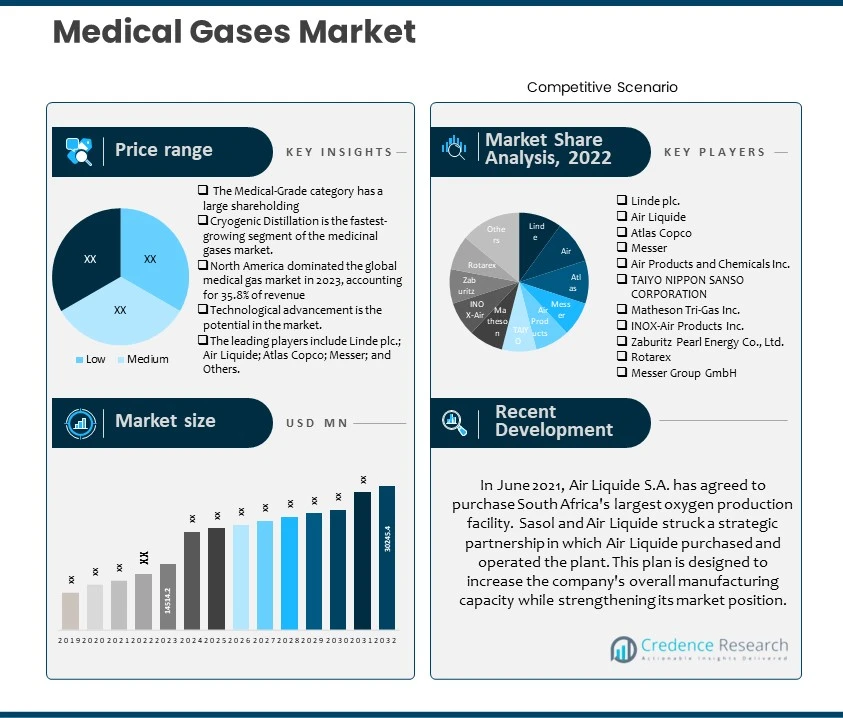
- The global demand for Medical Gases was valued at USD 14514.2 million in 2023 and is expected to reach USD 30245.4 million in 2032, growing at a CAGR of 8.50% between 2024 and 2032.
- The oxygen category has the fastest CAGR, while the medical air segment is expected to increase at a CAGR of 7.96%.
- In 2023, the therapeutic application category held the largest revenue market share, over 40%, while the diagnostics segment is expected to grow at the fastest rate (8.77%) throughout the forecast period.
- The hospital sector dominated the market, accounting for 28.6% of total revenue. Ambulatory Surgical Centers are another important category in the Medical Gases Market.
- The most popular segment is Cylinder.
- Compressed gas is the most popular category in the medical gases industry.
- Cryogenic distillation is the fastest-growing section of the medical gases market, while Chemical Processes is another major segment.
- The Medical-Grade category has a significant stake.
- Both the Gases and Equipment portions are important.
- North America dominated the global medical gas market in 2023, accounting for 35.8% of revenue, while Asia Pacific is expected to grow at the quickest CAGR, 8.7%, over the forecast period.
- The rising prevalence of chronic disorders propels market expansion.
- The global helium shortage hinders market growth.
Executive Summary
Market Definition
The medical gases market refers to the industry that deals with the production, distribution, and use of gases in the healthcare sector. These gases are used for various medical purposes, such as anesthesia, respiratory therapy, and surgical procedures. It's an important industry that ensures the availability of safe and high-quality gases for medical applications.
Market Overview
The global Medical Gases Market has witnessed steady growth in recent years and is expected to grow at a CAGR of 8.50% between 2024 and 2032. The market was valued at USD 14514.2 million in 2023 and is expected to reach USD 30245.4 million in 2032.
The Medical Gases Market is a rapidly growing industry that focuses on the production and distribution of gases used in the healthcare sector. These gases play a crucial role in various medical applications, such as anesthesia, respiratory therapy, and surgical procedures. The market is driven by factors like the increasing prevalence of chronic diseases, the rising demand for home healthcare services, and advancements in medical technology. It is a highly regulated market to ensure the safety and quality of medical gases.
Segmentation by Type
- The oxygen category is predicted to grow at the quickest CAGR of 8.30% throughout the forecast period. Because oxygen is essential for respiratory support, it serves as the foundation for all current anesthetic procedures and life support for artificially ventilated patients.
- The medical air segment is predicted to grow at a CAGR of 7.96% over the forecast period due to its diverse use in patient treatment and management.
Segmentation by Application
- In 2023, the therapeutic application category had the highest revenue market share, nearly 40%, due to the wide variety of medicinal gases used to treat and manage various diseases.
- The diagnostics segment is predicted to increase at the quickest rate (8.77%) throughout the projection period.
Segmentation by End-User
- The hospital sector dominated the market, accounting for 28.6% of total revenue, and is predicted to grow at the quickest CAGR of 8.69% throughout the forecast period. In hospitals, all commercially available medical gases, including oxygen (O2), nitrogen (N2), medicinal air, carbon dioxide (CO2), and nitrogen protoxide (N2O), are commonly used. The usage of medical gases in medical procedures such as surgeries, intensive care, and emergency response, as well as the global prevalence of medical procedures, all contribute to the segment's dominance.
- Ambulatory Surgical Centers are another key segment in the Medical Gases Market.
Segmentation by Delivery Mode
- The most popular segment is Cylinder. Cylinders are commonly used to store and deliver medical gases to healthcare institutions and patients. They offer a handy and portable option for the storage and transfer of medical gases, making them a popular market choice.
Segmentation by Form of Packaging
- Compressed Gas is the most in-demand segment in the medical gases industry. Compressed gases, such as oxygen and nitrogen, are widely employed in medical applications, including respiratory support, anesthesia, and other treatments. Compressed gases continue to be in great demand because of their crucial role in providing critical care and treatment in healthcare settings.
Segmentation by Source
- Cryogenic Distillation is the fastest-growing segment of the medicinal gases market. This technique separates gases at extremely low temperatures. It is gaining popularity because it effectively creates high-purity medicinal gases, which are required for a variety of medical applications.
- Chemical Processes is another key segment in the medical gases industry.
Segmentation by Purity
- The Medical-Grade category has a large shareholding. Medical-grade gases are manufactured and filtered to fulfill the high quality and safety criteria necessary for medical applications. These gases are utilized in a variety of healthcare settings, including hospitals, clinics, and laboratories, to help with patient care and treatment.
Segmentation by Product
- Both the Gases and Equipment segments are significant. The Gases division produces and supplies medical-grade gases such as oxygen, nitrogen, and carbon dioxide, which are required for a variety of medical applications. However, the Equipment segment, which comprises cylinders, regulators, flowmeters, vacuum systems, and other related items, is also important. This category provides the infrastructure required to store, deliver, and control the flow of medical gases in healthcare facilities.
Segmentation by Region
- North America dominated the global medical gas market in 2023, accounting for 35.8% of revenue
- Asia Pacific is predicted to expand at the fastest CAGR, 8.7%, throughout the projection period.
- The rest of the world, including Latin America, the Middle East, and Africa, supplies the remaining demand for Medical Gases.
North America dominated the global medical gas market in 2023, and is predicted to increase significantly during the forecast period. This constant expansion can be linked to the increased use of medicinal gases in the treatment of respiratory disorders including COPD and asthma. The increased prevalence of COPD, asthma, and other medical disorders such as cardiovascular and lifestyle-related diseases is expected to fuel demand for medical gases in the United States during the forecast period. Furthermore, the presence of cutting-edge healthcare facilities, notably intensive care units, a well-established market, and a growing senior population have all helped the United States capture the majority of the market.
Asia Pacific is predicted to expand at the fastest CAGR, 8.7%, throughout the projection period. The presence of densely populated rising economies such as India and China is likely to drive regional market expansion. Furthermore, the region is witnessing an increase in market investments. For example, in May 2023, INOX Air, India's top industrial and medical gas producer, announced an investment of nearly USD 364 million by 2025 to meet expanding market demand.
Key Highlights of the Report
The global Medical Gases Market is segmented based on type, application, end-user, delivery mode, packaging form, source, purity, product, and region. In 2023, the therapeutic application category held the most revenue market share, while the oxygen category had the fastest CAGR. Furthermore, cylinders are the most prevalent sector, while compressed gas is the most in demand. Furthermore, Cryogenic Distillation is the fastest-growing segment of the medical gases market, and the Medical-Grade category holds a considerable share, with North America driving market expansion.
Increasing frequency of chronic diseases, rising demand for home healthcare services, and the convenience of portable medical gas cylinders Technological developments are the primary market drivers. Furthermore, strict regulatory requirements and compliance standards, high costs associated with the manufacture, storage, and transportation of medical gases, and the limited availability of experienced specialists are the primary limitations of the market.
North America led the global medical gas market in 2023 and is expected to grow significantly over the forecast period. Furthermore, Asia Pacific is expected to grow at the fastest CAGR, 8.7%, over the forecast period.
What Are The Main Drivers Of The Global Medical Gases Market?
Several factors drive the Medical Gases Market. The increasing prevalence of chronic diseases has created a greater demand for advanced medical treatments, which often require the use of medical gases. Additionally, the rise in home healthcare services has led to a growing need for portable medical gas cylinders, providing convenience and flexibility for patients.
What Are The Major Challenges Faced By The Global Medical Gases Market?
While the Medical Gases Market presents promising opportunities, there are also some restraints to consider. Stringent regulatory requirements and compliance standards govern the production and distribution of medical gases, ensuring their safety and quality. These regulations can pose challenges for manufacturers and distributors, requiring them to meet strict standards. Moreover, the high costs associated with the production, storage, and transportation of medical gases can be a restraint for market growth.
What Are The Growth Opportunities In The Global Medical Gases Market?
Amidst the challenges, the Medical Gases Market also offers significant opportunities. Expanding into emerging economies with growing healthcare infrastructure presents a chance for market expansion. These countries often have an increasing demand for medical gases as their healthcare systems develop. Furthermore, the development of innovative gas mixtures and delivery systems tailored to specific medical needs can open up new avenues for market growth.
Market Drivers
Several factors drive the global Medical Gases Market. The following are the key drivers of the global Medical Gases Market:
Increasing Prevalence of Chronic Diseases
The number of persons suffering from obesity and related diseases has increased dramatically in recent years as lifestyle and eating habits have changed. The global prevalence of obesity nearly tripled between 1975 and 2016. According to the World Health Organization, more than 1.9 billion persons (18 years and older) were overweight in 2016. Of these, more over 650 million were deemed to be obese. In 2016, around 340 million children and adolescents ages 5-19 were overweight or obese worldwide.
Obesity is seen as a major contributor to the rising prevalence of chronic illnesses such as heart disease and diabetes. According to the World Health Organization, the global prevalence of diabetes, heart disease, and other non-communicable diseases has increased significantly during the previous two decades.
In 2019, the American Hospital Association reported that around 149 million people in the United States had at least one chronic ailment, including hypertension, heart disease, and respiratory disorders. By 2030, the figure is predicted to reach 171 million. Because medical gases are an important component of many long-term care treatments for chronic conditions such as cardiovascular disease, chronic respiratory disease, and cancer, the rising prevalence of lifestyle diseases is expected to have a significant impact on the growth of the medical gases and equipment market in the coming years.
Market Restraints
The global Medical Gases Market faces some challenges that may hinder its growth. These include the following:
Global Helium Shortage
Helium is commonly utilized in the healthcare industry for a variety of applications, including medical imaging (to cool MRI equipment) and as a carrier gas in GC and GC-MS techniques. Currently, medical applications such as MRI account for around 20% of total helium usage.
Globally, the United States accounts for the majority of helium production. Since the early 1960s, the US government has stockpiled helium in the federal helium reserve, which the US Bureau of Land Management oversees. In 2012, approximately one-third of the global helium supply came from the government helium reserve.
However, in 2022, the US government announced plans to close Texas' oldest helium reservoir; in 2019, legislation was passed to overturn the decision.
This legislation highlighted that helium from the reserve should be drawn down at a slower rate and at higher costs in order to allow a smoother transition and prevent a sudden drop in helium prices on the worldwide market. Despite the availability of helium from the United States, there is still a 5-10% shortfall of helium for important uses in aerospace and defense, as well as medical purposes. Thus, global helium prices are projected to rise in the future years.
The helium shortage has pushed MRI equipment producers to seek alternative gases for cooling MRI systems. This could have a detrimental impact on the overall growth of the medical gas market.
Opportunities
The global Medical Gases Market offers significant growth opportunities. These include the following:
Technological Advancements
Technological improvements have resulted in an increasing number of functional alternatives for medical gas handling equipment used in hospitals and home care. In contrast to previous technology, the most technologically advanced equipment offers a complementary system of monitoring and therapeutic delivery, as well as educational content and communication flow between patients and healthcare providers. Furthermore, numerous linked medical gas equipment is gradually being enhanced to provide a higher level of care. The development of lightweight and portable medical gas-handling equipment has proven beneficial to the burgeoning home healthcare sector.
Several medical gas equipment companies are currently working on producing smaller and more portable gas delivery devices that patients can carry with them. The nature of the medical gas equipment market for home care, in particular, is constantly evolving due to the availability of smaller and less expensive equipment on the market.
Competitive Landscape
Key Players
The global Medical Gases Market is highly competitive, with several key players. Some of the major players in the market and their market share are as follows:
- Linde plc.
- Air Liquide
- Atlas Copco
- Messer
- Air Products and Chemicals Inc.
- TAIYO NIPPON SANSO CORPORATION
- Matheson Tri-Gas Inc.
- INOX-Air Products Inc.
- Zaburitz Pearl Energy Co., Ltd.
- Rotarex
- Messer Group GmbH
- Amico Group
- GCE Group
These organizations prioritize product innovation, Service Provider expansion, and mergers and acquisitions to stay competitive.
The global Medical Gases Market's key players continually seek to stay ahead by offering new products and developments.
In March 2023, Atlas Copco bought FS Medical's operating assets, which included medical and laboratory gas equipment and systems. This acquisition is planned to expand Atlas Copco's support and service footprint.
In January 2022, NOVAIR announced the acquisition of Oxygen Generating Systems International. The acquisition is expected to expand the company's manufacturing capability and global footprint.
Summary of Key Findings
- Technological advancement is the potential in the market.
- Type, Application, End-User, Delivery Mode, Form of Packaging, Source, Purity, Product, and Region segment of the market.
- Compressed gas is the most demanded category in the medical gases market.
- The most common segment is cylinders.
- North America is leading market growth. The market is highly competitive, with key players including Linde plc.; Air Liquide; Atlas Copco; Messer; Air Products and Chemicals Inc and Others.
Future Outlook
- Growing demand for medical gases due to the increasing aging population.
- Technological advancements driving innovation in gas production and delivery systems.
- Rising focus on home healthcare services leading to increased demand for portable medical gas cylinders.
- Increasing adoption of medical gases in emerging economies.
- Stringent regulations ensuring the safety and quality of medical gases.
How CXOs Can Benefit from the Credence Research Medical Gases Market Report
The Credence Research Medical Gases Market Report provides CXOs with a comprehensive overview of the market, including:
- Market Product Type and growth forecast: The report provides detailed estimates of the global Medical Gases Market Product Type, segmented by Type, Application, End-User, Delivery Mode, Form of Packaging, Source, Purity, Product, and Region. It also includes forecasts for the market through 2032 based on key trends and drivers.
- Market segmentation: The report segments the Medical Gases Market by Type, Application, End-User, Delivery Mode, Form of Packaging, Source, Purity, Product and Region. This segmentation provides CXOs with a granular understanding of the market and the opportunities in each segment.
- Competitive Landscape: The report profiles the key players in the Medical Gases Market and provides insights into their strategies, product offerings, and financial performance. This information can help CXOs to identify and assess their competition.
- Key trends and drivers: The report identifies and analyzes the key trends and drivers shaping the Medical Gases Market. This information can help CXOs make informed decisions about their investments and strategies.
CXOs can use the insights from the Credence Research Medical Gases Market Report to:
- Identify growth opportunities: The report can help CXOs identify new growth opportunities in the Medical Gases Market. For example, it provides valuable insights and analysis that can assist them in making informed decisions and strategic plans for their businesses.
- Make informed investment decisions: The report can help CXOs to make informed investment decisions about Medical Gases. For example, it analyzes market trends, growth potential, and competitive landscape, allowing CXOs to assess the market's attractiveness and identify investment opportunities.
- Develop competitive strategies: The report can help CXOs develop competitive strategies for their Medical Gases businesses. For example, the report identifies the key strategies that dark fiber providers are using to differentiate themselves from their competitors.
- Track market developments :The report can help CXOs track market developments and stay ahead of the curve. For example, it provides insights into the latest trends and innovations in the Medical Gases Market.
Overall, the Credence Research Medical Gases Market Report is a valuable resource for CXOs who are looking to gain a deeper understanding of the market and identify opportunities for growth.
Segmentation
By Type:- Oxygen
- Nitrous Oxide
- Carbon Dioxide
- Nitrogen
- Medical Air
- Helium
- Others
- Therapeutic Applications (Respiratory, Cardiovascular)
- Diagnostic Applications
- Anesthetic Applications
- Pharmaceutical Manufacturing
- Others
- Hospitals
- Clinics
- Ambulatory Surgical Centers
- Pharmaceutical and Biotechnology Industries
- Diagnostic Centers
- Others
- Cylinder
- Bulk Delivery
- Compressed Gas
- Liquid Gas
- Physical Separation
- Cryogenic Distillation
- Chemical Processes
- Medical-Grade
- Industrial-Grade
- Gases
- Equipment (Cylinders, Regulators, Flowmeters, Vacuum Systems, Others)
- North America
- The U.S.
- Canada
- Mexico
- Europe
- Germany
- France
- The U.K.
- Italy
- Spain
- Rest of Europe
- Asia Pacific
- China
- Japan
- India
- South Korea
- South-east Asia
- Rest of Asia Pacific
- Latin America
- Brazil
- Argentina
- Rest of Latin America
- Middle East & Africa
- GCC Countries
- South Africa
- Rest of Middle East and Africa

Request a Free Sample
Fill in your details and we'll send you a free sample report.
- Sample data tables & charts
- Research methodology
Market Dynamics
Increasing Prevalence of Chronic Diseases
The rising incidence of chronic conditions such as cardiovascular diseases, diabetes, and respiratory disorders is driving demand for medical gases, which are essential for long-term care and acute interventions in these patient populations.
Expansion of Home Healthcare Services
The shift toward home-based care, especially for patients requiring respiratory support or palliative care, is boosting the need for portable and easy-to-use medical gas delivery systems, such as cylinders and concentrators.
Technological Advancements in Gas Production and Delivery
Innovations in gas purification, monitoring, and delivery equipment are improving the safety, efficiency, and convenience of medical gas usage, encouraging broader adoption in both hospital and home settings.
Growth of Healthcare Infrastructure in Emerging Markets
Rapid development of hospitals, clinics, and diagnostic centers in emerging economies, particularly in Asia Pacific, is expanding the customer base for medical gases and related equipment.
Stringent Regulatory Standards Ensuring Quality and Safety
Tight regulations governing the purity and handling of medical gases are fostering trust and reliability in their use, supporting market growth by ensuring patient safety and compliance.
Need a Custom Version of This Report?
Tailor the scope, geography, or segments to your exact requirements.
- Custom geography or segment scope
- Direct access to our analyst team
Frequently Asked Questions
What is the current Product Type of the global Medical Gases Market?
What is the expected growth rate of the Medical Gases Market between 2024 and 2032?
Which segment is leading the market share in terms of Application?
Which Form of Packaging segment governs the demand for rapid pharmaceutical microbiology testing in the world?
Who are the major players in the global Medical Gases Market?
Table of Content
Chapter 1 Market Segmentation
- 1.1 Segmentation Framework
- 1.1.1 Product and Service Classification
- 1.1.2 Application and End-Use Classification
- 1.1.3 Technology and Solution Classification
- 1.1.4 Customer and Distribution Channel Classification
- 1.1.5 Geographic Segmentation
- 1.1.6 Market Segment Definitions and Boundaries
- 1.2 By Type
- 1.2.1 Oxygen
- 1.2.2 Nitrous Oxide
- 1.2.3 Carbon Dioxide
- 1.2.4 Nitrogen
- 1.2.5 Medical Air
- 1.2.6 Helium
- 1.2.7 Others
- 1.3 By End-User
- 1.3.1 Hospitals
- 1.3.2 Clinics
- 1.3.3 Ambulatory Surgical Centers
- 1.3.4 Pharmaceutical and Biotechnology Industries
- 1.3.5 Diagnostic Centers
- 1.3.6 Others
- 1.4 By Application
- 1.4.1 Therapeutic Applications
- 1.4.2 Diagnostic Applications
- 1.4.3 Anesthetic Applications
- 1.4.4 Pharmaceutical Manufacturing
- 1.4.5 Others
- 1.5 By Delivery Mode
- 1.5.1 Cylinder
- 1.5.2 Bulk Delivery
Chapter 2 Introduction
- 2.1 Report Objectives and Scope
- 2.2 Product Definition and Industry Terminology
- 2.3 Market Inclusions and Exclusions
- 2.4 Research Process
- 2.4.1 Primary Research and Expert Interviews
- 2.4.2 Secondary Research and Source Review
- 2.4.3 Top-Down and Bottom-Up Estimation
- 2.4.4 Data Triangulation and Verification
- 2.5 Market Size Measurement Basis
- 2.5.1 2023: USD 14,514.2 million → 2023: USD 6,996.4 Mn
- 2.6 Historical and Forecast Reference Periods
- 2.6.1 Base Year: 2023
- 2.6.2 Forecast Period: 2023-2023
- 2.7 Research Assumptions and Limitations
Chapter 3 Executive Summary
- 3.1 Market Snapshot and Key Findings
- 3.2 Base-Year Market Size, 2023
- 3.3 Forecast Market Size, 2023
- 3.4 Revenue and Volume Growth Outlook
- 3.5 Key Demand and Supply Indicators
- 3.6 Leading Market Segments
- 3.7 Fastest-Growing Market Opportunities
- 3.8 Regional Performance Highlights
- 3.9 Technology and Industry Transformation
- 3.10 Competitive Landscape Summary
- 3.11 Analyst View and Strategic Implications
Chapter 4 Global Medical Gases Market Trends and Developments
- 4.1 Historical Industry Development
- 4.2 Recent Market Trends and Developments
- 4.3 Demand and Customer Behavior Trends
- 4.4 Technology and Product Innovation
- 4.5 Artificial Intelligence, Automation and Digitalization
- 4.6 Local Manufacturing and Supply Chain Realignment
- 4.7 Industry Partnerships, Mergers and Acquisitions
- 4.8 Sustainability and Circular Economy Developments
- 4.9 Government and Private Sector Investment Trends
- 4.10 Emerging Business Models and Commercialization
- 4.11 Industry Developments and Announcements
Chapter 5 Global Medical Gases Market Production, Supply and Demand Analysis
- 5.1 Demand Trend and Consumption Analysis
- 5.2 Demand Forecast, 2023-2023
- 5.3 Production and Output Trend
- 5.4 Production and Output Forecast, 2023-2023
- 5.5 Installed Capacity and Capacity Utilization
- 5.6 Company-Wise Production Plants and Statistics
- 5.6.1 Installed Production Capacity
- 5.6.2 Actual Production
- 5.6.3 Planned Capacity and Expansion Targets
- 5.7 Supply Chain Structure and Procurement Trends
- 5.8 Supply-Demand Gap and Bottlenecks
- 5.9 Import Dependence and Sourcing Structure
- 5.10 Contract Manufacturing and Outsourcing
- 5.11 Regional Supply and Demand Concentration
Chapter 6 Global Medical Gases Market Pricing Analysis
- 6.1 Pricing Structure and Measurement
- 6.2 Historical Pricing Trends
- 6.3 Pricing Outlook, 2023-2023
- 6.4 Average Selling Price and Unit Economics
- 6.5 Pricing by Product and Market Segment
- 6.6 Geographic Pricing Differences
- 6.7 Key Input, Energy, Labor and Logistics Costs
- 6.8 Contract Pricing and Purchasing Models
- 6.9 Pricing Sensitivity and Competitive Positioning
- 6.10 Price, Margin and Profitability Implications
Chapter 7 Global Medical Gases Market Dynamics
- 7.1 Market Growth Drivers
- 7.1.1 Demand-Side Drivers
- 7.1.2 Technology and Innovation Drivers
- 7.1.3 Infrastructure and Investment Drivers
- 7.1.4 Regulatory and Policy Drivers
- 7.2 Market Restraints
- 7.2.1 Cost and Affordability Constraints
- 7.2.2 Technology and Adoption Barriers
- 7.2.3 Supply Chain and Operational Constraints
- 7.3 Market Challenges
- 7.3.1 Competitive Pressure and Margin Erosion
- 7.3.2 Skills, Infrastructure and Implementation Gaps
- 7.4 Emerging Market Opportunities
- 7.5 Market Dynamics Impact and Time-Horizon Assessment
Chapter 8 Global Medical Gases Value Chain Analysis
- 8.1 Industry Value Chain Overview
- 8.2 Upstream Suppliers and Critical Inputs
- 8.3 Technology and Component Providers
- 8.4 Manufacturing or Service Delivery
- 8.5 Distribution, Channel Partners and Integrators
- 8.6 Downstream Applications and End Users
- 8.7 Value Addition and Profit Pools
- 8.8 Vertical Integration and Outsourcing
- 8.9 Supplier Concentration and Risk
- 8.10 Supply Chain Localization and Resilience
Chapter 9 Global Medical Gases Market Regulations and Policies
- 9.1 Relevant Laws, Standards and Compliance Frameworks
- 9.2 Product, Service, Safety and Quality Requirements
- 9.3 Government Policies, Incentives and Subsidies
- 9.4 Imports, Exports and Trade Barriers
- 9.5 Public Procurement and Local Content Requirements
- 9.6 Environmental and Sustainability Compliance
- 9.7 Upcoming Policy Changes and Market Implications
Chapter 10 Global Medical Gases Market Hotspots and Opportunities
- 10.1 Market Opportunity Mapping and Growth Hotspots
- 10.2 High-Growth Applications and Customer Groups
- 10.3 Underserved Markets and White-Space Opportunities
- 10.4 Emerging Technology and Product Opportunities
- 10.5 New Capacity and Investment Hotspots
- 10.6 Market Entry and Expansion Opportunities
- 10.7 Distribution and Partnership Opportunities
- 10.8 Near-Term and Long-Term Commercial Potential
- 10.9 Opportunity Attractiveness and Execution Risks
Chapter 11 Global Medical Gases Market Outlook, 2023-2023
- 11.1 Market Size and Analysis
- 11.1.1 Revenue (Market Measurement: 2023: USD 14,514.2 million → 2023: USD 6,996.4 Mn)
- 11.1.2 Market Volume and Quantity Sold
- 11.1.3 Historical Market Size
- 11.1.4 Base-Year Market Size, 2023
- 11.2 Market Forecast, 2023-2023
- 11.2.1 Revenue Forecast to 2023
- 11.2.2 Volume Forecast to 2023
- 11.2.3 CAGR and Year-on-Year Growth
- 11.2.4 Incremental Revenue Opportunity
- 11.3 Forecast Assumptions and Scenario Analysis
- 11.3.1 Base-Case Forecast
- 11.3.2 Optimistic and Conservative Scenarios
- 11.3.3 Technology, Pricing and Policy Sensitivities
- 11.4 Market Attractiveness and Growth Outlook
Chapter 12 Global Medical Gases Market Segmentation and Outlook
- 12.1 Segmentation Summary and Market Shares, 2023
- 12.2 Largest and Fastest-Growing Segments
- 12.3 By Type - Market Size and Forecast, 2023-2023
- 12.3.1 Segment Definition and Scope
- 12.3.2 Historical Market Size
- 12.3.3 Revenue Forecast, 2023-2023
- 12.3.4 Volume Forecast, 2023-2023
- 12.3.5 Base-Year Market Share, 2023
- 12.3.6 Segment CAGR and Growth Drivers
- 12.3.7 Subsegment Market Size and Forecast
- 12.3.7.1 Oxygen
- 12.3.7.2 Nitrous Oxide
- 12.3.7.3 Carbon Dioxide
- 12.3.7.4 Nitrogen
- 12.3.7.5 Medical Air
- 12.3.7.6 Helium
- 12.3.7.7 Others
- 12.3.8 Subsegment Pricing and Adoption Trends
- 12.3.9 Leading Suppliers and Competition
- 12.3.10 Regional Demand and Opportunities
- 12.4 By End-User - Market Size and Forecast, 2023-2023
- 12.4.1 Segment Definition and Scope
- 12.4.2 Historical Market Size
- 12.4.3 Revenue Forecast, 2023-2023
- 12.4.4 Volume Forecast, 2023-2023
- 12.4.5 Base-Year Market Share, 2023
- 12.4.6 Segment CAGR and Growth Drivers
- 12.4.7 Subsegment Market Size and Forecast
- 12.4.7.1 Hospitals
- 12.4.7.2 Clinics
- 12.4.7.3 Ambulatory Surgical Centers
- 12.4.7.4 Pharmaceutical and Biotechnology Industries
- 12.4.7.5 Diagnostic Centers
- 12.4.7.6 Others
- 12.4.8 Subsegment Pricing and Adoption Trends
- 12.4.9 Leading Suppliers and Competition
- 12.4.10 Regional Demand and Opportunities
- 12.5 By Application - Market Size and Forecast, 2023-2023
- 12.5.1 Segment Definition and Scope
- 12.5.2 Historical Market Size
- 12.5.3 Revenue Forecast, 2023-2023
- 12.5.4 Volume Forecast, 2023-2023
- 12.5.5 Base-Year Market Share, 2023
- 12.5.6 Segment CAGR and Growth Drivers
- 12.5.7 Subsegment Market Size and Forecast
- 12.5.7.1 Therapeutic Applications
- 12.5.7.2 Diagnostic Applications
- 12.5.7.3 Anesthetic Applications
- 12.5.7.4 Pharmaceutical Manufacturing
- 12.5.7.5 Others
- 12.5.8 Subsegment Pricing and Adoption Trends
- 12.5.9 Leading Suppliers and Competition
- 12.5.10 Regional Demand and Opportunities
- 12.6 By Delivery Mode - Market Size and Forecast, 2023-2023
- 12.6.1 Segment Definition and Scope
- 12.6.2 Historical Market Size
- 12.6.3 Revenue Forecast, 2023-2023
- 12.6.4 Volume Forecast, 2023-2023
- 12.6.5 Base-Year Market Share, 2023
- 12.6.6 Segment CAGR and Growth Drivers
- 12.6.7 Subsegment Market Size and Forecast
- 12.6.7.1 Cylinder
- 12.6.7.2 Bulk Delivery
- 12.6.8 Subsegment Pricing and Adoption Trends
- 12.6.9 Leading Suppliers and Competition
- 12.6.10 Regional Demand and Opportunities
- 12.7 Segment Growth Comparison
- 12.8 Segment Attractiveness and Priority Matrix
Chapter 13 Global Medical Gases End-Use and Application Market Outlook
- 13.1 End-Use Industry and Customer Demand Structure
- 13.2 Leading Applications and Customer Groups
- 13.3 End-Use Market Size, Share and Forecast
- 13.4 Major End-Use Industry Deep Dives
- 13.4.1 Customer Requirements and Use Cases
- 13.4.2 Demand and Replacement Cycles
- 13.4.3 Technical and Regulatory Considerations
- 13.4.4 Purchasing and Procurement Models
- 13.4.5 Leading Vendors and Distribution Channels
- 13.4.6 Forecast and Commercial Opportunities
- 13.5 Emerging Applications and Cross-Segment Demand
- 13.6 End-Use Industry Investment Priorities
Chapter 14 Global Medical Gases Geographic Market Outlook, 2023-2023
- 14.1 Regional Market Size and Share, 2023
- 14.2 Regional Market Forecast, 2023-2023
- 14.3 Regional Pricing, Production and Demand Differences
- 14.4 North America
- 14.4.1 United States
- 14.4.2 Canada
- 14.4.3 Mexico
- 14.5 Europe
- 14.5.1 Germany
- 14.5.2 France
- 14.5.3 Italy
- 14.5.4 United Kingdom
- 14.5.5 Spain
- 14.5.6 Poland
- 14.5.7 Russia
- 14.5.8 Netherlands
- 14.5.9 Belgium
- 14.5.10 Sweden
- 14.5.11 Denmark
- 14.5.12 Norway
- 14.5.13 Rest of Europe
- 14.6 Asia Pacific
- 14.6.1 China
- 14.6.2 India
- 14.6.3 Japan
- 14.6.4 South Korea
- 14.6.5 Thailand
- 14.6.6 Indonesia
- 14.6.7 Vietnam
- 14.6.8 Malaysia
- 14.6.9 Australia
- 14.6.10 Rest of Asia Pacific
- 14.7 Latin America
- 14.7.1 Brazil
- 14.7.2 Argentina
- 14.7.3 Colombia
- 14.7.4 Chile
- 14.7.5 Rest of Latin America
- 14.8 Middle East
- 14.8.1 Saudi Arabia
- 14.8.2 United Arab Emirates
- 14.8.3 Turkey
- 14.8.4 Israel
- 14.8.5 Iran
- 14.8.6 Rest of the Middle East
- 14.9 Africa
- 14.9.1 South Africa
- 14.9.2 Egypt
- 14.9.3 Nigeria
- 14.9.4 Morocco
- 14.9.5 Rest of Africa
- 14.10 Regional Investment, Policy and Supply Chain Differences
- 14.11 Regional Competitive Landscape
- 14.12 Geographic Growth Hotspots
Chapter 15 Global Medical Gases Technology, Innovation and Sustainability Outlook
- 15.1 Technology Landscape and Maturity
- 15.2 Product, Process and Service Innovation
- 15.3 AI, Automation and Digital Tools in the Industry
- 15.4 Technology Adoption and Performance Benchmarking
- 15.5 Innovation Pipeline and R&D Investment
- 15.6 Patent and Intellectual Property Trends
- 15.7 Energy Efficiency and Resource Management
- 15.8 Sustainability, Recycling and Circularity
- 15.9 Technology Roadmap, 2023-2023
- 15.10 Risks of Obsolescence and Technology Substitution
Chapter 16 Global Medical Gases Market Key Strategic Imperatives
- 16.1 Growth and Market Entry Priorities
- 16.2 High-Return Products and Segments
- 16.3 Pricing, Profitability and Cost Optimization
- 16.4 Technology Investment and Product Differentiation
- 16.5 Supply Chain Localization and Resilience
- 16.6 Distribution and Customer Acquisition
- 16.7 Partnership, Acquisition and Capacity Strategy
- 16.8 Regional Expansion Priorities
- 16.9 Short-, Medium- and Long-Term Actions
Chapter 17 Competition Outlook
- 17.1 Industry Competition Characteristics
- 17.2 Market Structure and Concentration
- 17.3 Market Share and Competitive Positioning, 2023
- 17.4 Company-Wise Revenue and Product Benchmarking
- 17.5 Production and Service Capacity Benchmarking
- 17.6 Technology, Pricing and Differentiation
- 17.7 Regional Footprint and Distribution Strength
- 17.8 Mergers, Acquisitions and Strategic Alliances
- 17.9 New Entrants and Competitive Threats
- 17.10 Porter's Five Forces and Industry Attractiveness
- 17.11 Competitive Outlook, 2023-2023
Chapter 18 Company Profiles
- 18.1 Company Coverage and Selection Criteria
- 18.2 Linde plc.
- 18.2.1 Business Description
- 18.2.2 Company Ownership and Geographic Presence
- 18.2.3 Product and Service Portfolio
- 18.2.4 Manufacturing and Operating Footprint
- 18.2.5 Production Capacity and Expansion Plans
- 18.2.6 Financial Performance and Investment
- 18.2.7 Market Share and Competitive Position
- 18.2.8 Technology and Innovation Capabilities
- 18.2.9 Strategic Alliances or Partnerships
- 18.2.10 Recent Developments
- 18.2.11 Growth Strategy and Outlook
- 18.3 Air Liquide
- 18.4 Atlas Copco
- 18.5 Messer Group GmbH
- 18.6 Air Products and Chemicals Inc.
- 18.7 TAIYO NIPPON SANSO CORPORATION
- 18.8 Matheson Tri-Gas Inc.
- 18.9 INOX-Air Products Inc.
- 18.10 Amico Group
- 18.11 GCE Group
- 18.12 Other Relevant Market Participants
Note: Every listed company is profiled on the structure shown under the first company. The company list is preliminary and may change based on research findings, market developments, data availability and client requirements.
Chapter 19 Disclaimer
- 19.1 Research and Forecast Disclaimer
- 19.2 Data Source and Estimation Limitations
Note: The depth of individual sections depends on data availability for this market. Volume, capacity, trade and other unit-based metrics are included where applicable.

