
Phone automation moves from pilots to front-door systems
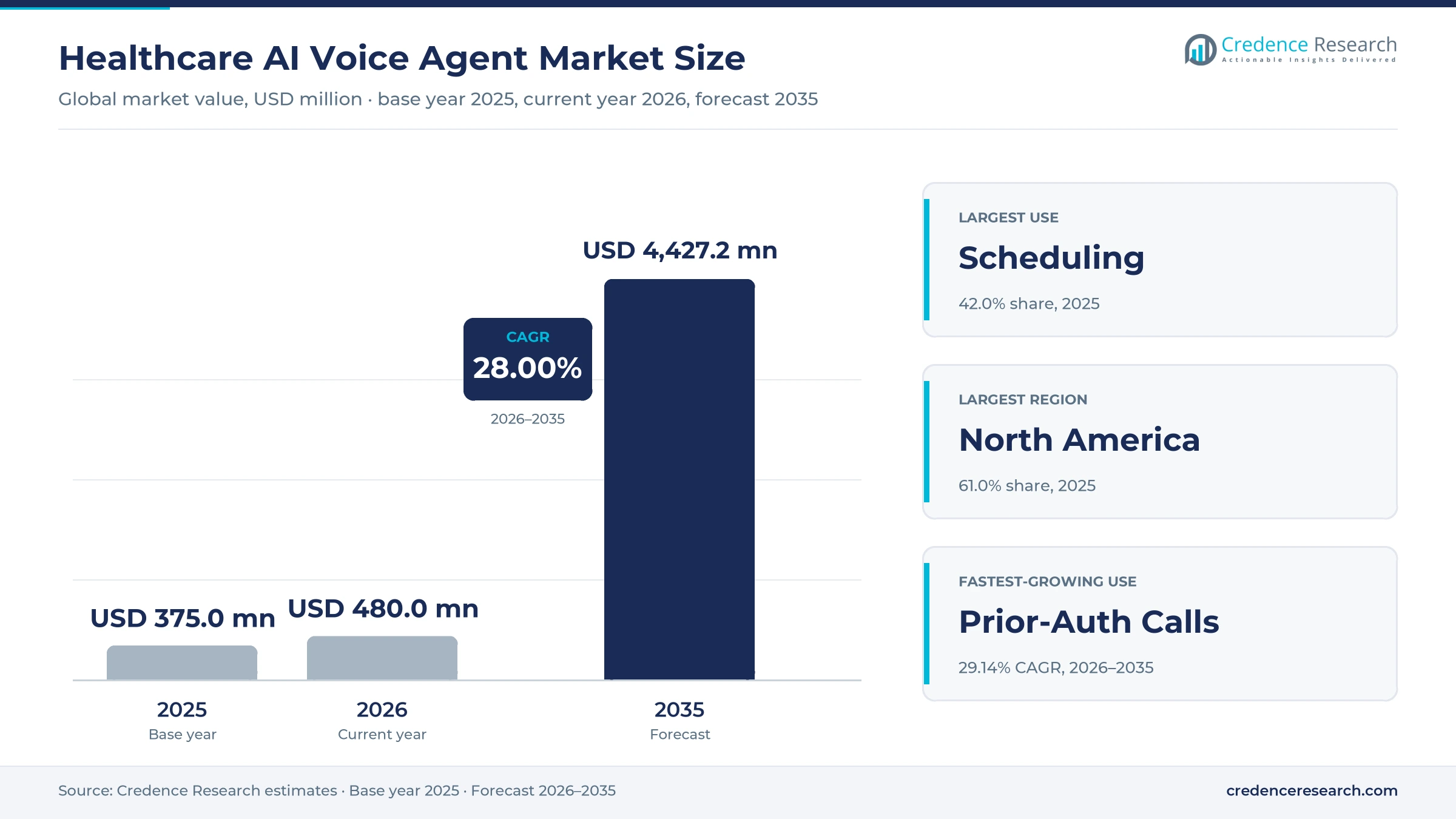
The global healthcare AI voice agent market was valued at USD 375.0 million in 2025 and is projected to increase from USD 480.0 million in 2026 to USD 4.43 billion by 2035, registering a CAGR of 28.00% during 2026–2035. Demand comes from health systems, clinics, payers and drug makers that use voice agents to book appointments, renew prescriptions, chase prior authorizations and reach patients by phone. North America held the largest regional share, 61.0% in 2025, because U.S. providers and payers carry the heaviest call loads and fund most deployments. Asia Pacific is the fastest-growing region at 29.27% a year as hospital groups in Singapore and Japan automate call centers. A major regulatory change came on Jan. 1, 2026, when federal prior authorization deadlines began to apply to impacted U.S. payers. Medical speech models with lower error rates on drug names also widen the range of calls that agents can finish without staff.
Which patient and payer calls do voice agents handle?
The healthcare AI voice agent market covers software that holds spoken phone conversations with patients, payers and pharmacies on behalf of health systems, clinics, health plans and drug makers. It includes subscription, per-call and per-minute fees for agents that book appointments, renew prescriptions, check prior authorization status and run outreach campaigns, plus the setup work that links them to scheduling and records systems.
The scope excludes text-only chatbots, ambient documentation tools that only transcribe clinical visits and touch-tone phone menus without conversational AI. Outsourced human call center staff are also excluded, even when those centers use automation tools for part of their work, because their fees pay mainly for labor.
Healthcare AI Voice Agent Market Insights
- The market is valued at USD 375.0 million in 2025 and is projected to reach USD 4.43 billion by 2035, growing at a 28.00% CAGR as providers and payers automate routine phone work.
- North America led with 61.0% of 2025 value, while Asia Pacific grows fastest at 29.27% a year as Singapore and Japan hospital groups automate call centers.
- Scheduling held 42.0% of 2025 value, and WellSpan Health reported more than 160,000 monthly patient calls on its voice agent in July 2026.
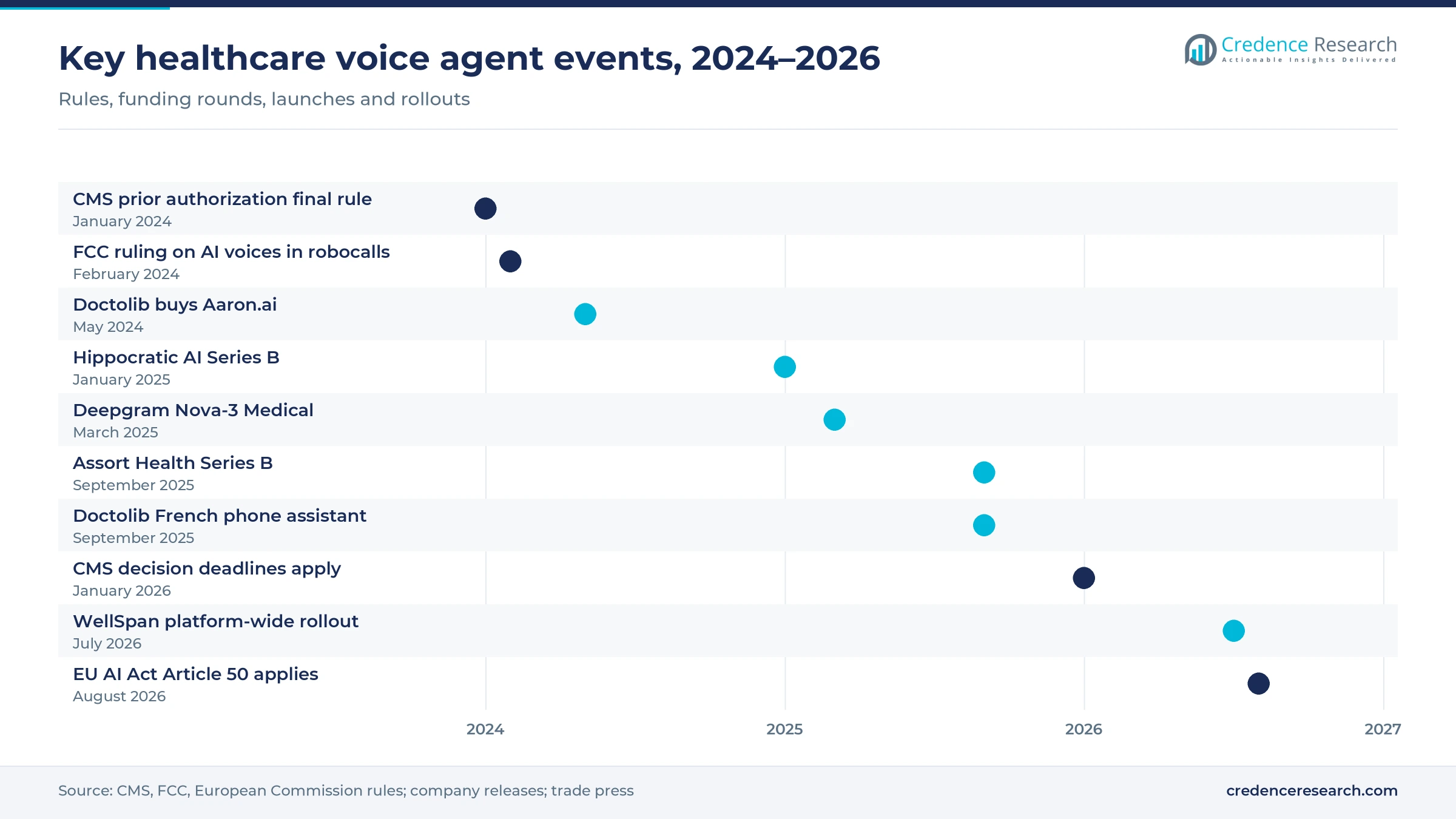
- CMS prior authorization rules require impacted payers to decide expedited requests within 72 hours and standard requests within seven days from 2026.
- Hippocratic AI raised $126 million at a $3.5 billion valuation in November 2025, and Assort Health raised $102 million in about four months.
Scheduling leads while prior-auth calls grow fastest
Why does scheduling lead and prior-auth work grow fastest?
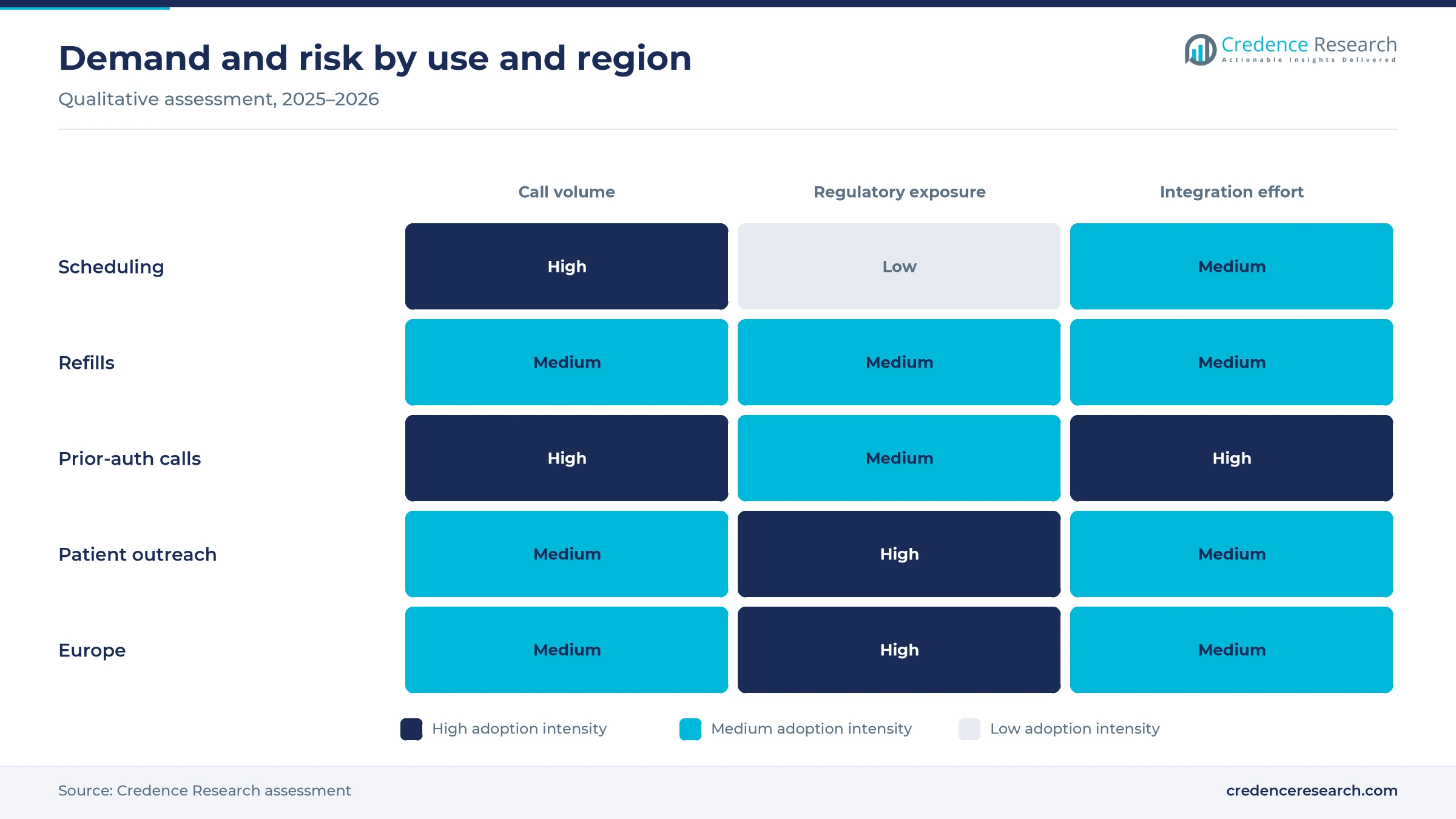
Based on use, the market is categorized into scheduling, refills, prior-auth calls and patient outreach. Scheduling led with a 42.0% share of 2025 value because booking and rescheduling make up most inbound patient calls. WellSpan Health's agent Ana handles more than 160,000 patient calls a month, mainly for appointment management, according to HIT Consultant in July 2026. Prior-Auth Calls grow fastest at 29.14% a year as payer workloads stay heavy. The American Medical Association found that practices completed 39 prior authorization requests per physician each week in late 2024, taking 13 hours of time.
Why do health systems lead and clinics grow fastest?
Based on buyer, the market is categorized into health systems, clinics, payers and pharma. Health Systems led with a 46.0% share of 2025 value because large systems run central call centers with the highest call volumes. University Hospitals deployed Hippocratic AI voice agents for nondiagnostic patient support, according to HLTH in November 2025. Clinics grow fastest at 28.76% a year as low monthly subscriptions reach small practices. Doctolib priced its French telephone assistant at €99 a month for doctors in September 2025, and InTouchNow served more than 150 U.K. GP practices by September 2026.
Why do inbound calls lead while outbound grows faster?
Based on call type, the market is categorized into inbound and outbound calls. Inbound calls led with a 64.0% share of 2025 value because patients still phone practices first to book, cancel or ask questions. The U.K. government said in May 2023 that an average practice of 10,000 patients often receives more than 100 calls in the first hour of a Monday. Outbound calls grow fastest at 28.70% a year as systems add proactive outreach. WellSpan plans outbound agents for missed imaging and post-discharge follow-up, and Infinitus automated payer calls for 1.17 million patients in 2025.
| Segment Group | Leading Sub-segment | Share, 2025 | Fastest-growing Sub-segment | CAGR, 2026–2035 |
|---|---|---|---|---|
| By Use | Scheduling | 42.0% | Prior-Auth Calls | 29.14% |
| By Buyer | Health Systems | 46.0% | Clinics | 28.76% |
| By Call Type | Inbound | 64.0% | Outbound | 28.70% |
Request a Free Sample
Fill in your details and we'll send you a free sample report.
- Sample data tables & charts
- Research methodology
Missed calls, staff gaps and payer rules drive demand
Call centers seek round-the-clock voice coverage
Health systems and practices want phone coverage outside office hours, because missed calls turn directly into lost appointments and slower care. Hello Patient said in September 2025 that up to 42% of patient calls and texts go unanswered during busy hours. In the U.K., InTouchNow answers GP practice calls 24 hours a day, and an analysis of 18 practices showed the share of answered calls rising from 55.9% to 65.6% while mean waits fell from 181 to 123 seconds. WellSpan Health's agent Ana already handles more than 160,000 monthly patient calls, according to HIT Consultant. In the Credence Research model this adds about 11.20 percentage points to annual growth to 2035.
Staffing cost pressure speeds automated scheduling
Front-desk and nursing shortages raise the cost of handling every call by hand, so providers automate scheduling and intake first. The World Health Organization counted a global shortage of 5.8 million nurses in 2023 and still projects a gap of 4.1 million by 2030. In Germany, medical assistants receive up to 1,000 calls per doctor per month, and a practice spends about 45 hours a month on the phone, according to Tech.eu's report on the May 2024 purchase of Aaron.ai by Doctolib. Assort Health tells clinics its agents return their cost in roughly 30 days, according to Fierce Healthcare. In the Credence Research model this adds about 7.84 percentage points to annual growth to 2035.
Medical speech recognition handles clinical vocabulary
Better speech models let agents understand drug names, procedures and insurance terms, which widens the calls they can complete without staff. Deepgram launched Nova-3 Medical on March 3, 2025 with a median word error rate of 3.44% and keyword recall of 93.99%, up from 84.97% for its earlier medical model. The model starts at $0.0043 per minute of pre-recorded audio, which keeps transcription cost low at high call volumes. Hippocratic AI agents already speak more than 15 languages, including Emirati Arabic, according to MobiHealthNews. These gains build on years of speech recognition work in other sectors. In the Credence Research model this adds about 5.04 percentage points to annual growth to 2035.
Prior authorization rules push payers to automate
Federal prior authorization rules and heavy manual workloads push payers, providers and drug makers toward automated status calls. The Centers for Medicare & Medicaid Services final rule of Jan. 17, 2024 requires impacted payers to decide expedited requests within 72 hours and standard requests within seven calendar days, with operational provisions from Jan. 1, 2026. The American Medical Association found that 40% of physicians have staff who work only on prior authorizations. Infinitus agents now follow prior authorization status until a final decision and connect directly with Humana and Express Scripts for benefit checks, according to the company. As a result, Prior-Auth Calls grow fastest at 29.14% a year.
Platform rollouts and specialty agents reshape buying
Shift from single tasks to platform-wide voice agents
Health systems are shifting from pilots on one call type to voice agents that span inbound, outbound, ambulatory and inpatient work. WellSpan Health expanded its Hippocratic AI partnership on July 30, 2026 to platform-wide use, adding outbound calls for missed imaging and post-discharge follow-up, according to HIT Consultant. Hippocratic AI had automated 2.5 million patient calls when it announced a collaboration with KPMG, according to Fierce Healthcare. Epic also unveiled the patient-facing Emmie agent alongside Art and Penny at its 2025 Users Group Meeting, according to Healthcare IT News. This shift favors vendors that connect calls with existing patient engagement solutions and records.
Rise of specialty agents backed by new capital
Specialty-specific voice agents are rising as investors fund vendors that know the workflows of orthopedic, cardiology and immunology clinics. Assort Health raised a $76 million Series B led by Lightspeed Venture Partners, bringing its funding to $102 million in about four months, according to Fierce Healthcare. Hello Patient raised a $22.5 million Series A on Sept. 4, 2025 after handling more than 100,000 phone calls and 300,000 patient conversations in under a year, according to Business Wire. Hippocratic AI raised $126 million at a $3.5 billion valuation in November 2025, according to HLTH. This capital speeds work on links to records and practice management systems for each specialty.
Payer and pharma access calls open a second market
Payer and pharma access calls are a clear opening because benefit checks and prior authorization follow-ups still run largely by phone. Infinitus automated calls for 1.17 million patients and 20% of U.S. providers in 2025, and its patient-facing agents earned a 90% satisfaction rating, according to the company. Memorial Hermann Health System joined a $51.5 million Series C in Infinitus led by Andreessen Horowitz in October 2024, according to HIT Consultant. CMS operational requirements for faster prior authorization decisions generally began on Jan. 1, 2026, which raises the value of quick status checks. Vendors that serve drug makers can therefore reuse payer knowledge across therapy areas and patient support programs.
Low-cost clinic plans and local languages open regions
Low-cost subscriptions and local-language agents are an opening among small clinics and outside the United States. Doctolib launched a French telephone assistant in September 2025 at €99 a month for doctors and €49 for osteopaths and podiatrists, according to En-Contact. In the same market, several hundred dental practices subscribed to DentalCall AI at €149 a month. Burjeel Holdings and Hippocratic AI agreed to deploy Arabic-speaking agents across facilities in the UAE and Oman, according to MobiHealthNews. In Brazil, Carecode raised $4.3 million in December 2024 to automate scheduling and confirmations, according to TechCrunch. These moves widen the buyer base well beyond large U.S. health systems.
AI disclosure, consent and safety rules add friction
EU AI Act rules slow entry into Europe
European rules raise compliance costs for agents that speak with patients. Article 50 of the EU AI Act has required providers to tell users they are talking to AI since Aug. 2, 2026, with fines of up to €15 million or 3% of worldwide turnover, according to Cooley. Hippocratic AI said it was not expanding into Europe because the act classifies its agents as high-risk, according to Fierce Healthcare. As a result, European buyers face fewer vendor choices and longer approval cycles.
U.S. robocall rules restrict outbound campaigns
U.S. calling rules limit how outbound agents reach patients without prior consent. The Federal Communications Commission ruled unanimously on Feb. 8, 2024 that AI-generated voices in robocalls fall under the Telephone Consumer Protection Act, according to Nextgov. Outreach for refills, screening or missed appointments must therefore rest on documented consent and clear caller identity. Vendors and health systems add consent checks and call logs, which slows campaign launches and raises legal review costs.
Safety limits keep staff on many calls
Clinical safety limits keep staff on many calls, which caps the savings per agent. Doctolib's French assistant was still in beta in October 2025, worked only with known patients and transferred emergencies such as palpitations to the practice secretary, according to En-Contact. InTouchNow resolves 50% to 70% of GP calls without staff, so the remaining calls still need receptionists. Providers therefore keep hybrid teams and pay for software and staff during the transition.
Thin outcome data slows purchase decisions
Limited published outcome data slows purchase decisions at cautious health systems. HIT Consultant's July 30, 2026 report on the WellSpan rollout gave no measured cost savings or clinical results, although the agent handles 160,000 monthly calls. Carecode's Brazilian agents still worked mainly on WhatsApp in December 2024, with voice calls on its roadmap, according to TechCrunch. Buyers therefore ask for pilots with defined call resolution and wait time targets before system-wide contracts.
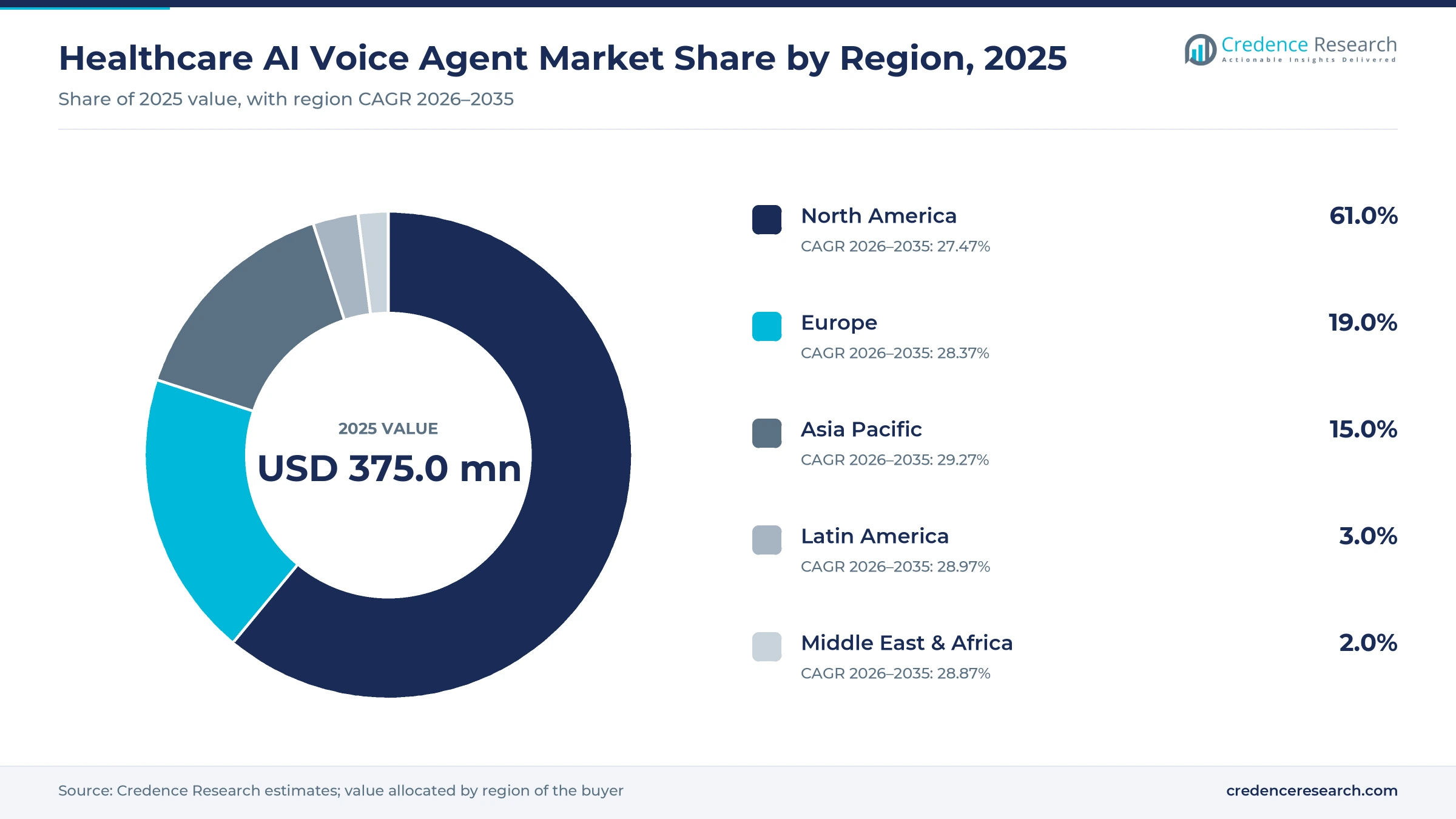
North America leads while Asia Pacific grows fastest
| Region | Value, 2025 (USD million) | Share, 2025 | CAGR, 2026–2035 |
|---|---|---|---|
| North America | 228.8 | 61.0% | 27.47% |
| Europe | 71.2 | 19.0% | 28.37% |
| Asia Pacific | 56.2 | 15.0% | 29.27% |
| Latin America | 11.2 | 3.0% | 28.97% |
| Middle East & Africa | 7.5 | 2.0% | 28.87% |
North America leads on provider and payer call loads
North America held a 61.0% share of 2025 value and grows at 27.47% a year to 2035. The region leads because U.S. health systems, payers and drug makers fund most voice agent contracts and venture rounds. Infinitus automated calls for 20% of U.S. providers in 2025, and WellSpan Health in Pennsylvania routes more than 160,000 monthly calls through its agent. The CMS prior authorization rule, with operational provisions from Jan. 1, 2026, adds payer demand. FCC robocall rules, however, require consent for outbound calls that use AI-generated voices.
Europe grows through GP and practice telephony
Europe held a 19.0% share of 2025 value and grows at 28.37% a year. Doctolib bought German phone assistant maker Aaron.ai in May 2024 and launched a telephone assistant for doctors in France in September 2025. In the U.K., InTouchNow serves more than 150 GP practices and raised £2.3 million in September 2026. Article 50 of the EU AI Act has applied since Aug. 2, 2026, which adds disclosure rules for every agent that talks with patients in the European Union.
Asia Pacific is the fastest-growing region
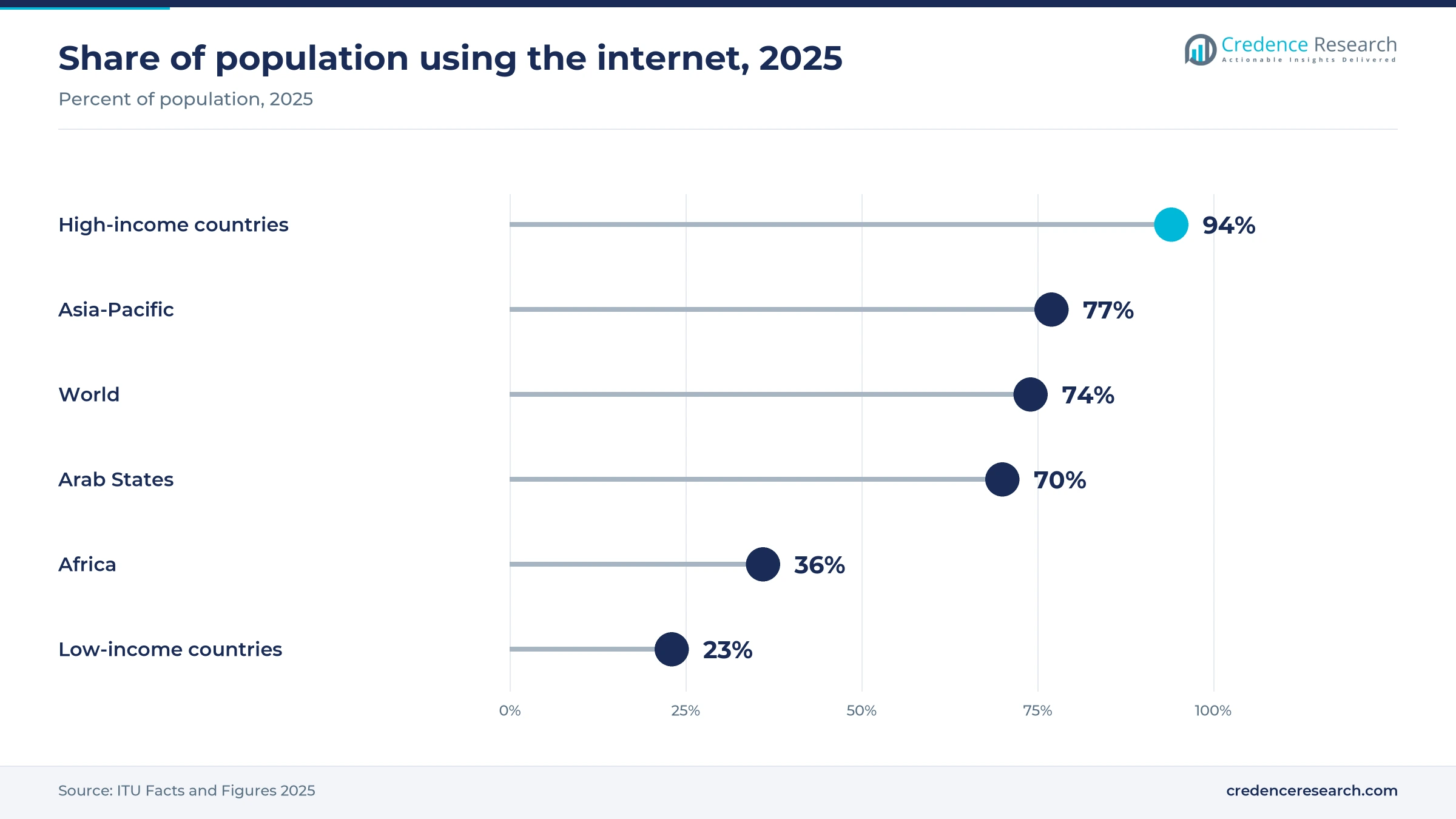
Asia Pacific held a 15.0% share of 2025 value and grows fastest at 29.27% a year. Hippocratic AI already works with organizations in Japan and Singapore, according to Fierce Healthcare. In Singapore, IHH Healthcare used WIZ.AI talkbots at the Mount Elizabeth and Gleneagles hospital call centers and cut human agent workload during peak hours by 65%, according to a WIZ.AI case study. About 77% of Asia-Pacific residents used the internet in 2025, according to the ITU, which supports digital front doors for patients.
Latin America starts with messaging-led agents
Latin America held a 3.0% share of 2025 value and grows at 28.97% a year. Carecode, backed by a16z and QED, raised $4.3 million in December 2024 to automate appointment scheduling and confirmations for Brazilian providers. Its chief executive said Brazilian healthcare companies spend about $100 billion a year on contact centers and administrative payroll, according to TechCrunch. Carecode works mainly on WhatsApp with text and audio messages, so voice agents in the region often run alongside messaging channels.
Middle East & Africa builds on Arabic-language agents
Middle East & Africa held a 2.0% share of 2025 value and grows at 28.87% a year. Burjeel Holdings and Hippocratic AI announced an alliance at Abu Dhabi Global Healthcare Week to deploy agents across facilities and physiotherapy clinics in the UAE and Oman. The agents cover Arabic and the Emirati dialect for non-diagnostic tasks in oncology, cardiology, neurology and orthopedics. Internet use reached 70% in the Arab States and 36% in Africa in 2025, according to the ITU, which limits reach across much of Africa.
Funding rounds and large rollouts defined 2025 and 2026
| Development | Status and market relevance |
|---|---|
| In January 2025, Hippocratic AI completed a $141 million Series B led by Kleiner Perkins at a $1.64 billion valuation. | Closed; funds patient-facing agent rollouts |
| In March 2025, Deepgram launched Nova-3 Medical with a 3.44% median word error rate on clinical speech. | Launched; improves recognition of drug and procedure names |
| In September 2025, Assort Health raised a $76 million Series B led by Lightspeed Venture Partners. | Closed; expands specialty voice agents |
| In September 2025, Doctolib launched an AI telephone assistant for French doctors at €99 a month. | Beta; brings low-cost agents to small practices |
| In July 2026, WellSpan Health expanded its Hippocratic AI partnership to platform-wide inbound and outbound voice agents. | Live; handles more than 160,000 calls a month |
Medical speech models and EHR links widen call scope
- Medical speech-to-text models such as Deepgram Nova-3 Medical transcribe drug and procedure names with lower error rates at well under one cent per minute.
- Safety-focused language models underpin Hippocratic AI agents, and the company is investing in its Polaris Safety Constellation Architecture for nondiagnostic tasks.
- Records and scheduling integration lets agents such as those of Assort Health book directly into practice systems, extending existing call center software rather than replacing it.
- Escalation and frustration detection routes clinical or complex calls to staff, as InTouchNow does when patients ask for a human receptionist.
Need a Custom Version of This Report?
Tailor the scope, geography, or segments to your exact requirements.
- Custom geography or segment scope
- Direct access to our analyst team
Vendors compete on safety, integrations and specialty fit
Competition centers on clinical safety, depth of records integration, specialty fit and proof of call resolution. Hippocratic AI sells safety-focused agents to health systems and has raised $404 million since its 2023 founding, with WellSpan Health and Universal Health Services among its investors. Assort Health targets specialty clinics with agents built for orthopedics, cardiology and immunology. Infinitus focuses on payer-facing benefit verification and prior authorization calls for providers and drug makers. Notable automates referral outreach by text, email or phone for systems such as Inova Health. Hello Patient serves clinic groups and digital health companies, while Doctolib and InTouchNow sell low-cost assistants to European practices. Electronic health record vendors such as Epic add their own agents, and older chatbots remain a cheaper text option. Vendors that show measured gains in answered calls will win system-wide contracts.
Companies profiled and their roles in this market
| Company | Type | Role in the market |
|---|---|---|
| Hippocratic AI | Agent platform | Safety-focused patient-facing agents for health systems in the United States, UAE, U.K., Japan and Singapore |
| Assort Health | Specialty specialist | Voice agents for specialty clinic call centers covering scheduling, refills and referrals |
| Infinitus | Access specialist | Payer-facing calls for benefit verification and prior authorization follow-up |
| Notable | Automation platform | Agentic referral and revenue cycle workflows with phone, text and email outreach |
| Hello Patient | Clinic specialist | Conversational agents for booking and follow-up at clinic groups and digital health firms |
| Doctolib | Practice software | AI telephone assistant for French doctors and the Aaron.ai phone product in Germany |
| InTouchNow | GP specialist | Inbound voice agent for U.K. GP practices with escalation to receptionists |
Measured call resolution will separate the leaders
Credence Research's view is that the healthcare AI voice agent market will be decided by measured call resolution rather than by funding size alone. Early deployments already answer more calls, as InTouchNow showed when answered calls rose from 55.9% to 65.6% across 18 U.K. practices. However, few public reports give cost or clinical outcomes, and rules in the United States and the European Union add consent and disclosure duties. Vendors that publish results, integrate with records systems and escalate safely will hold share through 2035.
Buyer-count and pricing model checked against deployments
The report uses 2025 as the base year and forecasts to 2035. Market values come from the Credence Research model, built from estimated counts of health systems, clinics, payers and drug makers using voice agents and public subscription and usage prices. Use, buyer, call type and regional splits are Credence Research estimates based on vendor disclosures, deployment reports, funding announcements and public statistics from the WHO, ITU and CMS. Company releases and trade press coverage were used to date events. No interviews or surveys were conducted for this edition of the report.
Outbound outreach and payer calls extend growth to 2035
The market is expected to grow from USD 480.0 million in 2026 to USD 4.43 billion by 2035 as health systems move from single call types to platform-wide agents and payers automate prior authorization checks. Scheduling will remain the largest use in the healthcare AI voice agent market after holding 42.0% of 2025 value, while outbound outreach gains from post-discharge and missed-appointment calls. North America will keep the largest share, and Asia Pacific will grow fastest as hospital groups automate call centers. Disclosure rules, consent duties and thin outcome data will remain the main limits on growth through 2035.
Frequently Asked Questions
How big is the healthcare AI voice agent market?
Which use leads the market?
Which use grows fastest?
Which region leads the market?
Which region grows fastest?
Who are the main companies in the market?
How do regulations affect healthcare voice agents?
Do voice agents replace front-desk staff?
Table of Content
Chapter 1 Market Segmentation
- 1.1 Segmentation Framework
- 1.1.1 Product and Service Classification
- 1.1.2 Application and End-Use Classification
- 1.1.3 Technology and Solution Classification
- 1.1.4 Customer and Distribution Channel Classification
- 1.1.5 Geographic Segmentation
- 1.1.6 Market Segment Definitions and Boundaries
- 1.2 By Use
- 1.2.1 Scheduling
- 1.2.2 Refills
- 1.2.3 Prior-Auth Calls
- 1.2.4 Patient Outreach
- 1.3 By Buyer
- 1.3.1 Health Systems
- 1.3.2 Clinics
- 1.3.3 Payers
- 1.3.4 Pharma
- 1.4 By Call Type
- 1.4.1 Inbound
- 1.4.2 Outbound
Chapter 2 Introduction
- 2.1 Report Objectives and Scope
- 2.2 Product Definition and Industry Terminology
- 2.3 Market Inclusions and Exclusions
- 2.4 Research Process
- 2.4.1 Primary Research and Expert Interviews
- 2.4.2 Secondary Research and Source Review
- 2.4.3 Top-Down and Bottom-Up Estimation
- 2.4.4 Data Triangulation and Verification
- 2.5 Market Size Measurement Basis
- 2.5.1 2025: USD 375.0 million → 2035: USD 4.43 billion
- 2.6 Historical and Forecast Reference Periods
- 2.6.1 Historical Period: 2018-2025
- 2.6.2 Base Year: 2025
- 2.6.3 Forecast Period: 2025-2035
- 2.7 Research Assumptions and Limitations
Chapter 3 Executive Summary
- 3.1 Market Snapshot and Key Findings
- 3.2 Base-Year Market Size, 2025
- 3.3 Forecast Market Size, 2035
- 3.4 Revenue and Volume Growth Outlook
- 3.5 Key Demand and Supply Indicators
- 3.6 Leading Market Segments
- 3.7 Fastest-Growing Market Opportunities
- 3.8 Regional Performance Highlights
- 3.9 Technology and Industry Transformation
- 3.10 Competitive Landscape Summary
- 3.11 Analyst View and Strategic Implications
Chapter 4 Global Healthcare AI Voice Agent Market Trends and Developments
- 4.1 Historical Industry Development, 2018-2025
- 4.2 Recent Market Trends and Developments
- 4.3 Demand and Customer Behavior Trends
- 4.4 Technology and Product Innovation
- 4.5 Artificial Intelligence, Automation and Digitalization
- 4.6 Local Manufacturing and Supply Chain Realignment
- 4.7 Industry Partnerships, Mergers and Acquisitions
- 4.8 Sustainability and Circular Economy Developments
- 4.9 Government and Private Sector Investment Trends
- 4.10 Emerging Business Models and Commercialization
- 4.11 Industry Developments and Announcements
Chapter 5 Global Healthcare AI Voice Agent Market Production, Supply and Demand Analysis
- 5.1 Demand Trend and Consumption Analysis, 2018-2025
- 5.2 Demand Forecast, 2025-2035
- 5.3 Production and Output Trend, 2018-2025
- 5.4 Production and Output Forecast, 2025-2035
- 5.5 Installed Capacity and Capacity Utilization
- 5.6 Company-Wise Production Plants and Statistics
- 5.6.1 Installed Production Capacity
- 5.6.2 Actual Production
- 5.6.3 Planned Capacity and Expansion Targets
- 5.7 Supply Chain Structure and Procurement Trends
- 5.8 Supply-Demand Gap and Bottlenecks
- 5.9 Import Dependence and Sourcing Structure
- 5.10 Contract Manufacturing and Outsourcing
- 5.11 Regional Supply and Demand Concentration
Chapter 6 Global Healthcare AI Voice Agent Market Pricing Analysis
- 6.1 Pricing Structure and Measurement
- 6.2 Historical Pricing Trends, 2018-2025
- 6.3 Pricing Outlook, 2025-2035
- 6.4 Average Selling Price and Unit Economics
- 6.5 Pricing by Product and Market Segment
- 6.6 Geographic Pricing Differences
- 6.7 Key Input, Energy, Labor and Logistics Costs
- 6.8 Contract Pricing and Purchasing Models
- 6.9 Pricing Sensitivity and Competitive Positioning
- 6.10 Price, Margin and Profitability Implications
Chapter 7 Global Healthcare AI Voice Agent Market Dynamics
- 7.1 Market Growth Drivers
- 7.1.1 Demand-Side Drivers
- 7.1.2 Technology and Innovation Drivers
- 7.1.3 Infrastructure and Investment Drivers
- 7.1.4 Regulatory and Policy Drivers
- 7.2 Market Restraints
- 7.2.1 Cost and Affordability Constraints
- 7.2.2 Technology and Adoption Barriers
- 7.2.3 Supply Chain and Operational Constraints
- 7.3 Market Challenges
- 7.3.1 Competitive Pressure and Margin Erosion
- 7.3.2 Skills, Infrastructure and Implementation Gaps
- 7.4 Emerging Market Opportunities
- 7.5 Market Dynamics Impact and Time-Horizon Assessment
Chapter 8 Global Healthcare AI Voice Agent Value Chain Analysis
- 8.1 Industry Value Chain Overview
- 8.2 Upstream Suppliers and Critical Inputs
- 8.3 Technology and Component Providers
- 8.4 Manufacturing or Service Delivery
- 8.5 Distribution, Channel Partners and Integrators
- 8.6 Downstream Applications and End Users
- 8.7 Value Addition and Profit Pools
- 8.8 Vertical Integration and Outsourcing
- 8.9 Supplier Concentration and Risk
- 8.10 Supply Chain Localization and Resilience
Chapter 9 Global Healthcare AI Voice Agent Market Regulations and Policies
- 9.1 Relevant Laws, Standards and Compliance Frameworks
- 9.2 Product, Service, Safety and Quality Requirements
- 9.3 Government Policies, Incentives and Subsidies
- 9.4 Imports, Exports and Trade Barriers
- 9.5 Public Procurement and Local Content Requirements
- 9.6 Environmental and Sustainability Compliance
- 9.7 Upcoming Policy Changes and Market Implications
Chapter 10 Global Healthcare AI Voice Agent Market Hotspots and Opportunities
- 10.1 Market Opportunity Mapping and Growth Hotspots
- 10.2 High-Growth Applications and Customer Groups
- 10.3 Underserved Markets and White-Space Opportunities
- 10.4 Emerging Technology and Product Opportunities
- 10.5 New Capacity and Investment Hotspots
- 10.6 Market Entry and Expansion Opportunities
- 10.7 Distribution and Partnership Opportunities
- 10.8 Near-Term and Long-Term Commercial Potential
- 10.9 Opportunity Attractiveness and Execution Risks
Chapter 11 Global Healthcare AI Voice Agent Market Outlook, 2025-2035
- 11.1 Market Size and Analysis
- 11.1.1 Revenue (Market Measurement: 2025: USD 375.0 million → 2035: USD 4.43 billion)
- 11.1.2 Market Volume and Quantity Sold
- 11.1.3 Historical Market Size, 2018-2025
- 11.1.4 Base-Year Market Size, 2025
- 11.2 Market Forecast, 2025-2035
- 11.2.1 Revenue Forecast to 2035
- 11.2.2 Volume Forecast to 2035
- 11.2.3 CAGR and Year-on-Year Growth
- 11.2.4 Incremental Revenue Opportunity
- 11.3 Forecast Assumptions and Scenario Analysis
- 11.3.1 Base-Case Forecast
- 11.3.2 Optimistic and Conservative Scenarios
- 11.3.3 Technology, Pricing and Policy Sensitivities
- 11.4 Market Attractiveness and Growth Outlook
Chapter 12 Global Healthcare AI Voice Agent Market Segmentation and Outlook
- 12.1 Segmentation Summary and Market Shares, 2025
- 12.2 Largest and Fastest-Growing Segments
- 12.3 By Use - Market Size and Forecast, 2025-2035
- 12.3.1 Segment Definition and Scope
- 12.3.2 Historical Market Size, 2018-2025
- 12.3.3 Revenue Forecast, 2025-2035
- 12.3.4 Volume Forecast, 2025-2035
- 12.3.5 Base-Year Market Share, 2025
- 12.3.6 Segment CAGR and Growth Drivers
- 12.3.7 Subsegment Market Size and Forecast
- 12.3.7.1 Scheduling
- 12.3.7.2 Refills
- 12.3.7.3 Prior-Auth Calls
- 12.3.7.4 Patient Outreach
- 12.3.8 Subsegment Pricing and Adoption Trends
- 12.3.9 Leading Suppliers and Competition
- 12.3.10 Regional Demand and Opportunities
- 12.4 By Buyer - Market Size and Forecast, 2025-2035
- 12.4.1 Segment Definition and Scope
- 12.4.2 Historical Market Size, 2018-2025
- 12.4.3 Revenue Forecast, 2025-2035
- 12.4.4 Volume Forecast, 2025-2035
- 12.4.5 Base-Year Market Share, 2025
- 12.4.6 Segment CAGR and Growth Drivers
- 12.4.7 Subsegment Market Size and Forecast
- 12.4.7.1 Health Systems
- 12.4.7.2 Clinics
- 12.4.7.3 Payers
- 12.4.7.4 Pharma
- 12.4.8 Subsegment Pricing and Adoption Trends
- 12.4.9 Leading Suppliers and Competition
- 12.4.10 Regional Demand and Opportunities
- 12.5 By Call Type - Market Size and Forecast, 2025-2035
- 12.5.1 Segment Definition and Scope
- 12.5.2 Historical Market Size, 2018-2025
- 12.5.3 Revenue Forecast, 2025-2035
- 12.5.4 Volume Forecast, 2025-2035
- 12.5.5 Base-Year Market Share, 2025
- 12.5.6 Segment CAGR and Growth Drivers
- 12.5.7 Subsegment Market Size and Forecast
- 12.5.7.1 Inbound
- 12.5.7.2 Outbound
- 12.5.8 Subsegment Pricing and Adoption Trends
- 12.5.9 Leading Suppliers and Competition
- 12.5.10 Regional Demand and Opportunities
- 12.6 Segment Growth Comparison
- 12.7 Segment Attractiveness and Priority Matrix
Chapter 13 Global Healthcare AI Voice Agent Geographic Market Outlook, 2025-2035
- 13.1 Regional Market Size and Share, 2025
- 13.2 Regional Market Forecast, 2025-2035
- 13.3 Regional Pricing, Production and Demand Differences
- 13.4 North America
- 13.4.1 United States
- 13.4.2 Canada
- 13.4.3 Mexico
- 13.5 Europe
- 13.5.1 Germany
- 13.5.2 France
- 13.5.3 Italy
- 13.5.4 United Kingdom
- 13.5.5 Spain
- 13.5.6 Poland
- 13.5.7 Russia
- 13.5.8 Netherlands
- 13.5.9 Belgium
- 13.5.10 Sweden
- 13.5.11 Denmark
- 13.5.12 Norway
- 13.5.13 Rest of Europe
- 13.6 Asia Pacific
- 13.6.1 China
- 13.6.2 India
- 13.6.3 Japan
- 13.6.4 South Korea
- 13.6.5 Thailand
- 13.6.6 Indonesia
- 13.6.7 Vietnam
- 13.6.8 Malaysia
- 13.6.9 Australia
- 13.6.10 Rest of Asia Pacific
- 13.7 Latin America
- 13.7.1 Brazil
- 13.7.2 Argentina
- 13.7.3 Colombia
- 13.7.4 Chile
- 13.7.5 Rest of Latin America
- 13.8 Middle East
- 13.8.1 Saudi Arabia
- 13.8.2 United Arab Emirates
- 13.8.3 Turkey
- 13.8.4 Israel
- 13.8.5 Iran
- 13.8.6 Rest of the Middle East
- 13.9 Africa
- 13.9.1 South Africa
- 13.9.2 Egypt
- 13.9.3 Nigeria
- 13.9.4 Morocco
- 13.9.5 Rest of Africa
- 13.10 Regional Investment, Policy and Supply Chain Differences
- 13.11 Regional Competitive Landscape
- 13.12 Geographic Growth Hotspots
Chapter 14 Global Healthcare AI Voice Agent Technology, Innovation and Sustainability Outlook
- 14.1 Technology Landscape and Maturity
- 14.2 Product, Process and Service Innovation
- 14.3 AI, Automation and Digital Tools in the Industry
- 14.4 Technology Adoption and Performance Benchmarking
- 14.5 Innovation Pipeline and R&D Investment
- 14.6 Patent and Intellectual Property Trends
- 14.7 Energy Efficiency and Resource Management
- 14.8 Sustainability, Recycling and Circularity
- 14.9 Technology Roadmap, 2025-2035
- 14.10 Risks of Obsolescence and Technology Substitution
Chapter 15 Global Healthcare AI Voice Agent Market Key Strategic Imperatives
- 15.1 Growth and Market Entry Priorities
- 15.2 High-Return Products and Segments
- 15.3 Pricing, Profitability and Cost Optimization
- 15.4 Technology Investment and Product Differentiation
- 15.5 Supply Chain Localization and Resilience
- 15.6 Distribution and Customer Acquisition
- 15.7 Partnership, Acquisition and Capacity Strategy
- 15.8 Regional Expansion Priorities
- 15.9 Short-, Medium- and Long-Term Actions
Chapter 16 Competition Outlook
- 16.1 Industry Competition Characteristics
- 16.2 Market Structure and Concentration
- 16.3 Market Share and Competitive Positioning, 2025
- 16.4 Company-Wise Revenue and Product Benchmarking
- 16.5 Production and Service Capacity Benchmarking
- 16.6 Technology, Pricing and Differentiation
- 16.7 Regional Footprint and Distribution Strength
- 16.8 Mergers, Acquisitions and Strategic Alliances
- 16.9 New Entrants and Competitive Threats
- 16.10 Porter's Five Forces and Industry Attractiveness
- 16.11 Competitive Outlook, 2025-2035
Chapter 17 Company Profiles
- 17.1 Company Coverage and Selection Criteria
- 17.2 Hippocratic AI
- 17.2.1 Business Description
- 17.2.2 Company Ownership and Geographic Presence
- 17.2.3 Product and Service Portfolio
- 17.2.4 Manufacturing and Operating Footprint
- 17.2.5 Production Capacity and Expansion Plans
- 17.2.6 Financial Performance and Investment
- 17.2.7 Market Share and Competitive Position
- 17.2.8 Technology and Innovation Capabilities
- 17.2.9 Strategic Alliances or Partnerships
- 17.2.10 Recent Developments
- 17.2.11 Growth Strategy and Outlook
- 17.3 Assort Health
- 17.4 Infinitus
- 17.5 Notable
- 17.6 Hello Patient
- 17.7 Doctolib
- 17.8 InTouchNow
- 17.9 Other Relevant Market Participants
Note: Every listed company is profiled on the structure shown under the first company. The company list is preliminary and may change based on research findings, market developments, data availability and client requirements.
Chapter 18 Disclaimer
- 18.1 Research and Forecast Disclaimer
- 18.2 Data Source and Estimation Limitations
Note: The depth of individual sections depends on data availability for this market. Volume, capacity, trade and other unit-based metrics are included where applicable.

