
Market Overview:
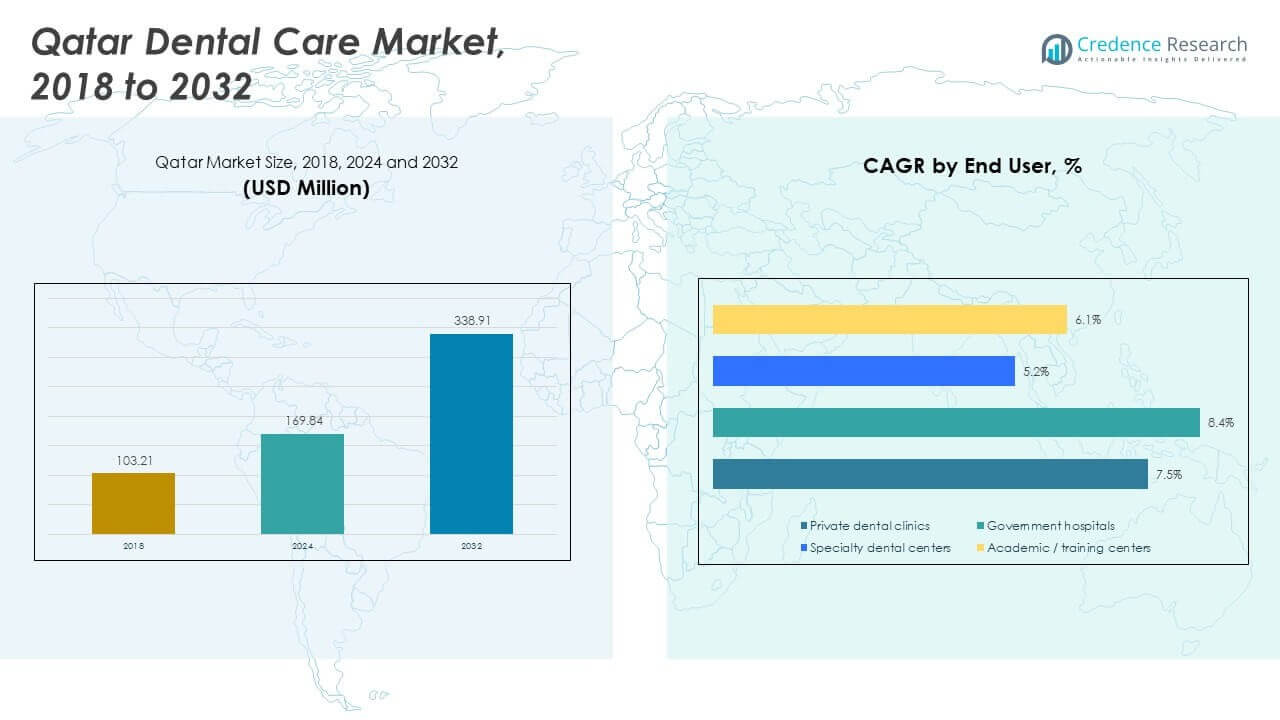
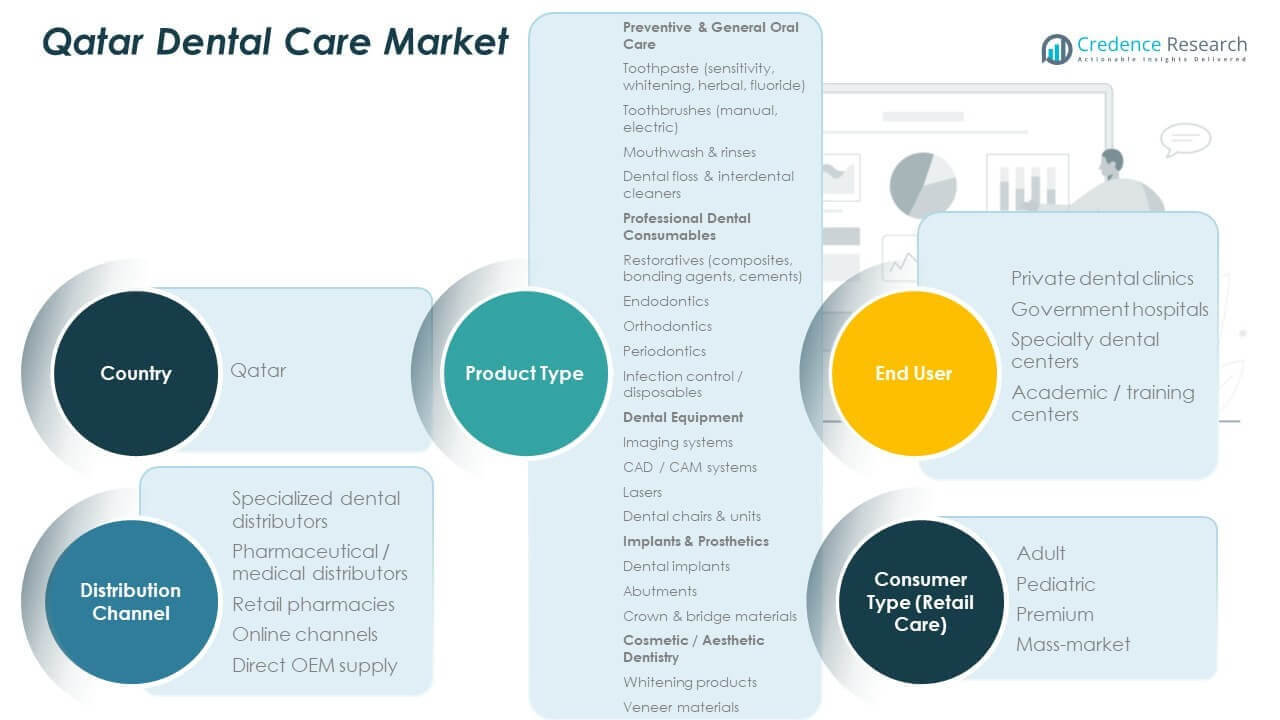
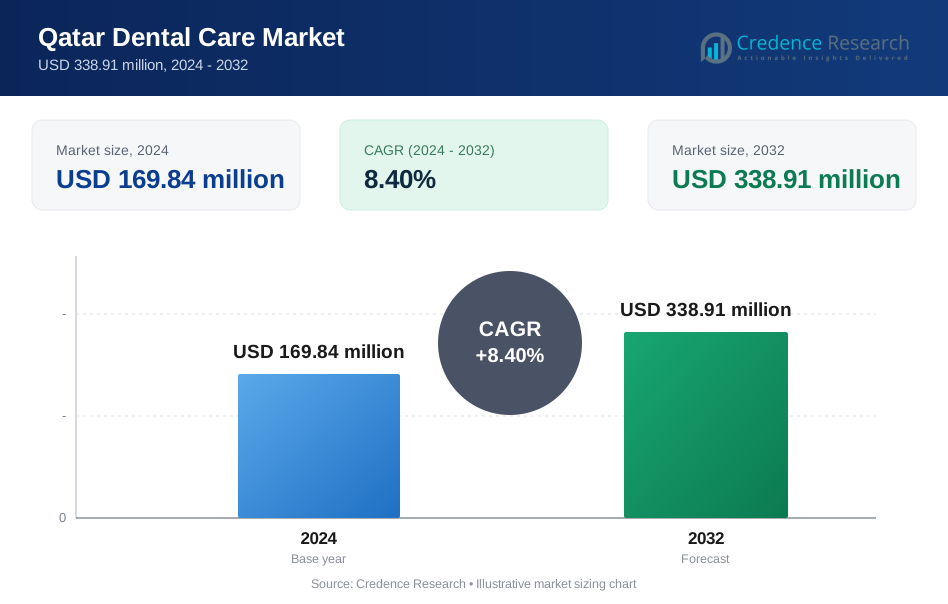
The Qatar Dental Care Market size was valued at USD 103.21 million in 2018 to USD 169.84 million in 2024 and is anticipated to reach USD 338.91 million by 2032, at a CAGR of 8.40% during the forecast period.
| REPORT ATTRIBUTE | DETAILS |
|---|---|
| Historical Period | 2020-2023 |
| Base Year | 2024 |
| Forecast Period | 2025-2032 |
| Qatar Dental Care Market Size 2023 | USD 164.92 million |
| Qatar Dental Care Market, CAGR | 8.5% |
| Qatar Dental Care Market Size 2032 | USD 343.67 million |
The Qatar Dental Care Market grows on the back of rising oral health awareness and higher disposable incomes. Government-backed healthcare initiatives encourage regular dental checkups and preventive treatment. A growing expatriate population demands diverse dental services, from basic care to cosmetic dentistry. Insurance penetration improves access to private clinics and specialized procedures. Adoption of advanced treatment technologies raises service quality. Dental tourism potential supports investments in modern facilities and skilled professionals. Corporate wellness programs also promote routine dental care.
The Qatar Dental Care Market reflects a strong concentration of services in major urban centers, especially the capital region. Doha hosts most advanced clinics, multi-specialty hospitals, and cosmetic dental practices. Peripheral municipalities see gradual expansion of basic and preventive services through private and public providers. High-income residential districts attract premium clinics targeting aesthetic dentistry. Industrial and worker-dense zones rely more on general and occupational dental care. Cross-border patient inflow remains modest but offers scope for future regional positioning in specialized services.
Market Insights:
- The Qatar Dental Care Market reached USD 103.21 million in 2018, expanded to USD 169.84 million in 2024, and is projected to hit USD 338.91 million by 2032, growing at a CAGR of 8.40% due to steady expansion in private and institutional dental services.
- Doha dominates with about 65% share, supported by high clinic density, premium service demand, and advanced dental infrastructure, while Al Rayyan and Al Wakrah together hold nearly 20% due to population growth and strong government hospital presence.
- Northern and central municipalities account for roughly 15% share and represent the fastest-growing region, driven by public healthcare expansion, school dental programs, and rising access to basic oral care services.
- By end user, private dental clinics lead with around 50% share, reflecting preference for specialized and cosmetic procedures, while government hospitals contribute close to 30% through broad access and preventive care coverage.
- Specialty dental centers and academic or training centers together hold about 20% share, supported by demand for advanced treatments, professional training, and referral-based care growth.
Market Drivers:
Government-Backed Healthcare Reforms Supporting Dental Infrastructure Expansion
The Qatar Dental Care Market benefits from national reforms aimed at building a comprehensive healthcare ecosystem. The Ministry of Public Health has prioritized oral health under broader wellness goals. Public dental clinics have expanded their reach, especially in underserved areas. Incentives for private dental practices have increased the number of specialized service providers. The Supreme Council of Health has integrated dental check-ups into national insurance schemes. These policy changes push both accessibility and preventive care. It now supports a stronger referral network between primary and specialist clinics. Insurance-backed affordability drives more patients toward routine treatments.
- For instance, Hamad Medical Corporation and Sidra Medicine have expanded preventive units to serve more residents under these guidelines. Incentives for private practices have increased specialized service providers by notable growth in clinic openings in key urban zones.
High-Income Demographics Driving Premium Dental Service Demand
The growing demand for aesthetic and specialized dental services reflects rising income levels in Qatar. High-income households prefer advanced orthodontics, implants, and cosmetic procedures. Clinics offering CAD/CAM and laser-based services attract patients seeking modern experiences. The private sector has responded with digital dentistry, aligning care with global standards. Well-equipped clinics cater to patient expectations with shorter treatment timelines and precision care. Dental spas and boutique clinics are gaining popularity among urban patients. These trends increase competition across providers and push service innovation. The Qatar Dental Care Market gains revenue momentum from premium segment expansion.
- For instance, Avenues Dental Center offers ceramic restorations supported by digital workflows that cut traditional lab timelines significantly. Private clinics invest in intraoral scanners and digital radiography, aligning care delivery with international standards.
Rising Expatriate Population Fuelling General Dentistry and Emergency Needs
Qatar’s large expatriate population contributes significantly to routine dental service demand. Migrant workers and professionals seek both preventive and corrective treatments. Employers are expanding insurance coverage to include dental benefits, boosting patient inflow. Clinics near industrial zones cater to walk-in and occupational dental cases. Preventive care campaigns run by private groups target diverse communities. Language-accessible services improve patient compliance and follow-ups. Emergency dental care remains a vital service for foreign workers. It helps stabilize demand across general dentistry and prosthetic categories in the Qatar Dental Care Market.
Oral Health Awareness and School-Based Programs Strengthening Preventive Focus
Awareness campaigns and educational outreach help build long-term preventive care habits. Public health entities promote oral hygiene in schools through screening programs and free kits. Children are increasingly receiving fluoride treatments and early orthodontic assessments. Parents are better informed about long-term dental health investments. Clinics offering pediatric dentistry see steady appointment growth. Preventive messaging through social media has improved health-seeking behavior. Dentists are now integrating AI-based diagnosis to detect early issues. The Qatar Dental Care Market benefits from growing awareness aligned with proactive treatment uptake.
Market Trends:
Integration of Digital Dentistry Platforms Across Public and Private Clinics
Dental clinics in Qatar are rapidly integrating digital workflows into clinical processes. Digital impressions, intraoral scanners, and 3D printing solutions improve treatment speed. AI tools assist diagnosis, while cloud-based platforms manage patient records and referrals. Public hospitals adopt e-health systems for dental imaging and monitoring. Clinics invest in smart chairs, digital x-rays, and remote consultations. These upgrades support patient convenience and faster turnaround times. Dental chains deploy centralized data systems for continuity across branches. The Qatar Dental Care Market evolves with smarter, connected dental ecosystems.
- For instance, by 2026, over 60% of private practices have adopted digital imaging systems and CAD/CAM technology with the market for these tools reaching $2.9 billion driven by patient demand for precision and the efficiency of same-day appointment cycles.
Expanding Medical Tourism for Specialized Dental and Cosmetic Procedures
Qatar is positioning itself as a destination for dental tourism, targeting the Gulf and MENA region. Patients travel for implants, veneers, and smile design offered at competitive pricing. Clinics provide bundled care packages with post-treatment monitoring. English-speaking staff and luxury facilities attract affluent foreign patients. Regulatory reforms ensure treatment quality meets global accreditation standards. Dental groups market their services through global platforms. Cosmetic procedures gain interest from tourists combining care with leisure travel. The Qatar Dental Care Market taps this influx to diversify clinic revenues.
- For instance, many private centers now hold certification to GCC quality standards, enhancing their global appeal. Dental groups promote services through regional events and online platforms, extending reach across neighboring countries.
Rise of Group Practices and Multi-Specialty Dental Chains in Urban Hubs
Dental services in Qatar are shifting toward group practices and multi-specialty centers. Urban regions such as Doha see a clustering of large-format dental clinics. These setups host orthodontists, periodontists, and cosmetic dentists under one roof. Clinics offer seamless referrals and higher patient retention. Franchise models scale faster due to consistent branding and standardized services. Investors prefer chains with strong digital infrastructure and diverse specializations. Multi-chair clinics improve operating margins by optimizing chair-time. The Qatar Dental Care Market gains efficiency from consolidated service delivery.
Growing Focus on Pediatric and Geriatric Oral Care Services
Targeted dental services for children and elderly patients are seeing stronger demand. Pediatric clinics focus on preventive care, cavity control, and early orthodontics. Schools coordinate with private dentists for periodic check-ups. For elderly patients, prosthodontics and implant-supported dentures are key segments. Home-based dental visits are emerging for immobile patients. Public and private insurers now recognize age-specific care as a necessity. Geriatric dental awareness campaigns increase demand for chronic care services. The Qatar Dental Care Market aligns its service models with these evolving demographic needs.
Market Challenges Analysis:
Shortage of Skilled Dental Professionals in Niche and Advanced Specializations
The Qatar Dental Care Market faces a persistent gap in qualified professionals across high-end procedures. Endodontists, periodontists, and maxillofacial surgeons remain in short supply. Clinics struggle to recruit and retain experts due to regional competition. Reliance on expatriate dentists raises issues around long-term retention. Licensing barriers and limited local training pathways slow workforce growth. Delays in skill replacement impact the continuity of advanced treatments. Market expansion in complex procedures stalls due to workforce constraints. It needs sustained investments in local dental education and global talent partnerships.
High Cost of Advanced Equipment and Operational Overheads in Private Practices
Digital dentistry adoption raises capital requirements across private clinics. Equipment like 3D scanners, milling units, and digital x-ray machines demand significant upfront investment. Operational costs including software subscriptions and skilled technician salaries add pressure. Smaller clinics delay technology upgrades due to profitability concerns. Urban rent inflation increases cost per chair and compresses margins. Import dependence for dental consumables inflates procurement cycles. These financial pressures limit the pace of modernization. The Qatar Dental Care Market must navigate these challenges to improve service reach and innovation.
Market Opportunities:
Growth in Preventive and Cosmetic Dentistry Among Working Professionals and Youth
Urban professionals and younger patients increasingly seek aesthetic and preventive dental solutions. Clinics offering clear aligners, whitening, and smile correction see high appointment volumes. Digital-first platforms attract tech-savvy patients preferring seamless care. Youth-focused campaigns support long-term oral health habits. The Qatar Dental Care Market can scale cosmetic segments through bundled care plans and faster chairside solutions.
Tele-Dentistry, AI-Based Diagnosis, and Smart Equipment Adoption for Next-Gen Clinics
Technology upgrades in diagnosis and treatment planning open new clinic models. AI tools identify caries and gum disease with improved accuracy. Smart equipment streamlines chairside operations. Remote consultations offer convenience in early triage and follow-ups. Clinics adopting these models gain patient loyalty and cost efficiency. The Qatar Dental Care Market can lead digital innovation across the region.
Market Segmentation Analysis:
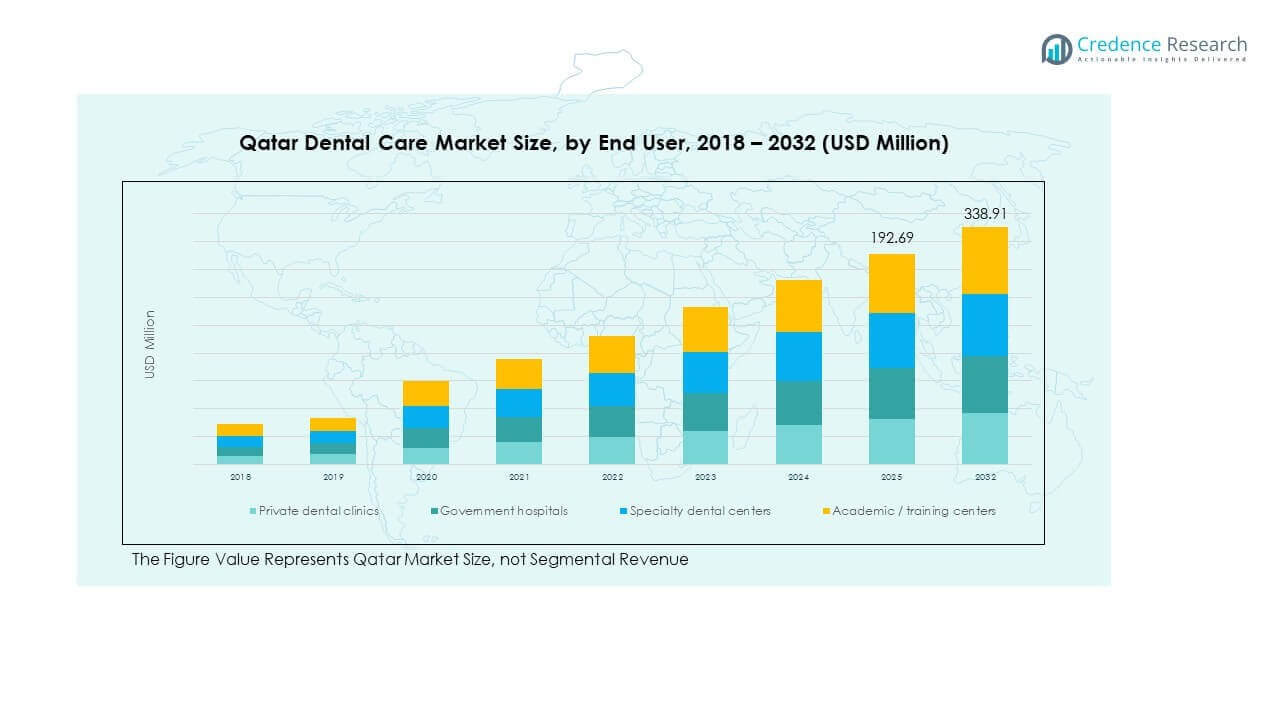
Product Type Insights: Preventive, Professional, and Technological Focus Areas
The Qatar Dental Care Market spans a diverse product mix supporting prevention, treatment, and aesthetic needs. Preventive and general oral care dominates volume-wise, driven by strong demand for toothpaste, toothbrushes, rinses, and interdental cleaners. Rising health awareness has expanded usage across fluoride, herbal, and whitening variants. Professional dental consumables such as restoratives, endodontics, and infection-control items see sustained uptake in clinics and hospitals. Dental equipment, including imaging systems, CAD/CAM tools, and lasers, gains momentum with private clinics embracing digital dentistry. Implants and prosthetics witness rising preference for advanced materials like abutments and crowns. Cosmetic dentistry grows through whitening kits and veneers, targeting younger and premium patient segments.
- For instance, high‑definition digital imaging systems and CAD/CAM tools are increasingly standard in advanced practices. Adoption of lasers in minor surgical procedures and soft‑tissue treatments improves precision and recovery times.
End User Preferences Shaped by Specialization and Accessibility
Private dental clinics account for the largest end-user base due to their wider reach and service diversity. Government hospitals serve essential and emergency dental care needs, especially for lower-income groups. Specialty dental centers attract patients for orthodontics, implants, and cosmetic procedures. Academic and training centers contribute to workforce development and research-oriented services. The market’s end-user split reflects a mix of public access and rising private investment.
- For instance, Sidra Medicine’s dental services contribute to academic research and advanced care delivery. Academic and training centers bolster workforce development and research‑oriented services.
Distribution Channels Expanding Across Retail and Digital Platforms
The distribution landscape is dominated by specialized dental distributors and pharmaceutical suppliers. Retail pharmacies provide accessibility for OTC oral care products. Online channels are expanding, driven by convenience and brand variety. Direct OEM supply serves institutional buyers including hospitals and clinics. Multichannel strategies improve coverage and responsiveness across consumer groups.
Consumer Type Trends Reflect Diverse Demand Across Demographics
Adult consumers remain the core target, but pediatric oral care sees improved adoption through school-based awareness. Premium care seekers drive innovation in aesthetic and implant categories. Mass-market segments continue to demand affordable, high-frequency consumables, especially in urban and expatriate-heavy zones. It supports multi-tiered offerings tailored to distinct income and care preferences.
Segmentation:
By Product Type
- Preventive & General Oral Care
- Toothpaste (sensitivity, whitening, herbal, fluoride)
- Toothbrushes (manual, electric)
- Mouthwash & rinses
- Dental floss & interdental cleaners
- Professional Dental Consumables
- Restoratives (composites, bonding agents, cements)
- Endodontics
- Orthodontics
- Periodontics
- Infection control / disposables
- Dental Equipment
- Imaging systems
- CAD / CAM systems
- Laser
- Dental chairs & units
- Implants & Prosthetics
- Dental implants
- Abutments
- Crown & bridge materials
- Cosmetic / Aesthetic Dentistry
- Whitening products
- Veneer materials
By End User
- Private dental clinics
- Government hospitals
- Specialty dental centers
- Academic / training centers
By Distribution Channel
- Specialized dental distributors
- Pharmaceutical / medical distributors
- Retail pharmacies
- Online channels
- Direct OEM supply
By Consumer Type (Retail Care)
- Adult
- Pediatric
- Premium
- Mass-market
Regional Analysis:
Doha Region – Leading Hub for Private Clinics and High-End Dental Services
Doha holds the largest market share, accounting for nearly 65% of the Qatar Dental Care Market. The capital city is home to the majority of private dental clinics, specialty centers, and cosmetic dentistry providers. High-income residents and international professionals drive demand for premium services like implants, orthodontics, and whitening. The availability of advanced equipment and experienced dentists supports market expansion in this region. Doha also leads in technology adoption, with clinics implementing CAD/CAM systems and digital imaging tools. High retail footfall supports stronger product uptake across pharmacies and dental stores. It anchors the market’s growth in both service and product sales.
Al Rayyan and Al Wakrah – Emerging Hubs for Community and Government-Based Dental Access
Al Rayyan and Al Wakrah contribute a combined 20% market share, driven by growing suburban populations and improved healthcare access. Government hospitals and public clinics play a central role in providing general oral care and pediatric services. Educational institutions in Al Rayyan collaborate with academic centers for dental awareness campaigns and screenings. Population growth and urban expansion support new clinic establishments in residential zones. Al Wakrah benefits from industrial development, requiring occupational dental support for migrant workers. Retail pharmacies and public health campaigns improve accessibility to preventive dental products in both regions. It sees moderate growth in mid-tier dental consumables.
Northern and Central Municipalities – Untapped Regions with Opportunity for Rural Outreach
Northern and central municipalities, including areas like Al Khor, Umm Salal, and Al Daayen, represent about 15% of the Qatar Dental Care Market. These regions are underpenetrated but show potential for expansion through mobile dental units and tele-dentistry. The absence of specialized clinics limits advanced treatment access, especially among elderly and low-income groups. Government outreach programs have introduced school-based checkups and fluoride distribution in select zones. Infrastructure upgrades and population shifts may attract investment in primary dental facilities. Local distributors explore pharmacy and clinic tie-ups to reach dispersed populations. It holds opportunity for low-cost preventive and restorative product segments.
Key Player Analysis:
- Colgate-Palmolive
- Procter & Gamble (Oral-B)
- Philips Oral Healthcare
- Straumann Group
- 3M
Competitive Analysis:
The Qatar Dental Care Market shows a competitive structure led by global oral care brands and regional distributors. Multinational players dominate preventive and retail oral care segments through strong brand trust and pharmacy penetration. Specialized dental consumable and equipment suppliers focus on private clinics and specialty centers. Competition centers on product quality, clinical performance, and distribution reach rather than price alone. Companies invest in professional education and dentist engagement to strengthen loyalty. Private-label products from regional distributors create pressure in mass-market categories. It remains moderately consolidated, with innovation and channel access shaping competitive advantage.
Recent Developments:
- In December 2025, Colgate-Palmolive and Ali Bin Ali & Partners marked a key partnership milestone in Qatar through a goal alignment meeting at the Crowne Plaza Hotel on December 15. The event recognized Ali Bin Ali & Partners for achieving the highest oral care market share among Qatar's top 3 customers in 2025, with both teams aligning on strategies for innovation, e-commerce growth, and sustaining leadership in the competitive dental care market heading into 2026.
Report Coverage:
The research report offers an in-depth analysis based on product type, end user, distribution channel, and consumer type segments. It details leading market players, providing an overview of their business, product offerings, investments, revenue streams, and key applications. Additionally, the report includes insights into the competitive environment, SWOT analysis, current market trends, as well as the primary drivers and constraints. Furthermore, it discusses various factors that have driven market expansion in recent years. The report also explores market dynamics, regulatory scenarios, and technological advancements that are shaping the industry. It assesses the impact of external factors and global economic changes on market growth. Lastly, it provides strategic recommendations for new entrants and established companies to navigate the complexities of the market.
Future Outlook:
- Preventive oral care will expand across all demographics, supported by school programs and retail availability.
- Aesthetic dentistry will see faster growth through demand for whitening, veneers, and smile design.
- Private clinics will invest in digital workflows, enhancing diagnostic accuracy and reducing patient wait times.
- Dental equipment sales will rise as clinics adopt CAD/CAM systems and low-radiation imaging technologies.
- Demand for pediatric dental services will increase with rising awareness among parents and early interventions.
- Implant and prosthetic segments will grow as aging populations and high-income groups seek durable solutions.
- Online retail platforms will gain traction among younger consumers purchasing toothbrushes, pastes, and rinses.
- Government health campaigns will influence consumption patterns and encourage early treatment-seeking behavior.
- Franchise-based dental chains will expand their presence in suburban municipalities with uniform service standards.
- The Qatar Dental Care Market will benefit from growing medical tourism, especially for cosmetic dental procedures.
Request a Free Sample
Fill in your details and we'll send you a free sample report.
- Sample data tables & charts
- Research methodology
Need a Custom Version of This Report?
Tailor the scope, geography, or segments to your exact requirements.
- Custom geography or segment scope
- Direct access to our analyst team
Frequently Asked Questions
What is the current market size for Qatar Dental Care Market, and what is its projected size in 2032?
At what Compound Annual Growth Rate is the Qatar Dental Care Market projected to grow between 2024 and 2032?
Which Qatar Dental Care Market segment held the largest share in 2024?
What are the primary factors fueling the growth of the Qatar Dental Care Market?
Who are the leading companies in the Qatar Dental Care Market?
Which region commanded the largest share of the Qatar Dental Care Market in 2024?
Table of Content
Chapter 1. Report Introduction
- 1.1 Report Description & Purpose
- 1.1.1 Report Title & Market Definition
- 1.1.2 Unique Selling Propositions (USP) & Key Differentiators
- 1.1.3 Value Proposition for Stakeholders
- 1.2 Research Objectives
- 1.2.1 Market Sizing Objectives (Volume & Revenue) (Volume Where Applicable)
- 1.2.2 Segmentation Objectives
- 1.2.3 Competitive Intelligence Objectives
- 1.2.4 Forecast & Scenario Objectives
- 1.3 Report Scope
- 1.3.1 Qatar Dental Care Scope – Segments & Subsegments Covered
- 1.3.2 Geographic Scope – Selected Country & Subnational Markets Covered
- 1.3.3 Historical Period, Base Year & Forecast Period (2024; forecast to 2032)
- 1.3.4 Inclusions & Exclusions
- 1.4 Industry Classification & Applicable Codes
- 1.5 Currency, Measurement Units & Valuation Basis
- 1.6 Target Stakeholders
- 1.7 Limitations & Assumptions
Chapter 2. Executive Summary
- 2.1 Qatar Dental Care Snapshot
- 2.1.1 Market Size – Historical (2024) & Forecast (2024-2032) (2024: USD 169.84 million → 2032: USD 338.91 million)
- 2.1.2 Volume & Revenue – National Totals (Volume Where Applicable)
- 2.1.3 Key Market Highlights – Top Five Facts
- 2.2 Qatar Dental Care Segmentation Snapshot
- 2.2.1 Market Split by Subnational Area – 2024 vs. 2032
- 2.3 Competitive Snapshot
- 2.3.1 Top 10 Players by Revenue Share – 2024
- 2.3.2 Top 10 Players by Volume Share – 2024 (Volume Where Applicable)
- 2.3.3 Recent Strategic Developments (18-Month Summary)
- 2.4 Key Investment Highlights & Strategic Conclusions
Chapter 3. Qatar Dental Care Dynamics & Industry Analysis
- 3.1 Market Overview & Context
- 3.1.1 Qatar Dental Care Position in the Broader Industry Value Chain
- 3.1.2 Demand Structure & Purchasing Dynamics
- 3.1.3 Market Maturity & Development Stage Across Domestic Markets
- 3.2 Qatar Dental Care Drivers
- 3.3 Qatar Dental Care Restraints & Challenges
- 3.4 Qatar Dental Care Opportunities
- 3.5 Porter's Five Forces Analysis
- 3.5.1 Threat of New Entrants
- 3.5.2 Bargaining Power of Suppliers
- 3.5.3 Bargaining Power of Buyers
- 3.5.4 Threat of Substitutes
- 3.5.5 Competitive Rivalry – Intensity Assessment
- 3.6 Qatar Dental Care Value Chain Analysis
- 3.6.1 Upstream – Key Inputs, Resources & Suppliers
- 3.6.1.1 Key Input/Resource 1
- 3.6.1.2 Key Input/Resource 2
- 3.6.1.3 Key Input/Resource 3
- 3.6.2 Midstream – Core Operations & Value Creation
- 3.6.2.1 Operating Model & Process Overview
- 3.6.2.2 Key Operating Locations & Capabilities by Company
- 3.6.3 Downstream – Market Channels & End Users
- 3.6.3.1 Direct Sales & Customer Engagement Channels
- 3.6.3.2 Indirect Sales, Intermediaries & Partner Channels
- 3.6.4 Value Chain Profitability Analysis
- 3.6.1 Upstream – Key Inputs, Resources & Suppliers
- 3.7 PESTEL Analysis
- 3.7.1 Political Factors
- 3.7.2 Economic Factors
- 3.7.3 Social Factors
- 3.7.4 Technological Factors
- 3.7.5 Environmental Factors
- 3.7.6 Legal Factors
- 3.8 Qatar Dental Care Supply Chain Analysis
- 3.8.1 Critical Input & Resource Availability Risk Assessment
- 3.8.2 Supplier & Operational Concentration Risk (Geographic Exposure)
- 3.8.3 Supply & Service Disruption Impact Analysis
- 3.9 National & Subnational Regulatory Landscape
Note: The regulatory and policy landscape section covers regulations based on their applicability to the market, Qatar Dental Care category, geography, and scope of the study. Only regulatory frameworks with a material impact on operations, compliance, trade, sustainability, or market access are analyzed in detail.
Chapter 4. Key Investment Pockets & Opportunity Analysis
- 4.1 Qatar Dental Care Attractiveness Analysis
- 4.1.1 By Subnational Area – Investment Attractiveness Matrix (Market Size × CAGR)
- 4.2 Absolute Revenue Growth Opportunity
- 4.2.1 By Subnational Area – Absolute Revenue Growth Through 2032
- 4.3 Incremental Demand Opportunity
- 4.3.1 By Subnational Area – Incremental Demand Through 2032
- 4.3.2 Segment – Incremental Demand
- 4.4 Emerging Submarket Opportunity Deep Dive (Subject to Applicability)
- 4.5 Priority Domestic Market Opportunity Scorecards
- 4.5.1 Priority Domestic Market 1
- 4.5.2 Priority Domestic Market 2
- 4.5.3 Priority Domestic Market 3
- 4.5.4 Priority Domestic Market 4
Note: Domestic market scorecards cover relevant states, provinces, territories, cities, or economic zones within the selected country. Numbered entries are populated with market names suited to the national administrative structure and research scope. Geographic share tables use one consistent, nonoverlapping set of areas.
Chapter 5. Qatar Dental Care Cross-Border Trade & Market Access Analysis
- 5.1 National Trade & International Partner Overview
- 5.1.1 Export Value by Destination Country (2024)
- 5.1.2 Export Volume by Destination Country (2024) (Where Applicable)
- 5.1.3 Import Value by Source Country (2024)
- 5.1.4 Import Volume by Source Country (2024) (Where Applicable)
- 5.1.5 National & Partner-Country Trade Balances (2024)
- 5.2 Export Analysis – Segment
- 5.2.1 Category 1 (Applicable Classification Code)
- 5.2.2 Category 2 (Applicable Classification Code)
- 5.2.3 Category 3 (Applicable Classification Code)
- 5.2.4 Category 4 (Applicable Classification Code)
- 5.2.5 Category 5 (Applicable Classification Code)
- 5.3 Import Analysis – Segment
- 5.3.1 Category 1 (Applicable Classification Code)
- 5.3.2 Category 2 (Applicable Classification Code)
- 5.3.3 Category 3 (Applicable Classification Code)
- 5.3.4 Category 4 (Applicable Classification Code)
- 5.3.5 Category 5 (Applicable Classification Code)
- 5.4 Cross-Border Pricing & Transaction Benchmarks
- 5.4.1 Export Pricing – Segment & Destination Country
- 5.4.2 Import Pricing – Segment & Source Country
- 5.4.3 Price Trends (2024)
- 5.5 Key Cross-Border Trade & Delivery Routes
- 5.5.1 Cross-Border Trade/Delivery Route 1
- 5.5.2 Cross-Border Trade/Delivery Route 2
- 5.5.3 Cross-Border Trade/Delivery Route 3
- 5.5.4 Cross-Border Trade/Delivery Route 4
- 5.5.5 Cross-Border Trade/Delivery Route 5
- 5.6 Trade Policy & Market Access Impact Assessment
- 5.6.1 Tariff & Non-Tariff Barriers
- 5.6.2 National Participation in Regional Trade & Economic Frameworks
- 5.6.3 Bilateral & Multilateral Trade Agreements
- 5.6.4 Cross-Border Operating, Licensing & Localization Requirements
Note: This chapter covers international trade relevant to Qatar Dental Care in the selected country. Exports are analyzed by destination and imports by source. Domestic interregional flows are excluded from international trade totals. Goods, services, and digital offerings use applicable classifications; volume and route analyses apply only where meaningful.
Chapter 6. Competitive Landscape & Company Benchmarking
- 6.1 Qatar Dental Care Concentration & Structure
- 6.1.1 Herfindahl-Hirschman Index (HHI) – vs. 2024
- 6.1.2 Leading, Mid-Sized & Emerging Player Structure
- 6.1.3 Multinational, National & Local Player Dynamics
- 6.2 Qatar Dental Care Share Analysis – 2024
- 6.2.1 National Revenue Share by Company
- 6.2.2 National Volume Share by Company (Volume Where Applicable)
- 6.2.3 Company Revenue Share by Subnational Area
- 6.2.4 Market Share Evolution ( vs. 2024)
- 6.2.5 Company Market Share by Key Segment
- 6.2.6 Company Market Share by Customer Group
- 6.3 Operating Scale, Capacity & Infrastructure Analysis
- 6.3.1 National Operating Scale & Supply Capacity
- 6.3.2 Resource Utilization & Operating Efficiency
- 6.3.3 Output, Service Delivery & Activity Metrics
- 6.3.4 Operating Footprint & Infrastructure Map
- 6.3.5 Planned Operational & Capacity Expansion
- 6.4 Qatar Dental Care Competitive Benchmarking Matrix
- 6.4.1 Revenue, Growth, Profitability & Operating Metric Comparison
- 6.4.2 Channel Revenue Mix
- 6.4.3 Revenue Exposure Across Domestic Markets
- 6.4.4 R&D Intensity
- 6.4.5 Sustainability Maturity
- 6.5 Strategic Developments in Qatar Dental Care (Last 24 Months)
- 6.5.1 Mergers, Acquisitions & Divestments
- 6.5.2 New Products, Services & Solutions in Qatar Dental Care
- 6.5.3 Operational & Infrastructure Expansions
- 6.5.4 Strategic Alliances, Joint Ventures & Partnerships
- 6.5.5 Distribution Expansion & Market Entry
- 6.5.6 Sustainability & ESG Initiatives
- 6.6 Competitive Strategy Mapping
- 6.6.1 Leader, Challenger, Follower & Niche Classification
- 6.6.2 Pricing Strategy Comparison
- 6.6.3 Channel Strategy Matrix
Note: Strategic developments are included based on their materiality and the availability of reliable information.
Chapter 7. Qatar Dental Care – By Sales & Delivery Channel
- 7.1 Segment Overview
- 7.1.1 Volume & Revenue Split by Channel (2024 & 2032) (Volume Where Applicable)
- 7.1.2 Channel Mix Evolution (2024-2032)
Chapter 8. Subnational Market Analysis – Country Overview
- 8.1 Domestic Geographic Market Overview
- 8.1.1 Subnational Volume Share (Where Applicable)
- 8.1.2 Subnational Revenue Share
- 8.1.3 Market Volume by Subnational Area (Where Applicable)
- 8.1.4 Market Revenue by Subnational Area
- 8.1.5 Subnational Forecasts Through 2032
- 8.2 Cross-Area Segment Analysis Within the Country
- 8.2.1 By Sales & Delivery Channel
- 8.2.2 By Competitive Positioning & Price Tier
Chapter 9. Qatar Dental Care – Priority Domestic Market 1
Chapter 10. Qatar Dental Care – Priority Domestic Market 2
Chapter 11. Qatar Dental Care – Priority Domestic Market 3
Chapter 12. Qatar Dental Care – Priority Domestic Market 4
Chapter 13. Qatar Dental Care Company Profiles
- 13.1 [Company 01]
- 13.1.1 Company Overview
- 13.1.2 Key Management Personnel
- 13.1.3 Products & Services Portfolio
- 13.1.4 Financial Performance
- 13.1.5 Domestic Market Focus & Local Operating Presence
- 13.1.6 Recent Developments & Strategic Initiatives
Note: The company profile list is preliminary and may change based on research findings, market developments, data availability, and client requirements.
Chapter 14. Appendices
- Appendix A – List of Abbreviations & Acronyms
- Appendix B – Industry Classification Code Reference – Full Series
- Appendix C – Supply, Output & Operating Capacity Data Tables
- Appendix D – End-Use & Demand Base Tables
- Appendix E – Demand, Adoption & Usage Assumptions
- Appendix F – Pricing & Revenue Metric Reference Tables
- Appendix G – Company Operations & Infrastructure Database
- Appendix H – Cross-Border Trade & Activity Data Tables (Where Applicable)
- Appendix I – Regulatory Summary Tables
- Appendix J – Primary Research Participant List (Anonymized)
- Appendix K – Primary Research Questionnaire Framework
- Appendix L – Data Sources & Bibliography
- Appendix M – Market Size Divergence & Source Comparison
Chapter 15. Research Methodology
- 15.1 Research Framework & Philosophy
- 15.2 Secondary Research – Sources, Hierarchy & Data Extraction
- 15.3 Data Modeling – National Market Sizing & Subnational Allocation
- 15.4 Primary Research – Stakeholder Framework, LOI & Sample Sizes
- 15.5 Forecast Methodology – Regression, Scenario & Sensitivity Analysis
- 15.6 Quality Control – Four-Layer Validation Framework
- 15.7 Limitations & Standard Assumptions
- 15.8 Disclaimer
