
Remote ADHD care moves toward insured psychiatry networks
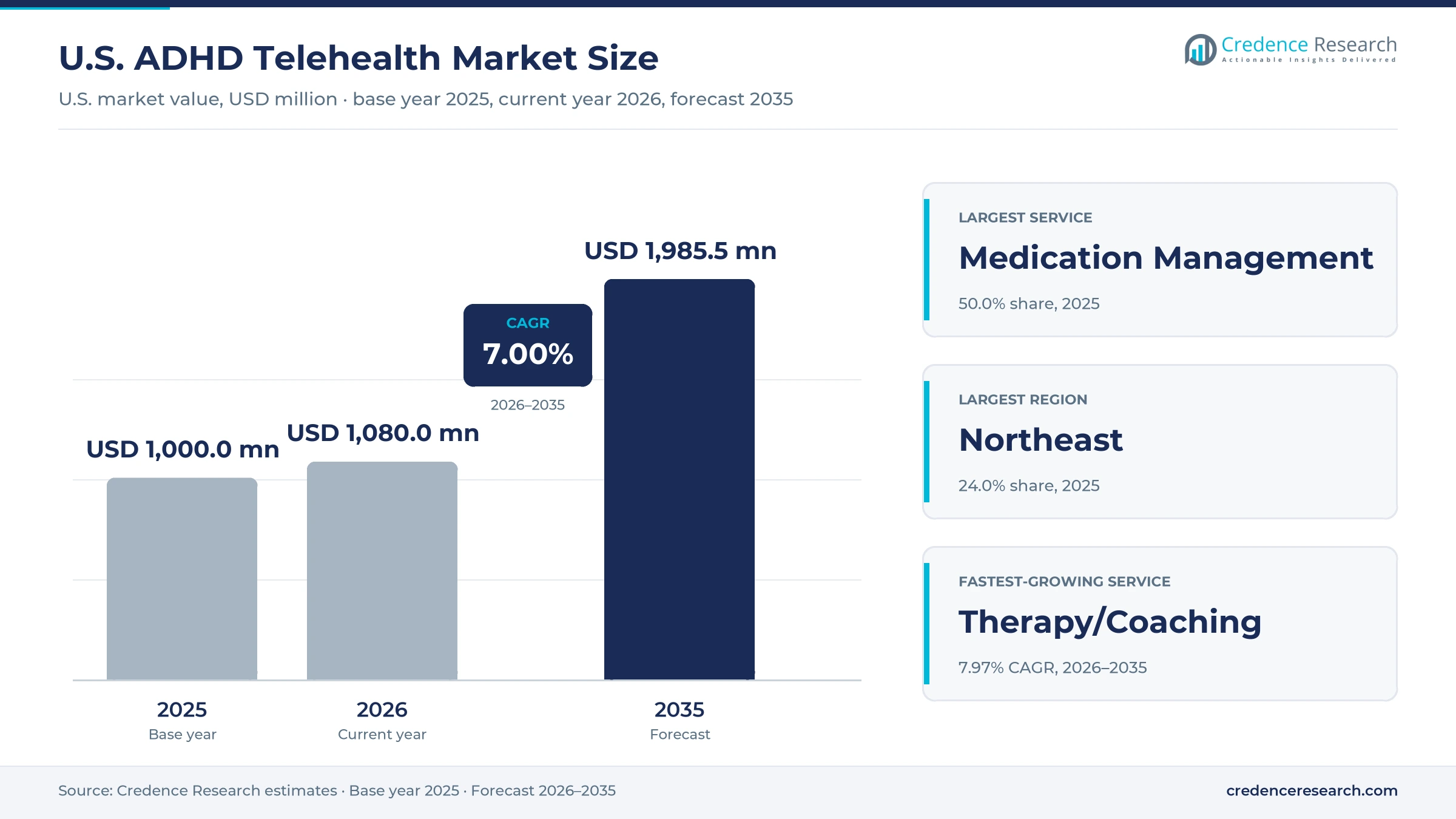
The U.S. ADHD telehealth market was valued at USD 1.01 billion in 2025 and is projected to increase from USD 1.08 billion in 2026 to USD 1.99 billion by 2035, registering a CAGR of 7.00% during 2026–2035. Demand comes from adults and children who receive ADHD evaluations, prescriptions, follow-up visits and coaching by video or app. The Northeast held the largest regional share, 24.0% in 2025, while the Mountain region grows fastest at 7.80% a year as remote care reaches patients far from psychiatrists. Growth rests on federal rules, because stimulants such as Adderall are Schedule II drugs and DEA flexibilities allow telemedicine prescribing without an in-person exam through Dec. 31, 2026. The CDC estimated that 15.5 million adults had a current ADHD diagnosis in 2023 and that about half had used telehealth for ADHD care. Insurer-backed psychiatry networks are gaining ground after enforcement against cash-pay startups, and the DEA sent a final special registration rule for White House review in August 2026.
What does remote ADHD care include in the U.S.?
The market counts spending on ADHD services delivered by video, phone or app, including diagnostic evaluations, medication management visits, therapy and ADHD coaching sessions, whether paid by health plans or in cash. Revenue is measured at the provider or platform level, covering clinician fees and memberships rather than the cost of the medicines dispensed.
The estimate excludes stimulant and nonstimulant drug sales, in-person office visits, school-based evaluations and standalone consumer apps that offer no clinician contact. It also excludes digital therapeutics sold as products, although remote tests used inside a telehealth evaluation are counted through the visit fee.
U.S. ADHD Telehealth Market Insights
- The market grows from USD 1.01 billion in 2025 to USD 1.99 billion by 2035, a 7.00% CAGR, as remote evaluations and follow-up visits reach more adults and children.
- The Northeast led with 24.0% of 2025 value, supported by insured demand and Brightline's pediatric care in New York, New Jersey, Connecticut and Massachusetts.
- Medication management held 50.0% of 2025 value, because stimulant patients need monthly or quarterly check-ins to keep prescriptions active.
- Talkiatry raised $210 million in February 2026 for an in-network model with more than 800 employed psychiatrists, a shift away from cash-pay startups.
- DEA flexibilities for prescribing Schedule II stimulants by telemedicine run through Dec. 31, 2026, and a final special registration rule went to White House review in August 2026.
Medication management leads while coaching grows fastest
Why does medication management lead remote ADHD care?
Based on service, the market is categorized into diagnosis, medication management and therapy/coaching. Medication Management led with 50.0% of 2025 value because stimulant care requires recurring visits, and Circle Medical lists 15-minute monthly check-ins at $120 each once treatment is stable. The CDC also found that about one third of adults with ADHD took a stimulant in the prior year. Therapy/Coaching grows fastest at 7.97% a year as non-drug care widens, since a CDC-authored study found that 44.4% of children with current ADHD received behavioral treatment in 2022. Shimmer had delivered more than 10,000 ADHD coaching sessions by January 2024, according to HIT Consultant.
Why do adults account for most remote ADHD spending?
Based on patient, the market is categorized into adults and children. Adults led with 71.0% of 2025 value because the CDC estimated that 15.5 million U.S. adults had a current ADHD diagnosis in late 2023, and about half of them had used telehealth for ADHD services. Roughly half of these adults were diagnosed at age 18 or older, which sends many first evaluations to online clinics. Adults also grow fastest at 7.20% a year as health analytics data reported by Axios in April 2026 showed stimulant prescriptions for commercially insured women aged 18 to 44 rising 94% between 2018 and 2024. Children remain a smaller share, although 6.5 million had current ADHD in 2022.
How do insurance and cash payment divide spending?
Based on payer, the market is categorized into insurance and cash. Insurance led with 57.0% of 2025 value because large networks bill health plans directly, and Talkiatry reports in-network contracts with more than 100 insurers covering over 170 million lives. Circle Medical says insured patients paid an average of $35 per appointment over six months, far below its $120 self-pay follow-up price. Insurance also grows fastest at 7.38% a year as Cerebral moved to an insurance-based model and Congress extended Medicare telehealth flexibilities through Dec. 31, 2027, under a law signed on Feb. 3, 2026. Cash care persists at Klarity, where self-pay visits start at $51.
| Segment Group | Leading Sub-segment | Share, 2025 | Fastest-growing Sub-segment | CAGR, 2026–2035 |
|---|---|---|---|---|
| By Service | Medication Management | 50.0% | Therapy/Coaching | 7.97% |
| By Patient | Adults | 71.0% | Adults | 7.20% |
| By Payer | Insurance | 57.0% | Insurance | 7.38% |
Request a Free Sample
Fill in your details and we'll send you a free sample report.
- Sample data tables & charts
- Research methodology
Access, follow-up and clinician tools keep patients in care
Telepsychiatry expands access to ADHD consultations
Telepsychiatry widens access to ADHD consultations for adults who cannot find a local psychiatrist, which keeps new evaluations flowing into the channel. The CDC reported in October 2024 that 46.0% of U.S. adults with current ADHD had ever used telehealth for ADHD-related services. Talkiatry now employs more than 800 psychiatrists and has logged 3 million patient visits, according to Fierce Healthcare, and its services extend the reach of remote psychiatric care to insured patients nationwide. Epic Research also found that about 60% of 205,065 initial ADHD visits led to a prescription within 30 days, with similar rates for telehealth and office care. In the Credence Research model this access driver adds about 2.73 percentage points to annual growth to 2035.
Digital scheduling and follow-up support patient retention
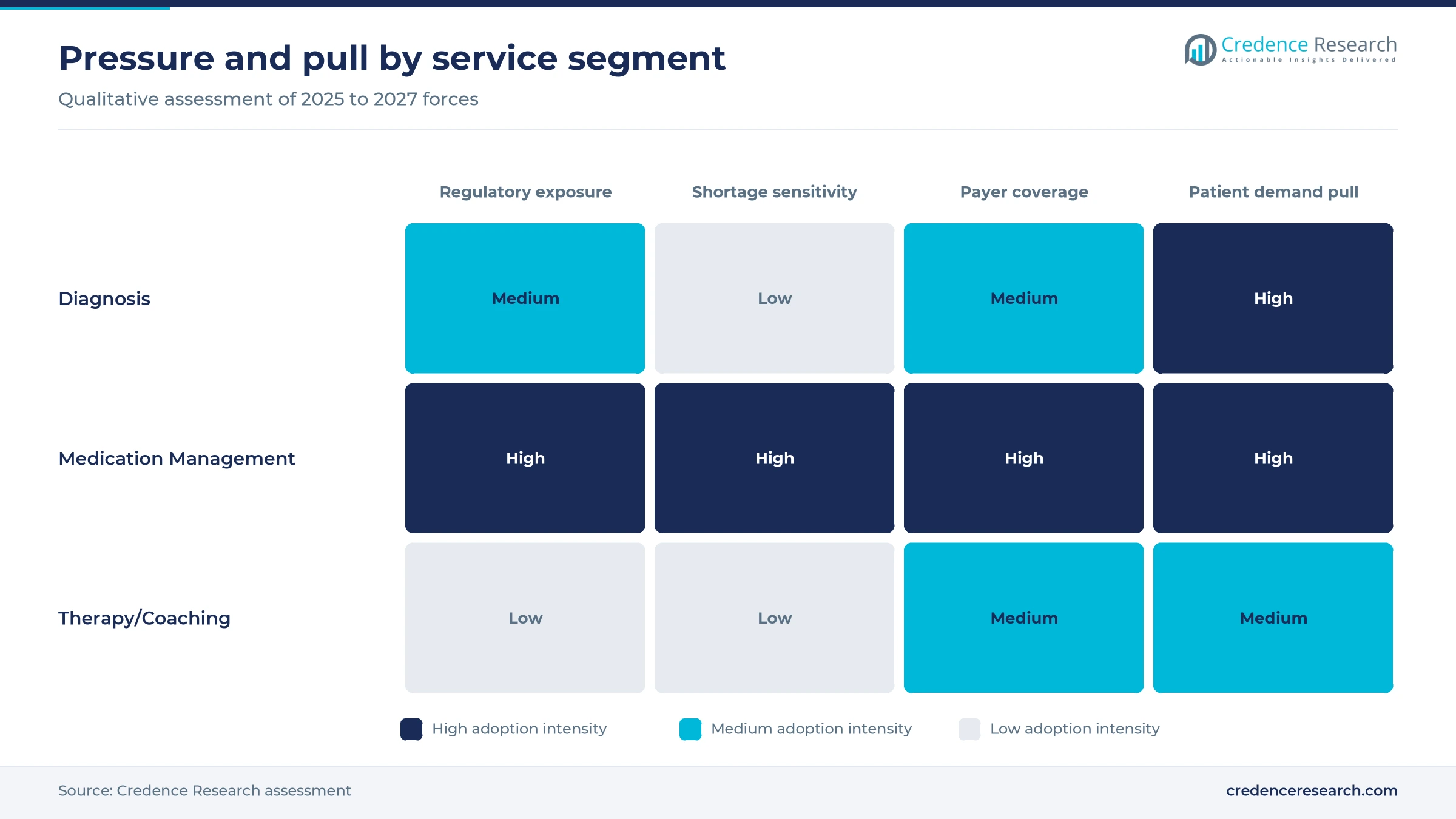
Digital scheduling and recurring follow-up keep ADHD patients in care, because stimulant prescriptions must be renewed and doses reviewed on a regular schedule. Circle Medical moves patients from a 30-minute intake to 15-minute monthly check-ins once treatment is stable, and it sends prescriptions to a pharmacy within 24 hours of the diagnosis visit. Klarity says diagnosis can happen in as little as 24 hours and lets patients book follow-ups at any time across all 50 states. Retention also matters during drug shortages, since the CDC found that 71.5% of adults taking stimulants had trouble filling a prescription because the medicine was unavailable. In the Credence Research model this retention driver adds about 1.96 percentage points to annual growth to 2035, and Medication Management keeps 50.0% of value.
Care integration and monitoring tools lift clinician output
Integrated care platforms and remote monitoring tools let each clinician handle more ADHD patients without cutting visit quality. Legion Health adopted Qbtech's FDA-cleared QbCheck remote test clinic-wide in April 2025, and the release said more than 12,000 clinicians in 44 states had adopted objective ADHD measures. Talkiatry says its AI-powered platform manages care delivery and clinical operations for its employed psychiatrists. Cerebral bought the ADHD self-management app Inflow in March 2026, letting its therapists refer patients to the app and Inflow members move into fuller care, according to Behavioral Health Business. These tools sit alongside behavioral health software already used by clinics. In the Credence Research model this productivity driver adds about 1.19 percentage points to annual growth to 2035.
Adult diagnoses and stimulant prescribing keep rising
Adult ADHD diagnoses and stimulant prescribing keep rising, which enlarges the pool of patients who need ongoing remote management. U.S. Pharmacist reported in January 2025, citing national prescription claims data, that dispensed stimulant prescriptions rose 57.9% between 2012 and 2022, with an 87.5% increase among females. Health analytics data published by Axios in April 2026 show that stimulant prescriptions for commercially insured women aged 18 to 44 rose 94% from 2018 to 2024. The same data show that nurse practitioners and physician assistants became the top prescriber group in 2024, at 34%, a workforce that many virtual clinics employ. Demand for stimulant and nonstimulant medicines therefore feeds visit volume, and Adults hold 71.0% of 2025 value.
Enforcement and objective testing reshape remote ADHD care
Shift from cash startups to in-network psychiatry
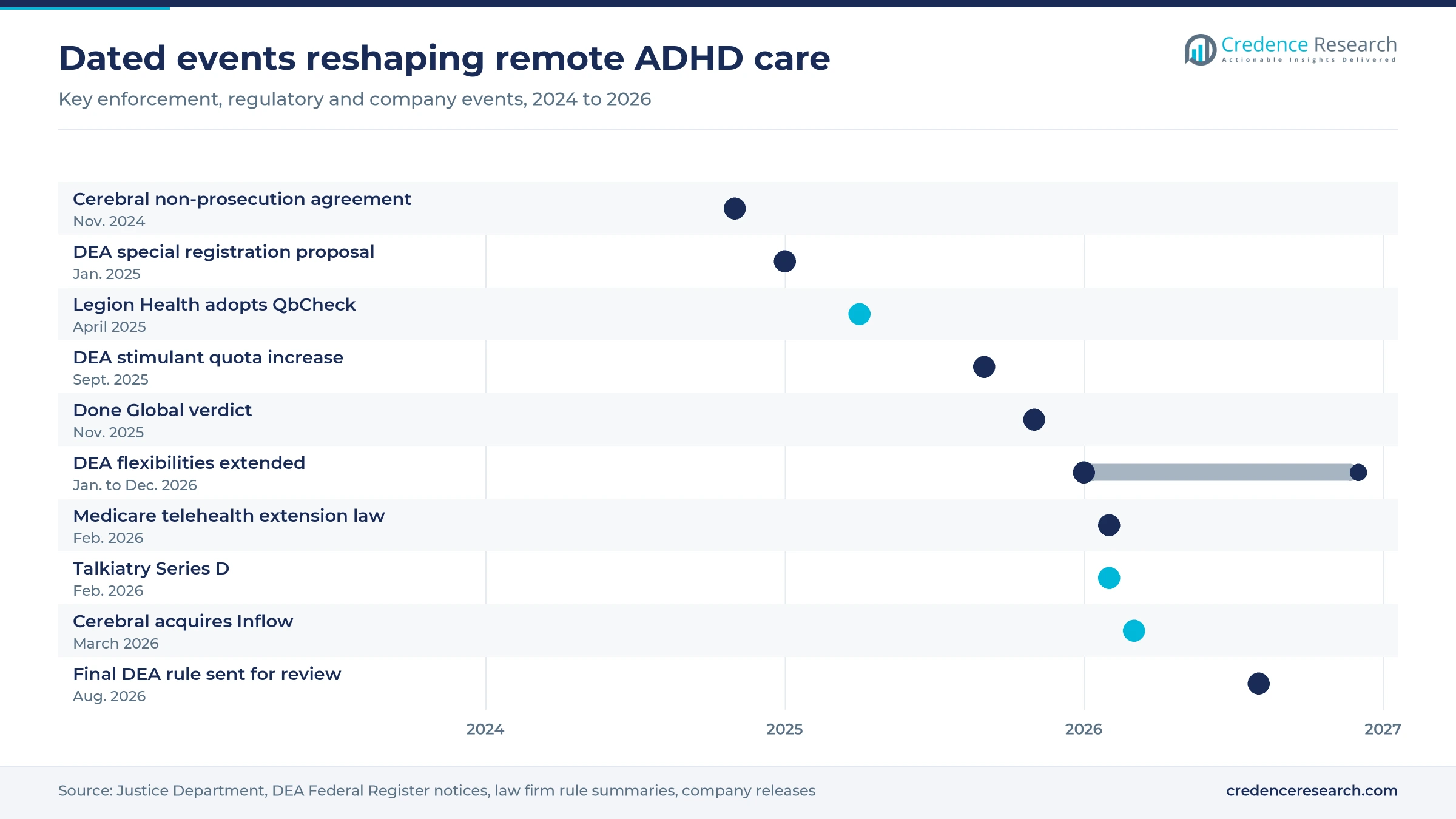
ADHD telehealth is shifting from cash-pay startups toward in-network psychiatry groups, a change driven by enforcement against early platforms. Cerebral entered a non-prosecution agreement on Nov. 4, 2024, and agreed to forfeit $3,652,000 after it had stopped prescribing controlled substances in October 2022, the U.S. Attorney's Office said. A federal jury convicted Done Global founder Ruthia He on Nov. 18, 2025, in a $100 million Adderall distribution case, according to Behavioral Health Business. In contrast, Talkiatry closed a $210 million Series D in February 2026 and is in network with more than 100 insurers covering over 170 million lives. Consequently, insurance plans hold 57.0% of 2025 value in the Credence Research estimate.
Rise of objective remote testing in evaluations
Objective remote testing is rising in ADHD evaluations, as clinics seek documentation that supports controlled-substance prescribing. Qbtech describes QbCheck as FDA-cleared technology that gives objective data during remote assessments, and Legion Health implemented it clinic-wide on April 8, 2025. The same release cited studies showing that digital ADHD tools increased clinician confidence by 77%. Klarity, with more than 4,000 licensed professionals, describes full evaluations that combine an interview, standardized rating scales and possible psychological tests, often over two or more visits. The January 2025 DEA proposal also called for prescription monitoring checks and identity verification, according to the law firm McDermott. As a result, Medication Management keeps the largest share while diagnosis visits become longer and better documented.
Opening in coaching and therapy for adults
Coaching and therapy for adults form a clear opening, because many patients want skills support beside or instead of stimulants. The CDC found that only 33.4% of adults with current ADHD took a stimulant in the prior year, which leaves a large group outside medication care. Shimmer raised $2.2 million in January 2024 and had delivered more than 10,000 live ADHD coaching sessions since its October 2022 launch, according to HIT Consultant. Cerebral now prescribes only non-stimulant medicines while expanding therapy, and its Inflow deal adds self-management tools to that model. Providers that bundle coaching with clinical follow-up can capture this group, and Therapy/Coaching grows at 7.97% a year in the Credence Research model.
Opening in pediatric and family virtual care
Pediatric virtual care is a clear opening, since a large share of children with ADHD receive no specific treatment. A CDC-authored study of the 2022 National Survey of Children's Health estimated that 7.1 million U.S. children aged 3 to 17 had ever been diagnosed with ADHD. Among those with current ADHD, 30.1% received no ADHD-specific treatment and only 44.4% received behavioral treatment in the past year. Brightline, which lists ADHD among the conditions it treats, opened its fourth New York-area clinic in White Plains in April 2026 to pair in-person and virtual care. Prescription games such as EndeavorRx, cleared by the FDA in 2020 for children, show how prescription digital therapeutics can support remote pediatric programs.
DEA rules, drug shortages and fraud cases raise risk
Will remote stimulant prescribing rules change after 2026?
Remote starts for Schedule II stimulants depend on a temporary DEA waiver that expires on Dec. 31, 2026. The DEA sent a final special registration rule to White House review on Aug. 25, 2026, and its January 2025 proposal included restrictions on Schedule II prescribing, according to McDermott. Circle Medical already withholds controlled-substance treatment in Georgia, Kentucky and Minnesota. Platforms are therefore preparing in-person partnerships so that patients can keep stimulant care if the final rule tightens access.
How do stimulant shortages disrupt follow-up care?
Stimulant shortages are a supply risk that interrupts treatment plans remote clinicians cannot fix with a visit. The DEA raised the 2025 d-amphetamine production quota by about 17.8% on Sept. 19, 2025, after manufacturers reported lisdexamfetamine shortages, according to the Federal Register. A study in the Journal of Pediatric Pharmacology and Therapeutics, published in April 2025, counted 26 amphetamine-derivative shortages from 2001 to 2023, with resolved ones lasting 20.7 months on average. Clinicians must then switch formulations or doses, which adds visits and frustrates patients.
Does fraud enforcement raise compliance costs?
Enforcement after the early stimulant boom raises compliance costs for every ADHD platform. Prosecutors said Done Global was linked to more than 40 million pills of Adderall and other stimulants, and insurers paid about $14 million on false prior authorizations, Fierce Healthcare reported. Cerebral also agreed in November 2024 to cooperate with the government for a 30-month term. Providers now fund prescription monitoring checks, longer evaluations and audit trails, which raises the cost of each new patient for smaller cash-pay brands.
Can Medicare in-person rules return for behavioral care?
Medicare coverage for home-based behavioral telehealth has depended on short extensions. The American Psychiatric Association warned on Jan. 8, 2026, that an in-person visit within six months before the first home telehealth service would be required from Jan. 31, 2026, unless Congress acted. Congress then extended the waiver through Dec. 31, 2027, in a law signed on Feb. 3, 2026, according to the law firm McGuireWoods. Public coverage gaps persist anyway, since Circle Medical does not accept Medicaid or Medi-Cal patients even for self-pay.
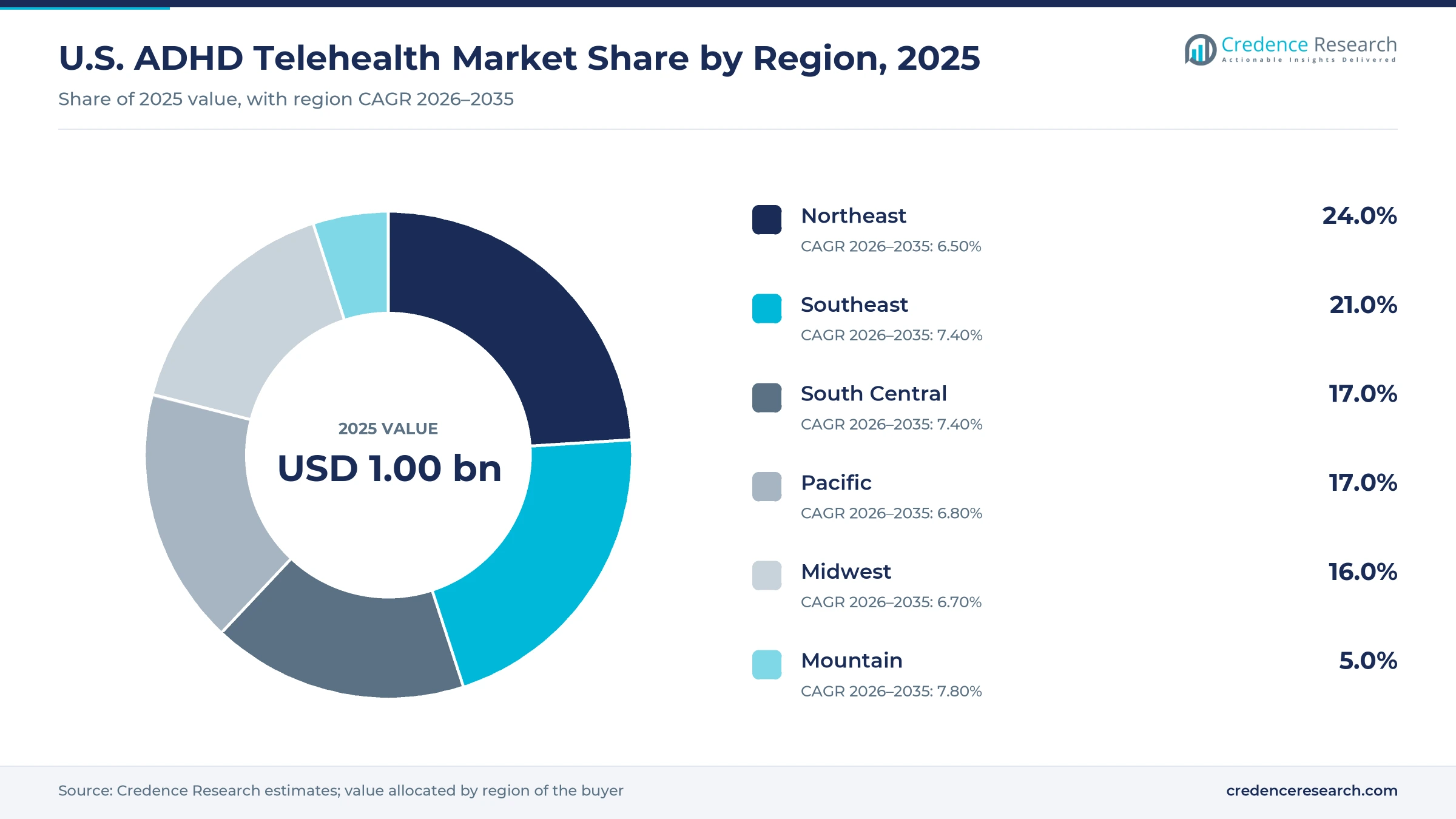
The Northeast holds the largest share of remote ADHD care
| Region | Value, 2025 (USD million) | Share, 2025 | CAGR, 2026–2035 |
|---|---|---|---|
| Northeast | 242.2 | 24.0% | 6.50% |
| Southeast | 212.0 | 21.0% | 7.40% |
| South Central | 171.6 | 17.0% | 7.40% |
| Pacific | 171.6 | 17.0% | 6.80% |
| Midwest | 161.5 | 16.0% | 6.70% |
| Mountain | 50.5 | 5.0% | 7.80% |
The Northeast leads on insured demand and dense networks
The Northeast held 24.0% of 2025 value and grows at 6.50% a year, below the national pace. The region combines high commercial coverage with dense provider networks, and Brightline lists New York, New Jersey, Connecticut and Massachusetts among its five states for pediatric mental health care. New Jersey requires one in-person visit before Schedule II prescribing, Circle Medical notes, which slows fully remote stimulant starts. The Census Bureau also reports that the Northeast was the only region to lose young adults aged 18 to 24 between 2020 and 2025.
The Southeast grows with population gains
The Southeast held 21.0% of 2025 value and grows at 7.40% a year, faster than the national rate. The Census Bureau reported that the South grew 6.0% from April 2020 to July 2025, nearly double the national pace, which adds working-age adults and families. Georgia is an exception for stimulant care, since Circle Medical does not offer controlled-substance treatment there. Providers in the zone therefore lean on in-network psychiatrists and non-stimulant plans to serve patients in Georgia and nearby states.
South Central gains from a young population base
The South Central region held 17.0% of 2025 value and grows at 7.40% a year, faster than the national rate. The zone shares the South's population gains, and Texas counties along the Mexican border have some of the largest under-18 population shares in the country, according to the Census Bureau. That young base supports pediatric and family ADHD care across the zone. Kentucky limits remote stimulant access, as Circle Medical does not provide controlled-substance treatment in the state, so platforms there depend more on evaluations, therapy and non-stimulant management.
The Pacific region tracks the national pace
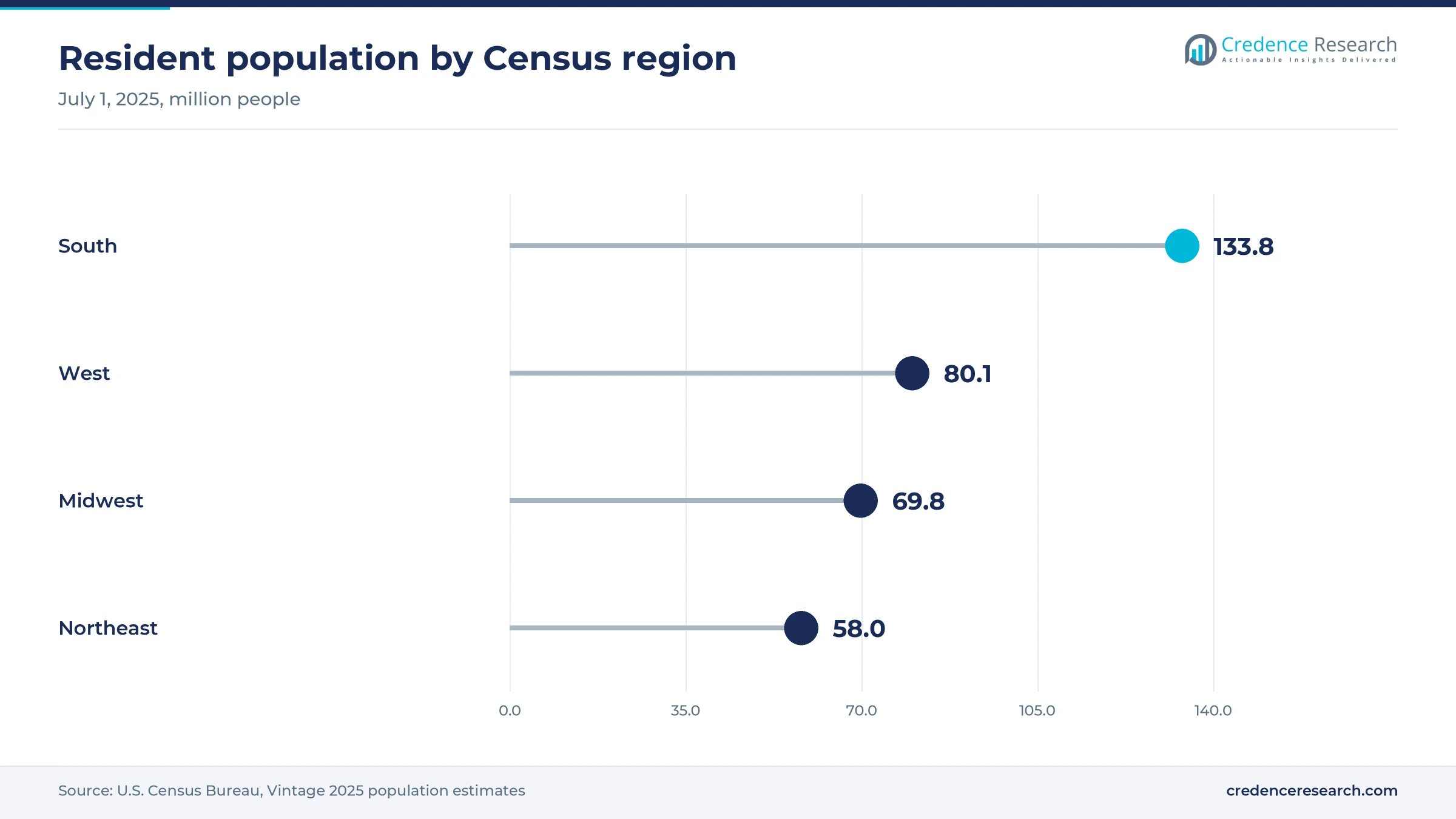
The Pacific region held 17.0% of 2025 value and grows at 6.80% a year, slightly below the national pace. The Census Bureau counted about 80.1 million people in the West census region, which also includes the Mountain states, in July 2025, up from 78.6 million in April 2020. However, the West had the largest percentage decline in its under-18 population, at 5.7%, which slows pediatric demand. Circle Medical also does not accept Medi-Cal patients even for self-pay, which leaves many low-income adults in California to other providers.
The Midwest grows slowly with state prescribing limits
The Midwest held 16.0% of 2025 value and grows at 6.70% a year, among the slowest regional rates. Census data show the Midwest population rose to about 69.8 million in July 2025, a gain of roughly 763,000 since April 2020. Minnesota adds a constraint, as Circle Medical does not provide controlled-substance treatment in the state. Rural counties still favor remote care, so insured networks and therapy-led models compete for share across the zone.
The Mountain region grows fastest from a young base
The Mountain region held 5.0% of 2025 value and grows at 7.80% a year, the fastest pace among the six zones. Utah recorded the lowest state median age in 2025, according to the Census Bureau, which points to a large pool of young adults entering the ages when many ADHD diagnoses now occur. The CDC found that about half of adults with ADHD were diagnosed at 18 or older. Sparse specialist coverage makes video evaluations and remote follow-up a practical route to care.
Settlements, funding and quota changes mark 2024 to 2026
| Development | Status and market relevance |
|---|---|
| In November 2024, Cerebral entered a non-prosecution agreement with federal prosecutors over its earlier ADHD stimulant prescribing practices. | Concluded; 30-month cooperation term |
| In September 2025, the DEA raised 2025 production quotas for d-amphetamine and lisdexamfetamine after manufacturers reported shortages. | In effect; aims to ease stimulant supply |
| In November 2025, a federal jury convicted Done Global founder Ruthia He in a $100 million Adderall distribution case. | Convicted; raises compliance scrutiny |
| In February 2026, Talkiatry raised $210 million in Series D funding to expand in-network psychiatry with employed psychiatrists. | Funded; strengthens insured ADHD care |
| In March 2026, Cerebral acquired the ADHD self-management app Inflow to link therapy with digital tools. | Completed; adds coaching-style support |
Remote tests and monitoring checks change evaluations
- Remote objective tests such as Qbtech's FDA-cleared QbCheck give clinicians objective data during video ADHD assessments, as Legion Health adopted in April 2025.
- Standardized rating scales collected online from patients and people who know them form part of the multi-visit evaluations that Klarity describes.
- Prescription monitoring checks would become mandatory under the January 2025 DEA special registration proposal, along with identity verification and audio-video visits.
- Self-management apps such as Inflow give patients daily ADHD tools between visits and route members into clinical care at Cerebral.
Need a Custom Version of This Report?
Tailor the scope, geography, or segments to your exact requirements.
- Custom geography or segment scope
- Direct access to our analyst team
Platforms compete on payer access and prescribing scope
Competition in ADHD telehealth centers on prescribing scope, payer access and the depth of follow-up care. Talkiatry competes as an in-network psychiatry group with more than 800 employed psychiatrists and contracts with over 100 insurers, backed by a $210 million Series D in February 2026. Circle Medical offers ADHD care through primary care clinicians in 32 states, with a three-visit evaluation and monthly check-ins, and works with most commercial plans. Klarity Health runs a network of more than 4,000 licensed professionals in all 50 states, mixing self-pay visits from $51 with insurance accepted by individual providers. Cerebral has rebuilt around insurance-based therapy and non-stimulant medicines after ending controlled-substance prescribing in October 2022, adding Resilience Labs and Inflow through acquisitions. Brightline serves children and families, and Legion Health uses remote objective testing. Clinical documentation, payer contracts and state prescribing rules decide which platforms keep patients.
How do the leading providers position their ADHD offers?
| Company | Type | Role in the market |
|---|---|---|
| Talkiatry | In-network psychiatry group | More than 800 employed psychiatrists, over 100 insurers and a $210 million Series D in February 2026 |
| Circle Medical | Virtual primary care | Three-visit ADHD evaluation and monthly check-ins in 32 states, with insurance or self-pay |
| Klarity Health | Provider network | More than 4,000 licensed professionals in all 50 states, self-pay visits from $51 |
| Cerebral | Mental health platform | Insurance-based therapy and non-stimulant care, with Inflow acquired in March 2026 |
| Brightline | Pediatric behavioral care | Hybrid virtual and clinic care for children, including ADHD, in five states |
| Legion Health | Telepsychiatry clinic | Adopted FDA-cleared QbCheck remote testing for ADHD assessments in April 2025 |
Compliance and payer contracts decide who scales
Credence Research's view is that compliance and payer contracts, rather than marketing, now decide which ADHD telehealth providers scale. The Cerebral settlement in November 2024 and the Done Global conviction in November 2025 ended the cash-pay, prescription-first model that grew during the pandemic. Insured psychiatry groups such as Talkiatry are now raising the largest rounds. The DEA flexibilities run only through Dec. 31, 2026, so documented evaluations, monitoring checks and in-person fallback options are essential. Coaching and therapy offer the fastest growth because they do not depend on controlled-substance rules.
How remote ADHD care spending was modeled
The report uses 2025 as the base year and 2035 as the forecast year, with market values taken from the Credence Research model. Service, patient, payer and regional splits are Credence Research estimates informed by public data and are not reported statistics. Sources include CDC surveys, DEA notices in the Federal Register, Justice Department releases, Census Bureau population estimates, telehealth rule summaries from law firms and the American Psychiatric Association, Epic Research and company price and press pages. No interviews or surveys were conducted for this edition, so segment shares should be read as modeled ranges.
Insured and documented remote care drives growth to 2035
From USD 1.08 billion in 2026, the market is expected to reach USD 1.99 billion by 2035 as remote evaluations, follow-up visits and coaching reach more adults and children. The final DEA special registration rule is the main swing factor for remote stimulant starts after 2026. Insured psychiatry networks should keep gaining share from cash-pay brands, while Medicare flexibilities through 2027 support older patients. Therapy and coaching grow fastest, and the Mountain region adds patients at the quickest pace. Growth therefore depends on compliant prescribing, stable stimulant supply and payer contracts that cover virtual follow-up.
Frequently Asked Questions
How big is the U.S. ADHD telehealth market?
Can ADHD stimulants be prescribed by telehealth?
Which service segment holds the largest share?
Which region leads and which grows fastest?
How many U.S. adults have ADHD?
How much do online ADHD evaluations cost?
What happened to Cerebral and Done Global?
Who are the leading companies?
Table of Content
Chapter 1 Market Segmentation
- 1.1 Segmentation Framework
- 1.1.1 Product and Service Classification
- 1.1.2 Application and End-Use Classification
- 1.1.3 Technology and Solution Classification
- 1.1.4 Customer and Distribution Channel Classification
- 1.1.5 Geographic Segmentation
- 1.1.6 Market Segment Definitions and Boundaries
- 1.2 By Service
- 1.2.1 Medication Management
- 1.2.2 Diagnosis
- 1.2.3 Therapy/Coaching
- 1.3 By Patient
- 1.3.1 Adults
- 1.3.2 Children
- 1.4 By Payer
- 1.4.1 Insurance
- 1.4.2 Cash
Chapter 2 Introduction
- 2.1 Report Objectives and Scope
- 2.2 Product Definition and Industry Terminology
- 2.3 Market Inclusions and Exclusions
- 2.4 Research Process
- 2.4.1 Primary Research and Expert Interviews
- 2.4.2 Secondary Research and Source Review
- 2.4.3 Top-Down and Bottom-Up Estimation
- 2.4.4 Data Triangulation and Verification
- 2.5 Market Size Measurement Basis
- 2.5.1 2025: USD 1.01 billion → 2035: USD 1.99 billion
- 2.6 Historical and Forecast Reference Periods
- 2.6.1 Historical Period: 2018-2025
- 2.6.2 Base Year: 2025
- 2.6.3 Forecast Period: 2025-2035
- 2.7 Research Assumptions and Limitations
Chapter 3 Executive Summary
- 3.1 Market Snapshot and Key Findings
- 3.2 Base-Year Market Size, 2025
- 3.3 Forecast Market Size, 2035
- 3.4 Revenue and Volume Growth Outlook
- 3.5 Key Demand and Supply Indicators
- 3.6 Leading Market Segments
- 3.7 Fastest-Growing Market Opportunities
- 3.8 Regional Performance Highlights
- 3.9 Technology and Industry Transformation
- 3.10 Competitive Landscape Summary
- 3.11 Analyst View and Strategic Implications
Chapter 4 U.S. ADHD Telehealth Market Trends and Developments
- 4.1 Historical Industry Development, 2018-2025
- 4.2 Recent Market Trends and Developments
- 4.3 Demand and Customer Behavior Trends
- 4.4 Technology and Product Innovation
- 4.5 Artificial Intelligence, Automation and Digitalization
- 4.6 Local Manufacturing and Supply Chain Realignment
- 4.7 Industry Partnerships, Mergers and Acquisitions
- 4.8 Sustainability and Circular Economy Developments
- 4.9 Government and Private Sector Investment Trends
- 4.10 Emerging Business Models and Commercialization
- 4.11 Industry Developments and Announcements
Chapter 5 U.S. ADHD Telehealth Market Production, Supply and Demand Analysis
- 5.1 Demand Trend and Consumption Analysis, 2018-2025
- 5.2 Demand Forecast, 2025-2035
- 5.3 Production and Output Trend, 2018-2025
- 5.4 Production and Output Forecast, 2025-2035
- 5.5 Installed Capacity and Capacity Utilization
- 5.6 Company-Wise Production Plants and Statistics
- 5.6.1 Installed Production Capacity
- 5.6.2 Actual Production
- 5.6.3 Planned Capacity and Expansion Targets
- 5.7 Supply Chain Structure and Procurement Trends
- 5.8 Supply-Demand Gap and Bottlenecks
- 5.9 Import Dependence and Sourcing Structure
- 5.10 Contract Manufacturing and Outsourcing
- 5.11 Regional Supply and Demand Concentration
Chapter 6 U.S. ADHD Telehealth Market Pricing Analysis
- 6.1 Pricing Structure and Measurement
- 6.2 Historical Pricing Trends, 2018-2025
- 6.3 Pricing Outlook, 2025-2035
- 6.4 Average Selling Price and Unit Economics
- 6.5 Pricing by Product and Market Segment
- 6.6 Geographic Pricing Differences
- 6.7 Key Input, Energy, Labor and Logistics Costs
- 6.8 Contract Pricing and Purchasing Models
- 6.9 Pricing Sensitivity and Competitive Positioning
- 6.10 Price, Margin and Profitability Implications
Chapter 7 U.S. ADHD Telehealth Market Dynamics
- 7.1 Market Growth Drivers
- 7.1.1 Demand-Side Drivers
- 7.1.2 Technology and Innovation Drivers
- 7.1.3 Infrastructure and Investment Drivers
- 7.1.4 Regulatory and Policy Drivers
- 7.2 Market Restraints
- 7.2.1 Cost and Affordability Constraints
- 7.2.2 Technology and Adoption Barriers
- 7.2.3 Supply Chain and Operational Constraints
- 7.3 Market Challenges
- 7.3.1 Competitive Pressure and Margin Erosion
- 7.3.2 Skills, Infrastructure and Implementation Gaps
- 7.4 Emerging Market Opportunities
- 7.5 Market Dynamics Impact and Time-Horizon Assessment
Chapter 8 U.S. ADHD Telehealth Value Chain Analysis
- 8.1 Industry Value Chain Overview
- 8.2 Upstream Suppliers and Critical Inputs
- 8.3 Technology and Component Providers
- 8.4 Manufacturing or Service Delivery
- 8.5 Distribution, Channel Partners and Integrators
- 8.6 Downstream Applications and End Users
- 8.7 Value Addition and Profit Pools
- 8.8 Vertical Integration and Outsourcing
- 8.9 Supplier Concentration and Risk
- 8.10 Supply Chain Localization and Resilience
Chapter 9 U.S. ADHD Telehealth Market Regulations and Policies
- 9.1 Relevant Laws, Standards and Compliance Frameworks
- 9.2 Product, Service, Safety and Quality Requirements
- 9.3 Government Policies, Incentives and Subsidies
- 9.4 Imports, Exports and Trade Barriers
- 9.5 Public Procurement and Local Content Requirements
- 9.6 Environmental and Sustainability Compliance
- 9.7 Upcoming Policy Changes and Market Implications
Chapter 10 U.S. ADHD Telehealth Market Hotspots and Opportunities
- 10.1 Market Opportunity Mapping and Growth Hotspots
- 10.2 High-Growth Applications and Customer Groups
- 10.3 Underserved Markets and White-Space Opportunities
- 10.4 Emerging Technology and Product Opportunities
- 10.5 New Capacity and Investment Hotspots
- 10.6 Market Entry and Expansion Opportunities
- 10.7 Distribution and Partnership Opportunities
- 10.8 Near-Term and Long-Term Commercial Potential
- 10.9 Opportunity Attractiveness and Execution Risks
Chapter 11 U.S. ADHD Telehealth Market Outlook, 2025-2035
- 11.1 Market Size and Analysis
- 11.1.1 Revenue (Market Measurement: 2025: USD 1.01 billion → 2035: USD 1.99 billion)
- 11.1.2 Market Volume and Quantity Sold
- 11.1.3 Historical Market Size, 2018-2025
- 11.1.4 Base-Year Market Size, 2025
- 11.2 Market Forecast, 2025-2035
- 11.2.1 Revenue Forecast to 2035
- 11.2.2 Volume Forecast to 2035
- 11.2.3 CAGR and Year-on-Year Growth
- 11.2.4 Incremental Revenue Opportunity
- 11.3 Forecast Assumptions and Scenario Analysis
- 11.3.1 Base-Case Forecast
- 11.3.2 Optimistic and Conservative Scenarios
- 11.3.3 Technology, Pricing and Policy Sensitivities
- 11.4 Market Attractiveness and Growth Outlook
Chapter 12 U.S. ADHD Telehealth Market Segmentation and Outlook
- 12.1 Segmentation Summary and Market Shares, 2025
- 12.2 Largest and Fastest-Growing Segments
- 12.3 By Service - Market Size and Forecast, 2025-2035
- 12.3.1 Segment Definition and Scope
- 12.3.2 Historical Market Size, 2018-2025
- 12.3.3 Revenue Forecast, 2025-2035
- 12.3.4 Volume Forecast, 2025-2035
- 12.3.5 Base-Year Market Share, 2025
- 12.3.6 Segment CAGR and Growth Drivers
- 12.3.7 Subsegment Market Size and Forecast
- 12.3.7.1 Medication Management
- 12.3.7.2 Diagnosis
- 12.3.7.3 Therapy/Coaching
- 12.3.8 Subsegment Pricing and Adoption Trends
- 12.3.9 Leading Suppliers and Competition
- 12.3.10 Regional Demand and Opportunities
- 12.4 By Patient - Market Size and Forecast, 2025-2035
- 12.4.1 Segment Definition and Scope
- 12.4.2 Historical Market Size, 2018-2025
- 12.4.3 Revenue Forecast, 2025-2035
- 12.4.4 Volume Forecast, 2025-2035
- 12.4.5 Base-Year Market Share, 2025
- 12.4.6 Segment CAGR and Growth Drivers
- 12.4.7 Subsegment Market Size and Forecast
- 12.4.7.1 Adults
- 12.4.7.2 Children
- 12.4.8 Subsegment Pricing and Adoption Trends
- 12.4.9 Leading Suppliers and Competition
- 12.4.10 Regional Demand and Opportunities
- 12.5 By Payer - Market Size and Forecast, 2025-2035
- 12.5.1 Segment Definition and Scope
- 12.5.2 Historical Market Size, 2018-2025
- 12.5.3 Revenue Forecast, 2025-2035
- 12.5.4 Volume Forecast, 2025-2035
- 12.5.5 Base-Year Market Share, 2025
- 12.5.6 Segment CAGR and Growth Drivers
- 12.5.7 Subsegment Market Size and Forecast
- 12.5.7.1 Insurance
- 12.5.7.2 Cash
- 12.5.8 Subsegment Pricing and Adoption Trends
- 12.5.9 Leading Suppliers and Competition
- 12.5.10 Regional Demand and Opportunities
- 12.6 Segment Growth Comparison
- 12.7 Segment Attractiveness and Priority Matrix
Chapter 13 U.S. ADHD Telehealth Geographic Market Outlook, 2025-2035
- 13.1 Domestic Market Distribution and Demand Clusters
- 13.2 State- or Province-Wise Market Size and Forecast, 2025-2035
- 13.3 City and Metropolitan Market Outlook
- 13.4 Industrial, Manufacturing and Commercial Clusters
- 13.5 Geographic Concentration of Key End Users
- 13.6 Local Pricing and Purchasing Differences
- 13.7 Domestic Production Facilities and Capacity Map
- 13.8 Local Infrastructure and Project Pipeline
- 13.9 State-Level Policy and Incentive Differences
- 13.10 Subnational Investment Hotspots and Opportunities
- 13.11 Distribution and Logistics Networks
- 13.12 Domestic Competitive Footprint
Chapter 14 U.S. ADHD Telehealth Technology, Innovation and Sustainability Outlook
- 14.1 Technology Landscape and Maturity
- 14.2 Product, Process and Service Innovation
- 14.3 AI, Automation and Digital Tools in the Industry
- 14.4 Technology Adoption and Performance Benchmarking
- 14.5 Innovation Pipeline and R&D Investment
- 14.6 Patent and Intellectual Property Trends
- 14.7 Energy Efficiency and Resource Management
- 14.8 Sustainability, Recycling and Circularity
- 14.9 Technology Roadmap, 2025-2035
- 14.10 Risks of Obsolescence and Technology Substitution
Chapter 15 U.S. ADHD Telehealth Market Key Strategic Imperatives
- 15.1 Growth and Market Entry Priorities
- 15.2 High-Return Products and Segments
- 15.3 Pricing, Profitability and Cost Optimization
- 15.4 Technology Investment and Product Differentiation
- 15.5 Supply Chain Localization and Resilience
- 15.6 Distribution and Customer Acquisition
- 15.7 Partnership, Acquisition and Capacity Strategy
- 15.8 Regional Expansion Priorities
- 15.9 Short-, Medium- and Long-Term Actions
Chapter 16 Competition Outlook
- 16.1 Industry Competition Characteristics
- 16.2 Market Structure and Concentration
- 16.3 Market Share and Competitive Positioning, 2025
- 16.4 Company-Wise Revenue and Product Benchmarking
- 16.5 Production and Service Capacity Benchmarking
- 16.6 Technology, Pricing and Differentiation
- 16.7 Regional Footprint and Distribution Strength
- 16.8 Mergers, Acquisitions and Strategic Alliances
- 16.9 New Entrants and Competitive Threats
- 16.10 Porter's Five Forces and Industry Attractiveness
- 16.11 Competitive Outlook, 2025-2035
Chapter 17 Company Profiles
- 17.1 Company Coverage and Selection Criteria
- 17.2 Talkiatry
- 17.2.1 Business Description
- 17.2.2 Company Ownership and Geographic Presence
- 17.2.3 Product and Service Portfolio
- 17.2.4 Manufacturing and Operating Footprint
- 17.2.5 Production Capacity and Expansion Plans
- 17.2.6 Financial Performance and Investment
- 17.2.7 Market Share and Competitive Position
- 17.2.8 Technology and Innovation Capabilities
- 17.2.9 Strategic Alliances or Partnerships
- 17.2.10 Recent Developments
- 17.2.11 Growth Strategy and Outlook
- 17.3 Circle Medical
- 17.4 Klarity Health
- 17.5 Cerebral
- 17.6 Brightline
- 17.7 Legion Health
- 17.8 Other Relevant Market Participants
Note: Every listed company is profiled on the structure shown under the first company. The company list is preliminary and may change based on research findings, market developments, data availability and client requirements.
Chapter 18 Disclaimer
- 18.1 Research and Forecast Disclaimer
- 18.2 Data Source and Estimation Limitations
Note: The depth of individual sections depends on data availability for this market. Volume, capacity, trade and other unit-based metrics are included where applicable.

