
Cash-pay peptide care grows under shifting federal rules
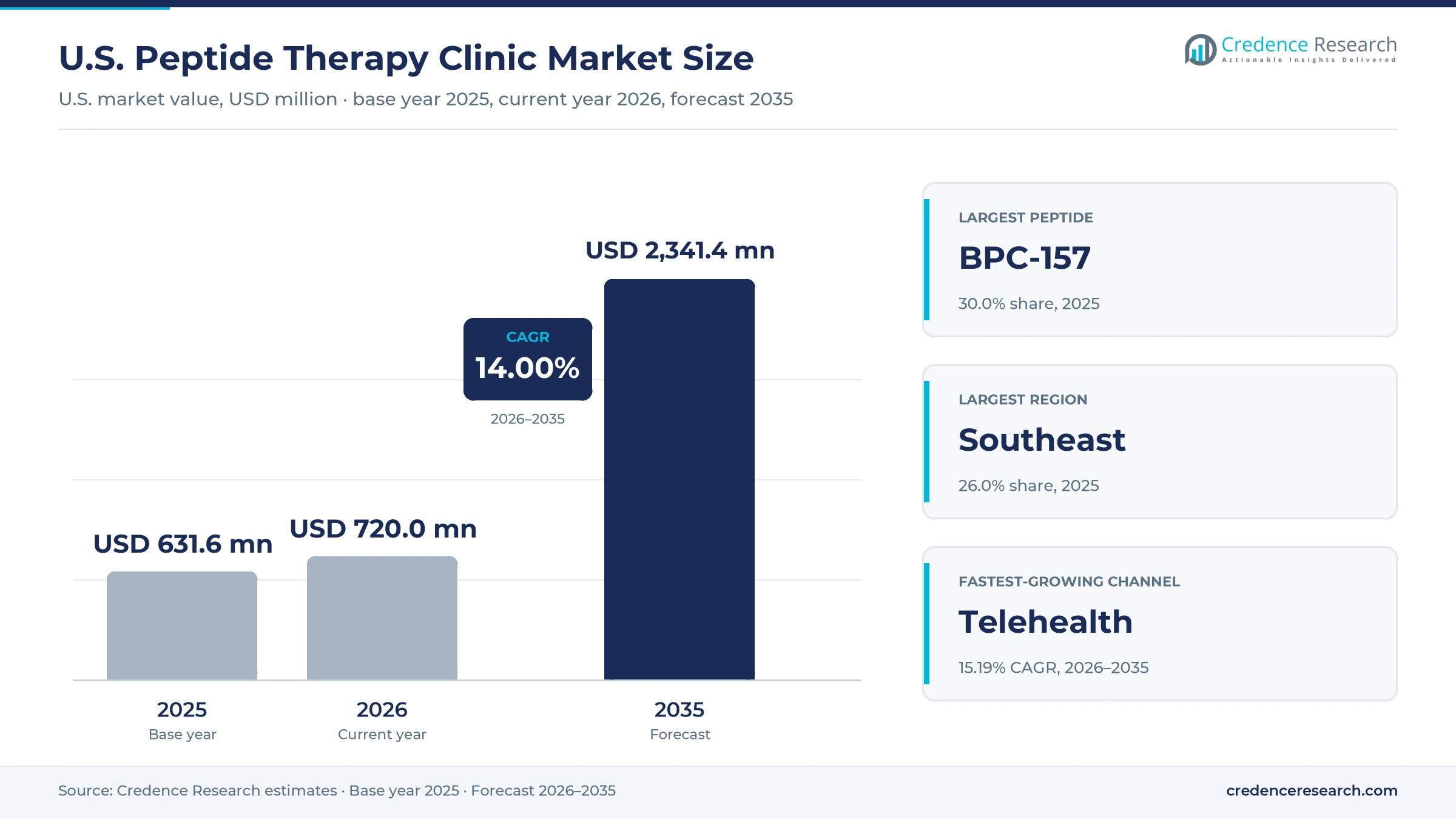
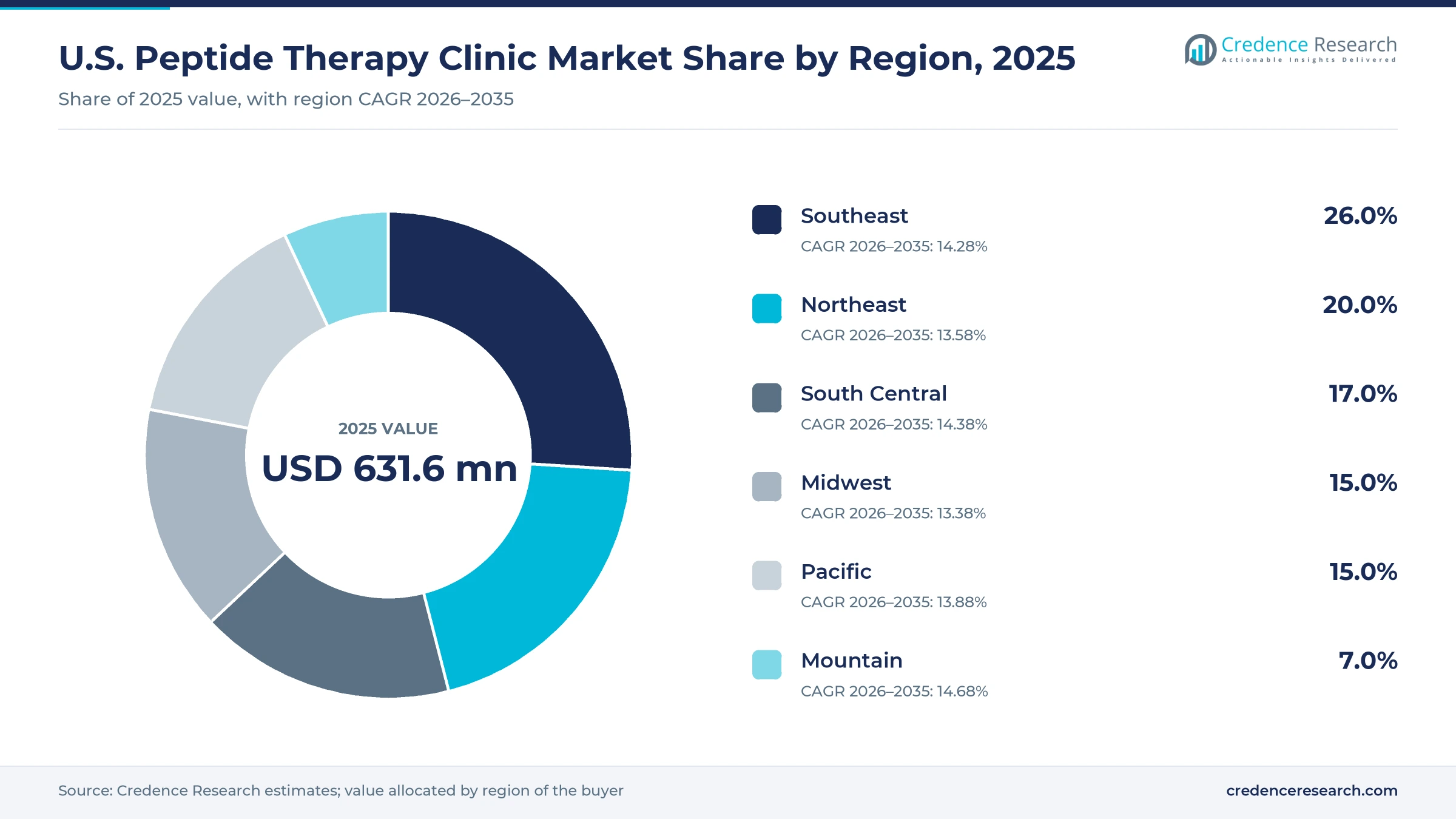
The U.S. peptide therapy clinic market was valued at USD 631.6 million in 2025 and is projected to increase from USD 720.0 million in 2026 to USD 2.34 billion by 2035, registering a CAGR of 14.00% during 2026–2035. Demand comes from adults aged 35 and older who pay cash for clinician-prescribed compounded peptides, follow-up laboratory panels and membership fees at clinics, telehealth platforms and med spas. The Southeast region held the largest regional share, 26.0% in 2025, while the Mountain region grows fastest at 14.68% a year as remote consultations reach smaller cities. Growth rests on a regulatory change in 2026, when HHS issued an interim policy that allows state-licensed pharmacies to compound six peptides, including BPC-157 and TB-500, under strict sourcing and reporting conditions. These peptides remain unapproved drugs, and the policy does not establish their safety or effectiveness. As a result, clinic spending is expected to shift toward prescribed, traceable products and away from research-use-only sellers.
What does cash-pay peptide care through clinics include?
The market counts patient spending on compounded peptides prescribed by clinicians, including BPC-157, CJC-1295 with ipamorelin, sermorelin and other peptides such as TB-500 and MOTS-c. Value covers the compounded product, the initial consultation, laboratory panels and the membership or follow-up fees that clinics, telehealth platforms and med spas bundle into monthly plans.
The estimate excludes FDA-approved peptide drugs filled through insurance, such as insulin and branded GLP-1 medicines, and it excludes compounded GLP-1 weight-loss programs. It also excludes peptides sold online as research chemicals without a prescription, cosmetic peptide creams and dietary supplements, which follow different rules and buying patterns.
U.S. Peptide Therapy Clinic Market Insights
- The market grows from USD 631.6 million in 2025 to USD 2.34 billion by 2035, a 14.00% CAGR, supported by an October 2026 HHS policy on six compounded peptides.
- The Southeast led with 26.0% of 2025 value, with Florida hosting 72 verified peptide clinics in a 2026 HealingMaps count of 846 clinics.
- BPC-157 held 30.0% of 2025 value, as 55.3% of the 846 verified clinics listed it, the most offered compound on clinic menus.
- An FDA advisory committee voted 8 to 6 on July 23, 2026, to recommend BPC-157 for the 503A bulks list, evaluated for ulcerative colitis.
- Hone Health closed a $33 million Series A in January 2025 and acquired ivee, adding in-home IV therapy and phlebotomy to its telehealth clinic.
BPC-157 leads clinic menus while newer peptides grow fastest
Why does BPC-157 lead clinic peptide menus?
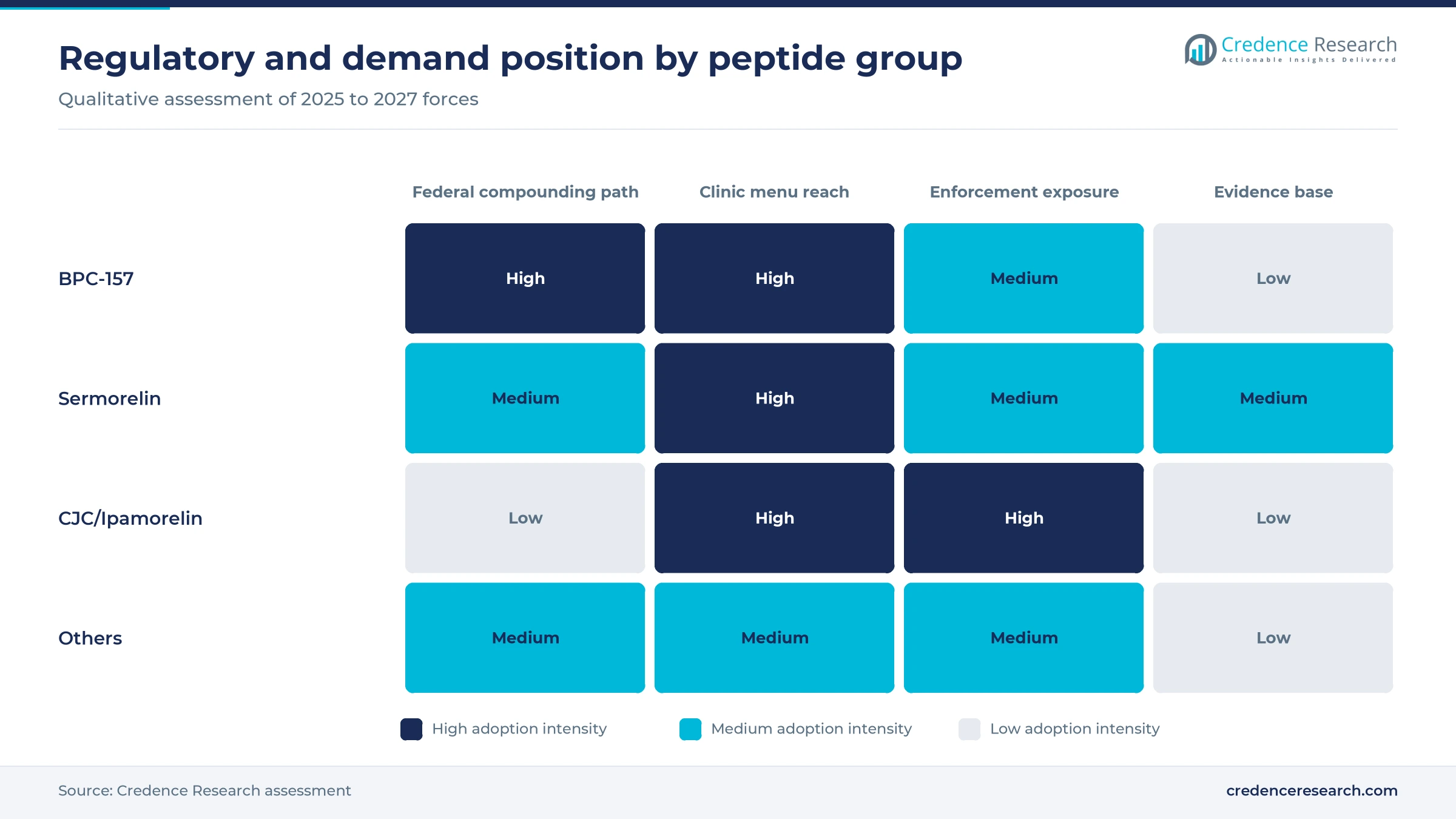
Based on peptide, the market is categorized into BPC-157, CJC/Ipamorelin, sermorelin and others. BPC-157 led with 30.0% of 2025 value because HealingMaps found it on 55.3% of 846 verified clinic menus in 2026, ahead of sermorelin at 48.9% and ipamorelin at 42.9%. Sermorelin follows, and Hone Health lists it at $175 a month as a compounded product that FDA has not approved. Others grows fastest at 15.23% a year as the HHS policy of October 2026 also covers TB-500, KPV, MOTS-c, Semax and epitalon. CJC/Ipamorelin grows more slowly because neither peptide is named in that policy.
How do clinics, telehealth and med spas divide spending?
Based on channel, the market is categorized into clinics, telehealth and med spas. Clinics led with 48.0% of 2025 value because in-person men's health and longevity chains built the first peptide menus, and SynergenX added BPC-157 and CJC-1295 with ipamorelin at its Low T Center and HerKare sites on Oct. 6, 2025. Telehealth grows fastest at 15.19% a year as platforms sell remote consultations with laboratory review, with Ways2Well charging $99 for a 20-minute peptide consult. Med spas grow more slowly, and the American Med Spa Association advised its members in July 2026 to document medical necessity and review advertising claims.
Why do men still account for most peptide spending?
Based on customer, the market is categorized into men and women 35+. Men led with 62.0% of 2025 value because peptide care grew out of testosterone clinics and men's telehealth, and Hone Health reported 55,000 patients treated when it raised its Series A in January 2025. Maximus also opened a waitlist for 18 peptide stacks with early access set for fall 2026. Women 35+ grows fastest at 14.67% a year as midlife care for women expands, with Midi Health raising $100 million on Feb. 3, 2026, and serving more than 25,000 patients a week across all 50 states.
| Segment Group | Leading Sub-segment | Share, 2025 | Fastest-growing Sub-segment | CAGR, 2026–2035 |
|---|---|---|---|---|
| By Peptide | BPC-157 | 30.0% | Others | 15.23% |
| By Channel | Clinics | 48.0% | Telehealth | 15.19% |
| By Customer | Men | 62.0% | Women 35+ | 14.67% |
Request a Free Sample
Fill in your details and we'll send you a free sample report.
- Sample data tables & charts
- Research methodology
Lab-led memberships and online booking widen patient reach
Personalized wellness interest fills peptide consults
Interest in personalized wellness brings adults to clinicians who review goals, laboratory results and history before prescribing peptides, which turns curiosity into paid consultations. The Census Bureau counted 64.6 million adults aged 65 and older on July 1, 2025, up 16.2% from April 2020, and the national median age reached 39.4. A HealingMaps review of 846 verified clinics found recovery or growth peptides on 71% of menus in 2026. Ways2Well charges $99 for a 20-minute consult that may end without any prescription, which shows how clinics sell the assessment itself. In the Credence Research model this driver adds about 5.5 percentage points to annual growth to 2035.
Membership clinics add recurring lab and follow-up revenue
Membership models attach recurring laboratory and follow-up fees to each peptide patient, which raises the value of every enrollment beyond the product itself. Hone Health sells a $25 basic tier with laboratory testing every six months and a $155 premium tier with regular physician consults. Its biomarker panel covers more than 50 markers at over 2,000 laboratory locations. Hone also reported 300,000 patients tested when it closed its $33 million Series A on Jan. 22, 2025. Function Health raised $298 million in November 2025, according to HLTH, and its members test at 2,000 Quest Diagnostics sites. In the Credence Research model this driver adds about 3.9 percentage points to annual growth to 2035.
Digital patient acquisition widens clinic reach
Online marketing and remote intake let a single clinic team serve patients across several states, which widens geographic reach without new buildings. LegitScript reported on Sept. 22, 2026, that telemedicine certification applications rose 101% in a year, according to PPC Land. Google requires that certification from U.S. telemedicine providers that advertise prescription services on its ad platform. LegitScript also found in December 2025 that online ads for unapproved peptides rose 208% in 2024 from 2023. Maximus lets its waitlist vote on 18 peptide stacks before launch, a direct test of online demand. In the Credence Research model this driver adds about 2.4 percentage points to annual growth to 2035.
HHS interim policy reopens lawful compounding paths
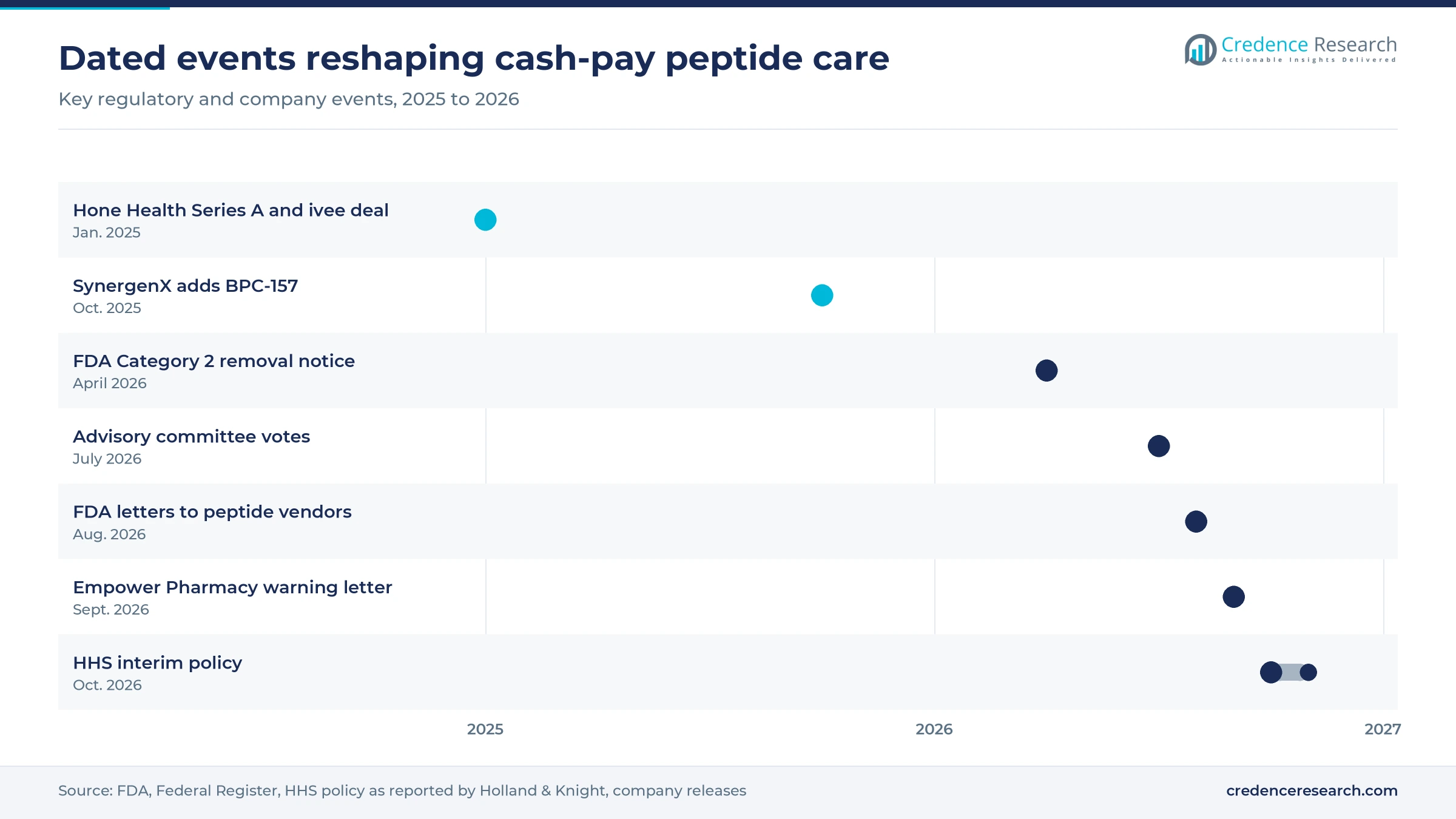
The federal stance on compounded peptides changed several times during 2026, and each step widened the lawful supply that clinics can prescribe. FDA announced on April 15, 2026, that it would remove 12 peptides from its Category 2 safety list, according to Goodwin. An FDA advisory committee then backed BPC-157, KPV, TB-500, MOTS-c, Semax and epitalon on July 23 and 24, 2026. Holland & Knight reported that HHS published an interim policy on Oct. 28, 2026, that sets ten conditions for 503A compounding of those six peptides. As a result, BPC-157 and Others gain the clearest supply path among peptide groups.
Prescribed compounding replaces research-use-only supply
Shift from research-use-only sellers to prescribed supply
Clinics are moving patients away from peptides sold online as research chemicals and toward patient-specific prescriptions filled by licensed pharmacies. FDA sent warning letters to five peptide vendors on Aug. 24, 2026, rejecting research-use-only labels as a defense, according to Arent Fox Schiff. The HHS interim policy requires certificates of analysis, single-ingredient products and syringes cleared through 510(k), according to Holland & Knight. Pharmacy Times noted in June 2026 that compounding was unlikely to resume at scale until formal list updates and batch validation were complete. Consequently, prescribed BPC-157 programs gain share from gray-market supply in the Credence Research model, and peptide therapy clinic operators that already document sourcing benefit first.
Rise of multi-peptide stacks on men's health platforms
Men's health platforms are building menus of named peptide combinations, which raises spending per patient beyond a single compound. Maximus has opened a waitlist for 18 physician-reviewed stacks, including BPC-157 with TB-500 and CJC-1295 with ipamorelin, with early access planned for fall 2026. SynergenX added BPC-157 and CJC-1295 with ipamorelin across its clinic brands on Oct. 6, 2025, alongside existing sermorelin care. A Los Angeles patient told Glossy in January 2026 that a BPC-157 and TB-500 stack cost just under $500 a month. However, the HHS policy covers single-ingredient products only, so combined vials face limits and each peptide therapy clinic must prescribe stack components separately.
Opening in post-GLP-1 care and women's midlife programs
Patients finishing GLP-1 weight-loss programs and women in midlife form a growing pool for peptide follow-up care. HealingMaps found that 47% of 846 verified clinics listed named GLP-1 drugs and 35% offered both GLP-1 and recovery peptides in 2026. Maximus lists a post-GLP-1 transition stack among its planned offers. Midi Health raised $100 million on Feb. 3, 2026, and serves more than 25,000 women a week, showing the scale of virtual midlife care. Providers that already run compounded GLP-1 telehealth programs can extend those patients into monitored peptide plans. A peptide therapy clinic that tracks body composition and laboratory results after weight loss can keep these patients in follow-up care for longer periods.
Opening in certified, lab-documented peptide programs
Clinics that document sourcing and outcomes can stand apart in a crowded market where few providers hold third-party certification. HealingMaps found that only 5.9% of 846 verified clinics were LegitScript certified in 2026. The HHS policy requires MedWatch and state adverse-event reporting, according to Holland & Knight, which favors clinics with structured follow-up. Hone Health already pairs prescriptions with biomarker panels at more than 2,000 laboratory locations. Clinics that combine peptides with bioidentical hormone replacement and laboratory monitoring can therefore win referrals from patients and physicians who want documented oversight. This advantage should grow once FDA completes formal rulemaking on the 503A bulks list and buyers compare providers on safety records.
Unapproved status, pharmacy quality and ad rules weigh
Do the peptides remain unapproved drugs?
Every peptide in this market remains unapproved, which limits the claims clinics can make. HHS states that its October 2026 policy does not grant FDA approval and does not establish safety or effectiveness, according to AJMC. FDA career scientists had recommended against adding the peptides at the July 2026 committee meeting. The BPC-157 vote of 8 to 6 covered only its evaluated use in ulcerative colitis. Clinics must therefore avoid efficacy claims and obtain informed consent for each patient.
Why are CJC-1295 and ipamorelin left behind?
The interim HHS policy names only six peptides, so CJC-1295 and ipamorelin stay outside its protection. FDA placed 19 peptide substances in Category 2 in 2023, citing potential safety risks, according to the National Law Review. The Federal Register notice of April 16, 2026 listed seven peptides for review, and neither compound was among them. Clinics that built menus on these two peptides face supply gaps and must shift patients to covered options.
How does pharmacy quality enforcement affect clinics?
Clinics depend on a small number of large compounders, so a pharmacy compliance problem can disrupt supply. FDA issued a warning letter to Empower Pharmacy on Sept. 18, 2026, after a Houston inspection from Nov. 3 to Nov. 14, 2025. The letter cited insanitary conditions, CGMP violations and copies of approved drugs, although it named GLP-1 products rather than peptides. Clinics must therefore qualify backup pharmacies and keep certificates of analysis on file.
Do sports and advertising rules narrow the patient pool?
Sports rules and ad policies limit how clinics can reach some patients. BPC-157 has been on the WADA prohibited list in Class S0 since 2022, according to the American Med Spa Association, so tested athletes risk disqualification. Google requires LegitScript certification from U.S. telemedicine advertisers, yet only 5.9% of 846 verified clinics held it in 2026. Uncertified clinics lose paid search reach, and they must screen athletes before prescribing.
The Southeast leads on older adults and dense clinic supply
| Region | Value, 2025 (USD million) | Share, 2025 | CAGR, 2026–2035 |
|---|---|---|---|
| Southeast | 164.2 | 26.0% | 14.28% |
| Northeast | 126.3 | 20.0% | 13.58% |
| South Central | 107.4 | 17.0% | 14.38% |
| Midwest | 94.7 | 15.0% | 13.38% |
| Pacific | 94.7 | 15.0% | 13.88% |
| Mountain | 44.2 | 7.0% | 14.68% |
The Southeast leads on older adults and Florida clinics
The Southeast held 26.0% of 2025 value and grows at 14.28% a year, the largest regional share in the market. HealingMaps counted 72 verified peptide clinics in Florida in 2026, second only to California. The Census Bureau reported that the South's population aged 65 and older grew 17.5% from 2020 to 2025, the fastest of any region. Florida was also one of the first three states where older adults outnumbered children, which supports cash-pay longevity care.
The Northeast holds a large share on age and income
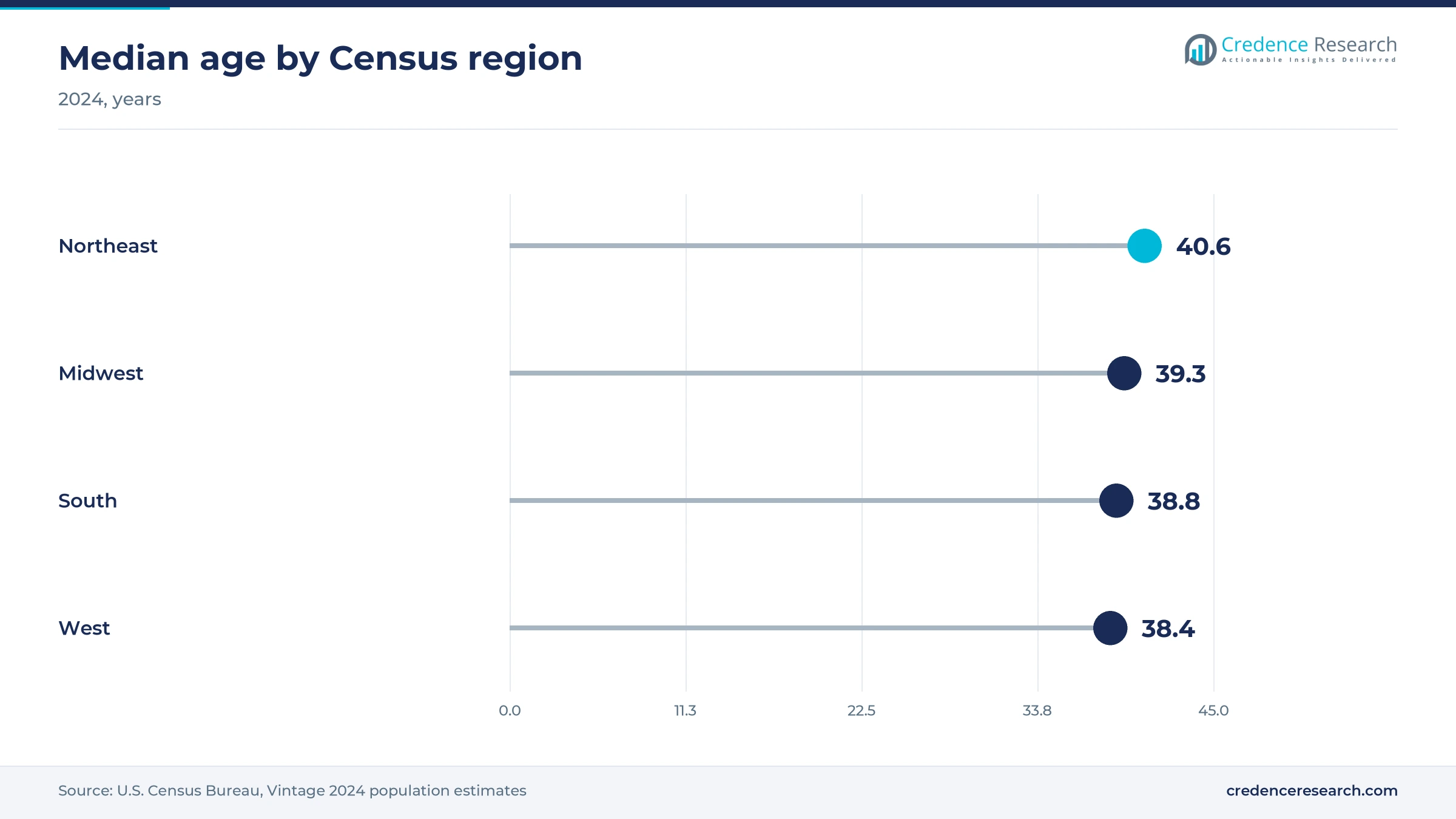
The Northeast held 20.0% of 2025 value and grows at 13.58% a year, below the national pace. The Census Bureau put the Northeast median age at 40.6 in 2024, the oldest of the four Census regions. Maine had the oldest state median age, at 44.9 in 2025. Remedy Place expanded its peptide offers to Manhattan and Boston in November 2025, according to Glossy. Census data also show the Northeast had the slowest growth among residents aged 65 and older, at 14.6% from 2020 to 2025, which holds growth below the national rate.
South Central rests on Texas clinics and Houston suppliers
The South Central region held 17.0% of 2025 value and grows at 14.38% a year, faster than the national rate. HealingMaps counted 70 verified peptide clinics in Texas in 2026, the third-highest state total. Houston also hosts Empower Pharmacy, which lists sermorelin acetate injection in its compounding catalog, and Ways2Well, which launched there in 2018. SynergenX announced its BPC-157 and CJC-1295 with ipamorelin rollout from Houston on Oct. 6, 2025, which shows how regional chains add peptides.
The Midwest grows slowest amid state pharmacy scrutiny
The Midwest held 15.0% of 2025 value and grows at 13.38% a year, the slowest pace among the six zones. HealingMaps placed Ohio and Illinois in a second tier with verified clinic counts in the high twenties to low thirties in 2026. The law firm McDermott noted that the Ohio Board of Pharmacy had acted against CJC-1295 with ipamorelin, which adds state-level risk for compounders. The Census Bureau put the Midwest median age at 39.3 in 2024, close to the national level.
The Pacific has the most clinics and premium prices
The Pacific region held 15.0% of 2025 value and grows at 13.88% a year, close to the national pace. HealingMaps counted 84 verified peptide clinics in California in 2026, the most of any state, and Washington sits in the second tier. Glossy reported in January 2026 that a Los Angeles longevity patient paid just under $500 a month for a BPC-157 and TB-500 stack. Hawaii and Oregon joined the states where older adults outnumber children by 2024, according to the Census Bureau.
The Mountain region grows fastest through remote care
The Mountain region held 7.0% of 2025 value and grows at 14.68% a year, the fastest pace among the six zones. The Census Bureau found high shares of adults aged 65 and older in counties across Arizona, Idaho and Nevada in 2025. Montana joined the states where older adults outnumber children by 2024. Long distances to specialty clinics favor telehealth, and Hone Health lets patients complete biomarker tests at more than 2,000 laboratory locations or at home.
HHS, FDA and platform moves reshape the peptide channel
| Development | Status and market relevance |
|---|---|
| In January 2025, Hone Health closed a $33 million Series A and acquired ivee, adding in-home IV therapy and phlebotomy services. | Completed; strengthens laboratory-led telehealth memberships |
| In October 2025, SynergenX added BPC-157 and CJC-1295 with ipamorelin at SynergenX, Low T Center and HerKare clinics. | Launched; widens in-person peptide menus |
| In April 2026, FDA said it would remove 12 peptides from Category 2 and scheduled advisory committee review of seven. | Completed; opened the review path for BPC-157 |
| In July 2026, the FDA advisory committee recommended BPC-157, KPV, TB-500, MOTS-c, Semax and epitalon for the 503A bulks list. | Advisory; formal rulemaking still pending |
| In October 2026, HHS published an interim enforcement discretion policy for 503A compounding of those six peptides. | In effect; comments due Nov. 13, 2026 |
Remote labs, sourcing controls and certification shape care
- Remote biomarker panels let telehealth clinicians review more than 50 markers before prescribing, and Hone Health offers tests at over 2,000 laboratory locations.
- Certificates of analysis document identity and purity for each bulk peptide lot, and the HHS policy makes them a condition for compounding the six covered peptides.
- Cleared injection supplies must accompany compounded injectables under the HHS policy, which requires syringes cleared through the FDA 510(k) process.
- Third-party certification from LegitScript lets U.S. telemedicine providers advertise prescription services on Google, which matters as applications rose 101% in a year.
Need a Custom Version of This Report?
Tailor the scope, geography, or segments to your exact requirements.
- Custom geography or segment scope
- Direct access to our analyst team
Platforms and clinic chains compete on oversight and labs
Competition in peptide care centers on clinical oversight, laboratory monitoring and compliant pharmacy supply rather than on the lowest price per vial. Hone Health combines memberships, biomarker panels and compounded sermorelin, and its ivee acquisition added in-home phlebotomy. Maximus is preparing 18 peptide stacks for fall 2026 alongside its testosterone care. Ways2Well sells a $99 clinician consult and protocols based on bloodwork from its Houston base. SynergenX extends peptides across its Low T Center and HerKare brands, while Remedy Place sells peptides in premium wellness clubs in West Hollywood, Manhattan and Boston. Empower Pharmacy lists compounded sermorelin and other peptides in its catalog, which ties clinic supply to its compliance record. Many clinics also coordinate with compounding pharmacies that can meet the HHS sourcing and testing conditions.
How do the leading providers position their peptide offers?
| Company | Type | Role in the market |
|---|---|---|
| Hone Health | Telehealth clinic | Sells sermorelin at $175 a month with membership laboratory testing and physician consults |
| Maximus | Telehealth clinic | Opened a waitlist for 18 physician-reviewed peptide stacks with early access in fall 2026 |
| Ways2Well | Telehealth clinic | Charges $99 for a 20-minute peptide consult based on goals, labs and history |
| Empower Pharmacy | Compounding pharmacy | Lists sermorelin acetate injection and received an FDA warning letter on Sept. 18, 2026 |
| SynergenX | Clinic chain | Added BPC-157 and CJC-1295 with ipamorelin across three clinic brands on Oct. 6, 2025 |
| Remedy Place | Wellness club | Expanded peptide offers to New York and Boston in November 2025 |
Compliance with the HHS conditions now decides who scales
Credence Research's view is that compliance with the HHS conditions now decides which peptide therapy clinic operators scale. The October 2026 policy gives six peptides a lawful compounding path, but it requires traceable ingredients, single-ingredient products, cleared syringes and adverse-event reporting. Clinics with laboratory-led memberships and certified marketing are best placed, while providers built on CJC-1295 with ipamorelin or research-use-only supply face the most disruption. Final FDA rulemaking on the 503A bulks list could take until 2027 or longer, so the policy may still change if safety signals appear.
How cash-pay peptide spending was modeled and checked
The report uses 2025 as the base year and 2035 as the forecast year, with market values taken from the Credence Research model. Peptide, channel, customer and regional splits are Credence Research estimates informed by public data and are not reported statistics. Sources for the peptide therapy clinic estimate include Federal Register notices, FDA warning letters, HHS policy summaries by law firms, Census Bureau population data, clinic menu counts, company pricing pages and trade press. No interviews or surveys were conducted for this edition, so segment shares should be read as modeled ranges.
Policy-backed compounding supports double-digit growth
From USD 720.0 million in 2026, the market is expected to reach USD 2.34 billion by 2035 as compounded peptides move from gray-market supply to prescribed, documented care. The six peptides in the HHS policy should gain share, while CJC-1295 with ipamorelin depends on future FDA review. Telehealth platforms will keep widening reach as laboratory networks and certified advertising lower the cost of each new patient. Formal 503A rulemaking, expected from 2027 at the earliest, will decide whether the interim access becomes permanent. Peptide therapy clinic growth therefore depends on safety reporting and quality control rather than on marketing alone.
Frequently Asked Questions
How big is the U.S. peptide therapy clinic market?
Is BPC-157 approved by the FDA?
Which peptide segment holds the largest share?
Which region leads and which grows fastest?
Which peptides does the HHS interim policy cover?
How much do patients pay for peptide care?
What enforcement actions affect peptide providers?
Who are the leading companies?
Table of Content
Chapter 1 Market Segmentation
- 1.1 Segmentation Framework
- 1.1.1 Product and Service Classification
- 1.1.2 Application and End-Use Classification
- 1.1.3 Technology and Solution Classification
- 1.1.4 Customer and Distribution Channel Classification
- 1.1.5 Geographic Segmentation
- 1.1.6 Market Segment Definitions and Boundaries
- 1.2 By Peptide
- 1.2.1 BPC-157
- 1.2.2 Sermorelin
- 1.2.3 CJC/Ipamorelin
- 1.2.4 Others
- 1.3 By Channel
- 1.3.1 Clinics
- 1.3.2 Telehealth
- 1.3.3 Med Spas
- 1.4 By Customer
- 1.4.1 Men
- 1.4.2 Women 35+
Chapter 2 Introduction
- 2.1 Report Objectives and Scope
- 2.2 Product Definition and Industry Terminology
- 2.3 Market Inclusions and Exclusions
- 2.4 Research Process
- 2.4.1 Primary Research and Expert Interviews
- 2.4.2 Secondary Research and Source Review
- 2.4.3 Top-Down and Bottom-Up Estimation
- 2.4.4 Data Triangulation and Verification
- 2.5 Market Size Measurement Basis
- 2.5.1 2025: USD 631.6 million → 2035: USD 2.34 billion
- 2.6 Historical and Forecast Reference Periods
- 2.6.1 Historical Period: 2018-2025
- 2.6.2 Base Year: 2025
- 2.6.3 Forecast Period: 2025-2035
- 2.7 Research Assumptions and Limitations
Chapter 3 Executive Summary
- 3.1 Market Snapshot and Key Findings
- 3.2 Base-Year Market Size, 2025
- 3.3 Forecast Market Size, 2035
- 3.4 Revenue and Volume Growth Outlook
- 3.5 Key Demand and Supply Indicators
- 3.6 Leading Market Segments
- 3.7 Fastest-Growing Market Opportunities
- 3.8 Regional Performance Highlights
- 3.9 Technology and Industry Transformation
- 3.10 Competitive Landscape Summary
- 3.11 Analyst View and Strategic Implications
Chapter 4 U.S. Peptide Therapy Clinic Market Trends and Developments
- 4.1 Historical Industry Development, 2018-2025
- 4.2 Recent Market Trends and Developments
- 4.3 Demand and Customer Behavior Trends
- 4.4 Technology and Product Innovation
- 4.5 Artificial Intelligence, Automation and Digitalization
- 4.6 Local Manufacturing and Supply Chain Realignment
- 4.7 Industry Partnerships, Mergers and Acquisitions
- 4.8 Sustainability and Circular Economy Developments
- 4.9 Government and Private Sector Investment Trends
- 4.10 Emerging Business Models and Commercialization
- 4.11 Industry Developments and Announcements
Chapter 5 U.S. Peptide Therapy Clinic Market Production, Supply and Demand Analysis
- 5.1 Demand Trend and Consumption Analysis, 2018-2025
- 5.2 Demand Forecast, 2025-2035
- 5.3 Production and Output Trend, 2018-2025
- 5.4 Production and Output Forecast, 2025-2035
- 5.5 Installed Capacity and Capacity Utilization
- 5.6 Company-Wise Production Plants and Statistics
- 5.6.1 Installed Production Capacity
- 5.6.2 Actual Production
- 5.6.3 Planned Capacity and Expansion Targets
- 5.7 Supply Chain Structure and Procurement Trends
- 5.8 Supply-Demand Gap and Bottlenecks
- 5.9 Import Dependence and Sourcing Structure
- 5.10 Contract Manufacturing and Outsourcing
- 5.11 Regional Supply and Demand Concentration
Chapter 6 U.S. Peptide Therapy Clinic Market Pricing Analysis
- 6.1 Pricing Structure and Measurement
- 6.2 Historical Pricing Trends, 2018-2025
- 6.3 Pricing Outlook, 2025-2035
- 6.4 Average Selling Price and Unit Economics
- 6.5 Pricing by Product and Market Segment
- 6.6 Geographic Pricing Differences
- 6.7 Key Input, Energy, Labor and Logistics Costs
- 6.8 Contract Pricing and Purchasing Models
- 6.9 Pricing Sensitivity and Competitive Positioning
- 6.10 Price, Margin and Profitability Implications
Chapter 7 U.S. Peptide Therapy Clinic Market Dynamics
- 7.1 Market Growth Drivers
- 7.1.1 Demand-Side Drivers
- 7.1.2 Technology and Innovation Drivers
- 7.1.3 Infrastructure and Investment Drivers
- 7.1.4 Regulatory and Policy Drivers
- 7.2 Market Restraints
- 7.2.1 Cost and Affordability Constraints
- 7.2.2 Technology and Adoption Barriers
- 7.2.3 Supply Chain and Operational Constraints
- 7.3 Market Challenges
- 7.3.1 Competitive Pressure and Margin Erosion
- 7.3.2 Skills, Infrastructure and Implementation Gaps
- 7.4 Emerging Market Opportunities
- 7.5 Market Dynamics Impact and Time-Horizon Assessment
Chapter 8 U.S. Peptide Therapy Clinic Value Chain Analysis
- 8.1 Industry Value Chain Overview
- 8.2 Upstream Suppliers and Critical Inputs
- 8.3 Technology and Component Providers
- 8.4 Manufacturing or Service Delivery
- 8.5 Distribution, Channel Partners and Integrators
- 8.6 Downstream Applications and End Users
- 8.7 Value Addition and Profit Pools
- 8.8 Vertical Integration and Outsourcing
- 8.9 Supplier Concentration and Risk
- 8.10 Supply Chain Localization and Resilience
Chapter 9 U.S. Peptide Therapy Clinic Market Regulations and Policies
- 9.1 Relevant Laws, Standards and Compliance Frameworks
- 9.2 Product, Service, Safety and Quality Requirements
- 9.3 Government Policies, Incentives and Subsidies
- 9.4 Imports, Exports and Trade Barriers
- 9.5 Public Procurement and Local Content Requirements
- 9.6 Environmental and Sustainability Compliance
- 9.7 Upcoming Policy Changes and Market Implications
Chapter 10 U.S. Peptide Therapy Clinic Market Hotspots and Opportunities
- 10.1 Market Opportunity Mapping and Growth Hotspots
- 10.2 High-Growth Applications and Customer Groups
- 10.3 Underserved Markets and White-Space Opportunities
- 10.4 Emerging Technology and Product Opportunities
- 10.5 New Capacity and Investment Hotspots
- 10.6 Market Entry and Expansion Opportunities
- 10.7 Distribution and Partnership Opportunities
- 10.8 Near-Term and Long-Term Commercial Potential
- 10.9 Opportunity Attractiveness and Execution Risks
Chapter 11 U.S. Peptide Therapy Clinic Market Outlook, 2025-2035
- 11.1 Market Size and Analysis
- 11.1.1 Revenue (Market Measurement: 2025: USD 631.6 million → 2035: USD 2.34 billion)
- 11.1.2 Market Volume and Quantity Sold
- 11.1.3 Historical Market Size, 2018-2025
- 11.1.4 Base-Year Market Size, 2025
- 11.2 Market Forecast, 2025-2035
- 11.2.1 Revenue Forecast to 2035
- 11.2.2 Volume Forecast to 2035
- 11.2.3 CAGR and Year-on-Year Growth
- 11.2.4 Incremental Revenue Opportunity
- 11.3 Forecast Assumptions and Scenario Analysis
- 11.3.1 Base-Case Forecast
- 11.3.2 Optimistic and Conservative Scenarios
- 11.3.3 Technology, Pricing and Policy Sensitivities
- 11.4 Market Attractiveness and Growth Outlook
Chapter 12 U.S. Peptide Therapy Clinic Market Segmentation and Outlook
- 12.1 Segmentation Summary and Market Shares, 2025
- 12.2 Largest and Fastest-Growing Segments
- 12.3 By Peptide - Market Size and Forecast, 2025-2035
- 12.3.1 Segment Definition and Scope
- 12.3.2 Historical Market Size, 2018-2025
- 12.3.3 Revenue Forecast, 2025-2035
- 12.3.4 Volume Forecast, 2025-2035
- 12.3.5 Base-Year Market Share, 2025
- 12.3.6 Segment CAGR and Growth Drivers
- 12.3.7 Subsegment Market Size and Forecast
- 12.3.7.1 BPC-157
- 12.3.7.2 Sermorelin
- 12.3.7.3 CJC/Ipamorelin
- 12.3.7.4 Others
- 12.3.8 Subsegment Pricing and Adoption Trends
- 12.3.9 Leading Suppliers and Competition
- 12.3.10 Regional Demand and Opportunities
- 12.4 By Channel - Market Size and Forecast, 2025-2035
- 12.4.1 Segment Definition and Scope
- 12.4.2 Historical Market Size, 2018-2025
- 12.4.3 Revenue Forecast, 2025-2035
- 12.4.4 Volume Forecast, 2025-2035
- 12.4.5 Base-Year Market Share, 2025
- 12.4.6 Segment CAGR and Growth Drivers
- 12.4.7 Subsegment Market Size and Forecast
- 12.4.7.1 Clinics
- 12.4.7.2 Telehealth
- 12.4.7.3 Med Spas
- 12.4.8 Subsegment Pricing and Adoption Trends
- 12.4.9 Leading Suppliers and Competition
- 12.4.10 Regional Demand and Opportunities
- 12.5 By Customer - Market Size and Forecast, 2025-2035
- 12.5.1 Segment Definition and Scope
- 12.5.2 Historical Market Size, 2018-2025
- 12.5.3 Revenue Forecast, 2025-2035
- 12.5.4 Volume Forecast, 2025-2035
- 12.5.5 Base-Year Market Share, 2025
- 12.5.6 Segment CAGR and Growth Drivers
- 12.5.7 Subsegment Market Size and Forecast
- 12.5.7.1 Men
- 12.5.7.2 Women 35+
- 12.5.8 Subsegment Pricing and Adoption Trends
- 12.5.9 Leading Suppliers and Competition
- 12.5.10 Regional Demand and Opportunities
- 12.6 Segment Growth Comparison
- 12.7 Segment Attractiveness and Priority Matrix
Chapter 13 U.S. Peptide Therapy Clinic End-Use and Application Market Outlook
- 13.1 End-Use Industry and Customer Demand Structure
- 13.2 Leading Applications and Customer Groups
- 13.3 End-Use Market Size, Share and Forecast
- 13.4 Major End-Use Industry Deep Dives
- 13.4.1 Customer Requirements and Use Cases
- 13.4.2 Demand and Replacement Cycles
- 13.4.3 Technical and Regulatory Considerations
- 13.4.4 Purchasing and Procurement Models
- 13.4.5 Leading Vendors and Distribution Channels
- 13.4.6 Forecast and Commercial Opportunities
- 13.5 Emerging Applications and Cross-Segment Demand
- 13.6 End-Use Industry Investment Priorities
Chapter 14 U.S. Peptide Therapy Clinic Geographic Market Outlook, 2025-2035
- 14.1 Domestic Market Distribution and Demand Clusters
- 14.2 State- or Province-Wise Market Size and Forecast, 2025-2035
- 14.3 City and Metropolitan Market Outlook
- 14.4 Industrial, Manufacturing and Commercial Clusters
- 14.5 Geographic Concentration of Key End Users
- 14.6 Local Pricing and Purchasing Differences
- 14.7 Domestic Production Facilities and Capacity Map
- 14.8 Local Infrastructure and Project Pipeline
- 14.9 State-Level Policy and Incentive Differences
- 14.10 Subnational Investment Hotspots and Opportunities
- 14.11 Distribution and Logistics Networks
- 14.12 Domestic Competitive Footprint
Chapter 15 U.S. Peptide Therapy Clinic Technology, Innovation and Sustainability Outlook
- 15.1 Technology Landscape and Maturity
- 15.2 Product, Process and Service Innovation
- 15.3 AI, Automation and Digital Tools in the Industry
- 15.4 Technology Adoption and Performance Benchmarking
- 15.5 Innovation Pipeline and R&D Investment
- 15.6 Patent and Intellectual Property Trends
- 15.7 Energy Efficiency and Resource Management
- 15.8 Sustainability, Recycling and Circularity
- 15.9 Technology Roadmap, 2025-2035
- 15.10 Risks of Obsolescence and Technology Substitution
Chapter 16 U.S. Peptide Therapy Clinic Market Key Strategic Imperatives
- 16.1 Growth and Market Entry Priorities
- 16.2 High-Return Products and Segments
- 16.3 Pricing, Profitability and Cost Optimization
- 16.4 Technology Investment and Product Differentiation
- 16.5 Supply Chain Localization and Resilience
- 16.6 Distribution and Customer Acquisition
- 16.7 Partnership, Acquisition and Capacity Strategy
- 16.8 Regional Expansion Priorities
- 16.9 Short-, Medium- and Long-Term Actions
Chapter 17 Competition Outlook
- 17.1 Industry Competition Characteristics
- 17.2 Market Structure and Concentration
- 17.3 Market Share and Competitive Positioning, 2025
- 17.4 Company-Wise Revenue and Product Benchmarking
- 17.5 Production and Service Capacity Benchmarking
- 17.6 Technology, Pricing and Differentiation
- 17.7 Regional Footprint and Distribution Strength
- 17.8 Mergers, Acquisitions and Strategic Alliances
- 17.9 New Entrants and Competitive Threats
- 17.10 Porter's Five Forces and Industry Attractiveness
- 17.11 Competitive Outlook, 2025-2035
Chapter 18 Company Profiles
- 18.1 Company Coverage and Selection Criteria
- 18.2 Hone Health
- 18.2.1 Business Description
- 18.2.2 Company Ownership and Geographic Presence
- 18.2.3 Product and Service Portfolio
- 18.2.4 Manufacturing and Operating Footprint
- 18.2.5 Production Capacity and Expansion Plans
- 18.2.6 Financial Performance and Investment
- 18.2.7 Market Share and Competitive Position
- 18.2.8 Technology and Innovation Capabilities
- 18.2.9 Strategic Alliances or Partnerships
- 18.2.10 Recent Developments
- 18.2.11 Growth Strategy and Outlook
- 18.3 Maximus
- 18.4 Ways2Well
- 18.5 Empower Pharmacy
- 18.6 SynergenX
- 18.7 Remedy Place
- 18.8 Other Relevant Market Participants
Note: Every listed company is profiled on the structure shown under the first company. The company list is preliminary and may change based on research findings, market developments, data availability and client requirements.
Chapter 19 Disclaimer
- 19.1 Research and Forecast Disclaimer
- 19.2 Data Source and Estimation Limitations
Note: The depth of individual sections depends on data availability for this market. Volume, capacity, trade and other unit-based metrics are included where applicable.

