
Remote testosterone care grows on home labs and memberships
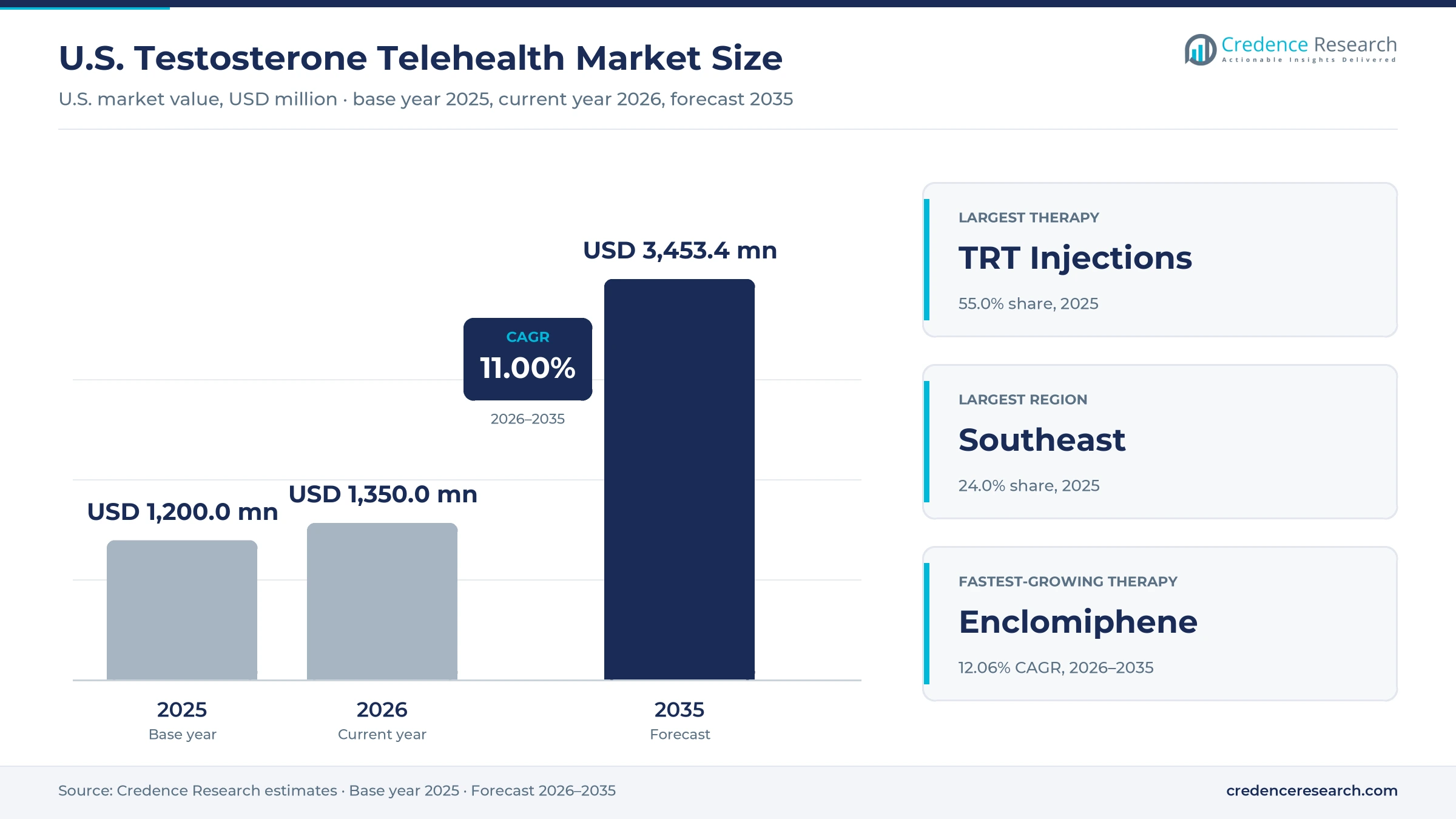
The U.S. testosterone telehealth market was valued at USD 1.20 billion in 2025 and is projected to increase from USD 1.35 billion in 2026 to USD 3.45 billion by 2035, registering a CAGR of 11.00% during 2026–2035. Demand comes from men who pay for remote consultations, testosterone prescriptions, home lab testing and recurring follow-up through online platforms. The Southeast held the largest regional share, 24.0% in 2025, while the Mountain region grows fastest at 11.71% a year as remote care reaches men far from urologists and endocrinologists. Growth rests on federal telemedicine flexibilities, because testosterone is a Schedule III controlled substance and remote prescribing without an in-person visit is allowed through the end of 2026. Label changes also matter, as the FDA removed cardiovascular risk language from the testosterone boxed warning in February 2025. Platforms are adding FDA-approved oral therapy and generic injections beside compounded products, while compounded enclomiphene remains outside FDA approval.
What does remote testosterone care include in the U.S.?
The market counts patient spending on testosterone management delivered through telehealth platforms, including clinician consultations, prescriptions for injections, creams, oral testosterone and compounded enclomiphene, lab panels and the membership fees that bundle follow-up care. Most plans are paid in cash each month, and medication ships to the patient from partner pharmacies.
The estimate excludes testosterone prescribed in physician offices and filled through insurance at retail pharmacies, gender-affirming hormone therapy and over-the-counter supplements marketed for testosterone support. It also excludes standalone lab tests bought without any linked consultation or prescription from a telehealth provider.
U.S. Testosterone Telehealth Market Insights
- The market grows from USD 1.20 billion in 2025 to USD 3.45 billion by 2035, an 11.00% CAGR, as remote prescribing and home lab testing reach more men.
- The Southeast led with 24.0% of 2025 value, supported by Census data showing the South grew 6.0% from 2020 to 2025.
- TRT injections held 55.0% of 2025 value, and Hims added weekly generic testosterone cypionate to its platform in October 2026.
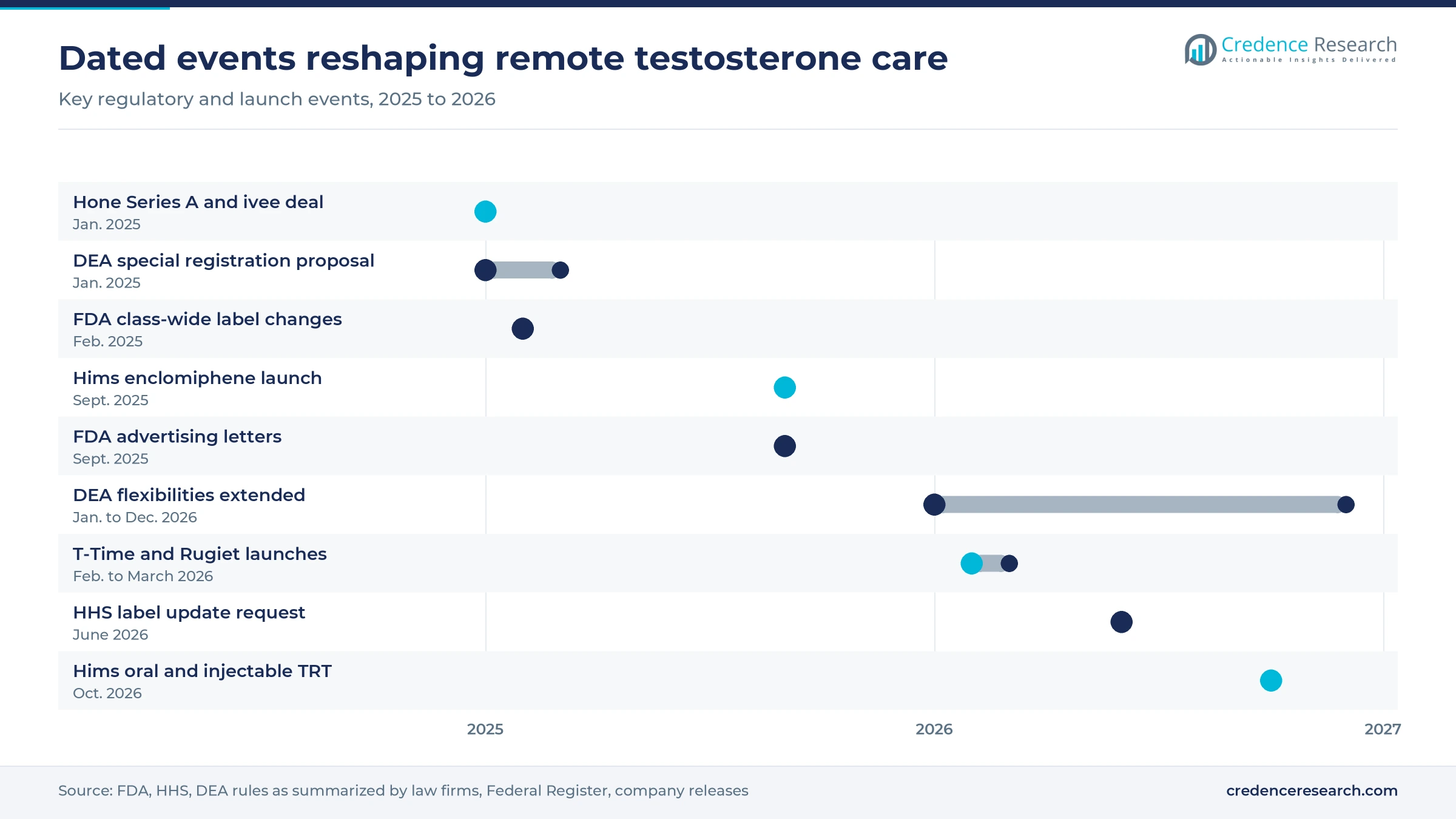
- The FDA removed cardiovascular risk language from the testosterone boxed warning in February 2025, and HHS requested further label revisions on June 18, 2026.
- DEA and HHS telemedicine flexibilities for controlled substances, including Schedule III testosterone, run through the end of 2026, a key date for every platform.
Injections lead while enclomiphene grows fastest
Why do injections still lead remote testosterone care?
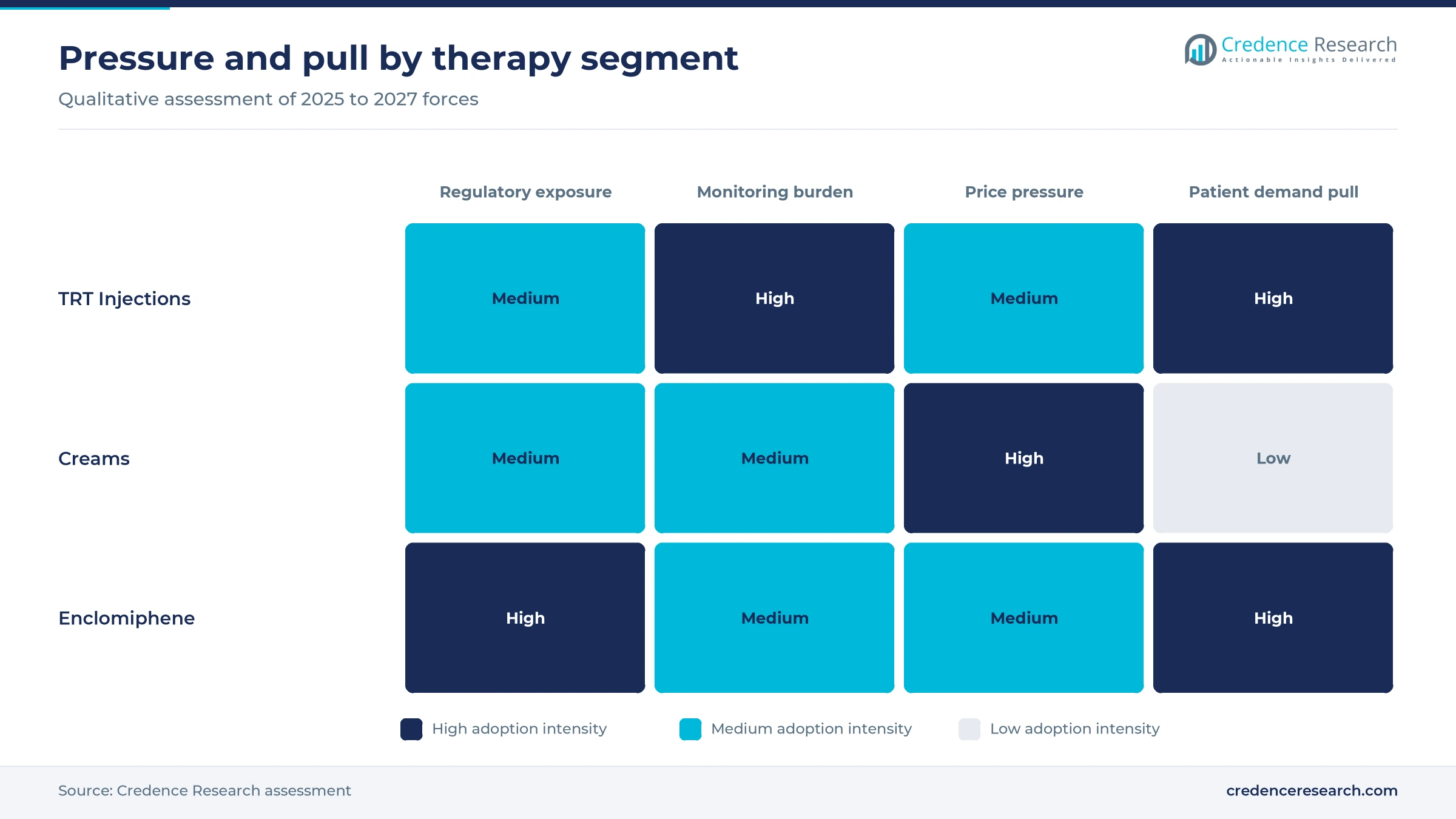
Based on therapy, the market is categorized into TRT injections, creams and enclomiphene. TRT Injections led with 55.0% of 2025 value because CMS Part D data cited by U.S. Pharmacist in June 2025 showed family medicine physicians wrote 59.8% of their testosterone prescriptions as injections. Hims then added weekly generic testosterone cypionate in October 2026, which brings commercial injectable androgen products onto the largest platform. Enclomiphene grows fastest at 12.06% a year as T-Time Health launched enclomiphene memberships across all 50 states on Feb. 9, 2026. However, enclomiphene is not FDA-approved for any use, which keeps this growth exposed to compounding rules.
How do subscription and labs-included plans divide spending?
Based on model, the market is categorized into subscription and labs included. Subscription led with 57.0% of 2025 value because most platforms sell memberships first and bill testing separately, with Hone Health listing a Basic plan at $25 a month plus medication and biomarker tests from $65. Membership fees then recur for as long as therapy continues. Labs Included plans grow fastest at 11.51% a year as bundling spreads, since Henry Meds includes initial and follow-up labs in its $129 monthly TRT price. Hims also began pairing a 22-biomarker home panel with treatment in October 2026.
Which age group spends the most on remote testosterone care?
Based on age, the market is categorized into men aged 30-44, 45-60 and 60+. Men aged 45-60 led with 46.0% of 2025 value because Epic Research found that 2025 testosterone prescription prevalence reached 1.57% of male patients aged 50 to 64 and 1.35% of those aged 40 to 49. These men combine symptoms, income and comfort with digital care. Men aged 30-44 grow fastest at 11.90% a year as state monitoring data published by U.S. Pharmacist in June 2025 showed prescribing rising 86% among patients aged 25 to 34 and 45% among those aged 35 to 44 between 2018 and 2022.
| Segment Group | Leading Sub-segment | Share, 2025 | Fastest-growing Sub-segment | CAGR, 2026–2035 |
|---|---|---|---|---|
| By Therapy | TRT Injections | 55.0% | Enclomiphene | 12.06% |
| By Model | Subscription | 57.0% | Labs Included | 11.51% |
| By Age | 45-60 | 46.0% | 30-44 | 11.90% |
Request a Free Sample
Fill in your details and we'll send you a free sample report.
- Sample data tables & charts
- Research methodology
Access, monitoring and home testing lift enrollment
Remote consultation widens access to testosterone care
Remote consultation lets men start testosterone management without visiting an endocrinologist or urologist, which keeps new patients entering the channel. Testosterone products are Schedule III controlled substances, as Marius Pharmaceuticals noted when Kyzatrex was approved in July 2022, so remote starts depend on federal telemedicine rules. The fourth DEA and HHS extension lets registered practitioners prescribe controlled substances by telemedicine without a prior in-person evaluation from Jan. 1 through Dec. 31, 2026. Epic Research also reported that the share of male patients with an active testosterone prescription rose from 0.64% in 2021 to 0.93% in 2025. In the Credence Research model this access driver adds about 4.29 percentage points to annual growth to 2035.
Recurring monitoring sustains subscription demand
Testosterone therapy requires repeat blood work and dose reviews, which turns a single consultation into a recurring membership. Hone Health prices its Premium plan at $155 a month plus medication, with retesting and follow-ups every 90 days, while its Basic plan schedules advanced testing every six months. Henry Meds ships medication every 30, 60 or 90 days at the provider's discretion, with follow-up labs included in its monthly plan. Monitoring needs also grew after the FDA ordered class-wide labeling changes on Feb. 28, 2025, adding blood pressure warnings to testosterone products that lacked them. In the Credence Research model this monitoring driver adds about 3.08 percentage points to annual growth to 2035, and Subscription plans keep 57.0% of 2025 value.
Home testing and pharmacy links ease onboarding
Home sample collection and integrated pharmacies remove the clinic visits that once slowed a testosterone start. Hims said on Oct. 21, 2026, that customers collect blood at home with the FDA-cleared Tasso device, with samples processed in a CLIA-certified lab for 22 biomarkers. Quest Diagnostics sells a men's hormone panel through consumer lab testing at $121.60 plus a $6 physician fee, with more than 2,000 patient service centers. Hone Health acquired ivee in January 2025 to add in-home phlebotomy, according to HIT Consultant. Henry Meds says most patients receive medication within 10 business days of speaking with a provider. In the Credence Research model this onboarding driver adds about 1.87 percentage points to annual growth to 2035.
Federal label revisions reduce prescribing hesitancy
Federal label revisions are removing warnings that made primary care clinicians cautious about testosterone, which widens the pool of men offered therapy. The FDA removed cardiovascular risk language from the boxed warning in February 2025 after the TRAVERSE trial. Urology Times reported that TRAVERSE followed 5,246 men for about 33 months, with major cardiovascular events at 7.0% on testosterone and 7.3% on placebo. HHS announced on June 18, 2026, that the FDA had requested removal of the 2015 limitation of use for age-related hypogonadism. A Federal Register notice on April 20, 2026, also invited sponsors to seek a decreased-libido indication for idiopathic hypogonadism. As a result, men aged 45-60 keep the largest age share at 46.0%.
Platforms add approved options as younger men enter
Shift toward branded oral and generic injectable TRT
Large platforms are shifting from compounded products toward FDA-approved and generic testosterone, which lowers regulatory exposure as federal scrutiny of telehealth rises. Kyzatrex, an oral testosterone undecanoate softgel, was approved on July 27, 2022, for adult males with hypogonadism in 100 mg, 150 mg and 200 mg strengths, according to Drugs.com and Marius Pharmaceuticals. Hims announced an exclusive Kyzatrex collaboration on Sept. 10, 2025, and launched it in October 2026 alongside weekly generic testosterone cypionate and a compounded subcutaneous injection. Maximus also lists oral testosterone, injectable testosterone and testosterone cream among its protocols. Hims said that, as of the second quarter of 2026, testosterone was scaling faster than any specialty outside weight loss. Consequently, TRT Injections keep 55.0% of value while oral options widen patient choice.
Rise of compounded enclomiphene protocols
Compounded enclomiphene protocols are rising as platforms market an oral option to men who want to avoid injections. Operation Supplement Safety states, in content current as of January 2026, that enclomiphene by itself has not been approved by the FDA for any use, although 503A pharmacies may compound it for patients with valid prescriptions. Hims began offering compounded enclomiphene on Sept. 10, 2025, and T-Time Health launched enclomiphene memberships with lab analysis on Feb. 9, 2026. Rugiet added enclomiphene with oral, injectable and topical options on March 10, 2026. Maximus publishes a protocol that pairs testosterone cream with enclomiphene for men concerned about fertility, a need shared with male infertility care. As a result, Enclomiphene grows at 12.06% a year in the Credence Research model.
Opening among men aged 30 to 44 seeking early care
Younger men form the clearest opening for platforms, because their testosterone prescribing grew fastest before telehealth brands scaled. Epic Research put 2025 prevalence at 0.57% for men aged 30 to 39, far below the 1.57% recorded for ages 50 to 64, which leaves room for screened growth. Hims estimates that about 20 million U.S. men have low testosterone, a pool far larger than the number now treated. A Hims survey of 2,000 U.S. men in August 2026 found that 45% knew at least one of seven listed low-testosterone treatments. Platforms that confirm deficiency with lab panels before prescribing can serve this group responsibly. In the Credence Research model, men aged 30-44 grow at 11.90% a year.
Opening in multi-category men's health platforms
Multi-category men's health platforms can add testosterone care to existing patient bases, which cuts acquisition costs for each new member. Rugiet said on March 10, 2026, that it had treated more than 400,000 patients before launching testosterone therapy. Hone Health had treated 55,000 patients when it closed a $33 million Series A in January 2025, with Tribe Capital among its investors, according to the company. Maximus lists tirzepatide and branded GLP-1 plans starting at $199.99 a month beside its testosterone protocols, much as compounded GLP-1 weight-loss plans grew on shared platforms. Hims also offers enclomiphene combined with tadalafil for men with sexual symptoms, according to its September 2025 announcement. These cross-sold patients already pay monthly, so Subscription plans keep the largest share.
DEA timing, enforcement and price cuts test platforms
Will the DEA telemedicine flexibilities lapse after 2026?
Remote starts for Schedule III anabolic steroid products rest on a temporary federal waiver that expires on Dec. 31, 2026. The DEA proposed a special registration rule on Jan. 17, 2025, that would require a state telemedicine registration for each patient state and checks of several state monitoring databases, according to Bradley. Smaller platforms licensed in many states face the largest compliance burden if the rule is finalized. Providers are therefore building in-person and lab partnerships as a fallback.
How does FDA advertising enforcement affect platforms?
The FDA released more than 100 letters on Sept. 16, 2025, aimed at drugmakers and online health companies, including a warning letter to Hims over claims about its compounded semaglutide, the Associated Press reported on Sept. 16, 2025. Compounded testosterone injections and enclomiphene are not FDA-approved, so similar claims for those products carry the same risk. Platforms must disclose compounding status and review marketing copy, which raises compliance costs, especially for newer brands that rely on social media acquisition.
Do safety monitoring rules raise the cost of care?
Testosterone labeling now carries class-wide blood pressure warnings under the FDA changes of February 2025, and the June 2026 proposal still recommends prostate risk assessment, screening and monitoring. Each requirement adds lab work, since a Quest Diagnostics men's hormone panel lists at $121.60 before any physician fee. Platforms that bundle labs absorb that cost within monthly prices, while cash-pay patients who skip follow-up testing raise clinical and legal exposure for prescribers. Strong monitoring protocols therefore become a real and recurring cost of competing.
Is price competition compressing membership fees?
Price competition is compressing membership fees as generic drug costs fall and new brands enter the market. U.S. Pharmacist reported that generic topical testosterone prices fell 87.3% between 2018 and 2022, which lowers the drug cost that platforms can mark up. Henry Meds advertises $50 off the first month of a plan with labs included, while Hone Health lists a Basic plan at $25 a month plus medication. Platforms without scale or clinical differentiation will struggle to hold margins as a result.
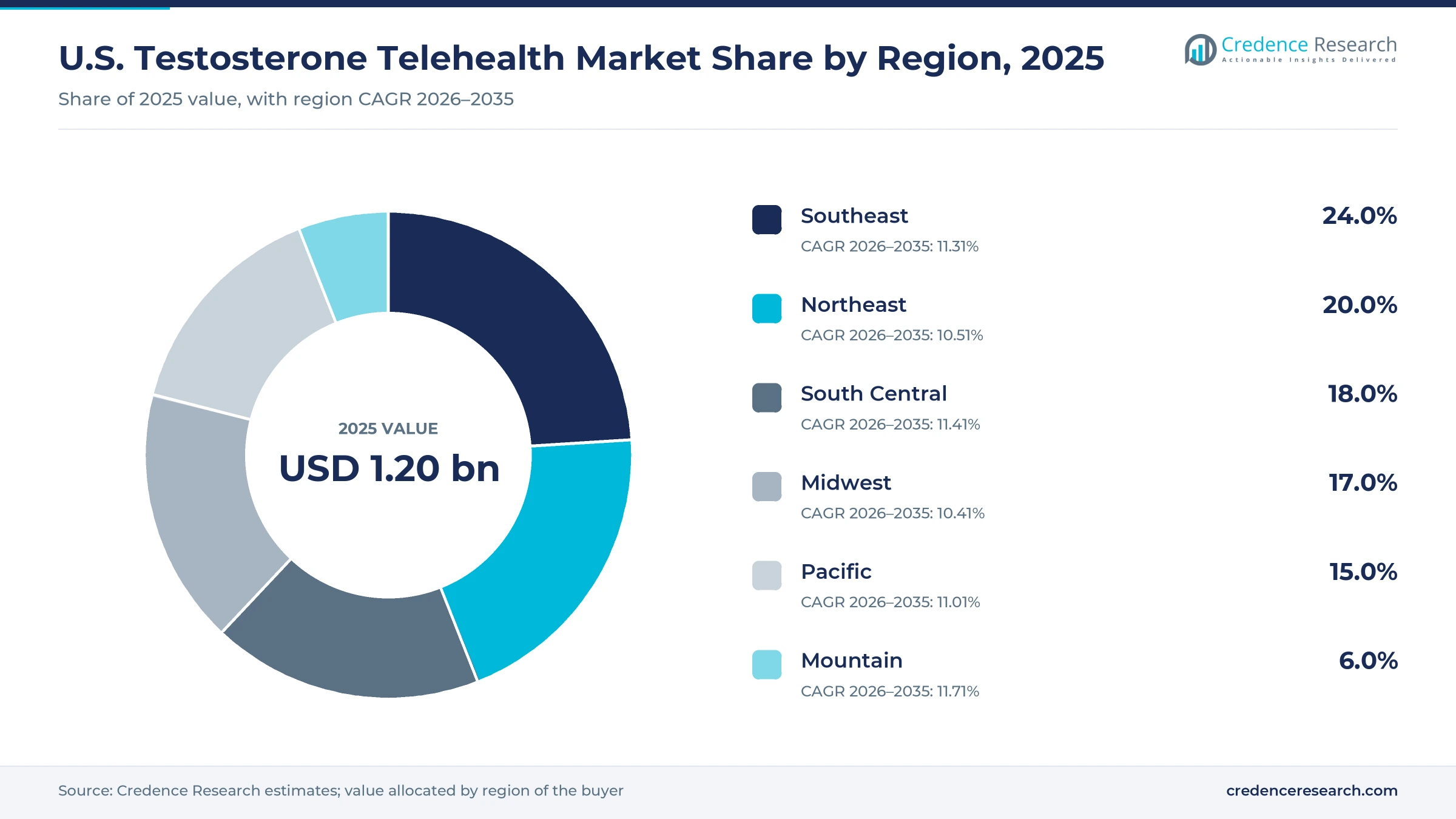
The Southeast holds the largest share of remote TRT demand
| Region | Value, 2025 (USD billion) | Share, 2025 | CAGR, 2026–2035 |
|---|---|---|---|
| Southeast | 0.29 | 24.0% | 11.31% |
| Northeast | 0.24 | 20.0% | 10.51% |
| South Central | 0.22 | 18.0% | 11.41% |
| Midwest | 0.20 | 17.0% | 10.41% |
| Pacific | 0.18 | 15.0% | 11.01% |
| Mountain | 0.07 | 6.0% | 11.71% |
The Southeast leads on population growth and older men
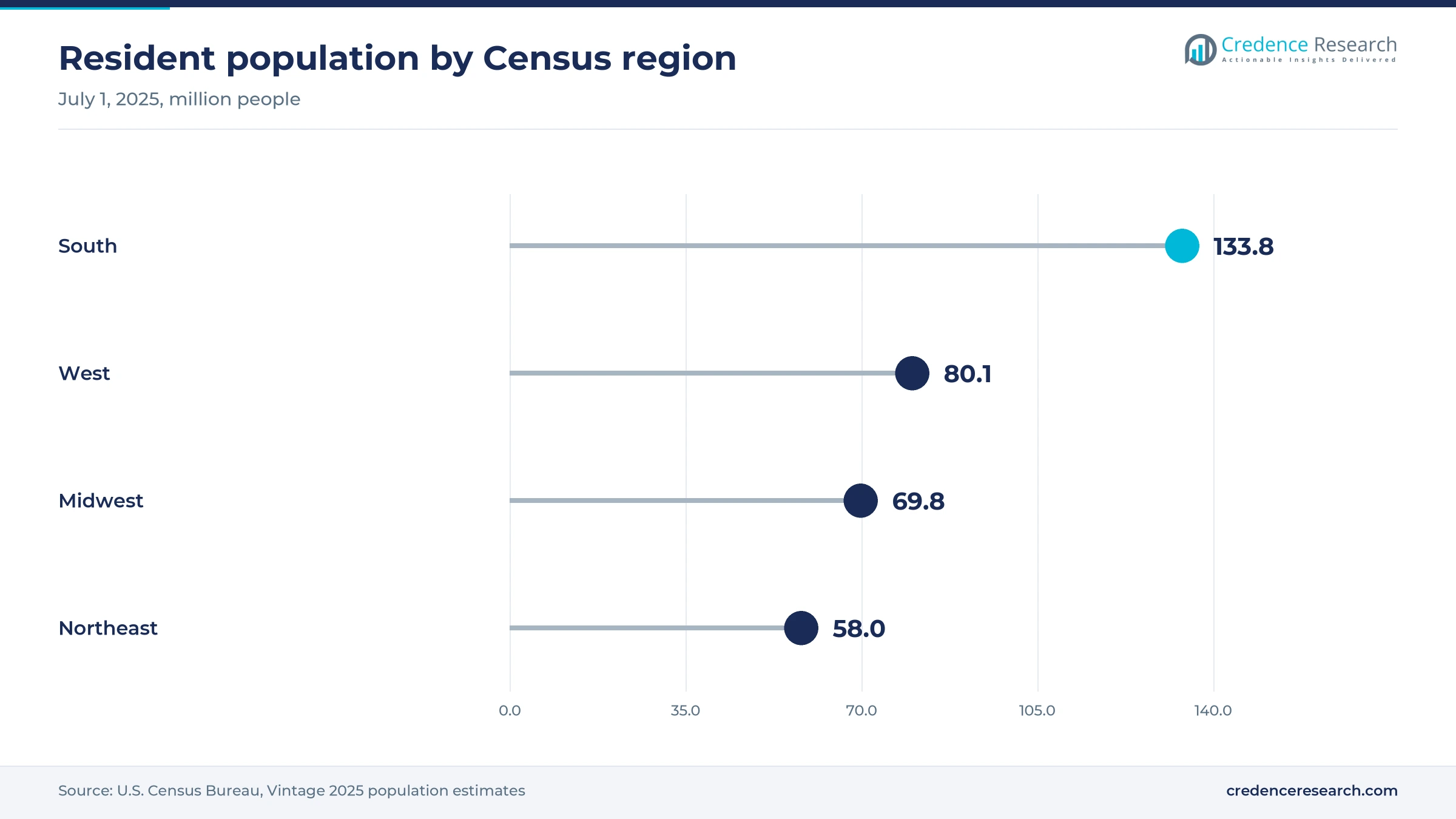
The Southeast held 24.0% of 2025 value and grows at 11.31% a year, the largest regional share in the market. The Census Bureau reported that the South grew 6.0% from April 2020 to July 2025, nearly double the national 3.1% pace. The South's population aged 65 and older rose 17.5% in the same period, which adds men who need careful monitoring. Platforms serving the zone therefore pair remote starts with dense lab partner networks.
The Northeast holds a large share despite an aging base
The Northeast held 20.0% of 2025 value and grows at 10.51% a year, below the national pace. Census data show the region's population aged 45 to 64 fell 7.1% between 2020 and 2025, shrinking a core age group for testosterone care. Its population aged 65 and older rose 14.6%, and Maine recorded the highest state median age in 2025, at 44.9 years. Higher incomes still support cash-pay memberships, while dense specialist networks keep many men in insured office care.
South Central gains from population growth and new local brands
The South Central region held 18.0% of 2025 value and grows at 11.41% a year, faster than the national rate. The zone shares the South's population gains, and the South was the only Census region where residents aged 45 to 64 increased between 2020 and 2025. Texas is also a base for new brands, as T-Time Health was founded there in 2025 and Rugiet announced its testosterone launch from Austin in March 2026. These local brands help platform enrollment across Oklahoma, Louisiana and other neighboring states.
The Midwest grows slowly as its middle-aged base shrinks
The Midwest held 17.0% of 2025 value and grows at 10.41% a year, the slowest pace among the six zones. Census data show the Midwest population grew only 1.1% from 2020 to 2025, while residents aged 45 to 64 declined 6.2%. Rural distances still favor remote prescribing for men who live far from urologists. However, slower population growth limits new patient flows, so Credence Research expects platforms to compete for share through lower prices and bundled lab plans.
The Pacific region tracks the national pace with uneven lab access
The Pacific region held 15.0% of 2025 value and grows at 11.01% a year, close to the national pace. The Census Bureau counted 80.1 million people in the West in July 2025, up 1.9% since 2020. Access is uneven within the zone, since Hims says its lab tests are not available in Hawaii and Quest mobile collection also excludes Hawaii. Platforms therefore rely on retail patient service centers and mail-order pharmacies across the West Coast states.
The Mountain region grows fastest from a young base
The Mountain region held 6.0% of 2025 value and grows at 11.71% a year, the fastest pace among the six zones. Utah recorded the lowest state median age in 2025, at 32.6 years, according to the Census Bureau, which points to a large pool of men moving into the 30-44 band. Long distances to specialists favor remote prescribing across the zone. However, Quest mobile collection is not offered in Arizona, so platforms there depend more on home collection kits.
Label changes, launches and DEA rules reshape the channel
| Development | Status and market relevance |
|---|---|
| In February 2025, the FDA ordered class-wide testosterone labeling changes that removed cardiovascular risk language from the boxed warning. | In effect; also adds blood pressure warnings across products |
| In September 2025, Hims launched compounded enclomiphene and announced an exclusive oral Kyzatrex collaboration with Marius Pharmaceuticals. | Launched; brings the largest platform into testosterone care |
| In January 2026, DEA and HHS published a fourth extension of telemedicine prescribing flexibilities through the end of 2026. | In effect; sustains remote starts for Schedule III drugs |
| In June 2026, HHS announced FDA requests to remove the age-related hypogonadism limitation from testosterone labels. | Proposed; would widen labeled use among older men |
| In October 2026, Hims launched oral Kyzatrex, generic testosterone cypionate and a compounded injection with home blood collection. | Launched; adds approved and generic options to remote care |
Home collection and lab panels change onboarding
- Push-button capillary collectors such as the FDA-cleared Tasso device let men draw a blood sample at home on the upper arm without a venous draw.
- Multi-biomarker lab panels processed in CLIA-certified labs measure total and free testosterone, SHBG, lipids and glycemic markers in one order.
- Oral testosterone softgels such as Kyzatrex deliver testosterone undecanoate twice daily with food, which removes injection training for remote patients.
- Prescription drug monitoring checks would become mandatory across patient and prescriber states under the DEA special registration proposal of January 2025.
Need a Custom Version of This Report?
Tailor the scope, geography, or segments to your exact requirements.
- Custom geography or segment scope
- Direct access to our analyst team
Platforms compete on lab logistics and therapy range
Competition in testosterone telehealth centers on prescribing access, lab logistics and the range of therapies each platform can legally offer. Hims & Hers entered the category in September 2025 with compounded enclomiphene and expanded in October 2026 to oral Kyzatrex, generic testosterone cypionate and a compounded injection, backed by home blood collection. Hone Health competes on clinical depth, with retesting every 90 days on its Premium plan and in-home phlebotomy from its ivee acquisition. Maximus publishes its own protocols for oral testosterone, cream and enclomiphene, and Henry Meds competes on a flat monthly price with labs included. Newer entrants such as T-Time Health and Rugiet use enclomiphene and existing men's health audiences to win patients. Price, DEA compliance and lab turnaround decide which brands keep patients beyond the first refill.
How do the leading platforms position their testosterone offers?
| Company | Type | Role in the market |
|---|---|---|
| Hims & Hers | Platform | Offers compounded enclomiphene since September 2025 and oral Kyzatrex and generic cypionate since October 2026 |
| Hone Health | Platform | Membership plans with retesting every 90 days and in-home phlebotomy through ivee |
| Maximus | Platform | Protocols for oral testosterone, injections, cream, enclomiphene and at-home testosterone tests |
| Henry Meds | Platform | TRT injections or cream at a flat monthly price with initial and follow-up labs included |
| Rugiet | Platform | Added enclomiphene and oral, injectable and topical testosterone in March 2026 |
| T-Time Health | Platform | Texas-founded enclomiphene membership with lab analysis, launched in February 2026 |
Compliance and lab logistics decide who scales
Credence Research's view is that lab logistics and controlled-substance compliance, rather than marketing, now decide which testosterone telehealth platforms scale. The DEA flexibilities run only through the end of 2026, and the January 2025 special registration proposal would add state registrations and database checks. At the same time, federal label revisions in 2025 and 2026 have reduced prescriber hesitancy and widened the eligible pool. Platforms that bundle home testing, offer FDA-approved options alongside compounded ones, and document monitoring are best placed. Enclomiphene growth carries regulatory risk because the drug is not FDA-approved for any use.
How remote testosterone spending was modeled
The report uses 2025 as the base year and 2035 as the forecast year, with market values taken from the Credence Research model. Therapy, model, age and regional splits are Credence Research estimates informed by public data and are not reported statistics. Sources include FDA and HHS labeling actions, DEA rules summarized by law firms, Census Bureau population estimates, Epic Research and published prescribing studies, and company releases and price pages. No interviews or surveys were conducted for this edition, so segment shares should be read as modeled ranges.
Compliant remote prescribing drives growth to 2035
From USD 1.35 billion in 2026, the market is expected to reach USD 3.45 billion by 2035 as remote prescribing, home testing and recurring memberships extend testosterone telehealth care to more men. The status of DEA telemedicine rules after 2026 is the main swing factor for remote starts. FDA-approved oral therapy and generic injections should take share from compounded products on the largest platforms, while enclomiphene stays exposed to compounding rules. Men aged 30 to 44 add the most new patients, and the Mountain region grows fastest. Growth therefore depends on compliant prescribing, reliable lab access and careful patient monitoring.
Frequently Asked Questions
How big is the U.S. testosterone telehealth market?
How does federal law treat testosterone prescribed online?
Which therapy segment holds the largest share?
Which region leads and which grows fastest?
Is enclomiphene approved by the FDA?
What did the FDA change on testosterone labels?
How much do testosterone telehealth plans cost?
Who are the leading companies?
Table of Content
Chapter 1 Market Segmentation
- 1.1 Segmentation Framework
- 1.1.1 Product and Service Classification
- 1.1.2 Application and End-Use Classification
- 1.1.3 Technology and Solution Classification
- 1.1.4 Customer and Distribution Channel Classification
- 1.1.5 Geographic Segmentation
- 1.1.6 Market Segment Definitions and Boundaries
- 1.2 By Therapy
- 1.2.1 TRT Injections
- 1.2.2 Enclomiphene
- 1.2.3 Creams
- 1.3 By Model
- 1.3.1 Subscription
- 1.3.2 Labs Included
- 1.4 By Age
- 1.4.1 45-60
- 1.4.2 30-44
- 1.4.3 60+
Chapter 2 Introduction
- 2.1 Report Objectives and Scope
- 2.2 Product Definition and Industry Terminology
- 2.3 Market Inclusions and Exclusions
- 2.4 Research Process
- 2.4.1 Primary Research and Expert Interviews
- 2.4.2 Secondary Research and Source Review
- 2.4.3 Top-Down and Bottom-Up Estimation
- 2.4.4 Data Triangulation and Verification
- 2.5 Market Size Measurement Basis
- 2.5.1 2025: USD 1.20 billion → 2035: USD 3.45 billion
- 2.6 Historical and Forecast Reference Periods
- 2.6.1 Historical Period: 2018-2025
- 2.6.2 Base Year: 2025
- 2.6.3 Forecast Period: 2025-2035
- 2.7 Research Assumptions and Limitations
Chapter 3 Executive Summary
- 3.1 Market Snapshot and Key Findings
- 3.2 Base-Year Market Size, 2025
- 3.3 Forecast Market Size, 2035
- 3.4 Revenue and Volume Growth Outlook
- 3.5 Key Demand and Supply Indicators
- 3.6 Leading Market Segments
- 3.7 Fastest-Growing Market Opportunities
- 3.8 Regional Performance Highlights
- 3.9 Technology and Industry Transformation
- 3.10 Competitive Landscape Summary
- 3.11 Analyst View and Strategic Implications
Chapter 4 U.S. Testosterone Telehealth Market Trends and Developments
- 4.1 Historical Industry Development, 2018-2025
- 4.2 Recent Market Trends and Developments
- 4.3 Demand and Customer Behavior Trends
- 4.4 Technology and Product Innovation
- 4.5 Artificial Intelligence, Automation and Digitalization
- 4.6 Local Manufacturing and Supply Chain Realignment
- 4.7 Industry Partnerships, Mergers and Acquisitions
- 4.8 Sustainability and Circular Economy Developments
- 4.9 Government and Private Sector Investment Trends
- 4.10 Emerging Business Models and Commercialization
- 4.11 Industry Developments and Announcements
Chapter 5 U.S. Testosterone Telehealth Market Production, Supply and Demand Analysis
- 5.1 Demand Trend and Consumption Analysis, 2018-2025
- 5.2 Demand Forecast, 2025-2035
- 5.3 Production and Output Trend, 2018-2025
- 5.4 Production and Output Forecast, 2025-2035
- 5.5 Installed Capacity and Capacity Utilization
- 5.6 Company-Wise Production Plants and Statistics
- 5.6.1 Installed Production Capacity
- 5.6.2 Actual Production
- 5.6.3 Planned Capacity and Expansion Targets
- 5.7 Supply Chain Structure and Procurement Trends
- 5.8 Supply-Demand Gap and Bottlenecks
- 5.9 Import Dependence and Sourcing Structure
- 5.10 Contract Manufacturing and Outsourcing
- 5.11 Regional Supply and Demand Concentration
Chapter 6 U.S. Testosterone Telehealth Market Pricing Analysis
- 6.1 Pricing Structure and Measurement
- 6.2 Historical Pricing Trends, 2018-2025
- 6.3 Pricing Outlook, 2025-2035
- 6.4 Average Selling Price and Unit Economics
- 6.5 Pricing by Product and Market Segment
- 6.6 Geographic Pricing Differences
- 6.7 Key Input, Energy, Labor and Logistics Costs
- 6.8 Contract Pricing and Purchasing Models
- 6.9 Pricing Sensitivity and Competitive Positioning
- 6.10 Price, Margin and Profitability Implications
Chapter 7 U.S. Testosterone Telehealth Market Dynamics
- 7.1 Market Growth Drivers
- 7.1.1 Demand-Side Drivers
- 7.1.2 Technology and Innovation Drivers
- 7.1.3 Infrastructure and Investment Drivers
- 7.1.4 Regulatory and Policy Drivers
- 7.2 Market Restraints
- 7.2.1 Cost and Affordability Constraints
- 7.2.2 Technology and Adoption Barriers
- 7.2.3 Supply Chain and Operational Constraints
- 7.3 Market Challenges
- 7.3.1 Competitive Pressure and Margin Erosion
- 7.3.2 Skills, Infrastructure and Implementation Gaps
- 7.4 Emerging Market Opportunities
- 7.5 Market Dynamics Impact and Time-Horizon Assessment
Chapter 8 U.S. Testosterone Telehealth Value Chain Analysis
- 8.1 Industry Value Chain Overview
- 8.2 Upstream Suppliers and Critical Inputs
- 8.3 Technology and Component Providers
- 8.4 Manufacturing or Service Delivery
- 8.5 Distribution, Channel Partners and Integrators
- 8.6 Downstream Applications and End Users
- 8.7 Value Addition and Profit Pools
- 8.8 Vertical Integration and Outsourcing
- 8.9 Supplier Concentration and Risk
- 8.10 Supply Chain Localization and Resilience
Chapter 9 U.S. Testosterone Telehealth Market Regulations and Policies
- 9.1 Relevant Laws, Standards and Compliance Frameworks
- 9.2 Product, Service, Safety and Quality Requirements
- 9.3 Government Policies, Incentives and Subsidies
- 9.4 Imports, Exports and Trade Barriers
- 9.5 Public Procurement and Local Content Requirements
- 9.6 Environmental and Sustainability Compliance
- 9.7 Upcoming Policy Changes and Market Implications
Chapter 10 U.S. Testosterone Telehealth Market Hotspots and Opportunities
- 10.1 Market Opportunity Mapping and Growth Hotspots
- 10.2 High-Growth Applications and Customer Groups
- 10.3 Underserved Markets and White-Space Opportunities
- 10.4 Emerging Technology and Product Opportunities
- 10.5 New Capacity and Investment Hotspots
- 10.6 Market Entry and Expansion Opportunities
- 10.7 Distribution and Partnership Opportunities
- 10.8 Near-Term and Long-Term Commercial Potential
- 10.9 Opportunity Attractiveness and Execution Risks
Chapter 11 U.S. Testosterone Telehealth Market Outlook, 2025-2035
- 11.1 Market Size and Analysis
- 11.1.1 Revenue (Market Measurement: 2025: USD 1.20 billion → 2035: USD 3.45 billion)
- 11.1.2 Market Volume and Quantity Sold
- 11.1.3 Historical Market Size, 2018-2025
- 11.1.4 Base-Year Market Size, 2025
- 11.2 Market Forecast, 2025-2035
- 11.2.1 Revenue Forecast to 2035
- 11.2.2 Volume Forecast to 2035
- 11.2.3 CAGR and Year-on-Year Growth
- 11.2.4 Incremental Revenue Opportunity
- 11.3 Forecast Assumptions and Scenario Analysis
- 11.3.1 Base-Case Forecast
- 11.3.2 Optimistic and Conservative Scenarios
- 11.3.3 Technology, Pricing and Policy Sensitivities
- 11.4 Market Attractiveness and Growth Outlook
Chapter 12 U.S. Testosterone Telehealth Market Segmentation and Outlook
- 12.1 Segmentation Summary and Market Shares, 2025
- 12.2 Largest and Fastest-Growing Segments
- 12.3 By Therapy - Market Size and Forecast, 2025-2035
- 12.3.1 Segment Definition and Scope
- 12.3.2 Historical Market Size, 2018-2025
- 12.3.3 Revenue Forecast, 2025-2035
- 12.3.4 Volume Forecast, 2025-2035
- 12.3.5 Base-Year Market Share, 2025
- 12.3.6 Segment CAGR and Growth Drivers
- 12.3.7 Subsegment Market Size and Forecast
- 12.3.7.1 TRT Injections
- 12.3.7.2 Enclomiphene
- 12.3.7.3 Creams
- 12.3.8 Subsegment Pricing and Adoption Trends
- 12.3.9 Leading Suppliers and Competition
- 12.3.10 Regional Demand and Opportunities
- 12.4 By Model - Market Size and Forecast, 2025-2035
- 12.4.1 Segment Definition and Scope
- 12.4.2 Historical Market Size, 2018-2025
- 12.4.3 Revenue Forecast, 2025-2035
- 12.4.4 Volume Forecast, 2025-2035
- 12.4.5 Base-Year Market Share, 2025
- 12.4.6 Segment CAGR and Growth Drivers
- 12.4.7 Subsegment Market Size and Forecast
- 12.4.7.1 Subscription
- 12.4.7.2 Labs Included
- 12.4.8 Subsegment Pricing and Adoption Trends
- 12.4.9 Leading Suppliers and Competition
- 12.4.10 Regional Demand and Opportunities
- 12.5 By Age - Market Size and Forecast, 2025-2035
- 12.5.1 Segment Definition and Scope
- 12.5.2 Historical Market Size, 2018-2025
- 12.5.3 Revenue Forecast, 2025-2035
- 12.5.4 Volume Forecast, 2025-2035
- 12.5.5 Base-Year Market Share, 2025
- 12.5.6 Segment CAGR and Growth Drivers
- 12.5.7 Subsegment Market Size and Forecast
- 12.5.7.1 45-60
- 12.5.7.2 30-44
- 12.5.7.3 60+
- 12.5.8 Subsegment Pricing and Adoption Trends
- 12.5.9 Leading Suppliers and Competition
- 12.5.10 Regional Demand and Opportunities
- 12.6 Segment Growth Comparison
- 12.7 Segment Attractiveness and Priority Matrix
Chapter 13 U.S. Testosterone Telehealth Geographic Market Outlook, 2025-2035
- 13.1 Domestic Market Distribution and Demand Clusters
- 13.2 State- or Province-Wise Market Size and Forecast, 2025-2035
- 13.3 City and Metropolitan Market Outlook
- 13.4 Industrial, Manufacturing and Commercial Clusters
- 13.5 Geographic Concentration of Key End Users
- 13.6 Local Pricing and Purchasing Differences
- 13.7 Domestic Production Facilities and Capacity Map
- 13.8 Local Infrastructure and Project Pipeline
- 13.9 State-Level Policy and Incentive Differences
- 13.10 Subnational Investment Hotspots and Opportunities
- 13.11 Distribution and Logistics Networks
- 13.12 Domestic Competitive Footprint
Chapter 14 U.S. Testosterone Telehealth Technology, Innovation and Sustainability Outlook
- 14.1 Technology Landscape and Maturity
- 14.2 Product, Process and Service Innovation
- 14.3 AI, Automation and Digital Tools in the Industry
- 14.4 Technology Adoption and Performance Benchmarking
- 14.5 Innovation Pipeline and R&D Investment
- 14.6 Patent and Intellectual Property Trends
- 14.7 Energy Efficiency and Resource Management
- 14.8 Sustainability, Recycling and Circularity
- 14.9 Technology Roadmap, 2025-2035
- 14.10 Risks of Obsolescence and Technology Substitution
Chapter 15 U.S. Testosterone Telehealth Market Key Strategic Imperatives
- 15.1 Growth and Market Entry Priorities
- 15.2 High-Return Products and Segments
- 15.3 Pricing, Profitability and Cost Optimization
- 15.4 Technology Investment and Product Differentiation
- 15.5 Supply Chain Localization and Resilience
- 15.6 Distribution and Customer Acquisition
- 15.7 Partnership, Acquisition and Capacity Strategy
- 15.8 Regional Expansion Priorities
- 15.9 Short-, Medium- and Long-Term Actions
Chapter 16 Competition Outlook
- 16.1 Industry Competition Characteristics
- 16.2 Market Structure and Concentration
- 16.3 Market Share and Competitive Positioning, 2025
- 16.4 Company-Wise Revenue and Product Benchmarking
- 16.5 Production and Service Capacity Benchmarking
- 16.6 Technology, Pricing and Differentiation
- 16.7 Regional Footprint and Distribution Strength
- 16.8 Mergers, Acquisitions and Strategic Alliances
- 16.9 New Entrants and Competitive Threats
- 16.10 Porter's Five Forces and Industry Attractiveness
- 16.11 Competitive Outlook, 2025-2035
Chapter 17 Company Profiles
- 17.1 Company Coverage and Selection Criteria
- 17.2 Hims & Hers
- 17.2.1 Business Description
- 17.2.2 Company Ownership and Geographic Presence
- 17.2.3 Product and Service Portfolio
- 17.2.4 Manufacturing and Operating Footprint
- 17.2.5 Production Capacity and Expansion Plans
- 17.2.6 Financial Performance and Investment
- 17.2.7 Market Share and Competitive Position
- 17.2.8 Technology and Innovation Capabilities
- 17.2.9 Strategic Alliances or Partnerships
- 17.2.10 Recent Developments
- 17.2.11 Growth Strategy and Outlook
- 17.3 Hone Health
- 17.4 Maximus
- 17.5 Henry Meds
- 17.6 Rugiet
- 17.7 T-Time Health
- 17.8 Other Relevant Market Participants
Note: Every listed company is profiled on the structure shown under the first company. The company list is preliminary and may change based on research findings, market developments, data availability and client requirements.
Chapter 18 Disclaimer
- 18.1 Research and Forecast Disclaimer
- 18.2 Data Source and Estimation Limitations
Note: The depth of individual sections depends on data availability for this market. Volume, capacity, trade and other unit-based metrics are included where applicable.

