
Cold immersion has moved from locker rooms into homes
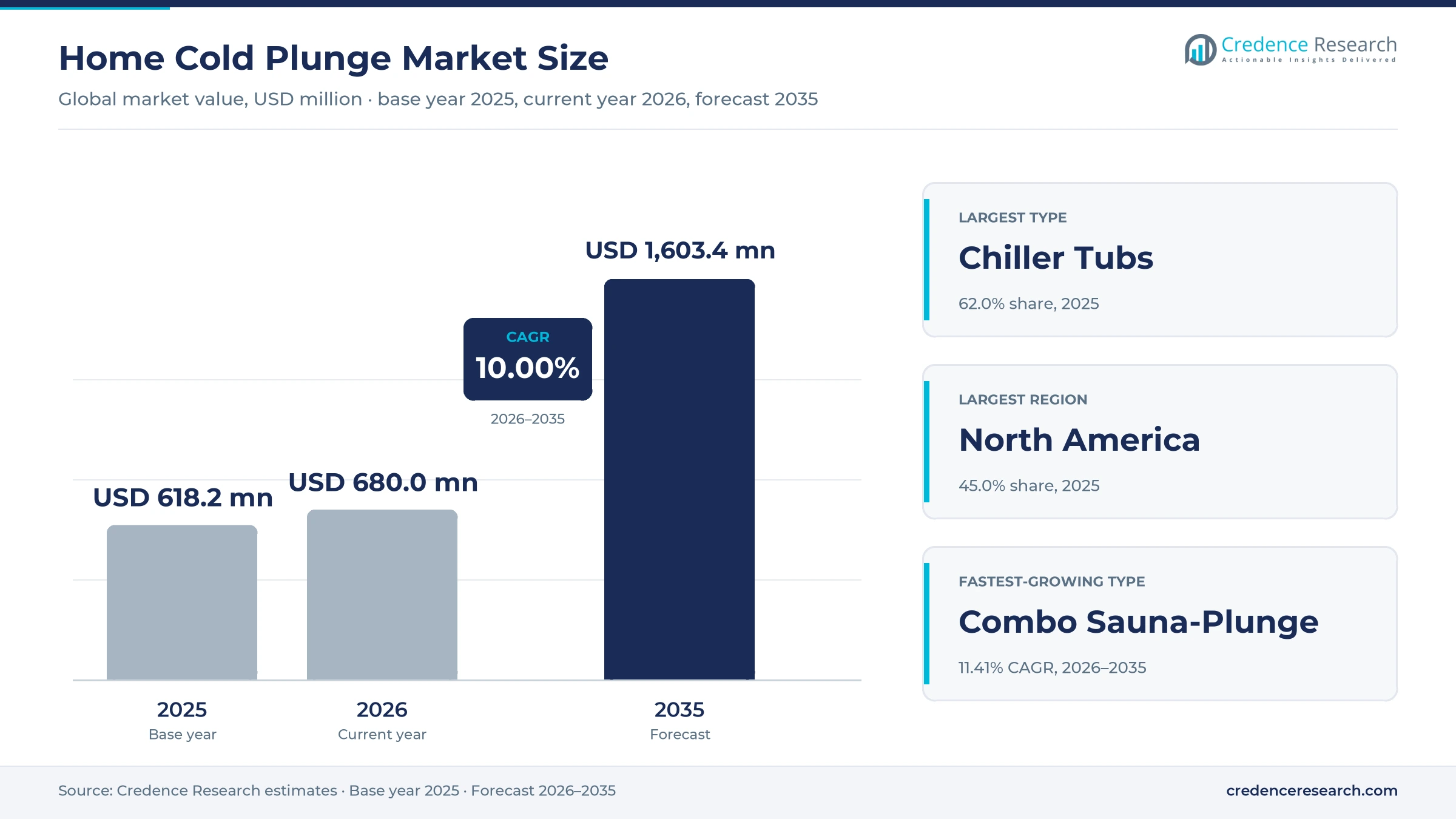
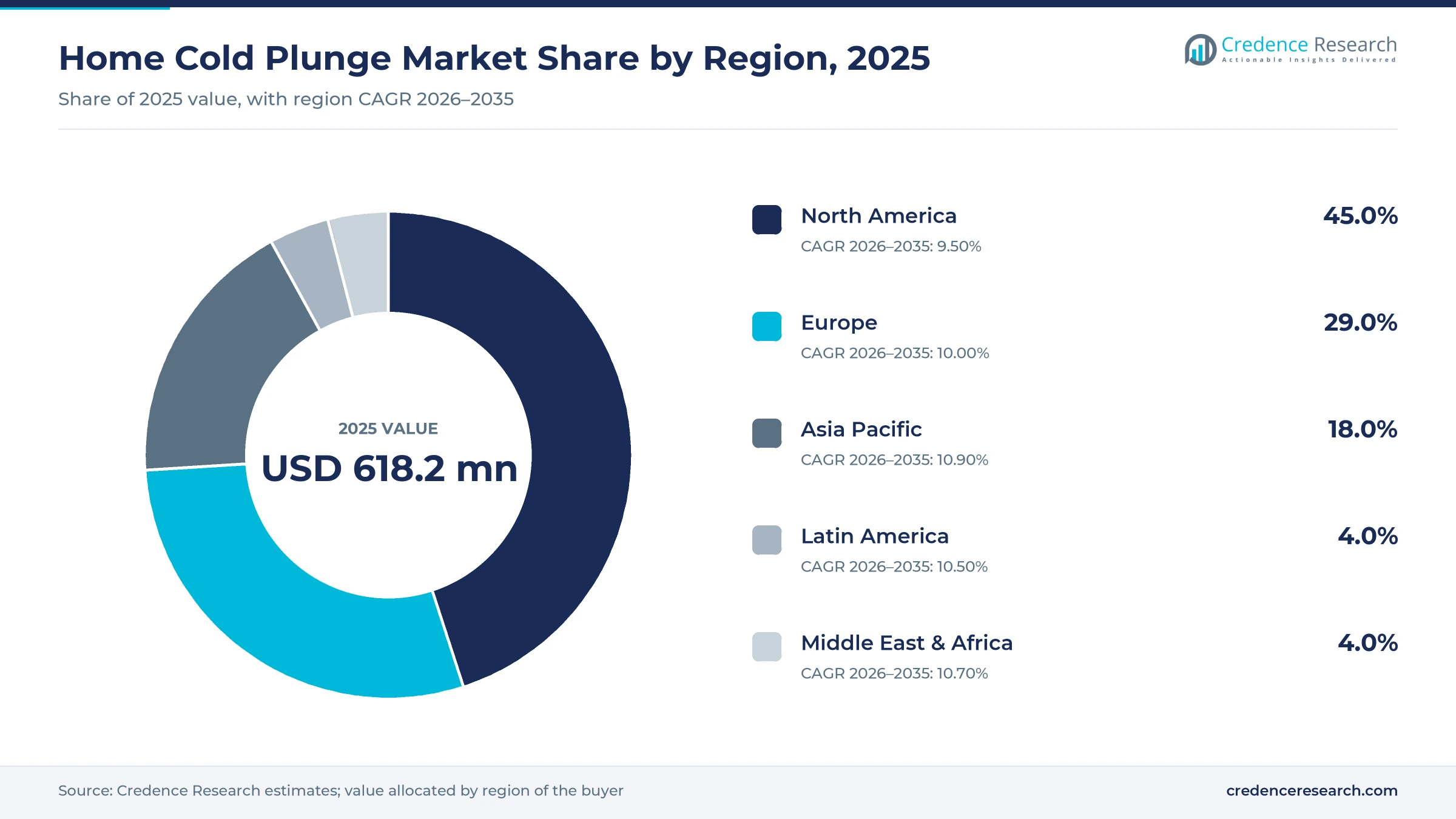
The global home cold plunge market was valued at USD 618.2 million in 2025 and is projected to increase from USD 660.8 million in 2026 to USD 1.20 billion by 2035, registering a CAGR of 6.90% during 2026–2035. Demand comes from households that buy tubs, chillers and ice barrels for daily cold immersion after training or as part of a morning routine. North America held the largest regional share, 45.0% in 2025, because the leading direct-to-consumer brands are based in the United States and sell through their own websites with financing. Asia Pacific is the fastest-growing region at 7.80% a year as Australian suppliers add chilled ice baths and Japanese sauna culture supports hot and cold bathing. A major commercial change came in September 2025, when the leading brand launched a second-generation all-in-one tub with ozone sanitation and a chiller that cools 31% faster. Lower-cost pop-up and inflatable tubs also widened the entry point for first-time buyers.
Which purchases count as home cold plunge spending?
The home cold plunge market covers tubs, barrels and chiller systems that households buy for cold water immersion at home. It includes chiller tubs with built-in cooling and filtration, inflatable and ice-filled tubs, and combined sauna and cold plunge systems sold as one package. Buyers purchase online from brand websites or through retailers and warehouse clubs.
The scope excludes commercial units sold to gyms, spas, clinics and sports teams, cryotherapy chambers, ice packs and cold showers. Value is counted at the retail price paid by households, including standalone chillers bought to upgrade a tub. Maintenance kits, filters and sanitizer plans are counted when sold with the hardware.
Home Cold Plunge Market Insights
- The market is valued at USD 618.2 million in 2025 and is projected to reach USD 1.20 billion by 2035, growing at a 6.90% CAGR as chilled tubs become standard home recovery equipment.
- North America led with 45.0% of 2025 value, while Asia Pacific grows fastest at 7.80% a year as Australian suppliers launch chilled cedar and steel ice baths.
- Chiller Tubs held 62.0% of 2025 value, and Plunge priced its All-In Gen 2 at $8,490 at its Sept. 29, 2025 launch with ozone sanitation built in.
- A University of South Australia review of 11 studies with 3,177 participants, published in January 2025, found that cold immersion cut stress for about 12 hours.
- SWTHZ opened its 100th contrast therapy studio on March 13, 2026, and its partnership with Plunge projects up to 12 million cold plunge sessions in 2026.
Chiller tubs and premium price points hold most value
Why do chiller tubs lead home cold plunge value?
Based on type, the market is categorized into chiller tubs, inflatable and ice tubs, and combo sauna-plunge systems. Chiller Tubs led with 62.0% of 2025 value because a chiller removes the daily need for ice and carries most of the price. The Plunge PlungePure chiller alone retailed for $3,499 at its April 2024 launch, according to Business Wire. Combo Sauna-Plunge systems grow fastest at 8.31% a year as brands sell heat and cold together. Plunge cuts up to $3,500 off its sauna and offers bundles with up to $6,500 off on its pricing page, which pushes buyers toward paired purchases.
Why do premium tubs lead while mid-priced tubs grow fastest?
Based on price, the market is categorized into under $1K, $1K–$5K and over $5K. Over $5K tubs led with 40.0% of 2025 value because all-in-one units with chillers, filtration and app control sit at the top of the ladder. The BlueCube C3 starts at $20,500 and the Renu Cold Stoic 3.0 launched at $10,699.99, according to a Sun Home comparison checked July 23, 2026. $1K–$5K tubs grow fastest at 7.48% a year as entry chiller systems fall in price. Plunge sells its pop-up tub with a chiller for $3,490, and Ice Barrel lists its 500 model at $1,749.99.
Why does direct-to-consumer selling lead the channel mix?
Based on channel, the market is categorized into direct-to-consumer and retail. Direct-to-Consumer sales led with 71.0% of 2025 value because leading brands sell from their own sites with financing and app support. Plunge offers 0% APR for up to 24 months through Bread Pay, with payments from $65 a month, on its pricing page. Retail grows fastest at 7.60% a year as warehouse clubs add chilled tubs at lower prices. Costco listed the LifeTrend Classic cold plunge with a chiller system at $729.99, according to a Slickdeals post in July 2026.
| Segment Group | Leading Sub-segment | Share, 2025 | Fastest-growing Sub-segment | CAGR, 2026–2035 |
|---|---|---|---|---|
| By Type | Chiller Tubs | 62.0% | Combo Sauna-Plunge | 8.31% |
| By Price | Over $5K | 40.0% | $1K–$5K | 7.48% |
| By Channel | Direct-to-Consumer | 71.0% | Retail | 7.60% |
Request a Free Sample
Fill in your details and we'll send you a free sample report.
- Sample data tables & charts
- Research methodology
Recovery habits, DTC brands and cheaper tubs lift sales
Home wellness consumers adopt cold recovery equipment
Households are buying cold immersion equipment because routines once limited to athletes have become daily wellness habits. A University of South Australia review of 11 studies with 3,177 participants, reported by ScienceDaily on Jan. 31, 2025, found that cold water immersion reduced stress for about 12 hours after exposure. The same review linked regular cold showers with a 29% drop in sickness absence in one study. Plunge says on its website that its app has logged more than 45 million sessions, which shows how often owners use their tubs. In the Credence Research model this adds about 2.56 percentage points to annual growth to 2035, with Chiller Tubs capturing most of that spending.
Premium direct-to-consumer brands widen product access
Direct-to-consumer brands have made premium tubs easier to buy by pairing online sales with financing, delivery and app support. U.S. retail e-commerce reached $340.2 billion in the second quarter of 2026, or 17.1% of total retail sales, according to the U.S. Census Bureau release of Aug. 18, 2026. Plunge offers 0% APR for up to 24 months through Bread Pay, which turns a tub costing several thousand dollars into a monthly payment. Ice Barrel sells its 500 model and chiller as a $5,749.98 bundle online. In the Credence Research model this adds about 1.87 percentage points to annual growth to 2035, and Direct-to-Consumer sales held 71.0% of 2025 value.
Compact tubs and maintenance plans lift household adoption
Smaller tubs and planned maintenance lower the space, cost and effort barriers that kept many households out of the category. Plunge launched its Evolve Series on April 10, 2024, including a $150 pop-up tub and a $1,190 inflatable Plunge Air that fits in a backpack. Coldture runs a ColdCare+ plan that ships two filters every three months and a yearly sanitizer kit, and it gives subscribers a two-year warranty. Plunge also bundles a starter maintenance kit with new tubs, according to its September 2025 launch release. In the Credence Research model this adds about 1.38 percentage points to annual growth to 2035, which supports $1K–$5K tubs at 7.48% a year.
Contrast therapy studios convert trial into home purchases
Contrast therapy studios let consumers try cold plunges before buying one, which shortens the path to a home purchase. SWTHZ opened its 100th studio on March 13, 2026, in Kansas City, with locations in more than 25 states, according to Market Realist. Its partnership with Plunge projects up to 12 million cold plunge sessions across the studios in 2026. Bathhouse raised $35 million and plans to grow to 10 locations, while Othership raised $8.5 million, according to Athletech News in May 2026. As a result, studio members become familiar with the brands, temperatures and routines they later buy for home use, which supports demand for Chiller Tubs.
Contrast therapy and smart chillers reshape home plunges
Shift toward combined sauna and cold plunge setups
Home buyers are shifting from single cold tubs to paired heat and cold setups that copy the studio contrast routine. Plunge released its All-In and Plunge Sauna in 2023, according to its April 2024 Business Wire release, and now discounts saunas by up to $3,500 and bundles by up to $6,500. Sun Home Saunas sells its Cold Plunge Pro Apex at $14,799 alongside its sauna range. In Dubai, TeckWave sold a sauna with two ice baths for just over Dh70,000, according to Khaleej Times in August 2025. This shift lifts average order values and makes Combo Sauna-Plunge the fastest-growing type at 8.31% a year.
Rise of connected chillers with ozone sanitation
Chillers are becoming connected appliances, with app control, sensors and built-in sanitation that reduce manual upkeep. Plunge launched the All-In Gen 2 on Sept. 29, 2025, with ozone sanitation, 10 sensors and a pump that filters the full water volume every 15 minutes, according to Business Wire. The company said the chiller cools 31% faster and is 50% more energy efficient than before. The Sun Home comparison lists ozone and 20-micron filters on Plunge, BlueCube and Sun Home models. In turn, buyers now compare tubs on hygiene and app features as much as on minimum water temperature. This trend favors brands that can push software updates and track water quality for each owner.
Warehouse clubs open a lower-price retail channel
Warehouse clubs and mass retailers are an opening for brands that can deliver chilled tubs below the premium price ladder. Costco listed the LifeTrend Classic cold plunge with a chiller system at $729.99, according to Slickdeals in July 2026, and Plunge also sells its own Ice Bath Pop-Up for $150 without a chiller, according to its April 2024 release. These prices sit far below the $4,990 Plunge All-In listed in the Sun Home comparison of July 2026. Retail remains the smaller channel today, yet it is the fastest-growing channel in the Credence Research model because club shoppers buy on price. This opening favors brands that can ship flat-packed tubs in volume and support them through store return desks.
Gulf and Australian buyers open premium demand
Gulf and Australian households offer an opening for premium tubs, because outdoor living and hot climates suit chilled water. Qey sells a typical all-in-one ice bath and chiller for Dh30,000 in the UAE, and TeckWave names the UAE and Saudi Arabia as its top markets, according to Khaleej Times in August 2025. Kula Recovery builds chiller tubs in Ajman and Sharjah that sell for about Dh11,000, according to The National in February 2025. SDS Australia opened pre-orders in December 2025 for its Eira cedar ice bath with a 1HP cooling system. Asia Pacific is the fastest-growing region in the Credence Research model as these suppliers scale.
Running costs, tariffs and safety recalls test buyers
Electricity costs raise the price of ownership
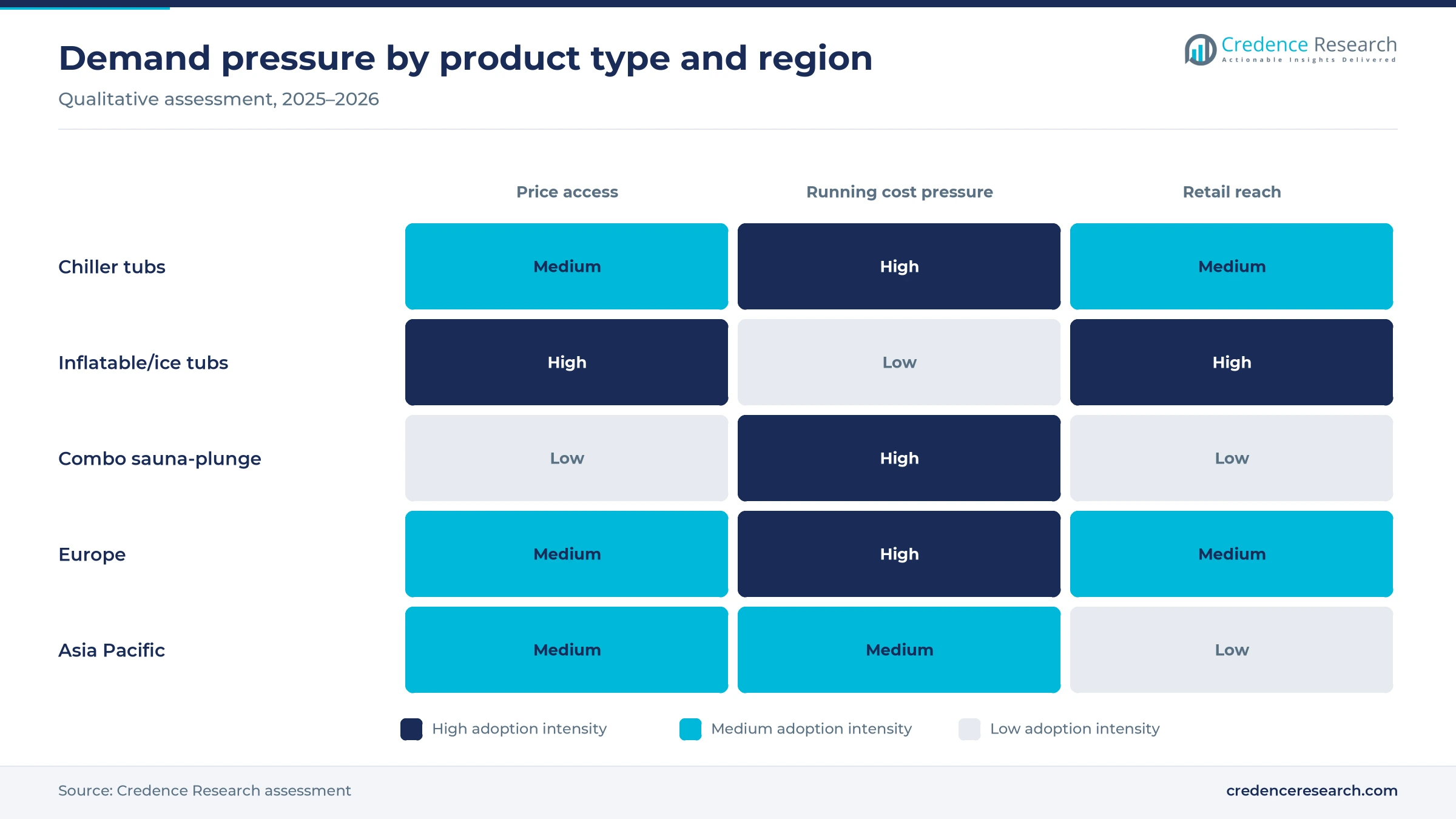
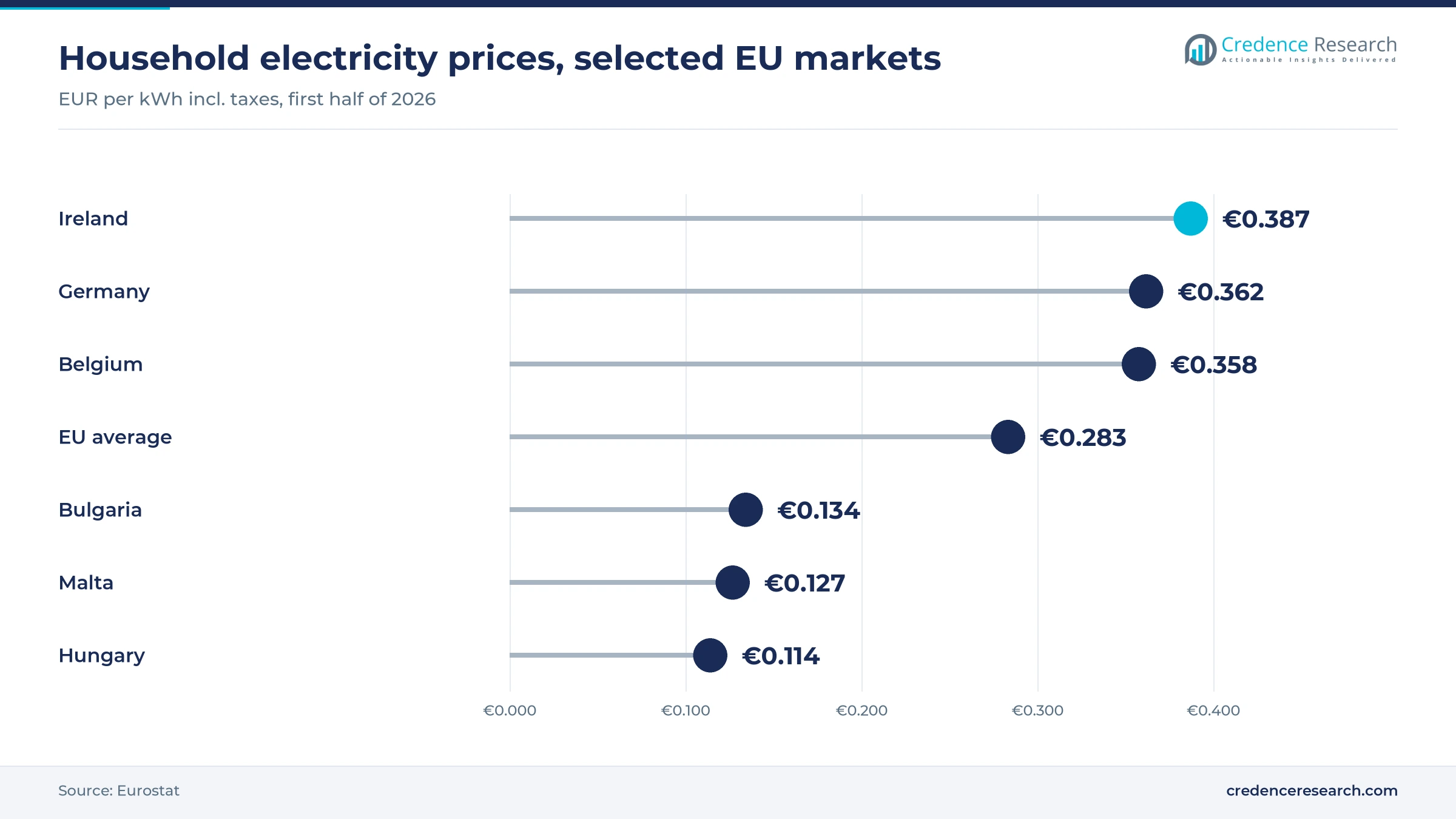
Running a chiller every day adds to household power bills, which weighs on buyers in high-tariff countries. Household electricity cost 0.3871 euros per kWh in Ireland and 0.3618 euros in Germany in the first half of 2026, against an EU average of 0.2832 euros, according to Eurostat. As a result, brands now advertise energy savings, and Plunge said its 2024 chiller uses 33% of the energy of its previous Pro model.
Import tariffs raise costs for chillers and tubs
Tariffs raise landed costs for brands that source chillers, pumps and inflatable tubs from Chinese factories. The additional U.S. tariff on Chinese goods rose from 10% to 20% on March 4, 2025, according to KPMG. Importers must absorb the cost or pass it on to households, which squeezes entry models most. Some brands respond by assembling in the United States or the Gulf, as Kula Recovery does in Ajman and Sharjah.
Product safety recalls dent trust in add-on kits
Safety problems with heaters and electrical parts can damage trust in a category that mixes water and power at home. On March 26, 2026, Plunge Buddy, which trades as DIY Cold Plunge, recalled about 675 sauna heater kits sold for $400 to $500 because conductors could overheat and cause fires, according to the CPSC notice published by Justia. Low-cost online kits are most exposed, so buyers now look for certified wiring and longer warranties.
Limited clinical evidence caps some health claims
Weak clinical evidence for some benefits limits the health claims brands can make in advertising. The January 2025 review by University of South Australia researchers found little evidence that cold immersion boosts immunity or mood, and its sleep findings came only from male participants. It also reported a temporary rise in inflammation after immersion. Brands therefore lean on recovery routines and stress relief rather than medical claims, which narrows their marketing message.
North America leads while Asia Pacific grows fastest
| Region | Value, 2025 (USD million) | Share, 2025 | CAGR, 2026–2035 |
|---|---|---|---|
| North America | 278.2 | 45.0% | 6.40% |
| Europe | 179.3 | 29.0% | 6.90% |
| Asia Pacific | 111.3 | 18.0% | 7.80% |
| Latin America | 24.7 | 4.0% | 7.40% |
| Middle East & Africa | 24.7 | 4.0% | 7.60% |
North America leads on direct brands and financing
North America held 45.0% of 2025 value and grows at 6.40% a year to 2035. The region leads because Plunge, Ice Barrel, BlueCube and Renu Therapy sell from U.S. websites, and Plunge, which offers financing, was founded in 2020 by Ryan Duey and Michael Garrett. SWTHZ runs 100 contrast therapy studios in more than 25 states, which introduces cold plunging to new buyers. Many households start with fitness equipment and later add a tub for recovery after training.
Europe grows on U.K. ice bath brands and club rollouts
Europe held 29.0% of 2025 value and grows at 6.90% a year. Brass Monkey, based in Wetherby, agreed in February 2025 to install ice baths at 32 Village Health & Wellness Clubs across the U.K., according to Health Club Management. Club and hotel use builds familiarity with ice baths before a household purchase. However, high power prices in Ireland, Germany and Belgium raise running costs, so energy-efficient chillers and ice-filled tubs sell well in the region.
Asia Pacific grows fastest on Australian and Japanese demand
Asia Pacific held 18.0% of 2025 value and grows fastest at 7.80% a year. Sun Stream Saunas promoted its Solace ice bath with active cooling to 3°C in Australia in August 2026, and SDS Australia scheduled Eira deliveries from January 2026. Japan counted about 16.48 million sauna-goers in the 2024 fiscal year, according to the Japan Sauna & Hot-Cold Bath Research Institute. That bathing culture supports demand for hydrotherapy and home cold baths.
Latin America starts from inflatable and ice tubs
Latin America held 4.0% of 2025 value and grows at 7.40% a year. Growth depends on local distributors that stock chillers, filters and spare parts and can service units after the sale.
Middle East & Africa builds on Gulf villa demand
Middle East & Africa held 4.0% of 2025 value and grows at 7.60% a year. Gulf buyers favor custom wood and steel ice baths, and TeckWave sells inflatable units from about Dh8,000 and premium units up to Dh32,000, according to Khaleej Times. Kula Recovery builds its chiller tubs locally in factories in Ajman and Sharjah. Hot summers make chilled water a year-round purchase, often installed beside portable pools and villa gardens.
Product launches and studio growth defined 2024–2026
| Development | Status and market relevance |
|---|---|
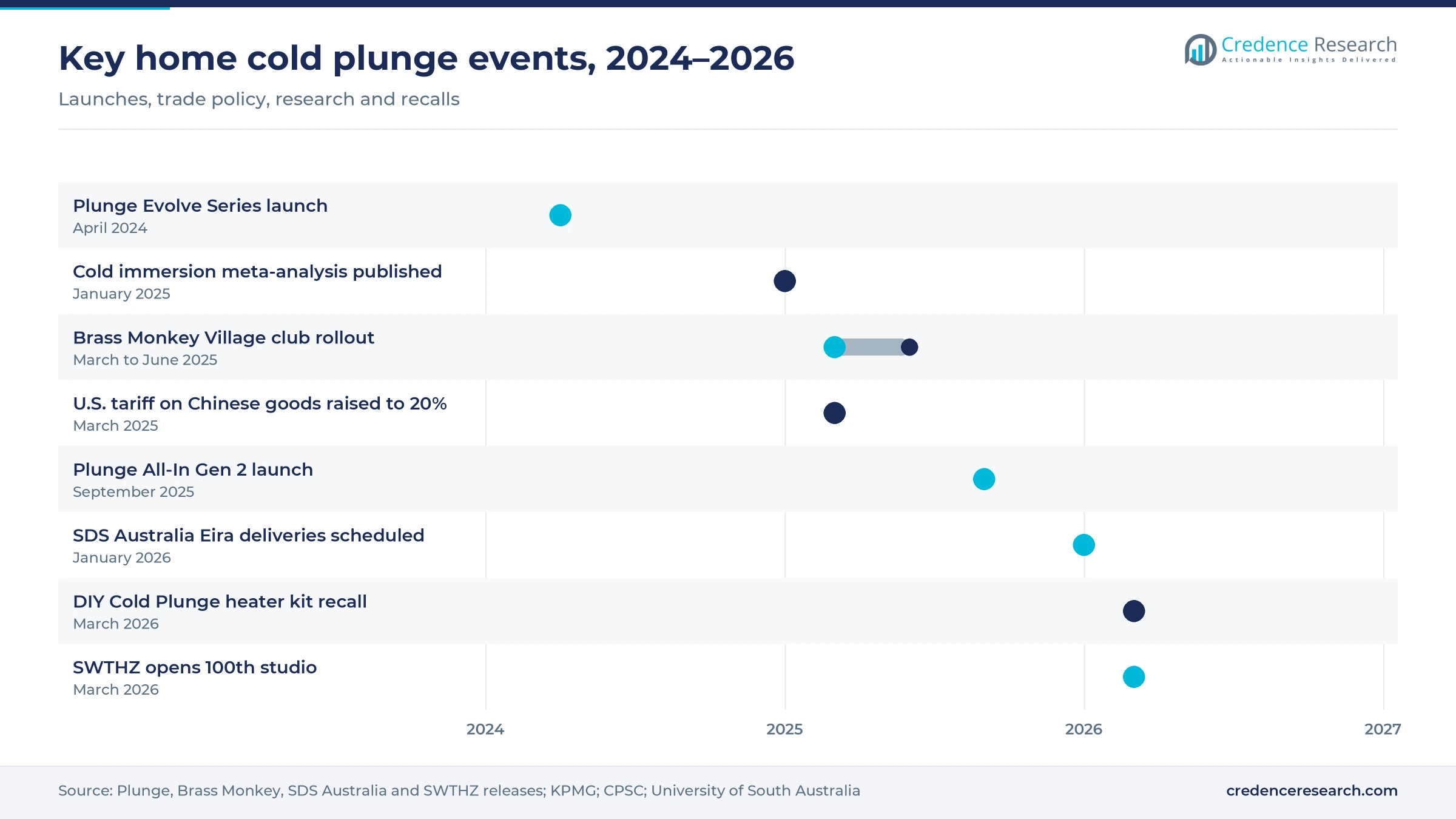
| In April 2024, Plunge launched its Evolve Series, including a $150 pop-up tub, the $1,190 Plunge Air and the $3,499 PlungePure chiller. | Live; widened the entry price ladder |
| In February 2025, Brass Monkey agreed to install ice baths at 32 Village Health & Wellness Clubs across the U.K. | Rolled out from March to June 2025 |
| In September 2025, Plunge launched the All-In Gen 2 at an early access price of $8,490 with ozone sanitation and 10 sensors. | Live; sets the premium benchmark |
| In December 2025, SDS Australia opened pre-orders for its Eira Canadian cedar ice bath with deliveries from January 2026. | Live; adds premium supply in Australia |
| In March 2026, DIY Cold Plunge recalled about 675 sauna heater kits in the U.S. because of a fire hazard. | Recall; raises focus on electrical safety |
Chillers, ozone and apps define home plunge hardware
- Compressor chillers hold water near 37°F, and the Plunge All-In Gen 2 chiller cools 31% faster than its earlier model.
- Ozone and filtration systems keep water clean between changes, with 20-micron filters and full turnover every 15 minutes.
- App-connected controls let owners set temperature, schedules and cleaning cycles remotely, track sessions and receive over-the-air software updates from the brand.
- Insulated and drop-stitch tubs cut cooling loss and let inflatable models hold ice longer, fold into a backpack or store away when the household needs the space.
Need a Custom Version of This Report?
Tailor the scope, geography, or segments to your exact requirements.
- Custom geography or segment scope
- Direct access to our analyst team
Plunge leads DTC as ice barrel and BlueCube hold niches
Competition centers on cooling performance, hygiene, price and the strength of each brand among athletes and wellness buyers. Plunge leads the direct-to-consumer segment with a full price ladder, from a $150 pop-up tub to the $8,490 All-In Gen 2, plus saunas and financing. Ice Barrel holds the ice-filled barrel niche with its 500 model at $1,749.99 and an optional chiller. BlueCube targets the top of the market with the C3 from $20,500 and a three-year parts and labor warranty. Renu Therapy sells U.S.-made Cold Stoic tubs that heat and chill water. Sun Home Saunas competes through sauna and plunge bundles sold to contrast therapy buyers. Lower-cost retail brands such as LifeTrend and Coldture compete through Costco, which pressures premium pricing and pushes leaders toward features, service plans and longer warranties.
Companies profiled and their roles in this market
| Company | Type | Role in the market |
|---|---|---|
| Plunge | Market leader | Direct-to-consumer brand with tubs from $150 to $8,490, chillers, saunas and an app |
| Ice Barrel | Barrel specialist | Upright ice-filled barrels, with the 500 model at $1,749.99 and an optional chiller |
| BlueCube | Premium specialist | High-end chilled tubs such as the C3 from $20,500 with a three-year warranty |
| Renu Therapy | Premium specialist | U.S.-made Cold Stoic tubs with chilling and heating, launched at $10,699.99 |
| Sun Home Saunas | Contrast bundle seller | Sauna maker selling the Cold Plunge Pro Apex at $14,799 |
| Brass Monkey | European challenger | U.K. ice bath maker supplying Village clubs and luxury hotels |
Price ladders and running costs will decide share
Credence Research's view is that the home cold plunge market will be decided by how well brands manage the gap between entry and premium prices. Pop-up and warehouse club tubs bring in first-time buyers, while chiller tubs and sauna bundles carry most of the value. Running costs are the second deciding factor, because power prices in parts of Europe make an inefficient chiller hard to justify. Brands that pair efficient chillers, built-in sanitation and service plans with financing will hold share as studio users move their routines into the home through 2035. The home cold plunge market already spans prices from $150 to more than $20,000, which gives brands room to serve several buyer groups at once.
Price-and-volume model checked against brand data
The report uses 2025 as the base year and forecasts to 2035. Market values come from the Credence Research model, built from published brand price lists, estimated household unit sales by product type and estimated price mixes. Segment, channel and regional splits are Credence Research estimates based on company releases, retailer listings and public statistics from the U.S. Census Bureau and Eurostat. Company announcements, recall notices, peer-reviewed research summaries and trade press coverage were used to date events. No interviews or surveys were conducted for this edition of the report.
Contrast therapy and retail reach carry growth to 2035
The market is expected to grow from USD 660.8 million in 2026 to USD 1.20 billion by 2035 as cold immersion becomes a standard part of home recovery routines. Chiller tubs will remain the value base, while combo sauna-plunge systems gain share as buyers copy the contrast routines they try in studios. Mid-priced tubs will expand fastest as chiller prices fall and warehouse clubs widen distribution. Energy-efficient cooling, ozone sanitation and app control will become standard features, and Asia Pacific and the Gulf will gain share as local suppliers add premium tubs. Chiller tubs held 62.0% of home cold plunge value in 2025 and will still hold the largest share of demand in 2035.
Frequently Asked Questions
How big is the home cold plunge market?
Which product type leads the market?
Which region leads the home cold plunge market?
Which region grows fastest?
How much does a home cold plunge cost?
Who are the main home cold plunge companies?
Does cold water immersion have proven health benefits?
What are the main challenges for buyers?
Table of Content
Chapter 1 Market Segmentation
- 1.1 Segmentation Framework
- 1.1.1 Product and Service Classification
- 1.1.2 Application and End-Use Classification
- 1.1.3 Technology and Solution Classification
- 1.1.4 Customer and Distribution Channel Classification
- 1.1.5 Geographic Segmentation
- 1.1.6 Market Segment Definitions and Boundaries
- 1.2 By Type
- 1.2.1 Chiller Tubs
- 1.2.2 Inflatable/Ice Tubs
- 1.2.3 Combo Sauna-Plunge
- 1.3 By Price
- 1.3.1 Under $1K
- 1.3.2 $1K–$5K
- 1.3.3 Over $5K
- 1.4 By Channel
- 1.4.1 Direct-to-Consumer
- 1.4.2 Retail
Chapter 2 Introduction
- 2.1 Report Objectives and Scope
- 2.2 Product Definition and Industry Terminology
- 2.3 Market Inclusions and Exclusions
- 2.4 Research Process
- 2.4.1 Primary Research and Expert Interviews
- 2.4.2 Secondary Research and Source Review
- 2.4.3 Top-Down and Bottom-Up Estimation
- 2.4.4 Data Triangulation and Verification
- 2.5 Market Size Measurement Basis
- 2.5.1 2025: USD 618.2 million → 2035: USD 1.20 billion
- 2.6 Historical and Forecast Reference Periods
- 2.6.1 Historical Period: 2018-2025
- 2.6.2 Base Year: 2025
- 2.6.3 Forecast Period: 2025-2035
- 2.7 Research Assumptions and Limitations
Chapter 3 Executive Summary
- 3.1 Market Snapshot and Key Findings
- 3.2 Base-Year Market Size, 2025
- 3.3 Forecast Market Size, 2035
- 3.4 Revenue and Volume Growth Outlook
- 3.5 Key Demand and Supply Indicators
- 3.6 Leading Market Segments
- 3.7 Fastest-Growing Market Opportunities
- 3.8 Regional Performance Highlights
- 3.9 Technology and Industry Transformation
- 3.10 Competitive Landscape Summary
- 3.11 Analyst View and Strategic Implications
Chapter 4 Global Home Cold Plunge Market Trends and Developments
- 4.1 Historical Industry Development, 2018-2025
- 4.2 Recent Market Trends and Developments
- 4.3 Demand and Customer Behavior Trends
- 4.4 Technology and Product Innovation
- 4.5 Artificial Intelligence, Automation and Digitalization
- 4.6 Local Manufacturing and Supply Chain Realignment
- 4.7 Industry Partnerships, Mergers and Acquisitions
- 4.8 Sustainability and Circular Economy Developments
- 4.9 Government and Private Sector Investment Trends
- 4.10 Emerging Business Models and Commercialization
- 4.11 Industry Developments and Announcements
Chapter 5 Global Home Cold Plunge Market Production, Supply and Demand Analysis
- 5.1 Demand Trend and Consumption Analysis, 2018-2025
- 5.2 Demand Forecast, 2025-2035
- 5.3 Production and Output Trend, 2018-2025
- 5.4 Production and Output Forecast, 2025-2035
- 5.5 Installed Capacity and Capacity Utilization
- 5.6 Company-Wise Production Plants and Statistics
- 5.6.1 Installed Production Capacity
- 5.6.2 Actual Production
- 5.6.3 Planned Capacity and Expansion Targets
- 5.7 Supply Chain Structure and Procurement Trends
- 5.8 Supply-Demand Gap and Bottlenecks
- 5.9 Import Dependence and Sourcing Structure
- 5.10 Contract Manufacturing and Outsourcing
- 5.11 Regional Supply and Demand Concentration
Chapter 6 Global Home Cold Plunge Market Pricing Analysis
- 6.1 Pricing Structure and Measurement
- 6.2 Historical Pricing Trends, 2018-2025
- 6.3 Pricing Outlook, 2025-2035
- 6.4 Average Selling Price and Unit Economics
- 6.5 Pricing by Product and Market Segment
- 6.6 Geographic Pricing Differences
- 6.7 Key Input, Energy, Labor and Logistics Costs
- 6.8 Contract Pricing and Purchasing Models
- 6.9 Pricing Sensitivity and Competitive Positioning
- 6.10 Price, Margin and Profitability Implications
Chapter 7 Global Home Cold Plunge Market Dynamics
- 7.1 Market Growth Drivers
- 7.1.1 Demand-Side Drivers
- 7.1.2 Technology and Innovation Drivers
- 7.1.3 Infrastructure and Investment Drivers
- 7.1.4 Regulatory and Policy Drivers
- 7.2 Market Restraints
- 7.2.1 Cost and Affordability Constraints
- 7.2.2 Technology and Adoption Barriers
- 7.2.3 Supply Chain and Operational Constraints
- 7.3 Market Challenges
- 7.3.1 Competitive Pressure and Margin Erosion
- 7.3.2 Skills, Infrastructure and Implementation Gaps
- 7.4 Emerging Market Opportunities
- 7.5 Market Dynamics Impact and Time-Horizon Assessment
Chapter 8 Global Home Cold Plunge Value Chain Analysis
- 8.1 Industry Value Chain Overview
- 8.2 Upstream Suppliers and Critical Inputs
- 8.3 Technology and Component Providers
- 8.4 Manufacturing or Service Delivery
- 8.5 Distribution, Channel Partners and Integrators
- 8.6 Downstream Applications and End Users
- 8.7 Value Addition and Profit Pools
- 8.8 Vertical Integration and Outsourcing
- 8.9 Supplier Concentration and Risk
- 8.10 Supply Chain Localization and Resilience
Chapter 9 Global Home Cold Plunge Market Regulations and Policies
- 9.1 Relevant Laws, Standards and Compliance Frameworks
- 9.2 Product, Service, Safety and Quality Requirements
- 9.3 Government Policies, Incentives and Subsidies
- 9.4 Imports, Exports and Trade Barriers
- 9.5 Public Procurement and Local Content Requirements
- 9.6 Environmental and Sustainability Compliance
- 9.7 Upcoming Policy Changes and Market Implications
Chapter 10 Global Home Cold Plunge Market Hotspots and Opportunities
- 10.1 Market Opportunity Mapping and Growth Hotspots
- 10.2 High-Growth Applications and Customer Groups
- 10.3 Underserved Markets and White-Space Opportunities
- 10.4 Emerging Technology and Product Opportunities
- 10.5 New Capacity and Investment Hotspots
- 10.6 Market Entry and Expansion Opportunities
- 10.7 Distribution and Partnership Opportunities
- 10.8 Near-Term and Long-Term Commercial Potential
- 10.9 Opportunity Attractiveness and Execution Risks
Chapter 11 Global Home Cold Plunge Market Outlook, 2025-2035
- 11.1 Market Size and Analysis
- 11.1.1 Revenue (Market Measurement: 2025: USD 618.2 million → 2035: USD 1.20 billion)
- 11.1.2 Market Volume and Quantity Sold
- 11.1.3 Historical Market Size, 2018-2025
- 11.1.4 Base-Year Market Size, 2025
- 11.2 Market Forecast, 2025-2035
- 11.2.1 Revenue Forecast to 2035
- 11.2.2 Volume Forecast to 2035
- 11.2.3 CAGR and Year-on-Year Growth
- 11.2.4 Incremental Revenue Opportunity
- 11.3 Forecast Assumptions and Scenario Analysis
- 11.3.1 Base-Case Forecast
- 11.3.2 Optimistic and Conservative Scenarios
- 11.3.3 Technology, Pricing and Policy Sensitivities
- 11.4 Market Attractiveness and Growth Outlook
Chapter 12 Global Home Cold Plunge Market Segmentation and Outlook
- 12.1 Segmentation Summary and Market Shares, 2025
- 12.2 Largest and Fastest-Growing Segments
- 12.3 By Type - Market Size and Forecast, 2025-2035
- 12.3.1 Segment Definition and Scope
- 12.3.2 Historical Market Size, 2018-2025
- 12.3.3 Revenue Forecast, 2025-2035
- 12.3.4 Volume Forecast, 2025-2035
- 12.3.5 Base-Year Market Share, 2025
- 12.3.6 Segment CAGR and Growth Drivers
- 12.3.7 Subsegment Market Size and Forecast
- 12.3.7.1 Chiller Tubs
- 12.3.7.2 Inflatable/Ice Tubs
- 12.3.7.3 Combo Sauna-Plunge
- 12.3.8 Subsegment Pricing and Adoption Trends
- 12.3.9 Leading Suppliers and Competition
- 12.3.10 Regional Demand and Opportunities
- 12.4 By Price - Market Size and Forecast, 2025-2035
- 12.4.1 Segment Definition and Scope
- 12.4.2 Historical Market Size, 2018-2025
- 12.4.3 Revenue Forecast, 2025-2035
- 12.4.4 Volume Forecast, 2025-2035
- 12.4.5 Base-Year Market Share, 2025
- 12.4.6 Segment CAGR and Growth Drivers
- 12.4.7 Subsegment Market Size and Forecast
- 12.4.7.1 Under $1K
- 12.4.7.2 $1K–$5K
- 12.4.7.3 Over $5K
- 12.4.8 Subsegment Pricing and Adoption Trends
- 12.4.9 Leading Suppliers and Competition
- 12.4.10 Regional Demand and Opportunities
- 12.5 By Channel - Market Size and Forecast, 2025-2035
- 12.5.1 Segment Definition and Scope
- 12.5.2 Historical Market Size, 2018-2025
- 12.5.3 Revenue Forecast, 2025-2035
- 12.5.4 Volume Forecast, 2025-2035
- 12.5.5 Base-Year Market Share, 2025
- 12.5.6 Segment CAGR and Growth Drivers
- 12.5.7 Subsegment Market Size and Forecast
- 12.5.7.1 Direct-to-Consumer
- 12.5.7.2 Retail
- 12.5.8 Subsegment Pricing and Adoption Trends
- 12.5.9 Leading Suppliers and Competition
- 12.5.10 Regional Demand and Opportunities
- 12.6 Segment Growth Comparison
- 12.7 Segment Attractiveness and Priority Matrix
Chapter 13 Global Home Cold Plunge Geographic Market Outlook, 2025-2035
- 13.1 Regional Market Size and Share, 2025
- 13.2 Regional Market Forecast, 2025-2035
- 13.3 Regional Pricing, Production and Demand Differences
- 13.4 North America
- 13.4.1 United States
- 13.4.2 Canada
- 13.4.3 Mexico
- 13.5 Europe
- 13.5.1 Germany
- 13.5.2 France
- 13.5.3 Italy
- 13.5.4 United Kingdom
- 13.5.5 Spain
- 13.5.6 Poland
- 13.5.7 Russia
- 13.5.8 Netherlands
- 13.5.9 Belgium
- 13.5.10 Sweden
- 13.5.11 Denmark
- 13.5.12 Norway
- 13.5.13 Rest of Europe
- 13.6 Asia Pacific
- 13.6.1 China
- 13.6.2 India
- 13.6.3 Japan
- 13.6.4 South Korea
- 13.6.5 Thailand
- 13.6.6 Indonesia
- 13.6.7 Vietnam
- 13.6.8 Malaysia
- 13.6.9 Australia
- 13.6.10 Rest of Asia Pacific
- 13.7 Latin America
- 13.7.1 Brazil
- 13.7.2 Argentina
- 13.7.3 Colombia
- 13.7.4 Chile
- 13.7.5 Rest of Latin America
- 13.8 Middle East
- 13.8.1 Saudi Arabia
- 13.8.2 United Arab Emirates
- 13.8.3 Turkey
- 13.8.4 Israel
- 13.8.5 Iran
- 13.8.6 Rest of the Middle East
- 13.9 Africa
- 13.9.1 South Africa
- 13.9.2 Egypt
- 13.9.3 Nigeria
- 13.9.4 Morocco
- 13.9.5 Rest of Africa
- 13.10 Regional Investment, Policy and Supply Chain Differences
- 13.11 Regional Competitive Landscape
- 13.12 Geographic Growth Hotspots
Chapter 14 Global Home Cold Plunge Technology, Innovation and Sustainability Outlook
- 14.1 Technology Landscape and Maturity
- 14.2 Product, Process and Service Innovation
- 14.3 AI, Automation and Digital Tools in the Industry
- 14.4 Technology Adoption and Performance Benchmarking
- 14.5 Innovation Pipeline and R&D Investment
- 14.6 Patent and Intellectual Property Trends
- 14.7 Energy Efficiency and Resource Management
- 14.8 Sustainability, Recycling and Circularity
- 14.9 Technology Roadmap, 2025-2035
- 14.10 Risks of Obsolescence and Technology Substitution
Chapter 15 Global Home Cold Plunge Market Key Strategic Imperatives
- 15.1 Growth and Market Entry Priorities
- 15.2 High-Return Products and Segments
- 15.3 Pricing, Profitability and Cost Optimization
- 15.4 Technology Investment and Product Differentiation
- 15.5 Supply Chain Localization and Resilience
- 15.6 Distribution and Customer Acquisition
- 15.7 Partnership, Acquisition and Capacity Strategy
- 15.8 Regional Expansion Priorities
- 15.9 Short-, Medium- and Long-Term Actions
Chapter 16 Competition Outlook
- 16.1 Industry Competition Characteristics
- 16.2 Market Structure and Concentration
- 16.3 Market Share and Competitive Positioning, 2025
- 16.4 Company-Wise Revenue and Product Benchmarking
- 16.5 Production and Service Capacity Benchmarking
- 16.6 Technology, Pricing and Differentiation
- 16.7 Regional Footprint and Distribution Strength
- 16.8 Mergers, Acquisitions and Strategic Alliances
- 16.9 New Entrants and Competitive Threats
- 16.10 Porter's Five Forces and Industry Attractiveness
- 16.11 Competitive Outlook, 2025-2035
Chapter 17 Company Profiles
- 17.1 Company Coverage and Selection Criteria
- 17.2 Plunge
- 17.2.1 Business Description
- 17.2.2 Company Ownership and Geographic Presence
- 17.2.3 Product and Service Portfolio
- 17.2.4 Manufacturing and Operating Footprint
- 17.2.5 Production Capacity and Expansion Plans
- 17.2.6 Financial Performance and Investment
- 17.2.7 Market Share and Competitive Position
- 17.2.8 Technology and Innovation Capabilities
- 17.2.9 Strategic Alliances or Partnerships
- 17.2.10 Recent Developments
- 17.2.11 Growth Strategy and Outlook
- 17.3 Ice Barrel
- 17.4 BlueCube
- 17.5 Renu Therapy
- 17.6 Sun Home Saunas
- 17.7 Brass Monkey
- 17.8 Other Relevant Market Participants
Note: Every listed company is profiled on the structure shown under the first company. The company list is preliminary and may change based on research findings, market developments, data availability and client requirements.
Chapter 18 Disclaimer
- 18.1 Research and Forecast Disclaimer
- 18.2 Data Source and Estimation Limitations
Note: The depth of individual sections depends on data availability for this market. Volume, capacity, trade and other unit-based metrics are included where applicable.

