
Reusable bottles replace single-use plastic in daily life
The global eco-friendly water bottle market was valued at USD 8.67 billion in 2025 and is projected to increase from USD 9.29 billion in 2026 to USD 17.21 billion by 2035, registering a CAGR of 7.10% during 2026–2035. Demand comes from households, commuters, students, gym users and offices that are replacing single-use plastic bottles with steel, glass and recycled-plastic containers they refill every day. North America held the largest regional share, 33.0% in 2025, because the United States imported more than $1.6 billion of vacuum flasks in 2024 and buys heavily through mass retailers. Asia Pacific is the fastest-growing region at 8.06% a year, as China supplies most of the world's insulated tumblers and India enforces its ban on identified single-use plastic items. The main regulatory change came on July 3, 2024, when the European Union began requiring caps to stay attached to single-use plastic bottles of up to three liters. That rule, together with recycled-content targets for 2025 and 2030, keeps steady pressure on disposable bottles.
Which reusable and plant-based bottles does this estimate cover?
In this report, the eco-friendly bottles market counts the value of reusable drinking bottles made from stainless steel, glass, aluminum, BPA-free or recycled plastic, silicone, bamboo and plant-based materials. It includes insulated, plain, filtered, collapsible and infuser formats, whether buyers purchase them online, at mass retailers, at specialty outdoor stores or through corporate gifting programs. Plant-based and biodegradable bottles are counted only when they are designed for repeated use, so single-use compostable packaging stays outside the estimate.
The estimate excludes packaged bottled water, single-use PET bottles, office water dispensers and refill station hardware. The value chain runs from steel, resin and glass suppliers through contract factories, many of them in Zhejiang province in China, to brand owners such as Stanley, Hydro Flask, Contigo and Klean Kanteen. From there, retailers, online marketplaces and gifting firms reach the end users who refill each bottle.

Eco Friendly Water Bottle Market Insights
- The eco-friendly water bottle market reached USD 8.67 billion in 2025 and is projected to reach USD 17.21 billion by 2035, growing at a 7.10% CAGR during 2026–2035 as reuse replaces single-use bottles.
- North America held 33.0% of global value in 2025, because U.S. imports of vacuum flasks topped $1.6 billion in 2024, with 96% from China.
- Insulated water bottles led product types with 44.0% of 2025 value, while stainless steel led materials with 52.0% of value.
- European Union rules required tethered caps on single-use plastic bottles from July 3, 2024, and at least 25% recycled content in PET bottles from 2025.
- Stanley recalled about 2.6 million travel mugs in December 2024, which shows how quality and safety now shape competition among reusable bottle brands.
Insulated steel bottles lead, filter bottles grow fastest
Why do insulated bottles lead and filtered bottles grow fastest?
Based on product type, the market is categorized into insulated water bottles, plain water bottles, filtered water bottles, collapsible water bottles and infuser and others. Insulated Water Bottles led with 44.0% of 2025 value because double-wall steel bottles sell at higher prices. China makes about 800 million insulated steel tumblers a year, according to the Global Times in July 2024. Filtered Water Bottles grow fastest at 8.68% a year, as about 2.1 billion people lacked safely managed drinking water in 2024, according to WHO and UNICEF. Collapsible water bottles remain a small niche of 2025 value, and Design Milk reported in October 2025 that the silicone elio bottle folds to just over an inch tall.
Why does stainless steel remain the leading bottle material?
Based on material, the market is categorized into stainless steel, plastic, glass, aluminum and a silicone, bamboo and bio-based group. Stainless Steel led with 52.0% of 2025 value because it resists corrosion, lasts for years and can be made from recycled metal. Klean Kanteen moved its bottles to certified post-consumer recycled 18/8 steel from 2022 and said the switch cuts steel emissions by 40%. Silicone, Bamboo and Bio-Based materials grow fastest at 8.54% a year, as new plant-based polymers reach the market. Avantium started up its FDCA plant in Delfzijl, the Netherlands, in August 2025 with capacity of up to five kilotons a year.
How do mass retailers and online stores share bottle sales?
Based on distribution channel, the market is categorized into supermarkets and hypermarkets, online, specialty stores and others. Supermarkets and Hypermarkets led with 38.0% of 2025 value because mass merchants carry the best-selling insulated brands at national scale. The U.S. Consumer Product Safety Commission listed Walmart, Target and Dick's Sporting Goods among the stores that sold 2.6 million recalled Stanley mugs between 2016 and 2024. Online grows fastest at 8.08% a year, as shoppers compare colors, lids and prices on marketplaces. The U.S. Census Bureau reported that e-commerce made up 17.1% of U.S. retail sales in the second quarter of 2026, up 12.2% in value from a year earlier.
| Segment Group | Leading Sub-segment | Share, 2025 | Fastest-growing Sub-segment | CAGR, 2026–2035 |
|---|---|---|---|---|
| By Product Type | Insulated Water Bottles | 44.0% | Filtered Water Bottles | 8.68% |
| By Material | Stainless Steel | 52.0% | Silicone, Bamboo and Bio-Based | 8.54% |
| By Distribution Channel | Supermarkets and Hypermarkets | 38.0% | Online | 8.08% |
Request a Free Sample
Fill in your details and we'll send you a free sample report.
- Sample data tables & charts
- Research methodology
Plastic bans, health concerns and refill points lift sales
Single-use plastic bans push buyers toward reusable bottles
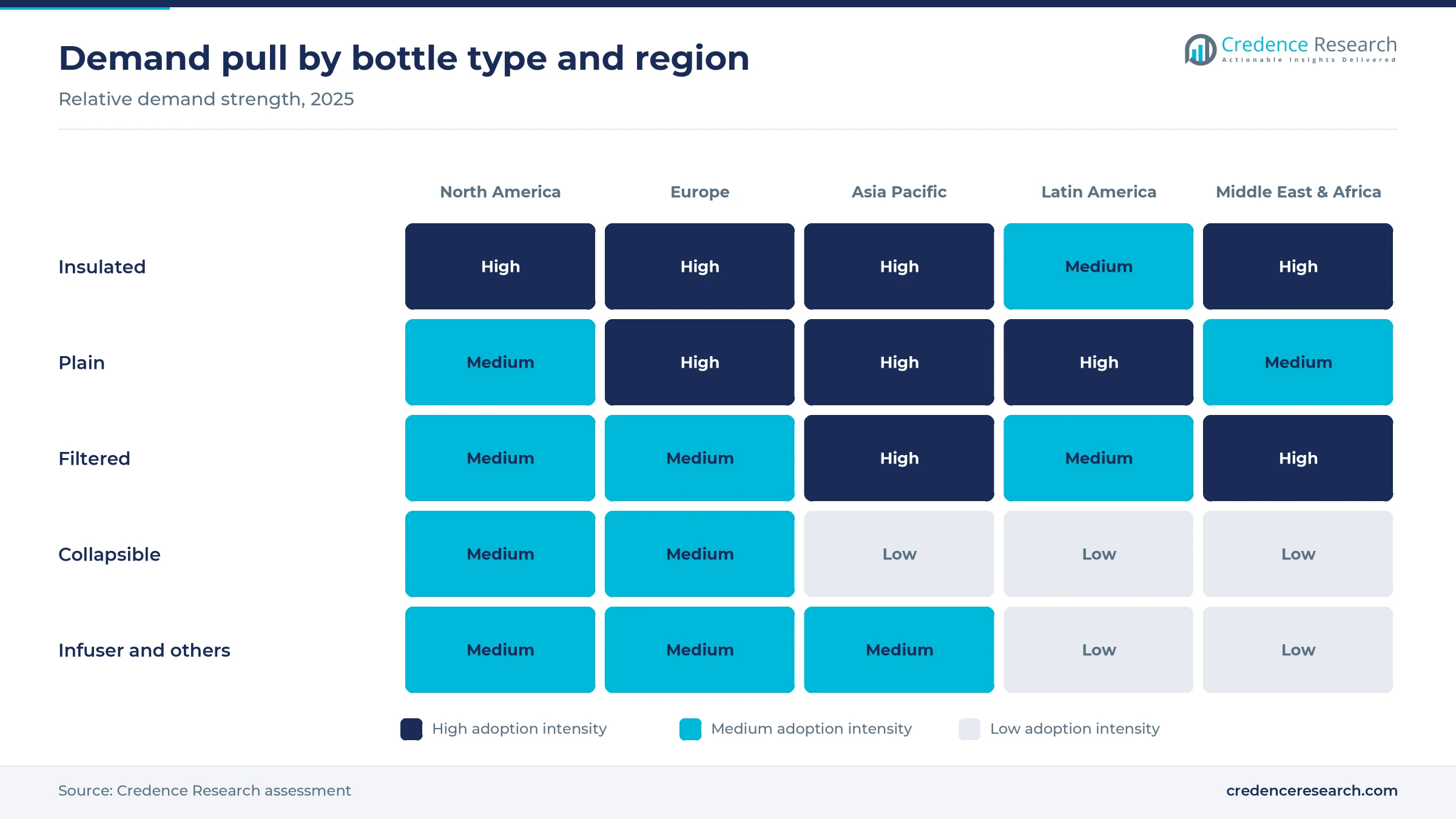
Governments are restricting disposable plastics, which moves everyday drinking toward bottles that buyers refill. The European Union required caps on single-use plastic beverage bottles of up to three liters to stay attached from July 3, 2024, and its Single-Use Plastics Directive sets at least 25% recycled content for PET bottles from 2025 and 30% for all beverage bottles from 2030. India banned identified single-use plastic items such as cups, glasses and straws from July 1, 2022, after 34 states and union territories had already issued their own restrictions. Mexico City banned single-use cutlery, cups and straws from Jan. 1, 2021, for its roughly 9 million residents. In turn, refill habits formed under these rules support demand for refillable formats in Asia Pacific.
Concern over plastic particles in bottled drinks lifts demand
Health concerns about plastic in packaged drinks give consumers a personal reason to switch to steel and glass bottles. Columbia University researchers reported in the Proceedings of the National Academy of Sciences in January 2024 that a liter of bottled water held about 240,000 plastic particles on average, and about 90% of them were nanoplastics, according to Axios. Concordia University researchers reviewed more than 140 studies and reported in October 2025 that people who drink bottled water take in about 90,000 more microplastic particles a year than tap water drinkers, according to ScienceDaily. As a result, Stainless Steel keeps the largest material share at 52.0% of 2025 value, because it adds no plastic to the drink.
Public refill networks make carrying a bottle easier
Free refill points lower the daily cost of carrying a reusable bottle, which turns a one-time purchase into a habit. Dubai Can, launched on Feb. 15, 2022, cut use of almost 18 million 500 ml single-use plastic water bottles in two years and had installed 50 public water stations with 30 more planned, according to Khaleej Times in March 2024. In the United Kingdom, the Refill campaign that City to Sea started in Bristol in 2015 maps cafes, shops and fountains where people can top up for free. WHO and UNICEF also reported that rural coverage of safely managed drinking water rose from 50% in 2015 to 60% in 2024, which widens the number of homes that can refill from a tap. As a result, plain and insulated bottles sell well wherever tap or station water is safe.
Limited editions and collaborations turn bottles into fashion
Brand collaborations and limited colors have turned the reusable bottle into a fashion item that buyers collect and replace. Starbucks sold a limited-edition pink 40-ounce Stanley quencher for $49.95 at its stores inside Target from Jan. 3, 2024, and many locations sold out, according to Axios. Contigo, a Newell Brands label, launched a limited-edition collection with artist Ally Love on Aug. 27, 2024, covering bottles, tumblers and travel mugs. Owala, launched by Trove Brands in 2020, saw its FreeSip bottle named one of Time's best inventions of 2023. These marketing strategies favor Insulated Water Bottles, which held 44.0% of 2025 value, and they keep shoppers returning to the wider drinkware aisles at mass retailers.
Recycled inputs, smart caps and plant-based polymers
Shift toward recycled steel and recycled plastic
A clear shift is under way toward bottles made from recycled inputs, which lets brands prove an environmental claim on the product itself. Klean Kanteen announced in August 2021 that its bottles would use certified 90% post-consumer recycled stainless steel, verified by Intertek and it has been Climate Neutral Certified since 2020. Nalgene introduced its Sustain bottles in August 2020 with 50% certified recycled content from Eastman Tritan Renew, roughly equal to eight single-use bottles each, at $14.95 for the 32-ounce size. European rules now require recycled content in PET drink bottles from 2025, which builds a larger supply of recycled resin. In turn, Stainless Steel brands use recycled metal claims to defend premium prices.
Rise of self-cleaning and filtering smart bottles
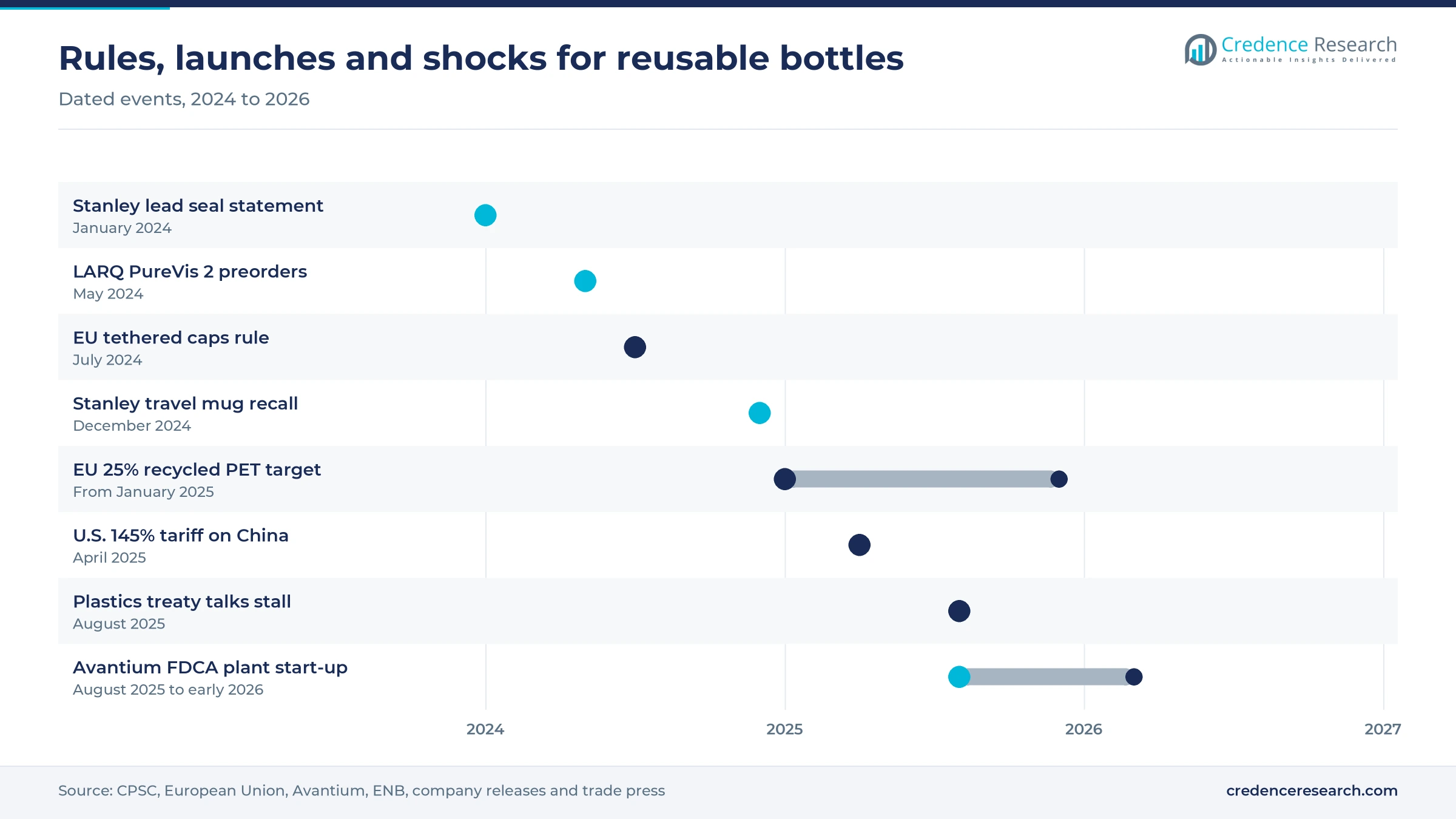
Smart and filtering bottles are rising as buyers want clean water on the go without buying packaged drinks. LARQ opened preorders for its PureVis 2 bottle in May 2024, with a cap-mounted UV light that it says removes up to 99.9999% of bio-contaminants and filters that target chlorine, PFOA and PFOS, at $79 against a $119 list price, according to Yanko Design. That crowdfunding campaign raised more than $528,000 before the bottles began shipping to backers. WHO and UNICEF counted 106 million people still drinking untreated surface water in 2024, which keeps filtration relevant for travelers and rural buyers. This is why Filtered Water Bottles grow fastest at 8.68% a year through 2035.
Opportunity in plant-based and biodegradable bottle materials
Plant-based polymers open an opportunity for brands that want bottles with a lower fossil footprint than conventional plastic. Avantium started up the first part of its FDCA flagship plant at Chemie Park Delfzijl in the Netherlands on Aug. 29, 2025, with capacity of up to five kilotons a year, according to Renewable Carbon News. Its partner Selenis will turn the FDCA into PEF, a fully plant-based and recyclable polymer that is undergoing food-contact testing. Avantium expects commercial sales in the first quarter of 2026 under existing offtake deals. Suppliers of bioplastics can therefore offer bottle brands a plant-based option for lids and bodies. Silicone, Bamboo and Bio-Based materials, which include bio-based bottles, grow at 8.54% a year as a result.
Opportunity in filter bottles where tap water is unsafe
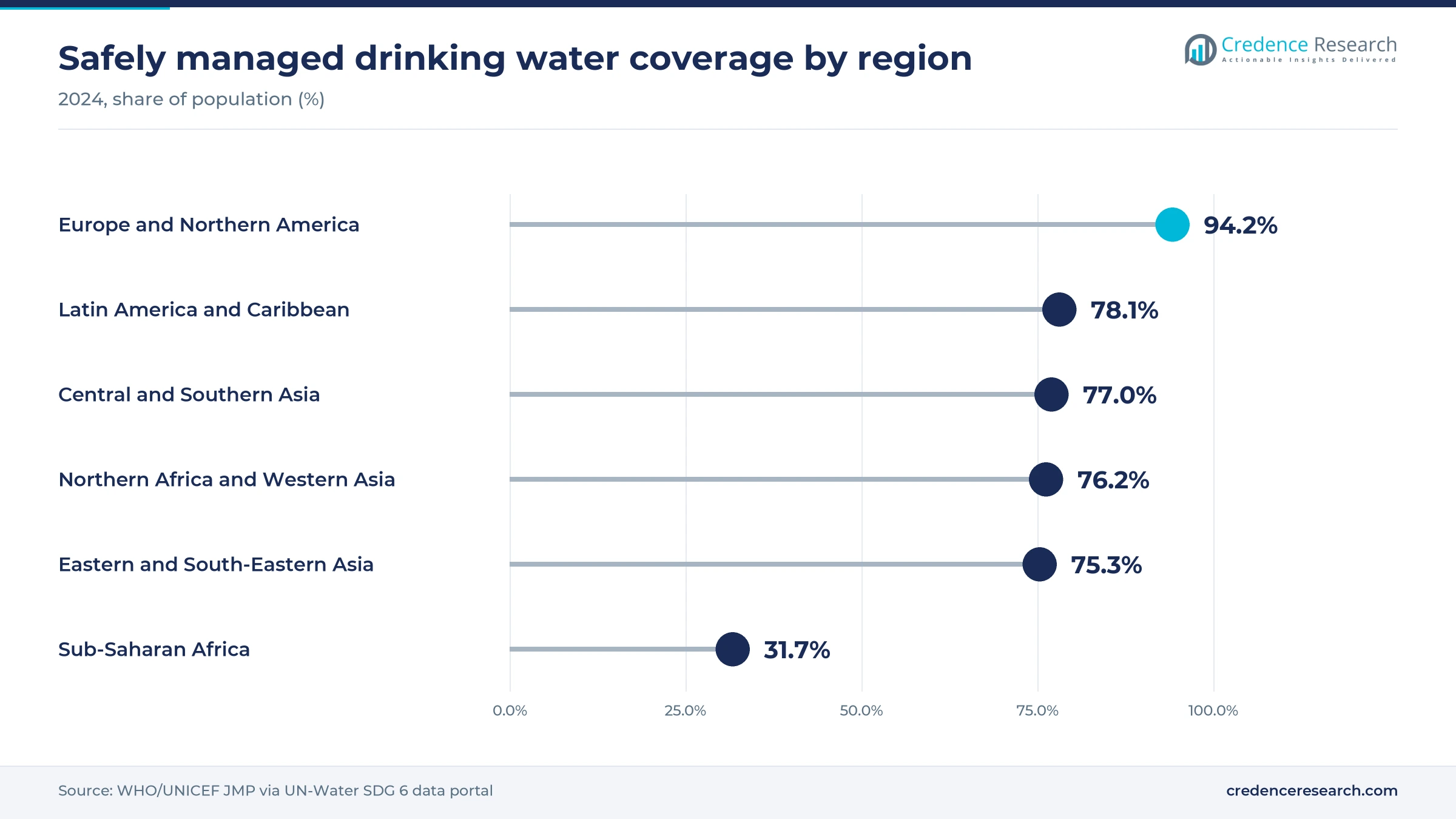
Regions with weak tap water quality offer an opening for filter bottles priced for daily use. Safely managed drinking water reached only 31.7% of people in sub-Saharan Africa in 2024, against 94.2% in Europe and Northern America, according to the UN-Water SDG 6 data portal. WHO and UNICEF reported in August 2025 that about 2.1 billion people, or one in four worldwide, lacked such a service. Coverage in Central and Southern Asia stood at 77.0%, which still leaves hundreds of millions of people without safe taps. Brands that pair a low-cost filter with a durable body can win schools, workers and travelers in these markets. This helps explain why Middle East & Africa grows at 7.76% a year.
Recalls, tariffs and stalled treaty talks weigh on brands
Product recalls and safety claims test buyer trust
Safety problems are a direct risk because a single defect can reach millions of units through mass retail. The U.S. Consumer Product Safety Commission announced on Dec. 12, 2024, that Stanley recalled about 2.6 million travel mugs after 91 reports of detached lids and 38 burn injuries worldwide. The mugs sold for $20 to $50 from June 2016. Brands answer with tighter lid testing, clearer care labels and fast replacement programs to protect repeat sales.
Tariffs raise the landed cost of China-made bottles
Dependence on one supplier country leaves brands exposed when trade rules change. The United States imported more than $1.6 billion of vacuum flasks and parts in 2024, and China supplied 96% of them, according to Sherwood News in April 2025. At a 145% tariff, a $45 Stanley tumbler could cost about $110, the same report estimated. Stanley already imports smaller volumes from Vietnam and Thailand, which gives it some room to shift orders.
Lead disclosures raise questions about vacuum seals
Material questions spread quickly on social media and can hit demand for a whole category. In January 2024, Stanley said the pellet that seals the vacuum layer at the base of its products contains some lead, although a steel layer covers it. A lawsuit on behalf of four women followed in California on Feb. 1, 2024, with other suits in Nevada and Washington state, according to Fox Business. Brands therefore publish clearer material statements on seals and coatings to reassure buyers.
Stalled global plastics treaty slows policy pull
Uneven policy weakens the regulatory push in countries that lack national bans on disposable bottles. The resumed fifth session of the plastics treaty committee ended in Geneva on Aug. 15, 2025, without adopting a treaty, according to the Earth Negotiations Bulletin. The chair adjourned the talks to resume at a later date, which leaves rules on single-use bottles to each country. Brands therefore depend on local laws, such as the EU tethered cap rule, rather than one global standard.
North America leads while Asia Pacific grows fastest
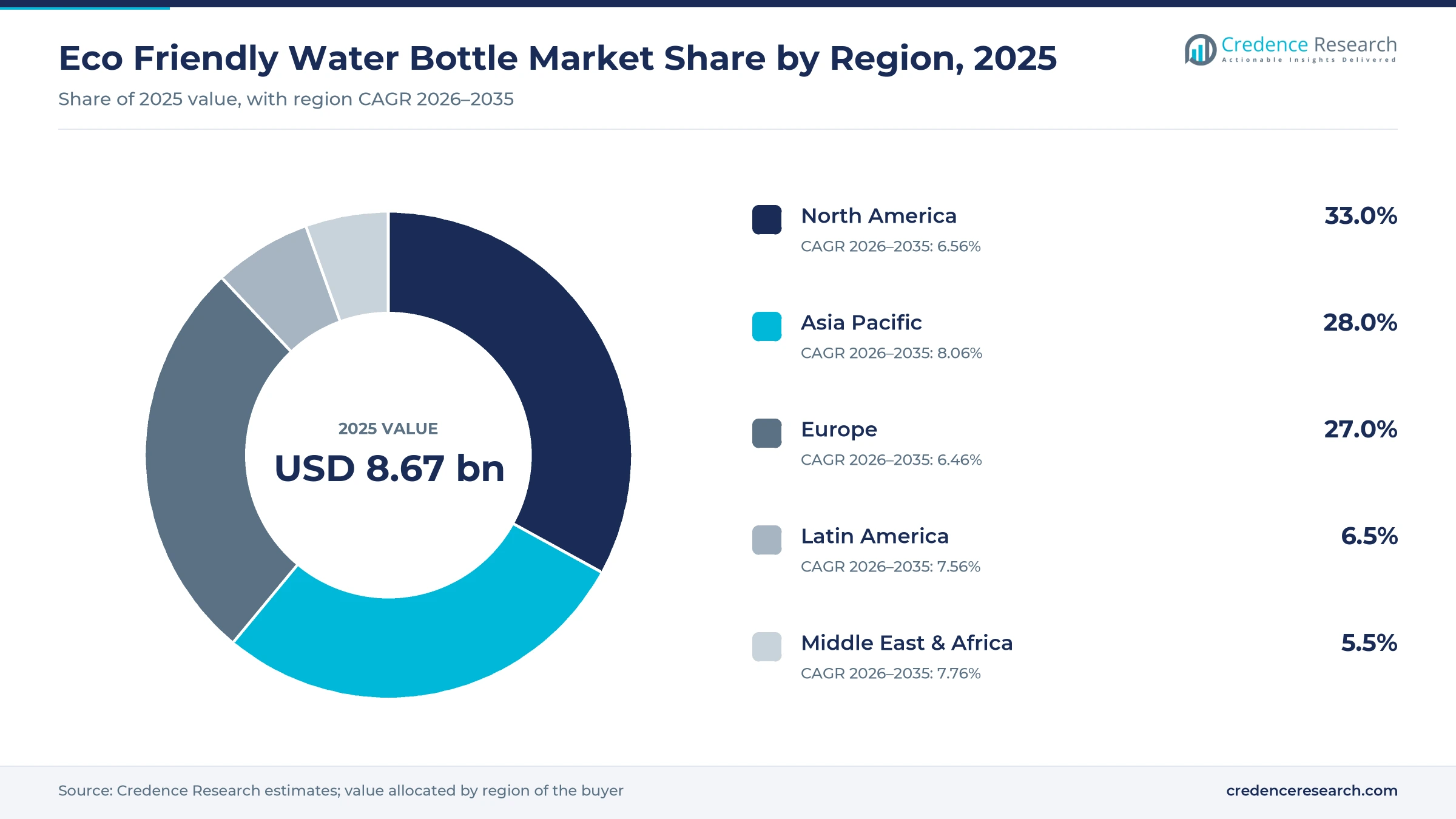
| Region | Value, 2025 (USD billion) | Share, 2025 | CAGR, 2026–2035 |
|---|---|---|---|
| North America | 2.86 | 33.0% | 6.56% |
| Asia Pacific | 2.43 | 28.0% | 8.06% |
| Europe | 2.34 | 27.0% | 6.46% |
| Latin America | 0.56 | 6.5% | 7.56% |
| Middle East & Africa | 0.48 | 5.5% | 7.76% |
North America leads on imports and mass retail reach
North America held 33.0% of 2025 value and grows at 6.56% a year, because U.S. households buy insulated bottles for work, school and sport. The United States imported more than $1.6 billion of vacuum flasks in 2024, mostly from China. Stanley sold its recalled mugs through Amazon, Walmart, Target and Dick's Sporting Goods, which shows how much volume runs through mass and online retail. However, the 2025 tariffs on Chinese goods raise landed costs for most brands in the region.
Asia Pacific grows fastest as factory base and buyer base
Asia Pacific held 28.0% of 2025 value and grows fastest at 8.06% a year, because it is both the main factory base and a large new consumer base. Yongkang in Zhejiang makes about one in three insulated tumblers sold worldwide, and more than 2,500 companies work in its thermal cup supply chain, according to the Global Times. China exported 27.8 billion yuan of thermal cups in 2022. India banned identified single-use plastic items from July 1, 2022, which steers offices and schools toward reusable bottles.
Europe grows on the strictest single-use plastic rules
Europe held 27.0% of 2025 value and grows at 6.46% a year, supported by the strictest single-use plastic rules among regions. The Single-Use Plastics Directive requires tethered caps from July 3, 2024, and 25% recycled content in PET bottles from 2025. In the United Kingdom, the Refill campaign has mapped free top-up points since its 2015 start in Bristol. Avantium's PEF plant in the Netherlands, which started up in August 2025, also gives European brands a local source of plant-based polymer.
Latin America adds demand under city plastic bans
Latin America held 6.5% of 2025 value and grows at 7.56% a year as city rules curb disposable items. Mexico City banned single-use cups, cutlery and straws from Jan. 1, 2021, for about 9 million residents. Safely managed drinking water reached 78.1% of people in Latin America and the Caribbean in 2024, according to the UN-Water SDG 6 portal, which leaves room for filter bottles in homes without safe taps. Price-sensitive buyers keep plain plastic and aluminum bottles important in the region.
Middle East and Africa gain from refill stations
Middle East & Africa held 5.5% of 2025 value and grows at 7.76% a year, the second-fastest pace. Dubai Can cut use of almost 18 million single-use plastic water bottles within two years of its Feb. 15, 2022, launch and had 50 public water stations by March 2024. In sub-Saharan Africa, only 31.7% of people used safely managed drinking water in 2024, which favors filter bottles over plain ones. Hot Gulf summers also favor insulated steel bottles that keep water cold all day.
Launches, a major recall and a new bio-based plant
| Development | Status and market relevance |
|---|---|
| In August 2024, Contigo launched a limited-edition bottle, tumbler and travel mug collection with artist Ally Love. | Launched in the United States by Newell Brands |
| In December 2024, Stanley recalled about 2.6 million Switchback and Trigger Action travel mugs sold in the United States. | Recall announced by the CPSC |
| In April 2025, a 145% U.S. tariff on Chinese imports put pressure on bottle brands, since China supplied 96% of 2024 U.S. vacuum flask imports. | Brands review sourcing in Vietnam and Thailand |
| In August 2025, the resumed plastics treaty talks in Geneva ended without adopting a global treaty on plastic pollution. | Session adjourned to resume at a later date |
| In August 2025, Avantium started up its FDCA flagship plant in Delfzijl, the Netherlands, with up to five kilotons of yearly capacity. | Commercial PEF sales expected in early 2026 |
Vacuum walls, UV caps and recycled resins shape products
- Double-wall vacuum insulation keeps drinks hot or cold for hours, and China alone makes about 800 million such steel tumblers a year.
- UV cleaning caps treat the water inside the bottle, as in the LARQ PureVis 2 that opened for preorder in May 2024 at $79.
- Recycled-content resins such as Eastman Tritan Renew let Nalgene make Sustain bottles with 50% certified recycled content.
- Plant-based polymers such as PEF, made from FDCA at the Avantium plant in Delfzijl, add a new option to bioplastic packaging materials for bottle bodies.
Need a Custom Version of This Report?
Tailor the scope, geography, or segments to your exact requirements.
- Custom geography or segment scope
- Direct access to our analyst team
Many brands compete on design, lids and retail reach
Competition is spread across many brands, and no single company holds a dominant share of global value. Stanley, owned by PMI Worldwide, and Owala, owned by Trove Brands, have driven much of the recent U.S. demand for straw-lid insulated designs. Contigo, a Newell Brands label, competes on spill-proof lids and mass retail placement, while Hydro Flask, owned by Helen of Troy, and Thermos compete on insulation and color ranges. Klean Kanteen, SIGG and Nalgene compete on durability and recycled or long-life materials, and LARQ competes on purification features. Many insulated brands sell straw-lid reusable tumblers alongside bottles, so one lid design can serve both lines. Most brands use contract factories in China, which gives new entrants fast access to supply. As a result, brands compete through limited editions, collaborations, safety testing and retail placement more than through factory scale.
Companies profiled and their roles in this market
| Company | Type | Role in the market |
|---|---|---|
| Stanley (PMI Worldwide) | Brand owner | Insulated quenchers and travel mugs; recalled 2.6 million mugs in December 2024 |
| Owala (Trove Brands) | Brand owner | FreeSip insulated bottle with a dual-mode straw lid, launched in 2020 |
| Contigo (Newell Brands) | Brand owner | Spill-proof bottles and travel mugs in mass retail; Ally Love collection in 2024 |
| Hydro Flask (Helen of Troy) | Brand owner | Insulated stainless steel bottles in many colors and lid styles |
| Klean Kanteen | Brand owner | Bottles made with certified 90% recycled stainless steel |
| Nalgene | Brand owner | Sustain bottles with 50% recycled Tritan Renew content |
| Thermos | Brand owner | Vacuum-insulated bottles and food jars |
| LARQ | Brand owner | PureVis UV-cleaning and filtering smart bottles |
Analyst view on where reusable bottle demand heads
Credence Research's view is that reusable bottles are moving from a trend purchase to a routine household item. Plastic rules in the European Union and India, and refill networks such as Dubai Can push in the same direction. However, the tumbler boom of 2023 and 2024 showed how quickly demand can swing on fashion, and the 2024 recall and 2025 tariffs showed how exposed brands are to safety and trade shocks. The online channel, growing at 8.08% a year, will take a larger share of demand as shoppers compare lids and prices. Brands that pair recycled or plant-based materials with filtration and reliable lids are best placed to grow through 2035.
Sizing approach behind the reusable bottle estimates
The report uses 2025 as the base year and 2026 to 2035 as the forecast period. Market values come from the Credence Research model, which brings the earlier 2024 estimate forward one year with its own growth rate and then applies a revised growth rate checked against trade data on vacuum flask imports and Chinese production volumes. Segment and regional splits are Credence Research estimates based on public data. Sources include WHO and UNICEF, the UN-Water SDG 6 data portal, the U.S. Census Bureau, the U.S. Consumer Product Safety Commission, European Union and Indian government texts, company press releases and trade publications. No interviews or surveys were used to build these estimates.
Reusable bottle outlook to 2035 rests on reuse habits
Through 2035, growth rests on steady reuse habits rather than on viral product launches. European recycled-content targets rise to 30% for all beverage bottles in 2030, which keeps pressure on single-use plastic in the region. Asia Pacific should add the most new value, because China makes most insulated bottles and India keeps its single-use plastic ban. Filter bottles gain where tap water is unsafe, especially in sub-Saharan Africa, where fewer than a third of people had safe coverage in 2024. Plant-based polymers such as PEF could reach bottle bodies once food-contact approvals and commercial volumes are in place after 2026.
Frequently Asked Questions
What was the eco-friendly water bottle market worth in 2025?
Which bottle type leads the market?
Is there a market for biodegradable water bottles?
What is the Contigo water bottle market share?
What marketing strategy works for reusable water bottles?
How large is the collapsible water bottle segment?
Where is demand for reusable bottles strongest?
Which rules support reusable bottle demand?
Table of Content
Chapter 1 Market Segmentation
- 1.1 Segmentation Framework
- 1.1.1 Product and Service Classification
- 1.1.2 Application and End-Use Classification
- 1.1.3 Technology and Solution Classification
- 1.1.4 Customer and Distribution Channel Classification
- 1.1.5 Geographic Segmentation
- 1.1.6 Market Segment Definitions and Boundaries
- 1.2 By Product Type
- 1.2.1 Insulated Water Bottles
- 1.2.2 Plain Water Bottles
- 1.2.3 Filtered Water Bottles
- 1.2.4 Collapsible Water Bottles
- 1.2.5 Infuser and Others
- 1.3 By Material
- 1.3.1 Stainless Steel
- 1.3.2 Plastic
- 1.3.3 Glass
- 1.3.4 Aluminum
- 1.3.5 Silicone, Bamboo and Bio-Based
Chapter 2 Introduction
- 2.1 Report Objectives and Scope
- 2.2 Product Definition and Industry Terminology
- 2.3 Market Inclusions and Exclusions
- 2.4 Research Process
- 2.4.1 Primary Research and Expert Interviews
- 2.4.2 Secondary Research and Source Review
- 2.4.3 Top-Down and Bottom-Up Estimation
- 2.4.4 Data Triangulation and Verification
- 2.5 Market Size Measurement Basis
- 2.5.1 2025: USD 8.67 billion → 2035: USD 17.21 billion
- 2.6 Historical and Forecast Reference Periods
- 2.6.1 Historical Period: 2018-2025
- 2.6.2 Base Year: 2025
- 2.6.3 Forecast Period: 2025-2035
- 2.7 Research Assumptions and Limitations
Chapter 3 Executive Summary
- 3.1 Market Snapshot and Key Findings
- 3.2 Base-Year Market Size, 2025
- 3.3 Forecast Market Size, 2035
- 3.4 Revenue and Volume Growth Outlook
- 3.5 Key Demand and Supply Indicators
- 3.6 Leading Market Segments
- 3.7 Fastest-Growing Market Opportunities
- 3.8 Regional Performance Highlights
- 3.9 Technology and Industry Transformation
- 3.10 Competitive Landscape Summary
- 3.11 Analyst View and Strategic Implications
Chapter 4 Global Eco Friendly Water Bottle Market Trends and Developments
- 4.1 Historical Industry Development, 2018-2025
- 4.2 Recent Market Trends and Developments
- 4.3 Demand and Customer Behavior Trends
- 4.4 Technology and Product Innovation
- 4.5 Artificial Intelligence, Automation and Digitalization
- 4.6 Local Manufacturing and Supply Chain Realignment
- 4.7 Industry Partnerships, Mergers and Acquisitions
- 4.8 Sustainability and Circular Economy Developments
- 4.9 Government and Private Sector Investment Trends
- 4.10 Emerging Business Models and Commercialization
- 4.11 Industry Developments and Announcements
Chapter 5 Global Eco Friendly Water Bottle Market Production, Supply and Demand Analysis
- 5.1 Demand Trend and Consumption Analysis, 2018-2025
- 5.2 Demand Forecast, 2025-2035
- 5.3 Production and Output Trend, 2018-2025
- 5.4 Production and Output Forecast, 2025-2035
- 5.5 Installed Capacity and Capacity Utilization
- 5.6 Company-Wise Production Plants and Statistics
- 5.6.1 Installed Production Capacity
- 5.6.2 Actual Production
- 5.6.3 Planned Capacity and Expansion Targets
- 5.7 Supply Chain Structure and Procurement Trends
- 5.8 Supply-Demand Gap and Bottlenecks
- 5.9 Import Dependence and Sourcing Structure
- 5.10 Contract Manufacturing and Outsourcing
- 5.11 Regional Supply and Demand Concentration
Chapter 6 Global Eco Friendly Water Bottle Market Pricing Analysis
- 6.1 Pricing Structure and Measurement
- 6.2 Historical Pricing Trends, 2018-2025
- 6.3 Pricing Outlook, 2025-2035
- 6.4 Average Selling Price and Unit Economics
- 6.5 Pricing by Product and Market Segment
- 6.6 Geographic Pricing Differences
- 6.7 Key Input, Energy, Labor and Logistics Costs
- 6.8 Contract Pricing and Purchasing Models
- 6.9 Pricing Sensitivity and Competitive Positioning
- 6.10 Price, Margin and Profitability Implications
Chapter 7 Global Eco Friendly Water Bottle Market Dynamics
- 7.1 Market Growth Drivers
- 7.1.1 Demand-Side Drivers
- 7.1.2 Technology and Innovation Drivers
- 7.1.3 Infrastructure and Investment Drivers
- 7.1.4 Regulatory and Policy Drivers
- 7.2 Market Restraints
- 7.2.1 Cost and Affordability Constraints
- 7.2.2 Technology and Adoption Barriers
- 7.2.3 Supply Chain and Operational Constraints
- 7.3 Market Challenges
- 7.3.1 Competitive Pressure and Margin Erosion
- 7.3.2 Skills, Infrastructure and Implementation Gaps
- 7.4 Emerging Market Opportunities
- 7.5 Market Dynamics Impact and Time-Horizon Assessment
Chapter 8 Global Eco Friendly Water Bottle Value Chain Analysis
- 8.1 Industry Value Chain Overview
- 8.2 Upstream Suppliers and Critical Inputs
- 8.3 Technology and Component Providers
- 8.4 Manufacturing or Service Delivery
- 8.5 Distribution, Channel Partners and Integrators
- 8.6 Downstream Applications and End Users
- 8.7 Value Addition and Profit Pools
- 8.8 Vertical Integration and Outsourcing
- 8.9 Supplier Concentration and Risk
- 8.10 Supply Chain Localization and Resilience
Chapter 9 Global Eco Friendly Water Bottle Market Regulations and Policies
- 9.1 Relevant Laws, Standards and Compliance Frameworks
- 9.2 Product, Service, Safety and Quality Requirements
- 9.3 Government Policies, Incentives and Subsidies
- 9.4 Imports, Exports and Trade Barriers
- 9.5 Public Procurement and Local Content Requirements
- 9.6 Environmental and Sustainability Compliance
- 9.7 Upcoming Policy Changes and Market Implications
Chapter 10 Global Eco Friendly Water Bottle Market Hotspots and Opportunities
- 10.1 Market Opportunity Mapping and Growth Hotspots
- 10.2 High-Growth Applications and Customer Groups
- 10.3 Underserved Markets and White-Space Opportunities
- 10.4 Emerging Technology and Product Opportunities
- 10.5 New Capacity and Investment Hotspots
- 10.6 Market Entry and Expansion Opportunities
- 10.7 Distribution and Partnership Opportunities
- 10.8 Near-Term and Long-Term Commercial Potential
- 10.9 Opportunity Attractiveness and Execution Risks
Chapter 11 Global Eco Friendly Water Bottle Market Outlook, 2025-2035
- 11.1 Market Size and Analysis
- 11.1.1 Revenue (Market Measurement: 2025: USD 8.67 billion → 2035: USD 17.21 billion)
- 11.1.2 Market Volume and Quantity Sold
- 11.1.3 Historical Market Size, 2018-2025
- 11.1.4 Base-Year Market Size, 2025
- 11.2 Market Forecast, 2025-2035
- 11.2.1 Revenue Forecast to 2035
- 11.2.2 Volume Forecast to 2035
- 11.2.3 CAGR and Year-on-Year Growth
- 11.2.4 Incremental Revenue Opportunity
- 11.3 Forecast Assumptions and Scenario Analysis
- 11.3.1 Base-Case Forecast
- 11.3.2 Optimistic and Conservative Scenarios
- 11.3.3 Technology, Pricing and Policy Sensitivities
- 11.4 Market Attractiveness and Growth Outlook
Chapter 12 Global Eco Friendly Water Bottle Market Segmentation and Outlook
- 12.1 Segmentation Summary and Market Shares, 2025
- 12.2 Largest and Fastest-Growing Segments
- 12.3 By Product Type - Market Size and Forecast, 2025-2035
- 12.3.1 Segment Definition and Scope
- 12.3.2 Historical Market Size, 2018-2025
- 12.3.3 Revenue Forecast, 2025-2035
- 12.3.4 Volume Forecast, 2025-2035
- 12.3.5 Base-Year Market Share, 2025
- 12.3.6 Segment CAGR and Growth Drivers
- 12.3.7 Subsegment Market Size and Forecast
- 12.3.7.1 Insulated Water Bottles
- 12.3.7.2 Plain Water Bottles
- 12.3.7.3 Filtered Water Bottles
- 12.3.7.4 Collapsible Water Bottles
- 12.3.7.5 Infuser and Others
- 12.3.8 Subsegment Pricing and Adoption Trends
- 12.3.9 Leading Suppliers and Competition
- 12.3.10 Regional Demand and Opportunities
- 12.4 By Material - Market Size and Forecast, 2025-2035
- 12.4.1 Segment Definition and Scope
- 12.4.2 Historical Market Size, 2018-2025
- 12.4.3 Revenue Forecast, 2025-2035
- 12.4.4 Volume Forecast, 2025-2035
- 12.4.5 Base-Year Market Share, 2025
- 12.4.6 Segment CAGR and Growth Drivers
- 12.4.7 Subsegment Market Size and Forecast
- 12.4.7.1 Stainless Steel
- 12.4.7.2 Plastic
- 12.4.7.3 Glass
- 12.4.7.4 Aluminum
- 12.4.7.5 Silicone, Bamboo and Bio-Based
- 12.4.8 Subsegment Pricing and Adoption Trends
- 12.4.9 Leading Suppliers and Competition
- 12.4.10 Regional Demand and Opportunities
- 12.5 Segment Growth Comparison
- 12.6 Segment Attractiveness and Priority Matrix
Chapter 13 Global Eco Friendly Water Bottle Geographic Market Outlook, 2025-2035
- 13.1 Regional Market Size and Share, 2025
- 13.2 Regional Market Forecast, 2025-2035
- 13.3 Regional Pricing, Production and Demand Differences
- 13.4 North America
- 13.4.1 United States
- 13.4.2 Canada
- 13.4.3 Mexico
- 13.5 Europe
- 13.5.1 Germany
- 13.5.2 France
- 13.5.3 Italy
- 13.5.4 United Kingdom
- 13.5.5 Spain
- 13.5.6 Poland
- 13.5.7 Russia
- 13.5.8 Netherlands
- 13.5.9 Belgium
- 13.5.10 Sweden
- 13.5.11 Denmark
- 13.5.12 Norway
- 13.5.13 Rest of Europe
- 13.6 Asia Pacific
- 13.6.1 China
- 13.6.2 India
- 13.6.3 Japan
- 13.6.4 South Korea
- 13.6.5 Thailand
- 13.6.6 Indonesia
- 13.6.7 Vietnam
- 13.6.8 Malaysia
- 13.6.9 Australia
- 13.6.10 Rest of Asia Pacific
- 13.7 Latin America
- 13.7.1 Brazil
- 13.7.2 Argentina
- 13.7.3 Colombia
- 13.7.4 Chile
- 13.7.5 Rest of Latin America
- 13.8 Middle East
- 13.8.1 Saudi Arabia
- 13.8.2 United Arab Emirates
- 13.8.3 Turkey
- 13.8.4 Israel
- 13.8.5 Iran
- 13.8.6 Rest of the Middle East
- 13.9 Africa
- 13.9.1 South Africa
- 13.9.2 Egypt
- 13.9.3 Nigeria
- 13.9.4 Morocco
- 13.9.5 Rest of Africa
- 13.10 Regional Investment, Policy and Supply Chain Differences
- 13.11 Regional Competitive Landscape
- 13.12 Geographic Growth Hotspots
Chapter 14 Global Eco Friendly Water Bottle Technology, Innovation and Sustainability Outlook
- 14.1 Technology Landscape and Maturity
- 14.2 Product, Process and Service Innovation
- 14.3 AI, Automation and Digital Tools in the Industry
- 14.4 Technology Adoption and Performance Benchmarking
- 14.5 Innovation Pipeline and R&D Investment
- 14.6 Patent and Intellectual Property Trends
- 14.7 Energy Efficiency and Resource Management
- 14.8 Sustainability, Recycling and Circularity
- 14.9 Technology Roadmap, 2025-2035
- 14.10 Risks of Obsolescence and Technology Substitution
Chapter 15 Global Eco Friendly Water Bottle Market Key Strategic Imperatives
- 15.1 Growth and Market Entry Priorities
- 15.2 High-Return Products and Segments
- 15.3 Pricing, Profitability and Cost Optimization
- 15.4 Technology Investment and Product Differentiation
- 15.5 Supply Chain Localization and Resilience
- 15.6 Distribution and Customer Acquisition
- 15.7 Partnership, Acquisition and Capacity Strategy
- 15.8 Regional Expansion Priorities
- 15.9 Short-, Medium- and Long-Term Actions
Chapter 16 Competition Outlook
- 16.1 Industry Competition Characteristics
- 16.2 Market Structure and Concentration
- 16.3 Market Share and Competitive Positioning, 2025
- 16.4 Company-Wise Revenue and Product Benchmarking
- 16.5 Production and Service Capacity Benchmarking
- 16.6 Technology, Pricing and Differentiation
- 16.7 Regional Footprint and Distribution Strength
- 16.8 Mergers, Acquisitions and Strategic Alliances
- 16.9 New Entrants and Competitive Threats
- 16.10 Porter's Five Forces and Industry Attractiveness
- 16.11 Competitive Outlook, 2025-2035
Chapter 17 Company Profiles
- 17.1 Company Coverage and Selection Criteria
- 17.2 Stanley (PMI Worldwide)
- 17.2.1 Business Description
- 17.2.2 Company Ownership and Geographic Presence
- 17.2.3 Product and Service Portfolio
- 17.2.4 Manufacturing and Operating Footprint
- 17.2.5 Production Capacity and Expansion Plans
- 17.2.6 Financial Performance and Investment
- 17.2.7 Market Share and Competitive Position
- 17.2.8 Technology and Innovation Capabilities
- 17.2.9 Strategic Alliances or Partnerships
- 17.2.10 Recent Developments
- 17.2.11 Growth Strategy and Outlook
- 17.3 Owala (Trove Brands)
- 17.4 Contigo (Newell Brands)
- 17.5 Hydro Flask (Helen of Troy)
- 17.6 Klean Kanteen
- 17.7 Nalgene
- 17.8 Thermos
- 17.9 LARQ
- 17.10 CamelBak
- 17.11 SIGG Switzerland AG
- 17.12 Other Relevant Market Participants
Note: Every listed company is profiled on the structure shown under the first company. The company list is preliminary and may change based on research findings, market developments, data availability and client requirements.
Chapter 18 Disclaimer
- 18.1 Research and Forecast Disclaimer
- 18.2 Data Source and Estimation Limitations
Note: The depth of individual sections depends on data availability for this market. Volume, capacity, trade and other unit-based metrics are included where applicable.

