
Market Overview:
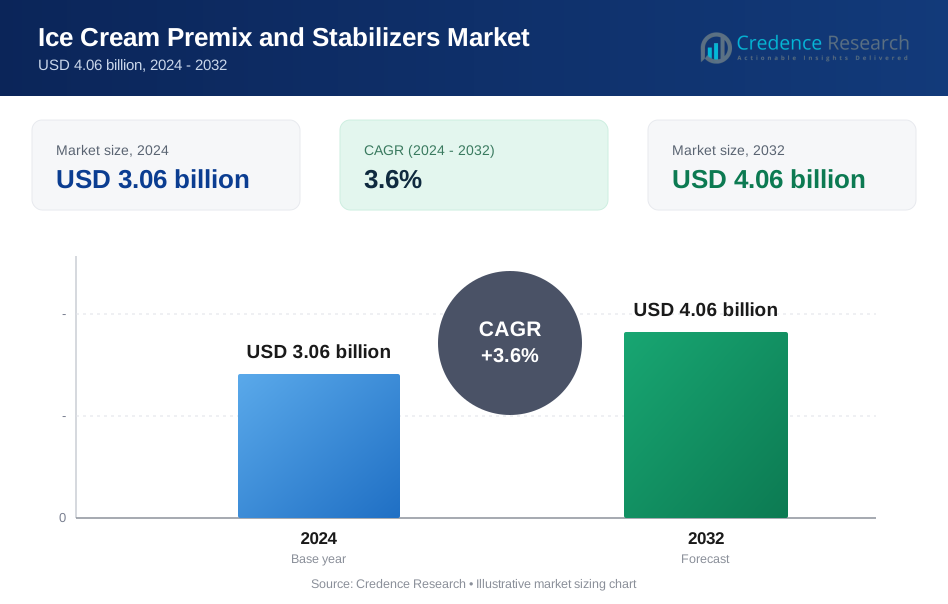
The Ice Cream Premix and Stabilizers Market size was valued at USD 3.06 billion in 2024 and is anticipated to reach USD 4.06 billion by 2032, at a CAGR of 3.6% during the forecast period (2024-2032).
| REPORT ATTRIBUTE | DETAILS |
|---|---|
| Historical Period | 2020-2023 |
| Base Year | 2024 |
| Forecast Period | 2025-2032 |
| Ice Cream Premix and Stabilizers Market Size 2024 | USD 3.06 billion |
| Ice Cream Premix and Stabilizers Market, CAGR | 3.6% |
| Ice Cream Premix and Stabilizers Market Size 2032 | USD 4.06 billion |
Rising consumer demand for premium and indulgent ice cream products, coupled with the surge in functional and clean-label ingredients, is shaping market growth. Manufacturers are investing in plant-based stabilizers and low-fat premix variants to cater to health-conscious consumers. The increasing penetration of quick-service restaurants (QSRs), specialty dessert chains, and online delivery platforms also fuels demand for ice cream premix and stabilizers, as these products offer operational efficiency and product standardization across diverse outlets.
Regionally, North America dominates the market due to strong demand for frozen desserts and innovation in product formulations. Europe follows, supported by strict quality standards and rising preference for natural stabilizers. The Asia-Pacific region is expected to record the fastest growth, driven by rapid urbanization, expanding middle-class populations, and a surge in organized retail distribution networks. Growing investments in cold chain infrastructure are further strengthening regional market expansion.

Market Insights:
- The Ice Cream Premix and Stabilizers Market is valued at USD 3.06 billion and projected to reach USD 4.06 billion by 2032, growing at a CAGR of 3.6%.
- Rising demand for premium and indulgent desserts is boosting adoption of premix and stabilizer formulations.
- Health-conscious consumers are driving growth in plant-based stabilizers and low-fat premix alternatives.
- Expanding QSRs, specialty dessert chains, and delivery platforms strengthen reliance on standardized premixes.
- High production costs and volatile raw material prices remain key challenges for market participants.
- North America leads with 38% share, followed by Europe at 27%, supported by innovation and quality standards.
- Asia-Pacific holds 22% share and is expected to post the fastest growth driven by urbanization and retail expansion.
Market Drivers:
Rising Demand for Premium and Indulgent Desserts Driving Market Expansion
The Ice Cream Premix and Stabilizers Market is experiencing growth due to consumer preference for premium desserts. Increasing awareness of texture, flavor, and product quality supports higher consumption of stabilizer-based formulations. It ensures consistent mouthfeel, smoothness, and extended shelf life, which are critical for consumer satisfaction. Growing demand for indulgent treats in both retail and foodservice channels reinforces the adoption of premixes.
Health-Conscious Consumers Encouraging Plant-Based and Low-Fat Formulations
The market is witnessing strong traction from health-conscious consumers seeking clean-label and plant-based alternatives. Manufacturers are introducing low-fat premix options and stabilizers derived from natural sources to meet evolving dietary preferences. It allows producers to balance indulgence with healthier product positioning. This driver is particularly significant as vegan and lactose-free ice cream segments gain momentum worldwide.
- For instance, DuPont Nutrition & Biosciences developed GRINDSTED GELLAN VEG 200, a stabilizer made from a single natural bacterial source that provides optimal texture in plant-based beverages without requiring other additives.
Rising Penetration of Quick-Service Restaurants and Specialty Dessert Chains
The expanding network of QSRs and dessert-focused outlets is fueling consistent demand for premixes and stabilizers. It enables standardized recipes, faster preparation, and uniform product quality across outlets. Operators rely on stabilizers for reliable texture, which enhances operational efficiency in high-demand environments. The growing influence of global and regional foodservice chains is strengthening market growth further.
- For instance, to achieve high efficiency, Ben & Jerry's production facilities are equipped to dispense ice cream at a rate of 200 pints per minute.
Expansion of E-Commerce and Cold Chain Infrastructure Supporting Growth
The Ice Cream Premix and Stabilizers Market benefits from robust distribution networks and improved cold chain infrastructure. The rise of e-commerce platforms and food delivery services increases accessibility to premium dessert products. It ensures product stability and consistent quality during transport and storage. Strong supply chain advancements continue to create favorable conditions for market expansion worldwide.
Market Trends:
Innovation in Functional and Clean-Label Ingredients Shaping Consumer Preferences
The Ice Cream Premix and Stabilizers Market is witnessing a strong shift toward functional and clean-label ingredient adoption. Consumers increasingly prefer natural stabilizers and premixes free from artificial additives, reflecting rising health awareness. It is driving manufacturers to invest in plant-based gums, natural emulsifiers, and reduced-fat formulations to align with dietary trends. Functional ingredients such as protein-enriched premixes and probiotic-infused stabilizers are gaining market traction. The clean-label movement also enhances product transparency, which strengthens consumer trust and brand loyalty. Growing regulatory support for natural food additives further accelerates the use of clean-label solutions across diverse ice cream applications.
- For instance, Valio's Eila MPC 65, a lactose-free milk protein concentrate, contains 65 grams of protein per 100 grams, enabling the creation of high-protein ice cream with a clean, milky taste.
Technological Advancements and Distribution Expansion Strengthening Market Growth
Ongoing technological innovation in processing and formulation is significantly shaping the Ice Cream Premix and Stabilizers Market. Advanced encapsulation techniques improve flavor retention and stability, offering manufacturers enhanced control over product performance. It also supports the development of new textures and formats that meet evolving consumer preferences for premium desserts. At the same time, expanding e-commerce and food delivery platforms increase accessibility, creating new growth channels. The expansion of cold chain infrastructure ensures quality maintenance during transport, which is vital for frozen desserts. Strategic collaborations between ingredient suppliers and ice cream brands are further supporting product innovation and faster market penetration.
- For instance, in August 2020, Hudsonville Ice Cream started a project to add a 156,466-square-foot cold storage hub to its headquarters, supporting the brand's expanding logistics and distribution network.
Market Challenges Analysis:
High Production Costs and Volatile Raw Material Prices Restraining Growth
The Ice Cream Premix and Stabilizers Market faces challenges due to high production costs and fluctuating raw material prices. Sourcing natural stabilizers such as guar gum, locust bean gum, and carrageenan often depends on seasonal crop yields, creating supply inconsistencies. It increases price volatility, which directly impacts production budgets for both small and large manufacturers. Rising energy and transportation costs further strain margins, making it difficult to maintain competitive pricing. Producers must constantly optimize formulations to balance quality with affordability. This dynamic continues to challenge market players operating in cost-sensitive regions.
Stringent Regulations and Shifting Consumer Perceptions Creating Barriers
Strict regulatory frameworks around food safety and labeling also pose obstacles for the Ice Cream Premix and Stabilizers Market. Compliance with international and regional standards demands continuous investment in product testing and certification. It can delay new product launches and increase operational costs for manufacturers. At the same time, shifting consumer perceptions toward artificial stabilizers intensify the pressure to reformulate. Brands that rely heavily on synthetic additives risk losing consumer trust in health-driven markets. The need to innovate while adhering to strict regulations creates ongoing challenges for global and regional market participants.
Market Opportunities:
Rising Demand for Plant-Based and Functional Dessert Solutions Creating Growth Potential
The Ice Cream Premix and Stabilizers Market is positioned to benefit from the increasing demand for plant-based and functional dessert products. Consumers are seeking dairy-free, vegan, and low-fat options that align with health and sustainability goals. It provides manufacturers with opportunities to innovate stabilizers derived from natural sources such as alginates, pectins, and guar gum. Functional premixes enriched with proteins, probiotics, and vitamins are also expanding market scope. Growing awareness of clean-label products strengthens consumer trust and widens acceptance in retail and foodservice channels. This trend allows brands to capture premium positioning while meeting evolving dietary preferences.
Expanding E-Commerce, Cold Chain Infrastructure, and Emerging Market Adoption Driving Opportunities
Expanding digital retail and food delivery networks are creating favorable conditions for the Ice Cream Premix and Stabilizers Market. The rising presence of e-commerce platforms allows wider consumer access to specialty dessert products. It also benefits from improvements in cold chain infrastructure, ensuring stability and consistent quality during distribution. Emerging economies in Asia-Pacific, Latin America, and the Middle East present untapped opportunities driven by urbanization and increasing disposable incomes. The adoption of standardized premixes by quick-service restaurants and specialty chains supports rapid market growth. These opportunities highlight the market’s strong potential for global expansion and product diversification.
Market Segmentation Analysis:
By Type
The Ice Cream Premix and Stabilizers Market is segmented into dairy-based premixes, non-dairy premixes, and stabilizers such as guar gum, carrageenan, and pectin. Dairy-based premixes dominate due to their widespread use in traditional ice cream formulations. Non-dairy premixes are expanding quickly, driven by rising demand for vegan and lactose-free products. It supports manufacturers targeting health-conscious and sustainability-focused consumers. Stabilizers remain critical for maintaining texture, mouthfeel, and shelf life across both premium and mass-market ice cream products. Growth in clean-label stabilizers further strengthens their market relevance.
- For instance, Nestlé implemented a proprietary fat-reduction technology across 2 of its major powdered milk brands, Ninho and Nido, to improve their nutritional value while maintaining a creamy texture.
By Distribution Channel
The Ice Cream Premix and Stabilizers Market is distributed through supermarkets, hypermarkets, convenience stores, specialty outlets, and online platforms. Supermarkets and hypermarkets hold a major share due to their wide product availability and established retail presence. Specialty outlets cater to premium and artisanal ice cream brands, offering tailored solutions for niche consumers. Online platforms are experiencing strong growth as e-commerce and food delivery services expand globally. It ensures higher accessibility of premixes and stabilizers across diverse regions. Strong supply chain networks and cold chain infrastructure improvements support consistent product quality in all distribution channels.
- For instance, major retailers like Walmart offer consumers premix options such as the Nostalgia brand, where a single 8 oz packet can produce 2 quarts of ice cream at home.
Segmentations:
By Type
- Dairy-Based Premixes
- Non-Dairy Premixes
- Guar Gum
- Carrageenan
- Pectin
- Other Stabilizers
By Distribution Channel
- Supermarkets
- Hypermarkets
- Convenience Stores
- Specialty Outlets
- Online Platforms
By Region
- North America
- U.S.
- Canada
- Mexico
- Europe
- UK
- France
- Germany
- Italy
- Spain
- Russia
- Belgium
- Netherlands
- Austria
- Sweden
- Poland
- Denmark
- Switzerland
- Rest of Europe
- Asia Pacific
- China
- Japan
- South Korea
- India
- Australia
- Thailand
- Indonesia
- Vietnam
- Malaysia
- Philippines
- Taiwan
- Rest of Asia Pacific
- Latin America
- Brazil
- Argentina
- Peru
- Chile
- Colombia
- Rest of Latin America
- Middle East
- UAE
- KSA
- Israel
- Turkey
- Iran
- Rest of Middle East
- Africa
- Egypt
- Nigeria
- Algeria
- Morocco
- Rest of Africa
Regional Analysis:
North America Leading Market Through Innovation and Strong Consumer Demand
North America holds 38% share of the Ice Cream Premix and Stabilizers Market. It leads due to strong consumer appetite for frozen desserts and continuous product innovation. The region benefits from advanced R&D capabilities and established foodservice chains that rely heavily on standardized premixes. Rising demand for premium, low-fat, and functional dessert options further accelerates adoption across retail and foodservice outlets. The presence of global ingredient suppliers and advanced processing technologies strengthens competitiveness. Growth in plant-based stabilizers also aligns with consumer preferences for natural and sustainable products.
Europe Driven by Quality Standards and Growing Preference for Natural Ingredients
Europe represents 27% share of the Ice Cream Premix and Stabilizers Market. The market here is supported by strict regulatory frameworks and high consumer expectations for quality. It is shaped by strong demand for clean-label stabilizers and reduced-fat formulations. The region benefits from the presence of established dairy industries and artisanal ice cream producers. European consumers show rising interest in natural stabilizers such as pectin and carrageenan, which align with sustainability goals. Premiumization trends, coupled with innovation in frozen dessert formats, reinforce regional growth.
Asia-Pacific Expected to Record the Fastest Growth Through Urbanization and Retail Expansion
Asia-Pacific holds 22% share of the Ice Cream Premix and Stabilizers Market. It is projected to record the highest growth rate during the forecast period. Rapid urbanization and rising disposable incomes drive strong demand for frozen desserts across emerging economies. The region is supported by expanding organized retail, food delivery platforms, and increasing penetration of international dessert chains. Growing investments in cold chain infrastructure ensure product stability and accessibility in diverse markets. Rising preference for indulgent yet affordable dessert options further accelerates adoption of premixes and stabilizers.
Key Player Analysis:
- Infusions4chefs
- DuPont Nutrition & Biosciences
- Jungbunzlauer
- Vanderbilt Minerals
- Cargill
- Palsgaard
- CP Kelco
- Sunita Hydrocolloids
- Incom
- Fufeng Group
- DuPont
- Vikas WSP
- TIC Gums
- Neelkanth Polymers
Competitive Analysis:
The Ice Cream Premix and Stabilizers Market features strong competition among global ingredient suppliers, regional manufacturers, and specialty solution providers. Key players focus on innovation in clean-label stabilizers, plant-based premixes, and functional formulations to address evolving consumer demand. It is characterized by strategic collaborations between ingredient suppliers and ice cream brands, enabling faster product development and improved market reach. Leading companies invest in advanced processing technologies to ensure consistency, texture enhancement, and extended shelf life across product lines. Regional players compete by offering cost-effective solutions tailored to local preferences, while global firms emphasize premium offerings and sustainable sourcing. Continuous investment in R&D, expansion of cold chain infrastructure, and entry into emerging economies are central strategies shaping competitive positioning. The Ice Cream Premix and Stabilizers Market reflects a balance of established multinationals and agile regional players, both aiming to capture growth in premium and health-focused dessert segments.
Recent Developments:
- In August 2025, DuPont's innovative products were recognized with three R&D 100 Awards. The award-winning technologies included the FilmTec™ Fortilife™ XC160 Membrane for wastewater reuse and the DuPont™ Tychem® 6000 SFR protective apparel.
- In September 2025, Jungbunzlauer announced a definitive agreement to acquire a multipurpose production site in Thomson, Illinois, from International Flavors & Fragrances (IFF) to establish a manufacturing footprint in the U.S.
Report Coverage:
The research report offers an in-depth analysis based on Type, Distribution Channel and Region. It details leading market players, providing an overview of their business, product offerings, investments, revenue streams, and key applications. Additionally, the report includes insights into the competitive environment, SWOT analysis, current market trends, as well as the primary drivers and constraints. Furthermore, it discusses various factors that have driven market expansion in recent years. The report also explores market dynamics, regulatory scenarios, and technological advancements that are shaping the industry. It assesses the impact of external factors and global economic changes on market growth. Lastly, it provides strategic recommendations for new entrants and established companies to navigate the complexities of the market.
Future Outlook:
- Rising consumer preference for premium and indulgent desserts will continue to drive product innovation.
- Health-focused trends will boost demand for low-fat, vegan, and lactose-free premix formulations.
- Clean-label stabilizers derived from natural sources will gain stronger traction in global markets.
- Quick-service restaurants and specialty dessert chains will expand reliance on standardized premixes for operational efficiency.
- E-commerce platforms and food delivery services will enhance accessibility and broaden product reach.
- Cold chain infrastructure improvements will ensure stability, texture retention, and longer shelf life during distribution.
- Regional players will increasingly focus on cost-effective stabilizer solutions to capture price-sensitive markets.
- Collaborations between ingredient suppliers and ice cream manufacturers will accelerate the development of functional and fortified products.
- Emerging economies in Asia-Pacific, Latin America, and the Middle East will drive new opportunities through urbanization and rising disposable incomes.
- Sustainability initiatives will encourage manufacturers to adopt eco-friendly sourcing and transparent labeling practices to strengthen consumer trust.
Request a Free Sample
Fill in your details and we'll send you a free sample report.
- Sample data tables & charts
- Research methodology
Market Dynamics
Premiumization and Indulgent Dessert Demand
Consumers are increasingly seeking premium and indulgent ice cream products, which require high-quality premixes and stabilizers to deliver superior texture, mouthfeel, and consistency. This trend is driving manufacturers to innovate and expand their offerings in the premium segment.
Health-Conscious and Plant-Based Trends
The rise in health awareness is fueling demand for low-fat, vegan, and lactose-free ice cream options. Manufacturers are responding by developing plant-based stabilizers and clean-label premixes, expanding the market to health-focused and specialty consumer segments.
Expansion of Quick-Service Restaurants and Specialty Dessert Chains
The proliferation of QSRs and specialty dessert outlets is increasing the need for standardized, easy-to-use premixes and stabilizers that ensure consistent product quality and operational efficiency across multiple locations.
Growth of E-Commerce and Cold Chain Infrastructure
The expansion of online retail and food delivery platforms, coupled with improvements in cold chain logistics, is making ice cream premixes and stabilizers more accessible to a wider consumer base and ensuring product quality during distribution.
Innovation in Functional and Clean-Label Ingredients
Manufacturers are investing in functional ingredients such as protein-enriched premixes and natural stabilizers, responding to consumer demand for clean-label, additive-free products. This innovation is broadening the market's appeal and supporting premium product positioning.
Need a Custom Version of This Report?
Tailor the scope, geography, or segments to your exact requirements.
- Custom geography or segment scope
- Direct access to our analyst team
Frequently Asked Questions
What is the current market size for Ice Cream Premix and Stabilizers, and what is its projected size in 2032?
At what Compound Annual Growth Rate is the Ice Cream Premix and Stabilizers Market projected to grow between 2024 and 2032?
Which Ice Cream Premix and Stabilizers Market segment held the largest share in 2024?
What are the primary factors fueling the growth of the Ice Cream Premix and Stabilizers Market?
Who are the leading companies in the Ice Cream Premix and Stabilizers Market?
Table of Content
Chapter 1 Market Segmentation
- 1.1 Segmentation Framework
- 1.1.1 Product and Service Classification
- 1.1.2 Application and End-Use Classification
- 1.1.3 Technology and Solution Classification
- 1.1.4 Customer and Distribution Channel Classification
- 1.1.5 Geographic Segmentation
- 1.1.6 Market Segment Definitions and Boundaries
- 1.2 By Type
- 1.2.1 Dairy-Based Premixes
- 1.2.2 Non-Dairy Premixes
- 1.2.3 Guar Gum
- 1.2.4 Carrageenan
- 1.2.5 Pectin
- 1.2.6 Other Stabilizers
Chapter 2 Introduction
- 2.1 Report Objectives and Scope
- 2.2 Product Definition and Industry Terminology
- 2.3 Market Inclusions and Exclusions
- 2.4 Research Process
- 2.4.1 Primary Research and Expert Interviews
- 2.4.2 Secondary Research and Source Review
- 2.4.3 Top-Down and Bottom-Up Estimation
- 2.4.4 Data Triangulation and Verification
- 2.5 Market Size Measurement Basis
- 2.5.1 2024: USD 3.06 billion → 2032: USD 4.06 billion
- 2.6 Historical and Forecast Reference Periods
- 2.6.1 Base Year: 2024
- 2.6.2 Forecast Period: 2024-2032
- 2.7 Research Assumptions and Limitations
Chapter 3 Executive Summary
- 3.1 Market Snapshot and Key Findings
- 3.2 Base-Year Market Size, 2024
- 3.3 Forecast Market Size, 2032
- 3.4 Revenue and Volume Growth Outlook
- 3.5 Key Demand and Supply Indicators
- 3.6 Leading Market Segments
- 3.7 Fastest-Growing Market Opportunities
- 3.8 Regional Performance Highlights
- 3.9 Technology and Industry Transformation
- 3.10 Competitive Landscape Summary
- 3.11 Analyst View and Strategic Implications
Chapter 4 Global Ice Cream Premix and Stabilizers Market Trends and Developments
- 4.1 Historical Industry Development
- 4.2 Recent Market Trends and Developments
- 4.3 Demand and Customer Behavior Trends
- 4.4 Technology and Product Innovation
- 4.5 Artificial Intelligence, Automation and Digitalization
- 4.6 Local Manufacturing and Supply Chain Realignment
- 4.7 Industry Partnerships, Mergers and Acquisitions
- 4.8 Sustainability and Circular Economy Developments
- 4.9 Government and Private Sector Investment Trends
- 4.10 Emerging Business Models and Commercialization
- 4.11 Industry Developments and Announcements
Chapter 5 Global Ice Cream Premix and Stabilizers Market Production, Supply and Demand Analysis
- 5.1 Demand Trend and Consumption Analysis
- 5.2 Demand Forecast, 2024-2032
- 5.3 Production and Output Trend
- 5.4 Production and Output Forecast, 2024-2032
- 5.5 Installed Capacity and Capacity Utilization
- 5.6 Company-Wise Production Plants and Statistics
- 5.6.1 Installed Production Capacity
- 5.6.2 Actual Production
- 5.6.3 Planned Capacity and Expansion Targets
- 5.7 Supply Chain Structure and Procurement Trends
- 5.8 Supply-Demand Gap and Bottlenecks
- 5.9 Import Dependence and Sourcing Structure
- 5.10 Contract Manufacturing and Outsourcing
- 5.11 Regional Supply and Demand Concentration
Chapter 6 Global Ice Cream Premix and Stabilizers Market Pricing Analysis
- 6.1 Pricing Structure and Measurement
- 6.2 Historical Pricing Trends
- 6.3 Pricing Outlook, 2024-2032
- 6.4 Average Selling Price and Unit Economics
- 6.5 Pricing by Product and Market Segment
- 6.6 Geographic Pricing Differences
- 6.7 Key Input, Energy, Labor and Logistics Costs
- 6.8 Contract Pricing and Purchasing Models
- 6.9 Pricing Sensitivity and Competitive Positioning
- 6.10 Price, Margin and Profitability Implications
Chapter 7 Global Ice Cream Premix and Stabilizers Market Dynamics
- 7.1 Market Growth Drivers
- 7.1.1 Demand-Side Drivers
- 7.1.2 Technology and Innovation Drivers
- 7.1.3 Infrastructure and Investment Drivers
- 7.1.4 Regulatory and Policy Drivers
- 7.2 Market Restraints
- 7.2.1 Cost and Affordability Constraints
- 7.2.2 Technology and Adoption Barriers
- 7.2.3 Supply Chain and Operational Constraints
- 7.3 Market Challenges
- 7.3.1 Competitive Pressure and Margin Erosion
- 7.3.2 Skills, Infrastructure and Implementation Gaps
- 7.4 Emerging Market Opportunities
- 7.5 Market Dynamics Impact and Time-Horizon Assessment
Chapter 8 Global Ice Cream Premix and Stabilizers Value Chain Analysis
- 8.1 Industry Value Chain Overview
- 8.2 Upstream Suppliers and Critical Inputs
- 8.3 Technology and Component Providers
- 8.4 Manufacturing or Service Delivery
- 8.5 Distribution, Channel Partners and Integrators
- 8.6 Downstream Applications and End Users
- 8.7 Value Addition and Profit Pools
- 8.8 Vertical Integration and Outsourcing
- 8.9 Supplier Concentration and Risk
- 8.10 Supply Chain Localization and Resilience
Chapter 9 Global Ice Cream Premix and Stabilizers Market Regulations and Policies
- 9.1 Relevant Laws, Standards and Compliance Frameworks
- 9.2 Product, Service, Safety and Quality Requirements
- 9.3 Government Policies, Incentives and Subsidies
- 9.4 Imports, Exports and Trade Barriers
- 9.5 Public Procurement and Local Content Requirements
- 9.6 Environmental and Sustainability Compliance
- 9.7 Upcoming Policy Changes and Market Implications
Chapter 10 Global Ice Cream Premix and Stabilizers Market Hotspots and Opportunities
- 10.1 Market Opportunity Mapping and Growth Hotspots
- 10.2 High-Growth Applications and Customer Groups
- 10.3 Underserved Markets and White-Space Opportunities
- 10.4 Emerging Technology and Product Opportunities
- 10.5 New Capacity and Investment Hotspots
- 10.6 Market Entry and Expansion Opportunities
- 10.7 Distribution and Partnership Opportunities
- 10.8 Near-Term and Long-Term Commercial Potential
- 10.9 Opportunity Attractiveness and Execution Risks
Chapter 11 Global Ice Cream Premix and Stabilizers Market Outlook, 2024-2032
- 11.1 Market Size and Analysis
- 11.1.1 Revenue (Market Measurement: 2024: USD 3.06 billion → 2032: USD 4.06 billion)
- 11.1.2 Market Volume and Quantity Sold
- 11.1.3 Historical Market Size
- 11.1.4 Base-Year Market Size, 2024
- 11.2 Market Forecast, 2024-2032
- 11.2.1 Revenue Forecast to 2032
- 11.2.2 Volume Forecast to 2032
- 11.2.3 CAGR and Year-on-Year Growth
- 11.2.4 Incremental Revenue Opportunity
- 11.3 Forecast Assumptions and Scenario Analysis
- 11.3.1 Base-Case Forecast
- 11.3.2 Optimistic and Conservative Scenarios
- 11.3.3 Technology, Pricing and Policy Sensitivities
- 11.4 Market Attractiveness and Growth Outlook
Chapter 12 Global Ice Cream Premix and Stabilizers Market Segmentation and Outlook
- 12.1 Segmentation Summary and Market Shares, 2024
- 12.2 Largest and Fastest-Growing Segments
- 12.3 By Type - Market Size and Forecast, 2024-2032
- 12.3.1 Segment Definition and Scope
- 12.3.2 Historical Market Size
- 12.3.3 Revenue Forecast, 2024-2032
- 12.3.4 Volume Forecast, 2024-2032
- 12.3.5 Base-Year Market Share, 2024
- 12.3.6 Segment CAGR and Growth Drivers
- 12.3.7 Subsegment Market Size and Forecast
- 12.3.7.1 Dairy-Based Premixes
- 12.3.7.2 Non-Dairy Premixes
- 12.3.7.3 Guar Gum
- 12.3.7.4 Carrageenan
- 12.3.7.5 Pectin
- 12.3.7.6 Other Stabilizers
- 12.3.8 Subsegment Pricing and Adoption Trends
- 12.3.9 Leading Suppliers and Competition
- 12.3.10 Regional Demand and Opportunities
- 12.4 Segment Growth Comparison
- 12.5 Segment Attractiveness and Priority Matrix
Chapter 13 Global Ice Cream Premix and Stabilizers Geographic Market Outlook, 2024-2032
- 13.1 Regional Market Size and Share, 2024
- 13.2 Regional Market Forecast, 2024-2032
- 13.3 Regional Pricing, Production and Demand Differences
- 13.4 North America
- 13.4.1 United States
- 13.4.2 Canada
- 13.4.3 Mexico
- 13.5 Europe
- 13.5.1 Germany
- 13.5.2 France
- 13.5.3 Italy
- 13.5.4 United Kingdom
- 13.5.5 Spain
- 13.5.6 Poland
- 13.5.7 Russia
- 13.5.8 Netherlands
- 13.5.9 Belgium
- 13.5.10 Sweden
- 13.5.11 Denmark
- 13.5.12 Norway
- 13.5.13 Rest of Europe
- 13.6 Asia Pacific
- 13.6.1 China
- 13.6.2 India
- 13.6.3 Japan
- 13.6.4 South Korea
- 13.6.5 Thailand
- 13.6.6 Indonesia
- 13.6.7 Vietnam
- 13.6.8 Malaysia
- 13.6.9 Australia
- 13.6.10 Rest of Asia Pacific
- 13.7 Latin America
- 13.7.1 Brazil
- 13.7.2 Argentina
- 13.7.3 Colombia
- 13.7.4 Chile
- 13.7.5 Rest of Latin America
- 13.8 Middle East
- 13.8.1 Saudi Arabia
- 13.8.2 United Arab Emirates
- 13.8.3 Turkey
- 13.8.4 Israel
- 13.8.5 Iran
- 13.8.6 Rest of the Middle East
- 13.9 Africa
- 13.9.1 South Africa
- 13.9.2 Egypt
- 13.9.3 Nigeria
- 13.9.4 Morocco
- 13.9.5 Rest of Africa
- 13.10 Regional Investment, Policy and Supply Chain Differences
- 13.11 Regional Competitive Landscape
- 13.12 Geographic Growth Hotspots
Chapter 14 Global Ice Cream Premix and Stabilizers Technology, Innovation and Sustainability Outlook
- 14.1 Technology Landscape and Maturity
- 14.2 Product, Process and Service Innovation
- 14.3 AI, Automation and Digital Tools in the Industry
- 14.4 Technology Adoption and Performance Benchmarking
- 14.5 Innovation Pipeline and R&D Investment
- 14.6 Patent and Intellectual Property Trends
- 14.7 Energy Efficiency and Resource Management
- 14.8 Sustainability, Recycling and Circularity
- 14.9 Technology Roadmap, 2024-2032
- 14.10 Risks of Obsolescence and Technology Substitution
Chapter 15 Global Ice Cream Premix and Stabilizers Market Key Strategic Imperatives
- 15.1 Growth and Market Entry Priorities
- 15.2 High-Return Products and Segments
- 15.3 Pricing, Profitability and Cost Optimization
- 15.4 Technology Investment and Product Differentiation
- 15.5 Supply Chain Localization and Resilience
- 15.6 Distribution and Customer Acquisition
- 15.7 Partnership, Acquisition and Capacity Strategy
- 15.8 Regional Expansion Priorities
- 15.9 Short-, Medium- and Long-Term Actions
Chapter 16 Competition Outlook
- 16.1 Industry Competition Characteristics
- 16.2 Market Structure and Concentration
- 16.3 Market Share and Competitive Positioning, 2024
- 16.4 Company-Wise Revenue and Product Benchmarking
- 16.5 Production and Service Capacity Benchmarking
- 16.6 Technology, Pricing and Differentiation
- 16.7 Regional Footprint and Distribution Strength
- 16.8 Mergers, Acquisitions and Strategic Alliances
- 16.9 New Entrants and Competitive Threats
- 16.10 Porter's Five Forces and Industry Attractiveness
- 16.11 Competitive Outlook, 2024-2032
Chapter 17 Company Profiles
- 17.1 Company Coverage and Selection Criteria
- 17.2 DuPont Nutrition & Biosciences
- 17.2.1 Business Description
- 17.2.2 Company Ownership and Geographic Presence
- 17.2.3 Product and Service Portfolio
- 17.2.4 Manufacturing and Operating Footprint
- 17.2.5 Production Capacity and Expansion Plans
- 17.2.6 Financial Performance and Investment
- 17.2.7 Market Share and Competitive Position
- 17.2.8 Technology and Innovation Capabilities
- 17.2.9 Strategic Alliances or Partnerships
- 17.2.10 Recent Developments
- 17.2.11 Growth Strategy and Outlook
- 17.3 Cargill
- 17.4 Jungbunzlauer
- 17.5 CP Kelco
- 17.6 Palsgaard
- 17.7 TIC Gums
- 17.8 Vanderbilt Minerals
- 17.9 Fufeng Group
- 17.10 Sunita Hydrocolloids
- 17.11 Vikas WSP
- 17.12 Other Relevant Market Participants
Note: Every listed company is profiled on the structure shown under the first company. The company list is preliminary and may change based on research findings, market developments, data availability and client requirements.
Chapter 18 Disclaimer
- 18.1 Research and Forecast Disclaimer
- 18.2 Data Source and Estimation Limitations
Note: The depth of individual sections depends on data availability for this market. Volume, capacity, trade and other unit-based metrics are included where applicable.

