
Festive hampers anchor formal employee reward budgets
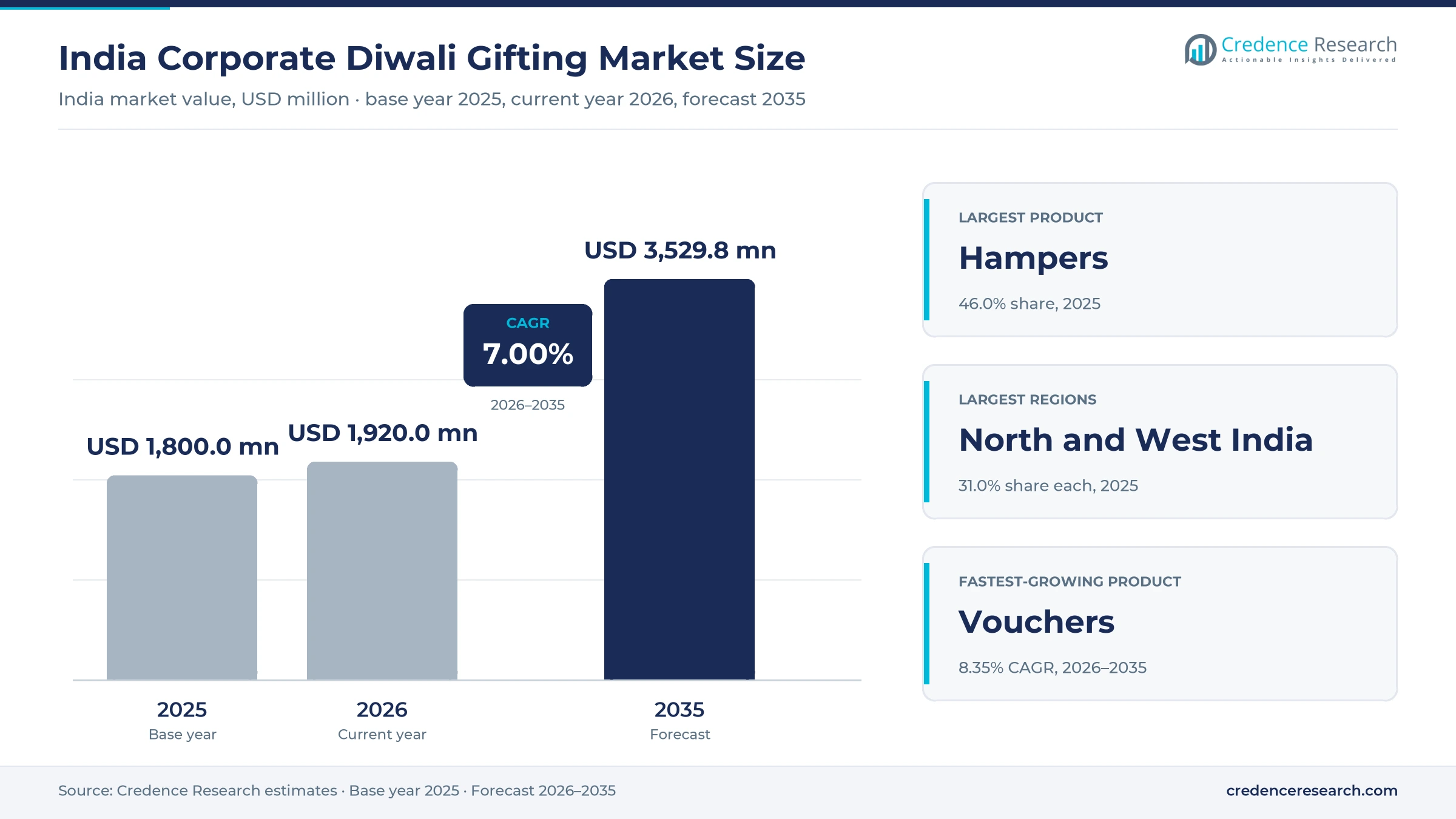
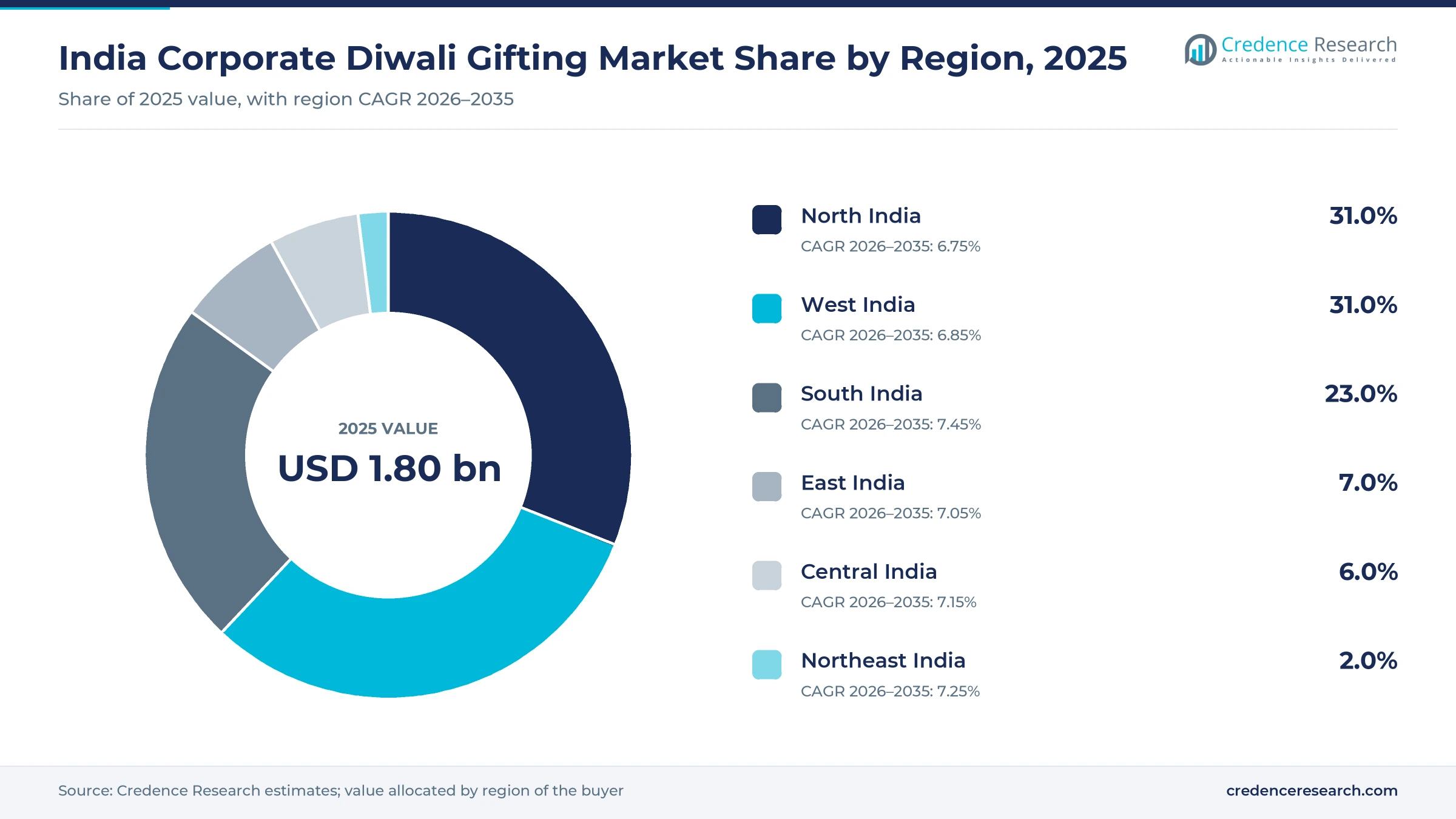
The India corporate Diwali gifting market was valued at USD 1.80 billion in 2025 and is projected to increase from USD 1.92 billion in 2026 to USD 3.53 billion by 2035, registering a CAGR of 7.00% during 2026–2035. Demand comes from employee recognition budgets, dealer and business-associate gifting, and branded hampers ordered in bulk ahead of the festival. North India and West India each held 31.0% of 2025 value, reflecting the concentration of headquarters and procurement teams in Delhi NCR and Mumbai. South India is the fastest-growing zone at 7.45% a year as global capability centers in Bengaluru add staff. A commercial change is reshaping the season, since Amazon Business reported a 60% rise in corporate gifting demand in October 2025. Sharp increases in pistachio and almond prices before Diwali 2026 are also pushing buyers toward smaller baskets and seed mixes, which limits hamper margins for vendors.
Which festive company purchases does this estimate count?
The market counts what companies spend on gifts for employees, dealers and business associates during the Diwali season. That spending covers sweets and dry fruits hampers, consumer electronics, vouchers and personalized items. Large corporates usually buy through annual vendor panels, while smaller firms order from marketplaces or local sweet shops a few weeks before the festival.
Cash bonuses, household gift purchases and personal Diwali gifting between families are excluded from this estimate. The value chain runs from nut importers, sweet makers and electronics brands to curators, packers and card issuers, and then through couriers that deliver to offices and homes across several cities.
India Corporate Diwali Gifting Market Insights
- The market rises from USD 1.80 billion in 2025 to USD 3.53 billion by 2035, a 7.00% CAGR during 2026–2035, as reward budgets formalize and digital procurement spreads.
- North India and West India each held 31.0% of 2025 value, because headquarters and purchasing teams cluster in Delhi NCR and Mumbai.
- Sweets and Dry Fruits Hampers held 46.0% of 2025 value, since most companies still treat sweets and nuts as the expected Diwali gift for staff.
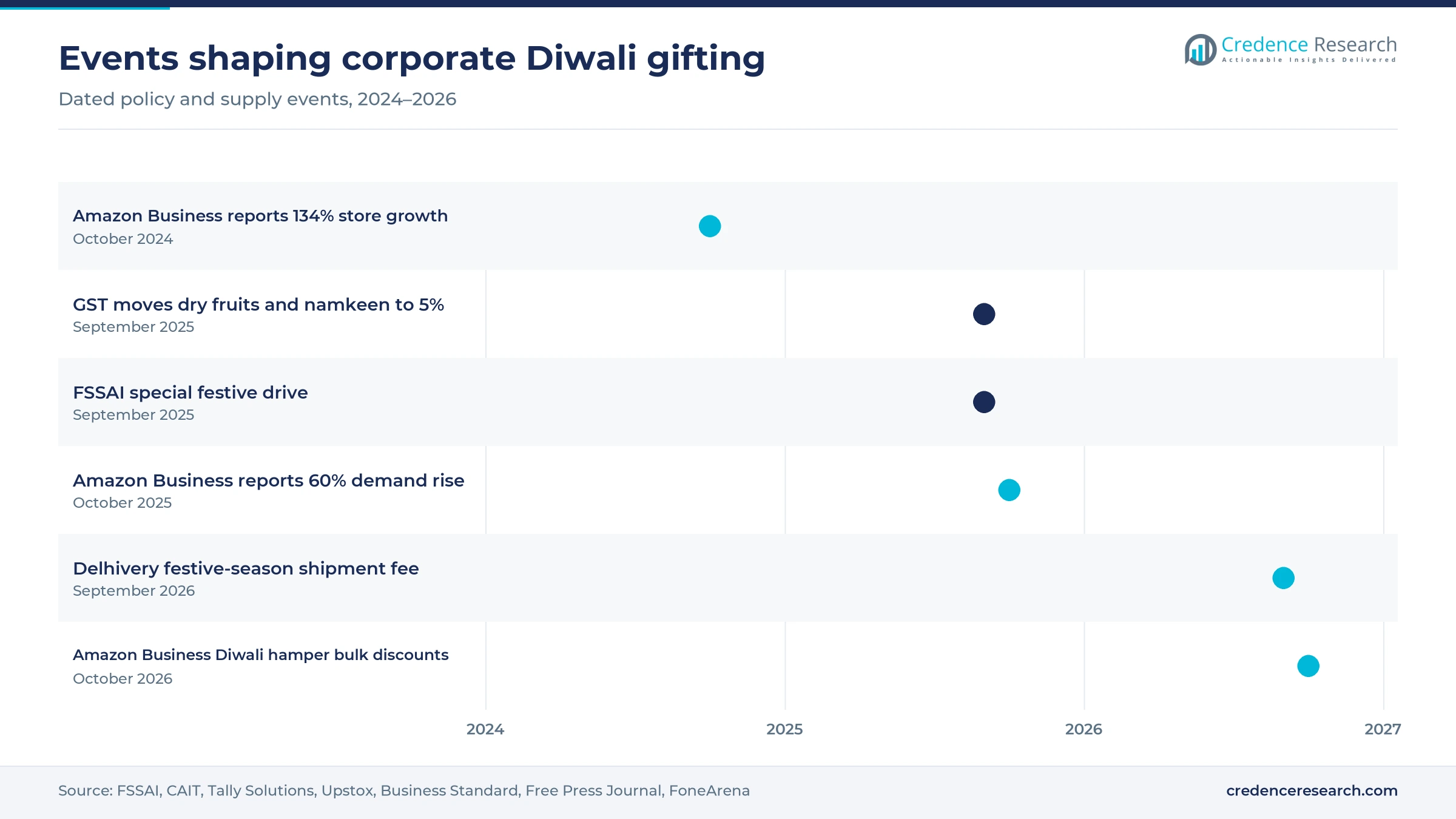
- Amazon Business reported a 60% rise in corporate gifting demand in October 2025, showing how procurement teams now source festive gifts through online business accounts.
- Pistachio prices doubled to about INR 1,800 per kilogram before Diwali 2026, pushing corporate buyers toward smaller baskets and cheaper seed mixes.
Hampers lead while vouchers and SME buyers grow fastest
Why do sweets and nuts still outsell vouchers at Diwali?
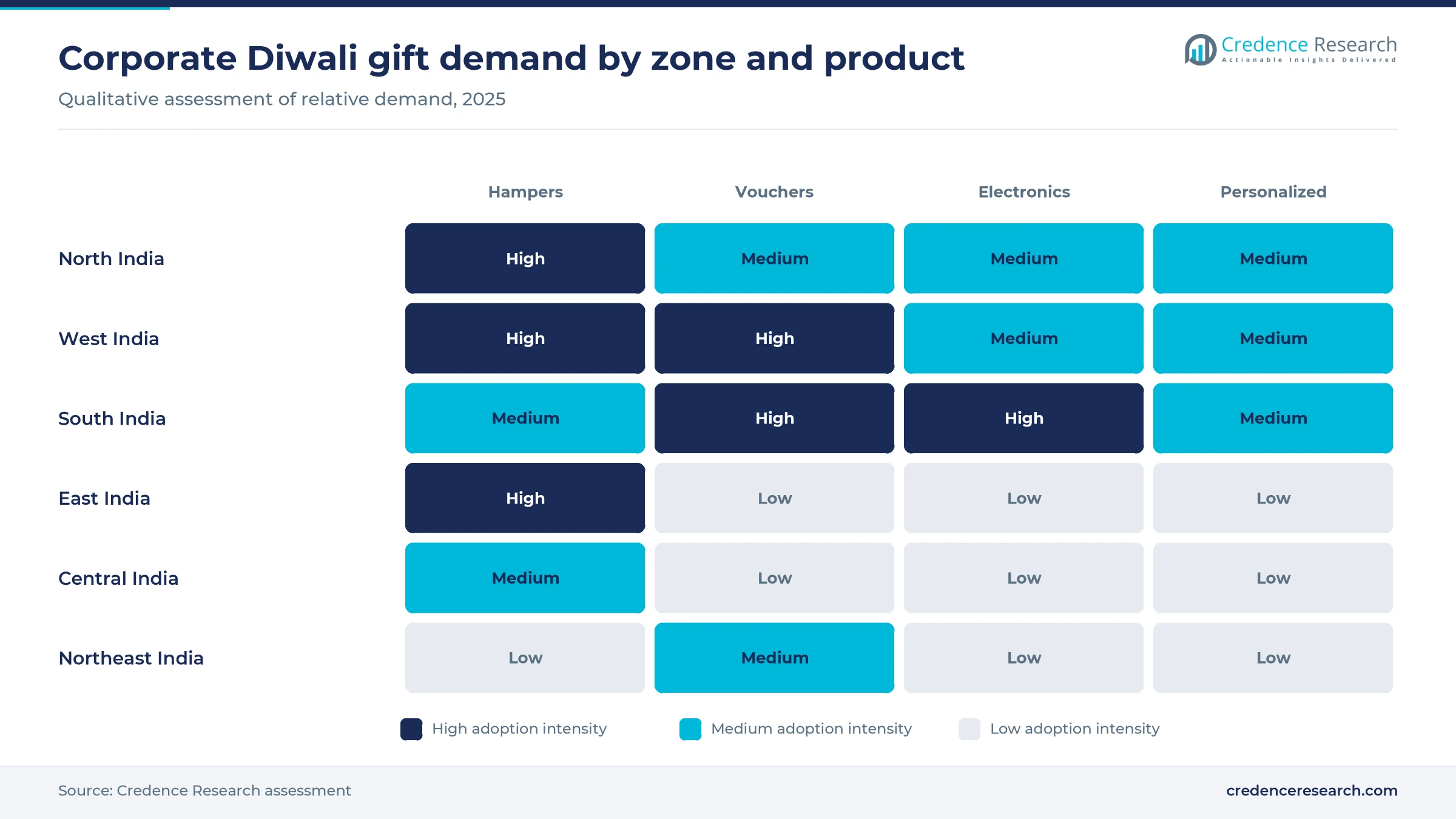
Based on product, the market is categorized into sweets and dry fruits hampers, electronics, vouchers and personalized gifts. Sweets and Dry Fruits Hampers led with 46.0% of 2025 value because food remains the default festive gift, and IGP announced in November 2023 that hampers had tripled their share of its business in five years. Vouchers are the fastest-growing product at 8.35% a year as Pluxee delivers virtual cards within 24 hours while physical cards take 7 to 10 working days. Amazon Business also named mixer grinders its most gifted item in 2024, which supports steady electronics orders.
How do large corporates and smaller firms buy differently?
Based on buyer, the market is categorized into large corporates and SMEs. Large Corporates led with 62.0% of 2025 value because they buy through vendor panels for thousands of staff, and Ferns N Petals lists Deloitte, Samsung, Vedanta and PwC among its corporate customers. SMEs are the fastest-growing buyers at 7.79% a year as an official statement carried by New Kerala counted over 7.9 crore enterprises on the Udyam and Udyam Assist platforms. Amazon Business also said in March 2026 that more than 70% of its customers came from tier-2 and tier-3 cities, which widens access for smaller firms.
Where do companies place their festive gift orders?
Based on channel, the market is categorized into B2B platforms and direct vendors. Direct Vendors led with 58.0% of 2025 value because large orders need branding and dispatch planning, and Bombay Sweet Shop offers logo sleeves on orders above 50 hampers with shipping to more than 75 cities. B2B platforms are the fastest-growing channel at 7.96% a year as Amazon Business reported 134% growth in its corporate gifting store during the first ten days of its 2024 festival. Its October 2026 sale added bulk discounts of up to 14% on Diwali hampers, according to FoneArena, which further favors marketplace buying.
| Segment Group | Leading Sub-segment | Share, 2025 | Fastest-growing Sub-segment | CAGR, 2026–2035 |
|---|---|---|---|---|
| By Product | Sweets and Dry Fruits Hampers | 46.0% | Vouchers | 8.35% |
| By Buyer | Large Corporates | 62.0% | SMEs | 7.79% |
| By Channel | Direct Vendors | 58.0% | B2B Platforms | 7.96% |
Request a Free Sample
Fill in your details and we'll send you a free sample report.
- Sample data tables & charts
- Research methodology
Reward budgets and online procurement carry order growth
Employee reward budgets raise Diwali gifting orders
Employee reward budgets are the largest source of orders because a festive gift now sits inside formal recognition plans rather than occasional office spending. The recipient base is also widening, since regular wage or salaried workers rose to 23.6% of India's workers in 2025 from 22.4% in 2024, according to the Ministry of Statistics. Nasscom estimated the tech workforce alone at 5.8 million in fiscal 2025, and EPFO recorded 21.04 lakh net payroll additions in July 2025. Budgets now reach beyond payroll too, as NoBroker set INR 1,500 per person for outsourced staff, the Financial Express reported in October 2025. In the Credence Research model this adds about 2.59 percentage points to annual growth to 2035.
Customized branded hampers increase average order values
Customized hampers lift order values because a company logo and a curated mix let vendors charge well above a plain box of sweets. YourStory reported that employee hampers typically cost INR 1,500 to INR 3,000, while gifts for business associates reach INR 3,000 to INR 10,000. Khoya Mithai told Business Standard in October 2025 that it expected business-to-business demand to rise by roughly one-third in 2025. IGP said personalized gifting doubled to 20% of its business over five years, and MyFlowerTree found that 67% of metro consumers preferred curated hampers to generic sweets. In the Credence Research model this adds about 1.89 percentage points to annual growth to 2035.
Online B2B procurement simplifies multi-city distribution
Online procurement removes the hardest part of festive gifting, which is sending thousands of parcels to staff scattered across many cities. Amazon Business announced 134% growth in its corporate gifting store in the first ten days of its 2024 festival, with total orders up 95% and buying customers up 107%, according to Upstox. Demand kept climbing in 2025, as the company told Business Standard that corporate gifting rose 60% after it introduced assembled gift sets. Ferns N Petals also offers multi-address and scheduled delivery, which fits the wider shift of online retail into office purchasing. In the Credence Research model this adds about 1.40 percentage points to annual growth to 2035.
Lower GST rates stretch festive purchasing budgets
Lower tax rates let purchasing teams fit more gifts into a fixed Diwali budget, particularly in food and electronics. Tally Solutions lists dry fruits, namkeen and kitchenware at 5% GST from Sept. 22, 2025, while televisions moved to 18% from 28%. The first festival after that change was strong, since the Confederation of All India Traders put Diwali 2025 trade at a record INR 6.05 lakh crore, with gift items at 7% and sweets and namkeen at 5% of the total. CAIT also found that 72% of surveyed traders credited lower GST rates for higher demand during the festival. That momentum supports hamper makers and electronics vendors, though higher nut prices offset part of the relief in 2026.
Digital rewards and quick delivery reshape festive orders
Shift from physical hampers to instant digital vouchers
Companies are shifting part of their budgets to digital vouchers because a code reaches remote staff instantly and leaves a clean audit trail. Analysts cited by CNBC-TV18 in October 2025 expected digital workplace gifting demand to grow 30% to 35% in fiscal 2025-26. Delivery speed explains much of the appeal, as virtual cards arrive far sooner than printed ones. The one-time Pluxee Celebrations card carries a maximum load of INR 10,000 and works across more than 50 lakh RuPay stores. Finance teams also favor these tools, since Zaggle offers approval workflows, budget controls and redemption analytics alongside prepaid cards for employee rewards.
Rise of quick commerce for last-minute festive orders
Quick commerce is rising as a channel for late and small orders that a vendor panel cannot serve in time. Business Standard reported on Oct. 6, 2025, that quick-commerce gifting demand rose 40% to 50% in the festival season, with IGP reporting a 40% jump. Ferns N Petals, which sells on Blinkit, Instamart and Zepto, reported nearly 50% growth in demand on these apps in 2025. Bombay Sweet Shop now steers small corporate orders of bestselling hampers to Swiggy and Zomato for same-day delivery. IGP had already seen same-day delivery climb to half of its business in five years, so buyers increasingly expect short lead times even for branded gifts.
Smaller-city SMEs offer an opening for curated bulk programs
Smaller-city firms offer a clear opening because few curated vendors serve them with low minimum orders and simple invoicing. Amazon Business said in March 2026 that more than 70% of its customers came from tier-2 and tier-3 cities, which shows where small-firm demand sits. The marketplace lists over 19 crore products from 17 lakh sellers. An official statement carried by New Kerala counted over 7.9 crore enterprises on the Udyam and Udyam Assist platforms, though most are micro units with modest budgets. IGP already serves tier-2 cities through its own warehouses, and FNP publishes corporate budget tiers from under INR 500 to INR 2,000 per recipient. Vendors that package these tiers for firms with 20 to 200 staff can reach buyers that large panels ignore.
Seed mixes and artisan gifts open a lower-cost hamper tier
Costly nuts create an opportunity for lower-cost hampers built on seeds, regional snacks and artisan products. CAIT national secretary Shankar Thakkar told the Free Press Journal in October 2026 that seed demand for gifting was up about 30%, as corporate buyers replaced costly dry fruits with pumpkin, watermelon and chia seeds. Social value adds a further selling point, since Greaves Electric Mobility partnered with Giftabled, which supports persons with disabilities, the Financial Express reported in October 2025. IGP also said sustainable gifting grew to a 10% share of its business over five years. Vendors that certify sourcing and hold prices below INR 1,500 can win budget-bound procurement teams.
Nut prices and tax limits squeeze festive gift budgets
Nut price spikes squeeze hamper margins
Pistachios doubled to about INR 1,800 per kilogram and almonds rose to INR 1,100 from INR 800 before Diwali 2026, according to indicative Mumbai wholesale prices in the Free Press Journal. As a result, vendors holding fixed quotes absorb the increase, while corporate buyers cut basket quantities. Importers of dry fruits told NewsDrum that thin arrivals left little room to pass on the earlier tax relief. Hamper makers can limit the damage through early contracts and seed-based substitutions.
Gift tax limits complicate employee and dealer programs
Tax thresholds limit how much a company can comfortably spend per person on festive gifts. StartupTalky reported in October 2026 that the Income-tax Rules, 2026, raised the tax-free limit on employer gifts to INR 15,000 a year from April 1, 2026, and that gifts above it are taxed in full, not only on the excess. Taxscan reported in October 2026 that gifts above INR 50,000 per employee lose the GST exclusion, and dealer gifts above INR 20,000 attract 10% TDS, according to CalcGuru. Consequently, finance teams favor smaller gifts and vouchers, while vendors add tax documentation to win orders.
Food safety drives raise sourcing risk for sweet hampers
Adulteration scares raise sourcing risk because a single bad batch can damage the sponsor company's reputation among its staff. The Food Safety and Standards Authority of India ordered a special festive drive on sweets and dairy on Sept. 23, 2025, and Delhi officials seized over 8,800 liters of adulterated ghee in the following weeks, The Tribune reported. Short-shelf-life sweets therefore carry the most risk, so procurement teams increasingly ask for licensed makers, batch records and packaged formats instead of loose mithai.
Peak-season logistics strain multi-city delivery
Diwali orders arrive in the same weeks as peak online shopping, so gift parcels compete for courier capacity and delivery slots. Delhivery handled over 103.6 million shipments in October 2025, with 7.2 million on its busiest day, according to CIOL. The Free Press Journal reported that the company added a fee of INR 4 per express parcel from Sept. 1, 2026. Consequently, late orders risk missing the festival, so FNP advises buyers to order two to three weeks ahead, which also helps logistics providers plan festive capacity.
North and West India tie as South India grows fastest
| Region | Value, 2025 (USD billion) | Share, 2025 | CAGR, 2026–2035 |
|---|---|---|---|
| North India | 0.56 | 31.0% | 6.75% |
| West India | 0.56 | 31.0% | 6.85% |
| South India | 0.41 | 23.0% | 7.45% |
| East India | 0.13 | 7.0% | 7.05% |
| Central India | 0.11 | 6.0% | 7.15% |
| Northeast India | 0.04 | 2.0% | 7.25% |
North India orders center on Delhi NCR headquarters
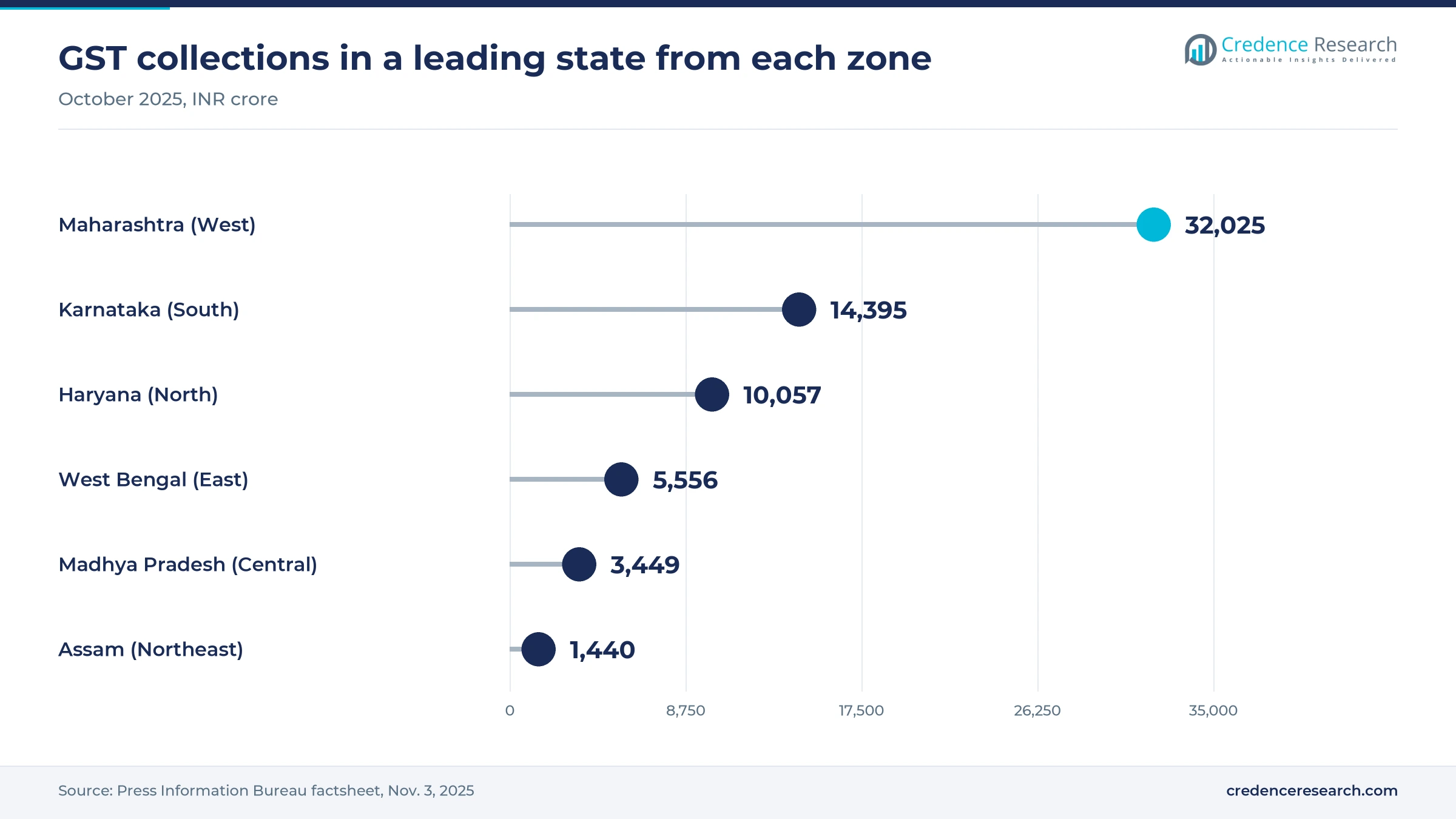
North India held 31.0% of 2025 value and grows at 6.75% a year. Delhi NCR anchors demand through corporate headquarters and a dense base of gifting vendors, including Khoya Mithai and Ferns N Petals. The October 2025 GST data from the Press Information Bureau shows Haryana at INR 10,057 crore, Uttar Pradesh at INR 9,806 crore and Delhi at INR 8,538 crore. Together these figures point to a large formal business base, though the zone's higher reliance on food hampers exposes it to nut prices.
West India spending rests on Mumbai and Gujarat firms
West India matched that leading share of 2025 value and grows at 6.85% a year. Maharashtra recorded the largest state GST collection in the Press Information Bureau factsheet for October 2025, at INR 32,025 crore, and Gujarat added INR 12,113 crore. Maharashtra also supplied 20.47% of EPFO net payroll additions in July 2025, which supports strong regional demand from a deep employee base. Mumbai wholesale prices for pistachios and dates, however, doubled before Diwali 2026, so hamper specifications are being trimmed.
South India leads growth on technology payrolls
South India held 23.0% of 2025 value and is the fastest-growing zone at 7.45% a year. Technology employers drive this lead, since Nasscom counts about 1,760 global capability centers in India and Bengaluru hosts more than 230 mid-market centers, according to Storyboard18 in September 2025. Karnataka collected INR 14,395 crore in GST in October 2025, ahead of Tamil Nadu at INR 11,588 crore and Telangana at INR 5,726 crore. These employers tend to favor vouchers and tech gifts for dispersed staff.
East India demand follows Kolkata and Odisha industry
East India held 7.0% of 2025 value and grows at 7.05% a year. West Bengal collected INR 5,556 crore in GST in October 2025, while Odisha added INR 4,824 crore and Bihar INR 1,652 crore, according to the Press Information Bureau. Demand therefore comes mainly from Kolkata offices and from industrial employers in Odisha. IGP said in November 2023 that major metros drive most corporate gifting, which leaves many eastern cities to local sweet makers and small curators.
Central India orders come from industrial employers
Central India held 6.0% of 2025 value and grows at 7.15% a year. Madhya Pradesh collected INR 3,449 crore in GST in October 2025 and Chhattisgarh INR 2,598 crore, according to the Press Information Bureau, which shows a smaller formal base than the western and northern zones. Business Standard also reported an annual decline for Madhya Pradesh that month. Orders here lean toward plant employers and dealer networks, so simple bulk boxes outsell premium curated sets.
Northeast India remains a small, delivery-bound market
Northeast India held 2.0% of 2025 value and grows at 7.25% a year from a low base. Assam collected INR 1,440 crore in GST in October 2025, the smallest figure among the states used in this comparison. Distance also shapes the market, as CIOL reported a Delhivery parcel traveling 4,085 kilometers from Thiruvananthapuram to Tezu that month. National employers therefore often send vouchers to staff in the region, because digital codes avoid transit damage and missed festival dates.
Tax cuts and marketplace pushes defined recent seasons
| Development | Status and market relevance |
|---|---|
| In September 2025, the Food Safety and Standards Authority of India ordered a special festive drive covering sweets, savories and dairy products. | Completed for 2025; raises supplier documentation demands on hamper makers |
| In October 2025, Amazon Business told Business Standard that corporate gifting demand had risen 60% after it added customized and assembled gift sets. | Active; moves bulk festive orders toward marketplace accounts |
| In October 2025, the Confederation of All India Traders put Diwali trade at a record INR 6.05 lakh crore, with gift items at 7% of the total. | Reported; shows the wider retail base behind corporate buying |
| In September 2026, Delhivery added a fee of INR 4 per express shipment and INR 2 per surface shipment, according to the Free Press Journal. | In effect; raises per-parcel costs for multi-city gift dispatch |
| In October 2026, Amazon Business offered bulk discounts of up to 14% on Diwali hampers during its Great Indian Festival, according to FoneArena. | Completed; sets a price reference for curated hamper vendors |
Procurement tools now decide how festive gifts are sent
- Voucher platforms such as Pine Labs' Woohoo combine bulk order delivery, credit management and APIs that let resellers and corporate catalogs sell gift cards.
- Reward wallets from Zaggle add approval workflows, budget controls, employee eligibility checks and audit trails that finance teams can review.
- Multi-address dispatch at Bombay Sweet Shop lets one order ship to several cities, with tracking for each recipient and standard hampers leaving in three to four days.
- Business marketplace accounts at Amazon Business give purchasers GST invoices, bulk discounts and delivery to multiple locations from one business account.
Need a Custom Version of This Report?
Tailor the scope, geography, or segments to your exact requirements.
- Custom geography or segment scope
- Direct access to our analyst team
Platforms, sweet makers and card issuers share the season
Competition splits across three groups that rarely offer the same thing. Gifting platforms such as IGP and Ferns N Petals sell curation, branding and dispatch, and Ferns N Petals names Accenture, Deloitte and Samsung among its corporate customers. Food brands such as Haldiram's, which introduced a curated gifting range in its stores in 2022, and Bombay Sweet Shop compete on recognizable taste and packaged supply. Amazon Business competes on selection and price, with bulk discounts during its festival. Card issuers such as Pluxee, Pine Labs and Zaggle compete for the same budget through instant delivery and reporting. Local sweet shops and small curators still win many SME orders because they offer short lead times and relationships. Vendors differentiate through compliance paperwork, on-time delivery and custom branding, since buyers can easily compare hamper contents and prices across rival quotes.
Companies profiled and their roles in this market
| Company | Type | Role in the market |
|---|---|---|
| IGP | Gifting platform | Curated hampers and personalized gifts, with its own warehouses serving tier-2 cities |
| Ferns N Petals | Gifting platform | Budget-tiered corporate hampers with multi-address and scheduled delivery |
| Haldiram's | Food brand | Sweets and nuts platters and gift packs sold through stores and delivery apps |
| Amazon Business | B2B marketplace | Corporate gifting store with GST invoices and bulk discounts on hampers and electronics |
| Pluxee | Card issuer | RuPay festive gift cards with a one-time load of up to INR 10,000 |
| Pine Labs | Card platform | Qwikcilver gift cards and Woohoo distribution for corporate catalogs |
| Zaggle | Rewards platform | Digital gift cards and reward wallets with approval and audit tools |
Compliance and price control will separate the winners
Credence Research's view is that this market will reward operational discipline more than creative packaging. Pistachio prices that doubled in a single year show how quickly a fixed-price hamper quote can turn loss-making, so vendors need hedged sourcing and flexible recipes. The INR 15,000 annual tax-free limit per employee, in force since April 2026, also caps the gift value many companies will approve. The strongest position belongs to vendors that combine food, vouchers and reporting in one offer, because procurement teams want one contract, one invoice trail and evidence that every gift reached its recipient.
How Credence Research built this market estimate
The report uses 2025 as the base year and forecasts values to 2035 through the Credence Research market model. Market values, segment splits and regional shares are Credence Research estimates. Inputs include government statistics and tax data from the Ministry of Statistics and the Press Information Bureau, trade-body releases from the Confederation of All India Traders, food regulator notices, company websites and news reports dated through October 2026. Recipient counts and gift values behind the estimate rely on published price bands and analyst assumptions. No interviews or surveys were conducted in preparing this report.
Vouchers and smaller-city buyers shape the path to 2035
The market is forecast to reach USD 3.53 billion by 2035 from USD 1.92 billion in 2026, with vouchers and SME buyers gaining share as online procurement spreads to smaller cities. Hampers should remain the largest product, although recipes will keep adjusting to imported nut prices. South India should continue to outpace the other zones as technology payrolls expand. Tax thresholds will shape typical gift values unless they are revised, because INR 15,000 a year now acts as a practical ceiling for employee gifts. Vendors that deliver reliably during the compressed festive window, and document every order, stand to take share from informal suppliers.
Frequently Asked Questions
How big is the India corporate Diwali gifting market?
Which product leads corporate Diwali gifting in India?
Which regions lead the market?
How much do companies typically spend per gift?
How are employee Diwali gifts taxed in India?
Why are online platforms gaining corporate orders?
What is the biggest cost challenge for hamper makers?
Who are the main companies in this market?
Table of Content
Chapter 1 Market Segmentation
- 1.1 Segmentation Framework
- 1.1.1 Product and Service Classification
- 1.1.2 Application and End-Use Classification
- 1.1.3 Technology and Solution Classification
- 1.1.4 Customer and Distribution Channel Classification
- 1.1.5 Geographic Segmentation
- 1.1.6 Market Segment Definitions and Boundaries
- 1.2 By Product
- 1.2.1 Sweets and Dry Fruits Hampers
- 1.2.2 Vouchers
- 1.2.3 Electronics
- 1.2.4 Personalized Gifts
- 1.3 By Buyer
- 1.3.1 Large Corporates
- 1.3.2 SMEs
- 1.4 By Channel
- 1.4.1 Direct Vendors
- 1.4.2 B2B Platforms
Chapter 2 Introduction
- 2.1 Report Objectives and Scope
- 2.2 Product Definition and Industry Terminology
- 2.3 Market Inclusions and Exclusions
- 2.4 Research Process
- 2.4.1 Primary Research and Expert Interviews
- 2.4.2 Secondary Research and Source Review
- 2.4.3 Top-Down and Bottom-Up Estimation
- 2.4.4 Data Triangulation and Verification
- 2.5 Market Size Measurement Basis
- 2.5.1 2025: USD 1.80 billion → 2035: USD 3.53 billion
- 2.6 Historical and Forecast Reference Periods
- 2.6.1 Historical Period: 2018-2025
- 2.6.2 Base Year: 2025
- 2.6.3 Forecast Period: 2025-2035
- 2.7 Research Assumptions and Limitations
Chapter 3 Executive Summary
- 3.1 Market Snapshot and Key Findings
- 3.2 Base-Year Market Size, 2025
- 3.3 Forecast Market Size, 2035
- 3.4 Revenue and Volume Growth Outlook
- 3.5 Key Demand and Supply Indicators
- 3.6 Leading Market Segments
- 3.7 Fastest-Growing Market Opportunities
- 3.8 Regional Performance Highlights
- 3.9 Technology and Industry Transformation
- 3.10 Competitive Landscape Summary
- 3.11 Analyst View and Strategic Implications
Chapter 4 India Corporate Diwali Gifting Market Trends and Developments
- 4.1 Historical Industry Development, 2018-2025
- 4.2 Recent Market Trends and Developments
- 4.3 Demand and Customer Behavior Trends
- 4.4 Technology and Product Innovation
- 4.5 Artificial Intelligence, Automation and Digitalization
- 4.6 Local Manufacturing and Supply Chain Realignment
- 4.7 Industry Partnerships, Mergers and Acquisitions
- 4.8 Sustainability and Circular Economy Developments
- 4.9 Government and Private Sector Investment Trends
- 4.10 Emerging Business Models and Commercialization
- 4.11 Industry Developments and Announcements
Chapter 5 India Corporate Diwali Gifting Market Production, Supply and Demand Analysis
- 5.1 Demand Trend and Consumption Analysis, 2018-2025
- 5.2 Demand Forecast, 2025-2035
- 5.3 Production and Output Trend, 2018-2025
- 5.4 Production and Output Forecast, 2025-2035
- 5.5 Installed Capacity and Capacity Utilization
- 5.6 Company-Wise Production Plants and Statistics
- 5.6.1 Installed Production Capacity
- 5.6.2 Actual Production
- 5.6.3 Planned Capacity and Expansion Targets
- 5.7 Supply Chain Structure and Procurement Trends
- 5.8 Supply-Demand Gap and Bottlenecks
- 5.9 Import Dependence and Sourcing Structure
- 5.10 Contract Manufacturing and Outsourcing
- 5.11 Regional Supply and Demand Concentration
Chapter 6 India Corporate Diwali Gifting Market Pricing Analysis
- 6.1 Pricing Structure and Measurement
- 6.2 Historical Pricing Trends, 2018-2025
- 6.3 Pricing Outlook, 2025-2035
- 6.4 Average Selling Price and Unit Economics
- 6.5 Pricing by Product and Market Segment
- 6.6 Geographic Pricing Differences
- 6.7 Key Input, Energy, Labor and Logistics Costs
- 6.8 Contract Pricing and Purchasing Models
- 6.9 Pricing Sensitivity and Competitive Positioning
- 6.10 Price, Margin and Profitability Implications
Chapter 7 India Corporate Diwali Gifting Market Dynamics
- 7.1 Market Growth Drivers
- 7.1.1 Demand-Side Drivers
- 7.1.2 Technology and Innovation Drivers
- 7.1.3 Infrastructure and Investment Drivers
- 7.1.4 Regulatory and Policy Drivers
- 7.2 Market Restraints
- 7.2.1 Cost and Affordability Constraints
- 7.2.2 Technology and Adoption Barriers
- 7.2.3 Supply Chain and Operational Constraints
- 7.3 Market Challenges
- 7.3.1 Competitive Pressure and Margin Erosion
- 7.3.2 Skills, Infrastructure and Implementation Gaps
- 7.4 Emerging Market Opportunities
- 7.5 Market Dynamics Impact and Time-Horizon Assessment
Chapter 8 India Corporate Diwali Gifting Value Chain Analysis
- 8.1 Industry Value Chain Overview
- 8.2 Upstream Suppliers and Critical Inputs
- 8.3 Technology and Component Providers
- 8.4 Manufacturing or Service Delivery
- 8.5 Distribution, Channel Partners and Integrators
- 8.6 Downstream Applications and End Users
- 8.7 Value Addition and Profit Pools
- 8.8 Vertical Integration and Outsourcing
- 8.9 Supplier Concentration and Risk
- 8.10 Supply Chain Localization and Resilience
Chapter 9 India Corporate Diwali Gifting Market Regulations and Policies
- 9.1 Relevant Laws, Standards and Compliance Frameworks
- 9.2 Product, Service, Safety and Quality Requirements
- 9.3 Government Policies, Incentives and Subsidies
- 9.4 Imports, Exports and Trade Barriers
- 9.5 Public Procurement and Local Content Requirements
- 9.6 Environmental and Sustainability Compliance
- 9.7 Upcoming Policy Changes and Market Implications
Chapter 10 India Corporate Diwali Gifting Market Hotspots and Opportunities
- 10.1 Market Opportunity Mapping and Growth Hotspots
- 10.2 High-Growth Applications and Customer Groups
- 10.3 Underserved Markets and White-Space Opportunities
- 10.4 Emerging Technology and Product Opportunities
- 10.5 New Capacity and Investment Hotspots
- 10.6 Market Entry and Expansion Opportunities
- 10.7 Distribution and Partnership Opportunities
- 10.8 Near-Term and Long-Term Commercial Potential
- 10.9 Opportunity Attractiveness and Execution Risks
Chapter 11 India Corporate Diwali Gifting Market Outlook, 2025-2035
- 11.1 Market Size and Analysis
- 11.1.1 Revenue (Market Measurement: 2025: USD 1.80 billion → 2035: USD 3.53 billion)
- 11.1.2 Market Volume and Quantity Sold
- 11.1.3 Historical Market Size, 2018-2025
- 11.1.4 Base-Year Market Size, 2025
- 11.2 Market Forecast, 2025-2035
- 11.2.1 Revenue Forecast to 2035
- 11.2.2 Volume Forecast to 2035
- 11.2.3 CAGR and Year-on-Year Growth
- 11.2.4 Incremental Revenue Opportunity
- 11.3 Forecast Assumptions and Scenario Analysis
- 11.3.1 Base-Case Forecast
- 11.3.2 Optimistic and Conservative Scenarios
- 11.3.3 Technology, Pricing and Policy Sensitivities
- 11.4 Market Attractiveness and Growth Outlook
Chapter 12 India Corporate Diwali Gifting Market Segmentation and Outlook
- 12.1 Segmentation Summary and Market Shares, 2025
- 12.2 Largest and Fastest-Growing Segments
- 12.3 By Product - Market Size and Forecast, 2025-2035
- 12.3.1 Segment Definition and Scope
- 12.3.2 Historical Market Size, 2018-2025
- 12.3.3 Revenue Forecast, 2025-2035
- 12.3.4 Volume Forecast, 2025-2035
- 12.3.5 Base-Year Market Share, 2025
- 12.3.6 Segment CAGR and Growth Drivers
- 12.3.7 Subsegment Market Size and Forecast
- 12.3.7.1 Sweets and Dry Fruits Hampers
- 12.3.7.2 Vouchers
- 12.3.7.3 Electronics
- 12.3.7.4 Personalized Gifts
- 12.3.8 Subsegment Pricing and Adoption Trends
- 12.3.9 Leading Suppliers and Competition
- 12.3.10 Regional Demand and Opportunities
- 12.4 By Buyer - Market Size and Forecast, 2025-2035
- 12.4.1 Segment Definition and Scope
- 12.4.2 Historical Market Size, 2018-2025
- 12.4.3 Revenue Forecast, 2025-2035
- 12.4.4 Volume Forecast, 2025-2035
- 12.4.5 Base-Year Market Share, 2025
- 12.4.6 Segment CAGR and Growth Drivers
- 12.4.7 Subsegment Market Size and Forecast
- 12.4.7.1 Large Corporates
- 12.4.7.2 SMEs
- 12.4.8 Subsegment Pricing and Adoption Trends
- 12.4.9 Leading Suppliers and Competition
- 12.4.10 Regional Demand and Opportunities
- 12.5 By Channel - Market Size and Forecast, 2025-2035
- 12.5.1 Segment Definition and Scope
- 12.5.2 Historical Market Size, 2018-2025
- 12.5.3 Revenue Forecast, 2025-2035
- 12.5.4 Volume Forecast, 2025-2035
- 12.5.5 Base-Year Market Share, 2025
- 12.5.6 Segment CAGR and Growth Drivers
- 12.5.7 Subsegment Market Size and Forecast
- 12.5.7.1 Direct Vendors
- 12.5.7.2 B2B Platforms
- 12.5.8 Subsegment Pricing and Adoption Trends
- 12.5.9 Leading Suppliers and Competition
- 12.5.10 Regional Demand and Opportunities
- 12.6 Segment Growth Comparison
- 12.7 Segment Attractiveness and Priority Matrix
Chapter 13 India Corporate Diwali Gifting Geographic Market Outlook, 2025-2035
- 13.1 Domestic Market Distribution and Demand Clusters
- 13.2 State- or Province-Wise Market Size and Forecast, 2025-2035
- 13.3 City and Metropolitan Market Outlook
- 13.4 Industrial, Manufacturing and Commercial Clusters
- 13.5 Geographic Concentration of Key End Users
- 13.6 Local Pricing and Purchasing Differences
- 13.7 Domestic Production Facilities and Capacity Map
- 13.8 Local Infrastructure and Project Pipeline
- 13.9 State-Level Policy and Incentive Differences
- 13.10 Subnational Investment Hotspots and Opportunities
- 13.11 Distribution and Logistics Networks
- 13.12 Domestic Competitive Footprint
Chapter 14 India Corporate Diwali Gifting Technology, Innovation and Sustainability Outlook
- 14.1 Technology Landscape and Maturity
- 14.2 Product, Process and Service Innovation
- 14.3 AI, Automation and Digital Tools in the Industry
- 14.4 Technology Adoption and Performance Benchmarking
- 14.5 Innovation Pipeline and R&D Investment
- 14.6 Patent and Intellectual Property Trends
- 14.7 Energy Efficiency and Resource Management
- 14.8 Sustainability, Recycling and Circularity
- 14.9 Technology Roadmap, 2025-2035
- 14.10 Risks of Obsolescence and Technology Substitution
Chapter 15 India Corporate Diwali Gifting Market Key Strategic Imperatives
- 15.1 Growth and Market Entry Priorities
- 15.2 High-Return Products and Segments
- 15.3 Pricing, Profitability and Cost Optimization
- 15.4 Technology Investment and Product Differentiation
- 15.5 Supply Chain Localization and Resilience
- 15.6 Distribution and Customer Acquisition
- 15.7 Partnership, Acquisition and Capacity Strategy
- 15.8 Regional Expansion Priorities
- 15.9 Short-, Medium- and Long-Term Actions
Chapter 16 Competition Outlook
- 16.1 Industry Competition Characteristics
- 16.2 Market Structure and Concentration
- 16.3 Market Share and Competitive Positioning, 2025
- 16.4 Company-Wise Revenue and Product Benchmarking
- 16.5 Production and Service Capacity Benchmarking
- 16.6 Technology, Pricing and Differentiation
- 16.7 Regional Footprint and Distribution Strength
- 16.8 Mergers, Acquisitions and Strategic Alliances
- 16.9 New Entrants and Competitive Threats
- 16.10 Porter's Five Forces and Industry Attractiveness
- 16.11 Competitive Outlook, 2025-2035
Chapter 17 Company Profiles
- 17.1 Company Coverage and Selection Criteria
- 17.2 IGP
- 17.2.1 Business Description
- 17.2.2 Company Ownership and Geographic Presence
- 17.2.3 Product and Service Portfolio
- 17.2.4 Manufacturing and Operating Footprint
- 17.2.5 Production Capacity and Expansion Plans
- 17.2.6 Financial Performance and Investment
- 17.2.7 Market Share and Competitive Position
- 17.2.8 Technology and Innovation Capabilities
- 17.2.9 Strategic Alliances or Partnerships
- 17.2.10 Recent Developments
- 17.2.11 Growth Strategy and Outlook
- 17.3 Ferns N Petals
- 17.4 Haldiram's
- 17.5 Amazon Business
- 17.6 Pluxee
- 17.7 Pine Labs
- 17.8 Zaggle
- 17.9 Other Relevant Market Participants
Note: Every listed company is profiled on the structure shown under the first company. The company list is preliminary and may change based on research findings, market developments, data availability and client requirements.
Chapter 18 Disclaimer
- 18.1 Research and Forecast Disclaimer
- 18.2 Data Source and Estimation Limitations
Note: The depth of individual sections depends on data availability for this market. Volume, capacity, trade and other unit-based metrics are included where applicable.

