
Imported nuts and festive gifting shape Indian demand
The India dry fruits market was valued at USD 2.23 billion in 2025 and is projected to increase from USD 2.38 billion in 2026 to USD 4.10 billion by 2035, registering a CAGR of 6.20% during 2026–2035. Demand rests on daily nutrition habits, festival and wedding gifting, and a gradual move from loose sacks to branded packs. USDA data carried by FreshPlaza in September 2026 put forecast almond consumption at 190,000 metric tons for 2026/27, nearly all of it imported. South India held the largest regional share, 31.1% in 2025, supported by cashew processing and date retail chains across Kerala and Karnataka. East and Central India is the fastest-growing region at 6.68% a year, as packaged brands extend beyond state capitals from a lower base. The sharpest recent commercial change came from tax, because GST on nuts and dried fruits fell from 12% to 5% on Sept. 22, 2025, although higher freight and tighter Iranian supply later lifted shelf prices.
What does the Indian dry fruits category actually include?
The category covers almonds, walnuts, pistachios, cashews, raisins, dates, figs, apricots and blended packs sold for domestic consumption. Households buy through neighborhood kirana shops, wholesale bazaars, supermarkets and delivery apps, while bakeries, sweet makers and ice cream producers buy in bulk through institutional contracts.
The analysis excludes kernels shipped abroad, raw cashew nuts awaiting processing and nut oils or extracts sold as separate ingredients. The value chain runs from orchards in Jammu and Kashmir and importers in Delhi and Mumbai to processors, packers, distributors and retailers across the country.
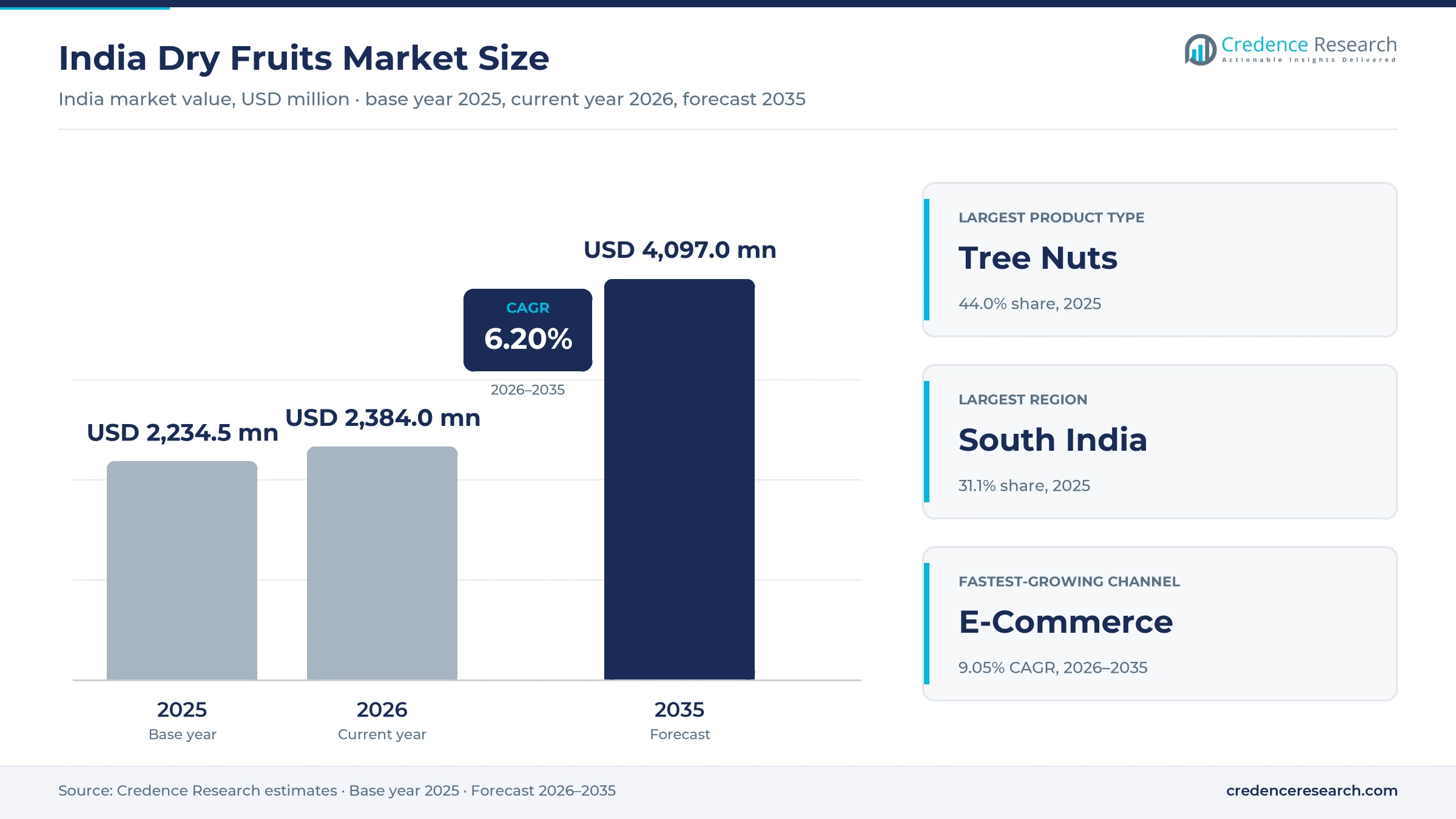
India Dry Fruits Market Insights
- The market grows from USD 2.23 billion in 2025 to USD 4.10 billion by 2035, a 6.20% CAGR built on packaged conversion, gifting and everyday snacking habits.
- South India held 31.1% of 2025 value, the largest share, while East and Central India grows fastest at 6.68% a year through 2035.
- Tree Nuts led with 44.0% of 2025 value, because almonds, walnuts and pistachios remain the staple items in household and festive baskets nationwide.
- GST on nuts and dried fruits fell from 12% to 5% on Sept. 22, 2025, lowering the tax on invoiced packs ahead of the festive season that year.
- Wonderland Foods raised Rs 140 crore in October 2025 for a Greater Noida plant, showing how capital is moving toward branded processing and modern distribution capacity.
Tree nuts and festive buying set the demand pattern
Why do tree nuts outsell cashews and dried fruits?
Based on product type, the market is categorized into tree nuts, cashews, dried fruits and blends and mixes. Tree Nuts led with 44.0% of 2025 value because almonds alone carry forecast consumption of 190,000 metric tons in 2026/27, according to USDA data reported by FreshPlaza in September 2026. Blends and Mixes grow fastest at 8.37% a year as processors widen ranges, and ProV Foods now lists trail mixes and flavored snacks beside plain nuts on its company site. This shift lets brands sell smaller, higher-margin packs to younger snack buyers.
Which buyers beyond households matter most?
Based on customer type, the market is categorized into households, corporate buyers, foodservice buyers and food manufacturers. Households led with 68.0% of 2025 value because USDA Foreign Agricultural Service reported in September 2025 that 70% to 75% of walnut consumption happens at the household level. Corporate Buyers grow fastest at 7.54% a year as the same USDA report cites bulk business gifting as an almond demand driver. Institutional demand is also visible, since Nutraj names ITC, Britannia, Amul, Mother Dairy and Haldiram Snacks among its customers on its institutional page.
How much of the year depends on festive buying?
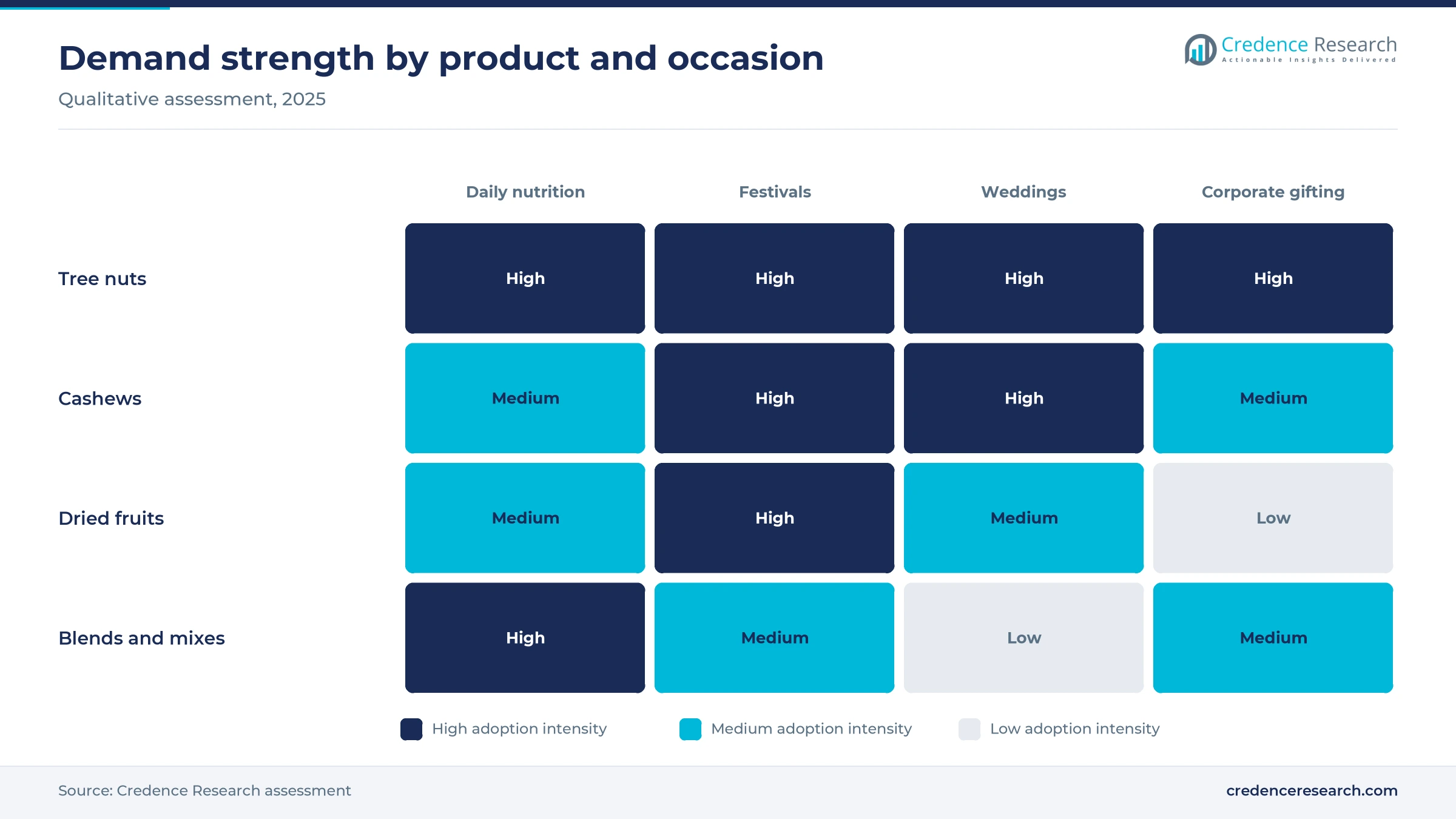
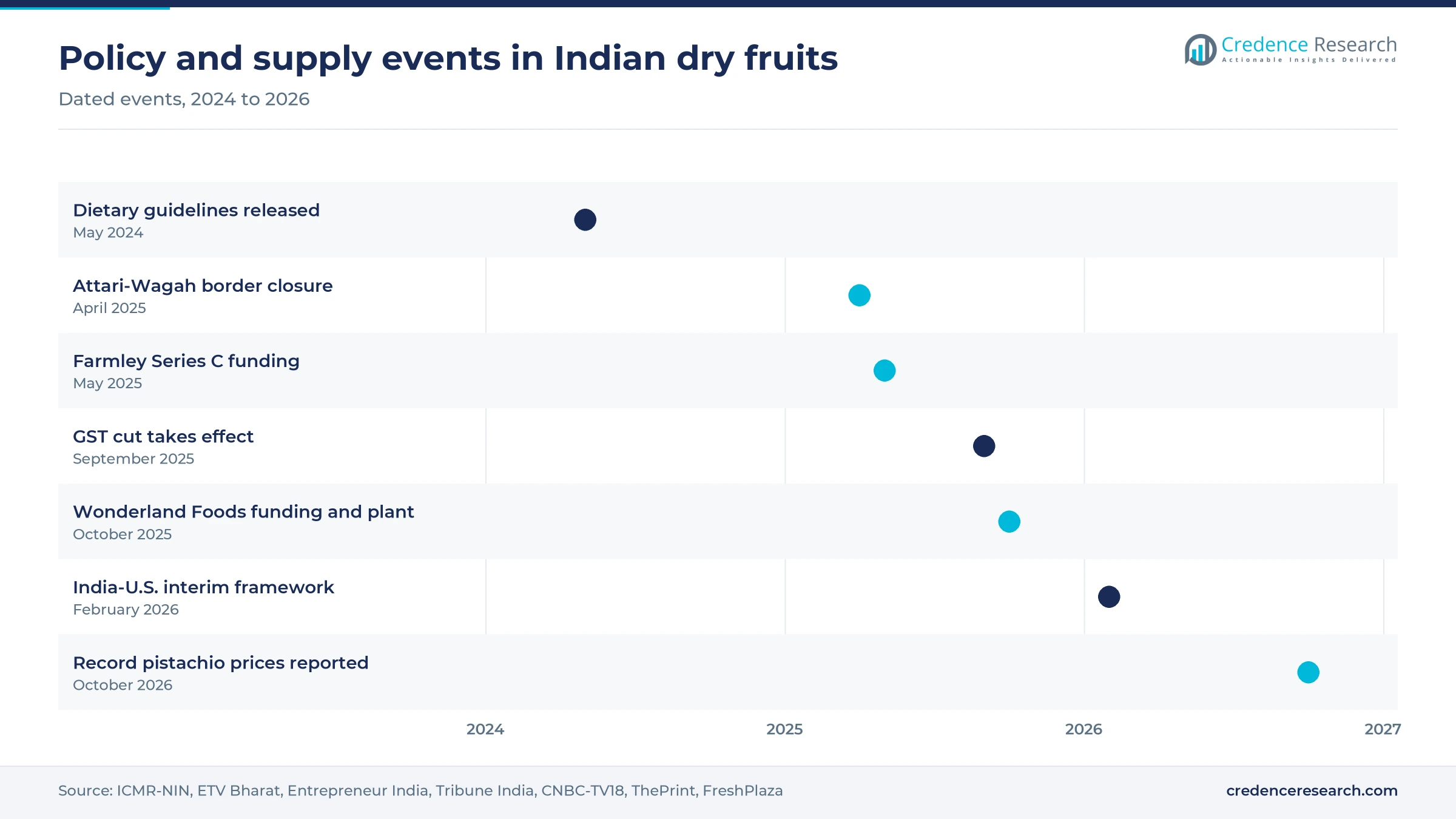
Based on purchase occasion, the market is categorized into daily nutrition, festivals and religious events, weddings and celebrations, and corporate gifting. Festivals and Religious Events led with 38.0% of 2025 value because USDA Foreign Agricultural Service found that more than half of household walnut use falls in the October to November festive season. Daily Nutrition grows fastest at 6.97% a year as ICMR-NIN guidelines released on May 8, 2024 linked 56.4% of the national disease burden to unhealthy diets, which encourages regular nut snacking. Weddings add a separate peak outside the Diwali window for sweet makers and caterers.
Why does general trade still hold most sales?
Based on distribution channel, the market is categorized into general trade, modern retail, e-commerce and institutional sales. General Trade led with 62.0% of 2025 value because roughly 70% of sales remain loose and unbranded, according to a February 2026 FnBnews column by Proventus Agrocom chief D P Jhawar. E-Commerce grows fastest at 9.05% a year as online retail deepens, and afaqs reported in October 2025 that Zepto ranked dry fruits among its top festive categories. Kirana stores still dominate Tier-2 to Tier-4 towns, which keeps distributors central.
| Segment Group | Leading Sub-segment | Share, 2025 | Fastest-growing Sub-segment | CAGR, 2026–2035 |
|---|---|---|---|---|
| By Product Type | Tree Nuts | 44.0% | Blends and Mixes | 8.37% |
| By Customer Type | Households | 68.0% | Corporate Buyers | 7.54% |
| By Purchase Occasion | Festivals and Religious Events | 38.0% | Daily Nutrition | 6.97% |
| By Distribution Channel | General Trade | 62.0% | E-Commerce | 9.05% |
Request a Free Sample
Fill in your details and we'll send you a free sample report.
- Sample data tables & charts
- Research methodology
Nutrition, gifting and new plants lift packaged sales
Health-oriented snacking widens daily nut consumption
Everyday nutrition is moving dry fruits beyond festive tins and into regular household baskets. ICMR-NIN released updated dietary guidelines on May 8, 2024, and The South First reported its estimate that unhealthy diets account for 56.4% of the national disease burden. USDA Foreign Agricultural Service then cited health awareness among young consumers and a superfood image as almond consumption drivers in its September 2025 annual. Farmley raised USD 40 million in Series C funding led by L Catterton, Entrepreneur India reported on May 12, 2025, to deepen regional reach and develop snack lines. As a result, Daily Nutrition is the fastest occasion at 6.97% a year, with roasted and portion-sized packs fitting office and school routines.
Festival, wedding and corporate gifting drive peak sales
Gifting gives the category its highest-value weeks, and trade data show how large those weeks are. The Confederation of All India Traders estimated 46 lakh weddings for Nov. 1 to Dec. 14, 2025, with dry fruits and sweets taking 5% of wedding spending of Rs 6.50 lakh crore. The same traders body put Diwali 2025 sales at Rs 6.05 lakh crore, with gifts holding 7%, Business Today reported on Oct. 21, 2025. Business Standard reported on Oct. 6, 2025 that FNP saw quick-commerce gift hampers rise 30% in the festive period. This concentration explains why Festivals and Religious Events hold 38.0% of value and why brands plan procurement, gift boxes and credit terms around October.
Domestic processing and brand formalization gather pace
Capital is moving from wholesale trading toward plants and consumer brands, which steadily formalizes a historically loose category. Wonderland Foods raised Rs 140 crore from Asha Ventures and British International Investments and plans a Rs 250 crore Greater Noida plant employing over 1,000 people, CNBC-TV18 reported on Oct. 27, 2025. Nutraj lists processing facilities in Jammu, Bangalore, Sonipat, Loni, Ahmedabad and Ghaziabad on its company page, giving national reach from several origins. ProV Foods describes Mumbai lines for hand cracking, inline roasting and nitrogen-flushed packing on its site. The September 2025 GST cut also helped invoiced branded goods, because lower tax narrows the shelf gap against loose sales.
Quick commerce extends brands into smaller cities
Fast delivery is giving packaged nuts a route to shoppers that bazaars and supermarkets never fully reached. USDA Foreign Agricultural Service reported in September 2025 that e-commerce and quick-commerce platforms extended almond access to Tier II and Tier III cities and lifted walnut sales. Zepto handled 23.7 lakh orders on Oct. 19, 2025, Angel One reported, showing the volume these apps now carry during Diwali week. FnBnews noted in February 2026 that delivery promises now run to 10 to 30 minutes, with Blinkit, Zepto and Instamart named alongside Amazon and Flipkart. Consequently, E-Commerce expands at 9.05% a year, and single-serve packs suit these small baskets well.
Blended packs and new origins reshape the category
Shift toward blended, flavored and portion-sized packs
Product development is moving from plain commodity nuts toward convenient formats that carry stronger margins than sacks of kernels. FnBnews described single-serve packs, smaller SKUs, flavored and roasted nuts and protein trail bars as the emerging format set in February 2026. Nutraj launched its Bactopure pathogen-free range in 2022 and now sells 70-gram Snackrite makhana packs and 180-gram date bite boxes on its site. Happilo promotes trail mixes, combo packs and gift hampers from its Bangalore unit, FoodTechBiz reported in July 2021. This pattern supports Blends and Mixes at 8.37% a year, even from a modest base, because blending lets packers smooth raw material swings across recipes.
Rise of alternative origins as Iranian supply tightens
Importers are widening sourcing because conflict and freight disruption have exposed reliance on a few origin countries. FreshPlaza, citing The Economic Times on Oct. 7, 2026, reported wholesale in-shell pistachios at Rs 1,650 per kg, nearly 74% higher year on year, as Iranian and Afghan supply tightened. USDA data published in September 2026 showed walnut imports split among Chile at 39%, Afghanistan at 26% and the United States at 21%. An earlier USDA attaché report forecast Indian almond output at only 4,150 metric tons, shelled basis, which explains that import reliance. Nagpur trader Bharat Lakhwani told The Hitavada on June 22, 2026 that he was scouting for new vendors every day. Sourcing range has therefore become a real advantage for large importers.
Opening for branded packs in Tier-2 and smaller towns
The largest commercial opening lies in converting loose buyers in smaller towns to packed, traceable products at acceptable prices. FnBnews estimated in February 2026 that loose goods often sell 15% to 30% below branded equivalents, which defines the premium that brands must justify. Nuts and Dryfruits Council president Gunjan Jain put the unorganized share at 60% or more in April 2025, FreshPlaza reported, leaving a wide conversion pool. Farmley named deeper regional penetration as a use of its May 2025 funding, and ProV Foods already sells through distributors beyond Mumbai and South Indian cities. Smaller pouches at sharp price points, as flexible pouch suppliers expand, can narrow that gap.
Opening in replanting and domestic cashew supply
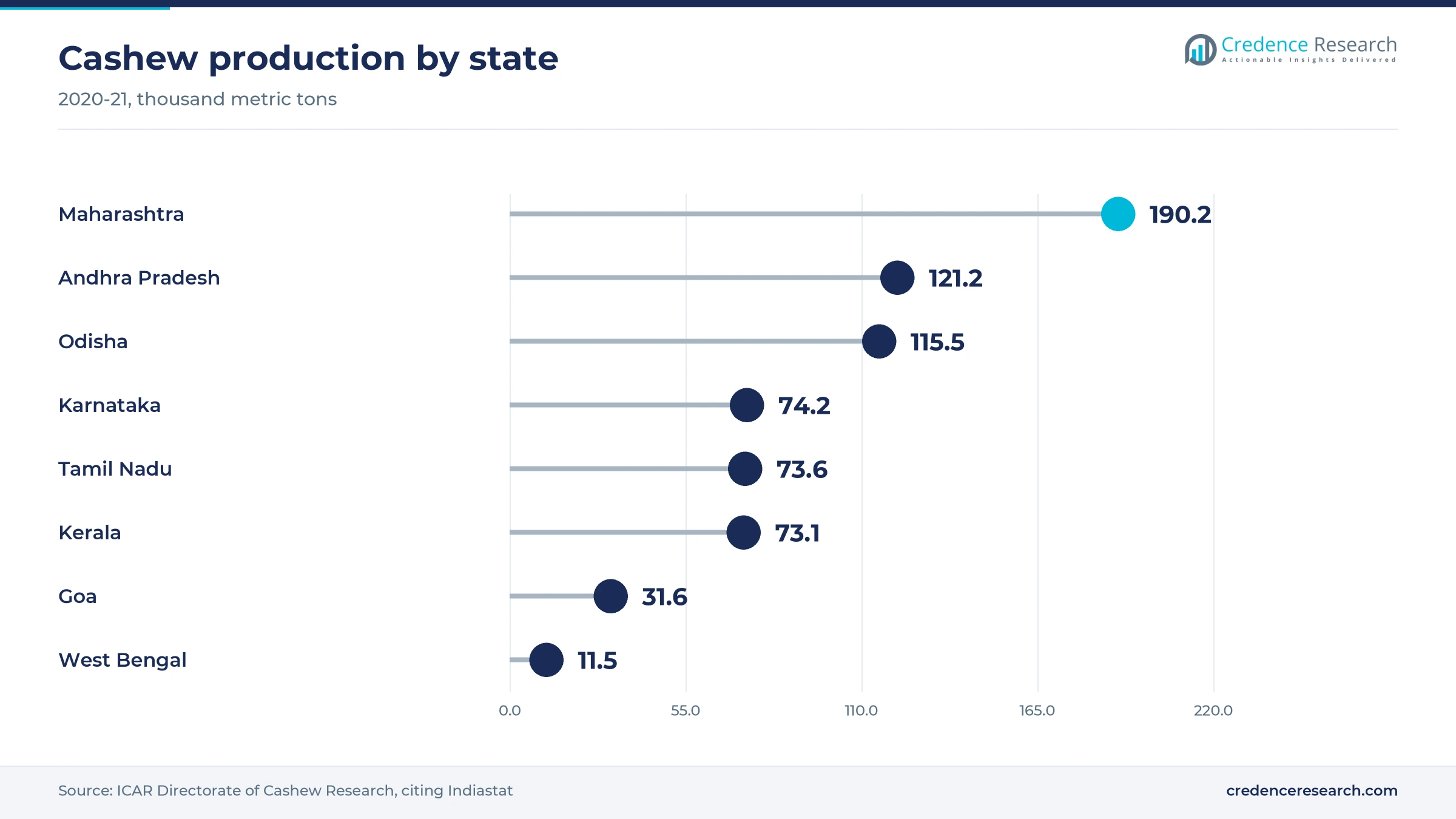
Domestic supply offers another opening, since India can raise its own cashew output and reduce dependence on imported raw nuts. The APEDA market dashboard for May 2026 projected production rising 18% from 620,000 metric tons to 730,000 metric tons, yet noted that nearly 40% of plantations are over 25 years old. IBEF reports that imports meet nearly half of processing requirements, leaving a clear gap for cashew growers and processors. Maharashtra produced 182,790 metric tons, Andhra Pradesh 147,110 metric tons and Odisha 144,980 metric tons in 2025-26, according to IBEF. Replanting could therefore reward processors that contract directly with these state clusters and secure kernels ahead of the festive season.
Price spikes and duty uncertainty squeeze importers
Sharp price spikes test festive affordability
Cost volatility is the most immediate pressure on packers and shoppers alike. FreshPlaza, citing The Economic Times on Oct. 7, 2026, reported almonds up 20% to 40% against the previous Diwali, with Peshawari pistachios at a record Rs 4,000 per kg. Household gift budgets shrink when prices move that quickly, and small retailers carry costlier stock with thin credit. Larger brands can respond with smaller gift formats and wider blends that reduce exposure to the costliest nuts.
Border closures expose Afghan supply routes
Overland supply can stop without warning, as the April 22, 2025 Attari-Wagah closure showed. ETV Bharat reported on May 2, 2025 that retail prices rose Rs 100 to Rs 400 per kg within days, while about 100 loaded trucks sat stranded near Attari. The article also noted that about 90% of Afghan fruit arrives in January and February, so importers lose a full season when a closure runs long. Sea routes remain the alternative, although longer transit adds working capital costs for smaller merchants.
Duty uncertainty delays import decisions
Pending tariff changes make buying decisions difficult for importers holding expensive stock. USDA Foreign Agricultural Service lists a 100% duty on walnuts and Rs 100 per kg on shelled almonds, while ThePrint reported on Feb. 7, 2026 that the India-U.S. framework promised cuts without stating exact reductions. India Seatrade News reported in July 2025 that some importers delayed clearance and accepted penalties, hoping for lower rates. This hesitation disrupts stock planning before Diwali, so larger buyers can stagger shipments and draw on Australian kernels, which supplied 6% of recent almond imports.
Loose trade undercuts branded price points
Branded players must overcome a stubborn price gap against unbranded sacks sold through familiar neighborhood shops. Nuts and Dryfruits Council president Gunjan Jain put the unorganized share at 60% or more in April 2025, while invoiced brands also absorb marketing, testing and platform fees. Value shoppers in smaller towns therefore switch slowly, and thin margins restrict advertising budgets for young companies. Brands can respond with sharper entry packs, quality testing claims such as the Nutraj Bactopure range launched in 2022, and private label work that fills plant capacity.
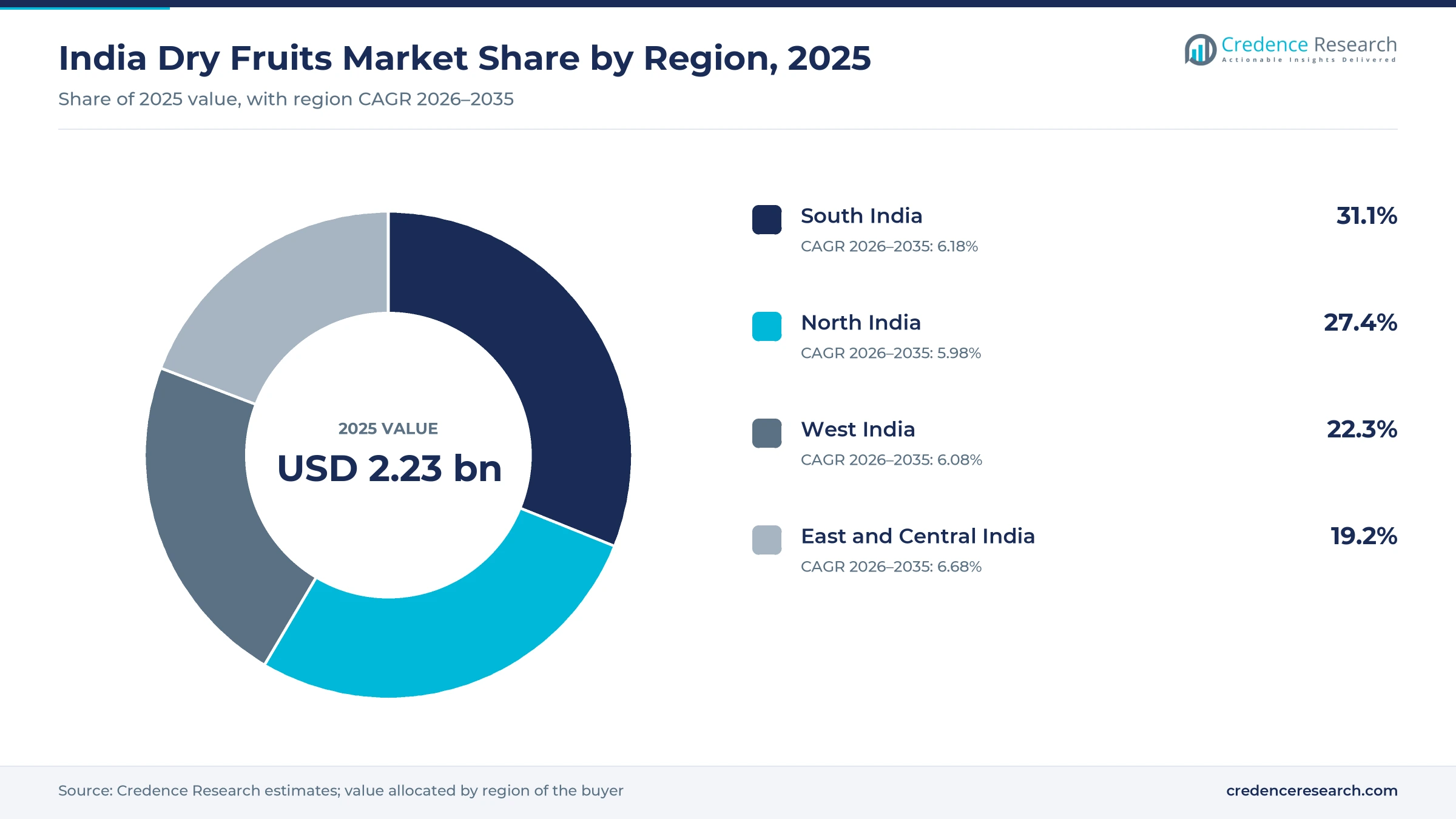
South India leads while the eastern belt grows fastest
| Region | Value, 2025 (USD billion) | Share, 2025 | CAGR, 2026–2035 |
|---|---|---|---|
| South India | 0.69 | 31.1% | 6.18% |
| North India | 0.61 | 27.4% | 5.98% |
| West India | 0.50 | 22.3% | 6.08% |
| East and Central India | 0.43 | 19.2% | 6.68% |
South India leads on processing and date retail
South India held 31.1% of 2025 value and grows at 6.18% a year, making it the largest zone. Kerala, Karnataka and Tamil Nadu together produced about 220,900 metric tons of cashew in 2020-21, according to ICAR Directorate of Cashew Research, which supports strong local kernel supply and gifting habits. Ajfan, a chain established in 2013, runs its own stores and imports dates from the Middle East, while Karnataka-based Bolas sells packaged dry fruits. Local kernel supply and specialty retail together keep the zone ahead of the other three in 2025.
North India anchors imports and wholesale trade
North India held 27.4% of 2025 value and grows at 5.98% a year, with Delhi acting as the national bazaar for imported goods. USDA data show Jammu and Kashmir grows 91% of Indian almonds and over 96% of its walnuts, which ties walnut orchards directly to northern processors. The Confederation of All India Traders expected Rs 1.8 lakh crore of Delhi wedding trade in late 2025. Wonderland Foods has also selected Greater Noida for its new Rs 250 crore plant.
West India combines raisins, ports and brands
West India held 22.3% of 2025 value and grows at 6.08% a year, supported by ports and modern retail in Mumbai. Village Square reports that seven Sangli taluks supply about 80% of national raisins, with graded lots selling at Rs 160 to Rs 250 per kg in Maharashtra markets. Rostaa began as a small Mumbai dry fruit shop, Gulfood records, while ProV Foods runs processing lines in the city. Vashi wholesale trade links these inland raisin belts with western urban buyers.
East and Central India grows from a lower base
East and Central India held 19.2% of 2025 value and grows fastest at 6.68% a year as branded distribution extends beyond state capitals. Odisha produced 144,980 metric tons of cashew in 2025-26, according to IBEF, which gives the zone its own processing base. The Hitavada reported Nagpur shelf prices of Rs 880 to Rs 1,000 per kg for almonds in June 2026, showing how price sensitive central buyers remain. Smaller packs therefore suit these markets better than large festive tins.
Funding, tax and trade moves reset the category
| Development | Status and market relevance |
|---|---|
| In May 2024, ICMR-NIN released updated Dietary Guidelines for Indians that attribute 56.4% of the disease burden to unhealthy diets. | Released May 8, 2024 and supports nut snacking messages |
| In April 2025, the Attari-Wagah border closed and halted Afghan dry fruit truck arrivals from Kandahar and Kabul at Attari. | Retail prices rose Rs 100 to Rs 400 per kg within days |
| In May 2025, Farmley raised USD 40 million in Series C funding led by L Catterton with DSG Consumer Partners. | Funds regional reach and new product development |
| In September 2025, GST on nuts and dried fruits fell from 12% to 5% under the 56th GST Council decisions. | In force since Sept. 22, 2025 and helps invoiced brands |
| In October 2025, Wonderland Foods raised Rs 140 crore and announced a Rs 250 crore greenfield plant in Greater Noida. | Announced, with over 1,000 jobs planned, mostly for women |
Nitrogen packs and inline roasting extend shelf life
- Nitrogen flushing replaces oxygen in pouches, and ProV Foods lists nitrogen-flushed and vacuum options on its site to slow rancidity in nuts.
- Inline roasting lets processors add flavors on continuous lines, which ProV Foods describes alongside machine sorting at its Mumbai facilities.
- Pathogen reduction gives brands a safety claim on raw nuts, and Nutraj launched its Bactopure range for this purpose in 2022.
- Vacuum packing protects shelled kernels on long routes, and USDA reports that over 95% of Indian walnut exports move as vacuum-packed kernels.
Need a Custom Version of This Report?
Tailor the scope, geography, or segments to your exact requirements.
- Custom geography or segment scope
- Direct access to our analyst team
Brands attack loose trade with plants and capital
Competition runs across three groups, namely national packaged brands, regional specialty chains and thousands of loose traders in bazaars. Nutraj pairs imported supply with processing in Jammu, Bangalore, Ahmedabad and the Delhi region, and it serves industrial buyers as well as shoppers. Farmley and Happilo compete on snack formats and online reach, with Farmley funded by L Catterton in May 2025. Wonderland Foods is adding capacity at Greater Noida, while ProV Foods sells through Amazon, Zepto, DMart, BigBasket and Reliance Retail. Rostaa and Ajfan lean on specialty retail and sourcing identity, and Bolas holds a Karnataka base. Loose goods keep a price advantage in most towns, so brands compete on trust, testing and pack design rather than kernel price alone. Scale in imports matters most when freight or origin shocks tighten supply.
Companies profiled and their roles in this market
| Company | Type | Role in the market |
|---|---|---|
| VKC Nuts Pvt. Ltd. (Nutraj) | Integrated processor and importer | Lists plants in Jammu, Bangalore, Sonipat, Loni, Ahmedabad and Ghaziabad, plus institutional supply |
| Connedit Business Solutions Pvt. Ltd. (Farmley) | Packaged snack brand | Raised USD 40 million Series C in May 2025 for regional reach |
| Happilo International Pvt. Ltd. | Packaged snack brand | Sells nuts, trail mixes and gift hampers from a Bangalore unit |
| Wonderland Foods | Processor and brand | Building a Rs 250 crore greenfield plant in Greater Noida |
| ProV Foods Pvt. Ltd. | Processor and brand | Runs Mumbai roasting and packing lines, sold through modern and online retail |
| Royal Dry Fruits Pvt. Ltd. (Rostaa) | Specialty brand | Grew from a Mumbai shop, exhibited at Gulfood 2026 |
| Ajfan Dates and Nuts | Specialty retail chain | Own stores since 2013 and date sourcing from the Middle East |
| Bolas Agro Pvt. Ltd. | Regional brand | Karnataka-based packaged dry fruits brand |
Brands that secure supply will win the next decade
Credence Research's view is that supply access, more than brand spending, will decide the winners in this category through 2035. The 2026 pistachio and almond spikes showed that packers without sourcing range and working capital lose festive weeks quickly. Brands should therefore pair origin diversity with smaller entry packs, since loose goods keep a clear price advantage in smaller towns. Investors should watch the final India-U.S. duty schedule, because it could reset almond and walnut costs. Cashew replanting also deserves attention, given the age of existing plantations and continued reliance on imported raw nuts.
How the India model and regional splits were built
The report uses 2025 as the base year and forecasts to 2035. Market values come from the Credence Research model, while segment and regional splits are Credence Research estimates built from trade volumes, prices, processing clusters and channel evidence. Sources include USDA Foreign Agricultural Service reports, APEDA dashboards, ICAR and IBEF cashew data, trader body releases, company pages and named press coverage. No primary interviews or surveys were conducted for this edition, so channel and occasion splits should be read as informed estimates.
Packaged conversion carries growth through 2035
The market is expected to reach USD 4.10 billion by 2035, growing at 6.20% through 2026–2035, as packaged goods take share from loose sacks. Blended packs and online channels should gain most, although general trade will still handle the larger part of volume in smaller towns. Import costs will stay the main swing factor, because almonds, pistachios and imported dates depend on foreign crops, freight and duty decisions. Domestic plants, cashew replanting and wider gifting programs should steadily strengthen the local value chain, which leaves processors with secure supply best placed by the forecast year.
Frequently Asked Questions
How big is the India dry fruits market?
How fast is the market expected to grow?
Which region leads the market?
Which product type holds the largest share?
What is the main growth driver?
How did the GST change affect the market?
What are the main challenges?
Who are the leading companies?
Table of Content
Chapter 1 Market Segmentation
- 1.1 Segmentation Framework
- 1.1.1 Product and Service Classification
- 1.1.2 Application and End-Use Classification
- 1.1.3 Technology and Solution Classification
- 1.1.4 Customer and Distribution Channel Classification
- 1.1.5 Geographic Segmentation
- 1.1.6 Market Segment Definitions and Boundaries
- 1.2 By Product Type
- 1.2.1 Tree Nuts
- 1.2.2 Cashews
- 1.2.3 Dried Fruits
- 1.2.4 Blends and Mixes
- 1.3 By Customer Type
- 1.3.1 Households
- 1.3.2 Food Manufacturers
- 1.3.3 Foodservice Buyers
- 1.3.4 Corporate Buyers
- 1.4 By Purchase Occasion
- 1.4.1 Festivals and Religious Events
- 1.4.2 Daily Nutrition
- 1.4.3 Weddings and Celebrations
- 1.4.4 Corporate Gifting
Chapter 2 Introduction
- 2.1 Report Objectives and Scope
- 2.2 Product Definition and Industry Terminology
- 2.3 Market Inclusions and Exclusions
- 2.4 Research Process
- 2.4.1 Primary Research and Expert Interviews
- 2.4.2 Secondary Research and Source Review
- 2.4.3 Top-Down and Bottom-Up Estimation
- 2.4.4 Data Triangulation and Verification
- 2.5 Market Size Measurement Basis
- 2.5.1 2025: USD 2.23 billion → 2035: USD 4.10 billion
- 2.6 Historical and Forecast Reference Periods
- 2.6.1 Historical Period: 2018-2025
- 2.6.2 Base Year: 2025
- 2.6.3 Forecast Period: 2025-2035
- 2.7 Research Assumptions and Limitations
Chapter 3 Executive Summary
- 3.1 Market Snapshot and Key Findings
- 3.2 Base-Year Market Size, 2025
- 3.3 Forecast Market Size, 2035
- 3.4 Revenue and Volume Growth Outlook
- 3.5 Key Demand and Supply Indicators
- 3.6 Leading Market Segments
- 3.7 Fastest-Growing Market Opportunities
- 3.8 Regional Performance Highlights
- 3.9 Technology and Industry Transformation
- 3.10 Competitive Landscape Summary
- 3.11 Analyst View and Strategic Implications
Chapter 4 India Dry Fruits Market Trends and Developments
- 4.1 Historical Industry Development, 2018-2025
- 4.2 Recent Market Trends and Developments
- 4.3 Demand and Customer Behavior Trends
- 4.4 Technology and Product Innovation
- 4.5 Artificial Intelligence, Automation and Digitalization
- 4.6 Local Manufacturing and Supply Chain Realignment
- 4.7 Industry Partnerships, Mergers and Acquisitions
- 4.8 Sustainability and Circular Economy Developments
- 4.9 Government and Private Sector Investment Trends
- 4.10 Emerging Business Models and Commercialization
- 4.11 Industry Developments and Announcements
Chapter 5 India Dry Fruits Market Production, Supply and Demand Analysis
- 5.1 Demand Trend and Consumption Analysis, 2018-2025
- 5.2 Demand Forecast, 2025-2035
- 5.3 Production and Output Trend, 2018-2025
- 5.4 Production and Output Forecast, 2025-2035
- 5.5 Installed Capacity and Capacity Utilization
- 5.6 Company-Wise Production Plants and Statistics
- 5.6.1 Installed Production Capacity
- 5.6.2 Actual Production
- 5.6.3 Planned Capacity and Expansion Targets
- 5.7 Supply Chain Structure and Procurement Trends
- 5.8 Supply-Demand Gap and Bottlenecks
- 5.9 Import Dependence and Sourcing Structure
- 5.10 Contract Manufacturing and Outsourcing
- 5.11 Regional Supply and Demand Concentration
Chapter 6 India Dry Fruits Market Pricing Analysis
- 6.1 Pricing Structure and Measurement
- 6.2 Historical Pricing Trends, 2018-2025
- 6.3 Pricing Outlook, 2025-2035
- 6.4 Average Selling Price and Unit Economics
- 6.5 Pricing by Product and Market Segment
- 6.6 Geographic Pricing Differences
- 6.7 Key Input, Energy, Labor and Logistics Costs
- 6.8 Contract Pricing and Purchasing Models
- 6.9 Pricing Sensitivity and Competitive Positioning
- 6.10 Price, Margin and Profitability Implications
Chapter 7 India Dry Fruits Market Dynamics
- 7.1 Market Growth Drivers
- 7.1.1 Demand-Side Drivers
- 7.1.2 Technology and Innovation Drivers
- 7.1.3 Infrastructure and Investment Drivers
- 7.1.4 Regulatory and Policy Drivers
- 7.2 Market Restraints
- 7.2.1 Cost and Affordability Constraints
- 7.2.2 Technology and Adoption Barriers
- 7.2.3 Supply Chain and Operational Constraints
- 7.3 Market Challenges
- 7.3.1 Competitive Pressure and Margin Erosion
- 7.3.2 Skills, Infrastructure and Implementation Gaps
- 7.4 Emerging Market Opportunities
- 7.5 Market Dynamics Impact and Time-Horizon Assessment
Chapter 8 India Dry Fruits Value Chain Analysis
- 8.1 Industry Value Chain Overview
- 8.2 Upstream Suppliers and Critical Inputs
- 8.3 Technology and Component Providers
- 8.4 Manufacturing or Service Delivery
- 8.5 Distribution, Channel Partners and Integrators
- 8.6 Downstream Applications and End Users
- 8.7 Value Addition and Profit Pools
- 8.8 Vertical Integration and Outsourcing
- 8.9 Supplier Concentration and Risk
- 8.10 Supply Chain Localization and Resilience
Chapter 9 India Dry Fruits Market Regulations and Policies
- 9.1 Relevant Laws, Standards and Compliance Frameworks
- 9.2 Product, Service, Safety and Quality Requirements
- 9.3 Government Policies, Incentives and Subsidies
- 9.4 Imports, Exports and Trade Barriers
- 9.5 Public Procurement and Local Content Requirements
- 9.6 Environmental and Sustainability Compliance
- 9.7 Upcoming Policy Changes and Market Implications
Chapter 10 India Dry Fruits Market Hotspots and Opportunities
- 10.1 Market Opportunity Mapping and Growth Hotspots
- 10.2 High-Growth Applications and Customer Groups
- 10.3 Underserved Markets and White-Space Opportunities
- 10.4 Emerging Technology and Product Opportunities
- 10.5 New Capacity and Investment Hotspots
- 10.6 Market Entry and Expansion Opportunities
- 10.7 Distribution and Partnership Opportunities
- 10.8 Near-Term and Long-Term Commercial Potential
- 10.9 Opportunity Attractiveness and Execution Risks
Chapter 11 India Dry Fruits Market Outlook, 2025-2035
- 11.1 Market Size and Analysis
- 11.1.1 Revenue (Market Measurement: 2025: USD 2.23 billion → 2035: USD 4.10 billion)
- 11.1.2 Market Volume and Quantity Sold
- 11.1.3 Historical Market Size, 2018-2025
- 11.1.4 Base-Year Market Size, 2025
- 11.2 Market Forecast, 2025-2035
- 11.2.1 Revenue Forecast to 2035
- 11.2.2 Volume Forecast to 2035
- 11.2.3 CAGR and Year-on-Year Growth
- 11.2.4 Incremental Revenue Opportunity
- 11.3 Forecast Assumptions and Scenario Analysis
- 11.3.1 Base-Case Forecast
- 11.3.2 Optimistic and Conservative Scenarios
- 11.3.3 Technology, Pricing and Policy Sensitivities
- 11.4 Market Attractiveness and Growth Outlook
Chapter 12 India Dry Fruits Market Segmentation and Outlook
- 12.1 Segmentation Summary and Market Shares, 2025
- 12.2 Largest and Fastest-Growing Segments
- 12.3 By Product Type - Market Size and Forecast, 2025-2035
- 12.3.1 Segment Definition and Scope
- 12.3.2 Historical Market Size, 2018-2025
- 12.3.3 Revenue Forecast, 2025-2035
- 12.3.4 Volume Forecast, 2025-2035
- 12.3.5 Base-Year Market Share, 2025
- 12.3.6 Segment CAGR and Growth Drivers
- 12.3.7 Subsegment Market Size and Forecast
- 12.3.7.1 Tree Nuts
- 12.3.7.2 Cashews
- 12.3.7.3 Dried Fruits
- 12.3.7.4 Blends and Mixes
- 12.3.8 Subsegment Pricing and Adoption Trends
- 12.3.9 Leading Suppliers and Competition
- 12.3.10 Regional Demand and Opportunities
- 12.4 By Customer Type - Market Size and Forecast, 2025-2035
- 12.4.1 Segment Definition and Scope
- 12.4.2 Historical Market Size, 2018-2025
- 12.4.3 Revenue Forecast, 2025-2035
- 12.4.4 Volume Forecast, 2025-2035
- 12.4.5 Base-Year Market Share, 2025
- 12.4.6 Segment CAGR and Growth Drivers
- 12.4.7 Subsegment Market Size and Forecast
- 12.4.7.1 Households
- 12.4.7.2 Food Manufacturers
- 12.4.7.3 Foodservice Buyers
- 12.4.7.4 Corporate Buyers
- 12.4.8 Subsegment Pricing and Adoption Trends
- 12.4.9 Leading Suppliers and Competition
- 12.4.10 Regional Demand and Opportunities
- 12.5 By Purchase Occasion - Market Size and Forecast, 2025-2035
- 12.5.1 Segment Definition and Scope
- 12.5.2 Historical Market Size, 2018-2025
- 12.5.3 Revenue Forecast, 2025-2035
- 12.5.4 Volume Forecast, 2025-2035
- 12.5.5 Base-Year Market Share, 2025
- 12.5.6 Segment CAGR and Growth Drivers
- 12.5.7 Subsegment Market Size and Forecast
- 12.5.7.1 Festivals and Religious Events
- 12.5.7.2 Daily Nutrition
- 12.5.7.3 Weddings and Celebrations
- 12.5.7.4 Corporate Gifting
- 12.5.8 Subsegment Pricing and Adoption Trends
- 12.5.9 Leading Suppliers and Competition
- 12.5.10 Regional Demand and Opportunities
- 12.6 Segment Growth Comparison
- 12.7 Segment Attractiveness and Priority Matrix
Chapter 13 India Dry Fruits End-Use and Application Market Outlook
- 13.1 End-Use Industry and Customer Demand Structure
- 13.2 Leading Applications and Customer Groups
- 13.3 End-Use Market Size, Share and Forecast
- 13.4 Major End-Use Industry Deep Dives
- 13.4.1 Customer Requirements and Use Cases
- 13.4.2 Demand and Replacement Cycles
- 13.4.3 Technical and Regulatory Considerations
- 13.4.4 Purchasing and Procurement Models
- 13.4.5 Leading Vendors and Distribution Channels
- 13.4.6 Forecast and Commercial Opportunities
- 13.5 Emerging Applications and Cross-Segment Demand
- 13.6 End-Use Industry Investment Priorities
Chapter 14 India Dry Fruits Geographic Market Outlook, 2025-2035
- 14.1 Domestic Market Distribution and Demand Clusters
- 14.2 State- or Province-Wise Market Size and Forecast, 2025-2035
- 14.3 City and Metropolitan Market Outlook
- 14.4 Industrial, Manufacturing and Commercial Clusters
- 14.5 Geographic Concentration of Key End Users
- 14.6 Local Pricing and Purchasing Differences
- 14.7 Domestic Production Facilities and Capacity Map
- 14.8 Local Infrastructure and Project Pipeline
- 14.9 State-Level Policy and Incentive Differences
- 14.10 Subnational Investment Hotspots and Opportunities
- 14.11 Distribution and Logistics Networks
- 14.12 Domestic Competitive Footprint
Chapter 15 India Dry Fruits Technology, Innovation and Sustainability Outlook
- 15.1 Technology Landscape and Maturity
- 15.2 Product, Process and Service Innovation
- 15.3 AI, Automation and Digital Tools in the Industry
- 15.4 Technology Adoption and Performance Benchmarking
- 15.5 Innovation Pipeline and R&D Investment
- 15.6 Patent and Intellectual Property Trends
- 15.7 Energy Efficiency and Resource Management
- 15.8 Sustainability, Recycling and Circularity
- 15.9 Technology Roadmap, 2025-2035
- 15.10 Risks of Obsolescence and Technology Substitution
Chapter 16 India Dry Fruits Market Key Strategic Imperatives
- 16.1 Growth and Market Entry Priorities
- 16.2 High-Return Products and Segments
- 16.3 Pricing, Profitability and Cost Optimization
- 16.4 Technology Investment and Product Differentiation
- 16.5 Supply Chain Localization and Resilience
- 16.6 Distribution and Customer Acquisition
- 16.7 Partnership, Acquisition and Capacity Strategy
- 16.8 Regional Expansion Priorities
- 16.9 Short-, Medium- and Long-Term Actions
Chapter 17 Competition Outlook
- 17.1 Industry Competition Characteristics
- 17.2 Market Structure and Concentration
- 17.3 Market Share and Competitive Positioning, 2025
- 17.4 Company-Wise Revenue and Product Benchmarking
- 17.5 Production and Service Capacity Benchmarking
- 17.6 Technology, Pricing and Differentiation
- 17.7 Regional Footprint and Distribution Strength
- 17.8 Mergers, Acquisitions and Strategic Alliances
- 17.9 New Entrants and Competitive Threats
- 17.10 Porter's Five Forces and Industry Attractiveness
- 17.11 Competitive Outlook, 2025-2035
Chapter 18 Company Profiles
- 18.1 Company Coverage and Selection Criteria
- 18.2 VKC Nuts Pvt. Ltd. (Nutraj)
- 18.2.1 Business Description
- 18.2.2 Company Ownership and Geographic Presence
- 18.2.3 Product and Service Portfolio
- 18.2.4 Manufacturing and Operating Footprint
- 18.2.5 Production Capacity and Expansion Plans
- 18.2.6 Financial Performance and Investment
- 18.2.7 Market Share and Competitive Position
- 18.2.8 Technology and Innovation Capabilities
- 18.2.9 Strategic Alliances or Partnerships
- 18.2.10 Recent Developments
- 18.2.11 Growth Strategy and Outlook
- 18.3 Happilo International Pvt. Ltd.
- 18.4 Connedit Business Solutions Pvt. Ltd. (Farmley)
- 18.5 Wonderland Foods
- 18.6 Royal Dry Fruits Pvt. Ltd. (Rostaa)
- 18.7 ProV Foods Pvt. Ltd.
- 18.8 Bolas Agro Pvt. Ltd.
- 18.9 Ajfan Dates and Nuts
- 18.10 Other Relevant Market Participants
Note: Every listed company is profiled on the structure shown under the first company. The company list is preliminary and may change based on research findings, market developments, data availability and client requirements.
Chapter 19 Disclaimer
- 19.1 Research and Forecast Disclaimer
- 19.2 Data Source and Estimation Limitations
Note: The depth of individual sections depends on data availability for this market. Volume, capacity, trade and other unit-based metrics are included where applicable.

