
A three-level exam ladder sustains paid CA preparation
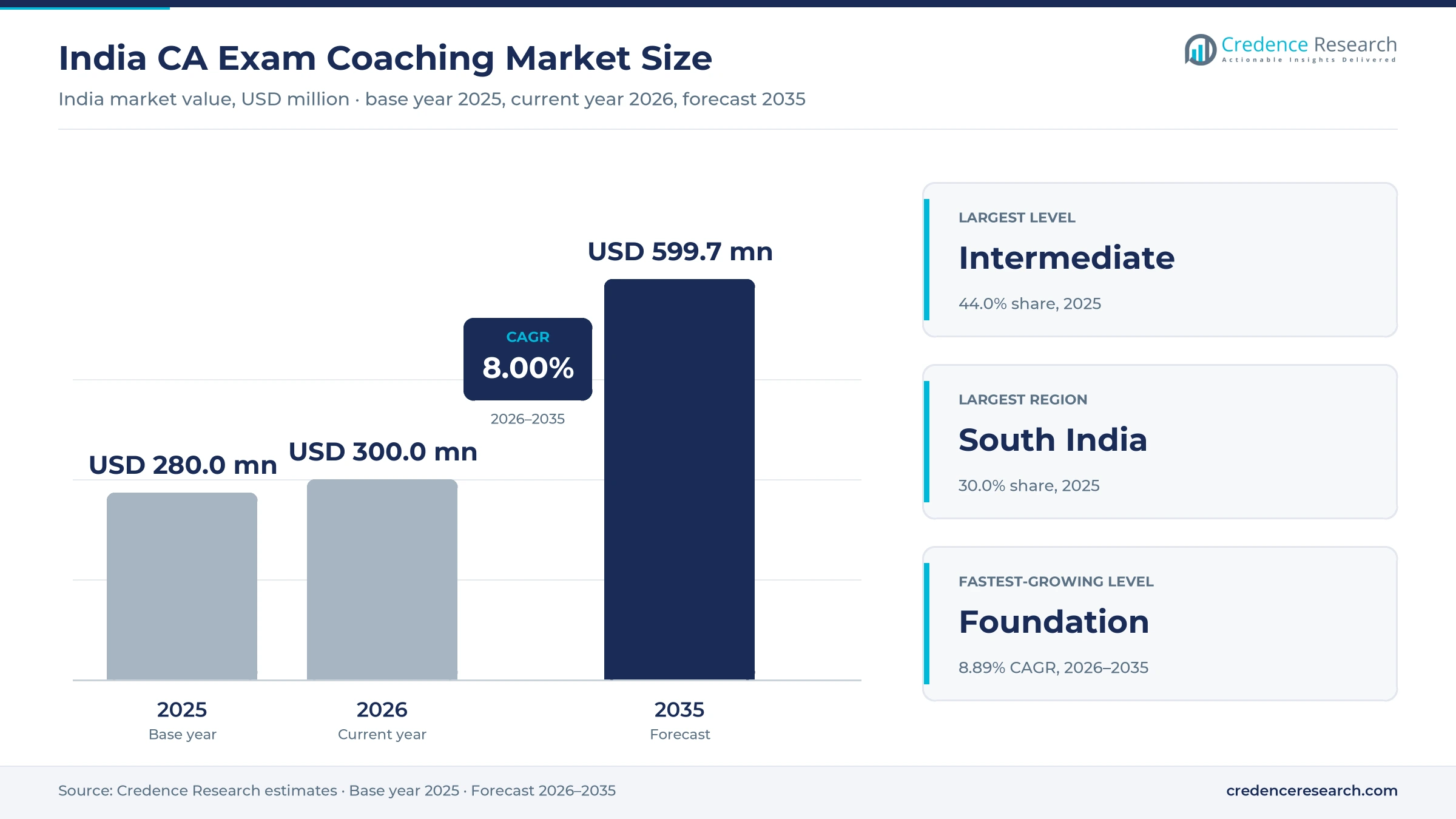
The India CA exam coaching market was valued at USD 280.0 million in 2025 and is projected to increase from USD 300.0 million in 2026 to USD 599.7 million by 2035, registering a CAGR of 8.00% during 2026–2035. Demand comes from students who pay for Foundation, Intermediate and Final courses across a qualification that counted 1,006,256 registered students in 2025. South India held the largest regional share, 30.0% in 2025, because institutes such as Master Minds run dense branch networks across Andhra Pradesh and Telangana, although North India and West India follow closely. East India is the fastest-growing region at 9.02% a year, as national brands add teaching in cities such as Patna and Kolkata. The exam calendar also changed in 2025, when the Institute of Chartered Accountants of India moved CA Final to three sittings a year. That shift gives students more attempts and gives providers more selling cycles for revision courses.
Which chartered accountancy course fees count toward this total?
The market counts fees paid to faculty brands, institutes and platforms for Foundation, Intermediate and Final preparation, including live online batches, recorded lectures on pen drives or cloud drives, classroom teaching and paid test series. Students usually buy by level, then by group or paper.
The estimate excludes statutory fees paid to the institute, articleship stipends, living costs and free material from the ICAI Board of Studies, although those free classes shape pricing. The value chain runs from star faculty and publishers through apps, distributors and centers to students, many of whom start after Class 12.
India CA Exam Coaching Market Insights
- Fees rise from USD 280.0 million in 2025 to USD 599.7 million by 2035, rising at an 8.00% CAGR as more students buy recorded and live courses across three exam sittings a year.
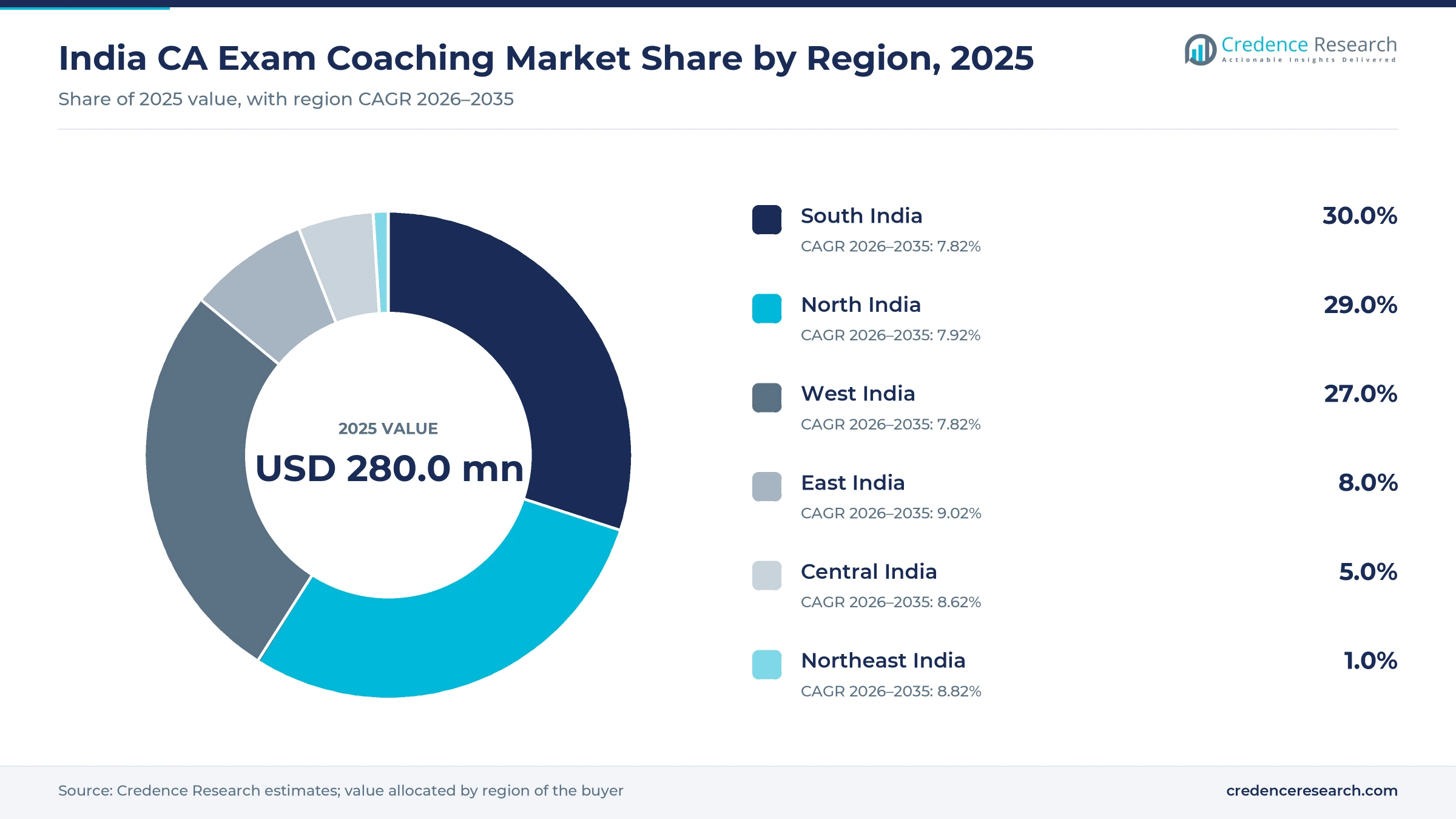
- South India held 30.0% of 2025 value, narrowly ahead of North India and West India, reflecting branch networks in Andhra Pradesh, Telangana and other southern states.
- Intermediate courses held 44.0% of 2025 value, supported by 417,609 registered Intermediate students, the largest of the three levels in ICAI data.
- Only 8.47% of candidates taking both Intermediate groups passed in May 2026, which keeps repeat course sales and paid revision modules firmly in demand.
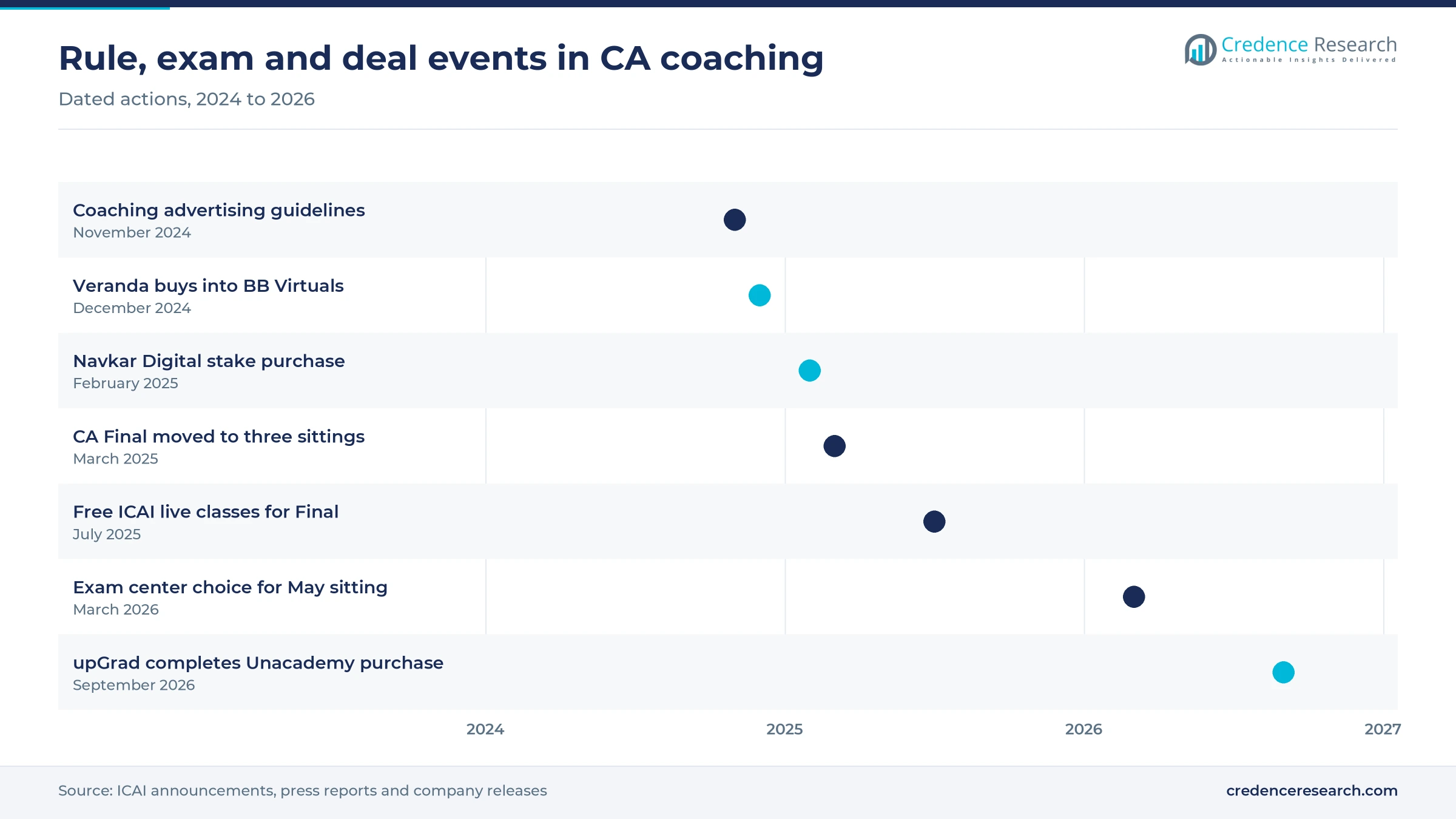
- Consolidation is active, with Veranda Learning buying into BB Virtuals in December 2024 and Navkar Digital in February 2025 and upGrad closing its all-stock Unacademy purchase in September 2026.
Intermediate carries value as Foundation grows fastest
Intermediate leads on students while Foundation grows fastest
Based on level, the market is categorized into Foundation, Intermediate and Final. Intermediate led with 44.0% of 2025 value because it had the largest base, 417,609 registered students in ICAI data reported by The Finance Story in November 2025, and students buy across six papers in two groups. Foundation grows fastest at 8.89% a year as registrations rose to 347,256 from 260,408 a year earlier, according to the same report. Final courses keep a high share because Aldine CA lists a single Financial Reporting paper at about Rs 20,000.
Online and pen-drive courses lead on reach and price
Based on mode, the market is categorized into online/pen-drive and offline. Online/Pen-Drive led with 64.0% of 2025 value and also grows fastest at 8.49% a year, because recorded and live lectures reach students who cannot attend a hub, and BB Virtuals alone has trained over 200,000 students online, according to Business Standard in February 2025. Offline teaching holds value through premium classroom fees and dense centers. JK Shah Classes lists 116 face-to-face centers across 41 cities, while ThePrint counted about 15 centers in one Pune hub in December 2018.
Faculty brands lead as platforms undercut on price
Based on provider, the market is categorized into faculty brands and platforms. Faculty Brands led with 72.0% of 2025 value because students usually choose a teacher by subject, and resellers such as Zeroinfy list a Swapnil Patni Classes Foundation combo at Rs 14,999 to Rs 20,999. Platforms grow fastest at 8.99% a year as they sell complete batches at lower prices, and PhysicsWallah listed its Sampurna Foundation batch at Rs 5,799 in an offer that ran until April 6, 2026. Unacademy also adds monthly evaluated test series across all of its subjects.
| Segment Group | Leading Sub-segment | Share, 2025 | Fastest-growing Sub-segment | CAGR, 2026–2035 |
|---|---|---|---|---|
| By Level | Intermediate | 44.0% | Foundation | 8.89% |
| By Mode | Online/Pen-Drive | 64.0% | Online/Pen-Drive | 8.49% |
| By Provider | Faculty Brands | 72.0% | Platforms | 8.99% |
Request a Free Sample
Fill in your details and we'll send you a free sample report.
- Sample data tables & charts
- Research methodology
Enrollment, digital reach and repeat attempts lift fees
Rising CA aspirants support paid Foundation and inter courses
A larger student base converts directly into course sales, since most candidates pay for at least part of their preparation at the first two levels. The Finance Story reported in November 2025 that Foundation registrations reached 347,256 from 260,408 in 2024, while Intermediate rose to 417,609 from 414,481. The institute counted 1,006,256 students in total, according to Careers360. Entry prices also sit within reach of families, with PhysicsWallah selling a Foundation batch at Rs 5,799 and Collegedunia listing live Foundation classes at Aldine CA for Rs 19,000. In the Credence Research model this adds about 3.04 percentage points to annual growth to 2035, and Foundation courses capture much of that gain.
Faculty-led digital batches reach learners beyond metros
Digital delivery lets a well-known teacher sell far beyond one city, which adds new buyers rather than only moving existing classroom students. Swapnil Patni's Classes, founded in a single Pune classroom in 2010, now reports a presence in 1,800 pin codes and more than 150 partners, according to The Finance Story. Business Standard reported in February 2025 that BB Virtuals had trained over 200,000 students online. Aldine CA pairs live classes with Google Drive backup, so students with weak connections can still study, and this wider form of e-learning now reaches small towns. In the Credence Research model this adds about 2.24 percentage points to annual growth to 2035.
Repeat attempts and revision modules add recurring sales
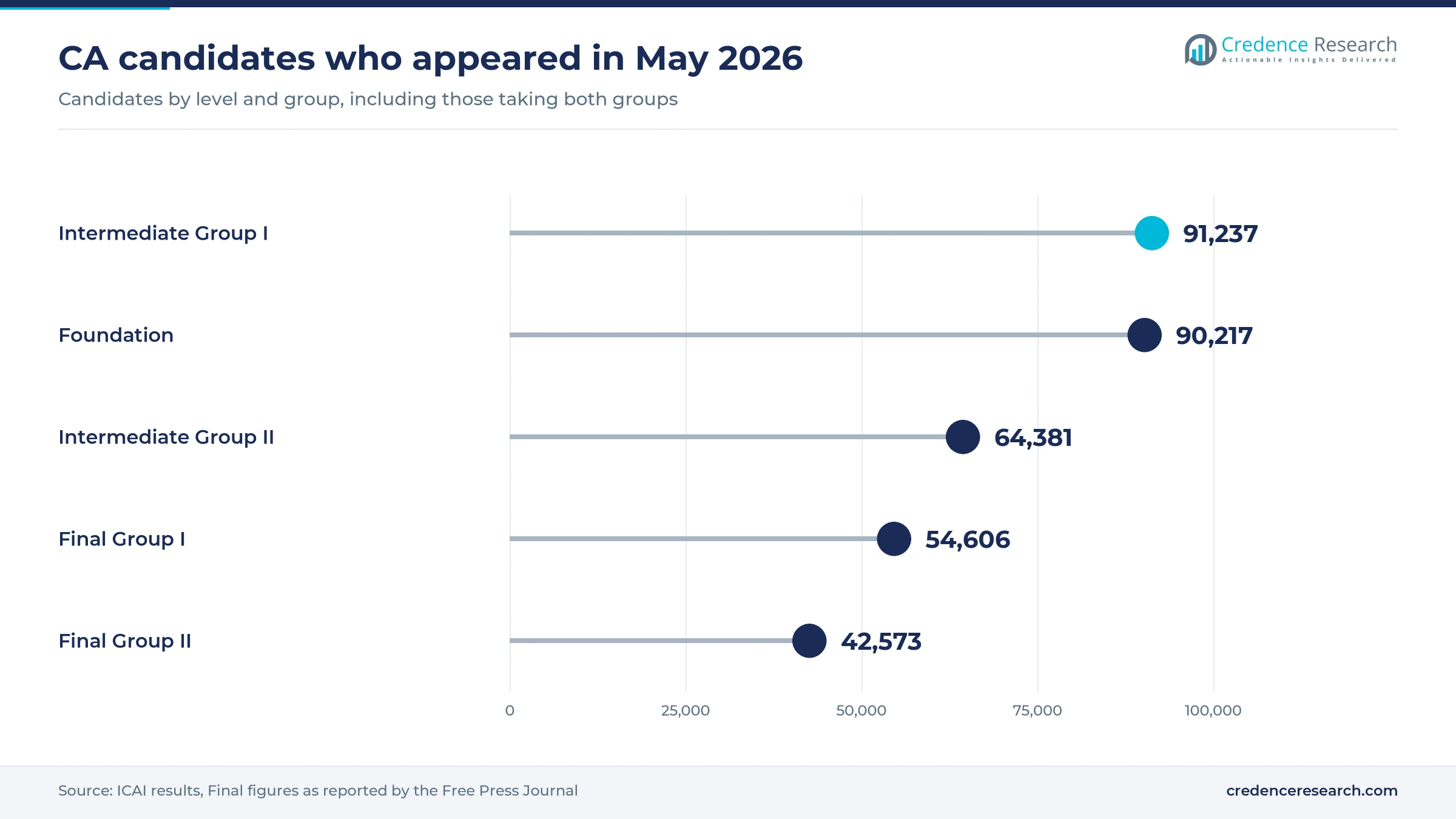
Low pass rates turn many students into repeat buyers, because a failed group often leads to a new revision course or test series. ICAI reported that only 20.09% of 90,217 Foundation candidates passed in May 2026, while 8.47% of 33,304 candidates cleared both Intermediate groups. The institute also announced on March 27, 2025 that CA Final would move to January, May and September sittings, matching the lower levels. Providers have priced for this behavior, with PhysicsWallah selling a Fastrack revision batch at Rs 1,800 and Unacademy offering monthly evaluated tests. In the Credence Research model this adds about 1.44 percentage points to annual growth to 2035.
A strong CA career pull draws graduates into preparation
The profession offers a clear career route at a time when educated young people still face a difficult job market, which keeps enrollment attractive to families. The Periodic Labour Force Survey press note for 2025 put urban youth unemployment at 13.6%, and the rate for people with at least secondary education at 6.5%. Careers360 reported ICAI data showing 407,629 members and 98,967 registered firms in 2025, of which 159,557 members held a certificate of practice, so families can see the profession's reach directly. Private tutoring is also a familiar household expense, since the Comprehensive Modular Survey on Education found in 2025 that 27% of students took coaching, which supports wider spending on test preparation.
Cloud delivery and deal activity reshape CA teaching
Shift from pen drives to cloud and app delivery
Recorded CA lectures are moving from physical pen drives toward cloud drives and apps, because students want lower prices and access on several devices. A September 2026 fee comparison by CA Test Series put both-group Intermediate courses at Rs 8,000 to Rs 16,000 on apps, Rs 12,000 to Rs 26,000 on Google Drive and Rs 16,000 to Rs 35,000 on pen drive. The same publisher noted in August 2026 that pen drive software is usually locked to one computer and takes three to seven days to arrive. Zeroinfy sells Swapnil Patni Foundation combos through Google Drive with two, three or unlimited views, which shows how providers now price access itself rather than hardware.
Rise of investor deals among CA faculty brands
Capital is moving into commerce education, as investors look for established teachers with loyal online audiences and repeat course sales. The Finance Story reported that Veranda Learning paid Rs 126.2 crore for 51% of BB Virtuals in December 2024 and Rs 45.5 crore for 65% of Navkar Digital Institute in February 2025. Adda247 also acquired Ekagrata Eduserv in July 2024, and the same November 2025 report said Sunil Singhania's family office invested in Swapnil Patni's Classes at a Rs 240 crore valuation. YourStory reported in February 2026 that Veranda planned to demerge its commerce business into JK Shah Commerce Education. As a result, larger groups should gain, although star faculty retain real bargaining power.
Opportunity in AI and analytics modules for a new syllabus
A curriculum review opens a chance to launch new courses ahead of competitors, because no provider yet owns teaching in these subjects. ICAI President Prasanna Kumar D told PTI, according to the Free Press Journal, that the institute will add artificial intelligence, data analytics, ESG and sustainability to the course. The institute has formed a Committee for Review of Education and Training to finalize recommendations, and the report expects updates to apply from 2028. These subjects are not currently part of the curriculum, so existing faculty have few ready materials. Providers that build practical modules on artificial intelligence in accounting could also sell them to working members, since Careers360 counted 248,072 of the 407,629 ICAI members in 2025 as not holding a certificate of practice.
Opening in hybrid centers and residential campuses
Hybrid formats offer a way to charge more than a recorded course, by adding mentoring and discipline for students who struggle alone. The Finance Story describes SPC Gurukul as the first residential CA campus in India, alongside a hybrid model of classes and streaming. PhysicsWallah, an education technology group, now lists CA Wallah offline centers at Laxmi Nagar, Pitampura, Jaipur and Patna, showing that online brands see value in classrooms. Local demand is visible in second-tier cities, as ICAI Indore recorded 2,205 Foundation and 1,136 Final candidates in September 2025, according to the Free Press Journal. Providers that combine local mentors with national faculty could win students who now choose on price alone.
Pass rates, free classes and tax pressure test providers
Falling pass rates raise doubts about course value
Weak results can make families question the value of paid courses. The Free Press Journal reported on June 18, 2026 that CA Final Group I passes fell to 12.00% in May 2026 from 22.38% a year earlier, while both-group passes fell to 14.07% from 18.75%. Providers that advertise rank holders face particular scrutiny after such drops, and smaller faculty brands have less data to show. Publishing subject-level outcomes and adding evaluated tests are the most practical responses to this problem.
Free ICAI live classes cap pricing at every level
The regulator of the profession also teaches, and that limits what private providers can charge. The Free Press Journal reported that free live virtual classes for CA Final began on July 21, 2025 across all five main papers, while the Board of Studies started Foundation sessions on Sept. 25, 2025. Price-sensitive students may therefore skip paid basics and buy only revision. Private faculty must respond with sharper exam strategy, more practice questions and stronger doubt support than the free classes offer.
Goods and services tax adds to fee burdens
Tax raises the delivered price, especially for smaller institutes and families paying across several attempts. Careers360 reported on Jan. 29, 2026 that the Coaching Federation of India asked the finance minister to cut tax on coaching to 5% or nil and to raise the exemption limit from Rs 20 lakh to Rs 1 crore. Listed prices such as those on Aldine CA already include the tax. Until rates change, providers must absorb part of the cost or lose buyers to lower-priced platforms.
Advertising rules limit claims about results
Results marketing is the main sales tool in this market, and it now carries legal risk. The consumer regulator issued 45 notices and fined 18 institutes Rs 54.6 lakh by November 2024, according to Morung Express, and its new guidelines require disclosure of each candidate's course. Unacademy now footnotes that its 5,010 claimed CA passes in 2026 include test series users and special class learners. Faculty brands must therefore keep clean enrollment records and written consent, or they risk penalties.
South India leads narrowly while East India grows fastest
| Region | Value, 2025 (USD million) | Share, 2025 | CAGR, 2026–2035 |
|---|---|---|---|
| South India | 84.0 | 30.0% | 7.82% |
| North India | 81.2 | 29.0% | 7.92% |
| West India | 75.6 | 27.0% | 7.82% |
| East India | 22.4 | 8.0% | 9.02% |
| Central India | 14.0 | 5.0% | 8.62% |
| Northeast India | 2.8 | 1.0% | 8.82% |
South India leads through dense branch networks in two states
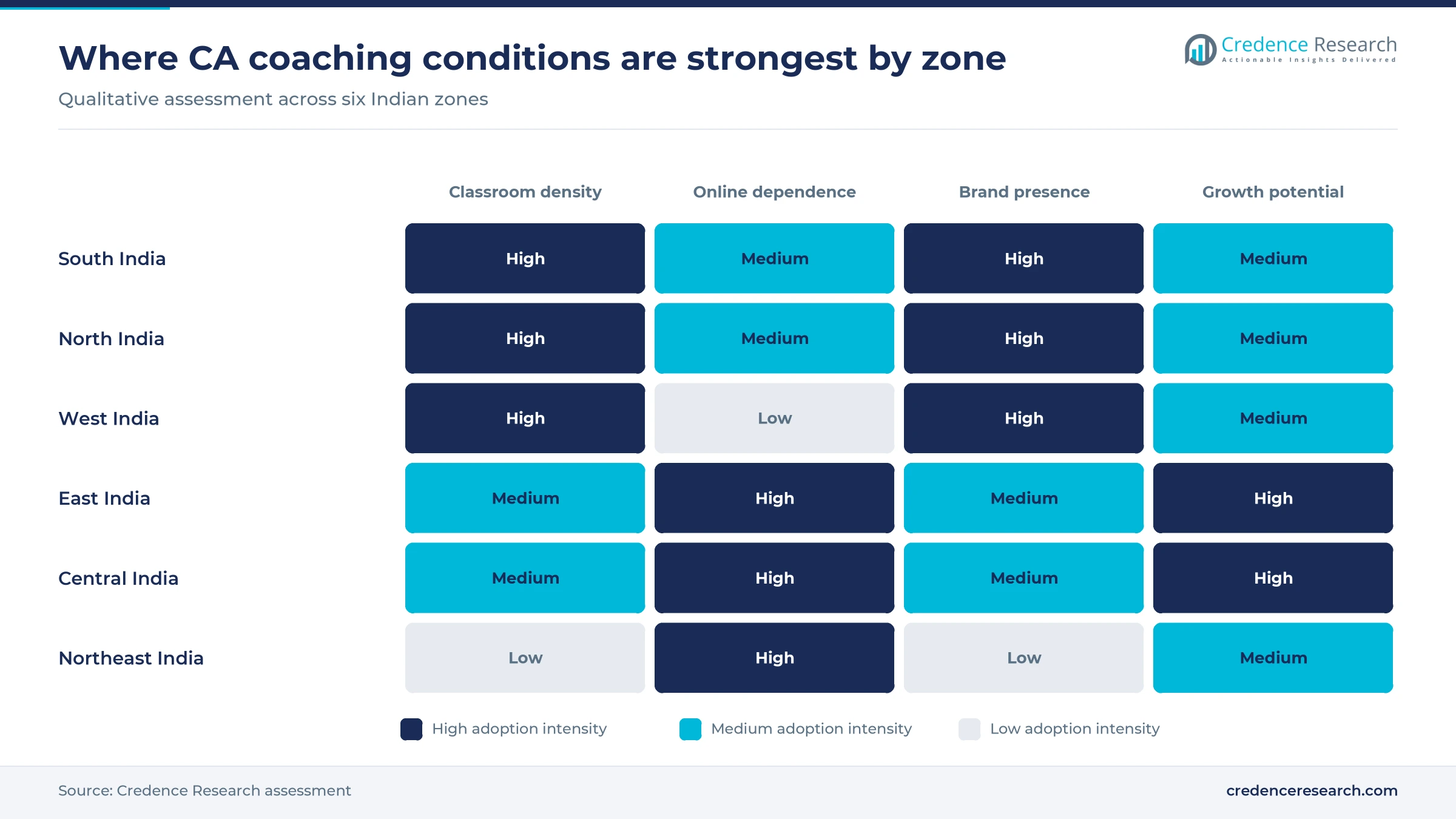
South India held 30.0% of 2025 value and grows at 7.82% a year, supported by dense local institutes rather than a single hub. Master Minds, established in Guntur in 2002, lists branches in Hyderabad, Vijayawada, Vizag, Tirupati, Kurnool, Nellore and Rajahmundry on its website. An ICAI notice of August 2026 placed six of its 23 convocation centers in the south, including Bengaluru, Chennai, Coimbatore and Ernakulam. This spread gives classroom providers a wide local base, although growth lags East India because the base is already large.
North India pairs Delhi classrooms with Jaipur batches
North India held 29.0% of 2025 value and grows at 7.92% a year, anchored by Delhi and Jaipur. PhysicsWallah listed seven CA Wallah Intermediate batches across Jaipur and Delhi in May 2026, at Gopalpura, Laxmi Nagar and Pitampura. Aldine CA teaches from Preet Vihar, Janakpuri and Pitampura, while VSI Jaipur listed pen drive courses in May 2024 at Rs 58,000 for Foundation. Together, these brands sell both local classes and recorded courses from the same faculty, so reach extends well beyond the zone.
West India draws value from Pune and Mumbai faculty
West India held 27.0% of 2025 value and grows at 7.82% a year, with Maharashtra and Gujarat as its anchors. ThePrint described one Pune hub in December 2018 with about 15 centers and 50 classrooms, where Foundation fees then ran Rs 30,000 to Rs 35,000 a year. JK Shah Classes names Mumbai, Ahmedabad and Pune among its main cities, and Navkar Digital serves Gujarat, according to Business Standard.
East India grows fastest as national brands arrive
East India held 8.0% of 2025 value and grows at 9.02% a year, the fastest pace among the zones. PhysicsWallah lists a CA Wallah center at Boring Road in Patna, and Aldine CA teaches at Girish Park in Kolkata, which brings well-known faculty closer to students. ICAI also named Kolkata and Bhubaneswar among its convocation cities for September 2026. Local centers can therefore serve students who would otherwise rely on recorded courses or travel, so more of those fees should stay in the zone.
Central India gains from strong Indore results
Central India held 5.0% of 2025 value and grows at 8.62% a year, with Indore as its main teaching base. The Free Press Journal reported that 2,205 Foundation and 1,136 Final candidates appeared through the ICAI Indore branch in September 2025, producing 130 new chartered accountants. Local institute Vidhyoday reported training 360 Intermediate students for that exam in a November 2025 press release. Bhopal and Raipur also hosted ICAI convocations in 2026, so classroom demand should strengthen around them.
Northeast India stays small and depends on Guwahati
Northeast India held 1.0% of 2025 value and grows at 8.82% a year from a very small base. Guwahati is the only northeastern city on the 23-center ICAI convocation list for September 2026, which shows how concentrated activity remains. The Finance Story reported in February 2023 that Assam allotted 144,000 square feet in Guwahati for an ICAI center serving 500 students and professionals. Recorded and live online batches remain the practical choice for most students in the eight states.
Exam reform and consolidation marked 2024 to 2026
| Development | Status and market relevance |
|---|---|
| In November 2024, the consumer regulator issued guidelines against misleading coaching advertisements and reported Rs 54.6 lakh in fines on 18 institutes. | In force; disclosure of the course taken applies to results claims. |
| In February 2025, Veranda Learning bought a stake in Navkar Digital Institute, after buying into BB Virtuals in December 2024. | Completed in stages; it added online and Gujarat classroom reach. |
| In March 2025, ICAI announced that CA Final would be held three times a year. | Implemented; sittings run in January, May and September. |
| In July 2025, ICAI began free live virtual classes for CA Final candidates targeting 2026 and early 2027 sittings. | Running; it adds a free option alongside paid batches. |
| In September 2026, upGrad completed its all-stock acquisition of Unacademy. | Completed; the Unacademy brand and its test preparation business continue under upGrad. |
Apps, drives and test engines change how CA is taught
- Live class apps give students chat, polls and doubt tools, as the Unacademy CA page describes, along with recorded replays for missed sessions.
- Cloud drive lectures allow downloads to laptops and phones, as the Aldine CA and Zeroinfy listings show, with validity often set at six to nine months.
- Pen drive software still serves students with weak internet, since CA Test Series notes that lectures play offline after a single activation on one computer.
- Evaluated test platforms support revision between sittings, as the monthly sectional and full-length tests from Unacademy demonstrate for candidates in all subjects.
Need a Custom Version of This Report?
Tailor the scope, geography, or segments to your exact requirements.
- Custom geography or segment scope
- Direct access to our analyst team
Faculty brands and low-price platforms split students
Competition turns on faculty reputation, price, published ranks and flexible access across recorded, live and classroom formats. Faculty brands such as Swapnil Patni's Classes and BB Virtuals sell largely through personal followings, and JK Shah Classes adds a large face-to-face network. PhysicsWallah competes through low batch prices and now pairs CA Wallah online courses with offline centers in Delhi, Jaipur and Patna. Unacademy, which passed to upGrad in September 2026, offers live classes and evaluated tests. Aldine CA runs Delhi and Kolkata centers while selling recorded subject courses from several teachers. The ICAI Board of Studies sits outside this commercial contest, yet its free material and live classes set a low reference price. As a result, private providers must justify fees with exam strategy, practice and mentoring, because basic content is widely available. Smaller local institutes compete mostly on proximity and personal attention.
Companies profiled and their roles in this market
| Company | Type | Role in the market |
|---|---|---|
| PhysicsWallah (CA Wallah) | Online platform with centers | Sampurna and Udesh batches, plus offline centers at Laxmi Nagar, Pitampura, Jaipur and Patna |
| Unacademy | Online platform | Live CA classes and monthly evaluated tests, under upGrad ownership since September 2026 |
| Aldine CA | Faculty-led institute | Delhi and Kolkata centers with live, Google Drive and pen drive subject courses |
| ICAI Board of Studies | Public, free provider | Free study material and live virtual classes that set a low reference price |
| Swapnil Patni's Classes | Faculty brand | Hybrid classes and streaming from Pune, with a presence in 1,800 pin codes |
| BB Virtuals | Faculty brand | Online CA and commerce platform founded by Bhanwar Borana, backed by Veranda Learning |
| JK Shah Classes | Classroom network | Face-to-face centers across 41 cities plus an online platform for other students |
Value moves toward flexible, attempt-linked courses
Credence Research's view is that the market will reward flexible access and proven exam support more than lecture hours alone. Three sittings a year mean students buy in shorter cycles, so attempt-linked validity and revision bundles should gain over long single courses. Platforms grow at 8.99% a year in the Credence Research model, the faster of the two provider types, yet personal teaching reputation still decides most purchases. Faculty brands should protect their followings with evaluated tests and honest results data. Buyers should compare validity, view limits and refund terms before paying for any course.
ICAI counts and fee pages anchor these estimates
The report uses 2025 as the base year and 2026–2035 as the forecast period. Market values come from the Credence Research model, and regional and segment splits are Credence Research estimates informed by ICAI student and exam counts, published fee pages and center listings. Sources include ICAI announcements and results, the statistics ministry labor survey, provider websites and named press reports. Some provider details come from company websites and press releases and are unaudited. No interviews or surveys were conducted for this edition of the report.
Spending roughly doubles as digital batches widen
The market reaches USD 599.7 million by 2035 at an 8.00% CAGR, and the path should stay steady because the qualification remains difficult and the student base is large. Online/Pen-Drive courses will likely keep gaining as cloud access replaces hardware, while classrooms concentrate on premium mentoring. A revised syllabus expected from 2028 should prompt a new cycle of course purchases, particularly for AI and analytics content. Consolidation should continue among faculty brands, and demand in East India should strengthen through 2035 as Patna and Kolkata centers mature.
Frequently Asked Questions
How big is the India CA exam coaching market?
Which CA level holds the largest share of coaching fees?
Which region leads spending on CA exam coaching?
Which region is growing fastest?
What drives demand for CA exam coaching?
How do low pass rates affect coaching demand?
How much do online CA courses cost compared with pen drives?
Which companies operate in the India CA exam coaching market?
Table of Content
Chapter 1 Market Segmentation
- 1.1 Segmentation Framework
- 1.1.1 Product and Service Classification
- 1.1.2 Application and End-Use Classification
- 1.1.3 Technology and Solution Classification
- 1.1.4 Customer and Distribution Channel Classification
- 1.1.5 Geographic Segmentation
- 1.1.6 Market Segment Definitions and Boundaries
- 1.2 By Level
- 1.2.1 Foundation
- 1.2.2 Intermediate
- 1.2.3 Final
- 1.3 By Mode
- 1.3.1 Online/Pen-Drive
- 1.3.2 Offline
- 1.4 By Provider
- 1.4.1 Faculty Brands
- 1.4.2 Platforms
Chapter 2 Introduction
- 2.1 Report Objectives and Scope
- 2.2 Product Definition and Industry Terminology
- 2.3 Market Inclusions and Exclusions
- 2.4 Research Process
- 2.4.1 Primary Research and Expert Interviews
- 2.4.2 Secondary Research and Source Review
- 2.4.3 Top-Down and Bottom-Up Estimation
- 2.4.4 Data Triangulation and Verification
- 2.5 Market Size Measurement Basis
- 2.5.1 2025: USD 280.0 million → 2035: USD 599.7 million
- 2.6 Historical and Forecast Reference Periods
- 2.6.1 Historical Period: 2018-2025
- 2.6.2 Base Year: 2025
- 2.6.3 Forecast Period: 2025-2035
- 2.7 Research Assumptions and Limitations
Chapter 3 Executive Summary
- 3.1 Market Snapshot and Key Findings
- 3.2 Base-Year Market Size, 2025
- 3.3 Forecast Market Size, 2035
- 3.4 Revenue and Volume Growth Outlook
- 3.5 Key Demand and Supply Indicators
- 3.6 Leading Market Segments
- 3.7 Fastest-Growing Market Opportunities
- 3.8 Regional Performance Highlights
- 3.9 Technology and Industry Transformation
- 3.10 Competitive Landscape Summary
- 3.11 Analyst View and Strategic Implications
Chapter 4 India CA Exam Coaching Market Trends and Developments
- 4.1 Historical Industry Development, 2018-2025
- 4.2 Recent Market Trends and Developments
- 4.3 Demand and Customer Behavior Trends
- 4.4 Technology and Product Innovation
- 4.5 Artificial Intelligence, Automation and Digitalization
- 4.6 Local Manufacturing and Supply Chain Realignment
- 4.7 Industry Partnerships, Mergers and Acquisitions
- 4.8 Sustainability and Circular Economy Developments
- 4.9 Government and Private Sector Investment Trends
- 4.10 Emerging Business Models and Commercialization
- 4.11 Industry Developments and Announcements
Chapter 5 India CA Exam Coaching Market Production, Supply and Demand Analysis
- 5.1 Demand Trend and Consumption Analysis, 2018-2025
- 5.2 Demand Forecast, 2025-2035
- 5.3 Production and Output Trend, 2018-2025
- 5.4 Production and Output Forecast, 2025-2035
- 5.5 Installed Capacity and Capacity Utilization
- 5.6 Company-Wise Production Plants and Statistics
- 5.6.1 Installed Production Capacity
- 5.6.2 Actual Production
- 5.6.3 Planned Capacity and Expansion Targets
- 5.7 Supply Chain Structure and Procurement Trends
- 5.8 Supply-Demand Gap and Bottlenecks
- 5.9 Import Dependence and Sourcing Structure
- 5.10 Contract Manufacturing and Outsourcing
- 5.11 Regional Supply and Demand Concentration
Chapter 6 India CA Exam Coaching Market Pricing Analysis
- 6.1 Pricing Structure and Measurement
- 6.2 Historical Pricing Trends, 2018-2025
- 6.3 Pricing Outlook, 2025-2035
- 6.4 Average Selling Price and Unit Economics
- 6.5 Pricing by Product and Market Segment
- 6.6 Geographic Pricing Differences
- 6.7 Key Input, Energy, Labor and Logistics Costs
- 6.8 Contract Pricing and Purchasing Models
- 6.9 Pricing Sensitivity and Competitive Positioning
- 6.10 Price, Margin and Profitability Implications
Chapter 7 India CA Exam Coaching Market Dynamics
- 7.1 Market Growth Drivers
- 7.1.1 Demand-Side Drivers
- 7.1.2 Technology and Innovation Drivers
- 7.1.3 Infrastructure and Investment Drivers
- 7.1.4 Regulatory and Policy Drivers
- 7.2 Market Restraints
- 7.2.1 Cost and Affordability Constraints
- 7.2.2 Technology and Adoption Barriers
- 7.2.3 Supply Chain and Operational Constraints
- 7.3 Market Challenges
- 7.3.1 Competitive Pressure and Margin Erosion
- 7.3.2 Skills, Infrastructure and Implementation Gaps
- 7.4 Emerging Market Opportunities
- 7.5 Market Dynamics Impact and Time-Horizon Assessment
Chapter 8 India CA Exam Coaching Value Chain Analysis
- 8.1 Industry Value Chain Overview
- 8.2 Upstream Suppliers and Critical Inputs
- 8.3 Technology and Component Providers
- 8.4 Manufacturing or Service Delivery
- 8.5 Distribution, Channel Partners and Integrators
- 8.6 Downstream Applications and End Users
- 8.7 Value Addition and Profit Pools
- 8.8 Vertical Integration and Outsourcing
- 8.9 Supplier Concentration and Risk
- 8.10 Supply Chain Localization and Resilience
Chapter 9 India CA Exam Coaching Market Regulations and Policies
- 9.1 Relevant Laws, Standards and Compliance Frameworks
- 9.2 Product, Service, Safety and Quality Requirements
- 9.3 Government Policies, Incentives and Subsidies
- 9.4 Imports, Exports and Trade Barriers
- 9.5 Public Procurement and Local Content Requirements
- 9.6 Environmental and Sustainability Compliance
- 9.7 Upcoming Policy Changes and Market Implications
Chapter 10 India CA Exam Coaching Market Hotspots and Opportunities
- 10.1 Market Opportunity Mapping and Growth Hotspots
- 10.2 High-Growth Applications and Customer Groups
- 10.3 Underserved Markets and White-Space Opportunities
- 10.4 Emerging Technology and Product Opportunities
- 10.5 New Capacity and Investment Hotspots
- 10.6 Market Entry and Expansion Opportunities
- 10.7 Distribution and Partnership Opportunities
- 10.8 Near-Term and Long-Term Commercial Potential
- 10.9 Opportunity Attractiveness and Execution Risks
Chapter 11 India CA Exam Coaching Market Outlook, 2025-2035
- 11.1 Market Size and Analysis
- 11.1.1 Revenue (Market Measurement: 2025: USD 280.0 million → 2035: USD 599.7 million)
- 11.1.2 Market Volume and Quantity Sold
- 11.1.3 Historical Market Size, 2018-2025
- 11.1.4 Base-Year Market Size, 2025
- 11.2 Market Forecast, 2025-2035
- 11.2.1 Revenue Forecast to 2035
- 11.2.2 Volume Forecast to 2035
- 11.2.3 CAGR and Year-on-Year Growth
- 11.2.4 Incremental Revenue Opportunity
- 11.3 Forecast Assumptions and Scenario Analysis
- 11.3.1 Base-Case Forecast
- 11.3.2 Optimistic and Conservative Scenarios
- 11.3.3 Technology, Pricing and Policy Sensitivities
- 11.4 Market Attractiveness and Growth Outlook
Chapter 12 India CA Exam Coaching Market Segmentation and Outlook
- 12.1 Segmentation Summary and Market Shares, 2025
- 12.2 Largest and Fastest-Growing Segments
- 12.3 By Level - Market Size and Forecast, 2025-2035
- 12.3.1 Segment Definition and Scope
- 12.3.2 Historical Market Size, 2018-2025
- 12.3.3 Revenue Forecast, 2025-2035
- 12.3.4 Volume Forecast, 2025-2035
- 12.3.5 Base-Year Market Share, 2025
- 12.3.6 Segment CAGR and Growth Drivers
- 12.3.7 Subsegment Market Size and Forecast
- 12.3.7.1 Foundation
- 12.3.7.2 Intermediate
- 12.3.7.3 Final
- 12.3.8 Subsegment Pricing and Adoption Trends
- 12.3.9 Leading Suppliers and Competition
- 12.3.10 Regional Demand and Opportunities
- 12.4 By Mode - Market Size and Forecast, 2025-2035
- 12.4.1 Segment Definition and Scope
- 12.4.2 Historical Market Size, 2018-2025
- 12.4.3 Revenue Forecast, 2025-2035
- 12.4.4 Volume Forecast, 2025-2035
- 12.4.5 Base-Year Market Share, 2025
- 12.4.6 Segment CAGR and Growth Drivers
- 12.4.7 Subsegment Market Size and Forecast
- 12.4.7.1 Online/Pen-Drive
- 12.4.7.2 Offline
- 12.4.8 Subsegment Pricing and Adoption Trends
- 12.4.9 Leading Suppliers and Competition
- 12.4.10 Regional Demand and Opportunities
- 12.5 By Provider - Market Size and Forecast, 2025-2035
- 12.5.1 Segment Definition and Scope
- 12.5.2 Historical Market Size, 2018-2025
- 12.5.3 Revenue Forecast, 2025-2035
- 12.5.4 Volume Forecast, 2025-2035
- 12.5.5 Base-Year Market Share, 2025
- 12.5.6 Segment CAGR and Growth Drivers
- 12.5.7 Subsegment Market Size and Forecast
- 12.5.7.1 Faculty Brands
- 12.5.7.2 Platforms
- 12.5.8 Subsegment Pricing and Adoption Trends
- 12.5.9 Leading Suppliers and Competition
- 12.5.10 Regional Demand and Opportunities
- 12.6 Segment Growth Comparison
- 12.7 Segment Attractiveness and Priority Matrix
Chapter 13 India CA Exam Coaching Geographic Market Outlook, 2025-2035
- 13.1 Domestic Market Distribution and Demand Clusters
- 13.2 State- or Province-Wise Market Size and Forecast, 2025-2035
- 13.3 City and Metropolitan Market Outlook
- 13.4 Industrial, Manufacturing and Commercial Clusters
- 13.5 Geographic Concentration of Key End Users
- 13.6 Local Pricing and Purchasing Differences
- 13.7 Domestic Production Facilities and Capacity Map
- 13.8 Local Infrastructure and Project Pipeline
- 13.9 State-Level Policy and Incentive Differences
- 13.10 Subnational Investment Hotspots and Opportunities
- 13.11 Distribution and Logistics Networks
- 13.12 Domestic Competitive Footprint
Chapter 14 India CA Exam Coaching Technology, Innovation and Sustainability Outlook
- 14.1 Technology Landscape and Maturity
- 14.2 Product, Process and Service Innovation
- 14.3 AI, Automation and Digital Tools in the Industry
- 14.4 Technology Adoption and Performance Benchmarking
- 14.5 Innovation Pipeline and R&D Investment
- 14.6 Patent and Intellectual Property Trends
- 14.7 Energy Efficiency and Resource Management
- 14.8 Sustainability, Recycling and Circularity
- 14.9 Technology Roadmap, 2025-2035
- 14.10 Risks of Obsolescence and Technology Substitution
Chapter 15 India CA Exam Coaching Market Key Strategic Imperatives
- 15.1 Growth and Market Entry Priorities
- 15.2 High-Return Products and Segments
- 15.3 Pricing, Profitability and Cost Optimization
- 15.4 Technology Investment and Product Differentiation
- 15.5 Supply Chain Localization and Resilience
- 15.6 Distribution and Customer Acquisition
- 15.7 Partnership, Acquisition and Capacity Strategy
- 15.8 Regional Expansion Priorities
- 15.9 Short-, Medium- and Long-Term Actions
Chapter 16 Competition Outlook
- 16.1 Industry Competition Characteristics
- 16.2 Market Structure and Concentration
- 16.3 Market Share and Competitive Positioning, 2025
- 16.4 Company-Wise Revenue and Product Benchmarking
- 16.5 Production and Service Capacity Benchmarking
- 16.6 Technology, Pricing and Differentiation
- 16.7 Regional Footprint and Distribution Strength
- 16.8 Mergers, Acquisitions and Strategic Alliances
- 16.9 New Entrants and Competitive Threats
- 16.10 Porter's Five Forces and Industry Attractiveness
- 16.11 Competitive Outlook, 2025-2035
Chapter 17 Company Profiles
- 17.1 Company Coverage and Selection Criteria
- 17.2 PhysicsWallah (CA Wallah)
- 17.2.1 Business Description
- 17.2.2 Company Ownership and Geographic Presence
- 17.2.3 Product and Service Portfolio
- 17.2.4 Manufacturing and Operating Footprint
- 17.2.5 Production Capacity and Expansion Plans
- 17.2.6 Financial Performance and Investment
- 17.2.7 Market Share and Competitive Position
- 17.2.8 Technology and Innovation Capabilities
- 17.2.9 Strategic Alliances or Partnerships
- 17.2.10 Recent Developments
- 17.2.11 Growth Strategy and Outlook
- 17.3 Unacademy
- 17.4 Aldine CA
- 17.5 ICAI Board of Studies
- 17.6 Swapnil Patni's Classes
- 17.7 BB Virtuals
- 17.8 JK Shah Classes
- 17.9 Other Relevant Market Participants
Note: Every listed company is profiled on the structure shown under the first company. The company list is preliminary and may change based on research findings, market developments, data availability and client requirements.
Chapter 18 Disclaimer
- 18.1 Research and Forecast Disclaimer
- 18.2 Data Source and Estimation Limitations
Note: The depth of individual sections depends on data availability for this market. Volume, capacity, trade and other unit-based metrics are included where applicable.

