
Overseas plans set the size of English-test coaching
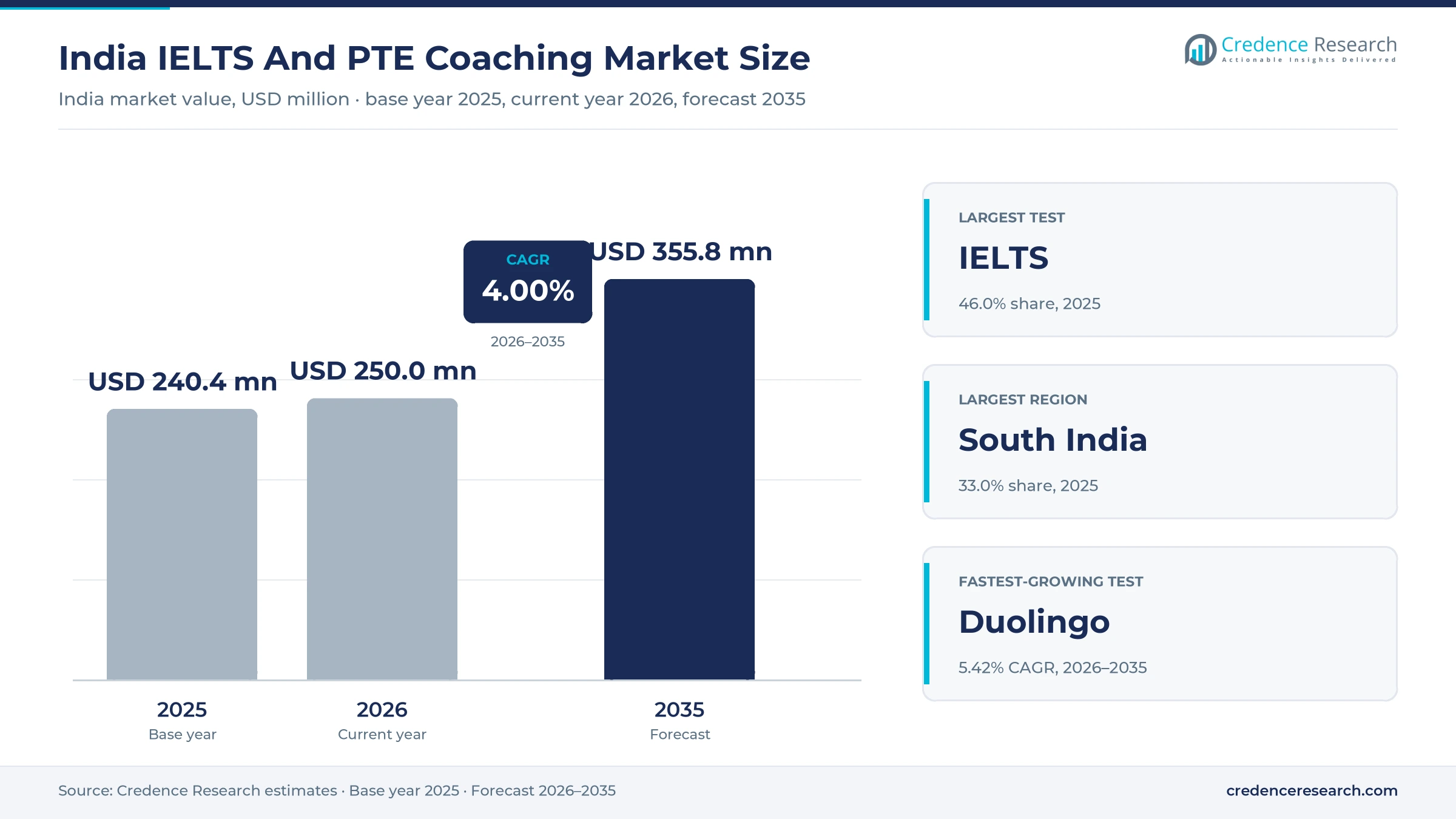
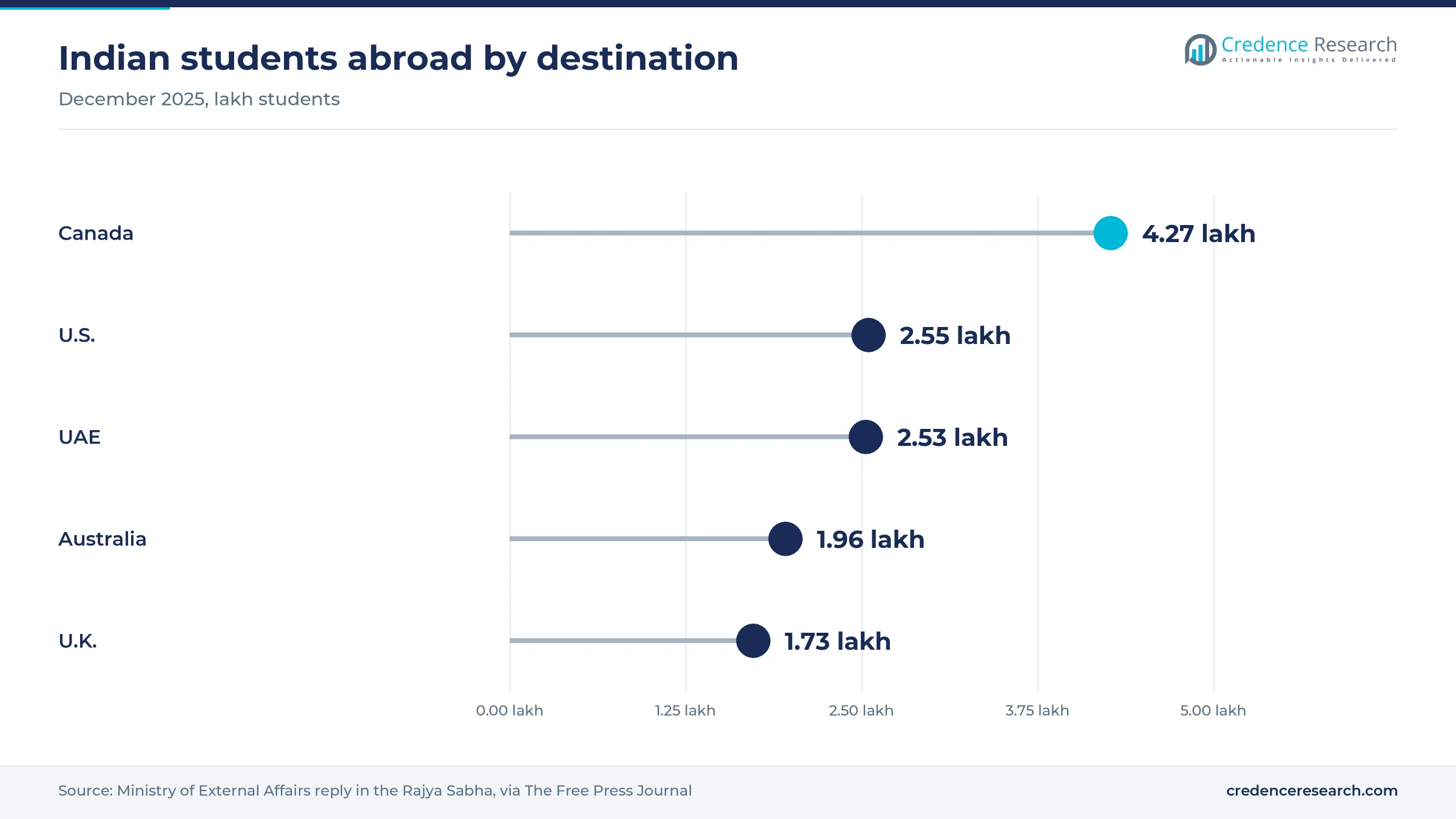
The India IELTS and PTE coaching market was valued at USD 240.4 million in 2025 and is projected to increase from USD 250.0 million in 2026 to USD 355.8 million by 2035, registering a CAGR of 4.00% during 2026–2035. Demand comes from students and migrants who need a recognized English score for Canada, the U.K., Australia and other destinations, and the Ministry of External Affairs counted 18.82 lakh Indian students abroad in December 2025. South India held the largest regional share, 33.0% in 2025, because training and test centers are spread across Bengaluru, Hyderabad, Chennai and Kochi. East India is the fastest-growing region at 4.77% a year from a small base, with new centers opening in Kolkata. The commercial picture changed sharply after study permits issued to Indians by Canada halved in 2025, and IDP reported a further 22% fall in India IELTS volumes for the year to June 2026. Higher fees for both major tests in 2026 and a move to computer-delivered formats are now reshaping what institutes sell.
What does English-test coaching spending cover in India?
The market counts fees paid to institutes, tutors and online platforms for preparation aimed at IELTS, PTE, TOEFL and the Duolingo English Test. Learners buy classroom batches, live and recorded online courses, mock tests and short revision programs, usually a few months before a planned visa or admission application.
The estimate excludes the exam fees paid to test owners, visa and admission consulting, general spoken English classes and school tuition. The value chain runs from test owners and content providers through chains and independent trainers to learners, who often decide on the advice of local counselors and agents.
India IELTS And PTE Coaching Market Insights
- Spending rises from USD 240.4 million in 2025 to USD 355.8 million by 2035, a 4.00% CAGR, as overseas study and migration goals keep English scores essential.
- South India held 33.0% of 2025 value, with named test cities including Bengaluru, Hyderabad, Chennai, Coimbatore, Kochi and Vijayawada.
- IELTS preparation held 46.0% of 2025 value, supported by IDP delivering every IELTS test in India since buying the British Council business in 2021.
- Study permits issued to Indians by Canada halved to 94,605 in 2025, and press reports then described center closures in Punjab and Gujarat.
- PhysicsWallah signed an IELTS agreement with IDP in October 2025, and Jamboree added centers in 2025 and 2026 as organized brands gained ground.
IELTS classrooms still hold most of the fee value
IELTS leads on reach while Duolingo grows fastest
Based on test, the market is categorized into IELTS, PTE, TOEFL and Duolingo preparation. IELTS led with 46.0% of 2025 value because IDP alone delivers the exam in India after buying the British Council business for £130 million in July 2021, and The Week reported its network at 77 offices in 63 cities in October 2025. Duolingo grows fastest at 5.42% a year as EduVouchers listed its fee at about Rs 6,667 in August 2026, roughly a third of the IELTS fee. PTE holds a strong position through 62 authorized centers in more than 35 cities, according to Cialfo.
Classrooms hold value as online batches gain
Based on mode, the market is categorized into offline centers and online. Offline Centers led with 66.0% of 2025 value because the local classroom remains the largest supply base, with The Tribune counting 5,000 to 6,000 institutes in Punjab and Chandigarh in February 2019 and EEC running 26 centers across Gujarat today. Online grows fastest at 5.16% a year as PhysicsWallah sells IELTS batches with 26 live classes and recorded access, and offered a free batch from June to December 2026. Karan Gupta's study abroad site puts Magoosh IELTS at about Rs 5,000 to Rs 7,000 for six months, which undercuts premium classroom courses.
South India leads as other states add new centers
Based on demand region, the market is categorized into Punjab/Haryana, Gujarat, South India and others. South India led the group in 2025 because Cialfo's July 2026 list names Bengaluru, Hyderabad, Chennai, Coimbatore, Kochi and Vijayawada as PTE cities, and Kerala adds nurse demand through the NORKA language institute. The Others group grows fastest at 4.43% a year as Jamboree opened centers in Dwarka, Ghodbunder, Nerul and Kharadi in July 2026, according to ThePrint. Punjab/Haryana lags after The Tribune reported 25 Amritsar centers shutting in early 2025.
| Segment Group | Leading Sub-segment | Share, 2025 | Fastest-growing Sub-segment | CAGR, 2026–2035 |
|---|---|---|---|---|
| By Test | IELTS | 46.0% | Duolingo | 5.42% |
| By Mode | Offline Centers | 66.0% | Online | 5.16% |
| By Demand Region | South India | 33.0% | Others | 4.43% |
Request a Free Sample
Fill in your details and we'll send you a free sample report.
- Sample data tables & charts
- Research methodology
Visa goals and computer tests sustain paid preparation
Migration and overseas study goals sustain test demand
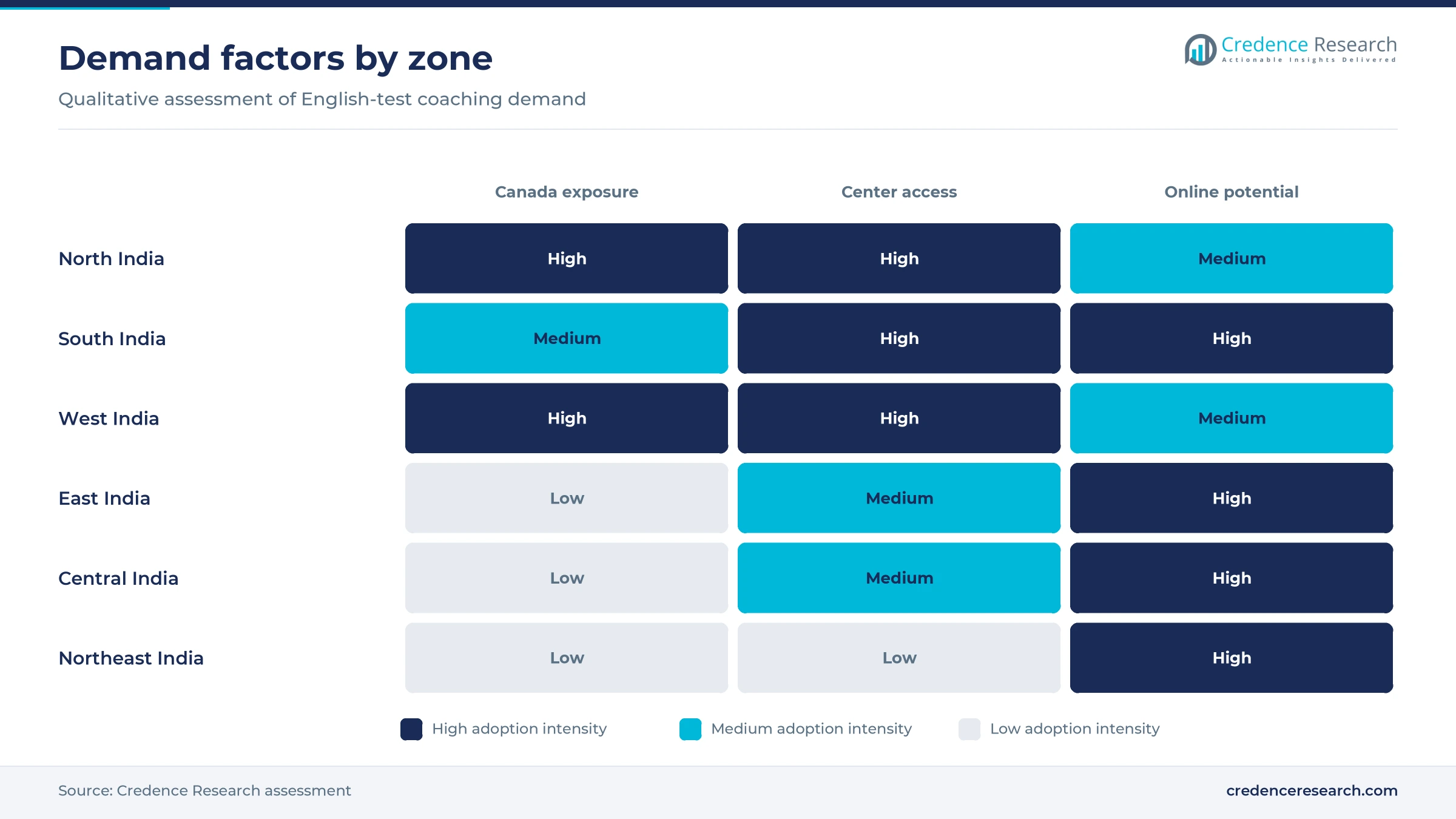
English scores remain a gate for overseas study and migration, so each visa plan usually starts with a preparation purchase. The Ministry of External Affairs told the Rajya Sabha on Dec. 4, 2025 that 18.82 lakh Indian students were abroad across 153 countries, according to The Free Press Journal. Home Office data for 2025 showed 95,231 sponsored U.K. study visas for Indians, about 23% of main applicants, according to Business Today. Canada still hosts the largest group at 4.27 lakh students, even though new permits have fallen. EEC includes free study abroad counseling at every branch, which shows how closely the two purchases sit together. In the Credence Research model this adds about 1.52 percentage points to annual growth to 2035.
Computer-delivered PTE and IELTS improve accessibility
Computer delivery gives learners more test options and quicker scores, which makes it easier to plan a short preparation cycle before an application deadline. IDP's FY26 results presentation says IELTS is transitioning to computer-based formats in key markets, naming India as an example. EEC's 2026 fee guide reports computer-delivered IELTS results in three to five business days against 13 calendar days on paper. Cialfo lists 62 authorized PTE centers in India, and News on AIR reported more than 111 crore internet subscribers at the end of June 2026, which also widens the audience for language learning apps. In the Credence Research model this adds about 1.12 percentage points to annual growth to 2035.
Repeat test takers and short courses lift frequency
Many learners return for another attempt or a short top-up course, so spending does not end with the first score report. EEC's guide says there is no limit on IELTS attempts and prices the One Skill Retake at Rs 12,650, usable within 60 days on computer-delivered tests. It also warns that a missed deadline after a retake can delay study plans by six to 12 months, which gives candidates a strong reason to buy revision help. The Tribune reported in February 2019 that a typical course in Punjab lasted two months at an average of Rs 8,000 to Rs 9,000 a month. In the Credence Research model this adds about 0.72 percentage points to annual growth to 2035.
Kerala nurse pathways add a health care learner base
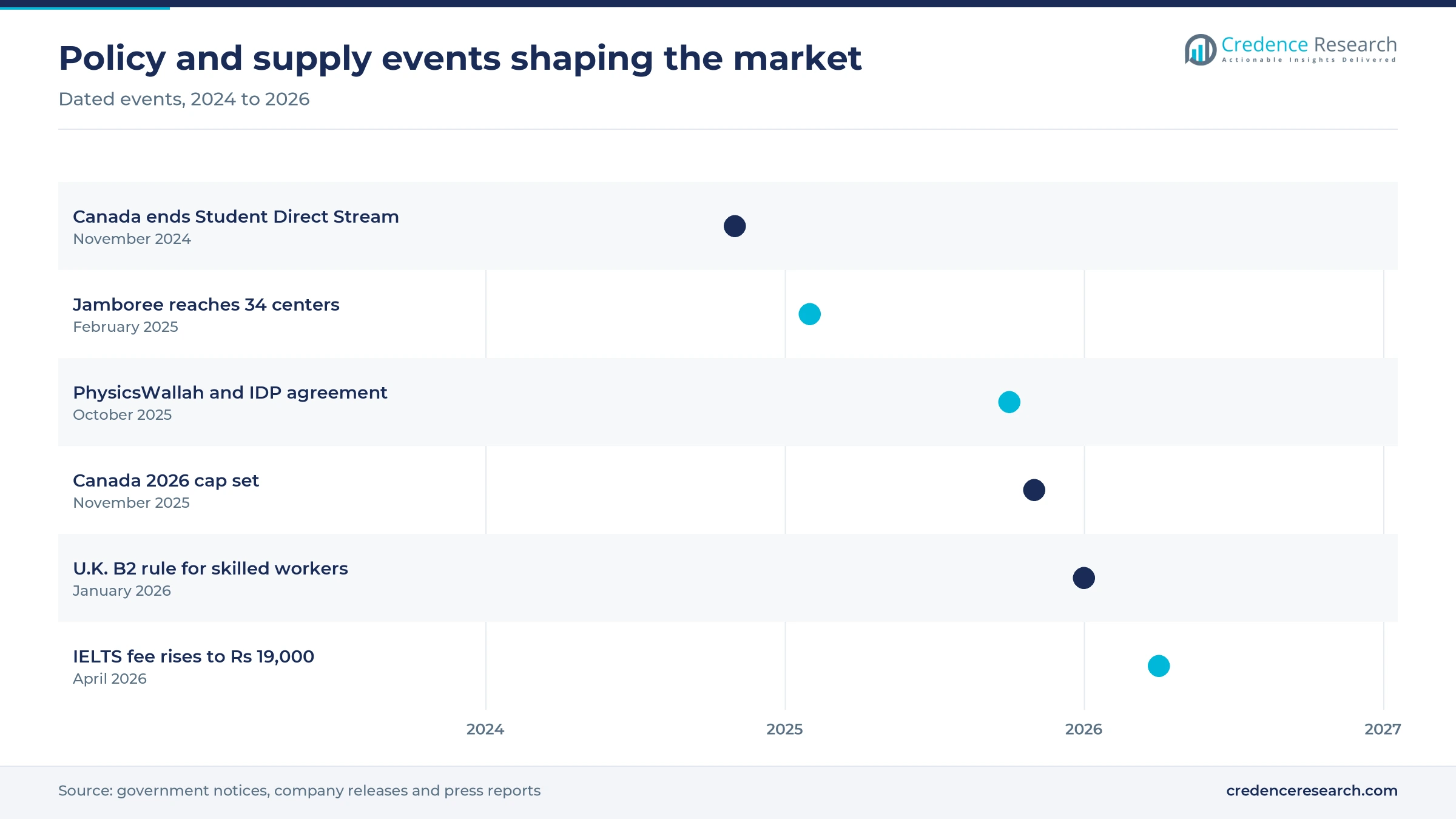
Overseas nursing recruitment creates a learner group whose demand does not depend on student visa caps alone. Kerala's ASAP program runs a Nurses Crash Finishing Course with IELTS or OET training from Pearson India Education Services, and candidates who reach the NHS language level receive placement help through state agency ODEPC. The NORKA Institute of Foreign Language also offers IELTS and OET courses aimed at migrants and health workers from the state. Business Standard reported in October 2025 that the U.K. planned a B2 English requirement for skilled worker applicants from Jan. 8, 2026, which raises the score that working migrants must prove. Each IELTS attempt costs Rs 19,000 from April 1, 2026, according to GradRight, so these candidates have a strong reason to pay for preparation first.
Test choice widens as owners partner with trainers
Shift toward a wider menu of accepted English tests
Institutes that once taught only IELTS now have to sell several exams, because price and speed differ across tests. Cialfo reports PTE Academic at Rs 18,900 from March 16, 2026, while College Simplified cites a TOEFL iBT fee of Rs 15,254 and EduVouchers lists Duolingo near Rs 6,667. The Ken reported in May 2024 that ETS went from no certified TOEFL trainers in Punjab to 500 within a year, copying the IELTS playbook. Pearson said its volumes fell 5% in 2025 although it continued to gain market share, and it expected PTE to return to growth in 2026. As a result, multi-test courses now look safer for an institute than a single-exam brand.
Rise of test-owner partnerships with education brands
Test owners are moving closer to large teaching brands, because national learner reach now matters as much as local storefronts. PhysicsWallah and IDP signed an agreement reported on Oct. 16, 2025 that places IELTS Corners on PW campuses and adds seminars, boot camps and expert masterclasses, according to The Week. IDP also said it cut its IELTS footprint worldwide from about 1,500 venues to fewer than 600 and moved toward third-party delivery in FY26. Jamboree, which covers exam preparation for GMAT, GRE, SAT, TOEFL and IELTS, reached 34 centers in February 2025 and added four more in July 2026, according to The Tribune and ThePrint. These moves favor organized chains over trainers that operate in a single city.
Opportunity in online batches for smaller towns
Online batches offer a clear opening among learners who live far from a good classroom or test center. EEC's guide estimates Rs 2,000 to Rs 5,000 in travel and lodging per trip for candidates in towns without a center, so low-cost remote preparation matters. The same guide puts recorded platforms at Rs 3,000 to Rs 10,000 and live online courses at Rs 10,000 to Rs 20,000, against Rs 20,000 to Rs 50,000 at premium brands. PhysicsWallah's free Zero to Hero 2.0 batch ran from June to December 2026, which gives it an inexpensive way to sign up first-time learners. Online delivery, at 5.16% a year, should collect most of this smaller-town spending.
Opening in U.K.-route and skilled worker English courses
U.K.-bound learners offer an opening because that route stayed larger than Canada in 2025 and has its own test rules. The Office for National Statistics said on May 21, 2026 that Indian was the most common non-EU+ nationality to immigrate to the U.K. in 2025, with study the leading reason among top groups. EEC lists IELTS for UKVI at Rs 19,250, and Cialfo says PTE Academic UKVI costs the same as the standard test, so institutes can package approved-test courses at clear prices. Demand is not guaranteed, however, since Deccan Chronicle reported in July 2026 that Indian master's enrollments fell to 11,453 from 15,149 in the first quarter. Skilled worker applicants facing the B2 rule therefore add useful balance for institutes.
Visa cuts and center closures pressure local institutes
Canadian permit cuts remove a core learner group
Canada's policy turn hit the learner group that built many Punjab and Gujarat institutes. IRCC data cited by The Tribune show study permits for Indians falling from 188,715 in 2024 to 94,605 in 2025. The Canadian government's 2026 cap notice then set aside only 155,000 permits for new arrivals. Institutes that relied on Canada-bound learners lose bookings first, so their recovery now depends on other routes such as the U.K., Australia and skilled migration.
Falling test volumes shrink the paying base
Test volumes are the clearest warning for institutes, because fewer candidates mean fewer course buyers within months. IDP's FY26 results reported India IELTS volumes down 22%, while Indian study visa applications to Australia, the U.K. and Canada fell 28% over the latest 12 months. Vox Booster's summary of IDP's FY25 results shows a 50% India fall the year before. Small trainers feel this first, and Amritsar trainer Saloni Poddar told The Tribune in March 2025 that students were down 70% to 80%, while some independent trainers took other jobs.
Licensing and coaching rules raise compliance work
Local licensing has become a real operating risk for smaller English-test institutes across Punjab. In June 2025, the Jalandhar administration canceled 14 licenses for IELTS, travel and consultancy firms under the Punjab travel professions law, The Tribune reported. The Education Ministry's January 2024 guidelines add branch registration, refunds within 10 days and penalties of Rs 25,000 for a first offense. Single-site operators bear this cost most heavily, and The Tribune reported in March 2025 that some Amritsar centers chose not to renew licenses.
Fragmented supply keeps course prices under pressure
Crowded local supply limits how much institutes can raise fees, even as exam prices climb. The Tribune reported in 2019 that unorganized players ran about 95% of Punjab centers, and Gujarat Samachar reported about 600 Gujarat institutes closing by March 2025. Today EEC sells IELTS coaching at Rs 7,500, while its fee guide puts local centers at Rs 5,000 to Rs 15,000. Weaker operators therefore struggle to fund trainers and mock tests, which pushes learners toward stronger brands.
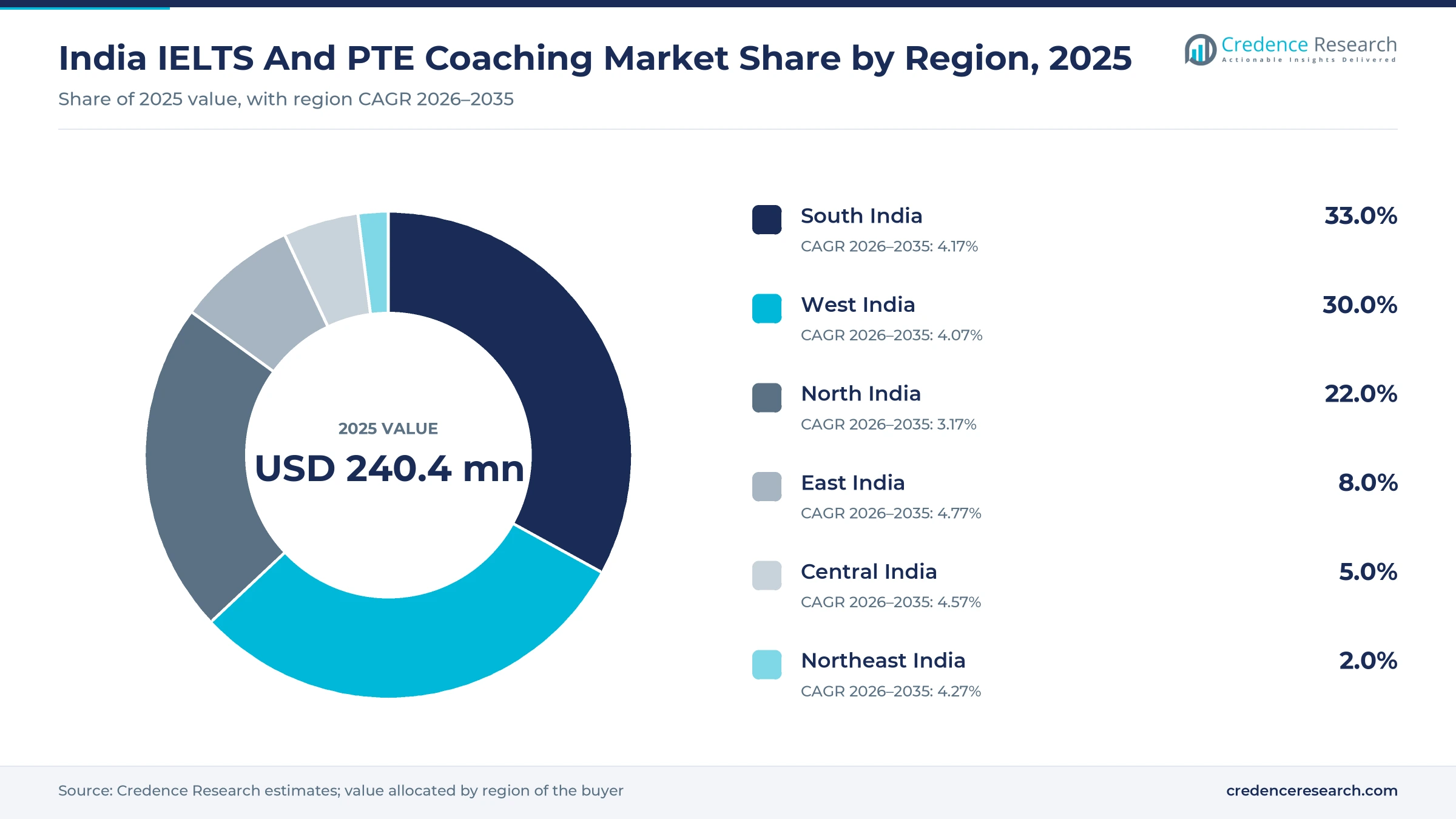
South India tops six zones as Kolkata lifts East India
| Region | Value, 2025 (USD million) | Share, 2025 | CAGR, 2026–2035 |
|---|---|---|---|
| South India | 79.3 | 33.0% | 4.17% |
| West India | 72.1 | 30.0% | 4.07% |
| North India | 52.9 | 22.0% | 3.17% |
| East India | 19.2 | 8.0% | 4.77% |
| Central India | 12.0 | 5.0% | 4.57% |
| Northeast India | 4.8 | 2.0% | 4.27% |
South India leads on wide city coverage
South India held 33.0% of 2025 value and grows at 4.17% a year, the largest position in the country. Cialfo names Bengaluru, Hyderabad, Chennai, Coimbatore, Kochi and Vijayawada among its PTE cities, which shows how evenly test access is spread across the southern states. Kerala adds an unusual demand source because state programs train nurses for overseas posts. Jamboree also opened centers at Bellandur in Bangalore and Tarnaka in Hyderabad in February 2025, which supports organized growth here.
West India balances Gujarat closures with Mumbai growth
West India held 30.0% of 2025 value and grows at 4.07% a year, with Gujarat and Maharashtra as its two main markets. Gujarat Samachar reported about 600 IELTS institutes closing in the state by March 2025 and a 41% drop in aspirants from Ahmedabad agents. Stronger chains still operate there, including EEC with 26 Gujarat centers. Maharashtra offers a steadier base, and Jamboree added Ghodbunder, Nerul and Kharadi in July 2026, which helps offset the weakness in Gujarat.
North India slows after the Punjab correction
North India held 22.0% of 2025 value and grows at 3.17% a year, the slowest rate among the six zones. Punjab was once the center of this market, but VisaVerge reported monthly test takers there falling to about 5,000 by September 2024 from 50,000 earlier. Ludhiana's registered centers dropped from 567 in 2023 to 431 in 2024, according to the same report. Delhi offers some support, since Jamboree opened a Dwarka center in July 2026 and Cialfo names Delhi, Noida and Gurugram as PTE locations.
East India grows fastest from a small base
East India held 8.0% of 2025 value and grows at 4.77% a year, the fastest pace among the zones. Kolkata anchors this region, with Jamboree opening a Salt Lake center in February 2025 and Cialfo naming the city among its PTE locations. Yocket's 2026 guide profiles Kolkata providers including Frame Learning, Worldwin and Orion Edutech, which shows a developed local supply outside the older northern hubs. The small base means a handful of new centers can move regional growth noticeably from year to year.
Central India gains through Bhopal and Indore
Central India held 5.0% of 2025 value and grows at 4.57% a year, helped by rising access in its larger cities. Cialfo lists Bhopal and Indore among authorized PTE locations, so candidates there no longer need to travel to a metro for a computer-based test. EEC's estimate of Rs 2,000 to Rs 5,000 per trip for those without a nearby center shows why this matters to families. Online batches should remain the main route to learners outside those two cities.
Northeast India remains a small online-led market
Northeast India held 2.0% of 2025 value and grows at 4.27% a year, the smallest position in the national picture. Cialfo's July 2026 list of named PTE cities includes none in the Northeast, which leaves many candidates traveling to take computer-delivered tests. Internet reach matters more here than in other zones, and News on AIR's national count of more than 111 crore subscribers suggests that online preparation can reach these learners first.
Visa caps and fee moves marked 2024 to 2026
| Development | Status and market relevance |
|---|---|
| In February 2025, Jamboree Education opened centers in Bangalore, Kolkata, Hyderabad and Pune, reaching 34 centers. | Completed, widens organized TOEFL and IELTS supply |
| In October 2025, PhysicsWallah and IDP Education India signed an agreement on IELTS Corners and preparation support. | Signed, links a large teaching brand to the test owner |
| In November 2025, Canada set its 2026 study permit cap at 408,000, including 155,000 for new arrivals. | In force, limits Canada-bound learners |
| In March 2026, the PTE Academic fee in India rose to Rs 18,900 from Rs 18,000. | In force, lifts the total cost of each attempt |
| In April 2026, the IELTS fee in India rose to Rs 19,000 from Rs 18,000. | In force, raises the value of first-attempt preparation |
Computer delivery changes how learners prepare
- Computer-delivered testing shortens the wait for results, with EEC reporting three to five business days for IELTS on computer, so learners can plan shorter courses.
- One Skill Retake lets computer-delivered IELTS candidates repeat one section within 60 days, which creates demand for short, single-skill revision.
- Live and recorded batches give PhysicsWallah learners live classes with recorded access for revision, along with mock tests and individual feedback.
- Self-paced video platforms such as Magoosh offer lessons, practice questions and a score predictor for learners who prefer studying without a classroom.
Need a Custom Version of This Report?
Tailor the scope, geography, or segments to your exact requirements.
- Custom geography or segment scope
- Direct access to our analyst team
Test owners, chains and local institutes compete
Competition in IELTS and PTE coaching runs on three levels across India. Test owners set the frame, with IDP delivering IELTS across India since its 2021 purchase of the British Council business, and Pearson and ETS building trainer and center networks for PTE and TOEFL. National chains such as Jamboree compete on counseling, faculty and multi-test courses, and they have kept adding centers in larger cities. Online brands such as PhysicsWallah and Magoosh compete on price, flexible study and low-cost trial batches, while regional groups such as EEC bundle coaching with counseling at low course fees. Below them sits a long tail of independent institutes, many of which depended on Canada-bound learners and have lost students since 2024. These local operators still hold important positions in their own towns because referrals, language support and agent relationships matter. However, the institutes most likely to gain are those that teach several tests and can serve learners through both classroom and online batches.
Test owners, chains and platforms active in India
| Company | Type | Role in the market |
|---|---|---|
| IDP Education | Test owner and distributor | Delivers IELTS in India and works with teaching partners, including PhysicsWallah |
| Pearson | Test owner | Owns PTE Academic, with 62 authorized centers listed in India, and supplies language training to a Kerala nursing program |
| ETS | Test owner | Owns TOEFL and has built a certified trainer network in Punjab |
| Jamboree Education | National chain | Teaches IELTS, TOEFL and admission tests through centers in major cities |
| PhysicsWallah | Online and campus brand | Sells IELTS batches and hosts IDP IELTS Corners on its campuses |
| Magoosh | Online platform | Sells self-paced IELTS and TOEFL preparation listed in rupees for Indian learners |
| EEC | Regional chain | Runs 26 centers across Gujarat and bundles coaching with study abroad counseling |
Value moves from Punjab storefronts to wider networks
Credence Research's view is that IELTS and PTE coaching is resetting rather than disappearing. The Punjab boom rested on one destination and thousands of small storefronts, and Canada's cuts ended that model. The base case of a 4.00% growth assumes higher exam and course prices, more repeat purchases and steadier demand from the U.K., Australia and skilled workers. The near-term risk sits on the downside, because IDP's reported volume decline points to a weak 2026 for many institutes. Multi-test chains and online brands look best placed, while single-exam operators remain the most exposed.
How the English-test coaching estimates were built
The report uses 2025 as the base year and 2026 to 2035 as the forecast period. Market values come from the Credence Research model, and segment and regional splits are Credence Research estimates. Inputs include company results, government statements, regulatory documents, published test and course prices, and news reports opened during this research. A bottom-up check multiplied estimated test volumes, coached share and typical course fees. National test counts by exam are not published, so that check carries a wide range. No interviews or surveys were conducted for this edition of the report.
Growth stays modest and depends on visa policy
From USD 250.0 million in 2026 IELTS and PTE coaching is expected to reach USD 355.8 million by 2035, a modest path that reflects a smaller Canada route and steadier demand elsewhere. Online courses should gain share as computer-based tests and low-cost batches spread beyond large cities. Punjab is unlikely to regain its former weight, although East and Central India can add learners from small bases. Visa policy remains the main swing factor, so any further cap, or any easing, in Canada, the U.K. or Australia would quickly change course bookings.
Frequently Asked Questions
How big is the India IELTS and PTE coaching market?
Which region leads the market?
Which region grows fastest?
Which test has the largest coaching share?
Why did IELTS centers close in Punjab and Gujarat?
How much does preparation cost in India?
Who are the main companies in this market?
What is the biggest risk to growth?
Table of Content
Chapter 1 Market Segmentation
- 1.1 Segmentation Framework
- 1.1.1 Product and Service Classification
- 1.1.2 Application and End-Use Classification
- 1.1.3 Technology and Solution Classification
- 1.1.4 Customer and Distribution Channel Classification
- 1.1.5 Geographic Segmentation
- 1.1.6 Market Segment Definitions and Boundaries
- 1.2 By Test
- 1.2.1 IELTS
- 1.2.2 PTE
- 1.2.3 TOEFL
- 1.2.4 Duolingo
- 1.3 By Mode
- 1.3.1 Offline Centers
- 1.3.2 Online
- 1.4 By Demand Region
- 1.4.1 Punjab/Haryana
- 1.4.2 Gujarat
- 1.4.3 South India
- 1.4.4 Others
Chapter 2 Introduction
- 2.1 Report Objectives and Scope
- 2.2 Product Definition and Industry Terminology
- 2.3 Market Inclusions and Exclusions
- 2.4 Research Process
- 2.4.1 Primary Research and Expert Interviews
- 2.4.2 Secondary Research and Source Review
- 2.4.3 Top-Down and Bottom-Up Estimation
- 2.4.4 Data Triangulation and Verification
- 2.5 Market Size Measurement Basis
- 2.5.1 2025: USD 240.4 million → 2035: USD 355.8 million
- 2.6 Historical and Forecast Reference Periods
- 2.6.1 Historical Period: 2018-2025
- 2.6.2 Base Year: 2025
- 2.6.3 Forecast Period: 2025-2035
- 2.7 Research Assumptions and Limitations
Chapter 3 Executive Summary
- 3.1 Market Snapshot and Key Findings
- 3.2 Base-Year Market Size, 2025
- 3.3 Forecast Market Size, 2035
- 3.4 Revenue and Volume Growth Outlook
- 3.5 Key Demand and Supply Indicators
- 3.6 Leading Market Segments
- 3.7 Fastest-Growing Market Opportunities
- 3.8 Regional Performance Highlights
- 3.9 Technology and Industry Transformation
- 3.10 Competitive Landscape Summary
- 3.11 Analyst View and Strategic Implications
Chapter 4 India IELTS And PTE Coaching Market Trends and Developments
- 4.1 Historical Industry Development, 2018-2025
- 4.2 Recent Market Trends and Developments
- 4.3 Demand and Customer Behavior Trends
- 4.4 Technology and Product Innovation
- 4.5 Artificial Intelligence, Automation and Digitalization
- 4.6 Local Manufacturing and Supply Chain Realignment
- 4.7 Industry Partnerships, Mergers and Acquisitions
- 4.8 Sustainability and Circular Economy Developments
- 4.9 Government and Private Sector Investment Trends
- 4.10 Emerging Business Models and Commercialization
- 4.11 Industry Developments and Announcements
Chapter 5 India IELTS And PTE Coaching Market Production, Supply and Demand Analysis
- 5.1 Demand Trend and Consumption Analysis, 2018-2025
- 5.2 Demand Forecast, 2025-2035
- 5.3 Production and Output Trend, 2018-2025
- 5.4 Production and Output Forecast, 2025-2035
- 5.5 Installed Capacity and Capacity Utilization
- 5.6 Company-Wise Production Plants and Statistics
- 5.6.1 Installed Production Capacity
- 5.6.2 Actual Production
- 5.6.3 Planned Capacity and Expansion Targets
- 5.7 Supply Chain Structure and Procurement Trends
- 5.8 Supply-Demand Gap and Bottlenecks
- 5.9 Import Dependence and Sourcing Structure
- 5.10 Contract Manufacturing and Outsourcing
- 5.11 Regional Supply and Demand Concentration
Chapter 6 India IELTS And PTE Coaching Market Pricing Analysis
- 6.1 Pricing Structure and Measurement
- 6.2 Historical Pricing Trends, 2018-2025
- 6.3 Pricing Outlook, 2025-2035
- 6.4 Average Selling Price and Unit Economics
- 6.5 Pricing by Product and Market Segment
- 6.6 Geographic Pricing Differences
- 6.7 Key Input, Energy, Labor and Logistics Costs
- 6.8 Contract Pricing and Purchasing Models
- 6.9 Pricing Sensitivity and Competitive Positioning
- 6.10 Price, Margin and Profitability Implications
Chapter 7 India IELTS And PTE Coaching Market Dynamics
- 7.1 Market Growth Drivers
- 7.1.1 Demand-Side Drivers
- 7.1.2 Technology and Innovation Drivers
- 7.1.3 Infrastructure and Investment Drivers
- 7.1.4 Regulatory and Policy Drivers
- 7.2 Market Restraints
- 7.2.1 Cost and Affordability Constraints
- 7.2.2 Technology and Adoption Barriers
- 7.2.3 Supply Chain and Operational Constraints
- 7.3 Market Challenges
- 7.3.1 Competitive Pressure and Margin Erosion
- 7.3.2 Skills, Infrastructure and Implementation Gaps
- 7.4 Emerging Market Opportunities
- 7.5 Market Dynamics Impact and Time-Horizon Assessment
Chapter 8 India IELTS And PTE Coaching Value Chain Analysis
- 8.1 Industry Value Chain Overview
- 8.2 Upstream Suppliers and Critical Inputs
- 8.3 Technology and Component Providers
- 8.4 Manufacturing or Service Delivery
- 8.5 Distribution, Channel Partners and Integrators
- 8.6 Downstream Applications and End Users
- 8.7 Value Addition and Profit Pools
- 8.8 Vertical Integration and Outsourcing
- 8.9 Supplier Concentration and Risk
- 8.10 Supply Chain Localization and Resilience
Chapter 9 India IELTS And PTE Coaching Market Regulations and Policies
- 9.1 Relevant Laws, Standards and Compliance Frameworks
- 9.2 Product, Service, Safety and Quality Requirements
- 9.3 Government Policies, Incentives and Subsidies
- 9.4 Imports, Exports and Trade Barriers
- 9.5 Public Procurement and Local Content Requirements
- 9.6 Environmental and Sustainability Compliance
- 9.7 Upcoming Policy Changes and Market Implications
Chapter 10 India IELTS And PTE Coaching Market Hotspots and Opportunities
- 10.1 Market Opportunity Mapping and Growth Hotspots
- 10.2 High-Growth Applications and Customer Groups
- 10.3 Underserved Markets and White-Space Opportunities
- 10.4 Emerging Technology and Product Opportunities
- 10.5 New Capacity and Investment Hotspots
- 10.6 Market Entry and Expansion Opportunities
- 10.7 Distribution and Partnership Opportunities
- 10.8 Near-Term and Long-Term Commercial Potential
- 10.9 Opportunity Attractiveness and Execution Risks
Chapter 11 India IELTS And PTE Coaching Market Outlook, 2025-2035
- 11.1 Market Size and Analysis
- 11.1.1 Revenue (Market Measurement: 2025: USD 240.4 million → 2035: USD 355.8 million)
- 11.1.2 Market Volume and Quantity Sold
- 11.1.3 Historical Market Size, 2018-2025
- 11.1.4 Base-Year Market Size, 2025
- 11.2 Market Forecast, 2025-2035
- 11.2.1 Revenue Forecast to 2035
- 11.2.2 Volume Forecast to 2035
- 11.2.3 CAGR and Year-on-Year Growth
- 11.2.4 Incremental Revenue Opportunity
- 11.3 Forecast Assumptions and Scenario Analysis
- 11.3.1 Base-Case Forecast
- 11.3.2 Optimistic and Conservative Scenarios
- 11.3.3 Technology, Pricing and Policy Sensitivities
- 11.4 Market Attractiveness and Growth Outlook
Chapter 12 India IELTS And PTE Coaching Market Segmentation and Outlook
- 12.1 Segmentation Summary and Market Shares, 2025
- 12.2 Largest and Fastest-Growing Segments
- 12.3 By Test - Market Size and Forecast, 2025-2035
- 12.3.1 Segment Definition and Scope
- 12.3.2 Historical Market Size, 2018-2025
- 12.3.3 Revenue Forecast, 2025-2035
- 12.3.4 Volume Forecast, 2025-2035
- 12.3.5 Base-Year Market Share, 2025
- 12.3.6 Segment CAGR and Growth Drivers
- 12.3.7 Subsegment Market Size and Forecast
- 12.3.7.1 IELTS
- 12.3.7.2 PTE
- 12.3.7.3 TOEFL
- 12.3.7.4 Duolingo
- 12.3.8 Subsegment Pricing and Adoption Trends
- 12.3.9 Leading Suppliers and Competition
- 12.3.10 Regional Demand and Opportunities
- 12.4 By Mode - Market Size and Forecast, 2025-2035
- 12.4.1 Segment Definition and Scope
- 12.4.2 Historical Market Size, 2018-2025
- 12.4.3 Revenue Forecast, 2025-2035
- 12.4.4 Volume Forecast, 2025-2035
- 12.4.5 Base-Year Market Share, 2025
- 12.4.6 Segment CAGR and Growth Drivers
- 12.4.7 Subsegment Market Size and Forecast
- 12.4.7.1 Offline Centers
- 12.4.7.2 Online
- 12.4.8 Subsegment Pricing and Adoption Trends
- 12.4.9 Leading Suppliers and Competition
- 12.4.10 Regional Demand and Opportunities
- 12.5 By Demand Region - Market Size and Forecast, 2025-2035
- 12.5.1 Segment Definition and Scope
- 12.5.2 Historical Market Size, 2018-2025
- 12.5.3 Revenue Forecast, 2025-2035
- 12.5.4 Volume Forecast, 2025-2035
- 12.5.5 Base-Year Market Share, 2025
- 12.5.6 Segment CAGR and Growth Drivers
- 12.5.7 Subsegment Market Size and Forecast
- 12.5.7.1 Punjab/Haryana
- 12.5.7.2 Gujarat
- 12.5.7.3 South India
- 12.5.7.4 Others
- 12.5.8 Subsegment Pricing and Adoption Trends
- 12.5.9 Leading Suppliers and Competition
- 12.5.10 Regional Demand and Opportunities
- 12.6 Segment Growth Comparison
- 12.7 Segment Attractiveness and Priority Matrix
Chapter 13 India IELTS And PTE Coaching Geographic Market Outlook, 2025-2035
- 13.1 Domestic Market Distribution and Demand Clusters
- 13.2 State- or Province-Wise Market Size and Forecast, 2025-2035
- 13.3 City and Metropolitan Market Outlook
- 13.4 Industrial, Manufacturing and Commercial Clusters
- 13.5 Geographic Concentration of Key End Users
- 13.6 Local Pricing and Purchasing Differences
- 13.7 Domestic Production Facilities and Capacity Map
- 13.8 Local Infrastructure and Project Pipeline
- 13.9 State-Level Policy and Incentive Differences
- 13.10 Subnational Investment Hotspots and Opportunities
- 13.11 Distribution and Logistics Networks
- 13.12 Domestic Competitive Footprint
Chapter 14 India IELTS And PTE Coaching Technology, Innovation and Sustainability Outlook
- 14.1 Technology Landscape and Maturity
- 14.2 Product, Process and Service Innovation
- 14.3 AI, Automation and Digital Tools in the Industry
- 14.4 Technology Adoption and Performance Benchmarking
- 14.5 Innovation Pipeline and R&D Investment
- 14.6 Patent and Intellectual Property Trends
- 14.7 Energy Efficiency and Resource Management
- 14.8 Sustainability, Recycling and Circularity
- 14.9 Technology Roadmap, 2025-2035
- 14.10 Risks of Obsolescence and Technology Substitution
Chapter 15 India IELTS And PTE Coaching Market Key Strategic Imperatives
- 15.1 Growth and Market Entry Priorities
- 15.2 High-Return Products and Segments
- 15.3 Pricing, Profitability and Cost Optimization
- 15.4 Technology Investment and Product Differentiation
- 15.5 Supply Chain Localization and Resilience
- 15.6 Distribution and Customer Acquisition
- 15.7 Partnership, Acquisition and Capacity Strategy
- 15.8 Regional Expansion Priorities
- 15.9 Short-, Medium- and Long-Term Actions
Chapter 16 Competition Outlook
- 16.1 Industry Competition Characteristics
- 16.2 Market Structure and Concentration
- 16.3 Market Share and Competitive Positioning, 2025
- 16.4 Company-Wise Revenue and Product Benchmarking
- 16.5 Production and Service Capacity Benchmarking
- 16.6 Technology, Pricing and Differentiation
- 16.7 Regional Footprint and Distribution Strength
- 16.8 Mergers, Acquisitions and Strategic Alliances
- 16.9 New Entrants and Competitive Threats
- 16.10 Porter's Five Forces and Industry Attractiveness
- 16.11 Competitive Outlook, 2025-2035
Chapter 17 Company Profiles
- 17.1 Company Coverage and Selection Criteria
- 17.2 IDP Education
- 17.2.1 Business Description
- 17.2.2 Company Ownership and Geographic Presence
- 17.2.3 Product and Service Portfolio
- 17.2.4 Manufacturing and Operating Footprint
- 17.2.5 Production Capacity and Expansion Plans
- 17.2.6 Financial Performance and Investment
- 17.2.7 Market Share and Competitive Position
- 17.2.8 Technology and Innovation Capabilities
- 17.2.9 Strategic Alliances or Partnerships
- 17.2.10 Recent Developments
- 17.2.11 Growth Strategy and Outlook
- 17.3 Pearson
- 17.4 ETS
- 17.5 Jamboree Education
- 17.6 Magoosh
- 17.7 PhysicsWallah
- 17.8 EEC
- 17.9 Other Relevant Market Participants
Note: Every listed company is profiled on the structure shown under the first company. The company list is preliminary and may change based on research findings, market developments, data availability and client requirements.
Chapter 18 Disclaimer
- 18.1 Research and Forecast Disclaimer
- 18.2 Data Source and Estimation Limitations
Note: The depth of individual sections depends on data availability for this market. Volume, capacity, trade and other unit-based metrics are included where applicable.

