
L5 passenger loans anchor e-three-wheeler credit in India
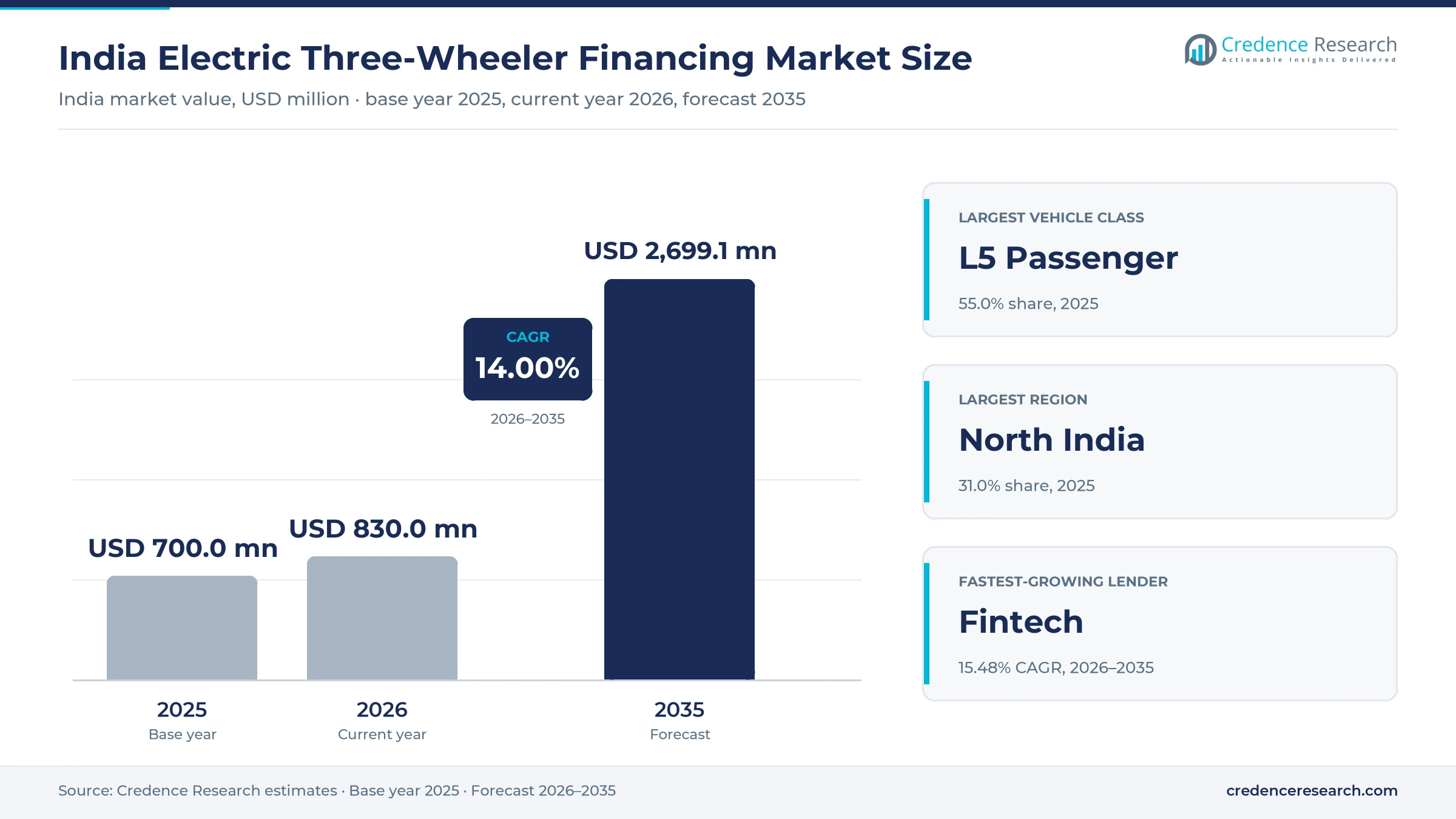
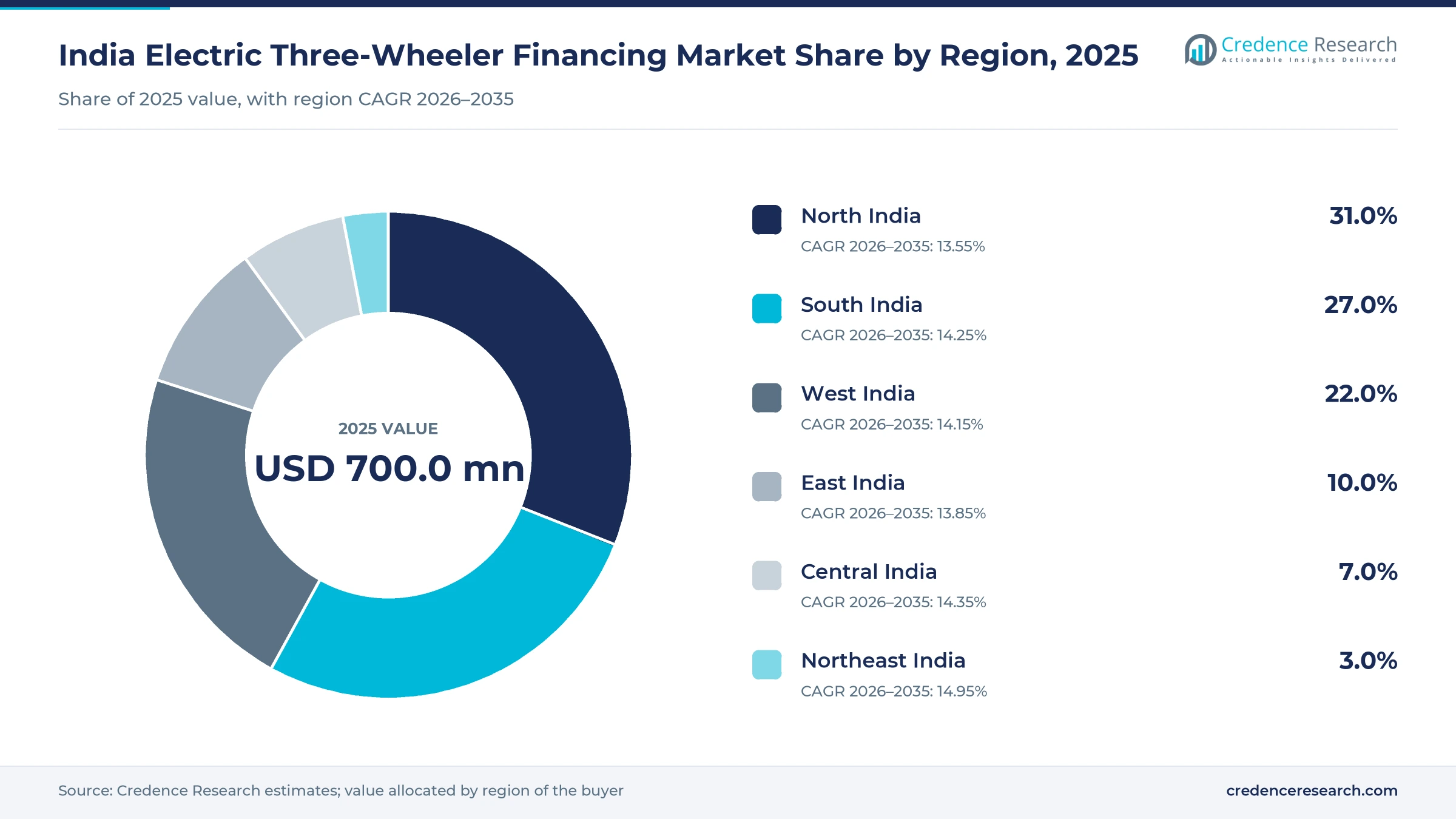
The India electric three-wheeler financing market was valued at USD 700.0 million in 2025 and is projected to increase from USD 830.0 million in 2026 to USD 2.70 billion by 2035, registering a CAGR of 14.00% during 2026–2035. Demand comes from owner-drivers replacing compressed natural gas autos, from e-rickshaw operators and from cargo fleets that lease rather than buy, as electric models took 61% of three-wheeler retail sales in fiscal 2025-26. North India held the largest regional share, 31.0% in 2025, because Uttar Pradesh and Delhi carry heavy e-rickshaw and L5 registrations. Northeast India is the fastest-growing region at 14.95% a year from a small base, helped by steep L5 registration growth in Assam, Meghalaya and Manipur. The largest commercial change is the arrival of bank and captive tie-ups, including the November 2025 memorandum between Mahindra Last Mile Mobility and Punjab National Bank. Battery replacement loans launched in 2025 and 2026 now extend lender exposure beyond the first vehicle contract.
What does electric three-wheeler credit in India cover?
The market counts the value of new loans and lease finance originated for e-rickshaw L3, L5 passenger and L5 cargo vehicles in India. Buyers reach this credit through dealer desks, NBFC branches, bank branches and digital lending apps, usually against hypothecation of the vehicle.
The estimate excludes electric two-wheeler and four-wheeler credit, combustion and compressed natural gas three-wheeler loans, and charging infrastructure debt. The value chain runs from vehicle makers and dealers through lenders and lessors to owner-drivers and fleet operators, with battery makers and swap networks increasingly tied into the same contracts.
India Electric Three-Wheeler Financing Market Insights
- Credit originations rise from USD 700.0 million in 2025 to USD 2.70 billion by 2035, a 14.00% CAGR, tracking vehicle volumes that reached 830,819 units in fiscal 2025-26.
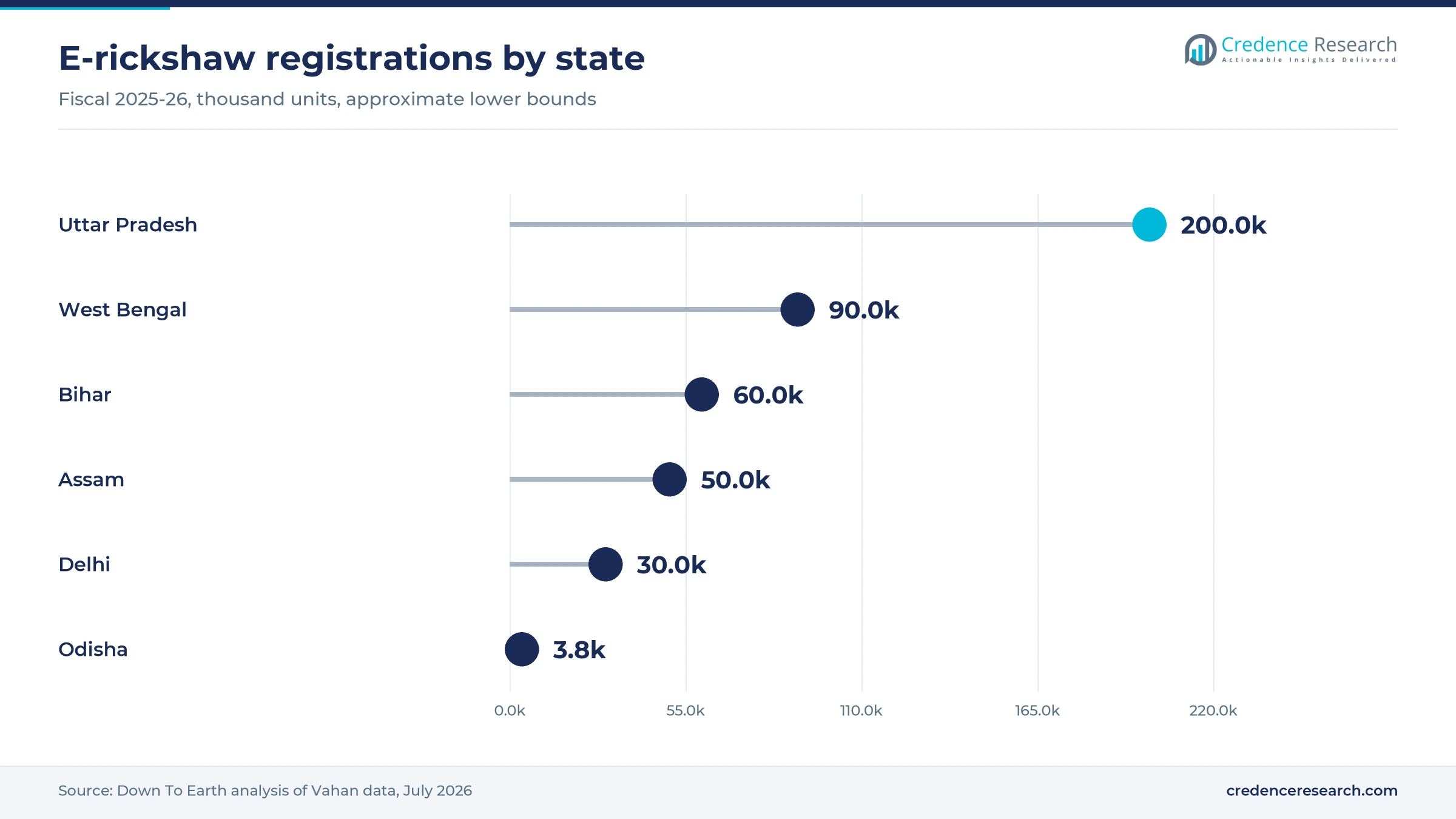
- North India led with 31.0% of 2025 value, because Uttar Pradesh alone logged more than 200,000 e-rickshaw registrations in fiscal 2025-26 according to Down To Earth.
- L5 Passenger held 55.0% of 2025 value, because an electric auto costs roughly twice as much as an e-rickshaw and so carries a larger loan.
- Battery replacement became a separate credit product, with Piaggio and RiseWise Capital launching in October 2025 and Manba Finance following in July 2026.
- NBFCs held 62.0% of 2025 value, while banks returned through dealer tie-ups such as the Punjab National Bank memorandum signed in November 2025.
Ticket size and lender reach shape the credit mix
Why L5 passenger loans outweigh e-rickshaw volumes
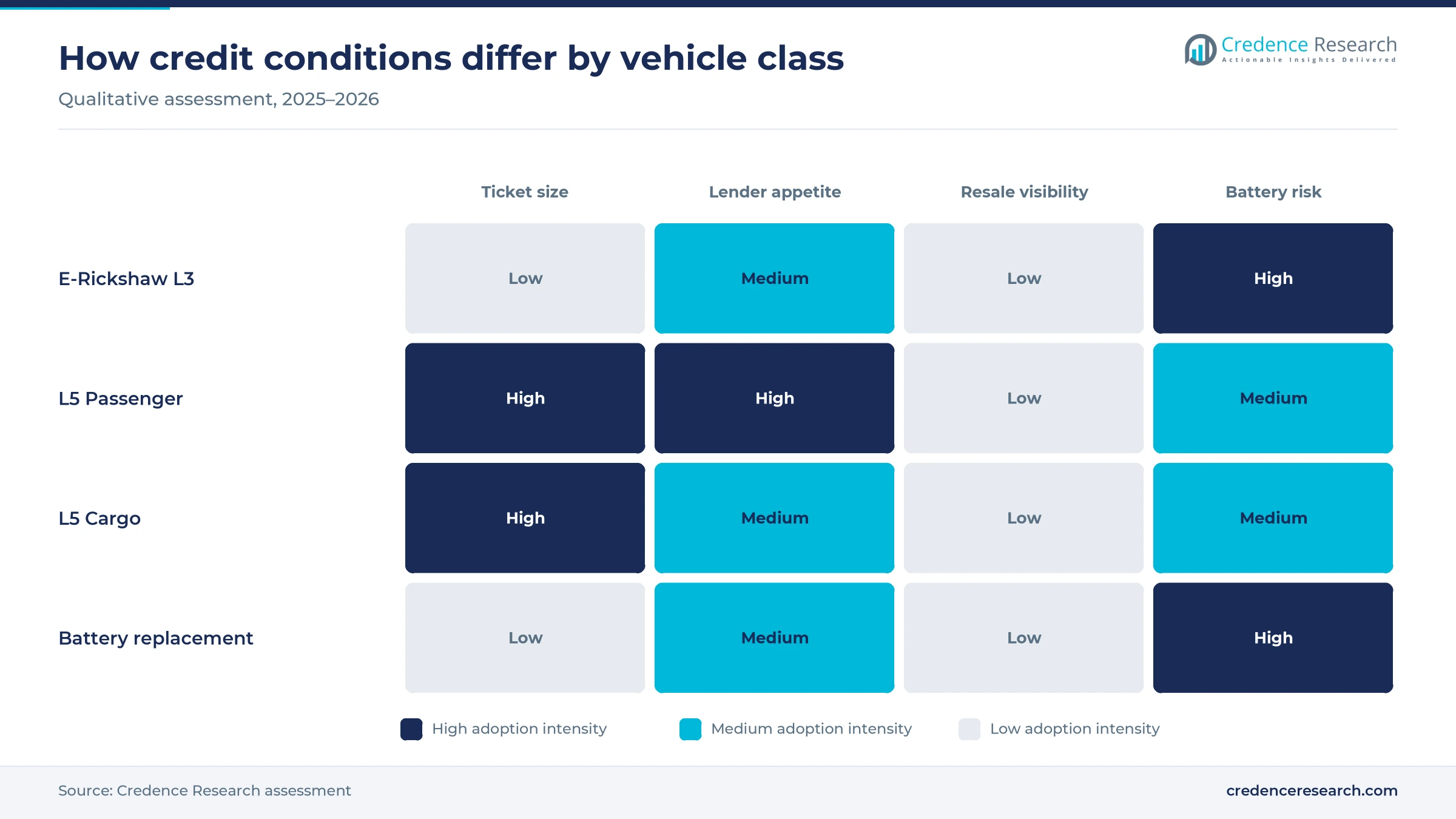
Based on vehicle, the market is categorized into E-Rickshaw L3, L5 Passenger and L5 Cargo. L5 Passenger led with 55.0% of 2025 value because each loan is far larger, with Ecofy citing INR 3.5 lakh to INR 4 lakh for an electric auto against about INR 1.9 lakh for the Bajaj Riki reported by The Week in November 2025. L5 Cargo grows fastest at 15.61% a year as TVS Motor and ALT Mobility agreed in September 2025 to deploy up to 3,000 passenger and cargo units on drive-to-own leases. EVreporter counted 477,765 e-rickshaws in fiscal 2025-26, which keeps L3 credit volume-led.
How NBFC terms beat banks for thin-file borrowers
Based on lender, the market is categorized into NBFC, Bank and Fintech. NBFC lenders led with 62.0% of 2025 value because their terms suit thin-file borrowers, as Shriram Finance advertises funding up to 95% of a new vehicle over 48 months from 10% a year. Bank of India, by comparison, caps e-rickshaw finance at 85% of invoice cost and asks for a permit and a 1.25 debt-service ratio. Fintech grows fastest at 15.48% a year as digital lenders in the fintech sector scale, with Revfin setting an INR 750 crore target for fiscal 2025-26 in April 2025.
Owner-drivers borrow on savings while fleets lease
Based on customer, the market is categorized into Owner-Drivers and Fleets. Owner-Drivers led with 78.0% of 2025 value because running savings help service the loan, as an Ecofy cost table shows monthly fuel falling from INR 8,000 to INR 1,500 for a driver moving to electric. Fleets grow fastest at 15.00% a year as lessors remove the upfront barrier, with ALT Mobility asking a three-month deposit against the 20% to 25% down payment banks typically require, YourStory reported in October 2025. That lessor now manages more than 15,000 vehicles, and about 60% of them are three-wheelers.
| Segment Group | Leading Sub-segment | Share, 2025 | Fastest-growing Sub-segment | CAGR, 2026–2035 |
|---|---|---|---|---|
| By Vehicle | L5 Passenger | 55.0% | L5 Cargo | 15.61% |
| By Lender | NBFC | 62.0% | Fintech | 15.48% |
| By Customer | Owner-Drivers | 78.0% | Fleets | 15.00% |
Request a Free Sample
Fill in your details and we'll send you a free sample report.
- Sample data tables & charts
- Research methodology
Fleet growth and showroom credit lift loan origination
Fleet expansion lifts vehicle-credit origination
Every new vehicle is a potential loan, so sales volume sets the base for origination. The International Energy Agency reports that sales rose about 15% from 2024 to nearly 800,000 units in 2025, mainly displacing compressed natural gas models. Vahan retail data published by Autocar Professional then show 830,819 units in fiscal 2025-26, up 19%, with a 61% share of all three-wheelers sold. Mahindra Last Mile Mobility reached 101,905 units and Bajaj Auto reached 89,604 units in that year, which pulled more buyers toward higher-ticket L5 models. In the Credence Research model this adds about 5.88 percentage points to annual growth to 2035.
Cash-flow and battery-risk tools widen lender appetite
Lenders are moving from collateral-led approval toward data drawn from the vehicle and the battery. ALT Mobility, with assets close to INR 300 crore, uses IoT data to predict defaults and breakdowns, according to YourStory in October 2025. Manba Finance added IoT integration and e-mandate repayment to the battery replacement loans it announced on July 22, 2026. Ecofy describes NBFC schemes that deduct installments daily from digital wallets based on driver earnings, and this matches repayment to cash flow. A report by NITI Aayog, SIDBI and RMI, published in April 2024, lists counterparty, product, operations, repossession and residual risk as the gaps these tools target. In the Credence Research model this adds about 3.78 percentage points to annual growth to 2035.
Dealer finance and leasing improve borrower access
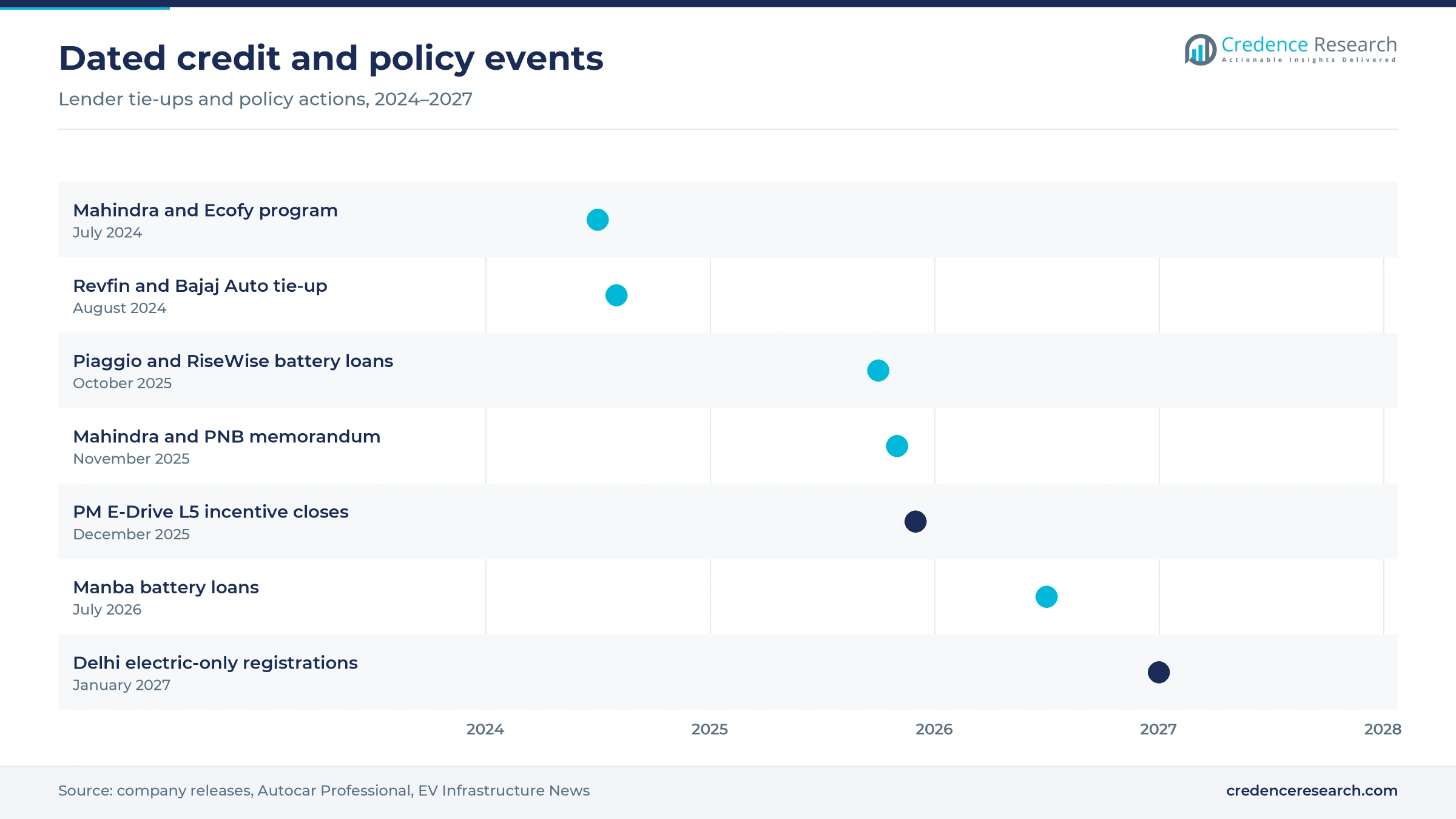
Credit now reaches buyers at the showroom, and this shortens the path from inquiry to a signed contract. Mahindra Last Mile Mobility signed a memorandum on Nov. 25, 2025, with Punjab National Bank, which has more than 10,000 branches, covering its full vehicle range. It had already partnered with Ecofy in July 2024 to fund 10,000 electric three-wheelers, according to EVreporter. Revfin also agreed in August 2024 to finance Bajaj Auto's high-speed models. Leasing widens access further for last-mile delivery operators, because ALT Mobility rentals start near INR 15,500 a month for three-wheelers. In the Credence Research model this adds about 2.38 percentage points to annual growth to 2035.
Delhi's electric-only rule sets a policy floor for loans
State mandates now add a policy floor to loan demand beyond the national subsidy. Delhi's EV Policy 2026, effective July 1, 2026, allows only electric autorickshaws and electric light goods carriers for new registrations from Jan. 1, 2027, according to EV Infrastructure News. The same policy offers purchase incentives of INR 50,000, INR 40,000 and INR 30,000 over three years, which reduces the amount a borrower must fund. At the national level, PM E-Drive keeps e-rickshaw and e-cart incentives running through March 31, 2028, Autocar Professional reported in March 2026. As a result, North India keeps a steady pipeline of first-time electric borrowers in its largest city market.
Battery loans and risk-sharing open new lending room
Shift toward standalone battery replacement loans
Lenders are shifting from vehicle-only loans to separate battery credit, because older electric three-wheelers now reach replacement age. Piaggio and RiseWise Capital launched up to 100% battery financing in October 2025, with rates from 10.99% and terms up to 24 months, for vehicles used at least three years. Manba Finance followed on July 22, 2026, with small-ticket lithium-ion and charger loans for e-rickshaws and e-carts. Bank of India already funds 75% of replacement cost over 18 months. A World Resources Institute India workshop in August 2023 put a lithium-ion battery replacement near INR 80,000 against INR 25,000 for lead-acid after scrap value, so the ticket now justifies its own product.
Rise of OEM-backed lithium e-rickshaws reshapes L3 credit
Branded lithium-ion e-rickshaws are emerging in a segment long served by small assemblers, and this gives lenders a stronger manufacturer to partner with. Bajaj Auto priced its Riki near INR 1.9 lakh and planned to reach 200 cities and towns between January and March 2026, starting with Uttar Pradesh, Bihar, Madhya Pradesh, Chhattisgarh and Assam, The Week reported in November 2025. World Resources Institute India put battery cost near INR 14,000 per kWh for lithium-ion against INR 6,600 for lead-acid, which raises the amount financed per vehicle. Bank of India now allows up to 48 months, against the roughly 24 months that workshop called typical, and this longer tenure suits the costlier lithium pack.
Registration drives open an e-rickshaw lending opportunity
Registration mandates create an opening for lenders, because a documented vehicle can support a hypothecated loan. West Bengal's Transport Department required all e-rickshaws to register in October 2025 and later moved the deadline to Jan. 31, 2026, according to EMobility Plus. L3 models then rose from about 80% of monthly state registrations to as much as 97% in December 2025 and January 2026. Delhi was also considering a one-month window for unregistered e-rickshaws in the capital region, that report said. Bank of India already requires a permit before it lends, so newly registered operators in East India, at 10.0% of 2025 value, can qualify for formal credit for the first time.
Risk-sharing facilities offer a path to cheaper loans
Shared-loss facilities give lenders an opportunity to price electric loans closer to combustion loans. A World Bank document dated December 2022 put organized financing at about 5% to 10% for electric two- and three-wheelers against about 60% for combustion models, which shows the room to grow. RMI reported in April 2024 that a USD 6 million SIDBI and Shell Foundation facility covers 75% of losses beyond the first 3%. RMI also estimates that derisking could save more than USD 250 in interest over an electric cargo loan. NITI Aayog and the World Bank set up a USD 300 million first-loss instrument in 2022, which could mobilize up to USD 1.5 billion.
Funding costs and weak resale limit lender appetite
High cost of funds keeps borrower rates elevated
Mufin Green's Dhiraj Agrawal told YourStory in July 2025 that lenders' cost of funds sits near 12%, which pushes electric loans above combustion equivalents. RMI said in April 2024 that rates for these vehicles ran twice those of combustion models, while a World Resources Institute India workshop heard of e-rickshaw loans reaching 20%. As a result, owner-drivers carry heavier installments on thin margins. Risk-sharing cover and bank tie-ups are the main mitigation, although both reach only part of the market today.
Thin resale market raises residual value risk
India has no established second-hand market for electric vehicles, Agrawal told YourStory in July 2025, and this makes repossessed collateral hard to value. The April 2024 report by NITI Aayog, SIDBI and RMI lists repossession and residual risk among the added risks financiers face. Shriram Finance still funds up to 90% of a used electric three-wheeler, so its exposure depends on recovery values that remain uncertain. Telematics tracking and battery health data are the main mitigation available to lenders today.
Subsidy step-down raises the amount borrowers must fund
PM E-Drive incentives for L5 models closed after Dec. 26, 2025, once the 288,000-unit target was met, according to Autocar Professional. Support for the remaining categories now stands at INR 2,500 per kWh, capped at INR 12,500, down from INR 5,000 per kWh, capped at INR 25,000, in a fund-limited scheme that can close early. Borrowers therefore finance a larger share of the invoice, which affects loan size and debt service. State incentives such as Delhi's offset only part of this, and only in the states that offer them.
Unregistered e-rickshaws complicate lending and recovery
An EVMS estimate cited by EMobility Plus in February 2026 put about 4.75 lakh e-rickshaws on the road without registration, fitness certification or insurance. Such vehicles cannot serve as clean collateral, which leaves their operators with informal lenders. Uttar Pradesh and Bihar, with 41.1% and 13.7% of cumulative e-rickshaw registrations in Vahan data, face the largest exposure. The Delhi High Court is also hearing a public interest case on enforcement. Wider state registration drives remain the most direct mitigation for lenders.
North India leads as registrations cluster in two states
| Region | Value, 2025 (USD million) | Share, 2025 | CAGR, 2026–2035 |
|---|---|---|---|
| North India | 217.0 | 31.0% | 13.55% |
| South India | 189.0 | 27.0% | 14.25% |
| West India | 154.0 | 22.0% | 14.15% |
| East India | 70.0 | 10.0% | 13.85% |
| Central India | 49.0 | 7.0% | 14.35% |
| Northeast India | 21.0 | 3.0% | 14.95% |
North India leads on Uttar Pradesh and Delhi volumes
North India held 31.0% of 2025 value and grows at 13.55% a year, the largest pool because registrations cluster there. A Down To Earth analysis of Vahan data counted more than 200,000 e-rickshaw registrations in Uttar Pradesh and more than 30,000 in Delhi in fiscal 2025-26. Uttar Pradesh also logged 38,606 L5 passenger registrations from January to August 2025, a 31.4% share of the national total. Delhi's 2027 registration rule supports the next wave of autorickshaw lending in the zone.
South India relies on L5 loans rather than e-rickshaws
South India held 27.0% of 2025 value and grows at 14.25% a year, because lending there is almost entirely L5 rather than e-rickshaw credit. Down To Earth counted just 337 e-rickshaw registrations in Karnataka and 77 in Kerala in fiscal 2025-26. EVreporter data show L5 passenger registrations in Tamil Nadu up 168.6% from January to August 2025. Bengaluru-based Three Wheels United had financed more than 4,000 auto-rickshaws by May 2022, which gives the zone an early specialist lender.
West India draws battery and bank credit programs
West India held 22.0% of 2025 value and grows at 14.15% a year, helped by larger L5 tickets in its urban transport and cargo markets. Piaggio and RiseWise Capital chose Maharashtra and Gujarat among the first four states for battery replacement loans in October 2025, which signals lender confidence in the aging fleet there. Mahindra Last Mile Mobility and Punjab National Bank announced their financing memorandum in Mumbai in November 2025, and that agreement covers cargo and passenger models sold across the zone.
East India pairs large e-rickshaw fleets with small tickets
East India held 10.0% of 2025 value and grows at 13.85% a year, a share held down by smaller e-rickshaw tickets despite large volumes. Down To Earth counted nearly 90,000 e-rickshaw registrations in West Bengal and more than 60,000 in Bihar in fiscal 2025-26, while Odisha logged 3,756. Bihar also recorded 12,794 L5 passenger registrations from January to August 2025, up 164.3%. This growing L5 base gives lenders a route to larger loans in the zone.
Central India gains from new OEM rollouts
Central India held 7.0% of 2025 value and grows at 14.35% a year, because manufacturers are now extending dealer networks and credit desks into smaller towns there. Bajaj Auto listed Madhya Pradesh and Chhattisgarh among the first-phase states for the Riki, with a recent launch in Raipur, The Week reported in November 2025. Madhya Pradesh L5 passenger registrations rose 119.8% from January to August 2025, while RiseWise battery loans also started in Chhattisgarh. Together, these moves widen formal credit access in the zone.
Northeast India grows fastest from a thin credit base
Northeast India held 3.0% of 2025 value and grows at 14.95% a year, the fastest rate of any zone. Assam logged 17,412 L5 passenger registrations from January to August 2025, a 14.2% share of the national total, and more than 50,000 e-rickshaw registrations in fiscal 2025-26. Meghalaya and Manipur posted L5 growth of 519.2% and 254.9%. The zone's 3.0% share is a Credence Research estimate that assumes a lower financed share than registrations alone would suggest, because public lender data for these states is limited.
OEM and bank tie-ups moved credit into showrooms
| Development | Status and market relevance |
|---|---|
| In July 2024, Mahindra Last Mile Mobility and Ecofy agreed to finance 10,000 electric three-wheelers through loans, leases and subscriptions. | Announced; an early captive-style program with a specialist NBFC |
| In September 2025, TVS Motor and ALT Mobility signed a memorandum to deploy up to 3,000 electric three-wheelers on drive-to-own leases in fiscal 2025-26. | Signed; extends leasing to passenger and cargo buyers |
| In October 2025, Piaggio and RiseWise Capital launched battery replacement financing in Maharashtra, Gujarat, Chhattisgarh and Karnataka. | Launched; rates from 10.99% with terms up to 24 months |
| In November 2025, Mahindra Last Mile Mobility and Punjab National Bank signed a financing memorandum covering the full vehicle range. | Signed; brings a public sector bank to the dealer desk |
| In July 2026, Manba Finance announced battery replacement loans for e-rickshaws and e-carts, starting with existing customers. | Phased rollout; adds IoT integration and e-mandates |
Telematics and digital mandates change loan servicing
- Battery-as-a-service contracts separate pack ownership from the vehicle loan, as in the Revfin tie-up with SUN Mobility, which planned almost 100,000 battery swapping vehicles over two years according to Outlook Business.
- Telematics and IoT data give lenders usage and location signals, and ALT Mobility uses them to predict defaults and breakdowns on its leased fleet.
- E-mandate repayment rails collect installments through NACH and UPI AutoPay, which the Piaggio and RiseWise Capital battery product accepts alongside ECS.
- Daily wallet deductions align installments with driver earnings, and Ecofy describes such schemes as a feature of NBFC lending to electric auto drivers.
Need a Custom Version of This Report?
Tailor the scope, geography, or segments to your exact requirements.
- Custom geography or segment scope
- Direct access to our analyst team
NBFCs compete with banks and lessors at the dealership
Competition in electric three-wheeler financing turns on dealer access, loan-to-value and the ability to price battery risk rather than on rate alone. Shriram Finance competes on reach and high advances, funding up to 95% of a new vehicle, and Mahindra Finance lists hybrid and electric e-rickshaws in its three-wheeler loan range. Revfin and Three Wheels United are specialists, with Revfin reporting more than 85,000 EVs financed by April 2025 across 25 states. Ecofy works through manufacturer programs such as its Mahindra Last Mile Mobility agreement, while Punjab National Bank and Bank of India bring lower-cost deposits but stricter documentation. ALT Mobility competes from outside lending with drive-to-own leases that bundle maintenance and insurance. Manba Finance has moved into battery replacement credit for e-rickshaw and e-cart owners. Manufacturers increasingly shape this contest, because they decide which lender sits at the dealer desk, and Mahindra Last Mile Mobility alone claims 39.7% of the L5 category.
Key lenders and lessors in electric three-wheeler credit
| Company | Type | Role in the market |
|---|---|---|
| Shriram Finance | NBFC | Funds up to 95% of new and 90% of used electric three-wheelers over up to 48 months |
| Mahindra Finance | NBFC | Lists hybrid and electric e-rickshaws within its three-wheeler loan range |
| Revfin | Digital lender | Set an INR 750 crore target for fiscal 2025-26 and about 24,000 EVs; partner to Bajaj Auto and SUN Mobility |
| Three Wheels United | Specialist lender | Bengaluru-based financier of electric autos with a Series A of USD 10 million in May 2022 |
| Ecofy | NBFC | Agreed in July 2024 to finance 10,000 Mahindra electric three-wheelers |
| Punjab National Bank | Bank | Signed a dealer-linked memorandum with Mahindra Last Mile Mobility in November 2025 |
| ALT Mobility | Lessor | Manages more than 15,000 vehicles with drive-to-own leases, about 60% of them three-wheelers |
| Manba Finance | NBFC | Launched e-rickshaw and e-cart battery replacement loans in July 2026 |
Battery risk will decide which lenders scale profitably
Credence Research's view is that electric three-wheeler financing faces its next test in the second contract rather than the first, because vehicles financed in the fiscal 2023 to fiscal 2025 L5 surge are now approaching battery replacement. Lenders that track pack health and repay from driver cash flow should hold lower credit costs than those relying on repossession, given the absence of a resale market. The loss of L5 subsidies after December 2025 also tests whether demand rests on operating savings alone. Northeast India and cargo leasing look underserved, although both carry thin data.
How Credence Research built this credit estimate
The report on electric three-wheeler financing uses 2025 as the base year and forecasts to 2035. Market values come from the Credence Research model, which applies financed share and loan-to-value assumptions to vehicle volumes and prices. Segment and regional shares and growth rates are Credence Research estimates. Source types are Vahan registration data as published by trade media and Down To Earth, International Energy Agency and World Bank documents, lender product pages, company releases and policy notifications. No interviews or surveys were conducted for this report on the market.
Credit growth shifts toward fleets and cargo by 2035
Electric three-wheeler financing originations are forecast to reach USD 2.70 billion by 2035, with growth moving from subsidy-led L5 passenger sales toward fleets, cargo and battery contracts. L5 Cargo and Fleets should gain share as leasing spreads through logistics, and Delhi's rule will test how quickly a large city can move fully to electric registrations. Banks should regain ground if risk-sharing facilities reach scale, although NBFCs are likely to keep the lead among owner-drivers. The market also leans on the roughly 12 percentage points of annual growth the model assigns to fleet expansion, underwriting tools and dealer credit. The main risk is a weak resale market if early batteries underperform.
Frequently Asked Questions
How big is the India electric three-wheeler financing market?
Which vehicle class takes the most credit?
Who lends the most for these vehicles in India?
Which region is the largest?
Which region is growing fastest?
Why are loans for these vehicles costly?
What is battery replacement financing?
How will the end of L5 subsidies affect credit?
Table of Content
Chapter 1 Market Segmentation
- 1.1 Segmentation Framework
- 1.1.1 Product and Service Classification
- 1.1.2 Application and End-Use Classification
- 1.1.3 Technology and Solution Classification
- 1.1.4 Customer and Distribution Channel Classification
- 1.1.5 Geographic Segmentation
- 1.1.6 Market Segment Definitions and Boundaries
- 1.2 By Vehicle
- 1.2.1 L5 Passenger
- 1.2.2 E-Rickshaw L3
- 1.2.3 L5 Cargo
- 1.3 By Lender
- 1.3.1 NBFC
- 1.3.2 Bank
- 1.3.3 Fintech
- 1.4 By Customer
- 1.4.1 Owner-Drivers
- 1.4.2 Fleets
Chapter 2 Introduction
- 2.1 Report Objectives and Scope
- 2.2 Product Definition and Industry Terminology
- 2.3 Market Inclusions and Exclusions
- 2.4 Research Process
- 2.4.1 Primary Research and Expert Interviews
- 2.4.2 Secondary Research and Source Review
- 2.4.3 Top-Down and Bottom-Up Estimation
- 2.4.4 Data Triangulation and Verification
- 2.5 Market Size Measurement Basis
- 2.5.1 2025: USD 700.0 million → 2035: USD 2.70 billion
- 2.6 Historical and Forecast Reference Periods
- 2.6.1 Historical Period: 2018-2025
- 2.6.2 Base Year: 2025
- 2.6.3 Forecast Period: 2025-2035
- 2.7 Research Assumptions and Limitations
Chapter 3 Executive Summary
- 3.1 Market Snapshot and Key Findings
- 3.2 Base-Year Market Size, 2025
- 3.3 Forecast Market Size, 2035
- 3.4 Revenue and Volume Growth Outlook
- 3.5 Key Demand and Supply Indicators
- 3.6 Leading Market Segments
- 3.7 Fastest-Growing Market Opportunities
- 3.8 Regional Performance Highlights
- 3.9 Technology and Industry Transformation
- 3.10 Competitive Landscape Summary
- 3.11 Analyst View and Strategic Implications
Chapter 4 India Electric Three-Wheeler Financing Market Trends and Developments
- 4.1 Historical Industry Development, 2018-2025
- 4.2 Recent Market Trends and Developments
- 4.3 Demand and Customer Behavior Trends
- 4.4 Technology and Product Innovation
- 4.5 Artificial Intelligence, Automation and Digitalization
- 4.6 Local Manufacturing and Supply Chain Realignment
- 4.7 Industry Partnerships, Mergers and Acquisitions
- 4.8 Sustainability and Circular Economy Developments
- 4.9 Government and Private Sector Investment Trends
- 4.10 Emerging Business Models and Commercialization
- 4.11 Industry Developments and Announcements
Chapter 5 India Electric Three-Wheeler Financing Market Supply and Demand Analysis
- 5.1 Demand Trend and Consumption Analysis, 2018-2025
- 5.2 Demand Forecast, 2025-2035
- 5.3 Supply Chain Structure and Procurement Trends
- 5.4 Supply-Demand Gap and Bottlenecks
- 5.5 Import Dependence and Sourcing Structure
- 5.6 Regional Supply and Demand Concentration
Chapter 6 India Electric Three-Wheeler Financing Market Pricing Analysis
- 6.1 Pricing Structure and Measurement
- 6.2 Historical Pricing Trends, 2018-2025
- 6.3 Pricing Outlook, 2025-2035
- 6.4 Pricing by Product and Market Segment
- 6.5 Geographic Pricing Differences
- 6.6 Key Input, Energy, Labor and Logistics Costs
- 6.7 Contract Pricing and Purchasing Models
- 6.8 Pricing Sensitivity and Competitive Positioning
- 6.9 Price, Margin and Profitability Implications
Chapter 7 India Electric Three-Wheeler Financing Market Dynamics
- 7.1 Market Growth Drivers
- 7.1.1 Demand-Side Drivers
- 7.1.2 Technology and Innovation Drivers
- 7.1.3 Infrastructure and Investment Drivers
- 7.1.4 Regulatory and Policy Drivers
- 7.2 Market Restraints
- 7.2.1 Cost and Affordability Constraints
- 7.2.2 Technology and Adoption Barriers
- 7.2.3 Supply Chain and Operational Constraints
- 7.3 Market Challenges
- 7.3.1 Competitive Pressure and Margin Erosion
- 7.3.2 Skills, Infrastructure and Implementation Gaps
- 7.4 Emerging Market Opportunities
- 7.5 Market Dynamics Impact and Time-Horizon Assessment
Chapter 8 India Electric Three-Wheeler Financing Value Chain Analysis
- 8.1 Industry Value Chain Overview
- 8.2 Upstream Suppliers and Critical Inputs
- 8.3 Technology and Component Providers
- 8.4 Manufacturing or Service Delivery
- 8.5 Distribution, Channel Partners and Integrators
- 8.6 Downstream Applications and End Users
- 8.7 Value Addition and Profit Pools
- 8.8 Vertical Integration and Outsourcing
- 8.9 Supplier Concentration and Risk
- 8.10 Supply Chain Localization and Resilience
Chapter 9 India Electric Three-Wheeler Financing Market Regulations and Policies
- 9.1 Relevant Laws, Standards and Compliance Frameworks
- 9.2 Product, Service, Safety and Quality Requirements
- 9.3 Government Policies, Incentives and Subsidies
- 9.4 Imports, Exports and Trade Barriers
- 9.5 Public Procurement and Local Content Requirements
- 9.6 Data Protection, AI and Cybersecurity Compliance
- 9.7 Upcoming Policy Changes and Market Implications
Chapter 10 India Electric Three-Wheeler Financing Market Hotspots and Opportunities
- 10.1 Market Opportunity Mapping and Growth Hotspots
- 10.2 High-Growth Applications and Customer Groups
- 10.3 Underserved Markets and White-Space Opportunities
- 10.4 Emerging Technology and Product Opportunities
- 10.5 New Capacity and Investment Hotspots
- 10.6 Market Entry and Expansion Opportunities
- 10.7 Distribution and Partnership Opportunities
- 10.8 Near-Term and Long-Term Commercial Potential
- 10.9 Opportunity Attractiveness and Execution Risks
Chapter 11 India Electric Three-Wheeler Financing Market Outlook, 2025-2035
- 11.1 Market Size and Analysis
- 11.1.1 Revenue (Market Measurement: 2025: USD 700.0 million → 2035: USD 2.70 billion)
- 11.1.2 Historical Market Size, 2018-2025
- 11.1.3 Base-Year Market Size, 2025
- 11.2 Market Forecast, 2025-2035
- 11.2.1 Revenue Forecast to 2035
- 11.2.2 CAGR and Year-on-Year Growth
- 11.2.3 Incremental Revenue Opportunity
- 11.3 Forecast Assumptions and Scenario Analysis
- 11.3.1 Base-Case Forecast
- 11.3.2 Optimistic and Conservative Scenarios
- 11.3.3 Technology, Pricing and Policy Sensitivities
- 11.4 Market Attractiveness and Growth Outlook
Chapter 12 India Electric Three-Wheeler Financing Market Segmentation and Outlook
- 12.1 Segmentation Summary and Market Shares, 2025
- 12.2 Largest and Fastest-Growing Segments
- 12.3 By Vehicle - Market Size and Forecast, 2025-2035
- 12.3.1 Segment Definition and Scope
- 12.3.2 Historical Market Size, 2018-2025
- 12.3.3 Revenue Forecast, 2025-2035
- 12.3.4 Base-Year Market Share, 2025
- 12.3.5 Segment CAGR and Growth Drivers
- 12.3.6 Subsegment Market Size and Forecast
- 12.3.6.1 L5 Passenger
- 12.3.6.2 E-Rickshaw L3
- 12.3.6.3 L5 Cargo
- 12.3.7 Subsegment Pricing and Adoption Trends
- 12.3.8 Leading Suppliers and Competition
- 12.3.9 Regional Demand and Opportunities
- 12.4 By Lender - Market Size and Forecast, 2025-2035
- 12.4.1 Segment Definition and Scope
- 12.4.2 Historical Market Size, 2018-2025
- 12.4.3 Revenue Forecast, 2025-2035
- 12.4.4 Base-Year Market Share, 2025
- 12.4.5 Segment CAGR and Growth Drivers
- 12.4.6 Subsegment Market Size and Forecast
- 12.4.6.1 NBFC
- 12.4.6.2 Bank
- 12.4.6.3 Fintech
- 12.4.7 Subsegment Pricing and Adoption Trends
- 12.4.8 Leading Suppliers and Competition
- 12.4.9 Regional Demand and Opportunities
- 12.5 By Customer - Market Size and Forecast, 2025-2035
- 12.5.1 Segment Definition and Scope
- 12.5.2 Historical Market Size, 2018-2025
- 12.5.3 Revenue Forecast, 2025-2035
- 12.5.4 Base-Year Market Share, 2025
- 12.5.5 Segment CAGR and Growth Drivers
- 12.5.6 Subsegment Market Size and Forecast
- 12.5.6.1 Owner-Drivers
- 12.5.6.2 Fleets
- 12.5.7 Subsegment Pricing and Adoption Trends
- 12.5.8 Leading Suppliers and Competition
- 12.5.9 Regional Demand and Opportunities
- 12.6 Segment Growth Comparison
- 12.7 Segment Attractiveness and Priority Matrix
Chapter 13 India Electric Three-Wheeler Financing End-Use and Application Market Outlook
- 13.1 End-Use Industry and Customer Demand Structure
- 13.2 Leading Applications and Customer Groups
- 13.3 End-Use Market Size, Share and Forecast
- 13.4 Major End-Use Industry Deep Dives
- 13.4.1 Customer Requirements and Use Cases
- 13.4.2 Demand and Replacement Cycles
- 13.4.3 Technical and Regulatory Considerations
- 13.4.4 Purchasing and Procurement Models
- 13.4.5 Leading Vendors and Distribution Channels
- 13.4.6 Forecast and Commercial Opportunities
- 13.5 Emerging Applications and Cross-Segment Demand
- 13.6 End-Use Industry Investment Priorities
Chapter 14 India Electric Three-Wheeler Financing Geographic Market Outlook, 2025-2035
- 14.1 Domestic Market Distribution and Demand Clusters
- 14.2 State- or Province-Wise Market Size and Forecast, 2025-2035
- 14.3 City and Metropolitan Market Outlook
- 14.4 Industrial, Manufacturing and Commercial Clusters
- 14.5 Geographic Concentration of Key End Users
- 14.6 Local Pricing and Purchasing Differences
- 14.7 Domestic Production Facilities and Capacity Map
- 14.8 Local Infrastructure and Project Pipeline
- 14.9 State-Level Policy and Incentive Differences
- 14.10 Subnational Investment Hotspots and Opportunities
- 14.11 Distribution and Logistics Networks
- 14.12 Domestic Competitive Footprint
Chapter 15 India Electric Three-Wheeler Financing Technology, Innovation and Sustainability Outlook
- 15.1 Technology Landscape and Maturity
- 15.2 Product, Process and Service Innovation
- 15.3 AI, Automation and Digital Tools in the Industry
- 15.4 Technology Adoption and Performance Benchmarking
- 15.5 Innovation Pipeline and R&D Investment
- 15.6 Energy Efficiency and Resource Management
- 15.7 Sustainability, Recycling and Circularity
- 15.8 Technology Roadmap, 2025-2035
- 15.9 Risks of Obsolescence and Technology Substitution
Chapter 16 India Electric Three-Wheeler Financing Market Key Strategic Imperatives
- 16.1 Growth and Market Entry Priorities
- 16.2 High-Return Products and Segments
- 16.3 Pricing, Profitability and Cost Optimization
- 16.4 Technology Investment and Product Differentiation
- 16.5 Supply Chain Localization and Resilience
- 16.6 Distribution and Customer Acquisition
- 16.7 Partnership, Acquisition and Capacity Strategy
- 16.8 Regional Expansion Priorities
- 16.9 Short-, Medium- and Long-Term Actions
Chapter 17 Competition Outlook
- 17.1 Industry Competition Characteristics
- 17.2 Market Structure and Concentration
- 17.3 Market Share and Competitive Positioning, 2025
- 17.4 Company-Wise Revenue and Product Benchmarking
- 17.5 Production and Service Capacity Benchmarking
- 17.6 Technology, Pricing and Differentiation
- 17.7 Regional Footprint and Distribution Strength
- 17.8 Mergers, Acquisitions and Strategic Alliances
- 17.9 New Entrants and Competitive Threats
- 17.10 Porter's Five Forces and Industry Attractiveness
- 17.11 Competitive Outlook, 2025-2035
Chapter 18 Company Profiles
- 18.1 Company Coverage and Selection Criteria
- 18.2 Shriram Finance
- 18.2.1 Business Description
- 18.2.2 Company Ownership and Geographic Presence
- 18.2.3 Product and Service Portfolio
- 18.2.4 Manufacturing and Operating Footprint
- 18.2.5 Financial Performance and Investment
- 18.2.6 Market Share and Competitive Position
- 18.2.7 Technology and Innovation Capabilities
- 18.2.8 Strategic Alliances or Partnerships
- 18.2.9 Recent Developments
- 18.2.10 Growth Strategy and Outlook
- 18.3 Mahindra Finance
- 18.4 Revfin
- 18.5 Three Wheels United
- 18.6 Ecofy
- 18.7 Punjab National Bank
- 18.8 ALT Mobility
- 18.9 Manba Finance
- 18.10 Other Relevant Market Participants
Note: Every listed company is profiled on the structure shown under the first company. The company list is preliminary and may change based on research findings, market developments, data availability and client requirements.
Chapter 19 Disclaimer
- 19.1 Research and Forecast Disclaimer
- 19.2 Data Source and Estimation Limitations
Note: The depth of individual sections depends on data availability for this market. Volume, capacity, trade and other unit-based metrics are included where applicable.

