
Verified users and QR lift Vietnam e-wallet payment flows
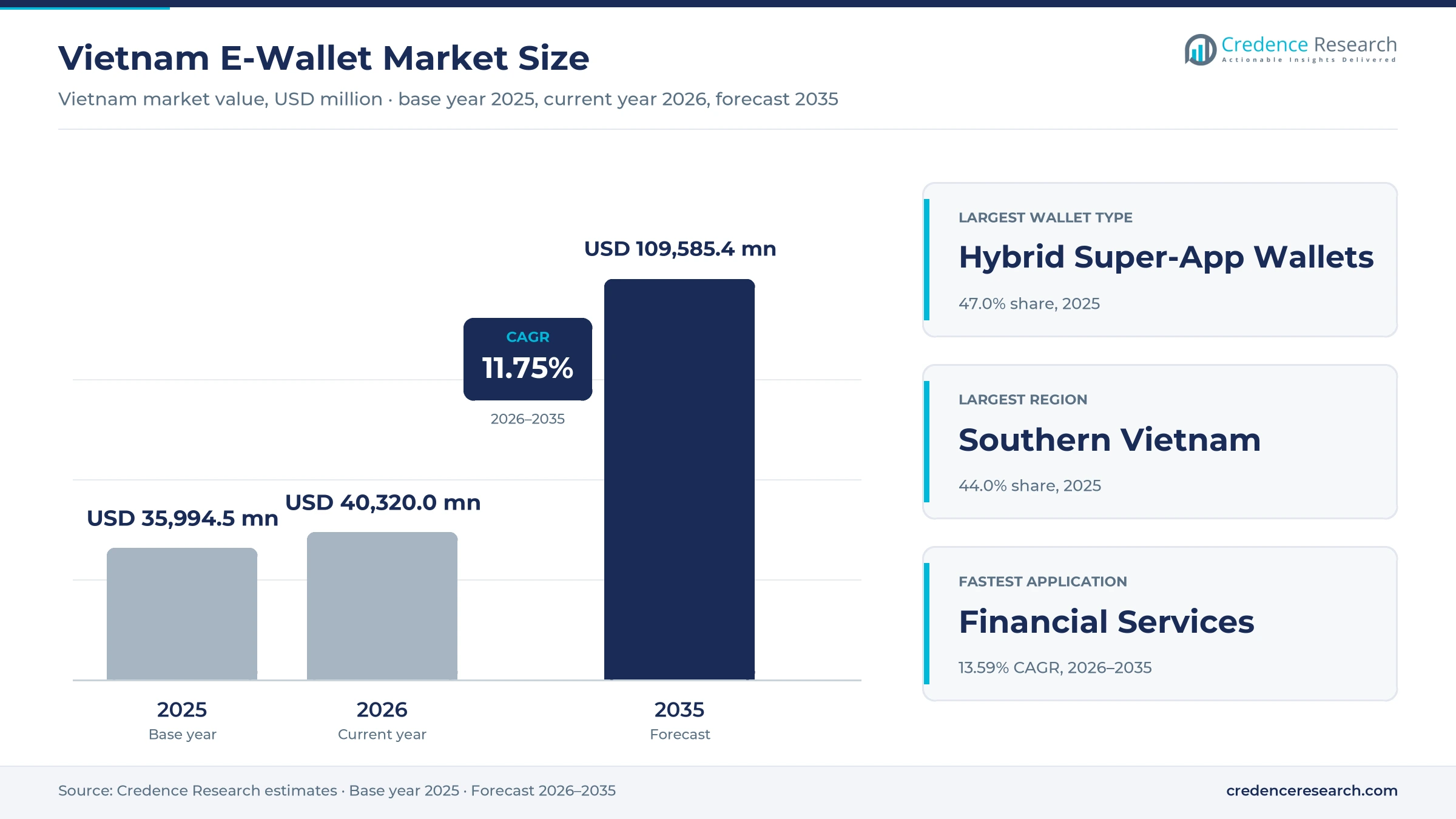
The Vietnam e-wallet market was valued at USD 35.99 billion in 2025 and is projected to increase from USD 40.32 billion in 2026 to USD 109.59 billion by 2035, registering a CAGR of 11.75% during 2026–2035. The value measured is money moved through licensed wallets, rather than the fees providers earn. Demand rests on verified users, shared QR acceptance and online retail, with 30.27 million active wallets recorded at March 31, 2025. Southern Vietnam held the largest regional share, 44.0% in 2025, helped by the Southeast economy and dense urban merchants. Highlands and Remote Provinces is the fastest-growing region at 13.30% a year, as Mobile Money accounts reach rural users. The main commercial change came on Jan. 1, 2026, when Vietnam abolished presumptive tax for household businesses, pushing small traders toward recorded digital receipts. Stricter identity rules under Circular 41/2025 are also shrinking dormant accounts, so growth now depends on active use rather than sign-ups.
What does the Vietnam e-wallet market value actually count?
The market value counts the gross transaction value of merchant payments, peer-to-peer transfers, bill payments, financial service payments and mobility or travel purchases completed through licensed wallets and telecom Mobile Money accounts. It is a flow of customer money at face value, so it should not be read as provider revenue. Wallet operators keep only a small part of that flow as merchant fees and service commissions.
The value excludes card spending, payments made directly from bank apps, cash on delivery and stored balances, which remain small. Provider fee income also sits outside this total, as it is a separate measure. Each wallet depends on licensed intermediaries, partner banks that hold customer funds, the shared national switch, merchants that accept payment and platforms that embed checkout in their own apps.
Vietnam E-Wallet Market Insights
- Wallet transaction value rises from USD 35.99 billion in 2025 to USD 109.59 billion by 2035, an 11.75% CAGR over 2026–2035, measured as gross payment flow rather than provider income.
- Southern Vietnam held 44.0% of 2025 transaction value, while remote provinces grow fastest as telecom Mobile Money reaches rural and island users.
- Hybrid Super-App Wallets led wallet type with 47.0% of 2025 value, because payments, savings, insurance and investment now sit inside a single app.
- Circular 41/2025 took effect on Nov. 5, 2025, banning wallet credit, interest and cash handling at provider locations, with biometric checks at registration required from the start of 2026.
- Investors were reported in June 2026 to be weighing up to a 50% stake in MoMo at a valuation of as much as USD 3 billion.
Super-app wallets and merchant payments hold the value
Why do hybrid super-app wallets carry most of the value?
Based on wallet type, the market is categorized into open-loop wallets, closed-loop wallets, hybrid super-app wallets and corporate wallets. Hybrid Super-App Wallets led with 47.0% of 2025 value because MoMo, which claims more than 30 million users according to The Investor in June 2026, now offers payments, savings, insurance and investments in one app. Corporate Wallets grow fastest at 13.65% a year as Circular 41/2025 gave them a defined route, with legal representatives verified in person or through a third party and listed companies exempted from biometric checks.
Which uses move the most money through wallets?
Based on application, the market is categorized into merchant payments, peer-to-peer transfers, bill payments, financial services and mobility and travel. Merchant Payments led with 39.0% of 2025 value because digital wallets accounted for 38% of e-commerce payments in 2025, according to Antom, in an online market the Ministry of Industry and Trade estimated at USD 31 billion. Financial Services grow fastest at 13.59% a year as wallets act as distributors, since Circular 41/2025 bans them from lending directly. Zalopay offers installments and cash loans of up to VND 30 million through CIMB Vietnam and SHB Finance.
How do mass users and small traders differ in wallet value?
Based on customer segment, the market is categorized into mass-market consumers, digitally active consumers, micro-merchants and SMEs and enterprises. Mass-Market Consumers led with 41.0% of 2025 value because account ownership reached 70.55% of adults in 2024, up from 56.27% in 2022, according to the World Bank, widening use well beyond early urban adopters. Micro-Merchants grow fastest at 13.37% a year as the presumptive tax regime ended on Jan. 1, 2026, moving about five million household businesses to declared revenue, Vietstock reported in December 2025. Recorded receipts tend to favor digital collection over cash at these small shops.
Which provider types hold wallet customers today?
Based on provider type, the market is categorized into independent fintech providers, technology ecosystem providers, telecommunications providers and bank-affiliated providers. Independent Fintech Providers led with 46.0% of 2025 value because MoMo alone claims more than 30 million users, according to The Investor in June 2026, and has operated since 2010. Telecommunications Providers grow fastest at 12.86% a year as Decree 368/2025 raised the monthly Mobile Money limit tenfold to VND 100 million in January 2026, while Viettel Money reported nearly 30 million users in April 2025.
| Segment Group | Leading Sub-segment | Share, 2025 | Fastest-growing Sub-segment | CAGR, 2026–2035 |
|---|---|---|---|---|
| By Wallet Type | Hybrid Super-App Wallets | 47.0% | Corporate Wallets | 13.65% |
| By Application | Merchant Payments | 39.0% | Financial Services | 13.59% |
| By Customer Segment | Mass-Market Consumers | 41.0% | Micro-Merchants | 13.37% |
| By Provider Type | Independent Fintech Providers | 46.0% | Telecommunications Providers | 12.86% |
Request a Free Sample
Fill in your details and we'll send you a free sample report.
- Sample data tables & charts
- Research methodology
Verified users, QR and commerce drive payment flows
Verified digital-payment users widen the wallet base
Vietnam e-wallet value grows first because more adults can pass identity checks and hold a formal account. World Bank account ownership data show 70.55% of Vietnamese adults holding an account in 2024, compared with 56.27% in 2022. That wider base sits behind 30.27 million active wallets at 47 licensed providers at March 31, 2025. Identity tools now reach the wallet sector as well as banks, because Viet Nam News reported in early 2026 that 39 payment intermediaries had deployed chip-card verification and 15 had deployed the VNeID application. As a result, onboarding is slower but each counted user is more likely to be real and able to transact at higher limits.
QR acceptance and merchant digitization extend wallet use
Shared QR codes let a stall or a shop accept wallet payments without buying a terminal, which explains the spread of acceptance beyond formal retail. The State Bank of Vietnam reported that QR code payments in 2025 rose 50.94% in volume and 124.06% in value. Terminals tell a different story, because POS devices rose just 0.53% to 772,552 units by March 2026, according to VOV. Tax reform adds a further push, since presumptive tax ended on Jan. 1, 2026, for household businesses. Zalopay alone connected 52,000 partners and 81,000 payment points by the end of 2024, according to VNG, showing how quickly merchant networks were built on this model.
Digital commerce and embedded services lift ticket flow
Online retail gives wallets a large, recurring flow of checkout payments, because many platforms place the wallet inside their purchase journey. The Ministry of Industry and Trade estimated Vietnamese e-commerce at USD 31 billion in 2025, up about 25%, and set a target of about USD 37 billion for 2026, Dan Tri reported in December 2025. Antom puts digital wallets at 38% of e-commerce payments, ahead of bank transfers at 28% and cash on delivery at 16%. The growth of live commerce adds further impulse purchases at checkout. Embedded services extend that flow, since Zalopay reached 16 million users with more than 100 products by May 2025, according to VNG.
Firmer legal status and higher limits support larger payments
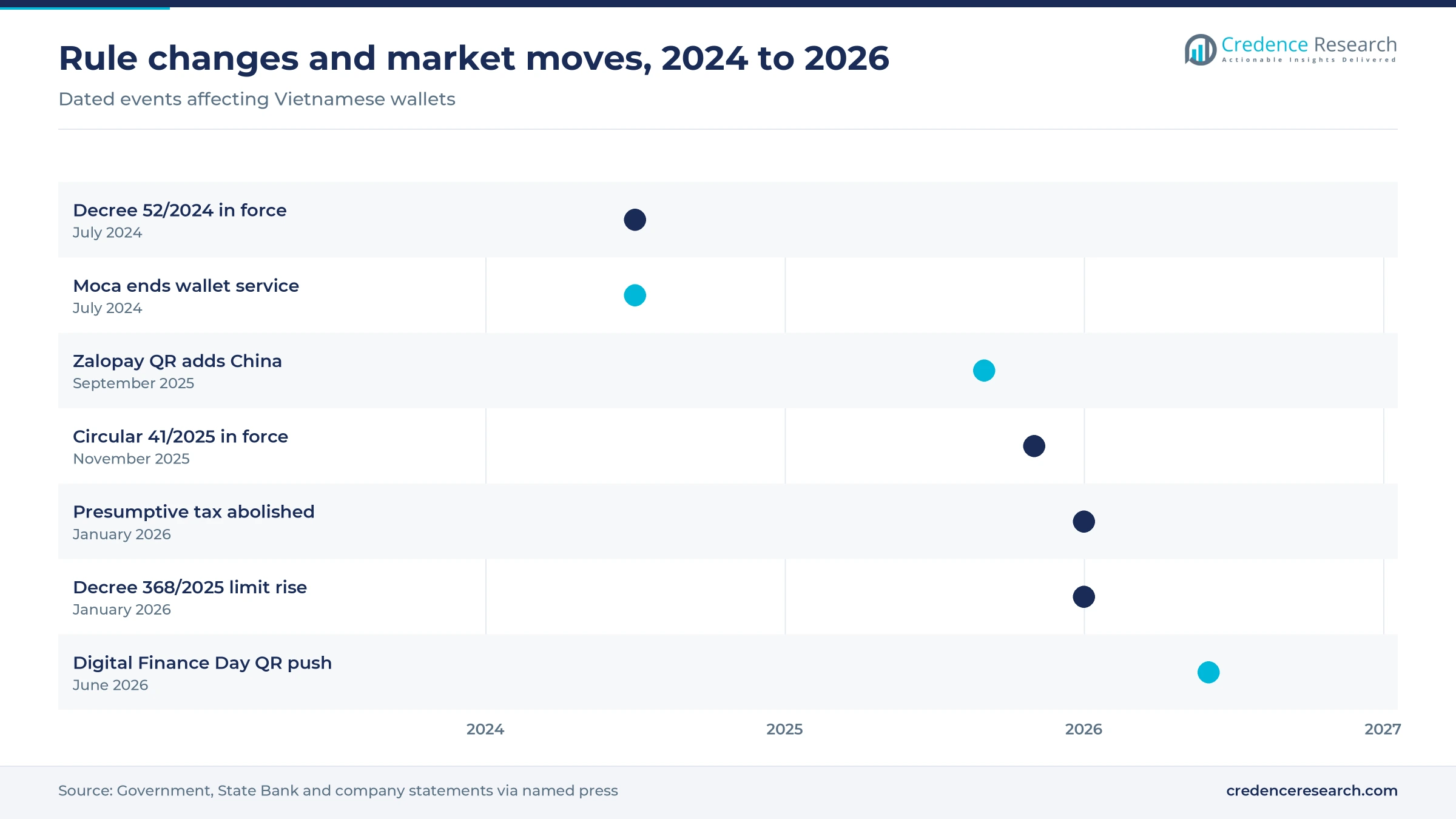
Clear rules let wallets carry larger and more regular payments, including essential services that were previously capped at lower levels. Decree 52/2024 added e-wallets to the list of non-cash payment instruments and gave e-money its first legal definition from July 1, 2024, according to law firm Tilleke & Gibbins. Circular 41/2025 then allowed a customer total of up to VND 300 million a month at one provider for certain essential services, Lawyers of Vietnam reported in November 2025. Public-sector use followed, because Hanoi Times reported that Viettel Money became an official channel on the National Public Service Portal. Together these steps move wallets from small-ticket convenience toward routine household and government payments.
Biometric rules and cross-border QR reset the field
Shift from activated accounts to verified active wallets
The count of activated wallets is falling while the active share improves, which marks a shift from sign-up campaigns to real use. The finance publication of Saigon Giai Phong reported 57.31 million activated wallets and 63.23% active at the end of 2023. By March 31, 2025, the figure had dropped to 46.01 million activated, with 65.8% active. Biometric checks at registration from early 2026 should extend that clean-up. Consolidation runs alongside it, since Moca stopped its wallet service from July 1, 2024, after losing its exclusive role on the Grab app. In turn, marketing budgets are moving from new account bonuses toward merchant offers and repeat use.
Rise of wallets as financial platforms under bank QR pressure
Vietnam e-wallet providers are moving beyond payments because bank apps now offer many of the same transfer and QR functions at no visible charge. VinVentures estimated that fintechs had spent hundreds of millions of dollars on promotions to compete with bank QR, VCCI reported in January 2025. Profit has since become the focus, as The Investor cited Reuters in June 2026 in saying that MoMo turned profitable in 2024. Investors were weighing up to a 50% stake at a valuation of as much as USD 3 billion, the same report said. This broader mobile payment contest now favors apps with savings, insurance and lending partners rather than payments alone.
Opening for wallets in cross-border QR and tourist spending
Cross-border QR offers wallets a new, higher-value flow from visitors and Vietnamese travelers. The National Payment Corporation of Vietnam said that transactions by visitors from Thailand, Laos and Cambodia rose nearly eightfold in volume and sixfold in value in the first eight months of 2026, Viet Nam News reported in September 2026. Visitor numbers supply the base, with about 13.9 million arrivals in the first seven months of 2026, up 6.6%. More than 20 Vietnamese banks and intermediaries are involved in these links. Outbound use is also building, since Zalopay extended its QR service to China in September 2025, completing a six-country network, Tuoi Tre News reported.
Opening to serve rural users through mobile money accounts
Rural users remain the clearest new customer pool, and telecom accounts reach them without a bank branch. Vietnamnet reported 10.89 million registered accounts at the end of September 2025, about 70% of them in rural, remote or island areas. Those accounts had processed more than 290 million transactions worth about VND 8.51 trillion. Accounts reached 11.45 million by March 31, 2026, according to VOV, with 5.64 million first-quarter transactions worth VND 154.34 billion, or about VND 27,400 each. Decree 368/2025 raised the monthly limit from VND 10 million to VND 100 million in January 2026, so larger household payments can now move through the same accounts.
Thin balances and bank QR squeeze wallet economics
Why do compliance rules raise the cost of each wallet?
Circular 41/2025 took effect on Nov. 5, 2025, and requires providers to verify identity documents and, from the start of 2026, biometric data before activating a wallet. It also bans cash deposits and withdrawals at provider locations, wallet credit and interest on balances. Smaller operators feel this most, because combined balances across active wallets were only about VND 2.8 trillion in March 2025. Providers can mitigate the burden by reusing VNeID and chip-card verification rather than building separate checks.
How does fraud exposure limit trust in wallet payments?
Fraud remains a direct brake on trust, since the State Bank SIMO monitoring system had flagged 592,000 payment accounts or wallets by Dec. 11, 2025, Vietnamnet reported. The system had also sent 2.13 million alerts to customers. New users and older mass-market customers are the most exposed, which slows adoption of larger payments. Wallets connected to SIMO can reduce losses, because more than 670,000 users cancelled or halted transactions after an alert, preventing losses above USD 105 million.
Can wallets defend margin against free bank transfers?
Bank apps and VietQR compete directly for the same everyday payment, and VinVentures estimated in a report cited by VCCI in January 2025 that fintechs had spent hundreds of millions of dollars on promotions in response. That spending pressures the income side of fintech and digital payments businesses, even when payment value rises. Independent wallets carry the most risk, since transfers alone earn little. Most are responding by adding savings, insurance and partner lending to their apps.
Will slower payment value growth weaken wallet economics?
Payment volume is growing far faster than value, which points to smaller tickets and thinner fee income per transaction. Non-cash volume rose 34.56% in the first eight months of 2026, while value rose just 13.26%, Viet Nam News reported in September 2026. Mobile value rose only 8.35% in the first quarter, according to VOV. Providers with high processing costs per payment are the most affected group. Wider merchant bundles and higher-value bill payments offer the most practical offset.
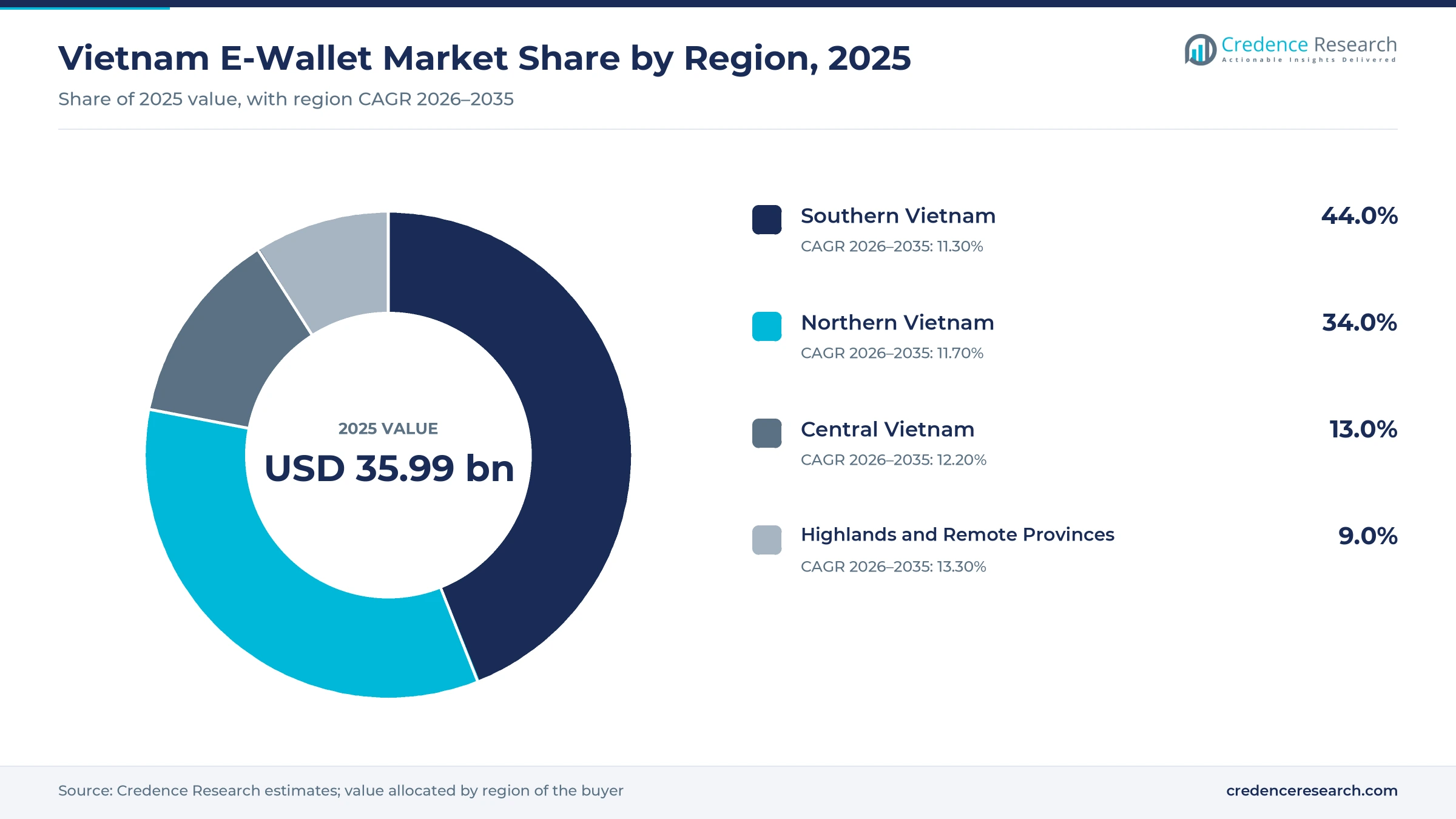
South leads, while remote provinces grow fastest
| Region | Value, 2025 (USD billion) | Share, 2025 | CAGR, 2026–2035 |
|---|---|---|---|
| Southern Vietnam | 15.84 | 44.0% | 11.30% |
| Northern Vietnam | 12.24 | 34.0% | 11.70% |
| Central Vietnam | 4.68 | 13.0% | 12.20% |
| Highlands and Remote Provinces | 3.24 | 9.0% | 13.30% |
Southern Vietnam holds the largest share of wallet value
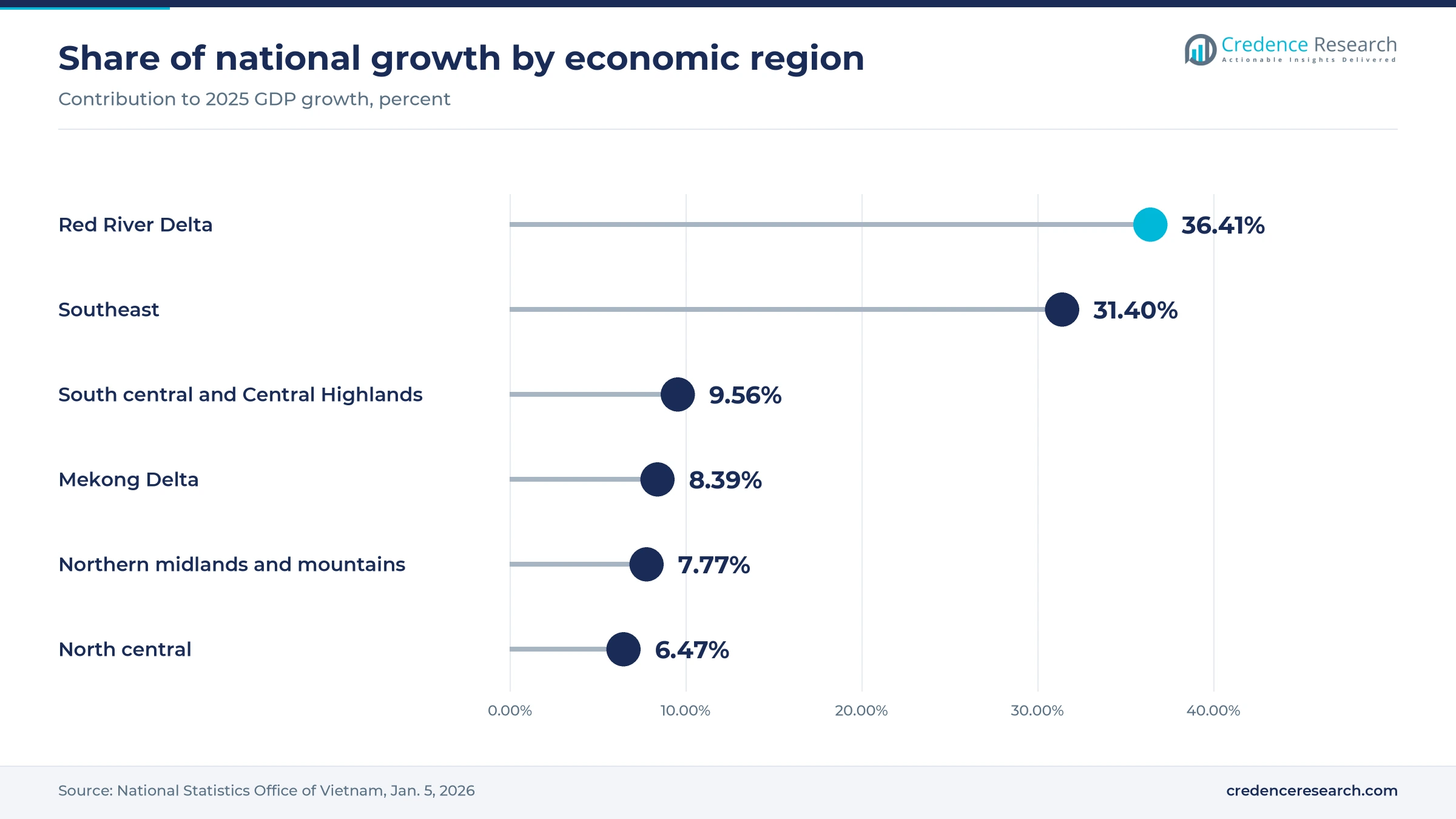
Southern Vietnam held 44.0% of 2025 value and grows at 11.30% a year. The zone benefits from the Southeast economy, which the National Statistics Office said contributed 31.4% of national growth in 2025, with the Mekong Delta adding 8.39%. Ho Chi Minh City also hosted Digital Finance Day on June 6–7, 2026, where the national payment switch promoted cross-border QR. Slower growth reflects a high existing wallet base and more use of bank apps.
Northern Vietnam follows with strong output growth
Northern Vietnam held 34.0% of 2025 value and grows at 11.70% a year. The Red River Delta grew an estimated 9.74% in 2025 and contributed 36.41% of national growth, according to the National Statistics Office, the highest of any region. Hanoi posted GRDP growth of 8.16%, while Hai Phong and Quang Ninh led the country. Rising incomes in these industrial hubs support larger merchant, utility and public-service payments through wallets.
Central Vietnam gains from coastal tourism and bill payments
Central Vietnam held 13.0% of 2025 value and grows at 12.20% a year. The north central region grew an estimated 8.37% in 2025 and the south central coast with the Central Highlands grew 7.74%, the National Statistics Office said. Together they contributed about 16% of national growth, so the zone remains a smaller payment pool than the north or south. Visitor spending should help this zone, since QR links for regional tourists are spreading to markets, restaurants and souvenir stalls.
Highlands and remote provinces add users from a low base
Highlands and Remote Provinces held 9.0% of 2025 value and grow at 13.30% a year, the fastest rate of any zone. Tickets remain small, because Mobile Money payments averaged about VND 27,400 each in the first quarter of 2026. Account reach is the main advantage, with about 70% of accounts in rural, remote or island areas. The northern midlands and mountains also grew an estimated 8.53% in 2025, supporting household payment growth.
Decrees and circulars set the pace from 2024 to 2026
| Development | Status and market relevance |
|---|---|
| In July 2024, Decree 52/2024 took effect, adding e-wallets to non-cash instruments and giving e-money its first legal definition, according to Tilleke & Gibbins. | In force; it sets the base for later wallet rules |
| In September 2025, Zalopay extended its international QR service to China, completing a six-country network for Vietnamese users, according to Tuoi Tre News. | Live; it opens outbound spending for wallet holders |
| In November 2025, Circular 41/2025 took effect, setting a VND 300 million monthly limit for certain essential services, with biometric checks at registration from the start of 2026. | In force; it raises onboarding cost and payment limits |
| In January 2026, Decree 368/2025 raised the monthly Mobile Money limit from VND 10 million to VND 100 million, according to Vietstock. | In force; it widens telecom wallet use in rural areas |
| In June 2026, The Investor reported that investors were weighing up to a 50% stake in MoMo at a valuation of as much as USD 3 billion. | Reported talks; no completed deal has been confirmed |
Identity checks and shared QR rails shape wallet design
- Biometric onboarding matches a customer to chip-card or VNeID records before a wallet is activated, and 39 intermediaries had adopted chip-card checks in early 2026.
- Shared QR rails let one merchant code accept payment from many banks and wallets, which removes the need for a POS terminal at small stalls.
- Fraud monitoring through SIMO lets providers warn users before a suspect transfer completes, and 122 of 147 banking institutions had reported data by Dec. 11, 2025.
- Cross-border QR links convert currency automatically at checkout, and the national switch planned connections with Singapore, India and Taiwan during 2026.
Need a Custom Version of This Report?
Tailor the scope, geography, or segments to your exact requirements.
- Custom geography or segment scope
- Direct access to our analyst team
Five large wallets compete with bank apps for habit
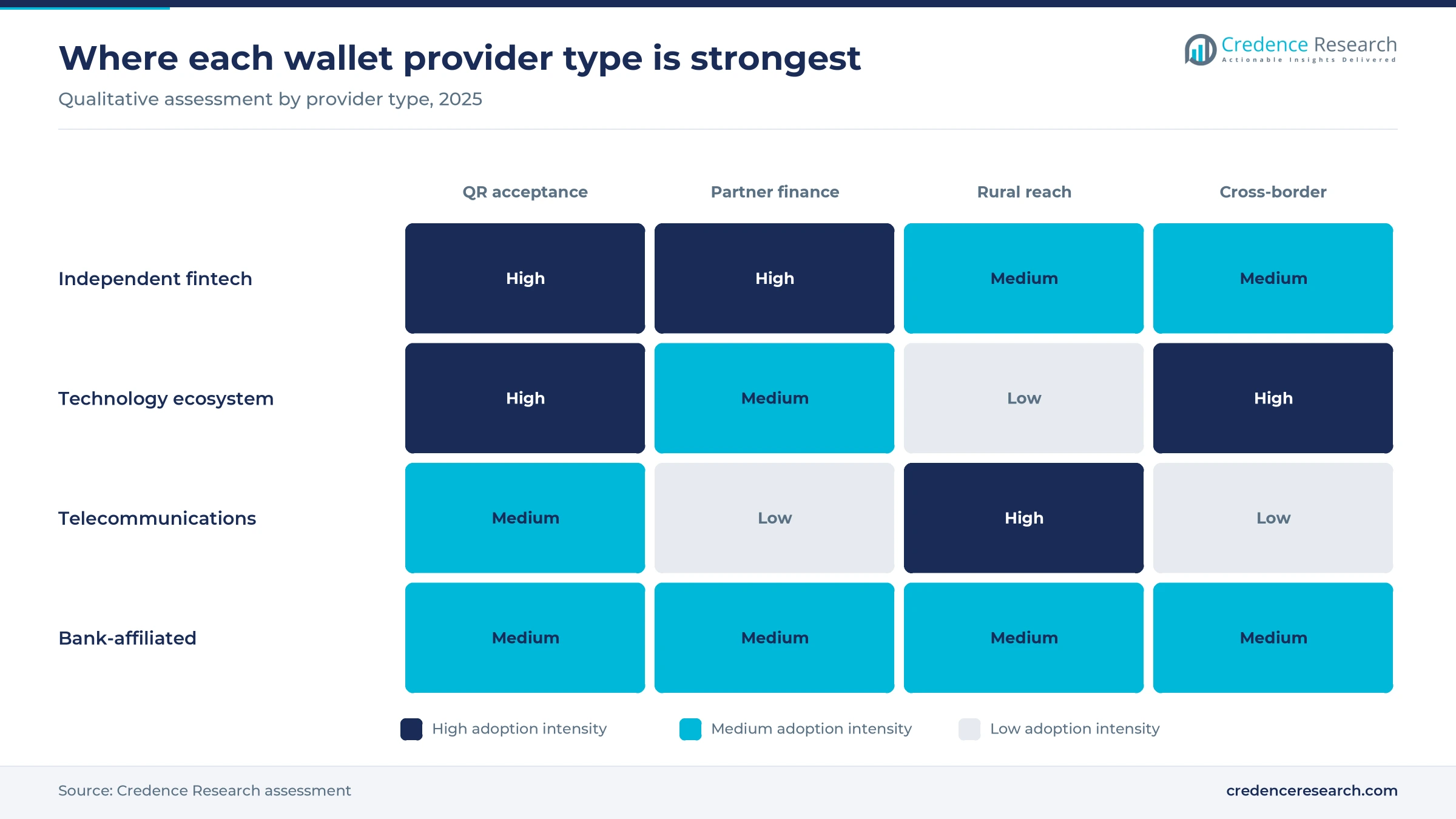
Competition centers on daily habit rather than on price, because bank apps have already made simple transfers cheap. Viet Nam News names MoMo, Viettel Money, ZaloPay, ShopeePay and VNPAY as the main players among 47 licensed wallet providers. MoMo holds the widest financial product range and the largest reported user share. ZaloPay draws on the Zalo messaging base and now accepts payment from bank apps and other wallets. Viettel Money uses telecom reach in rural provinces and holds a public-service role. VNPAY focuses on merchant QR, which it placed inside more than 32 banking apps and 15 wallets by June 2023. ShopeePay relies on checkout inside its parent shopping platform, which gives it steady online flow. SmartPay built its user base on retailers, with about 600,000 of them reported in January 2022. The next contest is over partner lending and insurance, since wallets cannot lend directly under Circular 41/2025.
Companies profiled and their roles in this market
| Company | Type | Role in the market |
|---|---|---|
| MoMo | Independent fintech | Super-app with payments, savings, insurance and investments; more than 30 million users claimed |
| ZaloPay | Technology ecosystem | Payment arm tied to Zalo, with 16 million users reported by VNG in May 2025 |
| Viettel Money | Telecommunications | Nearly 30 million users in April 2025 and a National Public Service Portal channel |
| VNPAY | Independent fintech | Merchant QR network embedded in more than 32 banking apps and 15 wallets |
| ShopeePay | Technology ecosystem | Named by Viet Nam News among the leading wallets, tied to platform checkout |
| VNPT Money | Telecommunications | VNPT was one of three operators licensed in the national Mobile Money pilot |
| MobiFone Money | Telecommunications | MobiFone was one of three operators licensed in the national Mobile Money pilot |
| SmartPay | Independent fintech | Retailer-led wallet, with about 600,000 retailers among two million users in January 2022 |
Payment value and wallet income are separate measures
Credence Research's view is that wallet payment value and wallet income are separate measures, and buyers should not confuse the two. Vietnam e-wallet transaction value keeps compounding at 11.75% through 2035, yet combined balances were only about VND 2.8 trillion in March 2025 and non-cash value grew just 13.26% in the first eight months of 2026. Volume is outrunning value, so the fee earned on each payment is under pressure. The strongest positions will belong to wallets that convert payment habit into partner lending, insurance and merchant services, as simple transfers have become a commodity supplied by bank apps.
How the transaction value estimate was built and tested
The report uses 2025 as the base year and 2035 as the forecast year. Market values come from the Credence Research model and measure gross wallet transaction value, not provider income. Segment and regional splits are Credence Research estimates rather than reported statistics. Those estimates draw on State Bank of Vietnam statistics, National Statistics Office releases, Ministry of Industry and Trade data, World Bank indicators, government decrees, law firm summaries, company statements and Vietnamese business press. A cross-check compared the total with e-commerce value, retail and service sales, active wallets and GDP. The State Bank does not appear to publish a single series for total wallet value, so the offline wallet share is an assumption and the total carries more uncertainty than a reported statistic.
Financial services and micro-merchants lead to 2035
Vietnam e-wallet transaction value should reach USD 109.59 billion by 2035, with growth moving from new users to deeper use. Financial services and micro-merchants add the most new flow, because partner lending and recorded small-business receipts both widen the reasons to keep money moving through an app. Financial Services remain the fastest-growing application segment at 13.59% a year through 2035, ahead of every other wallet use. Remote provinces gain share from a low base as Mobile Money limits rise. The main risks are a harder bank QR contest and tighter fraud controls, which could slow onboarding and hold payment value below this path in the early years.
Frequently Asked Questions
How big is the Vietnam e-wallet market?
What does the market value measure?
Which wallet type holds the largest share?
Which region leads wallet spending in Vietnam?
How many e-wallets are active in Vietnam?
What did Circular 41/2025 change for wallets?
Who are the main e-wallet providers in Vietnam?
How does Mobile Money differ from other wallets?
Table of Content
Chapter 1 Market Segmentation
- 1.1 Segmentation Framework
- 1.1.1 Product and Service Classification
- 1.1.2 Application and End-Use Classification
- 1.1.3 Technology and Solution Classification
- 1.1.4 Customer and Distribution Channel Classification
- 1.1.5 Geographic Segmentation
- 1.1.6 Market Segment Definitions and Boundaries
- 1.2 By Wallet Type
- 1.2.1 Hybrid Super-App Wallets
- 1.2.2 Open-Loop Wallets
- 1.2.3 Closed-Loop Wallets
- 1.2.4 Corporate Wallets
- 1.3 By Application
- 1.3.1 Merchant Payments
- 1.3.2 Peer-to-Peer Transfers
- 1.3.3 Bill Payments
- 1.3.4 Financial Services
- 1.3.5 Mobility and Travel
- 1.4 By Customer Segment
- 1.4.1 Mass-Market Consumers
- 1.4.2 Digitally Active Consumers
- 1.4.3 Micro-Merchants
- 1.4.4 SMEs and Enterprises
- 1.5 By Provider Type
- 1.5.1 Independent Fintech Providers
- 1.5.2 Technology Ecosystem Providers
- 1.5.3 Telecommunications Providers
- 1.5.4 Bank-Affiliated Providers
Chapter 2 Introduction
- 2.1 Report Objectives and Scope
- 2.2 Product Definition and Industry Terminology
- 2.3 Market Inclusions and Exclusions
- 2.4 Research Process
- 2.4.1 Primary Research and Expert Interviews
- 2.4.2 Secondary Research and Source Review
- 2.4.3 Top-Down and Bottom-Up Estimation
- 2.4.4 Data Triangulation and Verification
- 2.5 Market Size Measurement Basis
- 2.5.1 2025: USD 35.99 billion → 2035: USD 109.59 billion
- 2.6 Historical and Forecast Reference Periods
- 2.6.1 Historical Period: 2018-2025
- 2.6.2 Base Year: 2025
- 2.6.3 Forecast Period: 2025-2035
- 2.7 Research Assumptions and Limitations
Chapter 3 Executive Summary
- 3.1 Market Snapshot and Key Findings
- 3.2 Base-Year Market Size, 2025
- 3.3 Forecast Market Size, 2035
- 3.4 Revenue and Volume Growth Outlook
- 3.5 Key Demand and Supply Indicators
- 3.6 Leading Market Segments
- 3.7 Fastest-Growing Market Opportunities
- 3.8 Regional Performance Highlights
- 3.9 Technology and Industry Transformation
- 3.10 Competitive Landscape Summary
- 3.11 Analyst View and Strategic Implications
Chapter 4 Vietnam E-Wallet Market Trends and Developments
- 4.1 Historical Industry Development, 2018-2025
- 4.2 Recent Market Trends and Developments
- 4.3 Demand and Customer Behavior Trends
- 4.4 Technology and Product Innovation
- 4.5 Artificial Intelligence, Automation and Digitalization
- 4.6 Local Manufacturing and Supply Chain Realignment
- 4.7 Industry Partnerships, Mergers and Acquisitions
- 4.8 Sustainability and Circular Economy Developments
- 4.9 Government and Private Sector Investment Trends
- 4.10 Emerging Business Models and Commercialization
- 4.11 Industry Developments and Announcements
Chapter 5 Vietnam E-Wallet Market Supply and Demand Analysis
- 5.1 Demand Trend and Consumption Analysis, 2018-2025
- 5.2 Demand Forecast, 2025-2035
- 5.3 Supply Chain Structure and Procurement Trends
- 5.4 Supply-Demand Gap and Bottlenecks
- 5.5 Import Dependence and Sourcing Structure
- 5.6 Regional Supply and Demand Concentration
Chapter 6 Vietnam E-Wallet Market Pricing Analysis
- 6.1 Pricing Structure and Measurement
- 6.2 Historical Pricing Trends, 2018-2025
- 6.3 Pricing Outlook, 2025-2035
- 6.4 Pricing by Product and Market Segment
- 6.5 Geographic Pricing Differences
- 6.6 Key Input, Energy, Labor and Logistics Costs
- 6.7 Contract Pricing and Purchasing Models
- 6.8 Pricing Sensitivity and Competitive Positioning
- 6.9 Price, Margin and Profitability Implications
Chapter 7 Vietnam E-Wallet Market Dynamics
- 7.1 Market Growth Drivers
- 7.1.1 Demand-Side Drivers
- 7.1.2 Technology and Innovation Drivers
- 7.1.3 Infrastructure and Investment Drivers
- 7.1.4 Regulatory and Policy Drivers
- 7.2 Market Restraints
- 7.2.1 Cost and Affordability Constraints
- 7.2.2 Technology and Adoption Barriers
- 7.2.3 Supply Chain and Operational Constraints
- 7.3 Market Challenges
- 7.3.1 Competitive Pressure and Margin Erosion
- 7.3.2 Skills, Infrastructure and Implementation Gaps
- 7.4 Emerging Market Opportunities
- 7.5 Market Dynamics Impact and Time-Horizon Assessment
Chapter 8 Vietnam E-Wallet Value Chain Analysis
- 8.1 Industry Value Chain Overview
- 8.2 Upstream Suppliers and Critical Inputs
- 8.3 Technology and Component Providers
- 8.4 Manufacturing or Service Delivery
- 8.5 Distribution, Channel Partners and Integrators
- 8.6 Downstream Applications and End Users
- 8.7 Value Addition and Profit Pools
- 8.8 Vertical Integration and Outsourcing
- 8.9 Supplier Concentration and Risk
- 8.10 Supply Chain Localization and Resilience
Chapter 9 Vietnam E-Wallet Market Regulations and Policies
- 9.1 Relevant Laws, Standards and Compliance Frameworks
- 9.2 Product, Service, Safety and Quality Requirements
- 9.3 Government Policies, Incentives and Subsidies
- 9.4 Imports, Exports and Trade Barriers
- 9.5 Public Procurement and Local Content Requirements
- 9.6 Data Protection, AI and Cybersecurity Compliance
- 9.7 Upcoming Policy Changes and Market Implications
Chapter 10 Vietnam E-Wallet Market Hotspots and Opportunities
- 10.1 Market Opportunity Mapping and Growth Hotspots
- 10.2 High-Growth Applications and Customer Groups
- 10.3 Underserved Markets and White-Space Opportunities
- 10.4 Emerging Technology and Product Opportunities
- 10.5 New Capacity and Investment Hotspots
- 10.6 Market Entry and Expansion Opportunities
- 10.7 Distribution and Partnership Opportunities
- 10.8 Near-Term and Long-Term Commercial Potential
- 10.9 Opportunity Attractiveness and Execution Risks
Chapter 11 Vietnam E-Wallet Market Outlook, 2025-2035
- 11.1 Market Size and Analysis
- 11.1.1 Revenue (Market Measurement: 2025: USD 35.99 billion → 2035: USD 109.59 billion)
- 11.1.2 Historical Market Size, 2018-2025
- 11.1.3 Base-Year Market Size, 2025
- 11.2 Market Forecast, 2025-2035
- 11.2.1 Revenue Forecast to 2035
- 11.2.2 CAGR and Year-on-Year Growth
- 11.2.3 Incremental Revenue Opportunity
- 11.3 Forecast Assumptions and Scenario Analysis
- 11.3.1 Base-Case Forecast
- 11.3.2 Optimistic and Conservative Scenarios
- 11.3.3 Technology, Pricing and Policy Sensitivities
- 11.4 Market Attractiveness and Growth Outlook
Chapter 12 Vietnam E-Wallet Market Segmentation and Outlook
- 12.1 Segmentation Summary and Market Shares, 2025
- 12.2 Largest and Fastest-Growing Segments
- 12.3 By Wallet Type - Market Size and Forecast, 2025-2035
- 12.3.1 Segment Definition and Scope
- 12.3.2 Historical Market Size, 2018-2025
- 12.3.3 Revenue Forecast, 2025-2035
- 12.3.4 Base-Year Market Share, 2025
- 12.3.5 Segment CAGR and Growth Drivers
- 12.3.6 Subsegment Market Size and Forecast
- 12.3.6.1 Hybrid Super-App Wallets
- 12.3.6.2 Open-Loop Wallets
- 12.3.6.3 Closed-Loop Wallets
- 12.3.6.4 Corporate Wallets
- 12.3.7 Subsegment Pricing and Adoption Trends
- 12.3.8 Leading Suppliers and Competition
- 12.3.9 Regional Demand and Opportunities
- 12.4 By Application - Market Size and Forecast, 2025-2035
- 12.4.1 Segment Definition and Scope
- 12.4.2 Historical Market Size, 2018-2025
- 12.4.3 Revenue Forecast, 2025-2035
- 12.4.4 Base-Year Market Share, 2025
- 12.4.5 Segment CAGR and Growth Drivers
- 12.4.6 Subsegment Market Size and Forecast
- 12.4.6.1 Merchant Payments
- 12.4.6.2 Peer-to-Peer Transfers
- 12.4.6.3 Bill Payments
- 12.4.6.4 Financial Services
- 12.4.6.5 Mobility and Travel
- 12.4.7 Subsegment Pricing and Adoption Trends
- 12.4.8 Leading Suppliers and Competition
- 12.4.9 Regional Demand and Opportunities
- 12.5 By Customer Segment - Market Size and Forecast, 2025-2035
- 12.5.1 Segment Definition and Scope
- 12.5.2 Historical Market Size, 2018-2025
- 12.5.3 Revenue Forecast, 2025-2035
- 12.5.4 Base-Year Market Share, 2025
- 12.5.5 Segment CAGR and Growth Drivers
- 12.5.6 Subsegment Market Size and Forecast
- 12.5.6.1 Mass-Market Consumers
- 12.5.6.2 Digitally Active Consumers
- 12.5.6.3 Micro-Merchants
- 12.5.6.4 SMEs and Enterprises
- 12.5.7 Subsegment Pricing and Adoption Trends
- 12.5.8 Leading Suppliers and Competition
- 12.5.9 Regional Demand and Opportunities
- 12.6 By Provider Type - Market Size and Forecast, 2025-2035
- 12.6.1 Segment Definition and Scope
- 12.6.2 Historical Market Size, 2018-2025
- 12.6.3 Revenue Forecast, 2025-2035
- 12.6.4 Base-Year Market Share, 2025
- 12.6.5 Segment CAGR and Growth Drivers
- 12.6.6 Subsegment Market Size and Forecast
- 12.6.6.1 Independent Fintech Providers
- 12.6.6.2 Technology Ecosystem Providers
- 12.6.6.3 Telecommunications Providers
- 12.6.6.4 Bank-Affiliated Providers
- 12.6.7 Subsegment Pricing and Adoption Trends
- 12.6.8 Leading Suppliers and Competition
- 12.6.9 Regional Demand and Opportunities
- 12.7 Segment Growth Comparison
- 12.8 Segment Attractiveness and Priority Matrix
Chapter 13 Vietnam E-Wallet End-Use and Application Market Outlook
- 13.1 End-Use Industry and Customer Demand Structure
- 13.2 Leading Applications and Customer Groups
- 13.3 End-Use Market Size, Share and Forecast
- 13.4 Major End-Use Industry Deep Dives
- 13.4.1 Customer Requirements and Use Cases
- 13.4.2 Demand and Replacement Cycles
- 13.4.3 Technical and Regulatory Considerations
- 13.4.4 Purchasing and Procurement Models
- 13.4.5 Leading Vendors and Distribution Channels
- 13.4.6 Forecast and Commercial Opportunities
- 13.5 Emerging Applications and Cross-Segment Demand
- 13.6 End-Use Industry Investment Priorities
Chapter 14 Vietnam E-Wallet Geographic Market Outlook, 2025-2035
- 14.1 Domestic Market Distribution and Demand Clusters
- 14.2 State- or Province-Wise Market Size and Forecast, 2025-2035
- 14.3 City and Metropolitan Market Outlook
- 14.4 Industrial, Manufacturing and Commercial Clusters
- 14.5 Geographic Concentration of Key End Users
- 14.6 Local Pricing and Purchasing Differences
- 14.7 Domestic Production Facilities and Capacity Map
- 14.8 Local Infrastructure and Project Pipeline
- 14.9 State-Level Policy and Incentive Differences
- 14.10 Subnational Investment Hotspots and Opportunities
- 14.11 Distribution and Logistics Networks
- 14.12 Domestic Competitive Footprint
Chapter 15 Vietnam E-Wallet Technology, Innovation and Sustainability Outlook
- 15.1 Technology Landscape and Maturity
- 15.2 Product, Process and Service Innovation
- 15.3 AI, Automation and Digital Tools in the Industry
- 15.4 Technology Adoption and Performance Benchmarking
- 15.5 Innovation Pipeline and R&D Investment
- 15.6 Energy Efficiency and Resource Management
- 15.7 Sustainability, Recycling and Circularity
- 15.8 Technology Roadmap, 2025-2035
- 15.9 Risks of Obsolescence and Technology Substitution
Chapter 16 Vietnam E-Wallet Market Key Strategic Imperatives
- 16.1 Growth and Market Entry Priorities
- 16.2 High-Return Products and Segments
- 16.3 Pricing, Profitability and Cost Optimization
- 16.4 Technology Investment and Product Differentiation
- 16.5 Supply Chain Localization and Resilience
- 16.6 Distribution and Customer Acquisition
- 16.7 Partnership, Acquisition and Capacity Strategy
- 16.8 Regional Expansion Priorities
- 16.9 Short-, Medium- and Long-Term Actions
Chapter 17 Competition Outlook
- 17.1 Industry Competition Characteristics
- 17.2 Market Structure and Concentration
- 17.3 Market Share and Competitive Positioning, 2025
- 17.4 Company-Wise Revenue and Product Benchmarking
- 17.5 Production and Service Capacity Benchmarking
- 17.6 Technology, Pricing and Differentiation
- 17.7 Regional Footprint and Distribution Strength
- 17.8 Mergers, Acquisitions and Strategic Alliances
- 17.9 New Entrants and Competitive Threats
- 17.10 Porter's Five Forces and Industry Attractiveness
- 17.11 Competitive Outlook, 2025-2035
Chapter 18 Company Profiles
- 18.1 Company Coverage and Selection Criteria
- 18.2 MoMo
- 18.2.1 Business Description
- 18.2.2 Company Ownership and Geographic Presence
- 18.2.3 Product and Service Portfolio
- 18.2.4 Manufacturing and Operating Footprint
- 18.2.5 Financial Performance and Investment
- 18.2.6 Market Share and Competitive Position
- 18.2.7 Technology and Innovation Capabilities
- 18.2.8 Strategic Alliances or Partnerships
- 18.2.9 Recent Developments
- 18.2.10 Growth Strategy and Outlook
- 18.3 ZaloPay
- 18.4 VNPAY
- 18.5 Viettel Money
- 18.6 ShopeePay
- 18.7 VNPT Money
- 18.8 SmartPay
- 18.9 MobiFone Money
- 18.10 Other Relevant Market Participants
Note: Every listed company is profiled on the structure shown under the first company. The company list is preliminary and may change based on research findings, market developments, data availability and client requirements.
Chapter 19 Disclaimer
- 19.1 Research and Forecast Disclaimer
- 19.2 Data Source and Estimation Limitations
Note: The depth of individual sections depends on data availability for this market. Volume, capacity, trade and other unit-based metrics are included where applicable.

