
Aging home backup sets drive steady battery swaps
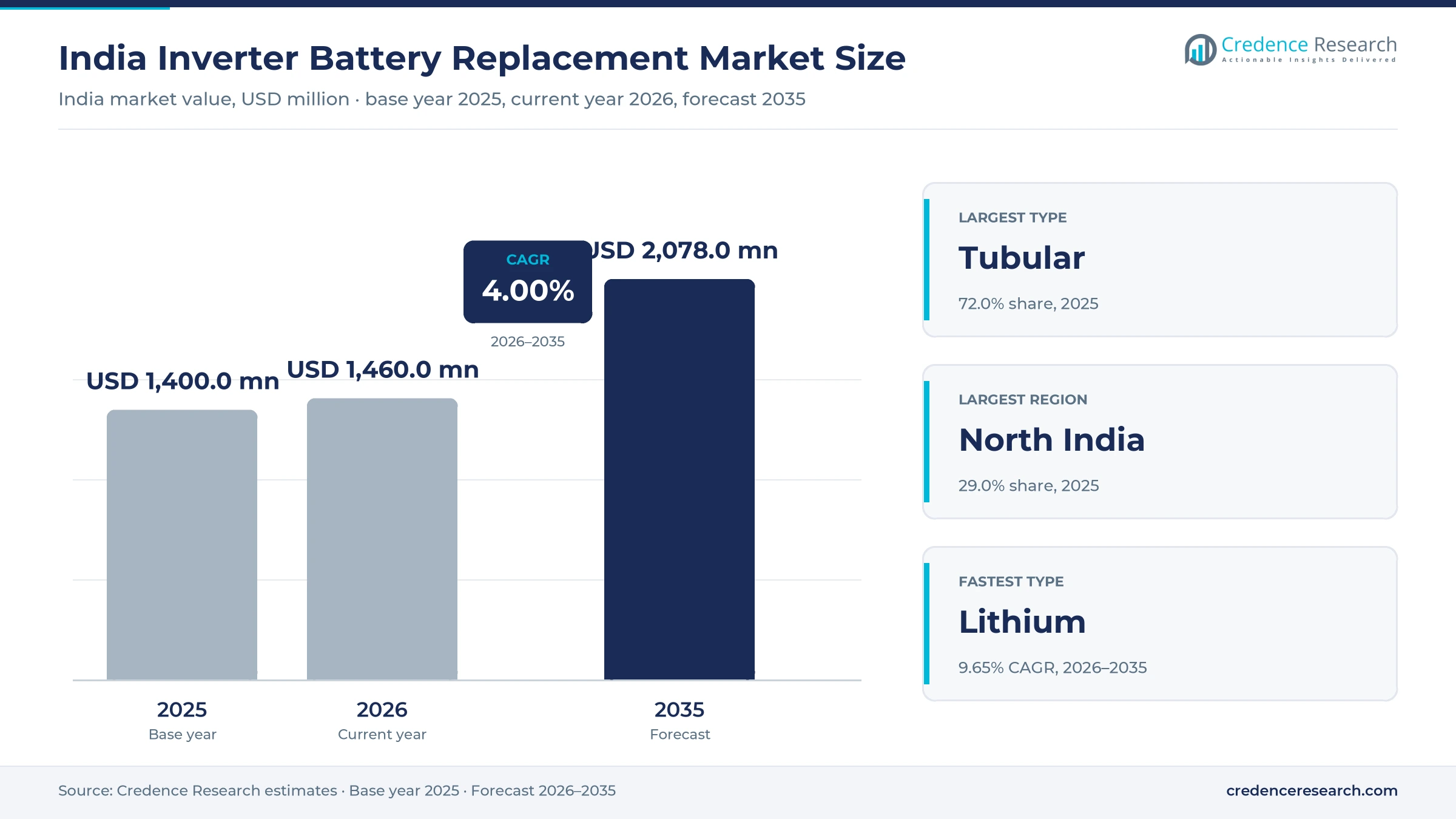
The India inverter battery replacement market was valued at USD 1.40 billion in 2025 and is projected to increase from USD 1.46 billion in 2026 to USD 2.08 billion by 2035, registering a CAGR of 4.00% during 2026–2035. Demand comes from homes and small shops that replace worn lead-acid and lithium batteries in existing inverter sets, usually through a dealer exchange. North India held the largest regional share, 29.0% in 2025, because rural feeders in Uttar Pradesh and nearby states still face long evening cuts. Northeast India is the fastest-growing region at 4.88% a year, starting from a small base. Prices also moved in buyers' favor, because GST on inverter lead-acid batteries fell from 28% to 18% in September 2025. Product mix is changing too, as Luminous opened a lithium-ion assembly line at Baddi in January 2026 and Microtek added an LFP inverter battery in April 2025.
What counts as a replacement inverter battery sale?
The market counts the value of batteries bought to replace worn units in existing home inverters and home UPS systems, including tubular, flat plate and lithium models. It covers sales through brand dealers, multi-brand battery shops and online marketplaces, net of the exchange credit that dealers give for the old battery.
The market excludes batteries sold with a new inverter as a first-time set, automotive starter batteries, telecom and data center batteries and large grid storage. Value flows from households and small shops to dealers and distributors, then to battery makers, which buy lead, plastic and lithium cells and send returned units to recyclers.
India Inverter Battery Replacement Market Insights
- Replacement value rises from USD 1.40 billion in 2025 to USD 2.08 billion by 2035 at a 4.00% CAGR, as millions of home inverter sets reach the end of their battery life.
- North India held 29.0% of 2025 value, because Uttar Pradesh still sees long evening cuts and more than 700 transformer failures a day.
- Tubular units held 72.0% of 2025 value, as Exide sells its Invatubular range with a 66-month warranty and up to 1,200 cycles.
- GST on inverter lead-acid batteries fell from 28% to 18% on Sept. 22, 2025, which lowered the shelf price of every replacement set.
- Luminous opened a 500 MWh lithium-ion assembly line at Baddi in January 2026, which prepares its dealers for lithium replacements.
Tubular units and mid-size sets lead replacements
Why tubular units hold most replacement value
Based on type, the market is categorized into tubular, flat plate and lithium. Tubular led with 72.0% of 2025 value because most owners replace like for like, and Exide rates its tubular lines for up to 1,200 cycles. Flipkart listed 160 Ah tubular units from Livguard and Luminous at Rs 14,252 and Rs 15,999 in June 2025, according to NDTV Shopping. Lithium grows fastest at 9.65% a year as Luminous opened a lithium-ion assembly line at Baddi in January 2026, according to T&D India. Flat plate units remain common in budget homes that face only short cuts.
Mid-size sets lead as larger units gain share
Based on capacity, the market is categorized into below 150 Ah, 150-200 Ah and above 200 Ah. 150-200 Ah led with 52.0% of 2025 value because this band runs fans, lights and a television through typical evening cuts, and Exide sells its Invabrite tubular range in 150 Ah and 180 Ah tall containers. Amazon India's May 2024 buying guide also listed Luminous, Livguard and Okaya models of 150 Ah to 160 Ah. Above 200 Ah grows fastest at 5.29% a year as homes add coolers and pumps, and NDTV Shopping listed Genus 220 Ah and 230 Ah tubular units on Flipkart in June 2025.
Dealers dominate while online sales grow fastest
Based on channel, the market is categorized into dealers and e-commerce. Dealers led with 88.0% of 2025 value because replacement usually needs old-battery pickup, installation and water top-ups, and Business India reported that Luminous supplies almost 60,000 dealers through more than 1,300 distributors. Exide also directs its tubular buyers to the nearest authorized dealer. E-Commerce grows fastest at 6.94% a year as brands list models online, and Moglix sells the Amaron 150 Ah tall tubular unit with a 54-month warranty. Okaya products are also sold on Amazon, according to a February 2025 Business Standard brand feature.
| Segment Group | Leading Sub-segment | Share, 2025 | Fastest-growing Sub-segment | CAGR, 2026–2035 |
|---|---|---|---|---|
| By Type | Tubular | 72.0% | Lithium | 9.65% |
| By Capacity | 150-200 Ah | 52.0% | Above 200 Ah | 5.29% |
| By Channel | Dealers | 88.0% | E-Commerce | 6.94% |
Request a Free Sample
Fill in your details and we'll send you a free sample report.
- Sample data tables & charts
- Research methodology
Aging fleets, rural cuts and lower GST lift demand
Aging backup systems create steady replacement demand
Every installed inverter needs a new battery every few years, which makes replacement the core of this market rather than first-time purchase. Exide sells its tubular lines with warranties of 42 to 66 months, which sets the usual replacement window for homes that bought sets during the outage-heavy years before 2018. The World Bank estimates that access to electricity in India rose from 85.1% of the population in 2014 to 99.5% in 2023, and many newly connected homes bought backup sets soon after. Okaya says it has served more than 110 million customers since 2002, which shows how large the fleet of aging units has become. In the Credence Research model this adds about 1.48 percentage points to annual growth to 2035.
Power resilience stays a priority outside the metros
Households outside the metros still face cuts that make a working battery a necessity, even as national supply improves. Union Power Minister Manohar Lal Khattar said in February 2025 that rural supply averaged 22.6 hours a day against 23.4 hours in cities. Local failures are larger, because ThePrint reported in May 2026 that more than 700 transformers fail each day in Uttar Pradesh. The UPPCL chairman ordered 18 hours of rural supply that month, according to India TV, which still leaves evening gaps in villages. Assam's APDCL supplied 2,684 MW against 2,809 MW of demand on one hot day, Pratidin Time reported in July 2025. In the Credence Research model this adds about 1.08 percentage points to annual growth to 2035.
Dealer exchanges and higher-cycle products lift value
Dealers now sell most replacements as an exchange, which moves buyers toward longer-life models and lifts the value of each sale. ScrapRates reported in March 2026 that a 150 Ah tubular unit weighs about 45 kg and fetches Rs 1,500 to Rs 2,500 as scrap, while retailers offer exchange discounts of Rs 500 to Rs 2,500. That credit makes it easier for buyers to step up to a 72-month model, such as the Genus GTT-270 listed on Flipkart at Rs 20,999 in June 2025. Okaya launched its JXT 90 Ah jumbo tubular unit with a 48-month warranty in January 2026, aimed at replacement demand in compact homes. In the Credence Research model this adds about 0.80 percentage points to annual growth to 2035.
Lower GST cuts the cost of a replacement set
Tax relief has made replacements cheaper, which pulls forward purchases that households had been postponing. Tata Green Battery notes that GST on inverter and solar lead-acid batteries under HSN 85072000 fell from 28% to 18% on Sept. 22, 2025, and stores added new MRP stickers to reflect the change. On a unit priced at Rs 12,000 before tax, the lower rate trims the final bill by Rs 1,200. Lead input costs are also steadier, because Hindustan Zinc says recycled lead supplies over 60% of India's lead and customs duty on lead scrap was removed in the FY2026 budget. As a result, the cut narrows the gap between buying a new tubular set and repeatedly repairing an old one.
Lithium packs and rooftop solar reshape replacement
Shift from lead-acid toward lithium home storage
Home backup is shifting from lead-acid toward lithium iron phosphate packs, which last longer and need no water top-ups. Microtek introduced an LFP lithium-ion inverter battery with its SyncCharge technology in April 2025. Luminous opened a lithium-ion assembly line at Baddi in Himachal Pradesh with 500 MWh of capacity, T&D India reported in January 2026, and its packs range from 1.2 kWh to 16 kWh. Exide commissioned the 6 GWh first phase of its Devanahalli cell plant near Bengaluru, Energetica India reported in September 2026, which builds local cell supply for energy storage systems. NewsBytes reported in June 2026 that up-front prices of lithium and lead-acid home batteries are converging.
Rise of solar-linked replacement buyers
Rooftop solar is creating a new group of replacement buyers, because hybrid systems need deep-cycle batteries that cycle every day. Energetica India reported that PM Surya Ghar had crossed 39.38 lakh rooftop installations with about 14.07 GW of capacity by July 20, 2026. Mercom said in August 2026 that the program had reached over 5 million households, against a target of 10 million homes by March 2027. Daily solar cycling wears batteries faster than occasional backup use, so these homes return to dealers sooner. Luminous already runs a solar panel plant at Rudrapur with 250 MW of capacity, Business India reported, which links its battery and solar sales.
Opening in organized take-back and recycling
Formal take-back is an opening for brands and large dealers, because new rules reward producers that recover used batteries. The Battery Waste Management Rules, 2022, require 35% recycled content in automotive and industrial batteries in 2024-25, rising to 40% from 2026-27, according to a Lawrbit summary of the rules. Recovery targets for those categories also step up from 55% in 2024-25 under the same rules. Hindustan Zinc says secondary lead already supplies over 60% of domestic lead, so each returned 45 kg unit has clear resale value. The same lead loop serves global lead-acid demand, which keeps scrap prices firm. Producers that run their own exchange counters can therefore lower input costs and meet EPR targets at once.
Opening for online sales in smaller towns
Online listing and consumer finance give brands an opening to reach replacement buyers in towns with few authorized dealers. A February 2025 Business Standard brand feature said Okaya products are sold on Amazon, and Moglix lists Amaron tall tubular units for delivery. Flipkart's June 2025 sale cut prices on Genus 220 Ah tubular models by 47%, NDTV Shopping reported, which shows how sharply online channels compete on price in the India inverter battery replacement market. NewsBytes also reported in June 2026 that consumer finance is making home batteries more accessible to households. Okaya has over 600 dedicated sales and service staff within a workforce of more than 1,500, according to its January 2026 release, which lets it support online buyers with installation visits.
Better supply and informal scrap trade slow growth
Better grid supply stretches replacement cycles
Better grid supply lengthens the time owners wait before replacing a weak battery. The Ministry of Power said India's energy shortage fell to 0.03% in FY2025-26 from 4.2% in FY2013-14, according to IANS in January 2026. Rural supply had already risen from 12.5 hours a day in 2014, according to the Union Power Minister. Owners who face only short, rare cuts can run an aging battery for longer. Brands respond by selling solar and lithium upgrades rather than like-for-like swaps.
Informal recyclers undercut formal take-back
Informal scrap buyers still compete with brand exchange counters for used batteries. ScrapRates reported in March 2026 that lead-acid scrap trades at Rs 50 to Rs 80 per kg of battery weight, which local buyers pay in cash. Retail exchange discounts often fall below that cash value for a large tubular unit. As a result, brands lose lead that they need to meet EPR recycled-content targets. Higher exchange offers and doorstep pickup can close part of this gap.
Lithium price gap still limits upgrades
Lithium packs still cost far more up front than tubular units, which slows upgrades in price-sensitive homes. VoltFlow's 2026 buying guide put a lithium battery equivalent to a 150 Ah lead-acid unit at Rs 30,000 to Rs 45,000, against Rs 12,500 to Rs 14,500 for an Exide Invamaster 150 Ah tubular model. Prices are converging, as NewsBytes noted in June 2026, but the gap is still about two to three times. Brands ease the gap with longer warranties and consumer finance offers.
Peak-season outages strain dealer stock
Sudden outage spells strain dealer stock and installation crews in a few weeks of the year. Uttar Pradesh supply peaked at 31,803 MW in May 2026, ThePrint reported, while more than 25% of the state's transformers had passed their operating life. Ayodhya residents faced a 21-hour blackout in June 2025, Free Press Journal reported. Replacement orders spike in such weeks, which leaves dealers short of popular mid-size models. Distributors that build stock before each summer avoid most of these lost sales.
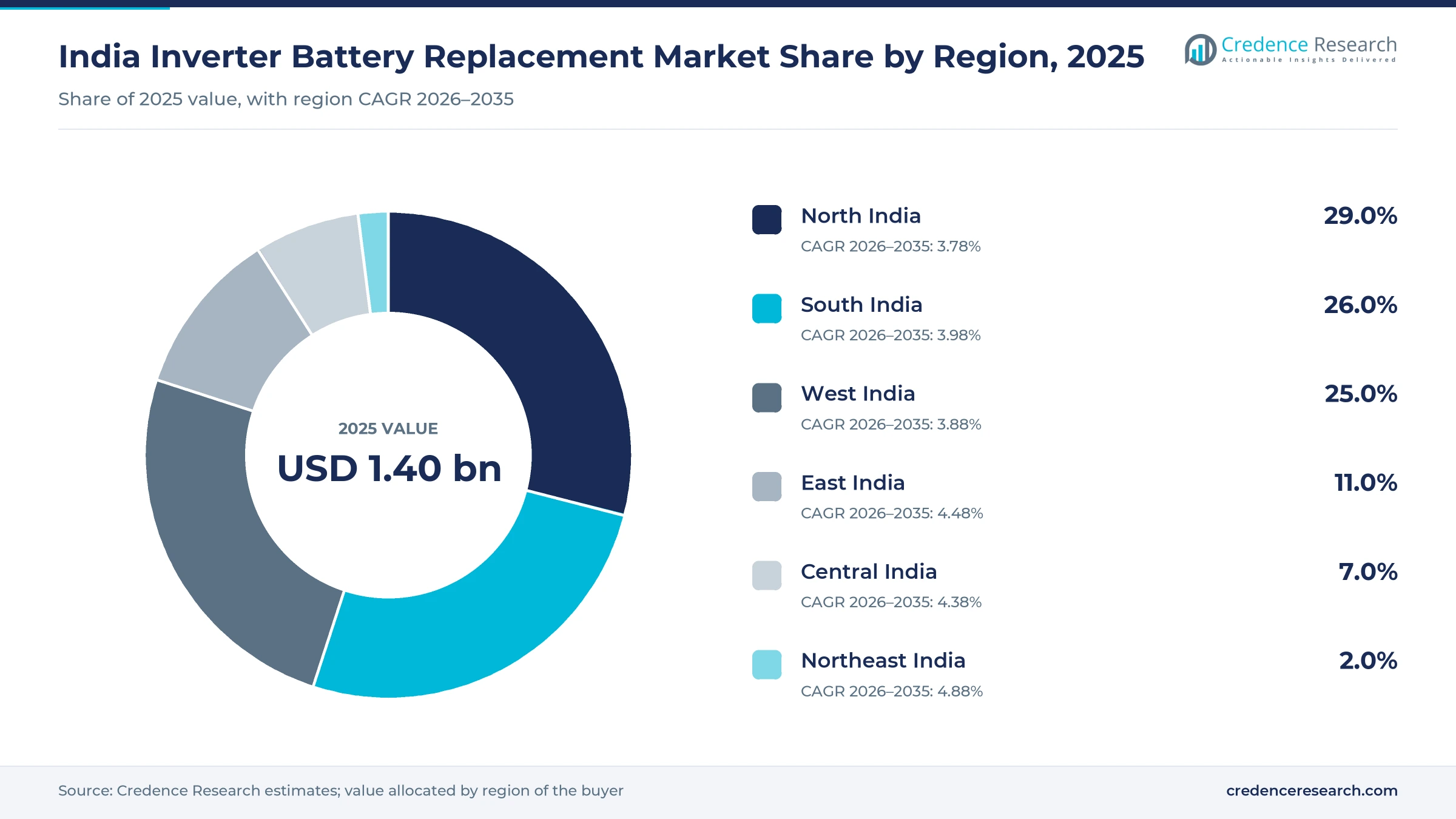
North India leads as rural cuts keep sets in use
| Region | Value, 2025 (USD billion) | Share, 2025 | CAGR, 2026–2035 |
|---|---|---|---|
| North India | 0.41 | 29.0% | 3.78% |
| South India | 0.36 | 26.0% | 3.98% |
| West India | 0.35 | 25.0% | 3.88% |
| East India | 0.15 | 11.0% | 4.48% |
| Central India | 0.10 | 7.0% | 4.38% |
| Northeast India | 0.03 | 2.0% | 4.88% |
North India leads on long rural evening cuts
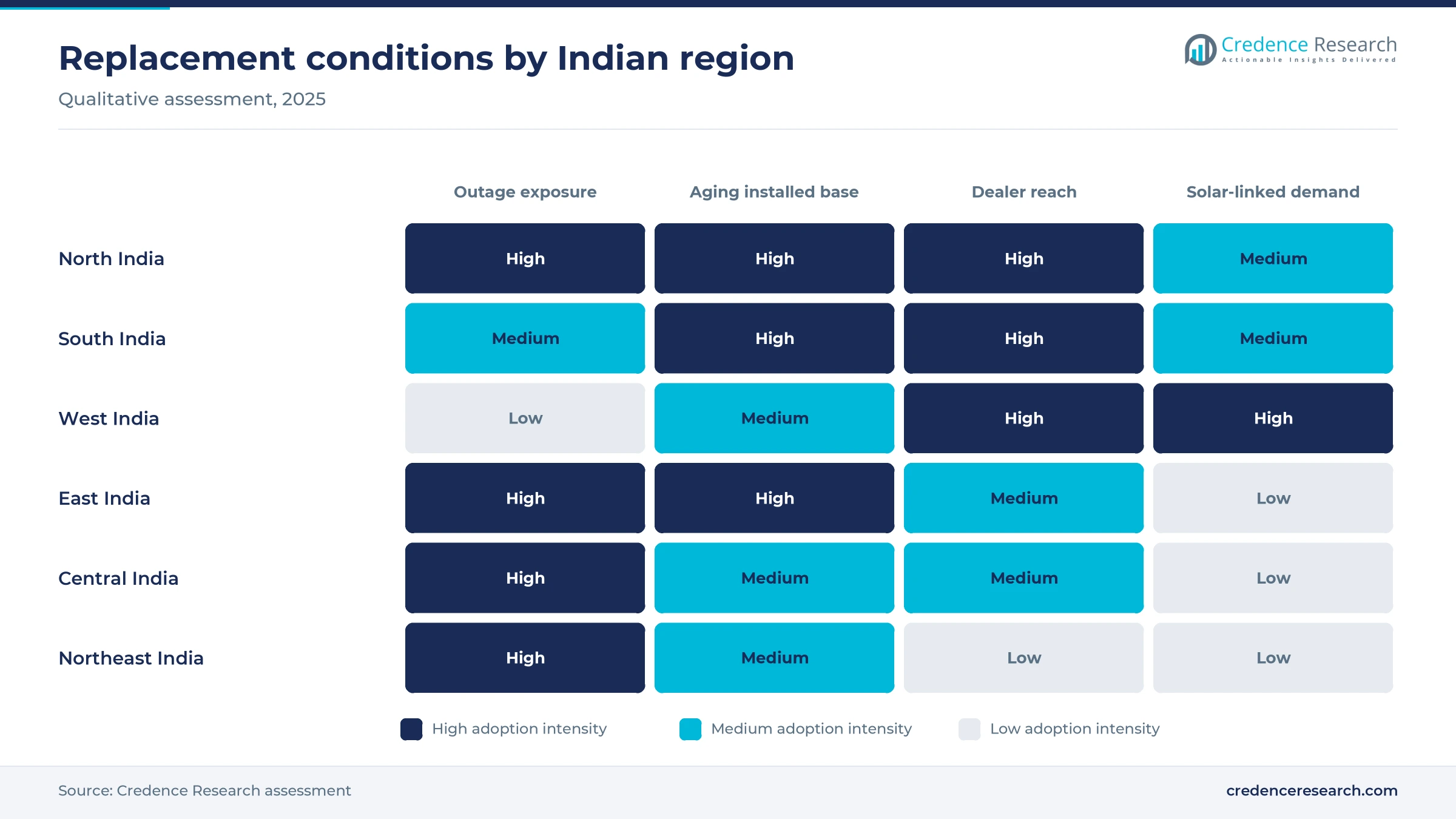
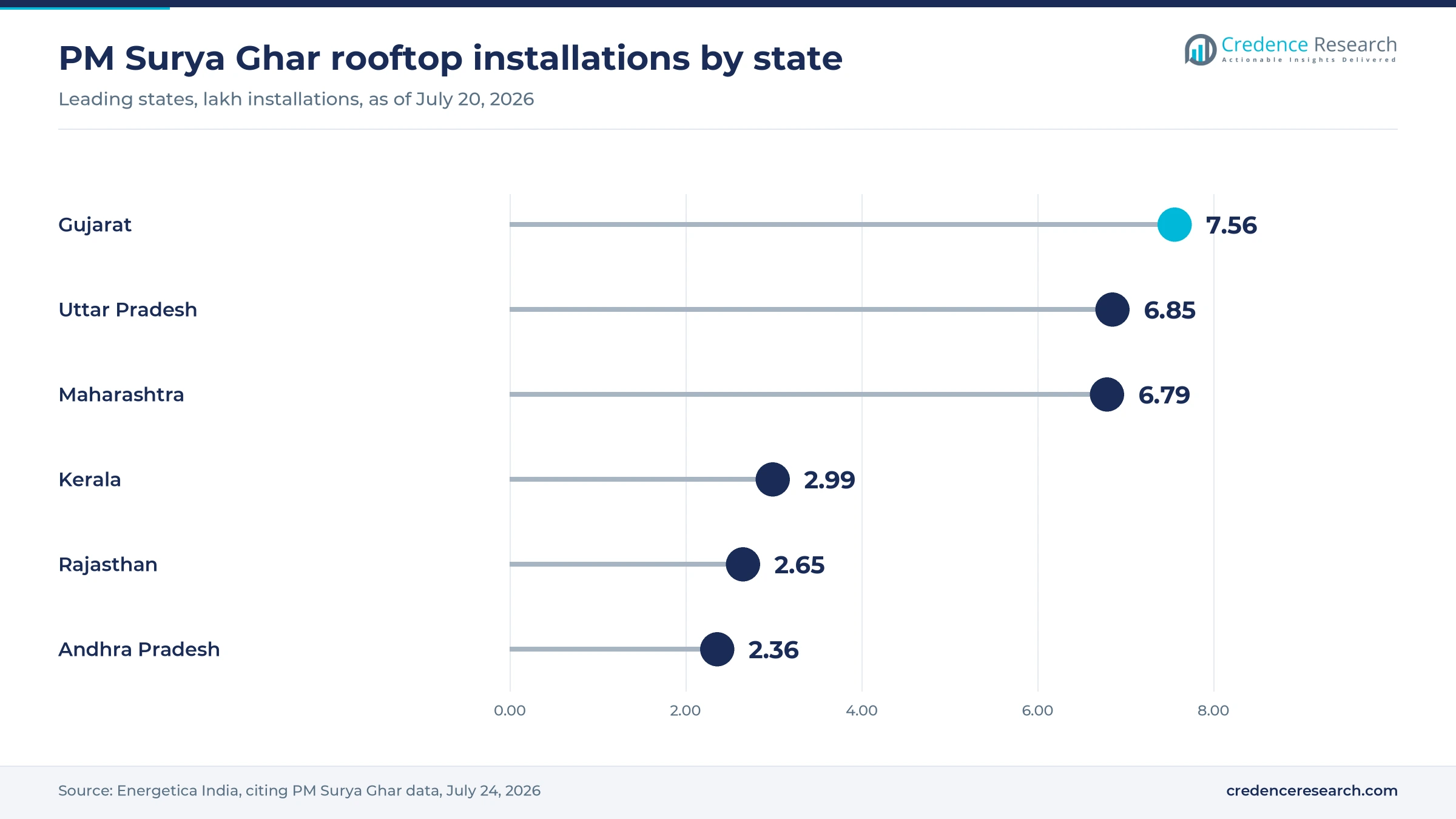
North India held 29.0% of 2025 value and grows at 3.78% a year, the largest zone in the model. Uttar Pradesh anchors demand, because Free Press Journal reported in June 2025 that a state opposition leader said parts of eastern districts received only three to four hours of power. The state also had 6,84,592 PM Surya Ghar installations by July 2026, which adds solar battery replacements. Rajasthan added 2,65,022 installations under the same program, and hot summers in Punjab and Haryana keep evening backup loads heavy.
South India pairs solar homes with farm cuts
South India held 26.0% of 2025 value and grows at 3.98% a year. Kerala had 2,99,065 PM Surya Ghar installations and Andhra Pradesh 2,36,286 by July 2026, according to Energetica India, which builds a base of solar-linked batteries. Farm supply remains uneven in Karnataka, where Raichur farmers said in September 2026 that pump sets got about five hours of power instead of 12, The Hans India reported. The Luminous plant at Hosur in Tamil Nadu, one of its six units listed by Business India, sits close to these markets.
West India grows on rooftop solar homes
West India held 25.0% of 2025 value and grows at 3.88% a year. Gujarat led PM Surya Ghar with 7,55,882 installations and Maharashtra had 6,79,303 by July 2026, according to Energetica India. Many of these homes use hybrid systems that cycle batteries daily, which shortens replacement intervals. Dense dealer networks in Mumbai, Pune, Ahmedabad and Surat make exchange offers easy to use. Urban cuts are shorter here, so value is tied more to solar and lithium upgrades than to long backup hours.
East India replaces sets bought in years of cuts
East India held 11.0% of 2025 value and grows at 4.48% a year, faster than the national pace. Bihar's peak supply reached a record 8,752 MW on July 23, 2025, and the state serves 2.12 crore consumers, Oneindia reported. Rural supply in Bihar was 18 to 20 hours a day at that time, according to the same report, so replacement demand for home backup sets persists. Many of those sets were bought when supply was far weaker, so their batteries are now due for replacement.
Central India relies on backup amid farm supply limits
Central India held 7.0% of 2025 value and grows at 4.38% a year from a smaller base. Madhya Pradesh faced an 800 MW shortage in October 2026 with unscheduled rural cuts, Construction World reported. In November 2025 the state withdrew an order that had capped farm feeder supply at 10 hours, Lokmat Times reported and restated 10 hours of uninterrupted supply for farmers. Rural homes on mixed feeders therefore keep backup sets running, which supports steady replacement through dealers in Indore, Bhopal and Raipur.
Frequent Assam cuts make the Northeast the fastest riser
Northeast India held 2.0% of 2025 value and grows at 4.88% a year, the fastest pace in the model. Assam's peak demand reached about 2,880 MW in 2024, Pratidin Time reported, while local generation covers only about 320 MW to 420 MW. A May 2025 storm cut power to parts of Guwahati for more than 12 hours, and the same report described households with drained inverters after a later rain outage. Frequent short cuts several times a day wear batteries faster, which brings replacement demand forward in Assam.
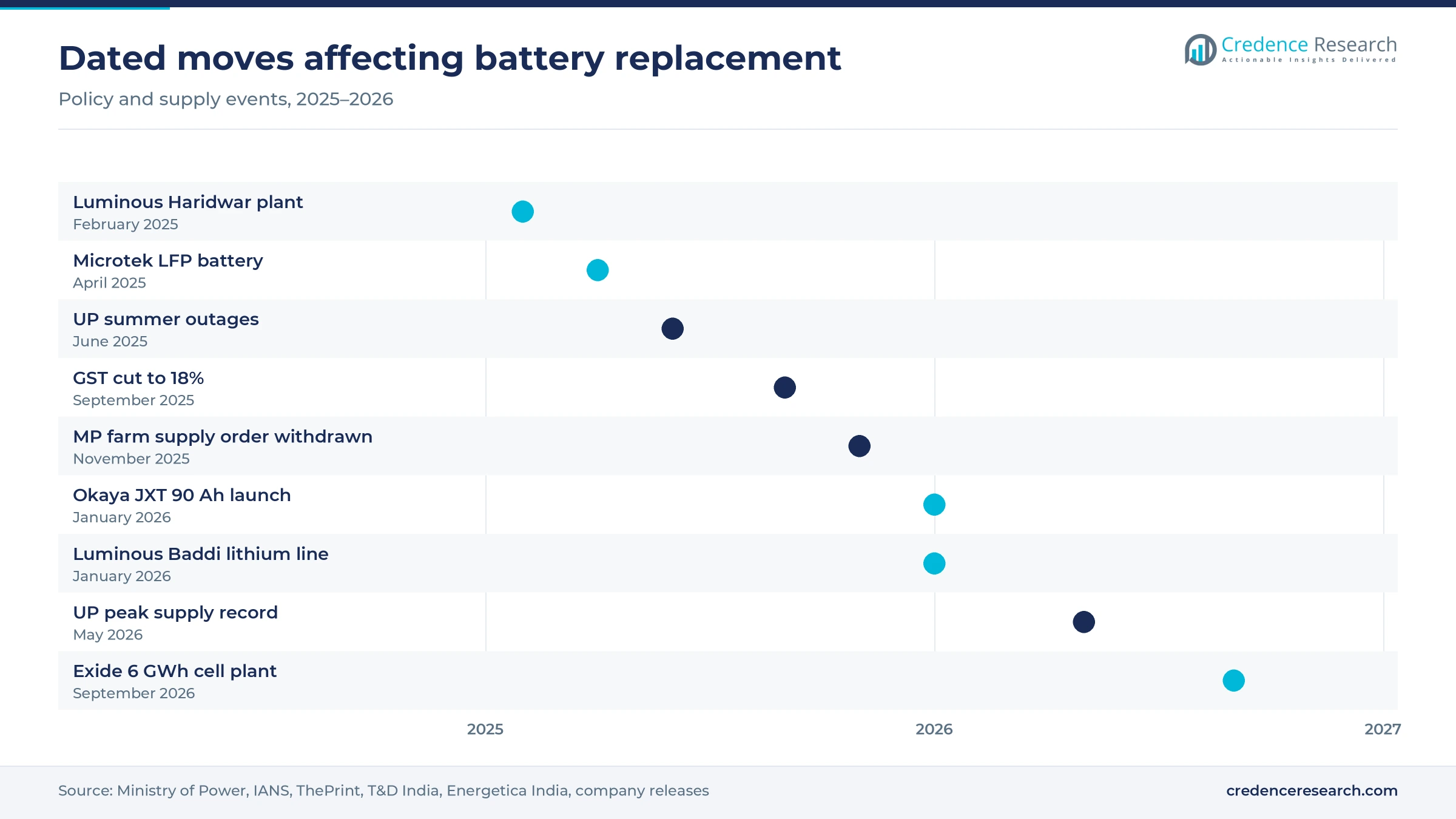
Plant, product and tax moves from 2025 to 2026
| Development | Status and market relevance |
|---|---|
| In February 2025, Luminous started production at an industrial battery plant in Haridwar with 1.5 GWh to 2 GWh of annual capacity. | Operating, adds lead-acid supply |
| In April 2025, Microtek introduced an LFP lithium-ion inverter battery with its SyncCharge charging technology. | Launched, widens lithium replacement options |
| In September 2025, GST on inverter and solar lead-acid batteries was cut from 28% to 18%, effective Sept. 22. | In force, lowers replacement prices |
| In January 2026, Okaya launched its JXT 90 Ah jumbo tubular inverter battery with a 48-month warranty. | Launched, targets compact homes and UPS users |
| In January 2026, Luminous inaugurated a 500 MWh lithium-ion battery assembly line at Baddi, Himachal Pradesh. | Operating, supports lithium home packs |
Plate design and lithium packs set battery life
- Tall tubular positive plates hold active material in gauntlets, which is why Exide rates its tubular lines for 1,000 to 1,200 cycles.
- Lithium iron phosphate packs last longer than lead-acid and need no water, and Luminous builds packs from 1.2 kWh to 16 kWh at Baddi.
- Electrolyte management systems recycle vapor inside the case, and Okaya says its AEMS design cuts water top-ups by 15%.
- Smart battery displays show charge level and voltage, a feature Okaya added to its Royale lithium packs at launch in 2021.
Need a Custom Version of This Report?
Tailor the scope, geography, or segments to your exact requirements.
- Custom geography or segment scope
- Direct access to our analyst team
Lead-acid majors defend dealers as lithium arrives
The India inverter battery replacement market is led by a few lead-acid makers that compete through dealer reach, warranty length and exchange offers. Exide sells Invatubular, Invamaster and Invabrite lines with warranties of 42 to 66 months and points buyers to its dealer locator. Luminous ranks second nationally in inverter batteries and supplies almost 60,000 dealers, Business India reported, while adding lithium assembly at Baddi. Amara Raja sells Amaron tall tubular units with 54-month warranties through dealers and online stores such as Moglix. Okaya competes with jumbo tubular designs and a team of over 600 sales and service staff, while Microtek sells inverters alongside its LFP lithium-ion battery. Okaya also pitches its JXT unit to semi-industrial users that run industrial UPS systems, telecom nodes and automation panels. Regional assemblers compete mainly on price in smaller towns and villages.
Companies profiled and their roles in this market
| Company | Type | Role in the market |
|---|---|---|
| Exide Industries | Lead-acid and lithium maker | Sells Invatubular, Invamaster and Invabrite tubular lines through its dealer network |
| Amara Raja (Amaron) | Lead-acid maker | Sells Amaron tall tubular home batteries with 54-month warranties |
| Luminous Power Technologies | Inverter and battery maker | Supplies almost 60,000 dealers and assembles lithium packs at Baddi |
| Microtek | Inverter and battery maker | Offers an LFP lithium-ion inverter battery with SyncCharge technology |
| Okaya | Inverter and battery maker | Sells jumbo tubular and Royale lithium batteries with a pan-India service team |
Exchange-led upgrades will decide brand share
Credence Research's view is that the India inverter battery replacement market will grow steadily rather than quickly, because better grid supply lengthens battery life even as the installed base keeps aging. Dealer exchange will remain the main route to the buyer, and brands that pay fair exchange credit will win both repeat sales and the lead they need for EPR targets. Lithium will gain share as prices converge and as rooftop solar homes need daily cycling. Tubular units will still dominate volume through 2035, so the contest is about moving owners to longer-warranty models.
How the installed-base replacement model was built
The report uses 2025 as the base year and forecasts to 2035. Market values come from the Credence Research model, built from an estimate of the installed home inverter base, typical battery life implied by published warranties and online shelf prices net of exchange credit. Segment and regional splits are Credence Research estimates informed by outage reports, rooftop solar data and company product information. Sources used include government statements, World Bank data, trade press, retail listings and company announcements. No interviews or surveys were conducted in preparing this report.
Replacement value climbs steadily through 2035
India inverter battery replacement value is forecast to reach USD 2.08 billion by 2035, as millions of aging home sets need new batteries every four to five years. North India should remain the largest zone, while Northeast India and East India grow faster where cuts are still frequent. Lithium is expected to grow at 9.65% a year as cell plants such as Exide's Devanahalli unit scale up. Dealers will keep most sales, but online channels should gain share in smaller towns. Formal take-back under the battery waste rules is likely to become a core part of every replacement sale.
Frequently Asked Questions
How big is the India inverter battery replacement market?
Which region leads the market?
Which battery type is replaced most often?
How did the GST change affect replacement prices?
What does a replacement tubular battery cost?
Why are lithium batteries growing fastest?
How much is an old inverter battery worth?
What is the biggest risk for the market?
Table of Content
Chapter 1 Market Segmentation
- 1.1 Segmentation Framework
- 1.1.1 Product and Service Classification
- 1.1.2 Application and End-Use Classification
- 1.1.3 Technology and Solution Classification
- 1.1.4 Customer and Distribution Channel Classification
- 1.1.5 Geographic Segmentation
- 1.1.6 Market Segment Definitions and Boundaries
- 1.2 By Type
- 1.2.1 Tubular
- 1.2.2 Flat Plate
- 1.2.3 Lithium
- 1.3 By Capacity
- 1.3.1 Below 150 Ah
- 1.3.2 150-200 Ah
- 1.3.3 Above 200 Ah
- 1.4 By Channel
- 1.4.1 Dealers
- 1.4.2 E-Commerce
Chapter 2 Introduction
- 2.1 Report Objectives and Scope
- 2.2 Product Definition and Industry Terminology
- 2.3 Market Inclusions and Exclusions
- 2.4 Research Process
- 2.4.1 Primary Research and Expert Interviews
- 2.4.2 Secondary Research and Source Review
- 2.4.3 Top-Down and Bottom-Up Estimation
- 2.4.4 Data Triangulation and Verification
- 2.5 Market Size Measurement Basis
- 2.5.1 2025: USD 1.40 billion → 2035: USD 2.08 billion
- 2.6 Historical and Forecast Reference Periods
- 2.6.1 Historical Period: 2018-2025
- 2.6.2 Base Year: 2025
- 2.6.3 Forecast Period: 2025-2035
- 2.7 Research Assumptions and Limitations
Chapter 3 Executive Summary
- 3.1 Market Snapshot and Key Findings
- 3.2 Base-Year Market Size, 2025
- 3.3 Forecast Market Size, 2035
- 3.4 Revenue and Volume Growth Outlook
- 3.5 Key Demand and Supply Indicators
- 3.6 Leading Market Segments
- 3.7 Fastest-Growing Market Opportunities
- 3.8 Regional Performance Highlights
- 3.9 Technology and Industry Transformation
- 3.10 Competitive Landscape Summary
- 3.11 Analyst View and Strategic Implications
Chapter 4 India Inverter Battery Replacement Market Trends and Developments
- 4.1 Historical Industry Development, 2018-2025
- 4.2 Recent Market Trends and Developments
- 4.3 Demand and Customer Behavior Trends
- 4.4 Technology and Product Innovation
- 4.5 Artificial Intelligence, Automation and Digitalization
- 4.6 Local Manufacturing and Supply Chain Realignment
- 4.7 Industry Partnerships, Mergers and Acquisitions
- 4.8 Sustainability and Circular Economy Developments
- 4.9 Government and Private Sector Investment Trends
- 4.10 Emerging Business Models and Commercialization
- 4.11 Industry Developments and Announcements
Chapter 5 India Inverter Battery Replacement Market Production, Supply and Demand Analysis
- 5.1 Demand Trend and Consumption Analysis, 2018-2025
- 5.2 Demand Forecast, 2025-2035
- 5.3 Production and Output Trend, 2018-2025
- 5.4 Production and Output Forecast, 2025-2035
- 5.5 Installed Capacity and Capacity Utilization
- 5.6 Company-Wise Production Plants and Statistics
- 5.6.1 Installed Production Capacity
- 5.6.2 Actual Production
- 5.6.3 Planned Capacity and Expansion Targets
- 5.7 Supply Chain Structure and Procurement Trends
- 5.8 Supply-Demand Gap and Bottlenecks
- 5.9 Import Dependence and Sourcing Structure
- 5.10 Contract Manufacturing and Outsourcing
- 5.11 Regional Supply and Demand Concentration
Chapter 6 India Inverter Battery Replacement Market Pricing Analysis
- 6.1 Pricing Structure and Measurement
- 6.2 Historical Pricing Trends, 2018-2025
- 6.3 Pricing Outlook, 2025-2035
- 6.4 Average Selling Price and Unit Economics
- 6.5 Pricing by Product and Market Segment
- 6.6 Geographic Pricing Differences
- 6.7 Key Input, Energy, Labor and Logistics Costs
- 6.8 Contract Pricing and Purchasing Models
- 6.9 Pricing Sensitivity and Competitive Positioning
- 6.10 Price, Margin and Profitability Implications
Chapter 7 India Inverter Battery Replacement Market Dynamics
- 7.1 Market Growth Drivers
- 7.1.1 Demand-Side Drivers
- 7.1.2 Technology and Innovation Drivers
- 7.1.3 Infrastructure and Investment Drivers
- 7.1.4 Regulatory and Policy Drivers
- 7.2 Market Restraints
- 7.2.1 Cost and Affordability Constraints
- 7.2.2 Technology and Adoption Barriers
- 7.2.3 Supply Chain and Operational Constraints
- 7.3 Market Challenges
- 7.3.1 Competitive Pressure and Margin Erosion
- 7.3.2 Skills, Infrastructure and Implementation Gaps
- 7.4 Emerging Market Opportunities
- 7.5 Market Dynamics Impact and Time-Horizon Assessment
Chapter 8 India Inverter Battery Replacement Value Chain Analysis
- 8.1 Industry Value Chain Overview
- 8.2 Upstream Suppliers and Critical Inputs
- 8.3 Technology and Component Providers
- 8.4 Manufacturing or Service Delivery
- 8.5 Distribution, Channel Partners and Integrators
- 8.6 Downstream Applications and End Users
- 8.7 Value Addition and Profit Pools
- 8.8 Vertical Integration and Outsourcing
- 8.9 Supplier Concentration and Risk
- 8.10 Supply Chain Localization and Resilience
Chapter 9 India Inverter Battery Replacement Market Regulations and Policies
- 9.1 Relevant Laws, Standards and Compliance Frameworks
- 9.2 Product, Service, Safety and Quality Requirements
- 9.3 Government Policies, Incentives and Subsidies
- 9.4 Imports, Exports and Trade Barriers
- 9.5 Public Procurement and Local Content Requirements
- 9.6 Environmental and Sustainability Compliance
- 9.7 Upcoming Policy Changes and Market Implications
Chapter 10 India Inverter Battery Replacement Market Hotspots and Opportunities
- 10.1 Market Opportunity Mapping and Growth Hotspots
- 10.2 High-Growth Applications and Customer Groups
- 10.3 Underserved Markets and White-Space Opportunities
- 10.4 Emerging Technology and Product Opportunities
- 10.5 New Capacity and Investment Hotspots
- 10.6 Market Entry and Expansion Opportunities
- 10.7 Distribution and Partnership Opportunities
- 10.8 Near-Term and Long-Term Commercial Potential
- 10.9 Opportunity Attractiveness and Execution Risks
Chapter 11 India Inverter Battery Replacement Market Outlook, 2025-2035
- 11.1 Market Size and Analysis
- 11.1.1 Revenue (Market Measurement: 2025: USD 1.40 billion → 2035: USD 2.08 billion)
- 11.1.2 Market Volume and Quantity Sold
- 11.1.3 Historical Market Size, 2018-2025
- 11.1.4 Base-Year Market Size, 2025
- 11.2 Market Forecast, 2025-2035
- 11.2.1 Revenue Forecast to 2035
- 11.2.2 Volume Forecast to 2035
- 11.2.3 CAGR and Year-on-Year Growth
- 11.2.4 Incremental Revenue Opportunity
- 11.3 Forecast Assumptions and Scenario Analysis
- 11.3.1 Base-Case Forecast
- 11.3.2 Optimistic and Conservative Scenarios
- 11.3.3 Technology, Pricing and Policy Sensitivities
- 11.4 Market Attractiveness and Growth Outlook
Chapter 12 India Inverter Battery Replacement Market Segmentation and Outlook
- 12.1 Segmentation Summary and Market Shares, 2025
- 12.2 Largest and Fastest-Growing Segments
- 12.3 By Type - Market Size and Forecast, 2025-2035
- 12.3.1 Segment Definition and Scope
- 12.3.2 Historical Market Size, 2018-2025
- 12.3.3 Revenue Forecast, 2025-2035
- 12.3.4 Volume Forecast, 2025-2035
- 12.3.5 Base-Year Market Share, 2025
- 12.3.6 Segment CAGR and Growth Drivers
- 12.3.7 Subsegment Market Size and Forecast
- 12.3.7.1 Tubular
- 12.3.7.2 Flat Plate
- 12.3.7.3 Lithium
- 12.3.8 Subsegment Pricing and Adoption Trends
- 12.3.9 Leading Suppliers and Competition
- 12.3.10 Regional Demand and Opportunities
- 12.4 By Capacity - Market Size and Forecast, 2025-2035
- 12.4.1 Segment Definition and Scope
- 12.4.2 Historical Market Size, 2018-2025
- 12.4.3 Revenue Forecast, 2025-2035
- 12.4.4 Volume Forecast, 2025-2035
- 12.4.5 Base-Year Market Share, 2025
- 12.4.6 Segment CAGR and Growth Drivers
- 12.4.7 Subsegment Market Size and Forecast
- 12.4.7.1 Below 150 Ah
- 12.4.7.2 150-200 Ah
- 12.4.7.3 Above 200 Ah
- 12.4.8 Subsegment Pricing and Adoption Trends
- 12.4.9 Leading Suppliers and Competition
- 12.4.10 Regional Demand and Opportunities
- 12.5 By Channel - Market Size and Forecast, 2025-2035
- 12.5.1 Segment Definition and Scope
- 12.5.2 Historical Market Size, 2018-2025
- 12.5.3 Revenue Forecast, 2025-2035
- 12.5.4 Volume Forecast, 2025-2035
- 12.5.5 Base-Year Market Share, 2025
- 12.5.6 Segment CAGR and Growth Drivers
- 12.5.7 Subsegment Market Size and Forecast
- 12.5.7.1 Dealers
- 12.5.7.2 E-Commerce
- 12.5.8 Subsegment Pricing and Adoption Trends
- 12.5.9 Leading Suppliers and Competition
- 12.5.10 Regional Demand and Opportunities
- 12.6 Segment Growth Comparison
- 12.7 Segment Attractiveness and Priority Matrix
Chapter 13 India Inverter Battery Replacement Geographic Market Outlook, 2025-2035
- 13.1 Domestic Market Distribution and Demand Clusters
- 13.2 State- or Province-Wise Market Size and Forecast, 2025-2035
- 13.3 City and Metropolitan Market Outlook
- 13.4 Industrial, Manufacturing and Commercial Clusters
- 13.5 Geographic Concentration of Key End Users
- 13.6 Local Pricing and Purchasing Differences
- 13.7 Domestic Production Facilities and Capacity Map
- 13.8 Local Infrastructure and Project Pipeline
- 13.9 State-Level Policy and Incentive Differences
- 13.10 Subnational Investment Hotspots and Opportunities
- 13.11 Distribution and Logistics Networks
- 13.12 Domestic Competitive Footprint
Chapter 14 India Inverter Battery Replacement Technology, Innovation and Sustainability Outlook
- 14.1 Technology Landscape and Maturity
- 14.2 Product, Process and Service Innovation
- 14.3 AI, Automation and Digital Tools in the Industry
- 14.4 Technology Adoption and Performance Benchmarking
- 14.5 Innovation Pipeline and R&D Investment
- 14.6 Patent and Intellectual Property Trends
- 14.7 Energy Efficiency and Resource Management
- 14.8 Sustainability, Recycling and Circularity
- 14.9 Technology Roadmap, 2025-2035
- 14.10 Risks of Obsolescence and Technology Substitution
Chapter 15 India Inverter Battery Replacement Market Key Strategic Imperatives
- 15.1 Growth and Market Entry Priorities
- 15.2 High-Return Products and Segments
- 15.3 Pricing, Profitability and Cost Optimization
- 15.4 Technology Investment and Product Differentiation
- 15.5 Supply Chain Localization and Resilience
- 15.6 Distribution and Customer Acquisition
- 15.7 Partnership, Acquisition and Capacity Strategy
- 15.8 Regional Expansion Priorities
- 15.9 Short-, Medium- and Long-Term Actions
Chapter 16 Competition Outlook
- 16.1 Industry Competition Characteristics
- 16.2 Market Structure and Concentration
- 16.3 Market Share and Competitive Positioning, 2025
- 16.4 Company-Wise Revenue and Product Benchmarking
- 16.5 Production and Service Capacity Benchmarking
- 16.6 Technology, Pricing and Differentiation
- 16.7 Regional Footprint and Distribution Strength
- 16.8 Mergers, Acquisitions and Strategic Alliances
- 16.9 New Entrants and Competitive Threats
- 16.10 Porter's Five Forces and Industry Attractiveness
- 16.11 Competitive Outlook, 2025-2035
Chapter 17 Company Profiles
- 17.1 Company Coverage and Selection Criteria
- 17.2 Exide Industries
- 17.2.1 Business Description
- 17.2.2 Company Ownership and Geographic Presence
- 17.2.3 Product and Service Portfolio
- 17.2.4 Manufacturing and Operating Footprint
- 17.2.5 Production Capacity and Expansion Plans
- 17.2.6 Financial Performance and Investment
- 17.2.7 Market Share and Competitive Position
- 17.2.8 Technology and Innovation Capabilities
- 17.2.9 Strategic Alliances or Partnerships
- 17.2.10 Recent Developments
- 17.2.11 Growth Strategy and Outlook
- 17.3 Amara Raja (Amaron)
- 17.4 Luminous Power Technologies
- 17.5 Microtek
- 17.6 Okaya
- 17.7 Other Relevant Market Participants
Note: Every listed company is profiled on the structure shown under the first company. The company list is preliminary and may change based on research findings, market developments, data availability and client requirements.
Chapter 18 Disclaimer
- 18.1 Research and Forecast Disclaimer
- 18.2 Data Source and Estimation Limitations
Note: The depth of individual sections depends on data availability for this market. Volume, capacity, trade and other unit-based metrics are included where applicable.

